
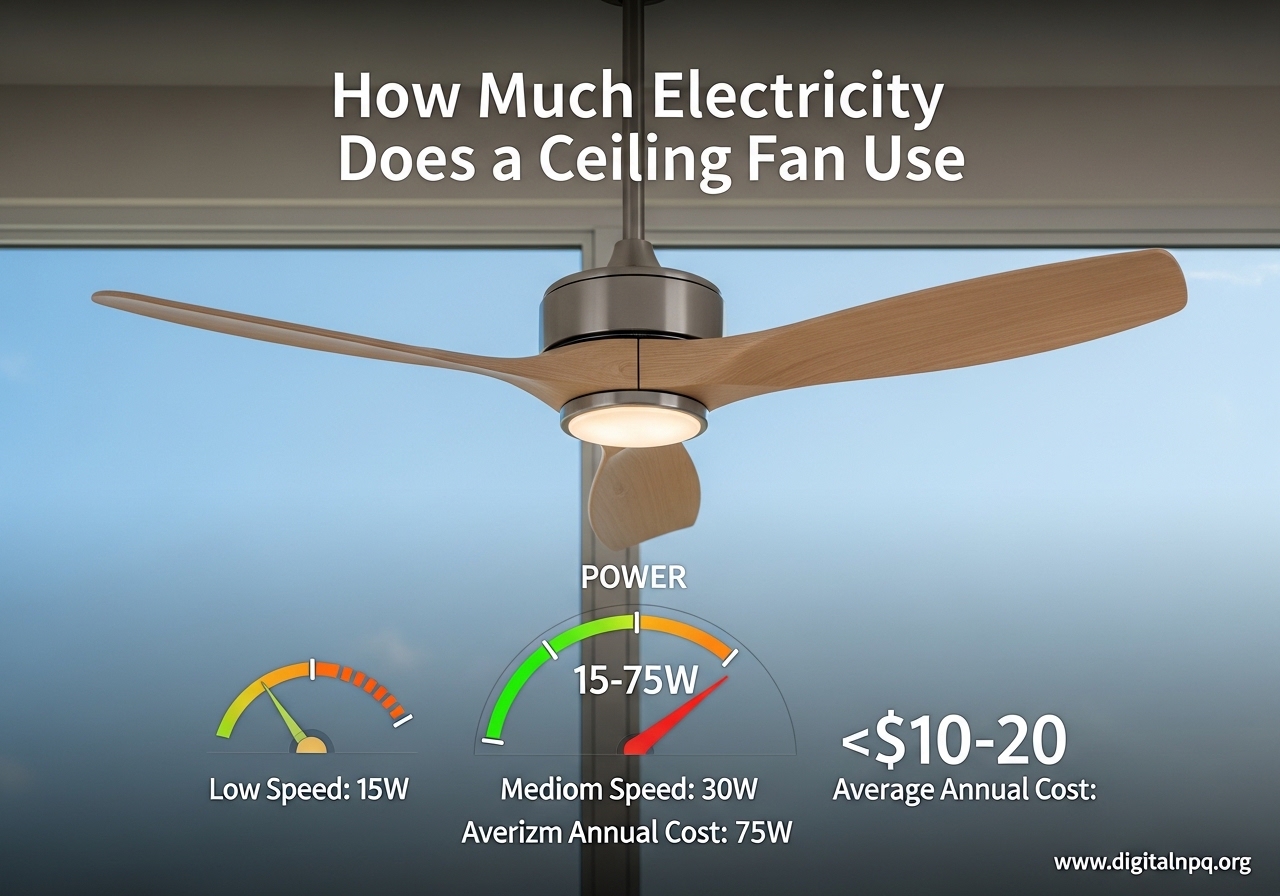
If you have ever stared at your summer electricity bill and wondered whether your ceiling fan is partly to blame, you are asking the right question. The short answer: probably not. Ceiling fans are among the lowest-energy appliances in any home, but the exact cost depends on a few factors worth understanding.
In this guide, we break down exactly how much electricity does a ceiling fan use, from wattage by size and motor type to real-world cost calculations you can apply to your own home. We looked at actual user reports, manufacturer specs, and energy rate data to give you numbers you can trust.
By the end, you will know what your ceiling fan costs per hour, per day, and per month, and how to cut those costs even further.
Quick Answer: How Much Electricity Does a Ceiling Fan Use
A standard 48-inch ceiling fan uses about 75 watts of electricity on high speed. At the average U.S. electricity rate of $0.16 per kilowatt-hour (kWh), that translates to roughly $0.01 per hour to run.
Here is what that looks like across common timeframes:
- Per hour: $0.01 (about 1 cent)
- Per day (8 hours): $0.10
- Per day (24 hours): $0.29
- Per month (running 24/7): about $6 to $8
- Per year (running 24/7): about $70 to $100
Most ceiling fans fall in the 15 to 100 watt range depending on their size, motor type, and speed setting. For comparison, a central air conditioner uses 500 to 3,000 watts, making a ceiling fan roughly 98% more energy-efficient than running your AC alone.
Real users on forums like r/Frugal and r/homeowners confirm these numbers, consistently reporting monthly costs of about $5 to $8 for a single fan running around the clock. One Reddit user tracked their ceiling fan running 24/7 over an entire summer and reported a monthly increase of just $6 on their electricity bill.
Understanding Ceiling Fan Power Consumption
Before we get into specific numbers, it helps to understand the basic units of electricity measurement. A watt (W) measures how much power an appliance draws at any given moment. A kilowatt-hour (kWh) measures how much energy gets used over time. One kilowatt-hour equals 1,000 watts running for one hour.
The formula to calculate any appliance’s electricity cost is simple:
Watts x Hours Used / 1,000 x Electricity Rate = Cost
So if your 75-watt ceiling fan runs for 8 hours at a rate of $0.16/kWh, the math looks like this: 75 x 8 / 1,000 x $0.16 = $0.096, or about 10 cents.
Ceiling fans also draw a small amount of current measured in amps. A typical residential ceiling fan pulls between 0.5 and 1.5 amps on a standard 120-volt circuit. This is well within the capacity of most household wiring, which handles 15-amp circuits as standard.
The national average electricity rate in the U.S. sits around $0.16 per kWh as of 2026, but your actual rate could be higher or lower. Residents in states like Connecticut or California may pay $0.25 to $0.30 per kWh, while states like Louisiana or Washington pay closer to $0.10 to $0.12 per kWh. Your local rate directly affects what your fan costs to run.
Ceiling Fan Wattage by Size and Type
Not all ceiling fans use the same amount of power. The blade span is one of the biggest factors in how much electricity a ceiling fan uses. Larger fans need more powerful motors to push more air, which means higher wattage.
Small Ceiling Fans (29 to 36 Inches)
These compact fans are designed for small rooms, bathrooms, and walk-in closets. They typically use between 15 and 45 watts on high speed. Even running 24 hours a day, a small 30-inch fan at 25 watts costs less than $3 per month at the national average rate.
Medium Ceiling Fans (42 to 48 Inches)
This is the most common size for bedrooms and medium-sized living spaces. A standard 48-inch ceiling fan uses about 45 to 75 watts on high. At 60 watts running 8 hours per day, you are looking at roughly $2.30 per month.
Large Ceiling Fans (52 to 60 Inches)
These fans cover large living rooms, open-plan spaces, and master bedrooms. Expect power draw between 60 and 100 watts on the highest setting. A 52-inch fan at 75 watts running 12 hours a day costs about $4.30 per month.
Extra-Large and Industrial Ceiling Fans (60+ Inches)
Fans designed for warehouses, large great rooms, or outdoor patios can draw 100 to 200 watts or more. Industrial-grade fans pushing heavy air volumes use significantly more power but still cost far less than air conditioning the same space.
How Speed Settings Change Wattage
A ceiling fan does not use its maximum wattage on every speed. The difference between low and high can be dramatic:
- Low speed: typically 10 to 30 watts
- Medium speed: typically 20 to 55 watts
- High speed: typically 40 to 100 watts
This means running your fan on medium instead of high can cut its electricity use by 30 to 50 percent while still providing decent air circulation.
DC Motor vs AC Motor: Which Uses Less Electricity
The type of motor inside your ceiling fan has a major impact on how much electricity it uses. There are two main types: traditional AC (alternating current) motors and newer DC (direct current) motors.
AC Motor Ceiling Fans
AC motor fans have been the standard for decades. They are simple, reliable, and affordable. However, they typically draw between 50 and 100 watts on high speed. Most basic and mid-range ceiling fans you find at big-box stores use AC motors.
AC motors operate at a fixed number of speeds (usually three), and they tend to use more electricity at every speed level compared to DC equivalents. They also generate more heat during operation, which represents wasted energy.
DC Motor Ceiling Fans
DC motor fans are the newer, more efficient option. They use significantly less power, typically between 10 and 40 watts on high speed. That is up to 70% less electricity than an equivalent AC motor fan.
DC motors also offer more speed settings (often six or more), run quieter, and produce less heat. Many modern DC fans include a BLDC (brushless DC) motor, which eliminates the friction and wear of traditional brushed motors. BLDC motors are even more efficient and tend to last longer because there are no brushes to wear out.
Real Savings Comparison
Let us look at the actual numbers. If you run a fan 12 hours a day for 6 months of the year:
- AC motor fan (75W): about $42 per year
- DC motor fan (25W): about $14 per year
- Annual savings: about $28 per fan
That might not sound like much for a single fan, but if you have four or five ceiling fans in your home, the savings add up to over $100 per year. Over the 10 to 15 year lifespan of the fans, you are looking at $1,000 or more in cumulative savings.
Forum users on r/AskElectricians frequently confirm that DC motor fans are worth the higher upfront cost for anyone who runs their fans extensively. One electrician noted that the power savings alone typically pay back the price difference within two to three years.
Real-World Cost Calculations: Per Hour, Day, Month, and Year
Let us walk through detailed cost calculations using the national average electricity rate of $0.16 per kWh. We will look at a standard 48-inch fan at 75 watts and a DC motor fan at 25 watts.
Cost Per Hour
For a standard 75-watt ceiling fan:
75 watts / 1,000 = 0.075 kWh per hour
0.075 kWh x $0.16 = $0.012 per hour (about 1.2 cents)
For a 25-watt DC motor fan:
25 / 1,000 = 0.025 kWh x $0.16 = $0.004 per hour (less than half a cent)
Cost Per Day
Running a 75-watt fan for different durations:
- 4 hours: $0.05
- 8 hours: $0.10
- 12 hours: $0.14
- 24 hours: $0.29
Even running nonstop around the clock, a single ceiling fan costs less than 30 cents per day.
Cost Per Month
Monthly costs for a 75-watt fan:
- 8 hours per day: $2.88
- 12 hours per day: $4.32
- 24 hours per day (24/7): $8.64
Forum users on r/Frugal consistently report similar numbers. Multiple users confirmed that running a standard ceiling fan around the clock adds roughly $5 to $8 to their monthly bill, which lines up closely with these calculations.
Cost Per Year
Annual costs for a 75-watt fan:
- 8 hours per day: $35
- 12 hours per day: $52
- 24 hours per day: $105
Compare that to a central air conditioner running 8 hours a day during summer months, which can cost $600 to $1,200 per year. The ceiling fan is a rounding error by comparison.
How Your State Changes the Math
Your local electricity rate significantly impacts your actual cost. Here is how the same 75-watt fan running 24/7 compares across different states:
- Louisiana ($0.11/kWh): about $5.94/month
- National average ($0.16/kWh): about $8.64/month
- California ($0.27/kWh): about $14.58/month
- Connecticut ($0.30/kWh): about $16.20/month
Even in the most expensive states, running a ceiling fan 24/7 costs less than $17 per month. That is still far cheaper than any air conditioning alternative.
Ceiling Fan vs Air Conditioner: Electricity Cost Comparison
One of the most common questions homeowners ask is whether it is cheaper to run a ceiling fan or an air conditioner. The answer is not even close.
Hourly Cost Comparison
Here is how common cooling options stack up per hour of use:
- Ceiling fan: $0.01 to $0.02 per hour
- Box fan: $0.01 to $0.03 per hour
- Window AC unit (8,000 BTU): $0.10 to $0.20 per hour
- Window AC unit (12,000 BTU): $0.15 to $0.30 per hour
- Central AC (2.5 ton): $0.30 to $0.80 per hour
- Central AC (5 ton): $0.50 to $1.50 per hour
A ceiling fan uses roughly 1/50th the electricity of a central air conditioning system. Even a small window AC unit uses 10 to 20 times more power than a ceiling fan.
The Combined Strategy That Saves the Most
The smartest approach is not choosing between a fan or AC. It is using both together. Running ceiling fans while raising your thermostat by 4 degrees Fahrenheit lets you feel just as comfortable while cutting your AC runtime by 10 to 15 percent.
Here is the math on that strategy. If your central AC costs $150 per month to run, raising the thermostat 4 degrees with ceiling fans could save you $15 to $22 per month. Meanwhile, the fans running in three rooms cost you about $18 to $25 per month total. But the net reduction in AC load often results in an overall bill decrease.
Users on r/homeowners consistently report that this combined approach drops their summer electricity bill by $30 to $50 per month compared to running the AC alone at a lower thermostat setting.
Box Fans vs Ceiling Fans
Box fans and portable fans are also cheap to run, typically drawing 40 to 100 watts. However, they are less effective at circulating air through an entire room. A ceiling fan mounted in the center of a room distributes air more evenly and creates a more consistent wind-chill effect. For the same or lower power draw, a ceiling fan provides better whole-room comfort.
Ceiling Fans with Light Kits: Extra Electricity Costs
One factor many people overlook is the electricity consumed by the light fixture attached to their ceiling fan. The light kit can actually use more power than the fan itself, depending on the type of bulbs installed.
Light Kit Power Consumption by Bulb Type
- LED bulbs: 5 to 15 watts per bulb (most common modern kits have 3 to 4 bulbs, so 15 to 60 watts total)
- CFL bulbs: 15 to 30 watts per bulb (45 to 120 watts total for a multi-bulb kit)
- Incandescent bulbs: 40 to 60 watts per bulb (120 to 240 watts total for a 3-4 bulb kit)
If you have an older ceiling fan with incandescent bulbs, the light kit could be adding $15 to $40 per month to your electricity bill if the lights run several hours a day. Swapping to LED bulbs brings that cost down to $2 to $8 per month.
Total Cost When Fan and Lights Run Together
For a ceiling fan with a modern 3-bulb LED light kit running 8 hours a day:
- Fan (75W): $2.88/month
- LED lights (30W total): $1.15/month
- Combined: $4.03/month
That is still remarkably cheap. But if you have older incandescent bulbs, the light kit alone could cost more than the fan. This is one of the easiest and fastest energy upgrades you can make in your home.
How to Reduce Your Ceiling Fan Electricity Usage
Even though ceiling fans are already cheap to run, there are several ways to lower their electricity consumption even further. Here are the strategies that make the biggest difference.
1. Turn Off the Fan When You Leave the Room
This is the most important tip, and it contradicts what many people assume. Ceiling fans do not cool rooms. They cool people by creating a wind-chill effect on your skin. If nobody is in the room, the fan is wasting electricity while providing zero benefit.
A fan running in an empty bedroom for 16 hours a day wastes about $1.90 per month. Across multiple rooms, that adds up. Make it a habit to switch off fans when you walk out.
2. Use the Correct Seasonal Direction
Your ceiling fan has a direction switch on the motor housing. Using it correctly makes a real difference in comfort and energy savings:
- Summer (counterclockwise): pushes air down, creating a cooling breeze. This lets you raise the AC thermostat 4 degrees.
- Winter (clockwise at low speed): pulls air up, forcing warm air trapped at the ceiling down along the walls. This can reduce heating costs by circulating warm air more evenly.
Most people never touch the direction switch, which means they miss out on free energy savings every winter.
3. Choose Energy Star Certified Fans
Energy Star certified ceiling fans are tested and verified to use less energy than standard models. According to the EPA, Energy Star fans move air 20% more efficiently on average, and some models are up to 60% more efficient than conventional fans.
These fans meet strict criteria for both airflow (measured in CFM, or cubic feet per minute) and energy consumption (measured in CFM per watt). An Energy Star fan delivering the same comfort as a standard fan will do it while drawing significantly fewer watts.
4. Opt for a DC Motor Fan
As covered earlier, DC motor fans use up to 70% less electricity than AC motor fans. If you are replacing an old fan or installing a new one, spending slightly more on a DC motor model pays for itself in energy savings within a few years.
DC fans also offer more speed options, run quieter, and tend to last longer due to fewer moving parts in the motor assembly.
5. Keep the Fan Clean
Dust buildup on fan blades adds weight and disrupts airflow, forcing the motor to work harder. A clean fan runs more efficiently and uses slightly less power. Wipe down the blades and motor housing every few weeks, especially during peak usage months.
6. Consider Smart Fan Technology
Smart ceiling fans connect to your home Wi-Fi and can be controlled through an app or voice assistant. Many include features like occupancy sensing, thermostat integration, and scheduling. Smart fans can reduce fan energy use by up to 11% by automatically turning off when nobody is in the room.
Some models also integrate with your smart thermostat, adjusting fan speed based on room temperature and occupancy patterns.
7. Raise Your Thermostat When Using Fans
The single biggest money-saving strategy is combining ceiling fans with a higher AC thermostat setting. Each degree you raise your thermostat saves roughly 3% on cooling costs. If your ceiling fans let you raise the thermostat from 72 to 76 degrees, you save about 12% on your AC bill while staying just as comfortable.
For a household spending $200 per month on cooling, that is a savings of $24 per month, far exceeding the $5 to $10 the fans cost to run.
Factors That Affect Ceiling Fan Electricity Consumption
Beyond size and motor type, several other variables influence how much power your ceiling fan draws.
Speed Setting
We touched on this earlier, but it is worth emphasizing. A fan on low speed may use only 10 to 15 watts, while the same fan on high could draw 70 to 100 watts. That is a 5x to 7x difference. If you only need gentle air circulation, dropping from high to medium can cut the fan’s electricity use nearly in half.
Fan Age and Condition
Older fans with worn bearings, unbalanced blades, or degraded motors draw more power than when they were new. A fan that is 15 years old might use 10 to 20% more electricity than it did when new, while also moving less air. If your fan wobbles, makes noise, or spins slower than it used to, it is working harder and wasting energy.
Blade Pitch and Material
Blade pitch (the angle of the blades) affects how much air the fan moves and how hard the motor works. Fans with steeper blade pitches move more air but require more power. Lighter blade materials (like composite or aluminum) reduce the load on the motor compared to heavier solid wood blades.
Standby Power for Smart Fans
Ceiling fans with remote controls, Wi-Fi modules, or smart features draw a small amount of power even when turned off. This standby power is typically 1 to 3 watts. Over a year, that adds up to about $1.50 to $4.20 in wasted electricity per fan. It is a small amount, but worth knowing about if you are trying to minimize every watt.
Stalled or Obstructed Fans
Forum users on r/AskElectricians frequently ask whether a stalled or frozen ceiling fan consumes extra power. The answer is that a stalled fan motor draws more current than a spinning one because it cannot generate back-EMF (the resistance that a spinning motor naturally creates). However, the difference is modest and most modern fans have thermal protection that shuts the motor off if it stalls. Still, if your fan is not spinning properly, get it fixed or replaced rather than letting it sit there straining.
Frequently Asked Questions
How much does it cost to run a ceiling fan on high for 24 hours?
Running a standard 75-watt ceiling fan on high for 24 hours straight costs about $0.29 at the national average electricity rate of $0.16 per kWh. That is less than 30 cents for a full day of continuous operation. A more efficient DC motor fan (25W) would cost only about $0.10 for the same 24-hour period.
Is it better to leave a ceiling fan on all the time or turn it off?
You should turn off ceiling fans when you leave a room. Ceiling fans cool people, not rooms, by creating a wind-chill effect on your skin. If nobody is in the room to feel the breeze, the fan is using electricity without providing any cooling benefit. Turning fans off in empty rooms is one of the easiest ways to avoid unnecessary energy waste.
Do ceiling fans run up your electric bill?
No, ceiling fans do not significantly run up your electric bill. A standard ceiling fan costs about $0.01 per hour to run, or roughly $6 to $8 per month even if left on 24 hours a day. That is a fraction of what air conditioning costs. In fact, using ceiling fans alongside your AC can lower your overall electricity bill by allowing you to raise the thermostat 4 degrees.
What runs up your electric bill the most?
The biggest electricity consumers in most homes are heating and cooling systems (HVAC), water heaters, clothes dryers, and refrigerators. Central air conditioning alone can account for 40 to 60 percent of summer electricity costs. Ceiling fans, by comparison, typically represent less than 1 percent of total household energy use.
Do ceiling fans take up a lot of electricity?
No, ceiling fans use very little electricity. Most residential ceiling fans draw between 15 and 100 watts, depending on size and speed. Even the largest fans running on high use less power than a single incandescent light bulb. They are one of the most energy-efficient ways to improve comfort in your home.
How much electricity does a ceiling fan use in 1 hour?
A standard 48-inch ceiling fan uses about 0.075 kWh of electricity in one hour when running on high speed (75 watts). Smaller fans on low speed may use as little as 0.01 kWh per hour. In dollar terms, running a typical ceiling fan for one hour costs about 1 cent at the national average electricity rate.
How much does it cost to run a ceiling fan for 1 hour?
Running a standard ceiling fan for one hour costs approximately $0.01 (one cent) at the national average electricity rate of $0.16 per kWh. Very efficient DC motor fans cost even less, at about $0.004 per hour. Even in states with high electricity rates like Connecticut or California, the hourly cost rarely exceeds 2 to 3 cents.
How much money does a ceiling fan use in 24 hours?
A standard 75-watt ceiling fan running continuously for 24 hours uses about $0.29 worth of electricity at the national average rate. That translates to roughly $8.64 per month if left on around the clock. A DC motor fan running 24 hours costs only about $0.10 per day, or roughly $2.88 per month.
Conclusion
So, how much electricity does a ceiling fan use? In most homes, the answer is surprisingly little. A standard ceiling fan draws 15 to 100 watts, costs about 1 cent per hour to run, and adds roughly $6 to $8 per month to your electricity bill even if you never turn it off.
The real value of a ceiling fan is not in replacing your air conditioner. It is in supplementing it. By running ceiling fans and raising your thermostat 4 degrees, you can reduce your overall cooling costs by 10 to 15 percent, which saves far more money than the fans cost to operate.
If you want to minimize your ceiling fan’s electricity usage, focus on three things: switch to DC motor fans for up to 70% less power consumption, turn fans off in empty rooms, and swap any incandescent light kit bulbs for LEDs. These simple steps cost very little and can shave several dollars off your monthly bill.
Ceiling fans remain one of the cheapest, most effective ways to stay comfortable at home without breaking the bank on energy costs. Now you have the numbers to prove it.