
When winter rolls around and your thermostat creeps up, indoor humidity can plummet below 30%. That dry air leaves your skin itchy, your throat scratchy, and your wooden furniture cracking at the seams. If you are shopping for a whole-home fix in 2026, you have probably landed on the same question I did: bypass vs powered humidifier — which one actually belongs on your furnace?
Our team spent weeks digging into HVAC forums, talking to installers, and comparing real owner experiences. The answer is not one-size-fits-all. It depends on your furnace type, your home size, and how dry your climate gets. By the end of this guide, you will know exactly which system matches your setup.
For a broader look at indoor comfort systems, see our humidity control solutions.
Quick Comparison: Bypass vs Powered Humidifier
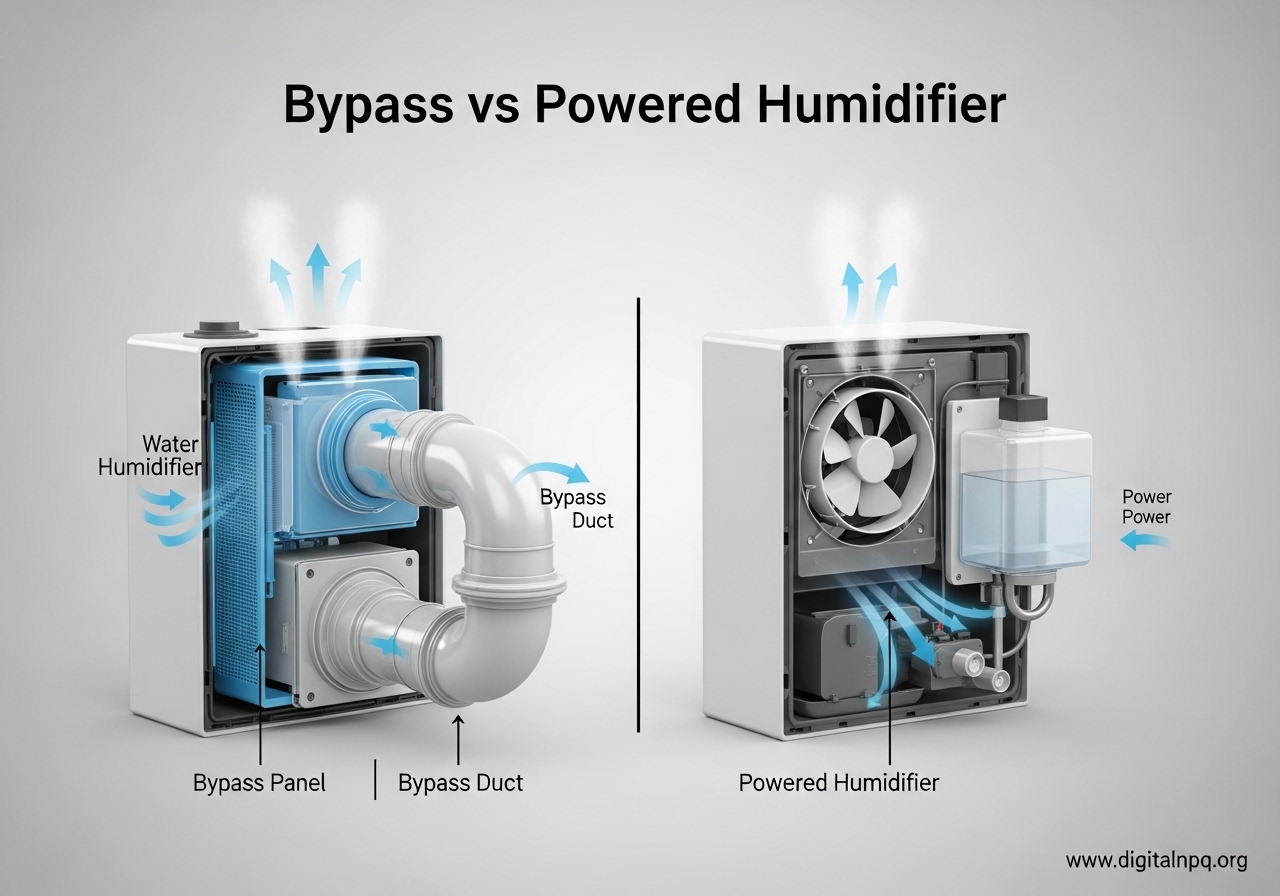
Before we get into the mechanics, here is the simplest way to separate the two. A bypass humidifier uses your furnace blower to push air through a wet evaporator pad. A powered humidifier has its own fan and does not need the furnace to run.
| Feature | Bypass Humidifier | Powered Humidifier |
|---|---|---|
| Airflow source | Furnace blower | Built-in 120V fan |
| Water efficiency | Lower (up to 14:1 waste ratio) | Higher |
| Power draw | None extra | ~1-2 amps |
| Heat pump friendly | Weak | Strong |
| Best for | Gas furnaces, smaller homes | Heat pumps, large homes, dry climates |
That table gives you the gist, but the details matter. Let me walk through each type so you understand why those differences exist.
How Does a Bypass Humidifier Work?
A bypass humidifier is the simplest whole-home humidifier you can add to a forced-air system. It mounts on either the supply or return plenum of your furnace. A small bypass duct connects the supply side to the return side, creating a pressure difference.
When the humidistat calls for humidity, a solenoid valve opens and drips water down a specially coated evaporator pad. Warm air from the furnace is drawn through that bypass duct by the pressure difference, picks up moisture from the pad, and is carried back into your ducts. The entire process relies on the furnace blower running.
Because there is no extra motor, bypass units have fewer moving parts. Many HVAC pros on Reddit praise them for being quieter and less likely to break. However, there is a catch: if your furnace is not running, the humidifier is not working. That can be a problem in mild weather when your heat cycles are short.
How Does a Powered Humidifier Work?
A powered humidifier, also called a fan-powered or fan-assisted humidifier, looks similar on the outside but operates very differently inside. It mounts on the supply plenum and contains its own 120V fan that pulls air directly from the duct.
That air is forced across the water panel, where it absorbs moisture. The fan then pushes the humidified air back into the supply duct and out to your rooms. Because it does not depend on the furnace blower, a powered unit can add humidity even when the furnace is off. This independent operation is the single biggest advantage for homes with limited furnace runtime.
Homeowners in the Southwest and other dry climates often report that powered units keep their humidity levels stable even on mild days. The trade-off is a small increase in electricity use and a faint hum from the internal fan when it runs.
Bypass Humidifier Pros and Cons
Our team looked at hundreds of owner comments and technician opinions. Here is what consistently shows up for bypass units.
Pros
- No extra electricity needed because the furnace blower does all the work.
- Fewer moving parts means fewer things that can break over a 10-year span.
- Generally quieter since there is no secondary fan motor.
- Lower upfront cost for the unit and basic installation.
Cons
- Water efficiency can be poor. Some models waste 14 gallons of water for every 1 gallon that becomes vapor.
- Requires a bypass duct, which takes up extra space and adds labor.
- Only works when the furnace is running, so humidity lags on mild days.
- Struggles with heat pumps because the supply air is not hot enough to drive fast evaporation.
Powered Humidifier Pros and Cons
Powered units come up often in discussions about 3,000-square-foot homes and heat pump systems. Here is the honest breakdown.
Pros
- Independent operation means humidity control even when the furnace is off.
- Better water efficiency because the fan forces air through the pad more aggressively.
- Stronger humidity output for large homes or homes with high ceilings.
- Works well with heat pumps and other systems with limited furnace runtime.
Cons
- Requires a dedicated 120V electrical outlet near the installation point.
- Internal fan adds a slight operating noise that light sleepers near the furnace may notice.
- Higher upfront cost for the unit and wiring.
- One more motor that could eventually need replacement.
Bypass vs Powered Humidifier: Key Differences
Now that you understand the mechanics, let me compare the categories that actually affect your daily life.
Energy Efficiency
Bypass humidifiers win on paper for energy use because they add zero watts to your electric bill. The powered unit draws about 1 to 2 amps while running, which translates to roughly 30 to 50 cents per month depending on your local rates. In practice, the powered unit may save you money overall because it reaches target humidity faster and keeps your thermostat feeling warmer.
Water Efficiency
Water waste is the most overlooked difference. HVAC technicians on HVAC-Talk forums mention that some bypass models dump 14 gallons of water down the drain to produce 1 gallon of vapor. Powered units recirculate or use the pad more effectively, often cutting that waste by half. If you live in a drought-prone region or pay for water by usage, this is a major factor.
Noise Levels
Bypass units are nearly silent because they rely on the furnace blower, which you already hear. Powered units add a small fan hum. Most owners describe it as a soft white noise, but if your furnace sits in a closet near a bedroom, it is worth considering. I would not call it loud, but it is not zero.
Installation Complexity
Both types mount on the ductwork, but a bypass unit needs an extra 6-inch bypass duct cut between the supply and return plenums. That adds an hour or two of labor. A powered unit needs a 120V outlet, which might require an electrician if one is not nearby. From a purely mechanical standpoint, the bypass unit is simpler; from an electrical standpoint, the powered unit is simpler.
Heat Pump Compatibility
Heat pumps deliver air at lower temperatures than gas furnaces. A bypass humidifier needs warm air to evaporate water efficiently, so it underperforms when the supply air drops below about 100 degrees. Powered units force enough air across the pad to compensate for cooler temperatures. If you have a heat pump, a powered humidifier is almost always the better choice.
Which Humidifier Should You Choose?
Here is the decision framework I use when friends ask me this question.
Choose a bypass humidifier if you have a gas or oil furnace, your home is under 2,500 square feet, you want the lowest upfront cost, and your furnace runs long enough to maintain humidity. It is a solid, reliable choice for traditional setups.
Choose a powered humidifier if you have a heat pump, a large home over 2,500 square feet, very dry air, or limited furnace runtime. The independent fan and stronger output justify the extra cost in those situations.
Consider a steam humidifier if you want the absolute fastest humidity recovery and do not mind a higher electric bill. Steam units are the third option many HVAC pros recommend for severe dryness or health conditions.
Maintenance and Installation Requirements
Both systems need an annual water panel replacement. The pad costs about $15 to $30 and takes 10 minutes to swap. You should also inspect the solenoid valve and drain line for mineral buildup, especially if you have hard water.
Installation costs vary by region, but expect $300 to $600 for a bypass unit and $400 to $800 for a powered unit, including labor. Professional installation is recommended for both because they tie into your ductwork and water line. Many owners on forums say DIY installation is possible if you are comfortable with sheet metal and plumbing, but a pro will ensure proper airflow and prevent leaks.
Frequently Asked Questions
Is it better to have a humidifier with or without a filter?
Both bypass and powered humidifiers use a water-soaked evaporator pad, which acts like a filter. The pad needs replacement once per heating season. There is no whole-home humidifier that runs entirely without this pad, because the pad is what creates the surface area for water to evaporate into the air.
Should I use a humidifier if I have COPD?
Proper humidity can ease breathing for people with COPD by keeping airways moist. Whole-home humidifiers maintain consistent relative humidity around 30 to 50 percent, which is generally recommended. However, you should consult your doctor before installing any humidifier, because too much humidity can encourage mold growth and worsen respiratory conditions.
Can a humidifier help with eczema?
Yes. Dry air below 30 percent relative humidity strips moisture from skin and can trigger eczema flare-ups. A whole-home humidifier keeps every room at a stable humidity level, which helps skin retain moisture better than a portable unit that only treats one space.
Can a humidifier help with migraines?
Some people report fewer migraines when indoor humidity stays between 30 and 50 percent. Very dry air can irritate nasal passages and sinuses, which may trigger headaches in sensitive individuals. While a humidifier is not a cure for migraines, stable humidity can be part of a comfortable home environment that reduces triggers.
Which is better for a heat pump, bypass or powered humidifier?
A powered humidifier is almost always better for heat pumps. Bypass humidifiers rely on warm air from the furnace to evaporate water efficiently. Heat pumps produce lower supply air temperatures, so a bypass unit will struggle to add enough moisture. The built-in fan of a powered unit forces air through the water panel regardless of furnace temperature, making it the clear winner for heat pump systems.
Conclusion
The bypass vs powered humidifier debate comes down to your HVAC system and your home. If you have a standard gas furnace and a modest home, a bypass unit is simple, quiet, and affordable. If you have a heat pump, a large home, or stubbornly dry air, the powered humidifier is worth the extra investment for independent operation and stronger output.
Either way, adding a whole-home humidifier is one of the best upgrades you can make for comfort and health during the heating season. Talk to a local HVAC technician about your ductwork layout, and you will be breathing easier before winter ends.