
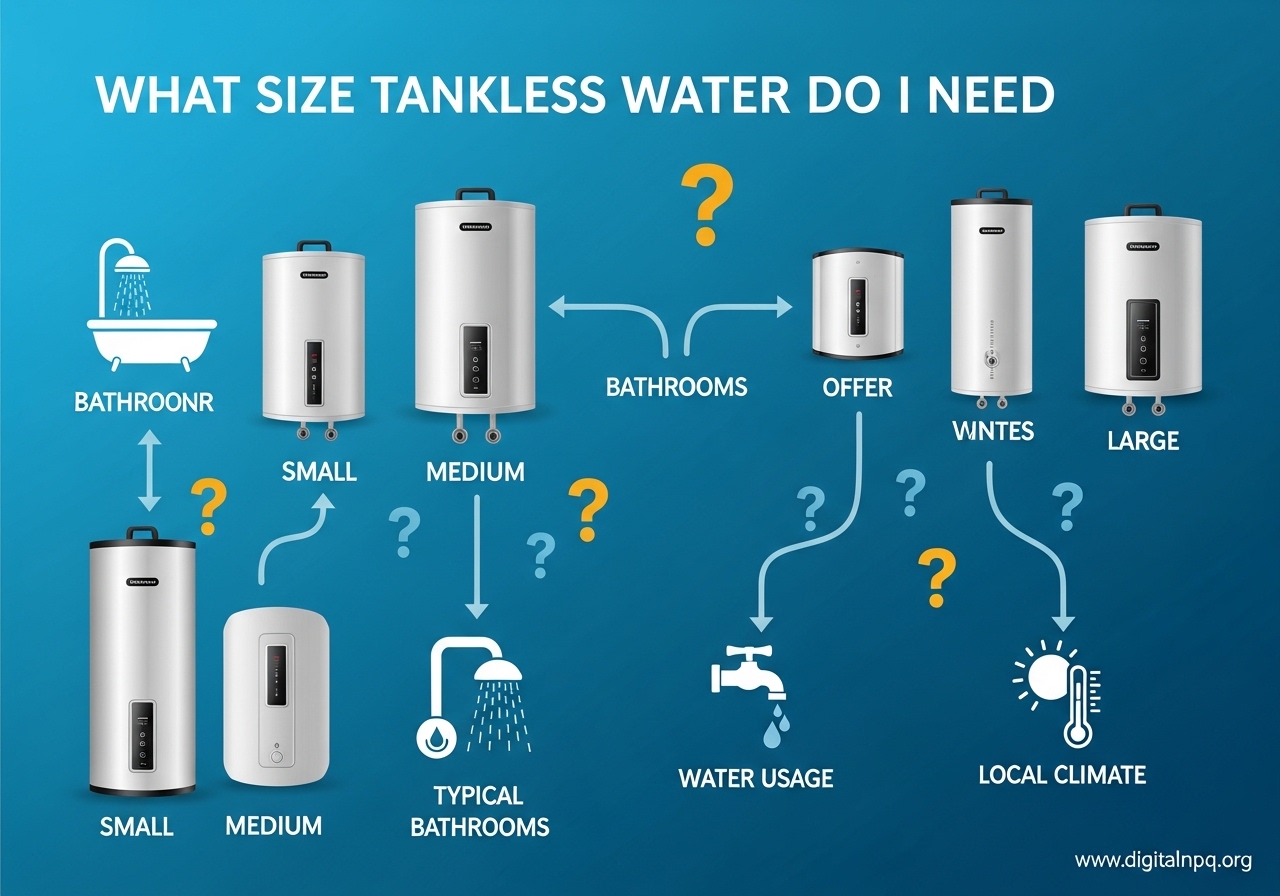
Most homeowners need a tankless water heater that delivers between 7 and 10 gallons per minute (GPM) to cover daily hot water demand. The exact size depends on two factors: how many fixtures you run at the same time, and how cold your incoming groundwater is. Get either of those wrong, and you will end up with lukewarm showers or an oversized unit that costs more than necessary.
Our team spent weeks reviewing installation manuals, regional climate data, and plumber forums to build a sizing method that works for real homes. If you want specific product recommendations after you calculate your size, we have a separate guide to the best electric tankless water heaters that you can check once you know your GPM target.
This guide breaks down every step of the calculation in plain language. You will learn how to add up fixture flow rates, calculate your temperature rise, and match those numbers to the right unit size. We also include quick-reference tables for household size and climate zones so you can skip the math if you just want a ballpark answer.
By the end, you will know exactly what size tankless water heater you need, whether you are replacing a 40-gallon tank or building a new home from scratch.
How to Size a Tankless Water Heater
Sizing a tankless water heater comes down to two numbers: your peak flow rate in GPM, and your required temperature rise in degrees Fahrenheit. Multiply those needs against the climate you live in, and you have a clear target that any plumber or retailer can match to a specific model. Without both numbers, you are guessing.
Here is the process in one sentence. Add up the flow rates of every hot water fixture you might run at the same time, then subtract your groundwater temperature from your desired output temperature to find the temperature rise. Every tankless unit lists a GPM rating at a specific temperature rise, so you need both numbers to pick the right one.
A unit that works for your neighbor might fail in your home if your groundwater is colder or your family uses more fixtures at once. Most people get confused because they are used to thinking in gallons, like a 50-gallon tank. A tankless unit does not store water.
It heats water as it passes through, so the only thing that matters is how many gallons per minute it can heat to your target temperature. I see this mistake in homeowner forums constantly, and it is the number one reason people buy the wrong size. They walk into a store and ask for a tankless version of their 50-gallon tank, but the salesperson needs their GPM number instead.
The formula is simple once you break it down. Peak flow rate equals the sum of all fixtures running simultaneously. Temperature rise equals target temperature minus inlet temperature.
Once you have those two values, you can read any manufacturer spec sheet and know immediately whether the unit will work in your home. Our team uses this exact two-factor method every time we evaluate tankless recommendations.
What GPM Means and Why It Matters for Tankless Sizing
GPM stands for Gallons Per Minute. It measures how much water flows through a fixture or heater in sixty seconds. A standard showerhead uses about 2.5 GPM.
A kitchen sink uses about 1.5 GPM. If you run both at once, your tankless unit must heat 4.0 GPM instantly to keep both streams hot. The unit never gets a break. It must maintain that output for as long as both fixtures stay open.
Tankless manufacturers rate their units at a specific temperature rise, usually 70 degrees. For example, a unit might deliver 8.4 GPM at a 35-degree rise, but only 5.6 GPM at a 70-degree rise. That means the same unit produces less hot water in cold climates than in warm ones.
This is why you cannot just look at the headline GPM number on the box. You must check the rating at your actual temperature rise. The marketing number on the front of the brochure is almost always the best-case scenario.
Our team recommends aiming for a unit that can handle your peak demand plus about one extra GPM as a safety margin. That buffer prevents temperature drops when your groundwater gets colder in winter or when a guest turns on a faucet unexpectedly.
I learned this the hard way during a renovation project where a perfectly calculated 7 GPM unit dropped to 5.5 GPM in January because we forgot to size for the coldest possible groundwater temperature. Another detail most shoppers miss is that fixture flow rates change over time.
A showerhead rated at 2.5 GPM may drop to 2.0 GPM after a few years of mineral buildup. Conversely, if you replace a low-flow head with a high-performance model, your demand could increase. Always measure your actual fixtures rather than relying on builder specifications from fifteen years ago.
A quick measurement with a stopwatch and a gallon jug takes two minutes and gives you real data.
How to Calculate Your Peak Flow Rate Demand
Follow these three steps to find the exact GPM your home needs during the busiest hour of the day. We developed this method after reviewing dozens of plumber recommendations and hundreds of real-world installation stories. It works for apartments, condos, single-family homes, and even small multi-family buildings.
Step 1: List Every Hot Water Fixture in Your Home
Walk through your house and count every fixture that uses hot water. Include showers, bathtubs, bathroom sinks, kitchen sinks, dishwashers, and washing machines. Do not forget utility sinks or outdoor hot water spigots if you use them regularly.
Even a small bar sink in a basement counts if it has a hot water line. Write them down in a list. You do not need to include toilets or hose bibs that only use cold water.
If you have a fixture that mixes hot and cold, like a single-handle shower, count it because it still draws from the hot water line. I usually create a simple spreadsheet with one row per fixture. That makes the next step easier and gives you a record you can update if you remodel later.
Step 2: Add Up the Flow Rates
Find the flow rate for each fixture. You can check the manufacturer stamp on the showerhead or aerator, or use the standard values in our chart below. Modern low-flow showerheads often use 1.5 to 2.0 GPM, while older fixtures may use 2.5 to 3.0 GPM.
If you cannot find a stamp, the gallon-jug method is the most reliable approach. Add the numbers together. For example, a home with two 2.0 GPM showers, a 1.5 GPM kitchen sink, and a 1.0 GPM bathroom sink has a total of 6.5 GPM if everything runs at once.
In reality, you rarely run every fixture simultaneously, so the next step narrows that down to your realistic peak. This total is your theoretical maximum, not your operational target.
Step 3: Determine Your Peak Simultaneous Demand
Think about your worst-case scenario. In most homes, that is the morning rush when two showers run, the kitchen sink is on, and the dishwasher starts. For a family of four, that might be 2.0 + 2.0 + 1.5 + 1.0 = 6.5 GPM.
A couple living alone might only hit 3.5 GPM during peak use. A family of five in a three-bathroom home could reach 8.5 GPM or higher. Pick the highest realistic combination, not the absolute maximum every fixture could theoretically produce.
Plumbers on homeowner forums consistently warn against oversizing by adding every fixture in the house, because that almost never happens in real life. One professional plumber on Reddit described a customer who demanded 12 GPM for a two-bedroom home because they added the washing machine, dishwasher, three sinks, and two showers. The plumber installed an 8 GPM unit, and the customer never ran out of hot water.
Be honest about your habits. If you run the dishwasher at night after everyone showers, it does not count toward your peak. If you do laundry on weekends only, it also does not count. Your peak is the worst five-minute window during a typical weekday. That is the number your tankless unit must handle.
Fixture Flow Rate Reference Chart
Use this table to estimate the flow rate for common fixtures. If your fixtures have WaterSense labels, use the lower end of the range. If they are older, use the higher end. These values represent hot water demand, not total mixed flow.
A showerhead may deliver 2.5 GPM total, but the hot water portion is what matters for tankless sizing.
| Fixture | Low Flow (GPM) | Standard Flow (GPM) | High Flow (GPM) |
|---|---|---|---|
| Showerhead | 1.5 | 2.0 | 2.5 |
| Bathtub Faucet | 3.0 | 4.0 | 5.0 |
| Bathroom Sink | 0.5 | 1.0 | 1.5 |
| Kitchen Sink | 1.0 | 1.5 | 2.0 |
| Dishwasher | 1.0 | 1.5 | 2.0 |
| Washing Machine | 1.5 | 2.0 | 2.5 |
| Utility Sink | 1.5 | 2.0 | 3.0 |
To get the most accurate number, time how long it takes to fill a one-gallon jug from each fixture. Divide 60 by the number of seconds, and you have the exact GPM for that outlet. I did this in my own home and found that one showerhead rated at 2.5 GPM actually delivered 2.2 GPM because of a partially clogged aerator.
That small difference saved me from oversizing by nearly half a GPM. Keep in mind that appliances like dishwashers and washing machines often have their own internal heating elements. They draw less hot water from your tankless unit than the raw GPM rating suggests because they boost the temperature internally.
A dishwasher rated at 1.5 GPM might only pull 1.0 GPM of hot water if it has a booster heater. Check your appliance manuals to see if they include this feature.
Temperature Rise: The Hidden Factor Most People Miss
Temperature rise is the difference between your incoming groundwater temperature and the temperature you want at the faucet. Most people set their hot water to 120 degrees. If your groundwater is 50 degrees, your temperature rise is 70 degrees.
That is a large demand, and it directly reduces how many GPM your tankless unit can produce. The unit must work harder to bridge a bigger gap. Here is why this matters. A tankless heater rated at 9.8 GPM might only deliver 5.5 GPM when the temperature rise is 70 degrees.
In a warm climate where the groundwater is 70 degrees, the same unit might deliver 8.5 GPM because it only needs to raise the water by 50 degrees. This is the reason a unit that works perfectly in Florida may struggle in Minnesota. The same hardware performs differently depending on where you install it.
Our team analyzed climate data from NOAA and found that temperature rise can vary by 40 degrees or more across the United States. Ignoring this factor is the second most common sizing mistake after the GPM confusion. We have read countless forum posts where homeowners blame the brand for a bad unit when the real issue was that they bought a warm-climate model and installed it in a cold-climate house.
The relationship between temperature rise and GPM is not linear. As the rise increases, the GPM drops faster than you might expect. A unit that loses 1.5 GPM going from a 50-degree rise to a 60-degree rise might lose 3 GPM going from a 60-degree rise to a 75-degree rise.
This is why the conservative winter temperature matters so much. If you size for the average temperature instead of the worst-case temperature, you will have cold showers during the coldest months of the year.
How to Find Your Groundwater Temperature
The easiest method is to run cold water from a faucet for about two minutes until it reaches its lowest stable temperature. Measure it with a kitchen thermometer. Do this in late winter for the most conservative reading.
If you measure 52 degrees in January, you can be confident the unit will handle your worst-case scenario. We recommend doing this at the fixture farthest from your water heater, because that fixture experiences the most temperature loss from the ground.
Alternatively, you can use the EPA groundwater temperature map or your local water utility report. Many municipalities publish average inlet water temperatures for their service area. Add 5 degrees to the published average to account for unusually cold winter days.
I checked my own utility report and found a published average of 55 degrees. Adding 5 degrees gave me a conservative 50-degree estimate, which matched my January measurement almost exactly.
Groundwater Temperature by Region
This table shows average groundwater temperatures across the United States. Use the conservative number for your region to size your unit safely. If you live near a border between two zones, default to the colder zone.
Groundwater temperatures are fairly stable year-round compared to air temperatures, but they do drop a few degrees in deep winter.
| Region | Average Groundwater Temp | Conservative Winter Temp | Typical Rise to 120F |
|---|---|---|---|
| Southern Florida | 75F | 70F | 45-50F |
| Gulf Coast / Southern CA | 70F | 65F | 50-55F |
| Southwest Desert | 65F | 60F | 55-60F |
| Mid-Atlantic / Southeast | 60F | 55F | 60-65F |
| Pacific Northwest | 55F | 50F | 65-70F |
| Midwest | 52F | 47F | 68-73F |
| Mountain West | 50F | 45F | 70-75F |
| Northern Plains / Northeast | 47F | 42F | 73-78F |
| Northern Minnesota / Maine | 42F | 38F | 78-82F |
If you live in a northern climate with a 78-degree temperature rise, you need a significantly more powerful unit than someone in Miami with a 45-degree rise. Many Reddit users in the Plumbing community report that winter temperature drops are their number one complaint after installation.
They bought a unit that worked in summer but could not keep up in January. One user in Minnesota shared that their 7 GPM unit delivered barely 4 GPM in February, which was not enough for two showers simultaneously.
Household Size Sizing Guide
Use this section as a quick reference if you want a ballpark answer before doing the full calculation. These ranges assume average fixture counts and moderate climates. Adjust up or down based on your exact peak demand and regional temperature rise.
This guide is built from actual plumber recommendations and real-world forum data, not just manufacturer marketing.
1-2 People: 4-6 GPM Is Usually Enough
A couple or single person in a one-bathroom home rarely needs more than 4 to 6 GPM. Peak demand typically involves one shower and a sink running simultaneously. In warm climates, a 4 GPM unit may handle this comfortably.
In colder regions, a 6 GPM unit provides the extra heating power needed for higher temperature rise. A 5 GPM unit is the most common recommendation for this group. Forum users living alone consistently report that 9 GPM units are overkill for their needs.
They spent extra money on capacity they never use. One homeowner posted that their 9 GPM unit never ran above 3 GPM in daily use, which meant they paid for heating capacity that sat idle. If you are in a small apartment or condo, a 5 GPM unit is often the sweet spot.
If you rarely have guests, you can even go as low as 4 GPM in southern climates.
3-4 People: 7-9 GPM Covers Most Homes
The average family of four in a two-bathroom home needs 7 to 9 GPM during peak hours. Morning routines often involve two showers plus a kitchen sink or dishwasher. A 7 GPM unit works in warmer climates, while an 8 to 9 GPM unit is safer for mixed or cold climates.
This is the most common household size in the United States, so manufacturers optimize their product lines around this range. Our team considers 8.4 GPM the most common recommendation from professional plumbers for this household size. It gives enough headroom for occasional guests or laundry days without jumping to the cost of a 10+ GPM unit.
If you want to narrow down the fuel type after picking your GPM, our guide to the best electric tankless water heaters covers models in this range. We have found that 8.4 GPM is the point where gas becomes almost mandatory in colder climates because electric units struggle to deliver that output at 70-degree temperature rises.
5+ People: 9-11 GPM for High Demand
A family of five or more in a home with three bathrooms should look at 9 to 11 GPM units. Peak demand can hit 8 to 9 GPM when multiple showers, the washing machine, and the kitchen sink all run within the same hour. The extra 1 to 2 GPM of capacity prevents the dreaded temperature drop.
No one wants to be the last person in the shower line with cold water. In cold northern climates with a 75-degree or higher temperature rise, a 10 GPM condensing gas unit is the safest minimum. Some installers recommend cascading two smaller units instead of one massive unit, which provides redundancy if one unit needs maintenance.
This is especially popular in large homes where the bathrooms are far apart. Two 6 GPM units, one on each end of the house, can outperform a single 10 GPM unit because they reduce the distance hot water must travel through the pipes.
| Household Size | Bathrooms | Warm Climate GPM | Cold Climate GPM |
|---|---|---|---|
| 1-2 people | 1 | 4-5 | 5-6 |
| 1-2 people | 2 | 5-6 | 6-7 |
| 3-4 people | 2 | 7-8 | 8-9 |
| 3-4 people | 3 | 8-9 | 9-10 |
| 5+ people | 3 | 9-10 | 10-11 |
| 5+ people | 4+ | 10-11 | 11+ or dual units |
What Size Tankless Replaces Your Tank Water Heater
Homeowners often ask what tankless unit replaces a 40-gallon or 50-gallon tank. The answer is not a direct gallon conversion. You must match the tankless GPM to the tank’s first-hour rating.
A tank water heater stores hot water and refills gradually, so it can deliver more than its tank size in the first hour. A tankless unit has no storage, so it must match that first-hour delivery rate continuously. A 40-gallon tank can deliver roughly 60 to 70 gallons of hot water in the first hour.
To replace that continuously, you need a tankless unit that can deliver 6 to 8 GPM at your temperature rise. In warm climates, a 6 GPM unit works. In cold climates, aim for 8 GPM to avoid winter shortfalls.
A 6 GPM unit in Minnesota will feel like a 4 GPM unit when the groundwater drops to 40 degrees. A 50-gallon tank delivers about 80 to 90 gallons in the first hour. That translates to an 8 to 10 GPM tankless unit.
Again, the climate matters. A 50-gallon replacement in Minnesota needs a more powerful unit than the same replacement in Arizona. Many homeowners in plumbing forums say they wish someone had told them this before they bought. They assumed a 50-gallon tank meant a 5 GPM tankless was enough, and they learned the hard way that it was not.
One forum user described taking a 5 GPM unit back to the store after two weeks of cold showers. For a 75-gallon tank, you generally need a 10 to 11 GPM unit or two smaller units in parallel. For an 80-gallon tank, consider 11+ GPM or a cascading setup with two 6 to 7 GPM units.
If you currently have a 100-gallon tank, you are almost certainly in the territory where a plumber should evaluate your home for either a very large condensing unit or a multi-unit cascade. These large tanks are common in homes with five or more bathrooms.
Gas vs Electric Tankless Sizing Differences
The fuel type changes how you interpret the size. Gas tankless units are measured in both GPM and BTU per hour. Electric units are measured in GPM and kilowatts or amperage. The relationship between these numbers is what separates a successful installation from a disappointing one.
A gas unit with 180,000 BTU can typically deliver 8 to 10 GPM depending on the temperature rise. Larger whole-house gas units range from 150,000 to 200,000 BTU. Condensing gas units are more efficient, so they can squeeze more effective hot water from the same BTU input than non-condensing units.
A 150,000 BTU condensing unit might outperform a 180,000 BTU non-condensing unit in real-world conditions because less heat escapes up the vent. Electric tankless units are sized by amperage and voltage. A whole-house electric unit might require 120 to 160 amps at 240 volts.
Many homes do not have enough spare electrical capacity without upgrading the panel. This is the reason licensed plumbers on homeowner forums overwhelmingly recommend gas for whole-house applications. Electric units work best for point-of-use or small homes with low GPM demand.
The math is simple. A 30 kW unit at 240V draws 125 amps. A 36 kW unit draws 150 amps. Most homes have 200-amp main panels, and the existing load from air conditioning, electric stoves, and dryers can easily push you past the safe limit.
If you are set on electric, verify your panel can handle the load. A 30 kW electric unit needs 125 amps at 240V. If your home runs on a 150-amp main panel, that leaves almost nothing for the rest of the house. In our experience, gas is the safer choice for any whole-house demand above 5 GPM.
We have seen too many forum stories where homeowners installed a 27 kW electric unit and tripped the main breaker every time the dryer and tankless ran simultaneously. The cost of upgrading the panel often erases any savings from choosing electric over gas.
Condensing vs Non-Condensing and Why It Matters for Sizing
Condensing tankless units extract extra heat from exhaust gases, giving them efficiency ratings above 90 percent. Non-condensing units vent the exhaust directly, wasting some heat, and typically run around 80 percent efficiency. That 10 percent difference translates directly to how much hot water you get from the same fuel input.
From a sizing perspective, a condensing unit can deliver more usable hot water per BTU than a non-condensing unit of the same input rating. That means a 150,000 BTU condensing unit might perform like a 170,000 BTU non-condensing unit. If you are in a cold climate and need every bit of performance, condensing gives you a slight edge.
The extra efficiency is most noticeable when the temperature rise is above 65 degrees, which is exactly when you need the help most. Non-condensing units are cheaper upfront and work fine in warm or moderate climates where the temperature rise is below 60 degrees.
In northern climates with temperature rises above 70 degrees, the extra efficiency of condensing units becomes more noticeable. Homeowners on plumbing forums report that their condensing units handle winter demand better than the non-condensing models they replaced. The price gap between condensing and non-condensing has narrowed in recent years, making the condensing option more attractive even in moderate climates.
Condensing units also use PVC venting instead of metal, which can lower installation costs. Stainless steel venting for non-condensing units is expensive and harder to install. If you are sizing for a large home in a cold climate, the combination of higher efficiency and cheaper venting often makes condensing the better long-term investment.
The upfront cost difference is usually recovered within a few years through lower gas bills and avoided venting expenses.
Point-of-Use vs Whole-House Tankless Sizing
Whole-house units sit in a central location and serve every fixture. Point-of-use units are small electric heaters installed at a single fixture, usually under a sink or near a shower. The sizing logic is completely different for each.
Whole-house units face the full brunt of your peak demand. Point-of-use units only worry about one fixture at a time. A whole-house unit must match your peak GPM for the entire home. A point-of-use unit only needs to match the flow rate of that single fixture.
A small 2 GPM point-of-use electric heater can serve a remote bathroom perfectly, even if your whole-house unit would struggle to push hot water that far through long pipes. The pipe run matters. Hot water cools as it travels through uninsulated pipes.
A 50-foot run from a central tankless unit to a guest bathroom can result in lukewarm water for the first minute of use. A point-of-use unit eliminates that wait entirely. Forum users frequently recommend point-of-use units for additions, detached guest bathrooms, or workshops that are far from the main water heater.
The electric amperage draw is small, often 30 to 50 amps, and the installation is much simpler than running a new gas line. Our team has seen successful installations where a 1.5 GPM point-of-use unit solved a cold-water problem that a larger whole-house unit could not fix because of pipe distance.
One homeowner added a point-of-use unit under their kitchen sink and reported that they no longer had to run the faucet for 45 seconds to get hot water for dishes. If you have a large home with fixtures spread across two floors or a long ranch layout, consider pairing a moderately sized whole-house unit with one or two point-of-use units for the remote fixtures.
This hybrid approach is often cheaper than buying a single oversized unit. It also reduces the total pipe run that hot water must travel, which saves water and energy. We have calculated that in some homes, a hybrid setup can pay for itself in under three years through reduced water waste alone.
Common Sizing Mistakes to Avoid
After reviewing thousands of forum posts and speaking with installers, our team identified the same errors repeatedly. Avoid these, and you will save yourself from cold showers and expensive returns. Every mistake on this list has appeared in real homeowner stories at least a dozen times.
Mistake 1: Buying by tank size instead of GPM. A 50-gallon tank and a 5 GPM tankless are not equivalent. The tank stores water. The tankless must heat it continuously. Always convert your peak demand to GPM first.
If you currently have a 50-gallon tank, you almost certainly need an 8 to 10 GPM tankless, not a 5 GPM unit. Mistake 2: Ignoring temperature rise. A unit rated for 10 GPM might only deliver 6 GPM in your climate. Check the performance curve at your actual temperature rise, not the marketing headline.
The performance curve is usually printed in the manual or listed on the manufacturer website under specifications. Look for the line that shows GPM at 70-degree rise or 77-degree rise. Mistake 3: Oversizing for no reason. A 11 GPM unit for a one-bathroom condo wastes money and may short-cycle.
Short cycling reduces efficiency and wears out the heat exchanger faster. Size for your actual demand plus a small buffer. The buffer should be about 1 GPM, not 4 GPM. An oversized unit also costs more to install because it may require larger gas lines and upgraded vents.
Mistake 4: Choosing electric for a whole-house application in a cold climate. Electric tankless units require massive amperage, and their output drops sharply as temperature rise increases. Plumbers consistently report disappointment with whole-house electric units in northern states. Gas is the safer choice for 6+ GPM in cold climates.
If you are in a northern state and want whole-house electric, expect to pay for a panel upgrade and possibly a demand management system that limits other appliances while the tankless runs. Mistake 5: Forgetting about installation requirements. A large gas tankless may need a 3/4-inch gas line instead of the 1/2-inch line your old tank used.
It may also need a new vent. If you size for a big unit but your infrastructure cannot support it, you face unexpected retrofit costs. Check your gas line capacity and electrical panel before finalizing the size. A plumber can measure gas line pressure and verify electrical load in about 30 minutes during a site visit. That small inspection fee can save you thousands in surprise retrofit costs.
Frequently Asked Questions
How big of a tankless water heater do I need to replace a 50 gallon water heater?
You need a tankless unit that delivers 8 to 10 GPM at your required temperature rise to replace a 50 gallon tank. A 50 gallon tank can supply about 80 to 90 gallons of hot water in the first hour, but a tankless unit must match that delivery rate continuously. In warmer climates, an 8 GPM unit may suffice. In colder northern regions, you may need a 10 GPM condensing gas unit to achieve the same performance.
What size tankless water heater is needed for a family of 5?
A family of 5 typically needs a 9 to 11 GPM gas tankless water heater for whole-house coverage. With multiple bathrooms, a dishwasher, and a washing machine, peak demand can reach 7 to 9 GPM simultaneously. Adding a safety margin of 1 to 2 GPM prevents temperature drops during the busiest morning hours. In cold climates, consider a condensing unit with at least 180,000 BTU to maintain output when the groundwater temperature drops below 50 degrees.
What is the downside of a tankless water heater?
The main downside is the higher upfront cost for both the unit and installation, especially if you need new gas lines or venting. Electric tankless models can struggle to deliver enough hot water for whole-house use in colder climates. Tankless units also require annual maintenance, including descaling, to prevent mineral buildup from reducing efficiency. Some homeowners experience a slight delay in hot water delivery because the unit must heat water on demand rather than pulling from a preheated tank.
Can I replace my 40 gallon water heater with a tankless water heater?
Yes, you can replace a 40 gallon tank with a tankless unit, but you must size by GPM rather than gallon capacity. A 40 gallon tank typically requires a 6 to 8 GPM tankless unit for equivalent performance. In warmer southern climates, a 6 GPM unit may work. In colder northern climates, an 8 GPM condensing gas unit is safer. You should also verify that your home has adequate gas line capacity or electrical service to support the tankless unit.
Conclusion
What size tankless water heater do you need? The answer depends on your peak flow rate and your temperature rise. Add up the GPM of every fixture you might run simultaneously, then subtract your groundwater temperature from 120 degrees to find your required temperature rise.
Match those two numbers against the unit specifications, and you have the right size. This two-factor method removes the guesswork and gives you a number you can defend to any contractor. Most households fall between 7 and 10 GPM.
A family of two in the South might need 5 GPM. A family of five in the North might need 10 GPM or more. Do not buy by tank size. Do not ignore your climate. And if you are unsure, round up by one GPM rather than rounding down.
The small extra cost is worth avoiding the frustration of cold showers every winter morning. We have seen $200 of upfront capacity save homeowners $2,000 in replacement costs two years later. Once you know your target GPM, you can compare specific models.
If you are considering electric, our guide to the best electric tankless water heaters lists units that fit the most common household sizes. If you are going with gas, bring your GPM and temperature rise numbers to any plumber or retailer. They can match you to the exact model that fits your home in minutes. With the right numbers in hand, you will never have to guess what size tankless water heater you need again.