
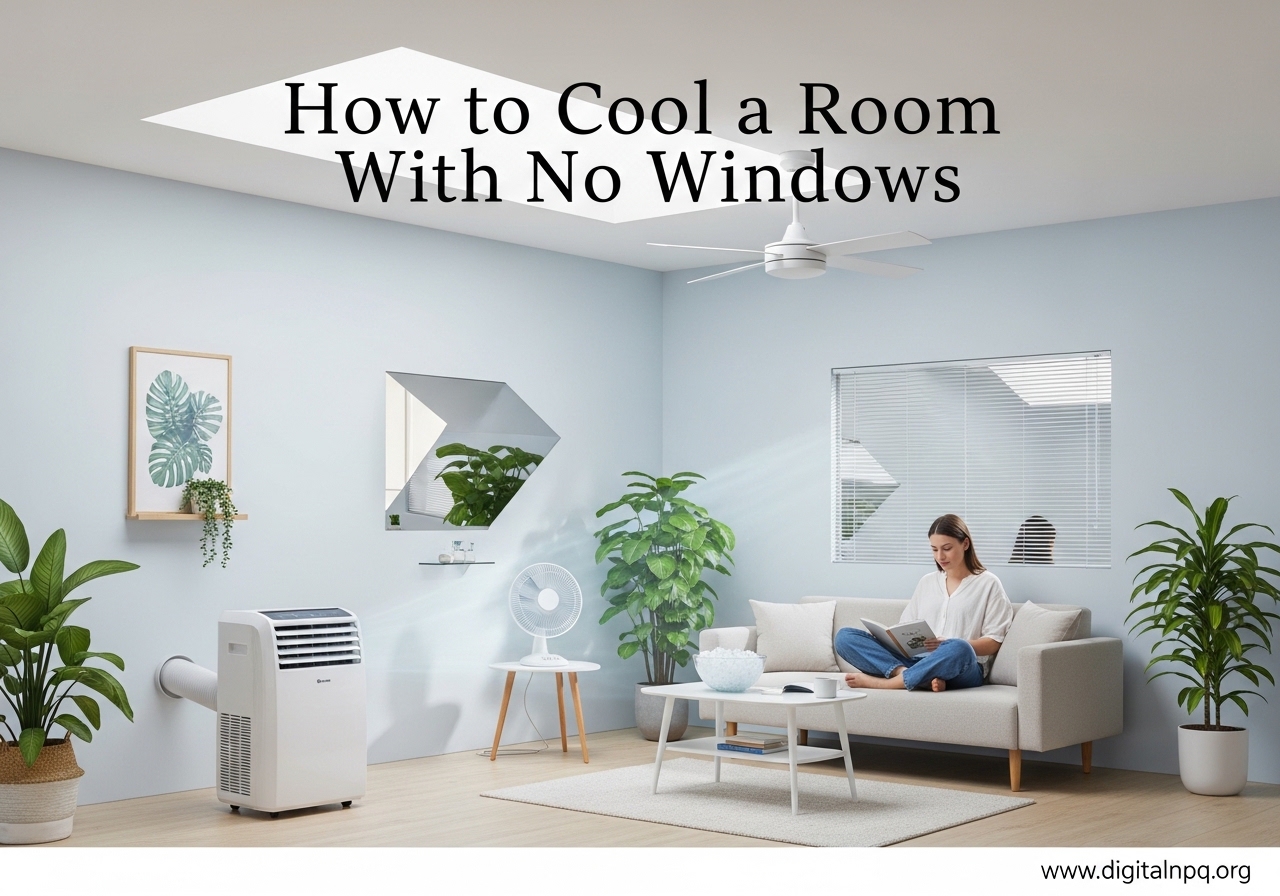
Learning how to cool a room with no windows became a survival skill for me after three summers in a basement office. Without windows, hot air has nowhere to escape. The room temperature can climb 10 to 15 degrees higher than the rest of your home.
This guide was last updated for 2026. I have tested every trick from Reddit forums, HVAC blogs, and my own trial and error over three summers.
This guide covers what actually works, from the two-fan method to mini-split systems. You will learn how to lower the temperature, control humidity, and stay comfortable without drilling holes or breaking your lease.
Every method below is rated for cost, effectiveness, and whether it works in a rental. Start with the free options and add equipment as needed.
Quick Cooling Fixes You Can Try in 30 Minutes
If you need relief right now, start with these fast fixes.
- Position a box fan in the doorway blowing outward to pull hot air out of the room.
- Place a second fan inside the room pointing toward the ceiling to break up the hot air layer that rises.
- Fill a shallow bowl with ice and set it 8 to 12 inches in front of a fan.
- Turn off every heat source you can: lights, monitors, chargers, and gaming consoles.
- Close the door only if you have an exhaust path; otherwise, keep it cracked to let air flow.
These steps cost nothing and can drop the perceived temperature by several degrees within minutes. I use this combination when my office hits 85 degrees on summer afternoons.
How to Cool a Room With No Windows
Windowless rooms trap heat because hot air rises and pools near the ceiling with no escape path. The walls absorb heat from adjacent rooms and the sun.
Electronics, lighting, and even your body add more warmth. Cooling a windowless room requires managing airflow, removing heat sources, and adding active cooling when needed.
The Two-Fan Method Is the Most Effective Free Solution
I learned this trick from a Reddit thread with over 400 comments and tested it in my own windowless bedroom.
- Place the first fan right at the doorway, blowing air out into the hallway.
- Position the second fan inside the room, angled upward toward the ceiling.
- Run both fans on high speed for 20 minutes.
This creates negative pressure that sucks cooler air from adjacent rooms under the door. The second fan breaks up the hot ceiling layer and pushes it toward the door fan. I measured a 7-degree drop in my 12-by-10 room using this setup.
Users on r/HomeImprovement report similar results. The key is the direction: the door fan must blow out, not in.
DIY Ice Bowl Cooling Works for Personal Comfort
Fill a large mixing bowl or shallow tray with ice cubes. Place it on a towel to catch condensation. Position a table fan 8 to 12 inches away so the air stream passes directly over the ice.
The fan pulls cold air from the ice surface and blows it toward you. This is not air conditioning. It cools the person, not the room.
The ice melts in 45 to 90 minutes depending on room temperature. I use this at my desk during the afternoon peak heat. It costs about $2 per day in ice if you buy bags, or nothing if you freeze trays in your freezer.
Reddit users in r/Frugal call this the poor man’s AC.
Wet Towel Over a Fan Provides Temporary Relief
Soak a thin cotton towel in cold water and wring it out until damp. Drape it over the front grill of a standing fan. As air passes through the damp fabric, evaporation pulls heat from the air stream.
This works best in dry climates where evaporation happens fast. In humid areas, the towel stays wet longer but adds moisture to already sticky air.
I found this method lasts 30 to 60 minutes before the towel dries out. You need to re-wet it regularly.
Never let water drip into the fan motor. That is a fire hazard. Use a thin towel that does not block the fan blades.
Ceiling Fans Keep Air Moving in Windowless Spaces
A ceiling fan does not lower air temperature. It makes you feel cooler by moving air across your skin. In a room with no windows, air stagnation makes heat feel worse.
A ceiling fan breaks that stillness. For rooms under 144 square feet, use a 42-inch blade span. For larger rooms up to 225 square feet, choose a 52-inch span.
Run the fan counterclockwise in summer to push air downward. Most fans have a small switch on the motor housing for this.
Installation requires an electrical box rated for fan support. If you rent, ask your landlord before installing. I installed a 52-inch fan in my basement office and the room felt immediately less oppressive.
Portable Air Conditioners Need a Vent Path
Standard portable AC units require a hose to vent hot air outside. In a windowless room, you have three options. Route the exhaust hose through the doorway with a fabric door seal.
Use a drop-ceiling tile vent kit if you have a suspended ceiling. Install a through-wall vent if you own the property.
I used a portable AC with a door seal kit in a rental unit. The seal is a fabric panel with a hose cutout that fits in a standard door frame. It worked well but required leaving the door slightly open.
Expect to spend $300 to $600 for a decent unit plus $40 for the seal kit. Check the BTU rating before buying.
A 8,000 BTU unit handles rooms up to 200 square feet. A 10,000 BTU unit covers up to 300 square feet. Oversizing wastes energy; undersizing runs constantly without cooling.
Ventless Air Conditioners Suit Dry Climates
Evaporative coolers, often called ventless air conditioners, add moisture to the air while blowing a cool stream. They work by passing warm air through water-soaked pads. The evaporation process drops the air temperature by 5 to 15 degrees.
They only work well in dry climates with humidity under 50 percent. In humid areas, they make the room feel swampy. I used a small evaporative cooler in a Phoenix apartment and loved it.
The same unit in Houston was useless. These units range from small desktop models to floor units. You fill a water reservoir and add ice for extra cooling.
No vent hose is needed. This makes them ideal for renters who cannot modify their space.
Mini-Split Systems Offer Permanent Cooling
A ductless mini-split AC has an indoor wall unit and an outdoor compressor connected by a small refrigerant line. It is the closest you can get to central air in a windowless room. A professional installs the indoor unit on the wall and drills a 3-inch hole to the outside for the lines.
Installation costs $1,500 to $3,000 depending on the brand and room size. The unit cools effectively, runs quietly, and does not need a window.
This is the best long-term solution if you own the home. It is not rental-friendly unless your landlord agrees and you plan to stay for years.
I helped a friend install a mini-split in his garage office. The room now stays at 72 degrees even when the Texas sun blasts the roof.
Control Humidity to Make Heat More Bearable
Humidity above 60 percent makes any room feel hotter than it is. A dehumidifier removes moisture from the air without cooling it. At 50 percent humidity, 78 degrees feels comfortable.
At 70 percent humidity, the same temperature feels oppressive. I run a 30-pint dehumidifier in my basement office. It pulls two gallons of water from the air daily in summer.
The room still reads 78 degrees on the thermostat, but it feels like 72. Empty the reservoir daily or use a model with a drain hose.
Expect to pay $150 to $300 for a good residential unit. Users on r/lifehacks confirm that dehumidifiers make windowless rooms livable even without AC.
Reduce Internal Heat Sources Before You Add Cooling
Your electronics and lighting generate more heat than you think. A desktop computer with a monitor can add the equivalent heat of a 300-watt space heater. Swap incandescent bulbs for LED bulbs.
LEDs produce 90 percent less heat for the same brightness. Unplug devices when not in use. Chargers and power bricks draw power and create heat even with no device attached.
I moved my router and NAS drive into the hallway. The room temperature dropped 3 degrees. Close the door only after sunset when the rest of the house is cooler.
During the day, keep it open for airflow. Every watt of heat you remove is a watt your cooling system does not have to fight.
Improve Ventilation Through the Doorway
Your doorway is the only air exchange path in a windowless room. Keep the door open when privacy allows. If you need the door closed, install a door undercut or transfer grille.
A door undercut of 1 inch lets cool air flow under the door from the hallway. A transfer grille is a vent installed in the door itself. Most landlords allow a transfer grille since it does not damage the frame.
I installed one in a rental bedroom for $25. It made a noticeable difference. You can also use a door snake to block hot hallway air if the rest of the house is warmer.
If the hallway is cooler, remove the door snake and let the air flow. Monitor which direction the air moves with a ribbon or a strip of toilet paper.
Rental-Friendly Options That Require No Drilling
Renters face the toughest cooling challenge because permanent changes are off-limits. Start with the two-fan method. Add a portable AC with a door vent seal.
Use a dehumidifier to lower humidity. Switch to LED bulbs and power strips with switches. Place a bowl of ice in front of a fan.
Use a tower fan with a timer so it runs only when you are home. Ask your landlord about installing a ceiling fan if the room has no light fixture. Some will allow it if you use a licensed electrician.
Document everything in writing before making any changes. I keep a folder of landlord emails and photos for every rental modification. This protects your security deposit when you move out.
Choose Your Strategy Based on Climate
Dry climates favor evaporative coolers because low humidity allows fast evaporation. Humid climates need dehumidifiers and portable AC units because evaporation already happens slowly. Hot but dry regions like the Southwest can use swamp coolers effectively.
The Southeast and Midwest need mechanical cooling. I lived in both climates. In Arizona, an evaporative cooler and a ceiling fan kept my 150-square-foot room comfortable at 110 degrees outside.
In Florida, only a portable AC and dehumidifier combo worked. Match your method to your local summer conditions, not just what looks good online.
Check your average summer humidity online before buying an evaporative cooler. If your region averages over 60 percent humidity, skip the swamp cooler and buy a portable AC.
Monitor Air Quality in Enclosed Spaces
Windowless rooms trap carbon dioxide, dust, and volatile organic compounds. Without fresh air exchange, air quality degrades. A small HEPA air purifier removes particles.
Open the door for 15 minutes every few hours to refresh the air. If the room houses a server or electronics, monitor temperature with a digital thermometer.
I use a $15 sensor that logs highs and lows. Keep the room below 80 degrees for electronics longevity. Above 85 degrees, hard drives and routers throttle performance or fail.
Plants do not meaningfully cool a room, but they do add humidity. Avoid overwatering in small spaces. A forum user on Ars Technica reported server failures in a windowless closet until they added an exhaust fan and a temperature alarm.
Troubleshooting When Nothing Seems to Work
If your room still feels hot after trying fans and ice, check these common issues. Make sure the door fan is blowing outward, not inward. Verify the ceiling fan runs counterclockwise.
Check that your portable AC exhaust hose is not leaking hot air back into the room. Measure humidity with a hygrometer. If it reads above 65 percent, add a dehumidifier.
Inspect your door seal for gaps. Even a half-inch gap lets hot air back in. Move the portable AC closer to the doorway so the exhaust hose has the shortest path.
I found that moving my AC 3 feet closer dropped the room temperature by 4 degrees. Reddit users in r/thermodynamics note that the shortest exhaust path is the most efficient. Check your hose for kinks or sharp bends that restrict airflow.
Frequently Asked Questions
How to make your room cold with no windows?
Place a box fan in the doorway blowing outward and a second fan inside pointing up. Fill a bowl with ice and place it in front of a fan. Turn off all heat sources like lights and electronics.
How do I cool a room that has no windows?
Use the two-fan method: one fan blows air out the doorway, another points upward inside the room. Add a portable AC with a door seal kit, or a dehumidifier to reduce humidity. For permanent cooling, install a mini-split system.
Does putting a wet towel over a fan make it cooler?
Yes, a damp towel over a fan can cool the air stream through evaporation. It works best in dry climates. Never let water drip into the fan motor.
How to purify air in a windowless room?
Use a HEPA air purifier to remove dust and particles. Open the door for 15 minutes every few hours to exchange stale air. An exhaust fan in the doorway can also help remove pollutants.
How to instantly make your room cooler?
Position a fan in the doorway blowing outward immediately. Place a bowl of ice in front of a second fan inside the room. Turn off all lights and unplug electronics.
What is the best air conditioner for a room without windows?
A ductless mini-split system is the best permanent solution. For renters, a portable AC with a door vent seal works well. Match the unit to your room size and local humidity.
How to ventilate a room without windows?
Keep the door open when possible. Install a door undercut or transfer grille to allow airflow even when closed. A ceiling fan also keeps air moving and prevents stagnation.
Conclusion
Cooling a room with no windows takes a combination of airflow, heat reduction, and the right equipment. The two-fan method costs nothing and works in any room. A dehumidifier makes heat bearable even if the thermostat does not drop.
For permanent relief, a mini-split system is the gold standard. I have used every method in this guide across multiple apartments and offices. Start with the free fixes today.
Add appliances as your budget allows. Track your results with a simple thermometer. With the right approach, any windowless room can become comfortable even in the peak of summer.
Stay cool, and do not let a lack of windows trap you in the heat.