
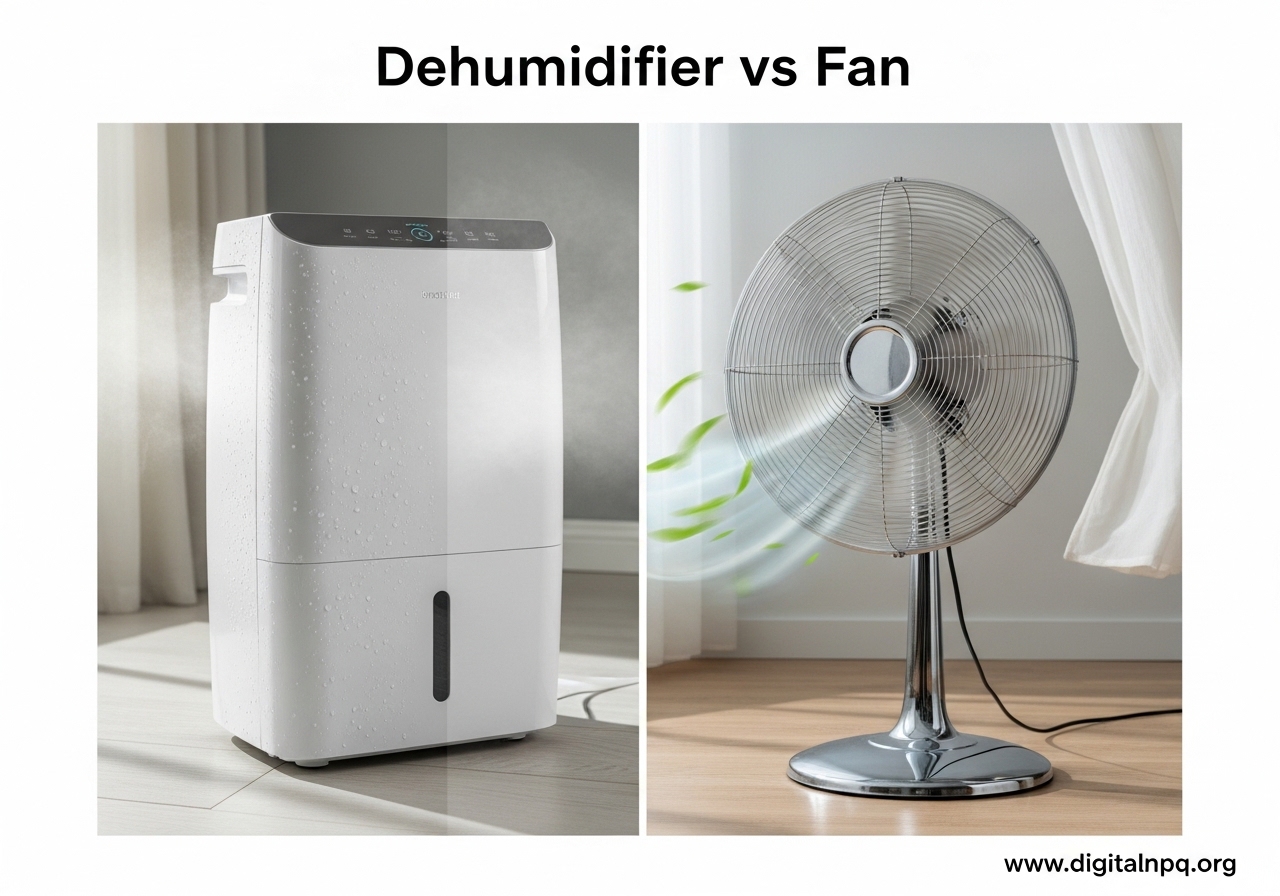
Walk into any damp basement or steamy bathroom and you will face the same question countless homeowners ask: should you reach for a dehumidifier or a fan? The dehumidifier vs fan debate comes up constantly in homeowner forums, and for good reason. Choosing the wrong device wastes money and leaves your space just as humid as before.
I have spent years testing both devices in real homes, from musty crawl spaces to stuffy apartments. The short answer is straightforward: a dehumidifier removes moisture from the air, while a fan simply moves air around. But knowing when each one makes sense depends on your specific situation, your budget, and what you are actually trying to fix.
In this guide, I will break down exactly how each device works, compare them side by side with real numbers, and help you figure out which solution fits your home. Whether you are battling basement condensation, bathroom mold, or just trying to make a room more comfortable, you will have a clear answer by the end.
One important note right up front: if your indoor humidity regularly reads above 60%, a fan alone will not solve the problem. That threshold matters more than most people realize, and I will explain why throughout this article.
How Dehumidifiers Work
A dehumidifier is a device designed to pull excess moisture out of the air. It does not just move air around. Instead, it physically extracts water vapor and collects it in a tank or drains it through a hose. The result is a measurable drop in relative humidity.
Most residential dehumidifiers use a refrigeration process. Here is how it works in plain terms: a fan inside the unit draws warm, humid air from the room. That air passes over cold evaporator coils. When warm air hits cold coils, the moisture condenses into water droplets, just like dew forming on a cold glass on a summer day.
Those water droplets drip down into a collection bucket or flow out through a drain hose. Meanwhile, the now-drier air passes over warm condenser coils and gets reheated before circulating back into the room. The entire cycle runs continuously until the built-in humidistat detects that your target humidity level has been reached.
A typical residential dehumidifier can extract anywhere from 20 to 70 pints of water per day, depending on the model and the conditions. I have seen units pull several gallons of water out of a damp basement in a single 24-hour period. It is genuinely surprising how much moisture can be hiding in the air.
Most modern dehumidifiers include a humidistat that lets you set your desired humidity level. The EPA recommends keeping indoor humidity between 30% and 50%. Once the room hits your target, the compressor shuts off and the unit enters standby mode. This feature saves energy and prevents over-drying the air.
Types of Dehumidifiers
Not all dehumidifiers use the same technology. Here are the three main types you will encounter.
Refrigerant (compressor) dehumidifiers are the most common type for home use. They work exactly as described above, using a compressor and refrigerant coils to condense moisture. They work best in temperatures above 65 degrees Fahrenheit and are rated by how many pints of water they can remove per day. These units handle large spaces and heavy moisture loads effectively.
Desiccant dehumidifiers use a moisture-absorbing material, usually silica gel or a similar desiccant wheel, instead of refrigerant. Air passes through the desiccant material, which absorbs water vapor directly. These units work well in cooler environments where refrigerant models lose efficiency. They are quieter but generally have lower moisture removal capacity.
Thermoelectric (Peltier) dehumidifiers use a small electronic component that creates a temperature difference, causing condensation. These are compact, extremely quiet, and best suited for small spaces like closets or small bathrooms. They remove much less moisture than the other two types, typically just a few ounces per day.
How Fans Work for Moisture Control
A fan moves air. That is its primary function. It does not remove moisture from the air, it does not condense water, and it does not have a collection tank. What a fan does is create airflow, and that airflow can help with humidity in specific, limited ways.
When air circulates, it promotes evaporation from surfaces. If you have condensation on windows or damp spots on walls, a fan can help dry those surfaces faster by moving drier air across them. This is why fans are commonly used in bathrooms after showers: they help evaporate standing water and speed up drying.
Exhaust fans serve a slightly different purpose. A bathroom exhaust fan or kitchen range hood pulls moist air out of the room and vents it outside. This does reduce room humidity, but only because the moist air gets replaced by drier air from elsewhere in the house or from outside. The fan itself is not removing moisture from the air, it is moving humid air out.
Here is the catch that catches many homeowners off guard: if the air outside your home is more humid than the air inside, running an exhaust fan can actually increase indoor humidity. In hot, humid climates, this is a real problem. I have seen forum posts from homeowners in Florida and the Gulf Coast who made their humidity problems worse by running fans that pulled in humid outdoor air.
Regular fans (ceiling fans, pedestal fans, box fans) do not remove moisture at all. They create a wind-chill effect on your skin, making you feel cooler, but the actual humidity level in the room stays the same. If your goal is comfort in a moderately humid room, a fan can help you feel better. If your goal is to actually reduce humidity, a fan will not do the job.
Types of Fans for Indoor Use
Ceiling fans circulate air throughout a room. They are permanent installations that can run continuously with minimal energy use. Some models have a reverse setting for winter use, but neither direction removes humidity from the air.
Pedestal and floor fans are portable units you can position wherever you need airflow. They are inexpensive, easy to move, and effective at drying wet surfaces. They do not reduce overall room humidity.
Exhaust fans are typically installed in bathrooms, kitchens, and laundry rooms. They vent moist air outside through ductwork. For small-scale humidity control in well-sealed rooms, exhaust fans can be effective. They need to be properly vented to the exterior, not into an attic or wall cavity, or you are just moving the moisture problem somewhere else.
Window fans pull air in or push air out through a window. They can help ventilate a room but are completely dependent on the humidity level of the air they are drawing in. On a dry, breezy day, a window fan can help. On a muggy summer evening, it will make things worse.
Dehumidifier vs Fan: Key Differences
This is where the dehumidifier vs fan comparison gets practical. I have tested both devices across dozens of homes, and the differences are significant.
- Moisture removal: A dehumidifier physically extracts water vapor from the air and collects it. A fan moves air around without removing any moisture. This is the fundamental difference that matters most.
- Energy consumption: Dehumidifiers use between 300 and 700 watts when running, depending on size and capacity. Most fans use between 50 and 100 watts. A fan costs roughly one-fifth as much to operate per hour.
- Upfront cost: A quality dehumidifier typically runs between $150 and $350. A good fan costs between $15 and $80. The entry price difference is significant.
- Effectiveness for high humidity: When indoor humidity exceeds 60%, a dehumidifier is the only reliable solution. Fans cannot lower the absolute moisture content of the air.
- Noise level: Dehumidifiers produce 45 to 55 decibels due to the compressor and internal fan. Most standalone fans produce 35 to 50 decibels. Desiccant and thermoelectric dehumidifiers are quieter but less powerful.
- Maintenance: Dehumidifiers require emptying the water tank (unless you use a drain hose) and cleaning the air filter periodically. Fans need occasional blade cleaning and dusting. Dehumidifier maintenance is more hands-on.
- Heat output: Dehumidifiers generate warmth as a byproduct of the refrigeration cycle. A running dehumidifier can raise room temperature by 2 to 5 degrees Fahrenheit. Fans do not add heat to a room.
- Space requirements: Dehumidifiers are larger and need floor space plus clearance for airflow. Fans come in many sizes and are generally more flexible in placement.
- Runtime: Dehumidifiers cycle on and off automatically based on the humidistat setting. Fans typically run continuously until you turn them off manually.
The bottom line: if your goal is to reduce the actual amount of water in the air, a dehumidifier is the right tool. If your goal is to improve air circulation, dry surface moisture quickly, or feel cooler, a fan works well.
When to Use Each Solution
The right choice depends entirely on your situation. Here is room-by-room and situation-by-situation guidance based on what actually works.
Basements and Crawl Spaces
Basements are the number one place where the dehumidifier vs fan question comes up, and the answer is almost always a dehumidifier. Basements are below ground level, surrounded by soil that holds moisture. They tend to stay cool, which means warm humid air from upstairs condenses on cold basement walls and floors.
A fan in a basement just circulates that damp air around. It might help dry condensation on surfaces temporarily, but the overall humidity level stays high. I have seen homeowners run fans in their basements for months with zero improvement in humidity readings.
A dehumidifier is the correct tool here. Set your target humidity to around 45-50% and let it run. If your basement is large, consider a unit rated for at least 50 pints per day. Use the continuous drain option with a hose so you do not have to empty the bucket daily.
Crawl spaces are even more prone to moisture problems. Encapsulating the crawl space and running a dehumidifier is the standard professional recommendation. Fans alone will not cut it in a damp crawl space.
Bathrooms and Laundry Rooms
Bathrooms produce bursts of high humidity during and after showers. An exhaust fan is the first line of defense here. Running the exhaust fan for 20-30 minutes after a shower removes the moist air directly. This works well if the fan is properly vented to the exterior and moves enough air, at least 50 cubic feet per minute for a standard bathroom.
If your bathroom has persistent humidity problems between showers, or if you see mold growing on walls or ceilings despite running the exhaust fan, a small dehumidifier can help. A compact unit rated for 20-30 pints per day is usually sufficient for a bathroom.
Laundry rooms follow similar logic. If your dryer is properly vented outside and you still have humidity issues, a dehumidifier addresses the root cause. A fan just moves the damp air into adjacent rooms.
Living Rooms and Bedrooms
In living spaces, the right answer depends on your humidity level. Get a hygrometer, they cost about $10, and check your readings. If humidity is between 30% and 50%, you are in the ideal range. A fan for air circulation is all you need.
If humidity consistently reads above 55-60% in living areas, you have a whole-house humidity problem. A portable dehumidifier can help individual rooms, but you may want to investigate the root cause: leaks, poor drainage around your foundation, or an undersized air conditioning system.
For bedrooms specifically, noise matters. If you need a dehumidifier running overnight, look for one rated below 45 decibels or consider a desiccant model, which runs quieter than compressor-based units. Some people find the steady hum of a dehumidifier similar to white noise and actually sleep better with one running.
Water Damage and Flood Recovery
After water damage, you need aggressive moisture removal. This is not the time to rely on fans alone. Professionals use commercial dehumidifiers alongside high-powered air movers, and that combination is deliberate.
For home water damage, a dehumidifier is essential. Extract standing water first, then run a dehumidifier continuously until humidity levels return to normal. Fans can help speed up surface drying by circulating air over wet materials, but they cannot remove the water vapor that evaporates into the air. Without a dehumidifier, that moisture just stays in the room.
Forum users from r/homeowners consistently report that dehumidifiers made the real difference during flood recovery. Multiple users noted that fans alone failed to prevent mold growth in the days following water intrusion.
Can You Use a Dehumidifier and Fan Together?
Yes, and in many situations, using both devices together is the best approach. This is something most comparison articles skip, but experienced homeowners and professionals use this combination regularly.
Here is why it works: the dehumidifier removes moisture from the air, while the fan distributes that drier air throughout the room. In a large space or a room with poor natural airflow, a dehumidifier sitting in one corner may take much longer to reduce humidity in the far corners. A fan helps circulate the dry air, making the dehumidifier more effective across the entire space.
The optimal setup is to place the dehumidifier in the area with the highest moisture, then use a fan on low speed to push air toward the dehumidifier. This creates a gentle circulation pattern that brings moist air to the dehumidifier and sends dry air back out across the room.
I have seen this combination drop basement humidity from 75% to 45% in about half the time it took with the dehumidifier alone. Reddit users on r/HVAC and r/basement report similar results, with multiple threads recommending this exact pairing.
A few tips for running both together: keep the fan on a low or medium setting so it does not create so much airflow that it pulls moist air from adjacent spaces. Avoid pointing the fan directly at the dehumidifier intake, which can confuse the humidistat sensor. And monitor your energy use, running both devices will increase your electricity bill compared to running just one.
Cost and Energy Comparison
Cost is one of the biggest factors in the dehumidifier vs fan decision, and the numbers tell a clear story.
Upfront cost: A quality residential dehumidifier costs between $150 and $350. A good fan costs between $15 and $80. If you are on a tight budget, a fan is much easier on the wallet up front.
Monthly energy cost: This is where things get interesting. A typical 50-pint dehumidifier draws about 300-500 watts while running. If it runs 12 hours per day in a humid environment, that translates to roughly $25-50 per month in electricity costs at the national average rate. In extreme humidity conditions, costs can reach $60-80 per month.
A standard fan draws about 50-100 watts. Running a fan 24 hours per day costs roughly $5-10 per month. The energy difference is significant.
Annual cost of ownership: Over a year, running a dehumidifier during the humid season (roughly May through September in most of the US) costs about $125-250 in electricity. A fan over the same period costs about $30-60. Add the upfront cost, and your first-year total for a dehumidifier runs $275-600, compared to $45-140 for a fan.
However, consider what you are getting for that money. A dehumidifier can prevent thousands of dollars in water damage and mold remediation. Mold removal in a single room can cost $500-3,000. Structural damage from prolonged humidity runs even higher. The dehumidifier pays for itself the first time it prevents a mold outbreak.
Energy Star consideration: Look for Energy Star certified dehumidifiers. They use about 15% less energy than non-certified models, which can save $20-40 per year on electricity. Over the 8-10 year lifespan of a dehumidifier, that adds up.
Pros and Cons of Each Device
Here is a quick-reference breakdown to help you weigh the trade-offs.
Dehumidifier Pros
- Actually removes moisture from the air, reducing humidity at the source
- Prevents mold and mildew growth by keeping humidity below 50%
- Automatically cycles on and off with a built-in humidistat
- Protects wood furniture, electronics, and building materials from moisture damage
- Available in sizes for small rooms up to whole-house systems
- Can drain continuously with a hose, reducing maintenance
Dehumidifier Cons
- Higher upfront cost than fans
- Higher energy consumption, adding $25-80 per month to electric bills
- Requires regular maintenance, including emptying the water tank and cleaning filters
- Generates heat as a byproduct, raising room temperature by 2-5 degrees
- Can be noisy, especially compressor models
- Heavier and less portable than fans
Fan Pros
- Very affordable, most quality fans cost under $50
- Low energy consumption, about $5-10 per month to run continuously
- Lightweight and portable, easy to move between rooms
- Quiet operation on low settings
- Provides immediate cooling comfort through airflow
- Helps dry surface moisture and prevents condensation on windows
Fan Cons
- Does not remove moisture from the air at all
- Cannot lower humidity in enclosed or poorly ventilated spaces
- May pull in humid air from outside or adjacent rooms, making problems worse
- Must run continuously for any effect, no automatic shutoff
- Does not address the root cause of humidity problems
- Not effective for spaces with humidity above 60%
One common pain point from forums is worth mentioning: dehumidifier water tanks need frequent emptying in humid conditions. Multiple Reddit users report emptying their tanks once or twice daily. If this is a concern, buy a unit with a drain hose connection and run it to a floor drain or sump pump. Problem solved.
Frequently Asked Questions
Should I get a dehumidifier or a fan?
Get a dehumidifier if your indoor humidity reads above 60% or you notice mold, condensation, or musty smells. Get a fan if you want to improve air circulation and comfort in a room with normal humidity levels (30-50%). For persistent moisture problems, a dehumidifier is always the better investment.
Can a fan replace a dehumidifier?
No, a fan cannot replace a dehumidifier. A fan moves air around but does not remove moisture from it. A dehumidifier physically extracts water vapor and collects it. If you have a real humidity problem (above 60% relative humidity), only a dehumidifier will solve it. A fan can complement a dehumidifier but cannot do its job.
What are the downsides of using a dehumidifier?
The main downsides are higher energy costs ($25-80 per month), the need to empty the water tank regularly, noise from the compressor (45-55 decibels), heat generation that raises room temperature 2-5 degrees, and the higher upfront purchase price compared to fans. Some users also find the maintenance of cleaning filters and draining units inconvenient.
Should a dehumidifier fan run continuously?
No, you should not run a dehumidifier continuously. Set the humidistat to your target humidity (around 45-50%) and let the unit cycle on and off automatically. Running it nonstop wastes energy and can over-dry the air, which causes its own problems like dry skin, cracked wood, and static electricity. Most units run 8-12 hours per day during humid conditions.
Is a fan better than a dehumidifier?
It depends on your goal. A fan is better for air circulation, cooling comfort, and energy savings. A dehumidifier is better for actually reducing humidity, preventing mold, and protecting your home from moisture damage. They serve different purposes. Neither is universally better, but for humidity problems specifically, the dehumidifier wins.
What does the fan setting do on a dehumidifier?
The fan setting on a dehumidifier controls the internal fan that circulates air through the unit. On auto mode, the fan runs only when the compressor is active. On continuous mode, the fan keeps running even when the compressor cycles off. Continuous fan mode helps circulate air and maintain even humidity readings but uses slightly more energy.
Final Recommendation
The dehumidifier vs fan question comes down to what you are trying to accomplish. If you have high humidity, mold concerns, condensation problems, or water damage, a dehumidifier is the only device that actually removes moisture from the air. A fan cannot do that, no matter how long you run it.
If your space has normal humidity levels and you just want better air movement and comfort, a fan is the simpler, cheaper choice. It uses far less energy and requires almost no maintenance.
For many homeowners, the best approach is using both. A dehumidifier handles the moisture removal while a fan distributes the dry air, speeding up the process and making the whole system more efficient. This combination is what professionals use, and it is what I recommend for basements, crawl spaces, and any room with persistent humidity above 60%.
Buy a $10 hygrometer first. Measure your humidity. If it reads above 60%, get a dehumidifier. If it reads between 30-50% and you just want better airflow, get a fan. That one measurement will answer the question for you.