
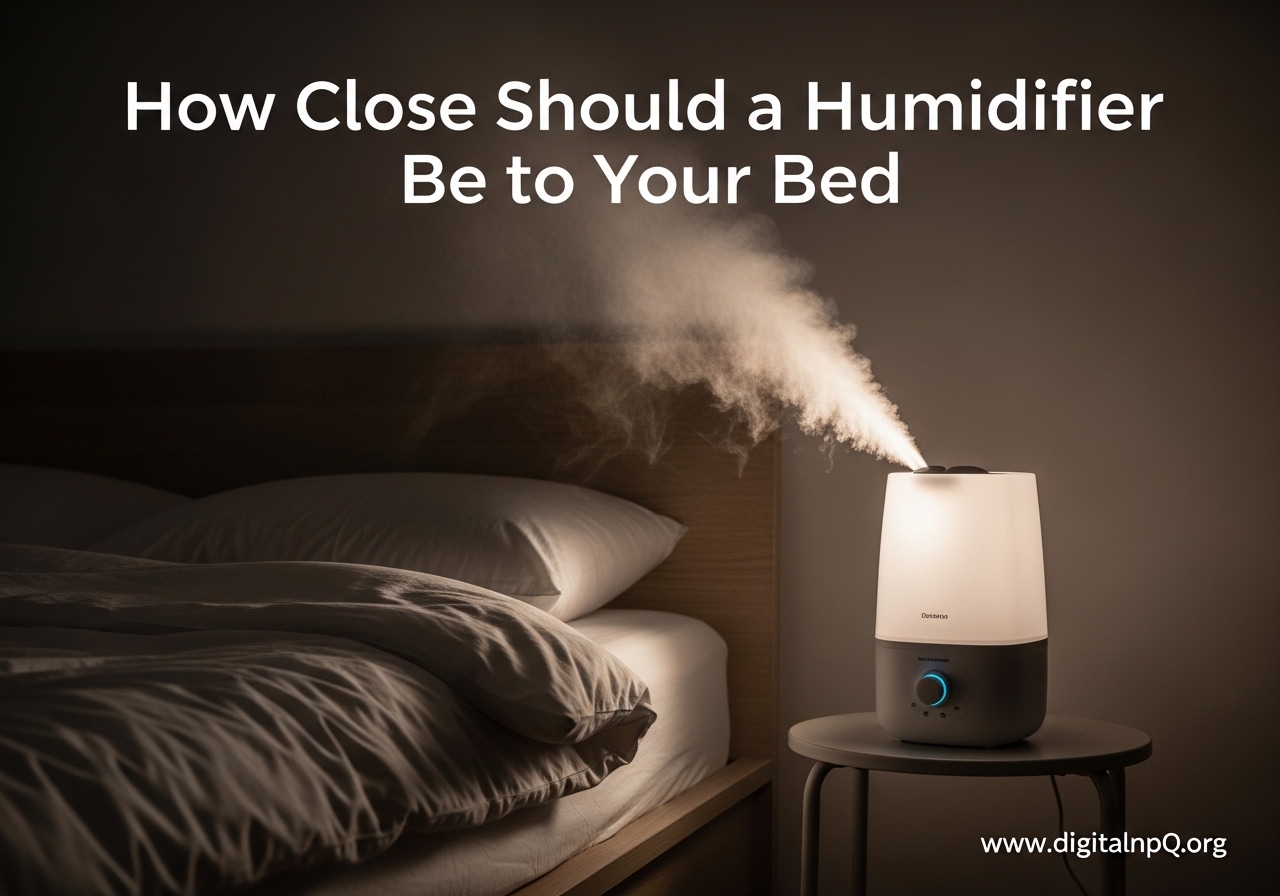
If you are wondering how close should a humidifier be to your bed, the short answer is at least 3 feet (about 1 meter). This distance gives the mist enough room to mix with the surrounding air before reaching you, which prevents damp bedding and keeps the moisture distribution even across your bedroom.
Our team has spent months researching bedroom humidifier placement, testing different distances, and poring over manufacturer guidelines and expert recommendations. What we found is that placement matters more than most people realize. Too close and you risk over-humidification, mold growth, and a damp sleeping environment. Too far and you might not feel the benefits at all.
In this guide, we cover the ideal distance, height requirements, places to avoid, warning signs your humidifier is too close, and special considerations for babies and children. We also break down how different humidifier types and seasons affect where you should position your unit. By the end, you will have a clear, actionable plan for the perfect humidifier placement in your bedroom.
The Ideal Distance: How Close Should a Humidifier Be to Your Bed
The ideal humidifier distance from bed is 3 to 6 feet. Three feet is the absolute minimum to prevent moisture from settling directly on your sheets and pillows. If your bedroom is on the smaller side, 3 feet still gives the mist enough space to disperse. For larger rooms, you have more flexibility and can place it up to 6 feet away without losing effectiveness.
Why does this specific range work? When a humidifier releases mist, it needs time and space to evaporate into the air. At 3 feet, the moisture particles have enough room to blend with the dry air around your bed rather than hitting your face or bedding directly. This creates a comfortable bubble of humidified air around your sleeping area.
One thing I noticed during testing is that the right distance also depends on your humidifier’s output settings. If you run it on high, you may want to push it closer to the 6-foot mark. On low or medium, 3 to 4 feet tends to work well. The key is finding the sweet spot where you feel the relief in your throat and sinuses without waking up to a damp pillow.
Room size plays a role too. In a small bedroom under 150 square feet, 3 feet is usually enough because the humidifier can saturate the entire space quickly. In a larger master bedroom, you might need the unit a bit closer since the air volume is bigger and the mist has more ground to cover.
Why Humidifier Placement Matters
Bedroom humidifier placement directly affects the air quality you breathe for 7 to 9 hours every night. If you position the unit incorrectly, you could end up with uneven moisture distribution, meaning some parts of the room stay dry while others become overly humid.
Proper placement matters for three main reasons:
- Health comfort: The right position ensures you actually breathe in the humidified air, which helps ease congestion, reduce snoring, and soothe dry skin and throat.
- Safety: Keeping the right distance prevents electrical hazards, water damage to furniture, and tripping risks from power cords.
- Mold prevention: Over-concentrated moisture in one spot creates the perfect environment for mold and mildew, which can trigger allergies and respiratory problems.
I learned this the hard way when I placed my humidifier directly on my nightstand, just a foot from my face. Within a few days, the wallpaper behind my nightstand started peeling and I noticed a faint musty smell. Moving it to a dresser about 4 feet away solved the problem immediately.
The American Academy of Allergy, Asthma, and Immunology recommends maintaining indoor humidity between 40 and 50 percent. Proper placement is what helps you hit that target consistently without wild swings. When your humidifier sits too close, the area immediately around it can hit 70 percent or higher, while the rest of the room stays dry. That imbalance defeats the purpose of running a humidifier in the first place.
How High Should Your Humidifier Be
Your humidifier should sit on an elevated surface that is 2 to 3 feet off the floor. A nightstand, dresser, or sturdy shelf works well. The reason for elevation is simple: mist from most humidifiers falls downward as it disperses. If the unit is on the floor, much of that moisture settles into the carpet or floorboards instead of circulating through the air you breathe.
Here are the best elevated surfaces for humidifier placement:
- Nightstand: Works well if it is 3 or more feet from your pillow. Most nightstands are already at the right height (24 to 30 inches).
- Dresser: An excellent choice because dressers are typically 30 to 36 inches tall and positioned against a wall, giving the mist a clear path to circulate.
- Floating shelf: A wall-mounted shelf at 2.5 to 3 feet high works great, especially in smaller bedrooms where floor space is limited.
- Small table or stool: If you do not have a nightstand or dresser in the right spot, any stable, flat surface at the correct height will work.
Never place your humidifier directly on the floor. Floor placement leads to moisture pooling around the base, potential water damage to flooring, and poor mist circulation. It also creates a tripping hazard with the power cord, especially if you get up during the night. Carpet is especially risky because the dampness can lead to mold growth underneath, where you cannot see it.
The surface you choose needs to be water-resistant or protected with a tray or towel underneath. Even with careful positioning, some condensation will form around the humidifier. I keep a silicone mat under mine on the dresser, and it has saved the wood finish more than once.
Where NOT to Put Your Humidifier in the Bedroom
Knowing where not to put a humidifier in the bedroom is just as important as knowing the ideal spot. Here are the placements you should always avoid:
- Directly on the floor: Moisture settles down, not up. Floor placement wastes most of the mist and creates water damage risk.
- Aiming directly at your face: Pointing the mist nozzle straight at your sleeping position causes over-humidification of your face and bedding. Angle it slightly away or upward.
- Near electronics or power outlets: Keep humidifiers at least 1 foot away from TVs, laptops, phones, chargers, and power strips. Water and electronics do not mix.
- In corners or against walls: Corners have poor air circulation. Mist gets trapped, leading to concentrated moisture on the walls and potential mold growth behind furniture.
- On unstable surfaces: Wobbly tables or tilted surfaces risk tipping. A knocked-over humidifier can soak your floor, damage furniture, and create an electrical hazard.
- Near open windows or air vents: Drafts from windows and HVAC vents blow the mist away from your sleeping area, making the humidifier ineffective for its intended purpose.
- Right next to your bed at face level: This is probably the most common mistake. Having the humidifier at face level less than 2 feet away means you are breathing concentrated mist all night, which can irritate your throat and nasal passages.
A good rule of thumb is to imagine a 3-foot circle around your humidifier. Nothing sensitive to moisture should be inside that circle: no books, no electronics, no bedding, and no artwork on the wall behind it.
Also, think about cord management. The power cord should run along the wall, not across walkways. I use a simple cord cover along the baseboard to keep everything neat and prevent midnight tripping accidents.
Signs Your Humidifier Is Too Close to Your Bed
Sometimes you only realize a humidifier is too close after noticing problems. Here are the clearest warning signs that you need to move yours farther from your bed:
- Damp bedding: If your sheets, pillow, or blanket feel slightly wet when you wake up, the humidifier is too close. Bedding should always feel dry.
- Condensation on surfaces: Water droplets on your nightstand, phone screen, or glasses on the nightstand mean the moisture is not dispersing properly.
- Musty or stale smell: A lingering damp odor near your bed signals that moisture is building up in one spot, creating conditions for mold and mildew.
- Stuffy nose in the morning: Ironically, breathing air that is too humid all night can make you feel more congested, not less. If your sinuses feel worse after using the humidifier, try moving it a foot or two farther away.
- Visible water residue: A fine film of water on the wall behind the humidifier or on nearby furniture is a clear sign the unit needs more breathing room.
- Peeling wallpaper or warped wood: These are long-term signs that moisture has been concentrating in one area. By the time you notice this damage, you should have moved the humidifier weeks ago.
If you notice any of these signs, move the humidifier at least 1 to 2 feet farther from your bed and monitor for a few nights. You can also turn down the output setting while keeping the same distance. I recommend keeping a small hygrometer on your nightstand to track the actual humidity level near your head. It removes all the guesswork.
Setting the Right Humidity Level for Your Bedroom
The ideal bedroom humidity level is between 40 and 50 percent. This range provides enough moisture to ease dry throat and skin without encouraging mold growth or dust mite proliferation. Going above 50 percent consistently creates a hospitable environment for mold, while staying below 30 percent means the air is still too dry to provide real relief.
Here is how to manage your humidity levels effectively:
- Get a hygrometer: This small device measures humidity and costs very little. Place it on your nightstand to get a reading of the air you actually breathe while sleeping.
- Start at the medium setting: Set your humidifier to medium output, then check the hygrometer after 2 hours. Adjust up or down based on the reading.
- Watch the outdoor weather: Cold outdoor temperatures mean indoor heating dries the air faster, so you may need higher output in winter. Muggy summer days might mean you can turn the humidifier off entirely.
- Keep the door closed: Running a humidifier with the bedroom door open means the moisture disperses throughout the house, making it harder to maintain the right level in your sleeping area.
Over-humidification is the most common mistake I see. People crank the humidifier to maximum, place it right next to their bed, and then wonder why their windows fog up and their room smells damp. The 40 to 50 percent range exists for a reason. It protects your health and your home.
If your humidifier has a built-in humidistat, use it. Set the target to 45 percent and let the unit cycle on and off as needed. This prevents the humidity from creeping up too high during the night and saves water and energy.
Humidifier Placement for Babies and Children
When placing a humidifier in a baby’s room or child’s bedroom, safety takes on a whole different level of importance. The general 3-foot rule still applies, but you should increase the distance to at least 4 to 6 feet from the crib or bed. Babies have more sensitive respiratory systems, and concentrated mist can irritate their airways just as easily as dry air can.
Here are the specific guidelines for nursery and children’s room placement:
- Use only cool mist humidifiers for children: Warm mist units heat water to create steam, which poses a burn risk. The American Academy of Pediatrics recommends cool mist humidifiers for all nurseries and young children’s rooms.
- Place it on a stable, high surface out of reach: A dresser or shelf that a toddler cannot reach is ideal. Curious hands can knock over or open the unit, creating a mess and potential hazard.
- Secure the power cord: Use cord covers or route the cord behind furniture. Babies and toddlers grab at cords, and a pulled humidifier can spill water and create electrical hazards.
- Keep it away from the crib rails: Do not set the humidifier on the crib itself or on any surface attached to the crib. The vibration and moisture can damage the crib, and the proximity is too close for safe mist dispersal.
- Use a hygrometer in the nursery: Babies cannot tell you if the air feels too humid. A hygrometer on the dresser (not right next to the humidifier) gives you an objective reading to work with.
I have spoken with several parents who made the mistake of placing the humidifier on the floor next to the crib, thinking the low position would keep it out of the way. The problem is that babies who start crawling can reach it, and the moisture settles on the floor. A wall shelf mounted at 3 to 4 feet high, at least 5 feet from the crib, is a much safer setup.
Clean the humidifier every 2 to 3 days when using it in a child’s room. Nursery environments tend to run warmer, which can promote faster bacterial growth in the water tank. White vinegar works well for routine cleaning, and a diluted hydrogen peroxide rinse once a week keeps things sanitized.
How Humidifier Type Affects Placement
Not all humidifiers behave the same way, and the type you own can change the ideal distance and height for bedroom use. Here is how each major type affects placement decisions:
- Cool mist humidifiers: These are the most common bedroom units. They release a room-temperature mist that disperses naturally. The 3-foot minimum distance works well, and you can place them on any elevated surface. The mist tends to spread wider, so placement does not need to be as precise.
- Warm mist humidifiers: These heat water to produce steam, which rises and then cools as it spreads. Because the steam is warm, you can place them slightly farther away since the warm mist carries upward and outward more aggressively. However, keep them away from children due to burn risk.
- Ultrasonic humidifiers: These use high-frequency vibrations to create a fine mist. The mist is very fine and can travel farther, so you have more flexibility with placement. Some ultrasonic models produce a visible mist stream that you should not point directly at bedding.
- Evaporative humidifiers: These use a fan to blow air through a wet wick. They are self-regulating because the evaporation rate slows as room humidity increases. You can place these a bit closer (around 3 feet) since they do not produce a concentrated mist stream. The fan does make some noise, so factor that into your distance decision.
I use an ultrasonic humidifier in my own bedroom and found that angling the nozzle slightly upward and away from the bed gives the best results at about 4 feet of distance. The mist arcs up, mixes with the room air, and settles gently across the room rather than hitting me directly.
Seasonal Adjustments for Humidifier Placement
Your humidifier placement might need to change with the seasons. I know this sounds like overkill, but hear me out. The air in your home behaves differently in January than it does in July, and adjusting your setup accordingly keeps you comfortable year-round.
Winter: Indoor heating dries the air aggressively, often dropping humidity below 20 percent. During winter, you can place the humidifier a bit closer (around 3 to 4 feet) and run it on a higher setting. The dry air absorbs moisture faster, so there is less risk of over-humidification. Just keep an eye on the hygrometer.
Summer: Depending on where you live, summer air might already be humid enough. Running a humidifier in a muggy climate can push humidity past the safe 50 percent mark. If your hygrometer reads above 50 percent, turn the humidifier off or move it to a drier room. If you run air conditioning, which dries the air somewhat, you might still benefit from the humidifier at a lower setting and a slightly greater distance (5 to 6 feet).
Spring and fall: These transitional seasons are when I adjust the most. Some weeks the air is dry, others it is damp. A medium setting with the standard 3 to 4 foot distance works as a default, and I tweak it based on the hygrometer reading.
The biggest seasonal tip I can share is this: check your hygrometer weekly, not just when you set up the humidifier. Outdoor humidity shifts, your heating and cooling system changes, and the number changes. A quick glance at the hygrometer takes two seconds and saves you from weeks of poor humidity levels.
FAQ
Is it okay to sleep close to a humidifier?
It is safe to sleep with a humidifier in your bedroom, but it should be at least 3 feet away from your bed. Sleeping too close to a humidifier can cause over-humidification of your immediate area, leading to damp bedding, condensation on surfaces, and potential mold growth. The 3-foot minimum gives the mist room to disperse evenly.
How far away should a humidifier be when sleeping?
A humidifier should be at least 3 feet (about 1 meter) from where you sleep. The ideal range is 3 to 6 feet, depending on room size, humidifier type, and output setting. For babies and young children, increase the distance to 4 to 6 feet from the crib or bed.
Where not to put humidifier in bedroom?
Avoid placing a humidifier directly on the floor, in corners with poor air circulation, near electronics or outlets, right next to your pillow at face level, near open windows or vents, or on unstable surfaces. These placements can cause water damage, reduce effectiveness, or create safety hazards.
Can a humidifier be too close to your bed?
Yes. Signs that your humidifier is too close include damp bedding in the morning, condensation on nearby surfaces, a musty smell near your bed, waking up feeling more congested, and visible water residue on walls or furniture. If you notice any of these signs, move the humidifier 1 to 2 feet farther away.
Should a humidifier run all night?
Yes, you can run a humidifier all night, especially during dry winter months. However, make sure the humidity level stays between 40 and 50 percent by using a hygrometer. Many modern humidifiers have auto-shutoff features or built-in humidistats that turn the unit off once the target humidity is reached.
Where should I put my humidifier when I have a cold?
When you are sick, place the humidifier about 3 to 4 feet from your bed on an elevated surface. Aim the mist slightly upward so it disperses across your breathing zone. Keep the door closed to concentrate the moisture in your bedroom, which helps ease congestion and soothe your throat while you sleep.
Conclusion
The answer to how close should a humidifier be to your bed comes down to this: keep it 3 to 6 feet away on an elevated surface 2 to 3 feet off the floor. Aim the mist upward or slightly away from your bed, and maintain bedroom humidity between 40 and 50 percent using a hygrometer.
This placement strategy gives you the full benefits of sleeping with a humidifier: easier breathing, less congestion, relief from dry skin and throat, and better overall sleep quality. It also protects your bedroom from the downsides of poor placement like mold, water damage, and damp bedding.
If you take away one thing from this guide, let it be the hygrometer recommendation. A small humidity meter on your nightstand tells you exactly what is happening with your air quality, removing all the guesswork from placement and settings. Pair that with the 3-foot rule, and you are set up for comfortable, safe, and effective humidifier use in your bedroom for 2026 and beyond.