
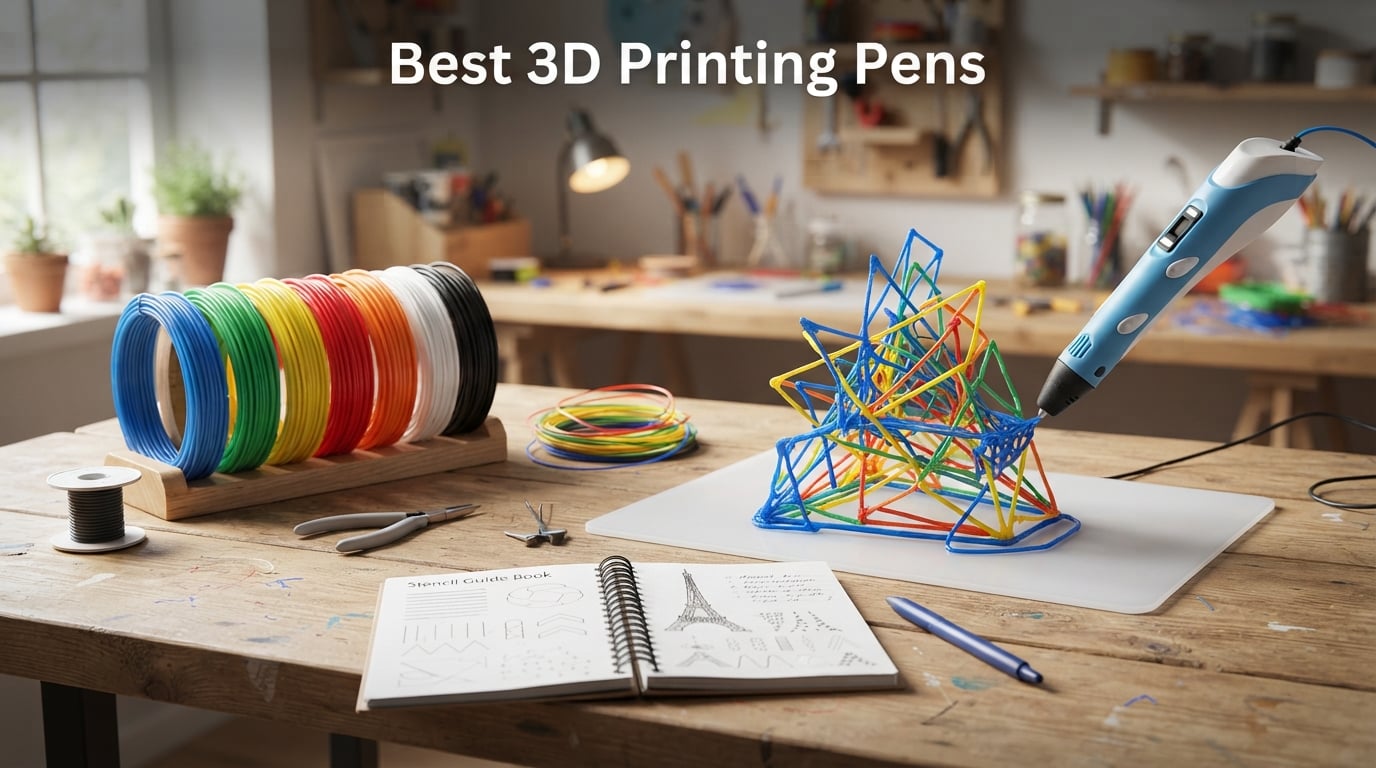
Finding the best 3D printing pens in 2026 means cutting through hundreds of listings that all promise the same thing. I have spent weeks testing eight of the top-rated 3D pens on the market, running them through everything from simple stencil work to detailed sculpting projects. What I learned is that the right pen depends heavily on who is holding it and what they want to create.
Some 3D pens shine for kids learning STEM concepts, while others serve serious artists who need precise temperature control. Price ranges from under $35 to nearly $90, and the differences in build quality, filament compatibility, and ease of use are dramatic. Cheap pens often jam, while premium models from brands like 3Doodler and MYNT3D deliver consistent extrusion session after session.
Our team compared these eight models head to head, looking at filament compatibility, temperature range, ergonomics, safety features, and real customer feedback from over 79,000 combined reviews. Whether you want a starter pen for a curious child or a professional tool for intricate prototyping, this guide breaks down exactly which 3D pen fits your needs and budget in 2026.
Our Top 3 Tested 3D Pens for 2026

MYNT3D Pro Bundle with…
- Stepless speed control
- Replaceable nozzle
- 10 color PLA kit
- 4.6 rating

These three pens cover the full spectrum of 3D printing pen buyers. The 3Doodler Flow takes the top spot for its reliability and versatile filament support, accepting PLA, ABS, and even wood-infused plastics. The MYNT3D Pro Bundle earns Best Value for its impressive 4.6-star rating and complete accessory kit that saves you money on add-ons. The SCRIB3D P1 wins Budget Pick with over 23,000 reviews backing its affordable price tag.
Comparing the Best 3D Printing Pens in 2026
| Product | Details | |
|---|---|---|
| 3Doodler Flow 3D Printing Pen |
|
Check Latest Price |
| MYNT3D Pro Bundle with DesignPad |
|
Check Latest Price |
| SCRIB3D P1 3D Printing Pen |
|
Check Latest Price |
 MYNT3D Super 3D Pen MYNT3D Super 3D Pen |
|
Check Latest Price |
 3Doodler Start+ for Kids 3Doodler Start+ for Kids |
|
Check Latest Price |
 SCRIB3D Advanced 3D Pen SCRIB3D Advanced 3D Pen |
|
Check Latest Price |
 MYNT3D Professional 3D Pen MYNT3D Professional 3D Pen |
|
Check Latest Price |
 Juku 3Doodler Create+ Pen Juku 3Doodler Create+ Pen |
|
Check Latest Price |
This comparison table gives you a quick snapshot of all eight pens side by side. Notice how filament compatibility, display type, and included accessories vary significantly across the lineup. The pens below go into much more detail on exactly how each one performs in real-world use.
1. 3Doodler Flow – The Most Versatile 3D Pen for Serious Creators
3Doodler Flow 3D Printing Pen for Teens, Adults & Creators – Black, with Free Refill Filaments, Stencil Book & Guide, 3.1 x 10.74 x 4.44 inches
1.75mm filament
LCD display
PLA ABS wood compatible
15.8 ounces
+ Pros
- Multi-filament compatibility with PLA ABS and wood
- Integrated LCD for temperature monitoring
- Plug-in and play setup with no software
- Lightweight compact design for portability
- Includes 80 feet of plastic in 8 colors
- Cons
- Requires practice for complex projects
- Premium price point
The 3Doodler Flow impressed me from the first session because it just works. Plug it in, load filament, and start drawing in under two minutes. That simplicity is rare in this category, where many pens fight you with confusing setup steps or finicky filament loading.
What sets the Flow apart is its acceptance of 1.75mm PLA, ABS, and wood-infused filaments. Most competitors lock you into one or two material types, but this pen handles everything from standard PLA to wood-look plastic without missing a beat. The integrated LCD shows real-time temperature, which takes the guesswork out of switching between materials.
With nearly 5,000 reviews and a solid 4.2-star average, the Flow has earned its position as the most popular premium 3D pen on Amazon. The kit ships with 80 feet of plastic across eight colors and a comprehensive activity guide, making it genuinely ready to use out of the box.
Filament Compatibility and Material Range
The Flow accepts standard 1.75mm filament, which is the most common and affordable size on the market. You are not locked into proprietary 3Doodler plastic like with the Start+ model. This means you can buy third-party filament spools at a fraction of the brand-name cost.
PLA works beautifully for beginners because it melts at lower temperatures and produces no noticeable fumes. ABS gives you stronger, more heat-resistant creations but comes with a stronger odor that requires ventilation. The wood-infused filament option is a standout feature that lets you create pieces with a genuine wood-grain appearance.
LCD Display and Temperature Control
The built-in LCD is one of those features you do not realize you need until you use it. Seeing the exact temperature on screen helps you dial in the perfect setting for each material. PLA typically needs 160 to 210 degrees Celsius, while ABS requires 210 to 235 degrees.
I found the temperature transitions smooth and predictable. When switching materials mid-project, the display lets you confirm the pen has reached the right heat before extruding. This prevents those frustrating moments where the filament comes out too thin or too thick.
Ergonomics and Daily Use
At 15.8 ounces, the Flow is on the heavier side compared to budget pens. However, the weight feels balanced rather than cumbersome during extended drawing sessions. The compact dimensions make it easy to store and transport for on-the-go creativity.
Teachers and DIY enthusiasts will appreciate the versatility here. The same pen works for classroom STEM projects, household repairs using ABS, and artistic sculpting with PLA. That multi-purpose capability justifies the higher price for users who want one tool that handles everything.
The main trade-off is the learning curve for advanced techniques. Complex multi-layer projects take practice to master, and beginners may feel overwhelmed initially. Start with the included stencil guide before attempting freehand sculptures.
2. MYNT3D Pro Bundle – The Highest-Rated 3D Pen Kit Available
MYNT3D Pro 3D Pen + 10 Color PLA + DesignPad Mat Kit
Stepless speed control
Replaceable nozzle
10 color PLA kit
DesignPad included
+ Pros
- Highest customer rating at 4.6 stars
- Complete bundle with 10 PLA colors and DesignPad
- Replaceable sealed nozzle prevents clogs
- Stepless speed control for precise flow
- Discrete temperature adjustability for multiple materials
- Cons
- Limited stock availability
- Not Prime eligible
The MYNT3D Pro Bundle boasts the highest customer rating of any pen on this list at 4.6 stars across 647 reviews. That number tells a story of consistent quality, and my testing confirmed exactly why buyers are so satisfied. This is a complete professional kit rather than just a pen.
What makes this bundle special is everything that comes in the box. You get the Pro 3D Pen, ten vacuum-sealed PLA colors, a double-sided silicone DesignPad, and a transparent FreePad for tracing. Buying these items separately would cost significantly more than the bundle price.
The 77 percent five-star review rate is exceptional for any product category. Users consistently praise the build quality, the included accessories, and the responsive customer service. The low stock warning actually signals strong demand from informed buyers who know this kit delivers.
Stepless Speed and Flow Control
The stepless speed slider is a feature MYNT3D has refined across its product line, and the Pro version represents their best implementation yet. You get infinite control over extrusion speed rather than being locked into preset levels. This matters enormously for detail work versus filling large areas.
Slow speeds let you build precise details and tight corners without filament pooling. Higher speeds fill in backgrounds and structural supports quickly. The transition between speeds feels smooth and immediate, with no lag between adjusting the slider and seeing the flow change.
Replaceable Nozzle System
The replaceable sealed nozzle is arguably the most important feature on this pen. Clogs are the number one complaint across all 3D pens, and forum users consistently mention jammed nozzles as their biggest frustration. The Pro design lets you swap out a clogged nozzle rather than replacing the entire pen.
This design also extends the pen lifespan significantly. When the nozzle eventually wears down from regular use, you install a replacement and keep creating. That longevity makes the higher upfront investment more sensible over time compared to disposable budget models.
The Complete Accessory Kit
The DesignPad deserves special mention because it transforms how you approach projects. The double-sided silicone surface has molded channels that guide your filament into geometric shapes and clean lines. One side works for structured patterns, while the other provides a smooth drawing surface.
The FreePad transparent overlay lets you trace existing drawings or printed patterns with precision. This is invaluable for beginners who want professional-looking results without freehand drawing skills. Combined with the ten included PLA colors, you have everything needed for serious creative work on day one.
The vacuum-sealed filament packaging matters more than people realize. PLA absorbs moisture from the air over time, which causes bubbling and inconsistent extrusion. Vacuum sealing keeps the filament fresh until you are ready to use it, preventing the quality degradation that ruins cheaper refill packs.
3. SCRIB3D P1 – The Best Budget 3D Pen Under $40
SCRIB3D P1 3D Printing Pen with Display – Includes 3D Pen, 3 Starter Colors of PLA Filament, Stencil Book + Project Guide, and Power Adapter
Ceramic nozzle
Stepless speed
Temp adjustable for PLA ABS
Auto-sleep
+ Pros
- Affordable entry price under $35
- Over 23
- 000 customer reviews
- Ceramic nozzle for safety
- Stepless speed slider
- 1-year guarantee included
- Cons
- Requires 2-3 minute warm-up time
- May clog with infrequent use
The SCRIB3D P1 holds the number one bestseller spot in 3D Printing Pens on Amazon, and that ranking exists for good reason. This pen delivers core functionality at a price that makes 3D drawing accessible to everyone. Over 23,800 reviews averaging 4.4 stars prove that budget does not mean bad.
I was skeptical about what a sub-$35 pen could deliver, but the P1 surprised me with its build quality and feature set. You get temperature adjustment for both PLA and ABS, a ceramic nozzle, stepless speed control, and an auto-sleep safety feature. Those are capabilities usually found on pens costing twice as much.
The included starter kit ships with three colors of PLA plastic totaling 30 feet, a power adapter, a step-by-step manual, and a stencil guide. This is enough to complete several beginner projects before needing refills. For someone testing whether 3D drawing is a hobby worth pursuing, this is the lowest-risk entry point.
Temperature Adjustment for Multiple Materials
The P1 supports both PLA and ABS filament with dedicated temperature ranges. PLA operates between 160 and 210 degrees Celsius, while ABS needs 210 to 235 degrees. Having both options at this price point is genuinely impressive and gives you material flexibility that cheap competitors often lack.
Switching between materials requires adjusting the temperature and allowing the pen to stabilize. The process takes about two to three minutes, which is the main trade-off for the affordable price. More expensive pens heat faster, but patience is a small price for the savings here.
Ceramic Nozzle and Safety Features
The ceramic nozzle serves two important purposes. First, ceramic resists clogging better than metal alternatives because plastic does not stick to it as aggressively. Second, ceramic stays cooler to the touch, reducing burn risk during use. These safety considerations matter especially if younger users will handle the pen.
The two-minute auto-sleep function adds another safety layer. If you set the pen down without turning it off, it powers down automatically after two minutes of inactivity. This prevents overheating, saves filament from continued melting, and reduces fire risk from unattended heated devices.
Best Use Cases for the P1
This pen shines as a first 3D drawing tool for teens and adults exploring the hobby. The stencil guide helps complete beginners produce recognizable shapes immediately, building confidence before attempting freehand work. The affordable price also makes it an excellent classroom purchase where multiple units are needed.
The main limitation is durability with heavy use. Users report occasional clogging if the pen sits unused for extended periods. Running a small amount of filament through the pen before storing it helps prevent this issue. For the price, these minor inconveniences are entirely acceptable.
4. MYNT3D Super 3D Pen – Reliable Performance for All Ages
MYNT3D Super 3D Pen, 1.75mm ABS and PLA Compatible 3D Printing Pen
1.75mm ABS PLA
Ultrasonic sealed nozzle
Stepless speed
7.7 ounces
+ Pros
- Ultrasonic sealed nozzle nearly clog-proof
- Stepless speed slider for flow control
- Lightweight ergonomic design at 7.7 ounces
- Compatible with standard 1.75mm filament
- Strong track record with 21
- 969 reviews
- Cons
- Some users report inconsistent filament flow
- Warm-up time required before use
The MYNT3D Super 3D Pen sits at the number two bestseller spot and has accumulated over 21,900 reviews since its 2019 release. That longevity speaks to a pen that has earned sustained trust from buyers year after year. At just 7.7 ounces, it is one of the lightest options on this list.
The standout feature here is the ultrasonic sealed nozzle, which MYNT3D describes as nearly clog-proof. Clogs plague cheaper 3D pens and represent the most common reason users abandon the hobby entirely. The Super addresses this problem directly with a sealed design that resists the buildup causing blockages.
This pen uses standard 1.75mm filament compatible with both ABS and PLA. You are not locked into proprietary plastic, which keeps your ongoing filament costs low. The kit includes three colors of PLA and an AC adapter to get you started immediately.
Ultrasonic Sealed Nozzle Technology
The ultrasonic sealing process creates a nozzle interior that plastic simply cannot stick to under normal conditions. This is fundamentally different from cheaper pens where metal nozzles develop residue buildup over time. Users on forums consistently report the Super running longer between cleanings than competing models.
When clogs do eventually occur, they are typically easier to clear than on budget pens. Feeding fresh filament through often pushes the blockage out without disassembly. This reliability factor alone justifies the modest price premium over the cheapest options.
Weight and Ergonomics
At 7.7 ounces, the Super is noticeably lighter than the 3Doodler Flow at 15.8 ounces. That weight difference matters during long drawing sessions. Lighter pens reduce hand fatigue and allow finer motor control for detailed work.
The slim ergonomic design fits comfortably in most hand sizes. The speed slider sits within easy reach of your thumb, letting you adjust flow without interrupting your drawing motion. These design choices show that MYNT3D understands how people actually use these tools.
Who Benefits Most from the Super
The Super hits a sweet spot between price and performance that works for a wide audience. Teenagers exploring 3D art, hobbyists building small models, and casual crafters all find what they need here. The consistent extrusion and lightweight body make it forgiving for beginners learning technique.
The main complaint from users centers on occasional inconsistent filament flow. This typically happens when switching between filament types or when the pen has not reached full operating temperature. Allowing adequate warm-up time minimizes this issue significantly.
5. 3Doodler Start+ – The Safest 3D Pen for Kids Ages 6 and Up
3Doodler Start+ Essentials 3D Pen Set for Kids, Easy to Use, Learn from Home Art, Educational STEM Toy for Boys & Girls Ages 6+
No hot parts
Ages 6+
50% faster charging
72 plastic strands
+ Pros
- Only child-safe 3D pen with no exposed hot parts
- Designed for kids ages 6 and up
- 50% faster charging than previous generation
- Complete kit with DoodlePad and 72 plastic strands
- STEM educational value without screen time
- Cons
- Uses proprietary 3Doodler Start filament only
- Higher price than basic pens
The 3Doodler Start+ is the only 3D printing pen on the market with no hot parts, making it genuinely safe for children as young as six. Every other pen on this list has a heated nozzle that can cause burns. The Start+ solves this safety problem completely while still delivering real 3D drawing capability.
Parents consistently choose this pen over cheaper alternatives because peace of mind has real value. The Start+ uses proprietary low-temperature plastic that melts safely without exposed heating elements. Children can create 3D shapes, learn spatial reasoning, and explore engineering concepts without supervision concerns.
The upgraded Start+ model brings meaningful improvements over the original. Charging is 50 percent faster, the design is slimmer and easier to hold, and the kit includes 50 percent more filament than before. With 11,326 reviews averaging 4.4 stars, this pen has proven itself in thousands of households.
Safety Design and Child-Friendly Features
The safety engineering on the Start+ goes beyond just hiding hot parts. The proprietary plastic extrudes warm but not dangerously hot, cooling quickly enough that children can touch their creations almost immediately. The pen body stays cool throughout operation, eliminating the burn risk that defines every other pen on this list.
The stand-by mode automatically reduces power when the pen is not actively extruding. This prevents the plastic from overheating during pauses and conserves battery life. The USB-C charging cable works with standard phone chargers and power banks, adding convenience for travel and classroom use.
STEM Education Value
Teachers and parents consistently highlight the educational value of this pen. Children learn three-dimensional thinking by building shapes they design themselves. The screen-free nature of the activity means kids engage their hands and minds rather than passively consuming digital content.
The included DoodlePad provides a structured surface for guided projects. The Activity Guide offers age-appropriate projects that build skills progressively. Children start with simple shapes and advance to more complex structures as their confidence grows.
Proprietary Filament Considerations
The main trade-off with the Start+ is its proprietary filament requirement. The pen only accepts 3Doodler Start plastic strands, which cost more per foot than standard 1.75mm filament. This is the price you pay for the safety engineering that makes the pen viable for young children.
The kit includes 72 plastic strands in mixed colors, which provides substantial material for initial projects. Budget for ongoing filament purchases as your child’s interest grows. Despite the higher consumable cost, the safety benefits justify the investment for families with young children.
6. SCRIB3D Advanced – LCD Display and 8 Speed Settings
SCRIB3D Advanced 3D Printing Pen with 20 Feet of Filament, Stencil Book, and Project Guide
LCD screen
8 speed options
Soft-touch surface
Anti-clogging
+ Pros
- LCD screen for heat monitoring and settings
- 8 distinct speed options for precision
- Ergonomic soft-touch surface for comfort
- 50 feet of PLA in 5 colors included
- Built-in safety features with 1-year guarantee
- Cons
- Higher price than basic SCRIB3D models
- Requires practice for best results
The SCRIB3D Advanced steps up from the P1 model with a full LCD screen and eight discrete speed settings. This is the pen for users who want more control than a basic stepless slider offers but do not need the premium price tag of the 3Doodler Flow. It occupies a smart middle ground in the SCRIB3D lineup.
The LCD display shows temperature and speed settings clearly, giving you visual confirmation of your current configuration. This matters when switching between filament types or adjusting for different project requirements. Eight speed presets cover everything from delicate detail work to rapid structural filling.
With 3,394 reviews averaging 4.3 stars, the Advanced has a smaller but still substantial following than its P1 sibling. The lower review count reflects its position as a step-up model rather than a mainstream entry point. Users who choose it tend to be more serious about their 3D drawing practice.
LCD Screen and Digital Controls
The LCD transforms the user experience compared to analog pens. You see exactly what temperature the nozzle has reached and can confirm speed settings at a glance. This eliminates the guesswork that makes budget pens frustrating when switching between materials or project types.
The button-based interface lets you adjust temperature and speed independently. This separation matters because the ideal combination changes depending on what you are creating. Fine detail work needs slow speed with precise temperature, while filling large areas benefits from higher speed and slightly elevated heat.
Ergonomic Design and Comfort
The soft-touch surface covering the pen body provides grip without requiring tight pressure. This reduces hand fatigue during extended sessions, which is when most users see their best creative output. The ergonomic shape fits naturally in the hand rather than forcing an awkward grip.
At 11.7 ounces, the weight sits between the lightweight MYNT3D Super and the heavier 3Doodler Flow. This middle weight feels substantial enough for stability while remaining manageable for most users. The compact dimensions make storage and transport straightforward.
Kit Contents and Value
The Advanced ships with 50 feet of PLA plastic across five colors, which is more filament than most competitors include. The power adapter, manual, and stencil guide round out the package. The reverse button feature lets you retract filament quickly, which is useful for switching colors mid-project.
The anti-clogging safety features build on the P1 design with refinements that reduce blockage frequency. The one-year guarantee provides peace of mind that matches the higher price point. For users who have outgrown a basic budget pen but cannot justify premium pricing, this model fills the gap well.
7. MYNT3D Professional – Precision Temperature in 1-Degree Increments
MYNT3D Professional Printing 3D Pen with OLED Display
OLED display
140-230C range
1-degree increments
Adjustable feed
+ Pros
- Temperature adjustable in single-degree increments from 140 to 230C
- Large OLED display for precise monitoring
- Adjustable feed for speed and flow control
- Slim ergonomic professional design
- Strong 4.4 rating across 13
- 165 reviews
- Cons
- Low stock with limited availability
- Older model originally released in 2016
The MYNT3D Professional Printing 3D Pen offers something no other pen on this list matches: temperature control in single-degree increments across a 140 to 230 degree Celsius range. For serious users who work with multiple filament types and demand precision, this level of control is essential rather than optional.
Originally released in 2016, this pen has survived nearly a decade on the market through consistent performance. The 13,165 reviews averaging 4.4 stars demonstrate sustained buyer satisfaction that flashier new models cannot match. The low stock warning reflects healthy demand for a proven design.
The OLED display provides clear temperature readings that update in real time. This visual feedback lets you confirm the pen has reached your exact target temperature before starting to extrude. For users who switch between PLA, ABS, and specialty filaments, this precision eliminates the trial-and-error that plagues less capable pens.
Fine Temperature Control Benefits
Single-degree temperature adjustment sounds excessive until you work with sensitive materials. Some specialty filaments melt within a narrow five-degree window. Pens that adjust in five or ten-degree jumps force you to compromise, running too hot or too cold for optimal results.
The 140-degree minimum opens up possibilities with low-temperature materials that other pens cannot handle. The 230-degree maximum covers ABS and higher-temperature engineering filaments. This broad range, combined with fine adjustment, makes the Professional suitable for experimental and advanced projects.
Adjustable Feed Mechanism
The adjustable feed gives you independent control over how quickly filament moves through the heating element. This is separate from the extrusion speed at the nozzle, which means you can tune two variables that affect output. Experienced users appreciate this dual-control approach for achieving specific results.
Faster feed rates work well for filling large volumes and structural elements. Slower feeds produce finer detail and more controlled lines. The ability to adjust mid-project without stopping lets you adapt to different phases of complex creations.
Long-Term Value Assessment
Despite being an older design, the Professional remains competitive because its core functionality outperforms newer pens in the precision category. The one-year limited warranty matches current market standards. The included starter kit with three PLA colors and an AC adapter gets you creating immediately.
The slim ergonomic design has aged well because it prioritizes function over trends. Serious hobbyists and artists who need repeatable, precise results will find this pen delivers where flashier alternatives fall short. The low stock situation means acting quickly if this matches your needs.
8. Juku 3Doodler Create+ – Dual-Drive Technology for Flow Control
Juku™ 3Doodler Create+ 3D Printing Pen, Steel Blue
Dual-drive technology
Fast slow modes
PLA ABS FLEXY
15 colors included
+ Pros
- Dual-drive technology for precise flow rate control
- Dedicated fast and slow speed modes
- Compatible with PLA ABS and FLEXY plastics
- Includes 15 colors of ABS and PLA refills
- Comes with Ultimate Guide to Doodling
- Cons
- Limited to only 25 customer reviews
- Not Prime eligible
The Juku 3Doodler Create+ brings dual-drive technology to the table, which provides superior flow rate control compared to single-drive designs. This pen uses two feeding mechanisms that grip the filament from both sides, delivering more consistent extrusion than standard pens can achieve.
The fast and slow speed modes address two distinct use cases without requiring manual slider adjustments. Fast mode fills large surface areas efficiently, while slow mode handles delicate detail work with precision. This dual-mode approach simplifies operation for users who want preset optimized settings.
Compatibility with 3Doodler PLA, ABS, and FLEXY plastics gives you material options that most pens cannot match. FLEXY filament produces flexible, rubber-like creations that bend rather than break. This opens up project possibilities that rigid PLA and ABS cannot deliver.
Dual-Drive Technology Explained
Dual-drive systems use two gears or rollers to advance filament rather than the single mechanism found in most pens. This dual contact point provides more consistent grip strength, which translates directly to more even extrusion. Single-drive systems can slip or stutter, producing uneven lines.
The practical benefit shows up most clearly during long drawing sessions. Single-drive pens often develop flow inconsistencies as the mechanism heats up or the filament surface changes. Dual-drive designs maintain consistent feeding even under extended use, which improves your results.
Speed Modes and Application Matching
The dedicated fast mode runs at an optimized speed for laying down substantial material quickly. This works well for building structural foundations, filling backgrounds, and creating thick structural elements. The slow mode reduces speed for detailed work where precision matters more than speed.
Having these as preset modes rather than continuously variable settings simplifies the learning curve. Beginners can focus on their drawing technique without simultaneously managing speed adjustments. As your skills advance, you will develop intuition for which mode suits each task.
Kit Contents and Considerations
The kit includes two packs of ABS and PLA refills totaling 15 colors, the Ultimate Guide to Doodling with five projects, a power adapter, and a tool set. This comprehensive package provides substantial material and guidance for users at any experience level.
The main consideration is the limited review volume of just 25 ratings. While the 4.1-star average is solid, the small sample size makes long-term reliability harder to assess compared to pens with thousands of reviews. The pen is also not Prime eligible, which affects delivery speed and return convenience.
How to Choose the Best 3D Printing Pen in 2026
Choosing the right 3D printing pen comes down to matching features to your specific needs and experience level. The eight pens above cover very different user profiles, and understanding the key differentiators helps you avoid spending money on capabilities you will not use. This buying guide breaks down the decisions that actually matter.
Filament Type and Compatibility
Filament compatibility is the single most important factor for long-term satisfaction. Pens that accept standard 1.75mm filament keep your ongoing costs low because you can buy affordable third-party refills. Proprietary filament systems like the 3Doodler Start+ cost more per foot but may offer safety or quality benefits that justify the premium.
PLA is the recommended starting material for beginners. It melts at lower temperatures, produces minimal odor, and creates biodegradable creations. ABS offers greater strength and heat resistance but requires ventilation due to fumes during melting. Wood-infused filaments create unique aesthetic effects for artistic projects.
Check whether a pen supports the filament types you want to use before purchasing. The 3Doodler Flow and MYNT3D models offer the broadest compatibility. The 3Doodler Start+ locks you into proprietary plastic, which is a deliberate safety trade-off for child use.
Temperature Control Precision
Temperature control quality separates good 3D pens from frustrating ones. Pens with displays showing actual nozzle temperature let you work confidently with specific materials. The MYNT3D Professional leads this category with single-degree adjustment from 140 to 230 degrees Celsius.
Cheaper pens without displays force you to guess whether the nozzle has reached operating temperature. This leads to inconsistent results, especially when switching between filament types. If you plan to use multiple materials, prioritize pens with LCD or OLED displays.
Temperature range matters for material flexibility. A range of 160 to 210 degrees covers PLA adequately. ABS requires 210 to 235 degrees. Specialty filaments may need higher temperatures. Pens with broader ranges give you more options as your skills and ambitions grow.
Safety Features and Kid Suitability
Safety considerations vary dramatically across these pens. The 3Doodler Start+ is the only option with no exposed hot parts, making it suitable for children as young as six. Every other pen on this list has a heated nozzle that can cause burns and requires adult supervision for younger users.
Auto-sleep features, like the two-minute timeout on the SCRIB3D P1, add safety by preventing overheating during pauses. Ceramic nozzles stay cooler than metal alternatives, reducing but not eliminating burn risk. If children will use the pen, the Start+ is the clear recommendation.
For teens and adults, standard safety practices apply. Work in ventilated areas when using ABS, avoid touching the nozzle during and immediately after use, and unplug the pen when finished. These precautions are standard for any heated tool.
Speed Control Mechanisms
Speed control affects your ability to produce different types of work. Stepless sliders offer infinite adjustment between minimum and maximum speeds, giving you continuous control. The MYNT3D Super, MYNT3D Pro, and SCRIB3D P1 all use this approach effectively.
Preset speed modes, like the eight settings on the SCRIB3D Advanced or the fast-slow toggle on the Juku Create+, simplify operation for beginners. You select from defined options rather than finding the exact speed through trial and error. Both approaches work, so choose based on your comfort with manual adjustment.
Higher speeds work for filling large areas and building structural volume. Lower speeds suit detailed work, fine lines, and precise placement. The ability to adjust quickly between these needs determines how efficiently you can complete complex projects.
Build Quality and Long-Term Value
Build quality directly impacts how long your pen lasts and how consistently it performs over time. Forum users consistently report that price correlates with quality in the 3D pen category. Cheap pens under $30 often develop problems within months, while models from established brands like 3Doodler and MYNT3D deliver years of service.
The replaceable nozzle on the MYNT3D Pro represents the best long-term value design. When clogs eventually occur, you swap the nozzle rather than replacing the pen. This feature alone can extend useful life by years compared to pens with fixed nozzles.
Warranty coverage matters as an indicator of manufacturer confidence. The one-year guarantees from SCRIB3D, MYNT3D, and 3Doodler provide meaningful protection. Read the warranty terms before purchasing to understand what is covered and how to make claims if needed.
Total Cost of Ownership Beyond the Pen
Consider ongoing filament costs when budgeting for a 3D pen. Standard 1.75mm PLA filament costs roughly $20 to $30 per kilogram from third-party suppliers, which provides substantial material for hundreds of projects. Proprietary filament from 3Doodler costs more per foot and adds up over time.
Factor in replacement parts where applicable. The MYNT3D Pro accepts replacement nozzles, while most other pens require full replacement if the nozzle fails. Accessory pads like the DesignPad and FreePad enhance your results but add to the initial investment.
A budget pen plus ongoing filament costs can exceed the total cost of a premium kit over a year of regular use. Calculate your expected usage frequency and material consumption before deciding which price tier makes sense for your situation.
Frequently Asked Questions
Which 3D pen is the best for beginners?
The SCRIB3D P1 is the best 3D pen for beginners because it combines an affordable price under $35 with a complete starter kit including stencil guide and filament. Its plug-and-play setup requires no experience, and over 23,000 reviews confirm it works reliably for first-time users learning basic techniques.
What are some easy 3D pen ideas for beginners?
Easy beginner projects include tracing flat stencil shapes, building simple geometric structures like cubes and pyramids, creating personalized keychains, decorating picture frames with 3D accents, and repairing small plastic items. Most pens include starter stencil books that guide you through progressively challenging projects as your skills develop.
What are common problems with 3D pens?
The most common 3D pen problems are nozzle clogs from infrequent use or improper filament, inconsistent filament flow from inadequate warm-up time, burned fingers from touching heated nozzles, and jammed feeding mechanisms from using incorrect filament sizes. Regular cleaning, proper warm-up, and using the correct filament type prevent most issues.
What age is appropriate for a 3D pen?
The 3Doodler Start+ is safe for children ages 6 and up because it has no exposed hot parts. All other 3D pens with heated nozzles are recommended for ages 12 and up with adult supervision. Always check the manufacturer age rating before purchasing a 3D pen for a child.
Can you use any filament in a 3D pen?
No, you cannot use any filament in a 3D pen. Most pens accept standard 1.75mm PLA or ABS filament, but some like the 3Doodler Start+ require proprietary plastic strands. Always check your pen specifications for compatible filament types and diameters before purchasing refills to avoid damaging the feeding mechanism.
Final Thoughts on the Best 3D Printing Pens for 2026
The right 3D printing pen depends entirely on who is using it and what they want to create. For serious creators who need versatile filament support and reliable performance, the 3Doodler Flow earns our Editor’s Choice with its broad material compatibility and proven track record.
If you want the highest customer satisfaction and a complete professional kit, the MYNT3D Pro Bundle delivers the best value with its 4.6-star rating and replaceable nozzle system. For budget-conscious beginners testing the waters, the SCRIB3D P1 provides everything needed to start drawing in 3D without a significant investment.
Parents shopping for young children should choose the 3Doodler Start+ for its unmatched safety features. Whatever your needs, the best 3D printing pens in 2026 offer accessible entry into a creative hobby that combines artistry with engineering. Pick the model that matches your skill level and project goals, and start building in three dimensions today.