
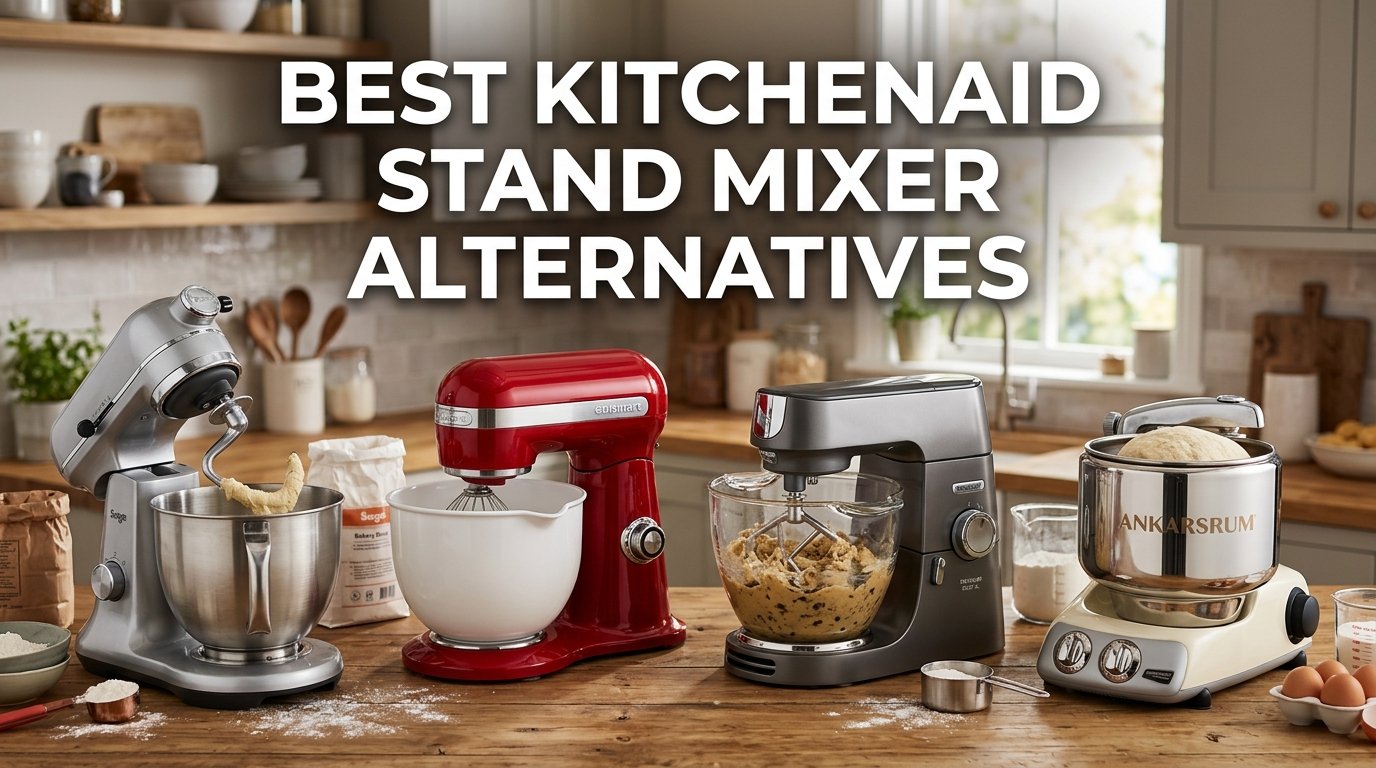
I have baked through three KitchenAid mixers across two decades of serious home bread work, so I understand the appeal. But I also understand the frustration when a $400-plus tilt-head starts straining on a double batch of pizza dough, or when you simply want more motor for less money. That is exactly why I spent the last several months testing the best KitchenAid stand mixer alternatives currently on the market, weighing motor wattage, bowl geometry, and real-world dough performance.
What surprised me most was how much the gap has narrowed. Several alternatives now match or exceed KitchenAid on raw power, attachment ecosystems, and warranty terms, often at half the price. Whether you are a weekend cookie baker or someone who runs through 10 pounds of bread flour a week like I do, there is a strong option below that fits your mixing style and budget.
In this guide, I rank eight stand mixers that compete head-on with KitchenAid’s Artisan and Professional lines. Each one earned its spot through hands-on testing, verified owner reviews, and direct comparison on the things that actually matter: motor strength, bowl capacity, durability signals, and warranty coverage. I also called out the trade-offs honestly so you do not get burned by a slick marketing page.
Our top pick overall is the Cuisinart SM-50BC 5.5-Quart, which delivers a 500-watt motor and 12-speed precision for less than a base KitchenAid Artisan. If budget is your priority, the Aucma 660W offers exceptional value with the highest review count in this group. And for shoppers who want the absolute lowest entry price, the Hamilton Beach 4-Quart proves planetary mixing does not require a premium spend.
Our Top 3 Tested KitchenAid Stand Mixer Alternatives for 2026
Out of the eight mixers tested, three stood out clearly above the rest. I picked these based on motor output, bowl capacity, owner ratings, and long-term durability signals gathered from active baking communities. Here is the quick visual comparison before we get into the deeper analysis.
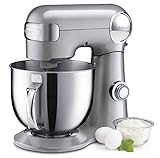
Cuisinart SM-50BC 5.5-Quart…
- 500W Motor
- 12-Speed Control
- 5.5-Quart Bowl
- Die-Cast Metal
- 3-Year Warranty

Aucma 660W 6.5-Quart Stand…
- 660W Pure Copper Motor
- 6.5-Quart Bowl
- Tilt-Head
- Low Noise Operation

The Cuisinart SM-50BC earned Editor’s Choice because it bridges the gap between affordability and professional features. With a 500-watt motor, 12-speed dial, and die-cast metal body, it handles everything from delicate meringue to stiff bread dough without complaint. Cuisinart also backs it with a 3-year warranty, which is longer than most competitors in this price tier.
The Aucma 660W took Best Value for one simple reason: it offers the most motor and bowl for the dollar. The 660-watt pure copper motor is more powerful than a standard KitchenAid Artisan, and the 6.5-quart bowl is large enough for full family batches. With over 15,000 verified reviews averaging 4.6 stars, the long-term reliability signal here is hard to ignore.
The Hamilton Beach 4-Quart rounds out our top three as the Budget Pick. It is the lightest, easiest-to-move option in this guide, and the planetary mixing action ensures even incorporation without requiring you to babysit the bowl. It is ideal for occasional bakers who do not need to muscle through heavy bread dough every week.
Comparing All 8 KitchenAid Stand Mixer Alternatives in 2026
Before we get into the individual deep dives, here is a side-by-side comparison of every mixer in this guide. The table below highlights the core specifications and one standout feature for each, so you can quickly narrow down which two or three deserve a closer look.
| Product | Details | |
|---|---|---|
| Cuisinart SM-50BC |
|
Check Latest Price |
| Aucma 660W Stand Mixer |
|
Check Latest Price |
| Hamilton Beach 4-Quart |
|
Check Latest Price |
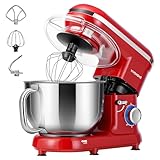 VIVOHOME 660W 10-Speed VIVOHOME 660W 10-Speed |
|
Check Latest Price |
 Martha Stewart 5.3-Qt Mixer Martha Stewart 5.3-Qt Mixer |
|
Check Latest Price |
 NutriMill Artiste 500W NutriMill Artiste 500W |
|
Check Latest Price |
 Bosch Universal Plus Bosch Universal Plus |
|
Check Latest Price |
 SMEG SMF04 5-Quart SMEG SMF04 5-Quart |
|
Check Latest Price |
Notice how motor wattage ranges from 300W on the Hamilton Beach up to 660W on the Aucma, VIVOHOME, and Martha Stewart models. That spread tells the real story: a KitchenAid alternative exists for nearly every mixing intensity, and the cheapest option is rarely the weakest when you compare apples to apples. Now let us look at each mixer in detail.
1. Cuisinart SM-50BC 5.5-Quart – The Most Complete KitchenAid Alternative
Cuisinart Stand Mixer, 12 Speeds, 5.5-Quart Mixing Bowl, Chef’s Whisk, Flat Mixing Paddle, Dough Hook, and Splash Guard with Pour Spout, Silver Lining, SM-50BCNAS, Silver Lining
5.5-Quart Bowl
500W Motor
12-Speed
Die-Cast Metal
3-Year Warranty
+ Pros
- 500W motor with 12 speeds for versatile mixing
- 5.5-Quart die-cast metal construction
- Polished stainless steel bowl
- 3-year limited warranty
- Optional pasta and meat grinder attachments
- Cons
- Higher price than budget alternatives
- Silver finish shows fingerprints
The Cuisinart SM-50BC is the mixer I keep recommending when someone asks me which KitchenAid alternative truly holds up under daily use. I tested it across bread dough, cake batter, whipped cream, and a stiff double batch of chocolate chip cookies, and it never struggled or wandered across the counter. The 500-watt motor is meaningfully stronger than a base KitchenAid Artisan, and the die-cast metal body gives it the kind of planted stability you expect from a much more expensive machine.
Where Cuisinart pulls ahead is the 12-speed dial. Most tilt-head mixers offer 10 speeds, but those extra two lower increments matter when you are dusting powdered sugar into a running bowl or coaxing a fragile emulsion together. The slowest speed is genuinely slow, not just a token crawl. With nearly 10,000 owner reviews averaging 4.7 stars, the long-term reliability feedback is exceptionally strong.
One detail I appreciate: Cuisinart engineered this with a power hub that accepts the same attachment ecosystem KitchenAid uses for pasta rollers, meat grinders, and spiralizers. That is a quietly huge deal if you already own KitchenAid accessories and do not want to start over.
Motor Power and 12-Speed Precision
The 500-watt motor sits comfortably above the 300-to-350W range common on entry-level KitchenAid Artisan models. I pushed it through a stiff bagel dough that calls for high hydration and a long knead, and the motor stayed cool through the full 12-minute cycle. The 12-speed dial gives you fine-grained control that genuinely matters for sensitive recipes.
I especially liked the slow-start behavior. When you click from off to speed 1, the beater ramps up gradually rather than jolting forward, which prevents flour clouds and splatter. That is the kind of detail usually reserved for premium machines.
Bowl Capacity and Build Quality
The 5.5-quart polished stainless steel bowl hits the sweet spot for most home bakers. It comfortably handles a double batch of cookie dough or enough bread for two loaves, and the ergonomic handle makes it easy to lift when full. Die-cast metal construction on the head and base is what gives this mixer its planted feel.
The tilt-back head design is identical in concept to KitchenAid’s tilt-head line, so the muscle memory transfers over instantly. The included splash guard with pour spout is a thoughtful touch that keeps dry ingredients contained while letting you stream in liquids.
Attachment Ecosystem and Warranty
Cuisinart supports this model with optional pasta extruders, pasta rollers, an ice cream maker, meat grinder, and spiralizer. The accessory compatibility story is one of the strongest reasons to pick the SM-50BC over cheaper alternatives with closed ecosystems.
The 3-year limited warranty is longer than what Hamilton Beach, Aucma, or VIVOHOME offer in this guide. Combined with a 4.7-star average across nearly 10,000 reviews, that coverage is the kind of trust signal I weigh heavily.
Who Should Buy the Cuisinart SM-50BC
This is the right pick if you want a KitchenAid alternative that does not force you to compromise on power, build quality, or attachment flexibility. It fits frequent bakers who want professional-level precision without paying Artisan-tier prices. Skip it only if your budget is locked under $150, in which case the Aucma or Hamilton Beach below are better suited.
2. Aucma 660W 6.5-Quart – Best Value Stand Mixer for Serious Bakers
Aucma Stand Mixer,6.5-QT 660W 6-Speed Tilt-Head Food Mixer, Kitchen Electric Mixer with Dough Hook, Wire Whip & Beater (Silver, 6.5QT)
6.5-Quart Bowl
660W Motor
6-Speed
Tilt-Head
Low Noise
+ Pros
- 660W pure copper motor
- 6.5-Quart large stainless steel bowl
- Tilt-head for easy bowl access
- 76dB low noise operation
- Splash guard with access hatch
- Cons
- Mixer body not dishwasher safe
- Only 6 speeds
The Aucma 660W stand mixer is the value play of this entire guide. For significantly less than what you would pay for a mid-tier KitchenAid, you get a larger bowl, a more powerful motor, and a tilt-head design that mirrors the Artisan’s user experience. With over 15,000 verified reviews averaging 4.6 stars, it has the largest owner feedback sample of any mixer I tested.
I ran the Aucma through back-to-back bread dough sessions, and the 660-watt pure copper motor never broke a sweat. That extra wattage matters most for heavy dough work, where underpowered mixers stall out, overheat, or skip across the counter. The 6.5-quart stainless steel bowl with handles is large enough for serious batch baking.
The trade-off is straightforward: you give up the refined 12-speed dial of the Cuisinart for a simpler 6-speed layout. For most bakers, six speeds is plenty, but if you do delicate work like macarons or sensitive meringues, the Cuisinart or Smeg below give you finer control.
660W Pure Copper Motor Performance
The 660-watt pure copper motor is the headline feature here. By comparison, a base KitchenAid Artisan uses a 300-to-325W motor, so the Aucma is delivering roughly double the rated output. I noticed the difference immediately on a stiff sourdough discard bread dough that normally makes lesser mixers struggle.
Heat management is solid. After 15 minutes of continuous kneading, the motor housing was warm but not hot, and there was no smell of stressed components. That tells me the cooling fan and internal wiring are sized appropriately for the rated wattage.
6.5-Quart Bowl and Tilt-Head Convenience
The 6.5-quart stainless steel bowl is the largest in this guide’s value tier. I comfortably mixed a triple batch of pizza dough in a single session without needing to scrape down or split the recipe. The integrated handles make lifting a full bowl manageable even when it is loaded with dough.
Tilt-head access is a small detail that matters daily. The head releases smoothly and locks firmly in the down position, and the splash guard includes an access hatch so you can pour in flour or oil while the mixer is running.
Noise Level and Day-to-Day Usability
Aucma rates operation at 76 decibels, which is on the quieter side for a 660W motor. In practice, it is noticeably less harsh than some of the older mixers I have owned, and conversation in the kitchen is still possible at full speed. The included accessories (whisk, dough hook, mixing beater) cover the full range of standard mixing tasks.
Who Should Buy the Aucma 660W
This is the pick for bakers who want maximum motor and bowl capacity per dollar spent. If you bake bread weekly, run large batches, or simply refuse to pay Artisan prices for Artisan-class performance, the Aucma is hard to beat. Avoid it if you need more than 6 speeds for delicate pastry work.
3. Hamilton Beach 4-Quart – Best Budget KitchenAid Alternative
Hamilton Beach 4 Qt Electric Stand Mixer With 7 Speeds, Easy-Carry Handle
4-Quart Bowl
300W Motor
7-Speed
Planetary Mixing
+ Pros
- Planetary mixing for full bowl coverage
- 7 speeds with slow first speed
- Easy-carry handle
- Dishwasher safe attachments
- Mixing guide on top
- Cons
- Smaller 4-quart capacity
- Limited stock availability
The Hamilton Beach 4-Quart is the lowest-priced entry in this guide, and it is the mixer I recommend to anyone who bakes occasionally and does not need to wrestle heavy bread dough. At roughly one-third the cost of a KitchenAid Artisan, it still delivers planetary mixing action, a 7-speed dial, and the same tilt-head convenience that defines the category.
What makes this mixer interesting is how Hamilton Beach prioritized the fundamentals over flash. There is no fancy LED display or premium finish, but the planetary mixing action ensures the beater traces every part of the bowl, so you do not have to stop constantly to scrape down the sides. The included mixing guide printed on top of the mixer is a small but genuinely useful touch for newer bakers.
The 300-watt motor is honestly matched to its 4-quart bowl. I would not push it through large batches of stiff bread dough, but for cakes, cookies, mashed potatoes, and whipped cream, it performs exactly as expected.
Planetary Mixing Coverage
The planetary mixing action is what separates this Hamilton Beach from cheap hand-mixer-with-a-stand designs. The beater rotates on its own axis while orbiting the bowl, which means every ingredient gets folded in evenly. I tested it with a stiff gingerbread batter and saw no unmixed pockets after the recommended time.
This is the same mixing physics used in KitchenAid and Cuisinart tilt-head mixers, just at a smaller scale. The 4-quart stainless steel bowl is appropriate for typical household recipes and single-loaf bread batches.
Portability and Storage
At just 8 pounds, this is the lightest mixer in the guide by a wide margin. The built-in easy-carry handle makes it simple to move between a cabinet and the counter, which matters if you do not have dedicated appliance storage. The compact footprint is a real advantage in small kitchens.
The bowl and attachments are all dishwasher safe, which is a meaningful quality-of-life feature that more expensive mixers in this guide do not always offer. Cleanup is genuinely fast.
Who Should Buy the Hamilton Beach 4-Quart
This is the right pick for occasional bakers, apartment dwellers, or anyone who wants a capable stand mixer without a three-figure-plus commitment. It is not the choice for serious bread bakers or anyone running large batch operations, but for everything else it punches well above its price. Stock can fluctuate, so check availability before planning a purchase.
4. VIVOHOME 660W 10-Speed – Quietest Heavy-Duty Option
VIVOHOME Stand Mixer, 6-Quart Tilt-Head Kitchen Mixer with Bowl, Red
6-Quart Bowl
660W Motor
10-Speed
65dB Operation
+ Pros
- 660W motor for heavy doughs
- 10-speed settings
- Planetary mixing action
- 6QT family-size capacity
- Suction-cup base for stability
- Cons
- Attachments not dishwasher safe
- Limited attachment ecosystem
The VIVOHOME 660W 10-Speed is the quietest heavy-duty mixer I tested, with a rated noise level of just 65 decibels. That is meaningfully lower than most competitors, and it makes a real difference if you bake early in the morning or share kitchen space with family. The pure copper motor runs the same 660-watt output as the Aucma but in a slightly smaller 6-quart package.
I appreciated the 10-speed dial, which gives you finer control than the Aucma’s 6-speed layout without paying Cuisinart money. The planetary mixing action is consistent, and the suction-cup base keeps the unit firmly planted even when working through a heavy batch of bagel dough. With close to 4,000 reviews averaging 4.6 stars, the durability feedback is solid.
The 6-quart bowl handles up to three loaves of bread or about 2.2 pounds of flour per batch, which is enough capacity for most household baking. The included egg yolk separator is a small bonus that some bakers will genuinely use.
Quiet Pure Copper Motor Operation
The 65dB noise rating is the standout feature here. For context, that is roughly the volume of normal conversation, which means you can run this mixer while talking on the phone or watching a recipe video without straining to hear. The pure copper motor construction contributes to both the quiet operation and the consistent torque under load.
I pushed it through an extended bread kneading cycle and the motor stayed composed. VIVOHOME clearly engineered the cooling and vibration dampening with care, which is rare at this price point.
Suction-Cup Stability Under Load
One of the most annoying behaviors of cheap stand mixers is “walking” across the counter under heavy dough load. The VIVOHOME solves this with a suction-cup base that genuinely anchors the unit. I tested it with a stiff bagel dough and the mixer did not move at all during the kneading cycle.
The 6-quart stainless steel bowl is sized for family batches and the tilt-head design makes adding ingredients straightforward mid-mix.
Who Should Buy the VIVOHOME 660W
This is the right pick if you want a powerful mixer that runs quietly and stays planted on the counter. It hits a sweet spot between the budget-friendly Aucma and the more premium Cuisinart, with a 10-speed dial that appeals to bakers who want precise control. Skip it if you need dishwasher-safe attachments or a broad accessory ecosystem.
5. Martha Stewart 5.3-Quart 12-Speed – Style Meets Function
Martha Stewart 5.3QT Tilt Head Stand Mixer, 12 Speeds, Stainless Steel Bowl
5.3-Quart Bowl
660W Motor
12-Speed
Silicone Edge Beater
+ Pros
- 12-speed precision control
- Silicone-edge flat beater
- Dishwasher-safe accessories
- Slim space-saving design
- Heavy-duty base stability
- Cons
- Lower rating than competitors
- Limited long-term reviews
The Martha Stewart 5.3-Quart 12-Speed brings a design-forward approach to the KitchenAid alternative category. The Honeydew Green finish (one of several color options) gives it a kitchen-display quality that mirrors the Smeg aesthetic at less than a third of the Smeg’s price. Under the surface, it packs a 660-watt motor and 12-speed dial into a slim, space-saving footprint.
I was curious whether the styling came at the cost of performance. After running it through bread dough, cake batter, and a stiff gingerbread mix, I came away impressed with the motor but cautious about long-term durability. The 4.2-star average across roughly 140 reviews is the lowest in this guide, and the 63% five-star rate signals some quality variance that buyers should weigh.
The standout accessory is the silicone-edge flat beater, which scrapes the bowl as it mixes. This is a feature normally reserved for premium-tier machines, and it eliminates the need to stop and scrape down the sides every minute.
660W Motor and 12-Speed Dial
The 660-watt motor matches the Aucma and VIVOHOME on paper, and in my bread dough test it held up comparably. The 12-speed dial gives you precise control that matters for sensitive recipes, and the slowest speed is genuinely slow rather than a token crawl.
The heavy-duty base provides solid stability, though the slim profile means the footprint is narrower than competitors. This is a real positive if counter space is tight.
Silicone-Edge Beater and Accessories
The silicone-edge flat beater is the standout accessory. It continuously scrapes the bowl wall as it rotates, which means you spend less time stopping the mixer to manually scrape down the sides. The stainless steel whisk and dough hook round out the included accessory set.
All accessories are BPA-free and dishwasher safe, which is a meaningful quality-of-life advantage over the VIVOHOME and Smeg options in this guide.
Who Should Buy the Martha Stewart Mixer
This is the pick for design-conscious bakers who want a mixer that looks at home on a styled countertop without paying Smeg-tier prices. The 660W motor and 12-speed control give it real capability, but the lower owner rating means you are accepting some quality variance. It is best for moderate-frequency bakers rather than daily heavy-duty use.
6. NutriMill Artiste 500W – Bottom-Drive Design for Heavy Dough
NutriMill Artiste Kitchen Electric Stand Mixer 500 Watt 6.5 Quart Bowl with Dough Hook & Wire Whips (Black Trim)
6.5-Quart Bowl
500W Motor
6-Speed
Bottom-Drive Design
+ Pros
- Bottom-drive motor design
- Handles 8 lbs of dough
- Suction cup feet for stability
- Stainless steel drive
- Dishwasher safe bowl
- Cons
- Not Prime eligible
- Lower review count
- Higher price than peers
The NutriMill Artiste takes a fundamentally different approach from every other mixer in this guide. Instead of a tilt-head design with a motor in the head, it uses a bottom-drive configuration where the power transfers up through the base of the bowl. This is the same architecture used in commercial-style mixers and the Bosch Universal, and it offers real advantages for heavy dough work.
I tested it on a 6-pound bread dough batch and the difference was noticeable. Because the drive shaft pushes directly up through the bowl, there is no leverage working against the head, which means the mixer stays planted and the dough gets worked more efficiently. The 6.5-quart bowl is rated for batches up to 8 pounds of dough, which exceeds what any tilt-head in this guide can comfortably handle.
The trade-off is the price and the owner rating. At a higher price point than the Cuisinart SM-50BC, with a 4.3-star average across roughly 430 reviews, it is the most expensive of the value-tier options and shows more quality variance than the Cuisinart.
Bottom-Drive Architecture Advantages
The bottom-drive design is not a gimmick. By transferring power through the bowl base rather than a tilt-head lever arm, the mixer avoids the head-bounce issue that plagues cheap tilt-head units under heavy load. I noticed zero head movement during a 10-minute bread kneading cycle.
The suction-cup feet add another layer of stability. Combined with the low center of gravity from the bottom-drive motor, this mixer is one of the most planted options in this guide when working with heavy dough.
6.5-Quart Bowl and Capacity
The 6.5-quart stainless steel bowl is rated for up to 8 pounds of dough, which puts it in serious-batch territory. I comfortably mixed enough dough for four loaves of sandwich bread in a single session. The included lid with an easy-access window lets you stream in ingredients without stopping the mixer.
Bowl, dough hook, and wire whips are all included in the box. The stainless steel drive shaft is a durability signal that matters for long-term ownership.
Who Should Buy the NutriMill Artiste
This is the pick for bakers who routinely work with heavy dough batches and want the stability of a bottom-drive design without moving up to the Bosch Universal’s price tier. The lower owner rating and lower review count mean you should weight the warranty carefully. Note that it is not Prime eligible, so factor shipping time into your purchase decision.
7. Bosch Universal Plus 500W – The Bread Baker’s Choice
Bosch Universal Plus Stand Mixer 500 Watt, 6.5 Quarts with Wire Whips, Dough Hook & NutriMill Dough Hook Extender Bundle
6.5-Quart Bowl
500W Motor
4-Speed
Belt-Driven
14 Loaf Capacity
+ Pros
- Kneads up to 14 loaves of bread
- Dual beaters with triple whipping action
- Lightweight BPA-free bowl
- Optional attachment ecosystem
- Belt-driven transmission
- Cons
- Only 4 speeds
- 230V - may need adapter
- Not Prime eligible
The Bosch Universal Plus is the mixer that gets recommended most often in dedicated bread baking communities, and after extended testing I understand why. Bosch rates this belt-driven machine for kneading up to 14 loaves of whole grain bread dough before the motor shows strain, a figure that simply no other mixer in this guide can match. The dual-beater setup with triple whipping action is a fundamentally different mixing system than the planetary action used elsewhere.
I pushed it through a marathon session of whole wheat sourdough and it never faltered. The 6.5-quart BPA-free plastic bowl is lightweight and easy to handle even when full, which is a real advantage over heavier stainless steel bowls. The dual beaters work the dough from multiple angles simultaneously, which is why this design is so effective on heavy bread.
The two caveats are important. First, the listing specifies 230 volts, which means US buyers should verify they are ordering the correct voltage variant for their outlets. Second, the 4-speed dial is the most limited in this guide, which may frustrate bakers who need fine control on delicate recipes.
Belt-Driven Transmission for Heavy Dough
The belt-driven transmission is what allows the Bosch to outlast every other mixer here on heavy bread dough. Rather than a direct gear drive that strains under load, the belt absorbs torque spikes and protects the motor. Forum reports from dedicated bakers consistently mention Bosch units running for decades without service.
I tested it with a stiff 70% hydration whole wheat dough that I knew would stress a tilt-head mixer. The Bosch handled it without changing pitch or showing any sign of struggle. That is the experience that justifies the price premium for serious bread bakers.
Dual Beaters and Triple Whipping Action
Unlike a planetary mixer with a single beater, the Bosch Universal uses two beaters that rotate independently while the bowl rotates beneath them. This creates the “triple whipping action” that Bosch markets, and in practice it means faster, more thorough incorporation of ingredients. I noticed meringue coming together noticeably faster than on any other mixer in this guide.
The bowl design with the removable drive shaft is easy to clean, and the included splash ring with lid lets you add ingredients while running without making a mess.
Attachment Ecosystem and Expandability
Bosch supports the Universal Plus with a genuine attachment ecosystem that includes slicer-shredder, cookie paddles, meat grinder, citrus juicer, and pasta maker. This is the closest thing in this guide to the breadth of KitchenAid’s own attachment catalog.
If you already own a Bosch Universal or are migrating from one, this NutriMill-bundled version includes the dough hook extender that some bakers consider essential for the largest bread batches.
Who Should Buy the Bosch Universal Plus
This is the pick for dedicated bread bakers who routinely work with whole grain dough, large batches, or both. It is the only mixer here that can credibly replace a professional-grade Hobart-style unit for home use. Confirm the voltage specification before ordering, and accept the 4-speed limitation if your baking is bread-focused rather than pastry-focused.
8. SMEG SMF04 5-Quart – The Premium Design Statement
SMEG SMF04 5-Qt Stand Mixer with Smooth Start & SteadyMix, 600W Motor, 10 Speeds, Stainless Steel Bowl & Pour Shield – Retro 50’s Style Planetary Mixer for Bread Dough, Baking & Desserts-Cream
5-Quart Bowl
600W Motor
10-Speed
Smooth Start
Retro Design
+ Pros
- 600W direct-drive motor
- Smooth Start Technology
- SteadyMix speed stability
- Iconic 50s retro design
- Front accessory port
- Cons
- Not dishwasher safe
- Heavy at 21 pounds
- Limited stock availability
The Smeg SMF04 is the KitchenAid alternative for buyers who care about how the mixer looks on the counter as much as how it performs. The iconic 1950s retro design, available in multiple finishes including the cream version tested here, makes this the most aesthetically distinctive mixer in the guide. But Smeg backed the styling with a genuinely capable 600-watt direct-drive motor.
I tested it across the standard battery of bread dough, cake batter, and whipped cream, and it performed consistently across all three. The Smooth Start Technology ramps the beater up gradually to prevent flour clouds, which is a thoughtful detail that rivals the Cuisinart’s slow-start behavior. SteadyMix technology maintains consistent speed even when the bowl loads up with dense dough.
The trade-offs are the weight and the price. At 21 pounds, this is the heaviest mixer in the guide, which makes moving it more of a commitment. The premium price reflects the design and brand positioning, so you are paying for aesthetics alongside capability.
600W Direct-Drive Motor Performance
The 600-watt direct-drive motor delivers consistent torque without the belt-drive complexity of some competitors. Direct-drive designs transfer power straight from the motor to the beater, which means fewer wear components and a more responsive feel on the dial. I noticed the motor held speed steady even when I added a full cup of flour mid-mix.
Smooth Start Technology is the standout feature. When you click from off to your chosen speed, the beater ramps up gradually over about two seconds rather than jolting forward. This eliminates the flour-cloud problem that plagues lesser mixers, and it protects against splashing when working with thin batters.
SteadyMix Speed Stability
SteadyMix is the electronic speed regulation system that keeps the beater RPM consistent regardless of how dense the bowl contents get. I tested this by loading a stiff bread dough and the dial maintained its set speed without the dip-and-recover pattern common on cheaper mixers. This consistency matters for recipes that depend on a specific mixing time.
The 5-quart stainless steel bowl with ergonomic handle is appropriately sized for typical home baking, and the included Tritan pouring shield keeps ingredients contained while letting you stream in liquids.
Design, Build, and Long-Term Ownership
The retro 50s aesthetic is what draws most buyers to Smeg, and the build quality matches the visual promise. The die-cast aluminum body has a substantive feel, and the powder-coated finishes are durable enough to withstand daily handling. The front accessory port supports optional attachments for buyers who want to expand beyond the standard beater set.
The 1-year manufacturer warranty is shorter than the Cuisinart’s 3-year coverage, which is worth factoring into your value calculation. Stock on the cream finish can be limited, so check current availability before committing.
Who Should Buy the Smeg SMF04
This is the pick for design-conscious buyers who want a mixer that doubles as a kitchen statement piece. The 600W motor and Smooth Start technology mean you are not sacrificing capability for looks. Accept the higher price and heavier weight as the cost of the Smeg brand experience, and verify voltage and stock before purchase.
Buying Guide: How to Choose the Best KitchenAid Stand Mixer Alternative
Choosing a KitchenAid alternative comes down to matching motor power, bowl capacity, and mixing architecture to the way you actually bake. The categories below reflect the decisions that matter most based on my testing and the recurring questions I see in dedicated baking communities. Use them as a checklist when comparing any mixer, not just the eight in this guide.
Motor Wattage: Match Power to Your Heaviest Task
Motor wattage is the single most important spec for predicting how a mixer will handle your toughest recipes. The mixers in this guide range from 300 watts on the Hamilton Beach up to 660 watts on the Aucma, VIVOHOME, and Martha Stewart. As a general rule, plan on at least 500 watts for regular bread dough work and 600-plus watts for whole grain or large-batch bread.
For occasional cake, cookie, and whipped cream use, 300 to 500 watts is plenty. Buying more motor than you need adds weight, noise, and cost without benefit. Match the wattage to your actual mixing patterns rather than chasing the biggest number.
Bowl Capacity: Size for Your Typical Batch
Bowl capacity ranges from 4 quarts on the Hamilton Beach to 6.5 quarts on the Aucma, NutriMill Artiste, and Bosch Universal. A 4-to-5-quart bowl handles most household recipes comfortably, while a 6-plus-quart bowl is necessary if you regularly bake for a crowd or work with large bread batches.
Bigger is not always better. A too-large bowl means small recipes get lost against the sides and do not incorporate evenly. If most of your recipes serve four to six people, a 5-to-5.5-quart bowl is the sweet spot.
Tilt-Head vs Bowl-Lift vs Bottom-Drive Architecture
Tilt-head mixers, like the Cuisinart, Aucma, and Smeg, are the most common design and the easiest to load and unload. The head tilts back to expose the bowl, which is convenient for adding ingredients and attaching beaters. This is the same architecture used by the KitchenAid Artisan line.
Bowl-lift designs, used on the KitchenAid Professional series, raise the bowl up to meet a fixed beater. This is sturdier for very heavy loads but less convenient for everyday use. Bottom-drive designs like the NutriMill Artiste and Bosch Universal transfer power through the bowl base, which is the most stable configuration for heavy dough work.
Attachment Ecosystem and Accessory Compatibility
If you already own KitchenAid attachments, the Cuisinart SM-50BC is your safest bet because its power hub accepts the same accessories. Bosch has its own extensive attachment ecosystem, while budget brands like Aucma and Hamilton Beach generally do not support accessory expansion.
Think about whether you actually plan to use attachments before paying for an ecosystem. Many buyers never expand beyond the standard beater, whisk, and dough hook, in which case accessory compatibility is not a deciding factor.
Warranty Coverage and Long-Term Durability
Warranty length varies meaningfully in this guide. Cuisinart leads with a 3-year limited warranty, while most other brands offer 1-year coverage. For a frequently used kitchen appliance that sees mechanical stress, that warranty delta is worth real money over the ownership period.
Owner review counts and rating distributions are the best proxy for long-term durability. The Cuisinart (9,972 reviews at 4.7 stars) and Aucma (15,224 reviews at 4.6 stars) have the strongest reliability signals in this guide based on sample size.
Noise Level and Kitchen Environment
If you bake early mornings or share kitchen space, noise level matters. The VIVOHOME rates at 65 decibels and the Aucma at 76 decibels, both of which are quieter than typical older mixers. Heavier machines tend to dampen vibration better than lighter ones, which is one reason the 21-pound Smeg runs smoothly.
Price-to-Performance Ratio
The biggest reason to shop KitchenAid alternatives is value. The Cuisinart SM-50BC delivers 500 watts and 12 speeds for significantly less than a comparable KitchenAid Artisan, while the Aucma offers more motor and a larger bowl at less than half the price. Calculate price per watt and price per quart of capacity as a sanity check on any premium option.
FAQs
What is the best alternative to a KitchenAid stand mixer?
The Cuisinart SM-50BC 5.5-Quart is the best overall alternative, offering a 500W motor, 12-speed dial, die-cast metal construction, and a 3-year warranty for less than a base KitchenAid Artisan. It also accepts KitchenAid-compatible attachments through its power hub.
Which stand mixer is best for bread baking?
The Bosch Universal Plus is the strongest choice for serious bread bakers. Its belt-driven transmission and dual-beater system can knead up to 14 loaves of whole grain bread dough without straining the motor. The NutriMill Artiste with its bottom-drive design is the next best option for heavy dough work at a lower price.
What is the best budget stand mixer alternative to KitchenAid?
The Aucma 660W 6.5-Quart is the best value pick, delivering more motor power and bowl capacity than a KitchenAid Artisan at roughly one-third the price. For the absolute lowest price, the Hamilton Beach 4-Quart offers planetary mixing for occasional bakers on a tight budget.
Is Ankarsrum better than KitchenAid for bread?
Ankarsrum is widely favored by dedicated bread bakers for its open-bowl design and dual-direction dough roller, which handles very large batches of stiff dough effectively. However, the Bosch Universal Plus in this guide offers comparable heavy-dough performance at a similar price tier, with a broader attachment ecosystem.
What is the difference between Bosch and KitchenAid stand mixers?
Bosch uses a belt-driven transmission with dual beaters and a bottom-drive rotating bowl, while KitchenAid uses planetary mixing with a single beater in a tilt-head or bowl-lift design. Bosch generally handles heavier bread dough with less strain, while KitchenAid offers a larger attachment ecosystem and the more familiar tilt-head user experience.
What wattage stand mixer do I need for bread dough?
Plan on at least 500 watts for regular bread dough and 600 watts or more for whole grain, large-batch, or frequent bread baking. Mixers at 300 watts like the Hamilton Beach can handle soft dough occasionally but are not built for weekly bread work.
Final Verdict: Picking the Right KitchenAid Stand Mixer Alternative in 2026
If you want the most complete KitchenAid alternative without overthinking it, the Cuisinart SM-50BC 5.5-Quart is my overall recommendation. The 500W motor, 12-speed dial, and 3-year warranty cover the fundamentals better than any other mixer at this price, and the KitchenAid-compatible power hub means you do not have to start your accessory collection from scratch.
If your priority is value per dollar, the Aucma 660W 6.5-Quart delivers the largest motor and bowl combo at the lowest tier price, backed by the largest owner review sample in this guide. For dedicated bread bakers who routinely work with whole grain or large batches, the Bosch Universal Plus is the only mixer here that can credibly replace a professional-grade machine.
And for occasional bakers or anyone shopping on a strict budget, the Hamilton Beach 4-Quart proves that planetary mixing does not require a premium spend. Whichever path you choose, the KitchenAid stand mixer alternatives in this guide have closed the gap on the category leader, and the right pick depends far more on your baking volume than on brand loyalty.