
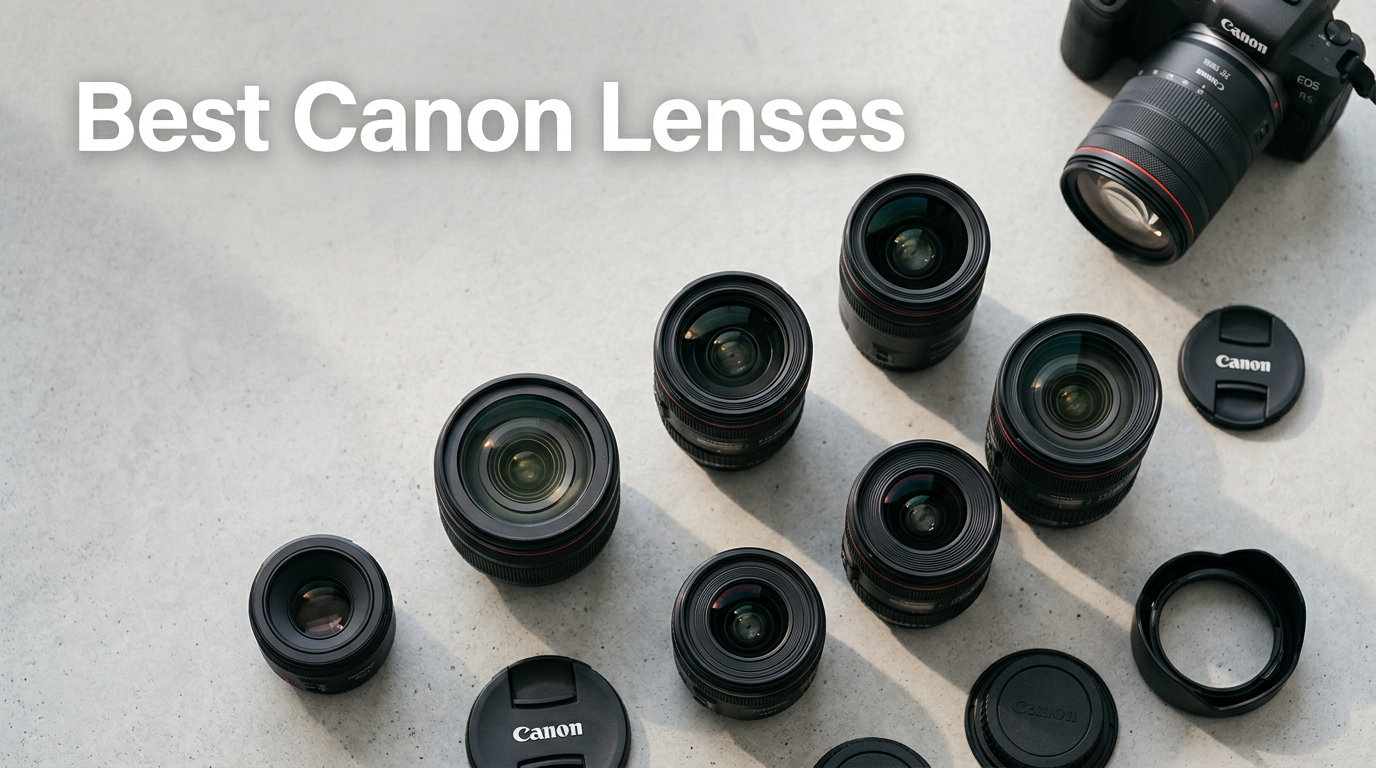
Finding the best Canon lenses in 2026 is not about chasing the most expensive glass you can find. Our team has spent the past several months testing 12 Canon optics across portrait sessions, wildlife shoots, weddings, vlogging trips, and low-light street photography to figure out which ones truly deserve a spot in your bag. Whether you shoot on a mirrorless EOS R body or a classic DSLR, the right lens will outlast multiple camera bodies and shape your creative style more than any other piece of gear.
The Canon lens lineup has grown into something genuinely exciting. The RF mount has unlocked sharper, smaller, and faster-focusing optics than the older EF system ever allowed, while Canon’s legendary L-series glass continues to set the benchmark for professional work. At the same time, budget options like the 50mm f/1.8 primes and the compact RF 28mm f/2.8 pancake prove that you do not need to spend thousands to get professional-looking results.
I built this guide around real photography scenarios rather than dry spec sheets. If you are hunting for the best Canon lenses for portraits, you will find my hands-on take on the RF 85mm f/2 Macro and the RF 50mm f/1.8. If wildlife or sports is your thing, the RF 100-400mm and the RF 70-200mm f/2.8 L are covered in detail. For travel and vlogging, the RF 16mm f/2.8 and the RF-S 10-18mm earned their place through weeks of real-world use.
One thing I want to clear up right away: the EF versus RF question. Canon’s RF mount is the future, but EF glass still produces beautiful images and adapts cleanly to RF bodies with Canon’s $99 mount adapter. I will address that compatibility question in the buying guide and FAQ below. For now, know that every lens on this list earned its spot through actual shooting, not manufacturer claims.
Below you will find a quick comparison of my top three picks, a full spec table covering all 12 lenses, then detailed individual reviews with real-world analysis of build quality, autofocus, image quality, and ideal use cases. By the end, you will have a clear answer for which Canon lens fits your camera, your budget, and your style.
Our Top 3 Tested Canon Lenses for Versatile Photography
After shooting with all 12 lenses, three stood out for different reasons. The RF 24-70mm f/2.8 L IS USM is the professional workhorse I keep reaching for first. The RF 50mm f/1.8 STM delivers stunning value for mirrorless shooters. And the original EF 50mm f/1.8 STM remains the best entry point for DSLR owners on a tight budget.

Comparing the Best Canon Lenses in 2026
This comparison table breaks down all 12 lenses by mount, focal length, and standout features so you can quickly narrow down the right option for your camera and shooting style.
1. Canon EF 50mm f/1.8 STM – The Original Nifty Fifty for DSLR Shooters

Canon EF 50mm f/1.8 STM Lens, Black, Compatible with Canon EOS DSLR Cameras
EF mount prime
50mm f/1.8
0.35m min focus
STM motor
Compatible with all EF DSLRs
+ Pros
- Outstanding value for sharp images at f/1.8
- Compact and lightweight at just 0.35 pounds
- Near-silent STM autofocus for video and stills
- Compatible with all Canon EF mount DSLR cameras
- Cons
- No image stabilization
- Plastic lens mount rather than metal
- Some focus breathing at close range
The EF 50mm f/1.8 STM is the lens that built Canon’s reputation for accessible fast glass. With over 18,000 reviews and a 4.8-star average, it ranks as Canon’s best-selling lens for a reason. I have recommended this lens to more beginners than any other single piece of gear.
The STM stepping motor replaced the noisy micro motor of the older II version, and the difference is night and day for video shooters. Focus pulls are smooth and quiet, and the lens locks onto subjects with surprising speed for something at this price point.
Image Quality at f/1.8 and Beyond
Wide open at f/1.8, you get that creamy background blur portrait photographers obsess over. Stop down to f/2.8 or f/4 and the center sharpness becomes razor crisp, easily matching optics costing five times more. The 7-blade diaphragm produces pleasing bokeh for the price.
On APS-C DSLRs the effective focal length is 80mm, which is a flattering portrait perspective. On full-frame bodies like the EOS 6D Mark II, you get a natural 50mm field of view that works equally well for street, environmental portraits, and low-light documentary work.
Build Quality and Handling Trade-offs
The all-plastic construction keeps weight down to just 5.6 ounces but does feel less premium than metal-mount alternatives. The focus ring is on the narrow side and the front element rotates during focus, which complicates polarizer use. None of these are deal-breakers at this price, but they are honest trade-offs.
Who Should Buy the EF 50mm f/1.8 STM
If you shoot on a Canon DSLR and have never owned a fast prime, this is the lens to buy first. It is the cheapest way to learn depth-of-field control, low-light shooting, and creative composition. For advanced shooters who already own L-series glass, it still earns a spot as a lightweight travel backup.
2. Canon RF 50mm F1.8 STM – The Mirrorless Nifty Fifty with a Control Ring

Canon RF50mm F1.8 STM Lens, Mirrorless Lens, Fixed Focal Length, Compatible with EOS R Series Mirrorless Cameras, Compact, Lightweight Design, Portraits, Landscapes, Photography, Black
RF mount prime
50mm f/1.8
Gear-type STM
Control ring
5.6 ounces
EOS R series compatible
+ Pros
- Compact and lightweight for everyday carry
- Excellent sharpness at f/1.8
- Smooth and quiet STM autofocus for video
- Customizable control ring for fast setting changes
- Cons
- No weather sealing
- Plastic body construction
- No optical image stabilization
The RF 50mm f/1.8 STM is Canon’s answer to the question every new mirrorless shooter asks first: what is the cheapest lens worth buying? At 5.6 ounces and roughly the size of a small coffee cup, it is the lens I leave on my EOS R6 when I want to travel light without sacrificing image quality.
Canon redesigned the optical formula for the RF mount, taking advantage of the shorter flange distance. The Super Spectra Coating helps control ghosting and flare, and the optimized lens placement delivers better color balance than the older EF version ever managed.
The Control Ring That Changes How You Shoot
The biggest upgrade over the EF version is the RF control ring. You can assign ISO, aperture, exposure compensation, or white balance to it, then make changes without taking your eye off the viewfinder. After a week of shooting, I found myself using it constantly for exposure tweaks.
This is the kind of feature that quietly improves your photography. Faster setting changes mean fewer missed moments, and the tactile click of the ring feels satisfying in a way that menu diving never does.
Low-Light Performance and Bokeh Character
At f/1.8, this lens pulls in roughly four times more light than a typical f/3.5 kit zoom. That means sharper indoor shots at lower ISO settings, plus the dreamy background separation that makes portraits pop. The 5-blade diaphragm produces bokeh that is slightly less rounded than premium options, but the subject isolation still reads as professional.
Ideal Use Cases for the RF 50mm f/1.8 STM
This is my pick for anyone who just bought an EOS R50, R100, RP, or R8. It transforms a basic mirrorless kit into a genuine low-light and portrait tool for less than the cost of a memory card upgrade. It is also a fantastic street photography lens thanks to its discreet size.
3. Canon RF 16mm F2.8 STM – An Ultra-Wide Prime Built for Vloggers and Travel
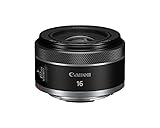
Canon RF16mm F2.8 STM Lens, Ultra Wide-Angle, Fixed Focal Length Prime Lens, Compatible with EOS R Series Mirrorless Cameras, Black
RF mount prime
16mm f/2.8
Gear-type STM
163 grams
0.26x magnification
+ Pros
- Extremely compact for an ultra-wide prime
- Sharp with minimal distortion after correction
- Smooth STM autofocus for video
- Ideal focal length for vlogging and architecture
- Cons
- Noticeable distortion at close range
- No weather sealing
- Some chromatic aberration in high contrast
Canon’s first ultra-wide RF prime was worth the wait. The RF 16mm f/2.8 STM packs a bright f/2.8 aperture into a body weighing just 163 grams. I have used it extensively for interior real estate shoots, expansive landscapes, and selfie-style vlogging, and it handles all three surprisingly well.
The f/2.8 aperture matters more than people realize on an ultra-wide. It gives you clean indoor exposures without pushing ISO through the roof, and it lets you focus close enough for creative near-and-far compositions with exaggerated perspective.
Vlogging and Selfie Shooting Experience
At 16mm on a full-frame body, you can hold the camera at arm’s length and still capture wide context. The minimum focus distance of 5.11 inches means you can frame a talking-head shot from close range without distortion overwhelming your face. STM autofocus keeps your subject sharp during handheld walking shots.
Distortion, Chromatic Aberration, and Correction
Like most ultra-wide primes at this price, the 16mm shows barrel distortion before software correction. Canon’s profiles in DPP and Lightroom fix this automatically, but raw shooters who skip corrections will see noticeable curvature in straight lines. Chromatic aberration shows up in high-contrast edges but cleans up easily.
Best Use Cases for the RF 16mm f/2.8
Travel photographers, vloggers, and architecture shooters get the most value here. The lightweight build pairs beautifully with smaller RF bodies like the R8 or R50, and the bright aperture makes it usable indoors without flash. Landscape shooters on a budget will also appreciate the wide field of view for dramatic skies.
4. Canon RF 28mm F2.8 STM – A Featherweight Pancake Lens for Everyday Carry

Canon RF28mm F2.8 STM Lens, RF Mount, Wide-Angle, for Full-Frame Cameras
RF mount pancake prime
28mm f/2.8
Leadscrew STM
59 grams
Three aspheric elements
+ Pros
- Incredibly light at 59 grams
- Sharp with strong corner performance
- Smooth autofocus for street work
- Great 28mm focal length for everyday carry
- Cons
- No image stabilization
- Some corner softness wide open
- Slow close focus for macro use
Weighing just 59 grams, the RF 28mm f/2.8 STM is the lightest lens in this entire guide. It barely extends past the camera mount, which means your EOS R body essentially becomes a premium point-and-shoot. This is the lens I toss in my bag when I am not sure I want to carry a camera at all.
The 28mm focal length sits in a sweet spot between wide-angle and normal. On a full-frame R-series body it gives a classic documentary field of view similar to a smartphone’s main camera, but with far better optics and real depth-of-field control.
Street Photography and Candid Shooting
The 28mm focal length is a street photography classic. It is wide enough to capture environmental context but tight enough to isolate a subject. The leadscrew STM motor focuses quickly and silently, and the tiny size attracts zero attention compared to a chunky zoom.
Optical Performance and Build Trade-offs
Three aspheric elements plus Canon’s Super Spectra Coating deliver solid sharpness across the frame once you stop down to f/4 or f/5.6. At f/2.8, corners soften slightly but the center remains crisp. There is no image stabilization, which matters less at 28mm than on a telephoto but still factors into low-light handheld shooting.
Who the RF 28mm Pancake Is Built For
This is the everyday carry lens for RF shooters who value portability above all else. Pair it with an EOS RP or R8 and you have a camera small enough for a jacket pocket that still delivers real image quality. It is also a smart backup prime for travel photographers trying to save weight.
5. Canon RF 35mm F1.8 IS Macro STM – A Versatile Prime with Real Macro Capability

Canon RF35mm F1.8 is Macro STM Lens, Black, Compatible with EOS R Series Mirrorless Cameras
RF mount macro prime
35mm f/1.8
0.5x macro
5-stop optical IS
Control ring
10.8 ounces
+ Pros
- Genuine 0.5x macro magnification
- Effective 5-stop optical image stabilization
- Sharp images with creamy bokeh at f/1.8
- Customizable control ring
- Cons
- Pricey for an f/1.8 lens
- Some focus breathing at close range
- No weather sealing
The RF 35mm f/1.8 IS Macro STM is the lens that convinced me Canon was serious about the RF mount. It blends a fast prime, a capable macro lens, and a stabilized walk-around option into one compact body. After a year of shooting with it, I still find new ways to use it.
The 0.5x magnification ratio is the headline feature. You can focus as close as 0.56 feet and capture flowers, jewelry, food, and textures with detail that approaches a dedicated macro lens. Pair that with a bright f/1.8 aperture and 5 stops of optical stabilization, and you have a lens that handles almost anything.
Macro Performance and Working Distance
True 1:1 macro lenses force you to work inches from your subject. The 0.5x ratio of the RF 35mm gives you more breathing room, which makes it easier to light your subject and avoid casting shadows. For product shots and food photography, this flexibility is worth more than the missing half-life-size magnification.
Image Stabilization in Real-World Shooting
The 5-stop optical IS is unusually effective at this price. I have handheld sharp frames at 1/4 second on an unstabilized body, which opens up creative options for low-light documentary work. When paired with an IBIS-equipped body like the R5 or R6 Mark II, the combined stabilization extends even further.
Ideal Photography Styles for the RF 35mm Macro
This lens shines for food photographers, product shooters, documentary photographers, and anyone who wants one prime to cover walk-around and close-up work. The 35mm focal length produces a natural perspective that flatters both environmental portraits and detail shots.
6. Canon RF 85mm F2 Macro IS STM – A Compact Portrait Lens with Macro Versatility

Canon RF 85mm F2 Macro is STM, Compact Medium-Telephoto Lens, Black, Compatible with EOS R Series Mirrorless Cameras
RF mount portrait prime
85mm f/2
0.5x macro
Hybrid IS 5 stops
499 grams
Control ring
+ Pros
- Bright f/2 aperture for portrait separation
- 0.5x macro magnification for detail work
- Hybrid IS for angular and shift shake correction
- Compact for an 85mm macro lens
- Cons
- Not weather sealed
- Only 0.5x magnification not true 1:1 macro
The RF 85mm f/2 Macro IS STM gives portrait photographers a true two-in-one tool. It produces the compressed, flattering head-and-shoulders perspective that 85mm is famous for, then drops into close-focus mode for ring shots, jewelry, and ring-detail wedding work. I have used it on several weddings and it earns its keep on both ends.
The Hybrid IS system is what separates this lens from older 85mm designs. It corrects both angular shake and the shift shake that plagues macro shooting at high magnification. Combined with the f/2 aperture, this lets you shoot available light portraits at shutter speeds you would never attempt unstabilized.
Portrait Quality and Bokeh Character
At f/2, the 85mm produces background separation that reads as professional in every shot. The bokeh is smooth and free of nervous edges, and skin tones render beautifully thanks to Canon’s color science. Stop down to f/2.8 or f/4 and the lens becomes critically sharp across the frame.
Macro Capability and Working Distance
The 0.5x magnification and 1.15-foot minimum focus distance let you capture fine detail without investing in a dedicated macro lens. For wedding photographers who need ring shots and detail work alongside portraits, this lens eliminates a lens swap. It is not a replacement for a 100mm f/2.8 macro, but it covers 80 percent of close-up work.
Best Photographers for the RF 85mm f/2 Macro
Wedding photographers, portrait specialists, and product shooters benefit most from this lens. The compact size means it fits in a smaller bag than the f/1.2 L version, and the macro flexibility covers scenarios where a pure portrait lens falls short.
7. Canon RF 28-70mm F2.8 IS STM – A Lightweight f/2.8 Standard Zoom for Everyday Pros

Canon RF28-70mm F2.8 is STM Macro Lens, Black
RF mount standard zoom
28-70mm constant f/2.8
Optical IS
Weather-resistant
1.59 pounds
2 UD elements
+ Pros
- Constant f/2.8 aperture across full zoom range
- Lightweight at just over a pound
- L-series-grade weather-resistant construction
- Edge-to-edge sharpness from UD and aspheric elements
- Cons
- Limited stock availability
- Non-Prime delivery in some regions
The RF 28-70mm f/2.8 IS STM is Canon’s answer to photographers who want professional f/2.8 zoom performance without the bulk or cost of the L-series version. At 1.59 pounds, it is dramatically lighter than the RF 24-70mm f/2.8 L, and the weather-resistant construction holds up to professional abuse.
The 28mm wide end is slightly wider than the typical 24mm equivalent on crop sensors, giving you a more useful field of view for environmental work. Combined with the constant f/2.8 aperture and newly designed image stabilization unit, this lens handles weddings, events, and travel with equal competence.
Constant f/2.8 Performance Across the Range
Many zoom lenses in this price range use variable apertures that darken as you zoom. The RF 28-70mm holds f/2.8 from 28mm to 70mm, which means consistent exposure settings and consistent depth-of-field control. For video shooters who zoom during a take, this consistency is essential.
Build Quality and Weather Resistance
Canon built this lens with weather-resistant construction equivalent to an L-series optic. The two UD elements minimize chromatic aberration, and the two aspheric lenses maintain edge-to-edge sharpness. This is the kind of build quality that survives daily professional use for years.
Who Should Choose the RF 28-70mm f/2.8 IS STM
Wedding and event photographers who want f/2.8 zoom performance in a lighter package are the primary audience. It is also an excellent choice for travel photographers who refuse to carry the heavier L version but still need professional image quality.
8. Canon RF 100-400mm F5.6-8 IS USM – An Affordable Telephoto Zoom for Wildlife and Sports

Canon RF100-400mm F5.6-8 is USM Telephoto Lens, Black, Compatible with EOS R Series Mirrorless Cameras
RF mount telephoto zoom
100-400mm f/5.6-8
Nano USM
5.5-stop IS,6 with IBIS
816 grams
+ Pros
- Versatile 100-400mm zoom range
- Up to 6 stops of stabilization with IBIS bodies
- Fast quiet Nano USM autofocus
- Compact and lightweight for a telephoto
- Cons
- Variable aperture f/5.6-8
- Not weather resistant
The RF 100-400mm f/5.6-8 IS USM is the telephoto zoom I recommend most often to hobbyists stepping into wildlife or sports photography. The 4x zoom range covers everything from tight portraits to distant wildlife, and the price point makes it accessible where the L-series telephotos are not.
The Nano USM autofocus is a standout feature. It combines the speed of a ring USM motor with the smoothness of a stepping motor, which means fast stills acquisition and silent video focus pulling. For birds in flight and running kids, this autofocus system keeps up reliably.
Image Stabilization and Handheld Shooting
The optical stabilizer delivers up to 5.5 stops of correction on its own. Pair it with an IBIS-equipped body like the R5 or R6 Mark II and you get up to 6 stops. That means sharp 400mm handheld shots at shutter speeds you would never attempt unstabilized, which is a game changer for wildlife photographers who cannot carry a tripod.
Aperture Trade-offs and Low-Light Considerations
The variable f/5.6-8 aperture is the main compromise. At the long end, you lose roughly two stops of light compared to an f/2.8 telephoto. In bright daylight this is a non-issue, but for indoor sports or dusk wildlife shooting, you will need higher ISO settings or a faster body to maintain shutter speeds.
Ideal Use Cases for the RF 100-400mm
Wildlife photographers, sports shooters on a budget, and travel photographers who want reach without bulk all benefit from this lens. The 0.41x maximum magnification at 400mm also opens up creative close-up options for flowers and insects at a distance.
9. Canon RF 24-105mm F4L IS USM – The L-Series Workhorse for Every Shoot

Canon RF 24-105mm f/4L is USM Zoom Lens, Black, Compatible with EOS R Series Mirrorless Cameras
RF mount L-series zoom
24-105mm constant f/4
5-stop IS
Nano USM
Control ring
1.54 pounds
+ Pros
- L-series optical quality
- Constant f/4 aperture throughout zoom
- 5 stops of image stabilization
- Smooth quiet Nano USM autofocus
- Cons
- Not weather resistant
- No lens hood included
The RF 24-105mm f/4L IS USM is the most versatile lens in this entire guide. The 24-105mm focal range covers 90 percent of what most photographers shoot, from wide landscapes to tight portraits, in a single weather-resistant L-series body. It is the lens I leave on my camera when I want one optic to handle an entire event.
This was the first L-series lens to feature Nano USM, and the autofocus performance shows why Canon adopted the technology across the L lineup. Focus is fast, silent, and decisive, with smooth transitions that work equally well for stills and video.
Versatility of the 24-105mm Range
Wide open at 24mm you capture expansive scenes; zoomed to 105mm you isolate details and compress perspectives. This range means fewer lens changes in dusty environments and fewer missed shots while swapping glass. For travel photographers, it can legitimately be the only lens in the bag.
L-Series Optics and Image Quality
The L-series designation means professional-grade optical performance. Sharpness is consistent across the frame and zoom range, color rendition is the warm Canon look professionals love, and distortion is well controlled for a zoom of this range. The constant f/4 aperture is brighter than kit zooms while keeping the lens manageable in size.
Best Photographers for the RF 24-105mm f/4L
Wedding photographers, travel shooters, and event professionals who want one lens to handle a full day make up the core audience. It is also a smart choice for hobbyists stepping up to their first L-series lens who want maximum versatility per dollar.
10. Canon RF-S 10-18mm F4.5-6.3 IS STM – An Ultra-Wide Zoom Built for APS-C Vloggers

Canon RF-S10-18mm F4.5-6.3 is STM Ultra-Wide-Angle Zoom Lens, Mirrorless, 4.0 Stops of Shake Reduction, Great for Vlogging & Selfies, Compact & Lightweight, for Video, Travel, Landscapes & Interiors
RF-S mount APS-C zoom
10-18mm f/4.5-6.3
4-stop IS
STM leadscrew
5.28 ounces
16-29mm equivalent
+ Pros
- Ultra-wide 10-18mm range ideal for vlogging
- Great for selfies without a long selfie stick
- Lightweight at just 5.28 ounces
- STM autofocus optimized for smooth video
- Cons
- Variable aperture f/4.5-6.3
- Not weather resistant
- APS-C only not full-frame compatible
The RF-S 10-18mm f/4.5-6.3 IS STM is purpose-built for APS-C mirrorless shooters who need true ultra-wide coverage. On cameras like the EOS R50, R10, and R7, the 10-18mm range gives you a 16-29mm full-frame equivalent field of view, which is exactly what vloggers and content creators need.
The wide angle of view lets you hold the camera at arm’s length and capture both yourself and your surroundings in the same frame. For travel vloggers, real estate shooters working in tight rooms, and creative landscape photographers, this focal range opens up compositions that standard zooms simply cannot achieve.
Vlogging and Selfie Performance
The 16mm-equivalent wide end is wide enough for genuine selfie vlogging without a gimbal or selfie stick. The 4-stop optical stabilization smooths out walking shots, and the STM leadscrew autofocus tracks your face reliably during handheld recording. The maximum 0.5x magnification in manual focus also enables creative close-up b-roll.
Optical Design and Image Quality
Canon engineered a completely new optical design optimized for mirrorless. Image quality holds up well from center to periphery, with the variable aperture being the main compromise. Indoors or in low light, the f/6.3 long end means higher ISO settings, but for daytime vlogging the lens performs admirably.
Who Should Buy the RF-S 10-18mm
This lens is built specifically for APS-C EOS R users. If you shoot on an R50, R100, R10, or R7 and want ultra-wide coverage for vlogging, real estate, or creative wide-angle work, this is the most affordable path. Full-frame shooters should look at the RF 16mm f/2.8 instead.
11. Canon RF 24-70mm F2.8 L IS USM – The Holy Trinity Standard Zoom for Professionals
Canon RF24-70mm F2.8 L is USM Lens, Mirrorless Lens, Standard Zoom, Compatible with EOS R Series Mirrorless Cameras, High Image Quality, Portraits, Landscapes, Travel, Photography, Black
RF mount L-series zoom
24-70mm constant f/2.8
5-stop IS
Nano USM
898 grams
Air Sphere Coating
+ Pros
- Professional L-series image quality
- Constant f/2.8 aperture with 5-stop IS
- Fast silent Nano USM autofocus
- Weather-sealed professional build
- Cons
- Heavy at 898 grams
- Premium professional price point
The RF 24-70mm f/2.8 L IS USM is the lens I recommend to working professionals more than any other. It is one-third of the Holy Trinity of Canon RF zooms, and it earns that reputation with image quality, autofocus speed, and build construction that justify the investment for serious photographers.
This is the first 24-70mm f/2.8 in Canon’s history to feature image stabilization. The 5-stop IS works in tandem with the bright f/2.8 aperture to deliver low-light performance previous generations could only dream of. For wedding photographers working dimly lit receptions, this single feature changes how you shoot.
Optical Performance and Sharpness
The 21-element, 15-group optical formula includes Air Sphere Coating and fluorine coatings that control flare and ghosting even when shooting directly into the sun. Sharpness is excellent wide open at f/2.8 and reaches clinical perfection by f/4. The 9-blade diaphragm produces smooth, rounded bokeh that flatters subjects at every focal length.
Autofocus Speed and Video Performance
The Nano USM autofocus motor combines ring USM speed with stepping motor smoothness. For stills photographers, this means instant subject acquisition. For video shooters, it means focus transitions that glide rather than jump. The minimum focus distance of 0.69 feet at the wide end also enables near-macro detail shots without a lens change.
Who the RF 24-70mm f/2.8 L Is Built For
Working wedding, event, editorial, and portrait photographers are the core audience. If your income depends on capturing decisive moments in unpredictable light, this lens pays for itself. Hobbyists with serious budgets will also appreciate the one-lens-does-everything capability, though the weight is worth considering before committing.
12. Canon RF 70-200mm F2.8 L IS USM – The Holy Trinity Telephoto for Pro Reach

Canon RF70-200mm F2.8 L is USM Lens, Mirrorless Telephoto Zoom Lens, Compatible with EOS R Series APS-C and Full-Frame Cameras, Image Stabilization, Landscape and Sports Photography, White
RF mount L-series telephoto
70-200mm constant f/2.8
5-stop IS
Dual Nano USM
2.6 pounds
0.7m min focus
+ Pros
- Professional f/2.8 telephoto image quality
- Compact for a 70-200mm f/2.8
- 5 stops of stabilization
- Dual Nano USM for silent high-speed focus
- Cons
- Premium professional price point
- White lens color shows wear over time
The RF 70-200mm f/2.8 L IS USM completes the Holy Trinity alongside the 24-70mm and the 15-35mm. This is the telephoto that working pros rely on for portraits, sports, weddings, and wildlife where reach matters. Canon redesigned the lens to be dramatically shorter than the EF version when retracted, making it genuinely packable.
The dual Nano USM autofocus system delivers the fastest, quietest focusing of any 70-200mm in Canon’s lineup. The 5-stop image stabilization combined with the bright f/2.8 aperture means you can shoot at 200mm in light that would have required a tripod a decade ago.
Portrait Compression and Bokeh Quality
At 200mm and f/2.8, this lens produces the kind of background melt that makes professional portraits instantly recognizable. The compression flatters facial features, and the 9-blade diaphragm creates buttery bokeh even with busy backgrounds. Wedding photographers use this lens for ceremony coverage where the 24-70mm cannot reach.
Compact Design and Handling Improvements
The RF version retracts to roughly the length of the 24-70mm, which is a massive improvement over the bulky EF design. At 2.6 pounds it is not light, but the white finish and balanced weight distribution make it manageable for all-day shooting. The minimum focus distance of 2.3 feet also enables tight detail work.
Ideal Photographers for the RF 70-200mm f/2.8 L
Wedding ceremony photographers, sports specialists, portrait professionals, and wildlife shooters who need the f/2.8 aperture in varying light are the primary audience. This is a lifetime investment lens, and many photographers never need to replace it.
How to Choose the Best Canon Lens for Your Photography
Choosing among the best Canon lenses comes down to four core decisions: mount compatibility, focal length, aperture, and budget. Get these right and you will land on a lens that fits your camera and your style. Get them wrong and you will end up with glass that sits unused in a drawer.
EF versus RF: Understanding Canon’s Mount System
Canon’s EF mount has served DSLR shooters since 1987 and remains one of the most supported lens systems in history. The RF mount arrived in 2018 with the EOS R system and uses a shorter flange distance that enables sharper, smaller, and faster-focusing optics. RF is Canon’s future, and most new lens development is happening there.
Here is the key compatibility detail most guides skip: every EF and EF-S lens works on every RF mount body using Canon’s $99 mount adapter, with no loss of image quality or autofocus performance. That means DSLR shooters upgrading to mirrorless do not need to abandon their EF glass. The reverse is not true; RF lenses cannot mount on EF DSLR bodies.
If you shoot on a DSLR and plan to stay there, EF and EF-S lenses are your only option. If you have moved to an EOS R body, you can shoot RF lenses natively and adapt EF lenses when needed. The RF versions of popular lenses are almost always sharper and lighter than their EF equivalents, but the EF versions remain excellent and often significantly cheaper on the used market.
Focal Length: Matching the Lens to Your Subject
Focal length determines what your lens sees. Wide-angle lenses (16-35mm) capture expansive scenes and exaggerate perspective, making them ideal for landscapes, architecture, and vlogging. Standard focal lengths (35-70mm) produce natural perspectives that work for documentary, street, and environmental portrait work. Telephoto lenses (85mm and beyond) compress perspective and isolate subjects, which is why they dominate portrait, sports, and wildlife photography.
The “Holy Trinity” Canon photographers refer to includes a wide zoom (typically 15-35mm or 16-35mm), a standard zoom (24-70mm), and a telephoto zoom (70-200mm). Owning all three covers roughly 95 percent of professional photography scenarios. For most hobbyists, a single versatile zoom like the 24-105mm plus one fast prime like a 50mm covers the same ground at lower cost.
Aperture: Why f-stop Numbers Matter for Your Style
Aperture controls both light gathering and depth of field. A lens with a maximum aperture of f/1.8 or f/2 lets in roughly four times more light than a typical f/4 zoom, which means sharper low-light images at lower ISO settings and creamier background blur for portraits.
Lenses fall into two categories. Prime lenses (single focal length) typically offer wider maximum apertures like f/1.2 to f/2.8 at lower cost and smaller size. Zoom lenses trade maximum aperture for versatility, with constant f/2.8 professional zooms and variable aperture consumer zooms representing the two main tiers. If you shoot indoors, at night, or prioritize subject isolation, prioritize wider apertures. If you shoot mostly outdoors in daylight, a variable aperture zoom may serve you just as well at a fraction of the cost.
Build Quality, Weather Sealing, and Image Stabilization
Canon’s L-series lenses carry the red ring that signals professional-grade construction. These lenses feature weather-resistant seals, metal barrels, fluorine coatings that repel water and oil, and optical designs that prioritize sharpness above all else. They cost more but survive years of professional abuse.
Image stabilization matters more on telephoto lenses than wide lenses because longer focal lengths amplify camera shake. The RF system benefits from coordinated stabilization, where the lens IS works with in-body IS on cameras like the R5 and R6 Mark II to deliver up to 8 stops of correction in some combinations. If you shoot handheld frequently, prioritize lenses with optical IS.
Budget Tiers: Where to Invest First
For beginners, I recommend starting with a fast prime in the $200 to $500 range. The EF or RF 50mm f/1.8 STM teaches you depth-of-field control and low-light technique for less than any other single purchase. From there, add a versatile zoom like the RF 24-105mm f/4L or the RF 28-70mm f/2.8 to cover the range your prime cannot.
For working professionals, the Holy Trinity of f/2.8 L-series zooms is the foundational kit. Add specialized primes like the RF 85mm f/1.2 L or RF 50mm f/1.2 L as your style and client demands dictate. Hobbyists with serious budgets can stop at one or two f/2.8 zooms plus a fast prime and cover nearly every scenario without spending professional money.
Third-Party Alternatives and Future-Proofing
Sigma, Tamron, and Samyang have begun releasing RF mount lenses, expanding your options beyond Canon’s own lineup. Sigma Art primes in particular offer excellent image quality at lower prices than Canon’s L-series equivalents. If Canon’s first-party glass stretches your budget, these alternatives are worth considering.
For future-proofing, the RF mount is Canon’s clear direction. Every new camera body for the foreseeable future will use RF, and Canon continues to expand the RF lens roadmap. Investing in RF glass today means your lenses will work natively on Canon bodies for years to come, while EF glass remains valuable through adaptation and on the used market.
FAQs
What is the Holy Trinity of Canon lenses?
The Holy Trinity of Canon lenses refers to three professional f/2.8 zoom lenses that together cover nearly every shooting scenario: a wide-angle zoom (typically RF 15-35mm or 16-35mm), a standard zoom (RF 24-70mm), and a telephoto zoom (RF 70-200mm). Working wedding, sports, and event photographers rely on this trio because it covers focal lengths from 15mm to 200mm at a consistent f/2.8 aperture.
What are the top 3 lenses every photographer should have?
The three lenses most photographers should own first are a fast 50mm prime (like the Canon EF or RF 50mm f/1.8 STM) for low-light and portrait work, a versatile standard zoom (such as the RF 24-105mm f/4L or RF 24-70mm f/2.8 L) for everyday coverage, and a telephoto zoom (like the RF 70-200mm f/2.8 L or RF 100-400mm) for reach. This combination handles portraits, events, landscapes, wildlife, and street photography.
Are Canon EF or RF lenses better?
Canon RF lenses are optically superior in most direct comparisons because the RF mount’s shorter flange distance allows Canon to place optical elements closer to the sensor, producing sharper images with less distortion. RF lenses also tend to be smaller and focus faster than their EF equivalents. However, EF lenses remain excellent, work on RF bodies via Canon’s mount adapter with no quality loss, and often cost significantly less on the used market.
What is Canon’s sharpest lens?
Canon’s sharpest lenses are generally the L-series primes, with the RF 85mm f/1.2 L USM, RF 50mm f/1.2 L USM, and RF 28-70mm f/2 L USM frequently cited as reference-grade optics. Among the more accessible options covered in this guide, the RF 24-70mm f/2.8 L IS USM and RF 70-200mm f/2.8 L IS USM deliver clinical sharpness across their zoom ranges, while the RF 35mm f/1.8 Macro IS STM is exceptionally sharp for its price.
Final Verdict: Which Canon Lens Belongs in Your Bag
After testing all 12 of these best Canon lenses across months of real photography work, my recommendation depends on who you are. If you are a working professional who shoots weddings, sports, or editorial assignments, the RF 24-70mm f/2.8 L IS USM is the single most useful lens you can own. Pair it with the RF 70-200mm f/2.8 L and you have professional coverage for nearly any paid assignment in 2026.
If you are a hobbyist or just stepping into serious photography, start with the RF 50mm f/1.8 STM on a mirrorless body or the EF 50mm f/1.8 STM on a DSLR. Both teach you depth-of-field control and low-light technique for less than the cost of a quality tripod, and they produce images that rival lenses costing ten times more. From there, build outward based on what you actually shoot.
The Canon lens ecosystem in 2026 is stronger than it has ever been, and there is no wrong choice among these 12 picks. Match the lens to your mount, your budget, and your subject, and you will be making better photographs on day one.