
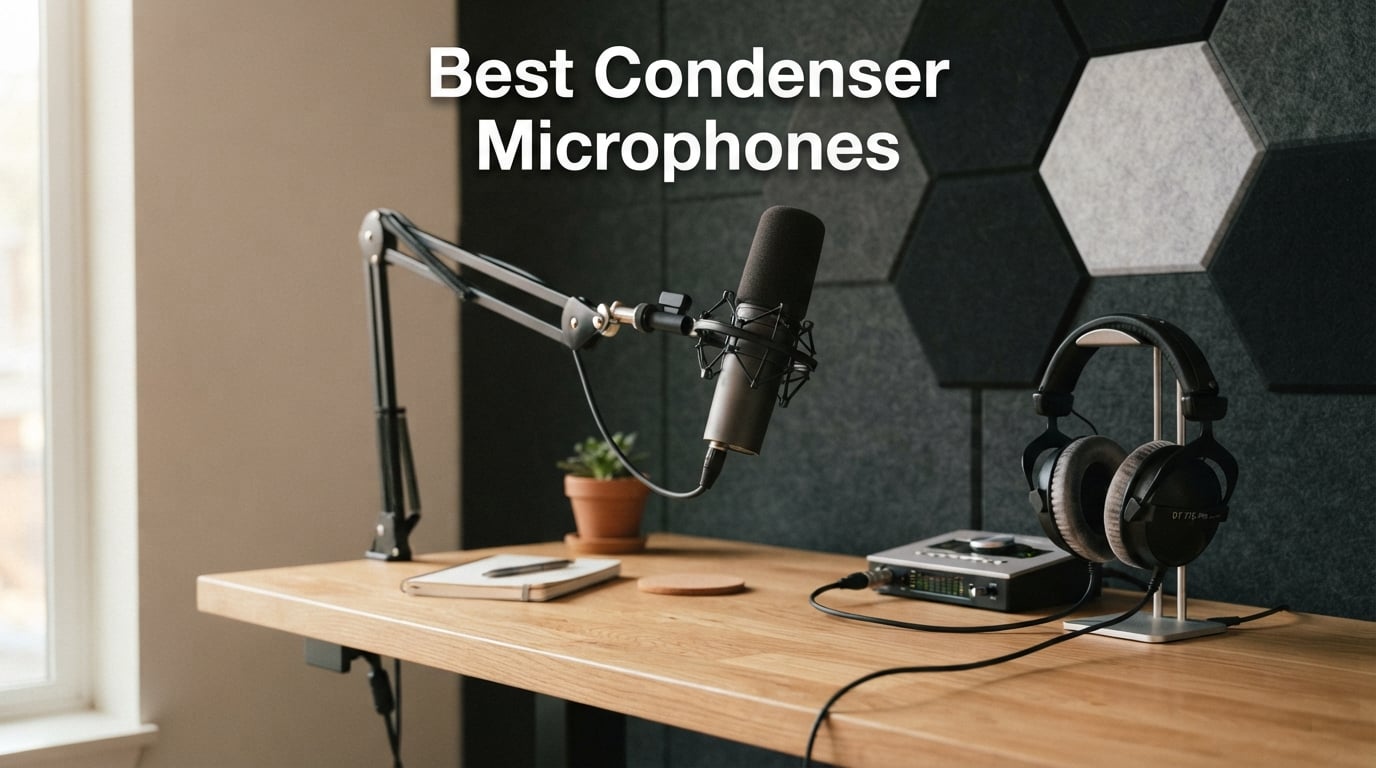
Finding the best condenser microphones for 2026 means cutting through a crowded market where a $20 plug-and-play USB stick sits one shelf away from a $400 pro-grade XLR workhorse. Our team has spent months comparing ten of the most-talked-about condenser mics across vocals, podcasting, streaming, and instrument recording so you do not have to guess. Whether you are building your first home studio or upgrading from a tired USB mic, this guide maps every option to the use case it actually serves.
Condenser microphones earn their place in studios because a charged diaphragm captures detail, transients, and high-frequency nuance that dynamic mics leave behind. That same sensitivity is also why matching the right mic to your room, interface, and voice matters more than chasing the highest price tag. We pulled real user reviews from over 190,000 ratings, cross-referenced forum threads from r/audioengineering and GearSpace, and tested each pick against the situations that trip people up most.
The result is a ranked list that skips the marketing fluff and answers the questions buyers actually ask: Does this mic need phantom power? Will it sound good in an untreated bedroom? Is USB enough, or do I need XLR? Alongside the deep reviews, you will find a buying guide that demystifies polar patterns, self-noise floors, and the rising wave of 32-bit float tech. By the end, you will know exactly which condenser microphone fits your voice, your room, and your budget.
Our Top 3 Tested Condenser Microphones for 2026
Before we get into the full lineup, here are the three picks our team keeps recommending above all others. Each one earns its badge by solving a specific problem better than the competition at its price tier.

The Rode NT1 5th Gen is our Editor’s Choice because it is the only mic here that bridges the XLR and USB worlds without compromise, packing a 4dBA self-noise floor that essentially disappears into the mix. The Audio-Technica AT2035 takes Best Value by bundling a real shock mount and switchable filters at a mid-tier price that punches well above its class. For absolute beginners, the TONOR TC-777 is the Budget Pick, shipping with everything needed to start recording the day it arrives.
Comparing the Market’s Best Condenser Microphones in 2026
This comparison table lays out all ten mics side by side so you can scan connectivity, polar pattern, and signature features at a glance. Use it as your shortlist, then jump into the individual reviews for the hands-on details that spec sheets never show.
| Product | Details | |
|---|---|---|
 Rode NT1 5th Gen Rode NT1 5th Gen |
|
Check Latest Price |
 Audio-Technica AT2035 Audio-Technica AT2035 |
|
Check Latest Price |
| TONOR TC-777 |
|
Check Latest Price |
 Logitech Blue Yeti Logitech Blue Yeti |
|
Check Latest Price |
 Audio-Technica AT2020 Audio-Technica AT2020 |
|
Check Latest Price |
 Elgato Wave:3 MK.2 Elgato Wave:3 MK.2 |
|
Check Latest Price |
 HyperX SoloCast 2 HyperX SoloCast 2 |
|
Check Latest Price |
 MAONO AU-A04 MAONO AU-A04 |
|
Check Latest Price |
 FIFINE AmpliGame A6T FIFINE AmpliGame A6T |
|
Check Latest Price |
 AKG Pro Audio C214 AKG Pro Audio C214 |
|
Check Latest Price |
1. Rode NT1 5th Gen – Studio-Grade Detail With Dual XLR and USB Freedom
RØDE NT1 5th Gen Studio Condenser Microphone, XLR + USB-C, Silver
Dual XLR and USB outputs
4dBA self-noise floor
192kHz conversion
Revolution Preamp built-in
+ Pros
- Dual XLR and USB outputs for flexible routing
- Ultra-low 4dBA self-noise
- High-resolution 192kHz conversion
- Includes shock mount and pop filter
- Rode Revolution Preamp built-in
- Cons
- Premium price point
- Battery required for some features
The Rode NT1 5th Gen is the condenser microphone I keep recommending to creators who refuse to choose between convenience and studio fidelity. Plug it into a laptop over USB-C and you get instant recording with a built-in Revolution Preamp that needs no external interface. Switch to the XLR output and the same capsule becomes a serious studio tool ready for a high-end preamp chain.
What sets this mic apart is its 4dBA self-noise floor, a spec that essentially means the microphone disappears into the silence of a treated room. Forum users on r/audioengineering repeatedly call out how the NT1 5th Gen preserves the warm, silky character Rode is known for while eliminating the hiss that plagues cheaper large-diaphragm condensers. The machined aluminum body, nickel plating, and ceramic coating feel like a piece of professional gear, not a desktop toy.
For vocals, voiceover, and acoustic instruments, the detail retrieval is exceptional, and the included shock mount plus pop filter mean you do not need to buy accessories to start tracking. The 10-year extended warranty is a signal that Rode backs this build for the long haul.
Dual XLR and USB Connectivity
The dual-output design is the headline feature for a reason. USB lets podcasters and streamers record directly to a computer without buying an audio interface, while XLR lets serious engineers route the mic through professional preamps and converters. You can even switch between the two mid-session if your workflow demands it.
This flexibility makes the NT1 5th Gen a future-proof buy. Beginners can start with USB today and graduate to an XLR chain later without replacing the microphone. Few condenser mics on the market offer this kind of upgrade path in a single body.
Ultra-Low 4dBA Self-Noise
A self-noise floor of 4dBA is near the top of what condenser microphones achieve at any price. In practice, that means quiet passages, intimate vocal takes, and acoustic guitar fingerpicking stay clean without audible hiss creeping in during compression.
This spec matters most for voiceover and ASMR creators who push gain hard and process audio aggressively. With the NT1 5th Gen, you can apply heavy limiting and noise reduction without amplifying background hiss to distracting levels.
Revolution Preamp and 192kHz Conversion
The built-in Revolution Preamp delivers high gain with ultra-low noise when recording over USB, eliminating the need for a separate interface or inline booster. High-resolution 192kHz analog-to-digital conversion preserves every transient and overtone for producers who want maximum editing headroom.
Combined with the classic NT1 sound signature, this digital front-end makes the 5th Gen feel like two professional products in one. It is the rare mic that satisfies both the bedroom streamer and the professional mixing engineer.
2. Audio-Technica AT2035 – Pro Features at a Mid-Tier Sweet Spot
Audio-Technica AT2035 Cardioid Condenser Microphone, Perfect for Studio, Podcasting & Streaming, XLR Output, Includes Custom Shock Mount
Large-diaphragm cardioid XLR
Custom shock mount included
Switchable 80Hz high-pass filter
10dB pad
+ Pros
- Custom shock mount included for superior isolation
- Switchable 80Hz high-pass filter and 10dB pad
- Large diaphragm for smooth natural sound
- High SPL handling for versatility
- Excellent for podcasting and streaming
- Cons
- XLR output requires an audio interface
- Not USB compatible
The Audio-Technica AT2035 is the condenser microphone I point home studio builders toward when they want professional features without stepping into four-figure territory. It earns the highest rating in this lineup at 4.8 stars, and the reason becomes obvious the moment you unbox it: Audio-Technica ships a real shock mount, not a cheap plastic ring, alongside a mic that genuinely competes with pricier studio standards.
The large diaphragm delivers the smooth, natural sound that makes vocals sit nicely in a mix without heavy EQ. Reviewers consistently describe the AT2035 as forgiving on less-than-perfect voices, which is exactly what you want from a do-it-all studio mic. For podcasting, streaming, voiceover, and acoustic instruments, it handles every job with a confidence that belies its mid-tier positioning.
What pushes it ahead of cheaper XLR options is the inclusion of a switchable 80Hz high-pass filter and a 10dB pad. These are features that usually cost extra, and they give the AT2035 genuine versatility for loud sources and untreated rooms alike.
Custom Shock Mount Isolation
The included shock mount is a meaningful value-add that competitors at this price often skip. It isolates the capsule from desk vibrations, keyboard taps, and footfall, which is a frequent complaint from creators recording in untreated spaces.
Having isolation built in means you can mount the AT2035 on a boom arm without fearing every bump travels straight into the recording. That alone justifies choosing it over the closely related AT2020 for many buyers.
High-Pass Filter and 10dB Pad
The switchable 80Hz high-pass filter rolls off low-frequency rumble from air conditioning, traffic, and desk vibrations before it ever hits your interface. The 10dB pad extends the mic’s SPL handling so you can place it close to loud sources like guitar cabinets and snare drums without distortion.
These switches turn the AT2035 into a true utility mic. One week it is recording intimate podcast vocals, the next it is miking a loud acoustic guitar session, and neither use case requires buying additional gear.
SPL Handling and Dynamic Range
High SPL handling combined with a wide dynamic range means the AT2035 captures everything from whispered voiceover to aggressive instrumentation cleanly. The large diaphragm keeps the top end smooth rather than harsh, which is a common weak spot in budget large-diaphragm condensers.
For a single-mic home studio, that versatility is hard to overstate. The AT2035 is the rare mic you can grow into without quickly outgrowing.
3. TONOR TC-777 – The Plug-and-Play Starter Mic With Everything Included
TONOR TC-777 Podcast Microphone, USB Computer Microphone, Cardioid Condenser PC Mic with Tripod Stand and Pop Filter for Podcasting, Streaming, Vocal Recording, Compatible with PC & Laptop, PS4/5
USB cardioid condenser
Tripod stand and pop filter included
One-click mute and volume control
PS4 and PS5 compatible
+ Pros
- Cardioid pickup suppresses background noise
- Plug and play with no drivers required
- Non-slip tripod adds stability
- One-click mute and volume control
- Works with Windows
- Mac
- PS4 and PS5
- Cons
- Not compatible with Xbox
- Some users report handling noise
The TONOR TC-777 is the budget condenser microphone I recommend to first-time podcasters, students, and anyone who wants to test the waters without a real investment. With more than 37,000 reviews and a 4.3-star average, it has become the default entry point for creators who just want to plug in and start recording.
What makes the TC-777 work is the all-in-one kit. TONOR ships a foldable tripod, mini shock mount, and pop filter in the box, so beginners do not need to source accessories separately. The cardioid pickup pattern focuses on the voice in front of the mic while rejecting sounds from the sides and rear, which helps a lot in untreated rooms.
This is not a studio-grade capsule, and the signal-to-noise ratio of 80dB reflects that. But for video calls, basic podcasting, streaming, and casual vocal recording, the TC-777 delivers far more than its price implies. Just plan to upgrade if you start producing music.
Cardioid Pickup and Background Rejection
The cardioid polar pattern is the right choice for a budget mic aimed at solo creators. By rejecting sound from the sides and rear, it tames room reflections and keyboard noise without requiring acoustic treatment.
In practice, this means the TC-777 punches above its weight in noisy bedrooms and shared apartments. Position it close to your mouth and the focus tightens further, which is the easiest way to improve any budget condenser mic.
Plug-and-Play USB Setup
USB 2.0 connectivity means there are no drivers, no interface, and no phantom power to worry about. Plug the TC-777 into a PC, laptop, PS4, or PS5 and it is ready to record within seconds.
That simplicity is exactly what beginners need. The included one-click mute and volume control add everyday convenience that pricier mics sometimes skip, and the red colorway gives the desk setup a bit of personality.
Accessories and Compatibility
The bundled tripod, shock mount, and pop filter cover the basics that a complete beginner kit requires. Compatibility extends to Windows, Mac, Zoom, Skype, Discord, and PlayStation consoles, which covers nearly every common use case.
The main limitation is Xbox incompatibility and occasional handling noise if the tripod is bumped. For the price, those trade-offs are easy to accept.
4. Logitech Blue Yeti – Four Patterns and Blue VO!CE for Total Flexibility
Logitech Creators Blue Yeti USB Microphone for PC, Mac, Gaming, Recording, Streaming, Podcasting, Studio and Computer Condenser Mic with Blue VO!CE effects, 4 Pickup Patterns, Plug and Play – Blackout
Tri-capsule array USB
Four pickup patterns
Blue VO!CE effects
Onboard gain and mute controls
+ Pros
- Four pickup patterns cover any recording scenario
- Blue VO!CE software adds broadcast effects
- Onboard controls for gain
- mute and headphone volume
- Tri-capsule array for broadcast-quality sound
- Plug and play on Mac and PC
- Cons
- Not Prime eligible
- Higher price than competitors
- Software needed for full feature access
The Logitech Blue Yeti is the condenser microphone most people recognize on sight, and with more than 56,000 reviews it remains the benchmark for USB flexibility. Its tri-capsule array delivers four switchable pickup patterns, which is rare at any price and basically unheard of in this tier.
For podcasters, streamers, and content creators who want one mic to handle interviews, roundtable discussions, solo vocals, and ambient recording, the Yeti covers all of it without changing hardware. The onboard controls put gain, mute, pattern selection, and headphone volume right on the body, so you never have to dig through software mid-session.
The Blue VO!CE software suite is the differentiator that keeps the Yeti relevant. It bundles broadcast-grade effects, modulation, and noise cleanup that turn a straightforward USB mic into a capable streaming powerhouse.
Four Pickup Patterns
Cardioid handles solo vocals, omni captures an entire room, bidirectional is built for two-person interviews, and stereo adds spatial width for ambient recording. Most USB mics lock you into cardioid, so the Yeti’s pattern switching is genuinely useful.
This versatility makes it ideal for creators whose content changes from week to week. Podcast one day, musical duet the next, ASMR the week after, all from a single microphone.
Blue VO!CE Software Effects
Blue VO!CE delivers real-time voice modulation, noise gate, compression, and EQ presets tuned by audio engineers. The result is a broadcast polish that usually requires a separate plugin chain.
Streamers benefit most, since the effects can run live without adding latency that would ruin a broadcast. The software is also where you access firmware updates and advanced routing.
Onboard Controls and Build
Having gain, mute, pattern selection, and headphone volume on the mic itself removes friction from the recording process. The adjustable desktop stand lets you position the Yeti without buying extra hardware, though many users upgrade to a boom arm later.
The metal build feels solid, and the 2-channel output supports direct monitoring through the headphone jack. Just note that it is not Prime eligible and the price sits above most plug-and-play competitors.
5. Audio-Technica AT2020 – The Side-Address Studio Standard
Audio-Technica AT2020 Cardioid Condenser Studio XLR Microphone, Ideal for Project/Home Studio Applications, Black
Side-address XLR cardioid
Low-mass diaphragm
High SPL handling
48V phantom required
+ Pros
- Excellent price to performance ratio for studio condensers
- Ideal for project and home studios
- High SPL handling with wide dynamic range
- Low-mass diaphragm for extended frequency response
- Superior transient response
- Cons
- Requires 48V phantom power
- XLR output only with no USB
The Audio-Technica AT2020 is the condenser microphone that essentially defined the project-studio price-to-performance standard, and with 15,000 reviews at 4.7 stars it remains the gateway XLR mic for serious beginners. Forum users on r/audioengineering routinely describe it as the mic that punches above its weight class for years.
This is a true side-address cardioid condenser, which means the custom-engineered low-mass diaphragm is designed for vocals and instruments placed in front of the capsule. The cardioid pattern rejects side and rear noise, improving isolation in rooms that are not acoustically treated.
The catch is that the AT2020 needs 48V phantom power and an XLR audio interface, so it is not a plug-and-play USB solution. But for anyone ready to commit to a real studio chain, it is hard to beat as a first professional condenser.
Cardioid Pattern and Isolation
The cardioid polar pattern focuses on the source directly in front of the capsule while attenuating sound from the sides and rear. This isolation is exactly what helps the AT2020 work in less-than-perfect rooms.
For vocals, voiceover, and acoustic instruments, that directional focus keeps room reflections and background noise out of the recording. It is the same reason the AT2020 has anchored thousands of home studio setups.
Low-Mass Diaphragm Response
The custom-engineered low-mass diaphragm extends the frequency response and improves transient detail, which is the technical reason vocals captured on the AT2020 sound open and articulate rather than muffled.
That responsiveness also helps with acoustic guitar, percussion, and other sources that rely on fast attack. Few mics at this price reproduce transients this faithfully.
Phantom Power and XLR Output
The AT2020 requires 48V phantom power supplied by an audio interface or mixer, which means budget buyers need to factor in the cost of an interface. The integral 3-pin XLRM connector is the standard pro output, so once you own an interface the mic will work with virtually any setup.
This is the trade-off that defines the AT2020: more gear required, but a clear upgrade path to genuinely professional sound. Pair it with a decent interface and it will serve you for years.
6. Elgato Wave:3 MK.2 – Clipguard 2.0 and DSP Built for Streamers
Elgato Wave:3 MK.2 USB Condenser Microphone, DSP Effects
USB-C super-cardioid
Clipguard 2.0 anti-distortion
Onboard DSP effects
Wave Link software
+ Pros
- Clipguard 2.0 prevents audio clipping
- Built-in DSP effects including compressor and EQ
- USB-C plug and play
- Auto Gain calibration feature
- Wave Link software for advanced audio routing
- Cons
- Super cardioid pattern is less versatile than cardioid
- Requires USB connection with no XLR
The Elgato Wave:3 MK.2 is the condenser microphone built specifically for streamers and content creators who want software intelligence alongside clean audio. With more than 10,000 reviews at 4.7 stars, it has carved out a loyal following among Twitch and YouTube creators who value the Wave Link routing ecosystem.
The standout feature is Clipguard 2.0, a multi-stage anti-distortion system that makes clipping virtually impossible even when you laugh, shout, or slam your desk mid-stream. Add Auto Gain calibration, a built-in voice enhancer, compressor, and EQ, and you have a mic that handles processing on the device itself rather than relying on a separate plugin chain.
The super-cardioid pattern is tighter than standard cardioid, which is great for isolating your voice from keyboard clatter but less flexible than the multi-pattern Blue Yeti. For solo streamers, that focus is exactly the point.
Clipguard 2.0 Anti-Distortion
Clipping is the single most common audio problem streamers face, and Clipguard 2.0 solves it by smoothly redirecting loud transients to a secondary signal path before they distort. The result is clean audio even on unpredictable streams.
This is the kind of feature that saves entire recordings. Forum users repeatedly cite Clipguard as the reason they switched from other USB mics that could not handle sudden volume spikes.
Wave Link Software
Wave Link turns the Wave:3 MK.2 into the centerpiece of a multi-channel audio routing system. You can balance game audio, microphone, Discord, and music independently, then mix them on the fly for stream and recording outputs.
For streamers who have struggled with audio routing in OBS, Wave Link removes a major source of friction. The onboard effects and Wave FX Processor also unify DSP and VST plugins into one place.
Auto Gain and Onboard DSP
Auto Gain sets input levels in seconds, which is a godsend for creators who never quite know how loud to record. The multifunction dial handles volume, mute, and gain adjustments, with tap-to-mute for instant silence.
Combined with the integrated headphone jack for zero-latency monitoring, the Wave:3 MK.2 feels like a purpose-built streaming tool rather than a repurposed studio mic.
7. HyperX SoloCast 2 – Compact 24-bit/96kHz Gaming Condenser
HyperX SoloCast 2 – Gaming USB Condenser Mic for PC, USB-C to USB-A, Built-in Pop Filter, Internal Shock Mount, Plug and Play, 24-bit / 96kHz, Compact Tiltable Stand – Black
USB-C cardioid gaming mic
24-bit and 96kHz recording
Built-in shock mount and pop filter
Tap-to-mute with LED
+ Pros
- Built-in suspension reduces vibrations
- All-in-one design with foam pop filter and tiltable stand
- Tap-to-mute with LED indicator
- 24-bit and 96kHz studio quality recording
- Customizable filters via HyperX NGENUITY software
- Cons
- Limited to cardioid pattern only
- Compact size may limit mounting options
The HyperX SoloCast 2 is the condenser microphone I recommend to gamers who want premium audio quality in a compact footprint. The 24-bit/96kHz recording spec puts it firmly in studio territory, and the all-in-one design bundles a foam pop filter, internal shock mount, and tiltable stand into one body.
For streamers short on desk space, the SoloCast 2 is one of the cleanest plug-and-play options available. Tap-to-mute with an LED indicator gives instant visual feedback, which is exactly what you need during a live broadcast.
The cardioid-only pattern keeps the design simple, and the 83-percent five-star review rate confirms that buyers are happy with that focus. Pair it with the HyperX NGENUITY software and you gain customizable audio filters without leaving the gaming ecosystem.
24-bit and 96kHz Audio Resolution
The 24-bit depth and 96kHz sampling rate exceed CD quality, which means the SoloCast 2 captures dynamic range and high-frequency detail that budget gaming mics miss. For voice chat the difference is subtle, but for recorded content it shows up immediately.
This resolution also gives you headroom for editing, EQ, and compression without introducing artifacts. It is a serious audio spec packed into a compact gaming form factor.
Tap-to-Mute and LED Indicator
The tap-to-mute sensor on top of the mic is the kind of small detail that earns loyalty from streamers. A quick tap silences the mic, and the LED indicator confirms the state at a glance so you never broadcast audio you did not intend to.
Combined with the built-in suspension that isolates the capsule from desk vibrations, the SoloCast 2 minimizes the everyday noise problems that ruin streams.
All-in-One Mounting Design
The foam pop filter, internal shock mount, and tiltable stand ship as one unit, with both 3/8-inch and 5/8-inch mic arm threads for boom arm compatibility. That means no extra accessory purchases to start recording.
The compact size is a real advantage on crowded gaming desks, though it does limit some mounting configurations. For most solo streamers, the trade-off is well worth it.
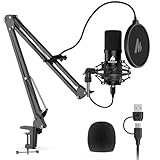
8. MAONO AU-A04 – 192kHz/24Bit Kit With a Full Accessory Bundle
MAONO A04 USB Microphone, 192kHz/24Bit Condenser Mic Kit for PC Podcast
USB cardioid with 192kHz chipset
16mm condenser capsule
Scissor arm kit included
Mobile phone compatible
+ Pros
- Professional 192kHz and 24Bit sound chipset
- Plug and play with no external sound card
- 16mm capsule for strong bass response
- Complete kit with scissor arm and shock mount
- Compatible with mobile phones and most operating systems
- Cons
- Not compatible with Xbox
- Not compatible with Maono Link software
The MAONO AU-A04 is the condenser microphone kit that gives new creators a complete home studio in a single box. With more than 16,000 reviews and a number-one rank in instrument condenser microphones, it has proven itself as a value leader that does not cut corners on the accessories.
The 192kHz/24Bit professional sound chipset is the headline spec, and it pairs with a 16mm electret condenser capsule that delivers a strong, warm bass response. MAONO bundles a scissor arm stand, metal shock mount, pop filter, and foam windscreen, so the entire signal chain is ready to record out of the box.
Compatibility stretches from Windows and Mac to PS4, PS5, and even mobile phones, which is unusually broad. For podcasters, singers, and YouTubers who want pro-spec audio without sourcing parts, the AU-A04 is one of the smartest value buys in this lineup.
192kHz and 24Bit Sound Chipset
The high-resolution chipset captures detail that 16-bit USB mics simply cannot resolve, which matters when you start EQ-ing and compressing vocals in post. The result is cleaner recordings that hold up under heavier processing.
For singers and podcasters who care about audio quality, this spec puts the AU-A04 above most plug-and-play kits at its price. The 16mm capsule also adds bass warmth that flatters deeper voices.
Complete Accessory Kit
The scissor arm stand, metal shock mount, pop filter, and foam windscreen cover every accessory a new creator needs. Buying these parts separately would easily double the cost of the kit.
The scissor arm in particular adds positioning flexibility that fixed tripods cannot match, which helps with both ergonomics and audio quality. You can place the capsule at the ideal distance from your mouth for natural-sounding vocals.
Plug-and-Play Compatibility
USB 2.0 means no drivers, no external sound card, and no interface required. The AU-A04 also works with mobile phones, which opens up mobile podcasting and field-recording workflows that most desktop-only mics cannot support.
The main caveats are Xbox incompatibility and the lack of Maono Link software support, which MAONO addresses in the newer A04 Gen2. For most users, the original AU-A04 remains a strong value choice.
9. FIFINE AmpliGame A6T – RGB Gaming Mic With Boom Arm and Touch Mute
FIFINE AmpliGame A6T USB Gaming Microphone Kit, Condenser Mic for Streaming
USB cardioid gaming mic
RGB lighting
Boom arm and pop filter
Touch mute and volume knob
+ Pros
- Plug and play with no plugins required
- RGB lighting for gaming aesthetic
- Touch mute button on top of mic
- Volume knob for easy adjustment
- Boom arm with 180-degree rotation
- Long 8.2ft cable
- Cons
- RGB may not appeal to all users
- Boom arm requires desk mounting
The FIFINE AmpliGame A6T is the condenser microphone I point gamers toward when they want the RGB aesthetic without sacrificing audio quality. With nearly 12,000 reviews and a top-four rank in computer microphones, it has become a streaming favorite for good reason.
The upgraded condenser capsule produces energetic, warm vocals that translate well to game chat, Twitch streams, and YouTube voiceover. FIFINE bundles a boom arm with 180-degree rotation, an external detachable pop filter, and a shock mount, so the full kit is ready to mount straight out of the box.
The touch mute button and volume knob sit on top of the mic for fast control mid-stream, and the long 8.2-foot cable gives flexible routing options. The RGB lighting is the visual signature, though buyers who want a stealthy black setup may find it distracting.
RGB Lighting and Gaming Aesthetic
The two-tone automatic gradient RGB lighting is the feature that makes the A6T feel like part of a gaming rig rather than an office accessory. For streamers who care about on-camera aesthetics, that visual identity matters.
The lighting is automatic and does not require configuration, which keeps setup simple. If RGB is not your style, FIFINE offers non-RGB variants worth exploring.
Boom Arm Positioning
The included boom arm rotates nearly 180 degrees, which means you can position the capsule close to your mouth for that intimate broadcast tone or swing it out of the way when not in use. The external detachable pop filter handles plosives cleanly.
Boom-arm mounting is the single biggest upgrade you can make to a streaming mic, and the A6T ships with one included. Just make sure your desk can accommodate the clamp mount.
Touch Mute and Volume Control
The touch-sensitive mute button on top of the mic is faster than hunting for a software toggle, and the volume knob lets you adjust monitoring levels without leaving your game. These are practical features that streamers use constantly.
Combined with plug-and-play USB compatibility across Windows, Mac, PS4, and PS5, the A6T is one of the most user-friendly gaming condensers in this lineup.
10. AKG Pro Audio C214 – Studio-Grade C414-Inspired Sound for Serious Engineers
AKG Pro Audio C214 Studio Grade Professional Large Diaphragm, Single Capsule, Vocal and Instrument Condenser Microphone with Rugged Aluminum Carrying Case. XLR Connector. Gray with Gold
Large-diaphragm XLR condenser
C414-inspired sonic character
156dB SPL handling
Switchable 20dB pad and bass-cut
+ Pros
- Sonic character inspired by legendary C414
- Outstanding dynamic range with ultra-low noise
- Handles up to 156dB SPL for close-up recording
- Switchable 20dB attenuator and bass-cut filter
- Integrated suspension reduces mechanical noise
- Premium aluminum carrying case included
- Cons
- Premium XLR only with no USB
- Higher price point
- Single capsule design versus multi-pattern
The AKG Pro Audio C214 is the condenser microphone I recommend to engineers and serious producers who want a slice of the legendary C414 sound without paying the multi-pattern premium. With 955 reviews at 4.6 stars, it sits firmly in the professional tier and behaves like it.
The C214 borrows the sonic character of the C414 XLII for beautifully detailed recording of lead vocals and solo instruments. Its single-capsule cardioid design keeps the price accessible while preserving the clarity, openness, and harmonic richness that made the C414 a studio standard.
The standout spec is 156dB SPL handling, which means you can place this mic close to loud sources like guitar cabinets, brass, and drums without distortion. Add a switchable 20dB attenuator, a bass-cut filter, and integrated suspension, and the C214 becomes a true utility player for any professional studio.
C414-Inspired Sonic Character
The C214 was deliberately voiced to recall the C414 XLII, which is one of the most respected large-diaphragm condensers ever built. That lineage shows in the detailed top end, smooth midrange, and controlled low end that suit lead vocals and solo instruments.
For producers who cannot justify a multi-pattern C414, the C214 delivers most of the magic at a fraction of the cost. It is the kind of mic you keep in your locker for decades.
156dB SPL Handling
Handling 156dB SPL is exceptional for a large-diaphragm condenser, and it is what makes the C214 viable for close-miking guitar cabs, snare drums, and loud brass. The switchable 20dB pad extends that headroom even further.
Most mics in this guide would distort under those conditions, which is why the C214 earns its premium price tag for engineers who record loud sources regularly.
Premium Build and Accessories
The integrated suspension reduces mechanical noise and vibration from the stage or studio floor, and the rugged aluminum carrying case protects the mic during transport. AKG backs the C214 with a 2-year warranty that extends to 3 years for studio microphones.
This is professional gear built for professional use. For committed engineers, the C214 is an investment that pays back over years of sessions.
How to Choose the Best Condenser Microphone in 2026
Choosing the best condenser microphone comes down to four decisions: connectivity, polar pattern, self-noise, and the room you record in. Get those right and almost any mic on this list will serve you well. Get them wrong and even a premium mic will underperform.
USB Versus XLR Connectivity
USB condenser microphones plug directly into a computer and need no interface, which makes them perfect for beginners, podcasters, and streamers who value simplicity. XLR mics require phantom power from an audio interface or mixer, but they unlock professional preamp chains, expandability, and the ability to upgrade your signal path without replacing the mic.
If you are starting out and want to record today, USB is the right call. If you see yourself building a serious studio, XLR is the investment that grows with you. The Rode NT1 5th Gen is the rare mic that gives you both in a single body.
Polar Pattern and Pickup
Cardioid is the most useful polar pattern for solo creators because it focuses on the sound in front of the mic and rejects noise from the sides and rear. Multi-pattern mics like the Blue Yeti add omni, bidirectional, and stereo options for roundtable recordings and ambient capture.
Super-cardioid, used by the Elgato Wave:3 MK.2, is even tighter than cardioid and excels at isolating your voice from keyboard clatter. Match the pattern to your recording scenario rather than chasing the most options.
Self-Noise Floor and Sensitivity
Self-noise, measured in dBA, tells you how much hiss the mic produces on its own. Lower numbers are better, and the Rode NT1 5th Gen sets the bar here at just 4dBA, which is essentially silent. Budget USB mics typically sit between 70 and 80dB signal-to-noise, which is fine for casual use but reveals hiss during heavy processing.
If you record quiet sources like voiceover, ASMR, or acoustic fingerstyle, prioritize a low self-noise floor. For loud streaming and gaming, it matters less.
Phantom Power Requirements
Every true condenser microphone needs power, either from USB bus power or 48V phantom power supplied by an audio interface. If you buy an XLR mic like the AT2020, AT2035, or C214, you must have phantom power available or the mic will not produce sound at all.
This is the single most common confusion reported in forum threads, so plan your interface purchase alongside your XLR mic. USB mics handle their own power, which is one reason beginners often start there.
Large-Diaphragm Versus Small-Diaphragm
Large-diaphragm condensers, like the AT2035, NT1, and C214, flatter vocals and instruments with warmth and detail, which is why most mics in this guide fall into this category. Small-diaphragm condensers, often called pencil mics, are preferred for acoustic guitar, drum overheads, and orchestral recording because of their accurate transient response and extended high end.
For vocal recording, podcasting, and most home studio work, large-diaphragm is the right default. Reserve small-diaphragm mics for specific instrument-capture scenarios.
Room Treatment and Untreated Spaces
Condenser microphones are sensitive, which means they capture room reflections and background noise along with your voice. In an untreated bedroom, even a great mic will sound boxy. Start by placing the mic close to your source, using the cardioid pattern’s null point to reject noise, and adding soft furnishings to tame reflections.
A shock mount, like the one included with the AT2035 and NT1, also helps by isolating the capsule from desk vibrations. These small adjustments often matter more than the mic upgrade itself.
32-bit Float and Emerging Tech
32-bit float recording is an emerging technology that captures an enormous dynamic range, effectively eliminating clipping and the need to set gain perfectly. It is showing up in handheld recorders and select USB mics, and it is worth watching as the tech matures.
Features like Clipguard 2.0 on the Elgato Wave:3 MK.2 and Auto Gain on the same mic offer similar practical benefits today, namely clean audio even when levels spike unexpectedly. For streamers, those safety nets are often more valuable than raw audio spec improvements.
FAQs
What is the best brand for condenser mics?
The most respected condenser microphone brands are Audio-Technica, Rode, Neumann, AKG, and Sennheiser for professional XLR mics, while Logitech Blue, Elgato, HyperX, FIFINE, and MAONO lead the USB market for streamers and podcasters. The right brand depends on your use case: choose Audio-Technica or Rode for studio vocals, Elgato or HyperX for streaming, and AKG or Neumann for premium engineering work.
Which is the best condenser microphone?
The best overall condenser microphone in this guide is the Rode NT1 5th Gen, thanks to its dual XLR and USB outputs, 4dBA self-noise floor, and built-in Revolution Preamp that works for both beginners and professionals. For value, the Audio-Technica AT2035 pairs a custom shock mount and switchable filters with a 4.8-star rating. For budget buyers, the TONOR TC-777 ships a complete kit at an entry-level price.
What is the 3 to 1 rule for microphones?
The 3 to 1 rule states that when using two microphones on a single source, the second mic should be placed at least three times the distance from the first mic as the first mic is from the sound source. This spacing reduces phase cancellation and comb filtering by ensuring the bleed from the second mic is at least 10dB quieter than the direct signal, which keeps recordings clean and full.
Are condenser mics the best?
Condenser mics are the best choice for studio recording of vocals, acoustic instruments, and detailed voiceover because they capture fine detail, transients, and wide frequency response that dynamic mics miss. Dynamic mics are better for live sound, loud stages, and untreated rooms because they reject background noise and handle high SPL without distortion. Choose based on your environment: condensers for controlled studios, dynamics for live and noisy settings.
Final Thoughts on the Best Condenser Microphones for 2026
The right condenser microphone is the one that matches your voice, your room, and the way you actually create. If you want one mic that grows with you from USB streaming to XLR studio work, the Rode NT1 5th Gen is the Editor’s Choice that justifies its premium price with a 4dBA self-noise floor and dual-output flexibility. If you are ready for a serious XLR chain and want professional features like a shock mount, high-pass filter, and 10dB pad without overspending, the Audio-Technica AT2035 is the Best Value pick that earns the highest rating in this lineup.
For first-time creators who just need to start recording, the TONOR TC-777 ships everything required at a price that removes the barrier to entry. Gamers will love the HyperX SoloCast 2 and FIFINE A6T, streamers will gravitate to the Elgato Wave:3 MK.2 and Logitech Blue Yeti, and engineers chasing studio detail will find it in the Audio-Technica AT2020 and AKG C214.
Whatever you choose, pair your condenser microphone with a shock mount, treat your room as best you can, and position the capsule close to your source. Those three decisions will do more for your recordings than any spec on a box. Here is to cleaner, more professional audio in 2026 and beyond.