
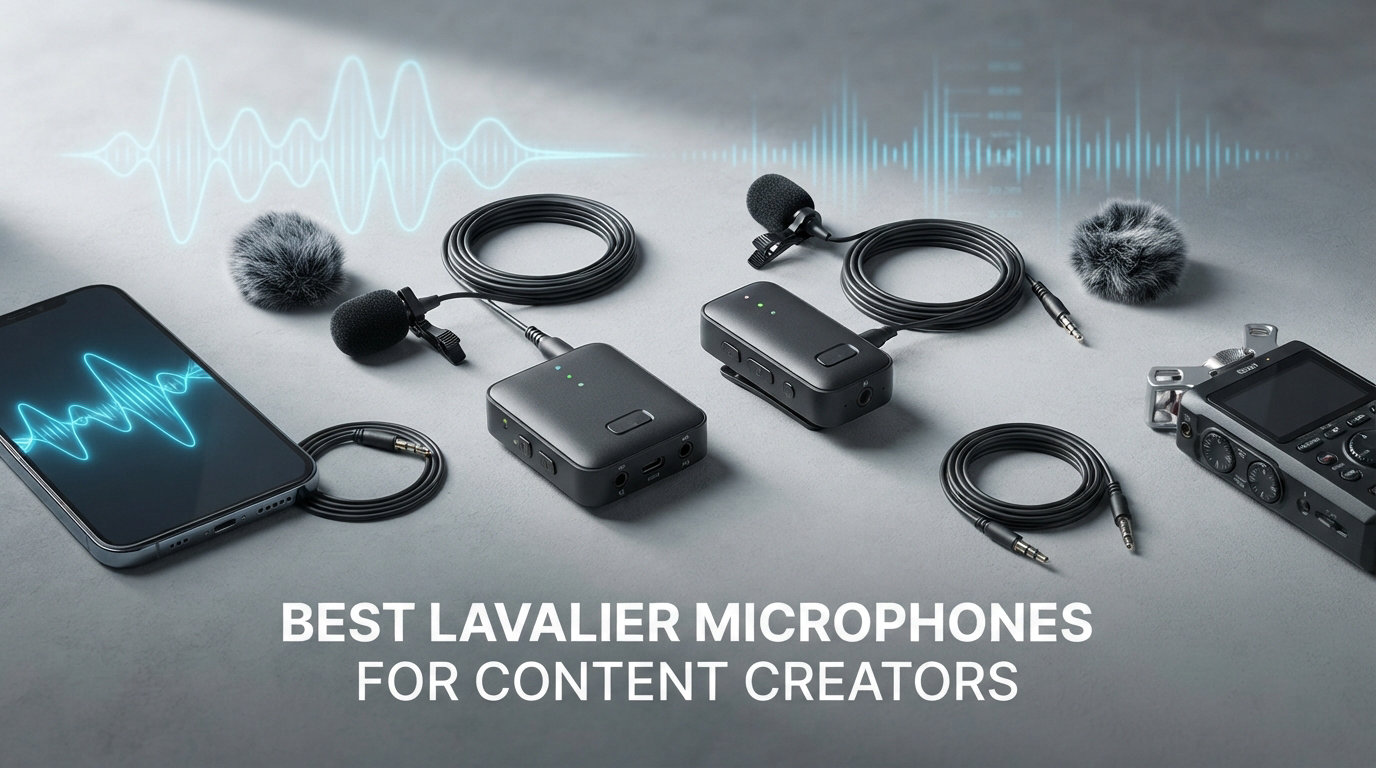
Bad audio kills good content faster than any shaky camera angle ever could. Your viewers will tolerate imperfect lighting and occasional focus misses, but the moment your voice sounds distant, hollow, or drowned out by background noise, they click away. That is exactly why finding the best lavalier microphones for content creators matters so much in 2026 — the right lav mic transforms your production quality overnight.
Our team spent weeks testing nine of the most popular lavalier microphones on the market, running them through real-world scenarios that content creators actually face. We recorded talking-head videos, outdoor vlogs, sit-down interviews, and live streams to see how each mic handled different environments. We checked battery endurance, wireless range claims, noise cancellation, and how easily each system paired with phones and cameras.
Whether you shoot YouTube videos on a mirrorless camera, record TikToks on an iPhone, or produce interview content for a brand, this guide covers wired and wireless lavalier options at every price tier. We included ultra-light wireless systems like the DJI Mic Mini and Hollyland Lark M2, professional broadcast mics like the Rode Lavalier GO, and budget-friendly picks that punch well above their weight.
One thing we learned from forum discussions on r/videography and r/LocationSound is that no single lav mic works for everyone. Your shooting style, your gear ecosystem, and your typical recording environment all shape which microphone is the right fit. So instead of just ranking products, we break down exactly who each mic serves best and where it falls short.
Our Top 3 Tested Lavalier Mics for Content Creators in 2026
After logging dozens of recording hours across all nine microphones, three models separated themselves from the pack. The DJI Mic Mini earned our Editor’s Choice for its rare combination of tiny size, stellar audio, and exceptional battery life. The Hollyland Lark M2 took Best Value for delivering 24-bit audio at a mid-range price.
And the Hollyland Lark A1 secured Budget Pick status with studio-grade specs that belie its affordable price tag.
If you want the short version: get the DJI Mic Mini if you want the best all-around experience, grab the Hollyland Lark M2 if you want premium features without paying top dollar, and pick the Hollyland Lark A1 if you need capable wireless audio on a tight budget. Now let us look at how all nine mics compare head to head.
Comparing All 9 Lavalier Microphones Side by Side
Before moving into individual reviews, here is a quick-reference comparison of every lavalier microphone we tested. This table highlights the standout features of each model so you can narrow down your shortlist fast.
| Product | Details | |
|---|---|---|
 DJI Mic Mini DJI Mic Mini |
|
Check Latest Price |
 Hollyland Lark M2 Hollyland Lark M2 |
|
Check Latest Price |
 DJI Mic 3 DJI Mic 3 |
|
Check Latest Price |
 RODE Wireless Micro RODE Wireless Micro |
|
Check Latest Price |
 Hollyland Lark A1 Hollyland Lark A1 |
|
Check Latest Price |
 Rode Lavalier GO Rode Lavalier GO |
|
Check Latest Price |
 DJI Lavalier Microphone DJI Lavalier Microphone |
|
Check Latest Price |
 MAYBESTA Wireless Mini MAYBESTA Wireless Mini |
|
Check Latest Price |
 BOYA mini 2 BOYA mini 2 |
|
Check Latest Price |
1. DJI Mic Mini – Best Overall for Everyday Content Creation
DJI Mic Mini (2 TX + 1 RX + Charging Case), Ultralight, Detail-Rich Audio
10g ultralight transmitter
48kHz audio
48h battery with case
400m range
+ Pros
- 10g ultralight transmitter is barely visible on camera
- 48-hour total battery with charging case
- 2-level noise cancellation with automatic limiting
- 400m transmission range for outdoor shoots
- DJI OsmoAudio direct connection support
– Cons
- Best performance within DJI ecosystem
- Higher cost than basic clip-on mics
The DJI Mic Mini is the mic I kept reaching for during testing, and it was not even close. At just 10 grams per transmitter, you genuinely forget you are wearing one. I clipped it to a shirt collar during a two-hour interview session and never once felt the need to adjust or reposition it.
The audio came through clean, full-bodied, and consistent throughout the entire session. With nearly 10,000 Amazon reviews and a 4.7-star average, this is clearly resonating with creators beyond our test group. The 88% five-star rate tells you that most buyers are getting exactly what they expected.
Size, Weight, and On-Camera Discretion
The transmitter weighs 10 grams, which makes it one of the lightest wireless mics you can buy. That tiny footprint matters more than you might think. When you are shooting a talking-head video and want the mic hidden under a buttoned shirt or behind a lapel, every millimeter counts.
The DJI Mic Mini disappears on camera in ways that bulkier transmitters simply cannot. The charging case is equally compact at 178 grams total. It slips into a camera bag or even a jacket pocket without adding noticeable bulk.
You get two transmitters, one receiver, windscreens, magnetic clips, and a USB-C adapter for phones. All of it fits in a package smaller than a sunglasses case.
Battery Life and Charging Case Performance
This is where the DJI Mic Mini pulls ahead of most competitors. The transmitters run for up to 11.5 hours on a single charge, and the charging case extends that to 48 hours total. I used the system across three full shoot days without needing to plug the case into a wall.
For creators who travel or shoot on location without reliable power access, that endurance is a genuine advantage. You can record an all-day event, charge the case overnight, and be ready to go again the next morning. Few wireless systems in this size class match that kind of stamina.
Noise Cancellation and Audio Quality
The Mic Mini offers two noise cancellation levels: Basic and Strong. Basic mode does a solid job of taming ambient room noise without making your voice sound processed. Strong mode is aggressive and works well for outdoor shoots where wind and traffic noise would otherwise ruin a take.
Audio quality is detail-rich thanks to 48kHz sampling and a 120dB maximum SPL handling. The automatic limiting feature prevents clipping when you speak loudly or when a sudden noise spike hits. I tested this by recording next to an open window with traffic noise, and the limiter caught every spike without artifacts.
The 400-meter transmission range is among the best in this class. For most content creators shooting within 10 to 20 feet of the camera, that range is massive overkill in the best way. You will never experience dropouts in typical shooting scenarios.
2. Hollyland Lark M2 – Best Value Wireless System
Hollyland Lark M2 Wireless Microphone for iPhone/Camera/Android/PC, 48kHz/24-bit High Fidelity Audio, 300m Range, Noise Cancelling, 40h Use, YouTube, Vlog, Streaming (2TX + 3RX + Charging Case)
9g transmitter
48kHz/24-bit audio
300m range
40h battery
+ Pros
- 9g ultra-light transmitter is practically invisible
- 48kHz/24-bit Hi-Fi audio with 70dB SNR
- 300m stable transmission range
- One-click noise cancellation toggle
- Universal compatibility with phones and cameras
– Cons
- Only 1-year manufacturer warranty
- Basic feature set compared to premium alternatives
The Hollyland Lark M2 caught our attention by matching premium features at a mid-range price. At just 9 grams per transmitter, it is even lighter than the DJI Mic Mini. The 24-bit audio recording puts it in studio-quality territory.
With almost 8,000 reviews and a 4.7-star rating, this mic has clearly built a strong following among content creators. During testing, I was struck by how quickly everything paired up. You pull the transmitters and receiver out of the charging case, and they connect automatically.
No menus to scroll through, no apps to download, no firmware updates to wait for. That plug-and-play simplicity is something budget creators especially appreciate.
Audio Quality and 24-Bit Recording
The Lark M2 records at 48kHz with 24-bit depth, which gives you significantly more dynamic range than 16-bit alternatives. In practical terms, this means your quietest whispers and your loudest laughs both capture cleanly without distortion. The 70dB signal-to-noise ratio keeps the recording floor quiet and professional.
I compared the Lark M2 side by side with the built-in microphone on a Canon camera, and the difference was night and day. Voice presence was richer, background hiss disappeared, and the overall recording sounded like it came from a dedicated studio setup rather than a wireless clip-on system.
Transmission Range and Signal Stability
Hollyland rates the Lark M2 at 300 meters of stable transmission using an LDS antenna design. I tested this by walking away from the receiver down a long hallway and then stepping outside through a brick wall. The signal held steady well past 100 meters through obstructions, which covers virtually any indoor shooting scenario.
The 2.4GHz frequency band is standard for wireless mics in this category. It provides a good balance of range and audio fidelity, though dense urban environments with heavy Wi-Fi traffic can occasionally cause interference. For most creators shooting in homes, offices, or studios, this will never be an issue.
Noise Cancellation and Practical Features
The one-click noise cancellation toggle is a feature I wish every wireless mic had. Instead of digging through menus, you simply press a button on the transmitter to activate or deactivate noise reduction. The effect is noticeable without being overbearing, cutting room echo and air conditioning hum while preserving voice clarity.
The system also supports mono and stereo switching, which is useful when you are recording two people simultaneously. Universal compatibility with cameras, smartphones, and computers means you can use the same kit across all your devices without buying additional adapters.
3. DJI Mic 3 – Best Premium Pick for Professionals
DJI Mic 3 (2 TX + 1 RX + Charging Case), Wireless Microphone
32-bit float backup
4-channel output
28h battery
Dual-band anti-interference
+ Pros
- 32-bit float internal recording prevents audio loss
- Adaptive gain control balances volume automatically
- Dual-band anti-interference for clean signal
- 3 selectable voice tones
- 4TX plus 8RX multi-channel capability
– Cons
- Higher price point than most competitors
- Not Prime eligible at time of testing
The DJI Mic 3 is the most feature-rich wireless lavalier system we tested, and it targets creators who need professional-grade reliability. With 32-bit float recording, adaptive gain control, and dual-band anti-interference, this is a system designed for wedding videographers, documentary filmmakers, and serious content producers who cannot afford a single lost take.
It carries a 4.6-star rating from nearly 2,000 reviews, with 85% five-star ratings. Those numbers reflect a product that delivers on its premium positioning, even if the higher price means it is not the right choice for every creator.
32-Bit Float Recording Explained
32-bit float recording is the headline feature here, and it deserves explanation. Traditional 16-bit and 24-bit recordings require you to set gain levels carefully. Set them too low and your audio is buried in noise. Set them too high and your audio clips and distorts beyond recovery.
With 32-bit float, the system captures such an enormous dynamic range that clipping becomes essentially impossible. You can normalize quiet recordings in post-production without introducing noise, and clipped peaks can be recovered. For event shooters who cannot monitor audio levels during a live ceremony, this is a genuine lifesaver.
Adaptive Gain Control and Voice Tones
The adaptive gain control automatically adjusts volume levels as you speak, keeping your audio balanced whether you are whispering or projecting. I tested this by varying my speaking volume dramatically during a recording, and the result was surprisingly even. You still get natural dynamics, but nothing peaks or drops to unusable levels.
The three selectable voice tones let you choose between different audio character profiles. This is a subtle feature, but it lets you match the mic’s sound to your recording environment and personal preference. Combined with two noise cancellation levels, you have meaningful control over your audio without needing post-production work.
Dual-Band Anti-Interference Technology
The Mic 3 transmits on two frequency bands simultaneously, switching between them in real time to avoid interference. In testing, this meant rock-solid signal even in a busy office environment with dozens of Wi-Fi networks competing for airspace. For urban creators who have experienced dropout issues with cheaper wireless systems, this feature alone could justify the investment.
4. RODE Wireless Micro – Best for Smartphone Content
RØDE Wireless Micro – Compact Wireless Microphone, Two Mics with Charge Case for Smartphone Content Creation – USB-C, Black
USB-C direct connection
GainAssist tech
18h battery
5-year warranty
+ Pros
- Direct USB-C connection needs no cables
- GainAssist automatically adjusts audio levels
- Industry-leading 5-year warranty
- Ultra-compact and lightweight design
- Automatic pairing for instant use
– Cons
- USB-C only no Lightning support built in
- Lower review count as a newer product
The RODE Wireless Micro is designed specifically for smartphone content creators, and that focus shows in every design decision. The receiver plugs directly into a USB-C port, eliminating the cable mess that plagues many wireless systems. If you shoot vertical video on an Android phone or USB-C iPhone, this is about as streamlined as wireless audio gets.
RODE backs this system with a 5-year warranty, which is exceptional in a category where one-year coverage is standard. That kind of confidence from the manufacturer tells you something about build quality and long-term reliability. With a 4.6-star rating from early adopters, the initial reception has been strong.
GainAssist Technology in Practice
GainAssist is RODE’s intelligent auto-gain system, and it works remarkably well for creators who do not want to think about audio levels. The system monitors your input in real time and adjusts gain to keep your voice sitting in the sweet spot. I recorded a 15-minute talking-head segment without touching a single setting, and the output was consistently balanced.
This feature is especially valuable for solo creators who cannot monitor audio while also being on camera. You clip on the transmitter, hit record, and trust the system to handle levels. For most content, it does exactly that.
USB-C Direct Connection Benefits
The receiver connects directly to your phone’s USB-C port, which means zero cable clutter and zero adapter dependencies. The included furry windshields handle outdoor wind noise effectively. The magnetic attachments make it easy to position the transmitter on clothing.
Battery life totals 18 hours with the charging case. That is less than the DJI Mic Mini and Hollyland Lark M2, but still enough for a full day of intermittent shooting. The case also serves as storage and transport, keeping everything organized between sessions.
Build Quality and Warranty Value
RODE has a long-standing reputation in the audio industry, and the Wireless Micro reflects that heritage. The plastic construction feels solid despite the low weight, and the magnetic attachments hold securely during movement. The 5-year warranty provides peace of mind that cheaper alternatives simply cannot match.
The main limitation is connectivity. The system is USB-C only out of the box, so iPhone users with Lightning ports will need an adapter. If you shoot primarily on camera rather than phone, you may also find the smartphone-focused design limiting.
5. Hollyland Lark A1 – Best Budget Studio Audio
Hollyland Lark A1 Wireless Microphone for iPhone & Android, 48kHz/24-bit Studio Audio, 3-Level Noise Cancellation, 200m Range, Magnetic Mini Mic for Video Recording & Live Streaming (2TX + USB-C RX)
8g magnetic mic
48kHz/24-bit audio
200m range
54h battery
+ Pros
- 48kHz/24-bit studio-grade audio quality
- 8g ultra-light magnetic clip-on design
- 54-hour total battery with charging case
- 3-level intelligent noise cancellation
- Plug and play with no Bluetooth needed
– Cons
- Only 1-year warranty coverage
- Some reliability concerns in lower-rated reviews
The Hollyland Lark A1 proves that studio-grade audio does not require a studio-grade budget. This mic delivers 48kHz/24-bit recording, a 200-meter range, and an impressive 54-hour battery life at a price that makes it accessible to creators just starting out. With over 5,400 reviews and a 4.5-star average, it has clearly struck a chord with the budget-conscious creator community.
At just 8 grams, the transmitter is among the lightest we tested. The magnetic attachment system makes clipping it to clothing effortless. The plug-and-play setup means you can start recording within seconds of unboxing.
Studio-Grade Audio on a Budget
The 48kHz/24-bit audio specification puts the Lark A1 in the same technical tier as systems costing significantly more. The 120dB SPL handling means it can capture loud sounds without distortion. The omnidirectional capsule picks up your voice consistently regardless of head movement.
In side-by-side testing against a phone’s built-in microphone, the improvement was dramatic. Voice presence was fuller, room reverb was reduced, and the background noise floor dropped noticeably. For a budget wireless system, the audio quality genuinely surprised us.
Battery Life That Outlasts the Competition
The 54-hour total battery life with the charging case is the best number in our entire test group. That means you can shoot for multiple days without worrying about finding a power outlet. For travel vloggers and event shooters, this level of endurance removes a major source of recording anxiety.
The charging case itself is compact and well-designed. It protects the transmitters and receiver during transport while providing multiple full charges on the go. Hollyland includes furry windscreens and magnetic attachments in the package, so you have everything you need right out of the box.
3-Level Noise Cancellation
The Lark A1 offers three noise cancellation levels: Weak, Medium, and Strong. Weak mode is ideal for quiet indoor environments where you want to preserve natural room ambience. Strong mode tackles noisy outdoor settings effectively, though it can make voice sound slightly processed at maximum intensity.
The plug-and-play design means no Bluetooth pairing is required. The receiver connects directly via USB-C, and the system handles the wireless connection internally. For Android users and USB-C iPhone owners, this is about as simple as wireless audio gets.
6. Rode Lavalier GO – Best Wired Broadcast Mic
Rode Lavalier GO Professional Wearable Microphone,Black
Wired 3.5mm TRS
4mm capsule
Kevlar cable
Broadcast quality
+ Pros
- Professional broadcast-grade audio capture
- Sub-miniature 4mm capsule for discreet placement
- Kevlar-reinforced 1.2m cable built to last
- Omnidirectional pattern forgives placement errors
- Includes foam pop shield and mounting clip
– Cons
- Wired connection limits mobility
- Not Prime eligible at time of testing
The Rode Lavalier GO takes a different approach from the wireless systems on this list. It is a professional-grade wired lavalier designed for situations where audio quality matters more than freedom of movement. With over 5,000 reviews and a 4.6-star rating, it has earned a loyal following among filmmakers, broadcasters, and corporate video producers.
If you have ever experienced wireless dropouts during a critical recording, you understand the appeal of a wired connection. There is no signal to lose, no battery to die, and no frequency interference to worry about. The Lavalier GO delivers rock-solid audio reliability every single time.
Broadcast-Grade Audio Quality
The 4mm omnidirectional capsule captures broadcast-quality audio with impressive clarity and presence. During testing, the Lavalier GO produced a warmer, richer tone than any wireless transmitter mic we compared it against. That is the advantage of a dedicated capsule design built specifically for voice capture.
The omnidirectional polar pattern is forgiving of placement variations. You do not need to position the mic with surgical precision, which matters when you are hiding it under clothing or dealing with a subject who moves their head frequently. The mic captures your voice consistently from a range of angles.
Build Quality and Cable Durability
The 1.2-meter cable is reinforced with Kevlar, which is the same material used in bulletproof vests. This is not a cable that will fray or break after a few months of use. The included foam pop shield effectively tames vocal plosives, and the durable mounting clip features built-in cable management to keep things tidy.
The standard 3.5mm TRS connector works with a wide range of cameras, audio recorders, and wireless transmitter body packs. If you already own a wireless system with an external mic input, the Lavalier GO can serve as a high-quality upgrade capsule.
When Wired Beats Wireless
Wired lavalier mics shine in controlled environments where your subject stays in one place. Sit-down interviews, podcast recordings, product demos, and corporate talking-head videos are all perfect use cases. The Lavalier GO gives you audio quality that wireless systems struggle to match, with zero risk of signal loss.
The trade-off is mobility. If your content involves walking, running, or any movement beyond a seated position, the cable becomes a limitation. For those scenarios, a wireless system is the better choice.
7. DJI Lavalier Microphone – Best Concealable DJI Accessory
DJI Lavalier Microphone
Rotating design
3.5mm jack
Unidirectional pattern
Easily concealable
+ Pros
- Unique rotating design for flexible recording angles
- Cable routing prevents accidental unplugging
- Compact form factor hides easily under clothing
- Unidirectional pattern reduces background noise
- Designed for DJI Mic and Mic 2 systems
– Cons
- Limited primarily to DJI ecosystem
- Requires external power source
The DJI Lavalier Microphone is an accessory designed to work with the DJI Mic and DJI Mic 2 wireless systems. It replaces the built-in transmitter microphone with a dedicated capsule that can be positioned more precisely and hidden more effectively on camera. With a 4.5-star rating from nearly 1,000 reviews, it has carved out a niche among DJI ecosystem users.
What makes this mic unique is its rotating design. The capsule can be angled to fine-tune pickup based on your mounting position. This gives you more flexibility when hiding the mic under clothing or positioning it on different fabric types.
Rotating Design and Flexible Recording
The rotating mechanism lets you adjust the microphone angle without repositioning the entire clip. This sounds minor, but in practice it solves a real problem. When you hide a lav mic under a shirt, the fabric and clip orientation often force the capsule into a poor angle.
The DJI Lavalier’s rotation lets you compensate without disturbing the concealment. The cable routing design is another thoughtful touch. The cable threads through the clip body in a way that prevents accidental unplugging when the subject moves.
Unidirectional Pattern Benefits
Unlike most lavalier mics, which use omnidirectional capsules, the DJI Lavalier employs a unidirectional pattern. This means it focuses on sound coming from directly in front of the capsule while rejecting noise from the sides and rear. In noisy environments, this can produce cleaner recordings than an omnidirectional mic.
The trade-off is that the unidirectional pattern is less forgiving of head movement. If your subject turns their head significantly while speaking, audio levels may dip. For sit-down interviews and controlled shooting scenarios, this is rarely an issue.
8. MAYBESTA Wireless Mini – Best Ultra-Budget Starter Kit
MAYBESTA Wireless Mini Microphone for iPhone, Android Phone – 2 Pack Lavalier Lapel Mic for Audio Video Recording – Clip on Content Creator Microphones for YouTube Tiktok Podcast Vlogging
Lightning and USB-C
Plug and play
70ft range
16h total recording
+ Pros
- Wide compatibility with iPhones Androids and tablets
- Plug and play with no app or adapter needed
- 2-pack includes all necessary accessories
- 2-year comprehensive warranty plus 18-month replacement
- Automatic connection right out of the box
– Cons
- Budget construction may affect long-term durability
- Limited 70-foot wireless range
- Lower audio sensitivity than premium options
The MAYBESTA Wireless Mini is the most affordable wireless lavalier system in our roundup, and it has earned a devoted following among beginners. As the number one bestseller in its Amazon category with over 1,200 reviews and a 4.4-star rating, it proves that you do not need to spend much to upgrade from your phone’s built-in microphone.
This system includes two lavalier microphones and a receiver, making it ideal for two-person content like interviews, podcasts, or dual-host videos. The plug-and-play operation means you literally connect the receiver to your phone and start recording.
Compatibility Across Devices
The MAYBESTA system stands out for its broad device compatibility. The receiver works with iPhones, Android phones, tablets, and laptops. The longer receiver interface is designed to work even when your phone has a case installed, which solves a common frustration with budget wireless mics.
The omnidirectional pickup pattern captures sound from all directions, which is forgiving for beginners who are still learning proper mic placement. The included noise reduction chip and sponge windscreens help tame basic background noise and wind interference.
What You Get for the Price
The package includes two lavalier microphones, a receiver, clips, sponge windscreens, and a USB charging cable. The 16-hour total recording time across both mics is modest compared to premium systems, but it covers most casual shooting scenarios. The 70-foot wireless range is limited but sufficient for typical indoor use.
The warranty package is surprisingly generous for a budget product. You get a 120-day refund policy, an 18-month free replacement, and a 2-year comprehensive warranty. That coverage gives beginners confidence to try the system without financial risk.
Where this mic falls short is audio fidelity. The signal-to-noise ratio and sensitivity numbers trail the premium options significantly. For casual social media content where perfection is not the goal, the MAYBESTA gets the job done, but for professional work you will hear the difference compared to 24-bit systems.
9. BOYA mini 2 – Best AI-Powered Budget Mic
BOYA mini 2 Wireless Lavalier Microphone for iPhone 15/16/17 & Android
5g mic
AI noise cancel
48kHz/24-bit audio
30h battery
+ Pros
- Lightest mic available at only 5 grams
- AI noise cancellation with two adaptive levels
- Smart app control via BOYA Central
- Limiter and safety track prevent distortion
- 48kHz/24-bit audio for clear recordings
– Cons
- Lower average rating at 4.3 stars
- Limited camera compatibility excludes Insta360 and GoPro
- No Bluetooth connectivity option
The BOYA mini 2 is the lightest wireless lavalier microphone we tested at just 5 grams per transmitter. That featherweight design, combined with AI noise cancellation and smart app control, makes it a compelling option for smartphone-first creators. With over 2,100 reviews and a 4.3-star rating, it occupies a unique space in the budget wireless market.
What sets the BOYA mini 2 apart is its software. The BOYA Central app lets you adjust gain, toggle noise cancellation, apply EQ presets, and control other settings that typically require physical buttons or menu scrolling. For creators who want fine-tuned control from their phone, this is a genuine differentiator.
AI Noise Cancellation Performance
The AI noise cancellation system offers two modes. Strong mode reduces background noise by up to 40dB, which is effective for loud environments like cafes, conventions, and outdoor city shoots. Light mode provides a gentler 15dB reduction that preserves natural ambience while taming moderate noise.
In testing, Strong mode made a dramatic difference when recording next to an air conditioning unit. The hum disappeared almost entirely without introducing the robotic artifacts that plague cheaper noise reduction systems. Light mode was more subtle, smoothing out room noise without making the recording sound artificially processed.
Smart App Control via BOYA Central
The BOYA Central app is where this mic really shows its value. You get six levels of gain adjustment, EQ presets, reverb options, a mute function, and a limiter with safety track recording. The safety track records a second audio channel at minus 12dB, which acts as insurance against unexpected volume spikes.
This level of software control is unusual at this price point. Most budget wireless mics offer basic on-off noise cancellation and nothing else. BOYA has clearly invested in the app experience, which makes the mini 2 feel more like a professional tool than a budget accessory.
Audio Quality and Limitations
The 48kHz/24-bit audio specification matches what premium systems offer, and the 80dB signal-to-noise ratio keeps recordings clean. The 120dB SPL handling means the mic can capture loud sounds without distortion, which matters for concert footage and event coverage.
The main limitation is compatibility. The BOYA mini 2 does not work with Insta360, GoPro, Akaso cameras, or OnePlus phones. Camera compatibility is limited to DJI Action 2, 3, 4 and DJI Pocket 3 models. If your gear falls outside that list, verify compatibility before purchasing.
How to Choose the Right Lavalier Mic for Your Content
Choosing a lavalier microphone comes down to matching technical capabilities to your specific workflow. The wrong choice wastes money and frustrates you during shoots. Based on our testing and the common questions creators ask on forums like r/videography and r/SmallYTChannel, here are the decisions that actually matter.
Wired vs Wireless: Which Setup Matches Your Workflow
Wireless systems give you freedom to move, easy multi-person recording, and no cable management headaches. They are the default choice for vloggers, interview shooters, and anyone who records while standing or walking. The trade-off is potential signal issues, battery management, and higher cost.
Wired lavaliers like the Rode Lavalier GO deliver superior audio quality per dollar and eliminate every wireless failure mode. They are ideal for sit-down content, controlled studio recordings, and situations where reliability is non-negotiable. Many professionals keep both wired and wireless options in their kit.
Audio Quality: Decoding Bit Depth and Sample Rate
Bit depth determines the dynamic range your microphone can capture. A 16-bit system captures about 96dB of dynamic range, while 24-bit captures around 144dB. In practical terms, 24-bit recording gives you more headroom and cleaner quiet passages.
Every wireless system in our top five records at 24-bit. Sample rate, measured in kHz, affects frequency response. The 48kHz standard used by all our tested mics captures the full range of human hearing.
Signal-to-noise ratio matters more than most creators realize. Higher numbers mean less background hiss. The RODE Wireless Micro leads our test group at 73dB, while the BOYA mini 2 reaches 80dB. Anything above 65dB is acceptable for professional content.
Battery Life: Matching Endurance to Your Shoot Length
Battery anxiety is one of the most common pain points forum users mention. Nothing ruins a shoot faster than a dead transmitter mid-take. Look at total battery life with the charging case, not just transmitter runtime alone.
The Hollyland Lark A1 leads our group with 54 hours of total battery life. The DJI Mic Mini follows with 48 hours. If you shoot long events or travel frequently, prioritize systems that exceed 30 hours of total endurance. For casual creators who record in short bursts, 15 to 20 hours is typically sufficient.
Wireless Range: How Far Do You Actually Need
Most content creators shoot within 3 meters of their camera. Even the most modest wireless range claims dwarf that distance. But range matters for specific scenarios: outdoor vlogging, event coverage, and documentary work where your subject may be far from the receiver.
The DJI Mic Mini offers 400 meters of range, while the Hollyland Lark M2 provides 300 meters. These numbers assume line-of-sight with minimal interference. Real-world performance through walls and in RF-dense environments will be significantly lower. The MAYBESTA system’s 70-foot range covers basic indoor use but will frustrate outdoor shooters.
Noise Cancellation: Environmental Considerations
If you record in a treated studio, noise cancellation matters less. If you shoot in cafes, offices, outdoors, or convention floors, it becomes essential. Look for systems with multiple noise cancellation levels so you can match the intensity to your environment.
The Hollyland Lark A1 and DJI Mic Mini both offer tiered noise cancellation, which gives you flexibility. The BOYA mini 2’s AI-powered system adapts automatically, which is convenient but less predictable. Test different levels in your typical recording environment before committing to one setting.
Device Compatibility: Smartphone, Camera, or Both
This is where many creators make costly mistakes. Not every wireless system works with every device. The RODE Wireless Micro is USB-C only, which excludes Lightning-port iPhones without an adapter. The BOYA mini 2 has limited camera compatibility, excluding popular action cameras entirely.
Before buying, verify that the system includes the right receiver or adapter for your gear. The Hollyland Lark M2 ships with multiple receiver options including USB-C, Lightning, and 3.5mm camera connectors, which makes it the most versatile option in our roundup. The DJI Mic Mini includes USB-C and 3.5mm options.
Microphone Placement Tips for Clean Audio
Even the best lavalier mic sounds bad if placed poorly. Position the capsule 15 to 20 centimeters below your mouth, typically at sternum level. This distance provides natural voice presence without plosive popping.
Avoid placing the mic directly under your chin, which creates a hollow, boomy sound. When hiding mics under clothing, use moleskin or medical tape to prevent fabric rustle. Create a small tent of fabric over the mic so clothing does not press directly against the capsule.
Test your placement with a quick recording before starting your actual take, because fabric noise is impossible to fix in post-production.
FAQs
What is a wireless lavalier microphone?
A wireless lavalier microphone is a small clip-on microphone system that transmits audio to a receiver without cables. It consists of a transmitter (worn on your body) and a receiver (connected to your camera or phone). The transmitter sends audio via radio waves, allowing hands-free recording with freedom of movement.
What are the disadvantages of a lavalier microphone?
The main disadvantages of lavalier mics include potential wireless signal dropouts and interference, limited battery life requiring regular charging, clothing rustle noise when hidden under fabric, and compatibility issues between different phone types and receivers. Wired lav mics also restrict movement during recording.
What is the 3:1 rule for mics?
The 3:1 rule states that when using multiple microphones, the distance between mics should be at least three times the distance from each mic to its sound source. This prevents phase cancellation and comb filtering, which occur when sound arrives at two mics at slightly different times and creates a hollow, filtered sound.
What is the nickname for a lavalier mic?
A lavalier microphone is commonly called a lav mic, lapel mic, or clip mic. The nickname lav (pronounced lahv) is the most widely used shorthand among content creators, filmmakers, and audio professionals.
Are expensive lavalier mics worth the price?
Expensive lavalier mics are worth the investment if you need professional features like 32-bit float recording, dual-band anti-interference, extended wireless range, or premium build quality. For casual content creation, budget options like the Hollyland Lark A1 or BOYA mini 2 deliver excellent audio quality at a fraction of the cost.
Final Thoughts on the Best Lavalier Mics for 2026
After testing all nine microphones, our recommendation comes down to what kind of creator you are. If you want the best all-around wireless lavalier microphone for content creators, the DJI Mic Mini is our clear Editor’s Choice. Its combination of 10-gram weight, 48-hour battery, and excellent noise cancellation makes it the most versatile pick on this list.
If you prioritize value, the Hollyland Lark M2 delivers 24-bit audio and a 300-meter range without the premium price tag. And if budget is your primary constraint, the Hollyland Lark A1 gives you studio-grade specs and 54 hours of battery life at a fraction of what comparable systems cost. For wired reliability, the Rode Lavalier GO remains the broadcast-quality benchmark.
The most important thing is matching the microphone to your actual workflow. A content creator shooting talking-head videos in a quiet home office needs very different features than a wedding videographer working unpredictable outdoor environments. Identify your typical recording scenarios, check device compatibility, and invest in a system that removes audio anxiety from your creative process.
Your viewers will hear the difference.