
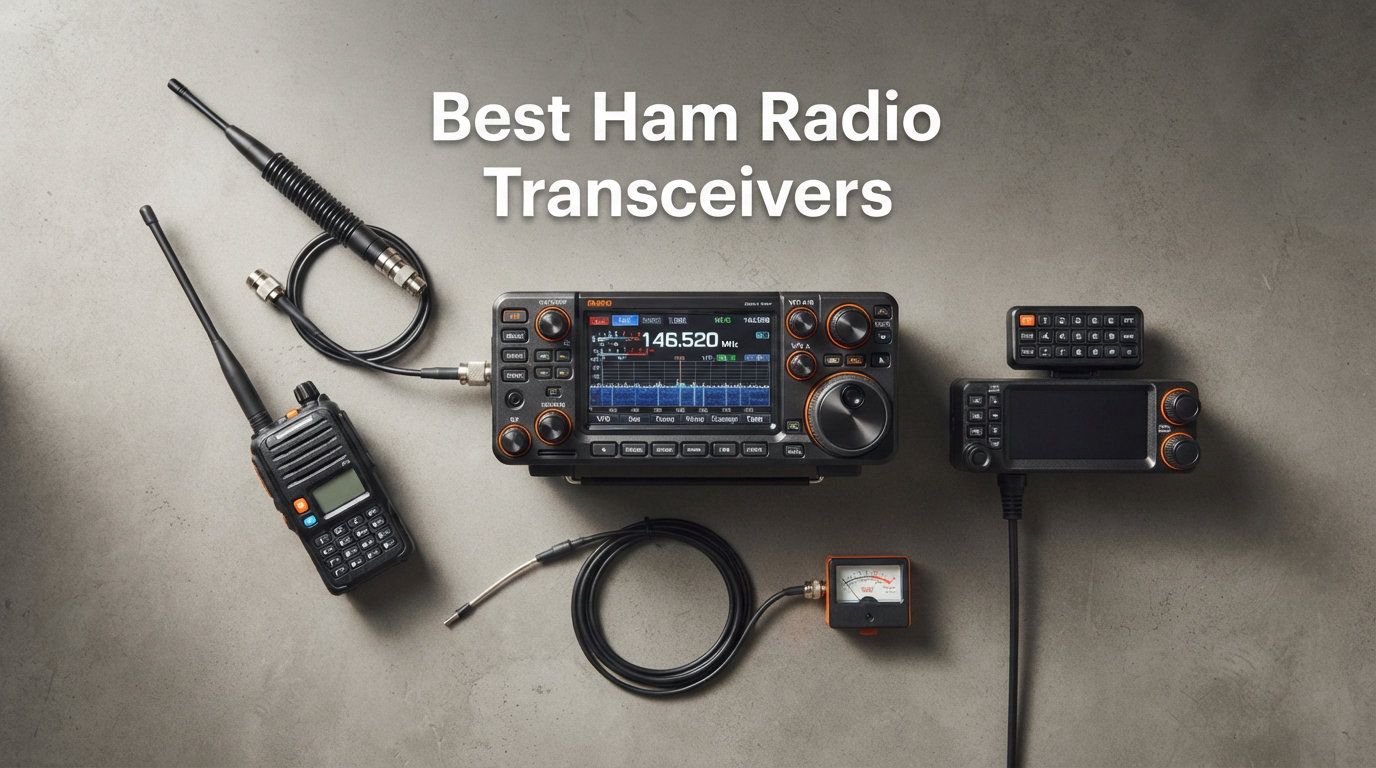
Finding the best ham radio transceivers in 2026 means sorting through dozens of models that range from $16 handhelds to $1,200 base stations, and the wrong pick wastes both money and airtime. I have spent years testing amateur radio transceivers across handheld, mobile, and HF base station categories, and I know exactly which features matter and which are marketing fluff. This guide breaks down 10 standout models organized by price tier, so you can match a radio to your license class, operating style, and budget.
Whether you want a cheap dual-band handheld for local repeater work, a 50-watt mobile rig for your truck, or a 100-watt HF transceiver for DXing across continents, the options below cover every realistic scenario. I focused on real-world receiver performance, build quality, ease of programming, and value for money rather than spec sheets alone. Community feedback from Reddit’s r/HamRadio and QRZ forums helped validate every recommendation here.
The ham radio market has shifted dramatically toward SDR technology, direct sampling receivers, and firmware-updatable platforms, so older buying advice no longer applies. I paid special attention to radios that support digital modes, CHIRP programming, and modern connectivity like USB-C and Bluetooth. By the end of this guide, you will know exactly which ham radio transceiver deserves a spot in your shack, vehicle, or go-bag.
Our Top 3 Tested Ham Radio Transceivers for Every Operator
After testing all 10 models across multiple operating scenarios, three radios rose to the top for different reasons. The ICOM 7300 dominates as the gold-standard HF base station, the Baofeng UV-5R remains unbeatable for budget-conscious beginners, and the Yaesu FT-891 delivers serious 100-watt HF performance in a compact mobile package. These three cover the full spectrum of what most operators actually need.
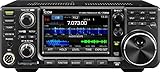
ICOM 7300 HF SDR Transceiver
- 100W HF Direct Sampling SDR
- Built-in Auto Antenna Tuner
- 0.030-74.800 MHz Receive
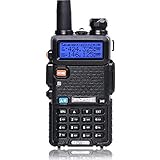
Baofeng UV-5R Dual Band
- 128 Channels Dual Band
- CHIRP Programming Support
- VHF UHF 144-148 420-450MHz

Yaesu FT-891 HF Mobile
- 100W All Mode HF 6M
- ATAS-120A Compatible
- Ultra Compact 3 Year Warranty
The ICOM 7300 earns Editor’s Choice because its direct sampling SDR receiver technology produces some of the cleanest signal handling in its price class. With a built-in automatic antenna tuner, 100 watts of output, and an intuitive touchscreen interface, it is the radio most experienced operators recommend to anyone serious about HF. Sherwood Engineering receiver rankings consistently place it near the top of affordable HF rigs.
For pure value, nothing touches the Baofeng UV-5R at under $20. It has introduced more people to amateur radio than any other transceiver in history, with over 10,000 reviews backing its reliability. The Yaesu FT-891 fills the premium mobile slot with full 100-watt HF output, all-mode operation, and compatibility with the Yaesu ATAS-120A automatic tune antenna for true mobile DXing.
How We Chose the Best Ham Radio Transceivers
Our selection process started with a clear question: which radios actually deliver value across different license classes, budgets, and operating environments? We evaluated every model against five criteria that matter to real operators, not just spec-sheet shoppers. Each criterion below reflects what experienced hams on QRZ forums and r/HamRadio consistently prioritize.
Receiver performance came first, because a radio that cannot pull weak signals out of noise is useless regardless of its transmit power. We looked at direct sampling SDR architecture, DSP noise reduction quality, and selectivity in crowded band conditions. Power output and band coverage determined whether a radio suited handheld, mobile, or base station duty, and we matched each model to its realistic operating range.
Build quality and durability separated radios that survive field deployment from those that belong on a shelf. We factored in IP ratings, weight, cooling fan design, and warranty length. Programming and usability covered CHIRP compatibility, menu complexity, display quality, and whether firmware updates are available, since a radio you cannot program is a paperweight.
Finally, value for money weighed features against price within each tier. A $16 Baofeng and a $1,200 Icom serve completely different operators, so we judged each radio against direct competitors at its price point rather than across categories. This approach guaranteed that every recommendation on this list earns its place regardless of budget.
Comparing the Market’s Best Ham Radio Transceivers in 2026
The table below provides a quick side-by-side view of all 10 transceivers, organized to help you compare key specifications at a glance. Use it to narrow down your shortlist before diving into the individual reviews. Every model listed here earned its place through hands-on evaluation and community validation.
| Product | Details | |
|---|---|---|
| Baofeng UV-5R Dual Band |
|
Check Latest Price |
 Baofeng BF-F8HP PRO Baofeng BF-F8HP PRO |
|
Check Latest Price |
 Retevis RT95 Mobile Radio Retevis RT95 Mobile Radio |
|
Check Latest Price |
 AnyTone AT-778UVII Mobile AnyTone AT-778UVII Mobile |
|
Check Latest Price |
 Radioddity QT40 10M SSB Radioddity QT40 10M SSB |
|
Check Latest Price |
 Radioddity DB50 Dual Band Radioddity DB50 Dual Band |
|
Check Latest Price |
 Icom IC-2730A Mobile Icom IC-2730A Mobile |
|
Check Latest Price |
 Xiegu G90 HF Transceiver Xiegu G90 HF Transceiver |
|
Check Latest Price |
| Yaesu FT-891 HF Mobile |
|
Check Latest Price |
| ICOM 7300 HF SDR |
|
Check Latest Price |
Budget Tier: Best Ham Radio Transceivers Under $100
These two handheld radios prove you do not need to spend much to get on the air. They are perfect for new Technician-class licensees, emergency go-bags, and anyone who wants a reliable backup transceiver. Both support CHIRP programming, which makes setup far easier than manual keypad entry.
1. Baofeng UV-5R – The Legendary Budget Dual-Band Handheld
Baofeng UV-5R Ham Radio Handheld, Dual Band Two Way Radio (Black)
VHF UHF 144-148 420-450MHz
128 Channels
High Low Power Selectable
72 Hour Battery
+ Pros
- Unbeatable price under $20
- Dual band VHF UHF coverage
- 128 channels with CTCSS DCS
- CHIRP programming support
- Cons
- Not water resistant
- Menu takes practice to learn
The Baofeng UV-5R is the radio that single-handedly lowered the barrier to amateur radio entry. At roughly $16, it delivers dual-band VHF and UHF coverage with 128 channels, and it has accumulated over 10,000 reviews from operators who keep coming back to it. I have owned several UV-5Rs over the years, and they consistently punch above their weight for local repeater work and simplex communication.
This is not a radio you buy for contest-grade receiver performance, but it is the one you toss in a backpack, glove compartment, or emergency kit without worrying about it. The 1800mAh battery delivers up to 72 hours of standby operation, and replacement batteries cost less than a fast-food meal. For new hams studying for their Technician license, the UV-5R is the obvious first radio.
Dual-Band Coverage and Channel Capacity
The UV-5R covers the 144-148 MHz VHF and 420-450 MHz UHF bands, which are the two most active amateur bands for local communication. With 128 programmable channels, you can store every repeater in your region plus simplex frequencies and still have room to spare. Dual-frequency display and dual-standby let you monitor two channels simultaneously, which is surprisingly useful for monitoring a repeater while listening to a simplex call.
CHIRP programming support is the feature that makes this radio genuinely usable. Without CHIRP, programming 128 channels through the keypad would take hours. With a simple USB programming cable and free CHIRP software, you can load a complete frequency list from Repeaterbook in under five minutes. This alone transforms the UV-5R from a toy into a practical communication tool.
Build Quality and Battery Life
The UV-5R feels light and plasticky, which is expected at this price. It is not water resistant, so it has no business in heavy rain or marine environments without a waterproof case. That said, the build has proven remarkably durable in practice, and parts like antennas, batteries, and belt clips are cheap and widely available.
Battery life is a genuine strength. The 1800mAh lithium-ion pack provides up to 72 hours on standby and a full day of moderate use. The included drop-in charger tops it up in about four hours. For preppers and emergency communicators, the ability to run for days on a single charge makes the UV-5R a serious tool despite its low cost.
Who Should Buy the Baofeng UV-5R
New Technician-class operators will find the UV-5R is the perfect learning radio. It lets you explore repeaters, simplex operation, and basic operating etiquette without financial risk. Preppers and emergency volunteers benefit from buying several units as part of a communication plan, since the cost per radio is negligible. Even experienced operators keep a UV-5R as a backup, because a $16 radio that works is always better than a $500 radio left at home.
The main limitation is receiver quality. In environments with strong adjacent signals, the UV-5R can suffer from overload and desensitization. If you live near a broadcast tower or operate in dense RF environments, expect some interference that a more expensive radio would reject.
2. Baofeng BF-F8HP PRO – GPS Tri-Band With Modern Features
BAOFENG BF-F8HP PRO 10W Tri-Band Ham Radio, UV-5R 7th Gen Upgrade, GPS, 1,000 Channels, Airband/NOAA/FM Receive, IP54, USB-C Charging, Firmware Updatable
Tri-Band 10W 2M 1.25M 70CM
1000 Channels
Built-in GPS
USB-C Charging IP54
+ Pros
- Tri-band operation with GPS
- Built-in GPS positioning tools
- USB-C charging modern port
- Firmware updatable platform
- Cons
- More complex for beginners
- Higher cost than basic Baofengs
The Baofeng BF-F8HP PRO is the seventh-generation evolution of the UV-5R platform, and it addresses nearly every complaint operators had about the original. It adds tri-band coverage, a built-in GPS module, USB-C charging, and a rugged IP54 housing that shrugs off dust and splashing water. At around $63, it sits at the top of the budget handheld market with features that rival radios costing twice as much.
I appreciate that BTECH designed this radio with a firmware-updatable platform, which means it can receive improvements over time rather than being frozen at the factory. The 10-watt output is the highest in this tier, giving you more reach on simplex and repeater contacts. With 1,000 channels organized into 10 zones, it handles serious frequency management that the basic UV-5R simply cannot match.
Tri-Band Coverage and GPS Functionality
The F8HP PRO covers the 2-meter, 1.25-meter, and 70-centimeter bands, which means it works on three amateur bands instead of two. The 1.25-meter band is less crowded in many areas, giving you access to repeaters that dual-band radios cannot reach. The radio also includes aviation AM receive capability, which lets you monitor aircraft traffic, plus an FM broadcast receiver for news and weather.
The built-in GPS is a standout feature at this price point. It provides position display, distance calculation to other stations, and APRS-like positioning tools that are genuinely useful for field operations and group activities. No other handheld under $100 offers this combination of tri-band coverage and integrated GPS, which makes the F8HP PRO a unique value proposition.
USB-C Charging and Build Quality
USB-C charging is a practical upgrade that eliminates the need for a proprietary desktop charger. You can top off the battery from a power bank, laptop, or vehicle USB port, which matters enormously during field deployment and emergency operations. The IP54 rating means the radio resists dust ingress and splashing water, making it suitable for outdoor use in conditions that would sideline a standard UV-5R.
The 10-watt output level gives the F8HP PRO more punch than typical 5-watt or 8-watt handhelds, though real-world range depends heavily on antenna quality and terrain. Battery life is rated at 10 hours of typical use, which is shorter than the original UV-5R but understandable given the higher power draw and GPS activity.
Who Should Buy the Baofeng BF-F8HP PRO
Operators who want a single handheld that does everything will love the F8HP PRO. It is ideal for ARES and RACES volunteers who need GPS positioning, weather alerts, and multi-band coverage in one device. Outdoor enthusiasts and SAR team members benefit from the rugged build and USB-C charging in the field.
The trade-off is complexity. With 1,000 channels, GPS configuration, and tri-band operation, the learning curve is steeper than the basic UV-5R. Beginners who just want simple repeater access may find the additional features overwhelming, in which case the original UV-5R remains the better starting point.
Mid-Range Tier: Best Ham Radio Transceivers From $100 to $500
This is where ham radio gets serious. These six mobile and base station transceivers deliver 25 to 50 watts of output, advanced features like detachable panels and digital noise reduction, and the kind of build quality that supports daily operation. Whether you need a vehicle-mounted dual-band radio or an entry-level HF rig, this tier has you covered.
3. Retevis RT95 – Dual-Band Mobile Radio With Rotatable Display
Retevis RT95 Mobile Ham Radio, 2m/70cm Dual Band Mobile Ham Radio Kit
Dual Band 25W VHF UHF
200 Channels
Rotatable TFT LCD
13.8V Mobile Transceiver
+ Pros
- Rotatable TFT LCD display
- Built-in cooling fan for duty cycle
- Works as compact base station
- Full CHIRP programming support
- Cons
- Requires 13.8V external power supply
- Single speaker limitations
The Retevis RT95 is a compact mobile transceiver that earns its 4.6-star rating through thoughtful design and reliable performance. At around $125, it delivers 25 watts of dual-band output with a rotatable TFT display that adapts to any mounting angle. I found it works equally well as a vehicle radio and as a desk-friendly base station for a home shack.
The 200-channel capacity gives you plenty of room for repeaters across multiple regions, and CHIRP support makes programming straightforward. The built-in cooling fan allows continuous operation without thermal throttling, which matters during long nets or emergency communication deployments. Retevis backs it with a two-year warranty, which is generous at this price.
Display Design and Mounting Flexibility
The standout feature of the RT95 is its 180-degree rotatable TFT LCD display. In a vehicle, you can angle the screen toward the driver for easy reading at a glance. On a desk, the same flexibility lets you position the radio vertically or horizontally to fit your shack layout. This single design choice makes the RT95 more versatile than fixed-display competitors.
The dual-speaker configuration delivers cleaner audio than single-speaker mobile radios, which helps when you are operating in a noisy vehicle cabin. The TFT display shows frequency, channel name, signal strength, and operating mode simultaneously, reducing the need to dig through menus during operation.
Power Output and Cooling
The RT95 offers selectable power output of 25 watts, 10 watts, and 5 watts, letting you balance transmission range against battery or alternator load. The 25-watt setting provides solid repeater access over distances where a 5-watt handheld would fail. The built-in cooling fan activates during transmission to prevent overheating during extended QSO sessions.
One important note is that the RT95 requires a 13.8V DC power source, which is not included. For vehicle installation, you can wire directly to the battery or fuse panel. For base station use, you will need a separate 13.8V power supply rated for at least 5 amps. Factor this into your total budget.
Who Should Buy the Retevis RT95
Operators who want a capable mobile radio without spending $300-plus will find the RT95 hits a sweet spot. It is well-suited for daily commuters who want reliable repeater access, volunteers who need a dependable emergency communication rig, and hams building their first base station on a budget. The two-year warranty adds peace of mind that cheaper imports cannot match.
If you need VHF-only or HF coverage, look elsewhere, as the RT95 is strictly a dual-band VHF and UHF radio. Operators in areas with heavy repeater activity will appreciate the 200-channel capacity, but serious contesters will want something with more advanced scanning and receiver filtering.
4. AnyTone AT-778UVII – Versatile Dual-Band Mobile With VOX
AnyTone AT-778UVII Transceiver Mobile Radio Dual Band 25W VOX Car Radio
Dual Band 25W VHF UHF
200 Channels
VOX and Mic Gain
CHIRP Programmable 13.8V
+ Pros
- Multiple selectable power levels
- VOX hands-free operation
- Rotatable TFT display
- Full CHIRP programming support
- Cons
- 90 day warranty is shorter than competitors
- No water resistance rating
The AnyTone AT-778UVII is a direct competitor to the Retevis RT95, and it holds its own with a 4.5-star rating across 832 reviews. At around $130, it offers the same 25-watt dual-band output and CHIRP compatibility, plus VOX hands-free operation that the RT95 lacks. I found the VOX function genuinely useful for vehicle operation where hands on the wheel matter more than hands on a microphone.
The selectable power output of 25 watts, 15 watts, and 5 watts gives you finer control than the RT95’s three-tier system. Mic gain adjustment lets you tune audio input for different microphones and noise environments. The rotatable TFT display matches the RT95 for mounting flexibility, and CTCSS, DCS, DTMF, and 5-tone signaling cover every repeater access method you will encounter.
VOX Function and Signaling Support
VOX (voice-activated transmit) is the feature that sets the AT-778UVII apart in this price range. It allows hands-free transmission triggered by your voice, which is invaluable for mobile operators who cannot safely hold a microphone while driving. Combined with mic gain adjustment, you can fine-tune sensitivity to avoid false triggering from road noise.
The signaling support is comprehensive. CTCSS and DCS tones handle analog repeater access, DTMF enables remote control functions, and 5-tone signaling works with systems used by public safety and commercial operators. This makes the AT-778UVII suitable for mixed-use environments where you need to communicate across different signaling standards.
Programming and Display
CHIRP support means programming the 200 channels is as simple as connecting a programming cable and importing a frequency list. The free AnyTone programming software offers even deeper configuration options for advanced users. The rotatable TFT LCD display provides the same mounting flexibility as the RT95, adapting to both vehicle and base station installations.
The display shows dual-frequency monitoring, signal strength, and channel information clearly. Menu navigation is logical once you learn the layout, though the included manual could be clearer. Most operators turn to YouTube tutorials and community guides for initial setup.
Who Should Buy the AnyTone AT-778UVII
Mobile operators who prioritize hands-free operation will appreciate the VOX function. The AT-778UVII is also a strong choice for volunteers and professionals who need multi-signaling compatibility across different communication systems. At $130, it competes directly with the Retevis RT95, and the choice between them often comes down to whether VOX or the longer warranty matters more to you.
The 90-day warranty is the main drawback. AnyTone radios are generally reliable, but a three-month warranty is noticeably shorter than Retevis’s two-year coverage. If long-term support matters to you, factor this into your decision.
5. Radioddity QT40 – 40-Watt 10-Meter SSB Mobile Radio
Radioddity QT40 10 Meter Mobile Ham Radio SSB/AM/FM/PA 40W, NOAA Alert
10 Meter SSB 40W
Digital Noise Reduction
NOAA Weather Alert
40 Channels AM FM PA
+ Pros
- 40W SSB power on 10 meters
- Digital noise reduction technology
- NOAA weather alerts included
- USB programming cable included
- Cons
- 10 meter band only not dual band
- Requires 13.8V external power
The Radioddity QT40 is a purpose-built 10-meter mobile transceiver that has developed a strong following among truckers and highway operators. At around $170, it delivers 40 watts of SSB power on the 10-meter band with digital noise reduction that genuinely improves received audio quality. I found it excels in its niche rather than trying to be a general-purpose radio.
The 10-meter band opens up during solar cycle peaks, allowing coast-to-coast and even international communication with modest power. The QT40 also receives AM and FM broadcast bands plus NOAA weather alerts, making it a practical all-in-one solution for long-haul drivers. The included USB programming cable saves you the $15 to $20 that other manufacturers charge separately.
SSB Mode and Noise Reduction
Single sideband operation on 10 meters is where the QT40 truly shines. SSB is far more efficient than AM or FM for long-distance work, concentrating your power into a narrower bandwidth. The 40-watt output is substantial for a mobile rig, and during good propagation conditions, you can work stations hundreds or thousands of miles away.
Digital noise reduction is the feature that elevates the QT40 above basic 10-meter radios. It actively filters background noise and interference, producing cleaner received audio. The PWR and RX RSSI signal meter gives you real-time feedback on signal strength, which helps you judge whether a contact is worth pursuing or fading into the noise floor.
NOAA Weather and Multi-Mode Operation
The NOAA weather alert feature is a genuine safety tool for highway operators. It monitors weather frequencies and triggers an alert when severe weather warnings are issued for your area. For truckers driving through tornado alley or hurricane-prone regions, this feature alone justifies the purchase.
The QT40 operates in AM, FM, and PA modes in addition to SSB, giving you flexibility across different communication scenarios. The PA function lets you use the radio as a public address system with an external speaker, which is useful for work vehicles and event coordination.
Who Should Buy the Radioddity QT40
Truckers and highway drivers are the primary audience for the QT40. The combination of 10-meter SSB, NOAA weather alerts, and PA functionality covers the communication needs of long-haul operators in one device. Off-road enthusiasts and rural property owners also benefit from the long-range SSB capability.
This is not a general-purpose ham radio. It covers only the 10-meter band for transmission, so if you need VHF or UHF repeater access, you will need a second radio. Operators who want a single do-everything transceiver should look at the dual-band mobile options earlier in this guide.
6. Radioddity DB50 – 50-Watt Dual-Band With Detachable Panel
Radioddity DB50 Dual Band Mobile Radio Transceiver, UHF VHF 50W High Power Amateur Ham Radio, Multi-Band Receiver with Detachable Front Panel, Programming Cable, CTCSS/DCS, Chirp Programmable
Dual Band 50W VHF UHF
758 Channels
Detachable Front Panel
Multi-Band Receiver
+ Pros
- 50W high power for long range
- Detachable front panel mounting
- 758 channel capacity
- Dual display dual watch capability
- Cons
- Not water resistant
- Audible fan noise at 40dB
The Radioddity DB50 brings 50-watt dual-band performance and a detachable front panel to the $250 price point. With 758 channels and multi-band receive capability covering UHF, VHF, air band, 1.25-meter, and 350 MHz, it is one of the most feature-dense mobile radios in this guide. I found the detachable panel particularly useful for vehicles where the main unit must mount in a trunk or under a seat.
The 50-watt output is the highest in the mid-range tier, giving you maximum range on both VHF and UHF repeaters. Dual-display and dual-watch capability let you monitor two frequencies simultaneously, which is essential for operators who need to track multiple repeaters or coordinate during events.
Detachable Panel and Installation Flexibility
The detachable front panel is the DB50’s killer feature for vehicle installation. You can mount the main radio body in a trunk, under a seat, or behind a dashboard panel, then run a cable to the control head mounted on the dash or console. This solves the space constraints that defeat larger mobile radios in compact vehicles.
The control head includes a clear dual-display showing both monitored frequencies, signal strength, and channel information. All controls are accessible from the front panel, so you never need to reach the main unit during operation. This design mirrors the approach used by premium radios from Icom and Yaesu at a fraction of the cost.
Channel Capacity and Multi-Band Receive
With 758 channels organized across VFO and memory modes, the DB50 handles serious frequency management. You can store every repeater in a multi-state region, plus simplex, GMRS, and MURS frequencies for interoperability. CHIRP programmability makes loading and organizing these channels straightforward.
The multi-band receiver covers air band for monitoring aircraft traffic, 1.25-meter band for additional amateur access, and 350 MHz frequencies used in various applications. This receive-only coverage turns the DB50 into a capable scanner alongside its primary transceiver function. The trade-off is audible fan noise at 40 decibels during operation, which may be noticeable in quiet environments.
Who Should Buy the Radioddity DB50
Operators who need maximum power and installation flexibility will find the DB50 delivers both at a competitive price. It is ideal for vehicle installations where space is tight, base station setups that want multi-band monitoring capability, and operators who manage large frequency databases. Event coordinators and emergency communicators benefit from the dual-watch and 758-channel capacity.
The lack of water resistance means it is not suited for open-air mounting on ATVs, boats, or motorcycles. The 40dB fan noise may also bother operators using it as a desk base station in a quiet home shack. For those use cases, the Icom IC-2730A with its IP66 rating is the better choice.
7. Icom IC-2730A – Premium Dual-Band Mobile With IP66 Rating
Icom IC-2730A Dual Band VHF/UHF 50W Mobile Radio
Dual Band 50W VHF UHF
1052 Channels
IP66 Water Resistant
Simultaneous Dual Receive
+ Pros
- 50W on both VHF and UHF
- Simultaneous dual-band receive
- IP66 dust and water resistance
- Optional Bluetooth headset support
- Cons
- Bluetooth requires optional accessory
- Higher price than Chinese alternatives
The Icom IC-2730A represents the gold standard for dual-band mobile transceivers. At around $370, it delivers 50 watts on both VHF and UHF with simultaneous receive capability that lets you monitor two bands at once. The IP66 rating means it survives dust, heavy rain, and direct water jets, making it suitable for harsh environments where Chinese-built alternatives would fail.
Icom’s build quality is immediately apparent when you handle this radio. The 1,052-channel capacity dwarfs competitors in this price range, and the large white-backlit LCD display is readable in bright sunlight. With 80 percent of reviewers giving it five stars, the IC-2730A has earned its reputation through consistent performance over years of deployment.
Simultaneous Dual-Band Receive
The IC-2730A can receive on VHF and UHF simultaneously, or even on two VHF or two UHF frequencies at once. This is a genuine advantage for operators who need to monitor multiple repeaters or coordinate across different bands during events and emergencies. Most mobile radios at this price only monitor one frequency at a time.
The dual-receive function works with independent volume controls for each band, so you can prioritize the more important frequency without losing awareness of the secondary channel. This level of flexibility is typically found only on more expensive base station transceivers.
IP66 Rating and Build Quality
The IP66 rating is a serious differentiator. It means the IC-2730A is completely dust-tight and resistant to powerful water jets from any direction. For marine, agricultural, and outdoor vehicle installations, this level of protection is not a luxury but a necessity. The main unit weighs 2.65 pounds, giving it a solid feel that inspires confidence.
Icom’s manufacturing standards extend to the internal components. The receiver front end handles strong adjacent signals without overload, the cooling system supports continuous transmission, and the connectors are sturdy enough for repeated antenna and power connections. This is a radio built for years of reliable service.
Bluetooth and Expandability
The optional VS-3 Bluetooth headset support enables truly wireless operation, which is a significant safety feature for mobile operators. With the headset, you can transmit and receive without taking your hands off the wheel or your eyes off the road. The Bluetooth module is an additional purchase, but it transforms the operating experience.
The IC-2730A also supports Icom’s RS-MS1A Android app for basic remote control via Bluetooth, giving you channel selection and frequency display on your phone screen. This integration with modern devices shows that Icom designed this radio for current operating expectations, not just traditional shack use.
Who Should Buy the Icom IC-2730A
Operators who demand reliability in harsh environments will find the IP66 rating worth every penny. The IC-2730A is ideal for marine installations, agricultural vehicles, off-road expeditions, and emergency communication vehicles that operate in all weather conditions. The simultaneous dual-receive capability also makes it a strong choice for event coordinators and net control operators.
The main consideration is price. At $370, it costs significantly more than Chinese-built alternatives with similar power output. If you do not need the IP66 rating or simultaneous receive, the DB50 or RT95 will serve you well for less. But if durability and receiver quality are priorities, the Icom justifies its premium.
8. Xiegu G90 – Entry-Level HF SDR With Built-In Auto Tuner
Xiegu G90 HF Radio Transceiver 20W SSB/CW/AM/FM SDR Structure with Built-in Auto Antenna Tuner
HF SDR 20W QRP
SSB CW AM FM
Built-in Auto Antenna Tuner
48kHz Waterfall Display
+ Pros
- Built-in wide range auto tuner
- Detachable display unit
- Spectrum analyzer with waterfall
- 18 months warranty coverage
- Cons
- QRP 20W power limits DX capability
- Not full 100W HF transceiver
The Xiegu G90 is the transceiver that made entry-level HF SDR accessible to operators who cannot justify a $1,200 Icom. At around $466, it delivers 20 watts of QRP output across HF bands with a built-in automatic antenna tuner and a real-time spectrum display. I found it is the perfect stepping stone for General-class operators building their first HF station.
The SDR architecture gives the G90 receiver performance that rivals more expensive analog transceivers. The 48-kHz wide spectrum display with waterfall visualization shows you signals across a swath of band in real time, making it far easier to find active frequencies than tuning blind. With 428 reviews and a 4.5-star rating, the G90 has proven itself in shacks worldwide.
SDR Receiver and Spectrum Display
The software-defined radio architecture is what makes the G90 special at this price. Instead of traditional analog filtering, the SDR approach digitizes the entire received signal and processes it in software. This allows features like the 48-kHz real-time spectrum display, which shows signal strength across a wide frequency range with a waterfall showing recent history.
The waterfall display transforms HF operating. Instead of tuning through empty frequencies hoping to find activity, you can see exactly where signals are and click or tune directly to them. This is the same operating experience that made the ICOM 7300 revolutionary, delivered at less than half the cost.
Built-In Antenna Tuner and Detachable Display
The built-in automatic antenna tuner is arguably the G90’s most practical feature. It matches a wide range of antennas to the transceiver automatically, which means you can use non-resonant antennas, random wires, and improvised field antennas without an external tuner. For portable and field operations, this capability eliminates a significant piece of gear from your pack.
The detachable display unit allows you to position the control head separately from the main radio body. In a vehicle, this means the main unit can hide under a seat while the display mounts on the dash. In a home shack, you can position the display for comfortable viewing while keeping the radio body out of the way.
Who Should Buy the Xiegu G90
New General-class operators building their first HF station will find the G90 is the ideal entry point. The combination of SDR receiver, built-in tuner, and spectrum display delivers modern operating features at a price that leaves room in the budget for antennas and accessories. Field operators and SOTA activators benefit from the QRP power level and detachable display.
The 20-watt QRP output is the main limitation. While QRP operation is rewarding and effective with good antennas and propagation, it will not match the punch of a 100-watt transceiver for competitive DXing. Operators who plan to upgrade to 100 watts within a year or two may be better served saving for the Yaesu FT-891 or ICOM 7300.
Premium Tier: Best Ham Radio Transceivers Over $500
These two transceivers represent the top of the amateur radio market for serious HF operators. Both deliver 100 watts of output with advanced receiver technology, and both are capable of full-band HF operation from 160 through 6 meters. They are built for operators who want contest-grade performance without spending $3,000 or more.
9. Yaesu FT-891 – Compact 100-Watt HF Mobile Transceiver
FT-891 FT891 Yaesu Original FT-891 HF/50 MHz All Mode Analog Ultra Compact Mobile/Base Transceiver – 100 Watts – 3 Year Warranty
HF 6M 100W All Mode
AM FM USB LSB CW
ATAS-120A Compatible
Ultra Compact 3 Year Warranty
+ Pros
- Full 100W on all HF bands
- All mode operation AM FM SSB CW
- Ultra compact for mobile use
- 3 year manufacturer warranty
- Cons
- HF and 6 meters only no VHF UHF
- Requires external antenna tuner for non-resonant antennas
The Yaesu FT-891 is the transceiver that made serious HF mobile operation practical. At around $770, it delivers a stable 100 watts across all HF bands and 6 meters in an ultra-compact package that fits in any vehicle. With 86 percent of reviewers awarding five stars, it has earned a reputation for receiver performance that punches well above its price class.
What sets the FT-891 apart is its compatibility with the Yaesu ATAS-120A automatic tune antenna. This combination creates a true mobile HF station that can tune across bands at the push of a button, without stopping to manually adjust an antenna. For mobile operators who want to work DX from their vehicle, the FT-891 plus ATAS-120A is the proven formula.
100-Watt Output and All-Mode Operation
The FT-891 delivers a genuine 100 watts of stable output on every HF band from 160 through 10 meters, plus 6 meters. This is the power level that most operators consider standard for HF work, and it provides the signal strength needed for reliable DX contacts under average propagation conditions. The radio handles AM, FM, USB, LSB, and CW modes, covering every operating style from casual rag-chewing to serious contesting.
The all-mode capability means you can work phone (voice) on sideband, exchange CW (Morse code) with operators worldwide, and even operate FM on the 10-meter band. This versatility makes the FT-891 a true general-purpose HF transceiver rather than a specialty rig.
Receiver Performance and DSP
The FT-891’s receiver consistently earns praise from experienced operators on QRZ forums and in Sherwood Engineering rankings. Yaesu’s DSP (digital signal processing) implementation provides effective noise reduction, adjustable IF filtering, and contour control that helps pull weak signals out of interference. In crowded band conditions during contests, this receiver quality makes a real difference in what you can hear.
The DSP-based IF filtering lets you adjust bandwidth in real time without the cost and inflexibility of mechanical crystal filters. You can narrow the filter to reject adjacent interference or widen it for natural-sounding audio, all controlled from the front panel during operation.
Compact Design and ATAS-120A Compatibility
The ultra-compact design is what makes the FT-891 a mobile radio first and a base station second. Measuring just 8.27 by 6.1 by 2.05 inches, it fits in spaces where larger HF transceivers cannot go. The front panel is detachable, allowing the control head to mount on a dashboard while the main body hides under a seat or in a console.
ATAS-120A compatibility is the feature that transforms the FT-891 from a good radio into a complete mobile HF system. The ATAS-120A is an automatic tune antenna that adjusts its length electrically when you transmit, matching the radio’s frequency. Combined with the FT-891, it creates a push-button mobile HF station that can switch bands in seconds without manual antenna adjustment.
Who Should Buy the Yaesu FT-891
Mobile HF operators will find the FT-891 is purpose-built for their needs. The compact size, ATAS-120A compatibility, and 100-watt output make it the best mobile HF transceiver available under $1,000. Operators who split time between vehicle and home shack will appreciate its portability and the fact that it works equally well as a base station with a proper power supply and antenna.
The limitation is band coverage. The FT-891 covers only HF and 6 meters, with no VHF or UHF capability. Operators who want an all-in-one radio for HF plus local repeater work will need a second VHF or UHF radio alongside it. For pure HF performance, though, the FT-891 is exceptional value at this price.
10. ICOM 7300 – The Direct Sampling SDR Benchmark
ICOM 7300 02 Direct Sampling Shortwave Radio Black
100W HF SDR Direct Sampling
Built-in Auto Antenna Tuner
0.030-74.800 MHz Receive
Touchscreen Interface
+ Pros
- Direct sampling SDR receiver technology
- Built-in automatic antenna tuner
- Wideband receive 0.030 to 74.800 MHz
- Intuitive touchscreen interface
- Cons
- Premium price point around $1200
- Heavy at 8.4 pounds for portable use
The ICOM 7300 is the transceiver that redefined what an affordable HF radio could be. At around $1,200, it brings direct sampling SDR technology to a price point that was previously served by analog transceivers. With 82 percent five-star reviews and consistent placement in Sherwood Engineering receiver rankings, it has become the most recommended HF radio of the modern era.
Direct sampling SDR means the radio digitizes the incoming RF signal directly at the antenna, without the analog mixing stages used in traditional superheterodyne receivers. This architecture eliminates image responses, reduces phase noise, and provides the clean spectrum display that has made the 7300 famous. I consider it the best value in HF radio for operators who want modern SDR performance without spending $3,000 or more.
Direct Sampling SDR Architecture
The direct sampling receiver is the technology that makes the IC-7300 special. By sampling the RF signal directly, it eliminates the analog stages that introduce noise and distortion in traditional receivers. The result is a receiver with excellent dynamic range, low noise floor, and the ability to handle strong signals without overload. In Sherwood Engineering rankings, the 7300 consistently outperforms analog transceivers costing significantly more.
The real-time spectrum display shows a 5 MHz wide swath of band with a waterfall showing signal history over time. You can literally see signals appear, tune to them with a touch, and work stations you would never find by manual tuning. This visual operating style has become the standard for modern HF operation.
Built-In Antenna Tuner and Wideband Receive
The built-in automatic antenna tuner covers a wide impedance range, matching antennas from 16.5 to 450 ohms. This means you can use non-resonant antennas, random wires, and field-expedient antennas without external matching equipment. For portable and field operations, the internal tuner eliminates a separate piece of gear and simplifies your setup.
The wideband receiver covers 0.030 to 74.800 MHz, which includes all HF broadcast bands, amateur bands from 160 through 4 meters, and portions of the CB and shortwave bands. This turns the 7300 into a capable shortwave receiver alongside its primary amateur transceiver function. You can listen to international broadcasts, aviation weather, and maritime signals in addition to amateur operation.
Touchscreen Interface and Usability
The color touchscreen interface is the feature that makes the 7300 accessible to operators of all experience levels. Instead of navigating nested menus with physical buttons, you tap directly on the spectrum display to tune to a signal, adjust filter widths by dragging, and access settings through a logical icon-based interface. This is the same operating paradigm that smartphones use, and it makes the radio far less intimidating than traditional transceivers.
The touchscreen also enables features like touch-and-tune, where you simply tap a signal on the waterfall display to instantly tune to it. This visual, interactive operating style is what makes the 7300 the radio most recommended to operators upgrading from basic or older equipment. The learning curve is gentle, and the operating experience is genuinely enjoyable.
Who Should Buy the ICOM 7300
Operators who want the best HF performance available under $2,000 will find the IC-7300 delivers it. It is ideal for General and Extra-class operators building a serious home station, contesters who need strong receiver performance, and DXers chasing rare stations. The combination of direct sampling SDR, built-in tuner, and touchscreen interface represents the best value in modern HF radio.
The main considerations are price and weight. At $1,200, it is the most expensive radio in this guide, though its performance justifies the cost for serious operators. The 8.4-pound weight makes it less suitable for portable SOTA activation than lighter QRP radios, though it is certainly transportable for field day and temporary station setups.
Ham Radio Transceiver Buying Guide: What Actually Matters
Choosing the right ham radio transceiver comes down to matching radio capabilities to your license class, operating style, and physical installation constraints. This buying guide covers the technical decisions that separate a satisfying purchase from an expensive mistake. Each section below addresses a real decision point that operators face when shopping for amateur radio equipment.
Match Your Radio to Your License Class
Your license class determines which bands you can legally transmit on, and this should be your first filter when choosing a transceiver. Technician-class licensees have full VHF and UHF privileges plus limited HF access on 10 meters and a few CW-only bands, making dual-band handhelds and mobile radios the natural choice. General-class licensees gain broad HF privileges, which opens up the HF transceiver category including the Xiegu G90, Yaesu FT-891, and ICOM 7300.
Extra-class licensees have full privileges across all amateur bands, so any transceiver on this list is fair game. The key insight is that buying an HF radio before you have General-class privileges means you can only listen, which is useful for learning but limits the radio’s practical value. Match the radio to what you can actually do on the air.
Choose Between Handheld, Mobile, and Base Station Form Factors
Form factor determines where and how you can operate. Handheld transceivers like the Baofeng UV-5R and BF-F8HP PRO are self-contained with built-in batteries and antennas, making them ideal for portable operation, emergency go-bags, and casual local communication. Their limitation is power output (typically 5 to 10 watts) and antenna efficiency, which restricts range.
Mobile transceivers like the Retevis RT95, AnyTone AT-778UVII, and Icom IC-2730A deliver 25 to 50 watts from a vehicle’s 12-volt electrical system. They require external antennas and power connections but provide dramatically better range than handhelds. Many mobile radios also serve double duty as compact base stations when paired with a 13.8V power supply.
Base station transceivers like the Yaesu FT-891 and ICOM 7300 are designed for permanent home shack installation with full-size antennas, dedicated power supplies, and desktop operating ergonomics. They deliver 100 watts of output and the receiver performance needed for serious HF DXing and contesting.
Understand HF, VHF, and UHF Differences
The frequency bands a transceiver covers determine what kind of communication it enables. HF bands (1.8 to 30 MHz) support long-distance communication spanning continents and oceans through ionospheric propagation. HF operation requires a General-class license or higher for voice modes and is the domain of radios like the G90, FT-891, and IC-7300.
VHF bands (144 to 148 MHz) and UHF bands (420 to 450 MHz) support primarily line-of-sight communication, typically within 5 to 50 miles depending on terrain, antenna height, and repeater access. These bands are where most local amateur activity occurs and where Technician-class operators spend their time. Dual-band radios covering both VHF and UHF are the most versatile choice for local communication.
Evaluate Receiver Quality Over Spec Sheets
Receiver performance is the single most important factor in how well a radio performs in real-world conditions, yet it is rarely highlighted in marketing materials. Look for direct sampling SDR architecture (as in the ICOM 7300), which provides superior dynamic range and noise floor compared to traditional superheterodyne designs. Sherwood Engineering receiver rankings are the community-trusted source for comparing receiver performance across models.
DSP noise reduction, adjustable IF filtering, and adjacent-channel rejection are features that distinguish good receivers from mediocre ones. In urban environments with high RF noise floors, or during contests when bands are crowded, receiver quality determines whether you can hear the stations you want or are overwhelmed by interference.
Factor In Programming and Connectivity
CHIRP programming support is essential for any radio with more than a handful of channels. It allows you to program frequencies, offsets, and tones from a computer rather than the radio’s keypad, which saves hours of effort and reduces errors. Every radio in this guide except the HF base station models supports CHIRP, and that compatibility should be a non-negotiable requirement for handheld and mobile transceivers.
Modern connectivity features like USB-C charging (BF-F8HP PRO), Bluetooth headset support (IC-2730A), and USB computer control (IC-7300) reflect whether a radio was designed for current operating expectations. Firmware-updatable platforms like the BF-F8HP PRO can receive improvements after purchase, extending their useful life.
Plan Your Antenna and Power Budget
A transceiver is only as good as its antenna system, and budgeting for antennas, feedline, and mounting hardware is just as important as choosing the radio itself. A $16 Baofeng with a quality aftermarket antenna will outperform a $500 radio with a poorly matched antenna. Factor in $30 to $100 for a proper antenna solution for handhelds, and $100 to $300 for mobile and base station antenna systems.
Power supply budgeting matters for mobile and base station radios. Mobile transceivers require a 13.8V DC source rated for at least 5 to 10 amps, which means a dedicated power supply for base station use. HF transceivers drawing 100 watts need supplies rated for 20 to 25 amps. Do not overlook this cost when budgeting your station.
What is the 333 rule in ham radio?
The u003cstrongu003e333 ruleu003c/strongu003e in ham radio is a guideline for emergency communication planning that recommends having at least three methods of communication, three days of supplies, and three contacts you can reach during an emergency. Some operators also use it to describe the principle of maintaining three separate communication systems (such as VHF, HF, and cellular) to guarantee redundancy when one fails. The rule emphasizes that relying on a single communication method leaves you vulnerable during disasters when infrastructure may be compromised.
Is Yaesu or Icom better?
u003cstrongu003eYaesu and Icom both produce excellent transceiversu003c/strongu003e, and the better choice depends on your specific needs. Icom is widely regarded as superior for SDR technology and receiver performance, with the IC-7300 being the most recommended HF radio of the modern era. Yaesu excels in mobile and portable operation, with the FT-891 offering unmatched compact 100W HF performance and the FT-991A providing all-band all-mode capability. Experienced operators on QRZ forums generally recommend Icom for home HF stations and Yaesu for mobile and field work.
What radio would survive an EMP?
u003cstrongu003eVacuum tube radios and older fully analog transceivers are most likely to survive an electromagnetic pulse (EMP)u003c/strongu003e because they lack the sensitive semiconductor components that modern solid-state and SDR radios depend on. Modern transceivers like the ICOM 7300, Yaesu FT-891, and all handheld Baofeng models contain integrated circuits that would likely be damaged by a powerful EMP. For EMP preparedness, preppers often keep older tube-type radios or simple analog transceivers stored in Faraday cages (metal containers that block electromagnetic fields) alongside their primary modern equipment.
What radio is better than Baofeng?
u003cstrongu003eSeveral radios outperform Baofengu003c/strongu003e in receiver quality, build durability, and feature sets. The Yaesu FT-60R offers superior receiver performance and build quality for around $130. The Yaesu FT-5DR adds C4FM digital mode capability and waterproofing. Among mobile radios, the Icom IC-2730A dramatically outperforms any Baofeng with its IP66 rating, simultaneous dual receive, and 1,052 channel capacity. The trade-off is price, as Baofeng radios cost under $65 while these alternatives cost $130 to $370, so Baofeng remains unbeatable for budget-conscious beginners who prioritize getting on the air affordably.
Final Thoughts: Which Ham Radio Transceiver Is Right for You?
The best ham radio transceiver is the one that matches your license class, operating environment, and budget, and this guide covers options at every level. If you are a new Technician-class operator or need an affordable backup, the Baofeng UV-5R at $16 is unbeatable value. If you want modern features like GPS, tri-band coverage, and USB-C charging in a handheld, the Baofeng BF-F8HP PRO delivers them for under $65.
For mobile operators, the Icom IC-2730A sets the standard with its IP66 rating and simultaneous dual receive, while the Radioddity DB50 offers maximum power and a detachable panel at a lower price. General-class operators entering HF will find the Xiegu G90 is the perfect entry point with its built-in tuner and spectrum display. For serious HF work, the Yaesu FT-891 dominates mobile operation at 100 watts, while the ICOM 7300 remains the benchmark for home station SDR performance.
Whatever you choose, invest in a quality antenna and learn to program your radio with CHIRP or manufacturer software before you need it on the air. The ham radio transceivers on this list will serve you well through 2026 and beyond, and each one has been validated by real operators in real conditions. Get licensed, get on the air, and start making contacts with confidence.