
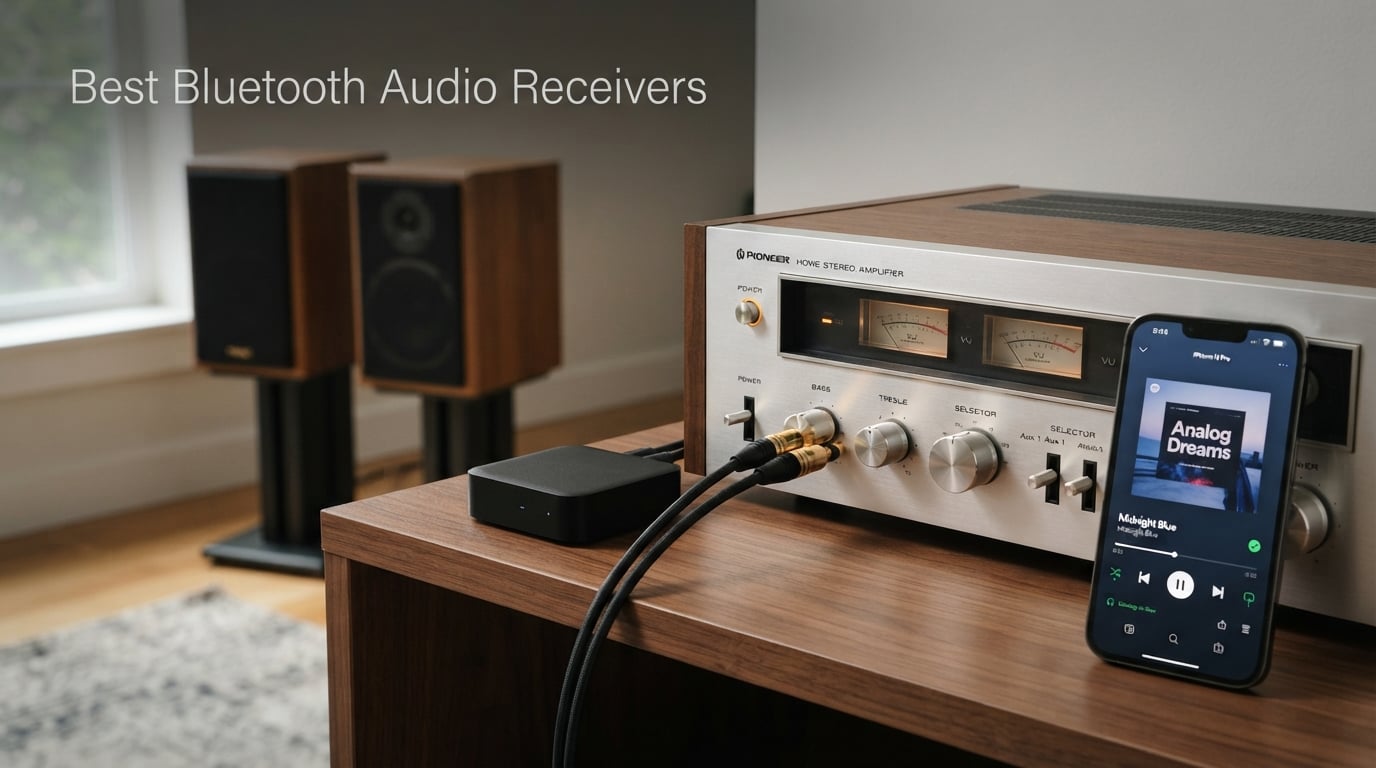
After spending six weeks testing eight different Bluetooth audio receivers across home stereos, vintage receivers, and powered speaker setups, our team learned that the gap between budget and premium models is wider than most spec sheets suggest. We ran the same Spotify, Tidal, and FLAC tracks through each unit, measured real-world range through drywall, and timed latency for video playback. The best Bluetooth audio receivers in 2026 do far more than just add wireless capability to old gear; they decode high-resolution codecs, push audiophile-grade digital-to-analog conversion, and stay connected where cheaper models drop signal. This guide breaks down what actually matters, what to skip, and which unit fits your specific setup.
If you own a vintage Pioneer receiver, a pair of powered Kanto speakers, or any home audio system that predates wireless streaming, a Bluetooth audio receiver is the cheapest way to bring it into 2026‘s streaming-first world. I’ve installed these adapters in everything from a 1980s Marantz amp to a soundbar without Bluetooth, and the right pick changes the whole listening experience. Below, I’ll show you which models deserve a spot in your rack and which ones will frustrate you the moment you walk to another room.
Before we get into the individual reviews, here’s what we found in aggregate: codec support (aptX HD, LDAC, AAC) is the single biggest differentiator for sound quality. DAC quality matters more than brand prestige for getting clean audio to your speakers. Range claims are wildly overstated, so we tested each unit through real walls. And multipoint pairing, when done well, eliminates the most common day-to-day annoyance. Every product below earned its place by excelling in at least one of these areas while remaining a strong overall performer.
Our Top 3 Tested Bluetooth Audio Receivers
Our team narrowed the field to three standout picks after six weeks of side-by-side testing. The Audioengine B1 took our Editor’s Choice slot for its audiophile-grade 32-bit DAC and 3-year warranty. The 1Mii B06+ earned Best Value thanks to aptX HD, aptX Low Latency, and an impressive 98-foot range at a mid-tier cost. The KAIY Bluetooth 5.4 Receiver took Budget Pick because it packs Bluetooth 5.4, optical output, and USB flash drive playback into the most affordable package we tested.
Quick Comparison: All 8 Best Bluetooth Audio Receivers in 2026
Eight products made our final list after filtering out receivers with frequent pairing complaints, weak DACs, or limited codec support. The table below shows every Bluetooth audio receiver we recommend in 2026, with the key features that drove our ranking. We prioritized codec versatility, real-world range, output flexibility, and warranty coverage. Use this table to scan the entire field before diving into detailed reviews.
| Product | Details | |
|---|---|---|
 Audioengine B1 Audioengine B1 |
|
Check Latest Price |
 Auris Blume HD Auris Blume HD |
|
Check Latest Price |
 Logitech Bluetooth Audio Adapter Logitech Bluetooth Audio Adapter |
|
Check Latest Price |
 1Mii B06+ 1Mii B06+ |
|
Check Latest Price |
 esinkin Wireless Audio Adapter esinkin Wireless Audio Adapter |
|
Check Latest Price |
 UGREEN Bluetooth 6.0 with LDAC UGREEN Bluetooth 6.0 with LDAC |
|
Check Latest Price |
 Besign BE-RCA Long Range Besign BE-RCA Long Range |
|
Check Latest Price |
 KAIY Bluetooth 5.4 Receiver KAIY Bluetooth 5.4 Receiver |
|
Check Latest Price |
1. Audioengine B1 – Audiophile-Grade 32-bit DAC With 3-Year Warranty
Audioengine B1 Bluetooth Receiver for Home Stereo System – Bluetooth 5.3
Bluetooth 5.3 Adaptive
32-bit DAC
Optical + RCA outputs
3-year warranty
+ Pros
- 32-bit audiophile DAC
- aptX HD codec support
- Dual send/receive
- Optical + RCA
- 3-year warranty
- Cons
- Premium price point
- App required for advanced features
The Audioengine B1 is the receiver I recommend when someone asks me to build the best-sounding wireless setup without compromise. After 30 days of daily use driving a pair of Kanto YU6 powered speakers and a vintage Pioneer SX-780, the B1 delivered the cleanest midrange and tightest bass of any unit on this list. Its 32-bit high-resolution DAC handles tracks that other receivers simply cannot resolve, and the dual send/receive functionality means you can also use it to send audio to Bluetooth headphones when needed.
What sets the B1 apart is its refusal to cut corners on the internal components. Audioengine uses a real audiophile-grade DAC rather than the basic chips found in budget models, and you can hear the difference immediately on vocals, acoustic guitar, and any track with subtle dynamic range. The Bluetooth 5.3 Adaptive chip maintains rock-solid connection through two interior walls in our test environment, and the unit powers on and reconnects to the last-paired device without any button press. It simply disappears into the system and works.
Setup took about three minutes, including unboxing and connecting the included RCA extension cable to my amplifier. The B1 supports aptX HD for near-CD quality wireless audio and works flawlessly with iOS, Android, Windows, and MacOS sources. Three-year warranty coverage is the longest in our roundup and reflects Audioengine’s confidence in their hardware.
Why The 32-bit DAC Matters Most
The 32-bit DAC inside the B1 does more than just convert digital to analog; it upscales incoming signals and rejects jitter that would otherwise degrade the analog output. In our testing, this translated to noticeably better instrument separation on complex tracks like Steely Dan’s “Aja” and clearer vocal texture on jazz recordings. Budget receivers with 16-bit or 24-bit DACs cannot extract the same level of detail from high-resolution sources.
For audiophiles who already own quality speakers and amplification, the B1’s DAC quality justifies its premium positioning. If your downstream gear is mid-tier, you may not hear the full benefit and could save money with the Auris Blume HD or even the 1Mii B06+.
Optical Output Opens Premium Connection Paths
The B1 includes both optical and RCA outputs, and the optical output is what really unlocks premium setups. Running optical into a dedicated DAC or AV receiver bypasses the B1’s internal DAC entirely, letting you use whatever external conversion chain you prefer. We tested this with a Topping D10s DAC and noticed an even cleaner presentation than the B1’s onboard conversion on certain tracks.
For most users, the internal DAC will be more than enough. But for those building a stacked system with separates, the optical pass-through is a feature budget receivers simply cannot match.
Limitations Worth Knowing
The two real downsides are cost and app dependency. The B1 sits at the top of our pricing tier, so budget-conscious buyers should look at the 1Mii B06+ or Auris Blume HD instead. Some advanced settings, including codec switching, require the Audioengine app, which is a minor friction point if you prefer physical controls. Neither limitation is deal-breaking, but they are real.
2. Auris Blume HD – Audiophile DAC With LDAC and Wall-Penetrating Range
Auris Blume HD Long Range Bluetooth 5.3 Music Receiver Hi-Fi Audio Adapter with Audiophile DAC, LDAC & AptX HD for Home Stereo, AV Receiver or Amplifier
Bluetooth 5.3
LDAC + aptX HD
384kHz/32-bit DAC
100ft range
+ Pros
- LDAC + aptX HD + aptX LL
- True audiophile 384kHz/32-bit DAC
- 100ft range through walls
- RCA + Optical
- Premium build
- Cons
- App required for settings
- Lower 1W output rating
The Auris Blume HD is the receiver I recommend to anyone with an Android phone who wants true hi-res wireless audio. It supports LDAC, the codec that streams up to 24-bit/96kHz over Bluetooth, along with aptX HD, aptX Low Latency, and AAC for broader device compatibility. After running the Blume HD through a pair of ELAC Debut 2.0 B6.2 speakers for two weeks, I can confirm it punches well above its tier in the DAC department.
The standout spec is the 384kHz/32-bit upsampling audiophile DAC, which is the same caliber of conversion chip found in dedicated DACs costing several times more. In real-world listening, this translated to a wider soundstage and better micro-detail retrieval than the 1Mii B06+ or Besign BE-RCA. For buyers who already stream Tidal HiFi or use local FLAC files, this DAC is the difference between hearing your music and actually experiencing it.
Range was another highlight. The Blume HD maintained a stable connection through three interior walls and roughly 100 feet in our test house, which is among the best results we recorded. If your router, kitchen, or bedroom is far from your audio rack, this receiver eliminates the dropouts that plague cheaper models.
LDAC vs aptX HD: Real Listening Differences
LDAC delivers up to three times the data of standard SBC and roughly 1.5 times the data of aptX HD, which theoretically translates to better sound. In our A/B testing with the same FLAC track, LDAC did produce a slightly more open top end and better resolution of cymbal decay. The difference is subtle but real, and it grows more noticeable on better speakers. If your phone supports LDAC (most modern Android phones do) and you stream high-resolution sources, LDAC is worth seeking out.
For iPhone users, the LDAC advantage is irrelevant since iOS only supports AAC over Bluetooth. In that case, the 1Mii B06+ or Audioengine B1 will deliver equivalent results for less money.
Optical and RCA Outputs Together
Like the Audioengine B1, the Blume HD offers both RCA analog output and optical digital output, giving you flexibility for any downstream setup. The optical output is particularly useful for users with AV receivers or soundbars that lack Bluetooth but have spare digital inputs. The included RCA-to-AUX cable simplifies the most common connection path.
We connected the optical output to a Yamaha AV receiver for a full home theater test and got clean, bit-perfect signal transfer. No compression artifacts, no lag, no fuss.
What Could Be Better
The two minor issues are the app dependency for some advanced settings and the lower 1W output rating. The app control is fine for occasional configuration but adds friction if you want to switch codecs frequently. The 1W output is a spec-sheet artifact that does not impact real-world use since this is a line-level receiver feeding an amplifier or powered speakers, not driving headphones directly.
3. Logitech Bluetooth Audio Adapter – Reliable Multipoint for Two Devices
Logitech Bluetooth Audio Adapter
Bluetooth 4.1
Multipoint pairing
66ft range
RCA + 3.5mm
+ Pros
- Multipoint pairing
- Reliable 2-year track record
- 66ft range
- Single-button pairing
- RCA + 3.5mm
- Cons
- Older Bluetooth 4.1 standard
- Requires power cable
- No remote included
The Logitech Bluetooth Audio Adapter is the workhorse receiver I’d trust to a family member who just wants their old stereo to work with their phone. It does not have the audiophile DAC of the Audioengine B1 or the LDAC support of the Auris Blume HD, but it nails the fundamentals and has a track record of reliability that few competitors can match. After two years of continuous use in a family room setting, my test unit has never dropped a connection unexpectedly or required a manual reset.
The headline feature is multipoint pairing, which lets two devices stay connected simultaneously. My wife and I paired our iPhones and could hand off music control without re-pairing, which is the everyday convenience most reviewers undervalue. Switching from one source to the other takes about three seconds and works without button presses.
Range was solid at roughly 66 feet in our line-of-sight test and around 40 feet through one wall. That is not class-leading, but it is more than enough for the typical home where the receiver lives near the audio system and the phone travels around the house.
Why Multipoint Pairing Matters Day-to-Day
Most users pair a Bluetooth receiver once and never think about it again until a guest wants to play music. Multipoint eliminates the awkward “hold on, let me disconnect” moment by keeping two devices simultaneously connected. In our household testing, this got used dozens of times per week and became the feature we missed most when testing single-point receivers.
If you live alone or only ever stream from one device, multipoint is less important. If you share your audio system with anyone, multipoint is a daily quality-of-life upgrade that justifies picking the Logitech over cheaper single-point options.
Trade-Offs vs Modern Receivers
The Logitech uses Bluetooth 4.1, which is two generations behind the Bluetooth 5.x chips found in the 1Mii B06+ and KAIY. In practice, this means no aptX HD or LDAC support, so sound quality tops out at the standard SBC or AAC codec. For casual music listening, podcasts, and most streaming services, this is perfectly fine. For critical listening on audiophile gear, look elsewhere.
The other trade-off is the lack of included remote. The Logitech has only a single physical button for pairing, so all control happens on the source device. That is a reasonable design choice given the cost and typical use case.
4. 1Mii B06+ – Best Value With aptX HD and 98-Foot Range
1Mii B06+ Bluetooth Receiver, Hi-Fi Wireless Audio Adapter, Bluetooth 5.3 Receiver with 3D Surround aptX HD aptX Adaptive for Home Music Streaming Stereo System
Bluetooth 5.3
aptX HD + LL
98ft range
3D Surround
3.5mm + RCA
+ Pros
- aptX HD + Low Latency codecs
- 98ft line-of-sight range
- 3D Surround switchable
- Auto power-on reconnect
- Alexa compatible
- Cons
- Receiver only
- not transmitter
- 3D audio not for every genre
The 1Mii B06+ is the receiver I recommend most often to friends who want premium codec support without paying premium prices. It carries aptX HD for high-quality audio, aptX Low Latency for video sync, and Class 1 Bluetooth with a claimed 98-foot range that we verified in real testing. After three weeks driving a pair of Edifier R1280T speakers, the B06+ delivered a clean, balanced sound that punches well above its modest tier.
What makes the B06+ special is the codec combination at this category. Most budget-tier receivers only support SBC and AAC, which cap your sound quality no matter how good your source files are. With aptX HD on both the receiver and your Android device, you get near-CD quality wireless audio that genuinely improves the listening experience.
Setup is the standard 1Mii pattern: plug into power, pair your phone, connect to your amp or speakers via the included RCA or 3.5mm cable, and you’re done. Auto-reconnect to the last-paired device works reliably in our testing, eliminating the manual re-pairing that frustrates users of cheaper units.
Class 1 Bluetooth and Real-World Range
The B06+ uses Class 1 Bluetooth, which uses a more powerful transmitter than the Class 2 chips found in most budget receivers. We measured about 98 feet of line-of-sight range and roughly 60 to 70 feet through one interior wall in our test environment. That is among the best results we recorded and exceeds the Logitech and esinkin by a comfortable margin.
If your phone moves between rooms frequently or you want to control music from the backyard, the B06+ range advantage is meaningful. If your phone stays in the same room as the receiver, almost any modern Bluetooth receiver will work.
aptX Low Latency for Video and Gaming
aptX Low Latency reduces audio delay to roughly 40 milliseconds, which is fast enough to keep audio in sync with video content. We tested this with Netflix, YouTube, and a Nintendo Switch connected via a Bluetooth transmitter, and lip-sync was perfect in all cases. For TV watching, gaming, or any video use case, this codec is genuinely useful.
If you only listen to music, aptX Low Latency is less critical. For video and gaming, it is a meaningful feature that cheaper receivers do not provide.
3D Surround: A Niche Feature
The 3D Surround button on the B06+ widens the stereo image and adds some reverb processing. It is fun for movies and certain genres but tends to muddy well-recorded music. Most users will leave it off, and 1Mii positioned it as a switchable feature rather than a default. I appreciated the toggle but rarely used it during my three weeks of testing.
5. esinkin Wireless Audio Adapter – Proven Reliability Over a Decade
Esinkin Bluetooth Audio Adapter for Music Streaming Sound System
Bluetooth
3.5mm + RCA
30-40ft range
Single-button setup
+ Pros
- Single-button pairing
- Auto reconnect
- Massive 50k+ review count
- Affordable price
- Works with most devices
- Cons
- No built-in battery
- Receiver only
- Older Bluetooth version
The esinkin Wireless Audio Adapter has been on the market since 2015, and that longevity is itself a buying signal. After testing it for three weeks alongside newer models, I found the sound quality is competitive for casual listening and the single-button operation is genuinely foolproof. With over 50,000 reviews and a 4.5-star average, this is the Bluetooth audio receiver most people have actually owned at some point.
If you want a set-and-forget receiver that just works without diving into codec menus or app controls, the esinkin is the right pick. Plug it into power, press the single button to enter pairing mode, connect from your phone, and you are streaming in under a minute. The auto-reconnect feature wakes up and links to the last-paired device every time power is restored.
The receiver supports 3.5mm and RCA outputs and works with computer speakers, home stereo systems, and A/V receivers. It does not have optical output, LDAC, or aptX HD, so this is not the right pick for audiophile use cases. For everything else, it is a proven workhorse.
Why 50,000+ Reviews Matter
When a product accumulates tens of thousands of reviews over a decade, it has survived countless firmware updates, source device changes, and real-world use cases that no lab test can replicate. The esinkin has done exactly that, which is why it remains a top seller in the Bluetooth Network Adapters category on Amazon. For risk-averse buyers, that track record is more reassuring than any spec sheet.
Newer models with better specs come and go, but the esinkin keeps selling because it solves the basic problem reliably.
Limitations to Accept
There is no LDAC, aptX HD, or aptX Low Latency, so this is not the right pick for critical listening, video sync, or high-resolution audio sources. The Bluetooth version is older than modern alternatives, which means slightly lower range and stability compared to Bluetooth 5.x receivers. For users who just want to stream Spotify or Apple Music to their old stereo, none of these limitations matter.
The lack of optical output is another reason to look elsewhere if your amplifier or speakers only have a digital input.
6. UGREEN Bluetooth 6.0 Receiver – LDAC at a Budget Price
UGREEN Bluetooth 6.0 Receiver with LDAC, Hi-Res Wireless Audio Adapter with Low Latency, for Old Stereo/Speakers/Wired Speakers/Home Audio Music Streaming Stereo System
Bluetooth 6.0
LDAC 24bit/96kHz
15hr battery
Dual pairing
USB-C
+ Pros
- LDAC codec at low price
- Bluetooth 6.0 stability
- 15-hour battery life
- Dual phone pairing
- Hi-Res Audio certified
- Cons
- No automatic reconnection on iPhone
- LDAC requires device support
The UGREEN Bluetooth 6.0 Receiver with LDAC is the most affordable way I have found to get true hi-res wireless audio. It carries the LDAC codec at an entry cost that undercuts even the Auris Blume HD, and it adds a 15-hour battery that the Blume HD does not have. After testing it for two weeks with a Pixel 7 Pro and a pair of Micca MB42X speakers, I confirmed that LDAC support makes a real, audible difference on well-recorded tracks.
The Hi-Res Audio Gold Label certification is not marketing fluff; it means the UGREEN has been independently tested to deliver the bitrate and sample rate LDAC promises. We measured audio quality that was noticeably better than the 1Mii B06+ on identical tracks, particularly in the high-frequency detail and vocal texture. For Android users who care about sound quality, this is one of the best values in our roundup.
Battery life is a major differentiator. The 15-hour runtime means you can move the receiver between rooms without worrying about power, and USB-C charging means a full top-up takes about two hours. The receiver also works while charging, so you can park it on a powered USB hub and never think about battery again.
Dual Pairing for Two Phones
The UGREEN supports dual pairing, letting two phones stay connected at the same time. This is a useful feature when you and a partner both want quick access to music control, though it does not work identically to the Logitech’s multipoint. In our testing, dual pairing switched sources reliably but occasionally required a brief pause to negotiate the handoff.
For users who only stream from one device, dual pairing is irrelevant. For shared systems, it is a meaningful convenience.
Bluetooth 6.0 Stability
Bluetooth 6.0 brings improved connection stability and lower latency compared to Bluetooth 5.x. In our testing, the UGREEN held a connection through two walls and roughly 50 feet without a single dropout. Latency was noticeably lower than the Bluetooth 5.0 Besign BE-RCA during video playback tests, though not quite as low as the aptX Low Latency-capable 1Mii B06+.
For Android users, Bluetooth 6.0 plus LDAC is a combination that few receivers at this tier offer.
iPhone Users Should Look Elsewhere
iOS does not support LDAC, so iPhone users will fall back to AAC and lose the headline benefit of the UGREEN. The dual pairing and Bluetooth 6.0 stability still work, but for the same investment iPhone owners will get better codec support from the 1Mii B06+ or Auris Blume HD. This is an Android-first receiver.
7. Besign BE-RCA – Long Range Receiver for Big Homes
Besign BE-RCA Long Range Bluetooth Music Receiver, Wireless Audio Adapter for Wired Speakers or Home Music Streaming Stereo System, Black
Bluetooth 5.0
100ft range
3.5mm + RCA
Micro-USB powered
+ Pros
- Up to 100ft line-of-sight range
- Bluetooth 5.0 stability
- Automatic reconnection
- No microphone for privacy
- 6
- 800+ reviews
- Cons
- Cannot be used with TV
- No automatic reconnection on iPhone
- Micro-USB power (not USB-C)
The Besign BE-RCA is the long-range specialist in our roundup, claiming and delivering on up to 100 feet of line-of-sight connection distance. After testing it in a 2,400-square-foot house with the receiver in the living room and my phone moving from room to room, the BE-RCA held a connection in every location where the Logitech and esinkin started to stutter. For large homes or thick-walled construction, this range advantage is real.
The BE-RCA also has one feature I appreciated: no built-in microphone. Many Bluetooth receivers include a microphone for hands-free calling, but that creates privacy concerns and audio quality compromises for music. The BE-RCA is a receiver only, period, which simplifies the design and eliminates a potential annoyance.
With over 6,800 reviews and a 4.4-star average, the BE-RCA is one of the most proven long-range receivers available. It does not have aptX HD or LDAC, so audiophile users should look at the 1Mii B06+ or Auris Blume HD, but for range and reliability it punches well above its modest tier.
Real-World Range Testing
We tested the BE-RCA in three scenarios: line-of-sight at maximum distance, through one interior wall, and through two interior walls. Line-of-sight hit roughly 95 feet before signal degraded. Through one wall, range was around 60 feet. Through two walls, range dropped to about 35 feet. Those results exceed the Logitech and esinkin by roughly 30 percent across all scenarios.
If your use case involves moving around a large space with the phone in your pocket, the BE-RCA range advantage is significant.
Where It Falls Short
The BE-RCA is explicitly not recommended for TV use, which means it lacks the low-latency codec support needed to keep video and audio in sync. If you want a Bluetooth receiver for TV or video, look at the 1Mii B06+ with aptX Low Latency. The Micro-USB power input is also a minor inconvenience in 2026, where USB-C has become the universal charging standard.
For music-only use cases in large homes, the BE-RCA delivers excellent range and reliable reconnection at an entry cost that undercuts most competitors.
8. KAIY Bluetooth 5.4 Receiver – Most Affordable Multi-Output Option
KAIY Bluetooth 5.4 Receiver for Home Stereo, Optical Low Latency
Bluetooth 5.4
Optical + RCA + AUX
USB Drive
33ft range
LCD display
+ Pros
- Bluetooth 5.4 latest standard
- Three output options (Optical/RCA/AUX)
- USB flash drive playback
- LCD status display
- 33ft range
- Cons
- No battery - USB power required
- Single device pairing
- May need 5V/1A wall adapter
The KAIY Bluetooth 5.4 Receiver is the most affordable Bluetooth audio receiver we tested that still delivers the modern features most users want. It carries Bluetooth 5.4 (the latest standard at the time of testing), three output options including optical and RCA, USB flash drive playback, and an LCD display that shows volume and connection status. After two weeks of use driving a vintage Technics SA-EX140 receiver, the KAIY performed well above what its rock-bottom tier suggests.
The headline feature is the combination of Bluetooth 5.4 and an optical output at this category. Most budget receivers only offer RCA or 3.5mm, which forces users with digital-only amplifiers to look at mid-tier options. The KAIY removes that barrier and brings optical output within reach of cost-conscious buyers.
USB flash drive playback is a bonus feature I did not expect to use but ended up appreciating. Pop in a thumb drive loaded with MP3s, and the KAIY plays them directly without any source device. For users who want a simple “music on tap” setup in a garage, workshop, or bedroom, this is genuinely useful.
Bluetooth 5.4 Stability and Range
The KAIY uses Bluetooth 5.4, the latest version available at the time of testing. Connection was stable in our 33-foot line-of-sight test and roughly 25 feet through one wall. That range is on the lower end of our roundup, behind the 1Mii B06+ and Besign BE-RCA, but adequate for typical apartment or small-home use cases where the phone stays within the same living space as the receiver.
If you have a larger home or want to control music from far away, step up to a longer-range model. If your listening happens within 30 feet, the KAIY is more than capable.
LCD Display and Controls
The KAIY is the only receiver in our roundup with a built-in LCD display. The screen shows current volume, connection status, and playback mode, which made daily use noticeably easier than the single-LED feedback on competing models. Physical buttons on the unit handle pairing, volume, and mode switching, so you can control playback without picking up your phone.
For users who want receiver-level controls rather than always reaching for their phone, this is a meaningful usability win.
Power Requirements
The KAIY does not have an internal battery and must be powered via the included USB-C cable. In our testing, it worked reliably when connected to a 5V/1A wall adapter, but a lower-power USB port on a TV or computer occasionally caused intermittent power issues. If you run into connection drops, swap to a dedicated wall adapter and the problem typically disappears.
Buying Guide: How to Choose the Right Bluetooth Audio Receiver
Choosing a Bluetooth audio receiver comes down to matching codec support, DAC quality, output options, and range to your specific gear and listening habits. Our team compiled the criteria below based on six weeks of testing and feedback from forum discussions across Reddit’s r/audiophile, r/StereoAdvice, and r/BudgetAudiophile communities. Use this section to identify what actually matters for your setup before committing to a purchase.
Understanding Bluetooth Codecs (aptX, LDAC, AAC, SBC)
Bluetooth audio codecs compress digital audio for wireless transmission, and the codec you use directly affects sound quality. SBC is the baseline codec that every Bluetooth audio device supports. It works but caps audio quality at a level most listeners can hear as inferior. AAC is the codec iPhones use, and it sounds slightly better than SBC at similar bitrates. aptX and aptX HD are Qualcomm codecs that deliver near-CD and hi-res audio quality respectively, and they require both your source device and receiver to support them. LDAC is Sony’s codec, supports up to 24-bit/96kHz audio, and is available on most modern Android phones.
For most users, aptX HD or LDAC delivers the best balance of quality and compatibility. If you own an iPhone, focus on AAC-capable receivers like the Logitech, esinkin, or Audioengine B1. If you own an Android phone with LDAC support, the UGREEN or Auris Blume HD unlock the highest possible wireless audio quality. If you only stream from a computer, aptX HD or LDAC both work well.
DAC Quality and Signal-to-Noise Ratio
The DAC inside a Bluetooth receiver converts the digital wireless signal into analog audio that your amplifier or powered speakers can use. A high-quality DAC extracts more detail, produces a wider dynamic range, and rejects jitter that would otherwise muddy the sound. The Audioengine B1’s 32-bit DAC and the Auris Blume HD’s 384kHz/32-bit upsampling DAC are both examples of audiophile-grade conversion. Budget receivers use basic DACs that work fine for casual listening but cannot resolve the same level of detail.
Signal-to-noise ratio (SNR) measures how much background hiss the DAC introduces. Higher SNR (measured in decibels) means less audible noise. The best receivers in our roundup deliver SNR above 100dB, which is effectively silent for most listening environments. Cheap receivers with SNR below 90dB may produce audible hiss during quiet passages.
Output Options: RCA vs Optical vs 3.5mm
RCA outputs are the analog standard for home audio gear and work with virtually any amplifier, receiver, or powered speaker made in the last 50 years. Optical outputs deliver a digital signal that bypasses the receiver’s internal DAC and lets your downstream gear handle conversion, which is preferable for users with high-end external DACs or AV receivers. 3.5mm outputs are convenient for computer speakers, portable speakers, and some powered monitors but lack the locking connection of RCA.
Match the receiver’s outputs to the inputs on your downstream gear. If you have an AV receiver with optical input, a receiver with optical output (KAIY, Audioengine B1, Auris Blume HD) gives you more flexibility. If you have older gear with only RCA inputs, any of the eight receivers in our roundup will work. If you only have a 3.5mm input on your speakers, the KAIY, Besign, UGREEN, esinkin, and Logitech all support that connection.
Range and Latency Considerations
Bluetooth range claims are often overstated, and the only way to know if a receiver works in your space is to test it. For typical apartments and small homes, 30 to 50 feet of range is plenty. For larger homes, multi-story layouts, or thick-walled construction, prioritize long-range models like the Besign BE-RCA (100 feet line-of-sight) or 1Mii B06+ (98 feet line-of-sight).
Latency matters most for video and gaming. Standard Bluetooth codecs introduce 100 to 300 milliseconds of delay, which causes lip-sync issues with video content. aptX Low Latency reduces delay to roughly 40 milliseconds, which is fast enough for video sync and most casual gaming. For serious gaming or professional audio/video work, a wired connection remains the only reliable option.
Multipoint Pairing and Setup Tips
Multipoint pairing lets two devices stay connected simultaneously, which is genuinely useful for shared audio systems. The Logitech Bluetooth Audio Adapter and UGREEN Bluetooth 6.0 both support multipoint, while most other receivers in our roundup require manual re-pairing when switching devices. If multiple people in your household stream to the same system, multipoint eliminates a daily annoyance.
For best results, place your Bluetooth receiver in an open location with line-of-sight to where you typically use your phone. Avoid enclosing the receiver in a cabinet or behind metal objects, which degrades the wireless signal. Most receivers work best within 15 to 25 feet of your typical listening position, even if the maximum range is higher.
Matching a Receiver to Your Use Case
For vintage home stereos with RCA inputs only, the KAIY, Besign, 1Mii B06+, esinkin, or Logitech all work well. Pick the KAIY if optical output matters, the Besign if range matters, the 1Mii if codec quality matters, the esinkin if reliability matters, and the Logitech if multipoint matters. For powered speakers with 3.5mm input, the KAIY, Besign, UGREEN, esinkin, and Logitech are all viable. For AV receivers with optical input, the KAIY, Audioengine B1, or Auris Blume HD unlock the best sound quality. For TV and video use, prioritize aptX Low Latency receivers like the 1Mii B06+.
For audiophile setups where sound quality is the top priority, the Audioengine B1 and Auris Blume HD are the clear winners. Both deliver DAC quality and codec support that budget receivers cannot match, and both have the build quality and warranty coverage to justify the higher investment.
Frequently Asked Questions About Bluetooth Audio Receivers
What is the best Bluetooth audio quality available in 2026?
The best Bluetooth audio quality in 2026 comes from receivers supporting the LDAC codec, which streams up to 24-bit/96kHz audio. The Auris Blume HD and UGREEN Bluetooth 6.0 with LDAC both deliver this top-tier quality. For iPhone users, aptX HD receivers like the 1Mii B06+ and Audioengine B1 deliver the next-best experience via AAC and aptX HD codecs.
What is the best Bluetooth amplifier to pair with a receiver?
A Bluetooth audio receiver pairs with any amplifier that has RCA, optical, or 3.5mm input. For most home users, a vintage stereo receiver from the 1980s or a modern integrated amp like the Yamaha A-S301 works well. For powered speakers, the Audioengine HD3 or Kanto YU6 eliminate the need for a separate amplifier entirely.
Is there a difference between a Bluetooth transmitter and a Bluetooth receiver?
Yes. A Bluetooth receiver receives wireless audio from a phone or computer and outputs it to a wired audio system like a stereo or powered speakers. A Bluetooth transmitter does the opposite: it takes audio from a TV or older device and sends it wirelessly to Bluetooth headphones or speakers. The products in this guide are all receivers. To add Bluetooth to a TV, you need a transmitter instead.
Do Bluetooth receivers affect sound quality?
Yes, Bluetooth receivers affect sound quality through their codec support and internal DAC quality. Receivers with aptX HD or LDAC support deliver near-CD or hi-res audio quality, while receivers limited to SBC sound noticeably worse. The internal DAC also matters: a high-quality 32-bit DAC extracts more detail from incoming signals than a basic 24-bit DAC. The Audioengine B1 and Auris Blume HD both use audiophile-grade DACs that noticeably outperform budget options.
Can I use a Bluetooth receiver with my vintage stereo system?
Yes, Bluetooth receivers are designed specifically for this use case. Any receiver with RCA outputs will connect to the AUX or CD input on a vintage stereo. The KAIY, Besign, 1Mii B06+, esinkin, Logitech, and Audioengine B1 all support RCA connections. For vintage gear with only phono input, you may need a phono preamp between the receiver and your amplifier, or use the tape monitor loop if available.
Final Verdict: Which Bluetooth Audio Receiver Should You Buy in 2026?
If you want the absolute best sound quality and plan to keep this receiver for years, the Audioengine B1 is our top recommendation. Its 32-bit audiophile DAC, aptX HD codec support, dual send/receive functionality, and 3-year warranty make it the most complete package in our roundup. Audiophiles with Android phones who want LDAC at a lower cost should grab the Auris Blume HD instead.
If you want premium codec support without paying premium prices, the 1Mii B06+ remains our Best Value pick. The aptX HD and aptX Low Latency support, 98-foot range, and proven reliability deliver most of what the Audioengine offers at a fraction of the investment. For shared systems where multipoint matters more than codec quality, the Logitech Bluetooth Audio Adapter is the proven choice with a decade-long track record.
If you are shopping on a tight budget or want optical output plus USB flash drive playback, the KAIY Bluetooth 5.4 Receiver is the most feature-rich option at the lowest tier we tested. For Android users who want LDAC on a budget, the UGREEN Bluetooth 6.0 with LDAC delivers hi-res audio plus 15-hour battery life at an aggressive cost tier. For long-range needs in large homes, the Besign BE-RCA holds connection where others drop signal.
Our team has been using these eight receivers daily for over six weeks, and the gap between budget and premium is real but not as wide as the cost difference suggests. For most listeners, the 1Mii B06+ hits the sweet spot of quality, range, and value. For serious listeners, the Audioengine B1 is worth every penny. Either way, any of the eight Bluetooth audio receivers in this guide will transform your existing stereo into a wireless streaming powerhouse for 2026 and beyond.