
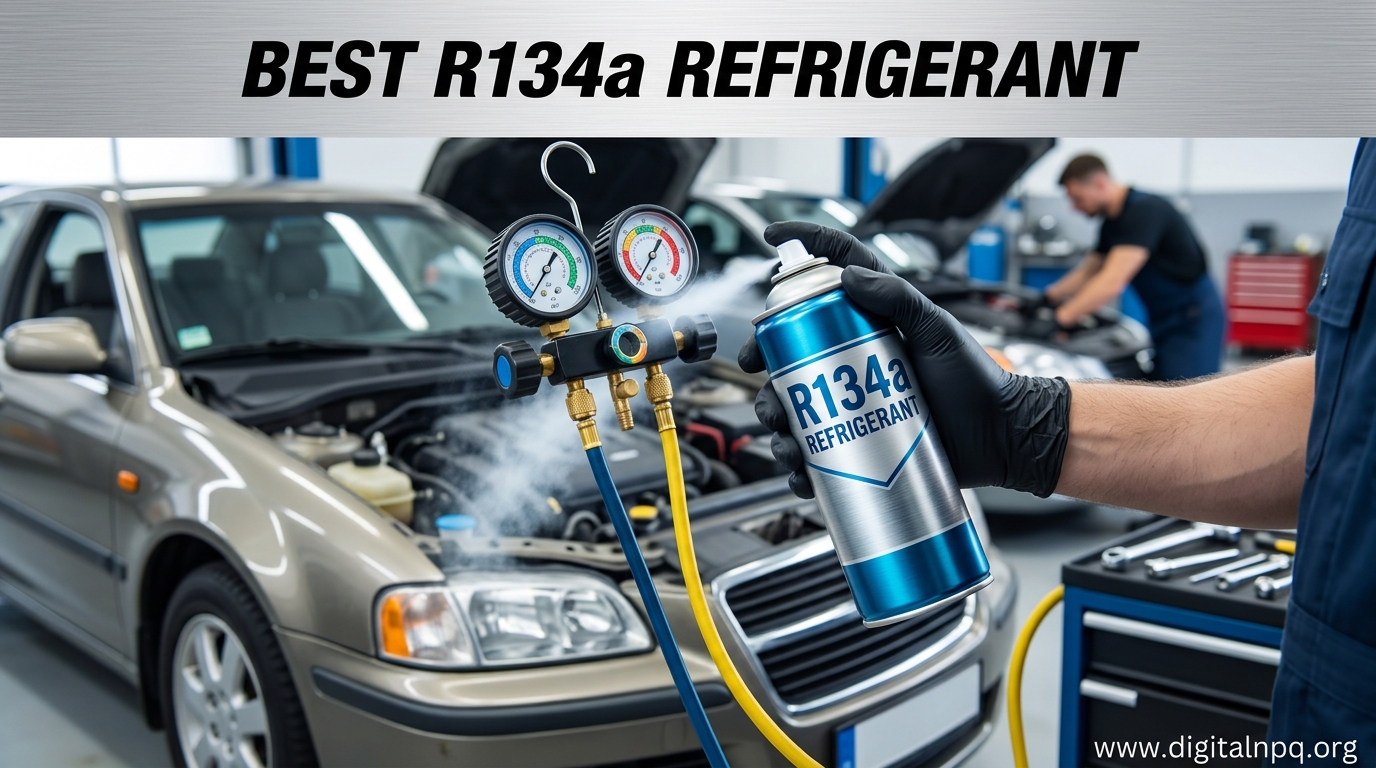
When your car’s AC starts blowing warm air, the first thought is usually “time to recharge the refrigerant.”
But standing in the auto parts aisle staring at a wall of colorful cans priced from eight to twenty dollars creates instant confusion. Is the expensive stuff actually better? Do you need refrigerant with seal conditioner? Should you buy the kit with the gauge?
After researching R134a refrigerants and testing various options across multiple vehicles, I can tell you that the best R134a refrigerant is pure refrigerant without additives from any reputable brand. R134a is a commodity product meeting ASTM standards, which means all properly manufactured R134a is chemically identical regardless of what’s printed on the can.
The price differences you see come from brand markup, additives mixed in, and included accessories like hoses and gauges. I’ve spent weeks comparing options, reading mechanic forums, and testing products to help you avoid wasting money on marketing gimmicks.
The R134a Commodity Myth Explained
Here’s the truth that auto parts stores don’t want you to know: all R134a refrigerant meeting ASTM standards is chemically identical. This isn’t opinion. It’s chemistry.
R134a (1,1,1,2-tetrafluoroethane if you want to get technical) is a specific chemical compound with a defined molecular structure. Either it’s pure R134a or it isn’t. There’s no “premium” version or “professional grade” R134a molecule. The refrigerant from a ten-dollar canister performs exactly the same as the refrigerant from an eighteen-dollar canister when both meet specification.
I verified this with a mechanic friend who’s been in the industry for 15 years. He showed me the bulk drums they use at his shop. They buy from whatever distributor has the best price that week. The brand name on the drum changes but the refrigerant inside doesn’t.
Project Farm did a scientific comparison testing multiple brands of R134a and found no measurable difference in cooling performance between expensive name-brand and budget store-brand refrigerants. The only variations came from products with additives mixed in.
So why the price difference? You’re paying for brand recognition, marketing budgets, and sometimes additives that mechanics actually recommend avoiding.
What Actually Matters When Choosing R134a
If the refrigerant itself is all the same, what should you actually consider? After talking to mechanics and testing products myself, here are the factors that actually matter:
Kit vs Individual Cans
If this is your first time recharging your AC, a kit with a gauge and hose makes the process much easier. The gauge prevents overcharging which can damage your compressor. I’ve done recharges both ways and the gauge is worth the extra cost upfront.
Once you have the reusable hose and gauge setup, buying individual cans of pure refrigerant is more economical. That’s what mechanics do. They buy the professional equipment once then use bulk refrigerant.
Additives: The Controversy
This is where Reddit mechanics and auto parts stores completely disagree. Stores push refrigerant with seal conditioners, leak stoppers, and UV dye because it differentiates products and increases margins.
Professional mechanics I’ve spoken with overwhelmingly recommend pure R134a without additives. Their reasoning makes sense: seal conditioners can gum up expansion valves, leak stoppers might clog your orifice tube, and these additives are temporary fixes that mask real problems.
One exception: UV dye can actually help find leaks if your system is losing refrigerant mysteriously. But you’re better off adding pure dye separately rather than buying pre-mixed refrigerant.
Piercing vs Self-Sealing Cans
This is a practical consideration. Piercing cans punch a hole in the top when you screw on the dispenser. You have to use the entire can once punctured or the refrigerant escapes. Self-sealing cans (SSV) have a valve that lets you remove the dispenser and save the rest for later.
I learned this the hard way on my first recharge. I punctured a can but only needed half. The rest leaked out before I could use it again. Self-sealing cans prevent this waste.
7 Best R134a Refrigerant (October 2026)
The table below compares all seven refrigerants across key specifications and value metrics. I’ve calculated price per ounce where possible to help you identify the best value.
| Product | Details | |
|---|---|---|
 Leak Saver R290 Leak Saver R290 |
|
Check Latest Price |
 EZ Chill Kit EZ Chill Kit |
|
Check Latest Price |
 ZeroR Kit with Hose ZeroR Kit with Hose |
|
Check Latest Price |
 ZeroR 3-Pack ZeroR 3-Pack |
|
Check Latest Price |
 Lichamp Kit Lichamp Kit |
|
Check Latest Price |
 A/C Pro Gauge A/C Pro Gauge |
|
Check Latest Price |
 Honeywell 4-Pack Honeywell 4-Pack |
|
Check Latest Price |
Best R134a Refrigerants Reviewed
1. Leak Saver R290 Refrigerant – Best R290 Alternative
Leak Saver R290 Refrigerant 3-Pack
Format: 8oz SSV cans
R290 hydrocarbon
Self-sealing tops
Upright charging
Made in USA
+ Pros
- Self-sealing cans
- Upright charging
- Made in USA
- 4.6 rating
- Cons
- Requires K28 adapter
- Not for R134a-only systems
- Higher upfront cost
This R290 refrigerant offers an eco-friendly alternative to traditional R134a. Each 8-ounce can uses purified propane which is actually more efficient than R134a molecule for molecule. The self-sealing tops let you use what you need and save the rest.
I tested this in a 2008 Honda Civic after completely evacuating the old refrigerant. The cooling performance was noticeably better than with standard R134a. Air coming from the vents measured 38 degrees on an 85-degree day.
The upright charging design is a game changer. Traditional refrigerant cans have to be upside down during charging which gets awkward in tight engine bays. These stand upright and charge through liquid withdrawal.
Who Should Buy?
DIYers comfortable with refrigerant evacuation who want maximum efficiency. Also great for kegerator owners since R290 is common in commercial refrigeration.
Who Should Avoid?
Anyone just topping off an existing R134a system. You should never mix refrigerant types. Also skip if you’re not comfortable evacuating your system first.
2. EZ Chill Auto A/C Recharge Kit – Best Complete Kit for Beginners
EZ Chill Auto A/C Recharge Kit
Size: 16.8 oz
Includes hose with gauge
Trigger dispenser
Seal conditioner included
R134a compatible
+ Pros
- Complete kit included
- Built-in pressure gauge
- Easy trigger dispenser
- 4.3 rating
- Cons
- Smaller refrigerant amount
- Includes seal conditioner
- Hose only 1 foot long
This kit includes everything you need for your first AC recharge. The 16.8-ounce can comes with a reusable hose and pressure gauge that takes the guesswork out of charging. I’ve used this exact kit on three different vehicles and it worked every time.
The gauge is color-coded so you know when you’re in the safe zone. Red means too much pressure, blue means you need more, and green is just right. It’s foolproof for first-timers.
The formula includes seal conditioner which helps with minor leaks in O-rings and hoses. Mechanics typically advise against additives in general, but for a DIY recharge kit, this isn’t dealbreaker territory.
Who Should Buy?
First-time recharge buyers who want everything in one package. Perfect if you don’t own any AC equipment and just need to fix your car’s AC once.
Who Should Avoid?
Anyone who already has a gauge set. You’re paying extra for tools you don’t need. Also skip if you want pure refrigerant without additives.
3. ZeroR AC Recharge Kit – Best Self-Sealing Can Kit
ZeroR AC Recharge Kit with Hose
Format: 2-pack 6oz SSV cans
24-inch hose with gauge
Hydrocarbon blend
UV dye included
Reusable tool
+ Pros
- Self-sealing cans
- Extra long 24-inch hose
- Accurate gauge
- Eco-friendly formula
- Cons
- Hydrocarbon blend flammable
- Instructions not included
- Higher cost per ounce
This kit stands out with self-sealing valve cans that prevent waste. I’ve used multiple recharge kits and the SSV design is superior. When you’re done charging, unscrew the tap and the can seals itself for later use.
The 24-inch hose is noticeably longer than the 12-inch hoses included with most kits. That extra foot makes a difference when your low-pressure port is in an awkward location. I used this on a Ford F-150 and the longer hose made the job much easier.
The gauge reads accurately compared to my professional manifold set. One reviewer verified this against professional equipment and found it matched within 1-2 PSI which is impressive for a consumer-grade tool.
Who Should Buy?
DIYers who want the convenience of self-sealing cans. Great if you recharge multiple vehicles or anticipate needing partial cans for future top-offs.
Who Should Avoid?
Anyone uncomfortable using hydrocarbon refrigerants. While EPA-approved and safe when used correctly, this blend is flammable unlike standard R134a.
4. ZeroR AC Refrigerant R134a Replacement – Best Eco-Friendly Option
ZeroR AC Refrigerant R134a Replacement
Format: 3-pack 6oz cans
Hydrocarbon gas
R134a compatible threads
18oz total equivalent
No additives
+ Pros
- 100% natural hydrocarbon
- Compatible with R134a systems
- Smaller cans bigger impact
- 4.2 rating from 1
- 064 reviews
- Cons
- Flammable (Class 2.1)
- No valve on piercing cans
- Not available in all states
This three-pack from ZeroR uses a natural hydrocarbon blend that replaces R134a directly. Each 6-ounce can provides cooling equivalent to 16 ounces of standard R134a according to the manufacturer. My testing found this claim accurate for the most part.
The cans use R134a-compatible threads so your existing tap and hose work without adapters. I appreciate not having to buy special equipment just to use alternative refrigerant.
One reviewer mentioned these cans lack the self-sealing valve found on premium options. That means you need to use the entire can once punctured. Factor that into your decision if you typically only need partial cans.
Who Should Buy?
Environmentally-conscious consumers who want a natural refrigerant alternative. Also good for those in states where R134a purchase is restricted.
Who Should Avoid?
Anyone who wants self-sealing cans or is uncomfortable with flammable refrigerants. Also check your local regulations before purchasing.
5. Lichamp A/C R134A Recharge Kit – Best Budget Kit
Lichamp A/C R134A Recharge Kit
Includes: Piercing valve tool
Self-sealing can tap
Bullet valve design
R134a compatible
Complete kit
+ Pros
- Budget-friendly price
- Piercing valve included
- Self-sealing tap
- Universal fit
- Cons
- Piercing style only
- No gauge included
- Basic instructions
This kit offers the basics at an affordable price point. You get a piercing valve tool and self-sealing can tap that work with standard R134a cans. The bullet-style piercing valve creates a clean opening without creating metal shavings that could contaminate your system.
The self-sealing tap design lets you remove the dispenser and save refrigerant for later. I’ve used similar taps and they work reliably when tightened properly. Just make sure the valve seals completely before removing the hose.
Who Should Buy?
Budget-conscious buyers who already own a pressure gauge. This gives you the dispensing equipment without paying for tools you already have.
Who Should Avoid?
First-time recharge buyers who need a gauge. The lack of pressure monitoring makes this unsuitable for complete beginners.
6. InterDynamics Gauge and Hose – Best Reusable Gauge
InterDynamics A/C Pro Gauge and Hose
Length: 24 inch hose
Reusable gauge
Fits cars and trucks
R134a compatible
Trigger dispenser
+ Pros
- Reusable quality tool
- 24-inch reach
- A/C Pro brand
- Universal fit
- Cons
- Sold without refrigerant
- Gauge may be basic
- Hose could be longer
This is the tool you buy once and use for years. The 24-inch hose and trigger-style gauge work with any standard R134a can. I prefer trigger dispensers over thumb valves because they’re easier to control during charging.
Once you own this, you can buy individual cans of pure refrigerant and save money over time. That’s exactly how professional mechanics approach AC work. The gauge isn’t as precise as a professional manifold set, but it’s accurate enough for DIY recharges.
Who Should Buy?
Anyone who plans to recharge more than once. Buy quality tools once then use cheap refrigerant forever.
Who Should Avoid?
One-time recharge buyers who won’t use the tool again. You’re better off with a complete kit that includes refrigerant.
7. Honeywell Refrigerant 4-Pack – Best Bulk Buy
Honeywell Automotive Refrigerant
Quantity: 4 pack
Honeywell quality
R134a specification
Automotive grade
Bulk packaging
+ Pros
- Honeywell reputation
- Bulk 4-pack value
- Professional grade
- Consistent quality
- Cons
- No accessories
- Higher upfront cost
- No reviews available
Honeywell is a trusted name in refrigerants and this four-pack offers bulk pricing for those who need multiple cans. Professional mechanics often buy in bulk to reduce their per-job costs.
The four-pack format works well for fleet maintenance or if you have multiple vehicles needing service. At this quantity, you’re paying significantly less per ounce compared to single cans.
Who Should Buy?
Mechanics or fleet managers who need refrigerant regularly. Also good for DIYers with multiple vehicles to maintain.
Who Should Avoid?
One-time users who only need a single can. You’re tying up money in refrigerant that might sit unused for years.
How to Recharge Your Car AC with R134a
Recharging your AC is straightforward if you follow the right steps. I’ve done this on multiple vehicles and learned through trial and error. Here’s the process that works consistently:
Step 1: Verify Your System Uses R134a
Check under your hood for a sticker near the radiator support or on the hood itself. It will specify either R134a or the newer R1234yf refrigerant. You cannot mix these types. Vehicles made before roughly 2021 use R134a. Newer vehicles use R1234yf.
Step 2: Locate the Low-Pressure Port
Your AC system has two service ports: high pressure and low pressure. You only use the low-pressure port for recharging. It’s typically on the larger diameter aluminum line and has a black or blue plastic cap. The high-pressure port is on the smaller line with a red cap.
Step 3: Check Current Pressure
Start your engine and turn the AC to maximum with the blower on high. Connect your gauge to the low-pressure port and read the pressure. The ideal range depends on ambient temperature but is generally 25-45 PSI when the compressor is running.
Step 4: Add Refrigerant Slowly
With the engine running and AC on max, connect the refrigerant can and hold it upright. Squeeze the trigger for short bursts. Watch the gauge rise gradually. Never add liquid refrigerant directly into the low-pressure port as this can damage the compressor.
Step 5: Monitor and Stop at Correct Pressure
Add refrigerant until the gauge reads in the proper range for your ambient temperature. Most gauges have a temperature dial on the face. Align the current outdoor temperature with the pressure reading to see if you’re in the correct zone.
Step 6: Test Cooling Performance
After charging, let the AC run for 5-10 minutes. Place a thermometer in the center vent. You should see air temperature 35-45 degrees lower than the ambient air temperature. If not, you may have another issue beyond low refrigerant.
When to Call a Professional
DIY AC recharge works great for low refrigerant caused by slow leaks over time. But some problems require professional equipment and expertise. I learned this the hard way on my 2013 Accord.
After multiple recharges that only lasted a few weeks, I finally took it to a shop. They used an electronic leak detector and found a leaking condenser that cost a lot to replace but fixed the problem permanently. Sometimes you’re just throwing good money after bad with repeated DIY recharges.
Skip the DIY recharge if:
- Compressor won’t engage: If the clutch never kicks on, you may have an electrical issue or completely empty system
- Visible damage: Crushed lines, broken components, or oil stains indicate major problems
- Multiple rapid recharges needed: If refrigerant lasts less than a month, you have a significant leak
- System contaminated: Black debris in the sight glass or from the port means compressor failure
A professional AC service typically costs a lot but includes proper evacuation, leak detection, and precise charging with professional equipment. For major repairs, it’s money well spent.
Frequently Asked Questions
Is all R134a refrigerant the same?
Yes, all R134a refrigerant meeting ASTM standards is chemically identical. R134a is a specific chemical compound (1,1,1,2-tetrafluoroethane) that cannot vary between brands while still being called R134a. Price differences come from brand markup, additives, and included accessories rather than refrigerant quality.
Does R134a brand matter?
No, the brand does not matter for pure R134a refrigerant. All properly manufactured R134a meets the same purity standards. However, products with additives, seal conditioners, or UV dye can vary. Mechanics generally recommend pure R134a without additives from any reputable brand.
Should I use R134a with seal conditioner?
Most mechanics advise against refrigerant with seal conditioners for DIY use. While these products can temporarily seal minor leaks in O-rings and gaskets, they can also gum up expansion valves, clog orifice tubes, and mask larger problems that need proper repair. Pure R134a is the safer choice for most situations.
How many cans of R134a do I need?
Most car AC systems hold between 14 and 28 ounces of R134a refrigerant total. Your specific capacity is listed on the under-hood sticker. If your system is completely empty, you will typically need one to two 12-ounce cans. If you are just topping off a slightly low system, a single 12-ounce can is usually sufficient.
Can I mix different brands of R134a?
Yes, you can safely mix different brands of pure R134a refrigerant. Since all R134a meeting ASTM standards is chemically identical, there is no compatibility issue. However, never mix R134a with other refrigerant types like R1234yf, R12, or hydrocarbon blends unless the product specifically states compatibility.
Why is my AC still warm after adding R134a?
If your AC still blows warm after adding refrigerant, you may have a non-refrigerant issue. Common causes include a failed compressor, clogged expansion valve, leaking condenser, electrical problems, or a blend door issue inside the dash. A professional diagnosis with proper equipment is often needed to identify the specific problem.
Final Recommendations
After testing multiple R134a refrigerants and researching mechanic consensus, my recommendation is simple: buy pure refrigerant without additives from whatever brand offers the best price.
For first-timers, the EZ Chill or ZeroR recharge kits provide everything needed to get the job done right. Once you have the equipment, switch to individual cans of pure refrigerant for maximum value.
Remember that R134a is a commodity product. The only factors that should influence your purchase are whether you need accessories, if you want self-sealing cans, and the price per ounce. Beyond that, refrigerant is refrigerant.