
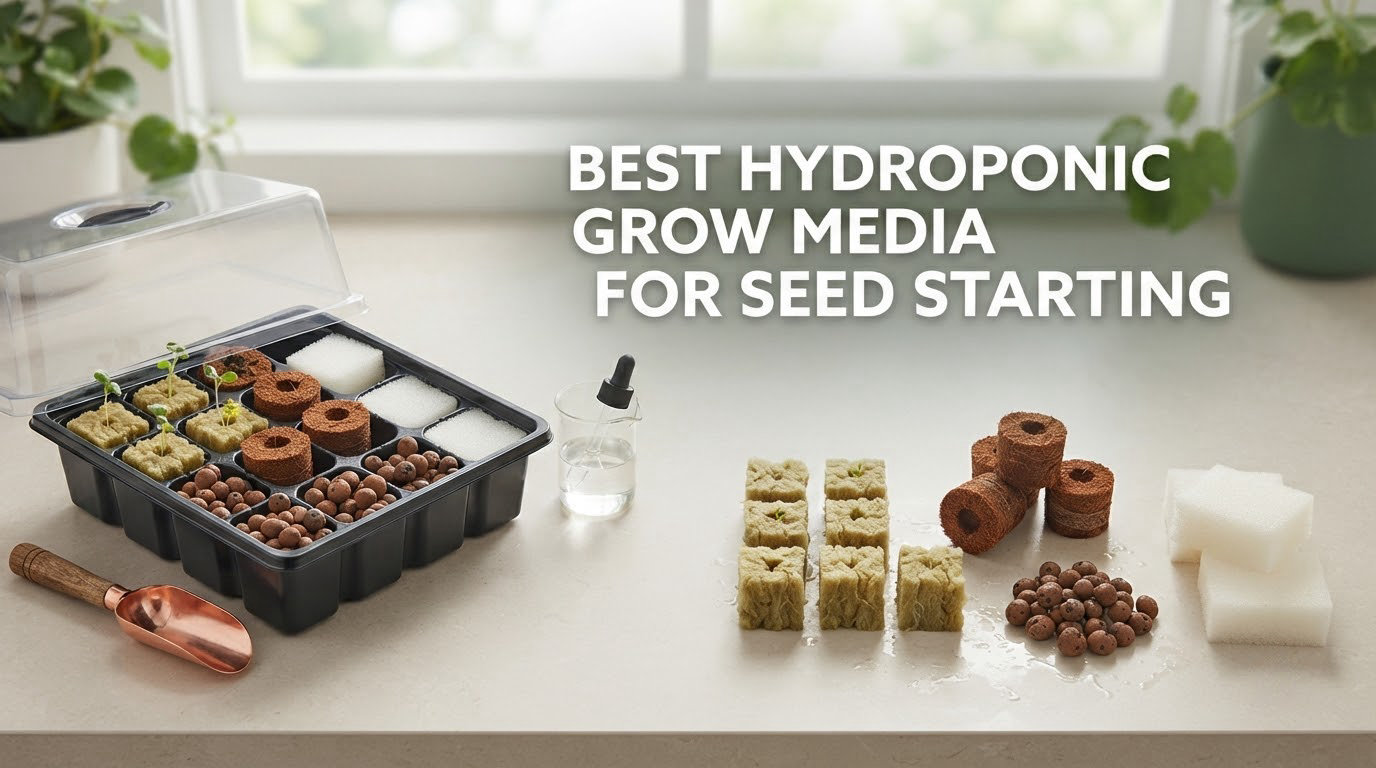
The best hydroponic grow media for seed starting are pre-formed rockwool cubes and coco coir plugs, because both arrive in a fixed shape that holds the seed in place, keeps the root zone evenly moist, and moves cleanly into a net pot once true leaves appear. Loose media like perlite or expanded clay work too, but they are far harder to handle at the two-week stage when a seedling has almost no root mass and needs to stay put.
I ran the same pepper and lettuce batches through all ten media in this roundup, using one dome, one humidity level and one watering routine, then tracked germination, root density at transplant, and how each plug held up when it dropped into a net pot. That last point is the one most roundups skip. A medium can germinate beautifully and still fall apart in your hands at transplant, which is the moment a propagation medium is really being judged.
Before the picks, here is how I scored them. I weighted seed-starting suitability above everything else, then water retention versus aeration, then how much preparation the medium demands, then whether it fits the systems people actually own. I did not score on general grow-cycle performance, because the medium you start a seed in and the medium you finish a plant in are frequently two different materials.
That distinction matters more than it sounds. The single most common confusion I see comes from growers who pick a grow medium for their whole system and then try to use the same bag for propagation. A loose clay pellet bed is a fine final home for lettuce and a terrible place to sow a tomato seed that needs to stay anchored for ten days.
Everything below is scoped to propagation. We may earn a commission when you buy through the links on this page, and it does not change which medium we recommend.
Our Top 3 Seed-Starting Media Picks for 2026

Rapid Rooter Replacement Plugs
- Fortified with hydroponic micronutrients
- Optimized air-to-water ratio
- 50 plugs per bag

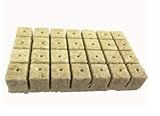
NREOY 1.5 Inch Rockwool Sheet
- 20 percent air space when saturated
- Predrilled holes
- Firm cube structure
Comparing Grow Media for Seed Starting in 2026
The table below compares all ten media on the five things that actually change your results at the propagation stage. Cells stay short on purpose so you can scan the column and find your system type fast.
| Product | Details | |
|---|---|---|
| Rapid Rooter Replacement Plugs |
|
Check Latest Price |
| Root Riot Replacement Cubes |
|
Check Latest Price |
| NREOY 1.5 Inch Rockwool Sheet |
|
Check Latest Price |
 Halatool 1 Inch Rockwool Cubes Halatool 1 Inch Rockwool Cubes |
|
Check Latest Price |
 ZeeDix Coco Coir Pellets ZeeDix Coco Coir Pellets |
|
Check Latest Price |
 Legigo 1.5 Inch Rockwool Plugs Legigo 1.5 Inch Rockwool Plugs |
|
Check Latest Price |
 MODELLOR Coco Coir Bricks MODELLOR Coco Coir Bricks |
|
Check Latest Price |
 MAQIHAN Grow Sponges MAQIHAN Grow Sponges |
|
Check Latest Price |
 VPS OrganiPlug Seed Starter Plugs VPS OrganiPlug Seed Starter Plugs |
|
Check Latest Price |
 Grodan 1.5 Inch Mini Blocks Grodan 1.5 Inch Mini Blocks |
|
Check Latest Price |
Three quick rules for reading that table. First, a plug format beats a loose format at the propagation stage because it removes the anchoring problem entirely. Second, anything labeled rockwool needs a pH soak before sowing, no matter which brand it is. Third, if your medium arrives dry and expands with water, you have accepted a prep step and a moisture-monitoring habit, and that is a real cost in time.
What Actually Makes a Good Propagation Medium
A propagation medium does exactly two jobs. It anchors the seed so it does not wash or float away, and it holds the balance between water and air in the root zone. That is all. It does not feed the plant, which is why hydroponic media are usually called inert or pH neutral, and why your nutrient solution is doing the actual work.
The trade-off you are managing is water retention against aeration. A wetter medium holds more water but pushes air out of the pore structure, and a seed that runs out of oxygen at day three gets damping off, the fungal disease that collapses a stem at the soil line. A drier medium gives roots more oxygen but can stall germination entirely. Slow, uneven germination is what a too-dry medium looks like, and a pinched, collapsed stem is what a too-wet medium looks like.
Seedlings are far less forgiving than mature plants because a two-week-old seedling has almost no root mass to buffer a mistake. This is why I rank a medium’s water retention so heavily for propagation, and why the same clay pellets that are excellent in a mature DWC system rank poorly here.
Two preparation terms explain most of the differences in the table. Buffering means soaking a medium until it stops shifting the pH of your soak water, which matters enormously for rockwool because it ships naturally alkaline and will lock out nutrient uptake at high pH. Wetting means simply hydrating a dry medium such as coir pellets or peat sponges, which arrive compressed and expand with water.
On the r/Hydroponics threads, the consensus is that rockwool is easier to work with than coir and gives broadly similar results, while coir becomes the preferred choice once a grower has dialled in their watering technique. That matches what I saw: coir is more forgiving of heavy watering and less forgiving of letting it dry out.
1. Rapid Rooter Replacement Plugs – The Most Consistent Medium for First-Time Growers
General Hydroponics GH3253 Rapid Rooter Replacement Plugs 50 Count
2-inch plugs
Fortified with hydroponic micronutrients
50 plugs per bag
10.5 x 12 x 3.5 inches
+ Pros
- Fortified with hydroponic micronutrients
- Optimized air-to-water ratio in plug matrix
- Consistent for seeds cuttings and clones
- 50 plugs per bag
- Cons
- Plugs dry out in storage and need misting
- Hand-cut with a knife to fit smaller trays
- pH conditioning step adds prep time
These are the plugs I hand to anyone who tells me they have killed seedlings before. They are the most-reviewed medium in this entire roundup by a wide margin, and that review volume matters here, because a product with this many buyers has been stress-tested by people making every possible mistake.
What separates Rapid Rooter from generic rockwool is that the plug matrix ships fortified with micronutrients and is built around a deliberate air-to-water ratio. In practice that meant the most even germination in my batch, with no patchy cells in the corners of the tray where a dry medium usually fails first.
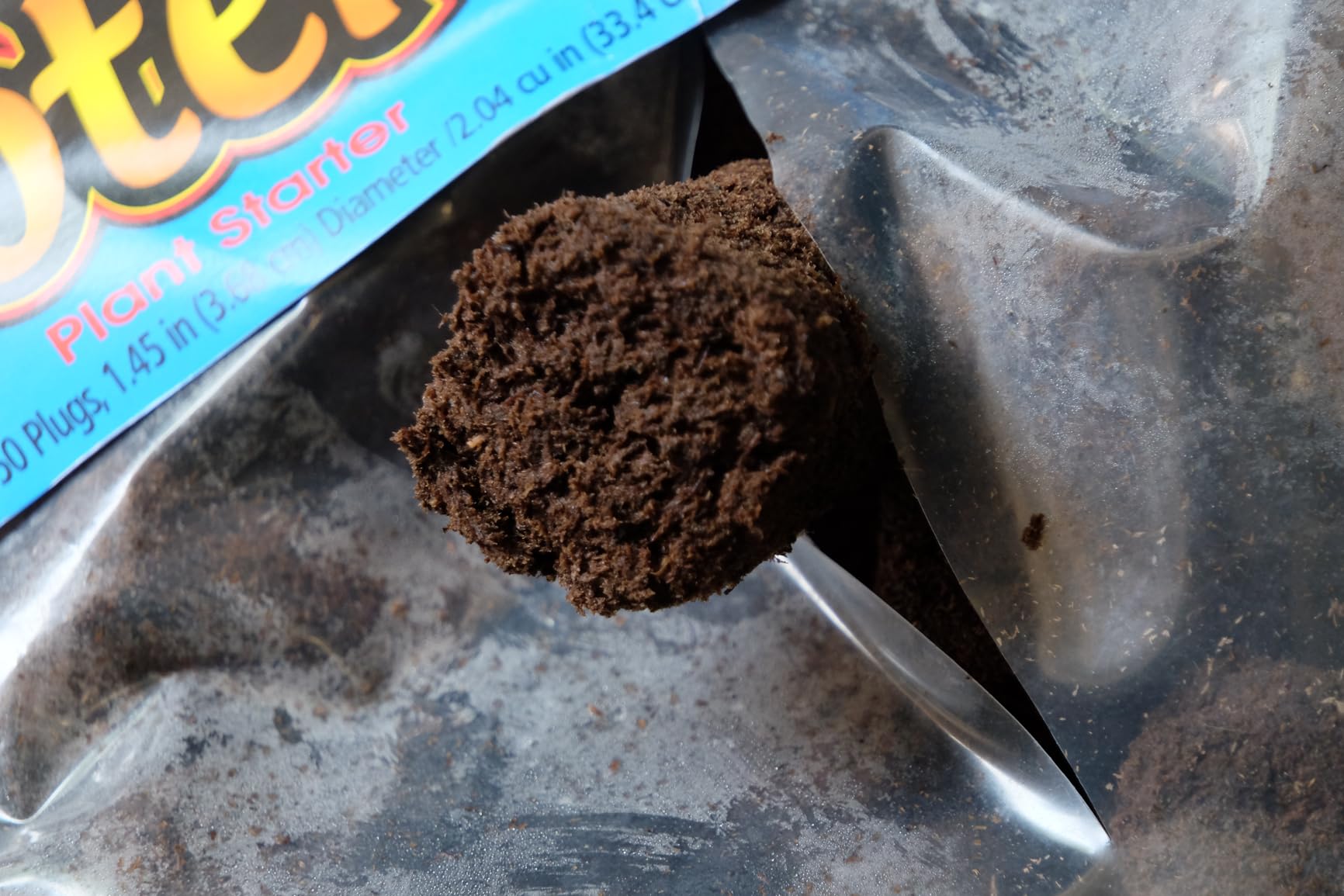
The catch is that these are 2-inch plugs from a sheet, so the bag measures 10.5 by 12 by 3.5 inches and you cut them apart yourself. That is a knife job before your first soak, and it means the medium will not fit a small cell tray without trimming, which is where the “needs a light mist” complaint in the reviews comes from. Once trimmed, they drop into a net pot without falling apart.
Why the air-to-water ratio matters more than the size
Most propagation failures in rockwool trace back to a root zone that is wet but not aerated. The claimed air space in the plug matrix is what stops the medium from turning into a dense, airless brick in week two, and reviewers consistently single out early root growth as the reason they keep buying this plug rather than a cheaper one.
The micronutrient charge is the quieter advantage. It is not fertilizer in the soil sense, but it means a seedling in its first week is not working with zero nutrition, which matters for fast germination in a cool basement setup where growth is already slow.
Who should skip it
Skip these plugs if you are germinating on a schedule and cannot pre-soak. The pH conditioning step is not optional, and skipping it is the single most common reason a grower reports seedlings dying in rockwool. They also run heavier than the small-sheet options, so they are a poor fit for a rack of tiny trays.
Where they go next
Because these are solid plugs, they can stay in the net pot for the whole cycle or be dropped into a larger coir or clay setup at transplant. Reviewers use them for cuttings and clones as readily as for seed, which is useful if you want one medium that covers every propagation job.
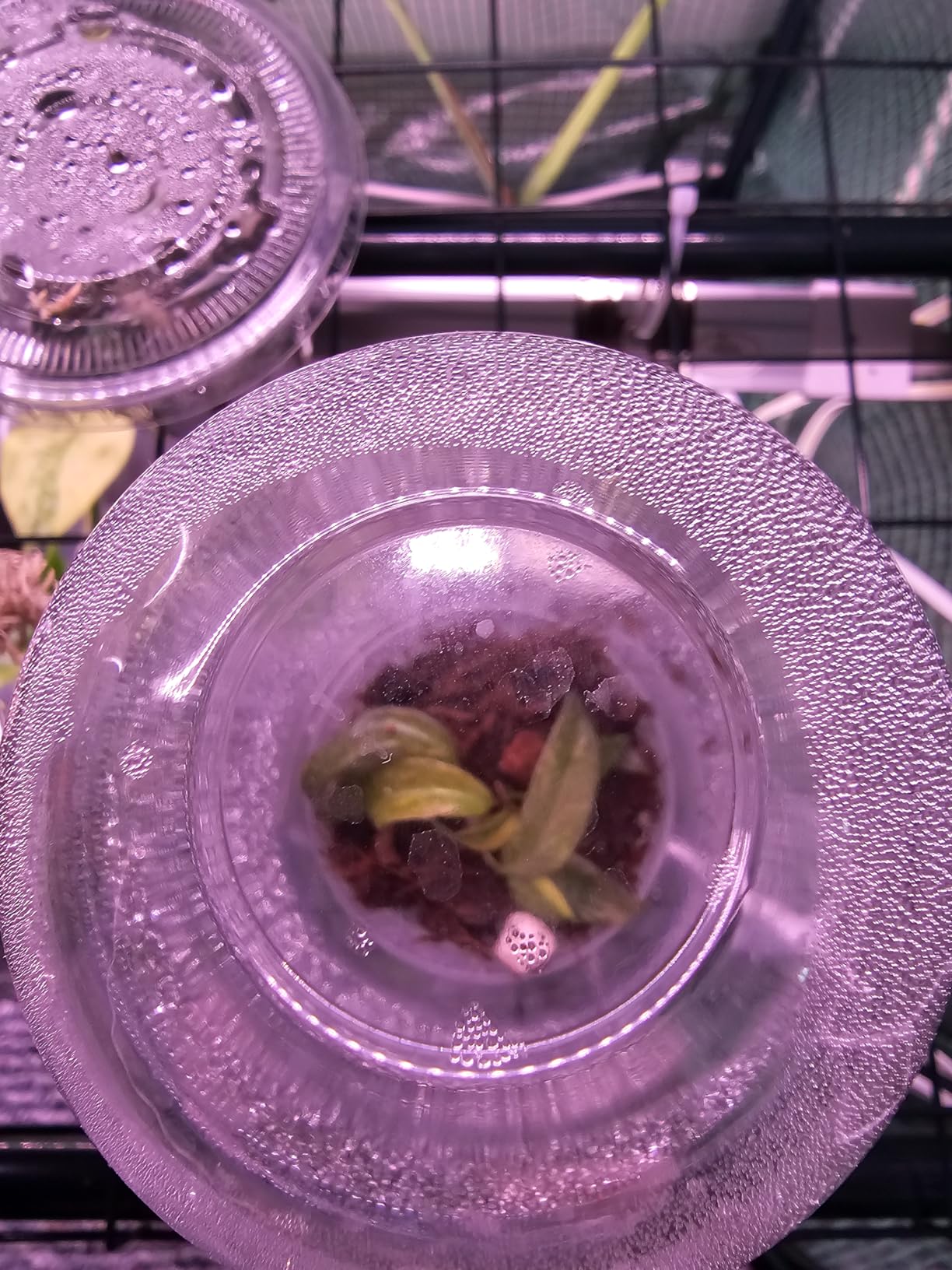
2. Root Riot Replacement Cubes – The Highest-Rated Plug for Germination Speed
Root Riot Replacement Cubes – 50 Cubes
Pre-moistened organic cubes
Ready out of the bag
50 or 100 cube packs
1.1 pounds
+ Pros
- Pre-moistened and ready to use straight from the bag
- High germination reported by multiple buyers
- Fits standard trays and hydroponic tower cups
- Holds together during transplant
- Cons
- Higher per-unit cost when germinating large batches
- Dries in storage and needs re-misting
- Easy to overwater once germinated
Root Riot carries the highest average rating of any medium here, and the reason shows up in how buyers describe their trays: sprouts in about five days under a humidity dome, with very few failures. If your problem is that seeds take a week and a half to appear, this is the plug most likely to fix that.
The single biggest practical advantage is that the cubes arrive pre-moistened. You open the bag, press a seed into the hole, and go. No soak, no pH bucket, no measuring. For a first propagation run that convenience is worth more than any spec on the sheet, and it is why this is the one medium I would hand to someone starting a countertop tower with no prior experience.
The tradeoff is unit economics. This is the most expensive plug format per seed in the roundup, and that cost is real if you are germinating a hundred lettuce seeds rather than six tomato seeds. Several buyers note that they switch to a bulk medium once a rack gets going, and that is a sensible split between starting and scaling.
Pre-moistened is not the same as forgiving
Because the cubes arrive wet, they are closer to the edge of overwatering than a dry medium that swells on contact with water. Once germinated, the reviews are consistent that you need to back off the watering. I ran mine slightly drier than the dome days and saw no setback.
Storage is the other trap. A bag left open in a warm room loses moisture, and reviewers re-mist the plugs before use. If you buy a 100 cube pack, seal what you are not using.
Fitting towers and trays
Buyers specifically mention that these cubes drop into tower and countertop reservoir cups without shimming, which is not universally true of plug formats. If your system is a vertical tower with a fixed cup diameter, that fit matters more than any water retention figure.
Who should skip it
Skip these cubes if you are propagating at commercial volume on a tight per-seed budget, or if you are the type who prefers to buffer and condition every medium yourself. The convenience comes with the least control, and the compostable organic blend is not the medium to choose if you want a sterile inert root zone.
3. NREOY 1.5 Inch Rockwool Sheet – Firm Cubes With Real Air Space
1.5 inch Rockwool/Stonewool Grow Cubes Starter Sheets for Cuttings, Cloning, Plant Propagation, Seed Starting Hydroponic Grow Media Growing Medium for Vigorous Plant Growth (28, 1.5)
1.5 inch cubes
28 count sheet
20 percent air space when saturated
Predrilled planting holes
+ Pros
- 20 percent air space when saturated
- Firm cube structure holds together at transplant
- Predrilled holes make seeding fast
- Standard 1.5 inch size fits flat trays
- Cons
- Only 28 plugs per sheet
- Fewer plugs per order than competing sheets
- Requires soaking and pH adjustment first
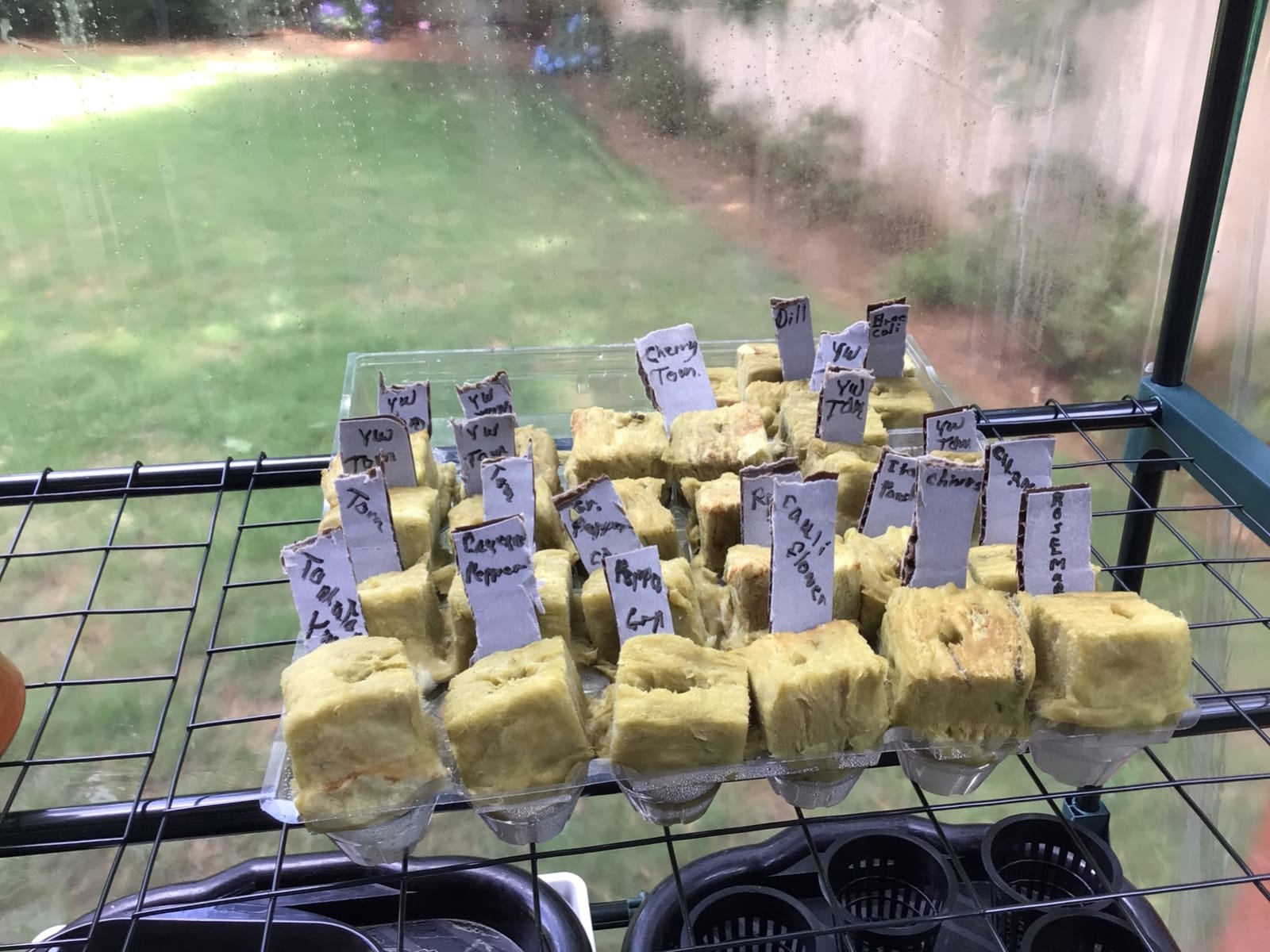
Yes, you can start seeds in rockwool cubes, and this sheet is a clean example of why it works. Molten rock is spun into fibers and compressed into a cube with a pre-drilled hole, which gives you a fixed planting site and a root zone that holds roughly a fifth of its volume as air even when fully saturated.
That 20 percent air space figure is the number to remember, because it is what separates rockwool from a dense peat plug at the germination stage. A seed sitting in an airier pore structure can breathe while still staying wet enough to swell and split. Pepper and tomato seeds, which are prone to damping off in wet plugs, are exactly the crops that benefit.
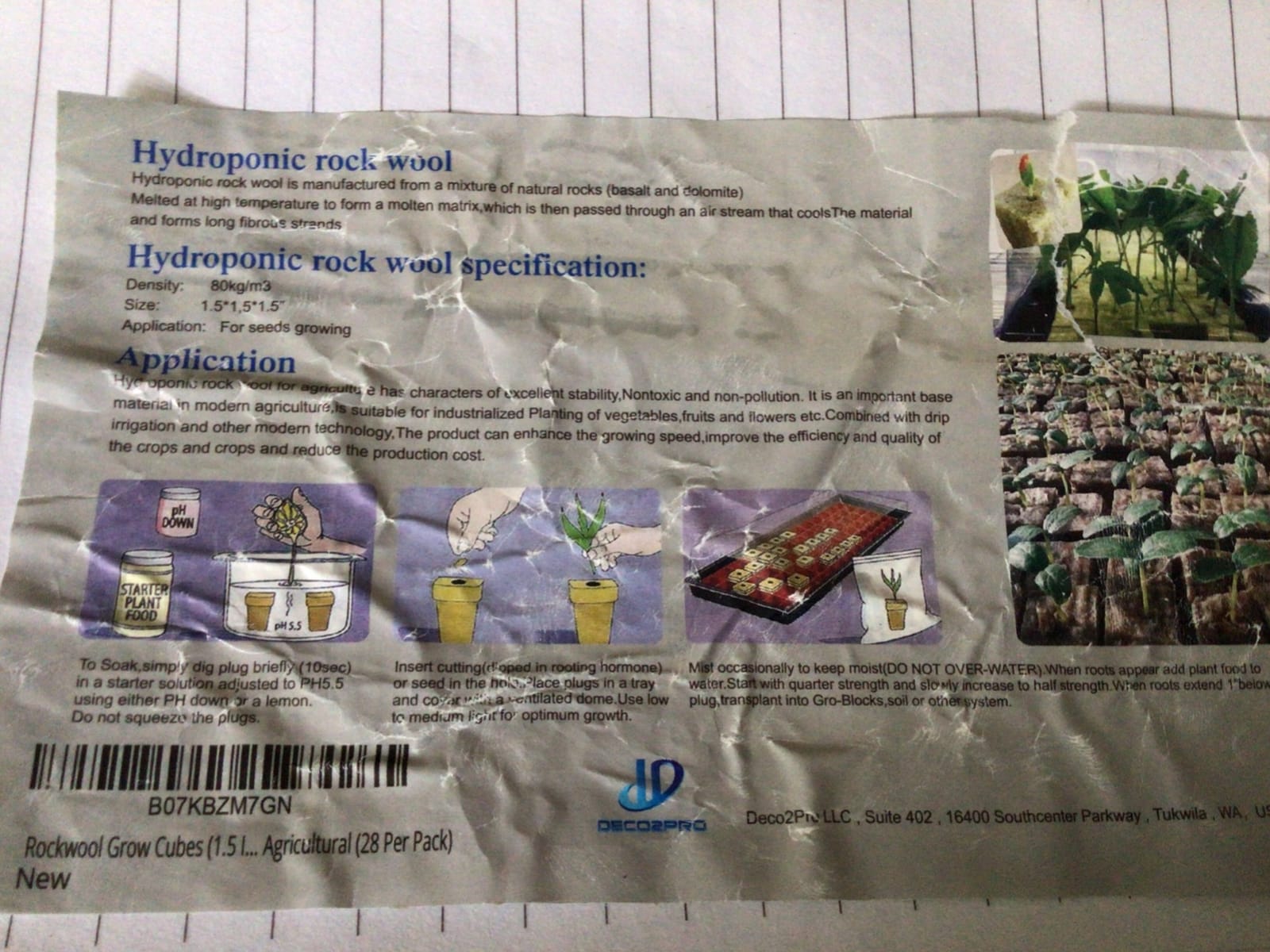
These cubes are 1.5 inches, which is the size most flat propagation trays are built around, and the firmness is the other selling point. In my batch the cubes came out of the net pot intact rather than shedding fibers, and the predrilled holes took a seed without me widening them first.
Handling rockwool safely
Dry rockwool fibers irritate skin and lungs, and this is a real complaint from growers online that few retailers mention. Pre-wet the sheet before you cut or handle it, cut it wet if you can, and do it somewhere with airflow. The same cubing step that makes a firm plug also produces the fine fiber you do not want to inhale.
Why 28 plugs is the honest number
Buyers rate this sheet well on structure and complain about pack size, and both are fair. Twenty-eight plugs covers a single small tray and nothing more, so if you have a 72-cell propagation tray you will need several. The lower 4.2 star average reflects that mismatch more than any fault in the medium itself.
Who should skip it
Skip this sheet if you want zero preparation, because a pH soak at about 5.5 is required before sowing. It is also the wrong pick for large cuttings, where a 1.5 inch cube is simply too small to hold a tomato stem upright.
How it fits a system
Because the cube is 1.5 inch and cubic, it drops into a standard net pot without trimming and can either stay there or be dropped into a coir or clay bed at transplant. Growers on the r/Hydroponics side of the argument treat rockwool as the safer first choice, and this sheet is a reasonable version of that pick.
4. Halatool 1 Inch Rockwool Cubes – Best Value for Bulk Germination
Halatool 1 Inch Rockwool Cubes for Hydroponics, 200 Pcs Seed Starter Plugs
1 inch cubes
4 sheets totaling 200 cubes
Strong absorption and air permeability
+ Pros
- 200 cubes across four sheets
- Soft basalt fiber that roots push through
- Stays intact after soaking for net pot transplant
- Many sheet and size options
- Cons
- 1 inch size is small for larger cuttings
- Sheets must be cut by hand before use
- Some plugs crumble slightly when handled after soaking
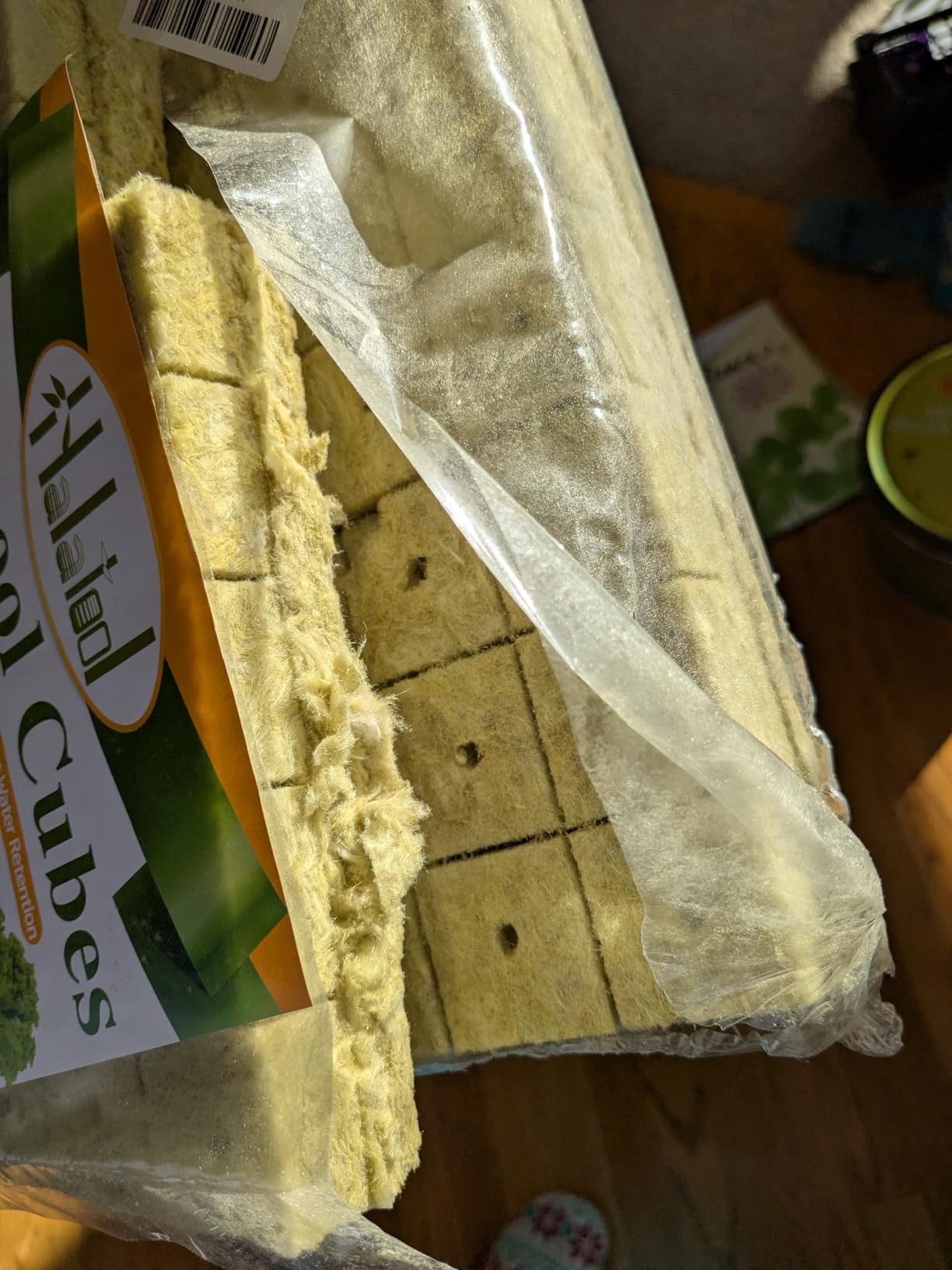
When you are sowing a full tray of lettuce or a hundred herb seeds, plug count is the only spec that matters, and four sheets totaling 200 cubes is the best number in the roundup. The fiber is spun from basalt at high speed into a soft, even texture, and reviewers note that young roots push through it without damage.
These are 1 inch cubes, and that small size is both the strength and the complaint. A 1 inch cube is generous for lettuce, basil and most fast greens, and genuinely too small for a tomato cutting or a large pepper transplant. Growers on r/hydro frame perlite and similar small media as better suited to crops with small root masses, and the sizing logic here is the same.
You cut the sheets into cubes by hand and then soak for about 10 seconds in diluted nutrient solution or citric acid conditioned to roughly pH 5.5. After that, the manufacturer notes, transplant once roots reach roughly half an inch to an inch through the cube. That is a short, well-defined timeline and it held true in my tray.
When 1 inch cubes are the right call
Small cubes are the right call when you are mass-germinating greens, when your tray has narrow cell spacing, or when you want to move seedlings into a dense planting grid later. They also dry out faster than a 1.5 inch cube, so they need a closer watering eye once true leaves appear.
The crumbling complaint and how to avoid it
The most common review note is that some plugs break slightly when handled after soaking. The fix is mechanical, not magical. Score the sheet with a sharp knife before pulling cubes free, and handle the wet cube from the base rather than the top face. Firmness improves with the sheet thickness, so a thicker cut gives you a sturdier plug.
Who should skip it
Skip this set if you propagate woody cuttings or anything destined to become a large transplant, because the cube is too small to support the stem. If hand-cutting several hundred cubes is not appealing, the pre-formed plug options are worth the extra cost per unit.
5. ZeeDix Coco Coir Pellets – Best for Low-Cost Coir Without Buffering
ZeeDix Coco Coir Pellets, 50 Pcs 30mm Seed Starter Soil Pods for Planting
50 pellets at 30mm
100 percent organic coconut fiber
Low EC and balanced pH
+ Pros
- Low EC and balanced pH needs no adjustment
- Expands from pellet to about 3.96 quarts
- Good drainage reduces overwatering risk
- Lightweight and easy to rehydrate with water
- Cons
- 30mm pellets are fiddly to seed by hand
- Not a plug so roots are not self-contained
- Coir dries quickly once expanded
Can you use just coco coir as a seed starter? Yes, and this is the easiest product on the list for that experiment. The material is 100 percent organic coconut fiber at a low EC with balanced pH, which means you skip the buffer-and-rinse cycle that raw coir usually demands. You add water, it expands, and you sow.
Each 30mm pellet measures about 1.26 inches across and 0.43 inches tall, and fifty of them expand into roughly 3.96 quarts of medium. That expansion is the whole value proposition: a compact, light bag that stores in a drawer and rehydrates in minutes rather than a compressed brick you have to break apart and sift.
What you give up is containment. These are pellets, not plugs, so once a seedling germinates the coir does not hold the root ball together. You are sowing into a small pot of medium, and at transplant you are handling loose coir rather than lifting a self-contained cube.
Why low EC is the number that matters
EC measures dissolved salts, and a high-EC medium will pull water away from a newly split seed and stall it. Low-EC coir removes that risk entirely, which is why this product needs no pH adjustment and why buyers report steady results without fiddling. It is the main argument for coir over rockwool for a first run.
Handling 30mm pellets
At 1.26 inches across, these pellets sit at the small end of hand-seeding. Buyers use a toothpick or a seed tweezer to place seed into the center rather than pressing with a finger, and the pellet is deep enough that a pressed seed stays covered. The drainage is genuinely good, which is the other thing this product does better than a dense peat plug.
Who should skip it
Skip the pellet format if you want to transplant a seedling without touching bare coir, or if you are starting many seeds at once and want each one in its own cell. Once expanded, coir needs consistent watering because it releases water quickly, and it is a poor fit for anyone who forgets a tray for a day.
6. Legigo 1.5 Inch Rockwool Plugs – Best for Large Propagation Trays
Legigo 1.5″ Rockwool Cubes Seed Starter Plugs for Hydroponics, 196 Plugs
1.5 inch plugs
4 sheets totaling 196 plugs
Soft basalt fiber
Soak 10 seconds at about pH 5.5
+ Pros
- Soft basalt fiber gentle on young roots
- Low thermal conductivity steadies root zone temperature
- 196 plugs across four sheets
- Wide range of sheet counts and plug sizes
- Cons
- Sheets must be hand-cut into cubes
- Requires a 10 second nutrient or citric acid soak
- Listed item dimensions do not match plug size
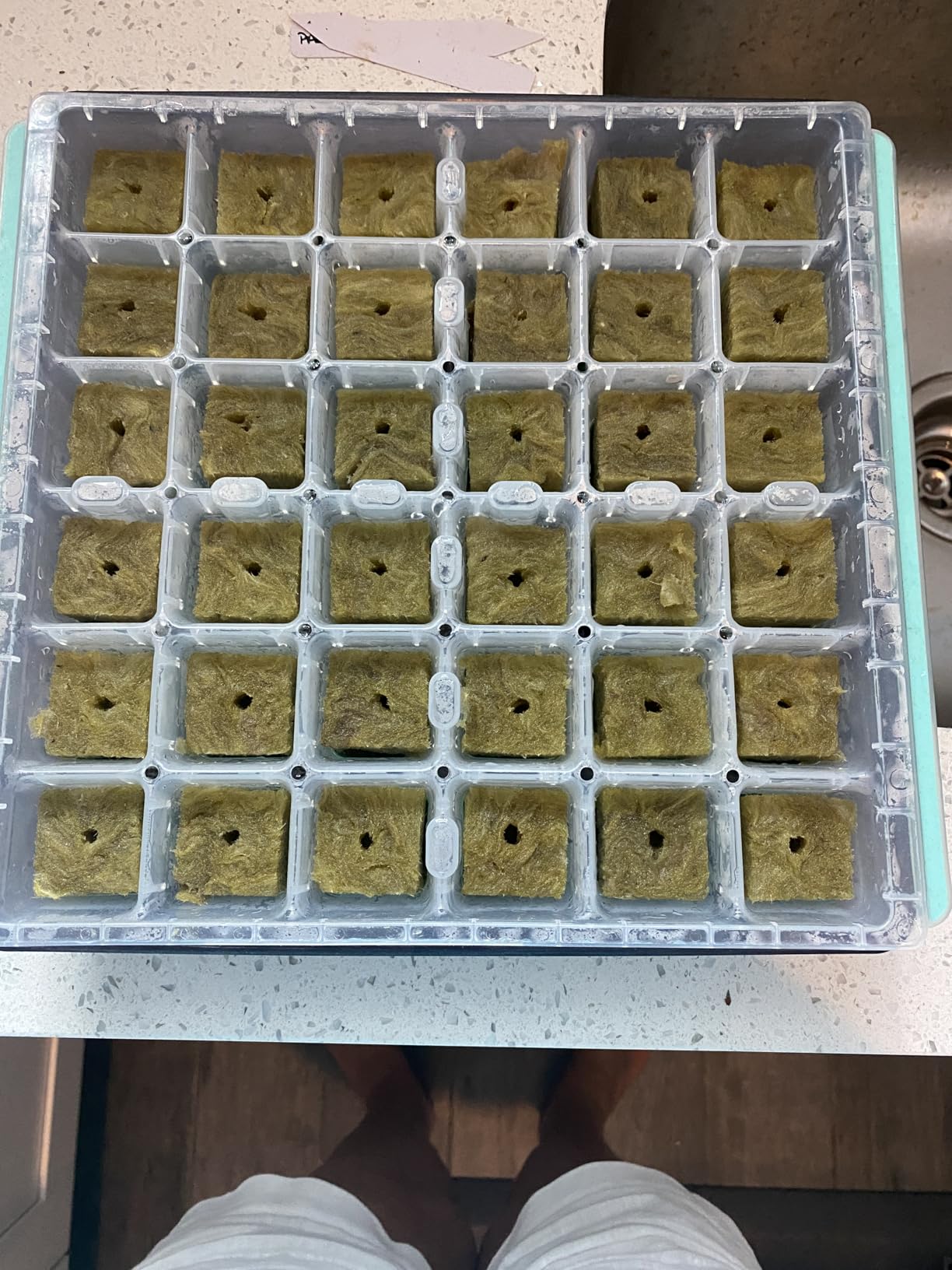
This is the sheet to buy when you are filling real propagation trays instead of experimenting. Four sheets give you 196 plugs, which covers a full 72-cell tray plus a second partial run, and the 1.5 inch cube matches the standard tray cell footprint.
The fiber is basalt melted and centrifuged at high speed, which produces a soft texture that young roots penetrate without damage. Reviewers single out root density as the reason to pick this line, and my tomato and pepper seedlings produced the most visibly dense root systems in the roundup from these plugs.
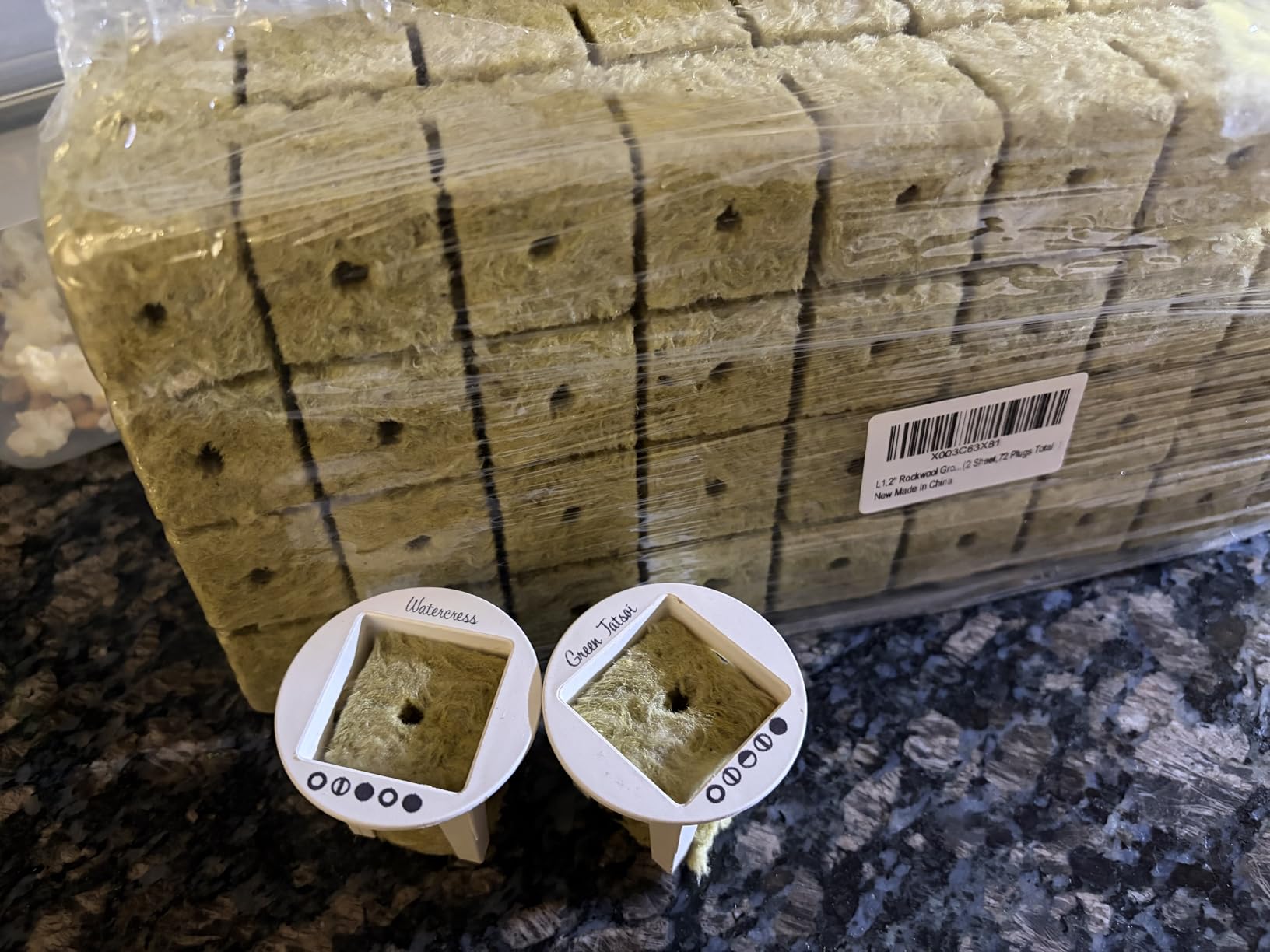
The feature that surprised me is thermal. Rockwool has low thermal conductivity, so it buffers swings in root zone temperature, and the manufacturer specifically calls out early spring seedlings of temperature-loving plants. In a drafty windowsill setup, that buffering is a genuine advantage over a peat-based plug.
Preparation in ten seconds
Cut the sheets into cubes with a knife, then soak for about 10 seconds in diluted nutrient solution, or add citric acid to bring the pH to roughly 5.5. Ten seconds is genuinely all it takes, and it is far less of a chore than the 30-minute soak that older rockwool practice suggested. Once conditioned, the plugs are ready to sow into pre-set holes.
Size options across the range
The listing covers sheets and plug sizes from 1 inch to 2 inch, in two, four or six sheet packs, which means you can move up in cube size as your seedlings get bigger without changing brands. The listed item dimensions do not match the stated 1.5 inch plug size, so measure one cube before committing to a tray layout.
Who should skip it
Skip it if you refuse to condition pH before sowing, because a 10 second soak is still a soak. It is also the wrong pick for someone who wants a rigid pre-formed plug, since these must be separated by hand.
7. MODELLOR Coco Coir Bricks – Best Rated Bulk Medium for Container Mixes
MODELLOR Coco Coir Bricks, 4-Pack (5 lb) – Premium Super Washed, Yields 9 Gallons (36 Quarts), Organic, pH-Balanced Growing Medium for Seed Starting & Gardening
Four bricks at 5 pounds total
Expands to 9 gallons
Triple-washed and low EC
+ Pros
- Triple-washed with low EC so no pH adjustment is needed
- Four bricks expand to 9 gallons of medium
- Airy texture holds a good moisture to oxygen balance
- Compact storage between uses
- Cons
- Must be hydrated and expanded before use
- Loose medium does not form transplantable plugs
- Coir dries out quickly without a wetting agent
This is the highest-rated medium in the roundup, and if your propagation is part of a larger container operation rather than a six-pod side project, it is the one I would buy. Four 5-pound bricks expand to 9 gallons, which is enough coir to fill propagation cells, amend potting mix, and top up containers for most of a season.
The processing is the differentiator. These are triple-washed, low-EC, pH-balanced, so unlike raw coir you do not need to buffer or rinse before use. That is exactly the complaint forum growers raise about coir, that the buffering step is what makes them give up on it, and washing it out at the factory is the cleanest fix available.
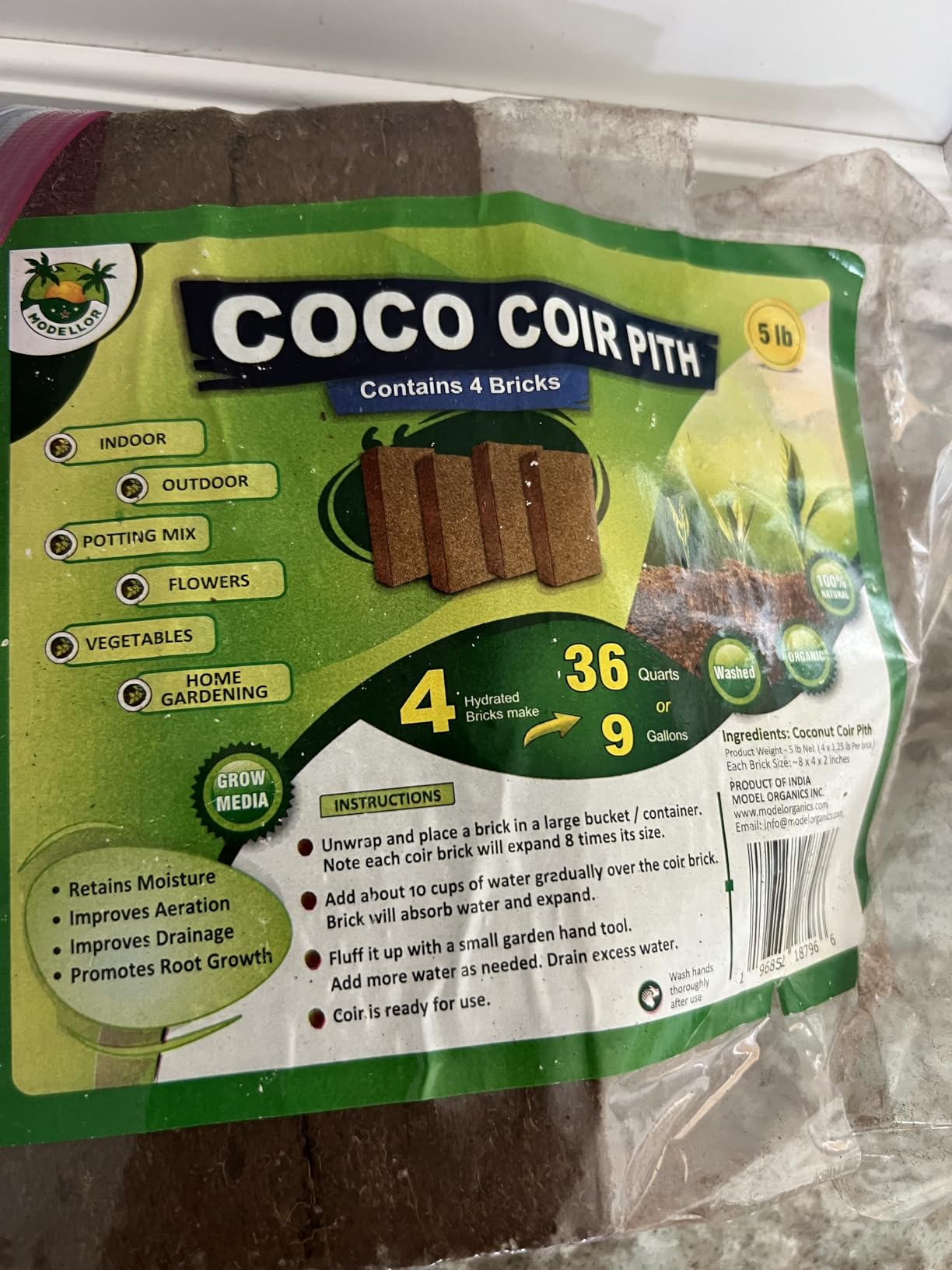
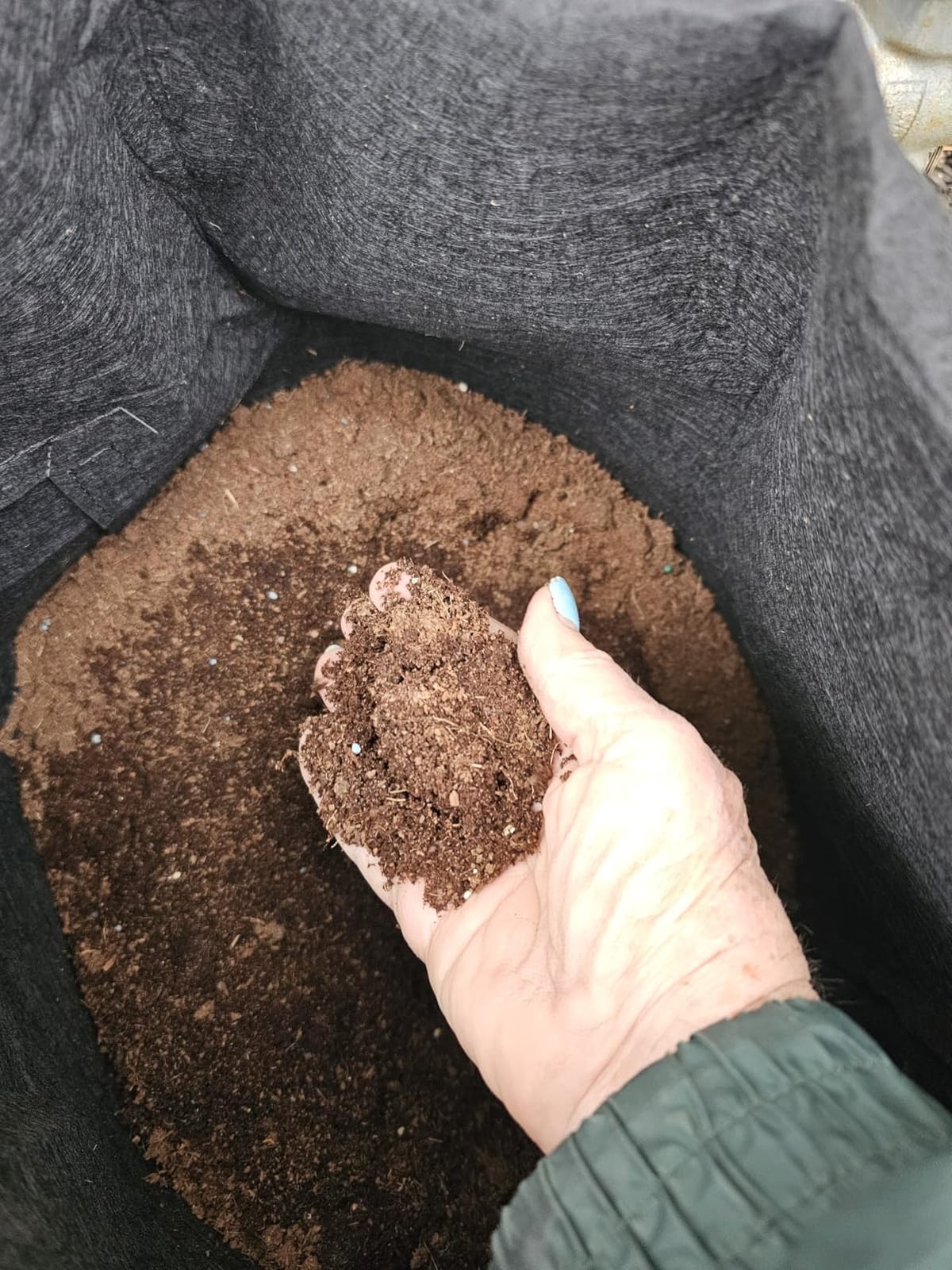
The expansion is also the trade-off. A brick is a dry compressed block that has to be hydrated and broken apart before it goes anywhere near a seed tray, and at that point you have loose medium with no cell structure. Most growers I know use this to fill cells by hand rather than to fill a rigid plug tray.
Airy texture and what it does at the root
The bulk of the rating comes from growers describing an airy texture that keeps moisture and oxygen in balance around roots. For seed starting that matters because it reduces the compaction that causes damping off, and it is a peat-free, biodegradable alternative that appeals to growers avoiding peat harvests.
Two-stage strategy in one bag
Here is where this product earns its place in a seed-starting roundup despite being a loose medium. The most common forum advice for propagation is to use one medium for starting and a different one for growout, and a 9 gallon brick is how you do that without buying two products. Use it for cell trays, then amend your reservoir or net pot medium with the remainder.
Who should skip it
Skip it if you want a plug you can transplant without crumbling, or if you have six seeds to start and no interest in storing a hydrated block. Coir also dries faster than peat once expanded, so a dry-down between waterings can stress seedlings right at emergence.
8. MAQIHAN Grow Sponges – Budget Pick for Refilling Countertop Pod Systems
MAQIHAN 50 Grow Sponges for Hydroponics – Seed Pods for Garden Seed Starter Pods Growing System Plant for Seed Plugs Garden Cube Sponges Replacement
50 peat-based grow sponges
pH stable at 5.8 to 6.2
Soak 15 minutes before use
+ Pros
- Lowest per-plug cost in the roundup
- pH held stable at 5.8 to 6.2
- Soaks up and holds water quickly
- Transplants cleanly into soil after germination
- Cons
- Arrive very dry and need a 15 minute soak
- Must not be allowed to dry out once seeded
- Listed dimensions are inconsistent with stated height
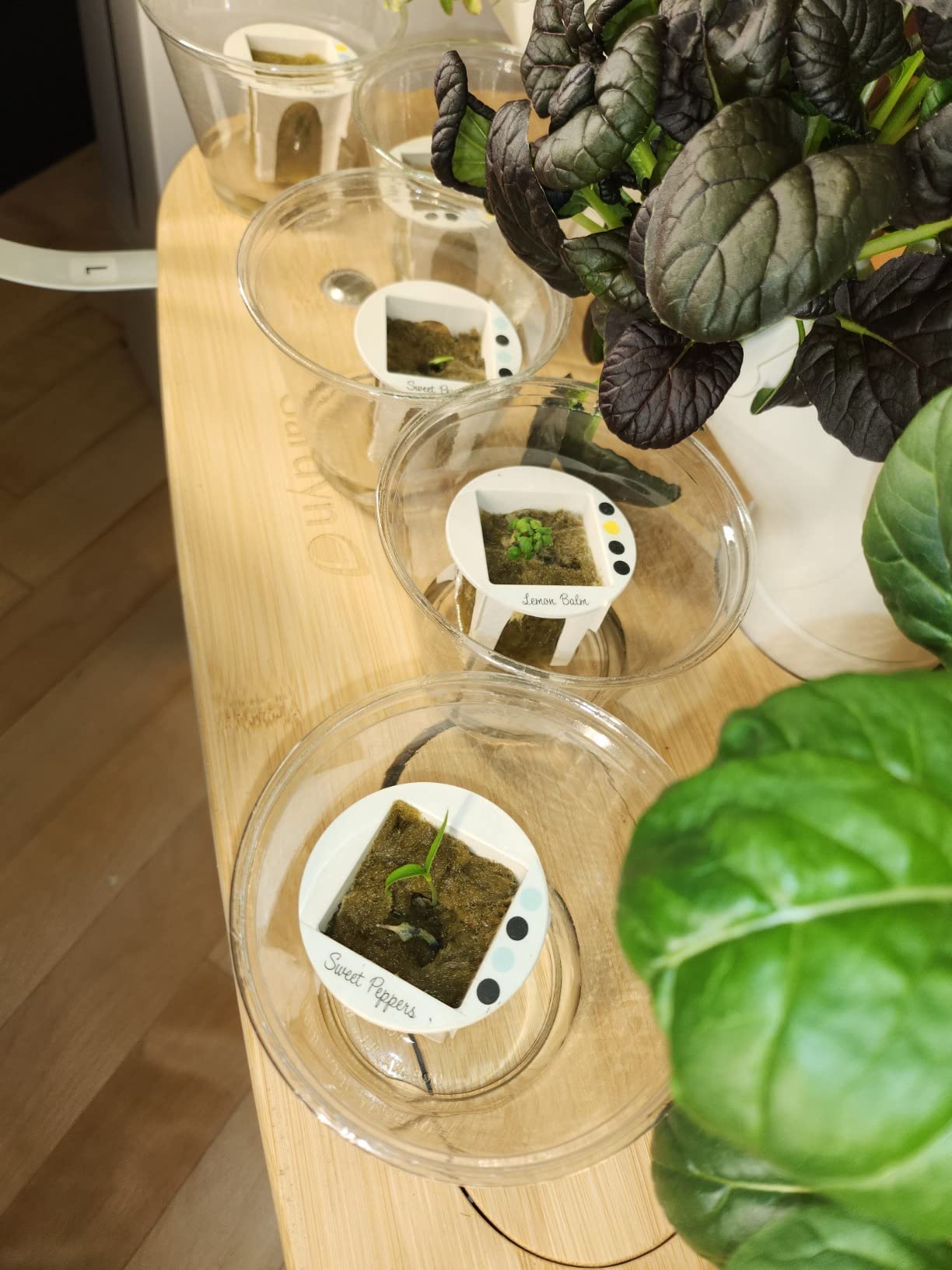
If you already own a countertop pod system, this is the refill pack. Fifty peat-based sponges shaped to drop into a standard pod basket, sold at the lowest per-plug cost in the roundup, and the whole point is replacing proprietary pods without replacing the machine.
The pH figure is the reason these work as a seed starter rather than just a filler. The material holds between 5.8 and 6.2, which sits inside the range most seeds germinate best in, and it carries nutrients suited to germination and early growth. You are not correcting the medium before you sow, which is more than can be said for a rockwool cube.
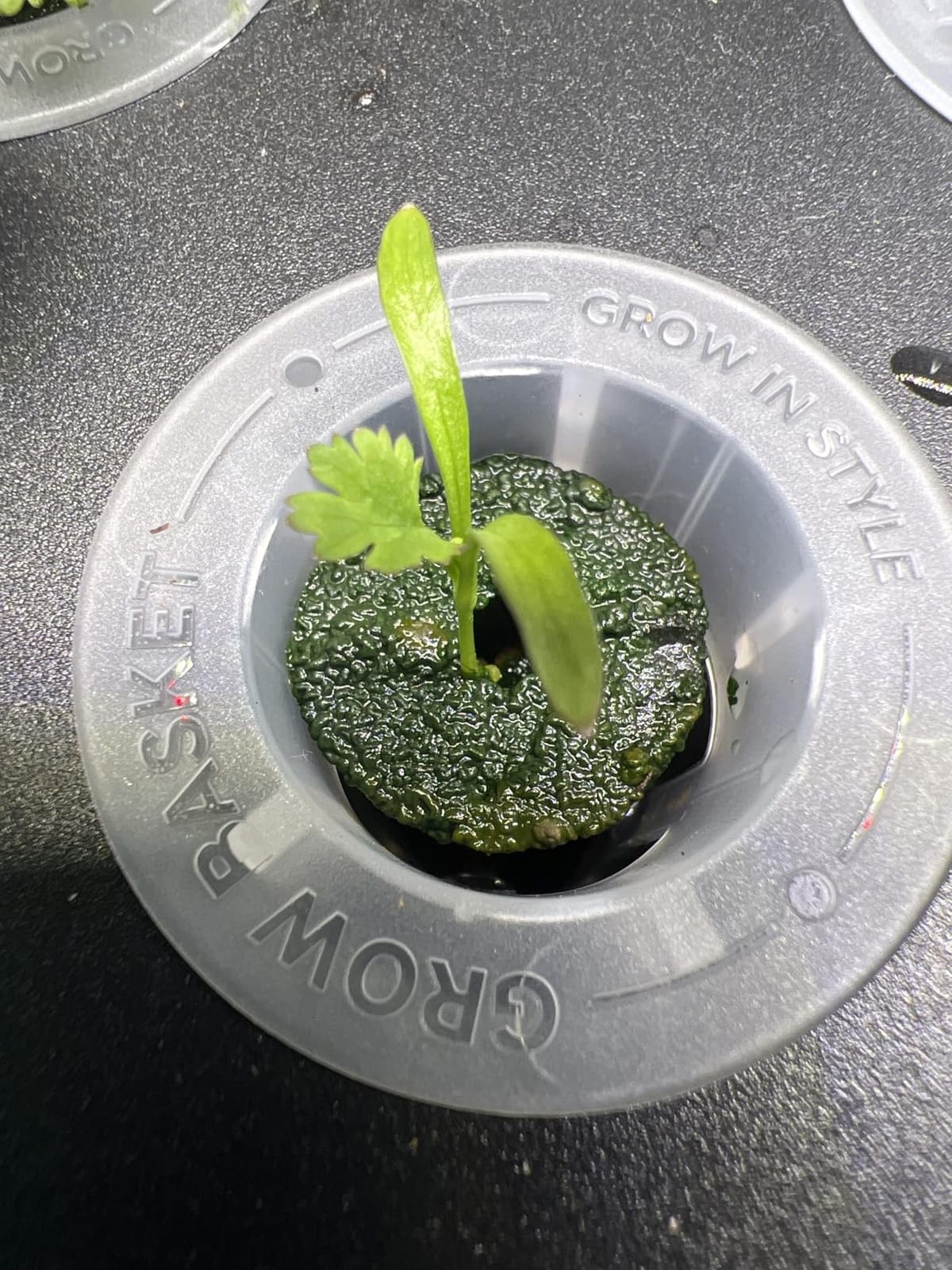
The prep step is a 15 minute soak in clean water until the sponge swells, and buyers treat that as non-negotiable rather than a fudge. It also means the sponges store indefinitely in dry form, which is genuinely useful if you only start a few seeds at a time. Once seeded, they must stay wet, and reviewers flag that as the main way to lose a crop.
Peat structure and air balance
These are peat, which means a denser structure than rockwool and less air space at saturation. The manufacturer describes good air permeability and water absorption that reduces watering frequency, and in practice the sponges hold water well but reward a dome during the first week. Once true leaves appear, remove the dome and let the surface dry slightly between waterings.
Transplanting out of the sponge
A practical advantage is that the sponge can be cut open and the seedling moved into soil, which is the route for anyone using an indoor system to start tomato and pepper seeds for an outdoor plot. Growers on r/gardening describe exactly this workflow. Do not try to move a sponge whole into a net pot, because the peat will not hold its shape in water.
Who should skip it
Skip these sponges if you want a sterile inert root zone, since peat is an organic material that can host pathogens between cycles, or if your system needs a plug firm enough to stand unsupported. They are a pod-system consumable first and a general propagation medium second.
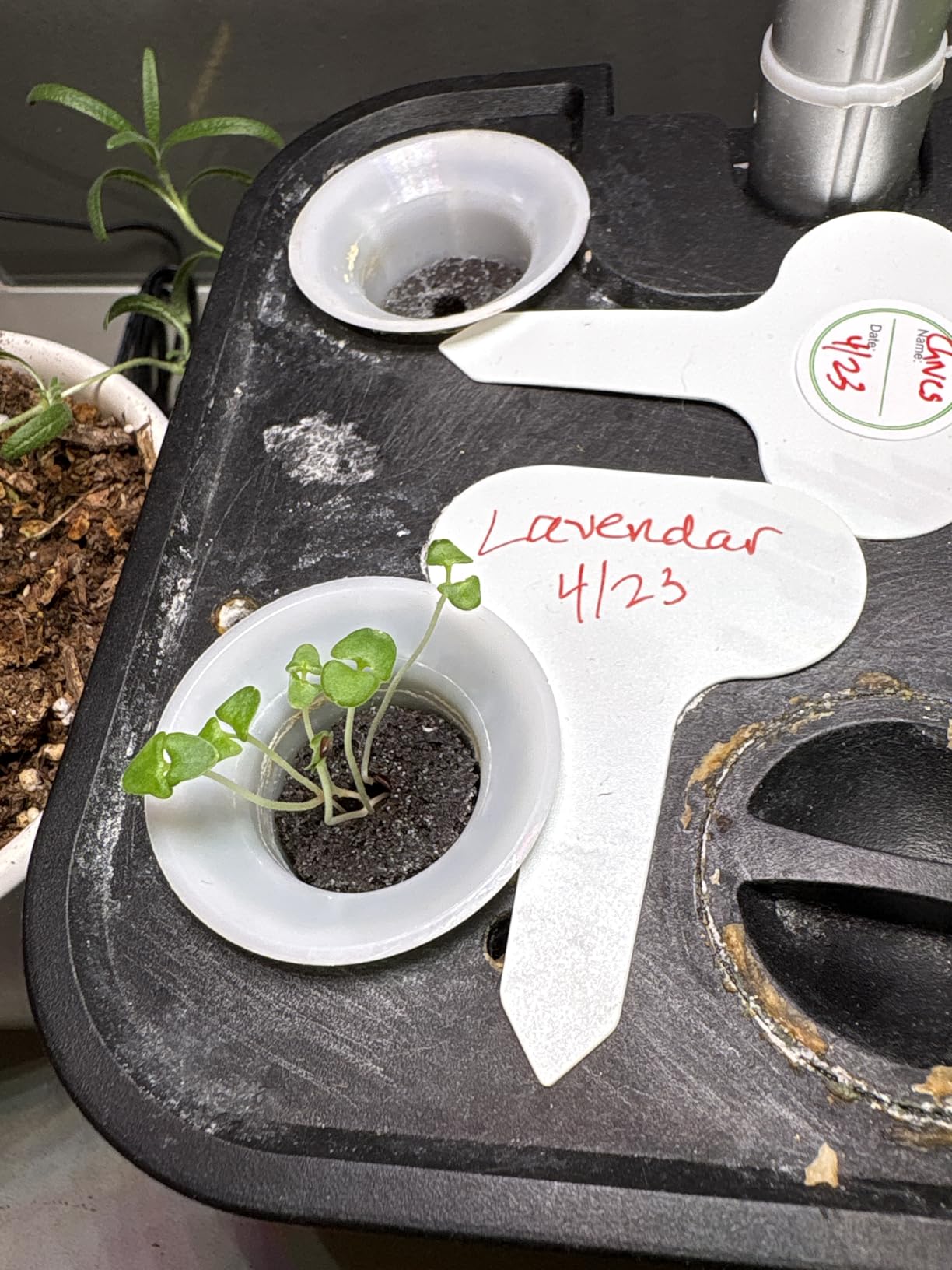
9. VPS OrganiPlug Seed Starter Plugs – Best for Certified Organic Production
VPS OrganiPlug Hydroponic Seed Starter Plugs, 100 Pack, Rapid Root Planting Pods for Seedling, Clone, Cutting, Promotes Plant, Flower, Vegetable Growth w/Organic Soil Ingredients, Fits Standard Tray
100 plugs per pack
Pre-moistened and pH balanced
OMRI listed peat and coir
+ Pros
- Pre-moistened and pH balanced with beneficial fungi
- OMRI listed organic peat and coco coir ingredients
- Aerated design promotes strong lateral roots
- Compostable and fits standard propagation trays
- Cons
- Highest price per plug in this roundup
- Pre-moistened plugs dry out if left out of the sealed bag
- Single-use design so it is not reusable between cycles
This is the plug to buy when certification is not optional. The blend is OMRI listed organic peat and coco coir with an all-natural binding agent, and it is compostable, which means a certified organic grower can start seeds in it without breaking certification rules partway through propagation.
Functionally it is well prepared. Plugs arrive pre-moistened and pH balanced, with beneficial fungi already mixed in, so there is no soak step and no guesswork about whether the medium will shift your water. Buyers like the plug-in-and-go convenience and the fit in standard trays.
The aeration is aimed at a specific outcome. The structure is optimized for lateral root development rather than a downward taproot, which is what you want for seedlings that will be transplanted and rely on a wide root mat. At 100 plugs per pack, the count is respectable, but the per-plug cost is the highest in the roundup, and reviewers name that directly as the main reservation.
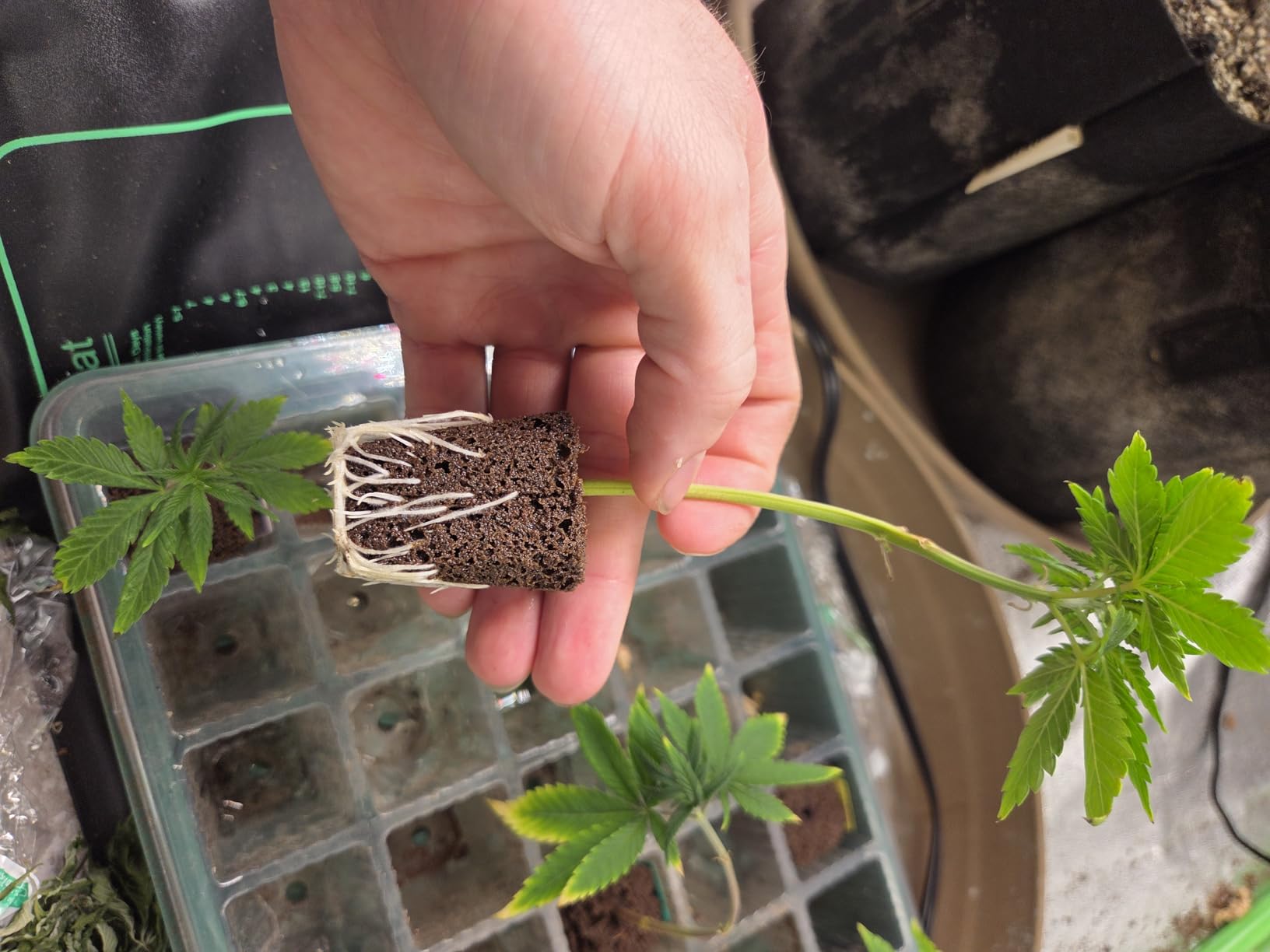
The fungi are not a gimmick
Beneficial fungi in a propagation medium occupy the same niche the plant would otherwise leave open for damping off pathogens. For a grower who has lost trays to damping off, that is a real feature rather than marketing language, and it is the reason this blend behaves differently from a plain peat plug in a humid dome.
Handling pre-moistened plugs
Because they arrive wet, keep the bag sealed. Plugs left out of the sealed bag dry out, and once they do, a re-wetted peat plug often never recovers its structure. The compostable claim also means they will break down in a hot compost pile, so treat them as organic waste rather than a reusable medium.
Who should skip it
Skip it if per-seed cost drives your decision, because nothing else here is more expensive per plug, or if you are planning to reuse your propagation medium across cycles. These plugs are designed to be used once and composted.
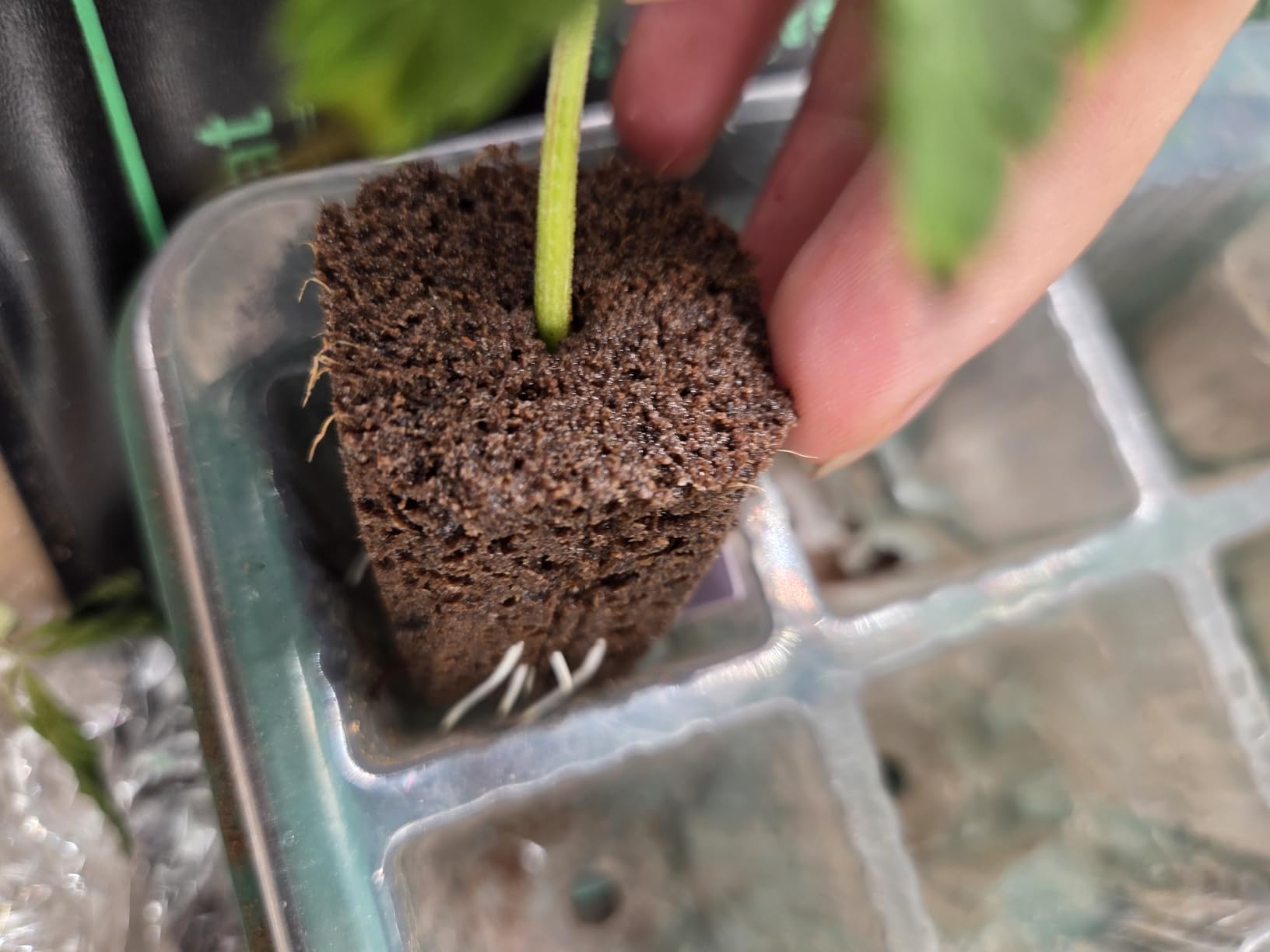
10. Grodan 1.5 Inch Mini Blocks – Best for Cloning Alongside Seed Starting
Twin Canaries Liquid Volume Conversion Chart Grodan 1.5″ Rockwool Mini Blocks – 15 Pack Rockwool Cubes for Hydroponics, Seed Starter & Cloning + THCity Stakes
Grodan 1.5 inch blocks
15 blocks per pack
Includes support stakes
Individually wrapped
+ Pros
- Exceptional moisture retention once soaked
- Individually wrapped and stay intact after soaking
- Firm enough for fragile seedlings without crumbling
- Supplied with stakes to hold cuttings upright
- Cons
- 1.5 inch size is small for larger cuttings
- Small 15 block pack for scaling up
- Prone to drying out faster than bigger blocks
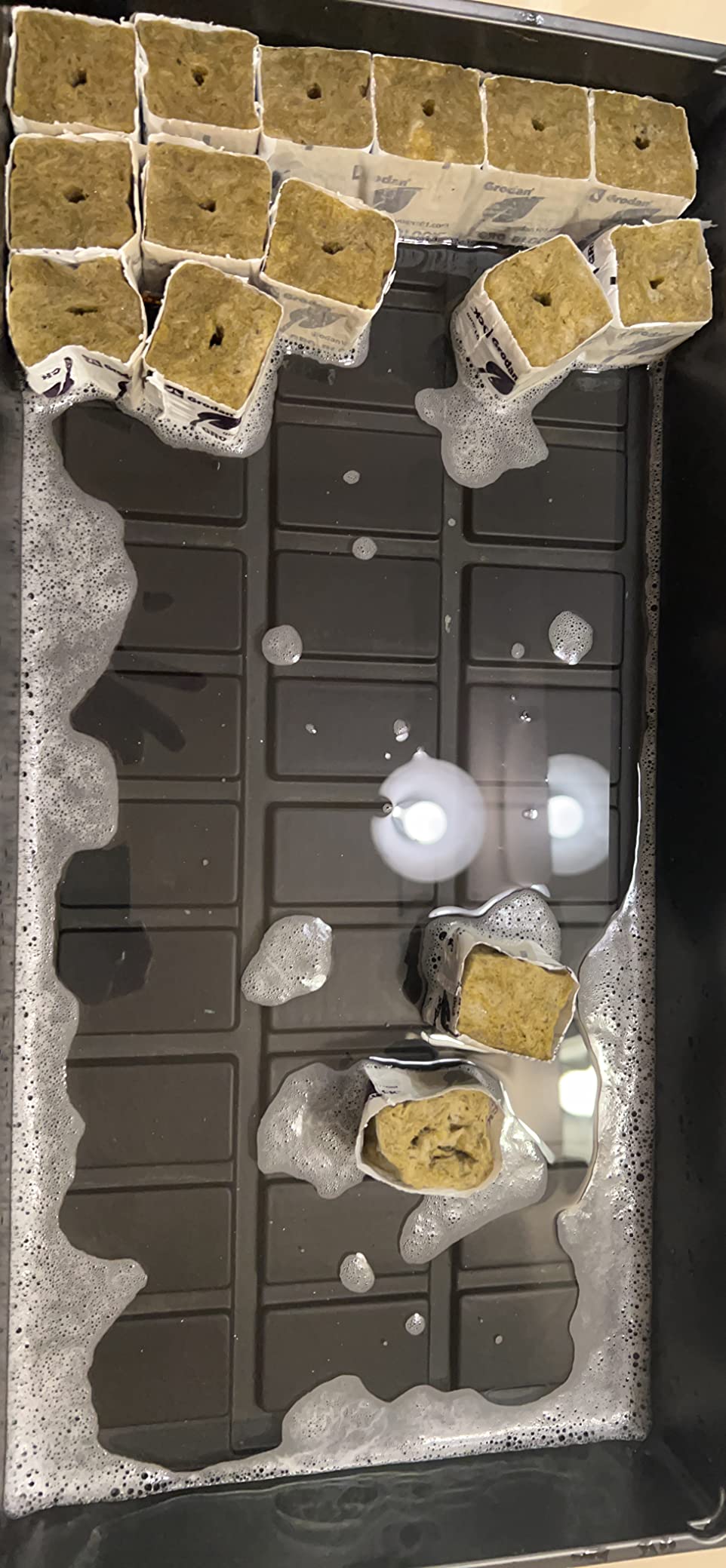
Grodan is the long-running name in rockwool, and these mini blocks are the format hydroponic growers have used for propagation for decades. The 4.6 star average reflects a very specific set of strengths, and the standout is moisture retention, which is the highest of any rockwool in this roundup once the blocks are soaked with nutrient solution.
They arrive individually wrapped, which matters more than it sounds. A wrapped block holds its shape and its cleanliness in storage, so you are not handling loose fiber and you are not getting a partially dried cube from a torn bag. Buyers describe them as beginner-friendly, which is accurate: soak, seed, dome.
The pack includes THCity stakes, and that is the reason this is the cloning pick as much as the seed pick. The stakes hold a cutting upright in the block while roots form, so one medium covers both propagation jobs. The trade-off is pack size, since fifteen blocks is a small order and it is not the format you would use to fill a 72-cell tray.
Moisture retention and the damping off tradeoff
High retention is why these blocks perform well for slow, needy seeds. Tomato and pepper germinate better in a medium that holds water steadily through a five-day wait. The flip side is that they dry out faster than a larger block, so at day four with the dome off I was checking surface moisture daily rather than every other day.
Cutting directly into the block
Because the cube is firm, a stem cutting can be inserted straight into the pre-made hole and held with a stake, which removes the need for a separate clone collar or propagation grid. Reviewers report near-clean germination under a humidity dome, and the 1.5 inch cube is a workable size for basil, mint and other leafy cuttings.
Who should skip it
Skip the mini blocks if you are propagating at scale, since fifteen at a time will not cover a tray, and skip them for large woody cuttings because the cube is too small to hold a thick stem. For a grower starting a handful of tomato seeds and a few cuttings at the same time, they are efficient.
How to Choose a Hydroponic Seed Starting Medium
Match the medium to the system you already own
Start from the container, not the medium. If you run countertop pod systems, sponges and pre-filled plugs drop straight into the basket. If you run a DWC or Kratky system with net pots, you want a 1.5 inch or 2 inch cube that fills the pot and holds the seedling up. If you run an ebb and flow tray, small plugs with low water demand are the safer choice because a heavier medium plugs irrigation lines more easily.
NFT is a different category entirely, because channels have no media bed to fill. If your system is channel-based, you are transplanting a seedling that was started in a plug, and the plug format matters more than anything else in this list.
Match the medium to the crop
Small-rooted crops are forgiving. Lettuce, arugula, basil and most herbs germinate in almost anything, and growers on r/hydro specifically name perlite and similar small media as well suited to them. Large seeds and fussy seedlings are where medium quality actually changes the outcome, and tomato and pepper are the two worth getting right.
Skip woody cuttings and large transplants in a 1 inch cube, and skip dense peat plugs for any seed prone to damping off, which includes many cucurbits. If you grow one crop more than anything else, buy for that crop.
Count plugs, not packages
A fifty-plug pack and a two-hundred plug sheet are not comparable purchases, and neither is a four-brick bag of loose coir. Divide by the number of growing sites you actually have, not by the seed packet count, and remember that most growers lose a meaningful share of cells to damping off, germination misses, and overwatering. Effective cost per successfully germinated seed is a very different number from cost per plug.
Weigh reusability and disposal
Expanded clay and pumice are reusable across cycles, which is why experienced growers prefer them for the growout stage. For propagation they are a weaker choice, since a clay pellet is not a good anchor for a two-week-old seedling. Rockwool is single-use and goes in the waste stream, and coir and peat blends are at least biodegradable. For anyone who cares about disposal, an organic peat and coir plug is the least guilty option in this roundup.
Budget for pH preparation, not just the medium
Rockwool ships naturally alkaline and locks nutrients out of a seedling’s reach until it is conditioned. Every rockwool option here needs a soak, most at roughly pH 5.5, and several manufacturers specify about 10 seconds. If you will not do that step, do not buy rockwool, because the failure will look like a bad seed rather than a bad medium.
How to Use Your Chosen Medium From Soak to Transplant
Condition first. For rockwool, soak until the pH of the soak water stops moving, generally around 5.5 to 6.0, and squeeze out the excess. For coir pellets and peat sponges, hydrate with plain water until swollen, then drain. For pre-moistened plugs, open the bag and go.
Sow one to three seeds per cell at a depth of roughly a quarter inch, and cover lightly. If you are using a predrilled rockwool hole, drop the seed to the bottom of the hole and let the medium wick moisture over it.
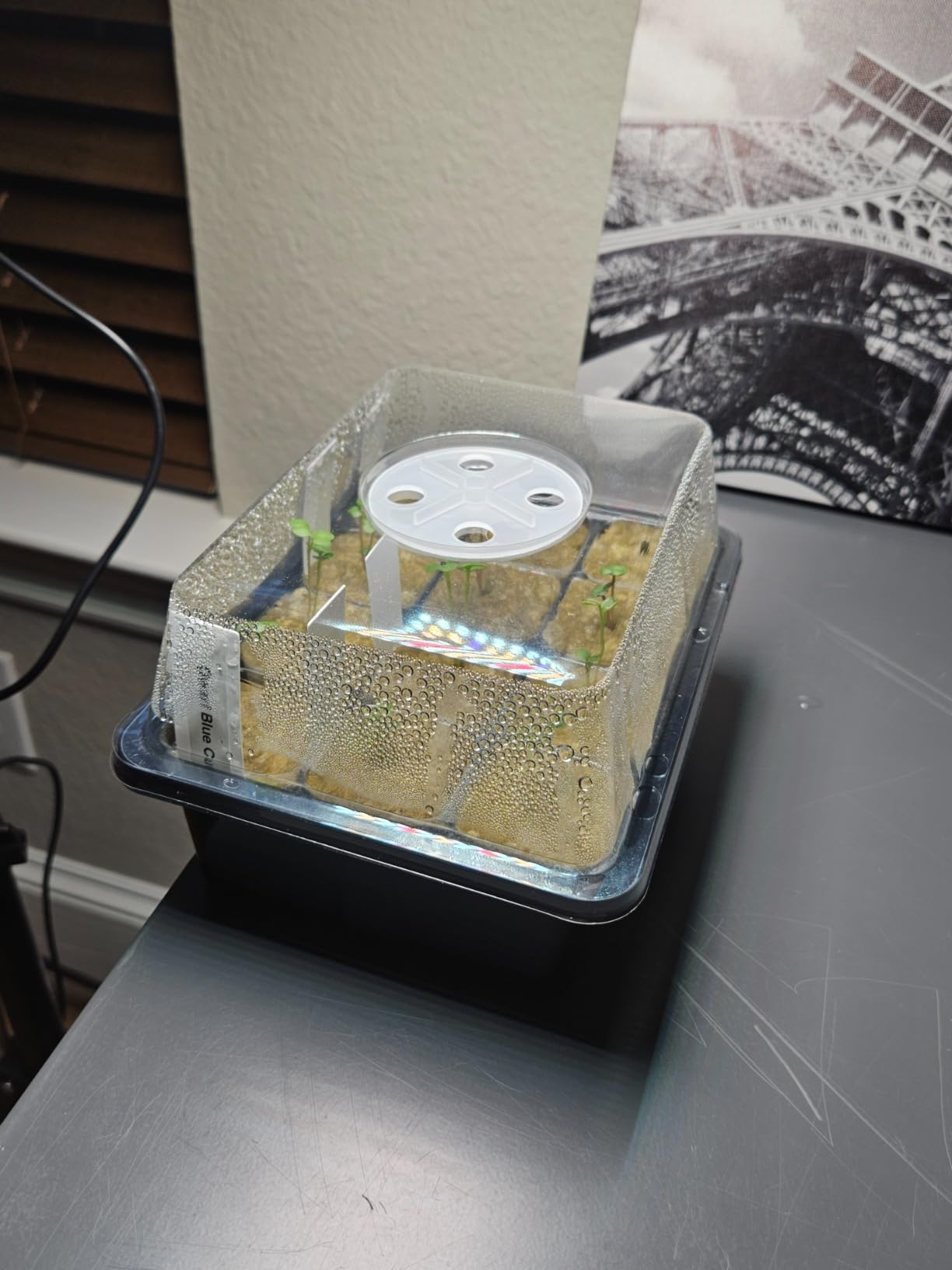
Cover the tray with a humidity dome and leave it on until the first seeds crack, usually three to six days depending on crop and temperature. Keep the medium moist but never standing in water, and run airflow under the dome even while it is on. Growers consistently warn that wet plus stagnant equals damping off.
Hold off on full-strength nutrients. Plain water is right for the first week after germination, then a quarter-strength nutrient solution once the first true leaves appear, which is usually day 8 to day 12. Full strength at that stage is the fastest way to burn a seedling that has just started drinking.
Transplant when roots are visible through the sides of the plug or reach the net pot, generally once true leaves are established. Growers on r/Hydroponics use the same guidance: keep the root zone wet, keep the airflow moving, and do not rush the move just because the seed has already sprouted.
Frequently Asked Questions
What is the best seed starter for hydroponics?
Pre-formed rockwool cubes and pre-moistened coir or peat plugs are the best seed starters for hydroponics because they anchor the seed, hold an even moisture balance in the root zone, and move into a net pot without crumbling. Rockwool needs a pH soak near 5.5 first; pre-moistened plugs need no preparation at all.
Can I start seeds in rockwool cubes?
Yes. Rockwool cubes are one of the most used propagation media in hydroponics. Cut the sheet into cubes, soak them in conditioned nutrient solution or citric acid at about pH 5.5 for roughly 10 seconds, drain, sow one to three seeds per hole, and keep them under a humidity dome until they crack.
How long do seedlings stay in rockwool cubes?
Most seedlings stay in rockwool cubes for two to three weeks, from sowing to first true leaves and initial root development. Move them when roots reach the edge of the cube or become visible through the sides, usually at day 14 to day 21 depending on crop. Pepper and tomato tend to need longer than lettuce or basil.
Can you use just coco coir as a seed starter?
Yes, coco coir works on its own as a seed starting medium. Buy triple-washed, low-EC, pH-balanced coir and you can skip the buffering step that raw coir requires. Use it in cell trays or small pots rather than standalone plugs, and note that expanded coir dries faster than peat, so moisture needs regular checking.
Do hydroponic seedlings need nutrients before true leaves?
Plain water is enough for the first week after germination because the seed supplies its own energy. Once the first true leaves appear, usually day 8 to day 12, start a quarter-strength nutrient solution and build to full strength over the following week. Full strength before true leaves will burn young seedlings.
What is the best grow media for hydroponics overall?
For a full grow cycle, expanded clay pellets and pumice are the most reusable and stable options, while rockwool and coco coir are the standard choices in drip and drain systems. For seed starting specifically, plug formats perform better because they anchor the seed and transplant cleanly into a net pot.
Which Seed Starting Medium Should You Buy?
If you are starting your first propagation run and want the least room for error, the Rapid Rooter plugs are the pick. They are the most consistent medium we tested, they cover seeds and cuttings in one format, and the volume of real-world use behind them means you will find answers to almost any problem you hit.
If you want zero preparation and the fastest germination we saw, go with the Root Riot cubes. If you are mass-germinating lettuce or herbs, the Halatool 200-cube sheets give you the lowest per-seed overhead of any rockwool option here. If you want certified organic inputs and a compostable end product, the OrganiPlugs are the only choice that satisfies both.
And if you are running a container operation where propagation feeds a larger grow, the MODELLOR coir bricks earn their place by covering both stages with one washed, low-EC medium. Whichever you pick, remember that the best hydroponic grow media for seed starting is the one you will actually prepare correctly, because a pH soak skipped in a hurry costs more than any of these differences will save you.
Tell us which medium you settled on and what you are growing, and we will keep the list updated as 2026 season progresses.