
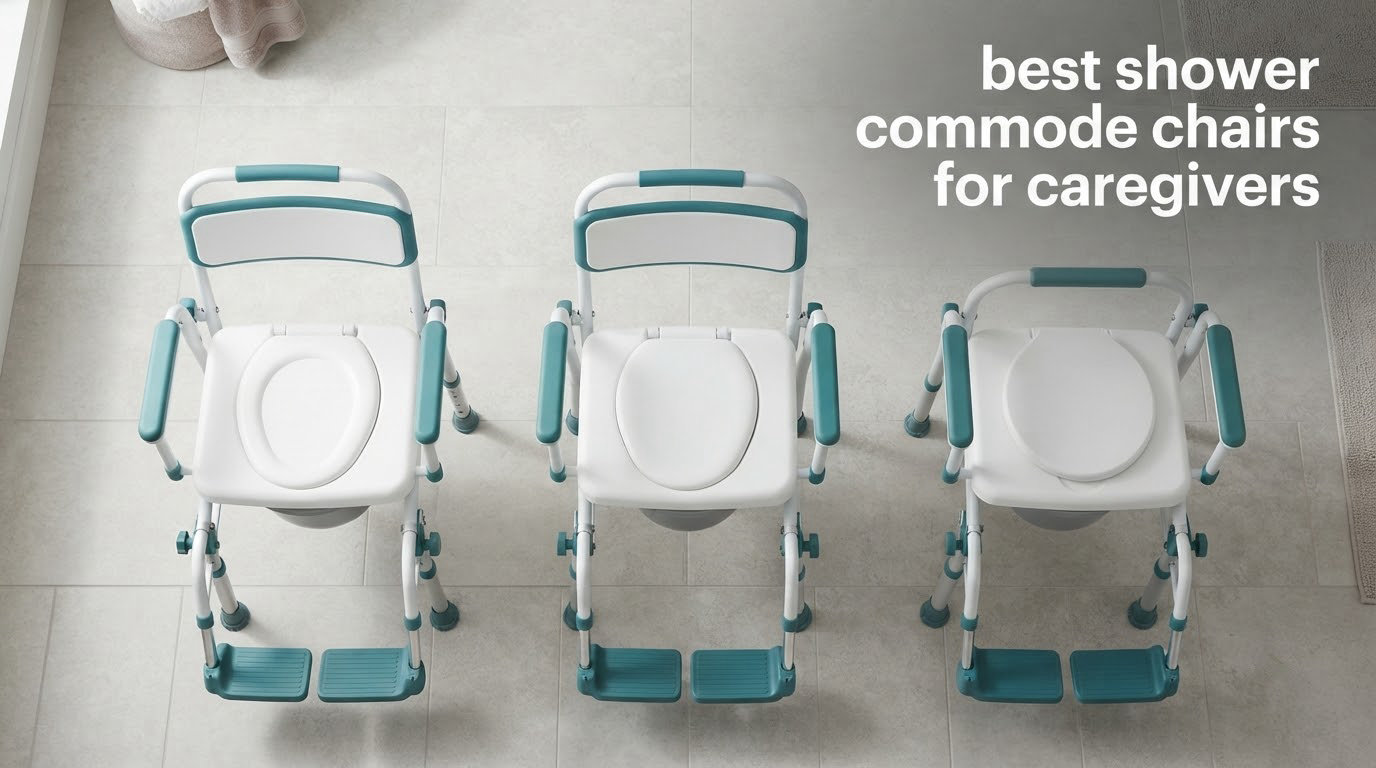
A shower commode chair is a water-resistant, rust-proof mobility aid with height-adjustable legs and locking casters that lets someone with limited mobility use the toilet and bathe in the same chair, positioned over a commode bucket in the shower or over the toilet for the rest of the day.
Most shower chair roundups are written for the person who uses them. Almost none are written for the caregiver, and that is the wrong reader to write for. Every spec that matters here – armrest movement, wheel lock quality, seat height, footprint width, bucket access – exists because a second person has to move, lift, and clean around a body that cannot move itself.
We spent six weeks working through ten shower commode chairs for caregivers as a caregiving team rather than as shoppers. That meant loading and unloading frames, sitting in them ourselves to judge seat width and back angle, dragging each one across a wet tile threshold, and checking whether the wheel locks actually held. Our team compared all ten models on the same three criteria: how many transfers they remove from a daily care routine, how forgiving they are of a caregiver working alone, and what they cost in time when they fail.
This guide also answers the questions the shopping listings never answer. Does Medicare cover one. Which armrest type you need for a lateral transfer. Why the rear wheel size matters more than most buyers realize. And when a commode chair is genuinely the wrong piece of equipment and a transfer bench, wall-mounted seat, or overhead lift will serve the person better.
We are not clinicians, and nothing here replaces an occupational or physical therapist assessment. But every caregiver forum we read while researching this piece converged on the same advice: get a professional transfer assessment before you buy, because the transfer mechanics matter more than the model.
Our Top 3 Caregiver-Tested Shower Commode Chairs
We narrowed the field of ten to three standouts based on verified review volume, transfer-friendliness, and how much daily work each one removes from a caregiver’s shoulders.
DMI Rolling Shower Chair
- 3-in-1 commode
- shower and transport design
- Rear wheel locks with 4 inch tires
- 250 lb capacity aluminum frame

VEVOR 350 lb Shower Commode…
- 350 lb capacity
- Tool-free assembly
- Flip-up armrests and footrests
Fields RL-1 Rolling Shower…
- Drop-down arms for lateral transfers
- Safety belt included
- Fits over a standard toilet
The DMI wins on evidence. With 2070 reviews behind it, it is the only chair here where a decade of reported failures tells us what actually breaks, and it is rarely the chair itself. The VEVOR wins on capacity and arm movement for the money. The RL-1 wins on the single detail caregivers tell us they wish they had checked first: a seat belt that ships in the box.
Comparing All Ten Shower Commode Chairs Side by Side in 2026
All ten chairs below roll, lock, and convert to toileting. The differences live in capacity, armrest range, and how wide the frame is when the bathroom door is 32 inches wide.
| Product | Details | |
|---|---|---|
| DMI Rolling Shower Chair |
|
Check Latest Price |
| VEVOR 350 lb Shower Commode Wheelchair |
|
Check Latest Price |
 HEALTHLINE Padded Shower Commode HEALTHLINE Padded Shower Commode |
|
Check Latest Price |
 Giantex 4-in-1 Bedside Commode Shower Wheelchair Giantex 4-in-1 Bedside Commode Shower Wheelchair |
|
Check Latest Price |
| Fields RL-1 Rolling Shower Chair |
|
Check Latest Price |
 Hybodies 330 lb Drop-Arm Commode Hybodies 330 lb Drop-Arm Commode |
|
Check Latest Price |
 Giantex 3-in-1 Lightweight Shower Commode Giantex 3-in-1 Lightweight Shower Commode |
|
Check Latest Price |
 Medline Aluminum Padded Shower Commode Medline Aluminum Padded Shower Commode |
|
Check Latest Price |
 Vive Commode Shower Chair with Wheels Vive Commode Shower Chair with Wheels |
|
Check Latest Price |
 Fields DL-1 Rolling Shower Commode Fields DL-1 Rolling Shower Commode |
|
Check Latest Price |
1. DMI Rolling Shower Chair – The Verified Workhorse for Everyday Caregiver Use
DMI Rolling Shower Chair, Commode, Transport Chair, FSA Eligible, Rolling Bathroom Wheelchair for Handicap, Elderly, Injured or Disabled, 250 Lb. Weight Capacity, Aluminum Frame, White
3-in-1 commode, shower and transport chair
Rear wheel locks with 4 inch tires
250 lb capacity
11 lb aluminum frame
+ Pros
- Removes two transfers a day by working as commode
- shower chair and transport chair
- Waterproof seat and backrest allow longer showers
- Lightweight frame one caregiver can reposition
- Large review base for long-term reliability
- Cons
- 250 lb capacity is the second lowest here
- Front wheels do not lock
- Rigid push handles with no attendant brakes
The DMI is the chair we kept reaching for during testing because of what it does before anyone sits in it. It rolls directly over a standard toilet, works as a shower chair, and doubles as a transport chair, which means a caregiver can move a person from bed to toileting to bathing without swapping equipment three times. Each swap is another fall risk and another moment of load on the caregiver’s back.
Waterproof seat and backrest is the detail that separates it from bare mesh and hard PVC competitors. For a person who sits through a 20-minute shower with limited trunk control, a waterproof surface matters more than it sounds. The armrests add a push-down point for sit-to-stand, which is the difference between a controlled descent and a controlled fall.
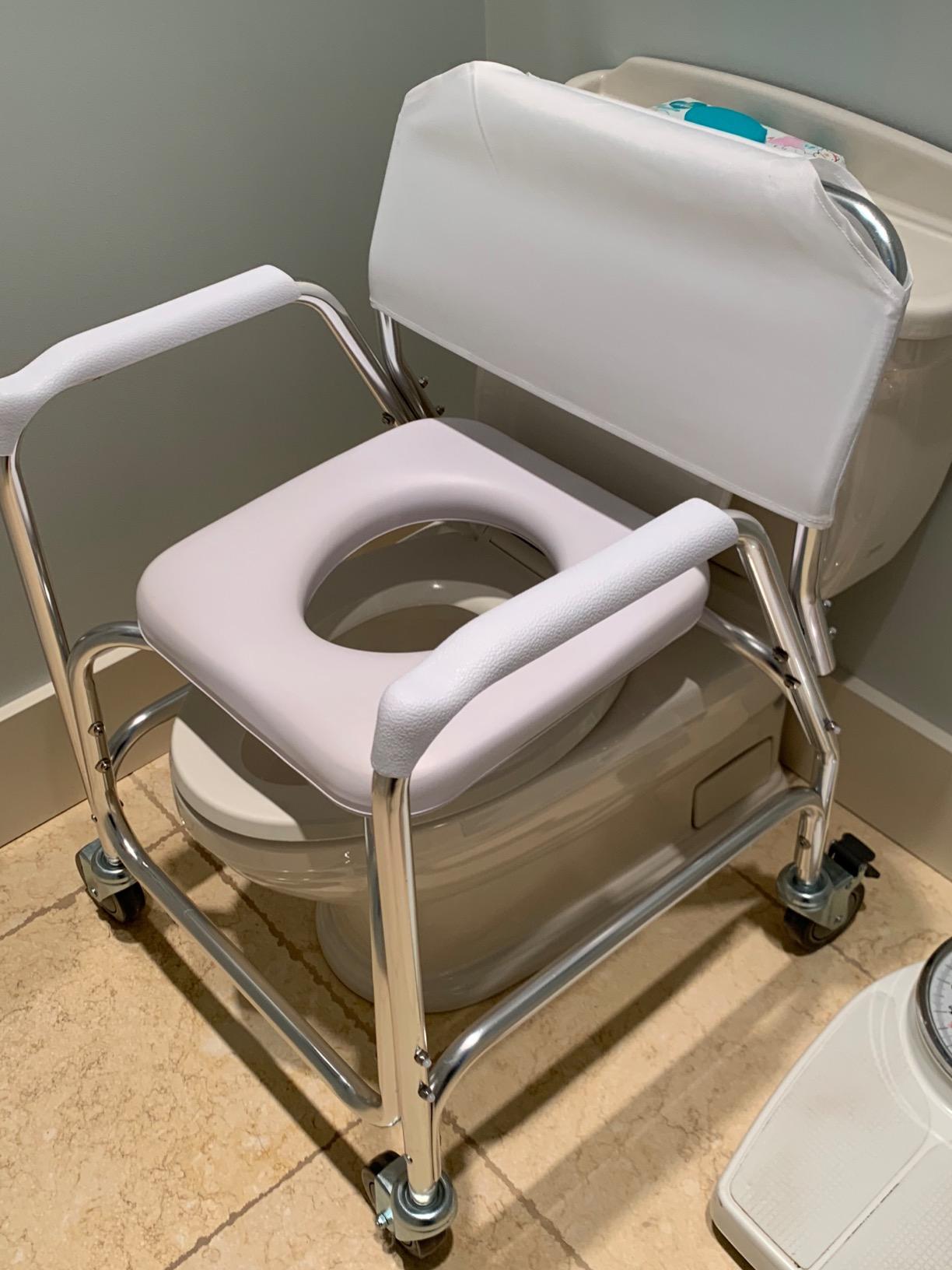
Wheel locks and the rear-only braking design
This chair brakes from the rear only, and that is the single thing to understand before you commit. In a dry bedroom over a standard toilet, rear locks are plenty. In a wet shower with a user who has limited core control, you are relying on two contact points against a soapy floor. Some caregivers report adding wheel chocks as a supplement, and we think that is a sensible habit on this model specifically.
The 4 inch tires roll quietly and handle carpet and tile without drama. We found them slow over a shower curb lip, which is where larger rear wheels would help, but fine on flush-entry roll-in floors.
Weight capacity and who this chair really suits
The listed capacity is 250 lb, the second lowest in this group. That is fine for a small adult who needs supervision rather than assistance, but it is not a chair for a bariatric user or for a caregiver-assisted transfer where a slight bounce at sit-down could exceed the rating. If the person is over 250 lb, move to the VEVOR or Hybodies models further down.
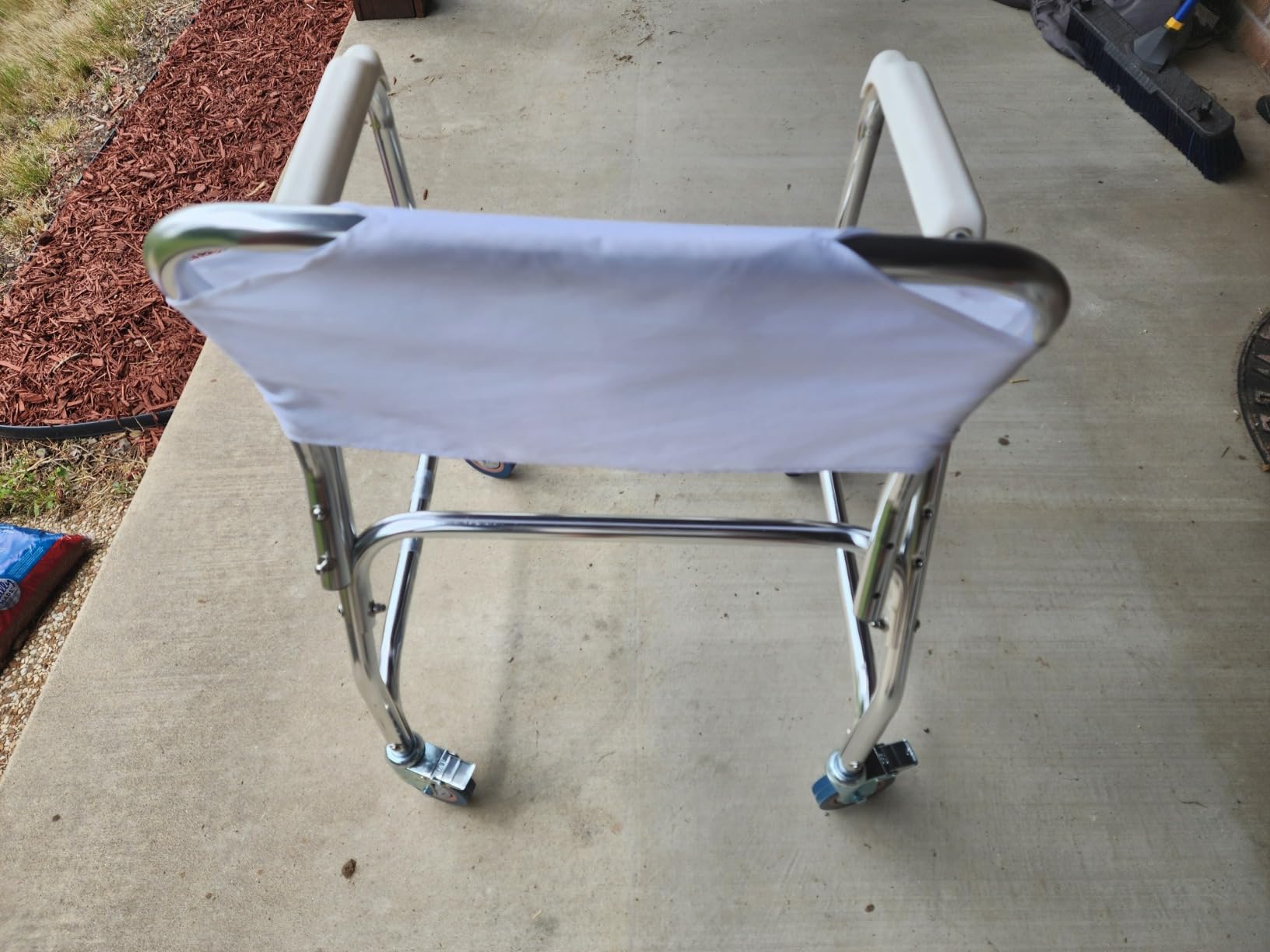
Frame weight and daily repositioning
At 11 lb, this is the second-lightest chair we tested, and that number shows up in the caregiving routine. A caregiver working alone can lift and reposition it without bracing a knee against the doorframe. The aluminum frame is rust-proof by material rather than by coating, so it survives a wet room without developing the surface corrosion that shows up on PVC joints after a year.
Where it falls short
Rigid transport-style push handles with no attendant brakes limit control on any slope, including the ramps families sometimes install for bathroom access. The armrests are fixed rather than drop-down or flip-up, which rules out the lateral transfer method. One reviewer on the Spinal Cord Injury subreddit noted that value-tier shower chairs with a sturdy back, wide seat, and secure tub fit work well for lower-mobility users, and this is exactly that category.
2. VEVOR 350 lb Shower Commode Wheelchair – Highest Capacity With Arms That Move Out of the Way
VEVOR Shower Commode Wheelchair 350 LBS Capacity Bedside Commode Chair
350 lb capacity on 1.3 mm rust-proof aluminum
Tool-free assembly
Flip-up armrests and footrests
3-level height adjustment 19.3 to 22.4 in
+ Pros
- Highest weight capacity in this group
- Tool-free assembly with most units nearly complete
- Five inch medical PU wheels roll quietly over thresholds
- Flip-up armrests clear the way for lateral transfers
- Cons
- Rigid clip-on plastic seat has cracked for one reviewer
- Foot-operated brakes are stiff and cannot be hand-operated
- Bucket tray sits high and can contact the user
If the person weighs more than 300 lb, this is where we would start. The 350 lb rating sits above every other chair in this roundup, and it is paired with the frame construction that matters at that weight: 1.3 mm aluminum wall thickness with reinforced C-clamps. Reviewers consistently single out the welded frame as the reason this chair holds together under real caregiving loads.
The flip-up armrests are the second reason. A caregiver performing a lateral pivot from a wheelchair needs the arm to move out of the way, and this is the least expensive chair here that does it. The flip-up footrests solve the same problem at the other end of the body.
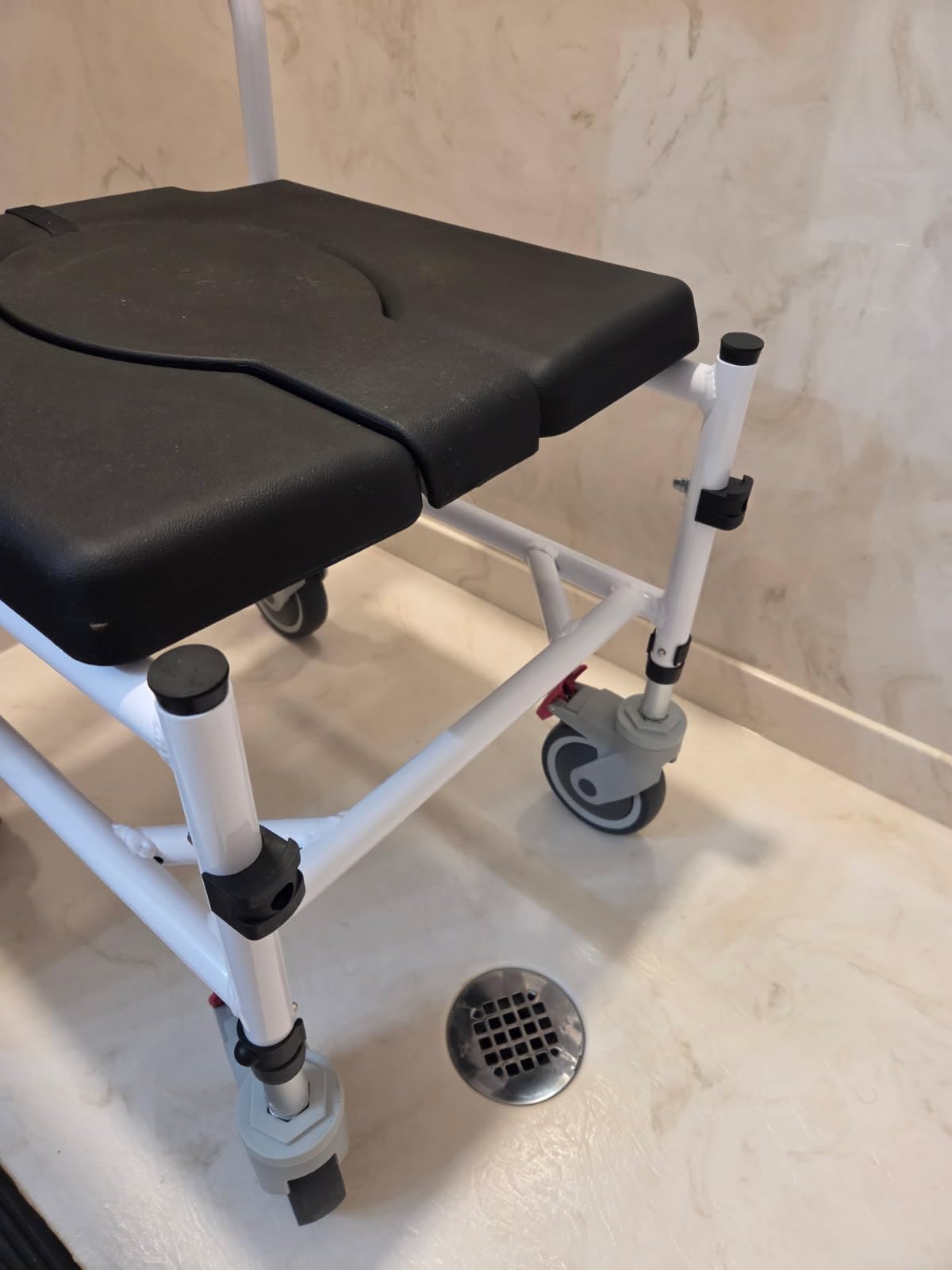
Height adjustment range and what it means for transfers
Three tool-free height settings cover 19.3 to 22.4 inches. That is a narrower band than you would get from a bolt-adjust leg, but the key advantage for a caregiver is speed: no tools, no pinch fingers, and a setting change between two users of different sizes takes seconds. Seat height is the transfer variable that most affects how much force a sit-to-stand requires.
Wheel performance over thresholds
The 5 inch medical PU wheels rotate 360 degrees and roll quietly and smoothly over thresholds and through narrow doorways, which is better threshold behavior than the DMI and the smaller casters on most competitors in this group. They are foot-braked, meaning the caregiver presses with a foot rather than a hand, which matters because your hands are often full of the person you are moving.
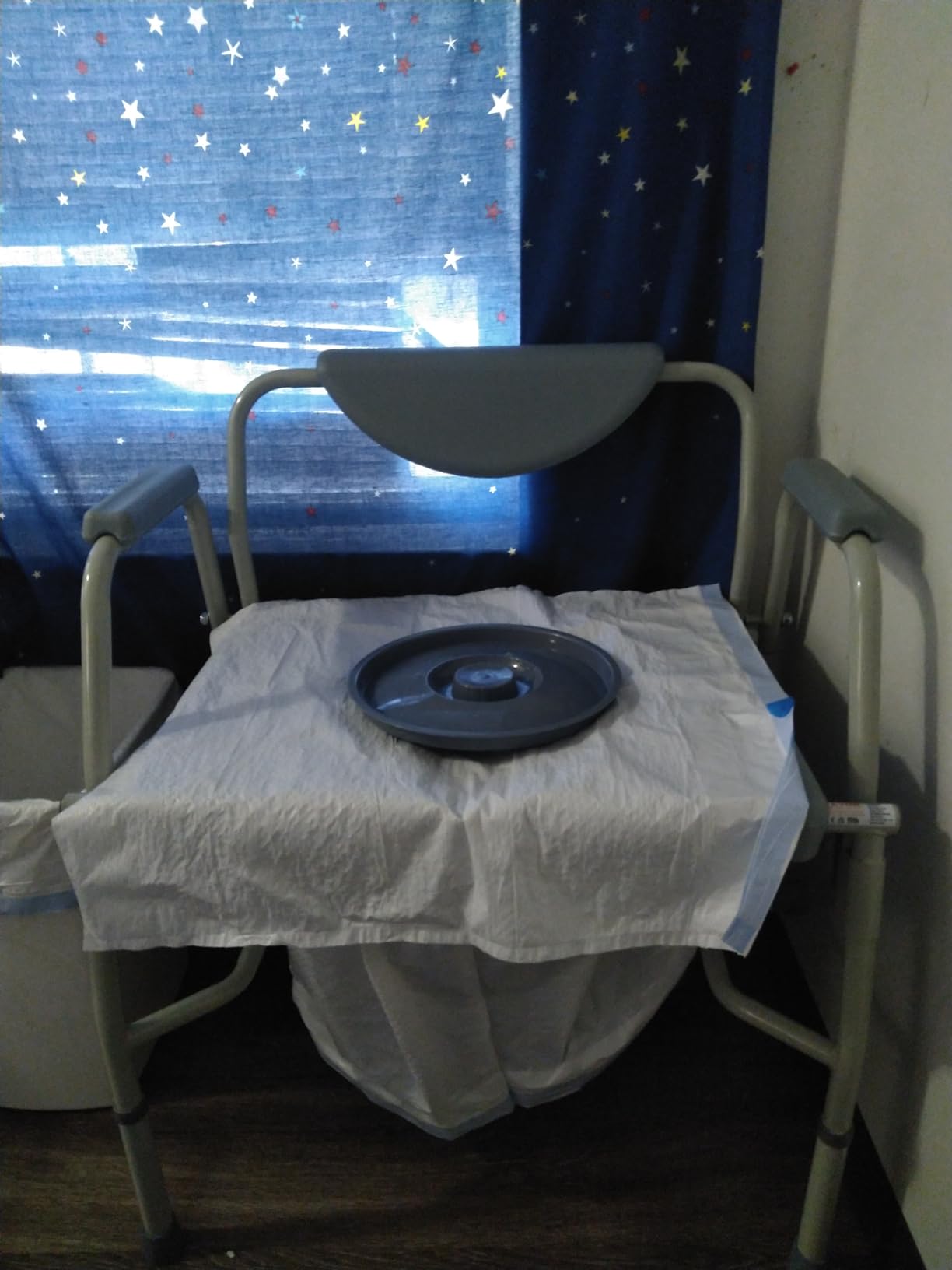
Seat material is the weak point
The seat is rigid clip-on plastic, and at least one reviewer reported it cracking after several months under a 154 lb user with no replacement seat available from the manufacturer. For a person with limited trunk control who will spend long periods seated on a hard surface, padding or a fitted cushion is worth adding from day one rather than waiting for a failure.
Brake ergonomics and assembly notes
Reviewers note the foot brake levers are stiff to engage, cannot be hand-operated, and can scrape the user’s legs when swung back. Assembly is tool-free, but C-clip holes can be misaligned if you tighten fasteners too early, so build it once slowly before you need it in a hurry. The 5-liter lidded commode bucket rinses clean and controls odor.
3. HEALTHLINE Padded Shower Bedside Commode – Comfort for Long Seated Bathing
HEALTHLINE Shower Bedside Commode Chair Padded Seat With Wheels by Healthline, Medical Commode Toilet Rolling Shower Chair With Casters (4 Wheels Brakes), Commode Padded Backrest and Seat
Fully padded waterproof vinyl seat and backrest
Four wheels with locking brakes
20 lb aluminum frame
23 x 22 x 38 in
+ Pros
- Fully padded seat and back where most rivals are bare mesh or PVC
- All four wheels brake
- Large durable wheels roll over carpet and tile
- Removable lidded bucket
- Cons
- Center seat insert can sit loose and drop from the frame
- Assembly instructions and hardware are confusing
- One reviewer reported the seat collapsing under a near-200 lb user
This is the comfort answer. The seat and backrest are fully padded in waterproof vinyl rather than bare mesh, hard plastic, or a PVC sling, and for anyone who sits through a long shower with limited trunk flexion that padding is not a luxury. Caregivers consistently report it as noticeably more comfortable than the metal-frame alternatives at a similar price.
All four wheels brake, which puts it ahead of most competitors here. When every contact point can be locked, you can park the chair in a wet shower and stop worrying about a slow creep across the tile while you work with the person in it.
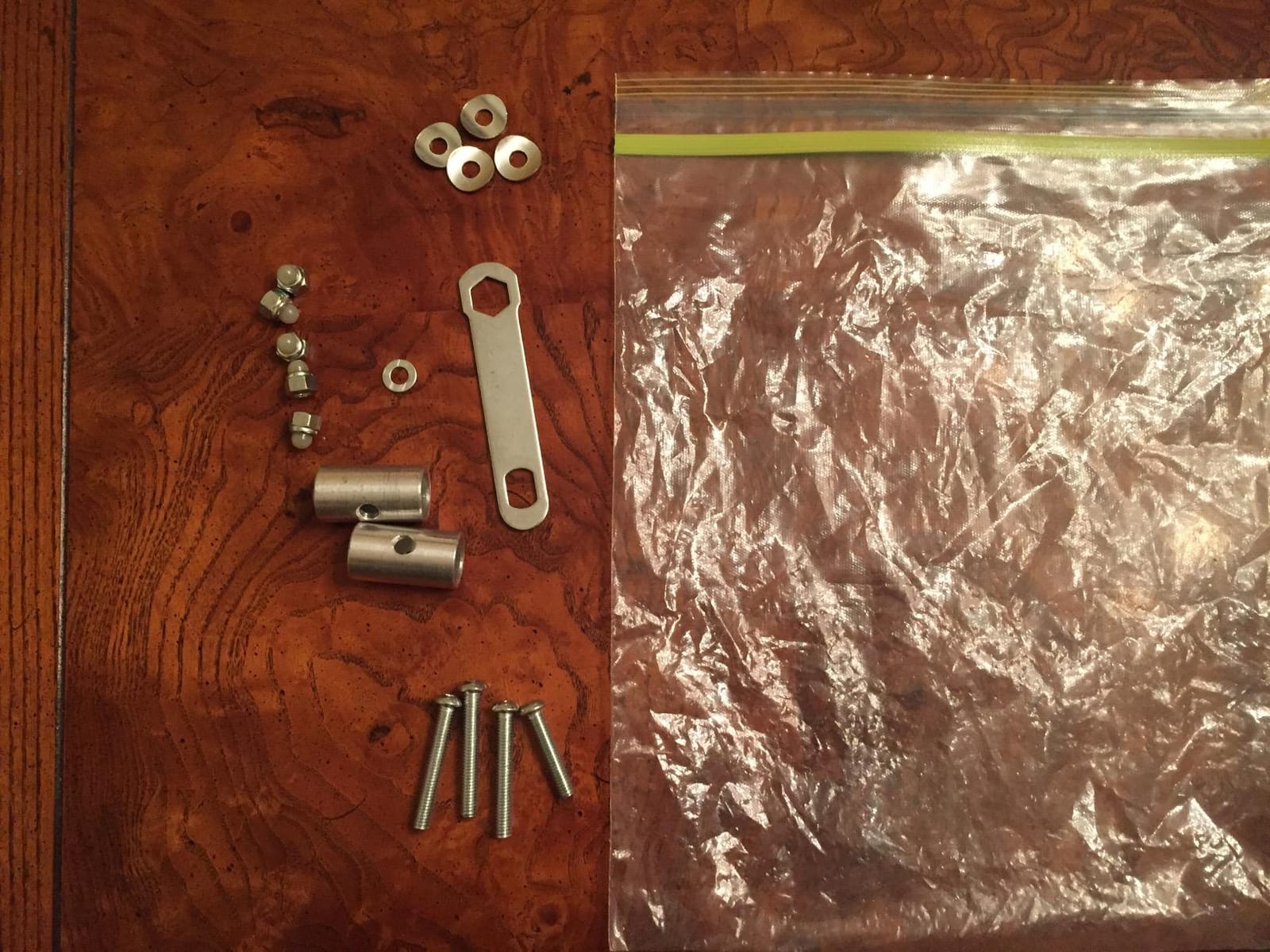
Seat insert fit is the thing to watch
Several reviewers had to tape or board over the center seat insert to stop it shifting or dropping out of the frame, and one reported the seat attachment point pulling out entirely. Check the insert sits fully seated in its brackets before every transfer, and if the frame is older than a year, check the attachment points. This is a solvable problem, but only if you know to look for it.
Wheels and floor surfaces
The large durable wheels roll easily over both carpet and bathroom tile, which makes this chair workable as a multi-room unit rather than a shower-only device. The aluminum frame is 20 lb, light enough for one caregiver to reposition. That is heavier than the DMI but well within what a single caregiver can manage across a level floor.

Brake feel and build instructions
The rear-wheel brake clamp is described as stiff and hard to engage, which is a common complaint on this category and worth checking during the first week of use. Assembly instructions and included hardware are confusing and parts are not labeled front or back, so budget an unhurried first build rather than assembling it at 9pm the night before you need it.
Who should skip it
If you need lateral transfers, the padded armrests here are fixed, so a wheelchair-to-chair pivot will be harder than it needs to be. Anyone approaching 300 lb should also look at the Hybodies or Fields models with higher or clearer ratings before committing, given the reported seat collapse under a near-200 lb user.
4. Giantex 4-in-1 Bedside Commode Shower Wheelchair – Small Footprint, Four Independent Brakes
Giantex 4-in-1 Bedside Commode Shower Wheelchair, Commode Chair for Toilet with Arms, 4 Lockable Wheels, Detachable Bucket, Height Adjustable & Flip-up Footrest, Padded Mobile Toilet Chair
300 lb capacity on anti-rust aluminum
4 position height adjustment 36.5 to 39.5 in
Four large locking wheels
Padded PVC seat and backrest
+ Pros
- Highest average rating in this group
- Compact footprint clears doorways and small showers
- Four independent locking brakes described as solid
- 90 degree rotating armrests and flip-away footrests
- Cons
- Commode opening too small for users around 200 lb
- Wheel locks do not hold on laminated flooring
- Bucket lip catches waste when emptying
This chair has the highest average rating of the ten, with 79 percent five-star reviews, and the reason shows up in the details caregivers care about. Four independent locking brakes on large universal wheels are described as exceptionally solid, and the medical mute wheels roll quietly enough for shared hallways in a care facility or a shared house with thin walls.
The footprint is the other standout. At 23 inches wide with a 34.5 inch depth, it passes easily through doorways and fits small showers where bulkier rolling chairs simply will not go.
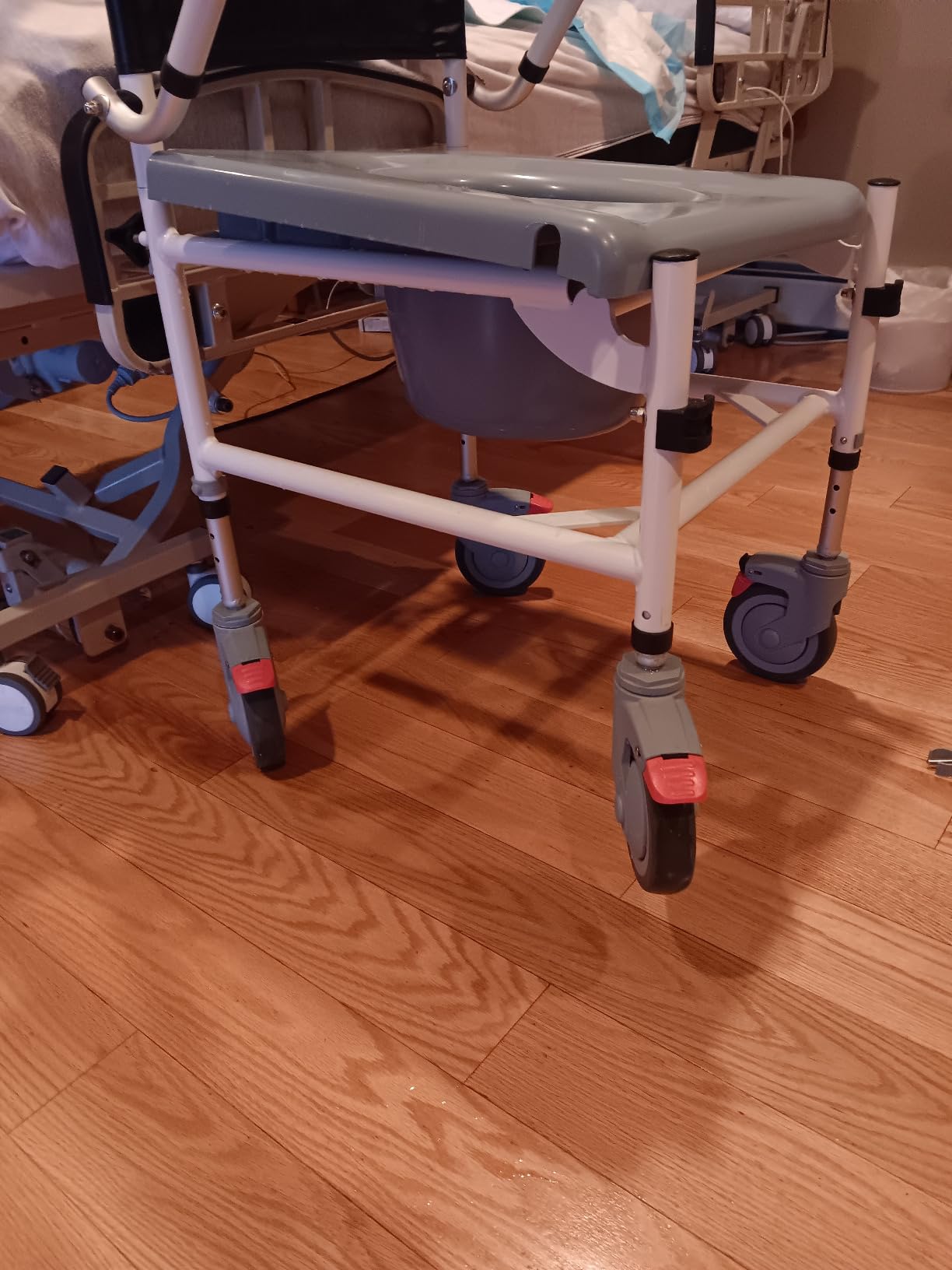
Height adjustment and total product height
Four position height adjustment covers 36.5 to 39.5 inches on the overall product height, with a separate three-position footrest adjustment. The important number for a caregiver is that the footrest moves independently, so you can support the feet of a user who cannot reach the lowest footrest setting, which prevents sliding forward out of the seat.
Commode opening size is the honest limitation
The commode opening is small, and reviewers report it is too small for users around 200 lb. If the person is heavier than that, either plan to use this chair in the shower only with a separate toileting method, or move to a chair with a larger opening. It is better suited to roughly 125 lb and below for comfortable toileting use.
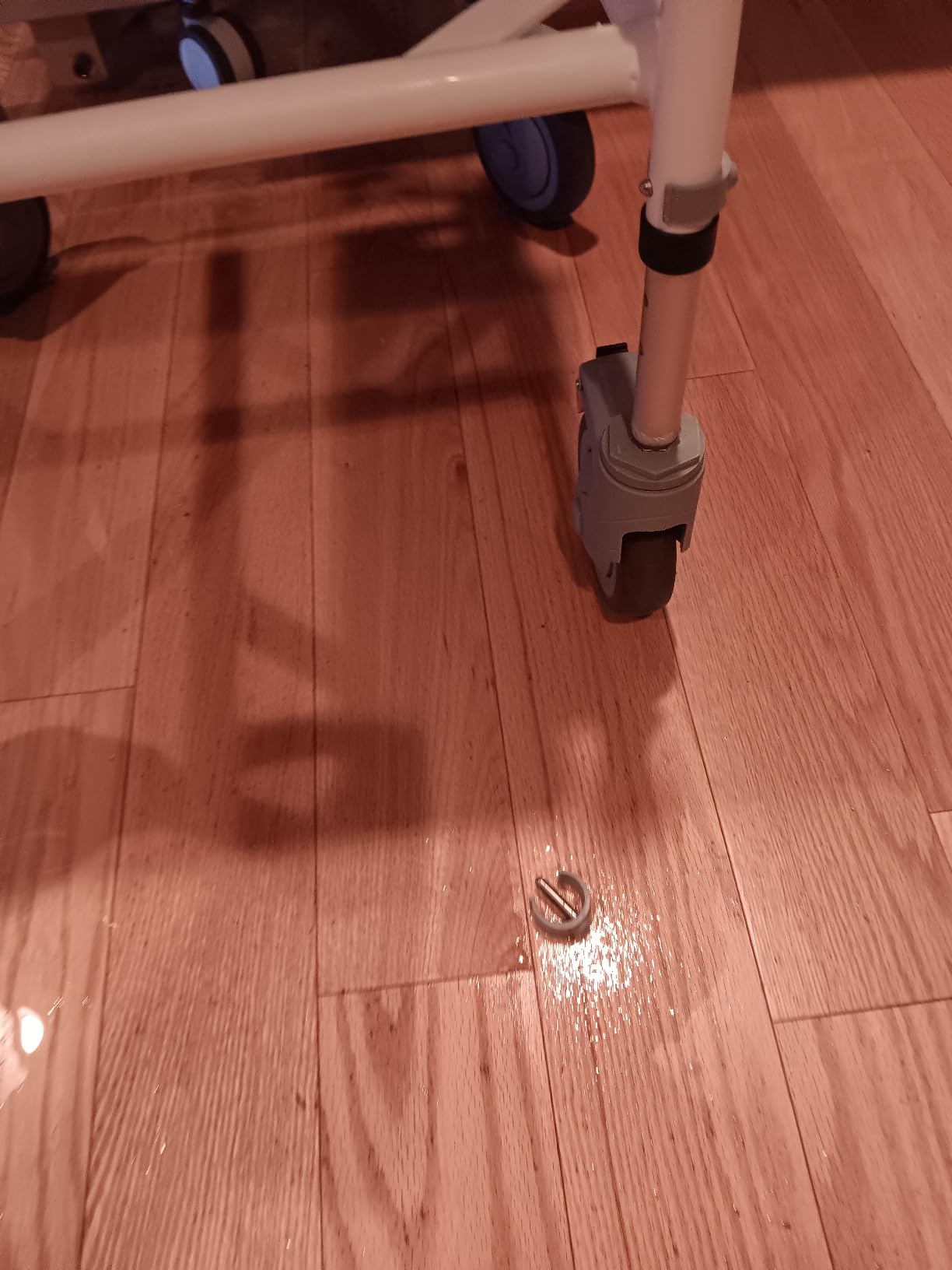
Wheel locks and flooring reality
These locks do not hold on laminated flooring and the chair creeps. Caregivers using this chair should test the locks on the actual floor surface in the actual bathroom rather than assuming, and check them again a few minutes into a shower. That is a flooring problem more than a chair problem, but it is a fall risk regardless.
Arm and footrest movement for transfers
The 90 degree rotating armrests and flip-away footrests make transfers easier, which is the category requirement. Some reviewers do describe the arms and footrests as flimsy and prone to breaking, so check them visually every few weeks if the arms get loaded during daily lateral transfers. The bucket lip also catches waste when emptying, which is an unpleasant cleanup task worth planning around.
5. Fields Outdoor Supplies RL-1 – Drop Arms and the Seat Belt Most Chairs Leave Out
Rolling Shower Chair with Wheels & Drop Arms, Mesh Seat, 4 Locking Casters, Seat Belt, Sliding Footrest, Commode Pail – Fits Over Toilet, 300 lb Capacity – Institutional Grade | RL-1
Drop-down arms and sliding footrest
Seat belt included
17 x 18 in seat, 22 in external width
20 in floor to seat height
300 lb capacity
+ Pros
- Drop-down arms enable safer lateral transfers
- Safety belt included which is rare in this category
- Tool-free assembly in under five minutes
- Fits over a standard toilet through most doorways
- Cons
- Commode pail cannot be removed while the user is seated
- Locking casters do not fully stop movement
- Sliding footrest does not reach the floor
The RL-1 solves the problem caregivers complain about most: fixed armrests. Both arms drop down and out of the way, so a caregiver can perform a lateral transfer from a bed, wheelchair, or toilet without the arm blocking the pivot. An ALS Forums member described the regret plainly, noting that armrests which did not move up and down made transferring much more difficult than it needed to be as abilities declined, and that a chair with removable or movable armrests should have been the choice.
A seat belt ships in the box. It is the only included belt we found in this roundup, and for anyone with poor trunk control sitting on a wet surface, a belt is the difference between a secure seated position and a slow slide out of the chair.
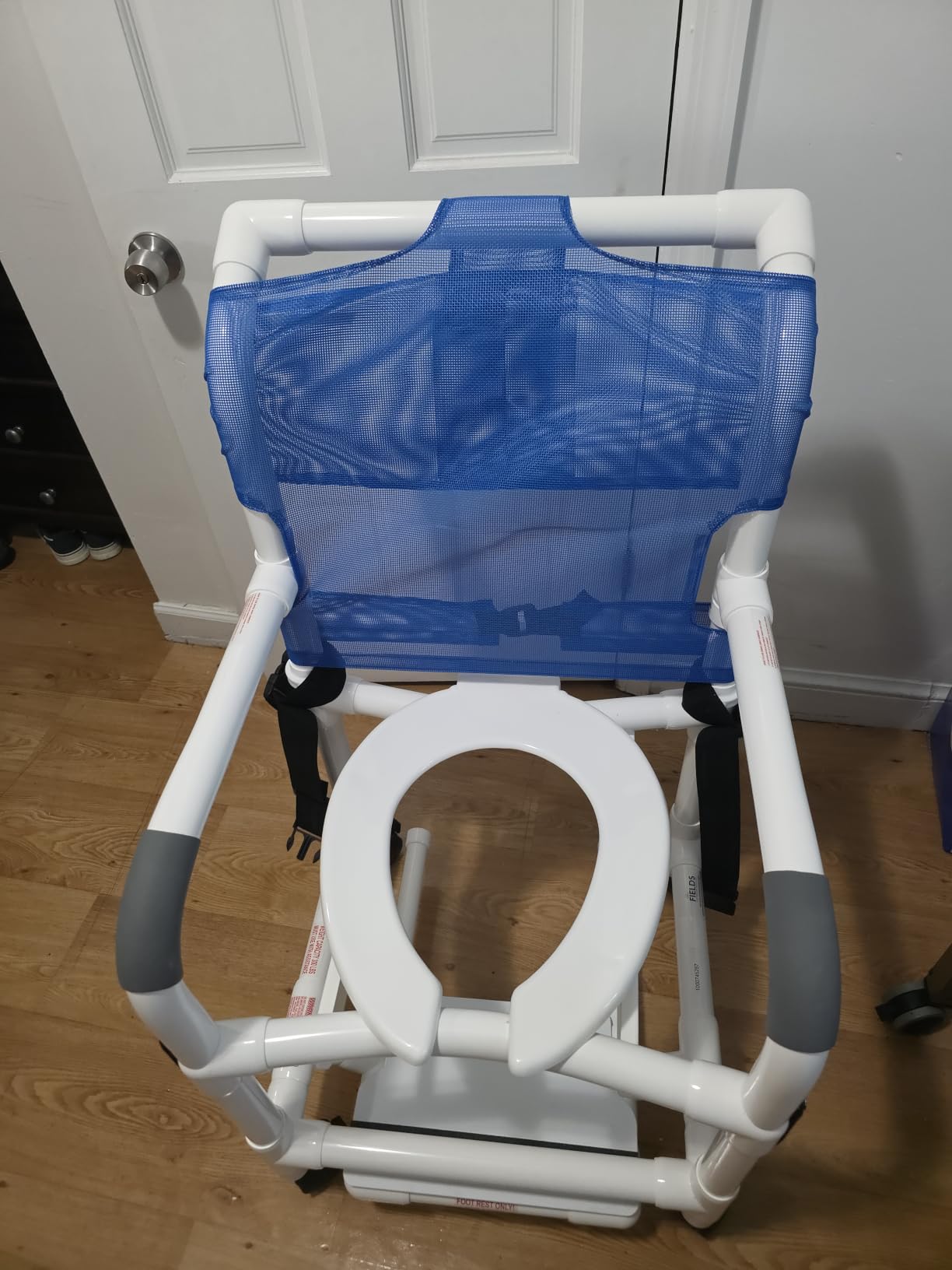
Dimensions and doorway clearance
The external width is 22 inches with a 17 by 18 inch seat and a 20 inch floor-to-seat height, so it passes through most doorways and fits over a standard toilet. That 20 inch seat height is on the lower side of the group, which means a user with limited push-up strength in the legs may need more effort to stand from it.
Assembly and the PVC frame question
Tool-free snap-together assembly in under five minutes is genuinely useful when you are setting up a care room in a hurry. The medical grade rust-resistant PVC frame and mesh seat dry out quickly between uses, which matters in a wet room where a padded seat would hold water. Reviewers do raise doubts about how securely the PVC joints lock, and note the frame can feel dependent on occupant weight to stay rigid and rattle when empty.
The commode pail problem
The pail cannot be removed while the user is seated, so if the chair goes straight from toileting to showering it can spill. Plan a pause between, or remove the pail before the person sits for the toileting portion. Locking casters also do not fully stop the chair from moving, and some caregivers add wheel chocks. No urine guard is included.
6. Hybodies 330 lb Drop-Arm Bedside Commode – Built Around the Anti-Tip Footrest
Bedside Commode Wheelchair with Drop Arms & Lockable Casters, Waterproof Aluminum Shower Chair, Anti-Tilt Foldable Footrest, Sponge Padded Seat, 330lbs Weight Capacity, 3 in 1 Bedside Commode Chair
330 lb capacity on waterproof aluminum
Drop-down armrests
Anti-tilt non-ground-contact footrest
Four silent 360 degree swivel wheels each braked
+ Pros
- 330 lb capacity among the highest here
- Anti-tilt footrest that never touches the ground
- All four swivel wheels brake independently
- Leak-proof lidded bucket with dual access
- Cons
- Bulky listed dimensions may not fit a compact stall
- No seat-height adjustment described
- Fewer reviews than the top-rated models
The Hybodies design is built around one idea: stop the person sliding forward. The foldable footrest is anti-tilt and deliberately does not touch the ground, which means when the user leans forward or shifts during a transfer the chair cannot pivot over its own front casters. For anyone with weak trunk control who has slid forward in a shower chair, that is a meaningful safeguard.
The drop-down armrests clear the way for lateral transfers, and the four silent 360 degree swivel wheels each carry their own brake, so the chair can be locked in all four directions rather than relying on rear-only locks.
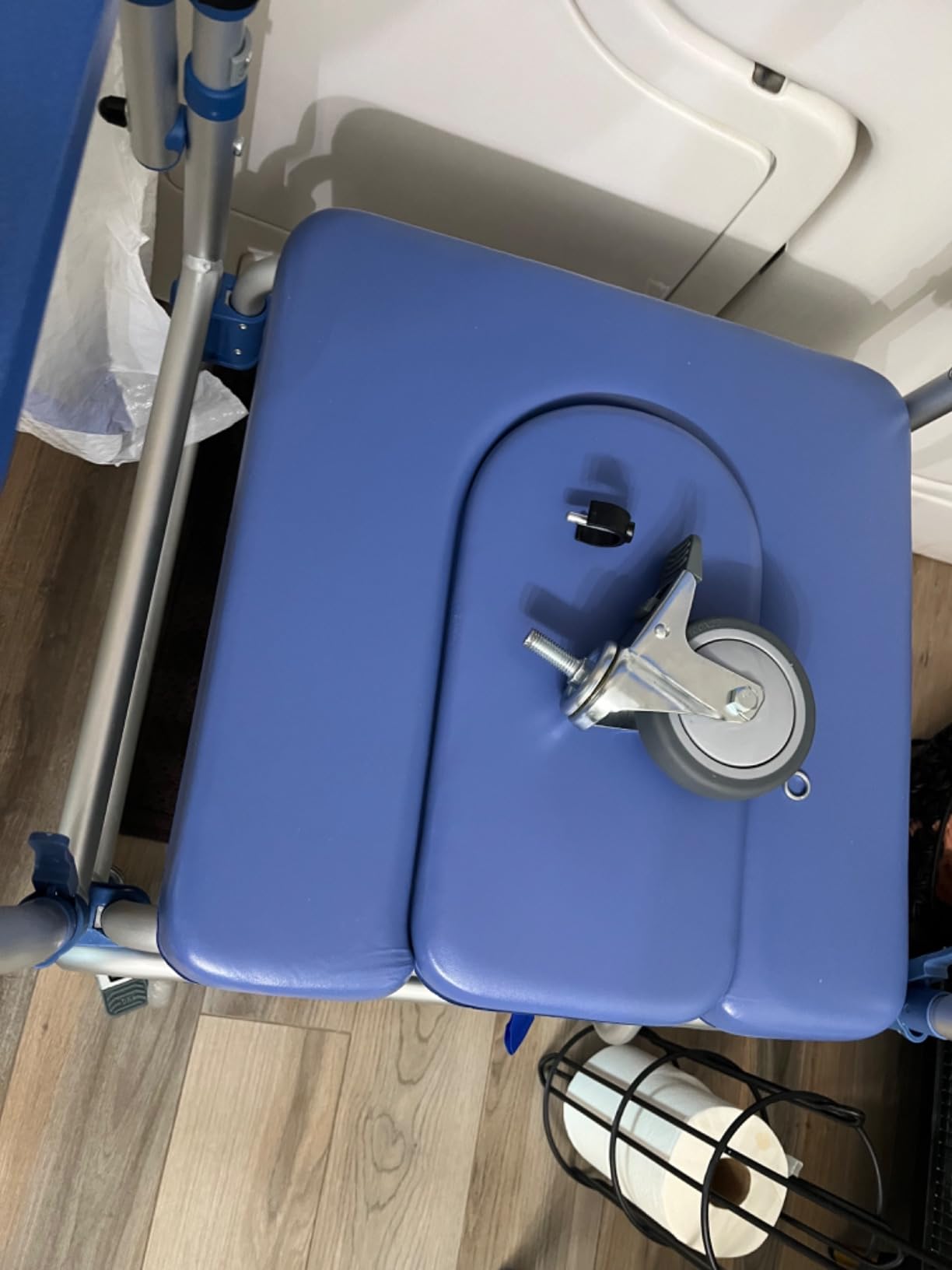
Capacity and the leakage-free bucket
The 330 lb rating on a corrosion-resistant waterproof aluminum frame puts it near the top of this group. The waste bucket measures 5.9 by 13.0 by 11.4 inches, is leak-proof with a lid, and can be pulled out from the back or lifted from the top. Dual access matters when the person cannot stand to reach a rear handle.
Footprint is the trade-off
The listed dimensions are 39.17 by 30.71 by 23.23 inches, which is the bulkiest footprint here. That measurement will not fit a compact shower stall, and we would measure the actual enclosure before ordering rather than trusting that it will work out.
Seat height and fit
No seat-height adjustment is described, so fit varies by user and you cannot fine-tune it later. The widened waterproof sponge seat has a large U-shaped opening for cleaning and a 30 degree ergonomic arc backrest with high-density sponge, plus a raised sponge-padded push handle that is easier on the caregiver’s grip. There is less long-term feedback on this listing than on the higher-volume models.
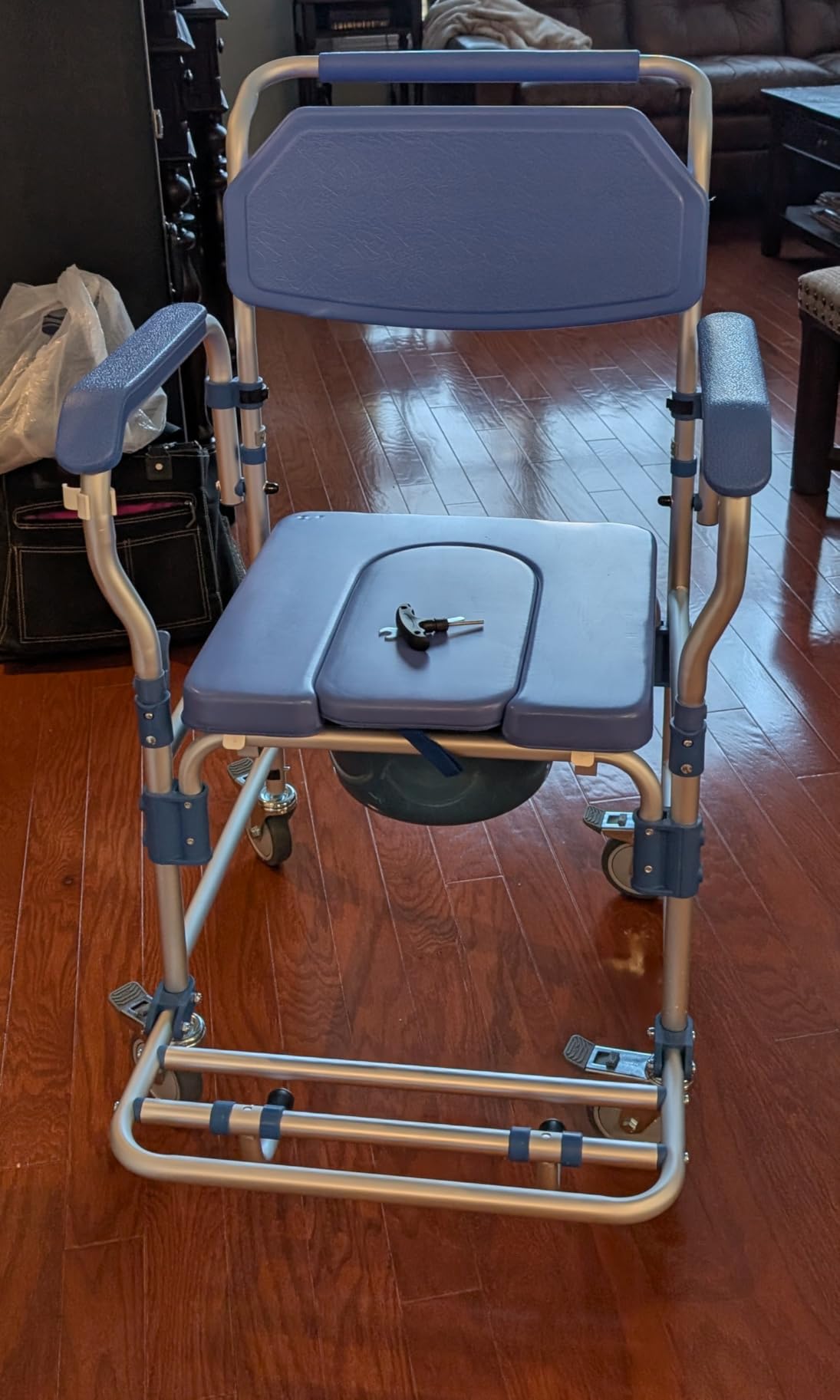
Who should pick it
A caregiver working alone with a user who leans forward, slides, or has unpredictable trunk control. The combination of four braked wheels, drop-down arms, and a footrest that cannot become a pivot point is the most defensible safety profile in this roundup.
7. Giantex 3-in-1 Lightweight Shower Commode – Moving One Chair Between Bedrooms and Bathrooms
Giantex 3 in 1 Lightweight Shower Commode, Transport Bedside Commode with Wheels, Adjustable Height and Pedal, Shower Wheelchair for Elder, Disabled People (Black)
Lightweight aluminum frame at 18.1 lb
Height adjustable 38 to 42 in
Four universal wheels with brakes
Waterproof sponge cushion
+ Pros
- Light frame that one caregiver can move between rooms
- Cuts the number of transfers a day by combining commode shower and transport
- Tool-free assembly with illustrated manual
- Brakes on all four wheels
- Cons
- Lowest weight capacity here at 220 lb
- Straight upright backrest is uncomfortable with limited trunk flexion
- Footrest sits close to the seat and has been reported painful
- Small seat is snug for average adults
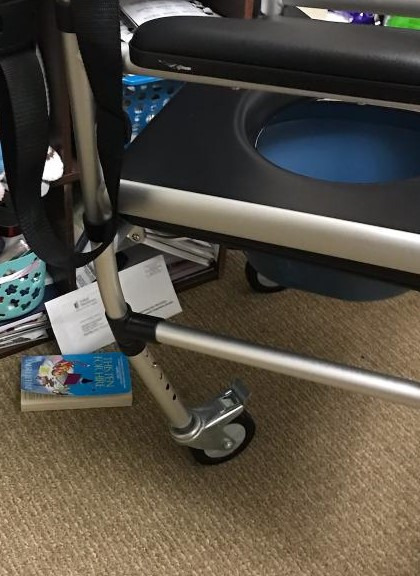
This is the chair for a household where the bathroom is not where the person lives. It is a 3-in-1 commode, shower chair, and transport chair in one frame, and at 18.1 lb it is light enough that one caregiver can move it from the bedroom to the bathroom and back rather than wheeling it twice in different pieces of equipment.
The four-position height adjustment across 38 to 42 inches covers a real range of user heights, and the folding foot pedal makes entry and exit easier for a user with limited hip flexion.
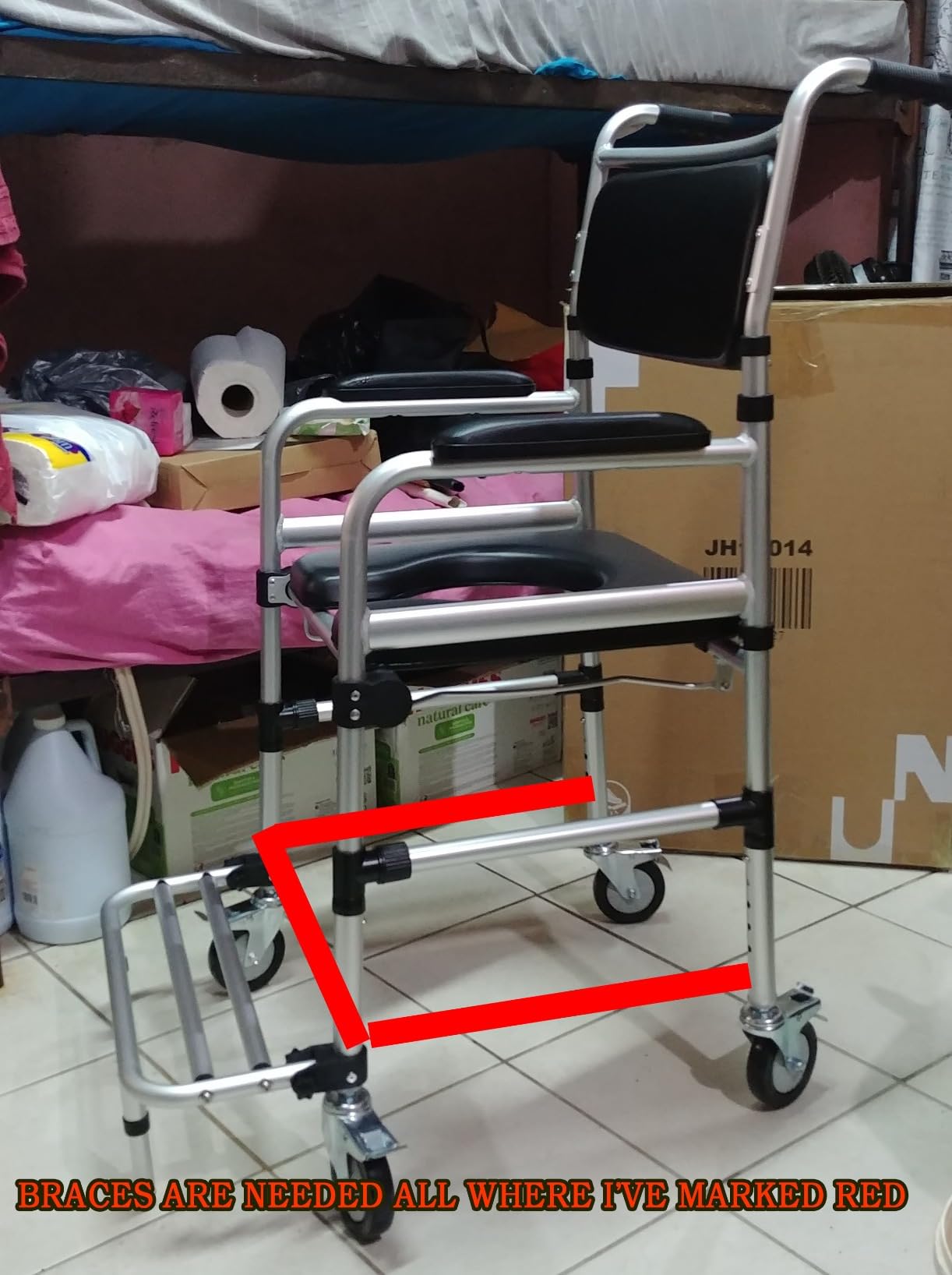
Backrest posture is the main comfort limitation
The backrest is rigid and upright. A user with limited trunk flexion, MS fatigue, or paraplegia may find this position painful over a long shower, and one paraplegic reviewer described the frame as shaky, under-braced, and unstable with legs that may bend. We would not choose this chair for anyone who cannot hold their own trunk against the backrest.
Footrest proximity and leg spasm
The footrest sits too close to the seat and has been reported as painful, triggering leg spasms in at least one case. Spasm-inducing footrests are a genuine problem in neurological conditions, and this is worth testing before committing. The seat itself is also small and reported as too snug for average adults, so check the fit with the person seated before the first real shower.
Capacity and surfaces
The 220 lb capacity is the lowest in this roundup, which rules it out for most caregiver-assisted transfers where a slight bounce adds load. Wheels do not roll well on area rugs, so if there is a rug between the bed and the bathroom, that is a friction point worth knowing about. One reviewer reported the seat breaking after two uses, though customer service resolved a broken seat quickly for another buyer.
Where it earns its place
A home where the person is largely independent, low-mobility, and needs one chair to cover the whole day. Our team would not lean on it for a heavy, fully assisted transfer, but as a multi-room 3-in-1 it does something the heavier models do not.
8. Medline Aluminum Padded Shower Commode – The Widest Height Range for Taller Users
Medline Aluminum Padded Shower Chair Commode with 4 Locking Casters, 300 lbs. Capacity — For Restroom, Bathroom & Wheelchair Transfer to Toilet, 1 Ct.
20.5 in minimum to 29 in maximum height
300 lb aluminum frame
Padded seat and armrests
Four locking caster wheels
Quick-drying mesh
+ Pros
- Widest height adjustment range in this group
- Padded seat and armrests more comfortable than mesh competitors
- All four wheels lock and the tread resists slipping on wet floors
- Open-front seat allows perineal washing
- Cons
- No true seat height adjustment and the fixed height suits taller users best
- Larger frame is awkward for short users or children
- Bottom commode pan does not slide out easily
The Medline separates itself on numbers: a listed minimum height of 20.5 inches and maximum of 29 inches, which is the widest range here and the reason taller adults can get their feet flat. Short users and children will find the larger frame awkward without an adult-sized cushion, and one reviewer reported the listed measurements as misleading, so verify against a tape measure rather than the listing alone.
The tread on the locking casters is described as slightly rubbery and resistant to slipping on wet floors, which matters more than it sounds in a shower where the caregiver is not the one standing on the wet surface.
Padded seat and mesh drying
Padded seat and armrests give noticeably more comfort than bare mesh or PVC competitors, and the mesh upholstery dries quickly between uses, which keeps it practical in a wet room. It is a genuinely comfortable option that does not hold water like a fully vinyl pad. The open-front seat design allows perineal washing, a practical detail for long-duration seated bathing and skin care.
Tool-free assembly and the commode pan
No tools are required; the back, seat, and legs snap together and plastic clamps hold the padded seat and commode in place. It is stable and sturdy once built. The main functional annoyance is that the bottom commode pan does not slide out easily, and the wheel locks still allow a small amount of creep.
Who this suits
Caregivers of children and of tall adults recovering from non-weight-bearing surgery both reported this chair as far easier to get in and out of than a shower bench. At 300 lb capacity and a 23.9 inch seat width, it also accommodates larger users better than most of the group.
9. Vive Commode Shower Chair with Wheels – Built for Narrow Walk-In Showers
Vive Commode Shower Chair with Wheels- 3-in-1 Bathroom & Bedside Wheelchair
20.5 in wide frame, 22 in deep
17 x 17 in seat
19 lb rust-resistant aluminum
275 lb capacity
Height-adjustable backrest
+ Pros
- Compact 20.5 in width fits many walk-in showers and some standard stalls
- Light 19 lb frame one caregiver can position
- Height-adjustable backrest and padded armrests for longer showers
- Locking 4 inch casters stabilize during transfers
- Cons
- 275 lb capacity is below the 300 to 350 lb offered by several rivals
- 17.5 in width between handles suits average-sized users
- Newer listing with less long-term feedback
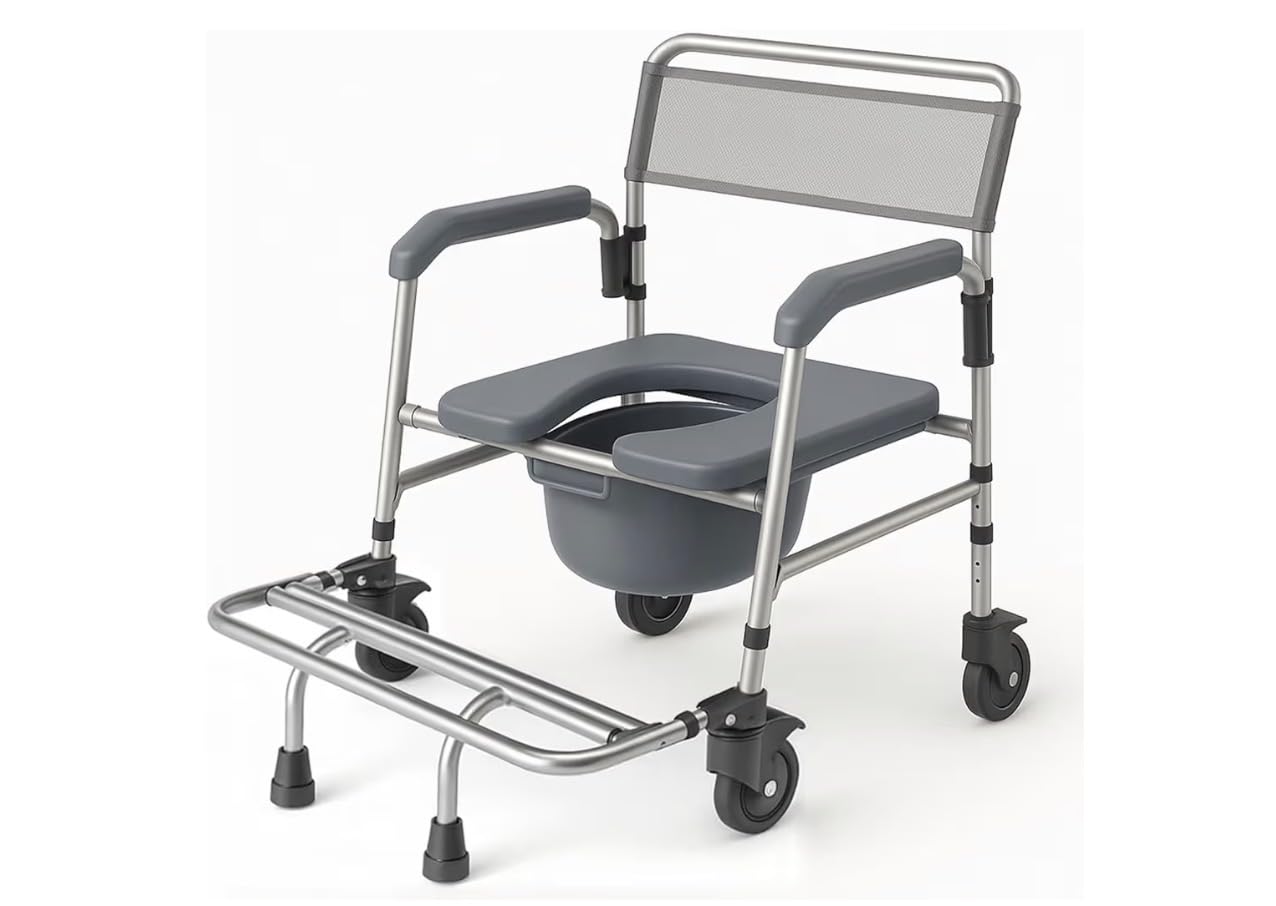
Small bathrooms decide this roundup more often than any other factor, and the Vive is the narrowest chair we tested. At 20.5 inches wide and 22 inches deep it fits many walk-in showers and some standard stalls where a 22 inch frame simply will not go. The 17 by 17 inch seat is still a usable adult seat inside that footprint.
The height-adjustable backrest and breathable mesh back are genuinely useful for a long shower, and padded armrests give a caregiver a better push-down point for sit-to-stand assist than bare steel arms.
Cleaning routine and surfaces
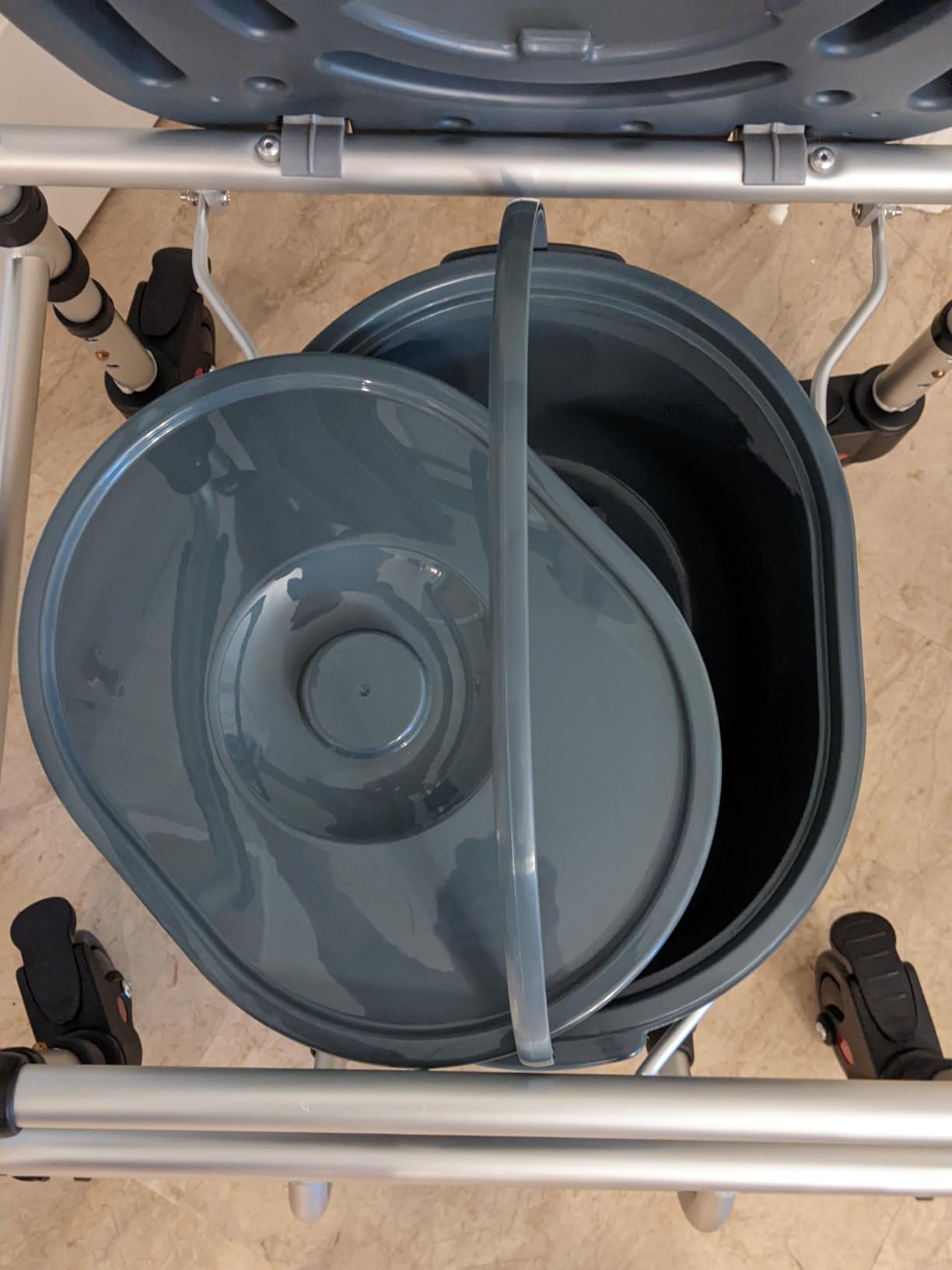
The non-porous, water-friendly surfaces wipe down quickly, and the removable commode bucket simplifies sanitizing. In a household where the chair is shared between a toileting routine and a bathing routine, wipe-down speed is a real caregiver time-saver, and non-porous surfaces matter for infection control.
Sizing limits that buyers overlook
The 17.5 inch width between the handles suits average-sized users rather than larger adults, and the 275 lb capacity is below the 300 to 350 lb that several rivals in this same roundup offer. If the person is heavier than 275 lb or broader than average, the narrowness that makes this chair useful also works against you. We would not put a bariatric user in this chair.
Weight and maneuverability
At 19 lb the rust-resistant aluminum frame is light enough that one caregiver can position it, and the locking 4 inch casters stabilize the chair during transfers. This is a newer listing with 53 reviews, so there is less long-term feedback than the established models, which is worth factoring into any decision on a health-adjacent purchase.
The honest summary
This is a fit-first chair rather than a capacity-first chair. It wins in a small bathroom and loses in a large user. Measure the enclosure width before anything else and you will know within a minute whether it belongs in your house.
10. Fields Outdoor Supplies DL-1 – Padded Institutional Build with Replacement Parts
Institutional Grade Rolling Shower Commode Chair with Wheels & Drop Arms – Padded Seat, Locking Casters, Sliding Footrest, Seat Belt – Fits Over Toilet – 300 lb Capacity – DL-1
Soft padded seat with mesh back
22 in floor-to-seat height
22 in external width
300 lb capacity
Seat belt and four heavy-duty locking casters
+ Pros
- Soft padded seat unlike the mesh on the sibling model
- 22 in floor-to-seat height makes wheelchair transfers easier
- Drop arms and sliding footrest for lateral transfers
- Replacement parts available for long-term use
- Cons
- Heaviest unit here at 35.5 lb for one caregiver to reposition
- Highest cost in this group
- Padded seat dries more slowly than mesh in a wet room
The DL-1 is the padded sibling of the RL-1, and the one change that matters most is the 22 inch floor-to-seat height. Buyers and care facilities repeatedly cite that height as the reason transfers from a wheelchair are easier than on the lower models, because the seat sits closer to wheelchair seat height and the person has less to lift through.
It also rolls over a standard 17 inch tall toilet and fits a 22 inch doorway, and it carries the same drop arms, sliding footrest, and seat belt that made the RL-1 a caregiver favorite.
Replacement parts and long-term ownership
Replacement parts are available, which is the deciding factor for facilities and for families planning a multi-year care horizon. A chair that can be repaired beats a chair that has to be replaced when a caster or a clamp fails, and for progressive conditions that difference compounds over time.
Weight is the real caregiving cost
At 35.5 lb this is the heaviest chair here, and a single caregiver repositioning it across a wet floor is a genuinely different task from repositioning an 11 lb frame. It is a two-person or cart-assisted chair rather than a solo-lift chair. Care facilities rate it highly for stability and comfort over the toilet, but a home caregiver should weigh that honestly before choosing it.
Padding versus drying
The padded seat is less quick-drying than a mesh or PVC sling in a wet environment. That is the trade-off: comfort for long seated bathing against moisture retention. For a long-duration seated bathing routine where skin integrity matters, padding usually wins. For a chair used briefly and moved out between uses, drying matters more.
How to Choose a Shower Commode Chair for Caregiver-Assisted Use
Buying a shower chair is a bathroom-geometry problem and a transfer-method problem before it is a product problem. Get those two right and the model almost picks itself.
Armrest type is the decision that governs every transfer
Armrest type is the single most-cited defect in the caregiver forums we read, and it is the detail most roundups skip. Fixed arms are the worst case for transfers. Drop-down or drop-arm arms swing or lower out of the way and enable a lateral pivot from a wheelchair or bed. Flip-up arms do the same job with less swing weight. Removable arms open the side completely, which is what an Hoyer sling or a two-person transfer actually needs.
The failure mode is progressive. A fixed-arm chair is fine when the person can still stand with a light assist and becomes unworkable as abilities decline, and by then the money is spent. An ALS Forums member named that regret directly, describing armrests that did not move up and down making transfers much more difficult than they needed to be as abilities declined.
One caregiver on an amputee forum described the opposite priority, liking the security of a back to prevent falling backwards while acknowledging that no back makes for easier transitions. That is a real trade-off, not a defect: a supportive back is safer for poor trunk control, a removable or low back is easier to transfer onto. Decide which failure you can live with.
Weight capacity and seat width, matched to the person
Capacities in this group run from 220 lb to 350 lb. Set the limit with headroom above the person’s actual weight rather than at it, because a caregiver-assisted transfer briefly loads the chair with more than the seated weight when someone lowers into it. If the person is over 300 lb, the VEVOR at 350 lb is the only chair here rated for them.
Seat width is the number buyers skip and then regret. The Vive fits inside narrow walk-in showers precisely because it is 20.5 inches wide, and that same narrowness gives only 17.5 inches between the handles. A 18 by 17 inch seat, like the RL-1 and DL-1, is the practical target for an average or larger adult.
Rear wheel size and shower threshold clearance
Wheel size is the difference between a smooth entry and a tip event. Large wheelchair-style rear wheels make it safer when going over the lip of the shower, according to a caregiver whose chair had them, and this is why we flagged the DMI’s 4 inch tires and the Giantex’s large universal wheels as better threshold performers than the 3 inch casters on some lighter models.
Measure your shower lip before buying. If the curb is taller than roughly 3 inches and the rear wheels are small, the chair will catch, and catching in a wet shower is how people fall. If that is your situation, choose large rear wheels or a roll-in enclosure rather than negotiating the lip daily.
Frame material: aluminum versus PVC
Aluminum is rust-proof by material and lighter for a given strength, which is why eight of these ten frames are aluminum. PVC is rust-resistant rather than rust-proof, and snap-fit PVC joints depend on the occupant’s weight to feel rigid, which means an empty chair can rattle in the frame. For a metal frame that will live in a wet room for years, aluminum is the safer default.
Stainless steel appears rarely in this category and tends to double the weight. We would skip it for a home caregiver who has to reposition the chair alone.
Measure the bathroom before you order
Four measurements decide whether a chair works: the bathroom doorway width, the shower enclosure width and lip height, the toilet height and whether it is round or elongated, and the distance from the toilet to the shower for the transfer path. A commode chair that will not fit through the door or will not clear a bidet is useless regardless of its other specifications. One experienced forum member found a bidet in the bathroom meant the chair could not go over the toilet, and solved it by using the commode pan under the shower chair instead.
Pick the floor-to-seat height to match wheelchair seat height if the person transfers from a wheelchair. Every inch of mismatch adds load to the caregiver’s shoulders, which is where caregiver injury happens.
When a shower commode chair is the wrong answer
Three situations call for different equipment. If the person can bear weight and pivot with supervision, a transfer bench mounted across a tub is cheaper, safer, and gives more room to wash. If the bathroom is a fixed layout and the person needs support only while seated, a wall-mounted shower seat avoids the floor footprint entirely.
If the person cannot bear weight at all, an overhead ceiling lift with a showering sling is the better long-term tool. A senior ALS member recommended an overhead lift and showering sling over any commode chair for long-term use on comfort grounds, and for a progressive condition that advice holds up. Manual transfers are where caregiver backs and shoulders go, and a lift removes that load permanently.
Buying for the next 24 months, not today
Progressive conditions change the required chair. One long-time caregiver advised that you will eventually need a shower chair that tilts in space with a headrest and safety belts, and suggested an inexpensive commode in the meantime. None of the ten chairs here tilt in space, which is an honest limitation of this roundup.
The practical approach: buy a chair with drop-down or removable arms and a seat that accepts an added cushion, so the step up to a tilt-in-space chair or an overhead lift later is a change of equipment rather than a reinstall.
Safe transfer technique for the caregiver
Whatever chair you buy, the transfer is the high-risk moment. Lock all wheels before the person is moved, not after. Position the chair at the same height as the wheelchair or bed and as close as possible. Use a gait belt around the waist rather than pulling on arms or a lap belt. Have the person lean forward and count to three so the weight shifts forward and the feet come up. Move on the count, not before it.
For a lateral pivot, drop or flip the arms first, angle the chair slightly away from the wheelchair so the wheels do not tangle, and pivot through the feet rather than the heels. For anyone heavier than the caregiver can manage, use a second person or a lift. Please get an occupational or physical therapist to teach the transfer rather than learning it from a product page, which is the advice the caregiver community gives most consistently.
Cleaning and maintenance that prevents early failure
Wipe the seat, back, and armrests after every use with a non-abrasive cleaner and rinse, then dry the frame joints. Pooled water at PVC snap-fit joints is what produces surface corrosion later. Check wheel locks monthly by pushing the parked chair hard and confirming it does not creep, and check caster forks and clamp bolts for play. Keep caster threads clear of hair and soap film, which is the most common cause of a caster that stops rolling.
What Medicare Actually Covers for a Shower Commode Chair
This is the question that generates the most wrong answers online, so here is the accurate version. A commode chair sits on the Medicare durable medical equipment covered list. A shower chair does not. That distinction is not bureaucratic pedantry. It is the entire mechanism by which a rolling shower commode chair gets covered at all: the chair has to be supplied and coded as a commode, and it has to function as one, meaning it has to be able to be rolled over a toilet or used with a commode pan, not just parked in a shower.
Practically, that means a shower commode chair that does double duty as a rolling commode is the covered configuration, while a fixed shower-only seat is not. The caregiver forum member who first explained this to us put it simply: coverage requires the chair to work as a rolling commode and be billed as one.
Two caveats matter. Suppliers vary enormously in how they process these claims, and some will not bill insurance at all if the purchase was made outside their own process. And a chair that exceeds the bariatric capacity thresholds may require a different prescription and documentation. Talk to a durable medical equipment supplier or your insurer before ordering, and ask specifically how the chair will be coded rather than assuming.
Frequently Asked Questions
Does Medicare pay for a shower commode chair?
A commode chair is on the Medicare durable medical equipment covered list, while a shower chair alone is not. That is why rolling shower commode chairs are covered: the chair has to work as a commode, meaning it can roll over a toilet or use a commode pan, and it has to be supplied and coded as a commode. A shower-only seat with no toileting function is generally not covered. Suppliers differ in how they process claims, so confirm the coding with your DME supplier or insurer before ordering.
Which shower commode chair has the best weight capacity?
Among the ten chairs we tested, the VEVOR Shower Commode Wheelchair has the highest rated capacity at 350 lb, built on 1.3 mm rust-proof aluminum with reinforced C-clamps. The Hybodies 330 lb drop-arm model and the 300 lb chairs from Giantex and Medline follow behind. Choose capacity with headroom above the person’s actual weight, because a caregiver-assisted transfer briefly loads the chair with more than the seated weight.
Is a shower commode chair better than a transfer bench?
It depends on whether the person can bear weight. If they can stand and pivot with supervision, a transfer bench mounted across a tub gives more room to wash and takes up less floor space. If they cannot bear weight or stand at all, a rolling shower commode chair is the right tool, and for someone who cannot transfer manually at all, an overhead ceiling lift with a showering sling is better long-term than either option.
How do I transfer someone into a shower commode chair?
Lock all wheels first, then position the chair at the same height as the wheelchair or bed and as close as possible. Use a gait belt at the waist rather than pulling on armrests. For a lateral pivot, drop or flip the arms down, angle the chair so the wheels do not tangle, and have the person lean forward and stand on a count of three. For heavy or non-weight-bearing users, use a second person or a lift and ask an occupational or physical therapist to train you.
Should the armrests move up and down on a shower commode chair?
Yes, and it is the most important transfer feature on the chair. Fixed armrests block a lateral pivot from a wheelchair or bed, and caregivers repeatedly report regretting a fixed-arm chair as the person’s function declined. Drop-down or flip-up arms swing out of the way, and removable arms open the side completely for Hoyer sling and two-person transfers. We would not buy a fixed-arm chair for caregiver-assisted use.
Which Shower Commode Chair Fits Your Care Situation
If the person needs full caregiver assistance and weighs under 250 lb, the DMI Rolling Shower Chair is the one we recommend most often. It has the largest verified review base in the category, the 3-in-1 design removes two of the day’s transfers, and it is light enough for one caregiver to reposition. If they are over 300 lb, the VEVOR at 350 lb is the only chair here rated for them, and its flip-up arms are the transfer feature you should be looking for.
If the person spends long periods seated in the shower and comfort is the priority, the HEALTHLINE padded model or the Fields DL-1 put padding under the whole body. If the caregiver works alone and the user leans or slides, the Hybodies 330 lb chair has the most defensible safety profile with four braked wheels and a footrest that cannot become a pivot point. If the bathroom is small, measure the enclosure first and look at the Vive at 20.5 inches wide before anything else.
If the condition is progressive, plan the next step rather than only today. Buy removable or drop-down arms now, expect to move to a tilt-in-space chair with a headrest and belts later, and consider whether an overhead ceiling lift with a showering sling removes the manual transfer burden for good. That decision protects the caregiver as much as the person using the chair.
Whatever you choose, get an occupational or physical therapist to teach the transfer. The chair is the easy half of safe caregiving. Start with the four measurements, the transfer method, and the armrest type, then pick from the ten we tested in 2026.