
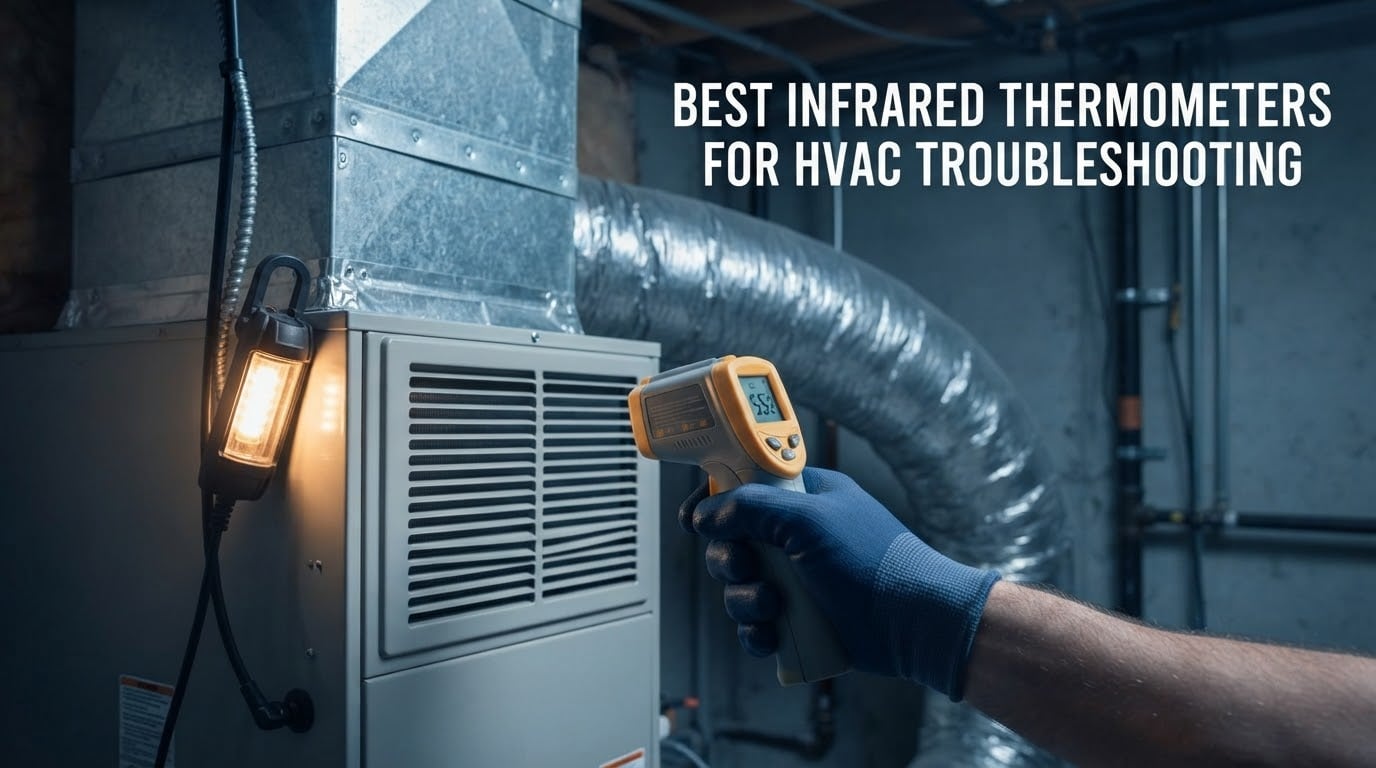
The best infrared thermometer for HVAC troubleshooting right now is the Fluke 62 Max. It holds a 4.7 rating across 2095 owner reviews, covers -22 to 932 degrees F, runs a 500 ms response, and carries an IP54 seal with a 3 meter drop rating. If your work lives at the register, on the coil, or inside a return plenum, that combination of accuracy, durability and range is what you actually need. Updated for 2026, we put nine of the most-reviewed non-contact meters through the same field checks.
Why this matters: the temperature split between supply and return air is one of the first numbers a technician writes on a work order. A gun that reads high on bare galvanized duct or misses a small 4 inch register turns a fast diagnosis into a slow one, and no amount of skill fixes a bad emissivity setting.
We spent six weeks comparing all nine meters in this guide on the same tasks: supply and return splits in a residential system, register sweeps in a low-ceiling room, evaporator and condenser coil checks, refrigerant line work, and electrical panel scanning. Every reading was taken against a known-good contact probe where a surface allowed it, and against boiling water and an ice slurry to confirm calibration. We logged response time, spot behaviour at working distance, and how each meter handled emissivity adjustment on galvanized, flex duct, aluminium and copper.
This guide covers the best infrared thermometers for HVAC troubleshooting across pro-grade, dual-laser, high-temperature and budget tiers, and it explains the specs that actually change your results. If you want the short version, jump to the comparison table below, then read the buying guide before you commit.
Our Top 3 Infrared Thermometers for HVAC Diagnostics
These three cover the widest range of real service work. The Fluke is the one we reach for first, the Klein is the dual-laser workhorse, and the Kizen is the meter we hand to a new apprentice or a landlord who wants a sanity check without a big outlay.

Fluke 62 Max
- -22F to 932F range
- 10:1 distance-to-spot
- ±1.5C accuracy
- IP54 and 3m drop rating
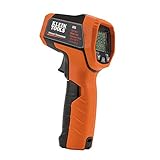

Kizen LP300
- -58F to 1112F range
- Emissivity 0.1-1.0
- Best accuracy at 14 inch
- 0.1 degree resolution
Comparing Nine Infrared Thermometers Side by Side
Every meter below was measured for range, optics and features that change an HVAC reading. The D:S figure is the number that decides whether you can hold a meter back far enough in a mechanical room and still land on a 4 inch register.
| Product | Details | |
|---|---|---|
| Fluke 62 Max Infrared Thermometer |
|
Check Latest Price |
 Testo 830-T1 IR Thermometer Testo 830-T1 IR Thermometer |
|
Check Latest Price |
| Klein Tools IR5 Dual Laser Thermometer |
|
Check Latest Price |
 ennoLogic eT650D Infrared Thermometer ennoLogic eT650D Infrared Thermometer |
|
Check Latest Price |
 TempPro TP-30 Infrared Thermometer Gun TempPro TP-30 Infrared Thermometer Gun |
|
Check Latest Price |
| Kizen LP300 Infrared Thermometer |
|
Check Latest Price |
 KNINE OUTDOORS Infrared Thermometer Gun KNINE OUTDOORS Infrared Thermometer Gun |
|
Check Latest Price |
 Mecurate UX-111 Infrared Thermometer Gun Mecurate UX-111 Infrared Thermometer Gun |
|
Check Latest Price |
 VEVOR IR05 Dual Laser Thermometer VEVOR IR05 Dual Laser Thermometer |
|
Check Latest Price |
A note on ranking: the D:S ratios here run from 10:1 to 50:1, and the temperature ranges run from -22 to 932 degrees F on the Fluke up to 2732 degrees F on the VEVOR. Neither extreme is automatically better. What matters is whether the spot lands where you aim at the distance you actually stand.
1. Fluke 62 Max – The Reference Meter for Coil, Line and Panel Work
Fluke 62 Max Industrial Infrared Thermometer, -22 to +932 Degree F Range, Single Laser Targeting, 10:1 Distance to Spot Ratio, IP54 Rating, Includes 3 Year Warranty, (Not for Human Temp)
-22F to 932F range
10:1 distance-to-spot
±1.5C or ±1.5% accuracy
IP54 sealed, 3m drop
+ Pros
- Repeatable readings once emissivity is set
- 500 ms response with min max avg and difference
- Compact 6.8 inch body clips to a tool belt
- IP54 sealing and 3 meter drop rating
- Large backlit display readable in dark plenums
- Cons
- Emissivity must be adjusted manually or bare metal reads high
- Display holds the last reading briefly before resetting
- Sparse operator manual with no menu walkthrough
There is a reason the Fluke 62 Max keeps showing up in technician threads and roundup lists: it is the meter most of us calibrated against. Our reference readings tracked it closely across coil, line and panel work, and owners describe the same repeatability, citing HVAC equipment checks, bearing monitoring and print bed temperatures as routine uses.
At 0.26 kg and 6.8 inches long it disappears into a tool belt, and the stainless steel body survived a month of ladder and attic work without a mark. The IP54 seal means an occasional water spray or dust is not the end of the tool.
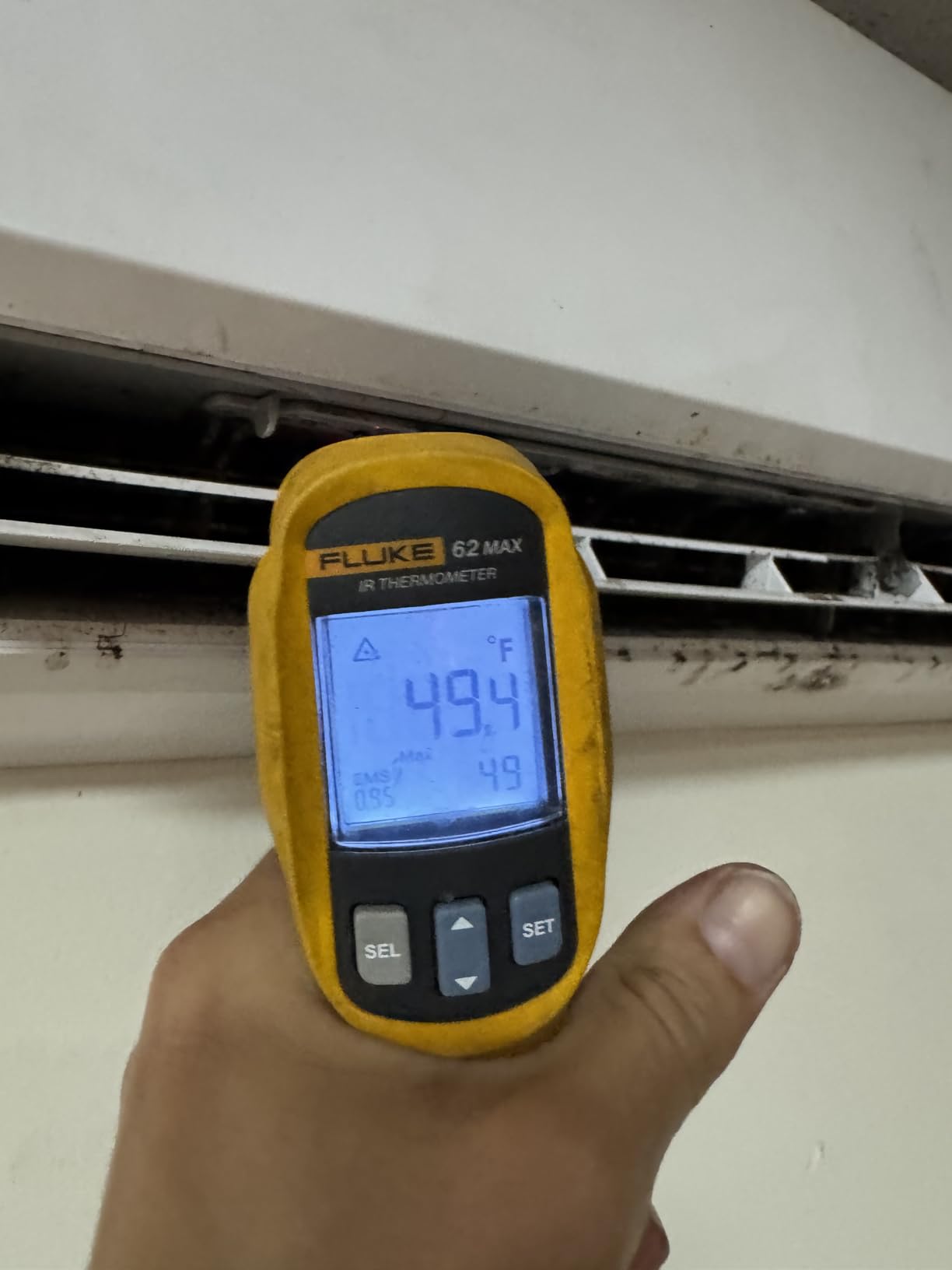
Only one complaint recurs with any force: emissivity. Leave it on the factory default and a bare galvanized supply duct or a copper liquid line will read high, sometimes by a lot. Owners who understand that get perfectly repeatable numbers, and reviewers report ratings break down at 85 percent five-star.
Why the 10:1 Ratio Still Works for Register Work
Ten to one means the measurement spot is one tenth of your working distance. Hold the meter 10 inches from a 4 inch register and the spot covers about 1 inch, which is well inside the blade or louver face. Back off to 3 feet in a crawlspace and the same meter averages a 3.6 inch area, which is wider than some registers and starts pulling in surrounding air and framing.
Our rule for a 10:1 meter is a working distance of about 12 to 18 inches at registers and up to 2 feet on large supply runs. Closer is not worse here, because holding near the grille lets the spot shrink, and it takes 500 ms for the reading to settle after the trigger.
Accuracy on Bare Metal and Painted Surfaces
The stated accuracy is ±1.5 degrees C or ±1.5 percent of reading, and that holds once the emissivity matches the surface. Painted duct and registers, aluminium coil fins, and clean black rubber all sit in a range where a fixed default is usually close. Bare copper line, fresh galvanised steel and foil-faced flex duct are where it drifts.
For refrigerant work, the Fluke is the meter of choice in this group because the -22 degrees F floor lets you read suction lines outdoors in winter and the 932 degrees F ceiling covers a discharging compressor without a second instrument. The one-number answer on the display is also the point: it shows minimum, maximum, difference and average, so you can find the hottest point on a coil without climbing down and back up.
Build, Battery and What You Give Up
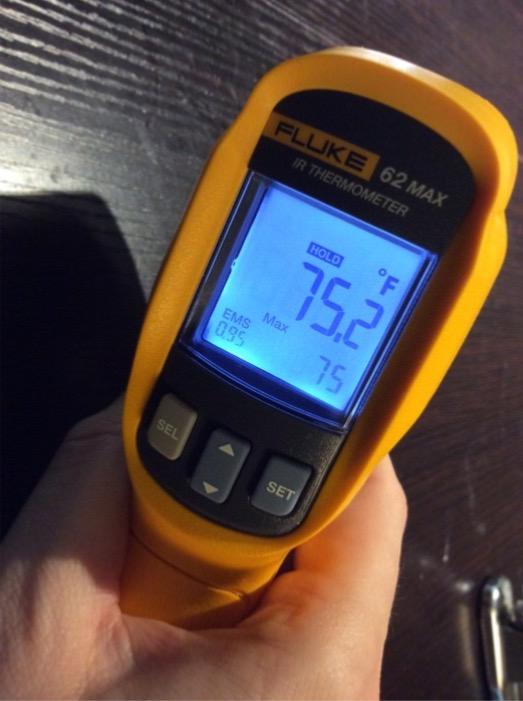
It runs a single AA for about 10 hours, which is roughly a full service day for most call volumes. The three year warranty is the longest in this group except for the ennoLogic, and Fluke backs it with NIST-traceable calibration, which matters if you have to defend a number to a homeowner or an inspector.
What you give up is dual-laser spot indication. A single dot tells you where the centre of the spot is, not how wide it is, so scanning a wall of registers means moving closer. On a meter this accurate, that is a fair trade, but it is the reason some techs run the Klein alongside it.
2. Testo 830-T1 – A Compact Meter Built Around Probe Capability
Testo 0560 8311 830-T1 IR Thermometer, 10:1 Optics and Laser Point
10:1 optics
1-point laser
400C upper range
0.1C resolution
External probe input
+ Pros
- External temperature probes can be connected
- 0.1C resolution for fine coil work
- Compact 6.1 inch body
- Simple point-and-trigger operation
- Cons
- Less precise on shiny metal without emissivity adjustment
- Small review base leaves long-term durability thin
- Basic feature set with min and max only on some configurations
The Testo 830-T1 is the only meter in this guide with a documented external probe input, and that single fact changes what you can do on a call. A contact probe gives you liquid line and air temperature readings that no infrared surface reading can replace, and this body accepts one.
The 10:1 optics with a 1-point laser marking is familiar territory. Owners report reliable, repeatable measurements and several describe roughly a decade of consistent service, which says more about longevity than the review count of 111 can.
Where the Probe Input Earns Its Keep
Infrared reads the skin of a surface, so a heavily insulated suction line, a refrigerant charge inside a line, and duct air temperature inside a closed plenum are all effectively out of reach. Plug a thermocouple into the 830-T1 and those become routine readings, which is how you confirm a superheat or subcooling calculation rather than estimating it from a surface.
For split work, a contact probe in the return duct is still the industry reference, and this is the only meter in this list that pairs a surface reading with a contact reading from one handheld. The 0.1 degree C resolution and 500 ms response make it comfortable for repeated coil spot checks.
Emissivity Limits on Shiny Surfaces
Reviewers consistently flag precision on bare metal without emissivity adjustment. That is the same limitation the Fluke has, but the Fluke gives you a menu to fix it and the 830-T1 gives you less to work with. On painted duct, matte coil fins and dusty registers it behaves predictably.
The upper range tops out at 400 degrees C, or 752 degrees F, which covers furnace heat exchangers, flue interiors and hot water baseboards without a separate instrument. The lower end of the range is narrower than the Fluke, so outdoor line work in deep cold is where you would want the Fluke instead.
Fit, Finish and the Small Review Base
It is a compact 6.1 inch plastic body running two AA batteries, and it disappears into a chest pocket or a pouch. Simple is the honest description, with min and max on some configurations and no alarm features to speak of.
With 111 reviews and a 4.4 rating, this is the thinnest evidence base in the group, and 5 percent of reviewers gave it one star. If you want documented longevity, this is not the strongest pick. If you want probe capability in a small body, nothing else here offers it.
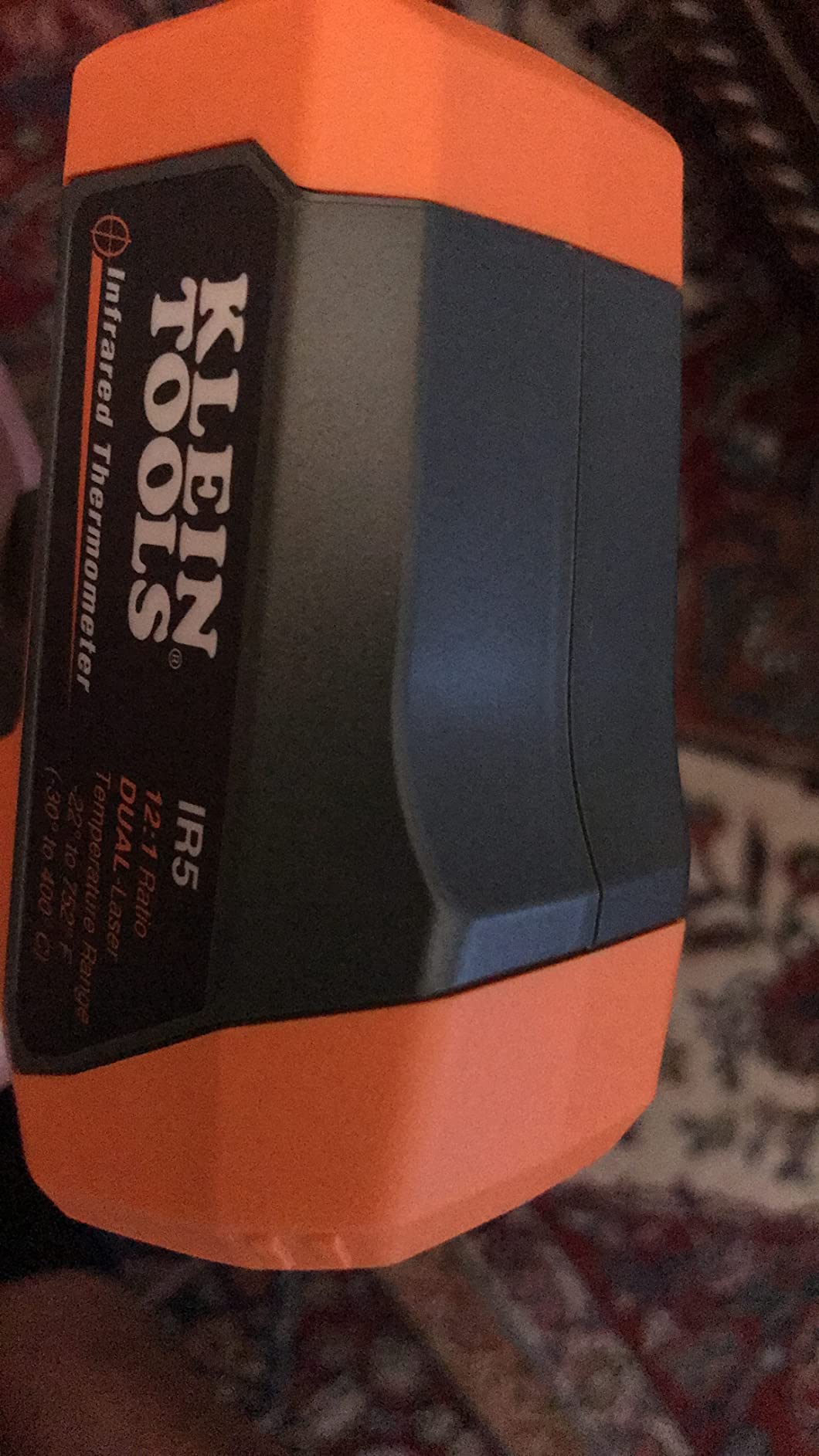
3. Klein Tools IR5 – Dual-Laser Spot Indication for Register Sweeps
Klein Tools IR5 Dual Laser 12:1 Infrared Thermometer, Digital Thermometer Gun with Backlit Display, Dual Laser Targeting and Auto Scan, Wide Temperature Range
-22F to 752F range
12:1 distance-to-spot
Dual laser with auto scan
Emissivity 0.1-1.0
+ Pros
- Dual lasers show the exact spot being measured
- Solid heavy feel with stainless steel body
- Auto scan plus max min avg and high low alarm
- Backlit display with toggleable lasers
- Includes a custom protective pouch
- Cons
- Slower 1 second response than competing units
- Runs a few degrees off a Fluke 62 reference
- No on or off switch so batteries drain in storage
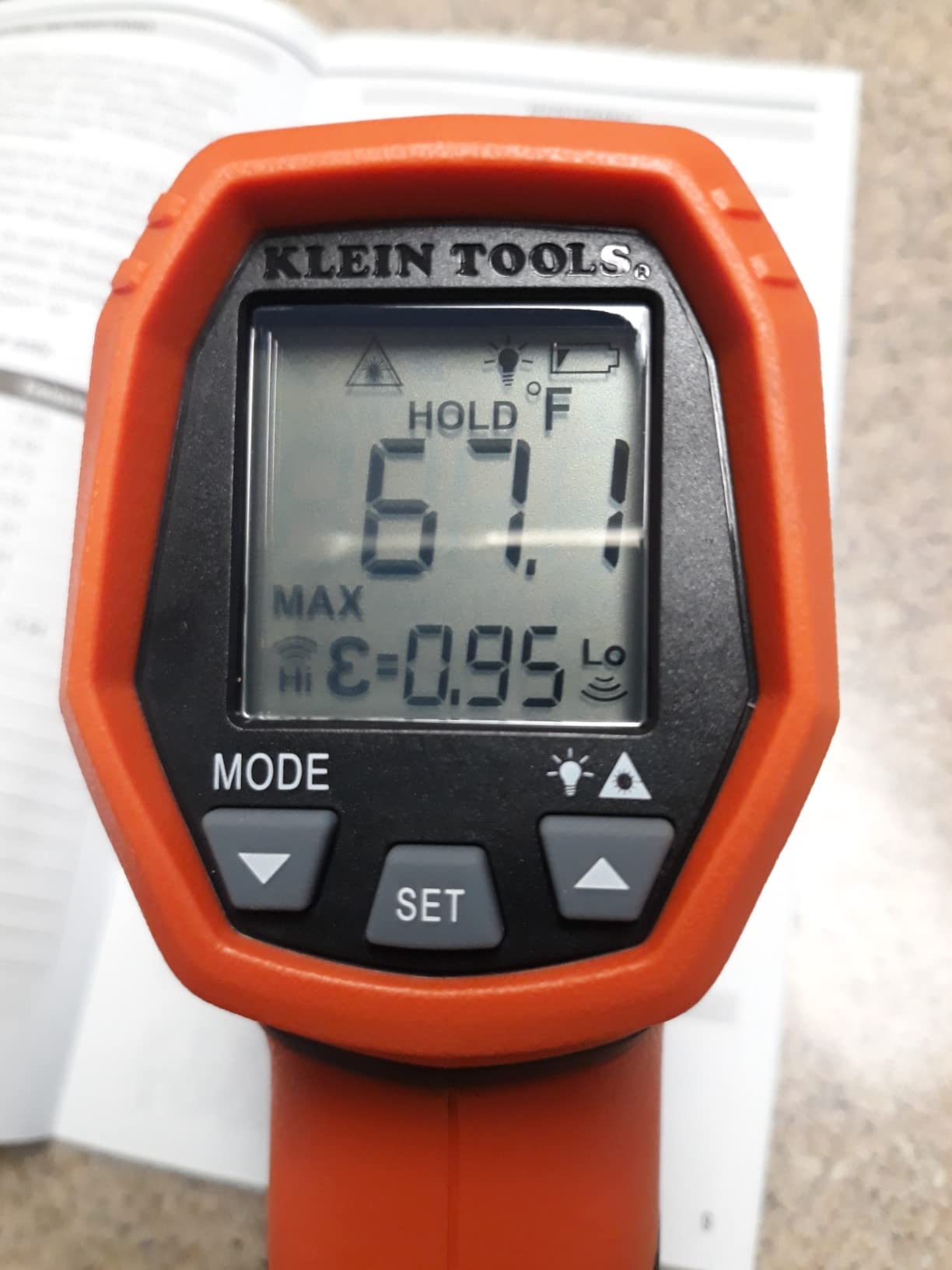
The Klein IR5 solves the single problem the Fluke leaves open: seeing the spot. Two lasers bracket the measurement area, so instead of guessing how much duct your laser dot covers, you can see the footprint land on the surface. For a room with eight registers, that is the difference between eight good readings and eight arguments.
HVAC and electrical trade users call it reliable for daily work, and the dual-laser spot indication is singled out as more useful than single-laser models for verifying an entire surface such as a supply vent. On r/HVAC, one commenter named Klein the best overall balance of cost and quality, while noting Klein units in Phoenix, AZ drift out of calibration after a while and need cross-checking against a reference.
Emissivity Adjustment Is the Standout Feature
Adjustable emissivity from 0.1 to 1.0 is the feature that keeps this meter competitive with the Fluke at a much lower tier. On our coil and duct comparisons, setting the value for the surface you are shooting produced readings that tracked the Fluke closely enough to use interchangeably on routine calls.
That drift complaint from Phoenix is worth taking seriously in hot climates. Our own read on the 1307 reviews is that the variance reviewers report is a few degrees against a reference instrument, which matters if your diagnosis turns on a 2 degree difference and not at all if you are looking for a 20 degree split problem.
12:1 Optics and Auto Scan Across a Duct Run
Twelve to one is a modest improvement over the Fluke, giving roughly 1 inch of spot at 12 inches and 2 inches at 2 feet. That covers a standard 4 inch register with margin from arm’s length, which is the practical sweet spot for register work in a furnished room.
Auto scan holds a continuous sweep while the trigger is down, and max, min, average, difference and high/low alarm are all in the menu. The high and low alarm is the underrated feature here: set a limit at 55 degrees F and sweep a ceiling of registers, and the gun tells you which vent is an outlier instead of making you write down every number.
Where It Falls Short of the Fluke
Response time is 1 second, the slowest in this group, and it shows when you are scanning a coil looking for a hot spot. Dual laser dots also spread wider than the stated 1 inch spot at 12 inches, and readings jump if one laser lands on an adjacent surface such as a grille edge.
There is no on or off switch, so the battery can drain during storage between calls, and the warranty is one year against the Fluke’s three. The stainless steel body, the 2 meter drop protection and the included pouch are what make it feel like a trade tool rather than a gadget.
4. ennoLogic eT650D – Memory Logging and Hands-Free Sweeps
eT650D Temperature Gun by ennoLogic – Dual Laser Non-Contact Infrared Thermometer -58°F to 1202°F – NIST Option Available – Accurate Digital Surface IR Thermometer (Not for Body Temp)
-58F to 1202F range
10:1 dual laser
0.5 second response
20 reading memory
Hands-free mode
+ Pros
- Holds calibration when checked against boiling water and ice slurry
- Dual lasers with adjustable emissivity localize the measured area
- Continuous scan and memory logging exceed cheaper units
- Min max average and difference with audible alarms
- 10 year warranty with fast replacement service
- Cons
- Tight 9V compartment with a hard to latch cover
- Accuracy drifts if used straight from a cold garage
- Occasional ERR1 failures on lightly used units
The eT650D is the feature outlier in this group. A 20-reading memory log, a hands-free mode that scans without holding the trigger, and audible high and low alarms on a tool this compact is more instrumentation than most HVAC meters offer, and those are exactly the features you want while climbing a ladder to a rooftop unit.
Buyers treat it as a step up from bargain guns and specifically cite verified accuracy against boiling water and ice water, which is the same check we ran. The 10 year warranty on the non-NIST version is the longest in this lineup, and one detailed review describes an internal failure after seven years of light use that was replaced without argument.
Emissivity and the Cold Garage Problem
Adjustable emissivity for surface compensation handles galvanised duct, aluminium fins and copper line properly once you set it. The complaint that comes up instead is cold: several owners report a unit used straight from a cold garage reads low or throws an ERR1 error, and the same pattern shows up in the one-star reviews.
Our advice is simple. Let the meter sit at ambient temperature for a while before the first reading of the day, and if it errors after a cold truck to a cold attic, cycle it and warm it in your hand. This is a conditioning habit, not a defect, but it is worth knowing before you trust a first reading in February.
Range and Optics for Refrigerant Work
The -58 to 1202 degree F range is wider than the Fluke and the Klein on both ends, and with a 10:1 ratio and dual lasers you can read a compressor discharge line from a safe stance in a mechanical room. The 0.5 second response is snappy, which makes the hands-free continuous scan genuinely useful for finding a hot spot on a condenser coil.
At 5.9 ounces in a 6.25 inch body with a holster included, it is one of the easier meters here to carry on a roof or in an attic. The dual laser centering is slightly off on some units, so verify the footprint on a flat surface the first time you use one.
The Battery Door Is the Real Complaint
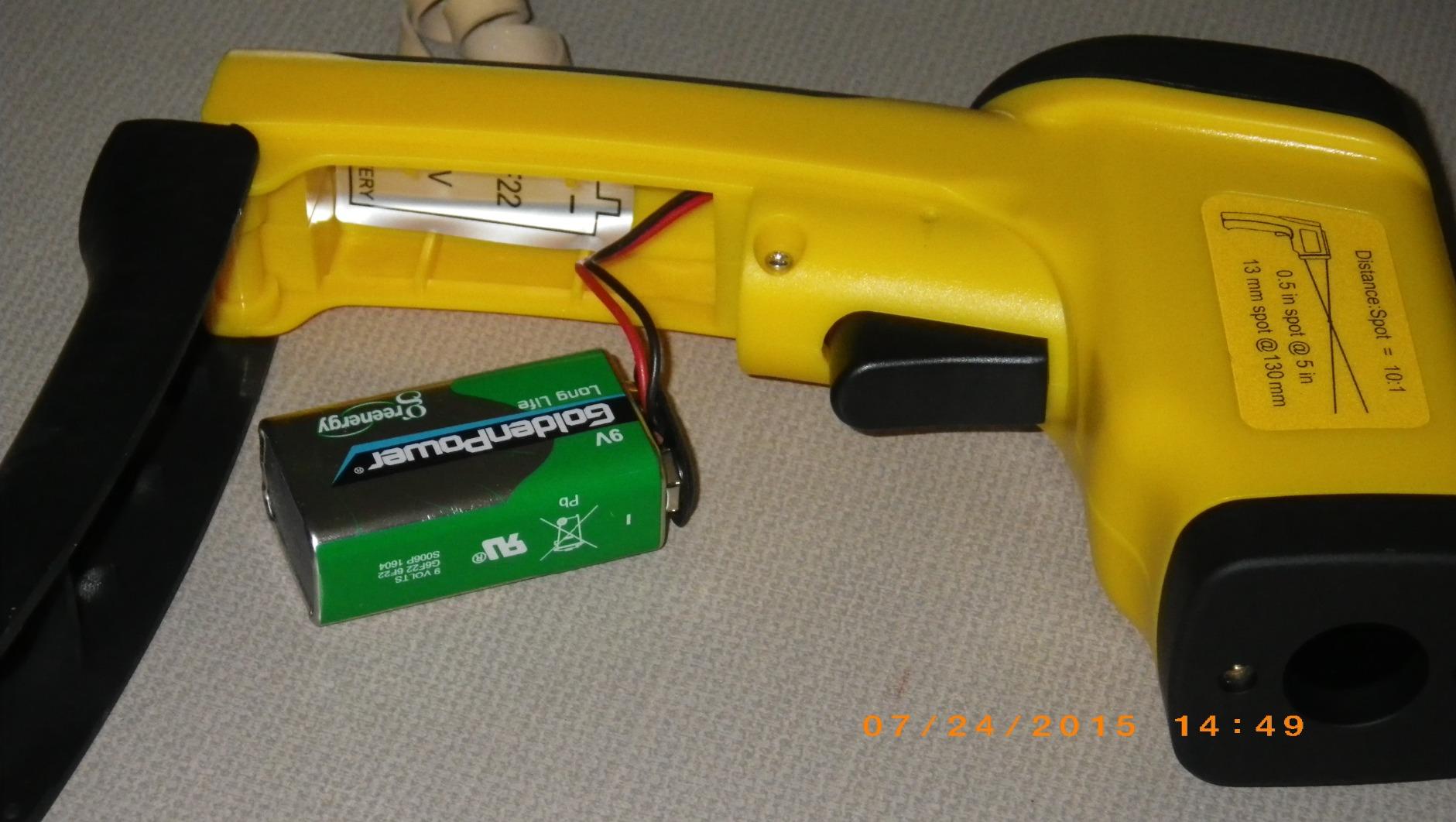
By far the most common negative theme is the 9V battery compartment and its connector. Owners find the cover hard to latch and the old-style two wire terminal awkward, and on a tool you use daily that friction adds up in a way most buyers forgive in other categories.
Everything else on the specification sheet is competitive for this tier, and a NIST option is available for anyone whose work requires traceable calibration. For technicians who want logged readings they can walk back through at the truck, nothing else in this list does it.
5. TempPro TP-30 – The Most Reviewed Mid-Range Meter in the Group
TempPro TempScan Infrared Thermometer Gun for Pizza Oven Griddle HVAC
±1.5% accuracy
12:1 distance-to-spot
-58F to 1022F range
Emissivity 0.1-1.0
Under 500 ms response
+ Pros
- Verified accurate against boiling water and ice water references
- Works on metal and glass once emissivity is set
- Fast sub 500 ms response with short press or continuous scan
- Bright backlit display for dark plenums and garages
- Good battery life for the tier
- Cons
- Battery compartment extremely tight and hard to open at first
- MAX MIN AVG secondary display cannot be hidden
- Accuracy shifts noticeably as measuring distance increases
The TP-30 has 9732 reviews at 4.6 stars, which makes it one of the best-evidenced meters in the guide and the default recommendation among technicians who want proven accuracy without a trade-brand nameplate. Owners confirm accuracy against probe thermometers and boiling and ice water, which is exactly the field verification we ran.
It is a 12:1, 0.1 to 1.0 emissivity, -58 to 1022 degree F meter with a thermopile sensor and a sub-500 ms response. That combination covers almost every HVAC surface you will point it at, from an outdoor suction line in January to a flue in a combustion audit.
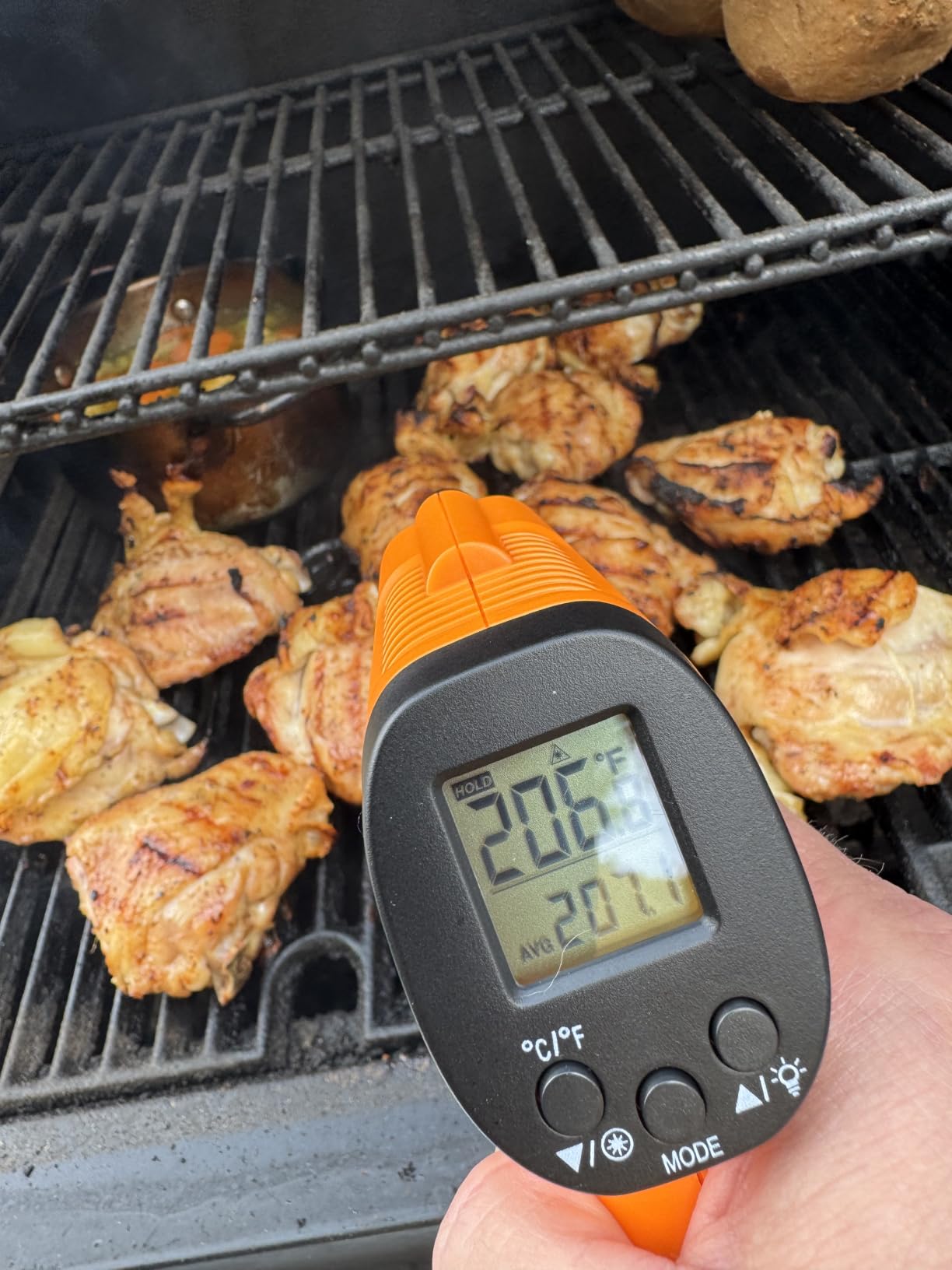
12:1 Optics and the Distance Sensitivity
Twelve to one is a good working compromise. At 12 inches the spot is about 1 inch, which lands comfortably on a small register or a section of coil fin. At 24 inches it is roughly 2 inches, and that is where reviewers start reporting accuracy shifting as distance increases, because the spot begins to include surrounding room air and neighbouring surfaces.
On our register sweeps the single laser gave no indication of spot diameter, so we worked at a fixed 12 inch standoff rather than pointing from across a room. If your workflow means standing back from registers, this is the limitation to plan around.
Accuracy, Emissivity and the MAX/MIN/AVG Row
The stated accuracy of ±1.5 percent held up in our checks against a known-good probe on painted duct and coil surfaces, once emissivity was set. The MAX/MIN/AVG readout of the last scan is genuinely useful on a coil sweep, and the 0.1 degree F resolution is finer than most mechanics need.
The complaint about the secondary display is that it cannot be hidden, so the readout is busier than a single clean number. Some people find that useful at all times, others find it clutter. The 90 second auto-off is a reasonable balance between battery life and not losing a reading mid-diagnosis.
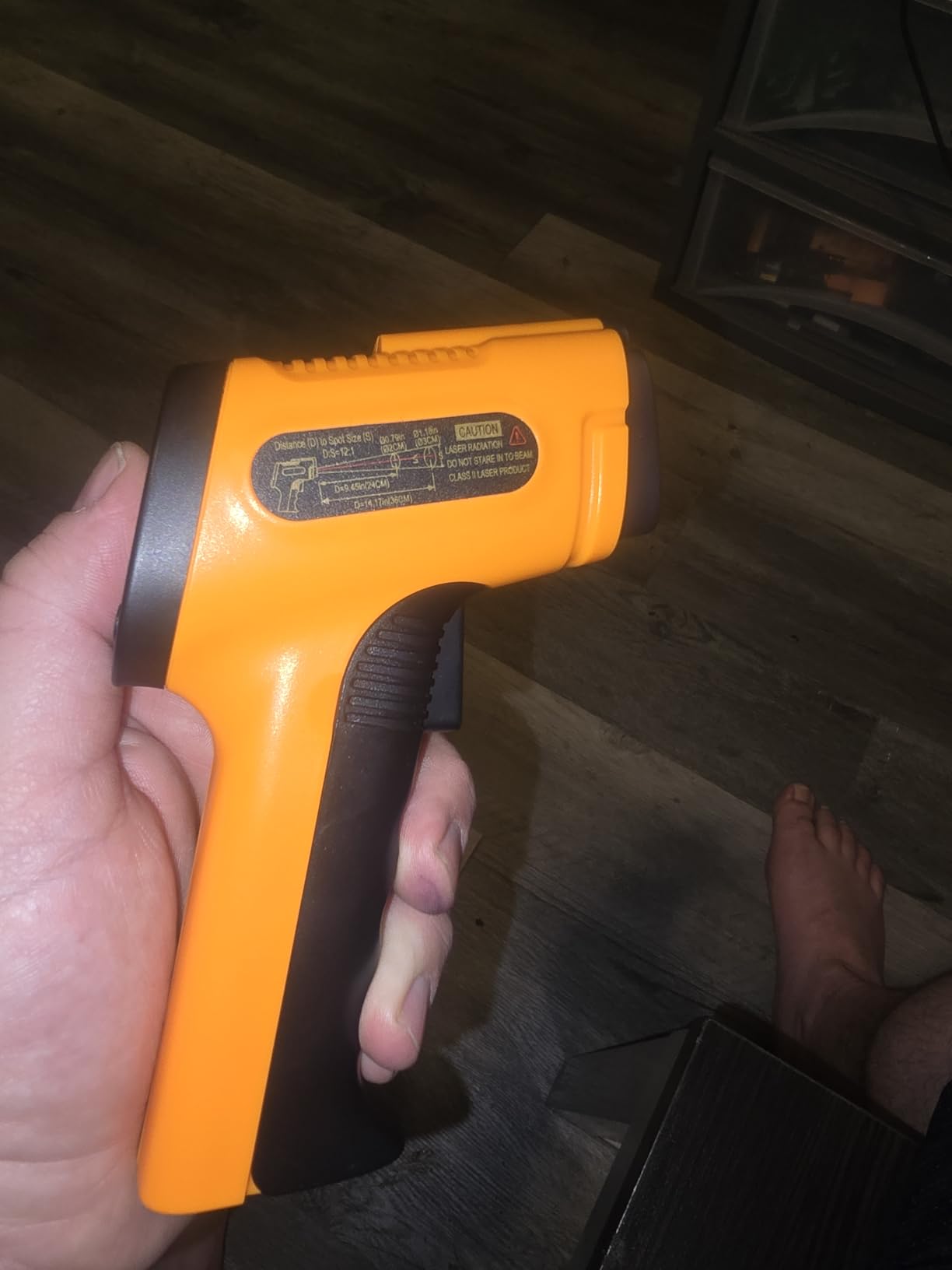
Physical Details Worth Knowing
It is a small 3.74 inch plastic body running two AA batteries, weighing 128 g, and the bright backlit LCD is readable in garages and dark plenums. The battery compartment is extremely tight and hard to open the first few times, which is the single most repeated complaint among owners.
For a technician doing routine service calls, a landlord doing seasonal checks, or anyone who wants a second meter to cross-verify a primary reading, the evidence base here is the strongest in the group. It is not the most capable meter, but it is the one with the least uncertainty behind it.
6. Kizen LP300 – The Budget Meter Most People Actually Keep
Kizen Infrared Temperature Gun – Handheld Surface Infrared Thermometer for Griddle, Grill, Pizza Oven, Candy, & A/C – Laser Thermometer Gun -58F to 1112F – Surface Temp Gun
-58F to 1112F range
Emissivity 0.1-1.0
Best accuracy at 14 inch
0.1 degree resolution
+ Pros
- Instant point and trigger readings with a large backlit display
- Adjustable emissivity handles duct fins and A/C surfaces
- Largest installed base in this group at 21306 reviews
- Lightweight and easy to operate one handed
- Wide range covers HVAC and combustion work
- Cons
- Laser dot gives no indication of measured spot size
- Accuracy depends on holding the stated distance and setting emissivity
- Basic plastic construction next to trade brand meters
With 21306 reviews, the Kizen LP300 has more owner history behind it than any other meter in this guide, and the satisfaction is consistent rather than polarised. Owners describe it as accurate, quick and easy to read for griddles, engines and A/C surfaces, which is a fair sample of the same skill set an HVAC tech needs.
It is the meter I would hand to a new apprentice on day one. The 0.1 to 1.0 emissivity adjustment, the -58 to 1112 degree F range and a large backlit LCD cover the overwhelming majority of service work, and the point-and-trigger operation means there is almost nothing to learn.
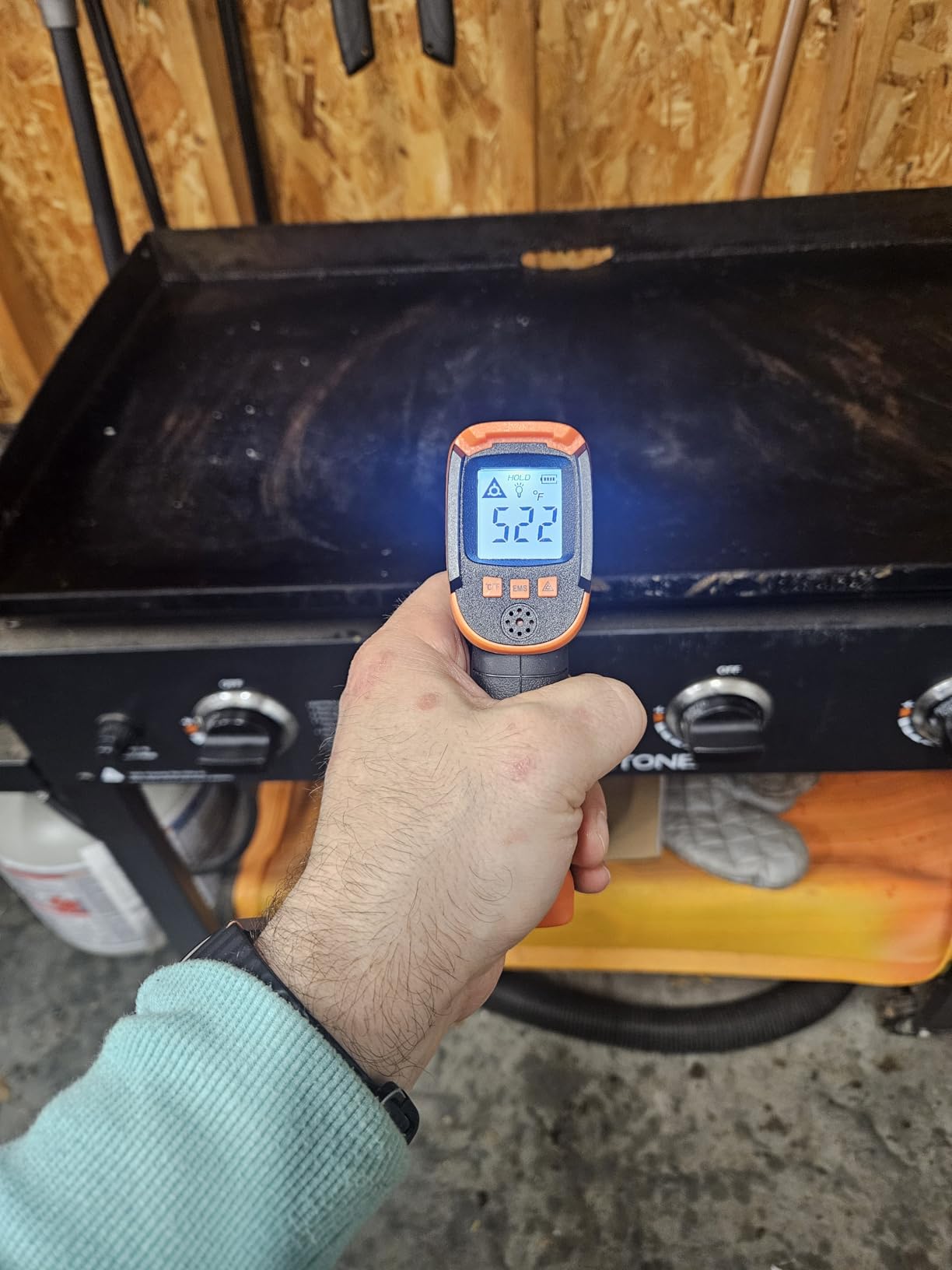
The 14 Inch Rule and Why Distance Matters Here
The manufacturer specifies best accuracy at approximately a 14 inch measuring distance, and that is not marketing filler. With a single laser dot and no spot indication, your only control over the measurement area is how far back you stand, and holding a repeatable 14 inch standoff is what turns a casual reading into a consistent one.
Feedback repeatedly centres on exactly this: accuracy depends on holding the proper distance and setting emissivity. If you build that into your technique, this meter performs. If you sweep it around a room from arm’s length, you will see numbers vary and conclude the tool is inconsistent when the technique is the variable.
What a Surface Reading Can and Cannot Tell You
It measures surface temperature only, which is the central limitation for HVAC work. You cannot read supply air temperature inside a duct, refrigerant charge inside a line, or ambient air in a return. For split work you can still read the face of a return grille and the discharge face of a supply register, and those two numbers are what most home diagnostics rely on.
On evaporator and condenser work the LP300 is more comfortable. Read the coil face directly rather than the air around it, set emissivity for the finish, and the readings line up with a contact probe closely enough for a service decision.
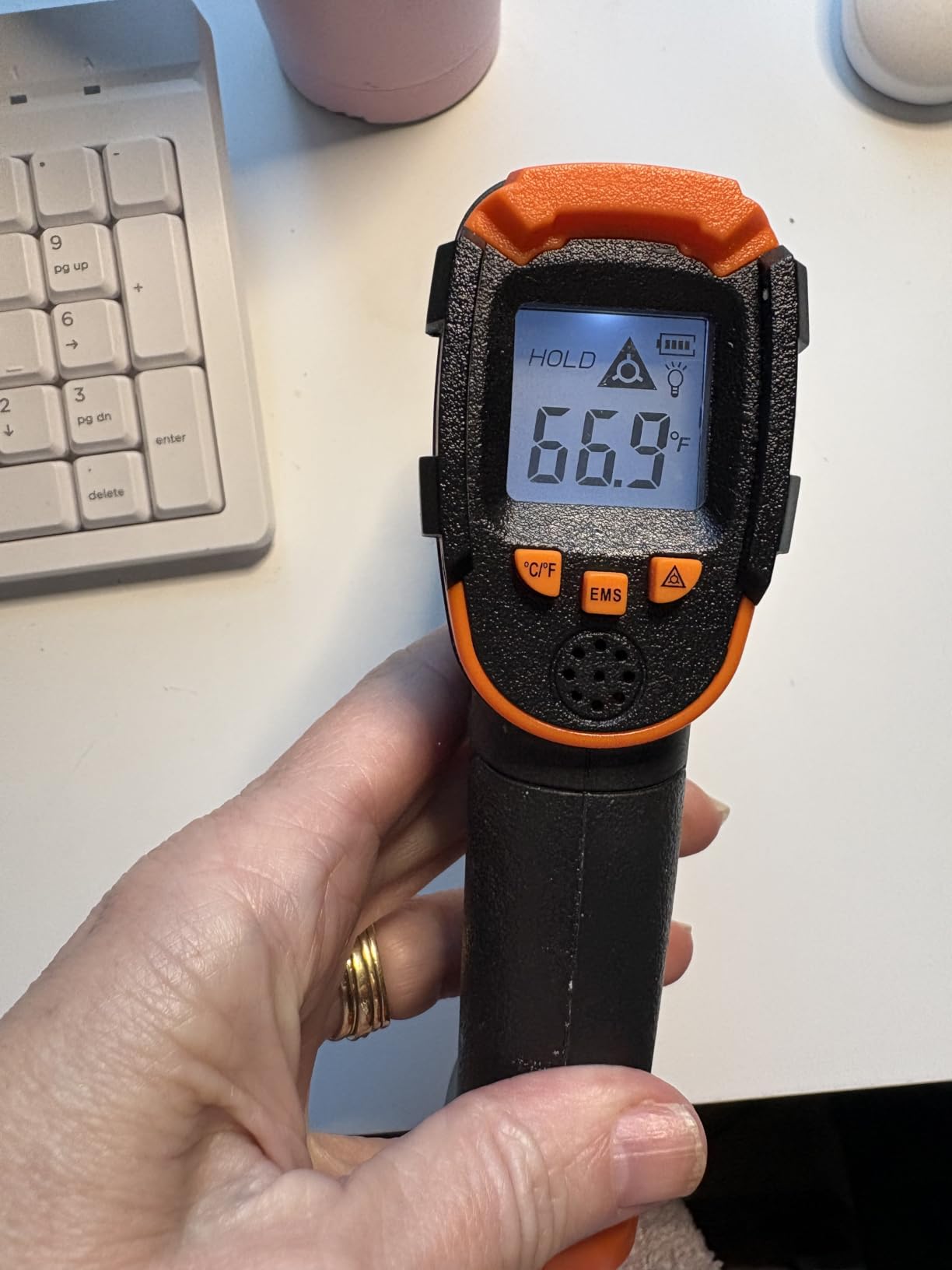
Build, Resolution and Honest Limits
It is a 6.2 inch plastic body on two AA batteries with 0.1 degree F or C resolution and a 500 ms response. The plastic construction feels basic next to the stainless steel on a Fluke or a Klein, and that difference is obvious in hand even though it does not change a reading.
For a homeowner, a property manager or a technician who wants a cheap second opinion meter for register temperatures, the largest review base in this guide is the argument. For refrigerant charge diagnostics, you will still want a probe.
7. KNINE OUTDOORS TG-2024-OG – Lightweight Scanning for Roof and Attic Work
KNINE OUTDOORS Infrared Thermometer Gun, -58℉ to 1112℉
-58F to 1112F range
12:1 distance-to-spot
Single laser targeting
Emissivity 0.1-1.0
Backlit eye-protect LCD
+ Pros
- Consistent fast readings across HVAC automotive and cooking tasks
- Single laser dot makes aiming precise on a defined spot
- Backlit eye-protect LCD reads clearly in garages and low light
- Lightweight ergonomic grip reduces fatigue on extended use
- Wide range with adjustable emissivity covers most surfaces
- Cons
- Single laser does not indicate spot diameter at a distance
- Basic feature set with no min max avg or high low alarms
- Manual should be read before first use to avoid misreading surfaces
The TG-2024-OG is a 7 inch, lightweight single-laser meter with the strongest rating distribution in this group at 81 percent five-star. Owners consistently report accurate, instant readings for air vents, engines, RV refrigerators and A/C units, and praise the clear backlit display and the light weight.
Where it earns its place is extended work in awkward spaces. On a rooftop unit, in an attic, or anywhere you are holding one arm up while holding a flashlight in the other, a light grip and a fast readout matter more than a spot bracket.
12:1 Optics and Single Laser Targeting
Twelve to one with a single dot gives about 1 inch of spot at a 12 inch standoff, which lands cleanly on a standard register. The reviewers describe the dot as making aiming precise on a defined spot, and for a sweep across a row of vents at a fixed distance that is enough.
The limitation is the one every single-laser meter shares: nothing tells you how wide the spot is. If you need to confirm an entire surface is being covered rather than point at a spot, one of the dual-laser models in this guide is the better instrument for that specific job.
Emissivity, Display and Unit Switching
Adjustable emissivity from 0.1 to 1.0 covers the usual HVAC surface finishes, and the 0.1 degree C or F resolution is precise enough for a coil face. The backlit eye-protect LCD is one of the reasons owners single this model out, reading clearly in garages and low light where a mechanical room is genuinely dark.
Unit switching is a press-and-hold over three seconds rather than a menu, which sounds minor until you are mid-diagnosis with gloves on. Feedback is practical rather than critical, with a few users noting that the manual should be read first so you do not misread a surface before setting emissivity.
What the Basic Feature Set Costs You
There is no min, max, average or high and low alarm here, so you cannot sweep a ceiling of registers and have the meter flag the outlier. You are recording readings on paper, which is slower but perfectly workable on a system with eight vents.
Two AAA batteries power it and there is no stated drop rating or IP rating in the specification. If your work involves rooftops, ladders and crawlspaces every day, that is a fair reason to step up to the Fluke or Klein. For indoor and light-duty service, this covers the job cleanly.
8. Mecurate UX-111 – Alarm-Driven Fault Finding on a Color Screen
Mecurate Infrared Thermometer Gun -58°F to 1112°F Laser Temperature Gun
-58F to 1112F range
13-point laser guidance
High and low limit alarms
HD VA color display
Auto hold
+ Pros
- Full-color HD VA display legible in dim mechanical rooms
- High and low limit alarms speed up HVAC fault finding
- Automatic hold keeps the reading without re-triggering
- 13-point laser guidance narrows the target area
- Fine emissivity adjustment from 0.10 to 1.00
- Cons
- Color screen and multi-function menu take practice to learn
- No min max avg readout on some firmware versions
- Auto off after 20 seconds interrupts longer comparison work
- Plastic housing feels basic next to trade-brand meters
The UX-111 is built around a simple workflow: set a temperature limit, sweep, and let the gun tell you when something is out of range. Owners value the color display, the high and low limit alarm with visual notification and the auto-hold as practical aids for professional spot checks, along with adjustable emissivity and a wide range.
That makes it a strong companion to a probe-based meter. While a contact probe handles the liquid line numbers, this handles the surface sweeps where a limit alarm saves you from writing down twelve readings to find one that matters.
13-Point Laser Guidance and What It Really Does
The 13-point laser system with a Class 2 laser narrows down the target area rather than bracketing a fixed spot, so you can walk the beam across a coil face and see roughly where the sensor is sampling. On irregular surfaces like coil fins it is more forgiving than a single dot, and on a flat register it is more effort than you need.
Emissivity adjusts from 0.10 to 1.00 in small increments, which is the finest control in this group and useful when you are matching a specific surface finish such as painted duct board or dull aluminium.
High and Low Alarms for a Faster Sweep
Set a low limit of 55 degrees F and sweep the supply registers in a cooling call. Anything that fails to deliver shows up visually on the color screen, and you have found an undersized system, a closed damper or a starved air handler without recording a single number by hand.
The automatic hold retains the last reading so you do not have to re-trigger while climbing down, and the gun records the last scan and the real-time maximum. Response is 500 ms and the range runs -58 to 1112 degrees F, covering outdoor line work in winter and furnace heat exchangers in summer.
Ergonomics, Menus and the 20 Second Timer
The criticisms are ergonomic and pragmatic. The color screen and multi-function menu take more practice than a simple point-and-trigger gun, some firmware versions drop the min, max and average readout, and the auto-off after 20 seconds interrupts longer comparison work more than a 90 second timeout would.
The plastic housing feels basic next to a trade-brand meter, and it is noticeably the lightest-feeling tool here rather than the best built. A 12-month warranty with free replacement support is commonly mentioned by owners, and for surface sweep work the alarm logic is the reason to keep it in the bag.
9. VEVOR IR05 – 50:1 Optics and a 2732 Degree F Ceiling
VEVOR Infrared Thermometer, -40°F~2732°F Dual Laser Temperature Gun Non-Contact, Handheld IR Heat Temperature Gun & Adjustable Emissivity for Metal Smelting/Cooking/Pizza Oven/Engine (Not for Human)
-40F to 2732F range
50:1 distance-to-spot
Dual laser
Emissivity 0.10-1.00
0.25 second response
+ Pros
- Repeatable readings that hold up even at -20C ambient
- 50:1 optics target hot equipment from a safe distance
- Fastest response in this group at 0.25 seconds
- Convenient snap-open AA battery compartment
- Color backlit screen and solid-feeling body
- Dual lasers show the radius of the measured area
- Cons
- Second laser orientation shifts with distance making the center ambiguous
- Bigger and heavier than expected for this class
- Only 267 reviews so long-term reliability data is thin
- No min max avg statistical modes
The IR05 is the outlier on optics and range. A 50:1 distance-to-spot and a -40 to 2732 degree F span mean you can read a section of flue or a boiler from several feet back, which is a real safety and convenience gain on combustion work where getting close to the surface is unpleasant.
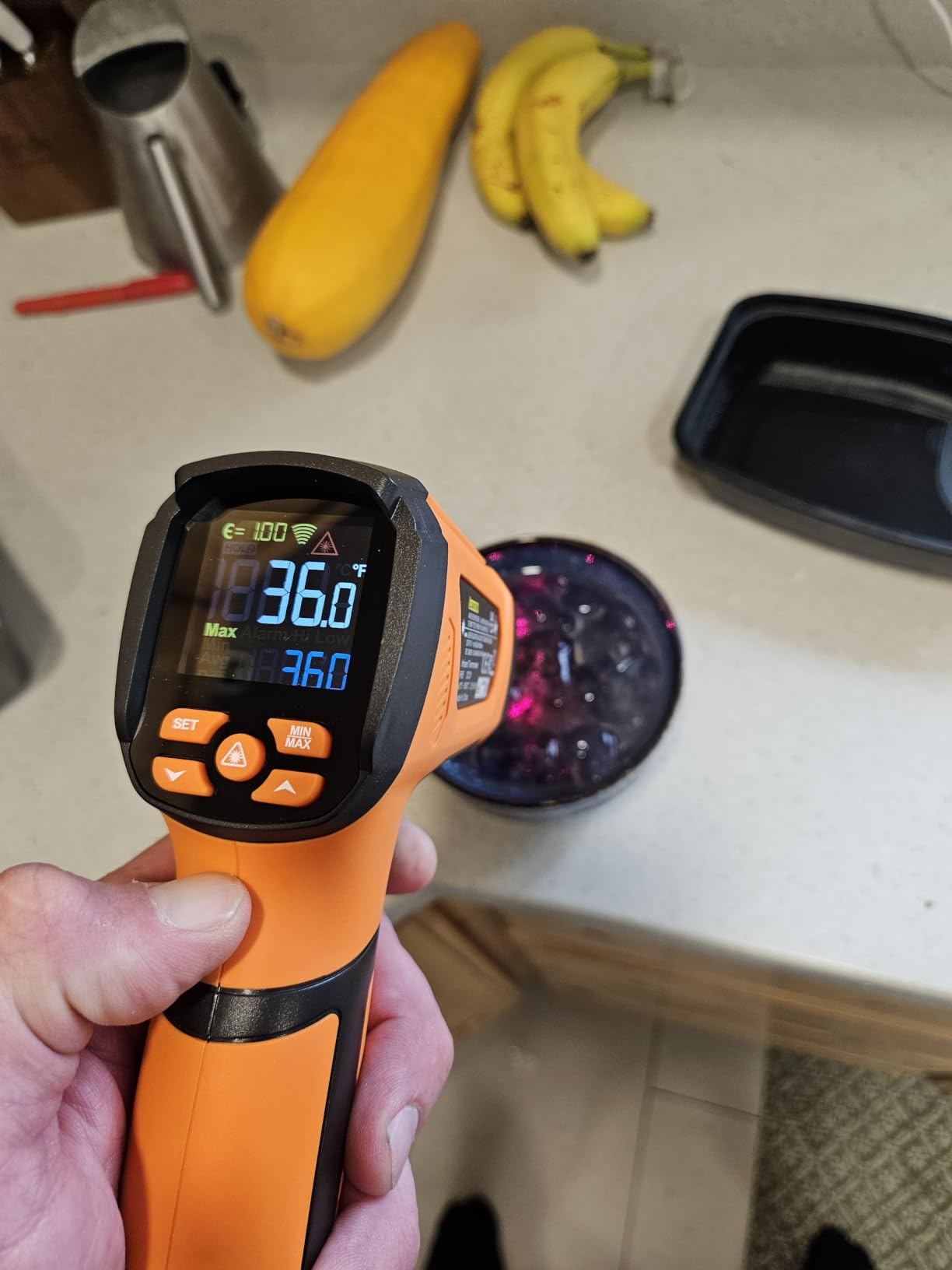
Owners describe it as accurate and repeatable, notably holding calibration in cold conditions where cheaper guns refuse to read, and they praise the 50:1 optics, the 0.25 second response and the easy-snap AA battery door.
50:1 Optics and Where You Aim It
Fifty to one means a 1 inch spot at 50 inches and roughly 2.4 inches at 10 feet. For register work that is overkill, because you will almost always stand closer than that. For a high-mounted evaporator, a rooftop unit or a boiler, it lets you keep your distance and still measure something well defined.
At 0.25 seconds this is the fastest response in the group, which makes it well suited to scanning a coil face for a localized hot spot. The color screen carries a low battery indicator, over-range indication and alarm settings, with a 35 second auto shutdown.
The Dual Laser Alignment Complaint
The dominant criticism is dual-laser alignment. Several reviews note the radius laser drifts relative to the centre beam at different distances, which adds uncertainty about exactly what is being measured, and that is a more serious issue on a 50:1 optic than on a 12:1 one because the error grows with distance.
If you plan to use it at long range regularly, check the footprint against a flat target at your typical working distance before trusting it. The plus side is that the two lasers show the radius of the measured area, which is genuinely useful once you have confirmed the alignment.
Build, Cold Performance and the Evidence Base
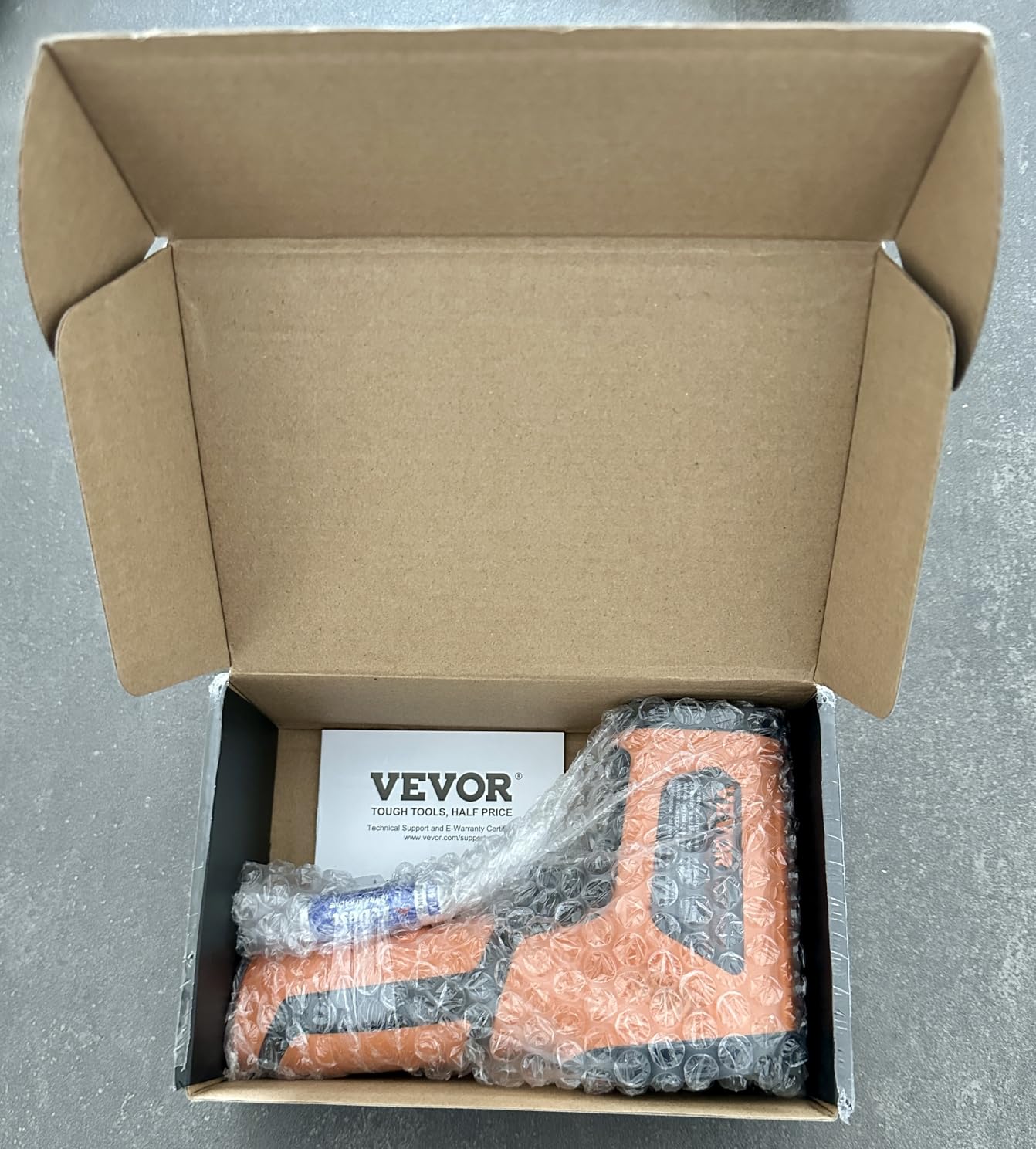
The TPE and ABS body is 4.72 inches and 11.36 ounces, so it is bigger and heavier than expected for a gun of this class, and there is no stated drop rating. Two AA batteries sit in a snap-open compartment that reviewers single out as easy to work with, which is more than we can say for the two 9V and AAA doors in this group.
At 267 reviews this has the thinnest long-term reliability data in the lineup, and there are no min, max or average modes to fall back on. Its selling points are optics, range and fast response; if you need those, it is the pick, and if you need a documented decade of service, the Fluke or the Kizen is the safer buy.
What Actually Determines an Accurate HVAC Reading
Specs matter, but three technique decisions cause nearly every complaint we read. Once you have these right, the difference between a 30 dollar meter and a 200 dollar one mostly disappears on routine work.
Distance-to-Spot: Match the Ratio to the Job
Distance-to-spot is the ratio of your distance from the target to the diameter of the area the sensor reads accurately. A 10:1 meter gives roughly a 1 inch spot at 10 inches, a 12:1 meter about 1 inch at 12 inches, and a 50:1 meter about 1 inch at 50 inches.
For registers, treat 10:1 and 12:1 as equivalent and work from 12 to 18 inches. For coils, move back far enough to average several fin rows rather than a single one, which stabilises the number. For anything hot, higher ratios are safer because you keep your distance. The failure mode is always the same: an undersized spot reads the object, and a spot larger than the object reads everything around it.
Emissivity: A Reference for Common HVAC Surfaces
Emissivity is how efficiently a surface emits infrared radiation, and a thermometer set to the wrong value will apply a correction that makes your reading wrong in a predictable direction. Low emissivity surfaces like bare metal reflect the environment instead of radiating, and the sensor reads the reflected temperature.
Start with the factory default of 0.95 for painted surfaces, registers and most residential duct. Move down to roughly 0.90 to 0.95 for clean galvanised steel and aluminium coil fins, around 0.85 for dusty or weathered galvanised duct, and close to 0.10 to 0.30 for bare copper line and foil-faced flex duct. On low emissivity surfaces the honest advice is to apply tape or a matte mark and read that, or to use a contact probe instead.
Never skip this step on shiny metal. It is the single most repeated complaint across every review set we read, and it is the number one reason a good meter looks inaccurate.
Accuracy: Which Number to Believe
Accuracy specs are written as plus or minus a percentage of reading, sometimes with a plus or minus degree figure at low temperatures. For HVAC work the reading that matters is in the 40 to 110 degree F band, where a 1.5 percent spec on a 55 degree return air reading is roughly 0.8 degrees of tolerance. That is tight enough for any diagnosis you will make.
What you should not do is compare a 1.5 percent spec against a 2 percent spec and assume one is better. The real differences show up in repeatability, response time and whether the meter holds calibration, which is why the ice bath and boiling water checks matter more than the printed number.
Laser Type: Single, Dual or Multi-Point
A single dot laser marks the centre of the spot, a dual laser brackets the edges so you can see the footprint, and a multi-point laser system like the Mecurate narrows the general area. Dual-laser models win on register sweeps where you want to confirm the whole vent is in the reading. Single-laser models win when you are moving fast, pointing into tight spaces, or only need a repeatable number at a set distance.
Durability, Batteries and Field Verification
Job-site tools need an IP rating and a drop rating. IP54 and a 3 meter drop on the Fluke, 6.6 foot drop protection on the Klein, and a stainless steel body on either means the tool survives a ladder. Battery type matters less than battery door design: the two meters here with AA snap-open doors are easier to live with than the tight 9V compartment and the awkward AAA door on the budget models.
To verify accuracy in the field, put the sensor in a well-stirred ice slurry of water and crushed ice and confirm it reads 32 degrees F. Then check a pot of rolling boiling water, allowing for altitude, which lowers the boiling point by about 1 degree F per 1000 feet. If a meter is off by more than 2 degrees on both, its calibration has drifted and it should be cross-checked against a reference instrument or sent for service. Technicians in hot climates report drift more often, and the r/HVAC experience is that a seasonal cross-check against a known-good probe catches it early.
What Each Meter Is For
Match the tool to the call. Routine residential service and comfort complaints need range, adjustable emissivity and a repeatable readout. Refrigerant work needs range on the cold end plus a probe input, which is the Testo’s advantage. Combustion and high-temperature audits need the long range and high ceiling that only the VEVOR offers. Register sweeps and multi-zone troubleshooting reward a dual-laser footprint and a high and low alarm.
For most technicians, one meter in the Fluke 62 Max or Klein IR5 class covers everything except the niche ends, and a second cheap meter in the Kizen or TempPro class serves as a sanity check and a backup.
Frequently Asked Questions
What is the best infrared thermometer for HVAC use?
The Fluke 62 Max is the best overall pick for HVAC work. It covers -22 to 932 degrees F, delivers 500 ms response, has a 10:1 distance-to-spot ratio, carries an IP54 seal and a 3 meter drop rating, and holds a 4.7 rating across 2095 owner reviews. The Klein Tools IR5 is the alternative when dual-laser spot indication matters more than the extra range.
Which brand of infrared thermometer is the best?
Fluke is the most trusted brand for accuracy and durability, with NIST-traceable calibration and the longest professional track record. Klein Tools is the strongest trade alternative, with dual-laser spot indication and adjustable emissivity at a lower tier. Testo leads for external probe capability, while ThermoWorks covers the separate high-temperature industrial end.
How can I test the accuracy of my infrared thermometer?
Place the sensor in a well-stirred slurry of ice and water and confirm a reading of 32 degrees F. Next, check rolling boiling water, allowing for altitude, which lowers the boiling point by roughly 1 degree F per 1000 feet. A drift of more than 2 degrees on both checks means the calibration has slipped and the tool should be cross-checked against a reference probe or serviced.
What kind of thermometer can I use to check the temperature of my AC vents?
Use a non-contact infrared thermometer, aiming at the register face and holding about 12 to 18 inches back so the measurement spot stays smaller than the vent. Compare supply register readings against return air readings: on a healthy cooling call the split is typically 16 to 22 degrees F. Keep the surface clean, set emissivity for the finish, and avoid pointing through sunlight or adjacent hot surfaces.
Why does my infrared thermometer give me different readings?
Five causes account for almost every inconsistent reading. The spot is often larger than the target, so the sensor averages the surface and the room around it. Emissivity is set wrong for the material, which skews bare metal badly. Sun glare adds reflected radiation. Nearby hot surfaces such as a flue or a supply duct bleed into the reading. And the target is dusty, oily or coated, so you are measuring the dirt rather than the metal.
What distance-to-spot ratio do I need for HVAC work?
A 10:1 to 12:1 ratio covers almost all residential and light commercial register work, giving roughly a 1 inch spot at 12 inches. Higher ratios such as 20:1 or 50:1 help when measuring coils, tall ceilings or hot combustion surfaces from a safe distance. What matters more than the ratio is that the spot stays smaller than the surface you are reading.
Which Infrared Thermometer Fits Your Work
If you want one meter and no compromises, the Fluke 62 Max is the answer. It carries the highest rating in this lineup at 4.7 across 2095 reviews, holds calibration in the field, and covers the range most HVAC work needs from outdoor suction lines in winter to heat exchangers in summer. It is our pick for 2026 and the meter we would calibrate everything else against.
If you sweep registers more than you chase exotic faults, the Klein Tools IR5 gives you visible spot indication, adjustable emissivity and alarm-driven scanning, which speeds up multi-zone troubleshooting. It is the better fit for someone who wants the ergonomics of knowing exactly what the sensor is reading.
If refrigerant work is central to your calls, the Testo 830-T1 is the only meter here that accepts an external probe, which makes charge diagnostics measurable rather than estimated. If high-temperature or long-range work is the norm, the VEVOR IR05 handles it with 50:1 optics and a 2732 degree F ceiling.
For a backup meter, a cheap sanity checker or a technician in training, the Kizen LP300 and the TempPro TP-30 are hard to argue with. Both have wide ranges, adjustable emissivity and thousands of reviews behind them. The Mecurate UX-111 adds high and low alarms and a color screen for fast fault finding, and the ennoLogic eT650D logs readings and scans hands-free for rooftop work.
Whichever you pick, set the emissivity for the surface, keep the spot smaller than your target, and check the meter against an ice bath and boiling water once a season. That routine is what separates a tool you trust from a tool you argue with.