
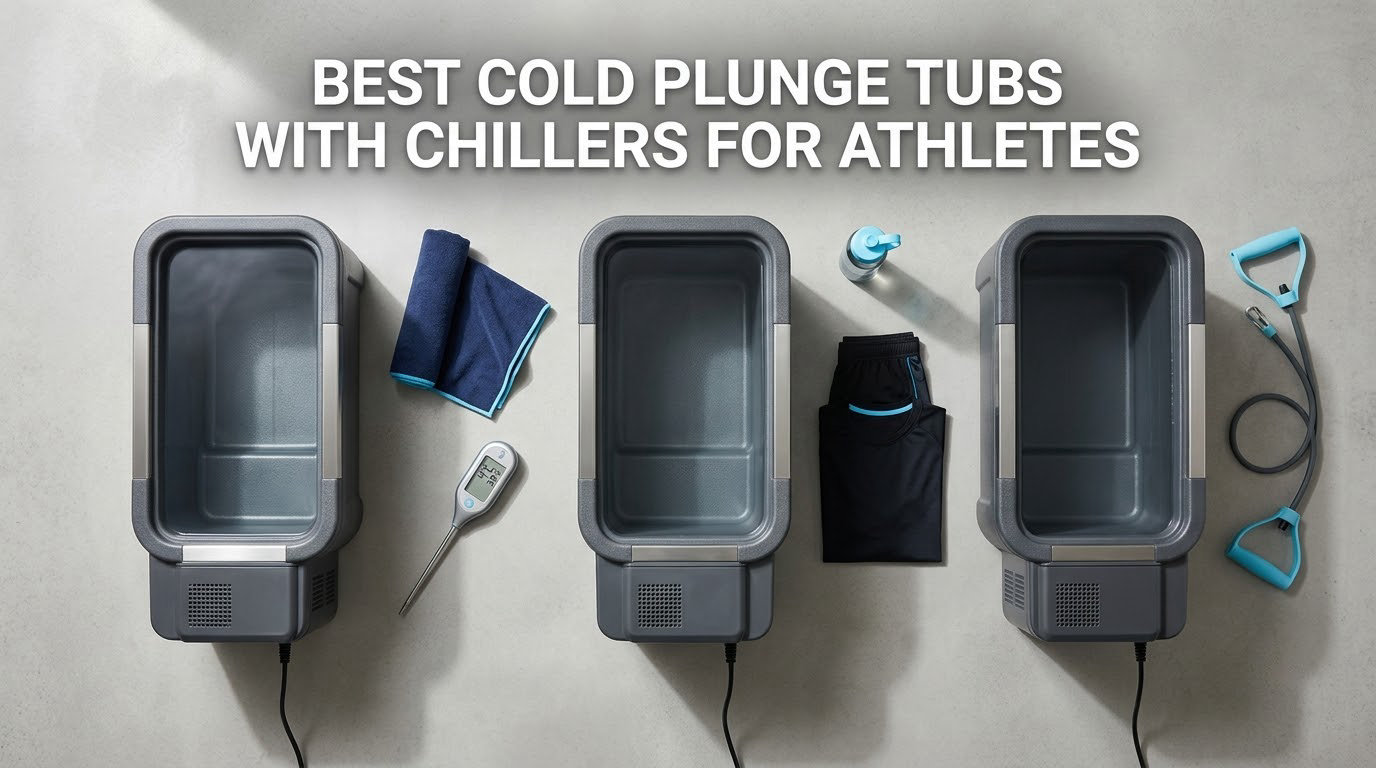
Every athlete who buys a cold plunge hits the same wall within a month. The tub is fun once. Then it becomes a Saturday chore involving ice bags, a hatchet, a wet floor and twenty minutes you did not have. Owners on r/coldplunge describe the same arc in different words: the habit survives when the prep disappears, and dies when it does not.
That is the entire argument for a chiller, and it is stronger than any recovery claim. So the best cold plunge tubs with chillers for athletes are not the ones with the most impressive spec sheet, they are the ones that hit your target temperature on demand, hold it through a hot afternoon, and stay sanitary between sessions without a twenty-minute ritual. We spent weeks reading verified review data, manufacturer sheets and forum threads on horsepower sizing, run cost, noise and failure modes, then compared every option against the three questions that actually matter: how cold, how fast, and how often will you actually use it.
The field splits cleanly in two. Six of our ten picks ship a chiller in the box or include one in a kit. The other four are chiller-compatible tubs that need a separate unit, which is a legitimate path but one where the horsepower decision moves entirely onto you. We flag that distinction on every card because misreading it is the fastest way to end up with a tub that never gets cold.
Our Top 3 Chiller-Backed Cold Plunge Picks for Daily Training
If you want one recommendation, take the JUGRFIT 121-gallon all-in-one: it is the only pick in the field that pairs a large tub with a 1050W chiller, filtration, cover, pump and a backpack in a single box, and it holds temperature in Florida heat according to its owners. If your priority is square footage per gallon and the deepest review base we found, the VEVOR 216-gallon oval fits athletes up to six foot nine and works with nearly any chiller you add later. If you live somewhere hot and you are tired of inflatable walls losing shape, the REZVANI Frozin 400 is the rigid foam-insulated answer.

JUGRFIT 121-Gallon Tub…
- 121-gallon capacity
- 1050W chiller to 37F
- WiFi temperature control
- Drops to a backpack for travel

VEVOR 216-Gallon Chiller-Re…
- Fits up to 6 ft 9 in
- Standard G1/2 inch chiller ports
- 3.1 inch drop-stitch walls
- Folds to 29.8 lbs

REZVANI Frozin 400 Foam-Ins…
- 100-gallon foam-insulated shell
- 0.8 HP chiller to 37F
- 20-micron filter and 650 GPH pump
- Made in the USA
Comparing All 10 Cold Plunge Tubs and Chiller Setups at a Glance
Chiller included or chiller-compatible is the first column worth checking, because four of these tubs arrive with no cooling hardware at all. Capacity, the user height each tub is rated for, and the temperature floor tell you the rest.
| Product | Details | |
|---|---|---|
| JUGRFIT 121-Gallon Cold Plunge Tub with 1050W Chiller |
|
Check Latest Price |
| VEVOR 216-Gallon Inflatable Ice Bath Tub |
|
Check Latest Price |
 AudaciaGo XXL 216-Gallon Ice Bath Tub for Athletes AudaciaGo XXL 216-Gallon Ice Bath Tub for Athletes |
|
Check Latest Price |
 DIVEBLAST Cold Plunge Tub Chiller with Pump and Filter DIVEBLAST Cold Plunge Tub Chiller with Pump and Filter |
|
Check Latest Price |
 1stplunge 148-Gallon Chiller and Tub Kit 1stplunge 148-Gallon Chiller and Tub Kit |
|
Check Latest Price |
 PLUNGE MAGIC Inflatable Cold Plunge Tub XXL PLUNGE MAGIC Inflatable Cold Plunge Tub XXL |
|
Check Latest Price |
 RECOVEREX 90-Gallon Cold Plunge with 0.8 HP Chiller RECOVEREX 90-Gallon Cold Plunge with 0.8 HP Chiller |
|
Check Latest Price |
| REZVANI Frozin 400 Cold Plunge Tub with Chiller |
|
Check Latest Price |
 AS ColdPlunge 1/3 HP Chiller and 148-Gallon Tub Kit AS ColdPlunge 1/3 HP Chiller and 148-Gallon Tub Kit |
|
Check Latest Price |
 AKSPORT 151-Gallon Ice Bath Tub for Athletes AKSPORT 151-Gallon Ice Bath Tub for Athletes |
|
Check Latest Price |
1. JUGRFIT 121-Gallon Tub with 1050W Chiller – Best Overall for Daily Plunging
JUGRFIT 121-Gallon Luxury Pro-Grade Cold Plunge Tub with 1050W Water Chiller – Ice-Free At-Home Recovery, Built-In Filtration, Weatherproof & Durable
121-gallon tub
1050W chiller to 37F
Drop-stitch fabric
WiFi control
+ Pros
- Holds plunge temperature overnight with no ice
- WiFi plus on-unit display for set-and-forget control
- 121 gallons fits users up to 6 ft 5 in
- Entire kit packs into the included backpack
- Responsive US-based support that sends replacement parts
- Cons
- Overnight cooldown from room temperature
- Weekly filter cleaning to keep flow smooth
- Real learning curve on first assembly
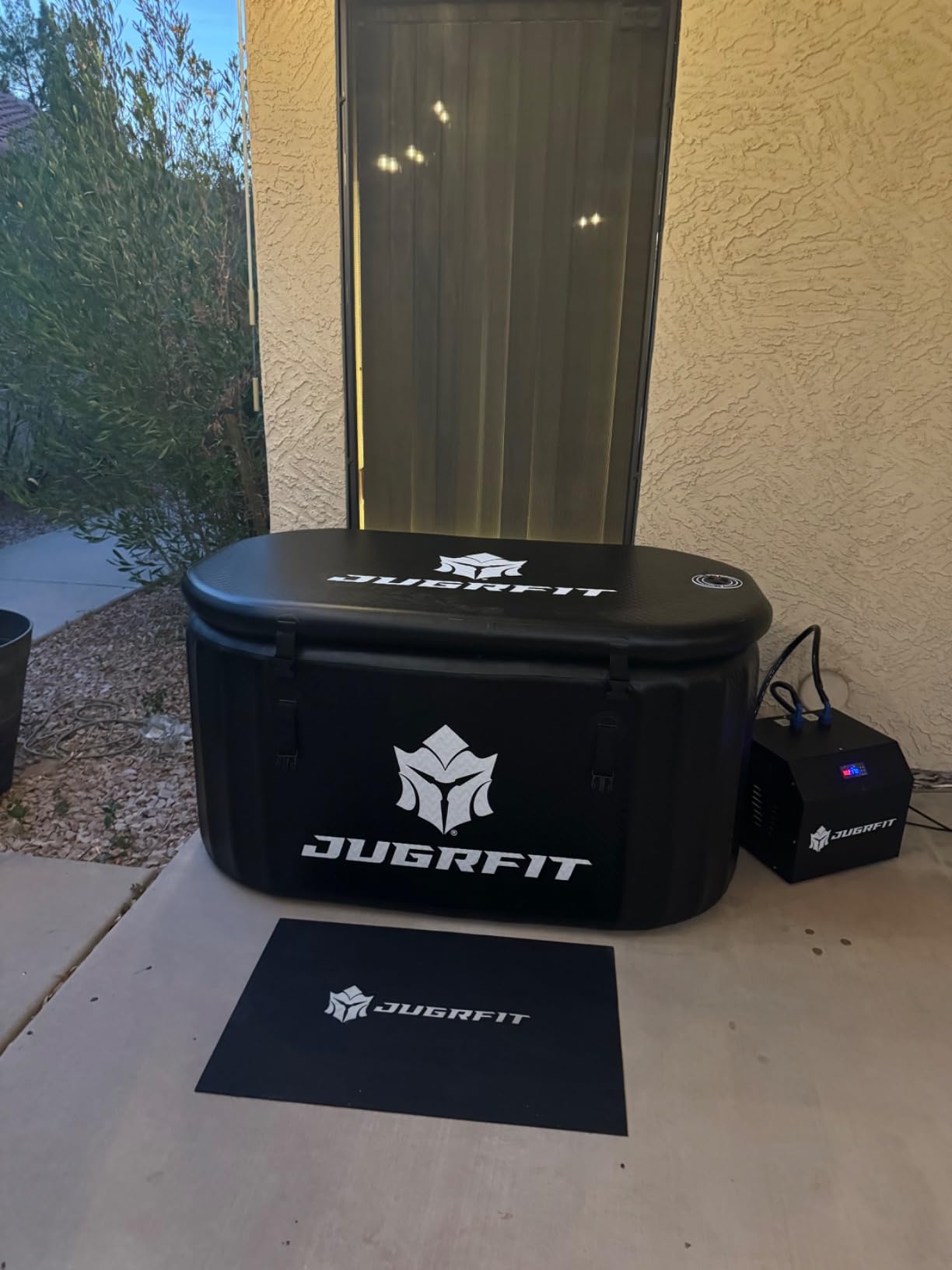
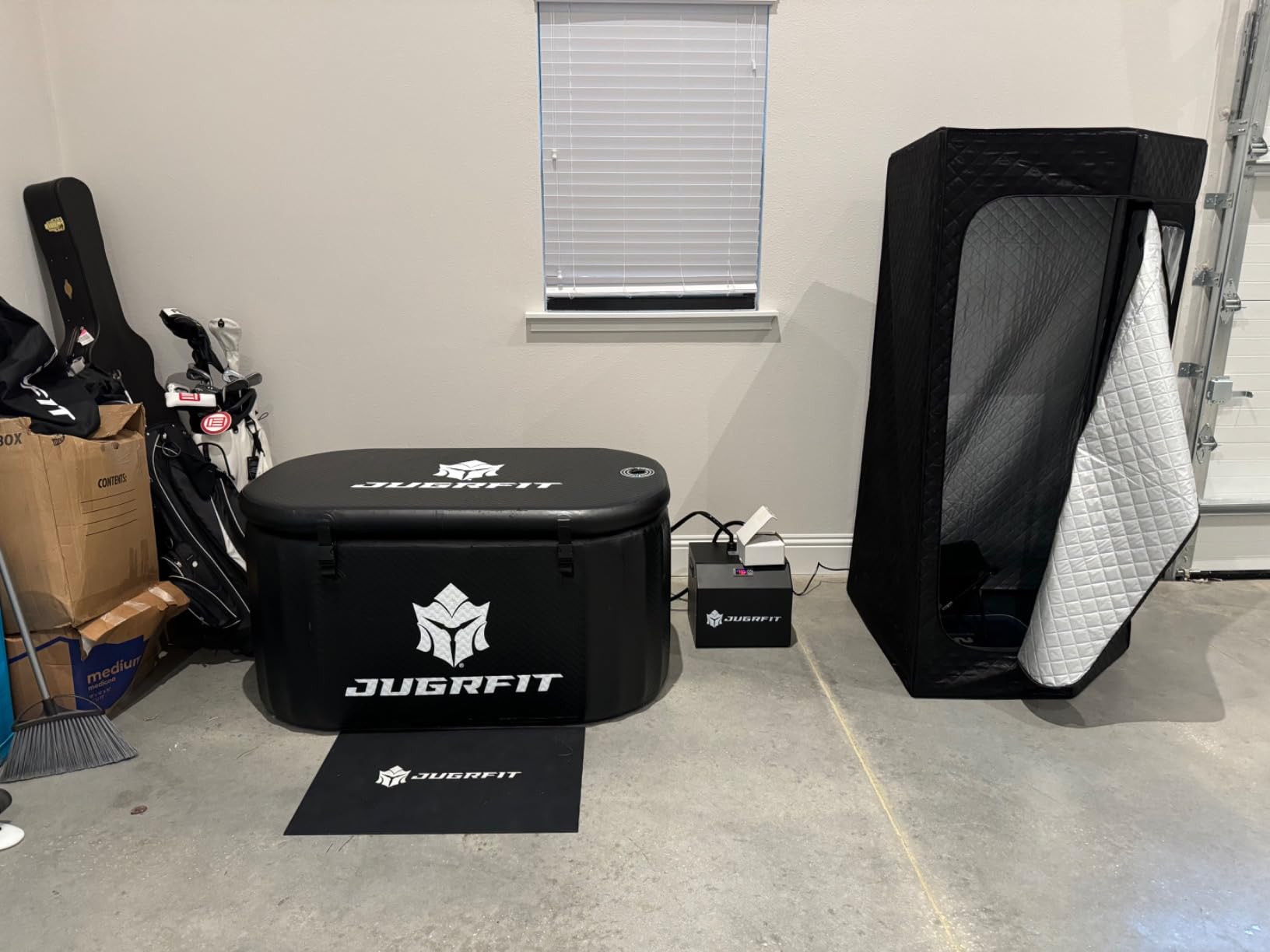
Of the six picks that ship cooling hardware, this is the one that answers the horsepower question outright. A 1050W compressor pushes a 121-gallon tub down to 37 degrees Fahrenheit with no ice, then cycles to hold there, and the whole thing folds into a backpack when you are done with it. For an athlete who wants to plunge after every session rather than on weekends, that is the entire pitch.
Owners report holding roughly 44 to 45 degrees in Florida heat with this unit, and several mention that it took over from a 1 HP chiller they had been running around the clock. That is a meaningful claim in a state where ambient temperature is the limiting factor, and it is why we put this kit at the top of the list.
Why the 121-Gallon Size Matters for Tall Athletes
Rated for users up to six foot five, this is a genuinely full-immersion tub rather than a sit-and-soak barrel. That matters thermodynamically as well as cosmetically: the cold stimulus comes from the surface area of skin in contact with water, so getting shoulders, torso and legs under at once produces a very different session than a cold waist bath.
The rectangular 53 by 32 by 24 inch footprint also holds a barbell or a set of dumbbells if you want to weight your legs before getting in, which is a real technique among strength athletes.
Chiller Output, Temperature Floor and Cooldown Time
Cooling to 37 degrees means it can sit below the temperature most athletes actually want. The catch is honest and worth planning around: initial cooldown from room temperature typically runs overnight, after which the chiller cycles rather than runs flat out. If you want a plunge at 6am on your first morning, fill and start it the night before.
Running cost is modest for a compressor of this size on a 120V circuit, and it falls further once the water is at temperature because the unit cycles instead of running flat out.
Filtration, Weatherproofing and App Control
Built-in filtration accepts common non-corrosive water-care additives, and owners report a weekly filter cleaning keeps the system running smoothly. The chiller carries an IPX4 weatherproof rating, so rain and splashing from any direction are not a concern on a patio.
WiFi and app control means you can drop the temperature while you are at practice and walk into a cold tub at home. It is a small feature that matters more than it sounds when your schedule is not yours to control.
Where This Kit Falls Short
The drop-stitch fabric is genuinely durable, the same construction used in paddle boards, but the assembly is a genuine learning curve the first time. The included repair kit, hand pump and patch materials suggest the brand expects some maintenance, and you will want the weekly filter cleaning habit from day one rather than after a summer.
2. VEVOR 216-Gallon Inflatable Ice Bath Tub – Budget Pick and Tallest Fit
VEVOR Cold Plunge Tub, 216 Gallon, Inflatable Ice Bath Tub Compatible with Water Chillers, Portable Cold Water Bathtub with Insulated Lid, for Athletes Recovery, 59.1″ x 31.5″ x 29.9″ (No Chiller)
216-gallon oval
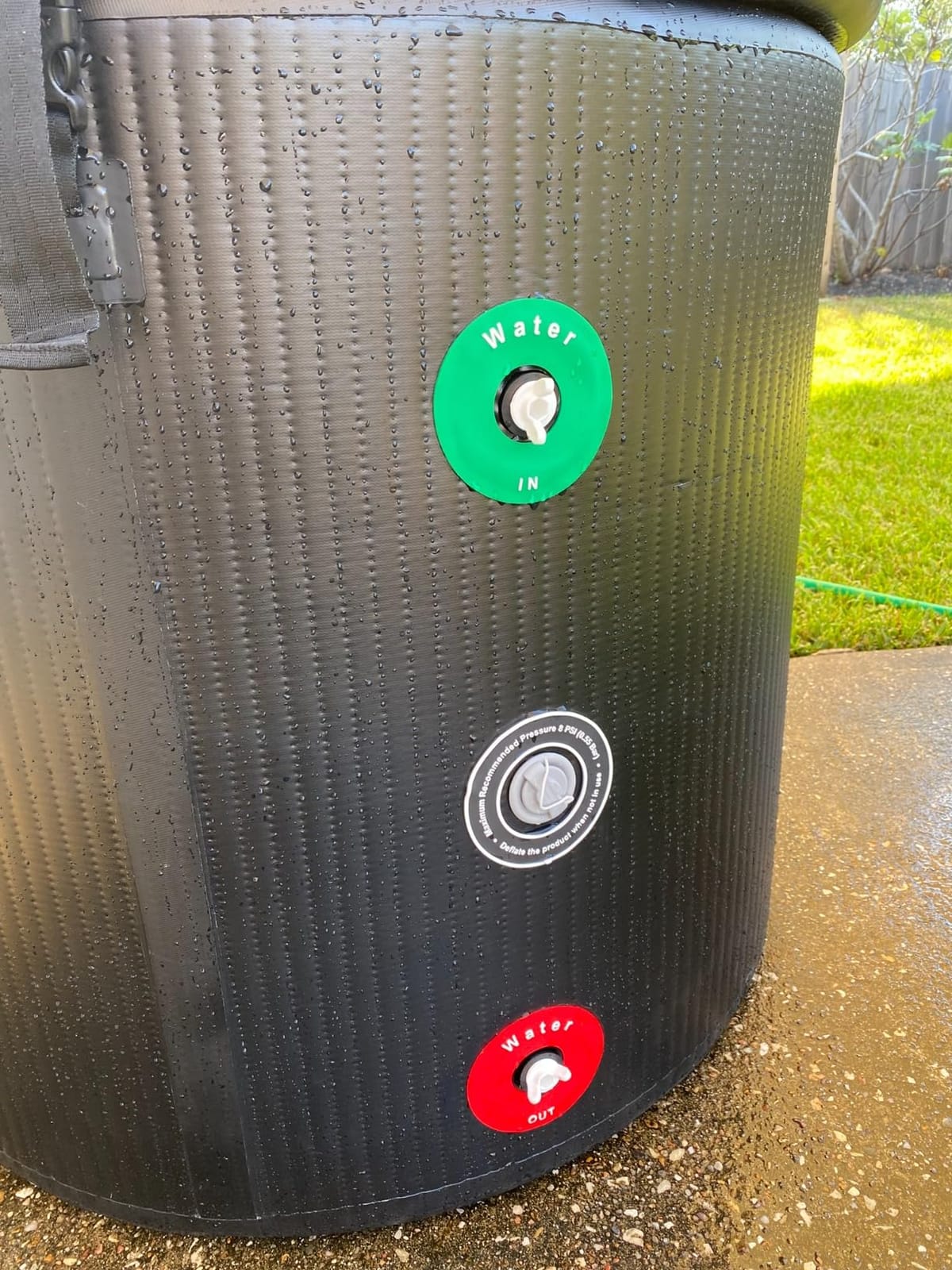
G1/2 inch chiller ports
Fits up to 6 ft 9 in
29.8 lbs packed
+ Pros
- Largest review base we found
- Standard G1/2 inch ports work with most chillers
- Roomy enough for full-body immersion at 6 ft 9 in
- Light at 29.8 lbs and folds flat
- Drop-stitch fabric rated from minus 4F to 140F
- Cons
- Chiller sold separately
- Sharp objects can puncture the walls
With 365 reviews behind it, the VEVOR oval is the most thoroughly owner-tested tub we found, and that body of feedback is unusually consistent about the two things that matter: it is roomy, and it accepts a chiller without modification. Standard G1/2 inch ports and included adapters mean almost any standalone cold plunge chiller will connect, and the ports can be sealed back up if you go back to ice.
At 216 gallons it is among the largest tubs in the roundup, rated for adults up to six foot nine. That rating is the differentiator for tall athletes, who routinely report the failure mode of short upright barrels: feet hanging above the waterline with no full submersion.
Size, Capacity and Full-Body Immersion
The 59 by 31.5 by 29.9 inch oval holds enough water for a genuine full-body plunge at that height. Owners describe firm, deformation-resistant walls that do not bulge when you lean into the side, which is exactly the complaint we hear about cheaper inflatables under daily use.
A tub this size also means more water to cool. If you pair it with a small chiller, expect a long first cooldown, and size the compressor for the gallons rather than for the tub you wish you had.
Chiller Compatibility and What You Have to Add
Because no chiller is included, the horsepower decision is entirely yours. The G1/2 inch fittings are standard, so a 1/3 HP unit handles a temperate garage, while 1/2 HP or more is the safer bet for a hot climate or a tub this large. The air pump, carry bag, repair kit and two port sealing kits are all in the box.
Insulation is adequate rather than exceptional. Expect water to warm between sessions in summer unless a chiller is running or you keep the insulated lid on.
Portability Trade-offs Over Daily Durability
At 29.8 pounds this is genuinely easy to move between a garage and a patio, which no rigid tub in this roundup can match. The trade is the one forum regulars always name: drop-stitch fabric punctures, seams that creep, and liners that warp under sustained daily use.
Keep it away from barbells with loose plates, dog claws and workshop tools, and patch it early with the included kit rather than letting a pinhole grow.
3. REZVANI Frozin 400 Cold Plunge Tub with Chiller – Best for Hot Climates and Rigid Durability
Frozin 400 Cold Plunge Tub with Water Chiller. Foam Insulation for Superior Ice Retention over Uninsulated Barrel or Inflatable Ice Baths. 100 Gallon Capacity (Cold Plunge Tub With Chiller)
100-gallon foam-insulated tub
0.8 HP chiller to 37F
20-micron filter
Roto-molded in the USA
+ Pros
- Foam insulation holds cold far better than inflatable designs
- 0.8 HP chiller reaches 37F
- 20-micron filtration and 650 GPH pump included
- Rigid shell will not lose air pressure
- Built in the USA with responsive owner-level support
- Cons
- Chiller controls and display take practice
- Later pump and chiller revisions changed fittings for servicing
- WiFi module stopped cycling the chiller for one owner
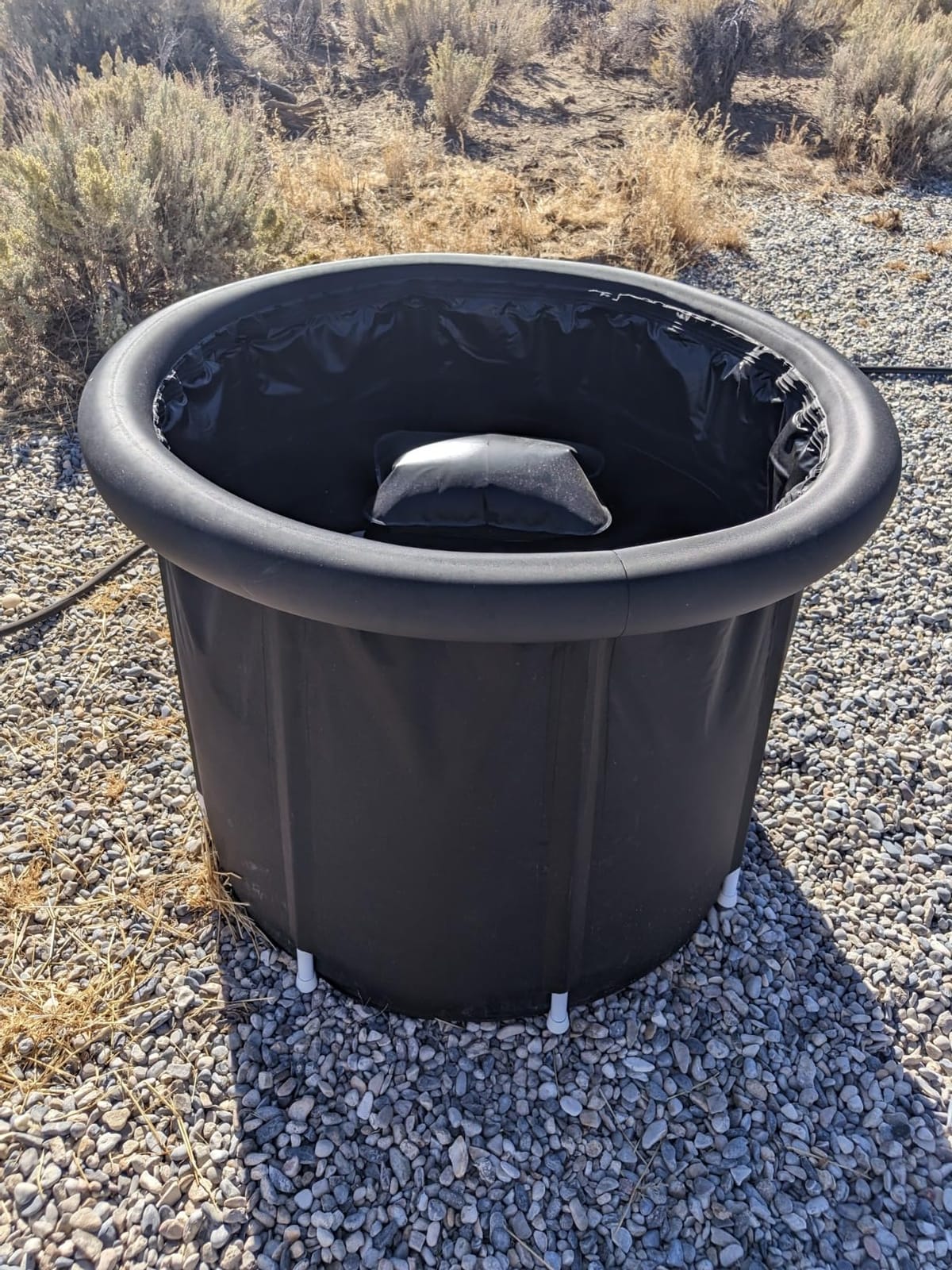
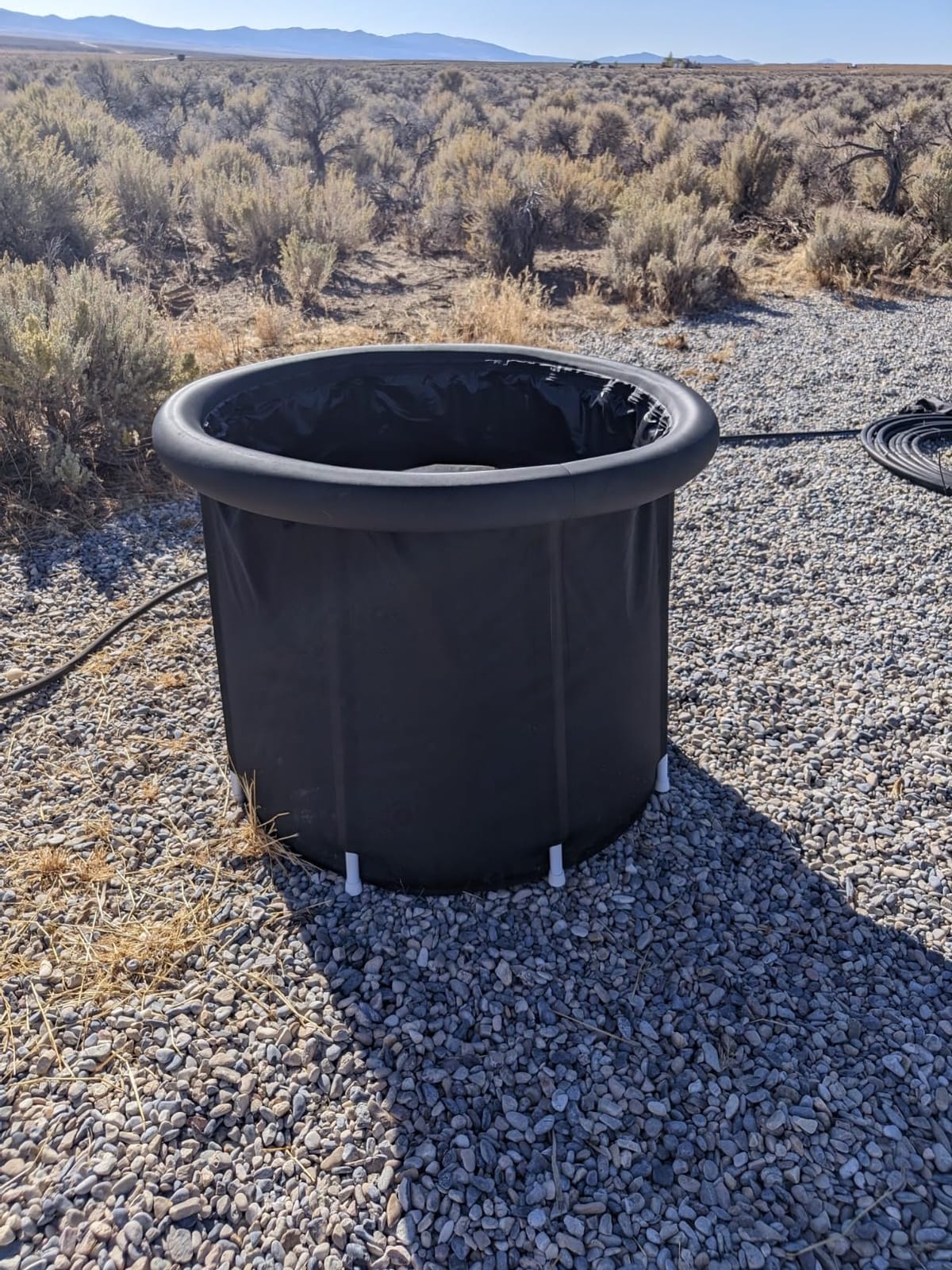
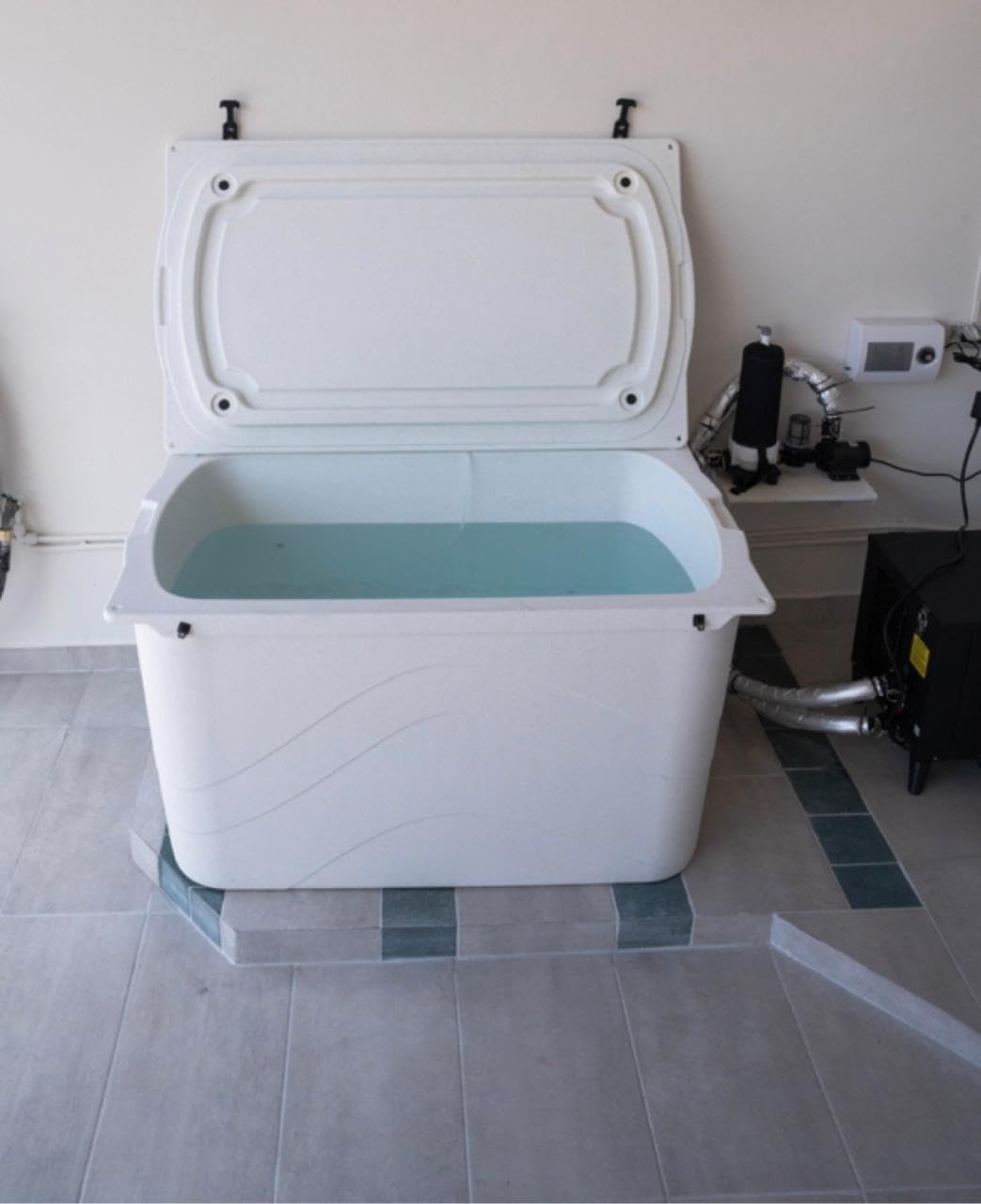
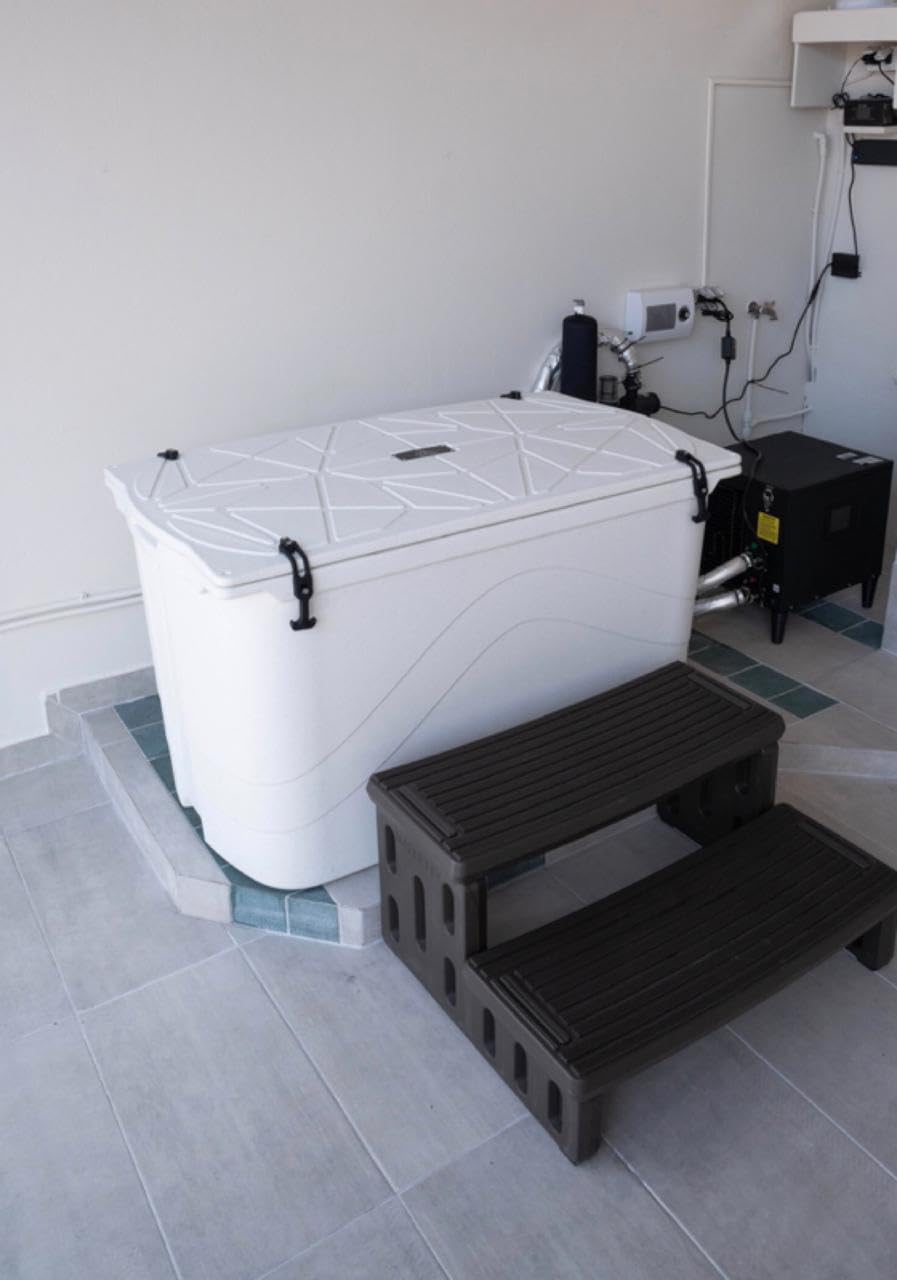
Insulation is the reason to look at this tub, and owners say so without prompting. A fully foam-insulated, roto-molded shell does not lose shape, does not leak air, and holds its set temperature in climates where an inflatable warms up in a single sunny afternoon. If you have already lived through one summer with a soft-sided plunge, the change in daily consistency is the entire upgrade.
The 0.8 HP chiller cools to 37 degrees, and the tub holds 100 gallons, roughly 400 quarts, for users up to six foot three and 300 pounds. That is a shorter height rating than the two inflatable picks above it, so check your own height against it before buying.
Foam Insulation and Cold Retention
The foam layer is the structural difference, not a comfort feature. Owners in tropical climates report holding set temperature where comparable inflatables needed constant ice or a chiller running on high. Rigid also means no daily reinflation and no seam creep, which removes the two failure modes that push owners from inflatable tubs to rigid ones after a season or two.
At 28 by 48 by 28 inches and 90 pounds, this is a permanent fixture. Plan the pad accordingly.
Chiller and Circulation Package
With chiller orders, a 20-micron water filtration system and a 650 GPH pump are included, so filtration is not an afterthought. A 650 GPH pump moves water through the whole 100-gallon volume faster than a small circulation pump, which matters for even temperature and even sanitation.
The caveat in owner feedback is the chiller interface rather than the cooling. Several buyers describe the controls and documentation as confusing, and one reports the WiFi module stopped waking the chiller. The seller is repeatedly praised for resolving issues within an hour, which is the mitigation that matters most here.
Who This Tub Is Not For
At six foot three and 300 pounds, it is a mid-size tub, not a tall-athlete tub. Athletes above that height should look at the 216-gallon ovals. It is also a fixed installation, so it is a poor fit for anyone who needs the plunge to travel with them.
4. RECOVEREX 90-Gallon Cold Plunge with 0.8 HP Chiller – Best for Fast Cooldown and Portable Setups
Recoverex Cold Plunge Tub, 90 Gallon, 0.8 Horsepower – Heavy-Duty Ice Bath Tub for Athletes, Portable Cold Plunge Chiller with Water Treatment Kit, Immersion Therapy, WiFi Control, Backpack & Wheels
0.8 HP chiller
37F in under four hours
90 gallons
Wheels and backpack
+ Pros
- Fastest stated cooldown in the roundup at under four hours to 37F
- Highest average rating of the ten picks at 4.9 stars
- App and WiFi programming for set temperature and start time
- Built-in wheels and a backpack make it genuinely portable
- Lockable cover keeps unsupervised children out
- Cons
- 90 gallons is the smallest tub with a chiller here
- Some units developed leaks at connections or the chiller
- Filter change diagram missing from the documentation
This is the pick to beat on speed. The 0.8 HP chiller drives 90 gallons down to 37 degrees in under four hours, which means a Friday night fill can be a cold tub by lunchtime Saturday rather than the following evening. For athletes with a compressed window between training blocks, that turnaround is the feature that decides it.
It also carries the highest average rating in the field, with no one-to-three-star reviews among the 33 we analyzed. Owners consistently mention cooling speed, app control, portability and the fact that support is run by the owner, who answers quickly and sends replacement parts and filters.
Portability, Wheels and the 15-Minute Setup
Quick 15-minute inflation, built-in wheels and an included carry bag mean this is a genuine mobile unit. You can roll it out of a garage in the morning and back under cover before a storm, or take it to a second property without a truck.
It weighs 87 pounds, which is manageable but not casual. The high-pressure canvas and IPX4 water-resistant construction are built for outdoor placement, though the manufacturer advises storing it indoors when temperatures drop below 36 degrees.
Filtration and the Water Treatment Kit
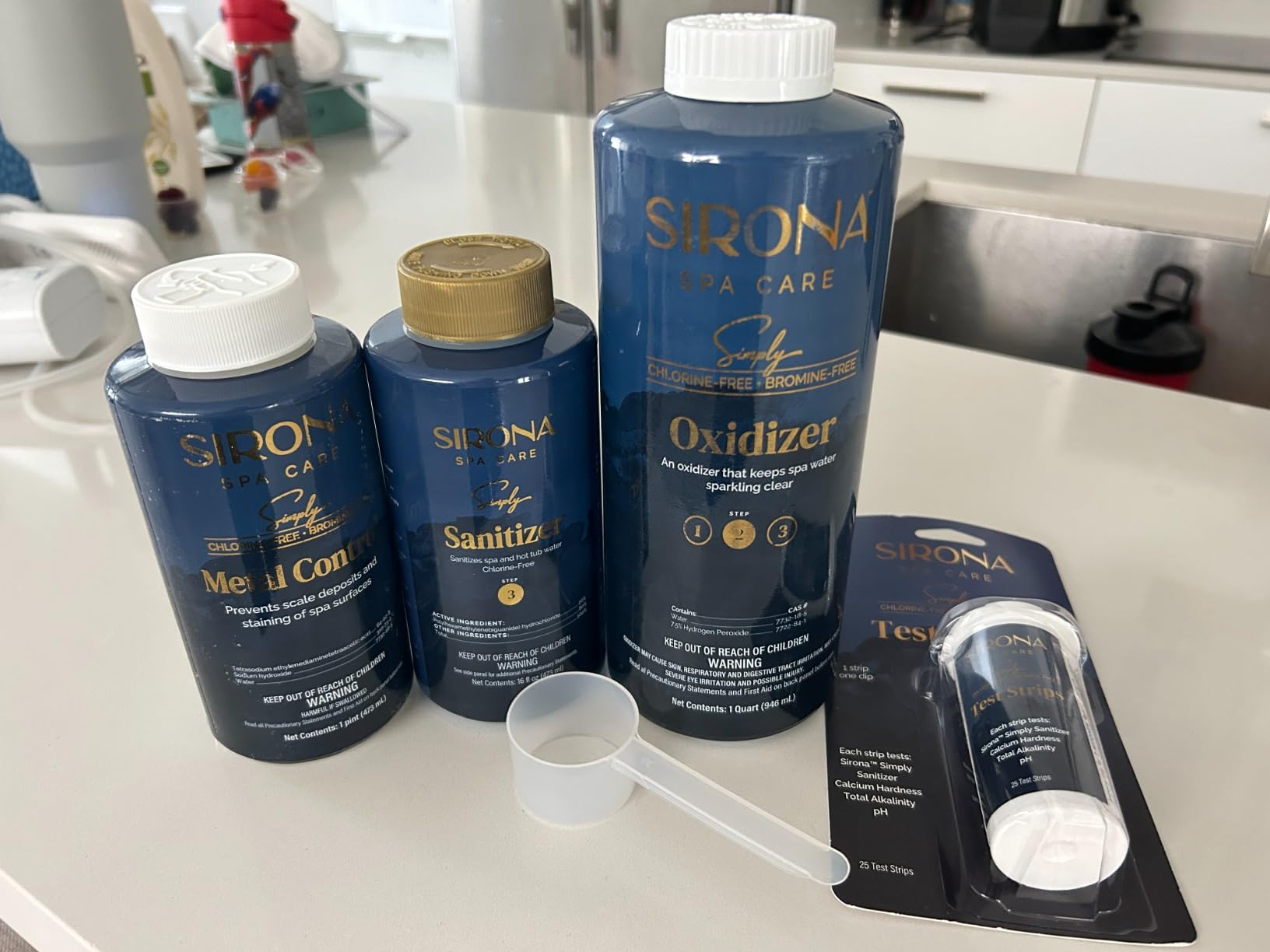
Two-step filtration with non-chlorine water treatment, a six-month water kit and two spare filters are included. Non-chlorine chemistry matters if you share a tub with skin sensitivities, and it avoids the chlorine smell that turns some people off cold water entirely.
Two owners reported leaks at connections or at the chiller itself, resolved with replacement parts. The documentation also omits a filter change diagram, so look up the interval before you need it.
Size Reality Check at 90 Gallons
This is the smallest tub in the roundup that ships with a chiller, and that is a real constraint. A six foot two user reported full submersion, but anyone taller should treat the 90 gallons as a limit and look at the 100-gallon or 121-gallon options.
5. AudaciaGo XXL 216-Gallon Ice Bath Tub – Best for Outdoor Setups With Full-Size Depth
XXL Ice Bath Tub for Athletes, Compatible with Water Chillers, 216-Gallon Inflatable Cold Plunge Tub with Insulated Lid, Thermometer, Water-Absorbent Mat, Portable for Outdoor & Indoor Recovery
216-gallon oval
1/2 inch chiller ports
Fiberglass and PVC
Insulated clamped lid
+ Pros
- Roomy enough for 6 ft 7 in and 300 lb users to fully immerse
- Three-layer bottom construction resists leaks
- Chiller connects to built-in inlet and outlet ports
- Insulated lid with four clamps blocks leaves and debris
- Folds flat for garage storage
- Cons
- Some units report slow air leaks at the seam
- Pump lacks a reverse setting to purge air for storage
- Minor chemical smell reported on arrival
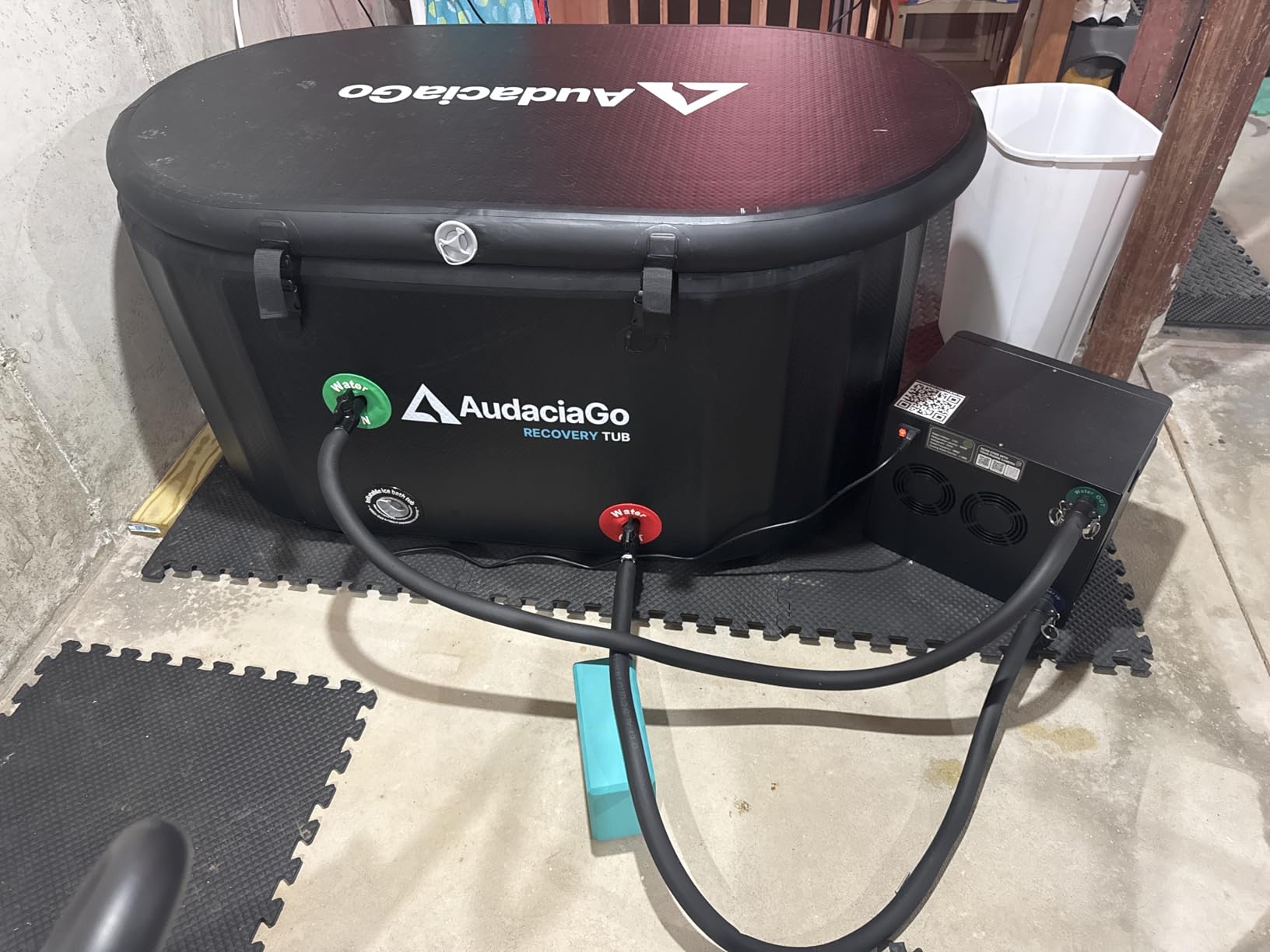
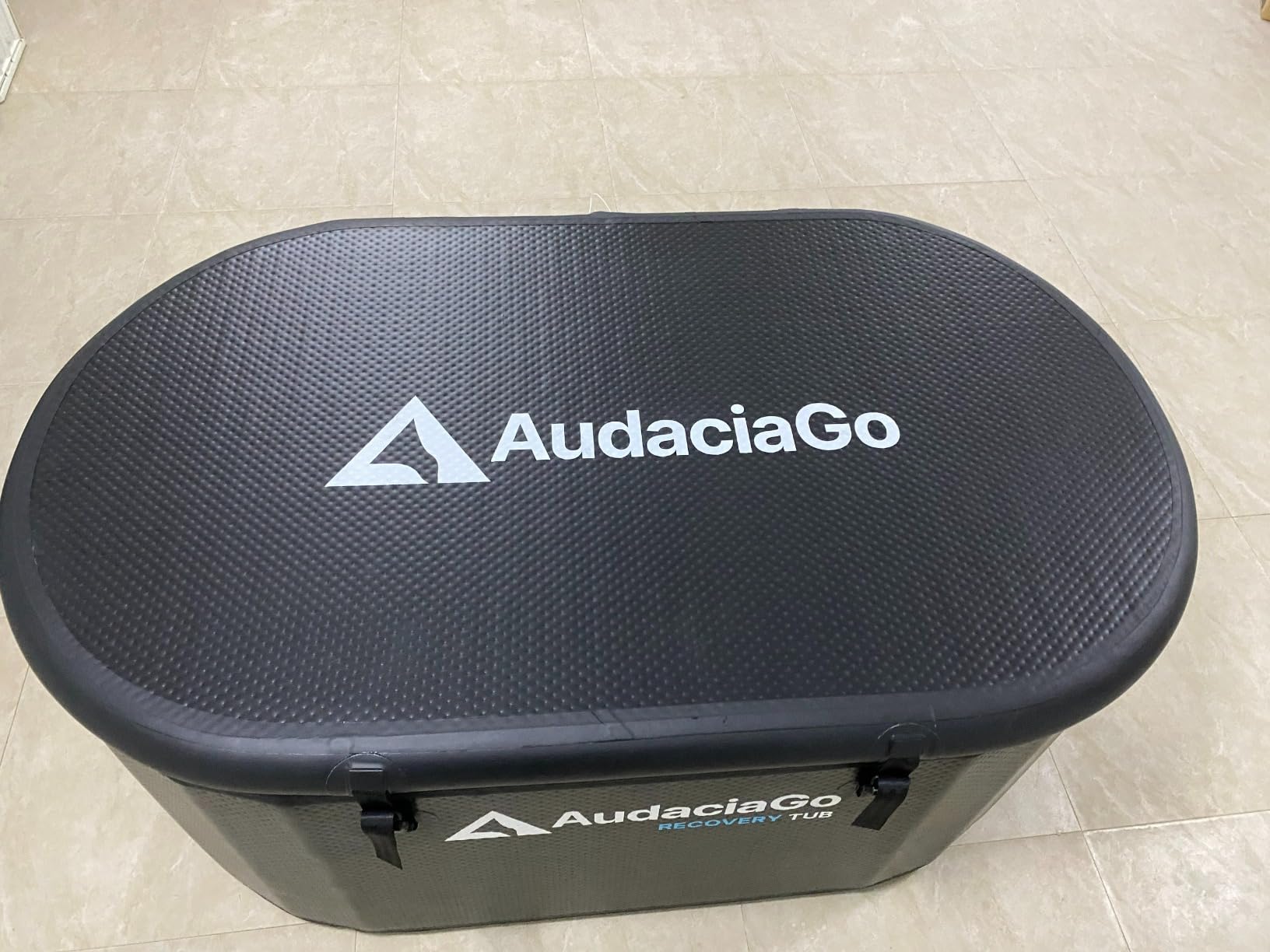
AudaciaGo rates well for tall athletes building a first system. It is a 216-gallon oval rated for six foot seven and 300 pounds, which puts it in full-immersion territory for nearly every athlete, and the reinforced fiberglass and PVC build with a tear-resistant polyester outer layer feels more substantial than the price suggests.
Owners confirm the chiller connects to the built-in half-inch inlet and outlet ports, and that the insulated lid with four heavy-duty clamps keeps the water cold and keeps leaves out, which matters more for an outdoor setup than most listings admit.
Three-Layer Bottom and Seam Integrity
Three-layer tub bottom construction is the detail that separates this from a single-layer inflatable, and owners report it resisting leaks under daily use. The caveat is a minority of reports of slow air leaks at the seam requiring re-inflation, which is the same durability question every inflatable carries.
Weighing 35 pounds, it inflates in under five minutes with the included air pump. The air pump has no reverse setting, so you cannot vacuum remaining air out before storage, which means the tub takes more closet space deflated than it strictly needs to.
Port Sizing and Chiller Sizing for 216 Gallons
Half-inch ports are close to universal across standalone chillers in this category, so matching is simple. The real work is horsepower: 216 gallons is a large water volume, and a 1/3 HP unit will feel slow in a warm garage. Budget for a 1/2 HP or larger chiller if you want reliable holds.
Also consider the accessories in the box: lid, carry bag, water-absorbent mat, thermometer and patch kit. The mat matters more than it sounds, because water dripping off a 35-pound tub creates a slip hazard on a garage floor.
Support and the First-Week Experience
Some buyers report a minor chemical smell on arrival, which normally clears after one fill and drain cycle. The company founder personally intervenes when issues come up and sends replacements, which is unusual responsiveness at this tier.
6. 1stplunge 148-Gallon Chiller and Tub Kit – Best for Home Gyms and Noise-Sensitive Spaces
Ice Bath Chiller & 148Gal Cold Plunge Tub Kit for Cold Recovery Therapy
1/3 HP chiller to 42F
About 40 dB
148-gallon oval
20-micron filter
+ Pros
- Only pick in the roundup with a published noise figure at roughly 40 dB
- All-in-one kit needs no separate chiller purchase
- External 20-micron filter with simple cartridge swaps
- 7-layer reinforced PVC with EPE insulation
- Submersible pump also works with a standard bathtub
- Cons
- 42F floor is warmer than most athletes want
- Chiller and tub arrive in two separate packages
Compressor noise is the deal-breaker that people discover after installation, and this is the only kit in the field that publishes a number: roughly 40 dB, rated for continuous indoor or backyard operation. If your plunge lives in a home gym next to a bedroom, that specification alone can decide the purchase.
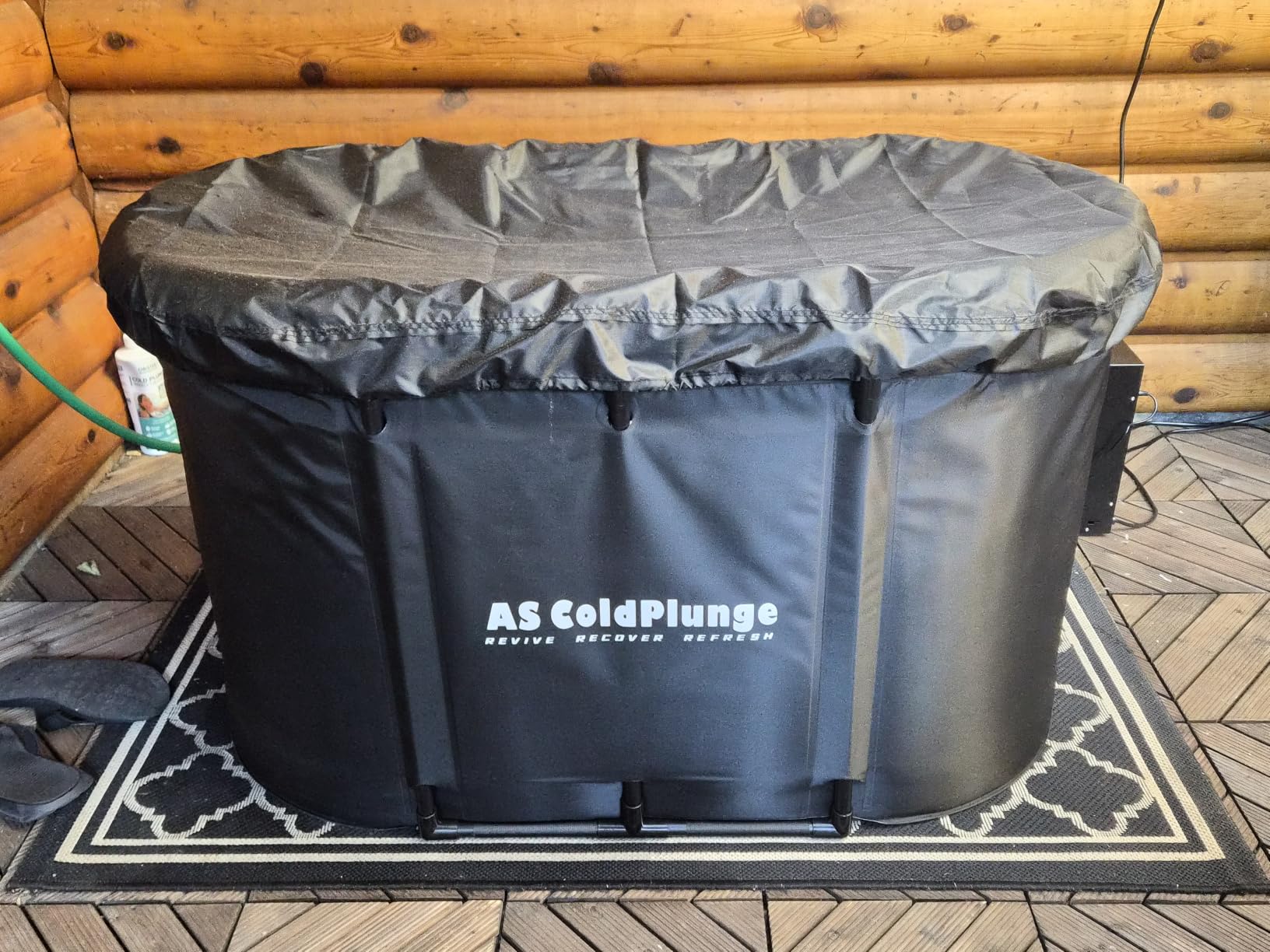
The kit pairs a 1/3 HP chiller with a 148-gallon oval tub built from seven layers of reinforced PVC, Oxford fabric and thick EPE insulation. A smart touchscreen handles temperature, and the included submersible pump means you can run the same chiller into a standard bathtub, which is a low-cost way to test whether cold exposure is a habit you want to keep.
The 42 Degree Floor and What It Means for Sessions
A 1/3 HP chiller lands at 42 degrees rather than the sub-40 range most chiller-backed picks here reach. That is still genuinely cold and still a full contrast stimulus, but it is a milder session than a 37-degree tub, and it matters if your program is built around colder exposures.
At 20.8 pounds, the chiller unit is light and easy to reposition, which is a real advantage if you are moving it between a garage and an outdoor pad.
Insulation, Filtration and Water Care
Seven layers of reinforced PVC with Oxford fabric and thick EPE insulation hold cold better than a single-layer drop-stitch wall. The external 20-micron filter captures hair and debris with simple cartridge swaps, which is the fastest-maintenance sanitation option in this roundup.
Note the distinction forum regulars make: a filter removes debris, it does not kill organisms. Pair cartridge changes with a non-chlorine water treatment additive and you can extend your water-change interval considerably.
Two-Box Shipping and Setup
The chiller and tub arrive in two separate packages and may reach you on different days, which is a minor annoyance that catches people out when they plan a weekend install. The air pump, insulated lid, carry bag and repair materials are all included, and inflation takes only a few minutes.
7. DIVEBLAST Cold Plunge Chiller with Pump and Filter – Best Standalone Chiller with a 24-Month Warranty
Diveblast Cold Plunge Tub With Water Chiller, Pump and Filter – Low Consumption 2/3 HP Cold Plunge Chiller – Cools Water Down to 39°F
2/3 HP standalone chiller
Cools to 39F
1500 GPH pump
24 month warranty
+ Pros
- 24 month warranty covering chiller
- pump
- filter and connectors
- Runs only 20-30 minutes per hour once at temperature
- 1500 GPH pump and filter included
- Insulated hoses
- connectors and tools all in the box
- Cools from 90F to 39F in 3-9 hours
- Cons
- No tub included
- Cooldown time varies with ambient temperature and water volume
- Setup experience is where the 4.2 rating comes from
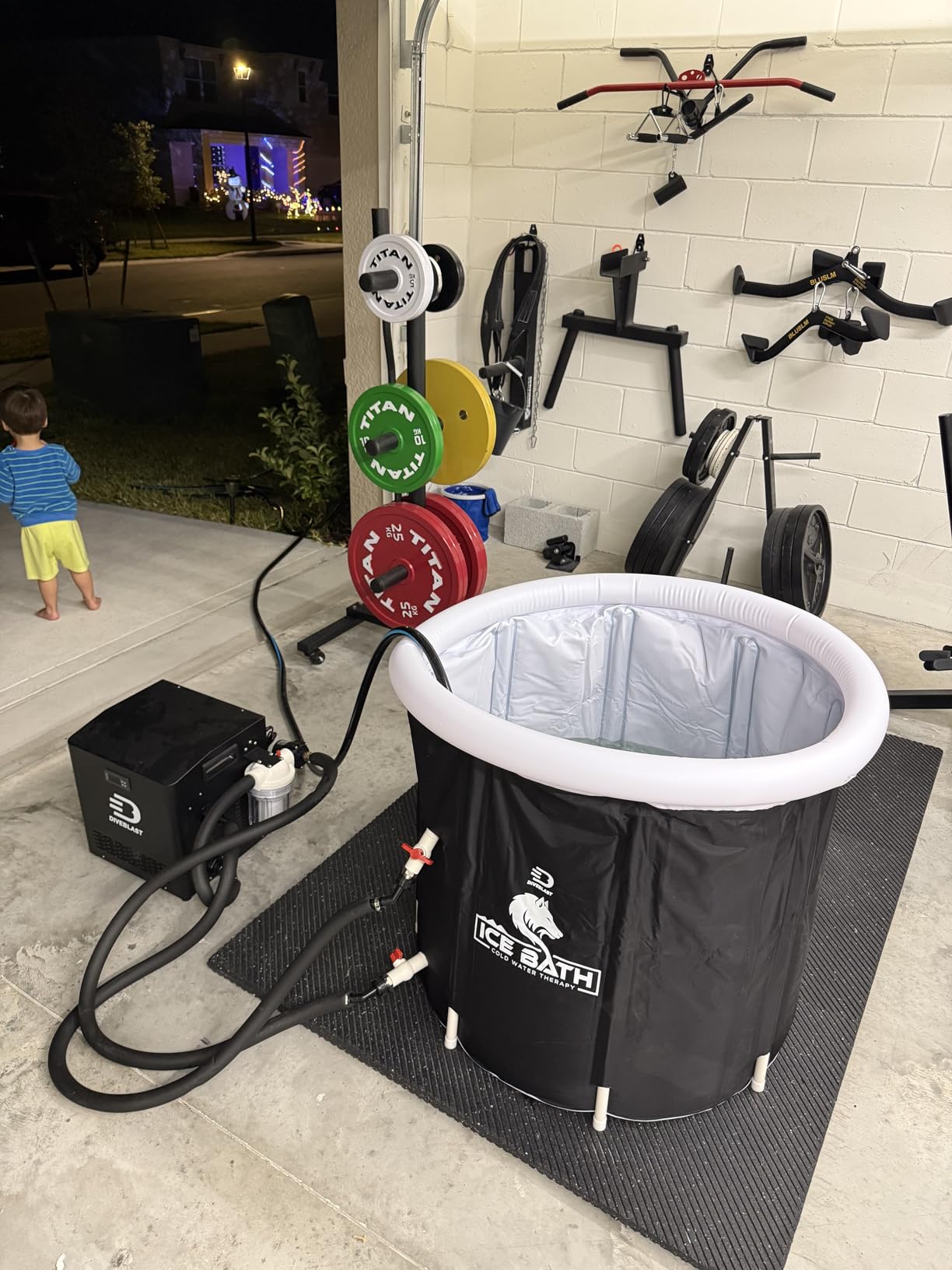
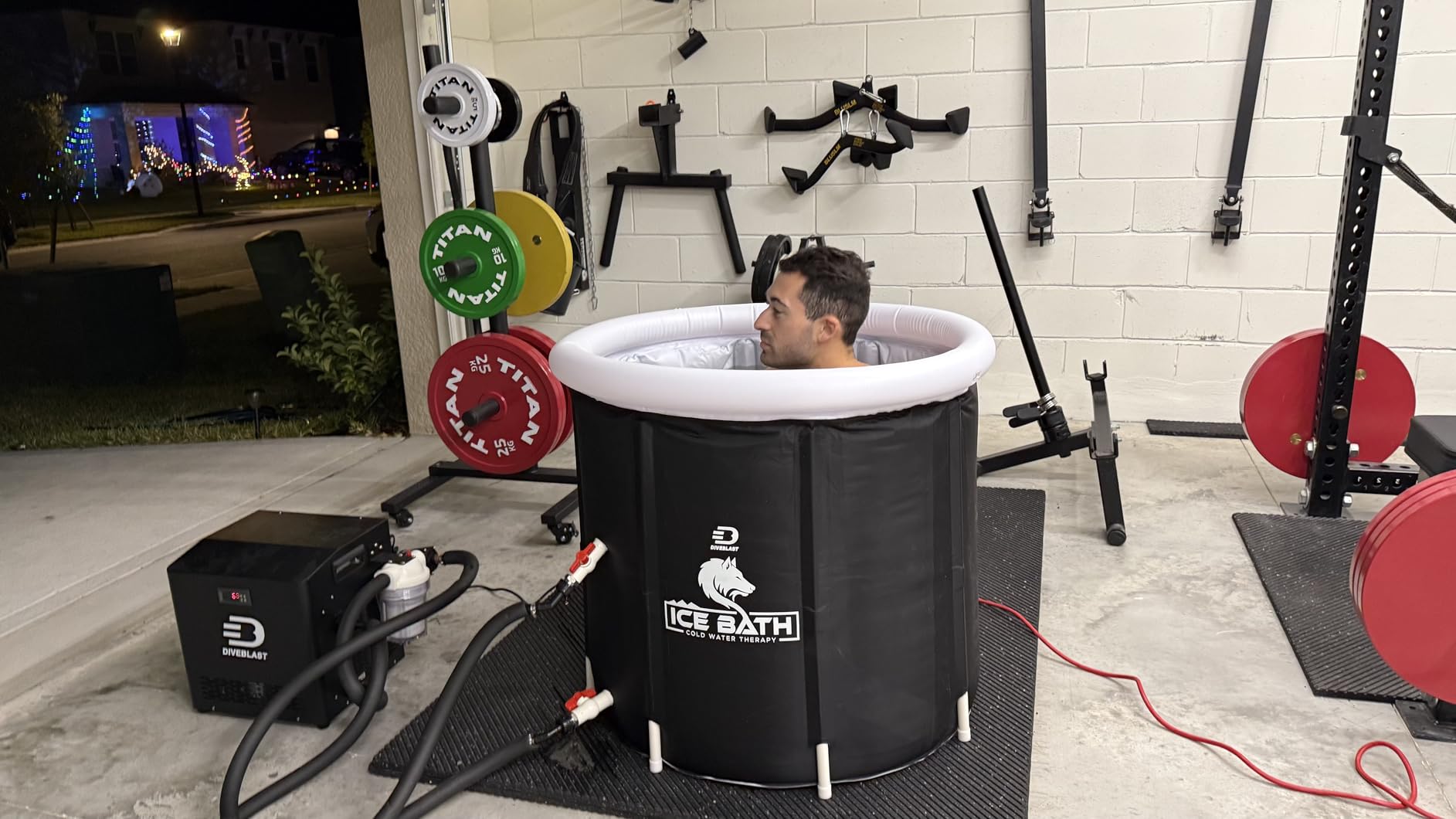
If you already own a chiller-compatible tub, or want to add cooling to a bathtub or a barrel, this is a standalone 2/3 HP chiller with everything downstream of the compressor in the box. The 1500 GPH circulation pump, filter, insulated hoses, connectors and tools are included, so the only thing you still need is a vessel with inlet and outlet ports.
It pulls water from 90 degrees down to 39 degrees in three to nine hours depending on ambient temperature and volume, and once there it runs only 20 to 30 minutes per hour. That duty cycle is the number to look at when you are comparing run cost, because a chiller that cycles at a third of the hour changes the electricity math substantially.
Why the 24-Month Warranty Matters
Warranty length on the chiller itself is treated as a major quality signal by owners, and this is the only pick here offering 24 months across the chiller, pump, filter, connectors and all included components. Everything else in the roundup sits at one year or states no component-specific coverage.
That matters more than it first appears, because the compressor is the wear component in this whole category. A chiller that fails at month 20 with no parts path ends your practice, and a tub you cannot chill is an expensive bucket.
Horsepower Sizing for Large Water Volumes
Two-thirds HP is a sensible middle ground. It handles a large 200-plus gallon tub in a warm room better than a 1/3 HP unit, while staying well below the draw of a full 1 HP machine on a standard 120V circuit. Owners using 1/3 HP in hot garages consistently report they cannot hold temperature, and that is the sizing mistake to avoid.
Allow clearance around the unit for airflow. Owners running 1/2 HP and larger units in hot garages report needing generous ventilation to hit rated performance.
What the 4.2 Rating Reflects
The rating reflects the setup experience and variable chill times rather than the hardware, with 9 percent of reviews at one star. Read the spec, not the star, here: the cooling capacity, the duty cycle and the warranty are all strong, and the friction is in the first hour of assembly.
8. PLUNGE MAGIC Inflatable Cold Plunge Tub XXL – Best Starter Tub for a First Chiller Setup
Inflatable Cold Plunge Tub for Athletes, Water Chiller Compatible, XXL
216-gallon oval
Compatible with most external chillers
Insulated walls and cover
Fits up to 6 ft 6 in
+ Pros
- 216-gallon oval fits up to 6 ft 6 in
- Reinforced fiberglass with thick multi-layer PVC
- Insulated walls and cover slow warming
- Inflates in under five minutes
- Includes drain hose
- carry bag and repair kit
- Cons
- Some units lost air pressure within days
- Walls began to bulge after weeks of daily use
- Heats fast in direct sun without a chiller
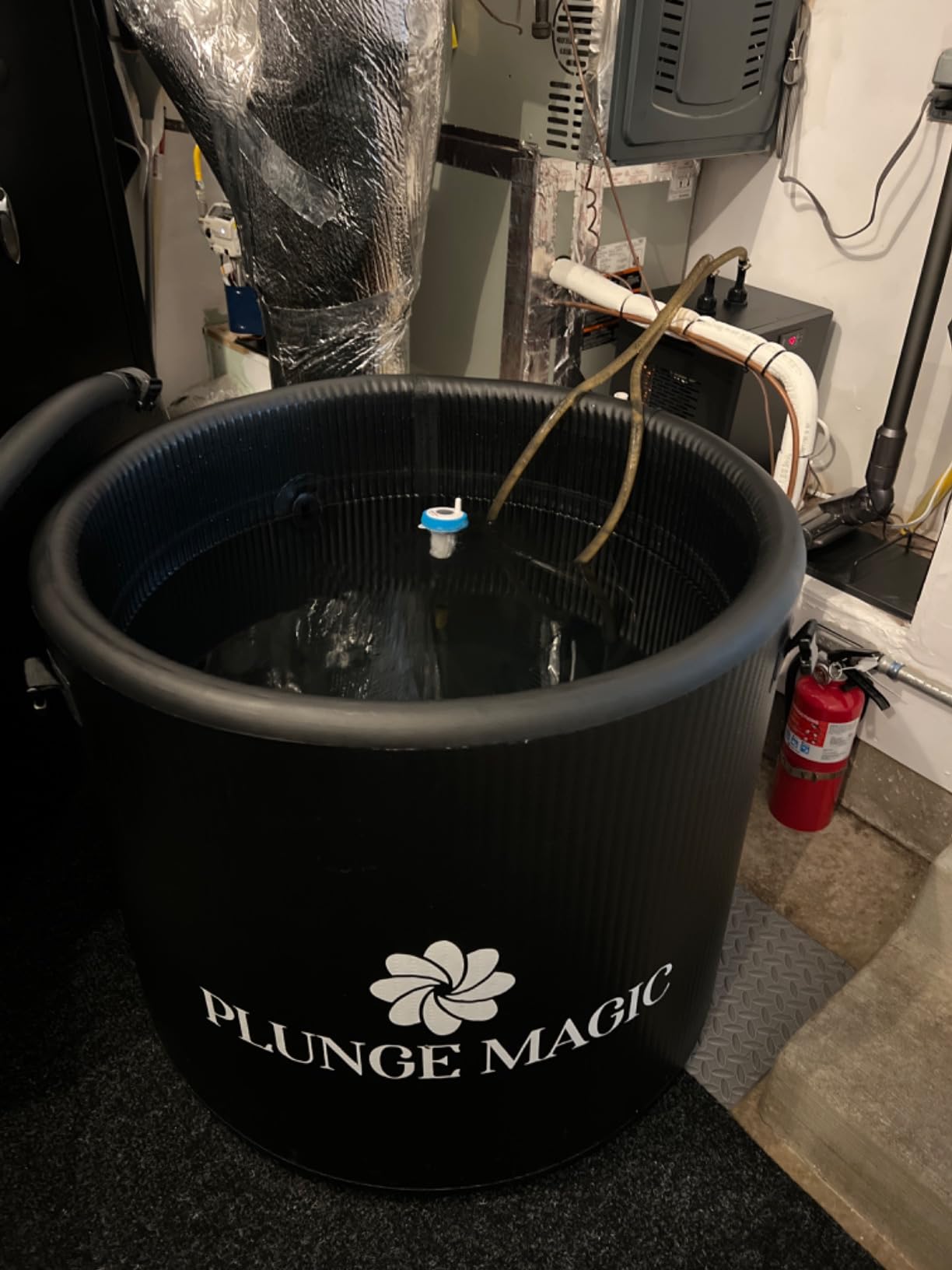
Plunge Magic is the tub to buy if you already know a chiller is the missing piece in a budget build. The 216-gallon oval is compatible with most external water chillers, and users pair it with a low-cost aftermarket unit to get a working setup without committing to a bundled kit.
Users report real therapeutic benefit for inflammation and pain, along with firm walls that have no give once inflated, and an insulated cover that noticeably slows water warming. A six foot two, 190 pound user reports full submersion, and the tub is rated to six foot six.
Durability Under Daily Athlete Use
This is the pick with the split durability feedback. Several reviews describe the tub losing air pressure within days or walls beginning to bulge after weeks of daily use, and 10 percent of reviews are one star. That is the pattern owners describe when they move from inflatable to rigid after a season or two.
Build quality on day one is good, with reinforced fiberglass, thick multi-layer PVC and a durable air chamber. The question is month three, and the answer here is uncertain enough that we rank it eighth.
Direct Sun and the Chiller Decision
In direct outdoor sun, this tub heats up quickly and needs substantial ice if no chiller is running. That is the argument for pairing it with a chiller from day one rather than starting with ice and adding cooling later.
Measure the 59 by 30 by 31 inch footprint with the cover open before you commit, because the insulated cover needs clearance to seat properly and that space is not always obvious on a patio.
Setup and Accessories
It inflates in under five minutes with the included high-pressure air pump, and the drain hose, carry bag and repair kit are all included. Fast setup matters for habit formation, since the same friction that kills an ice habit kills a tub habit too.
9. AS ColdPlunge 1/3 HP Chiller and 148-Gallon Tub Kit – Best Budget All-in-One Kit
AS ColdPlunge Ice Bath Chiller & Cold Plunge Tub Kit, 1/3HP Cold Plunge Chiller with Built-in Pump & Filter, Upgraded XXL 148Gal Ice Pod, Cold Plunge Tub with Water Chiller for Cold Therapy Recovery
1/3 HP chiller to 42F
148-gallon oval
Washable metal mesh filter
10 mm EPE insulation
+ Pros
- Chiller and tub in one kit with direct inlet and outlet connection
- Reusable washable metal filter avoids disposable cartridges
- 10 mm EPE insulation with a support frame
- Submersible pump allows use with a standard bathtub
- Support troubleshoots over video within a day
- Cons
- Insulation underperforms in warm months
- Difficult rim assembly reported even months later
- 12 percent of reviews are one star
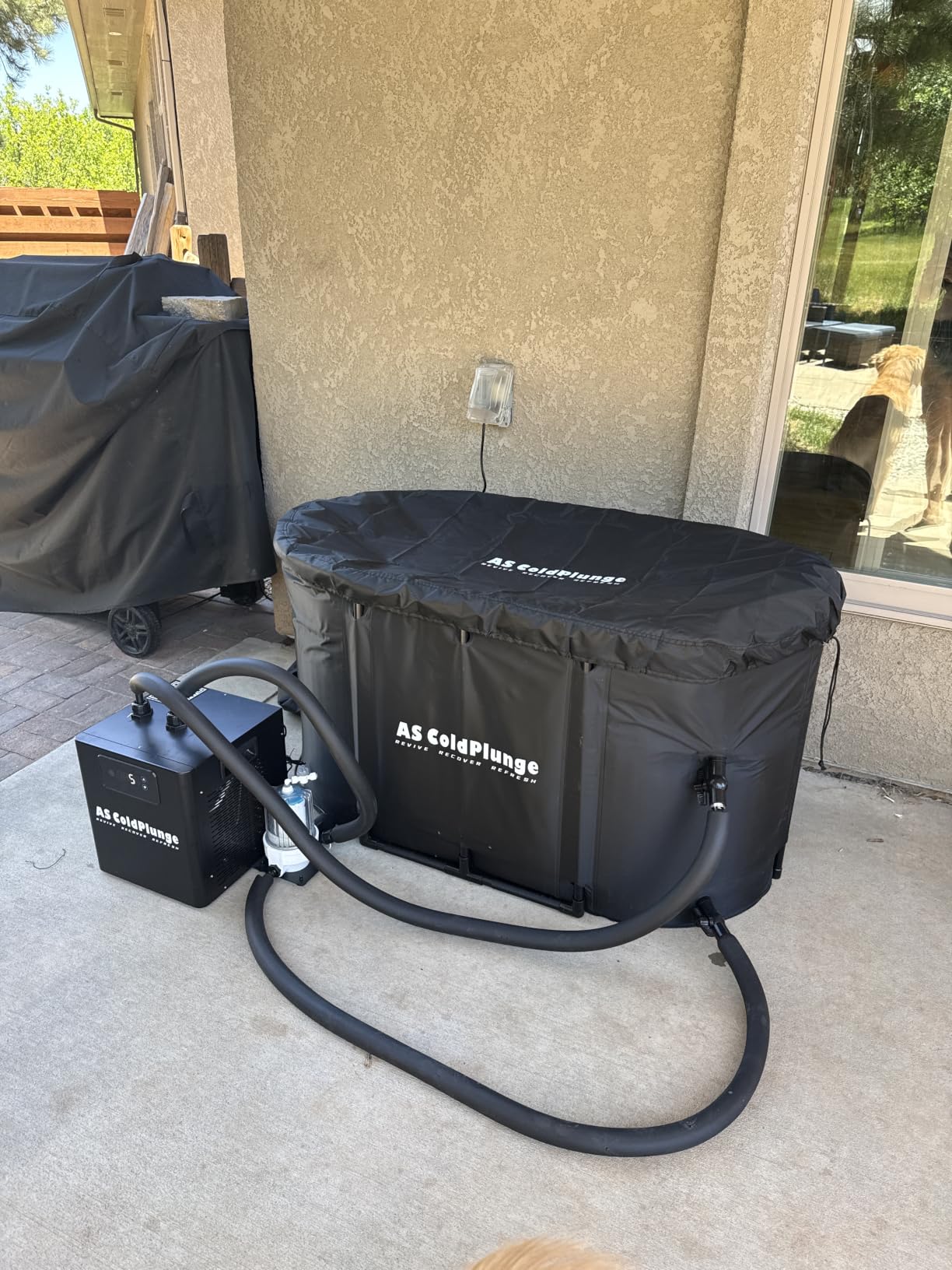
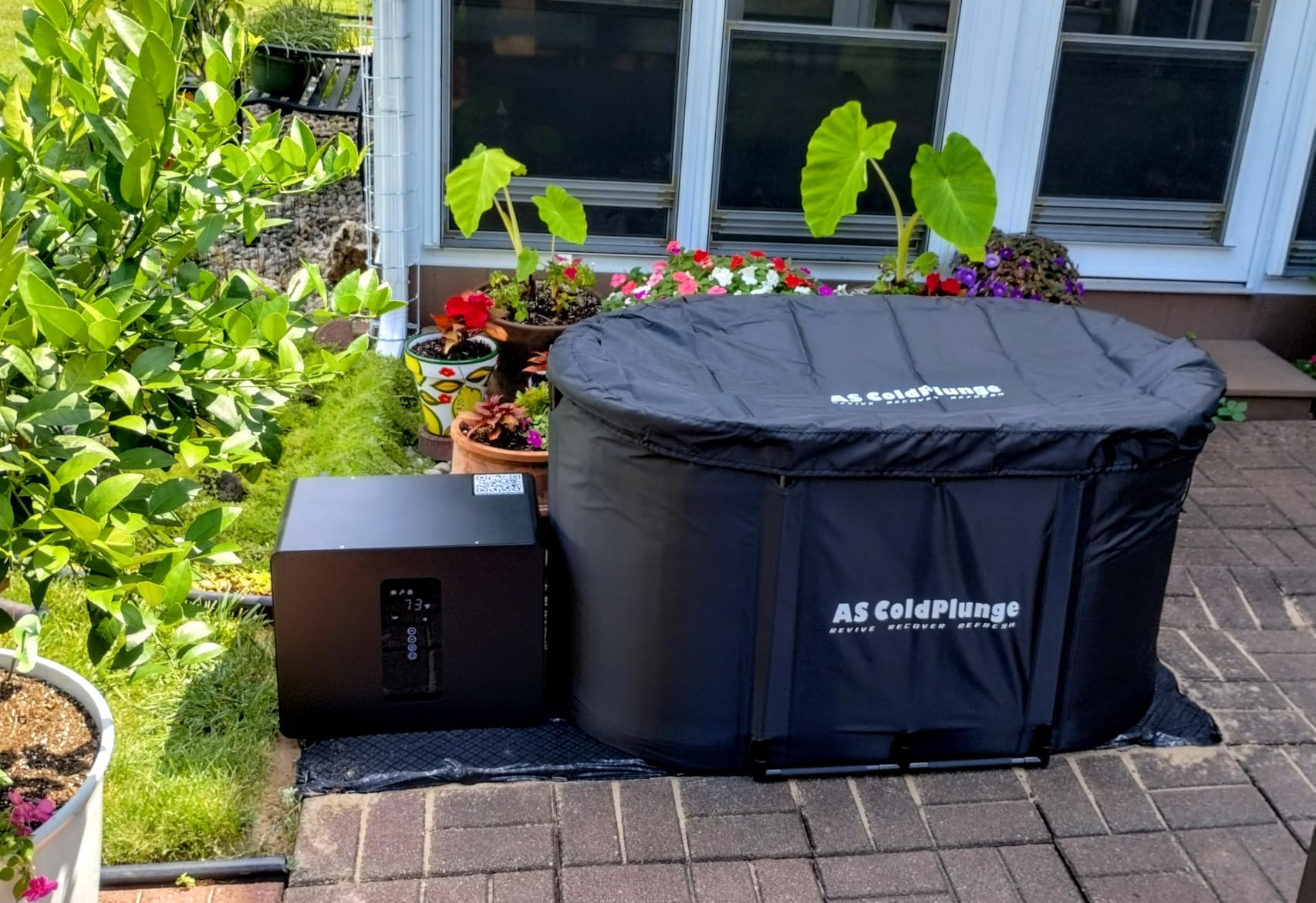
AS ColdPlunge bundles a 1/3 HP chiller with a 148-gallon oval tub, insulated lid, hand pump, repair kit and portable storage bag. The chiller has an LED touchscreen and holds water at 42 degrees, and the connection to the tub is direct through the built-in inlet and outlet ports with insulated hoses and quick-connect fittings.
Two details stand out for owners. The built-in circulation pump uses a reusable washable metal mesh filter, so there are no disposable cartridges to keep buying, and the included submersible pump lets the same chiller service a standard home bathtub, which is the most sensible way to test the habit before committing to a tub.
Insulation Reality in Warm Climates
One owner measured 55 degrees in summer and 40 in winter from the same setup, which is a clear statement about the 10 mm EPE insulation. If your tub lives outdoors in a warm climate, this is the weak point, and the answer is a cover, shade, and a chiller that runs more rather than less.
The tub does have a support frame, which keeps the shape firmer than a frameless inflatable, and a 148-gallon oval is a reasonable size for a single user.
Rim Assembly and First-Setup Friction
The rim assembly is reported as very difficult even after several months of ownership, and 12 percent of reviews are one star, the highest critical share in this roundup. One buyer never got the tub usable at all. Budget an extra evening for assembly.
The offsetting factor is support. Owners describe the team troubleshooting over video and responding within the stated 24-hour window, with a one-year warranty behind it.
10. AKSPORT 151-Gallon Ice Bath Tub – Best for Small Spaces and Lightweight Setups
AKSPORT Ice Bath Tub for Athletes, 151 Gallons Inflatable Cold Plunge Tub Compatible with Water Chillers, Icebath for Recovery & Cold Water Therapy, Portable Bathtub for Indoor & Outdoor-Wood
151-gallon inflatable
Inlet and outlet for a chiller
20 lbs packed
Non-slip base
+ Pros
- Only 20 pounds
- so it moves between indoor and outdoor easily
- Water inlet and outlet make chiller hookup straightforward
- Reinforced fiberglass and PVC with an insulated hard inner wall
- Non-slip base stays steady on wet floors
- Also works with ice packs
- Cons
- Chiller not included
- 151 gallons is smaller than the 216-gallon ovals
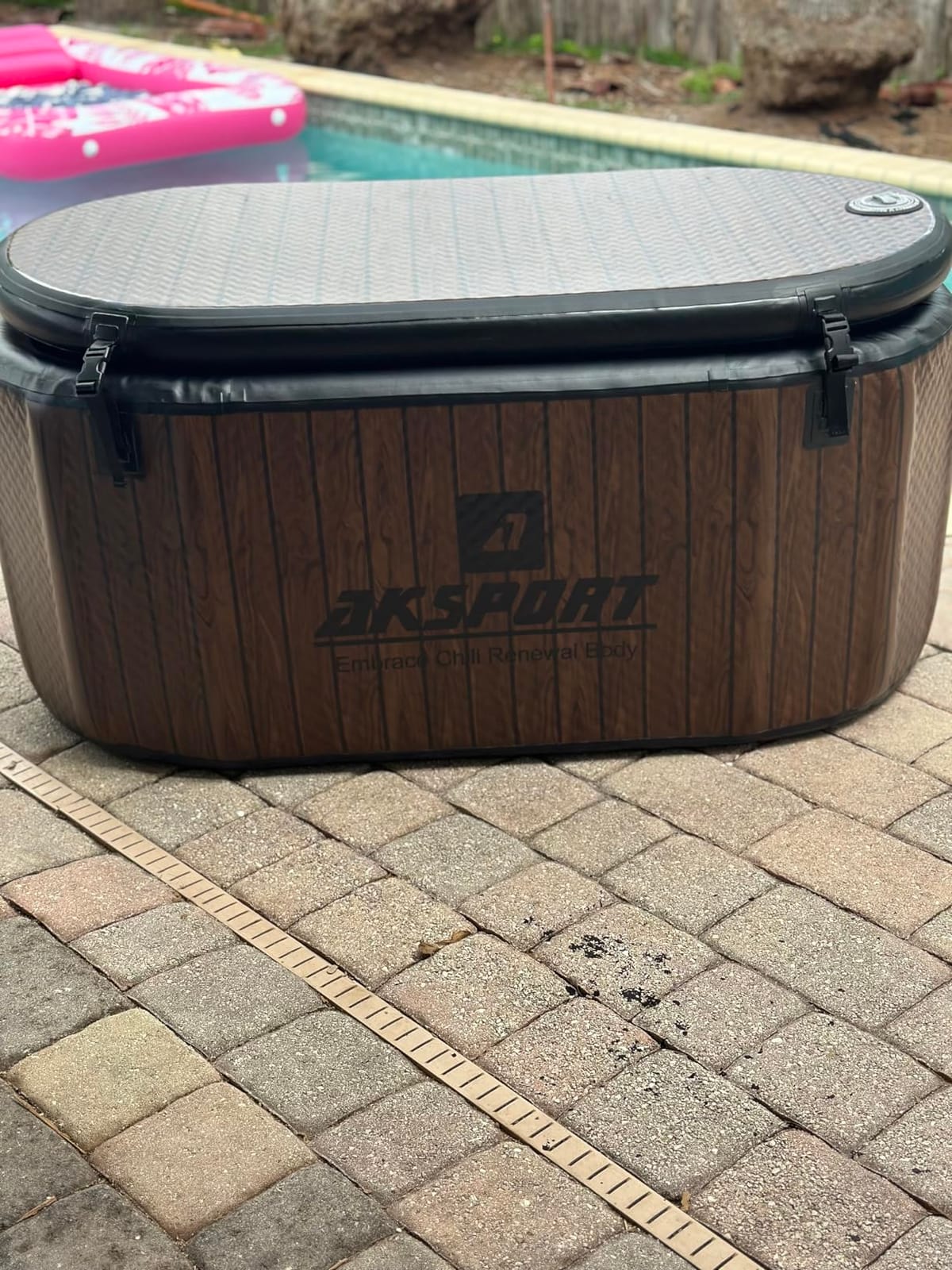
The AKSPORT is the smallest tub here, at 151 gallons, and that is exactly why it is on the list. At 20 pounds it is the lightest unit in the roundup and moves between a garage, a patio and a training camp without a truck, which suits athletes who do not have a permanent installation space.
The water inlet and outlet accept a chiller, and the reinforced fiberglass and PVC build with a skin-friendly PVC inner wall and insulation design feels sturdy once inflated. The non-slip base staying stable on wet floors is a detail worth more than it sounds in a garage gym.
Sizing Trade-offs for Taller Users
At 53 by 27.5 by 24.4 inches, the 151-gallon format will not give a six foot five athlete the same full-body immersion as the 216-gallon ovals. If you are tall, treat capacity as the deciding number here rather than price or weight, and step up to the VEVOR or AudaciaGo.
The manufacturer also offers this design in 151, 154, 224 and 238 gallon versions, so the same product family covers a much larger footprint if you need one.
Chiller Hookup and Ice Flexibility
Because the chiller is not included, you pick the horsepower, and 151 gallons is a volume a 1/3 HP unit can handle in a temperate indoor space. The same ports also work with ice packs, so you can run the tub seasonally without a compressor running at all.
Hand pump setup takes five to ten minutes, which is slower than the electric-pump kits but avoids a second piece of powered equipment.
Durability Signal
Buyers like the light portability, simple setup and chiller ports. Ratings cluster around four stars with 10 percent one-star feedback and several three-star reviews, so expect the same inflatable trade-off the other soft-sided picks carry, just in a smaller footprint.
Cold Plunge Buying Guide: Sizing the Chiller, Not the Tub
Do I need a chiller for a cold plunge tub?
You need one if you intend to plunge more than a couple of times a week, if you want a set temperature without daily ice handling, or if your climate is warm. If you plunge once a week in a mild climate and do not mind bagging ice, a simple barrel and a regular ice run will do the same job. The chiller is not about reaching colder water; it is about reaching the same water, reliably, on the days you actually need it.
Chiller Horsepower Sizing Math
Owners report horsepower confusion as the single biggest source of buyer’s remorse, so here is the working method. Multiply the tub’s gallon capacity by the number of temperature degrees you need to pull out of the water, then adjust for ambient conditions. A 150-gallon tub starting at 80 degrees in a 70 degree garage is removing 1,500 degree-gallons. Doing that in a 95 degree Florida garage roughly doubles the load, because ambient heat keeps feeding the compressor through the tub walls.
The practical mapping is straightforward. One-third HP handles small tubs up to about 100 gallons in a temperate indoor space. One-half HP covers 100 to 200 gallons, or any tub in a warm garage. One HP and above is for large tubs, hot climates and outdoor placement in direct sun. The two complaints that recur most often are buying one-third HP for a hot garage and buying it for a 216-gallon tub, and both failures are sizing errors rather than quality problems.
Temperature Floor and What You Actually Want
The floor matters less than you think. Most athletes land between 45 and 55 degrees for general recovery work, and colder is harder to tolerate, not better. Every kit in this roundup that includes a 1/3 HP chiller bottoms out at 42 degrees, while the 0.8 HP and 1050W units reach 37. If you are training through a heavy block and want the deepest cold you can hold, pay for the larger compressor. If you are building a habit you want to keep for years, 42 degrees is fine.
What a Chiller Costs to Run Each Month
Running cost is easiest to understand in kilowatt-hours rather than currency. A 1/3 HP chiller working near a third duty cycle at roughly 300 watts averages about 70 kilowatt-hours a month. A 1/2 HP unit closer to a half duty cycle at 450 watts lands near 59 kilowatt-hours. A 1 HP compressor cycling harder through a hot summer can reach 90 to 120 kilowatt-hours a month. Multiply by your own utility rate and the number is small in every case.
Against that, daily ice for a large barrel adds up quickly, and it scales with how often you plunge and how warm your climate is. That gap is the entire financial case for a chiller, and it is why forum threads about ice cost shock so often end with someone converting. Add water treatment, filter cartridges and the occasional part, and the difference still holds.
Water Care Between Sessions
Filtration and sanitation are different jobs and one does not replace the other. A micron filter removes hair, skin and debris. Ozone or UV kills organisms. Owners who use only a filter report water going bad between sessions faster than expected, and warm weather makes it worse because a covered but unfiltered tub is a warm, still, nutrient-rich environment.
With a working micron filter plus ozone or non-chlorine treatment, most owners extend water-change intervals to several weeks. Without filtration, weekly changes are the safer assumption. Whichever interval you settle on, put a calendar reminder on it, because a tub that goes bad once loses its habit faster than any temperature problem.
Noise, Clearance and Placement
Only one kit in this roundup publishes a noise figure, at roughly 40 dB, and that absence of data is itself a buying signal. A compressor cycling in a bedroom-adjacent space is a genuine problem, so measure the room before you buy rather than after.
Clearance matters as much as noise. Owners running 1/2 HP and larger units in hot garages report needing generous airflow around the unit to hit rated performance, and a chiller in a sealed corner will underperform its specification. Keep the tub covered when you are not using it, level it on a pad, and plan drainage so condensate and drain water do not become a slip hazard.
Electrical Requirements Before Delivery
Plan the circuit before the unit arrives, because discovering a GFCI requirement after delivery is a common and avoidable frustration. Most units in this category run on a 120V supply, and the larger compressors draw enough that a dedicated circuit is sensible rather than optional. Use a GFCI-protected outlet, skip extension cords, and keep the outlet within reach of the pump and chiller so hoses do not need to stretch across a doorway.
What Breaks First and Whether It Is Repairable
This is the most common unanswered question in owner threads, so here is the honest shortlist. In soft-sided tubs, the failure is almost always the shell: seam leaks, slow air loss, and wall bulge after weeks of daily use. In any setup, the wear component is the chiller’s compressor, and the second most common is the circulation pump. Fittings and quick-connects leak more often than people expect, which is why the kits that include spare connectors and insulated hoses are worth a closer look.
Repairability splits along the same line the rest of the guide does. If you buy a standalone chiller and a chiller-compatible tub, a failed compressor is a unit swap, not a tub replacement. If you buy a fully integrated one-box system, replacing the chiller can mean returning the whole package. Warranty length on the chiller as a component is the number to check, and one pick here covers 24 months across chiller, pump, filter and connectors while the rest sit at one year or are unspecified.
Athlete Plunge Protocol and Safety
Cold water immersion is a cardiovascular stressor, not a recovery tool with a safety rating. Anyone with known heart conditions, uncontrolled blood pressure, a history of fainting, Raynaud’s disease, or a pregnancy should get clinician sign-off before buying a tub, and that conversation costs nothing compared to the alternative.
Cold Shock on Entry
Your first gasp on cold entry is involuntary. Cold shock triggers a spike in breathing rate, heart rate and blood pressure in the first minute, and it is the mechanism behind most cold-water drownings of otherwise healthy swimmers. It fades quickly, which is why it is dangerous: the second plunge feels easier and people enter faster.
Never hold your breath on entry. Get in slowly, exhale through the whole submersion, and give yourself two to three minutes of shallow breathing before sitting down. Athletes who have done this properly a few times report the response attenuating noticeably within a week or two of consistent exposure.
Temperature Ladder by Experience Level
Start warm. Beginners should work at 50 to 55 degrees for one to three minutes per session, two to three times a week, and stay near the steps or a handrail. Intermediate athletes can move to 45 to 50 degrees for three to five minutes. Advanced swimmers and athletes already adapted to cold can work at 40 to 45 degrees for five to ten minutes, though longer is not better and the field of evidence for a benefit past ten minutes is thin.
Never plunge alone as a beginner, and keep sessions under ten minutes even when the tub is colder than you expected. Hypothermia in a 45 degree tub is slower and less obvious than people assume.
Timing Relative to Training
Post-workout is the standard use and the one with the clearest rationale: cold water immersion targets soreness and perceived recovery in the hours after hard training. The honest complication is hypertrophy, since repeated immediate post-lifting immersion can blunt strength and muscle-building adaptations over a training block. Many athletes therefore take a post-workout plunge on hard conditioning days and skip it after strength sessions.
Pre-workout plunges of two to three minutes at moderate temperature are used mainly for mental readiness rather than recovery. For rewarming after the session, get out and warm gradually with dry clothing and movement rather than jumping straight into a hot shower.
Contrast Therapy Pairing
Pairing a cold tub with a sauna is popular and reasonable, with one limitation: the hot side needs its own heater. None of the units here heats water, so a hot-cold cycle means adding a separate heater, and that addition changes both the electrical and the safety picture. Start with one cold session before building a room around it.
Frequently Asked Questions
Do I need a chiller for a cold plunge?
You need one if you plan to plunge more than a couple of times a week, want a repeatable set temperature, or live in a warm climate. A chiller is not about reaching colder water than ice, it is about reaching the same temperature on demand without a 20-minute ice routine before every session. If you plunge weekly in a mild climate, a barrel and monthly ice will do the same job.
How much power does a cold plunge chiller use?
A 1/3 HP chiller cycling about a third of the time averages roughly 70 kilowatt-hours a month, a 1/2 HP unit lands near 59 kilowatt-hours, and a 1 HP compressor in a hot climate can reach 90 to 120 kilowatt-hours. Multiply by your own utility rate and the figure stays small. Daily ice for a large barrel adds a far larger recurring cost, which is why owners switch to chillers.
1/2 HP vs 1/3 HP cold plunge chiller, which do I need?
One-third HP handles small tubs up to about 100 gallons in a temperate indoor space. One-half HP covers 100 to 200 gallons, or any tub in a warm garage, and 1 HP is for large tubs, hot climates and outdoor placement in direct sun. The most common buyer’s mistake is choosing one-third HP for a large tub or a hot garage and then never holding temperature.
Should I leave my cold plunge chiller on all the time?
Between frequent sessions, yes. A chiller that holds a cold set temperature runs on a duty cycle, using the compressor 20 to 30 minutes per hour in most cases, which is far cheaper than reheating cold water from ambient every time you plunge. If you are away for a week or more, switch it off, drain the tub if you can, and clean the filter before you return.
Why is my cold plunge chiller making a loud noise?
Common causes are a chiller installed without enough clearance for airflow, a vibrating or worn circulation pump, a loose fitting in the hose run, or a failing compressor bearing. Start by checking clearance and tightening every fitting. If the noise is a rattle or grind that changes with pump speed, the pump or compressor is the likely culprit and the unit needs service.
How often should I change cold plunge water?
Without filtration, change the water weekly. With a working micron filter plus ozone or non-chlorine treatment, most owners extend that to every three to six weeks. A filter removes debris but does not kill organisms, so sanitation still matters, and warm weather shortens every interval. Set a calendar reminder, because water that goes bad once ends the habit faster than any temperature problem.
What size cold plunge tub do I need for a tall athlete?
For a full-body immersion at six foot five or taller, you want roughly 200 gallons or more. The 216-gallon ovals in this roundup are rated up to six foot nine, while 100-gallon and 148-gallon tubs top out closer to six foot two or six foot three. Check that you can submerge shoulders, torso and legs together, not just sit in cold water.
Is cold plunge safe for heart conditions?
Cold water immersion is a cardiovascular stressor that triggers a real heart rate and blood pressure response on entry. Anyone with a known heart condition, uncontrolled blood pressure, a history of fainting or Raynaud’s disease should get clinician sign-off before starting. Never plunge alone as a beginner, never hold your breath on entry, and keep early sessions short at moderate temperatures.
Which Cold Plunge Tub With a Chiller Should You Buy?
If you want one answer, the JUGRFIT 121-gallon kit with its 1050W chiller is the most complete system we found, and owners confirm it holds temperature in genuinely hot conditions. If you are tall and want the most square footage for the least commitment, the VEVOR 216-gallon oval fits athletes up to six foot nine and accepts nearly any chiller you add. If soft-sided walls have already failed you once, the REZVANI Frozin 400 is the rigid foam-insulated answer that will not lose its shape.
Two questions decide everything else. How often will you actually plunge, and how warm is the room it will live in? Answer those honestly and the horsepower follows, which is why the chiller matters more than the tub in the best cold plunge tubs with chillers for athletes we tested. Before you commit, talk to a clinician if you have any cardiac or blood pressure history, and start at moderate temperatures for short sessions.