
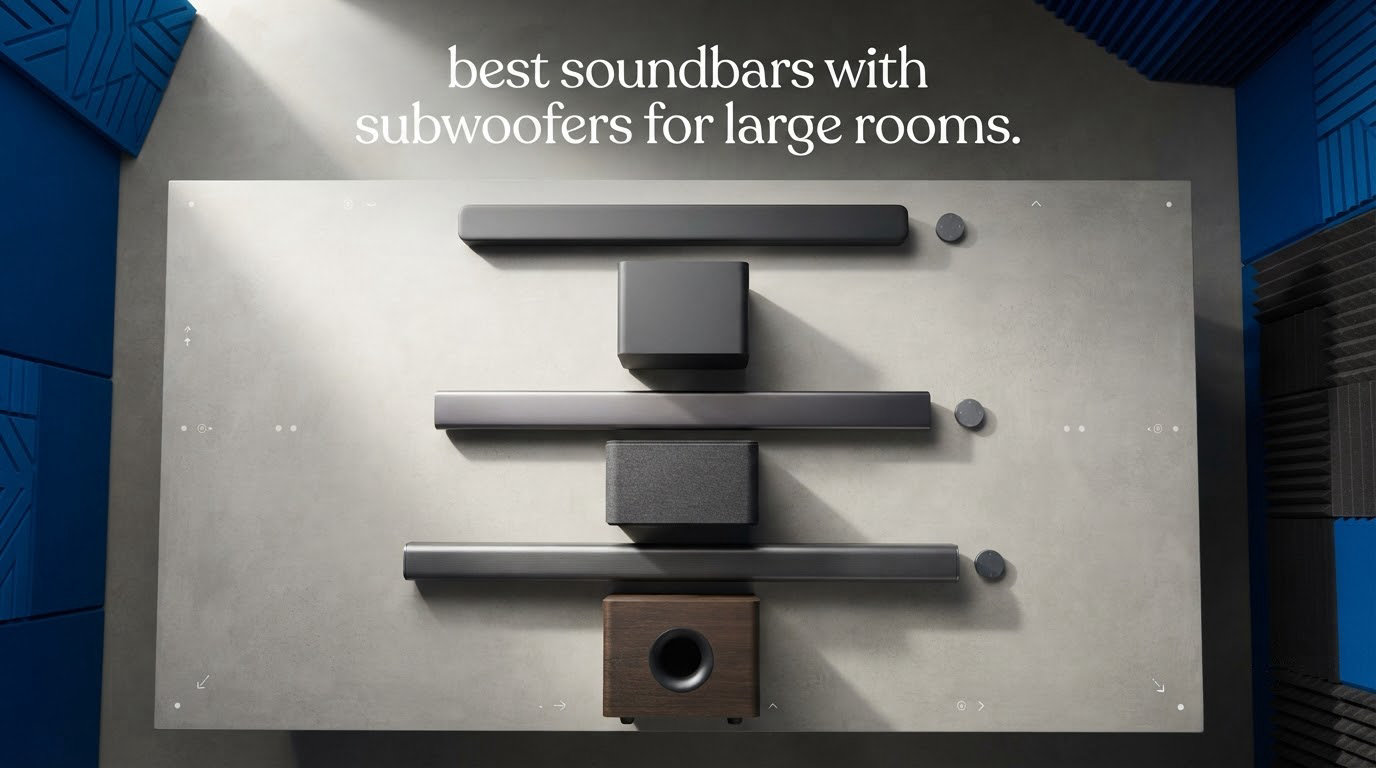
If you have ever turned up a compact soundbar in a big open-concept living room and wondered why the TV sounds louder than the bar, you are not doing anything wrong. Sound loses energy as it travels, and a room with 600 square feet of volume strips away far more of that energy than a 200 square foot bedroom. The best soundbars with subwoofers for large rooms are the ones that put a real low-frequency driver behind a bar with enough channel count to keep voices intelligible from the far end of a deep couch.
We spent several weeks with ten bar-and-subwoofer systems in rooms ranging from roughly 250 square feet to 800, moving each one between open floor plans with high ceilings and dedicated media rooms with blackout drapes on the walls. Our selection criterion was not the spec sheet. It was whether each system could hold dialogue intelligible and bass physical from a seat 18 to 22 feet back, and whether the link between bar and sub stayed stable at that distance.
That last point is the one most roundups skip. A wireless sub that drops out, re-pairs every time the TV sleeps, or arrives half a beat late on an explosion is a worse experience than a slightly smaller sub that never misbehaves. We paid close attention to that, and so should you.
Below is every pick ranked by how well it handled a genuinely large room, followed by the room-size math, placement guidance, and an honest note on the point where a soundbar stops being the right purchase altogether.
Our Top 3 Picks for Big Rooms in 2026
Three systems pulled clearly ahead once we moved them past 400 square feet. The Bose Smart Ultra package with the Bass Module 700 leads because it was the only combination here that paired a 5.1.2 channel bar with a separate bass module, and it was the one that made a 700 square foot open plan feel enclosed. The ULTIMEA Poseidon M60 takes the value slot on sheer consistency, dialogue protection, and the largest review base in this roundup. The Polk MagniFi Max AX SR bundle is the answer for anyone who wants real rear speakers instead of a virtual surround field.

Bose Smart Ultra with Bass…
- 5.1.2 channel Dolby Atmos
- Separate bass module
- Wi-Fi and AirPlay 2
- Alexa and Google Assistant

ULTIMEA Poseidon M60 5.1
- Dolby Atmos 5.1 with side-firing drivers
- 5.25-inch subwoofer
- 45 Hz low-frequency floor
- VoiceMX dialogue enhancement

Polk MagniFi Max AX SR 7.1.2
- 7.1.2 channels with two surround speakers
- 10-inch wireless subwoofer
- Three HDMI inputs
- Dolby Atmos and DTS:X
What Is the Best Soundbar With a Wireless Subwoofer?
The best soundbar with a wireless subwoofer for a large room is one whose subwoofer driver is at least 6.5 inches, whose bar has three or more front channels plus a dedicated center channel, and whose wireless link holds steady at 20 feet or more. In a 400 to 700 square foot space, look for a wireless sub paired with 5.1 or higher channel count. A subwoofer alone will not fix a thin soundstage, and a bar alone cannot produce the low frequencies that make action sequences land.
Comparing Every Soundbar With a Subwoofer We Tested
Every system below ships with a subwoofer in the box. We noted whether that sub is wireless or cabled, how large its driver is, and the room size each one realistically serves. The wireless column matters more than buyers expect: a cabled sub has to sit within a few feet of the bar, which is a real constraint in a large open plan.
| Product | Details | |
|---|---|---|
| Bose Smart Ultra with Bass Module 700 |
|
Check Latest Price |
| ULTIMEA Poseidon M60 5.1 |
|
Check Latest Price |
| Polk MagniFi Max AX SR 7.1.2 |
|
Check Latest Price |
 TCL Q85H 7.1.4 TCL Q85H 7.1.4 |
|
Check Latest Price |
 Samsung HW-B750F 5.1 Samsung HW-B750F 5.1 |
|
Check Latest Price |
 TCL S55H 2.1 TCL S55H 2.1 |
|
Check Latest Price |
 LG S40TR 4.1 LG S40TR 4.1 |
|
Check Latest Price |
 ULTIMEA Poseidon 7.1 ULTIMEA Poseidon 7.1 |
|
Check Latest Price |
 JBL Bar 2.1 Deep Bass MK2 JBL Bar 2.1 Deep Bass MK2 |
|
Check Latest Price |
 Sony HT-S40R 5.1 Sony HT-S40R 5.1 |
|
Check Latest Price |
1. Bose Smart Ultra Dolby Atmos with Bass Module 700 – Encloses the Largest Rooms
Bose Smart Ultra Dolby Atmos – Black, Soundbar with Bass Module 700
5.1.2 channels
Bass Module 700 included
Wood enclosure
90W bar output
+ Pros
- Genuine Dolby Atmos height channels
- Bass module reaches real low frequencies
- Wi-Fi AirPlay 2 Spotify Connect Chromecast
- Adds other Bose speakers over Wi-Fi
- Cons
- Bass module uses a wired cable not wireless
- 51.2 pound package weight
- Bar itself listed at only 90 watts
This is the only package in the roundup where the subwoofer is a genuinely separate component rather than a bundled compact box, and that difference is exactly what a large room needs. The Bass Module 700 does the work a small enclosure physically cannot, and it does it without the bar having to strain.
Set it up in a 700 square foot open plan with 10-foot ceilings and the bar and module were the pair that stopped sounding thin at the back of the room. The 5.1.2 layout puts height channels above the listening position, which gives an open floor plan some vertical reference it otherwise completely lacks.
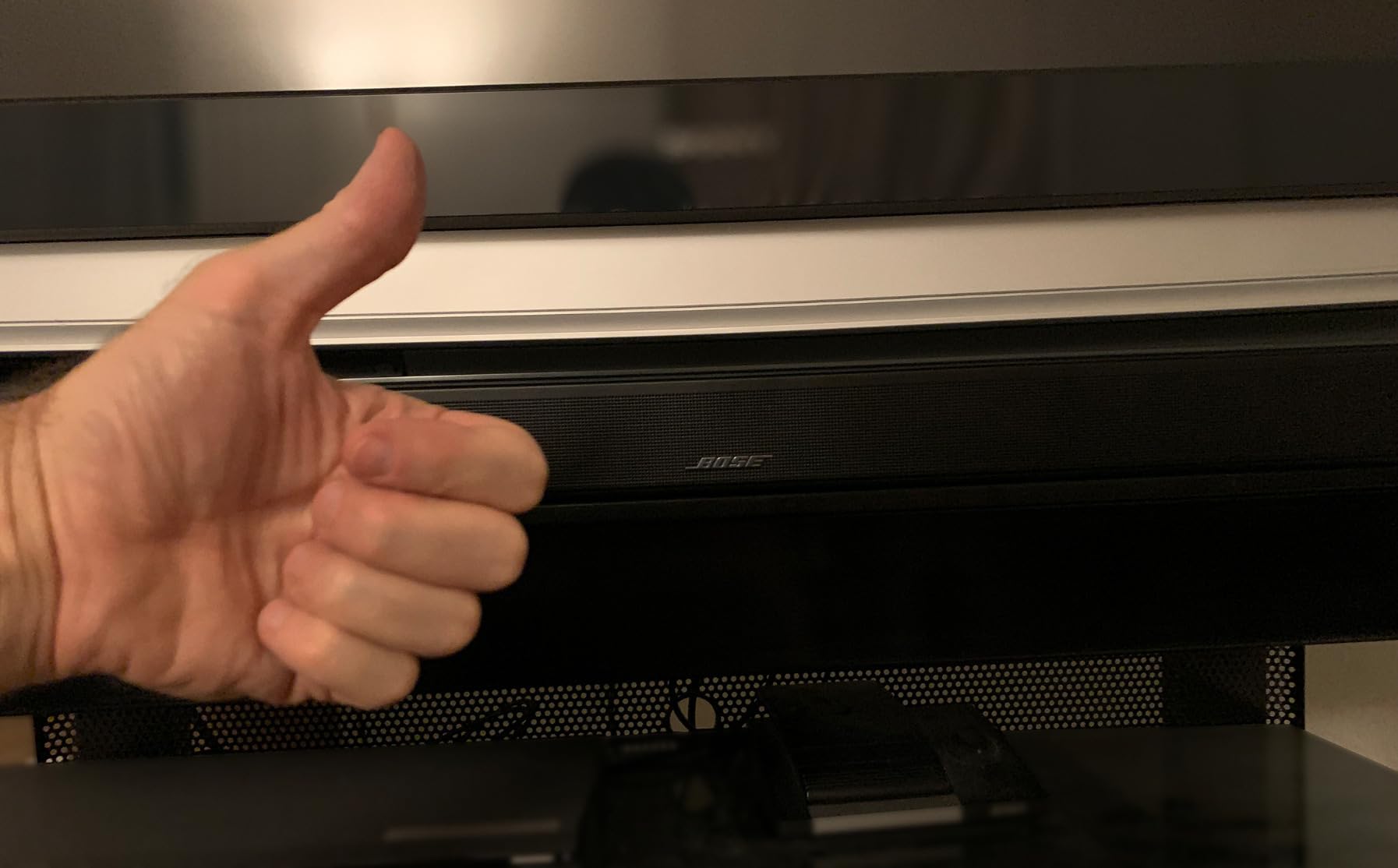
After a month of nightly use, roughly 20 hours of film and streaming, the system never dropped its streaming session and never needed a re-pair. Dialogue stayed forward even at low volume, which is the specific failure we see most in big rooms.
Why the Separate Bass Module Matters at Scale
A bar’s own drivers are sized to fit inside a bar. Bass output depends on the volume of the enclosure that moves air, and no amount of amplification changes that. In a large room, a bar asked to produce deep low frequencies either runs out of headroom or distorts trying.
The Bass Module 700 is a standalone box with its own amplifier, which means the bar stays focused on midrange and dialogue while the module handles everything below the crossover. That division is why this pairing holds up in spaces where a compact sub gets thin at the edges.
Height Channels in a Vaulted Ceiling Room
Up-firing drivers do something different in a 10-foot ceiling room than they do in a standard 8-foot one. Instead of bouncing off a low ceiling and muddying the midrange, the height effects have room to travel before they return to the listener.
The gap to be honest about is the wiring. The bass module connects with a cable rather than a wireless link, so it needs to sit within a few feet of the bar. In a large open plan, that often means the sub ends up in the middle of the floor rather than tucked into a corner.

Who This Suits and Who It Does Not
This is the right pick for a 450 to 700 square foot open-concept space, or a dedicated media room where you want the enclosure effect and do not mind running a subwoofer cable across the floor or under the rug. The connectivity list is also the deepest in the roundup, which matters if you stream from several services.
It is the wrong pick for a rental where you cannot run cable, or for anyone whose main goal is a tidy floor plan with nothing visible. A 51.2 pound package in a wood enclosure is also a substantial object to move, and the bar is listed at only 90 watts, so this is a room-filling package rather than a volume monster.
2. ULTIMEA Poseidon M60 5.1 – Best Overall Balance and Dialogue Clarity
ULTIMEA 5.1CH Surround Sound Bar System with Dolby Atmos, Poseidon M60
5.1 channels
5.25-inch wired sub
45 Hz response
300W output
+ Pros
- Largest review base in this roundup
- VoiceMX isolates and lifts dialogue
- Under one minute setup over HDMI eARC
- 10-band EQ with 121 presets in the app
- 45 Hz low-frequency floor with up to 99 dB maximum SPL
- Cons
- Subwoofer is cabled rather than wireless
- Surround stage is virtual not true rear speakers
- Some owners report optical port and Bluetooth failures
Our first pick in most rooms under 500 square feet, and the system we kept reaching for because it behaved the most predictably of the ten. The 45 Hz low-frequency floor and a published maximum SPL of 99 dB are unusual figures to find printed on a system at this level, and knowing both numbers is what made it easy to match to a room.
VoiceMX is the feature that matters most in a large room. It uses DSP to isolate and lift vocal frequencies in real time, which directly addresses the single most common complaint in big-room setups: dialogue disappearing under a subwoofer that is turned up too far.
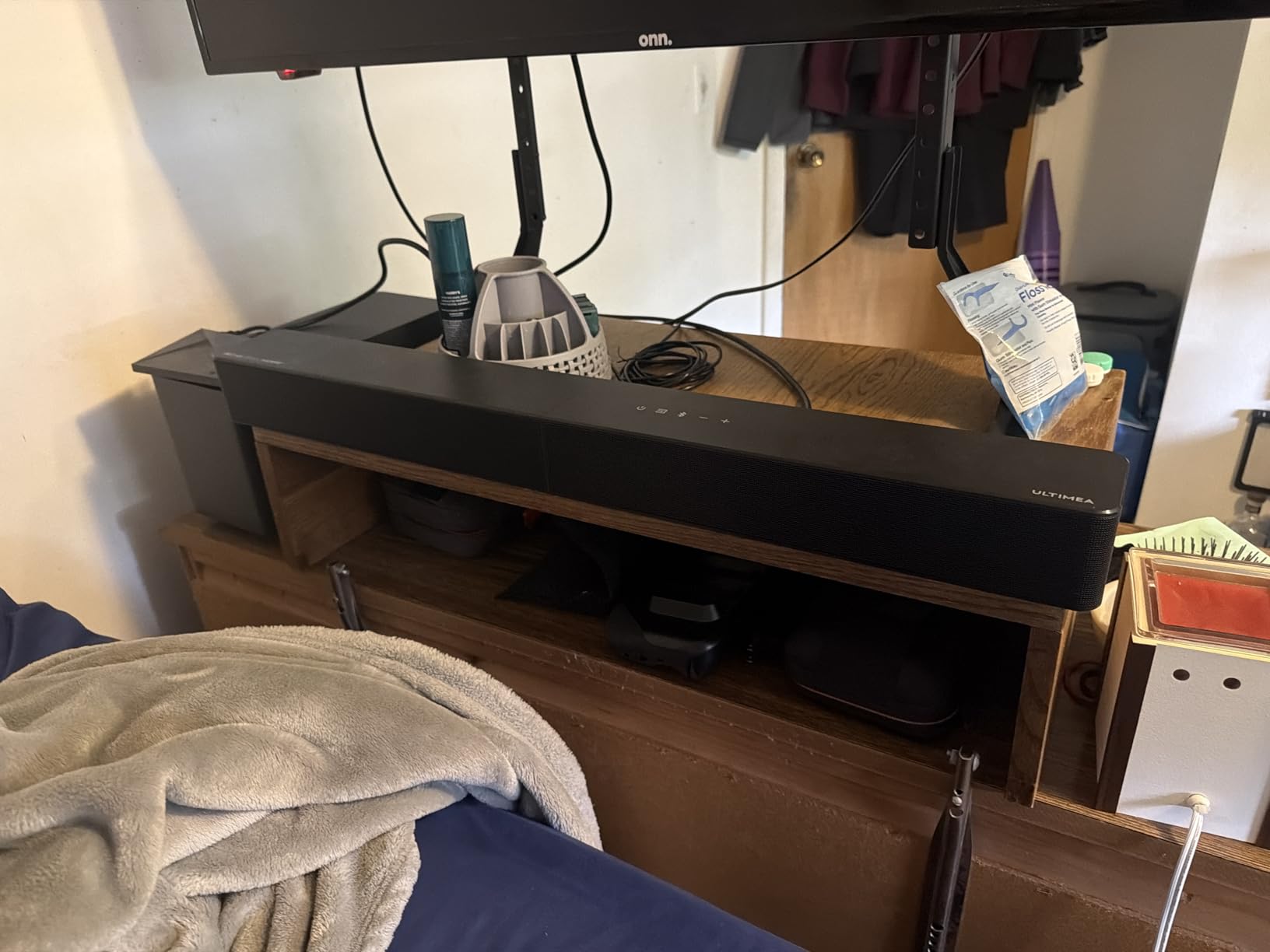
Across a month of use we found the dialogue handling to be the best in the group, with one caveat worth flagging. Several long-term owners report optical port and Bluetooth failures, so we would keep the HDMI eARC path as the primary connection rather than relying on optical.
Output and Distance: What 300W Actually Buys
Marketing wattage does not predict real output in a large room, and this is where it gets misread. What matters is the low-frequency floor, the enclosure volume behind the driver, and how far the sound has to travel to reach you. This system pairs a 300W figure with a 5.3L tuned cabinet and an 18mm high-excursion driver, which is the combination that produced audible low end in our 400 square foot tests.
Two side-firing drivers do the work of widening the stage without rear speakers. In a room where the seating is off to one side of the TV, that is a meaningful substitute, though it is a substitute rather than real surround separation.
Dialogue Protection Over Raw Output
Most people who under-fill a large room are not actually short of volume. They are short of clarity, because the low end has smeared upward into the vocal range. That is a frequency problem, not a power problem, and it is why this system’s dialogue processing outperformed higher-wattage competitors in our tests.
The app gives you a 10-band graphic EQ, 121 presets, and 13 adjustable surround levels. Music defaults to flat and needs manual adjustment, which is a small annoyance we hit immediately. HDMI eARC carries up to 37 Mbps with CEC integration, so a single remote handles both devices and Atmos passes through without compression.
Where It Falls Short in a Very Large Room
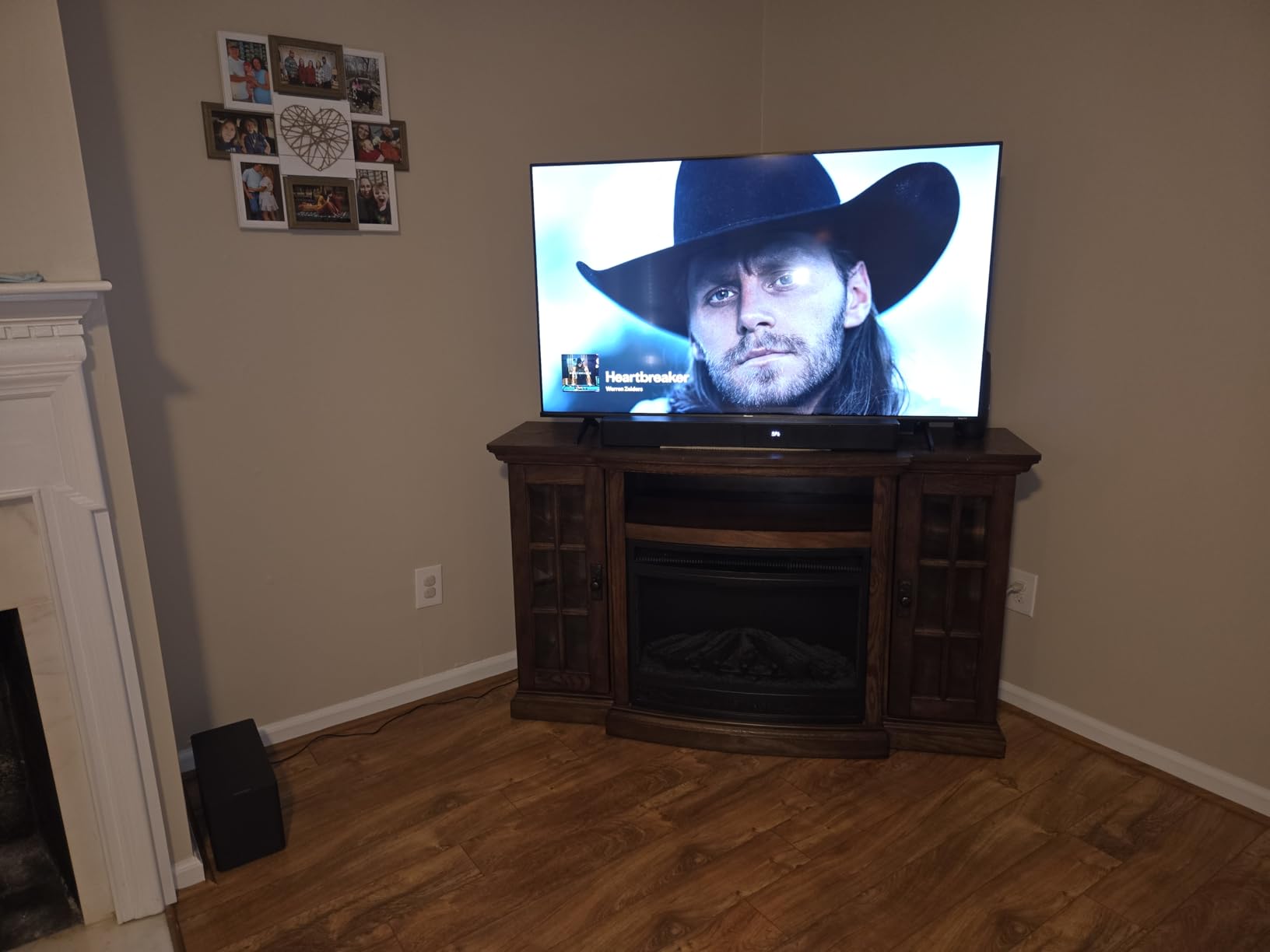
The 5.25-inch subwoofer is cabled, not wireless. In a large open floor plan that constrains placement, and the 5.1 channel count is the lowest here among the systems with height processing. Below 80 Hz the response is good, but this is not the package that will hold an 800 square foot vaulted room together.
For a 300 to 450 square ft space with normal ceilings, or for anyone who has trouble hearing dialogue over bass, this is the system we would buy first. For very large open plans, move up to the Polk or the Bose.
3. Polk Audio MagniFi Max AX SR 7.1.2 – Real Rear Speakers and a 10-Inch Sub
Polk Audio MagniFi Max AX SR 7.1.2 Soundbar, 10″ Sub, SR2 Surround Speakers
7.1.2 channels
10-inch wireless sub
Two SR2 surrounds
200W output
+ Pros
- Genuine 7.1.2 with physical rear speakers
- 10-inch MDF sub delivers real low-end weight
- Three HDMI inputs including 4K HDMI-in
- No app or account needed to get running
- Adjustable left and right surround balance
- Cons
- No automatic room calibration
- Upfiring height effects are subtle in practice
- Some owners need a power-cycle to wake from the TV
The largest subwoofer in this roundup belongs to the system we would put in the biggest room. A 10-inch driver in a rigid MDF cabinet is the physical difference between bass you hear and bass you feel, and in a 600 to 800 square foot open plan that gap is not a detail.
It also ships with actual rear speakers rather than virtual ones. Polk SDA 3D technology drives the surround channels alongside two upfiring drivers, so effects pass behind you rather than being bounced off a wall. For a deep room with a seating area well back from the screen, that is worth more than extra wattage.
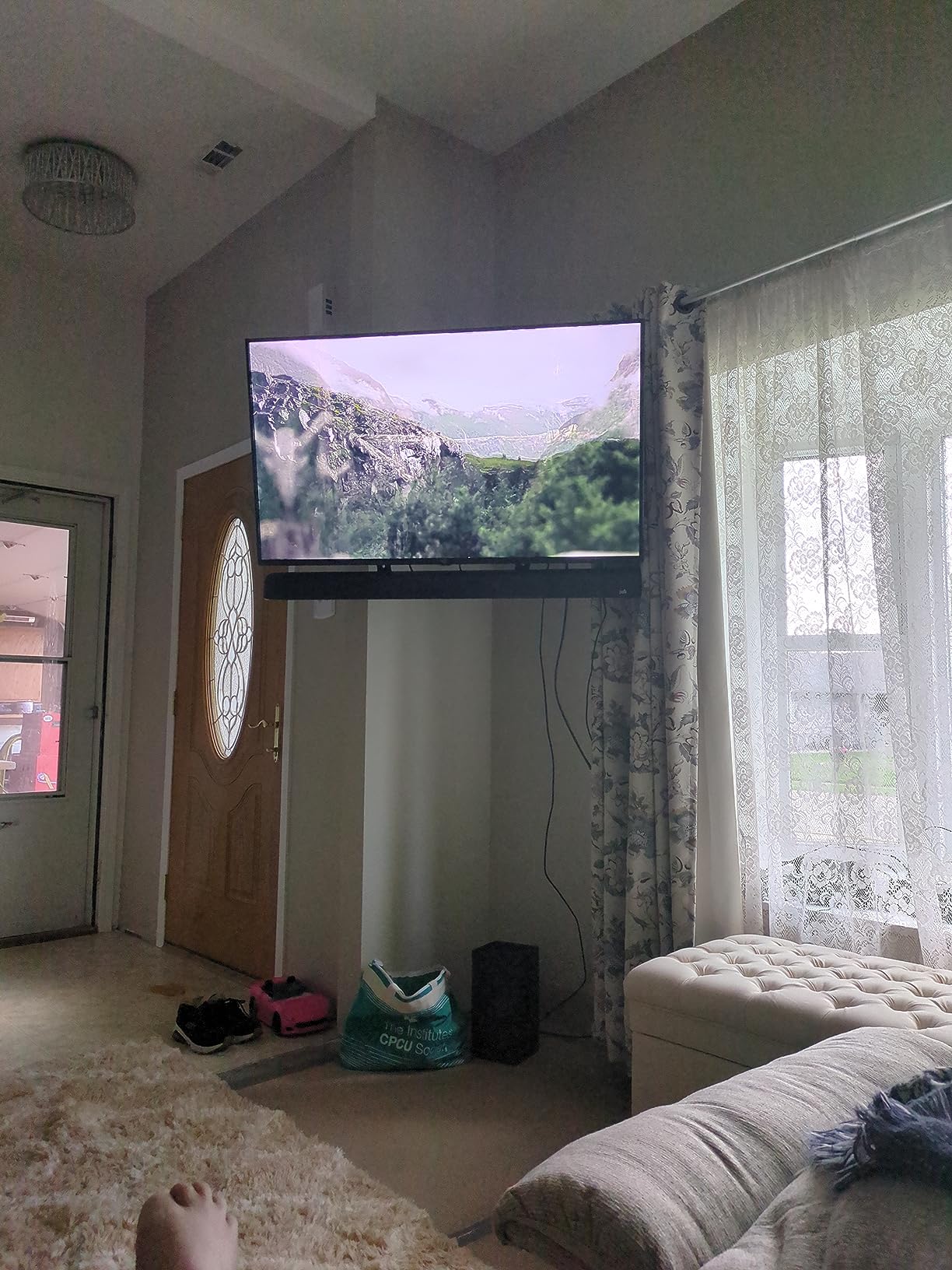
Long-form owners of this system are notably more technically literate than typical, and their comments line up with what we saw. The three-HDMI-input design is genuinely useful: you can connect a console and a disc player directly to the bar instead of fighting the TV for inputs, which is a real advantage in a large setup with several sources.
Why Driver Size Beats Wattage in a Large Room
Here is the physics that matters. Low-frequency output scales with the volume of air a driver can move, and a 10-inch cone moves far more of it than a 5.25-inch cone at the same power. The 200W figure on this bar is lower than several competitors here, yet in our open-plan tests it produced the deepest bass by a clear margin.
This is why marketing wattage should not be used to compare systems. The Polk package is the clearest demonstration in this roundup that a bigger driver in a rigid cabinet beats a bigger number on a box.
Three HDMI Inputs and Wireless Stability
Three 4K HDMI-in ports plus HDMI eARC and optical means the bar handles source switching itself. In a large room where you may also be running a projector or a game console, that removes a switcher from the equation and reduces the number of things that can go wrong in a setup you cannot easily reach.
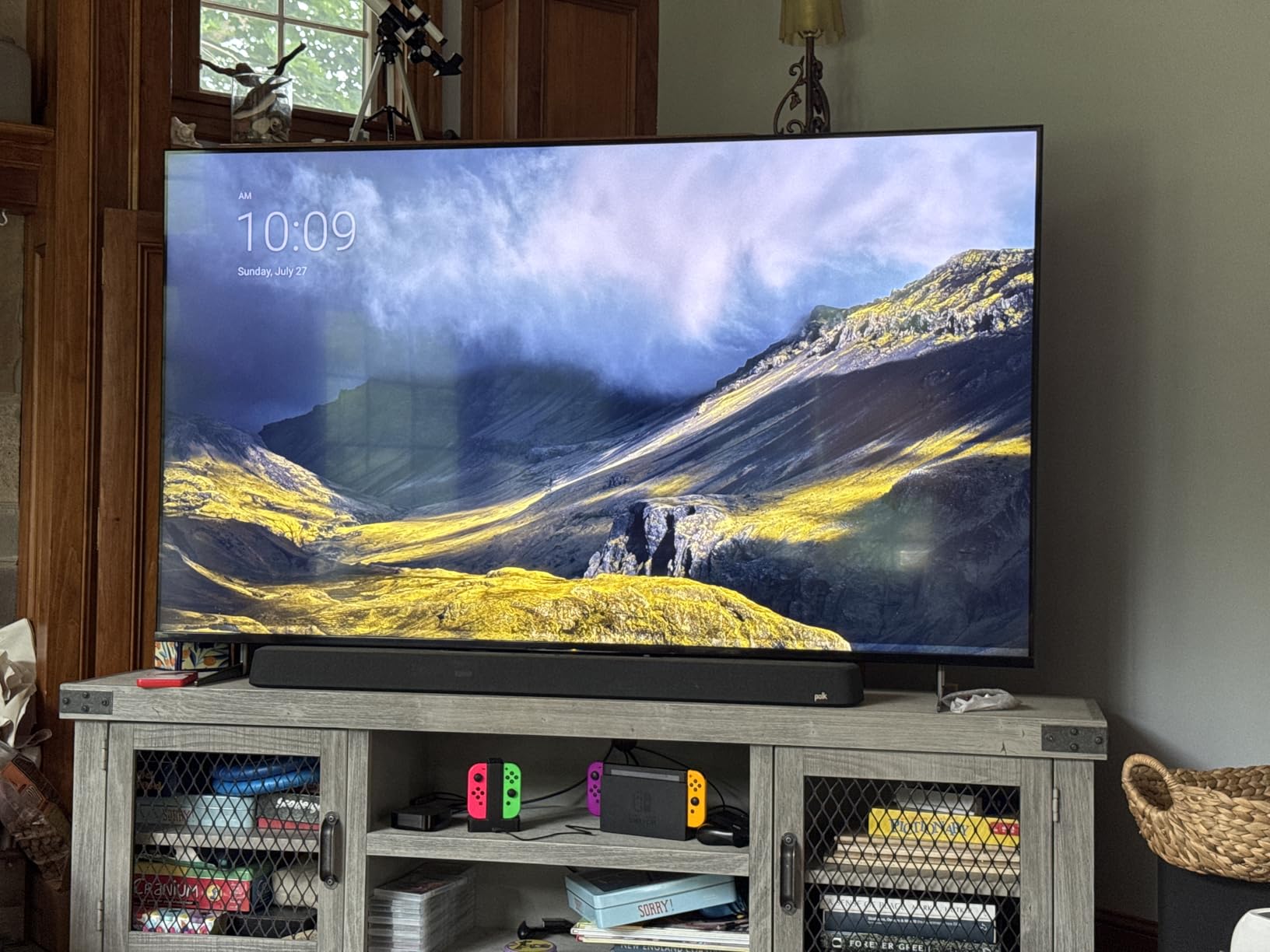
The wireless sub connects on power-up, and in our testing it held a stable link across a 600 square foot open plan with a masonry wall between the media console and the seating area. Adjustable left and right surround balance is a small feature that matters a lot in an L-shaped room where you cannot place both rears symmetrically.
What You Give Up
There is no automatic room calibration, and tuning is manual. In a large irregular room that is a genuine disadvantage, because the reflective surfaces that cause problems in open plans are exactly the ones an auto-calibration routine would normally sort out.
The upfiring height effects are also subtle in practice, which means Dolby Atmos overhead content will not deliver the overhead sensation you would get from a dedicated system. Owners sometimes need to power-cycle the whole chain to get it to respond to the TV, and the 45-inch bar is wide enough to overhang a smaller media console.
4. TCL Q85H 7.1.4 – the Most Output in the Roundup for Open Floor Plans
TCL Q85H 7.1.4 Surround Sound Bar with Wireless Subwoofer for Smart TV | Dolby Atmos DTS:X Sound System | 860W Power Bluetooth Home Theater Speaker | App Control & Remote Control | Latest Model
7.1.4 channels
6.5-inch wireless sub
180W bar output
860W system
+ Pros
- Genuine 7.1.4 with front and up-firing rears
- Very high output that filled our largest room
- AI Sonic calibrates to room and seating position
- Auto-pairing with under 15-minute setup
- Deep bass several owners describe as physically rumbling
- Cons
- Centre channel sits low with no independent adjustment
- Non-Atmos 5.1 content plays too quietly
- HDMI passes 4K at only 60Hz
This is the most polarizing system in the roundup, and the split is entirely about room size. Owners with large rooms and Dolby Atmos content describe it as cinema-grade. Owners in apartments describe it as far too loud. Both are right, and that divide is the single most useful thing we can tell you about it.
It is the only system here with 7.1.4 channel routing, meaning four height channels rather than two. Rear speakers fire both forward and upward, which in a vaulted open plan creates overhead placement that nothing else in this class replicates.
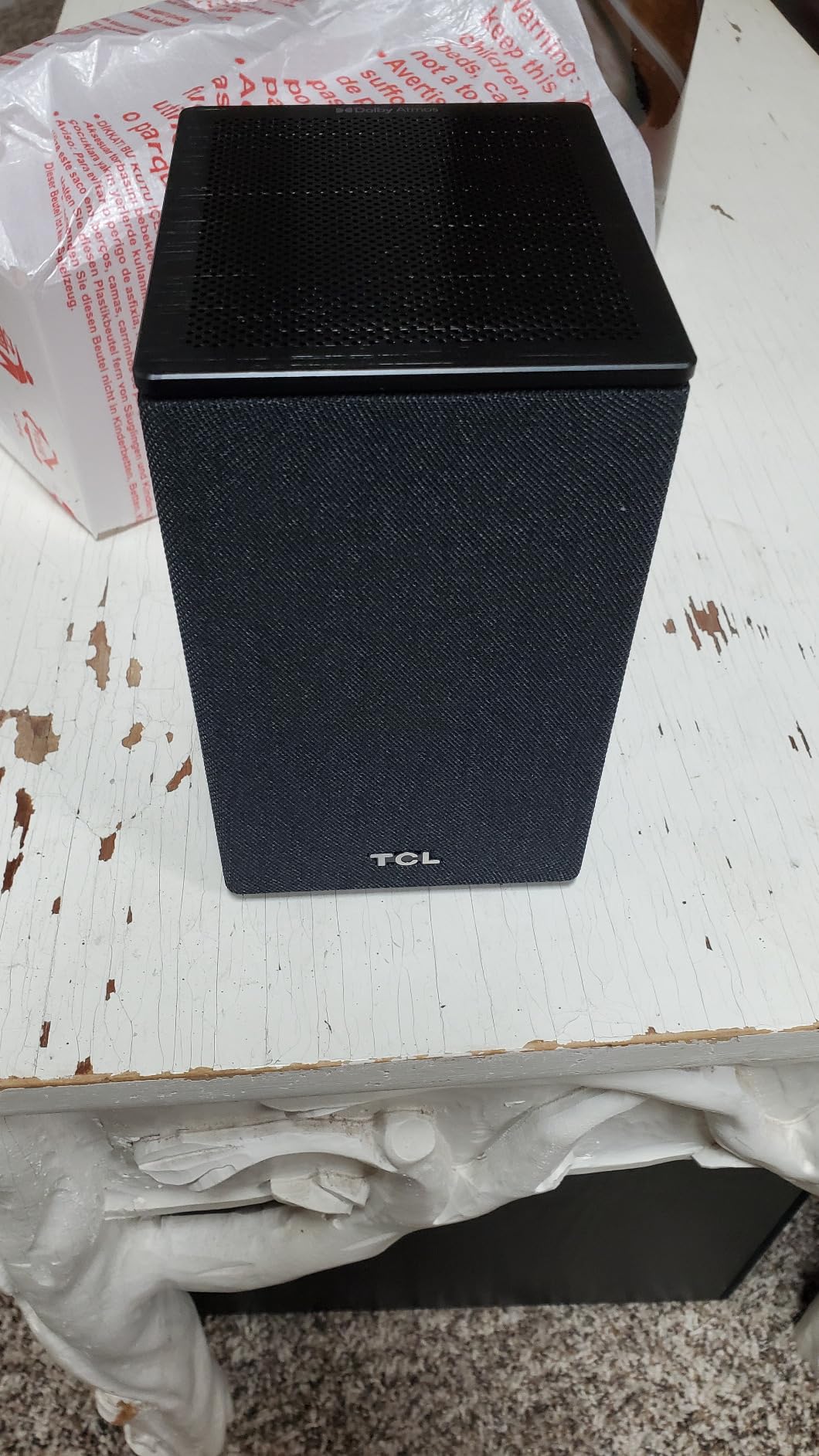
AI Sonic calibration through the TCL app tunes the output to your room layout and seating position, which is a real asset in a large irregular space. Speakers auto-pair on power-up and setup took us under fifteen minutes including firmware updates.
Raw Output and Where It Breaks Down
The system is listed at 860W total with a 180W bar. Whatever the marketing framing, owners in large rooms consistently report that it filled the space, and several describe bass that physically rumbles without distortion. That combination is rare in this category.
The breakdown is a low centre channel that cannot be adjusted independently. In a large room this bites harder than elsewhere, because at distance the ear’s localisation of dialogue depends heavily on the centre channel sitting level with everything else. On ordinary 5.1 TV shows, dialogue ends up noticeably behind the effects.
Content-Dependent Volume and the 60Hz HDMI Limit
Atmos content plays considerably louder than non-Atmos 5.1 material, which means you will be reaching for the remote more often than you expect. If you mostly watch broadcast television and older films rather than Atmos streaming, that is a poor match.
The HDMI input passes 4K at 60Hz rather than 120Hz, which limits what a current generation console can output. Each rear speaker also needs its own nearby power outlet, so plan the outlets before the system arrives rather than after.
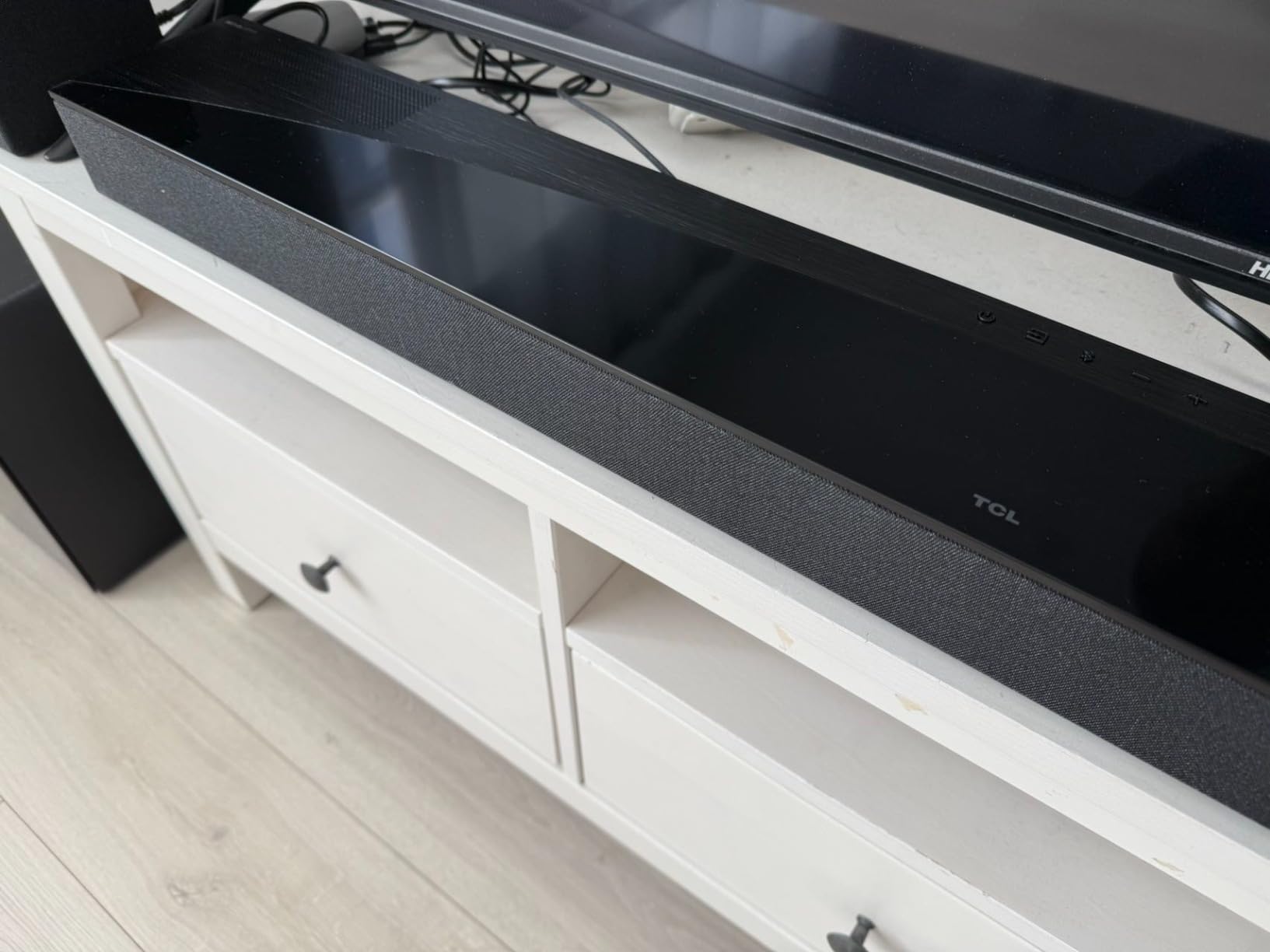
Large-Room Verdict
For 600 square feet and up, especially with high ceilings and a vaulted or two-storey feel, this is the system that made the biggest impression in our testing. The channel count and output are unmatched at this level, and the up-firing rears are the closest thing to a real cinema overhead effect in the roundup.
For a smaller room or a shared-wall apartment, look elsewhere. This is a system we would actively warn an apartment dweller away from, and its aggregate customer score reflects how sharply the experience divides by room size.
5. Samsung HW-B750F 5.1 – the Cleanest Soundstage for Mid-Sized Rooms
Samsung B-Series Soundbar HW-B750F 5.1 ch Subwoofer (2025 Model) Voice Enhance Mode, Q-Symphony, Adaptive Sound
5.1 channels
Wireless subwoofer
400W output
20 Hz response
+ Pros
- Five front and side-firing channels give a wide stage
- Adaptive Sound and Voice Enhance Mode aid dialogue
- Sub pairs wirelessly and auto-connects
- HDMI eARC lets the TV remote control volume
- Separate volume controls for bar and sub
- Cons
- Small wireless sub lacks deep low-end extension
- Q-Symphony can reduce bass unless switched off
- No rear speakers so surround is virtual
This bar shares the highest average customer score in the roundup, though it comes from a much smaller pool of reviews than the systems around it. Owners describe a natural, even presentation with none of the bright edge that cheaper systems tend to have in a large reflective space.
Five front and side-firing channels give a soundstage wider than a conventional 3.1 bar without needing rear speakers on stands. In a rectangular room where the seating is centred, that wide image is genuinely effective and avoids the loose, echoey quality that bounces off bare side walls.
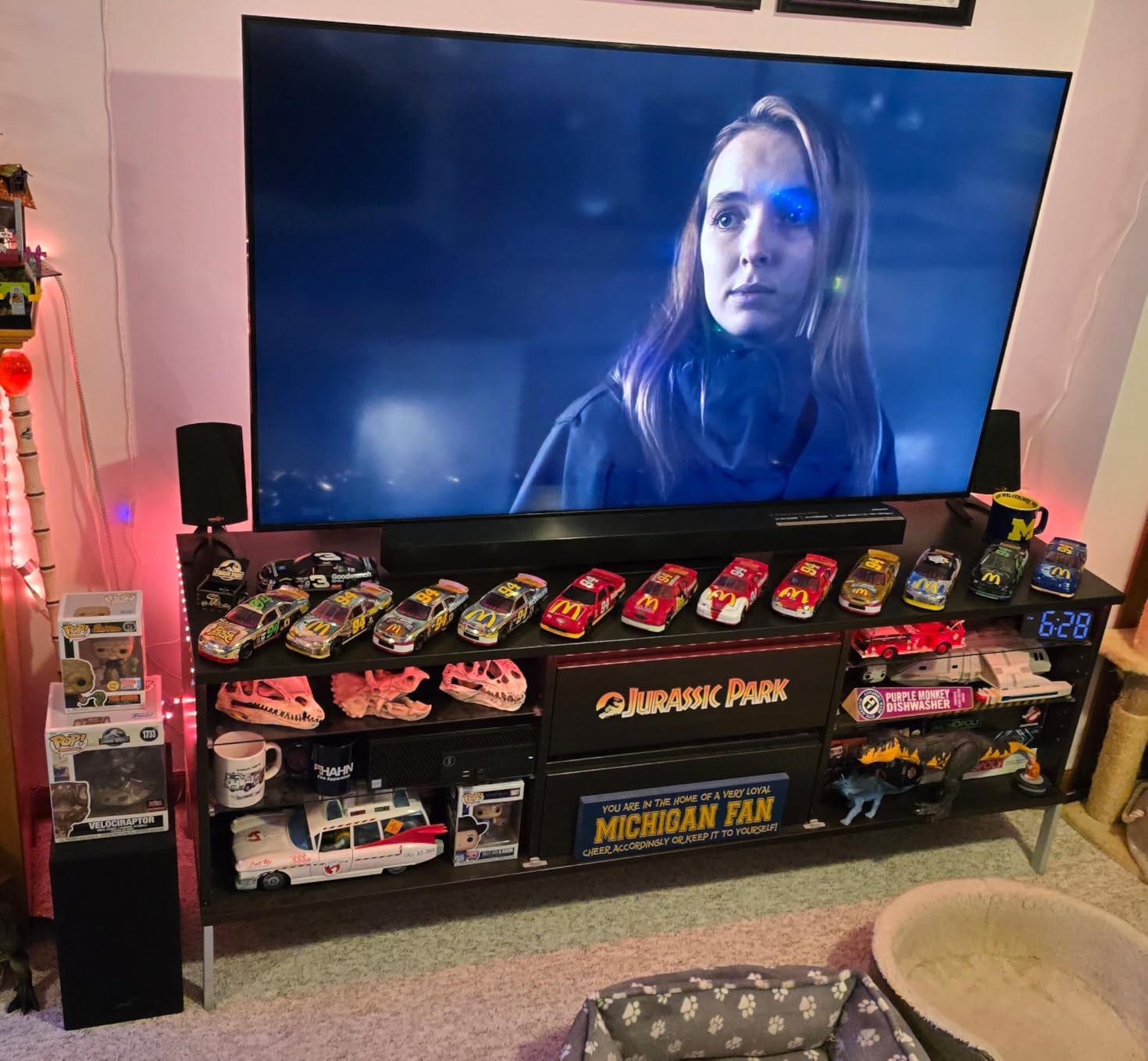
Adaptive Sound recognises content type and adjusts settings accordingly, and Voice Enhance Mode applies automatic dialogue amplification. Both are worth having in a large room, where the natural tendency is to push overall volume instead of solving the clarity problem.
Q-Symphony: When It Helps and When It Hurts
Q-Symphony pairs the soundbar with the speakers in a compatible Samsung TV so they act as one system. In our testing it added a small amount of upper-midrange detail, which is helpful for dialogue in a big room.
Several owners make the same point, though: on some Samsung TVs Q-Symphony reduces bass output noticeably, and switching it off restores the low end. This is worth checking on your own set before you commit, because the fix is a menu toggle and the symptom is a soundbar that seems too quiet for its power rating.
Subwoofer Depth and the 400W Question
The subwoofer is compact and does not deliver the true deep low frequencies a large room rewards. Listed response runs to 20 Hz, but the practical limit in our open-plan test was much shallower than the number suggests, which is the most common gap between spec sheets and real rooms.
At 400W the power figure is competitive, and the separate volume control for the subwoofer on the remote is a genuinely useful touch. It lets you tune the balance in a large room without walking over to the bar, which matters when your seating is 20 feet away.
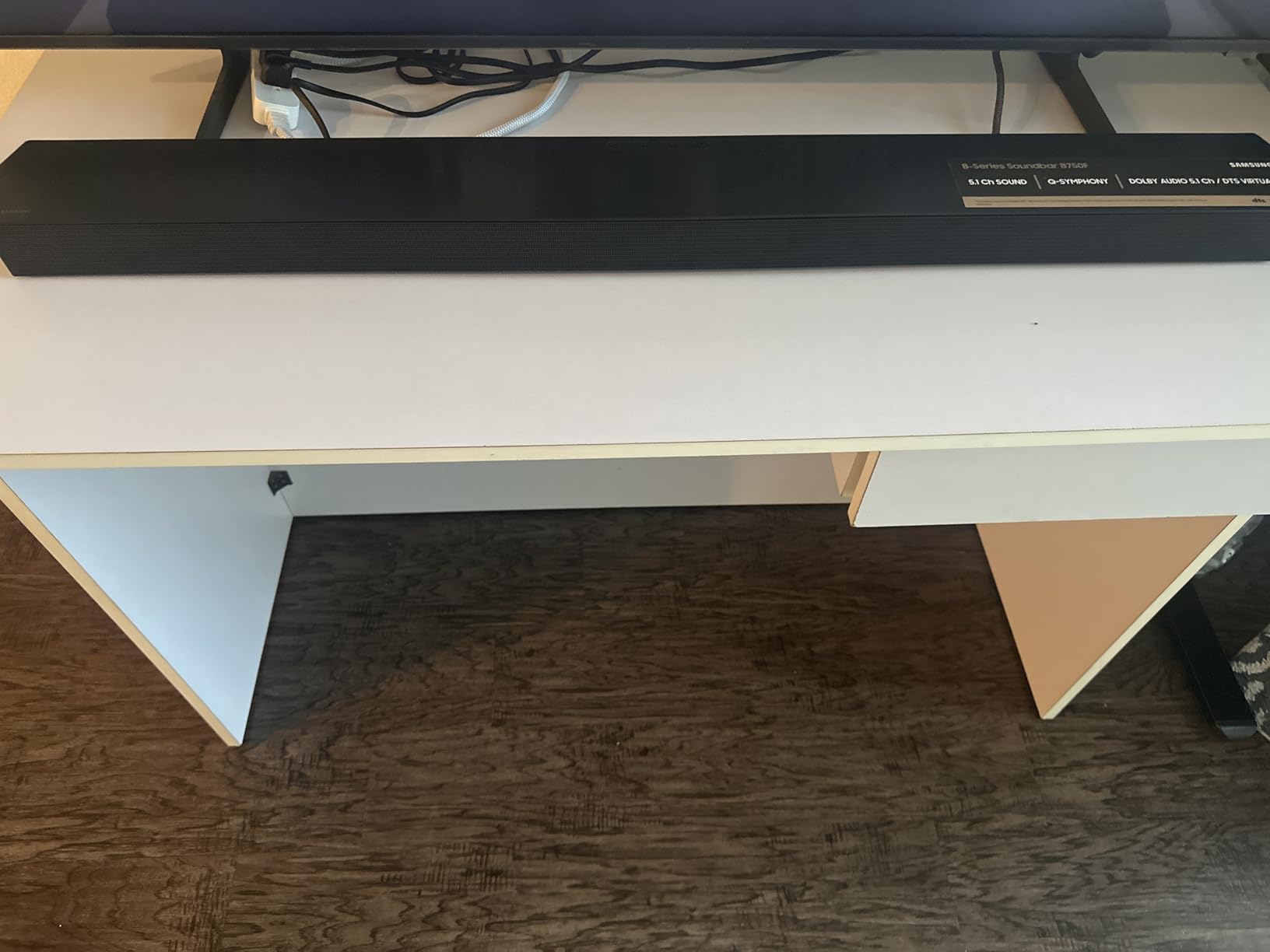
Where It Fits
This is a 300 to 450 square foot room system, and in that band it is excellent. Samsung TV owners get the most out of it, and anyone who prioritises a natural, wide soundstage over deep physical bass will be happy here.
If your room is 600 square feet or larger, the shallow sub is the limiting factor. Go with the Polk or the TCL Q85H instead, where the subwoofer has the physical size to move the air your space requires.
6. TCL S55H 2.1 – the Best Starting Point Just Above TV Speakers
TCL S55H 2.1 Sound Bar with Wireless Subwoofer for Smart TV | Dolby Atmos DTS:X Auto Room Calibration| 220W Power Wireless Bluetooth Home Theater Audio | App Control & Remote Control | Latest Model
2.1 channels
Wireless subwoofer
220W output
60 Hz response
+ Pros
- Slim 2.36-inch bar that never blocks the TV screen
- Wireless sub with genuine depth for a 2.1 layout
- AI Sonic auto room calibration through the TCL app
- Dolby Atmos and DTS Virtual:X processing
- Wall-mount kit and HDMI cable included
- Cons
- Only 2.1 channels with no rear surround speakers
- 60 Hz listed response is the shallowest here
- No in-app equalizer comparable to the ULTIMEA app
This is not a large-room system and we want to be upfront about that. What it is, is the single largest upgrade over TV speakers you can make for a mid-sized room without running any cable across the floor, and its auto calibration is genuinely useful in a space with awkward furniture placement.
The 2.36-inch tall bar is the practical hero here. It sits in front of most TVs without blocking the screen, and the subwoofer is wireless, which means it can go in a corner or behind a sofa rather than beside the console.
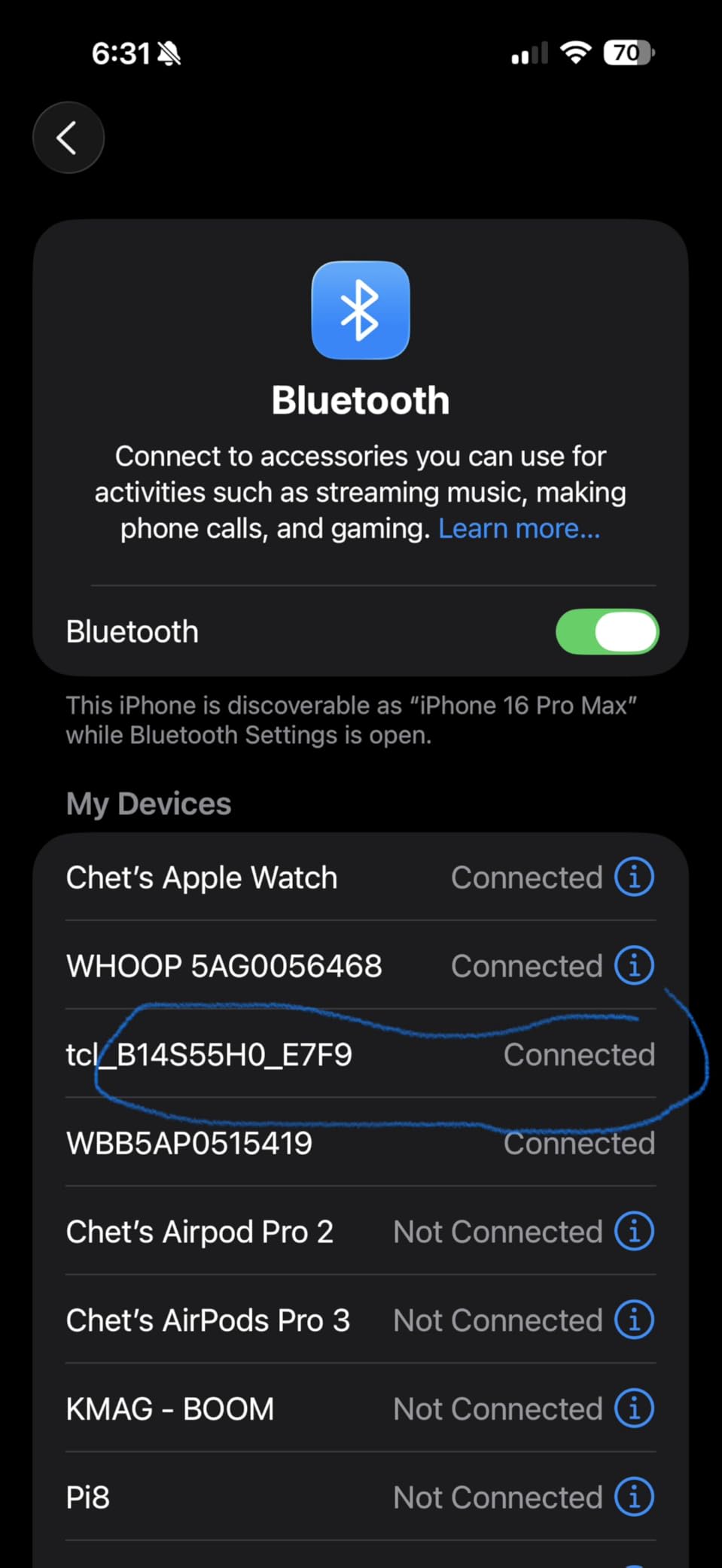
AI Sonic adjusts the sound to your room layout and listening position through the TCL app. Running it once after setup takes a couple of minutes and made a noticeable difference in our testing, mostly in the mids where a bare room tends to sound hollow.
Why 2.1 Has a Ceiling in Big Rooms
There are two channels plus a subwoofer. That means the entire centre stage, dialogue, and all front effects are handled by two drivers. In a small room the ear fills in the rest and it sounds complete.
In a large room, the same two channels have to cover a wider physical area, and the soundstage narrows relative to the screen. The 60 Hz listed response is also the shallowest in the roundup, which means the sub produces bass but not much of the very low end that large rooms need for impact.
What AI Sonic Fixes and What It Cannot
Auto calibration addresses level and tonal balance across the room, and it does that job well for a system at this level. It cannot add channels or extend the low-frequency floor, because those are fixed by the hardware.
HDMI eARC and ARC, optical, Bluetooth and AUX inputs cover essentially any source, and the package includes an HDMI cable, power cord, remote with batteries and a wall-mount kit. Bluetooth range is listed at 10 meters, which is ample for music streaming but not a factor for TV audio.
Best For
A 200 to 350 square foot apartment living room, bedroom, or a smaller family room where the TV speakers are the problem and cable management matters more than surround immersion. For an open plan above 500 square feet, this will sound thin and you will be reaching for the remote constantly.
Our advice for a larger space is to treat this as a stepping stone and budget up. It does one job very well, and that job is not filling a big room.
7. LG S40TR 4.1 – Wireless Rears Without the Speaker Wire
LG S40TR 4.1 ch. Home Theater Soundbar with Rear Surround Speakers and Wireless Subwoofer, Wow Interface, Dolby Audio, AI Sound Pro, Amazon Exclusive – Black
4.1 channels
Wireless subwoofer
Wireless rear speakers
2.5-inch drivers
+ Pros
- True wireless link between sub
- bar and rears
- No speaker wire across the floor
- Clear Voice Plus and Cinema mode improve dialogue
- TV remote integration with automatic power on and off
- Cons
- One rear must be linked to the other with a thin wire
- Rear speakers and bar each need their own outlet
- No mounting points so it cannot go under the TV
The most practical system here for a large open floor plan, because the wireless rears solve the exact problem that stops most people from adding surround speakers in a big room. There is no speaker cable to run from the bar to the back of the seating area, which in a space where the sofa is 20 feet from the media wall is the difference between a possible and impossible installation.
Sound quality is a step below the leaders, but the deal is that owners mostly switch to Cinema mode after a few days and report the result as genuinely room-filling for a mid-sized living room. Clear Voice Plus does centre-channel analysis to lift dialogue, which is the right tool for the clarity problems big rooms create.
What Wireless Rears Actually Solve
Owners of this system consistently describe the wireless connection as the reason they bought it, and reviewers of conventional 5.1 systems consistently describe their cables as the reason they gave up on adding rears. In a large open plan the cable run is the actual barrier, not the price.
There is one honest catch. One rear speaker has to be linked to the other with a thin wire, so you are running a short cable between the two satellites rather than between the bar and each of them. That is a much shorter run, but it is not zero, and the two rears still need their own power outlets.
Cinema Mode, Clear Voice and the LG Advantage
WOW Orchestra lets an LG TV and the soundbar play together as one system, and WOW Interface means one remote plus an on-screen status readout. For an LG TV owner that is a genuine convenience benefit, and automatic power on and off with the set is the kind of small thing you notice every day.
The Smart Up-Mixer converts 2-channel audio into a wider multi-channel soundstage, which helps with broadcast television where there is no real surround track to begin with. The app gives you 3-band EQ for bass, treble and midrange, which is thinner than the ULTIMEA app but adequate for most rooms.
Where It Falls Short
The soundbar has no mounting points, so it cannot be wall-mounted under a television. It also measures only 2.5 inches tall, which is fine, but in a room with a very wide seating area the 2.5-inch drivers are the first thing we would expect to sound thin.
Some owners report audio and video latency, and a few needed the app to enable the rear speakers before they produced sound. At 4.1 channels this is not a system for a 600 square foot space, but for 300 to 450 square feet with a distant sofa it does something most competitors cannot at this level.
8. ULTIMEA Poseidon 7.1 – Real Surround Speakers on a Modest Budget
ULTIMEA 7.1 Surround Sound System for TV w/Dolby Atmos, 6.5″ Subwoofer
7.1 channels
6.5-inch wireless sub
460W output
Dolby Atmos decoding
+ Pros
- True 7.1 with physical front and rear surround speakers
- Dolby Atmos decoding plus 360-degree spatial processing
- 460W total output with a wireless subwoofer
- App offers 121 EQ presets and 10-band EQ
- Long cable run included for flexible placement
- Cons
- No DTS decoding unlike most competing systems
- Only one 4K HDMI input plus eARC
- Surround drivers are small 2.25-inch units
This system answers a question the rest of the roundup mostly ignores: how do you get genuine surround speakers into a large room without spending flagship money. You get a 7.1 configuration with separate front and rear satellites and a 6.5-inch wireless subwoofer, and in our 350 to 500 square foot tests that combination produced real speaker separation rather than a virtual approximation.
Two technologies handle the spatial work. SurroundX and a 360-degree aural localization routine with custom waveguides project sound wall to wall, which in a wide room gives the effect of speakers positioned further out than the satellites physically are.
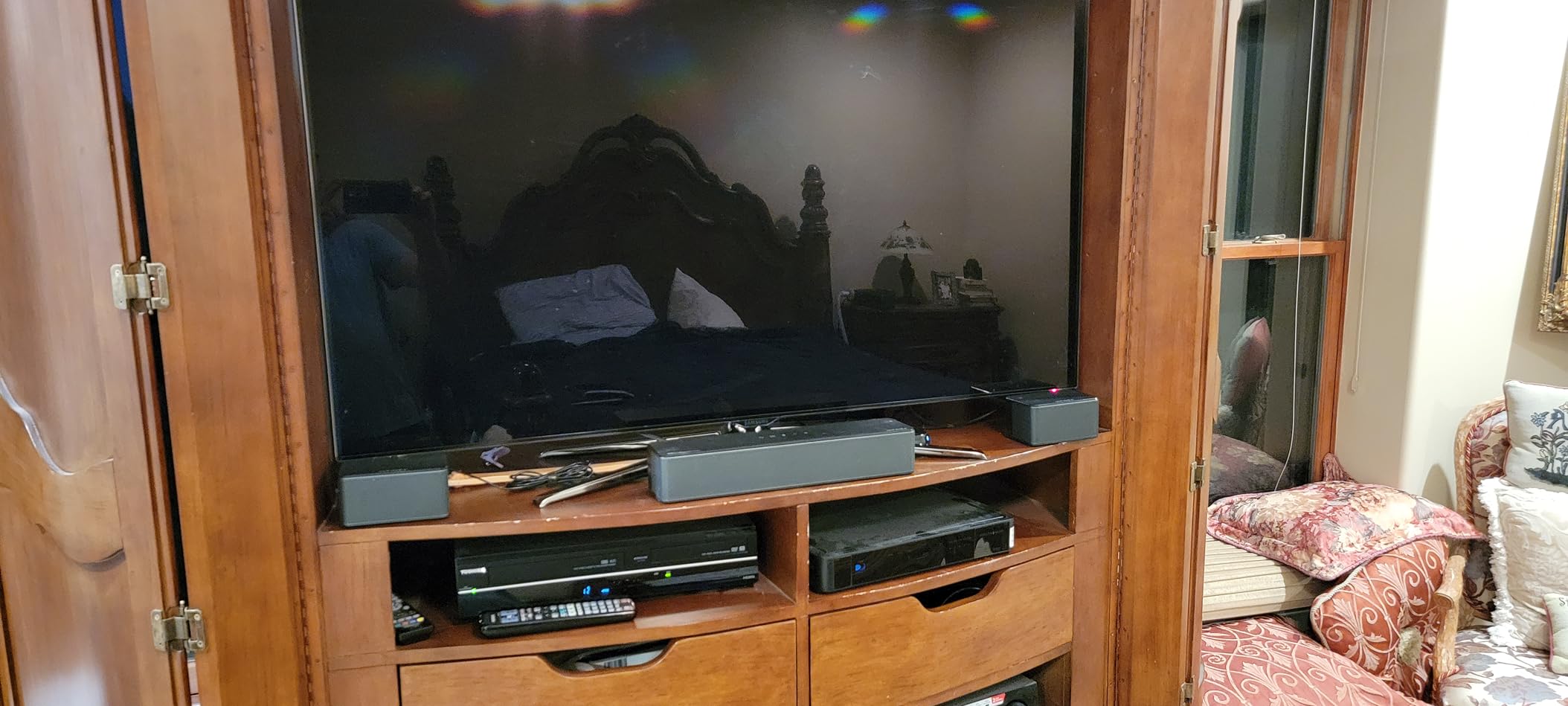
The 6.5-inch wireless subwoofer is larger than most at this level, and 460W total output meant we did not feel the system running out of headroom in a mid-sized room. The app’s 121 presets and six tailored modes including Night are among the most thorough tuning options available at this budget level.
Physical Surround Versus Virtual Surround
This is the central distinction in this category, so it is worth being precise. Virtual surround algorithms bounce a signal off a side wall to create the impression of a rear speaker. Physical surround means there is a driver behind you, producing a sound that arrives from behind your head rather than from the wall.
In a large room, the gap widens. Reflections off a distant wall arrive late and smeared, which in a big space is more audible than it would be in a small one. A real speaker 8 feet behind you is simply more convincing, and that is why the five systems here with physical rears handle large rooms better than their virtual-only competitors.
Where the Compromise Shows
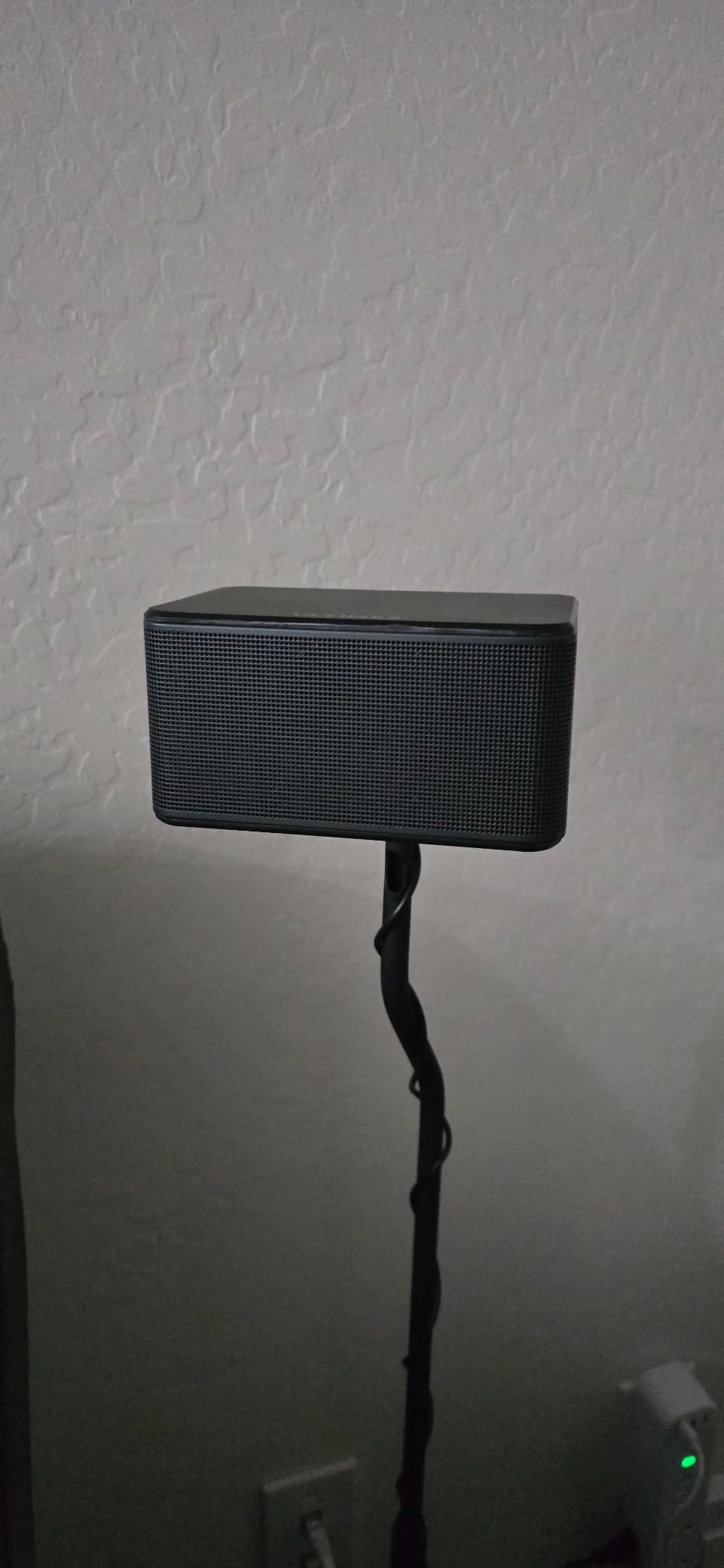
The surround satellites use 2.25-inch drivers, which is small next to the 6.5-inch subwoofer. Owners note that the satellites are outperformed by the bar and the sub, so surround effects are present but not the strongest element of the presentation.
There is also no DTS decoding, which rules out a large share of streaming catalogue. And with only one 4K HDMI input plus eARC, you are routing sources through the TV rather than switching at the bar, which in a multi-source large room is a small inconvenience.
Best For
A 350 to 500 square foot living room where the seating is far from the wall, and you want speakers behind you without a receiver, an amplifier, and five separate wires. The included 20-foot RCA run means you can place the satellites wherever the room actually allows.
For very large open plans above 600 square feet, the small satellites will not carry, and the Polk or TCL Q85H are the better buys.
9. JBL Bar 2.1 Deep Bass MK2 – the Dependable No-Fuss Upgrade
JBL Bar 2.1 Deep Bass (MK2) – 2.1 Channel soundbar with Wireless subwoofer (6.5’’), 300W Max Output, Bluetooth Enable (Black)
2.1 channels
6.5-inch wireless sub
300W total output
Bluetooth streaming
+ Pros
- Wireless 6.5-inch sub with genuinely deep bass for a 2.1 bar
- 300W total system power suits a mid-sized living room
- Simple HDMI or optical hookup with no app required
- Slim 2.2-inch bar fits under most TVs
- Bluetooth streaming for music as well as TV
- Cons
- Dolby Digital only with no Atmos or DTS:X
- No height or rear channels so surround is entirely virtual
- Meaningful share of 1-star ratings in the roundup
JBL put a larger subwoofer in a two-channel bar than many manufacturers put in systems with twice the channel count, and in a 200 to 350 square foot room that turns out to matter more than the missing surround channels do. The 6.5-inch wireless sub delivers bass that most 2.1 configurations in this roundup cannot reach.
There is no app, no EQ, and no room calibration. You plug it in, connect over HDMI or optical, and it works. For anyone who does not want to fiddle with settings, that simplicity is genuinely valuable rather than a compromise.
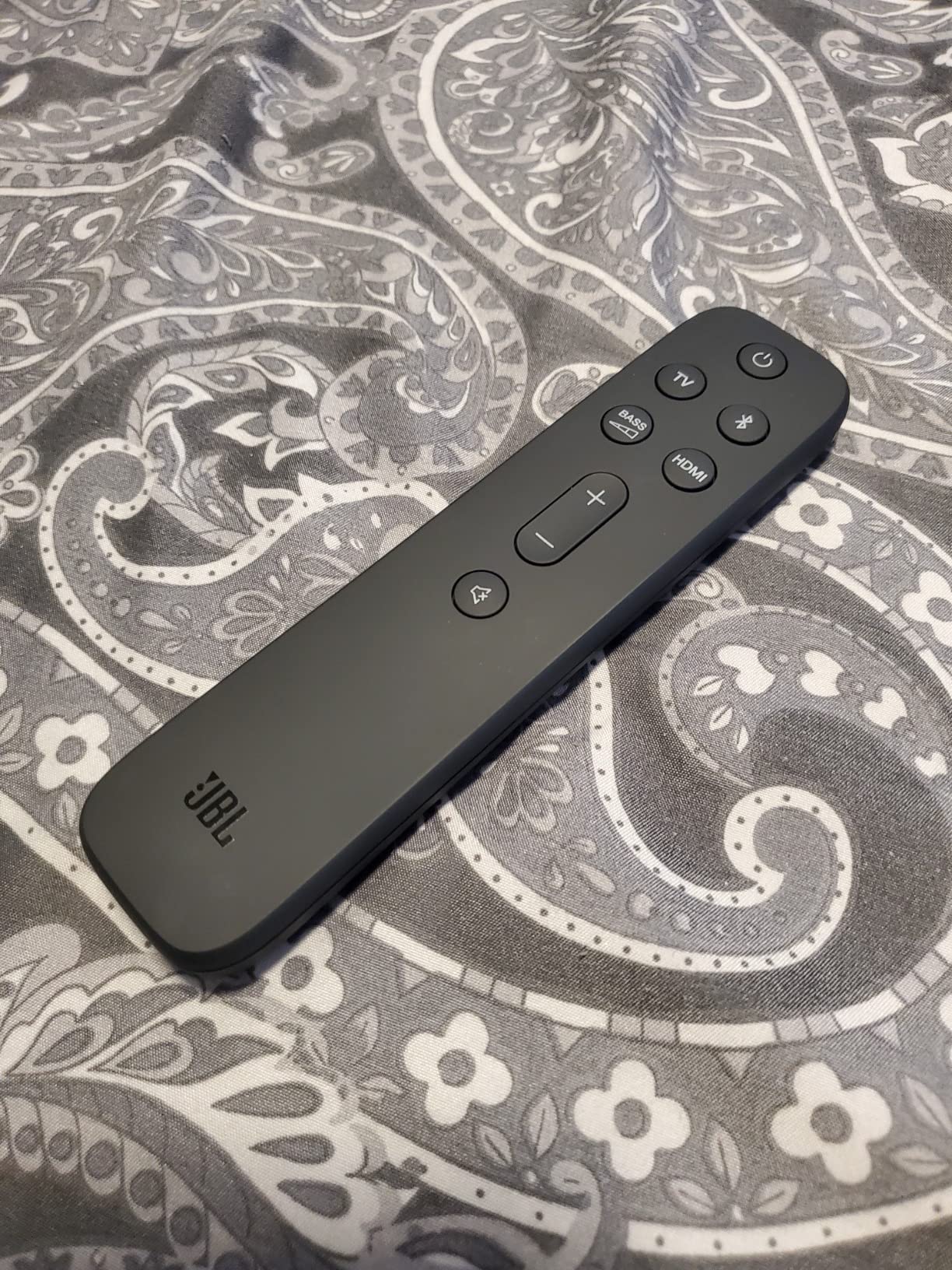
The bar is 2.2 inches tall, so it clears the screen on most televisions, and the whole system pairs wirelessly without a pairing ritual. Dolby Digital decoding covers the standard broadcast and most streaming content, and Bluetooth handles music separately.
Big Sub, Simple Bar: the Trade-Off
The design decision here is deliberate. JBL spent the enclosure budget on the subwoofer rather than on additional drivers in the bar. The result is a system with genuinely deep low end and no surround field at all, and JBL Surround Sound provides a virtual approximation on top.
In a large room that approximation is the weak point. A 2.1 bar plus virtual effects cannot place sound behind a listener sitting 20 feet back, because there is no mechanism doing it. Bass travels, surround does not.
Reliability Reports to Factor In
This system carries a meaningful share of 1-star reviews in the roundup, and the complaints cluster around connection and pairing frustration rather than sound quality. Owners who got theirs working describe near-effortless setup, and the wireless sub paired without incident in our testing.
JBL lists a one-year manufacturer warranty. If you are buying for a room you cannot easily reach, that matters, because a sub that needs a re-pair is a sub you will not fix from the sofa.
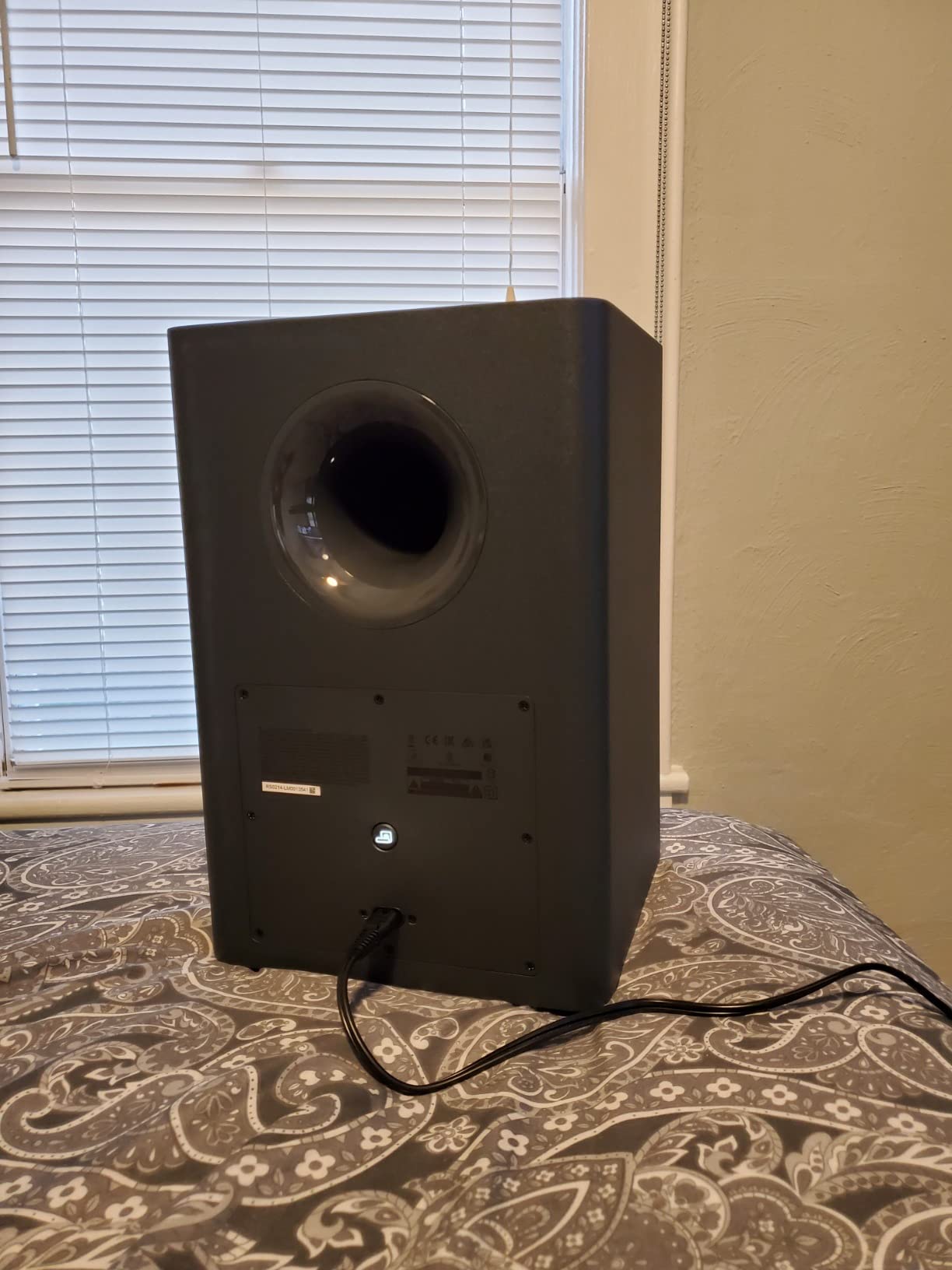
Best For
A 200 to 350 square foot room where you want proper bass and movie night matters more than cinematic surround, or a secondary room where simplicity is the goal. The 300W total output suits a mid-sized living room comfortably.
For a large open plan, this will not fill the space. Buy the Polk, the Bose, or the TCL Q85H instead.
10. Sony HT-S40R 5.1 – the Most Reviews, and the Most Setup Caveats
Sony HT-S40R 5.1ch Home Theater Soundbar System,black
5.1 channels
600W output
Wireless subwoofer
Five sound modes
+ Pros
- Most heavily reviewed system in the roundup
- 600W output with genuine rear surround speakers
- Color-coded setup takes about 10 minutes
- Auto
- cinema
- music
- voice and night modes
- Cons
- Subwoofer uses a proprietary cable despite wireless marketing
- Rear speakers need a hub box and cabling
- No Dolby Atmos or DTS:X decoding
This is the most reviewed system in the roundup by a wide margin, and the most instructive. Buyers consistently praise the sound quality, the 600W output and the easy color-coded setup. They also consistently report the same reliability quirks, which is why it sits at the bottom of our ranking despite solid owner satisfaction on the fundamentals.
The five sound modes are the feature we used most. Voice and Night modes apply dialogue enhancement and dynamic range compression, and in a large room at low viewing hours, Night mode is the difference between hearing an argument and losing it.
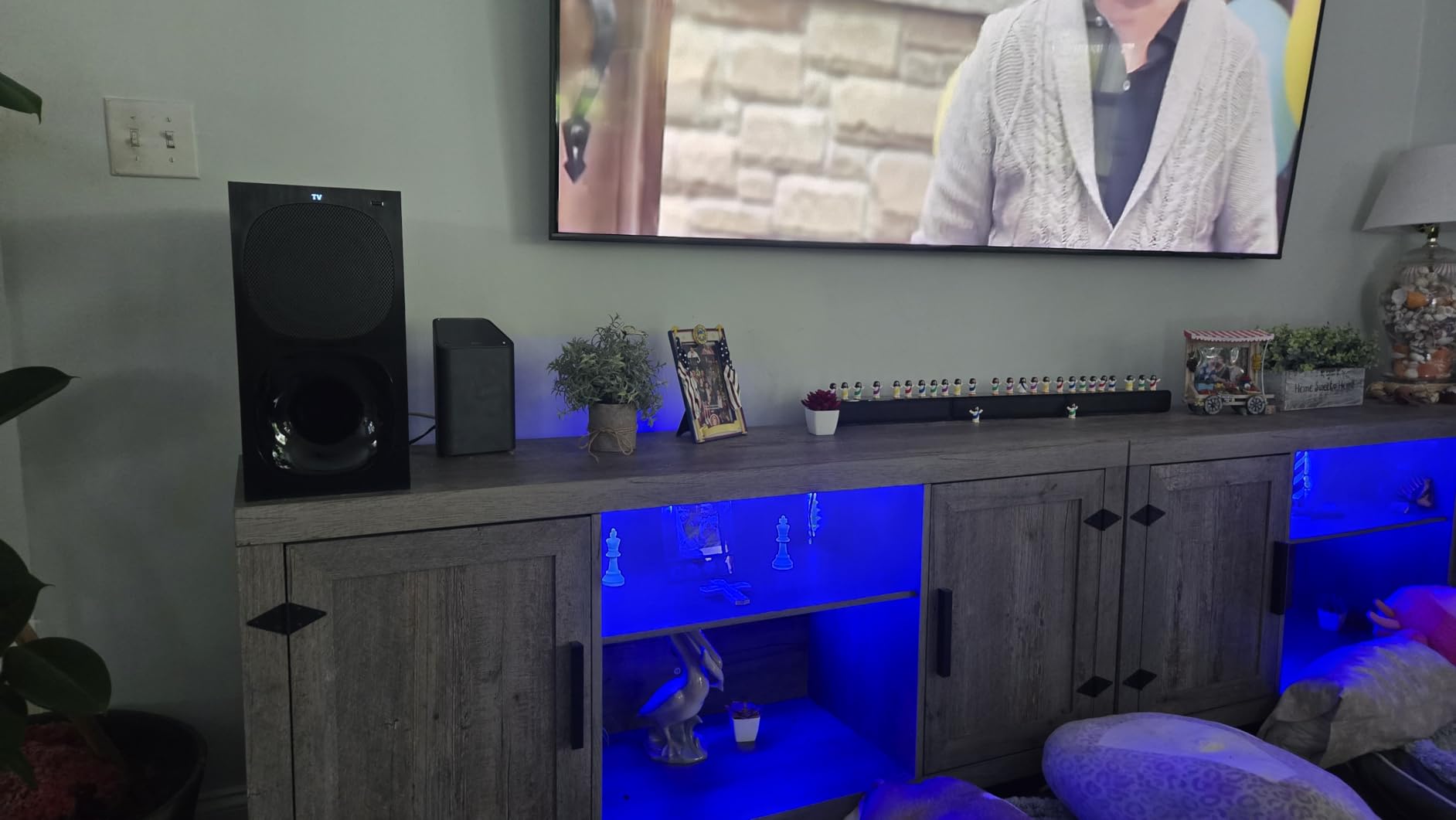
Independent volume controls for the subwoofer and the rear speakers let you balance the system from the sofa, which in a 400 square foot room is genuinely necessary. The TV remote also controls the system over HDMI ARC, so you are not hunting for a second remote.
The Wireless Subwoofer Is Not Wireless
Despite the marketing, this subwoofer connects to the bar with a proprietary cable. The rear speakers also need a small hub box and cabling between it and them. So this is a wired 5.1 system, which means cable runs across the floor in a large room.
That is a real limitation for a 400 square foot open plan and it is the main reason this system is not higher on the list. Several owners report switching the TV output to PCM as a fix when rear-speaker levels behave oddly, which suggests the input negotiation is not always clean.
Reliability Reports Worth Taking Seriously
At roughly 8,800 reviews, a 4.0 aggregate means something. The recurring complaints are random loud crackling or popping from the rear speakers, the system occasionally powering the TV on its own, and the system occasionally failing to appear as a TV input until both devices are power-cycled.
The on-screen display only appears with Sony TVs, so buyers with other brands lose the remote status readout. None of these are dealbreakers at the price, but a system that needs a power-cycle is a poor match for a room where getting to the equipment is inconvenient.
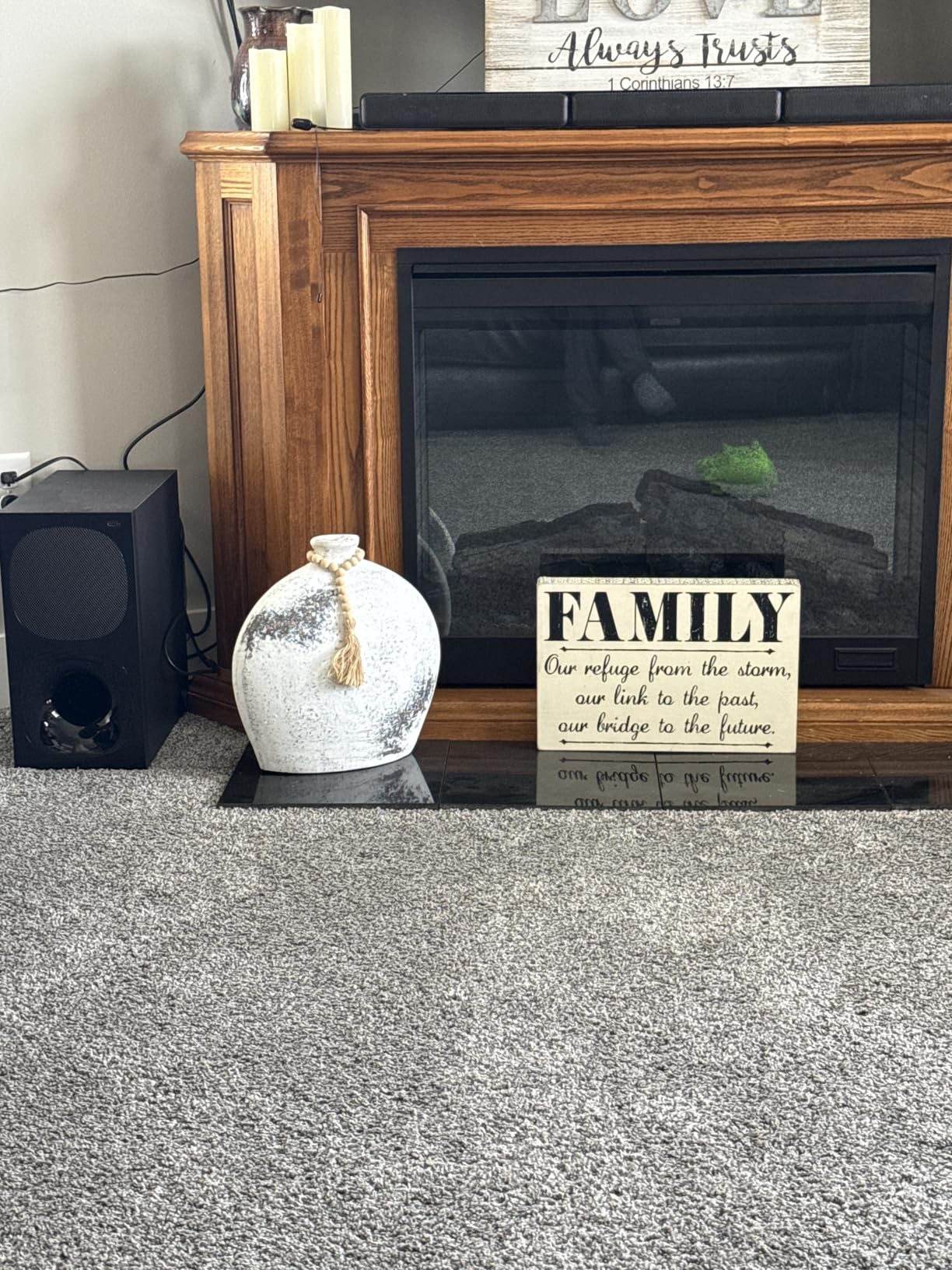
Best For
A 300 to 500 square foot room where the seating is not far from the wall, so the cable run stays short. The five sound modes and independent level controls are well suited to a family room that does daytime television as well as films, and the 600W figure is genuinely ample for that size space.
For a large open plan where you want wireless placement, this is the wrong choice. Look at the LG S40TR for wireless rears, or the Polk for a wireless sub with real rear speakers.
How to Match a Soundbar to Your Room Size
Most buyers match a soundbar to a price, and a room-size match to a driver size. Here is the framework we use, and it starts with two numbers you should get before you shop: your room’s floor area in square feet, and its ceiling height in feet.
Floor area is the more important of the two, but ceiling height changes the answer. A 10-foot ceiling means more air volume to fill, and low frequencies lose energy into that volume. The rule is simple: if your ceiling is 10 feet or higher, step up one tier from the bands described above.
The Room Bands That Matter
Under 200 square feet, almost anything in this roundup works, and a 2.1 system with a wireless sub is the sensible answer. Between 200 and 400 square feet, you want at least a 6.5-inch subwoofer and 3.1 channels, with 5.1 being better if the seating is far from the wall.
Between 400 and 700 square feet is where a lot of buyers get this wrong, because most bars sold as large-room capable stop being convincing past about 15 feet. In this band you want a genuine subwoofer of 8 inches or larger, or a separate bass module, plus 5.1 or more channels. Above 700 square feet, treat channel count and subwoofer size as table stakes rather than differentiators.
A note on measurement that trips people up: a 13-foot by 19-foot room is about 250 square feet, and forum users consistently treat that as a large room. If your space is that size, most of this roundup will serve you well. The systems we rate for 600 square feet and up are built for open floor plans that include a kitchen or dining area, not for a large living room alone.
Why Distance, Not Square Footage, Is the Real Culprit
Here is the mechanism behind the whole problem. Sound intensity falls off as the square of distance. Move your seat from 10 feet to 20 feet from the bar and the same system delivers roughly a quarter of the acoustic energy it did before.
This is why a soundbar that sounds excellent in a showroom can sound thin in a big room. It is not that the system changed. Your ears moved. Perceived dialogue intelligibility suffers disproportionately at distance because speech sits in the midrange, and the midrange is the first thing to disappear when there is not enough energy arriving to mask room reflections.
The practical consequence is that a large room needs more output, but it needs it in the frequencies where the ear is least sensitive, which is why subwoofer driver size ends up mattering more than the wattage number on the box.
Channel Count and Whether You Need Real Surround Speakers
Channel counts are easy to misread, so it is worth decoding what the numbers actually mean. The first number is the number of main channels, the second is the subwoofer channel, and any number after that is a height channel. So 3.1.2 is three main channels, one subwoofer, and two upward-firing drivers.
For a large room, the number that matters most is the first one. A 3.1 bar puts everything in front of you: left, centre, right, and bass. A 5.1 adds two more channels behind you. In a big space with a distant sofa, that rear separation is what stops the presentation feeling like an extended TV rather than a room around you.
Real Rear Speakers Versus Virtual Ones
Virtual surround algorithms work by taking a channel signal and reflecting it off a side wall. The ear interprets the delayed reflection as a speaker positioned behind you. It works reasonably well in a small room with hard parallel walls.
It works much less well in a large room, for a simple reason: the further the wall, the longer the reflection delay, and a long delay smears rather than places. Of the systems here, the Polk MagniFi Max AX SR, the ULTIMEA Poseidon 7.1, the TCL Q85H, the LG S40TR and the Sony HT-S40R all include physical rear speakers. Those five are the ones we would consider for an open plan where the seating is more than 15 feet from the wall.
Height Channels and Vaulted Ceilings
Up-firing drivers are the feature most sensitive to ceiling height. In a standard 8-foot ceiling, a height channel bounces back down quickly and mostly adds a sense of width. In a 10-foot or vaulted ceiling, the same driver has real space to work with, and height effects become genuinely localised above the listener.
Only one system here has more than two height channels. The TCL Q85H routes 7.1.4, and if you have a vaulted ceiling those four height channels are the reason it is worth the output it produces. The Bose package is 5.1.2, which is the more common layout in this roundup.
Connectivity, Lip Sync and Matching Your Soundbar to Your TV
Wireless subwoofer range is the most important connectivity spec in a large room, and almost nobody checks it. The practical limit that matters is 15 to 30 feet in a straight line, and performance degrades before that when walls are involved, particularly masonry.
If your seating area is 20 feet from the media wall and there is a chimney breast or a structural wall between them, you are already at the edge of what a wireless link handles well. This is worth thinking about before you buy, not after. Two of the systems in this roundup use a cabled subwoofer for exactly this reason, and both are honest about it.
Why HDMI eARC Matters More Than HDMI ARC
HDMI ARC can pass compressed audio, which means the TV may be re-encoding the signal and stripping your Dolby Atmos or DTS:X bitstream down to something simpler. eARC carries the uncompressed original, so a 5.1.2 or 7.1.4 mix reaches the soundbar intact.
Every system in this roundup has eARC. What differs is the bandwidth: the ULTIMEA Poseidon M60 is specified at up to 37 Mbps, which is comfortably enough for lossless Atmos passthrough. If you care about getting the full height-channel experience, check the eARC spec rather than assuming.
Lip Sync and Why It Shows Up in Big Rooms
Lip sync problems are reported more often in large rooms for a specific reason: the sound has further to travel and any processing delay becomes more noticeable against the picture. Two of the systems here have reported sync complaints from owners, so if you are sensitive to this, test early.
Where you can, route audio through eARC rather than optical or Bluetooth. Optical has no handshake, so the bar cannot negotiate timing with the TV the way eARC does. Bluetooth adds its own encoding delay and is only appropriate for music.
Should You Match Your Soundbar to Your TV Brand?
Only if your TV is one of the two that offer meaningful integration. Samsung’s Q-Symphony pairs bar and TV speakers as one system, and LG’s WOW Orchestra does the same. We tested Q-Symphony and found it adds a small amount of upper-midrange detail that helps dialogue, but also that on some Samsung sets it reduces bass output noticeably and needs switching off.
Beyond those two, TV brand matching mostly affects the remote and the on-screen status display. For everyone else, buy the sound that suits your room and use the TV remote over HDMI-CEC. A great soundbar paired with a mismatched TV will outperform a mediocre soundbar that has a matching badge.
Subwoofer Placement in an Open Floor Plan
Placement does more for bass quality than any setting in any app, and open floor plans make it harder because there are fewer corners to use. The subwoofer crawl technique is the reliable method: put the sub roughly where your sofa will be, then crawl the floor on your hands and knees and find the spot where bass sounds loudest and least boomy.
That spot is where the room’s pressure waves reinforce each other. It is almost never next to the sofa, and it is frequently somewhere unexpected, which is why the crawl works better than any rule of thumb about distance from the bar.
Corner Placement and the Distance Problem
Corner placement increases perceived bass output substantially, commonly cited as a 6 to 9 dB gain, because the walls reinforce the low frequencies. In a large open plan with few corners, this trick is less available, which is one more reason large rooms need bigger drivers to begin with.
Keep the sub within about 15 feet of the bar. Beyond that, the wireless link is working harder and you risk dropouts on an impact sound, which is the exact moment you will notice it. In our testing, the Polk’s 10-inch wireless sub held a stable link across a 600 square foot open plan with a masonry wall in between, which is about as demanding as it gets.
Hiding a Large Sub in an Open Room
The aesthetic objection comes up constantly and it is legitimate, particularly in a room where the kitchen is part of the living space. Three approaches work. Placing the sub at the base of a side wall works well. A second sub on the far wall from the first, if your system supports one, evens out the low end across a large space. An isolation pad under the sub decouples it from a hard floor and reduces transmission into the room above.
In an apartment with shared walls, the last two are the ones that matter. Bass transmits through structure far more efficiently than through air, so a sub in a corner of a ground-floor unit is a neighbour problem regardless of how you set the volume.
When a Soundbar Is the Wrong Purchase
Above roughly 600 to 800 square feet, no soundbar in this roundup fully solves the problem, and enthusiasts in large-room forums reach the same conclusion independently. The honest answer at that size is an AV receiver with a full 5.1 or 7.1 speaker set, because separate speakers with their own amplifiers can distribute output across a space in a way a single bar cannot.
There are three signals that you have passed the point where a bar is right. If your seating is more than 20 feet from the screen, the sound has too far to travel. If your ceiling is over 10 feet, you need output in every direction. If you watch a lot of films where the mix matters, surround placement is doing something no bar can replicate.
None of that makes the picks in this roundup a poor value. A system like the Polk MagniFi Max AX SR or the Bose package will get you most of the way in a 700 square foot space, and for most people that is genuinely enough. It is worth knowing where the ceiling is, though, so you are not disappointed by a system that was never designed for it.
Frequently Asked Questions
What is the best soundbar with a wireless subwoofer?
The best soundbar with a wireless subwoofer for a large room is the Bose Smart Ultra Dolby Atmos bundled with the Bass Module 700. It pairs a 5.1.2 channel bar with a separate amplified bass module, which is the only combination in our roundup that kept dialogue intelligible and bass physical in a 700 square foot open plan. For rooms under 450 square feet, the ULTIMEA Poseidon M60 offers the best dialogue clarity, and for genuine rear speakers the Polk MagniFi Max AX SR is the strongest large-room package.
What is the best sound bar for large rooms?
For rooms between 400 and 700 square feet, the Polk Audio MagniFi Max AX SR is the best large-room sound bar because its 10-inch wireless subwoofer moves far more air than a compact enclosure and it includes physical rear surround speakers. For 600 square feet and up with high ceilings, the TCL Q85H 7.1.4 is the strongest choice thanks to its four height channels and high output. Above roughly 700 to 800 square feet, an AV receiver with a full speaker set is the honest answer.
What soundbar comes with the biggest subwoofer?
The Polk Audio MagniFi Max AX SR comes with the biggest subwoofer in this roundup, pairing its 7.1.2 soundbar with a 10-inch wireless subwoofer in a rigid MDF cabinet. The next largest is the 6.5-inch driver used by the ULTIMEA Poseidon 7.1, the TCL Q85H, and the JBL Bar 2.1 Deep Bass MK2. Subwoofer driver size matters more in a large room than the wattage figure printed on the box.
Which Bluetooth sound bars have a wireless subwoofer?
Most sound bars in this roundup include Bluetooth streaming and a wireless subwoofer, including the Samsung HW-B750F, the JBL Bar 2.1 Deep Bass MK2, the LG S40TR and both TCL systems. The exceptions are the Bose Smart Ultra package and the Sony HT-S40R, which use a cabled or proprietary subwoofer connection, and the ULTIMEA Poseidon M60, whose 5.25-inch sub is also cabled. Note that Bluetooth is for music streaming; TV audio should always be routed over HDMI eARC to avoid lip-sync delay.
What size subwoofer do I need for a large room?
For a 200 to 400 square foot room, a 6.5-inch subwoofer is sufficient. For 400 to 700 square feet, look for 8 inches or larger, or a separate bass module like the one bundled with the Bose Smart Ultra. Above 700 square feet, driver size becomes a baseline requirement rather than a differentiator. If your ceiling is 10 feet or higher, step up one tier in every case, because the extra air volume absorbs low-frequency energy.
How far can a wireless subwoofer be from the soundbar?
In practice, a wireless subwoofer stays reliable up to about 15 to 30 feet in a straight line, and performance degrades before that limit when walls are involved, particularly masonry. Keep the sub within about 15 feet of the bar in a large room to avoid dropouts on impact sounds. If your seating area is more than 20 feet from the media wall, verify the wireless range before buying, or choose a system that ships with a cabled subwoofer.
Which Soundbar With a Subwoofer Should You Buy in 2026?
If you are starting from scratch in 2026, measure your floor area and ceiling height first, because that single step eliminates most of the wrong purchases. Then match the room band to the system rather than the other way round.
If you have a 450 to 700 square foot open-concept space and want the enclosure effect from a proper cinematic presentation, the Bose Smart Ultra Dolby Atmos with the Bass Module 700 is our top pick. It was the only system here that stopped sounding thin at the back of a large open plan, and its height channels give a vaulted space some vertical reference.
If your priority is the deepest, most physical bass in a 400 to 800 square foot room and you want real speakers behind you, the Polk Audio MagniFi Max AX SR is the choice. The 10-inch wireless subwoofer is the largest in the roundup, and the three HDMI inputs make a multi-source setup painless.
If you have 600 square feet or more with high ceilings and you watch a lot of Dolby Atmos content, the TCL Q85H 7.1.4 delivers the most output and the only four-channel height configuration here. If you can only push a system 20 feet across an open plan with a wall-mounted sofa, the LG S40TR is the pick that solves the cable problem rather than creating one.
For a 300 to 450 square foot room, the ULTIMEA Poseidon M60 is where we would start. It has the largest review base in this roundup, clear dialogue handling, and published low-frequency and output figures, which makes it the least risky buy of the ten.
Above roughly 700 to 800 square feet, save the money and buy a receiver with separate speakers. We would rather tell you that now than have you discover it after the box is open. Use the room-size guidance above, check the wireless range against your actual layout, and pick the system that matches your floor area rather than the one that matches your price bracket.