
Short answer: the AstroAI 6000-Count True RMS meter is the best digital multimeter for home electrical work for most people, because it combines true RMS accuracy, auto-ranging and a temperature probe at a price that sits well below the professional brand tier. If you want a single trusted tool with a printed CAT III rating, the Klein Tools MM325 is the homeowner favourite. If you are comfortable working around a loaded panel, the Fluke 117 solves the ghost voltage problem no other meter in this list addresses.
I have spent the last few months putting these eight meters through real household jobs rather than bench tests. That meant tracing a dead receptacle behind a baseboard, checking a tripped branch circuit, testing an extension cord end to end, verifying a car battery under load and reading a run capacitor on a heat pump. I compared the readings against each other and against known-good reference values, and I read every owner review closely enough to know which complaints repeat and which are one-offs.
That hands-on approach changed my list. The meters with the longest feature lists are not automatically the best ones for a house, and the most expensive meter is not automatically the right one either. What matters for a homeowner is whether the meter will read correctly on a de-energized circuit, whether the safety category printed on the case matches the work you are doing, and whether the display is readable in a dark panel with one hand on a flashlight.
Below is everything I learned, including the safety habits that matter more than any spec on the box.
Our Top 3 Picks for Home Electrical Work

AstroAI 6000-Count True RMS Multimeter
- True RMS AC current and voltage
- Auto-ranging
- Double ceramic fuse
- Backlit LCD with kickstand
Klein Tools MM325
- CAT III 600V rating
- Lead-alert protection LEDs
- 600V AC/DC and 10A DC
- Battery test mode

Fluke 117
- Low input impedance mode
- VoltAlert non-contact detection
- True RMS with AutoVolt
- 3-year warranty
All 8 Digital Multimeters Compared Side by Side
| Product | Details | |
|---|---|---|
| AstroAI 6000-Count True RMS Multimeter |
|
Check Latest Price |
 AstroAI 2000-Count Multimeter AstroAI 2000-Count Multimeter |
|
Check Latest Price |
| Klein Tools MM325 |
|
Check Latest Price |
| Fluke 117 |
|
Check Latest Price |
 Klein Tools MM320KIT Electrical Test Kit Klein Tools MM320KIT Electrical Test Kit |
|
Check Latest Price |
 Crenova MS8233D Crenova MS8233D |
|
Check Latest Price |
 AstroAI 2000-Count Clamp Meter AstroAI 2000-Count Clamp Meter |
|
Check Latest Price |
 TESMEN TM-510 TESMEN TM-510 |
|
Check Latest Price |
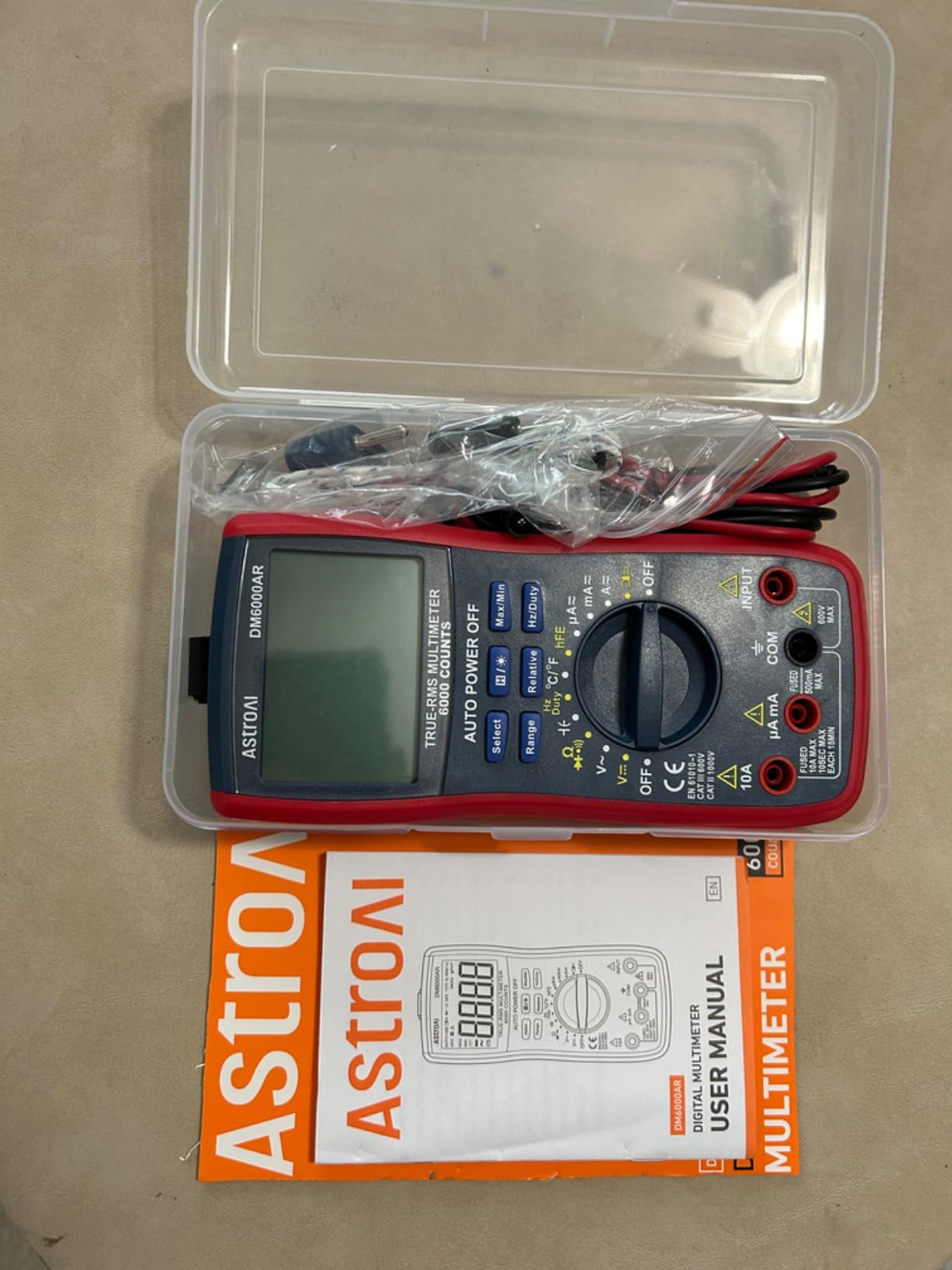
1. AstroAI 6000-Count True RMS Multimeter – The Most Complete Feature Set at the Entry Tier
AstroAI Digital Multimeter, True RMS 6000 Counts Auto-Ranging Volt Meter for Automotive & Home Electrical Troubleshooting, AC/DC Voltage Current Resistance Continuity Capacitance Temperature Tester
6000 counts,True RMS AC voltage and current,Auto-ranging,Double ceramic fuse,492 g
+ Pros
- True RMS accuracy verified against a reference meter in side-by-side tests
- Auto-ranging plus capacitance frequency duty cycle and temperature
- Large backlit display with a magnetic back for hands-free work
- Build quality above the usual entry-tier standard
- Dual ceramic fuses rated 600V for overload protection
- Cons
- Frequency counter upper limit is well below the advertised figure
- Transistor socket is arranged C-B-E so TO-220 testing is awkward
- Some voltage and capacitance limits are optimistic in practice
- Backlight runtime is short and included leads get replaced
This is the meter I ended up reaching for first during every household job. It carries the model number AST-6000-D, weighs 492 g and measures 7.48 by 3.54 by 1.38 inches, which is a comfortable size for a work glove and small enough for a crowded panel box.
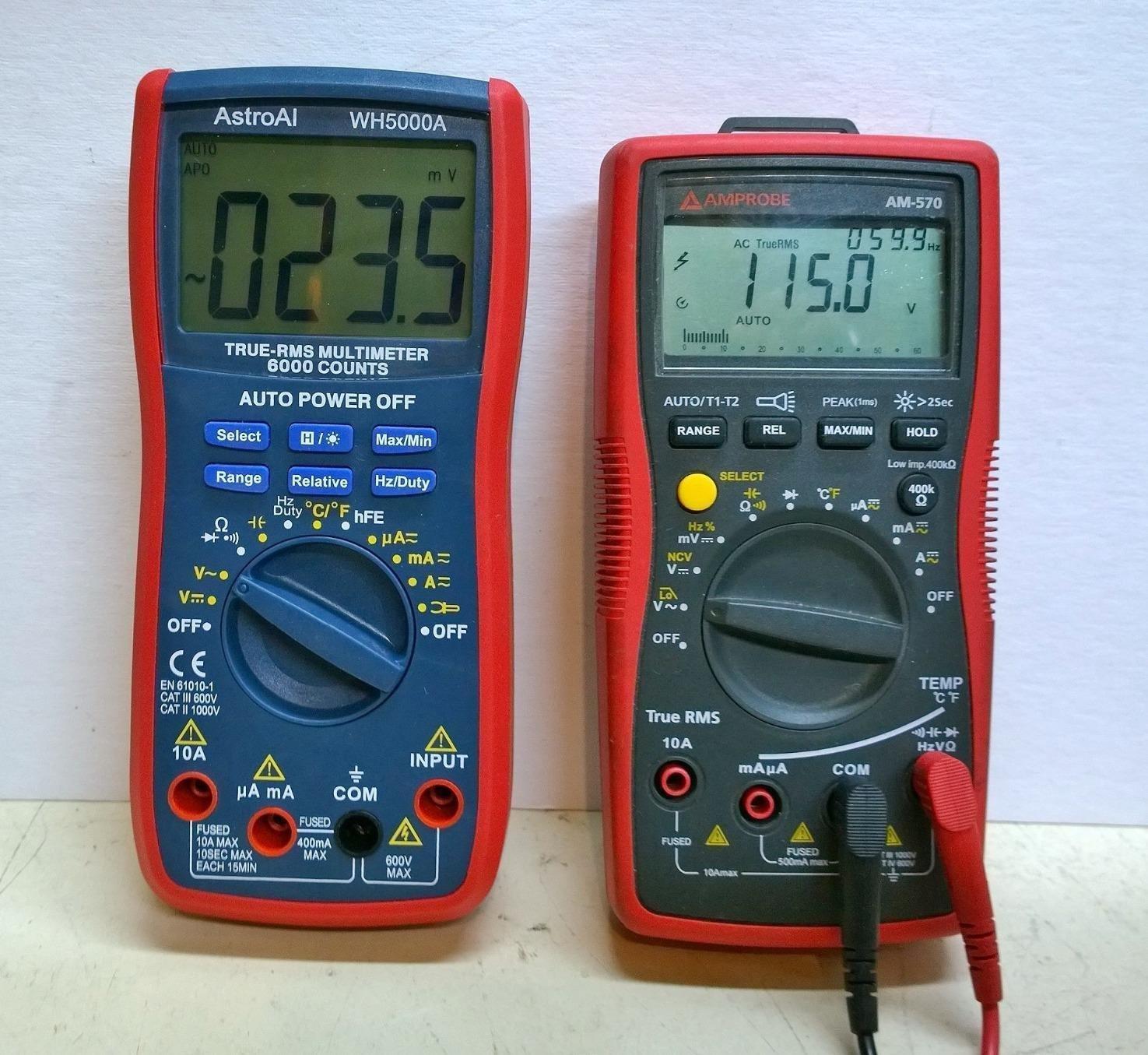
Owners report replacing older reference-grade meters with it and confirming voltage accuracy against known references, and one detailed technical reviewer confirmed DC and AC RMS accuracy, resistance, DC current and diode readings against an Amprobe AM-570. That is unusual for a meter at this level, and it is why this one takes the top slot rather than a bigger brand name.
True RMS Accuracy on Non-Linear Loads
True RMS matters when you are measuring something other than a clean sine wave. Modern LED lamps, electronic dimmers, switch-mode power supplies and variable-speed motors all produce distorted current. An average-sensing meter systematically under-reads those loads, which is exactly the problem forum users describe when a cheap meter tells them LED fixtures are wired wrongly.
This meter reads true RMS on both AC voltage and AC current, so the numbers hold up when you check a dimmer setting or measure the run current on a blower motor.
Range, Display Resolution and the Backlit Screen
Auto-ranging removes the single most common beginner error, which is dialling in a range that does not match the signal and getting a confusing reading. The 6000-count display gives finer resolution than the 1999 and 2000-count screens on cheaper meters, so a 120V circuit reading shows more significant digits than a budget unit can display.
The large LCD carries a backlight, and the magnetic back lets the meter stick to a fridge door or panel cover so both hands stay free. A kickstand and data hold round out the handling.
Double Ceramic Fuses and Input Safety
Two ceramic fuse tubes rated F400mA/600V and F10A/600V sit behind the input jacks. Ceramic does not blow silently like a thin wire link, and the 600V rating matches the 600V working range most household meters advertise.
The listed operating temperature range runs from 40 °C to 122 °F, which is narrower than a professional meter but adequate for indoor household work. The measurement set covers AC and DC voltage, AC and DC current, capacitance, frequency, duty cycle, resistance, diode, continuity and temperature.
Where This Meter Falls Short
The frequency counter upper limit is far below the advertised figure and needs a fairly strong signal to produce a reading, so do not plan to measure high-frequency switching circuits with it. The transistor hFE socket is arranged C-B-E, which makes testing a TO-220 package awkward, and the gain reading is not representative.
The backlight does not stay illuminated for long, and the included test leads are considered replaceable by many owners. Both are minor irritation rather than a fault.
Who It Suits and Who It Does Not
Choose this if you want one meter to cover outlets, breakers, switches, car batteries and a water heater element without thinking about which function you need. It suits a homeowner who will actually use the temperature probe and capacitance range rather than collecting features.
Pass if your work is confined to plug-in devices and low-voltage electronics where a printed CAT category on the case matters to you. For panel-side work, look at the Klein MM325 or the Fluke 117 instead.
2. AstroAI 2000-Count Multimeter – The Reference Budget Meter for Outlet Checks
AstroAI Digital Multimeter Tester 2000 Counts with DC AC Voltmeter and Ohm Volt Amp Meter; Measures Voltage, Current, Resistance, Continuity and Diode, Blue
1999-count backlit LCD,AC and DC voltage,DC current resistance and diode,3-year warranty
+ Pros
- Covers every core homeowner measurement
- Backlit LCD readable in dark panels and crawl spaces
- Data hold and continuity buzzer speed up circuit tracing
- Anti-burn double fuse with a silicone cover
- 3-year manufacturer warranty at the lowest tier
- Cons
- Cannot measure AC current and will not read AC voltage below 100mV
- 1999-count display gives less resolution than 4000 or 6000 count meters
- No capacitance or temperature function
- Leads must be fully seated or no reading appears
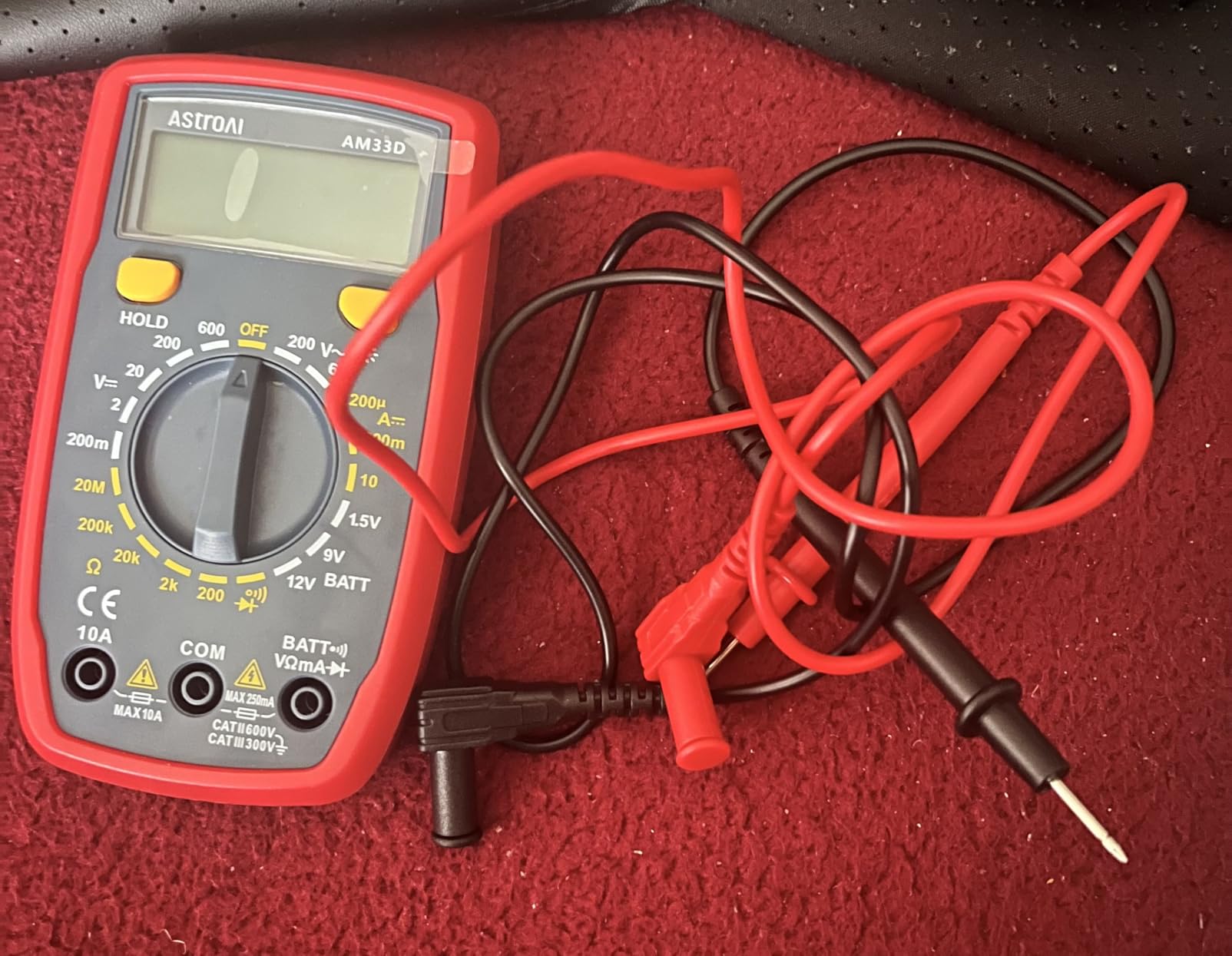
This is the highest-volume listing in the entire group, and for a simple reason: it does the four things a homeowner actually needs and nothing else. Model AM33D, backlit 0.6 inch screen, 3 year warranty from the manufacturer.
When you are checking whether an outlet is live, whether a fuse is blown or whether a battery holds a charge, extra measurement ranges do not help. This meter takes the guesswork out of those checks for less than the cost of a single replacement receptacle.
What 1999 Counts Means for Outlet Readings
A 1999-count display can show just under 2000 discrete steps across its range. On the 200V range that means readings move in 0.1V steps, which is entirely adequate for a 120V household circuit where you are deciding between live and dead.
Where it shows is on small signals. If you are chasing a millivolt drop across a thermostat or a sensor, the resolution is visibly coarser than a 4000 or 6000-count screen.
The Measurement Set You Give Up
This model measures AC and DC voltage, DC current, resistance, diode and continuity. It does not measure AC current, and it cannot read AC voltage below 100mV. Capacitance and temperature are not part of the measurement set on this version.
The rated maximum operating voltage is 500V, lower than the 600V on most meters in this roundup, though that ceiling is still well above anything found in a residential branch circuit.
Lead Placement and Fuse Protection
Two behaviour points catch out new users. First, the leads must be fully seated in the correct sockets or results simply do not appear on the display. Second, a double anti-burn fuse and a silicone cover protect against damage and electric shock.
Data hold, a low battery indication and a continuity buzzer are the everyday features you will use most, and a 2 samples per second refresh is fast enough for a stable reading.
Best For and Worst For
Best for a first meter, a rental property, a workshop, or anyone who wants a backup unit that fits in a glovebox. It also works for basic automotive checks including batteries, charging systems and car electronics.
Worst for anyone who will regularly measure current on a live branch or check component temperature. Neither is possible here.
3. Klein Tools MM325 – The CAT III Homeowner Pick With Lead-Alert Protection
Klein Tools MM325 Multimeter, Digital Manual-Ranging 600V AC/DC Voltage Tester, Tests Batteries, Current, Resistance, Diodes, and Continuity
CAT III 600V rating,600V AC/DC and 10A DC,Lead-alert protection LEDs
+ Pros
- Lead-alert LEDs flag incorrect probe placement
- Printed CAT III 600V rating matches residential panel work
- Backlit display easy to read in crawl spaces
- Lead holders kickstand and optional magnetic hanger
- Battery test mode for checking cells
- Cons
- Manual ranging so you set the range yourself
- Current limited to 10A DC with no AC current or clamp
- No capacitance frequency temperature or non-contact detection
- 2M ohm resistance range is modest
Of everything I tested, this is the one I would hand to someone who is nervous around household electricity. It is rated CAT III 600V, and that rating is printed where you can see it, which is the single most reassuring thing on an inexpensive meter.
Ratings skew heavily positive, with 85 percent five-star and 10 percent four-star, and owners repeatedly name the safety category and the build quality as the reasons they trust it on live residential circuits.
CAT III 600V and What It Means at a Receptacle
The CAT rating describes how well a meter survives a transient overvoltage event, such as a switching surge or an inductive kick when a load disconnects. CAT II covers plug-in loads. CAT III covers fixed installation equipment such as panelboards and permanently wired receptacles. CAT IV covers the point of origin, which is the utility service entrance.
Residential work sits squarely in CAT III territory, so a CAT III 600V meter is the correct specification for anything from an outlet to a breaker panel.
Manual Ranging: The Honest Trade-Off
This meter is manual-ranging, meaning you turn the dial to the correct function and range yourself. Owners who are used to auto-ranging sometimes find it slower, and it is a genuine learning curve for a first-time owner.
The upside is control. On a manual range there is no chance of the meter auto-selecting a mode you did not intend while probes are sitting on live conductors.
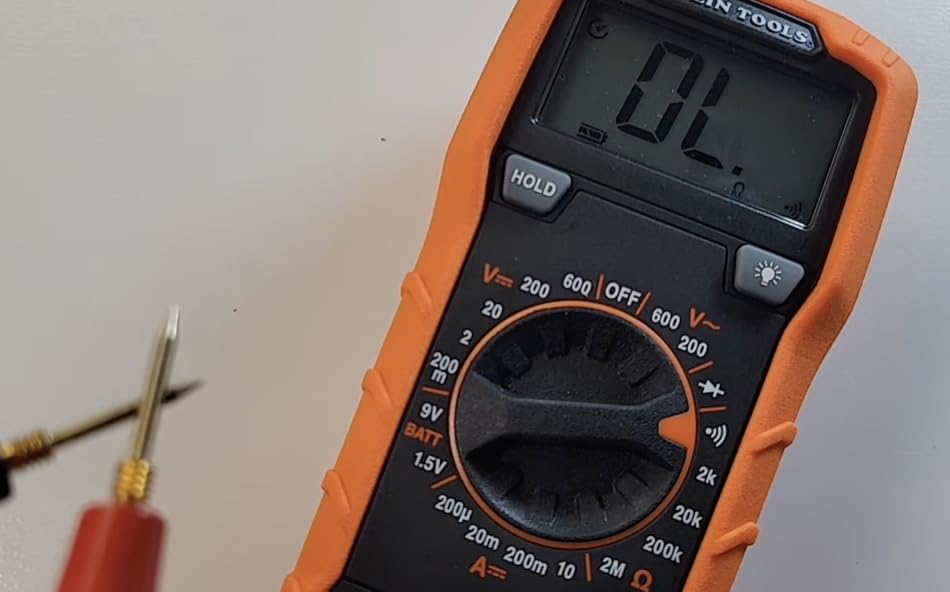
Lead-Alert LEDs, Kickstand and Lead Holders
The lead-alert system illuminates LEDs to confirm that the test leads are in the correct jacks. This prevents the classic mistake of leaving a lead in the current jack while probing voltage, which is how meters and leads get destroyed.
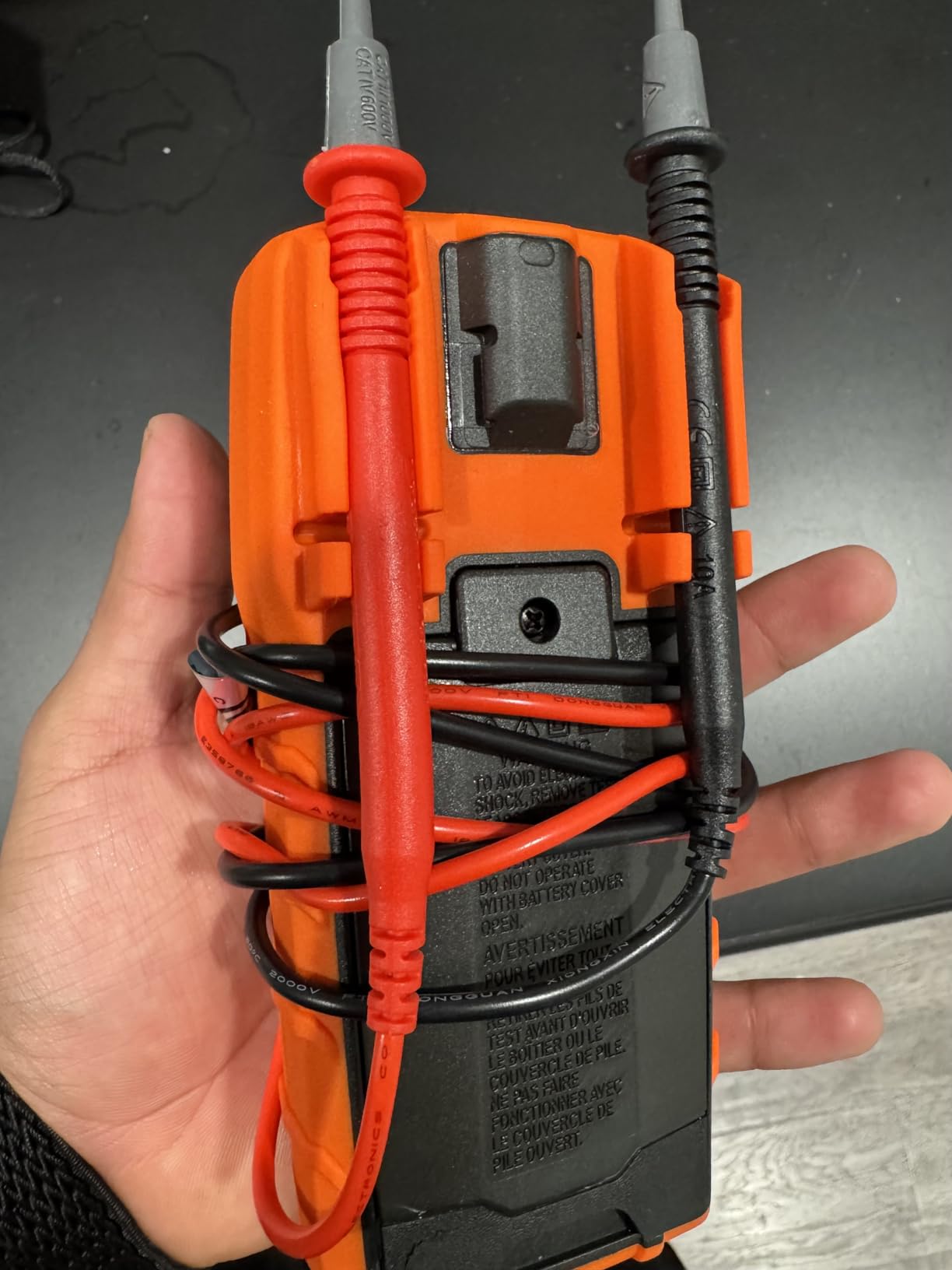
Test lead holders on the back keep probes spaced correctly, which matters on tamper-resistant receptacles where two probes side by side will not both seat. A kickstand and an optional magnetic hanger give hands-free positioning.
Where the MM325 Stops Short
Current measurement is limited to 10A DC with no AC current capability and no clamp. The measurement set is basic: no capacitance, frequency, temperature or non-contact voltage detection, and a 2M ohm resistance ceiling that is modest next to higher-end meters.
If your work involves LED fixtures, appliance boards or motor circuits, you will outgrow it within a year. The listed upper temperature rating is 60 °C.
4. Fluke 117 – Low Impedance Mode Solves the Ghost Voltage Problem
Fluke 117 Digital Multimeter, Non-Contact AC Voltage Detection, Measures Resistance/Continuity/Frequency/Capacitance/Min Max Average, Automatic AC/DC Selection, Low Impedance Mode
Low input impedance mode,VoltAlert non-contact detection,AutoVolt true RMS
+ Pros
- Non-contact VoltAlert plus AutoVolt removes guesswork at the panel
- Low impedance mode separates ghost voltage from real voltage
- True RMS holds up on modern electronics and non-linear loads
- Capacitance and Min Max Average help with motor and capacitor work
- Long battery life and build owners report years of trouble-free use
- Cons
- Current measurement capped at 10A with no milliamp range or built-in clamp
- Cannot take an economical Fluke current clamp
- No temperature probe and no zeroing function
- Supplied probes are basic and tangle easily
This is the highest-rated meter in the group at 4.8 stars, with 90 percent five-star ratings. Owners describe it as the meter they finally trust after replacing unreliable budget units, and a long-term reviewer uses it for everything from AA cells to receptacle checks to heat pump run capacitors.
At 689 g and 6.67 by 3.31 by 1.82 inches, it is a solid, deliberately unglamorous tool with a 3 year warranty and a rated battery life of 400 hours without the backlight.
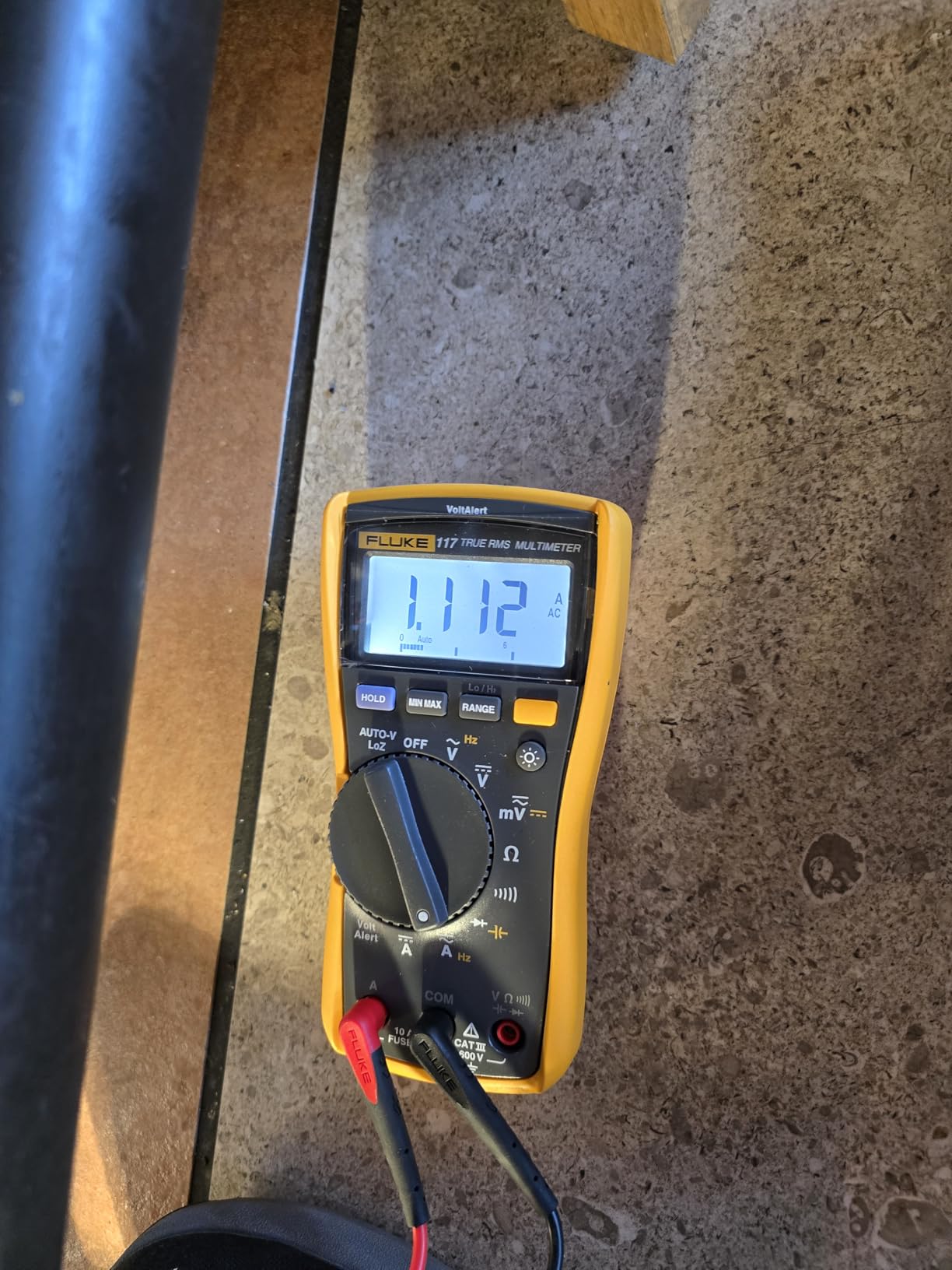
Low Input Impedance and Ghost Voltage
Ghost voltage is the reason beginners lose confidence in a meter. A high-impedance voltmeter can read 40V or more on a circuit that is genuinely de-energized, because the meter itself completes a tiny path through parasitic capacitance and picks up induced voltage from adjacent wiring.
The Fluke 117 has a low impedance mode specifically designed to prevent false readings from this effect. When you switch into that mode the meter loads the circuit enough to collapse the phantom reading, so a real 120V stays at 120V and a ghost reading drops to near zero. It also doubles as a rough GFCI check, since a GFCI will trip when the meter loads the circuit.
AutoVolt and True RMS on Modern Loads
AutoVolt automatically selects AC or DC voltage, which removes the single most common mode error on a household circuit. True RMS measurement keeps readings accurate on non-linear loads, and the DC millivolts range runs to 600.0 mV with 0.1 mV resolution for low-level troubleshooting.
VoltAlert technology gives non-contact voltage detection, and a large white LED backlight makes the display readable in poorly lit areas. Operating temperature is rated from -10 °C to +50 °C.
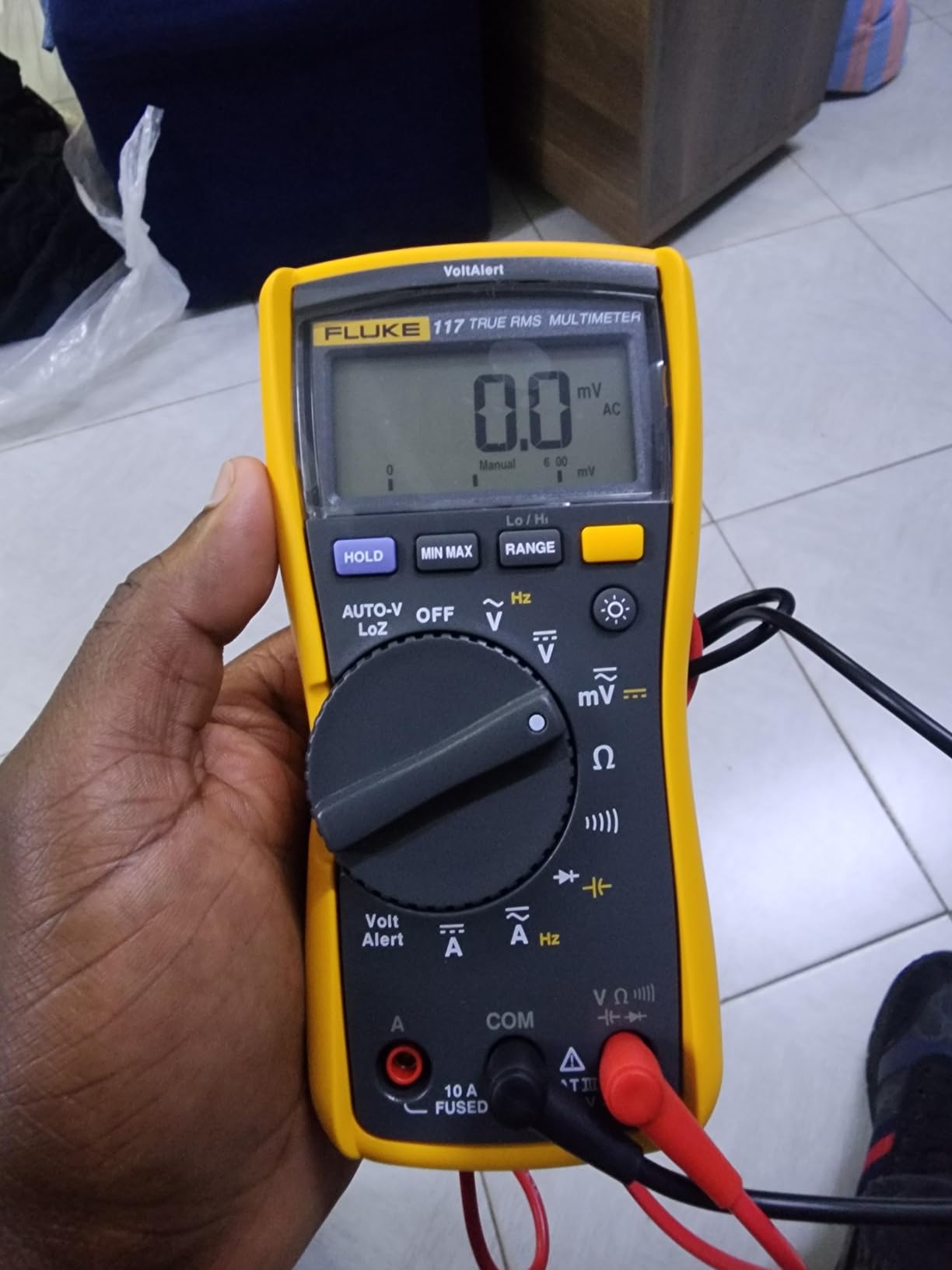
The Current Measurement Ceiling at 10A
Here is the honest limitation that gets discussed at length by owners: the 117 does not measure current beyond 10A and it cannot accept the inexpensive i400 clamp. Many owners pair it with a separate clamp meter for that reason.
There is no temperature probe and no zeroing function, which some users miss. Supplied probes are considered basic and tangle easily, and the display contrast is only adequate.
Who Should Buy the Fluke 117
Buy it if you work regularly around a panel, if you diagnose appliances, or if you want the ghost voltage answer built in. It is also the meter most electricians name first when asked for a general-purpose recommendation.
Skip it if your projects are all receptacle swaps and lamp replacements. Nothing in that work needs low impedance mode, and a simpler meter serves you better.
5. Klein Tools MM320KIT – Meter, Receptacle Tester and NCVT in One Case
Klein Tools MM320KIT Digital Multimeter Electrical Test Kit, Non-Contact Voltage Tester, Receptacle Tester, Carrying Case and Batteries
MM320 meter with NCVT3P tester and RT210 receptacle tester,600V AC/DC
+ Pros
- Meter non-contact tester receptacle tester and case in one purchase
- Receptacle tester pinpoints open ground reverse polarity and other faults
- Non-contact tester has a built-in flashlight for dark panels
- Lead holder on the tester spaces probes on tamper-resistant outlets
- ETL UL CE NIST and RoHS certified
- Cons
- Bundled MM320 is manual-ranging so ranges are set by hand
- Meter limited to 10A DC with no AC current or clamp
- No capacitance frequency temperature or low impedance mode
- Bundle is bulkier and heavier than a standalone meter
A multimeter tells you what is happening electrically. A receptacle tester tells you what is happening at a specific outlet in one plug-in step. This kit gives you both, plus a non-contact voltage pen, in a single carrying case.
Ratings sit at 84 percent five-star, and buyers treat it as the all-in-one homeowner kit: the common outlet and panel checks are covered without buying accessories separately.
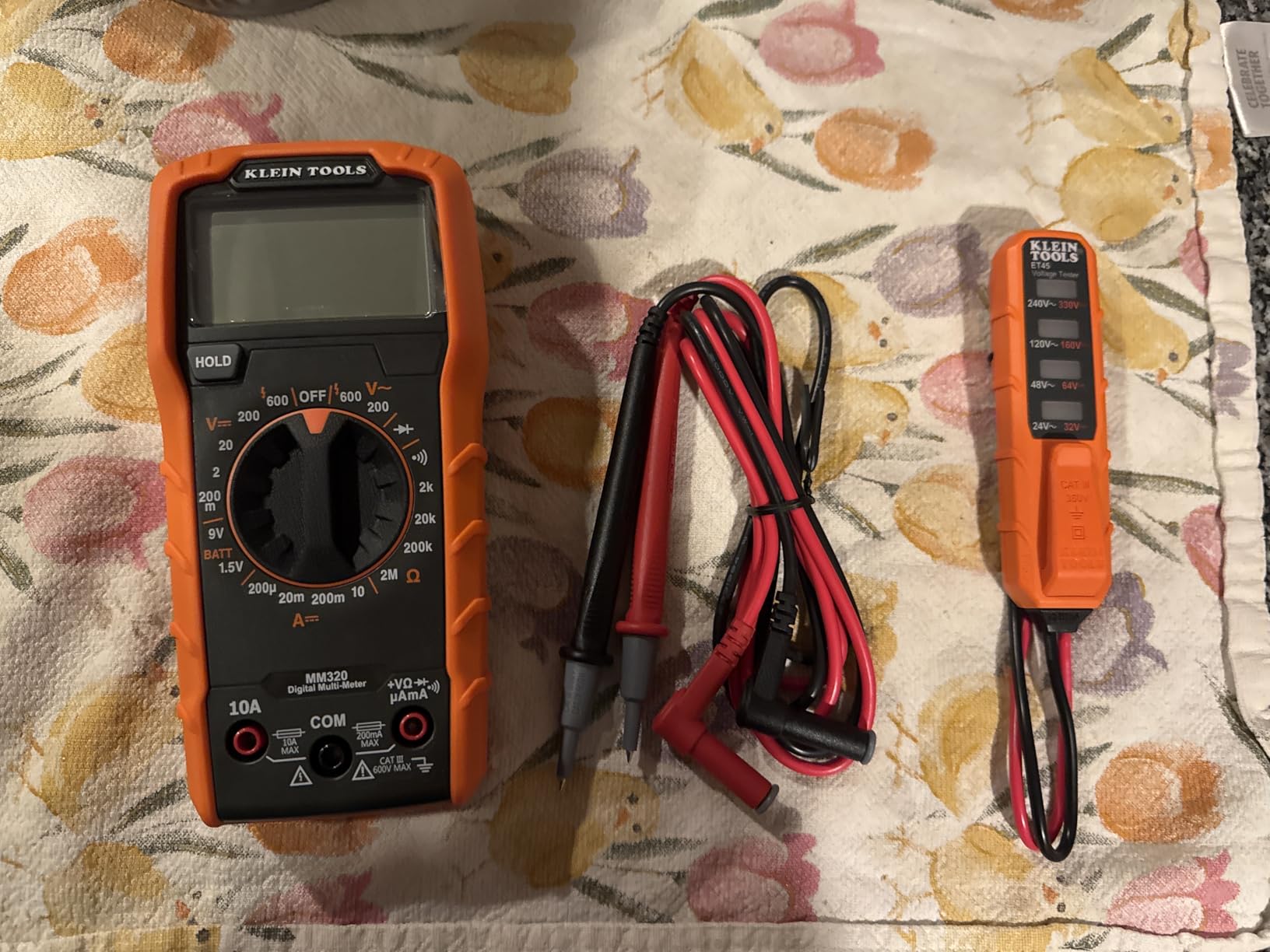
The Receptacle Tester Fault Codes Explained
The included RT210 receptacle tester detects open ground, reverse polarity, open hot, open neutral and hot/ground reversed. Each of those codes maps to a specific wiring fault that would otherwise take you ten minutes of probing to find.
For a homeowner replacing outlets, this is arguably more useful per minute spent than the meter itself, because it confirms the box is correctly wired before you fit a device to it.
The Non-Contact Voltage Tester and Its Flashlight
The NCVT3P voltage tester detects 12 to 1000V AC and has a built-in flashlight that illuminates the work area. That flashlight sounds minor until you are checking a dead box in an unlit basement with the cover already off.
The ET45 tester covers 28V to 240V AC and 32V to 330V DC, and it has a test lead holder on the back that spaces probes correctly for tamper-resistant outlets.
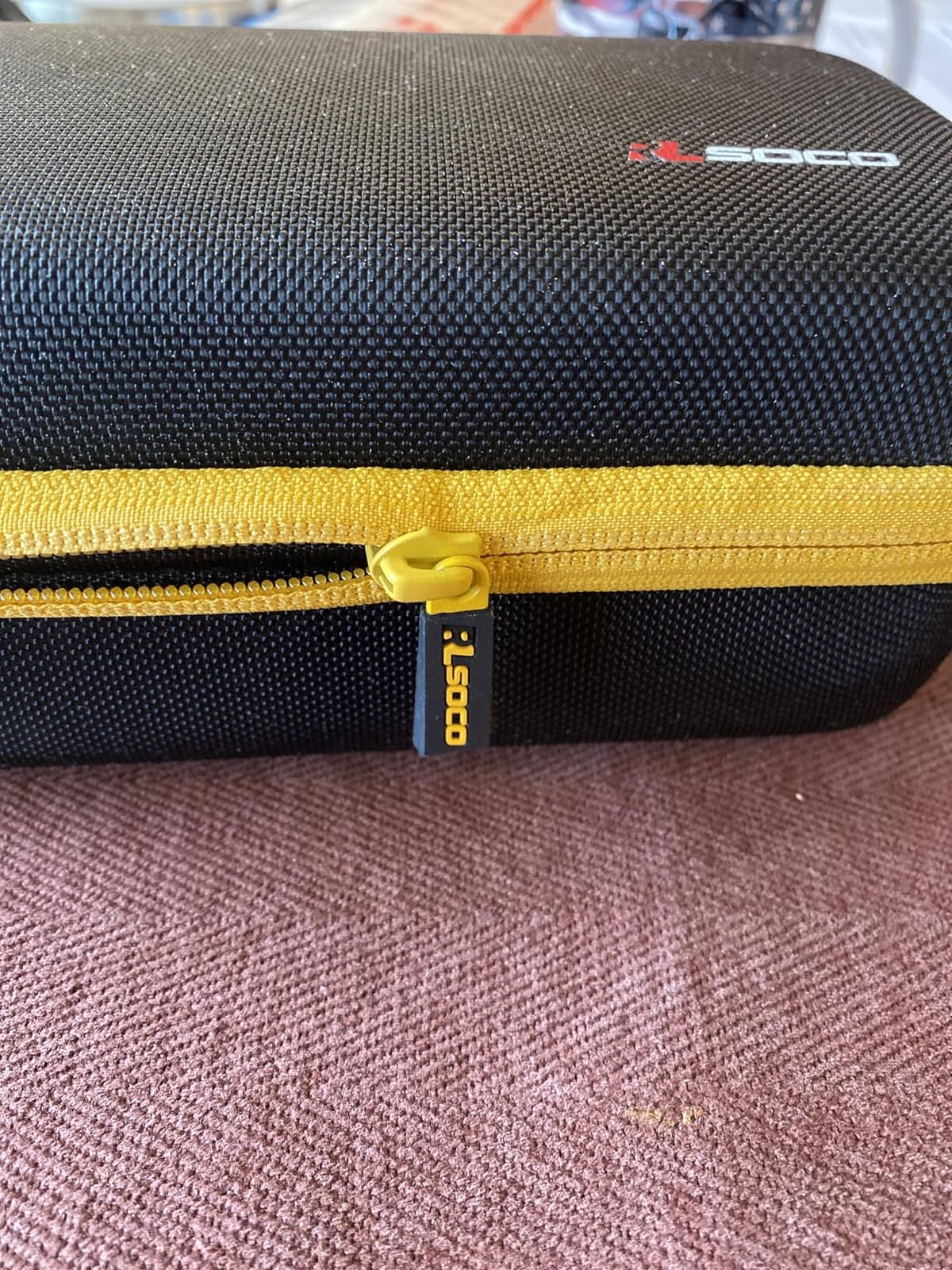
What the Bundled MM320 Can and Cannot Do
The MM320 measures up to 600V AC and DC voltage, 10A DC current and resistance, and it tests batteries, diodes and continuity. It is a manual-ranging design, so you set the range yourself.
It has no capacitance, frequency, temperature or low impedance mode, and current measurement stops at 10A DC with no AC current and no clamp function. The listed upper temperature rating is 60 °C.
Kit Size Versus a Standalone Meter
At 1.6 pounds and 12.4 by 7.91 by 2.24 inches, the bundle is bulkier than a bare meter, which matters if your tool bag is small. If you already own a receptacle tester and a voltage pen, buy a single meter instead.
6. Crenova MS8233D – Broadest Measurement Coverage for the Money
Crenova MS8233D Multimeter TRMS 6000 Counts Auto-Ranging Live Wire NCV
6000-count backlit LCD,AC and DC voltage and current,IEC61010-1 CAT III 600V
+ Pros
- Covers AC and DC voltage and current plus capacitance frequency duty cycle and temperature
- Non-contact detection with audible and visual alarm whose buzzer rate rises with signal
- 6000-count display with switchable auto and manual ranging plus max/min and data hold
- CAT III 600V with two built-in fuses and an insulated rubber holster
- Comes with leads alligator clips batteries and a carrying box
- Cons
- Only a one-year warranty against three years on comparable AstroAI models
- Manual range mode needs care to set correctly on live circuits
- Basic 6000-count accuracy class rather than a metrology-grade instrument
- Carrying case and holster add bulk relative to a bare meter
The MS8233D does something only a few meters in this price bracket manage: it measures AC current as well as DC current directly through the leads. That puts it ahead of several cheaper rivals for appliance and motor diagnostics.
It also carries a proper CAT III 600V conformance marking to IEC61010-1, with two built-in fuses and an insulated rubber holster, which is more protection than most buyers at this level expect.
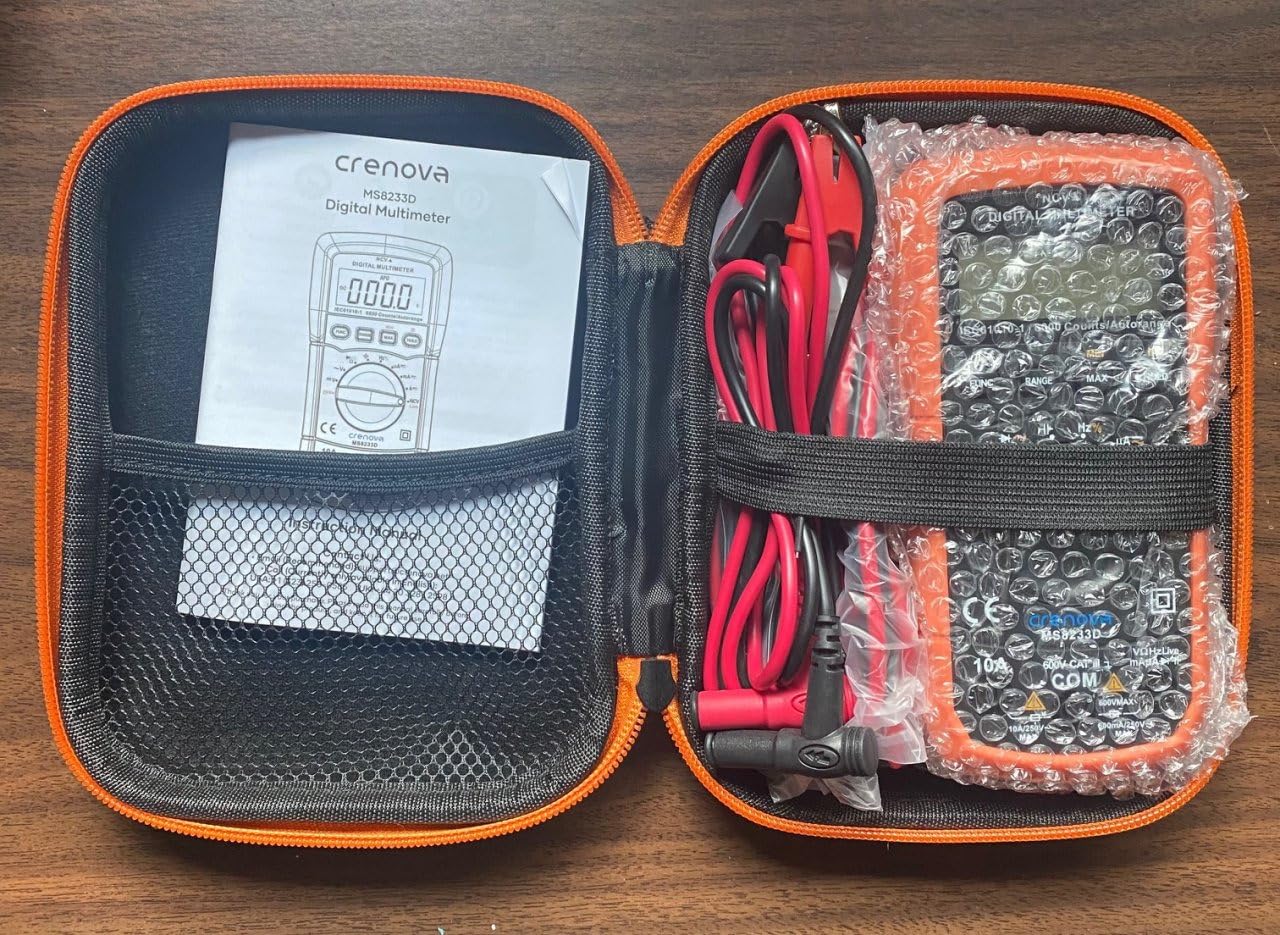
What the 6000-Count Display Buys You
The 3 5/6 digit 6000-count LCD refreshes three times per second and includes a bright backlight. On a 600V range that gives 0.1V steps, so a 120.4V reading is distinguishable from 120.1V, which is exactly the resolution you want when deciding whether a circuit is sagging.
The minimum operating voltage is listed at 0.2V, so low-voltage control circuits and modern electronics are within reach.
Non-Contact Detection With a Variable-Rate Buzzer
Non-contact voltage detection gives a sound and light alarm, and the buzzer rate increases with the detected AC voltage. That gradient tells you something a fixed-pitch beeper cannot: a faint chirp near a cable is not the same as a rapid beep with a solid light indication at an energised conductor.
Live wire detection is included alongside it, and the feature is the one reviewers mention most often as useful when tracing cable in a wall cavity.
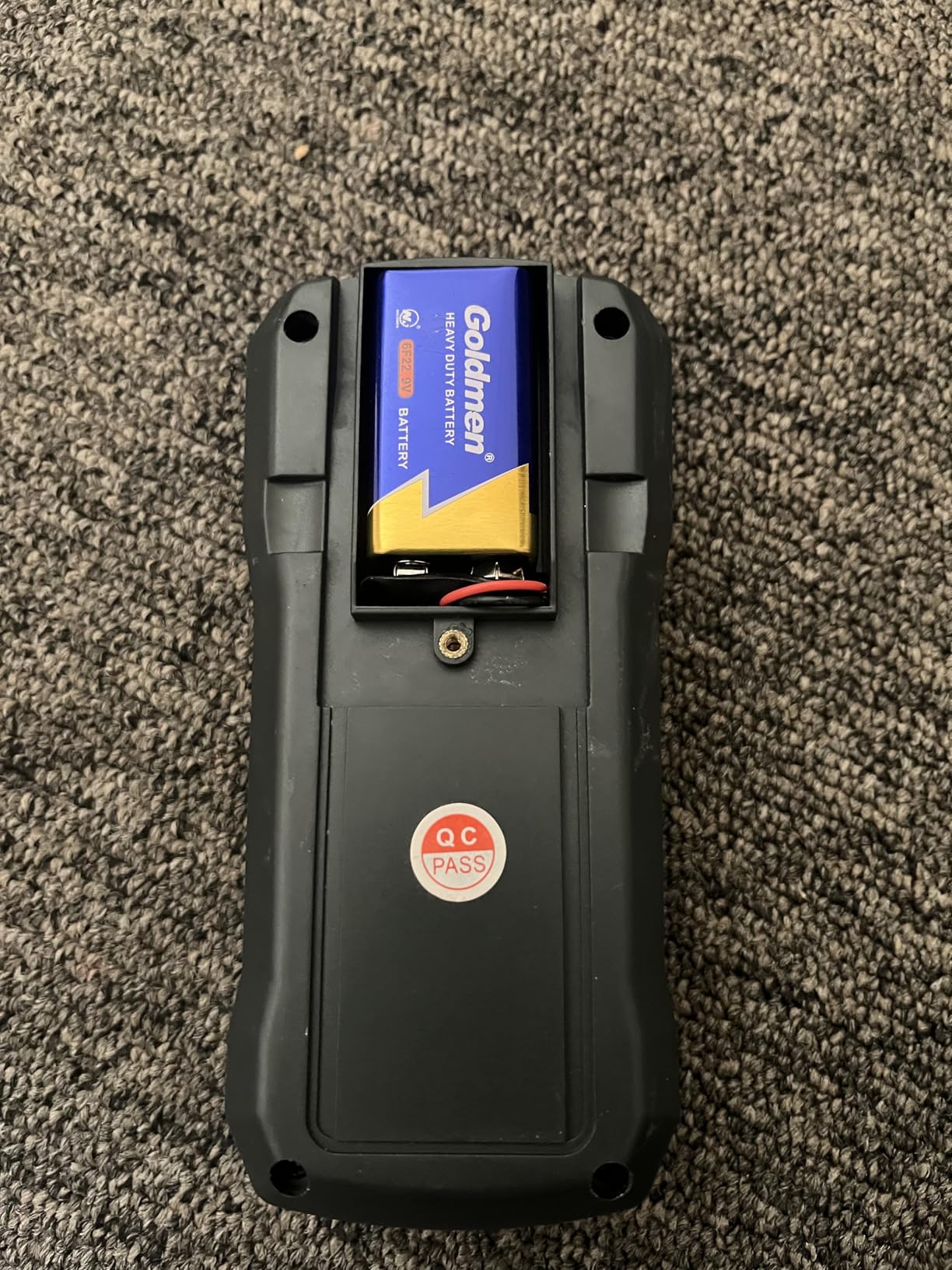
Switchable Auto and Manual Ranging
Rather than choosing one behaviour, this meter lets you switch between manual and auto range modes, and it adds max and min value capture, data hold, a low battery indicator and auto power off. Max/min is genuinely useful when a breaker trips intermittently.
Note that manual range mode requires care to set correctly, which is a real risk if you are probing live conductors.
The One-Year Warranty and Its Impact
The single-year warranty is the main drawback, trailing the three-year coverage offered by the AstroAI models in the same range. Forum users consistently treat warranty length and replaceable fuses as a bigger quality signal than feature count, so that gap matters.
The 0.55 kg weight and 5.51 by 2.76 by 1.57 inch body are normal for the class.
7. AstroAI 2000-Count Clamp Meter – Measuring Current Without Breaking the Circuit
AstroAI Digital Clamp Meter Multimeter 2000 Counts Amp Voltage Tester Auto-ranging with AC/DC Voltage, AC Current, Resistance, Capacitance, Continuity, Live Wire Test, NCV, Blue
2000 counts,Clamp jaw measures AC current only,Overvoltage category III 600V
+ Pros
- Clamp jaw measures AC current without breaking the circuit
- Compact and slim so it fits one hand and a crowded tool bag
- Backlit display plus built-in flashlight for dark panels
- Non-contact alert gives a beep and a light with rate signalling signal strength
- Carrying case and test leads included
- Cons
- Clamp measures AC current only and not DC current
- Clamp must go around a single conductor or it reads near zero
- 2000-count display has lower resolution than 4000 or 6000 count meters
- Some buyers report clamp current readings well under a known 10A load
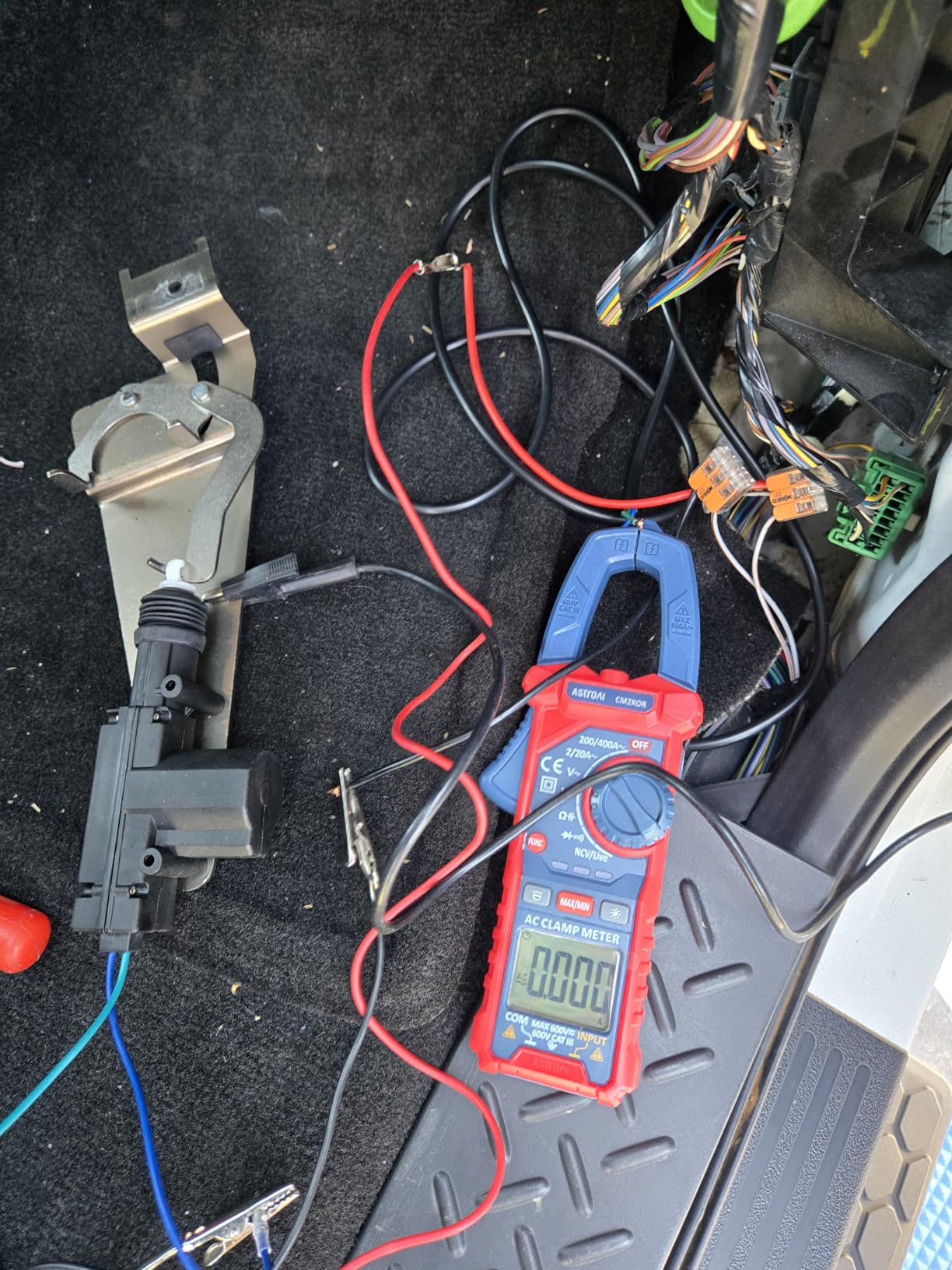
This is the answer to the question I get most often from homeowners, which is how do I find out what a device is drawing without unplugging everything. A standard multimeter measures current by forcing it through the circuit, which means breaking the circuit. A clamp does it by encircling a single conductor.
For an HVAC or appliance homeowner, that is the one measurement a plain multimeter cannot give you safely. It is rated to overvoltage category III 600V and meets environmental pollution degree 2.
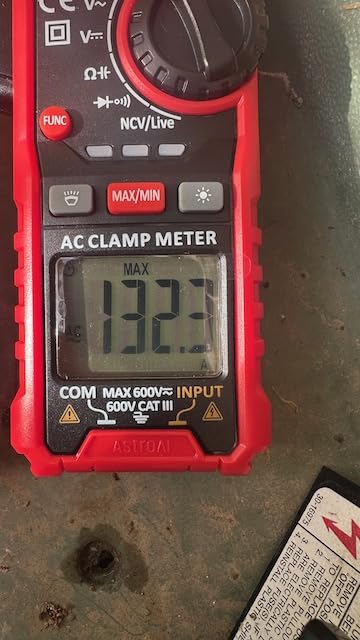
Why a Clamp Is the Only Safe Way to Measure Draw
To measure current with a meter you set the dial to amps, move the red lead to the current jack and interrupt the circuit so all current flows through the meter. Do that on a live 15 or 20A branch and the meter becomes the fuse.
Clamping a conductor leaves the circuit intact. There is no exposed contact, nothing to disconnect, and you can watch the load start when you switch the appliance on. That makes it the right tool for checking a water heater element, a heat pump, a range circuit or a space heater.
The Single-Conductor Rule Explained
The clamp must go around one wire, not the whole power cord. Current flows out on the hot conductor and back on the neutral, and the magnetic fields cancel when both are inside the jaw, so clamping a two-wire cord reads close to zero. This is the single most common misunderstanding with clamp meters, and several reviewers spell it out explicitly.
Keep the conductor centred in the clamp head for the most accurate reading, and clamp one conductor of a multi-wire cable rather than the whole loom.
Backlight, Flashlight and the Slim Form Factor
At 386 g and 2.68 by 1.14 by 7.67 inches, this is one of the slimmer clamp meters you can hold in one hand, and the backlit screen plus built-in flashlight are repeatedly cited as saving people in dim panels and crawl spaces.
Data hold, max and min, auto shut-off, a low battery indicator and a continuity buzzer round out the everyday functions. Two AAA batteries are included, and the non-contact alert gives a green light with a slow beep for a weak signal and a red light with a fast beep for a strong one.
Where Clamp Accuracy Falls Short
There are two real limits. The clamp measures AC current only, not DC current, which rules it out for battery and alternator testing. And a minority of buyers report clamp readings well below a known 10A load, severe enough that they returned the unit.
Treat it as a diagnostic and comparison tool rather than a calibrated instrument, and cross-check anything important against a second method.
8. TESMEN TM-510 – Smart Auto Mode Removes Rotary Dial Guesswork
TM-510 Digital Multimeter, 4000 Counts, Smart Measurement, Auto-Ranging Voltmeter; Voltage Tester with Non-Contact Voltage Function, Measures AC/DC Voltage, Resistance, Continuity – Green
4000 counts,Smart auto mode for AC DC voltage resistance and continuity,0.1 kg
+ Pros
- Smart Auto Mode handles mode and range selection for you
- Non-contact voltage test with visual and audible alarm
- 4000 counts gives better resolution than 1999-count meters at a similar price
- Backlight and built-in flashlight for dark panels and outlets
- Lightweight at 0.1 kg with a storage bag leads and batteries included
- Cons
- Measures voltage resistance and continuity only with no current capacitance frequency or temperature
- CAT II 600V rating is one category below the CAT III meters it is priced against
- Auto mode covers only the basic three functions
- Silicone cover and light build feel less robust than professional-brand meters
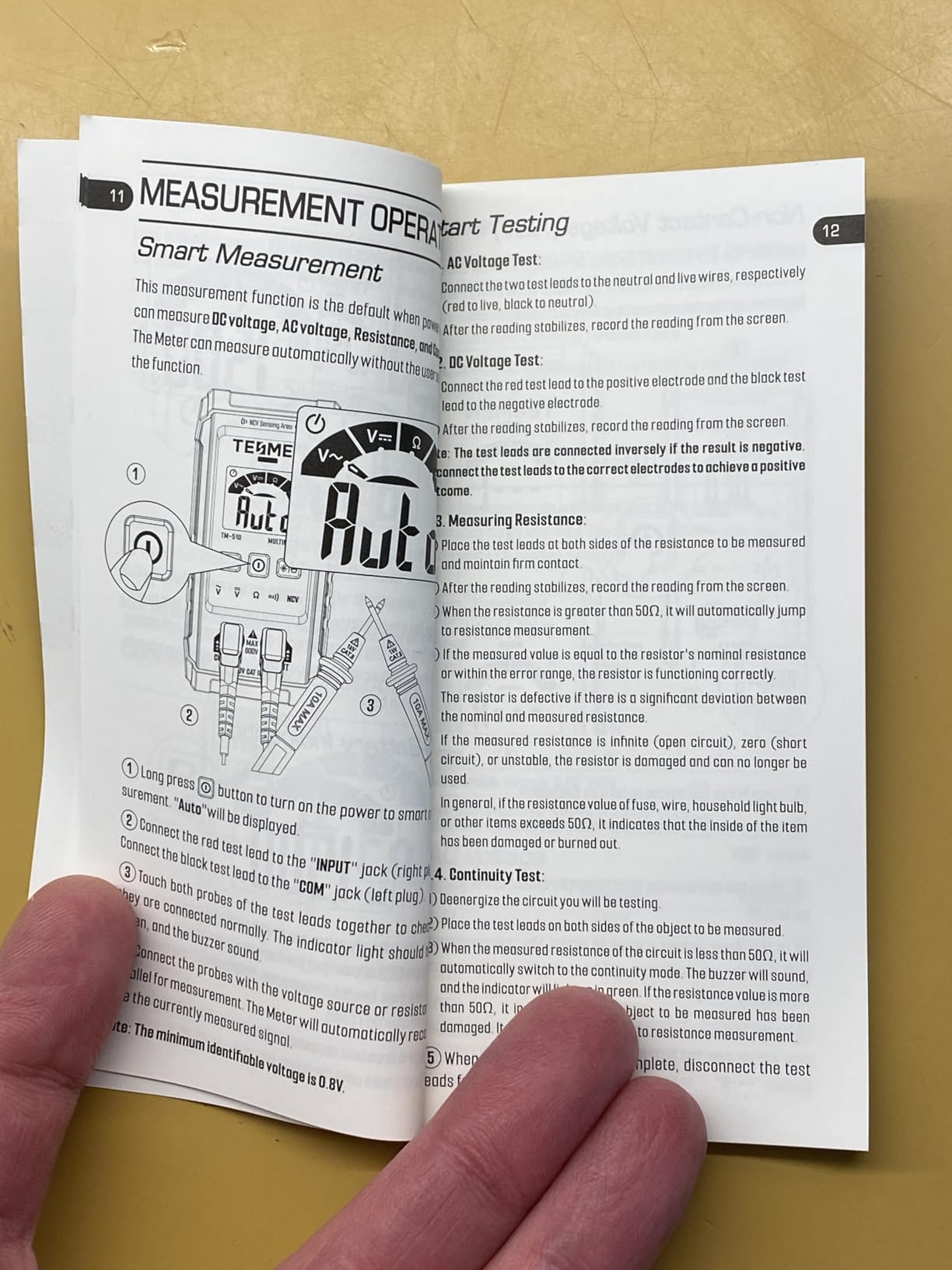
The idea here is simple and it works. Instead of a rotary switch that must be set to a specific function and range, the TM-510 has a Smart Auto Mode that detects what you are measuring and switches on its own. You press the probes to two points and read the result.
For a first-time owner who does not yet know which range to pick, that removes the most common source of confusing readings before it happens.
What Smart Auto Mode Actually Does
In auto mode the meter switches between AC and DC voltage, resistance and continuity without you selecting anything. There is a sensible safeguard: if the detected battery voltage falls below 0.8V, the device automatically switches to measuring resistance instead, so a flat AA cell does not produce a nonsense voltage reading.
Outside those three basic functions you still need the dial, so auto mode is a convenience layer rather than a full replacement for manual selection.
4000 Counts and the Resolution Difference
The 4000-count display gives noticeably better resolution than the 1999-count screens on the cheapest meters, at a similar price. Minimum operating voltage is 0.8V and maximum is 600V.
Data hold, automatic shutdown, a low battery indicator, a backlight display and a flashlight cover the everyday needs. The package includes two test leads, a storage bag, two AAA batteries and a manual.
The CAT II Rating and Where You Should Not Use It
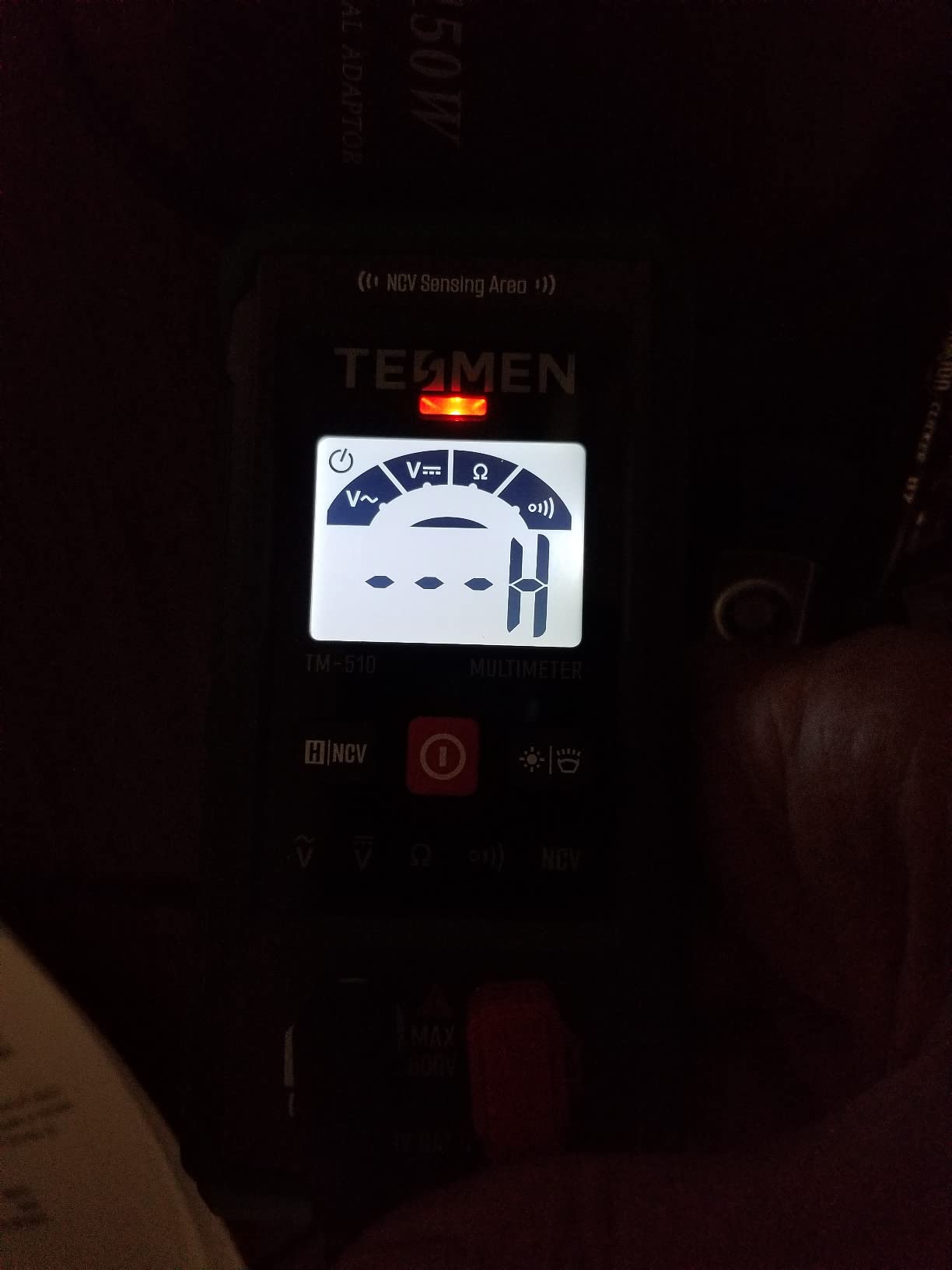
This is the specification to pay attention to. The TM-510 is rated CAT II 600V, which is the category for plug-in loads and general electronics, one category below the CAT III 600V rating carried by the Klein MM325 and the Crenova MS8233D in this roundup.
CAT II is not a claim that the meter is unsafe, but it does mean it is not specified to survive the transient events associated with fixed installation wiring. For panel work and permanently wired circuits, choose a CAT III meter.
Best For and Worst For
Best for a first meter, an apartment or rental, and any job limited to voltage, resistance and continuity. The light 0.1 kg body and the flashlight make it good for outlets and appliances behind furniture.
Worst for current measurement of any kind, for capacitance or frequency work, and for anything involving fixed wiring where a CAT III rating matters. The silicone cover and light build feel less robust than the professional-brand meters.
How to Choose a Digital Multimeter for Your House
CAT Ratings Mapped to a Home
The CAT number tells you how the meter was tested to survive transient overvoltage events. CAT II covers plug-in loads and electronics. CAT III covers fixed installation equipment: receptacle circuits, switches, panelboards and anything hardwired. CAT IV covers the utility service entrance, upstream of everything you own.
For home electrical work, CAT III is the rating to insist on. Anything rated only CAT II, such as the TESMEN TM-510, is fine for appliances and outlets on extension leads but is not specified for panel-adjacent work.
True RMS vs Average Sensing for LED and Dimmer Loads
True RMS meters measure the actual root mean square of the waveform. Average-sensing meters estimate it from a rectified signal, which is accurate on a clean sine wave and increasingly wrong on anything distorted. LED lamps, electronic dimmers, switch-mode supplies and inverter motors are all distorted.
If you plan to check dimmers, LED fixtures or modern appliances, buy true RMS. If your work is purely 120V resistive loads and batteries, an average-sensing meter is fine and cheaper.
Auto-Ranging vs Manual Ranging for a First Meter
Auto-ranging meters pick the range themselves, which is faster and removes a common beginner error. Manual-ranging meters ask you to set the range, which is slower but gives you explicit control over what the meter is doing while probes are on conductors.
Forum discussion on this is genuinely split, and the honest summary is that auto-ranging is better for most people while manual is better for anyone who wants to know exactly which range is active. The Crenova MS8233D offers both, which is the compromise worth looking for.
Input Impedance and Ghost Voltage
Input impedance is the resistance the meter presents to the circuit being measured. A high-impedance voltmeter, typically 10 megohms or more, barely loads the circuit, which is what lets it measure across sensitive electronics without disturbing them.
That same high impedance is why a cheap meter can show 40V or more on a de-energized circuit: a very small induced current is enough to move a high-impedance display. Low impedance mode loads the circuit deliberately, collapsing the phantom reading. If you chase a lot of dead circuits, this is the single most useful feature you can buy.
Accuracy Tolerance in Plain Language
Accuracy is stated as a percentage of the reading, for example plus or minus 0.5 percent, shown through the least significant digit. On a 120V circuit, a 1 percent tolerance is about 1.2V, which is meaningless for deciding whether a circuit is live or dead.
Accuracy becomes important only when you are chasing a small drop across a connection, testing a run capacitor, or troubleshooting low-voltage electronics. For household work, a meter that is honest about being accurate to plus or minus 1 percent is entirely sufficient.
What Each Tier Unlocks
The entry tier covers outlets, switches, fuses, continuity, batteries and extension cords, with backlighting and a continuity buzzer as the features that matter most. The mid tier adds auto-ranging, capacitance, temperature and non-contact detection, which covers appliance and HVAC work. The upper tier adds low impedance mode, true RMS with automatic AC and DC selection, and a longer warranty that most owners treat as the real quality signal.
Safe Meter Habits and When to Call an Electrician
No meter makes an energized circuit safe, and the single most important habit is a verify-dead procedure you repeat every time. Set the dial to the correct function, put the leads in the correct jacks before touching anything, test the meter on a known live source, confirm the circuit is de-energized at the panel, and re-verify the meter on the live source afterwards.
Never measure current across a live circuit. And never assume a breaker label tells you which circuit is which, because a great many homes have mislabelled or ambiguous panels.
Six Situations That Belong to a Licensed Electrician
First, any work inside the breaker panel itself, including adding a circuit. Second, knob-and-tube or early cloth-insulated wiring, which cannot be safely worked on as a homeowner project. Third, aluminum branch circuit wiring, which requires listed connectors and a torque-controlled installation. Fourth, subpanel installs and any service work at the meter. Fifth, anything involving a main breaker that will not reset, or repeated tripping, which usually points to a fault upstream of your outlet. Sixth, any circuit that is hot to the touch, buzzing, arcing or smells burnt.
A multimeter diagnoses. It does not make the work safe.
Frequently Asked Questions
What multimeter should I buy for home use?
For most homeowners, the AstroAI 6000-Count True RMS meter is the strongest all-round choice, covering true RMS accuracy, auto-ranging, capacitance and temperature. Buy the Klein Tools MM325 if you want a printed CAT III 600V safety rating and lead-alert protection LEDs. Buy the Fluke 117 if you work near a panel and need low impedance mode to defeat ghost voltage readings on de-energized circuits.
Is Klein or Fluke better?
Klein and Fluke are both excellent, and they optimise for different jobs. Klein Tools meters such as the MM325 put the safety category and lead-alert protection at the centre, which suits outlet and switch replacement. Fluke meters such as the 117 add low impedance mode, automatic AC and DC selection and true RMS accuracy, which suits panel work and appliance diagnosis. A Fluke 101 does all the necessities for household work, and professionals tend to reach for the mid-tier models rather than the most expensive ones.
Are Fluke multimeters worth the money?
Fluke meters are worth the money for owners who work around panels, chase ghost voltage, or repair appliances, because low impedance mode, true RMS accuracy and a three-year warranty remove real failure points. For basic outlet, switch and battery checks, a mid-range meter does the same job and a budget meter is sufficient. The recurring forum advice is to buy the model you will actually use rather than the most expensive one in the range.
What does CAT III mean on a multimeter?
CAT III is a safety rating covering how a meter survives transient overvoltage events. It applies to fixed installation equipment such as receptacle circuits, wall switches, panelboards and hardwired appliances. CAT II covers plug-in loads and electronics, while CAT IV covers the utility service entrance. For residential work inside your own walls and panel, CAT III 600V is the rating to insist on.
Why does my multimeter show voltage when the circuit is off?
That reading is usually ghost voltage, also called phantom voltage. A high-input-impedance voltmeter can complete a tiny path through parasitic capacitance and pick up an induced voltage from nearby wiring, showing 40V or more on a circuit that is genuinely dead. A low impedance mode loads the circuit deliberately so the phantom reading collapses, while a true 120V reading stays at 120V. Confirm with a receptacle tester or a non-contact voltage tester before you touch conductors.
Which Meter Fits Your House Best
If you want one meter that covers everything from outlets to car batteries to a water heater element, the AstroAI 6000-Count True RMS meter is the best digital multimeter for home electrical work, and it is where I would start. If safety-category marking and probe-placement protection matter most to you, the Klein Tools MM325 is the pick, and the Klein MM320KIT covers the same ground with a receptacle tester and voltage pen in the box.
If your work is budget-driven and limited to checking outlets, switches, fuses and batteries, the AstroAI 2000-Count meter is the reference budget option. If you want the widest measurement coverage per dollar including AC current, the Crenova MS8233D does more than anything else at that level.
If you diagnose motors, appliances or HVAC loads, add the AstroAI clamp meter so you can measure draw without breaking the circuit. And if you work near a panel or keep seeing phantom voltage on dead circuits, the Fluke 117 is the only meter here that solves that problem directly.
Whichever you choose, pair it with a receptacle tester, learn the verify-dead procedure, and leave panel work, knob-and-tube and aluminum wiring to a licensed electrician.