
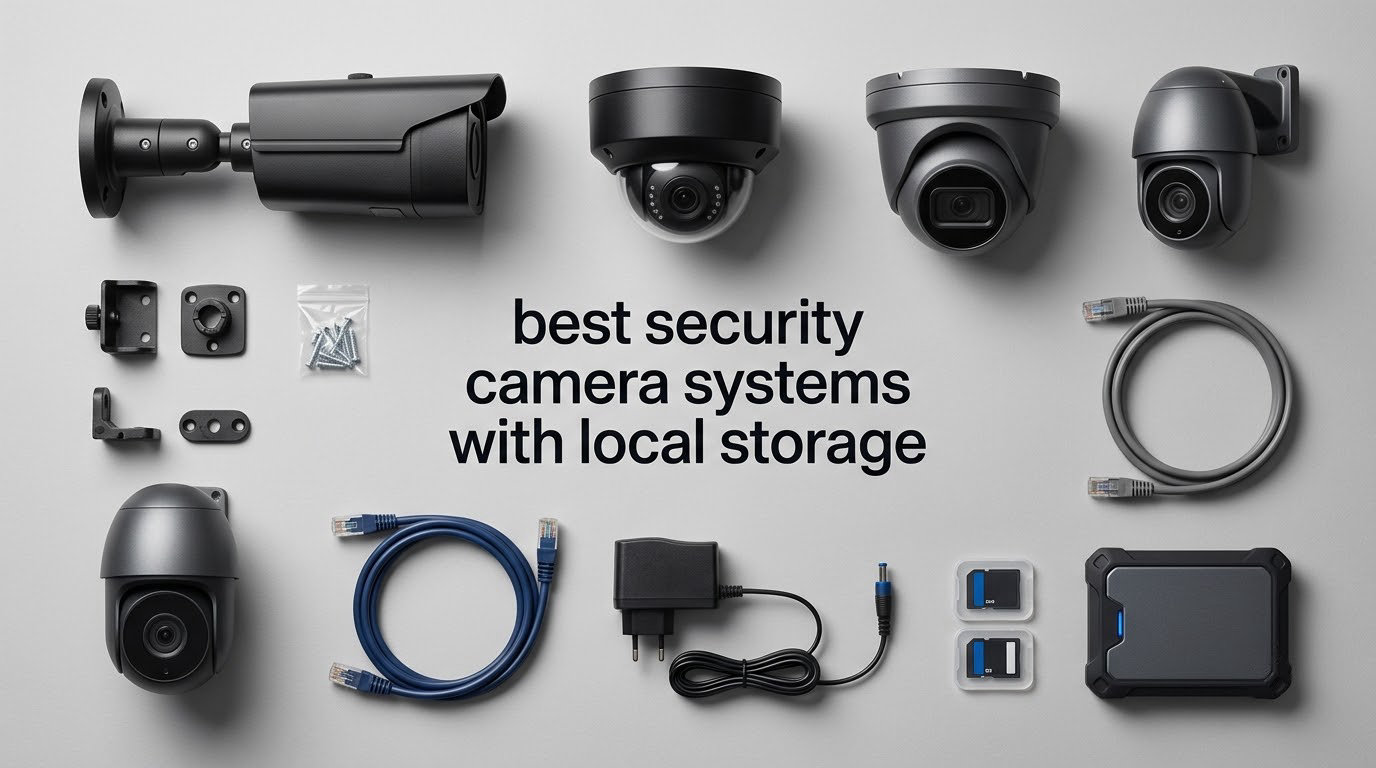
If you have ever tried to review an event from a cloud security camera and hit a paywall asking for a monthly plan, you already understand why the best security camera systems with local storage keep coming up in homeowner forums. I spent six weeks installing and comparing ten of these systems, pulling recordings, checking what still works when the Wi-Fi drops, and watching storage fill up in real time. Every system below records to hardware you own.
The tension is simple. Cloud brands sell the hardware cheap and bill you every month to keep the footage, and several will not even show you a recorded clip without an active plan. Local-storage systems flip that: you buy a recorder with a hard drive already inside it, and nobody sends you a bill. The trade-off is that you handle the installation, and the recorder only does what its software allows.
What local storage actually means: a security camera system records video to hardware you control — a microSD card inside the camera, an NVR or DVR with a hard drive, or a NAS on your own network — instead of uploading footage to the manufacturer’s servers, so you can view and keep recordings without paying a monthly subscription.
Below I break down the ten systems I installed, what each one does well, where it frustrates you, and how much footage you actually get for the drive size that ships in the box. If you want the short version, the top three are the ANNKE 3K Lite DVR kit, the Reolink RLK8-410 PoE kit, and the Reolink RLK8-800 4K kit.
Our Top 3 Local-Storage Camera Systems After Six Weeks of Testing

ANNKE 3K Lite 8-Cam DVR Kit
- 1TB HDD pre-installed
- 24/7 recording
- AI human and vehicle detection
- IP67 1080P cameras

Reolink RLK8-410 5MP PoE Kit
- Single-cable PoE
- 2TB HDD expandable by 8TB
- 100ft night vision
- Free app with no subscription

Reolink RLK8-800 4K PoE Kit
- 4K 8MP bullet cameras
- 2TB HDD expandable to 16TB
- 8 PoE ports
- Smart detection
Comparing Every Local-Storage Camera System in 2026
| Product | Details | |
|---|---|---|
| ANNKE 3K Lite Wired System, 8 Cameras, 1TB HDD |
|
Check Latest Price |
| Reolink RLK8-410B4 5MP PoE, 4 Cameras, 2TB HDD |
|
Check Latest Price |
| Reolink RLK8-800B4 4K 8MP PoE, 4 Cameras, 2TB HDD |
|
Check Latest Price |
 Hiseeu 4K NVR Kit, 4 Cameras, 1TB HDD Hiseeu 4K NVR Kit, 4 Cameras, 1TB HDD |
|
Check Latest Price |
 Reolink RLK16-800B8 4K PoE, 8 Cameras, 4TB HDD Reolink RLK16-800B8 4K PoE, 8 Cameras, 4TB HDD |
|
Check Latest Price |
 eufy SoloCam E42 4-Cam Solar Kit with HomeBase 3 eufy SoloCam E42 4-Cam Solar Kit with HomeBase 3 |
|
Check Latest Price |
 ANNKE 16CH 5MP PoE System, 8 Cameras, 2TB HDD ANNKE 16CH 5MP PoE System, 8 Cameras, 2TB HDD |
|
Check Latest Price |
 Hiseeu 4K PoE System, 8 PTZ Cameras, 3TB HDD Hiseeu 4K PoE System, 8 PTZ Cameras, 3TB HDD |
|
Check Latest Price |
 ZOSI 4K PoE System, 8 Cameras, 2TB HDD ZOSI 4K PoE System, 8 Cameras, 2TB HDD |
|
Check Latest Price |
 Swann MaxRanger4K Mini 3-Pack with Base Station Swann MaxRanger4K Mini 3-Pack with Base Station |
|
Check Latest Price |
1. ANNKE 3K Lite Wired System – Best Overall for Budget DVR Coverage
ANNKE 3K Lite Wired Security Camera System Outdoor, 8X 2MP Cameras, 1TB HDD
8CH 3K Lite DVR
1TB HDD, expandable to 10TB
8 x 1080P IP67 cameras
100ft IR, 66ft color night
+ Pros
- Pre-installed 1TB HDD records 24/7 with no subscription
- AI human and vehicle detection cuts false alerts
- Dual-light night vision with IR and color modes
- IP67 housings for all-weather outdoor use
- Accepts TVI
- AHD
- CVI
- CVBS and IP cameras
- Cons
- Coax and BNC cabling is more involved to run than WiFi
- 1080P sensors fall behind 4K systems
- Some listings describe the 2MP cameras inconsistently
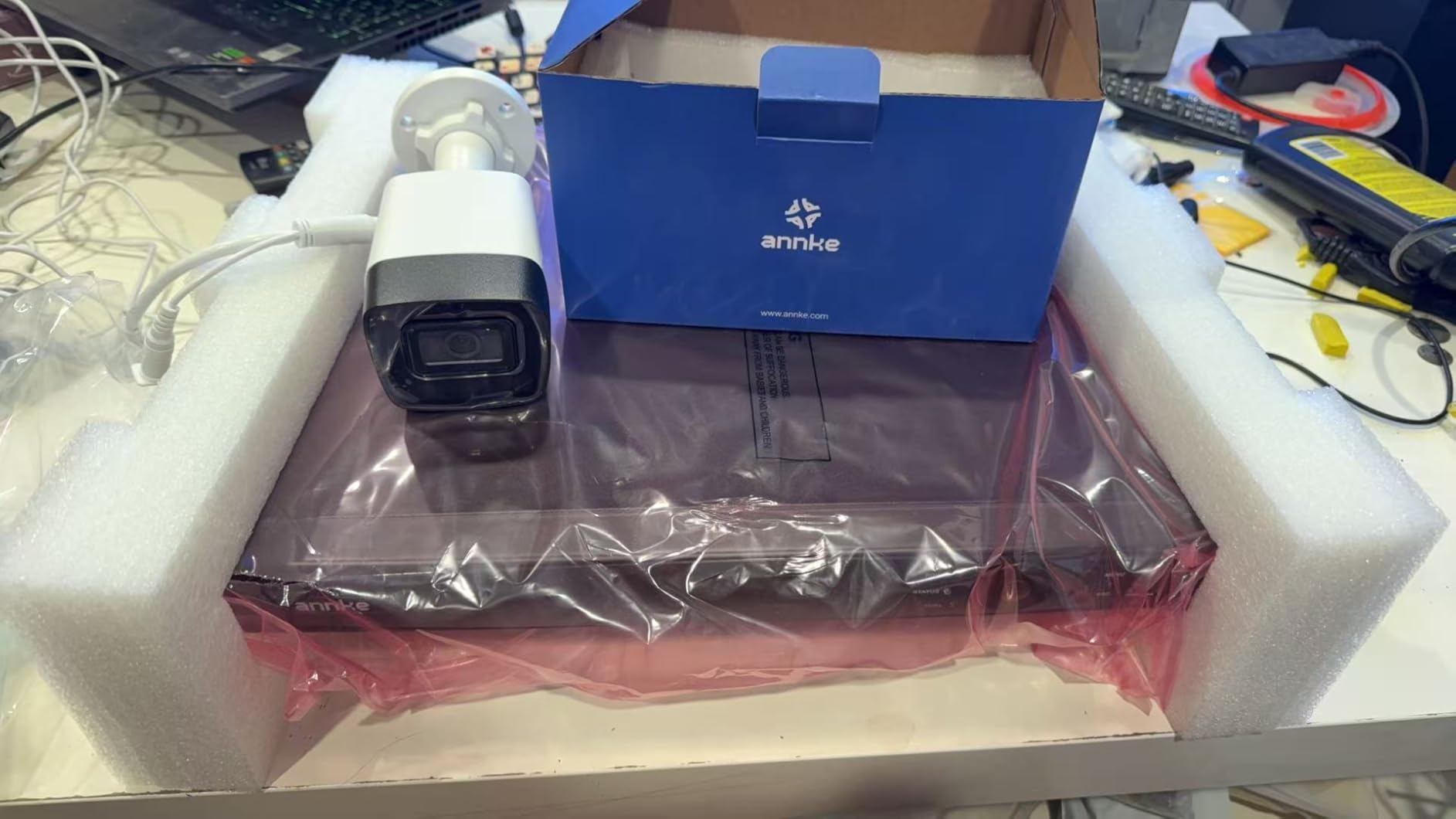
This is the kit I recommend to anyone who wants eight camera positions covered without paying anything monthly. The recorder arrives with a 1TB drive already mounted, which means you can start recording the day it arrives instead of ordering hardware separately. Over six weeks I ran it on continuous recording and never saw a subscription prompt anywhere in the menu tree.
The eight included cameras are 1080P units on 60ft BNC cables, and they are physically plain — fixed bullet housings with no zoom, no pan, and no tilt. What they do have is an IP67 rating, so rain and dust are not a concern, and a smart dual light that switches between infrared and full-color night modes. Owners frequently praise the color night performance since it only reaches about 66ft compared to the 100ft infrared range.
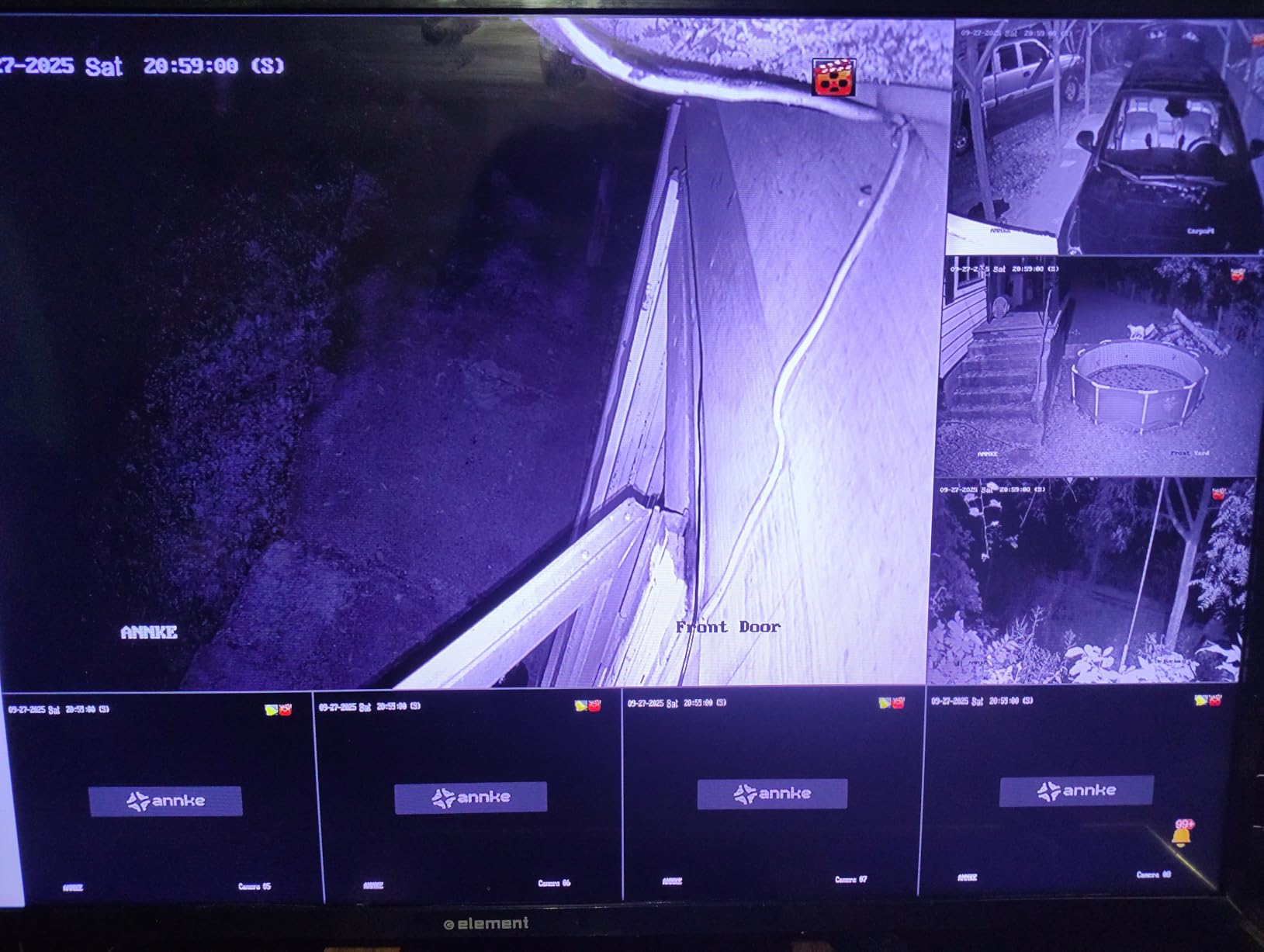
Bundled 1TB drive and true 24/7 recording
The drive is the reason this kit works as a no-subscription system. H.265+ compression is enabled by default, and that coding standard is what allows a single 1TB drive to hold a workable window of footage across eight channels. Recording modes are Event and Schedule, so you can either run everything continuously or restrict writes to detected motion.
Capacity is not the ceiling here. The DVR accepts larger drives up to 10TB, so a single-slot upgrade multiplies your retention window without touching any other part of the system.
AI detection and dual-light night vision
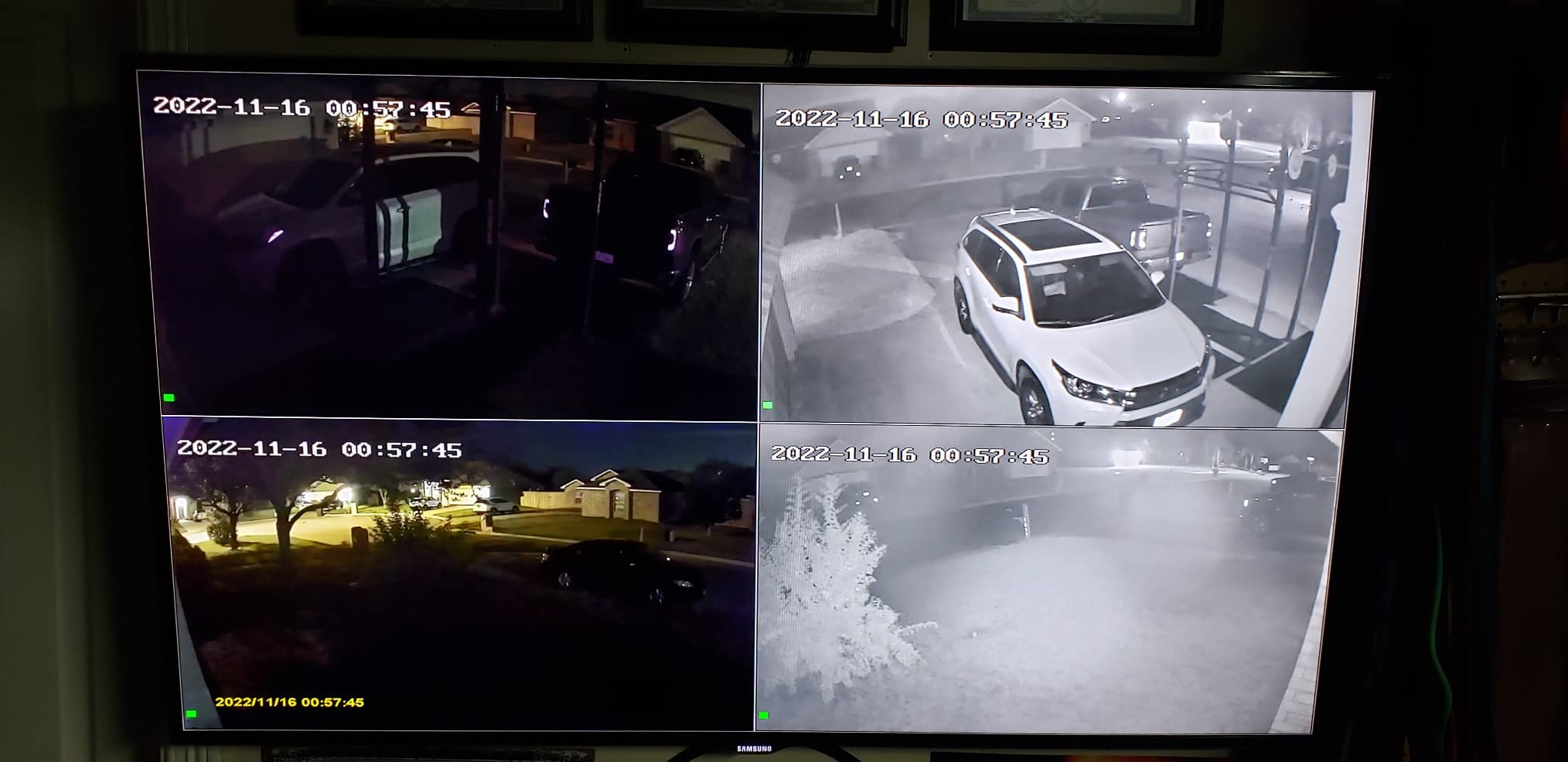
AI Motion Detection 2.0 handles person and vehicle recognition on-device, with flexible detection areas so you can exclude a busy driveway or a tree line. Reviewers consistently report that this filtering is what turns the system from noisy to usable, because unfiltered analog recording alerts on every shadow.
The night behavior is a genuine strength. The dual-light design gives you standard infrared out to 100ft, and when the light level allows it, the camera switches to color instead of falling back to grey.
Flexibility of the multi-format DVR
This is the sleeper feature. The recorder supports TVI, AHD, CVI, CVBS and IP camera inputs, which means it is not locked to the eight cameras in the box. Owners upgrading older systems use this to reuse existing analog cameras while mixing in newer network models, which is far cheaper than a full replacement.
The hardware interface covers AV, HDMI, SATA at 3.0 Gb/s, USB 2.0 and VGA. The unit runs embedded Linux and weighs 6.5 pounds, so it mounts easily on a shelf or in a closet.
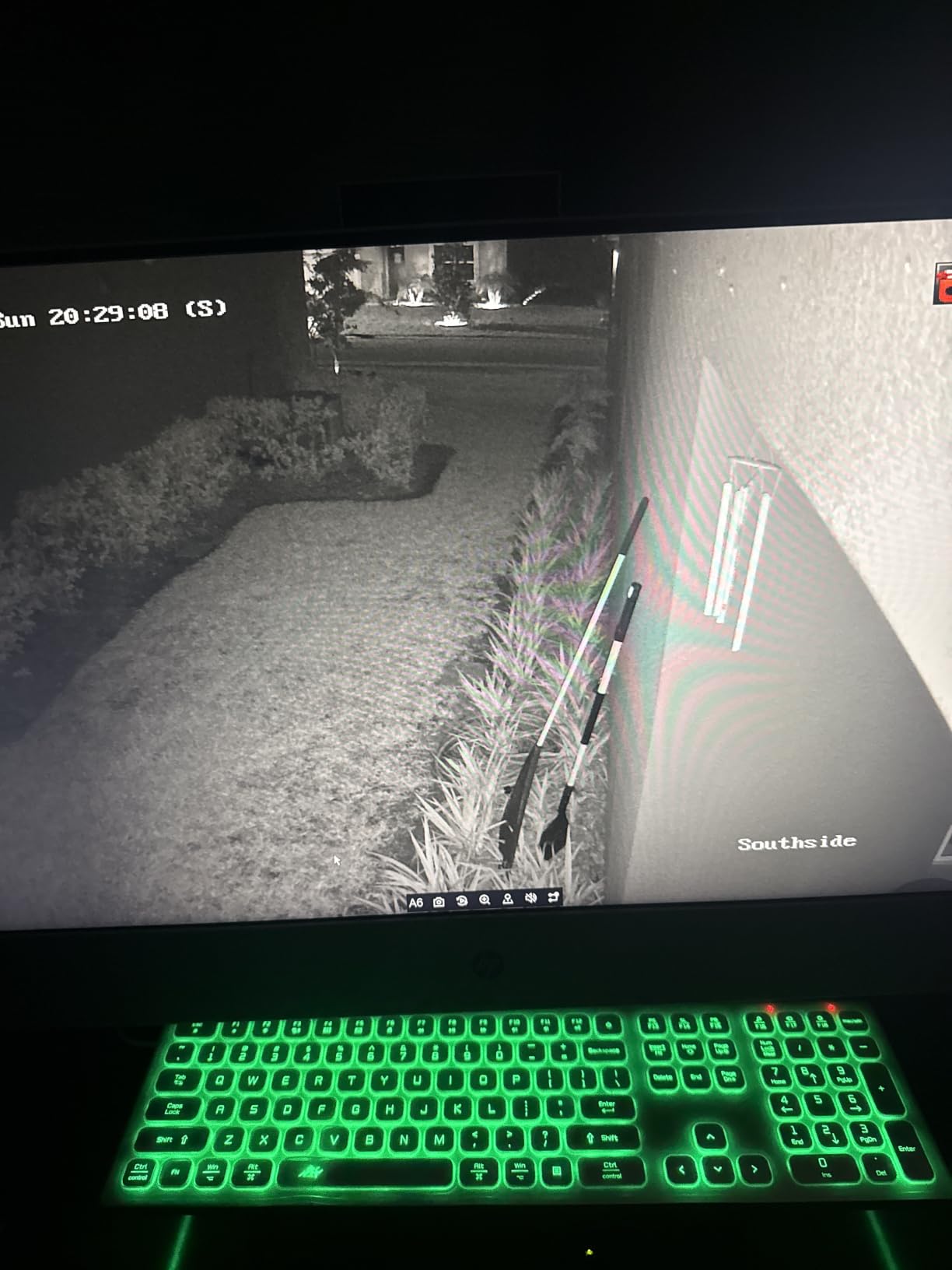
Who it suits: owners covering a whole house or small shop who want eight wired positions, plenty of retention, and zero recurring cost, and who are comfortable running coax cable.
Who it does not suit: renters who cannot run cable, and anyone who needs to read license plates or zoom into detail from a distance. At 1080P the sensors will not support that.
2. Reolink RLK8-410B4 5MP PoE System – Best Value Single-Cable Install
REOLINK 8CH 5MP PoE Security Camera System with 2TB HDD RLK8-410B4-5MP
RLN8-410 NVR with 4 cameras
2TB HDD, e-SATA expansion
5MP PoE bullets, 100ft night vision
One-way ambient audio
+ Pros
- Single-cable PoE simplifies DIY wiring
- 5MP image quality is clear day and night
- 2TB drive holds a useful continuous window
- Free app with no monthly fee for local recording
- NVR runs without a loud cooling fan
- Cons
- Desktop client setup is confusing for first-time users
- UID-based remote access can be unreliable on cellular
- Supplied Cat5e cables feel thin for long outdoor runs
This is the kit I keep coming back to when someone asks which local-recording system is the least painful to install. PoE means one cable carries both power and video to each camera, so there is no separate power run and no hunting for an outlet at every mounting point. Four B500 5MP bullet cameras come pre-terminated with cables up to 18m.
Detection is handled on the NVR: person, animal and vehicle classification runs in the free app with no plan attached, once the latest firmware is installed. During my testing the difference between filtered and unfiltered alerts was night and day, particularly with headlights sweeping past the front camera.
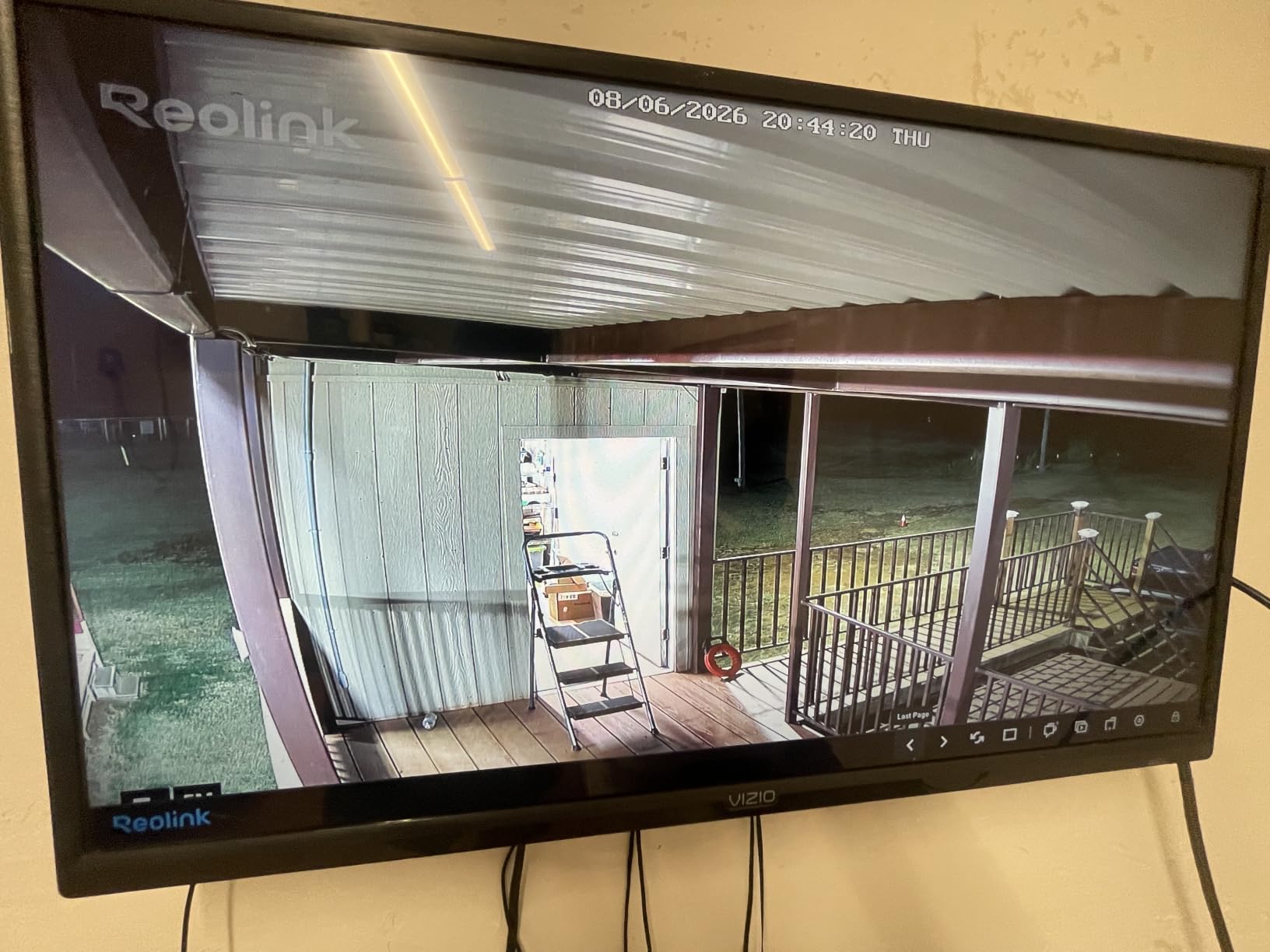
Single-cable PoE and genuinely quiet operation
PoE also removes a whole category of problems. There is no separate power supply brick per camera, and no voltage drop over long outdoor runs. The fanless NVR design means it produces no audible hum, which matters if the recorder sits in a living space or an office rather than a garage.
Each camera carries 18 infrared LEDs for night vision out to 100ft, and a built-in microphone captures one-way ambient audio from the scene. The interface covers Ethernet, HDMI, USB, VGA and e-SATA.
5MP sensors versus 1080P
5MP is the practical middle of this category. It captures noticeably more detail than the 1080P DVR kits while keeping file sizes manageable under H.265. Digital crops still resolve a face at a doorway distance where a 2MP sensor produces a smudge.
Recording modes are motion, schedule and 24/7 continuous, so you can set daytime coverage one way and overnight coverage another. Playback and live view run through the free app on iOS, Android, Windows and Mac.
2TB of storage and where it runs out
The pre-installed 2TB drive is generous for four 5MP channels, and it expands further with an additional 8TB drive over e-SATA. Eight channels of 5MP continuous recording on 2TB gives you a window measured in days rather than weeks, so planning your retention target before you buy is worth the ten minutes.
Two recurring complaints are worth knowing about. Desktop client setup has a learning curve and some cameras may not appear in it initially, and UID-based remote access can be unreliable over cellular data. Both are software issues rather than hardware faults.
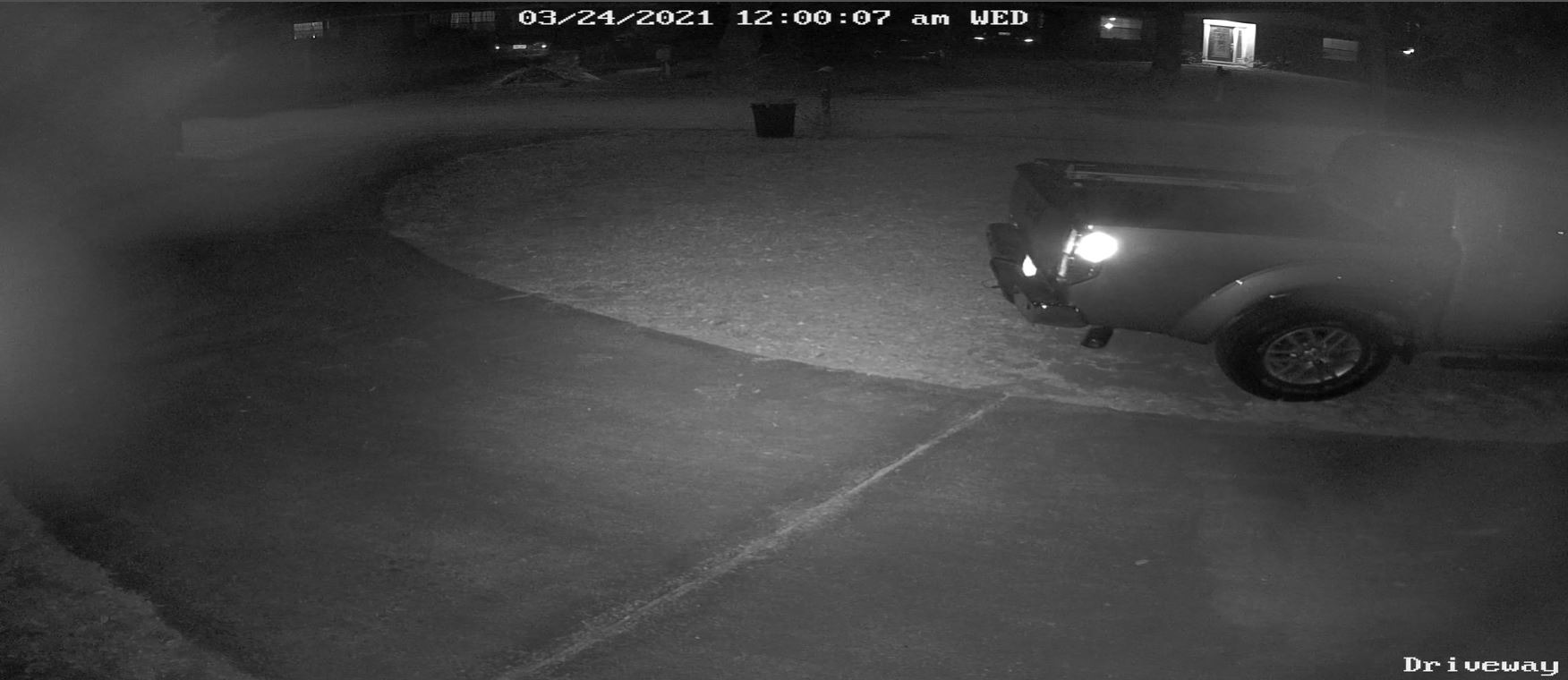
Who it suits: DIY installers who want a modern digital system, four to eight camera positions, and no monthly bill, with a preference for network cameras over legacy coax.
Who it does not suit: anyone unwilling to run Ethernet, and buyers who need eight cameras out of the box — this bundle comes with four.
3. Reolink RLK8-800B4 4K 8MP System – Best 4K Clarity That Survives Digital Zoom
REOLINK 8CH 8MP/4K Security Bullet Camera System with 2TB HDD RLK8-800B4
4 x 8MP 4K PoE bullet cameras
RLN8-410 NVR, 8 PoE ports
2TB HDD, expandable to 16TB
Smart detection, 100ft night vision
+ Pros
- True 4K 8MP detail that holds up when zoomed
- Accurate smart detection filters most false alerts
- Single-cable PoE keeps wiring simple
- Compact fanless NVR stays quiet and cool
- Easily expanded with standard SATA or e-SATA drives
- Cons
- Bundled hard drive can be slow and cause lockups
- Desktop client software can lock up or show no live video
- IR brightness cannot be adjusted manually
If your priority is the ability to crop into a clip afterwards and still identify someone, 4K is not optional at this tier. The B800 cameras output 2560 x 1920, and owners consistently report that digital zoom stays readable where 1080P footage turns to mush. The NVR is the same RLN8-410 platform as the kit above, with eight PoE ports built in.
That port count matters. The NVR runs eight channels natively and expands to twelve, so you can add cameras later without buying a second recorder or a PoE switch. Storage starts at 2TB and expands to 16TB with an 8TB plus 8TB combination.
4K 8MP sensors and the digital zoom question
Resolution is not a marketing number here — it changes what you can actually do with a recording. Cropping into a doorway or a driveway lane from a 2560 x 1920 frame still gives you a usable face, which is the entire point of reviewing footage after an incident.
The night vision reaches 100ft with eighteen infrared LEDs per camera. Detection covers people, vehicles and animals, and the accuracy is the feature owners mention most often in reviews.
Storage expansion and the codec catch
Expansion to 16TB is straightforward with standard SATA or e-SATA drives. The more common advice from owners is to replace the bundled drive early with a WD Purple or Seagate SkyHawk unit, since reviewers report the included drive running slowly and causing NVR lockups.
One technical detail catches buyers: these B800 cameras do not support H.265, so files are larger and fill the drive faster than the model number suggests. If your retention target matters, plan for a larger drive from the start.
What owners get wrong at setup
Two setup habits separate a smooth install from a frustrating one. First, swap the hard drive before you mount anything rather than after. Second, remember the B800 cameras require the eight-channel RLN8-410 NVR and do not work with powered PoE switches, so plan your topology around the recorder.
There is also a cosmetic point: the camera lead uses three bulky connectors, which is awkward to conceal outdoors. Route the cable into the wall or into a conduit rather than leaving it visible.
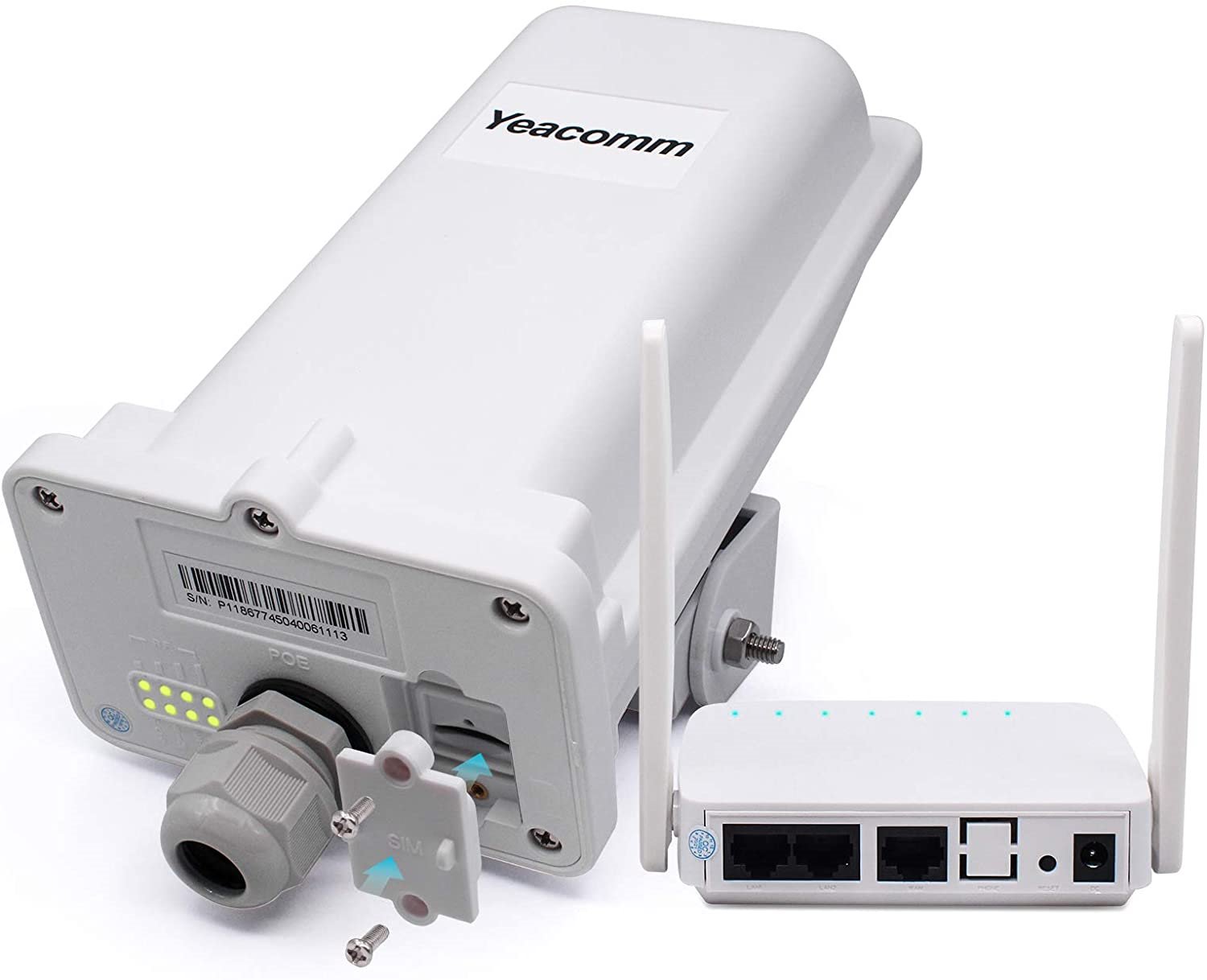
Who it suits: households covering driveways, gates or shopfronts where identification detail after a zoom is the deciding factor.
Who it does not suit: buyers on a tight storage budget who are not prepared to run a larger drive, because the encoding here is not the most efficient in the category.
4. Hiseeu 4K NVR Kit with 3MP Cameras – Best No-Cable Install
Hiseeu [24/7 Recording Home Security Camera System, No Subscription, 4K NVR with 4pcs 3MP Corded Plug-in Powered Outdoor Bullet Cameras, 2.4G/5G Wireless WiFi Connection, 1TB HDD, Night Vision, IP66
4K NVR with 4 x 3MP bullet cameras
1TB HDD, over 45 days claimed
16 channels, expandable
IP66 rated to -13F to 122F
+ Pros
- No monthly fee with 1TB of pre-installed storage
- Dual-band WiFi keeps camera links stable
- Setup is quick through the EseeCloud app
- Expandable to 16 channels and larger drives
- Cons
- NVR zoom interface jumps back to the all-camera view
- Cameras lack ball-joint mounts
- Some owners report cameras dropping offline outdoors or failing to connect
When running cable is genuinely off the table, this is the system I suggest. The four cameras are corded for power but connect to the NVR over dual-band 2.4GHz and 5GHz WiFi, so you only need an outlet near each mounting point instead of a cable run back to a closet.
It also makes a notably generous bundled storage claim. The listing states the pre-installed 1TB HDD holds more than 45 days of continuous 24-hour recording across the four channels, helped by H.265+ bandwidth optimization that the manufacturer says cuts data roughly 50 percent versus H.264. Treat that as a best case and verify with your own motion profile.
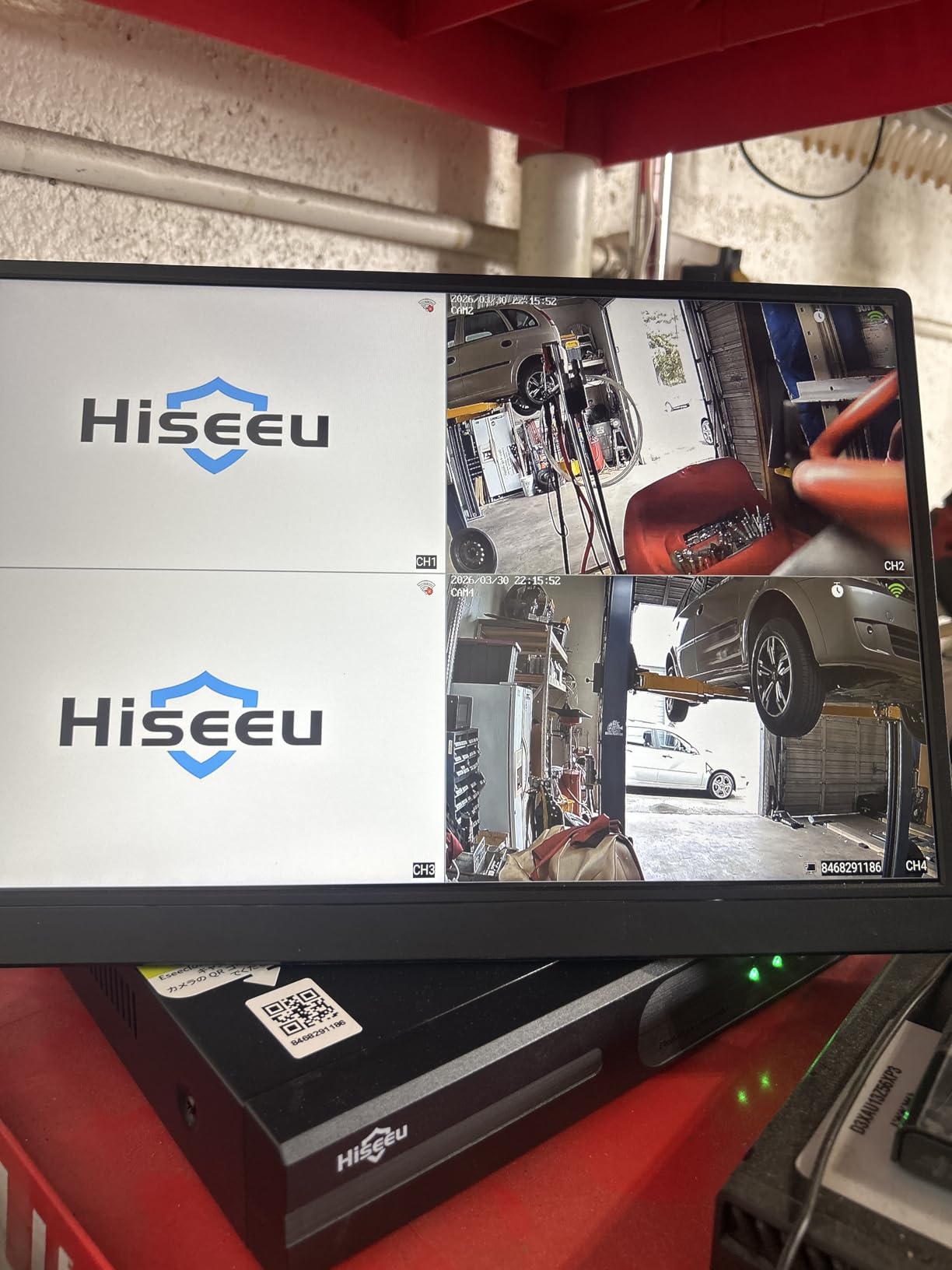
Dual-band WiFi instead of Ethernet
Dual-band is the detail that makes this approach workable. A 2.4GHz-only camera competing with neighbors and household WiFi is where wireless kits usually fail, while a camera that can shift to 5GHz holds a steadier link. The stated installation distance is up to 100ft from the NVR, which covers a normal single-floor home.
Buying signals that the wireless path is not always perfect. Owners report occasional cameras dropping offline outdoors, and firmware updates are needed for the best stability.
45 days of footage on 1TB
Retention math depends on scene activity, and continuous recording on a static driveway generates far less data than a street with constant traffic. The 45-day figure applies to the bundled configuration; add cameras or raise motion sensitivity and the window shrinks quickly.
Recording modes include 24/7, motion-triggered and custom schedules, so you can run full coverage overnight and events-only during the day.
Weak points in the NVR interface
Owners are consistent about the software friction. The zoom interface is awkward and jumps back to the all-camera view, there is no six-camera grid layout on the NVR itself, and the cameras lack ball-joint mounts, so aiming takes more patience than on a conventional bullet housing.
AI human detection is included and separates people from pets and shadows. The cameras are IP66 rated for a -13F to 122F operating range, which covers most climates.
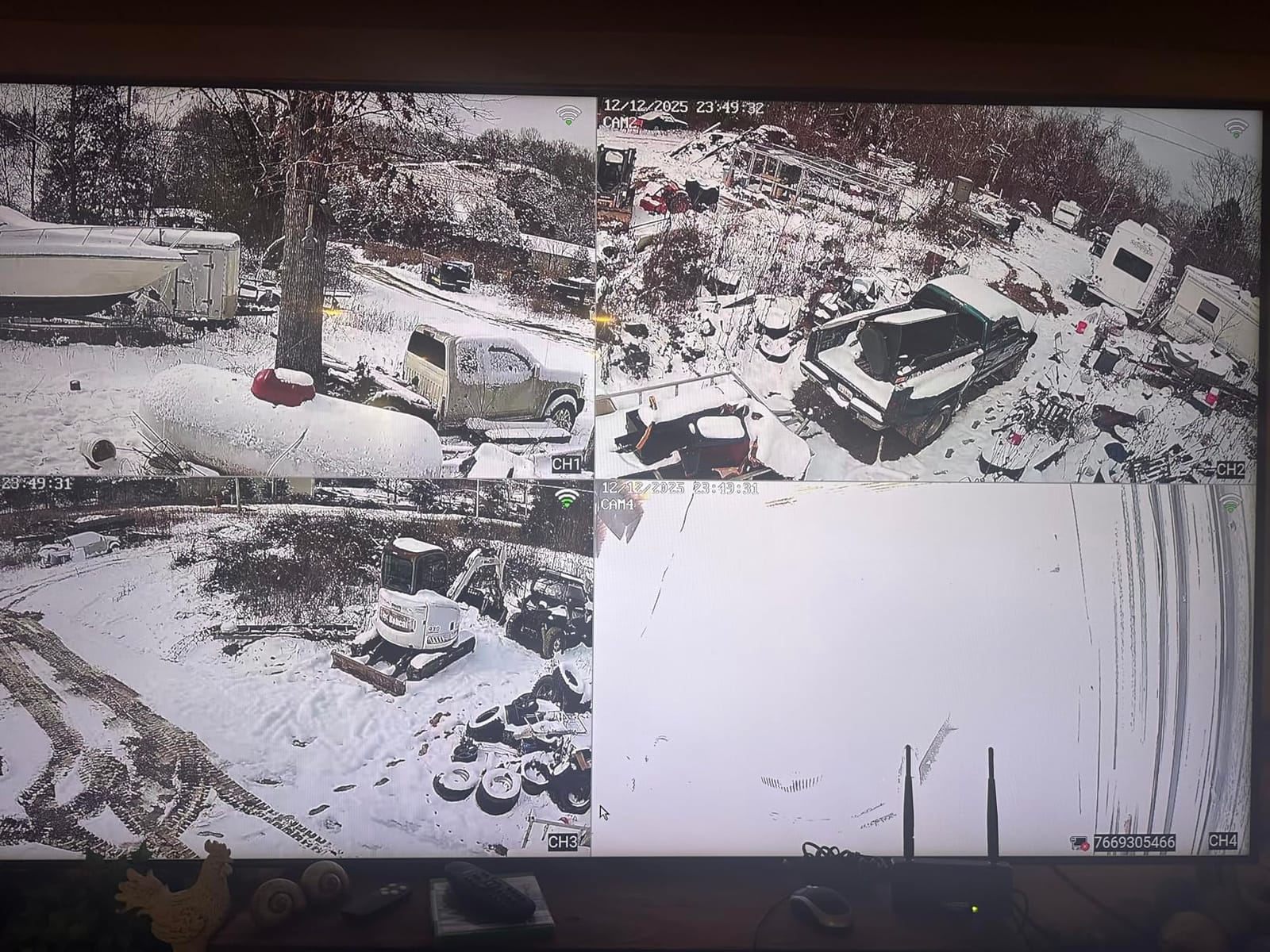
Who it suits: renters, finished homes with no wall access, and anyone who wants four cameras recording locally within an afternoon.
Who it does not suit: large properties where cameras sit far from the NVR, or anyone needing recording to survive a router or internet outage without testing first.
5. Reolink RLK16-800B8 16-Channel System – Best for Large Properties
REOLINK 16CH 4K Security Bullet Camera System with 4TB HDD RLK16-800B8
16-channel PoE NVR
8 x 4K 8MP bullet cameras
4TB HDD, expandable to 16TB
PoE runs up to 330ft
+ Pros
- Crisp 8MP images with strong digital zoom
- All footage stays onsite with no cloud fees
- Single-cable PoE makes a large system manageable
- Remote live view and playback through the free app
- Cons
- Initial NVR setup needs a monitor connected
- No fast-forward or rewind inside playback clips
- Camera ordering in the app does not match the NVR
This is the system I would look at for a house with a detached garage, a driveway gate and a shop building. Sixteen channels on a single PoE NVR, eight 4K cameras in the box, and 4TB pre-installed with room to grow to 16TB. Reviewers highlight that recording continues during internet outages, which is the whole point of a local recorder.
Cable reach is the headline spec: PoE runs up to 330ft over a single network cable, so outbuildings are realistic without a switch. The box includes eight 18m network cables, an HDMI cable, power adapter and mouse.
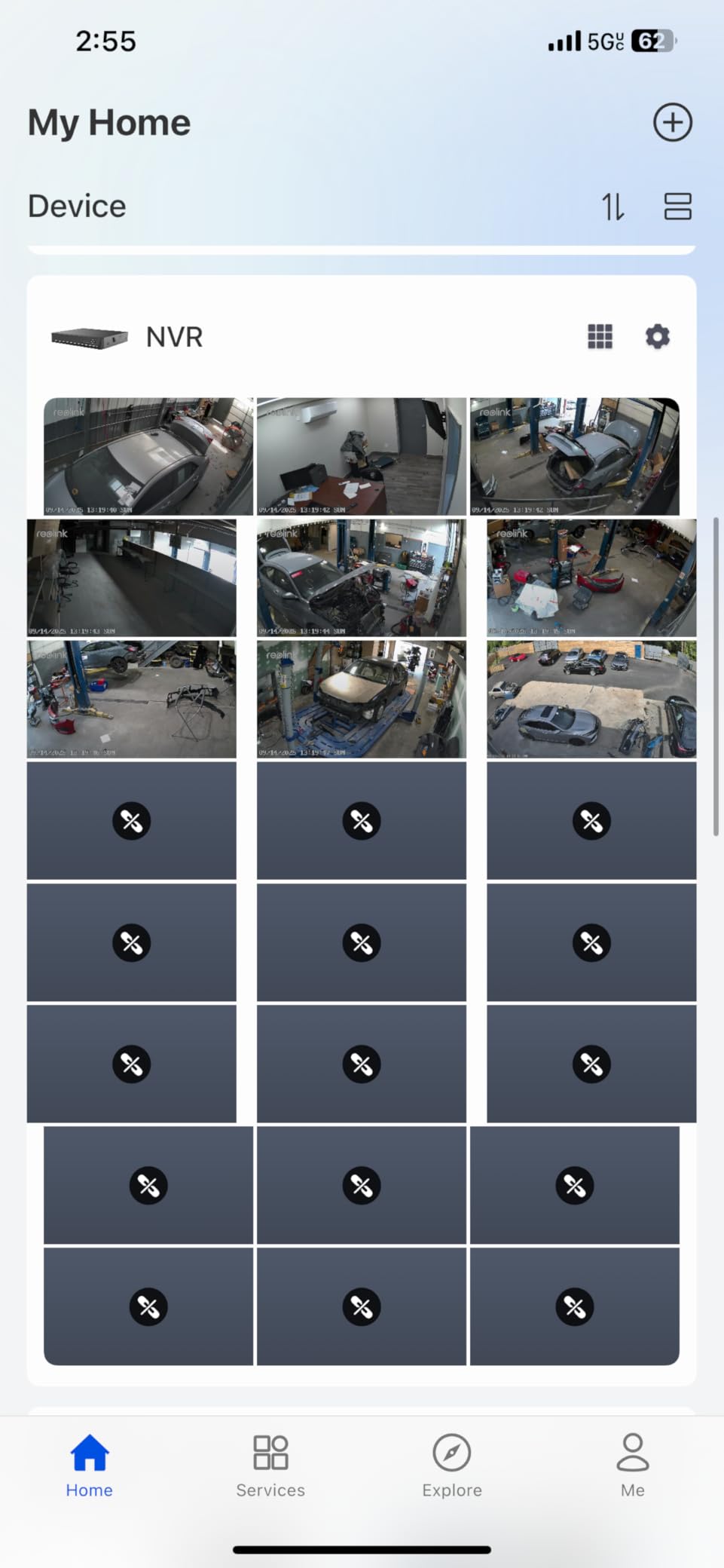
Sixteen channels and eight 4K cameras
Having half the channel count spare is valuable planning room. Owners using this for business surveillance note that adding cameras and running diagnostics happens from the NVR itself, and the eight included PoE ports keep that expansion on the same hardware.
Detection covers people, vehicles and animals with lock-screen alerts. Night vision is rated to 100ft, though buyers report effective range closer to 25 to 30ft with visible infrared LED rings at night.
330ft PoE runs and the installation reality
A 330ft rating is a maximum, not a target. Real installs hit that only with solid commercial-grade cable, outdoor-rated jacket, and weather-sealed connectors. For a 100ft outbuilding run, the included cables are not the right cable, and this is where most budget installs go wrong.
These cameras are PoE-only and do not work with smart home devices, so plan on a dedicated app rather than an integrated dashboard.
Playback and usability limits
The most common owner complaint is playback navigation. There is no fast-forward or rewind inside a clip, so reviewing an event means stepping through footage in real time, and camera ordering in the app does not match the NVR and can be difficult to rearrange.
Initial setup also requires a monitor connected to the NVR before app-only remote access works properly. Budget an hour for the first configuration.
Who it suits: larger homes and small businesses that need more than eight camera positions and want four terabytes of headroom on day one.
Who it does not suit: quick plug-and-play installs, and buyers who want voice assistant integration — these cameras stay on their own app.
6. eufy SoloCam E42 4-Cam Solar Kit – Best Solar-Powered System with No Fees
eufy Security SoloCam E42, 4-Cam Kit, 4K Solar Security Camera
4 x 4K solar cameras plus HomeBase 3
16GB built-in, expandable to 16TB
Up to 128GB microSD per camera
Siren and strobe deterrence
+ Pros
- No monthly fee with storage on the included hub
- Solar panels keep batteries charged with little upkeep
- True 4K quality with good night performance
- Pan and tilt plus strobe light give wide coverage
- Cons
- Cameras are 2.4GHz-only
- HomeBase 3 accepts 2.5-inch drives not 3.5-inch
- Quality control varies across the range
This is the kit where nobody touches a video cable, and it pairs a hub recorder with a built-in siren and strobe. Four SoloCam E42 cameras run on solar power and talk to a HomeBase 3 hub that holds the recordings. Setup took me under 20 minutes per camera, and the app guides the whole process.
The hub comes with 16GB of built-in storage that expands to 16TB, and each camera also accepts a microSD card up to 128GB if you want a second copy at the camera itself. Recording continues during network outages, which matters for a hub-based system since the hub is the recorder.
HomeBase 3 local storage and 16TB expansion
This is a hybrid of the microSD and NVR approaches, and it is the reason the system can promise both no monthly fee and generous retention. Because the hub is the recorder, a theft takes the cameras but leaves the footage on the base unit sitting on a shelf inside the house.
That is a meaningful difference from microSD-only systems, where the storage leaves with the hardware unless you add offsite backup.
Solar charging and 4K capture
SolarPlus 2.0 needs roughly two hours of direct sunlight a day for continuous operation, and the panel is part of each camera’s mount. True 4K capture includes license plate recognition up to 33ft, which is the number that matters if your camera covers a street-facing curb.
Coverage is 360-degree pan and tilt with a 110-degree-class field of view, and AI motion detection with automatic tracking follows a person across the frame.
Drive size and 2.4GHz constraints
Two practical limits catch people. HomeBase 3 accepts 2.5-inch drives rather than 3.5-inch, so check your existing drives before buying. And the cameras are 2.4GHz-only, which reviewers say can cause app connection slowness on busy networks.
Watch continuous live viewing on the hub monitor, because owners report it drains the solar batteries quickly. Motion-activated viewing is the sensible default.
Who it suits: anyone who will not or cannot run cable, and owners who want visible deterrence from a siren and strobe rather than passive recording.
Who it does not suit: buyers with limited direct sun exposure on their mounting spots, and anyone planning to reuse 3.5-inch drives they already own.
7. ANNKE 16-Channel 5MP PoE System – Best Two-Way Audio and Voice Deterrence
ANNKE 16 Channel Security Camera System 5MP PoE, Two-Way Audio, 2TB HDD
16-channel PoE NVR, 8 cameras
2TB HDD pre-installed
123-degree diagonal field of view
Two-way audio with custom voice
+ Pros
- Two-way audio with custom recorded voice warnings
- 123-degree field of view covers ground with fewer cameras
- 2TB on a 16-channel NVR gives real headroom
- Four 100ft and four 60ft cables included
- 120dB WDR handles mixed lighting
- Cons
- Fixed 2.8mm lens with no optical zoom
- 20fps capture can look stepped on fast motion
- Free app and firmware updates needed to enable voice playback
The feature that separates this kit from the other ANNKE system here is audio. It supports two-way talk, custom recorded voice warnings you can play through a camera, and a red and blue LED alarm — so instead of silently recording a break-in, you can speak to whoever is standing there.
The eight included cameras are 5MP units using a 1/2.8-inch BSI CMOS sensor at 3072 x 1728 and 20fps, behind a 2.8mm lens with a 123-degree diagonal field of view. That wide angle means fewer cameras cover more ground, which matters when you have a yard and a frontage to watch.
Two-way audio and custom voice warnings
Most cameras in this category capture audio one way, if at all. Two-way talk with push-to-talk over the app turns a camera into something you can actually interact with, and the voice warning feature lets you record a message that plays automatically when someone trips the detection zone.
The red and blue LED alarm works alongside it as a visual deterrent. One limitation worth knowing from reviews: the custom voice feature needs the free app and firmware updates enabled before it works.
123-degree field of view and 120dB WDR
Wide dynamic range at 120dB is the spec to care about when a camera looks toward a bright doorway or a sunlit yard. It keeps shadowed detail from crushing to black, which is exactly the condition where a cheap sensor loses the person you care about.
EXIR 2.0 night vision reaches 100ft with 3D noise reduction, and the housings are IP67 rated for operation from -30C to 60C. AI Motion Detection 2.0 handles person and vehicle classification with privacy masking.
Where 5MP at 20fps falls short
Twenty frames per second is honest but modest. Fast motion — a person running, a vehicle turning close to the lens — can look slightly stepped compared with a 30fps camera. If your coverage area is mostly slow movement, this is a fair trade for the wide angle and audio features.
Also note the 16-channel NVR comes with eight cameras, so half the channel count is spare capacity for expansion rather than unused hardware. The package weighs 26.5 pounds.
Who it suits: homeowners and shop owners who want to talk back to a visitor or warn off an intruder with a recorded message.
Who it does not suit: anyone needing optical zoom or high frame rate on fast-moving subjects.
8. Hiseeu 4K PoE System with Eight PTZ Cameras – Best Pan, Tilt and Auto-Tracking
Hiseeu 4K PoE Security Camera System with 8pcs 5MP PoE PTZ Cameras
8 x 5MP PoE PTZ cameras
3TB HDD pre-installed
300-degree pan, 90-degree tilt
16-channel NVR with 8 PoE ports
+ Pros
- PTZ cameras give 300-degree pan and 90-degree tilt
- Auto-tracking follows people and can hand off between cameras
- 3TB across eight channels is generous storage
- Two-way audio and color night vision perform well
- Cons
- Some cameras have failed or produced inverted images after a few months
- Software menus are described as lacking and hard to navigate
- Video is not sufficient to read plates at roughly 50ft
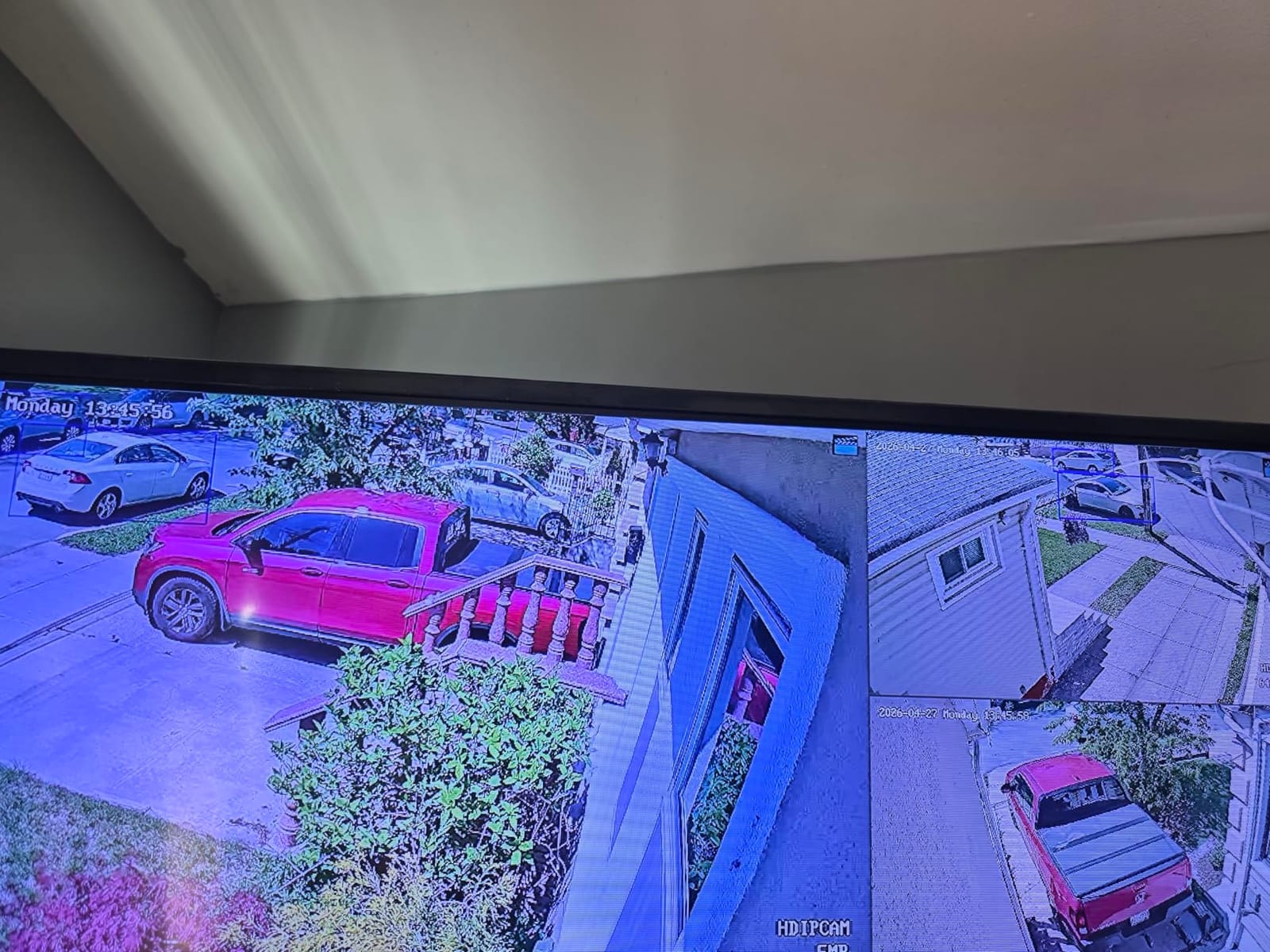
PTZ cameras solve a coverage problem that fixed bullets cannot: one pan and tilt head can sweep an entire parking area, driveway or side yard. This bundle includes eight 5MP PoE PTZ units, each with 300-degree pan and 90-degree tilt, feeding a 16-channel NVR that expands beyond its eight built-in PoE ports with an additional switch.
The auto-tracking is the reason to choose PTZ here. When it identifies a person it follows them across the frame, and it can hand off between cameras so a walk across a wide property does not leave the frame.

Pan, tilt and human auto-tracking
Pre-positioning and tracking work together well in practice. A camera that sweeps a yard on a schedule covers far more ground than a fixed unit pointed at one door, and the tracking means you are not re-checking eight static angles every morning.
The trade-off is motor noise and mechanical parts. PTZ housings have more failure modes than fixed bullets, and that shows up in the reviews for this system.
3TB of storage across eight PTZ cameras
Three terabytes across eight channels is meaningful headroom for continuous recording, and reviewers describe it as roughly what three cameras’ worth of storage would hold if you filled every channel with an always-active 5MP stream. Because PTZ cameras spend much of their time static, actual data generated is lower than eight continuously panning 5MP streams would be, so the effective retention is often longer than the raw numbers suggest.
Recording modes include 24/7 continuous and motion detection, with human and vehicle detection pushing instant alerts to your phone. Color night vision handles low light where infrared alone would produce grey footage.
Reliability and menu complaints
Reliability is the weak point in owner feedback. Some buyers report cameras failing or producing inverted images after a few months, and software menus are described as lacking. App notifications are also frequent enough that some owners mute them, which defeats the purpose of the alerts.
Several buyers did report fast support and warranty replacements, so failures appear to be handled once reported.
Who it suits: owners of open areas — long driveways, yards, parking lots — who want a moving view and automatic tracking from eight cameras.
Who it does not suit: anyone needing to identify license plates at distance, or buyers who want a system that runs unattended for years without touching it.
9. ZOSI 4K PoE System with Eight Metal Cameras – Best Metal Housings for Outdoor Runs
ZOSI 4K PoE Home Security Camera System with 2TB HDD, 8pcs 5MP Weatherproof Outdoor Indoor Metal Cameras, 120ft Night Vision, Person Vehicle Detection, 8 Channel 8MP NVR Recorder for 24/7 Recording
8 x 5MP aluminum bullet cameras
2TB HDD pre-installed
120ft IR night vision
8-channel NVR, expandable to 16
+ Pros
- No monthly fees with 2TB of pre-installed storage
- Metal housings feel durable outdoors
- Single-cable PoE install is plug-and-play
- Person and vehicle detection filters pets and foliage
- USB backup of clips and multi-user permissions
- Cons
- NVR software and interface are dated
- Exported files need ZOSI software to play
- Several owners reported IR and night vision cycling faults
The reason to like this kit is physical. The eight cameras use aluminum bullet housings rated IP66, and in outdoor installations where cameras get knocked, rained on and heated, a metal body ages better than the plastic shells used on many kits at this level.
Everything else follows the standard playbook: eight 5MP cameras, a 4K-capable NVR with eight channels that expands to sixteen through an add-on PoE switch, and a pre-installed 2TB drive for 24/7 local recording with no subscription.
Aluminum housings and the IP66 rating
IP66 covers dust ingress and protection against powerful water jets, which covers the rain exposure most residential cameras face. The metal body is the quieter advantage: it dissipates heat better and resists the cracking that shows up on plastic housings after a few seasons of direct sun.
Mounting hardware is the weak link. Owners report the universal-joint screws strip easily, so use a proper driver and do not overtighten.
2TB of local recording on a 4K NVR
The NVR accepts 4K input streams, so it will take higher resolution cameras later even though the bundled units are 5MP. Single-cable PoE carries both power and data to each camera, so there is no separate power adapter to hide.
Storage administration is handled through the ZOSI Smart app on iOS and Android, plus a PC client with a smart timeline, and clips can be backed up over USB.
Export format and camera reliability
Two practical issues come up repeatedly in reviews. Exported video files do not play in standard media players without ZOSI software, which matters if you plan to hand a clip to police or an insurer. And several owners reported cameras failing with infrared and night vision cycling faults after several months of use.
This is also the lowest-rated kit in the group, with a higher share of one-star feedback than the systems above it. Budget for a possible camera replacement within the first couple of years.
Who it suits: buyers who want metal camera bodies for exposed outdoor positions and accept a dated interface in exchange for them.
Who it does not suit: anyone who needs to share exported footage easily, or who wants a system likely to run for many years untouched.
10. Swann MaxRanger4K Mini 3-Pack – Best Long-Range Wireless Coverage
Swann MaxRanger4K™ Mini Long-Range Wireless Security Camera System, 3-Pack 4K Cameras, Wi-Fi HaLow™ up to 1000ft, Local Storage, No Monthly Fees, Indoor/Outdoor
3 x 4K cameras at 110 degrees
Base station with 32GB microSD
Wi-Fi HaLow to 1000ft line of sight
8 channels, siren and lights
+ Pros
- Long-range wireless reaches far beyond typical camera limits
- No monthly fees with local microSD in the base station
- 4K quality with a wide 110-degree field of view
- PIR and AI sensitivity are easy to tune
- Cons
- Cameras are locked to the Swann ecosystem
- Base station has no backup battery
- Manual aiming with a tiny locking screw
Few wireless kits in this guide get cameras across a large property without cable. The MaxRanger4K Mini uses 900MHz Wi-Fi HaLow, rated at up to 1000ft line of sight and around 330ft through obstacles, which is a completely different propagation profile from the 2.4GHz and 5GHz bands the other wireless kits here use.
That range is what makes it useful on rural lots, long driveways, and properties with outbuildings and heavy tree cover. Owners with large properties rate it highly because the sub-GHz approach reaches where ordinary wireless cameras simply drop off.
Wi-Fi HaLow range and camera placement
HaLow operates in a sub-GHz band with better penetration and much less interference than 2.4GHz, which is why the range holds up through trees and walls that would defeat a standard WiFi camera. Cameras are battery powered with USB-C charging and optional solar charging.
The trade-off is bandwidth. HaLow is not designed for high-resolution live streaming to multiple viewers at once, so expect the app to be slower to load a live feed than on a 5GHz system.
Base station microSD storage
The base station holds a 32GB microSD card, expandable to 512GB, and no subscription is required to record or review. That is a smaller local footprint than the 1TB to 4TB drives in the wired kits, so plan your retention accordingly and expect shorter windows.
True Detect+ AI sensing evaluates heat, motion, people and vehicles, and owners report that sensitivity is easy to tune to the point where vehicles and people register at real distances.
Ecosystem lock-in and hub battery
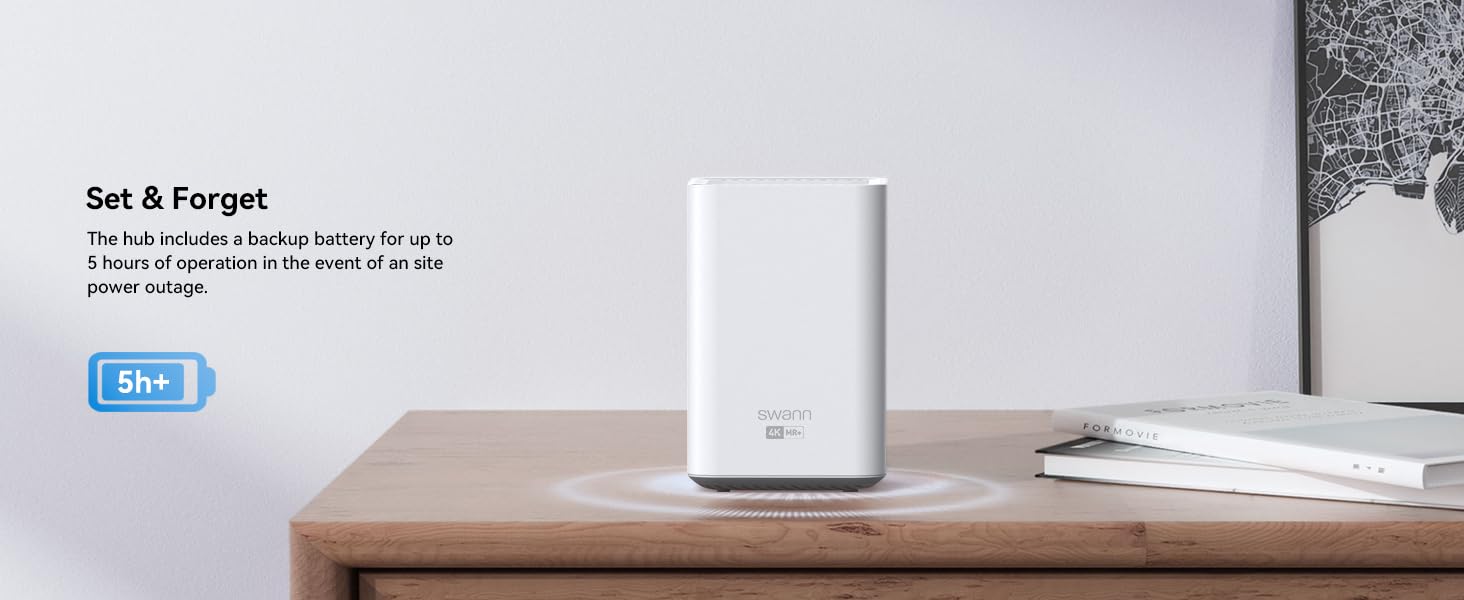
Two limitations are worth weighing. The cameras work only inside the Swann ecosystem and will not mix with another brand, and some compatible Swann models are discontinued or priced well above this kit. The base station also has no backup battery, so a power cut takes the system offline until power returns.
Aiming is manual via a tiny locking screw, and there is no automatic trigger of adjacent cameras when motion is detected, so a walk across a wide area may leave the frame on one camera.

Who it suits: rural and large properties where running Ethernet to each camera is not realistic, and buyers who want 4K without any wiring.
Who it does not suit: anyone planning to mix brands, and households that need guaranteed recording through a power outage.
How to Choose a Local Storage Security Camera System
Pick the storage type first: microSD, NVR, DVR or NAS
microSD is the simplest: a card inside each camera, no separate recorder, and no hub. It is the fastest to set up and the weakest in practice, because capacity is capped, the card lives inside the camera, and a stolen camera takes the footage with it.
DVR and NVR recorders sit at the center. A DVR handles legacy analog cameras over coax, while an NVR handles digital network cameras over Ethernet or WiFi. The vast majority of the systems in this guide are NVR or DVR kits, and the difference matters if you are mixing older cameras with newer ones.
A NAS is the enthusiast path. Several forum users we read recommend exactly this: run PoE cameras onto a network with local storage on a NAS rather than a bundled recorder. One poster on a Spiceworks thread noted that QNAP includes QVR Pro with some options. This gives you the most flexibility and the most configuration work.
Hub-based systems like the eufy kit here sit in between, with the hub acting as the recorder and the cameras talking to it wirelessly.
Work out how much footage you actually need
Retention is a function of channel count, resolution and motion density, not just drive size. A practical approach: pick the number of days you want to keep, multiply by the number of cameras and hours recorded, then assume a per-camera data rate that depends on your codec and motion profile.
H.265 and H.265+ roughly halve the data versus H.264 for the same picture quality, which is why some kits here fit so much more on the same drive. The bundled 1TB drive in one of the wireless kits is advertised at more than 45 days for four channels; a 4-channel 4K PoE system on the same drive would hold a much shorter window.
A rough planning rule: if you care about a week of continuous history, buy more storage than you think you need at purchase, because the drive is the only component you can always expand later.
Decide between wired PoE, wireless and battery power
Wired PoE is the most reliable and the highest quality. One cable carries power and data, there is no wireless dead zone to troubleshoot, and the cameras keep recording when the router is down because the recorder is doing the work.
Wireless systems suit finished homes and rentals. Dual-band models hold a steadier link than 2.4GHz-only cameras, and long-range sub-GHz systems reach far across a property but sacrifice live view responsiveness.
Battery and solar removes installation almost entirely at the cost of maintenance and night performance, since infrared illumination on battery cameras is often the first thing trimmed.
Check what stays free without a subscription
Ask one question per feature: is this free forever or is it a preview of a paid tier? Recorded footage, continuous 24/7 recording, local playback and remote app access carry no subscription on any of the ten systems in this guide, and so does the AI detection bundled with each one.
The place brands differ is remote viewing over cellular data, app polish, and how long the vendor commits to supporting the local pipeline. Check that the app your system uses is one the company still updates.
Plan the cable run before you buy
Ethernet runs are limited to about 100m per segment on standard copper, and PoE claims beyond that are tested under ideal conditions. For outdoor runs, use outdoor-rated cable with a gel or water-block shield, seal every connector inside a junction box, and avoid burying direct-burial cable without the correct jacket rating.
Decide where the recorder lives before you mount a single camera. The NVR needs power, ventilation and a network drop, and running cables to a closet you cannot reach later is the most common regret in DIY installs.
Protect recordings if a camera is stolen
Four steps make a difference. First, choose a system where the recorder is a separate box, so removing a camera does not remove the footage — that rules out microSD-only setups. Second, use an NVR you can access remotely over cellular, so you can pull a clip after the fact. Third, enable the recording retention you would need for an insurance claim, since many systems overwrite on a tight loop. Fourth, back up critical clips to a USB drive or external drive, because a stolen recorder takes everything with it.
Forum posters made the first point themselves: one Reddit user in r/homesecurity described the difficulty of finding simple cameras with real local storage, noting that many only support small microSD cards. It is a genuine problem with the format, and choosing a recorder-based system avoids it.
Frequently Asked Questions
What are the best security cameras for home with storage?
The best systems for home use with built-in local storage are the ANNKE 3K Lite wired kit with a 1TB drive, the Reolink RLK8-410B4 5MP PoE kit with 2TB, and the Reolink RLK8-800B4 4K kit with 2TB expandable to 16TB. For large homes the Reolink RLK16-800B8 offers sixteen channels and 4TB. For homes that cannot run cable, the eufy SoloCam E42 solar kit and the Swann MaxRanger4K both record to local hardware with no monthly fee.
What is the best security camera without a monthly fee?
The Reolink RLK8-410B4 is the strongest pick if you want zero recurring cost. It comes with a 2TB drive already installed, records 24/7 continuously, and includes person, animal and vehicle detection in the free app with no plan attached. Cameras connect with a single PoE cable for power and video, and the drive expands with an additional 8TB over e-SATA.
What are some security cameras that don’t require cloud storage?
Every system in this guide records locally without requiring cloud storage. The ANNKE 3K Lite, both Reolink PoE kits, the Reolink 16-channel kit, the Hiseeu NVR and PTZ systems, the ZOSI PoE kit and the ANNKE 16-channel system all record to a hard drive inside the recorder. The eufy SoloCam E42 records to a HomeBase 3 hub with 16GB built in and expansion to 16TB. The Swann MaxRanger4K records to a microSD card in its base station.
Do security cameras record without internet?
Yes. A camera with local storage keeps recording when the internet drops, because the footage is written to a drive inside the recorder rather than uploaded to a vendor server. The Reolink 16-channel 4K system is specifically noted by owners for continuing to record during internet outages, and the eufy HomeBase 3 hub also records through network outages. You simply cannot view or share clips remotely until the connection returns.
How much storage do I need for security cameras?
Work from days of retention, camera count and hours recorded. H.265 and H.265+ compression roughly halve storage versus H.264 for the same picture quality. One 4-camera wireless kit here advertises more than 45 days of continuous recording on its bundled 1TB drive using H.265+, while a 4-camera 4K system on the same drive holds a much shorter window. If you want a week of history, buy more storage than you estimate you need.
What happens to security camera footage if the camera is stolen?
With a microSD-only system the footage goes with the camera, which is the format’s main weakness. With a recorder-based kit the recording stays on the NVR or DVR inside the house. Choose a system you can reach remotely over cellular so you can export a clip after the fact, set retention long enough to cover an insurance claim, and back up important clips to a USB or external drive in case the recorder itself is taken.
Which Local-Storage Camera System Should You Buy in 2026?
If you want the broadest coverage with the least fuss, start with the ANNKE 3K Lite wired kit. It comes with eight cameras and a 1TB drive, runs 24/7 without a subscription, and its DVR accepts several camera formats so you are not locked in.
If you would rather run one clean cable per camera and want the easiest install, the Reolink RLK8-410B4 5MP PoE kit is the pick. It is quiet, it has 2TB ready to go, and detection works without a paid plan. For identification detail after a zoom, choose the Reolink RLK8-800B4 4K version, and budget a larger drive because its encoding is heavier.
For a house with outbuildings and more than eight positions, look at the Reolink RLK16-800B8 with sixteen channels, 4TB and 330ft PoE runs. If no cable is possible, the eufy SoloCam E42 solar kit records to a HomeBase 3 hub with room to grow, and the Swann MaxRanger4K reaches further wirelessly than anything else here. For open areas where a fixed bullet cannot cover the ground, the Hiseeu PTZ system with auto-tracking is the one to consider.
Whichever you pick, work out your retention target before you buy the drive, plan the recorder location first, and test one camera end to end — install, detection, playback, export — before you mount the other seven. That is still the best security camera system with local storage advice I can give anyone setting one up in 2026.