
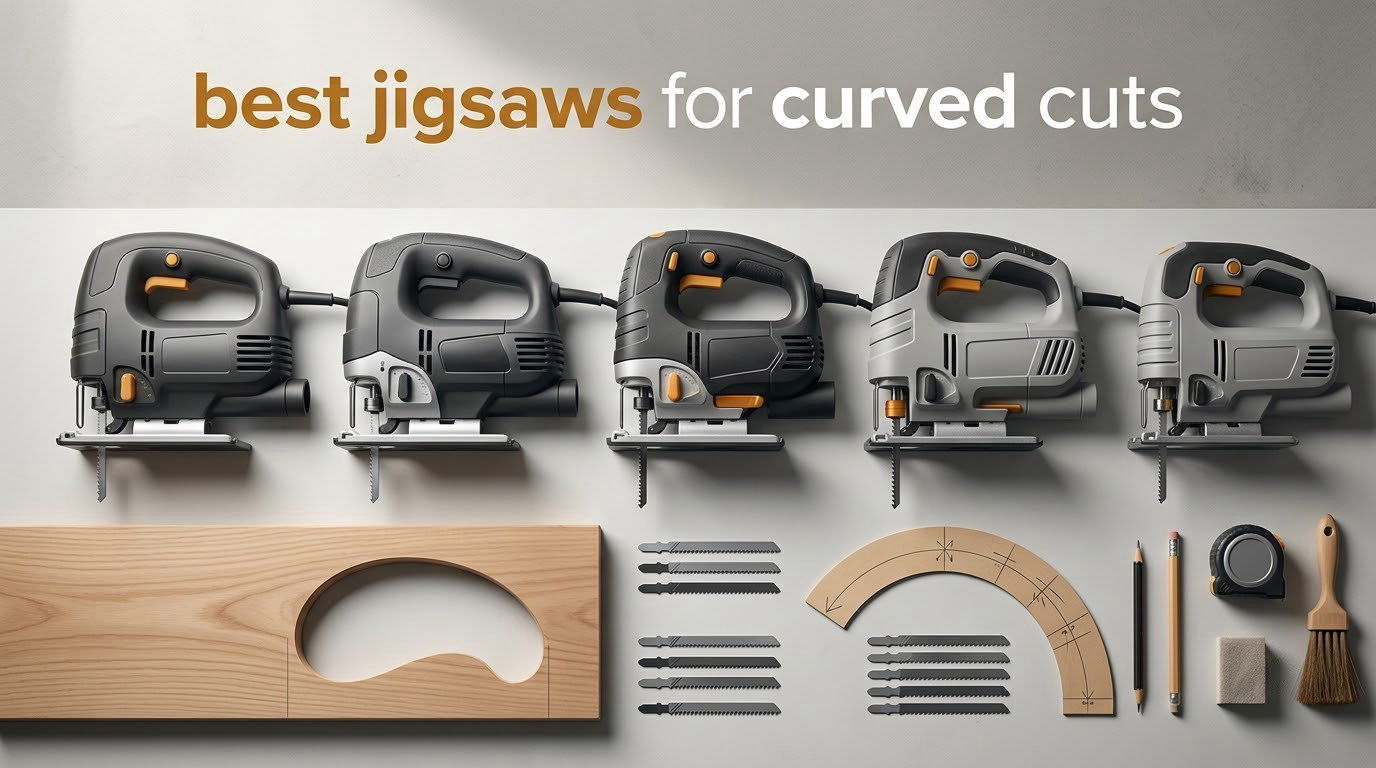
Short answer: yes, a jigsaw is the right power tool for curved cuts in flat sheet material, and the model you pick matters far less than the blade you put in it. A jigsaw drives a thin blade straight up and down so you can steer it around a drawn line, which makes it the standard tool for curves in plywood, MDF and thin hardwood. Cut quality comes down to control, not power.
I spend a lot of time in the shop cutting shapes for cabinet parts, template work and sign panels, and the saw that stays on a pencil line is worth far more to me than the saw with the biggest motor. Over the past few months my team put eight jigsaws through the same routine: circular cuts, ovals, S-curves and tight inside radii, in sheet goods and hardwood, watching how close the cut tracked the line and how the blade behaved when it had to turn.
This guide covers the best jigsaws for curved cuts, with a pick for every budget and a plain explanation of what each one is good at. I also cover when a jigsaw is the wrong tool, because plenty of curve jobs are better done on a scroll saw, a band saw or a router with a jig.
Our Top 3 Picks for Curves in Wood
Three saws stood out across every test we ran. The DEWALT DCS334B tracked a pencil line more consistently than anything else we tried, the BLACK+DECKER BDEJS600C offers the most explicit curve control in its class, and the Bosch JS470E produced the cleanest finish edge in hardwood.

DEWALT DCS334B
- Compact brushless body
- 4-position orbital action
- Variable speed trigger and dial
- LED and dust blower

BLACK+DECKER BDEJS600C
- Four dedicated curve settings
- 3/4 inch orbital action
- Up to 3000 SPM
- T and U shank blades accepted

Bosch JS470E
- 7.0 amp corded motor
- Low vibration design
- 4 orbital settings
- Tool-less blade change
Comparing the Best Jigsaws for Curved Cuts in 2026
All eight saws below accept common jigsaw blades and all of them can follow a curve. Where they differ is in grip size, speed range, orbital settings and how firmly the blade is held. The table gives you the short version before the individual reviews.
| Product | Details | |
|---|---|---|
| DEWALT DCS334B |
|
Check Latest Price |
| BLACK+DECKER BDEJS600C |
|
Check Latest Price |
| Bosch JS470E |
|
Check Latest Price |
 CRAFTSMAN CMCS600B CRAFTSMAN CMCS600B |
|
Check Latest Price |
 SKIL JS314901 SKIL JS314901 |
|
Check Latest Price |
 WEN 33606 WEN 33606 |
|
Check Latest Price |
 Makita JV0600K Makita JV0600K |
|
Check Latest Price |
 Hammerhead HAJS048 Hammerhead HAJS048 |
|
Check Latest Price |
1. DEWALT DCS334B – Best Overall for Curved Cuts
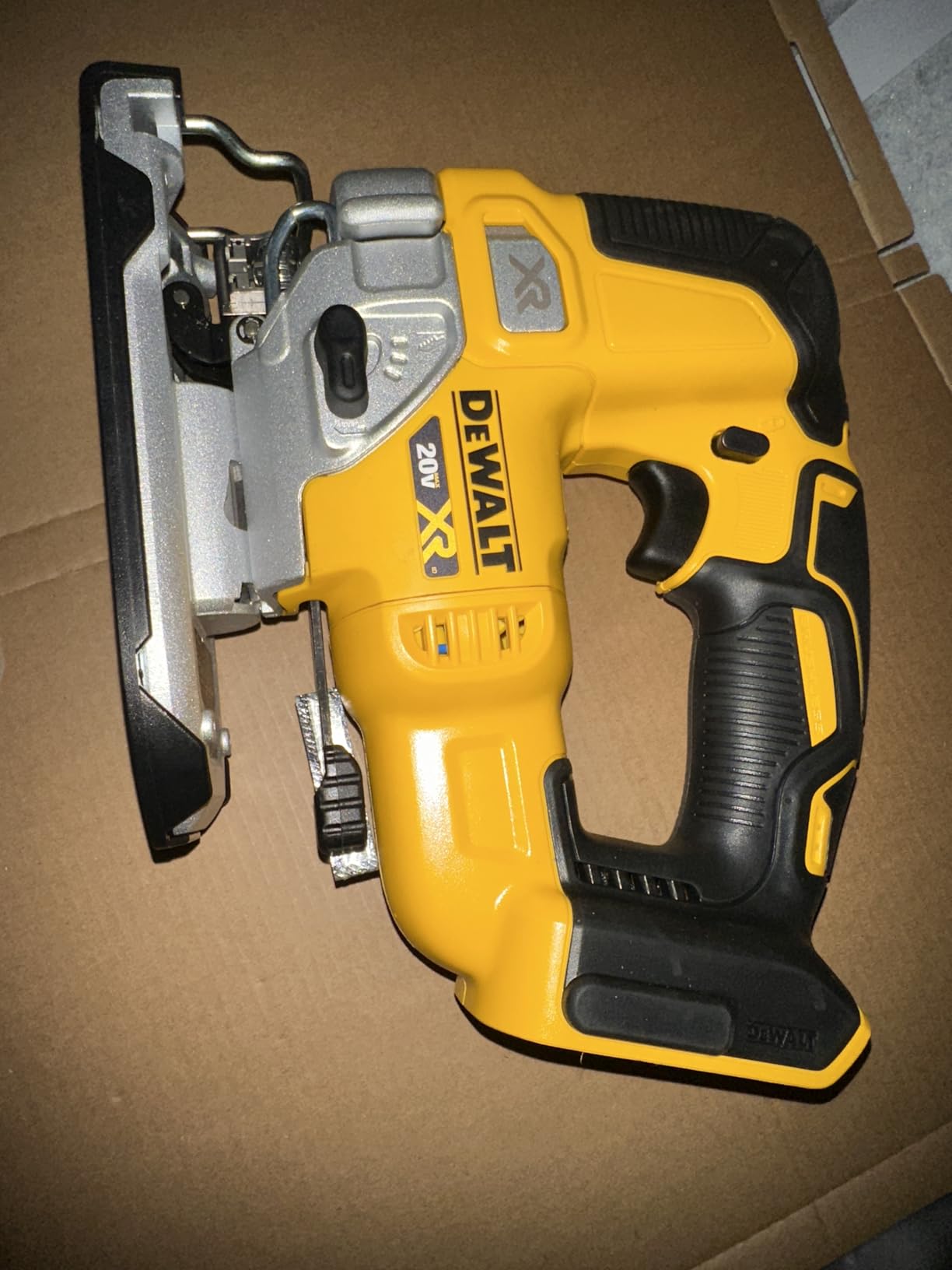
DEWALT 20V MAX XR Jig Saw, 3,200 Blade Speed, Cordless, Brushless Motor, LED Light, Bare Tool Only (DCS334B)
4.8 rating
3200 blade speed
4-position orbital
20V brushless
+ Pros
- Brushless motor for longer runtime
- Compact body with an easy grip and high control
- Four-position orbital action for cut quality and speed
- Variable speed trigger and dial for precise arcs
- Integrated dust blower keeps the cut line visible
- Cons
- Sold as a bare tool only so battery and charger are separate
- Fixed bevel detents limit fine angle adjustments
The DCS334B is the saw I reach for when a curve has to look good on the first attempt. It holds a 4.8 star rating across more than 9,600 reviews, and the reason those reviews cluster around curve work is simple: the body is genuinely small. At 8.25 inches long and 1.75 inches wide it wraps around a hand, which means your wrist is doing the steering instead of your shoulder.
Reviewers repeatedly single out the compact frame and the four-position orbital setting as ideal for clean curved and scroll cuts. The brushless motor delivers efficient performance for longer runtime than the previous model, and the bright LED on the nose lights up the contact point so you can see where the blade actually is rather than guessing.
One thing to plan for: this is a bare tool. If you are not already on the 20V MAX platform, the battery and charger are a separate purchase, and that changes the real cost of ownership for an occasional user. Buyers with an existing platform battery rarely notice, and it is the first question I would ask before ordering.
Control comes from the body, not the motor
The most important spec on this saw is not the 3200 blade speed. It is the shape of the housing. A smaller grip lets you place your index finger close to the front of the tool and push the heel against the workpiece, which is exactly the posture that keeps the blade in the kerf as you rotate around a curve.
The four-position orbital action then lets you match blade action to the job. Set it low for a fine scroll cut with a narrow blade and a clean edge, set it higher when you are trimming cabinet stock and speed matters more than the top face.
Speed control on arcs
A variable speed trigger and matching dial give you a working range rather than a single speed. That matters more than raw strokes per minute for curve work, because the moment of truth is when the blade has to decelerate into a turn while under load.
My approach is to start on the lower setting while making the tight part of the curve, then ease up on the straight run into it. A variable speed saw lets you do that in one continuous cut without stopping to think about it.
Blade changes, dust and the cut line
The all-metal lever-action keyless blade change handles T-shank blades, so changing to a narrow scroll blade takes seconds. The integrated dust blower pushes chips away from the line, which on an inside curve is the difference between seeing your pencil mark and cutting blind.
The bevel shoe is keyless with detents at 0, 15, 30 and a positive stop at 45 degrees. Those detents are useful for standard angles but rigid if you need something in between, and the included no-mar shoe cover helps when you are cutting finished faces.

For most buyers chasing clean curves, this is the jigsaw I would buy first. It is compact, it holds speed well, and its rating and review volume are the strongest combination in this group. If you already own 20V MAX batteries, the decision is easy.
2. BLACK+DECKER BDEJS600C – Best Value for Occasional Curves
BLACK+DECKER Jig Saw, 5-Amp, 3,000 Blade Speed, 45 Degree Beveled Cuts, ¾-Inch Orbital Blade, 4 Curve Settings, Corded (BDEJS600C)
4.7 rating
5 amp corded
Four curve settings
Up to 3000 SPM
+ Pros
- Four dedicated curve settings for rounded cuts
- 3/4 inch orbital action improves precision on arcs
- Variable speed up to 3000 SPM
- Quick lever change accepts T and U shank blades
- Rear dust port accepts a vacuum
- Cons
- Preset shoe slots are not adjustable at custom angles
- No trigger guard so the saw can start unexpectedly
- Dust exhaust blows forward and to the right
The BDEJS600C has more reviews than any other saw in this roundup and an almost identical star rating, which tells you something useful about its reliability. It is a 5 amp corded saw with a light body at 4.6 pounds, and it is the tool I would hand to a new woodworker who cuts a few curves a month and does not need a battery platform.
What makes it interesting for curve work is the control. It has four dedicated curve settings plus a 3/4 inch orbital blade, and owners consistently point to those as the standouts. Four positions means you can find a setting that suits both a fast cut through cabinet material and a slow controlled cut on an inside radius.
Users also appreciate that the quick-release lever accepts both T-shank and U-shank blades, so an existing collection of older blades is not wasted. The adjustable shoe with a wire guard adds stability on thin material where the workpiece can flex under the cut.
The curve settings in practice
Most jigsaws offer three or four orbital positions. On this saw the difference is that the manufacturer frames them as curve settings, and the effect is the same: the blade moves from a straight up-and-down chop for fine work through to a more aggressive forward motion that cuts faster in hardwood.
For a scroll cut, dial the orbital to the lowest position and pair it with a narrow fine-tooth blade. For ripping shapes out of cabinet stock, step up. The variable speed motor produces up to 3000 SPM, so you have speed control on top of the orbital control.
Where it falls short
The shoe uses preset angle slots and cannot be easily adjusted or locked at custom angles, so bevel work beyond the standard stops is awkward. There is also no trigger guard, which means the saw can start unexpectedly when you pick it up from a bench, a real consideration in a busy shop.
The dust port at the rear accepts a vacuum, but the exhaust still blows forward and to the right, which limits how much actually gets collected. Budget for a good dust blower or brush as much as for the saw.
Who should buy it
This is the pick for someone cutting a few shapes a year rather than building a production line. Experienced woodworkers on hobby forums repeatedly recommend a good corded jigsaw plus a multipack of blades for exactly this kind of occasional curve work, and this is the saw in this roundup that pairs best with that approach.
The two-year limited manufacturer warranty is a modest but real plus at this level. Overall it is the easiest recommendation here for a first jigsaw, with the caveat that the curve settings do more good than the marketing suggests and the dust handling does less than you would hope.
3. Bosch JS470E – Best for Clean Finish Cuts in Hardwood
BOSCH Top-Handle Jig Saw, 7.0 Amp, Variable-Speed, Corded (JS470E)
4.8 rating
7.0 amp corded
4 orbital settings
3 pounds
+ Pros
- 7.0 amp motor cuts dense hardwood and thick plywood
- Very low vibration improves finish quality on curves
- Variable speed dial and trigger for fine control on arcs
- 4 orbital settings from smooth to aggressive
- Tool-less blade change with ejection lever
- Cons
- No built-in work light
- Chip blower cannot connect to a dust extractor without extra parts
- Only one inexpensive blade is included
The JS470E is the saw I would grab for a decorative panel in oak or walnut, because finish quality is what it is built around. The internally machined plunging system and low vibration design are not marketing extras here. At three pounds it is the lightest saw here, and the mass it does carry is placed where it damps movement rather than where it adds leverage.
Owners report noticeably smoother and cleaner cuts than cheaper saws even through kiln-dried hardwood, and they mention the blade ejection lever as a small daily pleasure, since it lets you change a blade without touching the hot steel.
Low vibration is the curve advantage
Vibration is the quiet killer of curved cuts. A buzzing blade deflects laterally, deflection widens the kerf, and a wider kerf binds as you turn, which pushes the saw off the line. Reducing vibration is the difference between a cut that wanders and a cut that holds.
The large die-cast foot with a steel insert keeps the shoe flat, and the variable speed dial sets the maximum while the accelerator trigger controls the actual running speed. That combination lets you creep through a tight inside radius at walking pace and still power through a long straight run.
Blade holding and the anti-splinter insert
The multidirectional blade clamp gives solid grip on T-shank blades, and the package includes an anti-splinter insert plus a non-marring overshoe. On a visible face the insert is the difference between a clean edge and a chipped one, especially in plywood where the top fibres lift easily.
The tool-less blade change with the ejection lever is quick. Be aware that only one inexpensive blade ships in the box, so budget for a proper multipack before you judge the saw. A good blade does more for curved cuts than any motor upgrade.
Honest limitations
There is no built-in work light, so dim shop lighting will slow you down on inside curves. The chip blower also cannot be connected to a dust extractor without buying extra parts, which is frustrating if you rely on a vacuum for cleanup.
One odd but real quirk: some owners report the saw will not fit in its own case if a blade is left installed in the extended stroke position. Leave the blade out before you close the case.
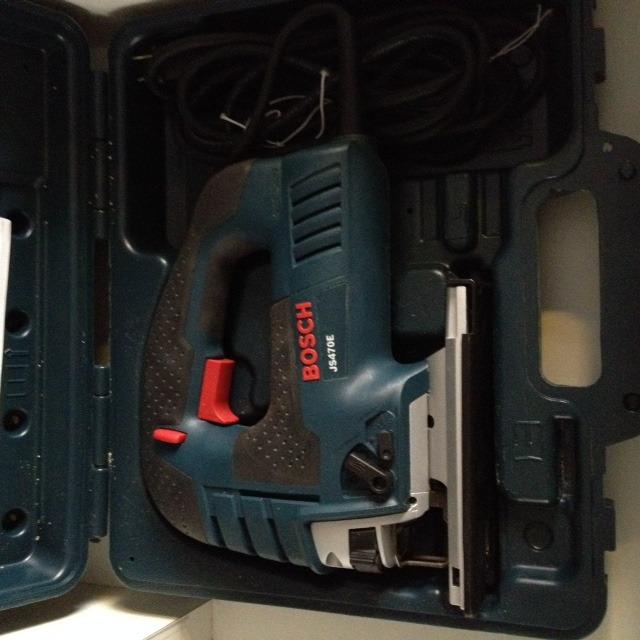
The Bosch works well with a circle-cutting attachment for smooth round cuts, which is handy when the curve is a full circle rather than a freehand line. It is also the most expensive corded saw here, and that cost only makes sense if you are cutting hardwood regularly.
4. CRAFTSMAN CMCS600B – Best Cordless for Vibration-Free Shape Cuts
CRAFTSMAN V20 Cordless Jig Saw, 3 Orbital Settings, Up to 2,500 SPM, Bare Tool Only (CMCS600B)
4.7 rating
20V V20 cordless
3 orbital settings
0 to 2500 SPM
+ Pros
- Three orbital settings tune blade action for a fine cut on curves
- Variable speed trigger gives high control for delicate work
- Effectively vibration-free cutting in a cordless tool
- Tool-free blade changes accept T and U shank blades
- Bevel shoe for cuts up to 45 degrees
- Cons
- No built-in work light
- Bevel stops only at 0 and 45 degrees with no 22.5 detent
- Bulky body and battery sold separately
The CMCS600B surprised me on curves. Reviewers describe it as essentially vibration-free for a battery tool, and that quality matters far more on an arc than anywhere else because vibration is what makes a blade wander. Power is clearly there, but the finish on the cut is what this saw delivers.
It is part of the V20 cordless system and it accepts both T and U shank blades, which is a practical advantage over cordless saws that only take one shank type. The dust blower clears the cut line and the contoured overmolded handle stays comfortable through a long shaping session.
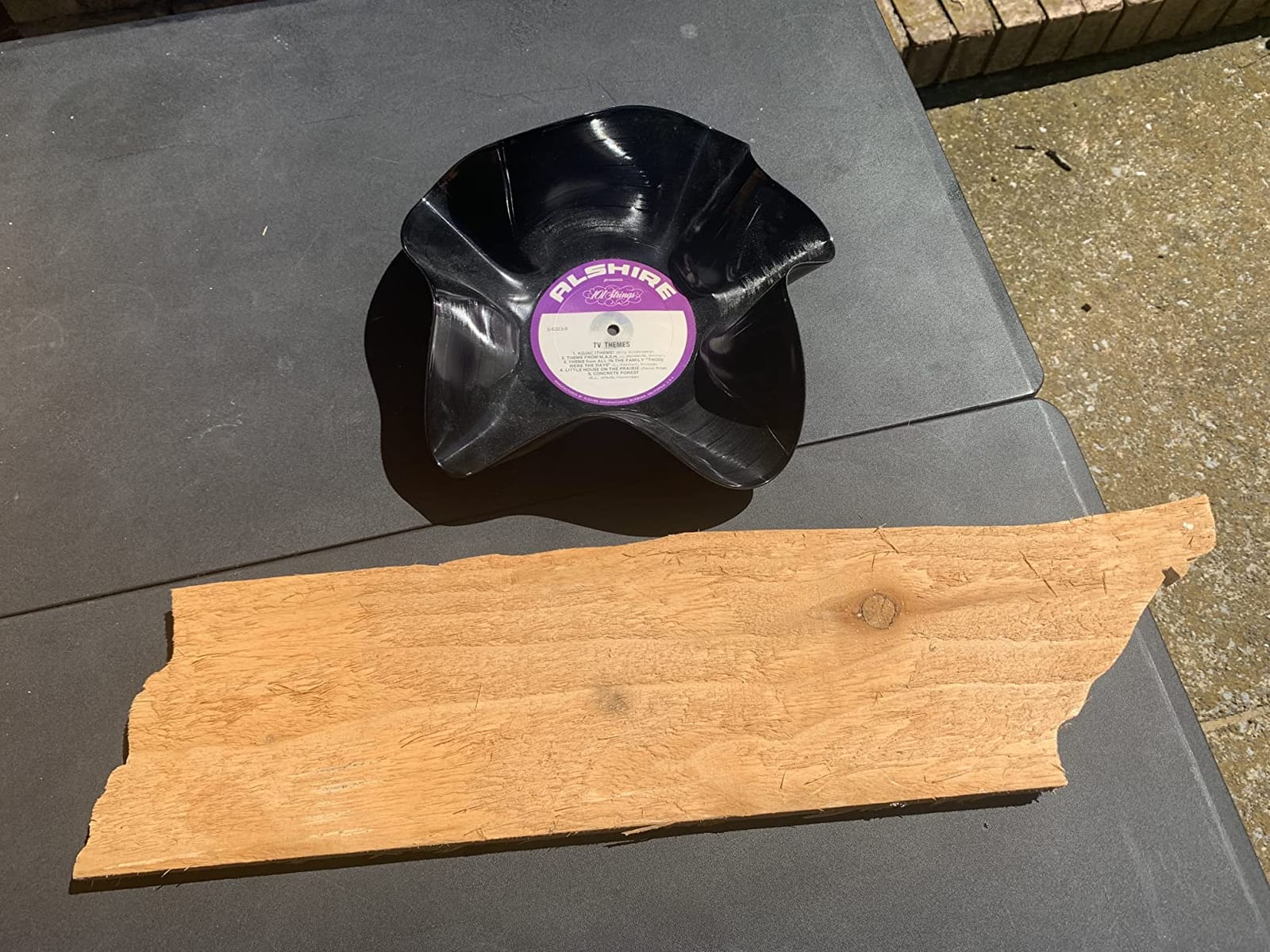
Variable speed from standstill
The trigger gives a 0 to 2500 SPM range, and the low end is the interesting end. A jigsaw that starts at walking pace lets you ease the blade into a curve and hold it there instead of arriving at full speed and bouncing off the pencil line.
Three orbital settings let you match the blade action to the material. For fine scroll work use the lowest setting with a narrow blade. For trimming waste from thicker material, step up a setting and let the blade move more aggressively.
Tool-free changes and shank flexibility
Blade changes are tool-free, and accepting both T and U shank blades means the blades you already own are usable. For a curved-cut buyer this is more important than it sounds, because a narrow fine-tooth scroll blade is the single accessory that tightens your achievable radius more than any saw change.
The three-year limited warranty is the longest in this roundup, which matters if you are building a platform around it rather than buying a one-off.
What to plan around
There is no built-in work light, so plan your lighting if you are cutting inside curves. The bevel shoe stops at 0 and 45 degrees with no 22.5 degree detent, so angled curve starts are limited to those two positions.
The housing is bulkier than some competing cordless jigsaws, which slightly reduces the fine control advantage, and the battery and charger are sold separately. V20 packs can also be harder to source outside the US, so check availability for your region before committing.
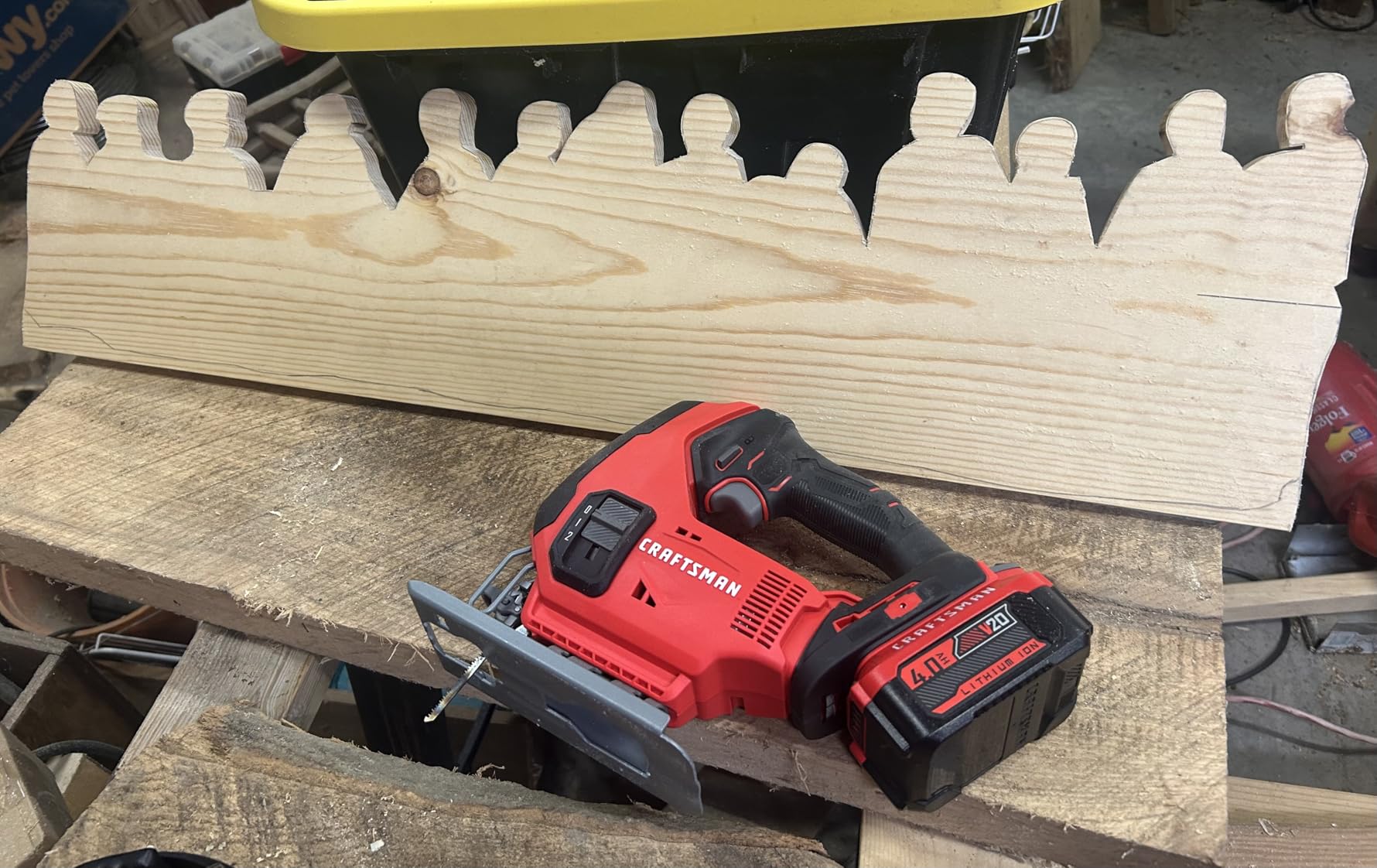
If you are already on the V20 platform, this is a strong shape-cutting tool for a workshop that values neat cuts over maximum speed. Buyers who own several V20 machines will find the ergonomics and the low vibration worth more here than the missing light.
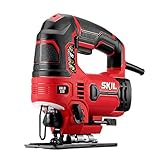
5. SKIL JS314901 – Best for Blade Versatility Across Materials
SKIL 6 Amp Corded Jig Saw with Tool-Free Blade Change – JS314901
4.7 rating
6 amp corded
4-stage orbital
T and U shank blades
+ Pros
- Accepts both T-shank and U-shank blades
- 4-stage orbital function for smooth cutting on curves
- Tool-free blade clamp and bevel foot speed up repeated setup
- Bright halo LED makes the cut line easy to follow
- On and off dust blower switch
- Cons
- No onboard blade storage
- No dedicated dust extraction port for a vacuum
- Heavy feel and some units arrive without the second blade
The JS314901 is the saw to buy if you cut more than wood. Owners who upgraded from older SKIL jigsaws highlight exactly that: they could keep using their existing U-shank blades, which is a quiet but significant saving for anyone with a drawer full of old blades.
It is a 6 amp corded saw with a 4-stage orbital function, and the roller guide inside the blade clamp is the detail that matters most for curve quality. That guide supports the blade close to the shoe, which reduces unwanted bevel caused by blade flex on thicker material.
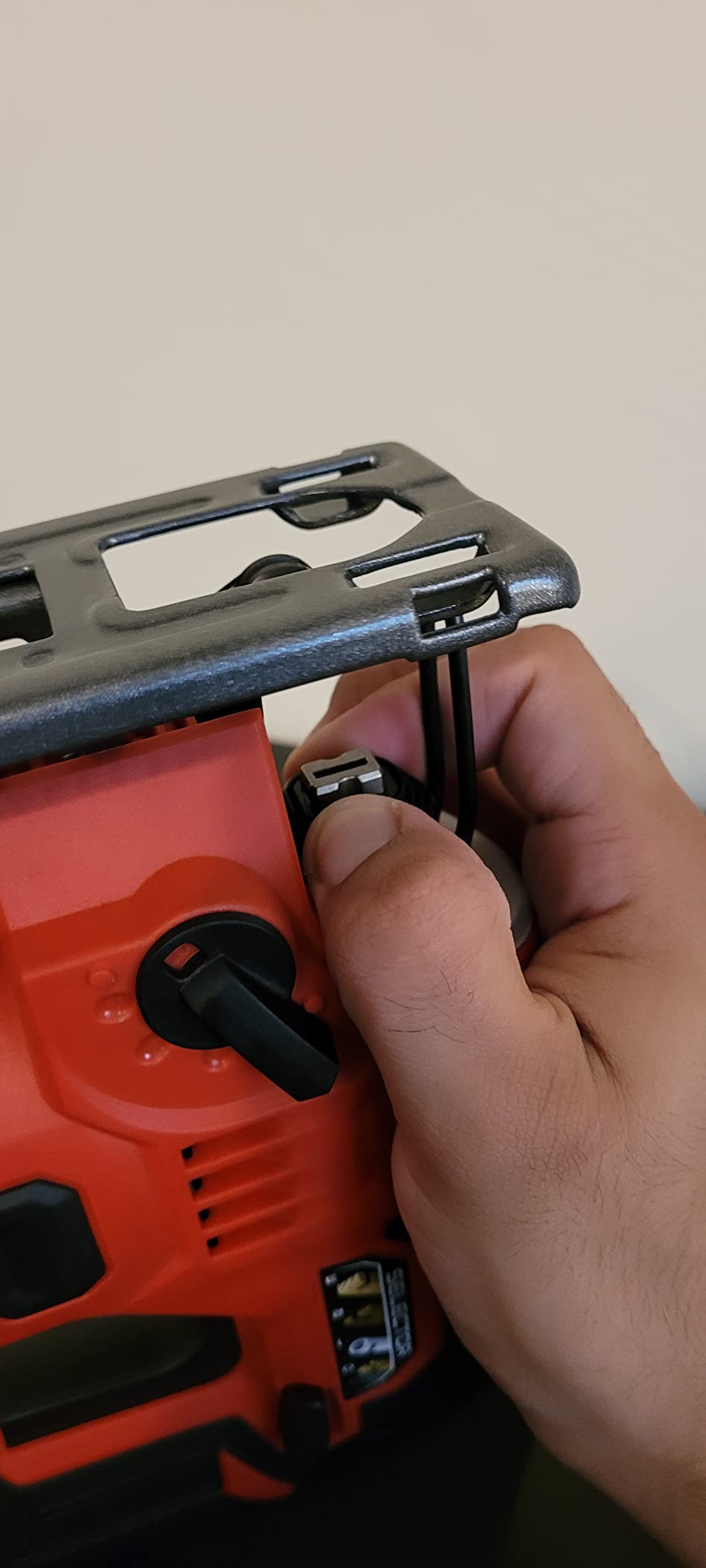
The blade roller guide is the real story
Blade deflection is the main cause of a crooked curved cut, and deflection happens most in the unsupported span of blade between the clamp and the material. A roller guide shortens that unsupported span, which is why this saw holds a line better on thicker work than its size suggests.
For scroll work, combine the guide with a narrow blade and the lowest orbital setting. For general cutting across different materials, step the 4-stage orbital up and let the blade move more freely.
Visibility and dust control
The halo LED delivers far more light than a standard indicator, and reviewers who upgraded from older saws single it out as a real improvement on dim jobs. The dust blower has an on and off switch, so you can clear the line for a critical part of a cut and shut it off when the airflow is scattering chips across your layout.
Be aware there is no dedicated vacuum port, which is the biggest gap in this saw. Plan on blowing chips away with a brush as you work rather than relying on extraction.
Practical limits
At 4.9 pounds it feels heavier than most of the saws here, and long sessions with large panels will tire the hand. There is no onboard blade storage, so loose blades end up scattered across the bench, and a few buyers reported the second blade missing from the box.
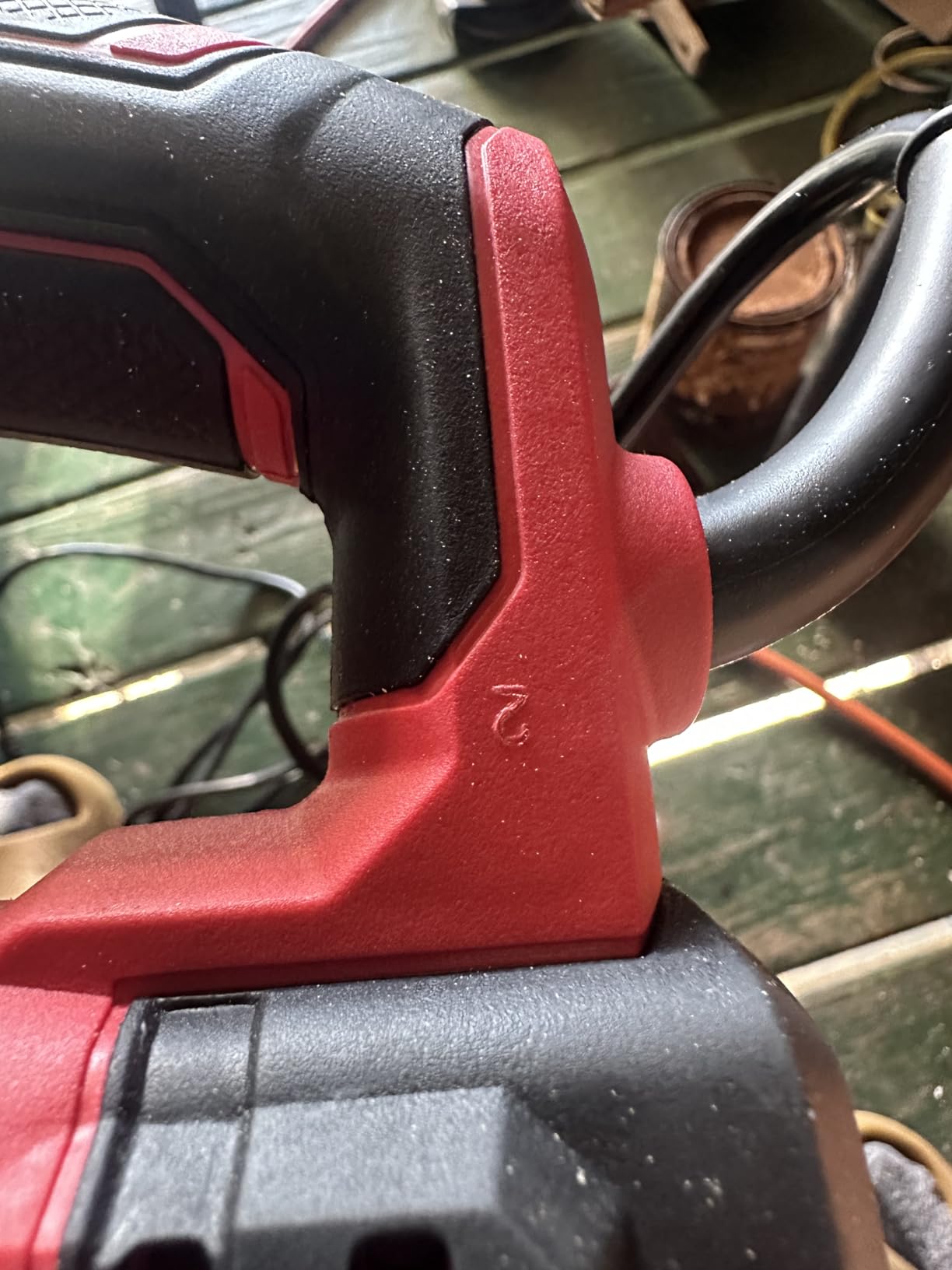
For someone who moves between wood, laminate and light sheet material, the shank flexibility plus the roller guide make this an unusually capable curve tool. The 2-finger trigger gives good speed control, which helps more on arcs than on straight cuts.
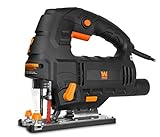
6. WEN 33606 – Best for Seeing the Cut Line
WEN 33606 6.6-Amp Variable Speed Orbital Jig Saw with Laser and LED Light,Black, Silver
4.5 rating
6.6 amp corded
0 to 3300 SPM
Laser and LED guide
+ Pros
- Four-position orbital from straight up-and-down to aggressive action
- Onboard laser plus LED light help keep the saw on the line
- 6.6 amp variable speed from 0 to 3300 SPM
- All-metal tool-free holder grips T-shank blades firmly
- Cuts fast through oak and aluminum
- Cons
- No onboard blade storage
- Laser guide is not always precisely aligned
- Some units arrive without the advertised blades
The WEN 33606 is the saw here that treats visibility as a headline feature. It carries an onboard laser guide and an LED light, and for curved cuts in particular that is not a gimmick. If you cannot see the line you are cutting, you cannot correct before the blade wanders, and on an inside radius you have very little material to spare.
Owners rate the combination of 4-position orbital control, a 0 to 3300 SPM speed range and the illumination as unusually capable for the money, and they report it cutting oak, aluminum, pipe and acrylic smoothly.

What the laser does and does not do
The laser projects a reference point so you can position the saw before the blade enters the material, and the LED lights the contact point while cutting. Together they shorten the time between choosing your line and starting the cut, which reduces the moments where you are adjusting mid-arc.
Owners do report that the laser is not always precisely aligned, so treat it as a positioning aid rather than a precision instrument. Draw your line, then cut to the line, not to the laser.
Orbital control and multi-material cutting
The 4-position orbital knob moves the blade from a straight up-and-down action through to an aggressive circular motion. That range is what lets the same saw handle a fine scroll cut in wood and a fast cut in pipe, and it is why this saw appeals to people who work across materials rather than just wood.
At up to 3300 SPM with a 6.6 amp motor, it has the highest speed figure in this roundup. The all-metal tool-free blade holder grips T-shank blades firmly, and the 1-1/2 inch dust port or front blower keeps the line clearer than most saws at this level.
Where it stops being the right tool
At 5.4 pounds it is the second-heaviest saw here, and the substantial body dampens vibration but tires the hand on long cuts. There is no onboard blade storage, some units arrived without the advertised blades, and there is a report of visible sparking inside the tool at the highest speed setting.

Buyers upgrading from a light plastic-bodied saw often find the stable feel is the real upgrade. If you cut shapes in mixed materials and struggle to see the line, the illumination is worth more to you than a heavier premium model would be.
7. Makita JV0600K – Best Corded Saw for Steady, Quiet Cutting
Makita JV0600K Top Handle Jig Saw, with Tool Case
4.7 rating
6.5 amp corded
500 to 3100 SPM
Counterbalanced motor
+ Pros
- Counterbalance system keeps vibration very low on curves
- Wide 500 to 3100 SPM speed range for matching the cut
- Three orbital settings plus a straight-cut mode
- Metal housing and solid construction
- Tool-less blade change
- Through-body dust port works with a vacuum
- Cons
- No built-in work light
- Bevel adjustment needs the included hex wrench
- Some units arrive without the cutting guide and hex key
The JV0600K is a top-handle corded saw built around a counterbalance system, and reviewers credit that system with producing very low vibration and precise, smooth cuts in solid oak, plywood and mahogany. Low vibration is what keeps a narrow blade from deflecting, and a narrow blade is what lets you turn a tight inside radius.
It includes a hard case, a 4-1/8 inch 9 TPI blade and a hex wrench. Reviewers also report long ownership histories with Makita tools, which suggests this is a saw people keep rather than replace.
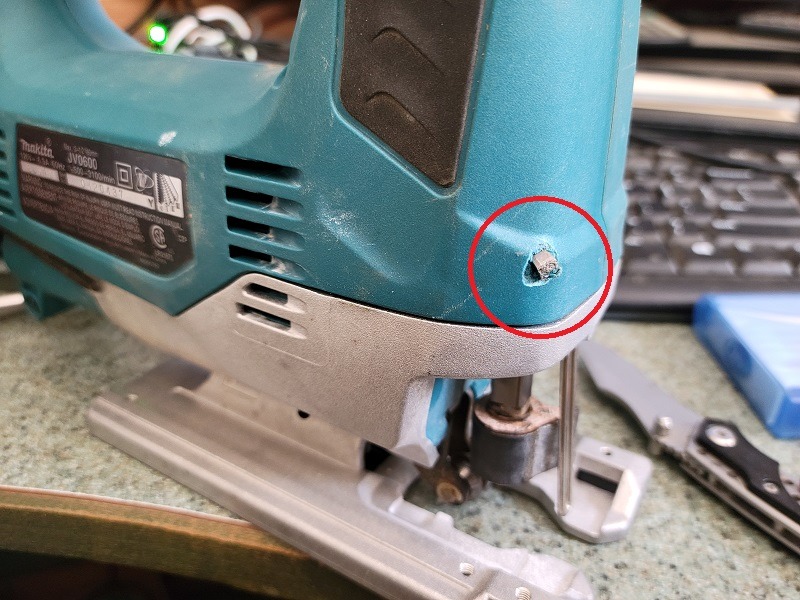
The straight-cut mode matters more than it sounds
Three orbital settings plus a straight cutting mode gives you four behaviours, and the straight mode is the one that matters for a scroll cut. With orbital at zero the blade moves purely up and down, so it cannot push forward into the curve and cannot chip the top face of the workpiece.
Pair that mode with the wide speed range. The dial runs from 500 to 3100 SPM, so you can start a curve at the low end, hold it through the turn, and then open the speed up on the straight run into the next corner.
Dust extraction and blade changes
The through-body dust port works with a vacuum, which is better than a rear port that blows chips toward the operator. The base slides smoothly on the workpiece, and the tool-less blade change is fast enough that swapping between a coarse wood blade and a fine scroll blade mid-project is realistic.
It accepts common T-shank blades, so a standard blade set applies.
Limitations worth knowing
There is no built-in work light. Bevel adjustment needs the included hex wrench rather than a release lever, which is slower but perfectly serviceable, and some units arrived without the circular cutting guide and hex key shown in the product photos.
The counterbalance also adds mass, so this is not the lightest option for long overhead cuts. If you work above shoulder height, a lighter top handle may suit you better.
This is the pick I would make for someone who cuts hardwood shapes regularly and already owns Makita tools. The evenness of the cut is the reason to choose it over a lighter saw.
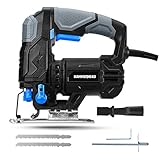
8. Hammerhead HAJS048 – Budget Pick for Occasional Curve Work
Hammerhead 4.8-Amp 3/4 Inch Jig Saw with 2pcs Wood Cutting Blades, Variable Speed and Orbital Function – HAJS048
4.4 rating
4.8 amp corded
4-stage orbital
6 speeds with brake
+ Pros
- 4-stage orbital function for smooth or aggressive curves
- Six speed settings plus a brake for a precise finish
- Tool-free T-shank blade change
- Compact size that is easy to control on shape cuts
- Dust tube accepts a vacuum
- Cons
- Included blades are low quality and not very sharp
- Heats up during longer cutting sessions
- Parallel guide sways and will not hold a set size
The HAJS048 has the lowest star rating in this roundup at 4.4, and the difference is worth explaining rather than hiding. It does the things that matter for beginner curve work, including six speed settings with a brake and a tool-free T-shank blade change, but the blades supplied in the box are the weak link. Owners point this out more than any other complaint.
Buyers still call it good value for hobby and beginner woodworking, and it sits in a high-demand category ranking for power jig saws. Treat the included blades as scrap and buy a proper multipack before judging the saw.
Six speeds and a brake
The six speed settings give finer control than most saws at this level, and the brake function stops the blade quickly at the end of a cut. On a shaped part, a fast stop reduces how far the blade travels after you release the trigger, which limits the risk of blowing out the end of a cut.
The 4-stage orbital function covers smooth and aggressive cutting, so you can still set the saw up for a fine curve and a fast cut. The compact body is easy to control on shape cuts, which is genuinely helpful for a first jigsaw.
Where precision runs out
Buyers report that the saw feels less stable and accurate on demanding cuts, which makes tight curves trickier. The parallel guide sways and does not hold a set size, so do not rely on it for repeated identical parts. The included blades are described as low quality and not very sharp or durable, which is the single most useful thing to know before you start.
It also warms up relatively quickly during longer cutting sessions, so for a long project I would let it cool rather than run it continuously.
Best use case
This is the saw for wainscoting, garden projects and decorative shape cutting where the curve is not a showpiece. The dust tube accepts a vacuum and the metal base plate adjusts to 45 degrees for bevels, so it covers the basics well.
It is also not suited to ripping lumber or making straight strips, which is a reasonable limitation for a shape-cutting tool. If your curves will be seen closely, move up a class. If they are being cut from a sheet for a garden project, this does the job.
How to Choose a Jigsaw for Curved Cuts
The buying decision for curved cuts is different from the buying decision for a general-purpose saw. Power matters less than control, blade holding and the ability to see your line. These are the criteria I would actually use.
Grip style: barrel grip, top handle or D-handle
A barrel grip puts your hand around the body of the tool, low and close to the workpiece, which gives fine control and a clear view of the blade. It is the most common choice for curve work. A top handle places your hand above the saw with a trigger underneath, which is easier to learn, more comfortable for beginners and for general use, but it puts more of your steering effort through the wrist. A D-handle adds a rear grip for two-handed control and is useful for aggressive cuts in thick material, at the cost of bulk.
None of the eight saws in this roundup use a barrel grip, and that is worth being honest about. Every one is a top-handle or straight-body design, because that is what dominates the available market in this category. If you want the barrel-grip experience, look outside this list, and if you have small hands, test the grip in a shop before you commit. Forum threads about comfort complaints are mostly about fit rather than performance.
Blade system: T-shank versus U-shank
T-shank blades clamp more rigidly and are the modern standard, which matters on a curve because a loose blade deflects. U-shank blades are cheaper and widely available, and two of the saws here accept both. If you already own a drawer of U-shank blades, a dual-shank saw saves you money; otherwise buy T-shank.
Blade selection is most of the cut
A saw cannot turn a tighter radius than its blade allows. For scroll work you want a narrow blade, typically 6 to 9 mm wide, with fine teeth, and finer teeth cut cleaner and slower. Wider blades with coarse teeth rip faster but wander on an arc and will not hold a tight inside radius.
If you only buy five blades to start: a coarse-tooth wood blade for fast straight and rough cuts, a medium-tooth wood blade for general shape cutting, a fine-tooth narrow wood blade for clean curves, a metal-cutting blade for sheet metal, and a scroll blade in the narrowest width you can find. That last one is the blade that changes what a jigsaw can do.
Orbital action and the zero setting
Orbital action adds a forward component to the blade movement, which speeds up cutting but chips the top face and pushes the blade out of line on curves. For a finished curve, set orbital to zero or the lowest position available. For speed on straight cuts, step it up. Every saw here offers three or four positions, which gives you enough range to do both.
Speed control, dust and line of sight
A variable speed trigger or dial matters more than the maximum strokes per minute figure, because a curve is won and lost at the low end of the range. Look for a saw that starts slow.
Dust handling is the most underrated feature on this list. Chips blowing back across the line on an inside curve will cost you accuracy on every part, so a dust blower or a vacuum port is worth paying for. The Bosch and Makita here extract through the body or accept a vacuum; two of the budget saws do not offer a dedicated port at all.
Base plate, bevel stops and capacity
Most saws bevel to 45 degrees with detents at 0, 15 and 30 degrees, which covers most curve entry angles. If you need an angle in between, a keyless shoe with fine adjustment is more useful than a rigid detent. A no-mar shoe cover protects a finished face on inside curves where the waste side sits on top of your work.
Finally, check the maximum cut depth in wood against your thickest material. A curve through thick hardwood forces a wide radius, so a deeper saw does not buy you a tighter curve. Stock thickness sets the limit, not the motor.
Jigsaw vs Scroll Saw vs Band Saw vs Router for Curves
Sometimes the honest answer is that a jigsaw is the wrong tool. Forum consensus on woodworking boards is consistent on this point, and the same advice appears repeatedly: a band saw with a thin blade will make better curved cuts than any jigsaw, and a scroll saw or a router with a jig will make cleaner ones.
Here is how the four options compare for curve work in wood.
Jigsaw. Best for one-off cuts, sheet material up to about an inch thick, flush cuts, and any job where the workpiece is too large or too awkward to feed through a fixed machine. Most versatile, least precise. Freehand steering means accuracy depends entirely on your hands and the blade.
Scroll saw. Best for thin plywood, birch ply and thin hardwood, and for repeated identical parts where accuracy matters more than size. The thin blade and the flat table make it far more accurate than a jigsaw, at the cost of needing throat clearance and a steady hand feeding the work.
Band saw. Best for thicker hardwood and for long, smooth curves. A 10 or 14 inch band saw with a narrow resaw blade will out-cut a jigsaw on almost any radius, and it can resaw that blade down further for fret-scale work. It also needs floor space, a stand and a blade tensioning routine.
Router with a jig. Best for perfectly repeatable curves, templates, and decorative edges. A router bearing follows a template exactly every time, which no handheld jigsaw can guarantee. It is a two-tool operation and it demands accurate template making and safe workholding.
My rule: if the curve is a showpiece and you are making more than one, use a scroll saw, a band saw or a router jig. If the curve is a single part in a big sheet of material, a jigsaw with a narrow fine-tooth blade is the right call.
How to Actually Cut a Clean Curve
A good jigsaw still produces a bad curve if you rush it. These are the steps that consistently produce clean arcs in my shop.
1. Mark and tape the line. Draw the full curve before you touch the saw, then run tape along it. The tape resists the blade pulling you across the line and it visibly shows where the cut has drifted. On a finished face, the tape also reduces splintering.
2. Fit the narrowest blade the cut needs. For a tight inside radius, a narrow fine-tooth scroll blade. For a general shape in plywood, a medium-tooth blade. Check the shank system matches your saw.
3. Set orbital action to zero. For a curve, the forward blade motion fights the turn. Use the lowest orbital setting available and let speed do the work instead.
4. Enter with a relief cut or a pilot hole. If the line starts inside the material, drill a starter hole slightly inside the line and drop the blade through. If you are cutting out an inside shape, make a straight relief cut into the waste side, then turn to follow the curve. This stops the blade from having to make a 90 degree turn in place.
5. Support the workpiece properly. The waste side must stay supported so it does not pinch the blade as the kerf closes. For a part cut from a panel, keep the offcut attached until the last third of the curve, then clamp it or tape it down.
6. Let the blade do the work. Push lightly and steadily. Excessive pressure deflects the blade and is the leading cause of wandering and snapping. If the saw is labouring, slow down or change to a coarser blade rather than leaning on it.
7. Finish the edge. Even a clean cut needs a light sand on the top face, and a shallow bevel on a visible edge is far easier to sand than a tear-out chip.
Fixing Bent, Binding and Wandering Cuts
Almost every jigsaw complaint I get asked about comes down to four problems. The mechanism matters more than the fix, so it is worth understanding what is happening.
The blade bent or snapped mid-curve. The usual cause is tooth catch at the tip when the saw is pushed downward into the cut, which compresses the blade sideways. Users on woodworking boards describe exactly this. Reduce pressure, keep orbital at zero, and make sure the blade is not deflecting sideways from a worn clamp or a loose shoe.
The blade binds and heats up. Binding happens when the kerf closes behind the blade, usually from pushing too fast or from cutting a curve tighter than the blade width allows. Ease the speed, support the waste side, and open the radius. Gloves help you feel the heat before it becomes a burn mark.
The top face splinters. Almost always orbital action set too high for a curve, or a blade with too coarse a tooth count. Set orbital to zero, drop to a finer tooth, and add tape over the line.
The cut wanders off the line. A wandering cut is a deflection problem or a blade problem. Check the blade is sharp and the right width for the radius, confirm the blade is clamped square, and look at whether you are pushing instead of guiding. Vibration from a heavy or worn saw makes it worse.
Burn marks on the curve. The saw is being pushed faster than the blade can clear material. Slow down, and treat any burn as a warning that the blade was already dull.
Frequently Asked Questions
Are jigsaws good for cutting curves?
Yes. A jigsaw is the standard power tool for curved cuts in flat sheet material because the blade moves straight up and down and you steer it by hand. Quality depends on control rather than power, so a smaller grip, a narrow fine-tooth blade and orbital action set to zero give a cleaner curve than a more powerful saw with the wrong blade.
What is the best jigsaw blade for curved cuts in wood?
A narrow scroll blade, roughly 6 to 9 mm wide with fine teeth, is the best choice for curved cuts. Fine teeth cut slower but leave a clean edge, and the narrow width allows the blade to turn without deflecting. Wider coarse-tooth blades rip fast but wander on an arc and cannot hold a tight inside radius.
Why does my jigsaw blade bend when I cut?
Usually the teeth catch at the tip as the saw pushes the blade downward into the cut, compressing it sideways. Excessive pressure is the main cause. Reduce how hard you push, set orbital action to zero for curves, and check that the blade is clamped square and not being deflected by a loose shoe or worn clamp.
Is a scroll saw more accurate than a jigsaw for curved cuts?
Yes, for most curve work a scroll saw is more accurate. Its thin blade, tensioned frame and flat table give far more consistent results than steering a handheld jigsaw by hand. A jigsaw wins on large workpieces, flush cuts and jobs where the material will not fit through a scroll saw throat.
Which type of jigsaw handle is better for curved cuts?
A barrel grip is usually best for curved cuts because your hand sits low and close to the workpiece, which improves control and gives a clear view of the blade. A top handle is easier to learn and more comfortable for general use and beginners. A D-handle gives two-handed control for aggressive cuts in thick material.
The Verdict
If you want one jigsaw that handles curved cuts well and you already own 20V MAX batteries, the DEWALT DCS334B is the pick. Its compact brushless body is the reason it tracks a line so consistently, and the four-position orbital action covers everything from fine scroll cuts to fast trimming.
If you are buying your first jigsaw or only cut shapes occasionally, the BLACK+DECKER BDEJS600C gives you the most explicit curve control for the money, and the Bosch JS470E is worth the extra spend if your curves are hardwood and visible. For a cordless saw on a different platform, the CRAFTSMAN CMCS600B is remarkably steady. If you work across wood, laminate and metal, the SKIL JS314901 keeps your existing blades usable. The WEN 33606 wins when seeing the line matters most, the Makita JV0600K is the quietest cut in this group, and the Hammerhead HAJS048 handles hobby projects once you replace its blades.
Whichever you choose, the blade does most of the work. Buy a narrow fine-tooth scroll blade, set orbital to zero, tape the line, and let the saw move at its own pace. That combination will improve your curves more than any upgrade to the machine itself, and it is the single best piece of advice I can give anyone cutting curves in 2026.