
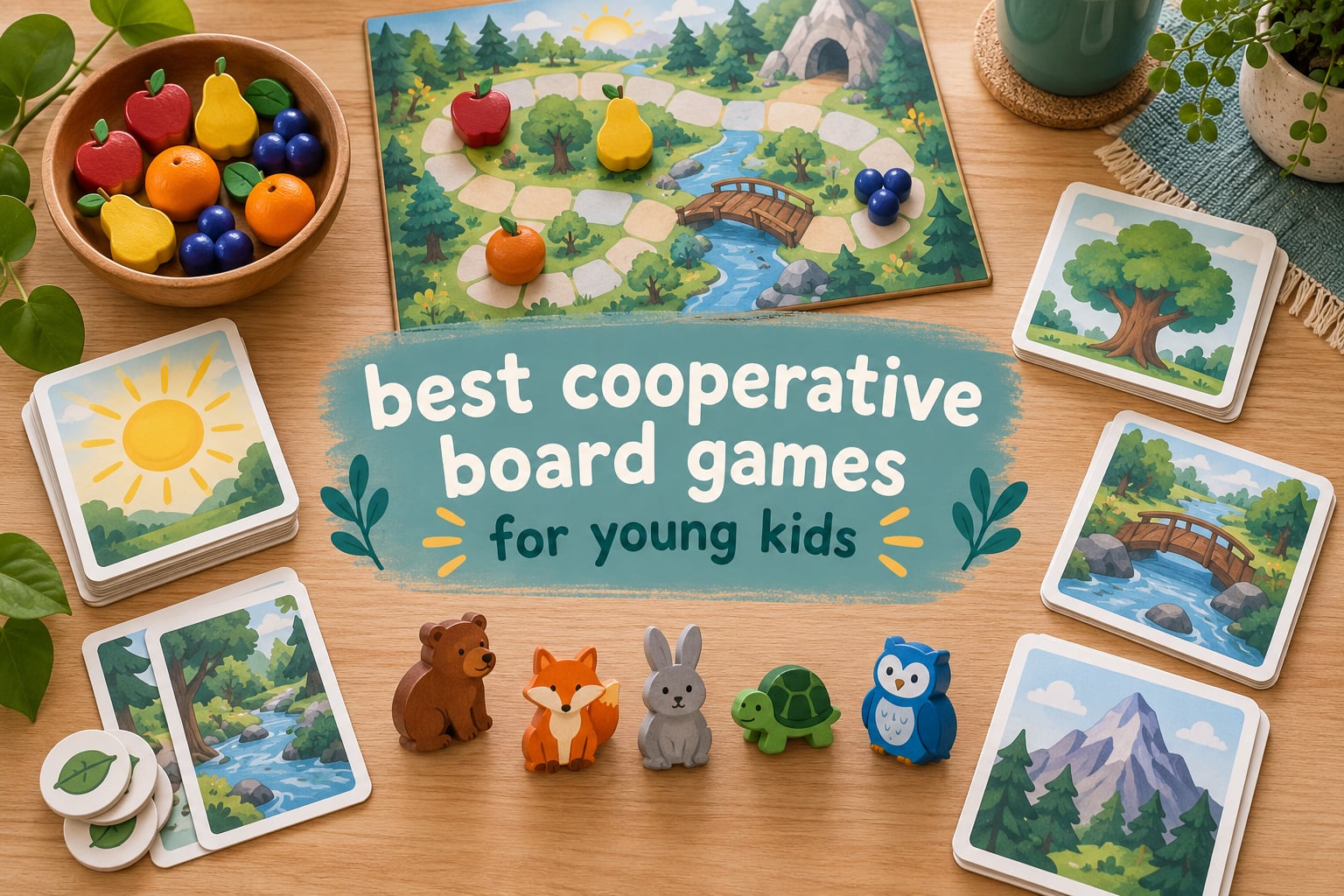
A cooperative board game is one where every player works toward the same goal instead of competing, so the whole family wins or loses together and no child is ever eliminated. That single rule is why the best cooperative board games for young kids work so well: there is no loser to cry over, no winner to gloat, and every child is still moving pieces right up to the final turn. We spent several weeks playing these eleven titles at the table with children aged 2 through 8, and every pick below reflects what actually happened at that table rather than what the box promises.
The format also quietly teaches the things a four-year-old needs most: taking turns, counting, matching, waiting while someone else decides, and coping with a disappointment that the whole group shares. There is no player elimination, no turn order conflict, and no crying over whose turn it is. If your child finds competitive games emotionally difficult, switching to co-op usually solves the problem in one evening.
Here are our quick answers if you want the short version:
- Best overall: Outfoxed! for children aged 5 and up, four players, roughly 20 minutes.
- Best for ages 4 to 6: Hoot Owl Hoot, two to four players, about 15 minutes, no reading required.
- Best first board game for a 2-year-old: HABA My Very First Games My First Orchard, four players, chunky wooden fruit.
- Best for ages 6 to 8: My First Castle Panic, icon cards, no reading, about 20 minutes a round.
- Best for a big table: Mermaid Island, which supports two to six players.
- Best for parents who want an adjustable challenge: National Geographic My First Safari, three difficulty levels.
Our Top 3 Cooperative Board Games for Young Kids in 2026
These three sit at the top because they cover the widest range of ages and table sizes. Outfoxed! is the most-requested cooperative game in the category by a wide margin, Hoot Owl Hoot is the safest first choice for a four-year-old, and My First Orchard is the only one here that genuinely works before a child turns three.
Comparing 11 Cooperative Games by Age, Players and Play Time in 2026
| Product | Details | |
|---|---|---|
 Outfoxed! Outfoxed! |
|
Check Latest Price |
 Hoot Owl Hoot Hoot Owl Hoot |
|
Check Latest Price |
 Bluey Scavenger Hunt Bluey Scavenger Hunt |
|
Check Latest Price |
 Race to the Treasure Race to the Treasure |
|
Check Latest Price |
 My First Orchard My First Orchard |
|
Check Latest Price |
 Mermaid Island Mermaid Island |
|
Check Latest Price |
 My First Castle Panic My First Castle Panic |
|
Check Latest Price |
 Baby Dinosaur Rescue Baby Dinosaur Rescue |
|
Check Latest Price |
 My First Safari My First Safari |
|
Check Latest Price |
 Orchard Squirrel Challenge Orchard Squirrel Challenge |
|
Check Latest Price |
 Rainbow Unicorn Rescue Rainbow Unicorn Rescue |
|
Check Latest Price |
Two columns matter more than the rest here: the minimum age, which tells you when a child can genuinely play rather than merely tolerate the game, and the player count, which tells you whether the game survives a table of two adults and two toddlers.
1. Outfoxed! – The Best Cooperative Mystery for Children Aged 5 and Up
OUTFOXED, A CLASSIC WHO DUNNIT GAME FOR PRESCHOOLERS, 4 players
Ages 5+
4 players
20 minutes
Reading required
+ Pros
- Teaches deduction
- logic and memory
- No player elimination
- 20 minute rounds finish before bedtime
- Works with parents
- siblings and grandparents
- Cons
- Clue cards and decoder wheel require independent reading
- Marker wear makes clue text harder to read over time
- Children often lose interest once they learn the trick
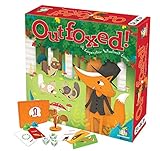
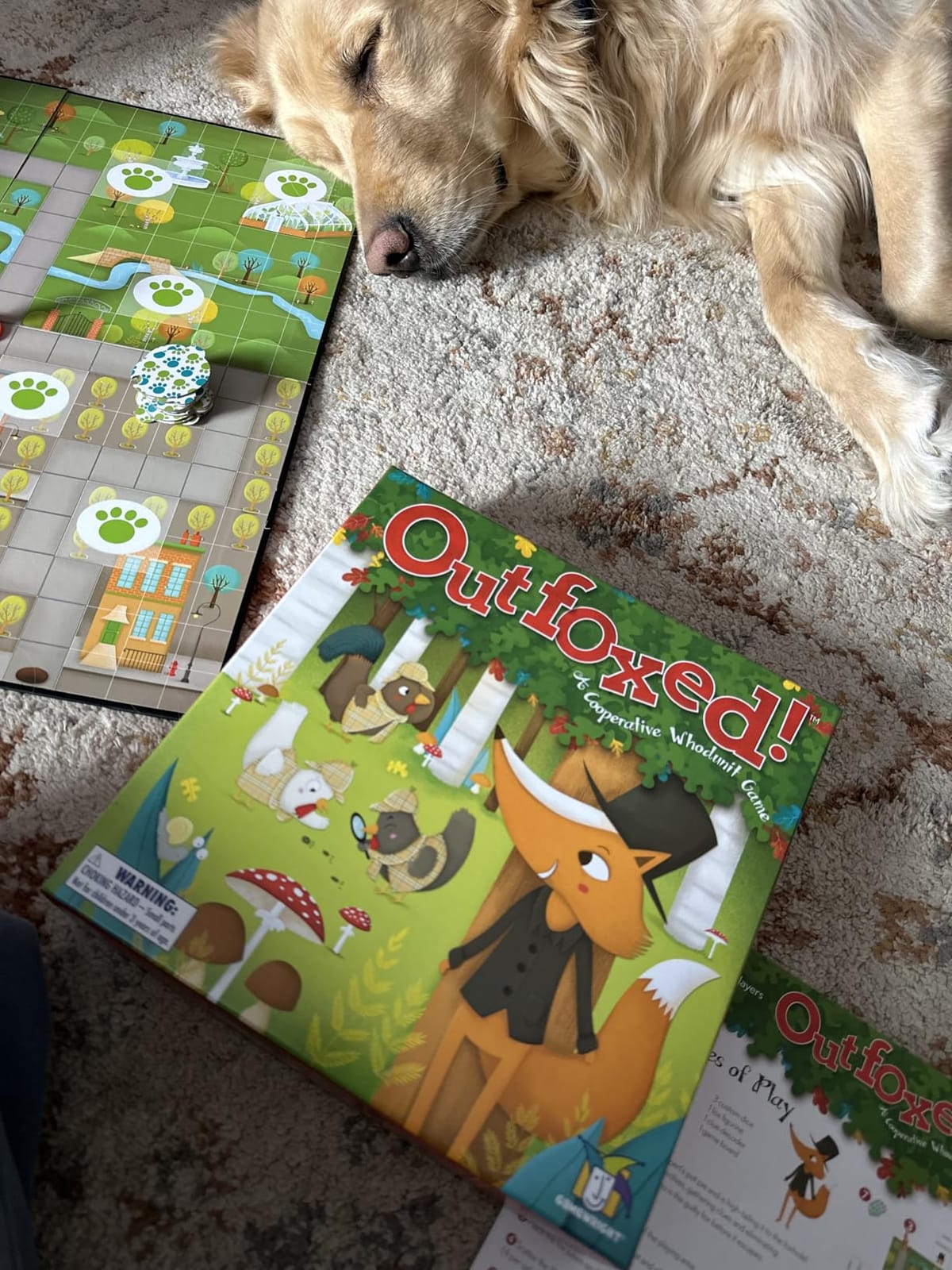
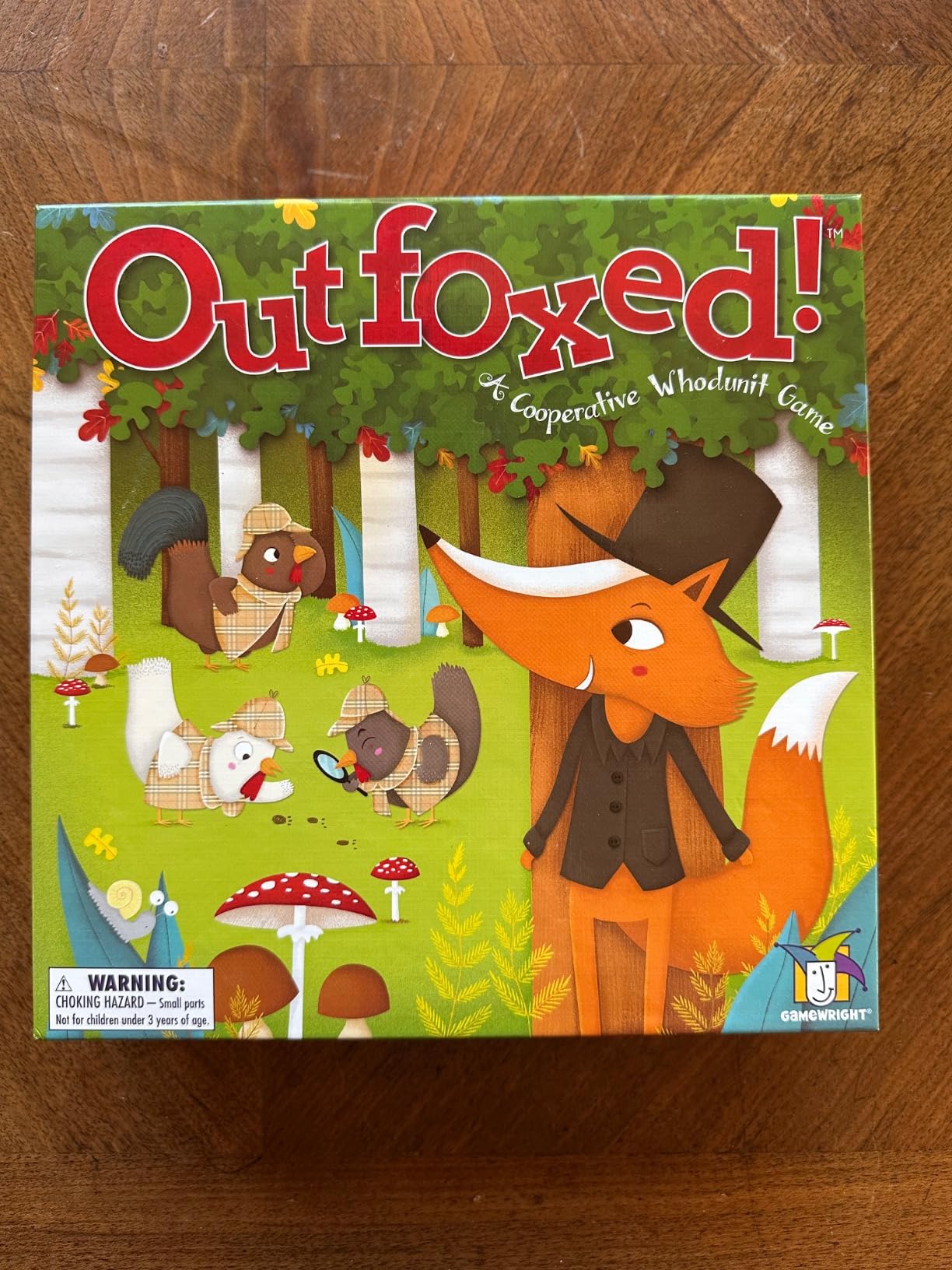
Outfoxed! is the cooperative game parents ask about by name, and after repeated sessions at our table it earned that reputation honestly. On each turn the children roll dice, move a fox token around the board, collect clue cards, and work together to narrow down which of the 25 woodland creatures stole the pie. The clues come in three lengths, and each player draws from the same stack, so nobody has special powers and nobody gets left out.
The genius of the design for young children is that every round ends with a visible elimination. When a fox lands in front of a suspect, that creature is crossed off the board and the group gets visibly closer to the answer. My four-year-old could follow that narrowing process perfectly even though she could not yet read the clue cards aloud, which meant she happily narrated the eliminations while an adult read the words aloud.
Deduction Skills the Box Does Not Mention
The core skill here is elimination reasoning, which is genuinely more advanced than anything on a typical preschool game. Reviewers consistently credit the game for building logic, memory and deduction skills through clue-solving rather than through direct instruction, and the three clue lengths mean a group can run an easier session by always drawing short clues.
If your child is not yet an independent reader, you have a simple fix. Read the clue cards aloud yourself and let your child work the decoder wheel. That keeps the deduction challenge intact while removing the reading barrier, and the wheel itself is a satisfying physical step that small hands manage well.
Why Two Players Work Better Than Four Here
The box lists four players, and that is the ideal configuration for a family with several children. With two players the sessions run longer and the clue stack cycles faster, which some groups find repetitive. If you are one adult with one child, it still works, but expect a shorter and slightly gentler game than the four-player version.
What Ages Actually Work
The listed age range is 4 to 15 years, but the reading load pushes the realistic floor to about 5. Parents on parent-review forums describe this game as outstanding for ages 5 and up and note that a four-year-old can join in and play happily, as long as an adult handles the clue text. Treat the printed age as a starting point rather than a promise.
One honest limitation: once a child has worked out that the long clues are the informative ones, some lose interest after a handful of plays. Rotate it out and bring it back a month later. The decoder wheel and the elimination count as new again after a break.
2. Hoot Owl Hoot – The Safest First Cooperative Game for Ages 4 to 6
Peaceable Kingdom Hoot Owl Hoot – Cooperative Matching Game For Kids
Ages 4+
2-4 players
15 minutes
No reading required
+ Pros
- No reading required so ages 4 can join in
- Sunlight meter creates tension without a loser
- 15 minute rounds suit short attention spans
- Teaches planning ahead and strategic thinking
- Cons
- Repetitive once children master the sunlight meter
- Clean-up is a chore with so many cards
- Small cards need careful handling with younger children
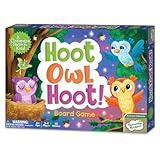
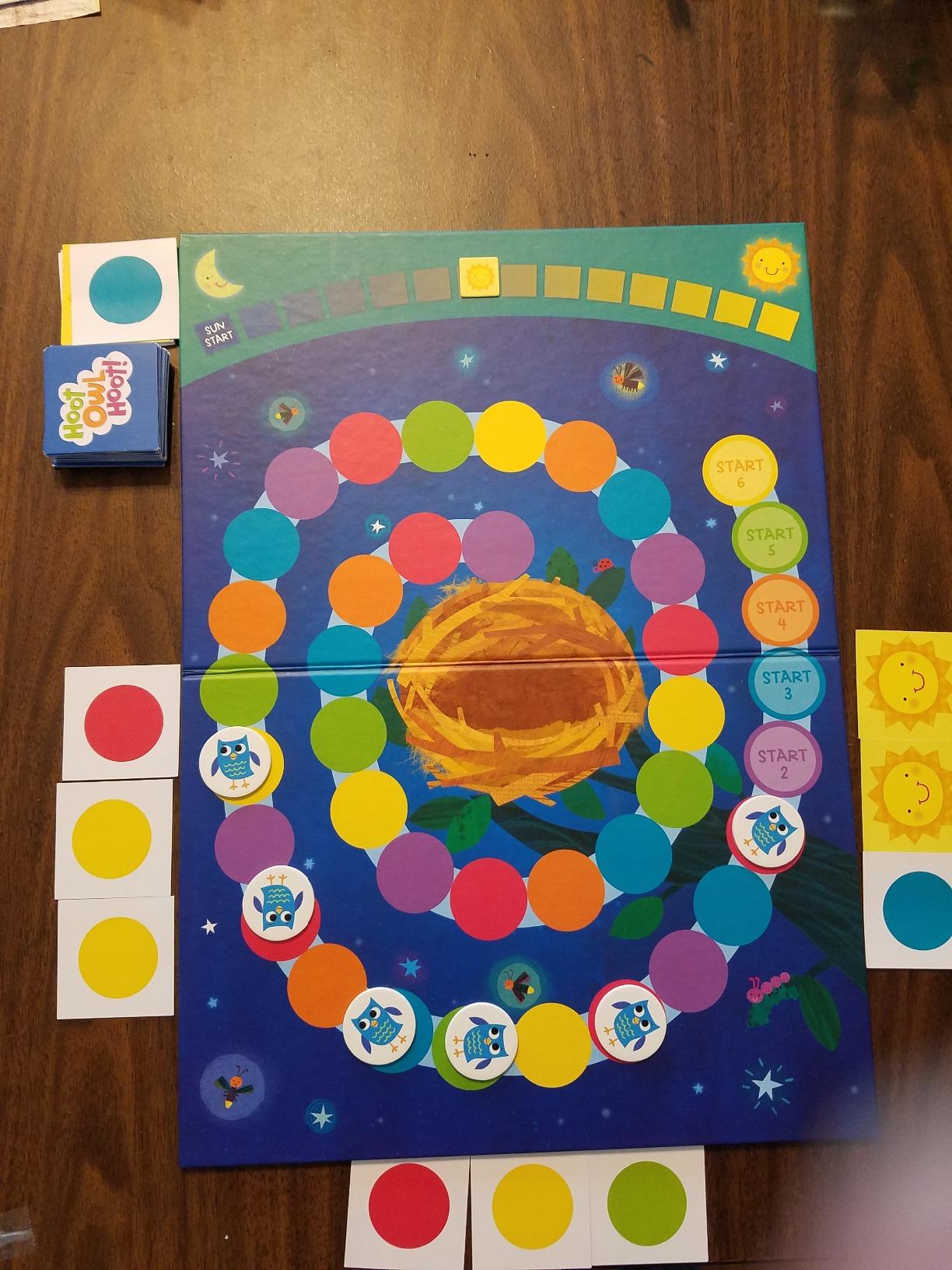
Hoot Owl Hoot is the game I hand to a family with a nervous four-year-old. Three cartoon owls sit in a nest, the sun is rising, and every card the group plays moves the sun up one notch on a meter. When the meter fills, the sun rises and the owls must be home before that happens. Nobody is eliminated and nobody goes home early. The whole group either succeeds or starts again, and the sun meter turns that outcome into visible tension rather than a score.
The mechanic is color matching, which sounds too simple to be interesting until you play it. Matching one card forces a choice about which card to play next, and with four children competing for the same colors the table quickly fills with quiet deliberation. That is strategic thinking developing in real time, and parents on family board game review sites consistently name this game as the cooperative preschool starter.
Why the Sunlight Meter Is the Clever Part
Without the meter, a matching game for preschoolers becomes a race with no stakes. The meter supplies a countdown that everyone can see, so children start planning two moves ahead instead of reacting. Reviewers describe exactly this effect: families report that the game builds strategic thinking and planning ahead precisely because the sun moves whether or not you are ready.
The tension is real but gentle. Nobody is threatened and nothing is taken away from a player, which is why this is one of the few cooperative games a child who hates losing will play twice in a row.
Play Time, Player Count and the Small Card Problem
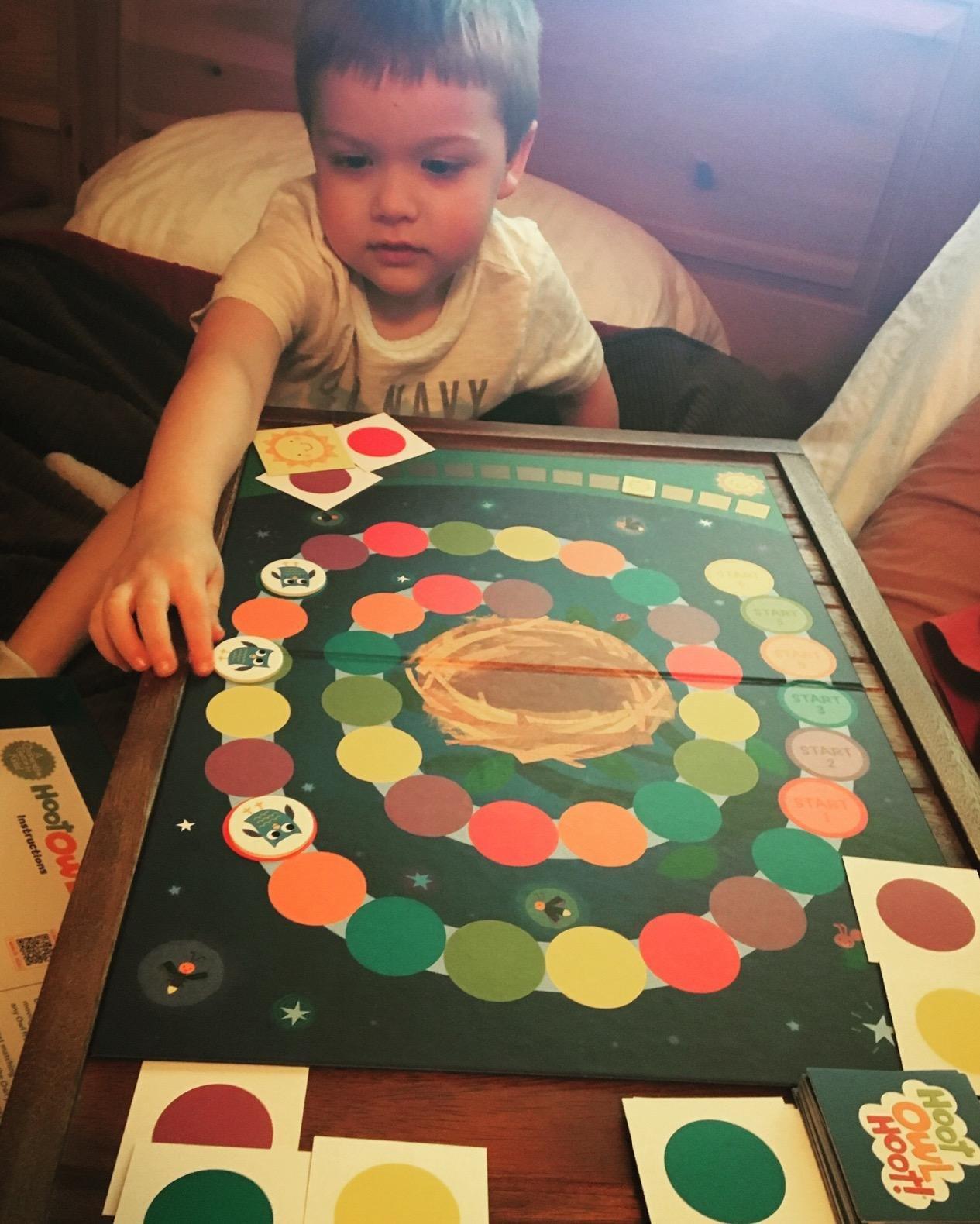
A round runs about 15 minutes for two to four players, which matches the attention span of most preschoolers almost exactly. The card count is high, though, and reviewers flag clean-up as a genuine chore. Sort the cards into the box while the children are still absorbed in the story and it stays manageable.
Best For and Best Against
This is the pick for a four-year-old who cannot read yet, for a table with a big age spread, and for a rainy afternoon when you want a complete game inside twenty minutes. It also scales to two players without any adjustment, which makes it our go-to for parent and child play.
The limitation is longevity. Once a group has seen the sun meter several times, it becomes easy to win and the tension evaporates. Families who get bored of it often keep it in the rotation for a younger sibling and move up to a game with hidden information.
3. Bluey Scavenger Hunt – Cooperative Play That Works from Age 3
Bluey Scavenger Hunt Board Game, Cooperative Play with 4 Exclusive Mini-Figures, Indoor Games for Kids Ages 5+, Fun Toy Token Collecting Game
Ages 3+
2-4 players
Quick rules
Four mini-figures
+ Pros
- Works from age 3 according to the manufacturer
- Four collectible mini-figures included
- Simple rules preschoolers pick up immediately
- Encourages sharing clues under time pressure
- Cons
- Thin paper-board construction wears quickly
- Children often play with the figures instead of the game
- Losing tokens frustrates the youngest players
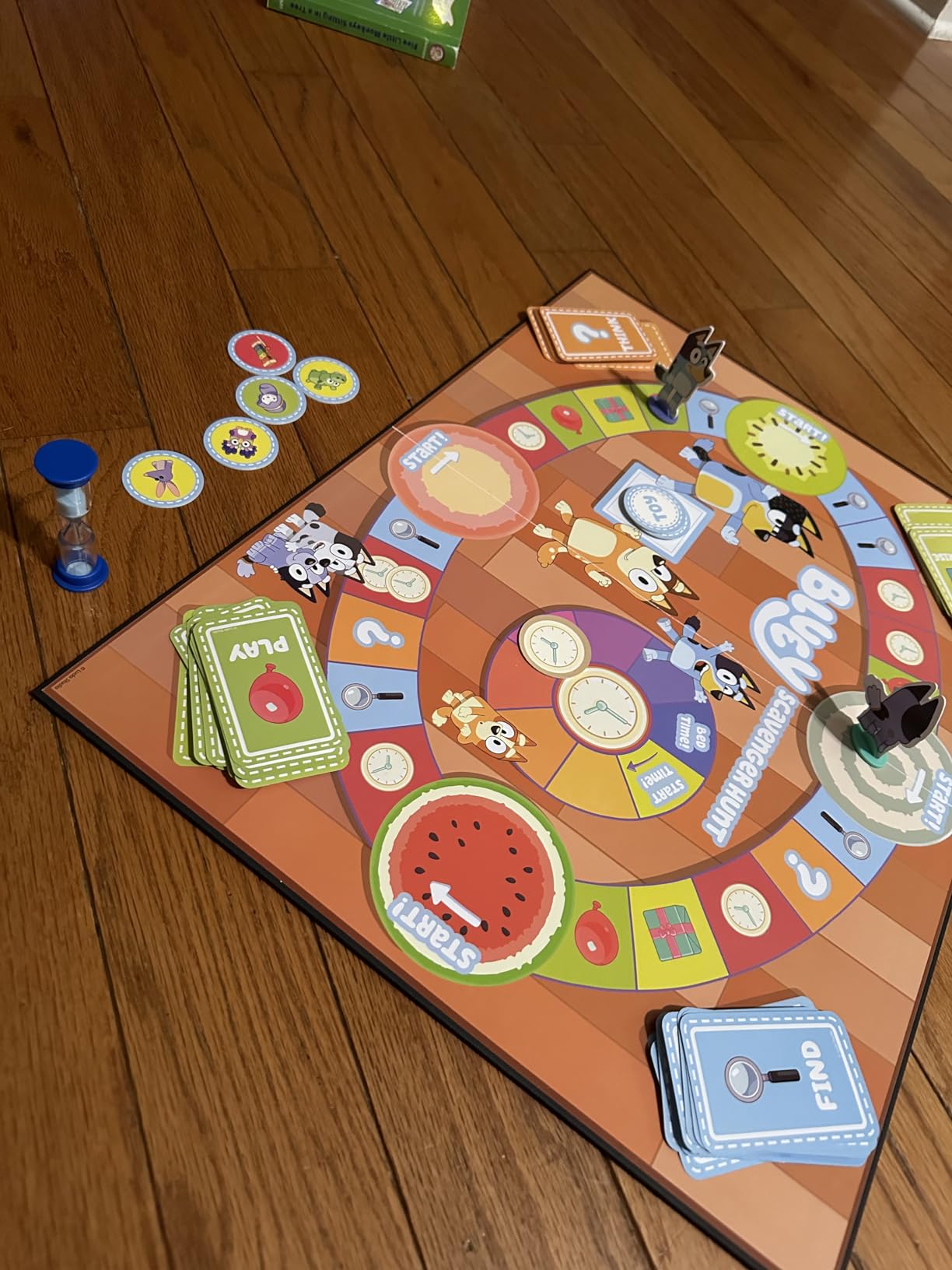
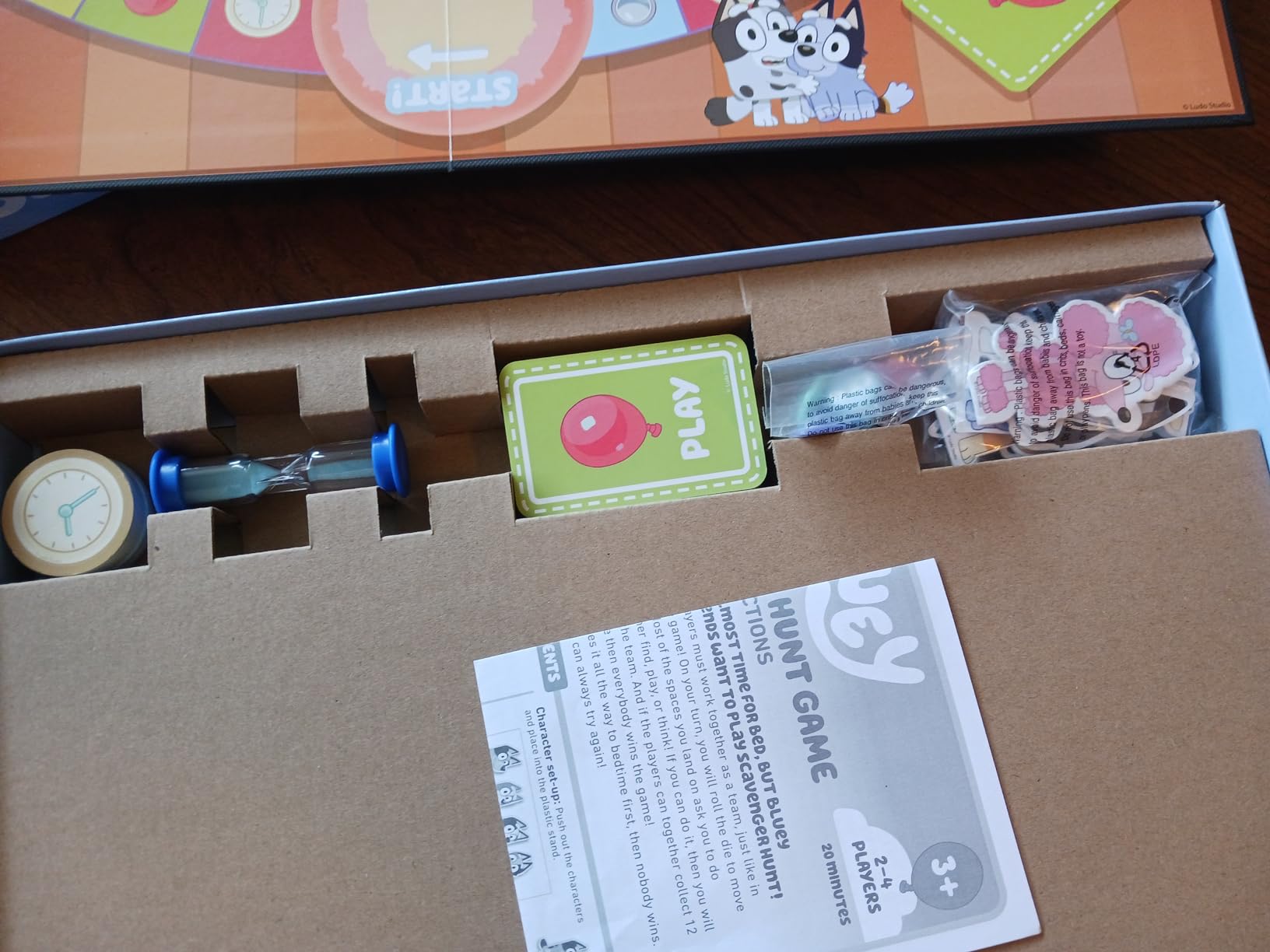
The Bluey Scavenger Hunt is listed from 36 months, which makes it one of the younger-rated cooperative games in this group, and in practice the rules really are that light. Children take turns drawing find cards and moving a character pawn around the board, and the group collects all twelve toy tokens before the round ends. The box includes four exclusive mini-figures of Bluey, Bingo, Bandit and Chilli, which matters more than it sounds for this age band.
A familiar character does an enormous amount of work in a preschool household. A child who recognises the cartoon can be playing the game independently within two turns, without an adult explaining a rulebook. Parents report that the accessible teamwork play appeals to fans of the show and that the shared goal under time pressure produces genuine conversation between siblings.
Token Collecting and Why It Frustrates the Youngest Players
The token collection loop is the heart of the game, and it is also where three-year-olds struggle. Reviewers report that losing a token quickly, or having a turn where no token is available, generates the most complaints in this category. Our fix is simple: count out fewer tokens than the box provides so the pressure drops while the shape of the game stays the same.
The mini-figures are a double-edged feature. Reviewers love them and also report that some children want to play with the figures rather than focus on the game. That is fine at this age. Let the figures sit on their character spaces and keep playing.
Build Quality You Should Know About
The board and cards are thin paper-board, and reviewers repeatedly mention the flimssy construction and a short shelf life for very young players. If your household has a toddler who chews corners or a child who treats game components as toys, this will not survive the year.
Plan on replacing it rather than passing it down. For a family that wants a game to last across three children in sequence, look at the wooden fruit games later in this list instead.
Two Players or Four
The game supports two to four players and works well at both ends of that range. With two players the turns are longer and the conversation stays easier to follow. With four it becomes hectic, and the fastest player tends to dominate.
This one also travels well, since it is flat and light enough to fit in a bag for a restaurant table or a playdate. For a two-adult-plus-two-toddler table it is one of the few options here where the youngest child can genuinely hold a turn.
4. Race to the Treasure! – The Best Co-op Game for Five-Year-Olds
Peaceable Kingdom Race to the Treasure! Cooperative Path Building Game for 2 to 4 Kids Ages 5+
Ages 5+
2-4 players
20 minutes
No reading required
+ Pros
- Real strategic depth for such young children
- Creates genuine suspense as the Ogre advances
- No reading required
- Simple components make clean-up easy
- Cons
- Cardboard path tiles wear after heavy play
- Younger siblings stop contributing meaningfully partway through
- The Ogre can feel too slow and lengthen the game
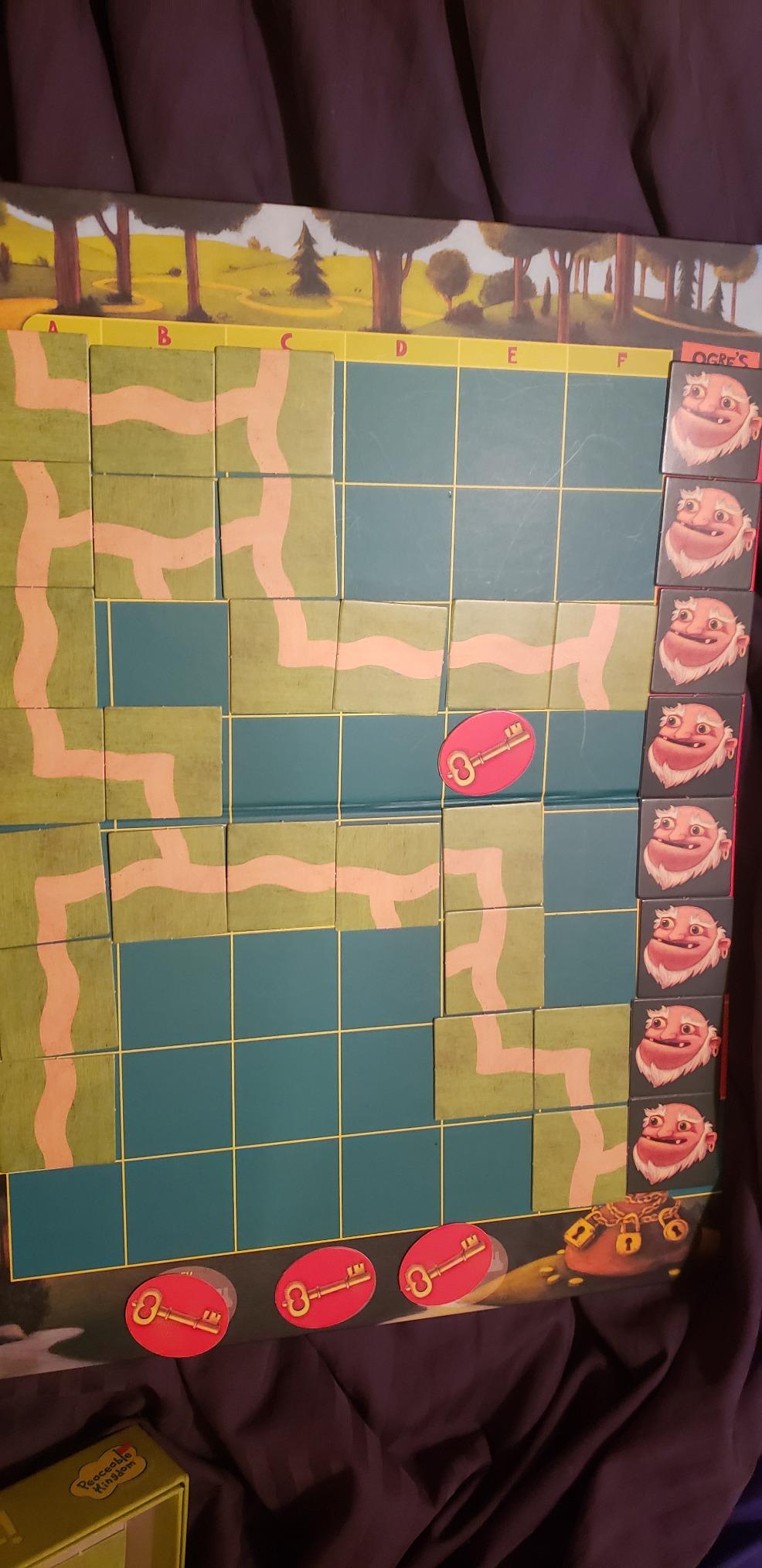
Race to the Treasure! is the game that parents describe almost universally as the first cooperative game that worked in their house. The children build a path of stepping-stone tiles from the start to the treasure, flipping cards to reveal what each tile does, while a cardboard ogre advances two spaces every time the deck is exhausted. If the ogre reaches the treasure before the group finishes the path, everybody loses together.
The reason it clicks so fast is that the goal is physical and obvious. Build the path, get the keys, beat the ogre. There is no abstract objective to explain and nothing to read, so a five-year-old can join in from the second turn. My oldest tester immediately started strategising about which tile to place without being prompted, which is unusual at that age.
Where the Strategy Actually Lives
The depth comes from the tile deck. Some tiles move the ogre forward, some move the group forward, and some hand out keys. Choosing a tile is choosing between two things you want at once, and children who can hold a card and read its icon start planning around that trade-off within a few rounds. Reviewers consistently praise the genuine strategic depth for such young children.
The suspense is what keeps a table quiet. Watching the ogre creep along its track produces a genuine pause before each flip, and that shared tension is something competitive games do not create.
The Younger Sibling Problem and How to Fix It
Reviewers note that younger siblings can stop contributing meaningfully as the game goes on, and that is the one complaint that recurs. The reason is turn length: an older child plans for a minute, an older child solves the puzzle, and a three-year-old ends up holding a card with nothing to do.
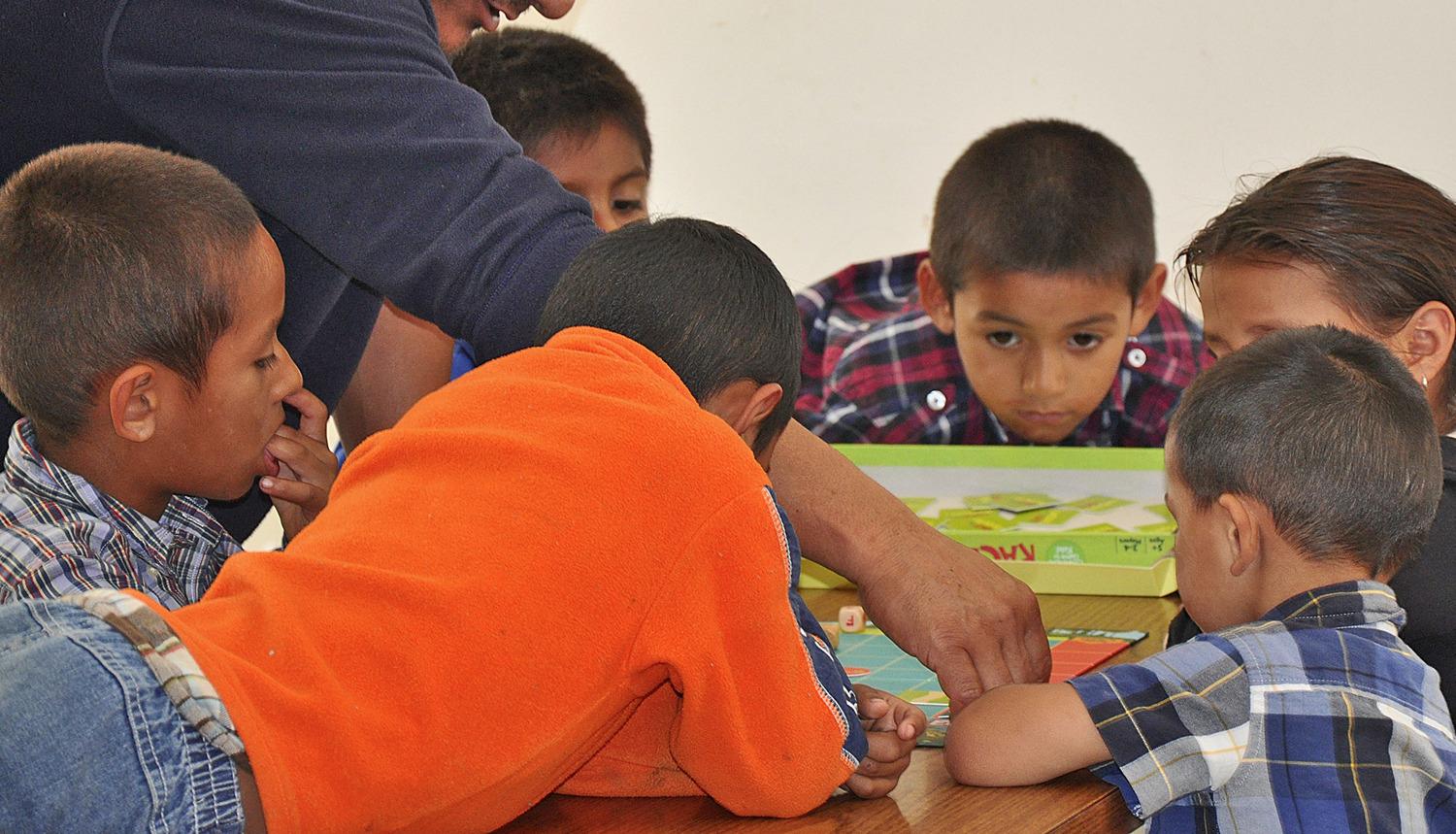
Our fix is to give the youngest child a fixed, small job that is still part of the game. Have them flip the next tile and place it, or hand out the keys. It takes ten seconds to set up and it keeps a two-adult-plus-two-toddler table together for the whole round.
Practical Notes on Components and Pace
Components are few and simple, which makes this the easiest game in the list to clear away before bed, and the box measures roughly 12.5 by 9 by 1 inches. Two reviewers note that the cardboard path tiles show wear after heavy play, so expect visible scuffing rather than a pristine board after a year of family use.
The ogre pace is the other variable. Some groups find it too slow and lengthen the game beyond the advertised 20 minutes, others find it just right. If your table prefers a faster finish, deal fewer cards before starting.
5. My First Orchard – The Best First Board Game for 2-Year-Olds
HABA My Very First Games – First Orchard Toddler Game – My First Orchard Game, Cooperative Toddler Board Games for 2 Year Olds – Made in Germany
Ages 2+
4 players
Counting practice
Wooden components
+ Pros
- Designed for children from 24 months
- Chunky wooden fruit and a large colour die
- Reinforces colour recognition and counting
- PEFC certified wood built to last
- Cons
- Children age out of it quickly because strategy is thin
- Hard wooden pieces can hurt if thrown
- The raven space can frustrate players who roll it early
My First Orchard is the only game in this roundup rated from 24 months, and after playing it with a two-year-old and a four-year-old I can confirm the rating is honest. The game is almost entirely a die roll and a colour match. Roll the big wooden die, pick the matching fruit from the tray, and place it on the tree. The whole family harvests together, and a cardboard raven sits in the corner waiting for the number everyone is trying to avoid.
What makes it exceptional is physical. Sixteen large wooden fruit pieces in four colours sit in a wooden tray, and the die is oversized so a small hand can actually close its grip around it. Parents describe it as the definitive first board game for toddlers, and the more than three million copies sold over three decades suggest they are not alone.
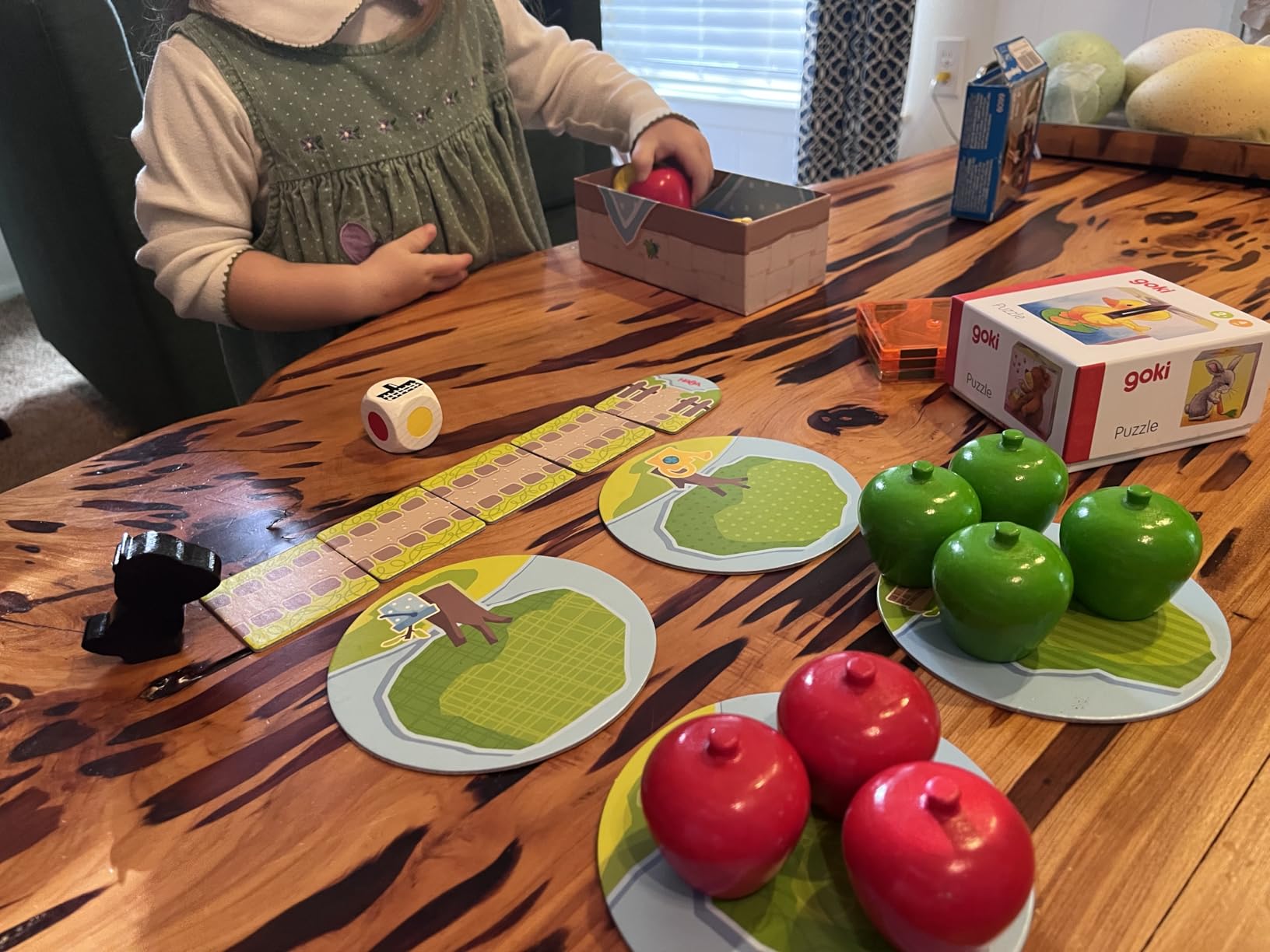
The Skills This Game Actually Practises
The educational objective listed for this game is counting, and the counting happens naturally. Children look at the die, match a colour, and say the number out loud, over and over, in a context where the number matters. Colour recognition gets the same treatment. The result is genuine practice disguised as a harvest, which is why homeschoolers value it.
Reviewers also single out the social skills listed by the manufacturer: taking turns and following directions. At this age those are the two hardest things to teach, and a die-and-match format is about as low-stakes as it gets.
Durability for Under-3s and What to Watch
The components are PEFC certified wood, and that shows up immediately in play. Nothing creases, nothing tears, and the game survived a year of being dropped and chewed without incident. The box measures about 8.94 by 8.86 by 2.8 inches and the pieces are large enough that choking is not the concern here.
One caution that a few parents raise: the wooden pieces are hard enough to hurt if thrown across a table. That is a conduct issue rather than a product flaw, and it is worth telling a two-year-old before the first round.

The Two Problems Every Family Hits
The first is the raven. Roll the number that lands the raven and the whole table groans, which is the first lesson in coping with disappointment that many children get. Narrate it as a shared accident rather than anyone being at fault, and it works.
The second is shelf life. There is almost no strategy, so most children are done within a month. That is not a flaw in the product, it is the job description. Plan to hand it down to a younger sibling and replace it with a cooperative game that has more to think about.
6. Mermaid Island – The Best Co-op Game for a Big Table of Six
Peaceable Kingdom Mermaid Island Award Winning Cooperative Board Game for 2 to 6 Kids Ages 5+
Ages 5+
2-6 players
15 minutes
Spinner movement
+ Pros
- Supports 2 to 6 players
- widest player range in this group
- No reading required with a 15 minute length
- Every player moves on every turn
- Cons
- Too easy to win so older children repeat it
- Several reviewers argue the age rating should be 3+
- The spinner can detach though replacements are quick
Mermaid Island is the answer to the most common real family configuration: two adults and four or five children at one table. The game supports two to six players, which no other pick in this roundup matches, and every player controls something on every turn. Three mermaid tokens need to reach Mermaid Island while a Sea Witch shuffles along its own track, and everyone shares the same goal.
The component list is unusually tidy for a game this size: a board, three mermaid tokens, a Sea Witch on a stand, four wand tokens, a spinner and instructions. Reviewers praise the illustrated board and note there is no extraneous packaging or filler pieces, which matters when you are trying to get a six-player game back into a box at bedtime.
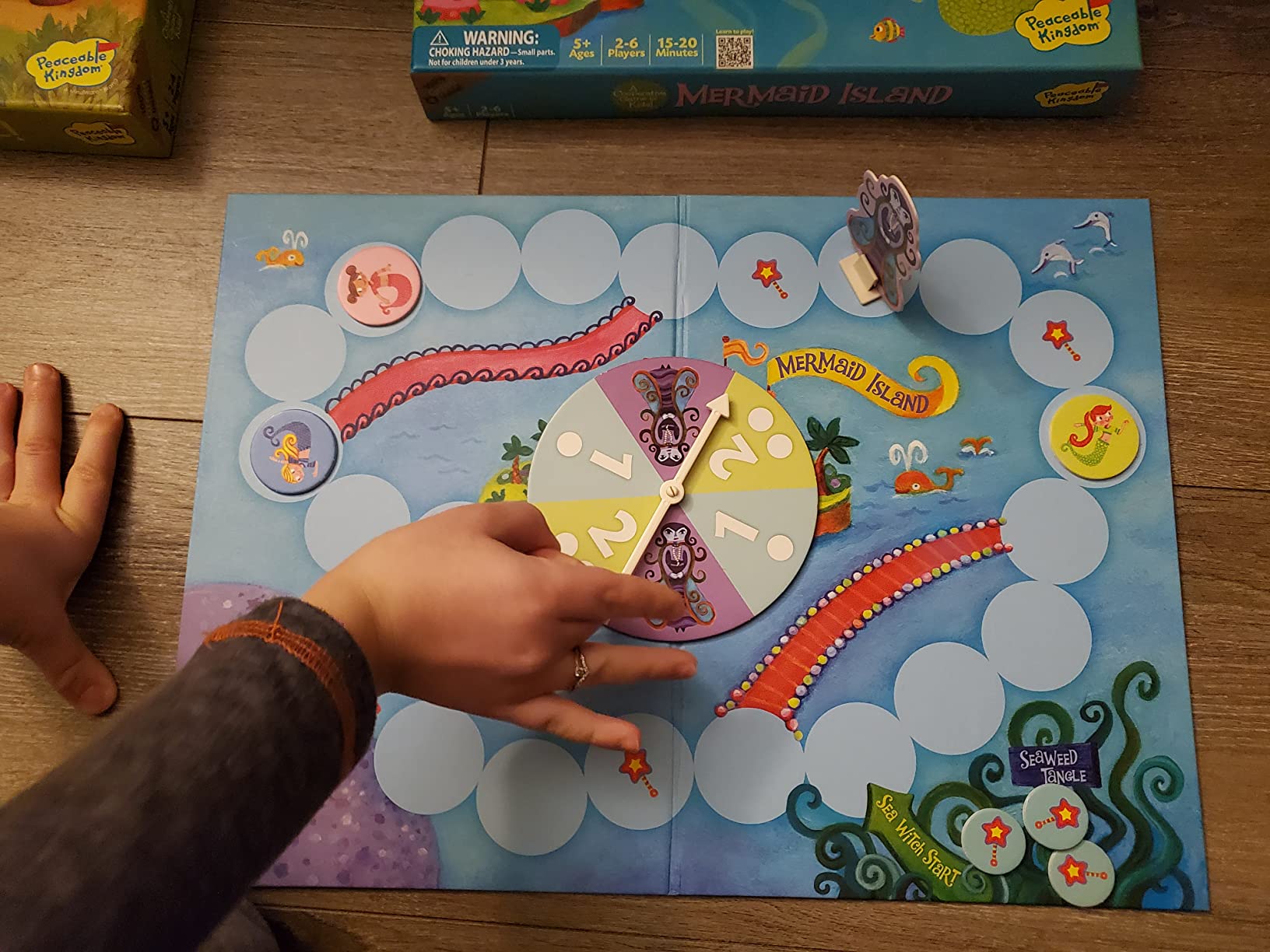
What Six Players Actually Changes
With more players, each turn gets shorter and the spinner gets more important, because landing on a wand space affects everyone. The shared decision-making becomes genuine: the table argues about whether to use a wand token now or save it. Reviewers describe exactly this effect, with children developing shared decision-making skills in a setting that avoids the anxiety of winning and losing.
Downscaling works fine too. At two players the game becomes a quiet shared-deck exercise rather than a conversation, which is why we recommend it for groups rather than for parent and child play.
The Age Rating Is Too Conservative
Several reviewers argue the stated 5 and up rating should be 3 plus, and after playing it with a four-year-old I lean their way. There is no reading required, the turns are short, and the theme is gentle enough that nobody minds losing. If you have a four-year-old and a nine-year-old at the same table, this game holds both of them better than almost anything else here.
The counter-argument is difficulty. Some groups find the Sea Witch moves too slowly to create any real challenge, and that is where the other side of the age range gets short-changed.
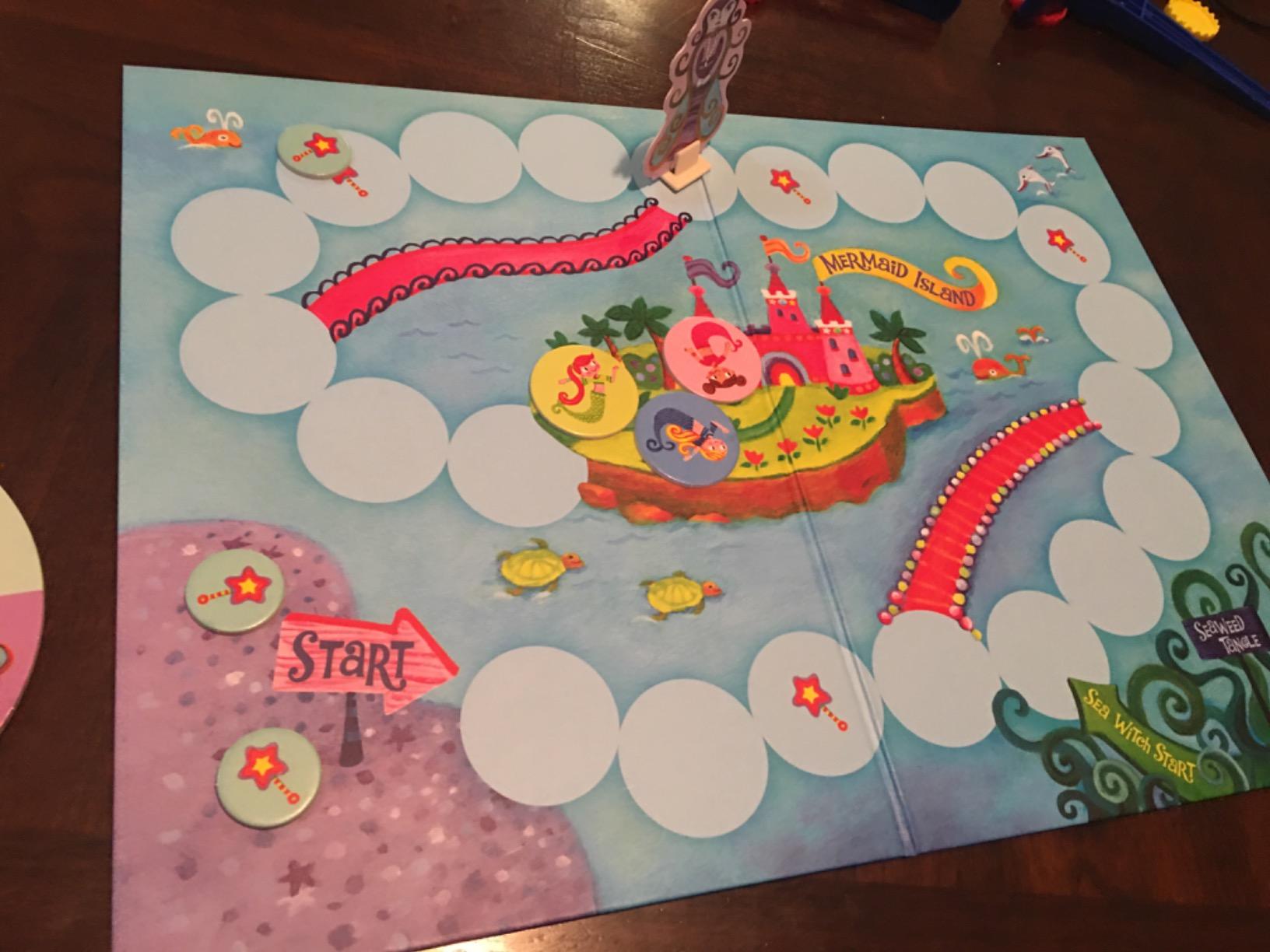
Build and Longevity Notes
The materials are a mix of cardboard and plastic, and the board measures about 9.06 by 12.6 by 1.57 inches. The one recurring hardware complaint is the spinner, which some reviewers have had detach or break, though the company replaces it quickly. Keep a spare on hand if you have a group that plays rough.
The bigger limitation is repetition. This is one of the easiest games here to win, so older children tend to finish it and move on. Treat it as the game you pull out when four children arrive at once rather than as a long-term fixture.
7. My First Castle Panic – The Best Step Up for Ages 6 to 8
Fireside Games My First Castle Panic Fantasy Board Game
Ages 4 to 8
4 players
20 minutes
Icon cards
+ Pros
- Icon-based cards mean no reading required
- About 20 minute rounds suit short attention spans
- Large monster tokens and a sturdy standing castle fit small hands
- Teaches asking for help and losing well
- Cons
- Card quality is thin and cards need sleeves with young players
- Components can go missing which breaks the game
- Too easy for children aged 5 to 7 who know co-op games
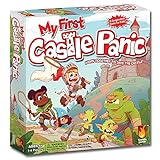
My First Castle Panic is the first cooperative game on this list where children are asked to make a real decision under pressure. The group cooperates to defend a standing castle from monsters, and the decisions come from drawing symbol cards that tell you to take a knight, a catapult, a dragon or a wall. Cards get discarded, and once you run out of a type you can no longer play that action. That constraint is what makes an eight-year-old start planning.
It is also the natural next step after the matching games earlier in this list. Parents describe it as an ideal stepping stone from simple preschool games to genuine strategy games, and reviewers note that it teaches asking for help, planning, turn taking and coping with a loss.
Icon Cards and Why No Reading Is a Real Feature
Every card carries a picture and nothing else. A child who cannot read can hold up a knight card and say what it does, so a five-year-old and an eight-year-old can play the same hand together without one of them translating. That is unusual for a game with actual strategic depth, and it is the main reason this one scales across an age span.
The built-in end condition is another quiet strength. When the monster deck runs out, the game ends immediately, so there is never a long tail of shuffling. That keeps a round near 20 minutes even when the group is negotiating hard.
Components, Sleeves and Missing Pieces
The physical design is built for small hands: a sturdy standing castle, thick wall pieces and large monster tokens. Reviewers consistently praise the durability of the standing castle in particular. The weakness is the cards, which several reviewers describe as lackluster and recommend sleeving for young players.
The more serious complaint is components going missing. A game that depends on drawing a specific symbol stops working the moment that card is gone. Check the component count before every session, particularly in a house with several children.
Who Should Skip It
Children who already know co-op games well may find the base version too easy between ages 5 and 7, and reviewers make that point directly. That is a real limit on longevity rather than a fault in the components.
Buy it for a six-year-old or an eight-year-old, and buy it if an older sibling is in the house who will enjoy being the one who explains the icons. For a table of only five-year-olds, go back to Hoot Owl Hoot.
8. Baby Dinosaur Rescue – The Best Cooperative Game for Classroom Play
Baby Dinosaur Rescue Cooperative Board Game for Kids Ages 4+, Family Fun
Ages 4+
2-4 players
20 minutes
Image-based cards
+ Pros
- Image-based cards mean no reading required
- Matches
- turn-taking and communication practice in 20 minutes
- Short rounds suit classrooms and homeschool
- Cute dinosaur artwork engages young players
- Cons
- Very thin cardboard bends and wears quickly
- Token and card sizes need close supervision under age 4
- Gameplay becomes repetitive once matching is mastered
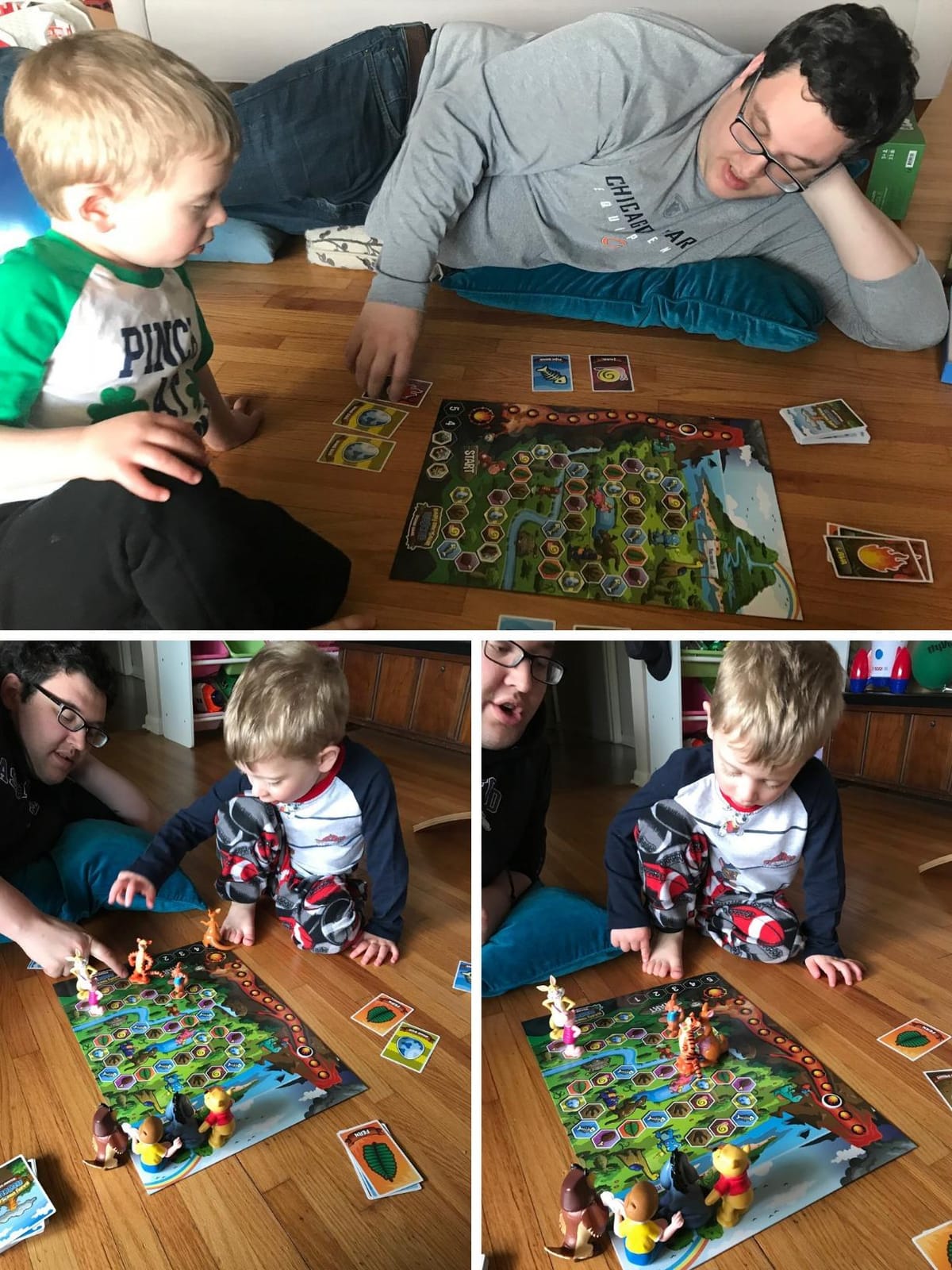
Baby Dinosaur Rescue has a lava token and a shrinking path. The group moves the dinosaur tokens across the board to reach Dinosaur Island, and each round of cards pushes the lava forward along the same route. Everyone moves on every turn, so a two-year-old at the edge of the table is still participating rather than watching. That design choice is what makes it work in a room with several small children.
The item cards carry pictures rather than words, so no reading is required and a non-reader can play the whole game independently of an older sibling. Teachers and homeschool parents value that. Reviewers highlight the combination of matching, turn-taking, communication and problem-solving inside a round that lasts about 20 minutes.
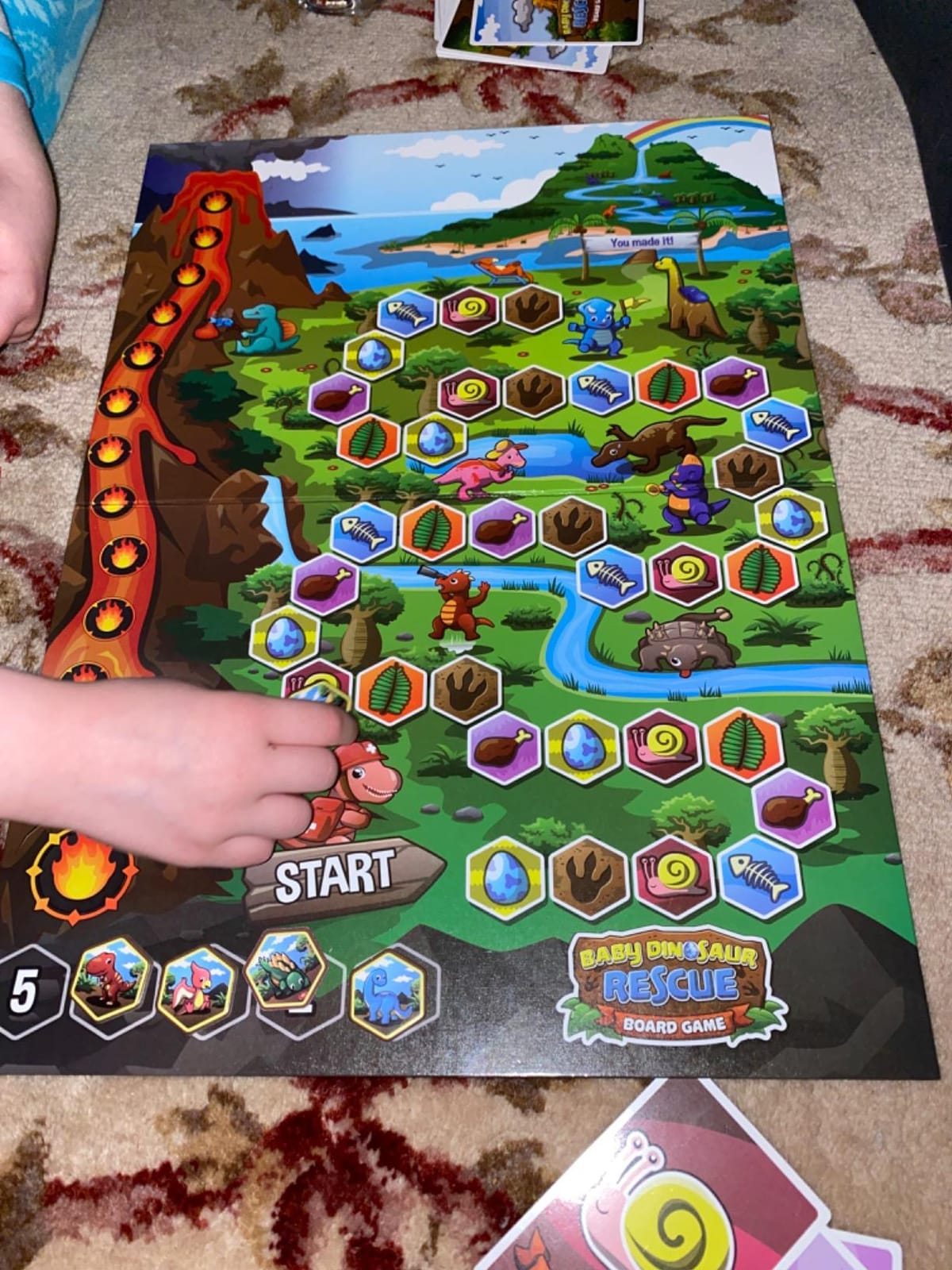
Why the Advancing Lava Works as a Clock
The lava creates a deadline that everyone can see, so children start planning two moves ahead rather than reacting to the current turn. It also gives the group a reason to talk, because the only way to speed it up is a shared decision. Reviewers point to this cooperative pressure of the advancing lava as the feature that keeps a group of mixed ages engaged.
Unlike a competitive game, the tension does not punish any individual. A four-year-old cannot cause the loss on their own, which removes the argument that usually ends a group session.
Thin Cardboard and Supervision
This is the weakest build in the roundup. The board and pieces are very thin cardboard, and reviewers repeatedly report bending and quick wear. In a classroom with a dozen children and a set of tokens going into mouths, expect to replace it within a couple of terms.
The stated choking hazard and the small token sizes mean close supervision for children under four. That makes it a preschool-and-up game rather than a true toddler game, despite the friendly artwork.
Best For and Best Against
Choose it if you need a cooperative game for a mixed group, for a homeschool table, or for any situation where you want shared matching practice inside twenty minutes. The colorful dinosaur artwork does a lot of work with children who are drawn to animals rather than to the idea of a game.
Skip it if durability matters to you, or if your child quickly masters simple matching and wants more depth. Reviewers note the gameplay becomes repetitive for players who solve the matching quickly, which tends to happen around age six.
9. National Geographic My First Safari – The Best Co-op Game With Adjustable Difficulty
National Geographic My First Safari Cooperative Board Game for Kids
Ages 4 and up
4 players
Three difficulty levels
Short rounds
+ Pros
- Three difficulty levels let the game grow with the child
- Learning guide covers 21 animals
- All players reach the end together
- Short rounds with clear rules for ages 4 to 6
- Cons
- Explorer figures are hard to fit into their stands
- One reviewer found the components poorly made
- Low decision complexity for experienced co-op players
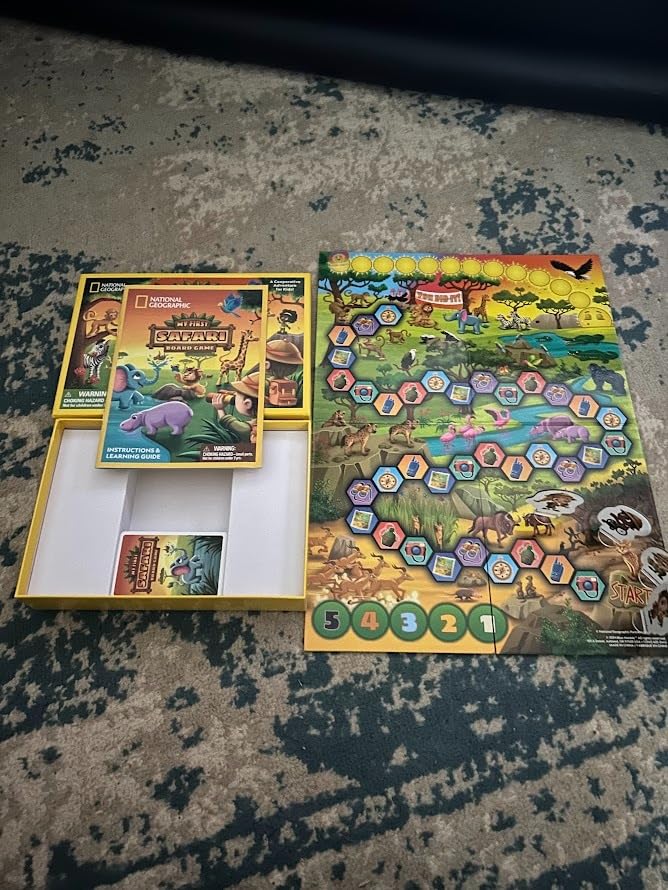
My First Safari is the only game here that lets you tune the difficulty instead of outgrowing a fixed level. The group moves five safari explorers across the board to see every animal before the sun token reaches the end of its track, and the Sun cards control how far the sun moves. Set up the number of Sun cards that suits your child and the same box serves a four-year-old and a seven-year-old.
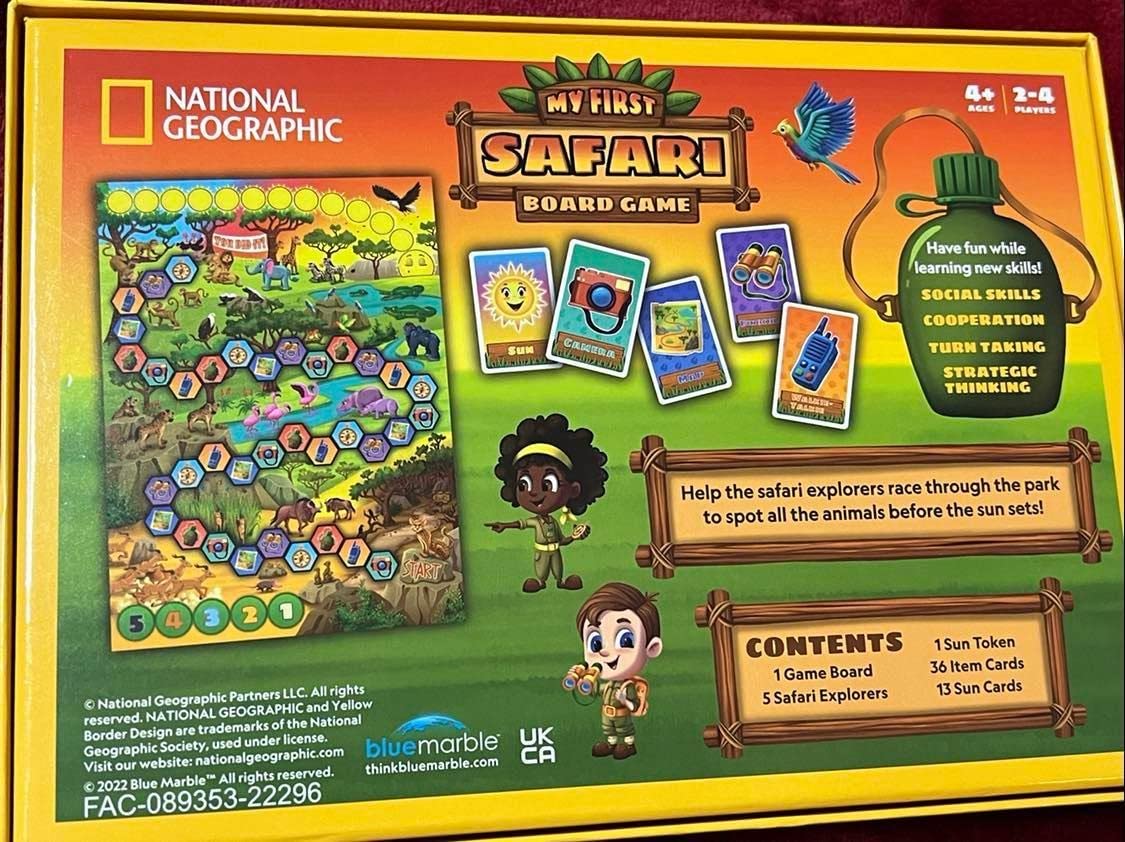
The box contains a board, five safari explorers, a sun token, 36 item cards, 13 sun cards and a learning guide covering 21 animals. That last component is the quiet differentiator: it turns the end of the game into something other than an abrupt stop.
How the Three Difficulty Levels Work
Difficulty comes from the Sun deck rather than from a rule change. More Sun cards means a faster sunset and a tighter deadline. Start with the smallest number that still feels like a game, then add cards as your child gets confident. Reviewers single out the adjustable difficulty as the main reason the game keeps working over time.
The collaborative structure matters here: all players reach the end together rather than one player racing ahead. That design removes the finishing-order problem that causes arguments in most family games.
The Explorer Figures Are the Weak Point
The most common complaint by a distance is the explorer pieces themselves. They are difficult to fit into their stands and can get damaged in the process, which is an annoying problem during a game that children otherwise enjoy. A parent may need to steady the board while a child places a figure.
One reviewer also found the components poorly made overall, and another noted that decision-making drops once children are used to cooperative games. Neither is a dealbreaker at this age, but it is not a keepsake-quality product like the wooden fruit games.
Where It Fits in Your Collection
Put this one in the middle of a starter stack. It is too simple for a child who has been playing co-op games for a year, and it is exactly right for a four-year-old meeting the format for the first time. The learning guide gives you something to open at the end when the board game itself is over.
It also works well for a four-player table, and the short rounds mean it slots into a homeschool morning without taking over the session.
10. Orchard Squirrel Challenge – The Best Co-op Game for the Youngest Players
Nene Toys Cooperative Orchard Board Game for Toddlers Ages 2-4
Ages 2 to 4
2-4 players
20 minutes
Wooden pieces
+ Pros
- Listed from 18 months
- Chunky FSC-certified wooden pieces for small hands
- Reinforces colours
- counting
- focus and turn taking
- No small parts warning and no batteries
- Cons
- No printed rulebook makes first play less straightforward
- Basic dice matching with little strategic depth
- Wooden pieces pack a punch if thrown
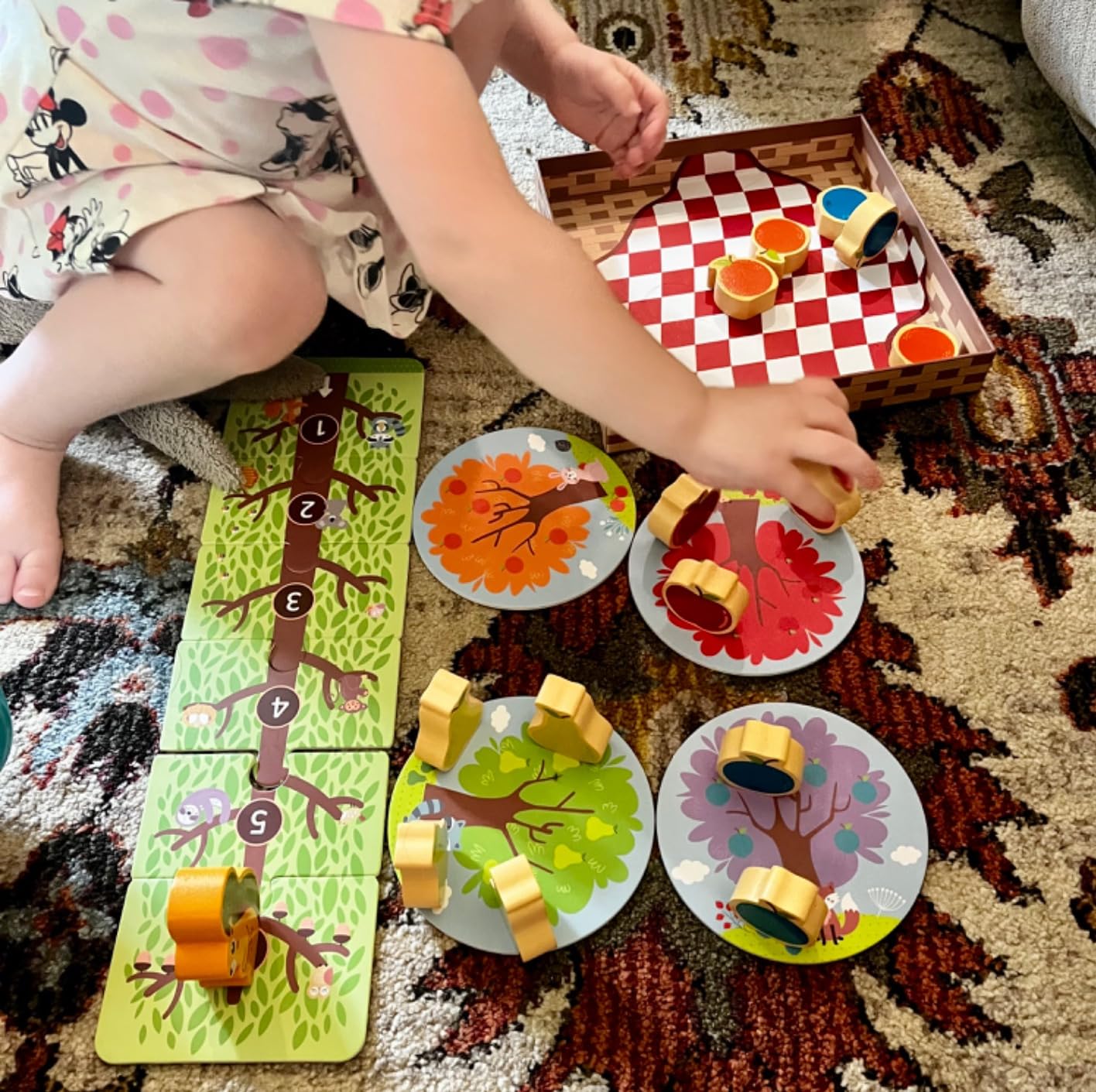
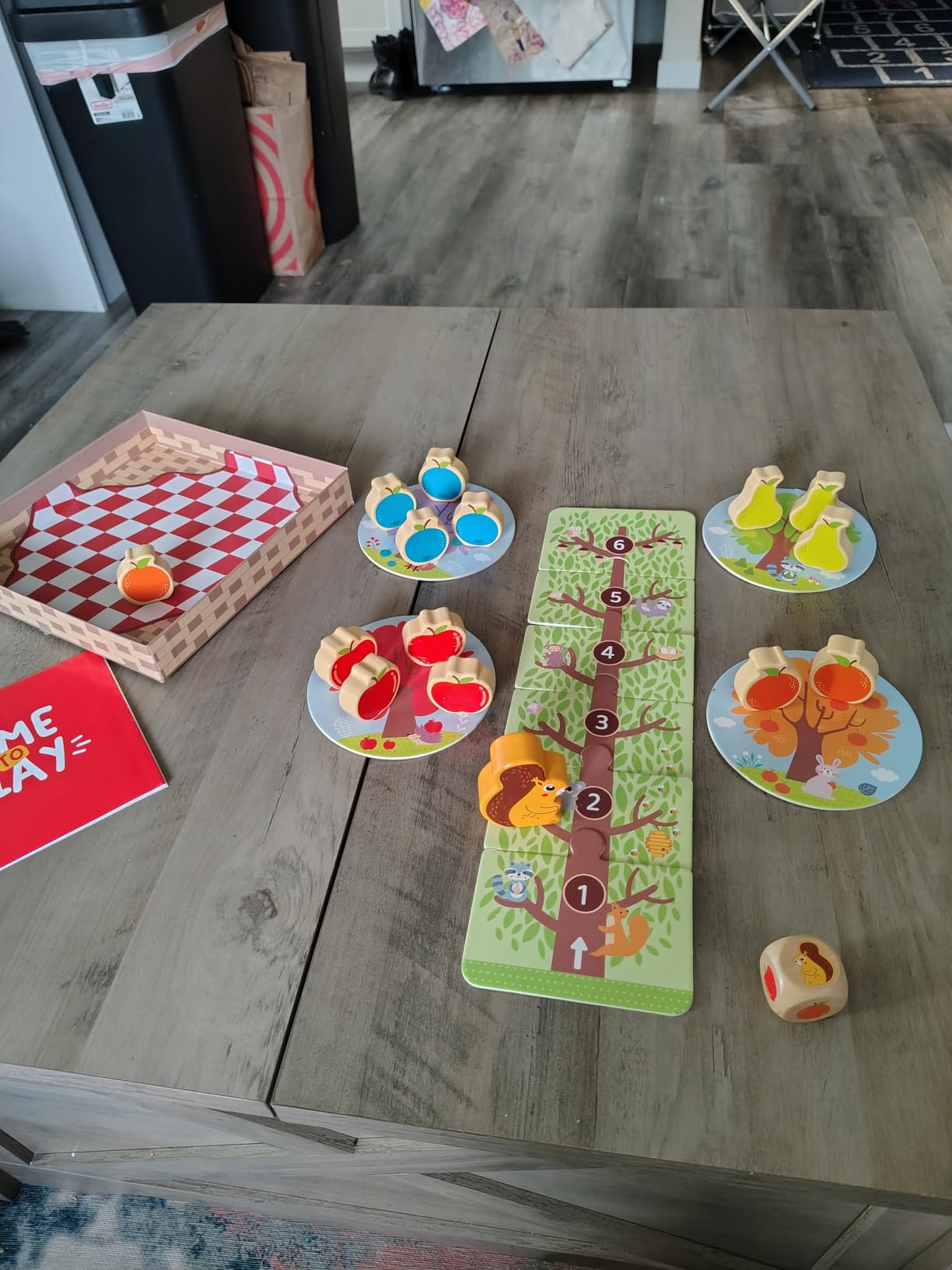
The Orchard Squirrel Challenge covers the youngest band in this roundup, listed from 18 months. Like the wooden fruit games, it is a die roll and a colour match: children roll, pick the matching fruit, and work together to keep it away from the squirrel. The play pattern is Montessori in feel rather than strategic, with tactile sorting and no screens, and the box lists 2 to 4 players with a 20 minute round.
What sets it apart is the safety profile. The CPSIA statement for this product reads no warning applicable, there are no batteries, and the pieces are FSC-certified wood with smooth finishes. For a household with a child under two, that combination is unusual in a cooperative board game.
No Rulebook Is a Real Problem on Day One
The most common complaint among buyers is that no printed rules are included. For an experienced board game family that is a five-minute nuisance. For a household playing their first game with a two-year-old, it means one adult spends the opening round working out what to do while the child loses interest.
Our workaround: before the first session, write the four-step sequence on an index card. Roll, match the fruit, put it on the tree, repeat. With the sequence visible, the game runs smoothly and the card stays in the box for the next session.
Chunky Wood and the Throwing Problem
The pieces are genuinely well sized. Reviewers focus on how easy they are for small hands to grasp and how the smooth finishes hold up to daily handling, and the wooden construction means nothing tears or creases.
As with the other wooden games in this list, reviewers raise the same caution: the pieces are hard enough to hurt if a toddler throws one across the table. Set that expectation before the first roll rather than after the first incident.
How Long It Lasts and Who It Beats
There is very little strategic depth here, so children outgrow it quickly, usually somewhere between two and four. Buyers describe the value in terms of the colours, counting, focus and turn taking it reinforces rather than any replay potential.
It beats the alternatives for the youngest band specifically. If your child is between 18 months and three, this and the HABA wooden fruit game are the only two picks that are honestly playable, and both work far better than a game rated 4 plus and played down.
11. Rainbow Unicorn Rescue – The Best Co-op Game That Also Works Competitively
Rainbow Unicorn Rescue – Board Game for Kids Ages 4-8, Fun Family Board Games, Games for 4+ Year Olds, Kids Games for 4+ Year Old Birthday Gift, Unicorn Toy for Girls and Boys, Cooperative Board Games
Ages 4 to 8
2-4 players
10-15 minutes
Two play modes
+ Pros
- Offers both cooperative and head-to-head play in one box
- 10 to 15 minute rounds finish before bedtime
- Beginning readers can follow the rainbow cards alone
- Well-made wood pieces and a solid spinner
- Cons
- Two different shades of blue are both labelled simply blue
- Several special spaces appear in succession which feels unbalanced
- Printed directions do not match the contents and black dice are missing
Rainbow Unicorn Rescue is the answer for a household that cannot agree on cooperative versus competitive play. The same box runs as a fully cooperative game or as a head-to-head race, which means a family that includes a competitive nine-year-old does not have to buy two products. The cooperative mode has players collecting rainbows while the spinner drives movement around the board, and the rounds run 10 to 15 minutes.
The rainbow cards do something the other games here do not. Each one prompts a silly animal sound, which turns a plain turn into a bit of performance. Parents of four and five year olds report that these prompts add energy and giggles, and that beginning readers can follow the cards on their own.
When Two Play Modes Genuinely Help
Having a competitive mode is not a compromise in a family with older children. It lets a household use one box for a cooperative game with a four-year-old and a head-to-head game with an eight-year-old in the same week, which is a genuine saving of shelf space and money over buying two titles.
Cooperative mode suits preschool play and the classroom, since the shared goal reduces arguing. Competitive mode suits older siblings who find cooperative games too easy. Reviewers highlight the classroom friendliness and the two-mode design as the reason it works across a wide age spread.
Two Production Errors to Know Before You Play
Two specific issues come up repeatedly. First, the board includes two different shades of blue that are both labelled simply blue, which confuses players who are still learning the colours by name. Check the board with your child and tell them which is which once, at the start.
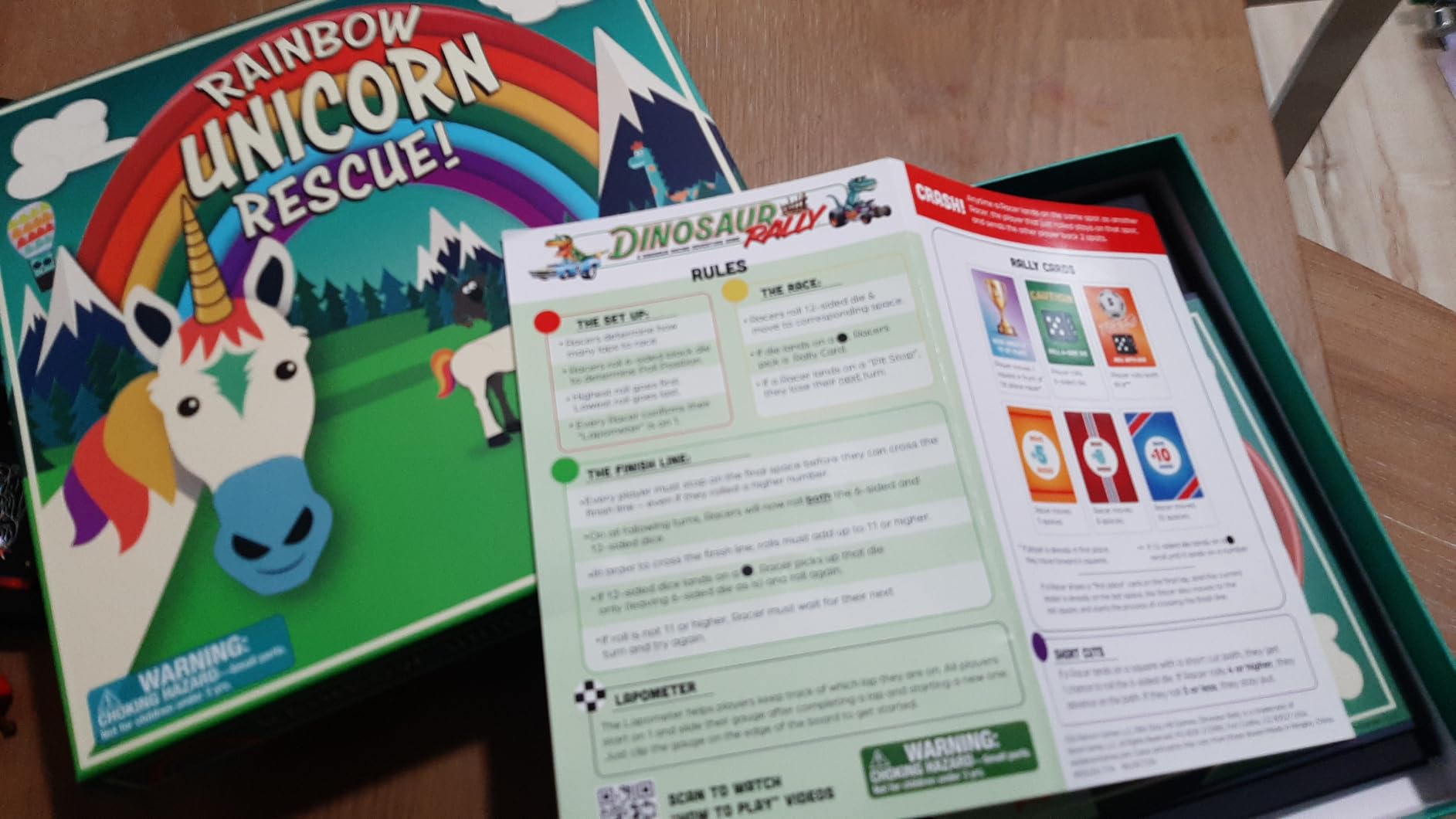
Second, the printed directions do not match the components included, and black dice are not in the box. That sounds serious but it is a labelling problem rather than a missing-parts problem for most families. Substitute any die you have at home and follow the general shape of the rules rather than the exact wording.
Build Quality and Component Count
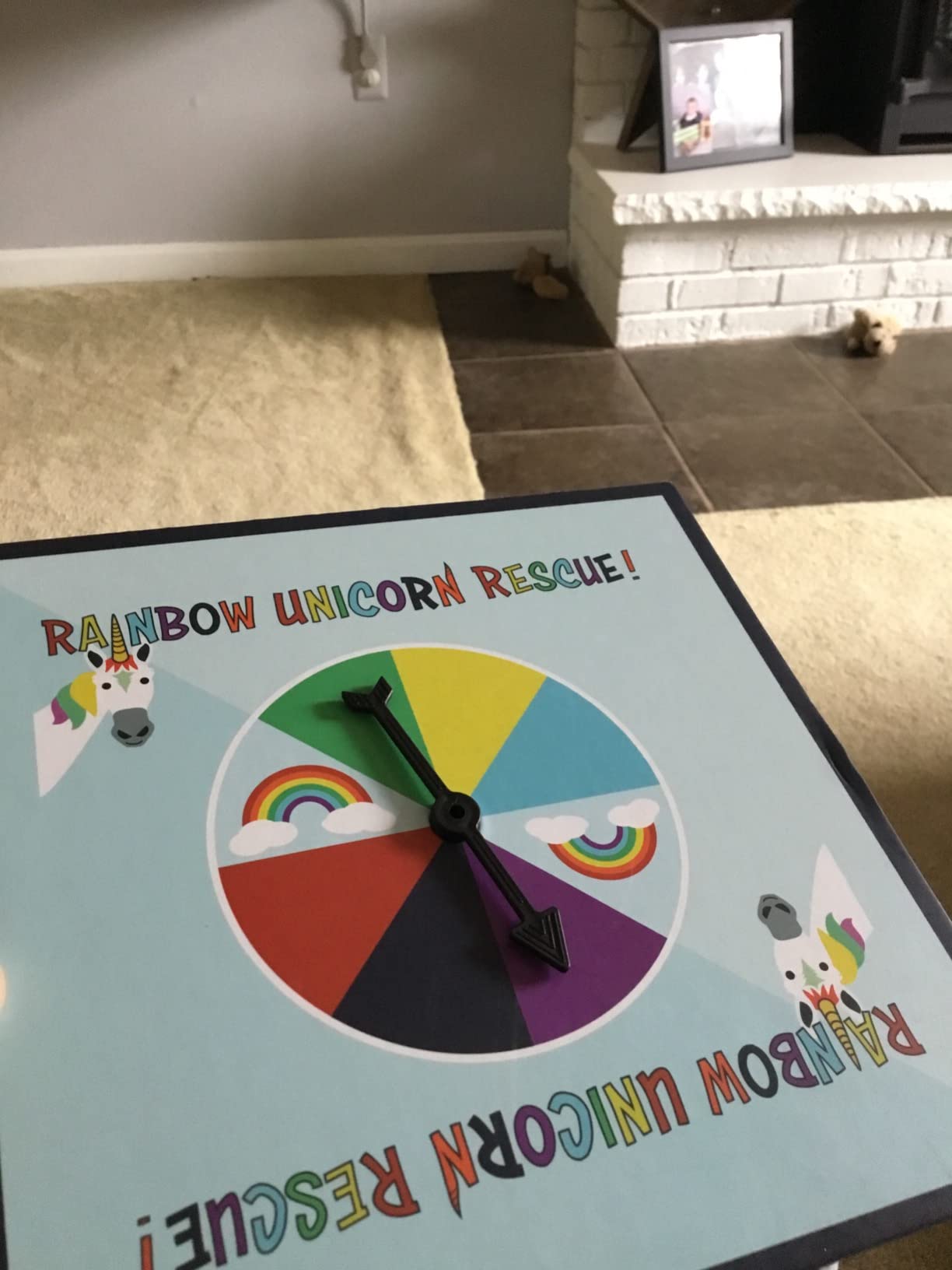
The board and wood pieces are well made for the price band, with a solid spinner, and reviewers single this game out as one where the components feel sturdy. The board measures 10 by 10 inches, which makes it a genuinely portable option for a playdate or a trip.
One further balance note: several special spaces appear in succession on the track, which some groups read as unfair. For a four-year-old who does not yet lose well, start on the lower difficulty mode and stay there until the moves feel ordinary.
How to Choose a Cooperative Game Your Child Will Actually Finish
Most disappointing board game purchases for young children fail on logistics, not on quality. The game is fine, but it is too long, too hard, or too many pieces for the table in front of it. Here is how to avoid that.
1. The Age on the Box Is a Floor, Not a Ceiling
Manufacturers list the youngest child who can physically handle the components, not the youngest child who can win or follow the rules. That gap is why so many families buy a game rated 4 plus and abandon it after two sessions, a frustration that shows up again and again on parent forums. Our calibration after playing these eleven games is simple: add one year to the printed rating for anything with hidden information or reading, and trust the rating for anything with icons only.
So Outfoxed!, printed from 4 and really a 5-plus game, needs an adult to read the clue cards for a four-year-old. Mermaid Island, printed from 5, genuinely plays at 4. My First Orchard, printed from 24 months, plays exactly as advertised.
2. Match the Play Time to the Attention Span, Not the Box
The listed play time is a floor rather than a ceiling, and most families underestimate. A 20 minute game played with a four-year-old and a chatty sibling regularly runs 35 minutes. If you need to be out the door by bedtime, pick something listed at 15 minutes or less, and treat the longer cooperative games as weekend activities.
The games here cluster into two groups: 15 minute rounds for Hoot Owl Hoot, Mermaid Island and Rainbow Unicorn Rescue, and 20 minute rounds for everything else. That difference decides whether you finish a game or abandon it half-finished.
3. Check the Player Count Against Your Real Table
Player counts on boxes describe the range that works, not the range that is fun. Most cooperative games have a sweet spot at three or four players. At two players the turns stretch and the shared decisions become thin; at five or more, the youngest child stops contributing.
For a parent and one child, the games that genuinely scale down are Hoot Owl Hoot, My First Orchard, the Orchard Squirrel Challenge and the Bluey Scavenger Hunt. For a table of two adults and three or four toddlers, Mermaid Island is the one to buy because it supports six players and nobody sits out. For a table with a nine-year-old, My First Castle Panic and Rainbow Unicorn Rescue hold the whole age range without a sibling dropping out.
4. Count the Minutes It Takes to Teach the Rules
This is the barrier parents mention most often. Games with hidden information, simultaneous selection or an app need more explanation than a parent has patience for on a weeknight. The icon-only games in this roundup can be taught in under two minutes by pointing at a card and asking what it does.
A good rule for a first game night: demo one full turn yourself, then let them take over. Do not read the rulebook aloud. Do not explain the whole game. One turn is enough, and the rest they will learn by playing.
5. Pick the Theme Before the Mechanic
For this age band, theme decides more games than complexity does. A dinosaur rescue beats an abstract matching game for a child who has been watching dinosaurs all week, and a unicorn game with sound prompts wins over almost anything else for a five-year-old. Familiar characters also reduce rule teaching dramatically, because the child arrives already interested in the story.
The gentle themes here are a deliberate choice. Cooperative games for young children work best when the mood is calm, and a game with monsters and a volcano still lands fine when the whole group is winning together.
6. Check Small Parts and Durability Before You Buy
Most products in this category carry a choking hazard statement for small parts, which rules out genuine toddler play for anything under three. The exceptions in this roundup are the wooden fruit games, where the pieces are large and the CPSIA statement reads no warning applicable. Treat any cardboard game as consumable and expect to replace thin components within a year; the wooden pieces are the ones that get handed down.
Second-hand and library borrowing is realistic for the cardboard games, since a worn board does not change the rules. It is not realistic for a wooden fruit game, since those are the ones worth passing to a younger sibling intact.
7. Plan for the Loss Before the First Round
Cooperative games for young children end in a loss most of the time, and that is by design rather than a flaw. The ogre reaches the treasure, the sun fills the meter, the lava covers the path. Parents report feeling like they have let their child down when this happens, and the fix is simple and well documented in parent communities: narrate it as we almost had it, and let the child pick the next game.
The other rule that works is to never let a child be the reason the group lost, in your language. Say the deck beat us, not you chose badly. That single phrasing change is the difference between a co-op game that teaches resilience and one that teaches blame.
Frequently Asked Questions
What are some good co-op games for children?
The strongest co-op games for children aged 4 to 8 are Outfoxed!, Hoot Owl Hoot, Race to the Treasure!, My First Castle Panic and Mermaid Island. For ages 2 and under, My First Orchard and the Orchard Squirrel Challenge are the only ones that genuinely work. Pick by minimum age, then check the play time against your child’s attention span.
Are cooperative board games good for young children?
Yes, and they suit young children better than competitive games for one reason: nobody is eliminated and nobody is the loser. The whole group wins or loses together, so there is no crying over second place and every child is still moving pieces at the end. Cooperative play also practises turn-taking, counting, planning and coping with disappointment.
What are some good two-player board games for kids?
The games in this roundup that genuinely work with one adult and one child are Hoot Owl Hoot, My First Orchard, the Orchard Squirrel Challenge and the Bluey Scavenger Hunt. Most cooperative games stretch at two players, so pick one from that group rather than the shortest box on the shelf. Hoot Owl Hoot is the safest starting choice at age 4.
What is the best board game for a toddler?
For a 2-year-old, HABA My Very First Games My First Orchard is the best pick. It is rated from 24 months, uses 16 chunky wooden fruit pieces and a large colour die, and needs no reading. A second option is the Orchard Squirrel Challenge, rated from 18 months with wooden pieces and no small parts warning.
What are some games similar to Outfoxed?
If you want Outfoxed!’s cooperative mystery feel but need less reading, My First Castle Panic uses icon cards instead of clue text and works from age 4. If you want a shared goal with no deduction at all, Race to the Treasure! or Hoot Owl Hoot give the same win-together tension with pure matching and path building.
How do I teach a 4-year-old a cooperative board game?
Demo one full turn yourself, then hand the pieces over and stop talking. Do not read the rulebook aloud and do not explain the whole game. Choose a game with no reading requirement, keep the first round short, and if a game printed for 5 and up is too hard, read the cards aloud yourself so your child keeps the decision.
Why does my child lose interest in a cooperative game after a few plays?
It is usually repetition rather than difficulty. Games like Hoot Owl Hoot and Mermaid Island are easy to win once the group learns the mechanic, so the tension disappears. The fix is to rotate the game out for a few weeks and bring it back later, or step up to a game with hidden information such as My First Castle Panic.
Which Cooperative Game Should You Buy First in 2026?
If you are starting from nothing, buy three games rather than one, and stagger them. My First Orchard covers ages 2 and up with chunky wood and counting practice. Hoot Owl Hoot covers ages 4 to 6 with no reading required and a 15 minute round that fits almost any evening. My First Castle Panic covers ages 6 to 8 with icon cards and the first real decisions a child will make at the table. Together those three carry a family from a second birthday through third grade.
If you only want one, our top pick is Outfoxed! for a child aged 5 and up, and the age band decides the rest. For a child who cannot read yet, take Hoot Owl Hoot. For a five-year-old who wants suspense, take Race to the Treasure!. For a six-year-old ready for decisions, take My First Castle Panic. For a table of six or more children, take Mermaid Island. For the youngest band, take the wooden fruit games and nothing else.
The best cooperative board games for young kids all share one quality that no rating captures: every player is still in the game at the end. Start with the age band that matches your child this 2026, give the first session one demo turn and no rulebook, and let them pick the next game.