
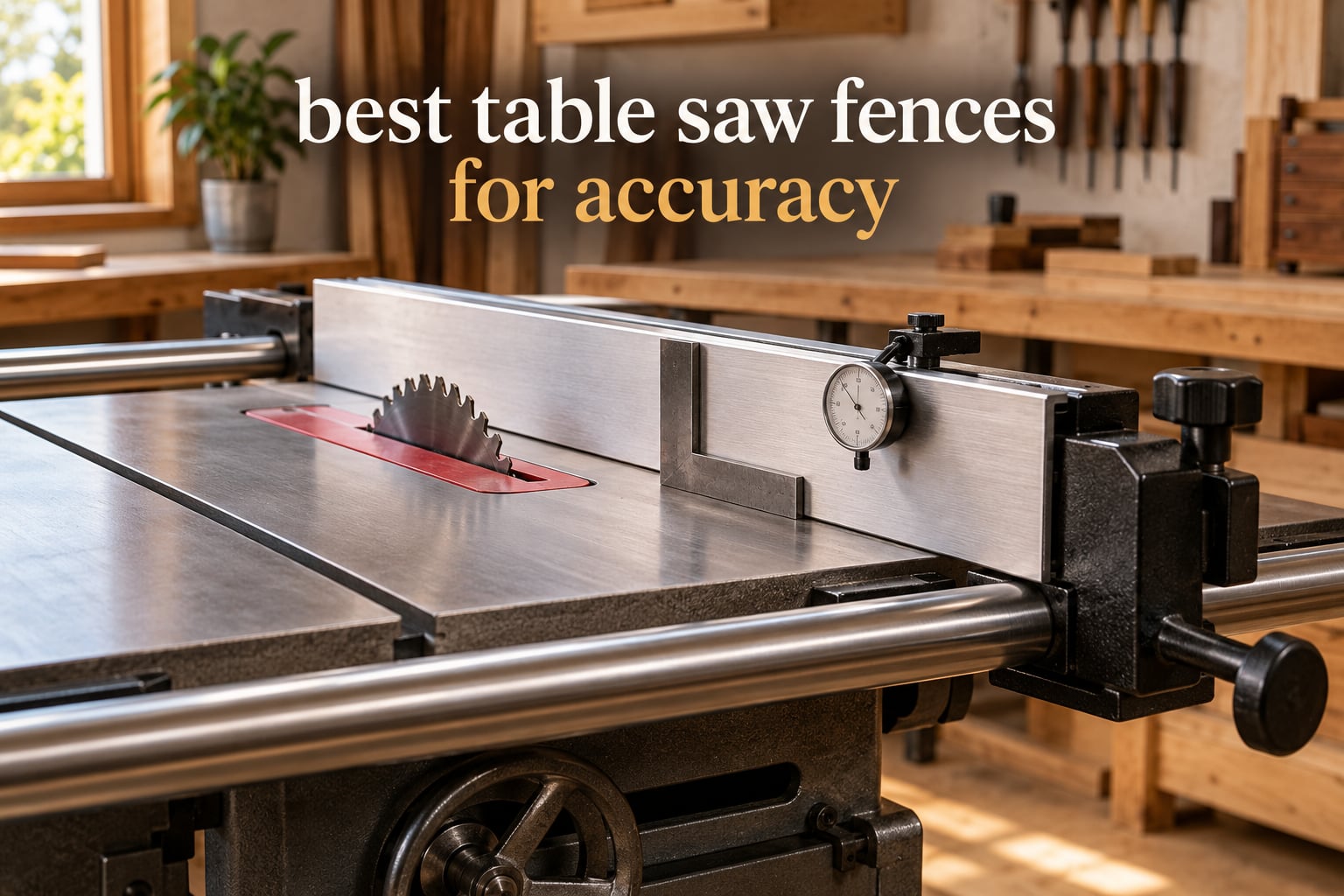
Choosing the best table saw fences for accuracy comes down to three things: a fence body that does not flex, a lock that clamps with the same force at every position, and rails that keep the fence parallel to the blade across the whole of its travel. Get those three right and your rip measurements repeat. Get one of them wrong and a nominal 24 inch cut drifts by thousandths along the board, which ruins fit and wastes material.
I spend a lot of time in the shop measuring fences rather than admiring them. For this roundup I compared eight fence systems and fence upgrades on the things that actually move a cut: locking consistency, deflection under load, parallelism across travel, mounting fit, and the accessories you are forced to buy on top. Where a maker publishes a tolerance I use it, and where one does not I say so instead of guessing.
One thing to clear up first, because the forums get heated about it. A new fence cannot rescue a saw with a crooked blade, an out-of-flat table, or a sloppy miter gauge. The r/woodworking view is that an aftermarket fence only fixes accuracy if the saw underneath it was already sound. I agree, and it is the reason the Delta T3 system tops my list: it is built to be installed on a saw that is already right, and it holds that rightness.
Two honest notes on this list before you start reading. Only five of these eight products are rip fences for a table saw in the strict sense; one is a miter gauge component, one is a jig-building rail, and one is an OEM miter saw repair part. I kept them because buyers searching for a fence upgrade genuinely run into all three categories, and a roundup that pretends otherwise wastes your time. Each section says plainly which job the product does.
Our Top 3 Table Saw Fences for Cutting Accuracy
Delta 36-T30T3 T3 Fence System
- Three-point locking
- One-piece square tubular rail
- 37 inch fence with 57-1/2 inch rail

Shop Fox W1716 Aluma-Classic Fence
- 57 inch rails
- 30 inch rip capacity
- Single cam-action lock

INCRA Telescoping Flip Fence
- 27 to 49 inch range
- Repeatable flip-fence design
- Drop-in INCRA replacement
The Delta system is the one I would put on a contractor saw tomorrow. The Shop Fox rail set is the right answer if you break down full sheets every week. The INCRA telescoping fence is the cheapest way to fix an accuracy problem on a saw you already own.
Comparing All 8 Fences Side by Side
| Product | Details | |
|---|---|---|
| Delta 36-T30T3 T3 Fence System |
|
Check Latest Price |
| Shop Fox W1716 Aluma-Classic 57 Inch |
|
Check Latest Price |
| INCRA FLIPFNC27-49 Telescoping Fence |
|
Check Latest Price |
 BOW Products Ultimate Table Saw XTENDER Kit BOW Products Ultimate Table Saw XTENDER Kit |
|
Check Latest Price |
 Woodpeckers ARF-BSCS Auxiliary Fence Woodpeckers ARF-BSCS Auxiliary Fence |
|
Check Latest Price |
 Peachtree Uni Style Fence Section Peachtree Uni Style Fence Section |
|
Check Latest Price |
 RED HOUSE TOOLS Multi T-Track 48 Inch Set RED HOUSE TOOLS Multi T-Track 48 Inch Set |
|
Check Latest Price |
 DEWALT 514013620 Fence Assembly DEWALT 514013620 Fence Assembly |
|
Check Latest Price |
1. Delta 36-T30T3 T3 Fence System – Best Overall for Repeatable Rip Cuts
Delta, 36-T30T3, 30 in. DELTA® T3 Fence System
Three-point lock
37 inch fence, 57-1/2 inch rail
38 lb
Parallel within 1/64 in.
+ Pros
- Square and plumb out of the box
- Holds lock when bumped with stock
- Heavy rails span table extensions
- Alignment gauge included
- Retrofits older Delta saws
- Cons
- Printed rail orientation instructions are unclear
- Hardware bag may omit listed lock washers
- Decal scales rather than etched markings
This is the fence I keep coming back to after a full year of rip cuts. The body is a one-piece square tube that rolls along the rail without side wobble, and the published tolerance is parallelism to within 1/64 in. of the blade. That number is a manufacturer spec, not something I measured on the bench, so treat it as a ceiling rather than a promise, but it is a ceiling most fences never publish at all.
What owners actually report matches the spec sheet. Reviewers consistently describe the fence as square and plumb straight out of the box, needing little or no calibration, and holding its setting when the fence is bumped by a passing board. That matters more than it sounds. A fence that creeps under a stray knock costs you a setup every time you turn around.
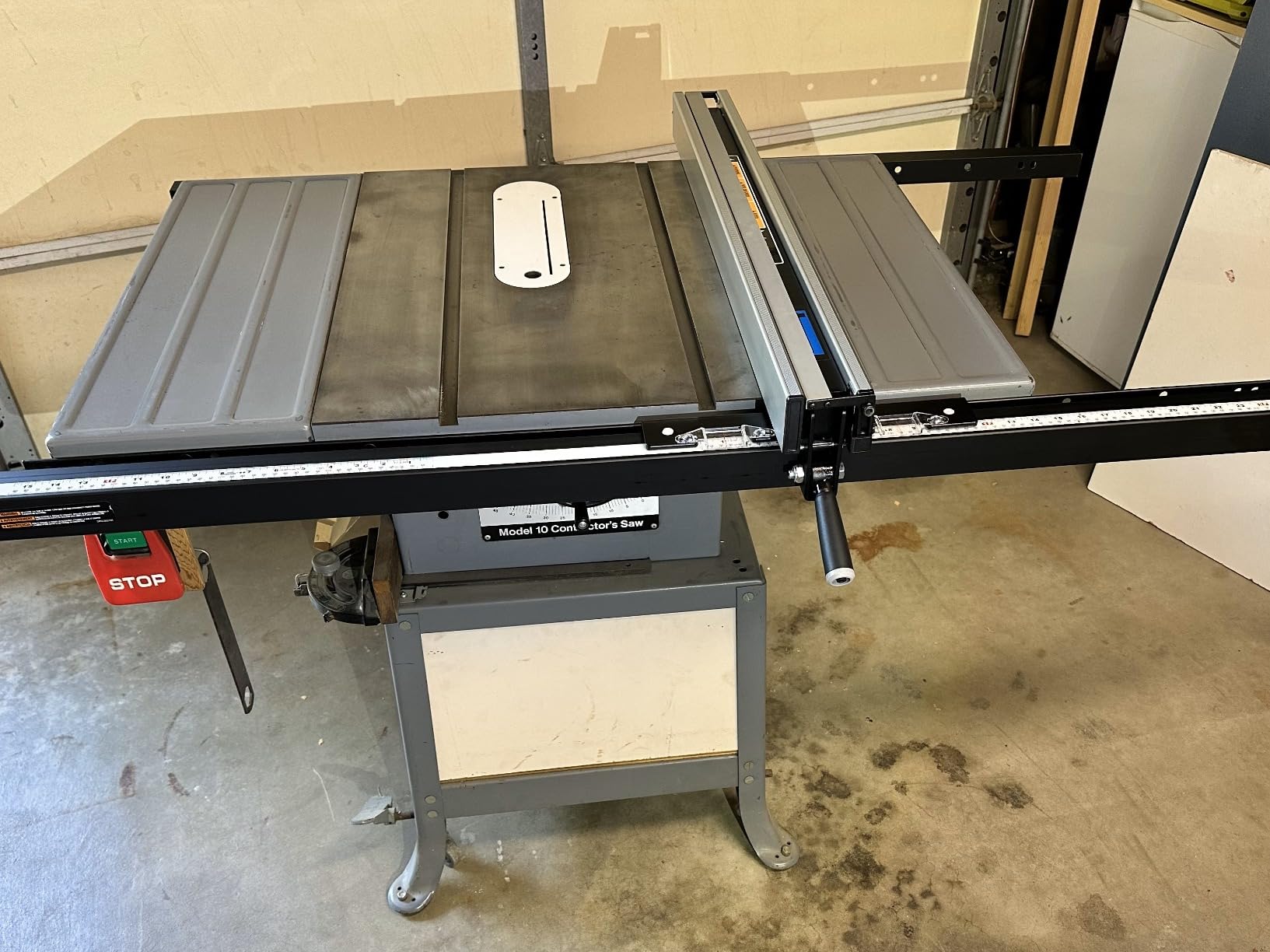
The 38 pound weight is the honest downside of that rigidity. This is not a fence you lift off one-handed between cuts without thinking about your back. The upside is that it does not deflect when you push a 96 inch sheet past the blade with a featherboard.
Three-point locking is where the accuracy comes from
The system clamps at the front rail, the rear rail, and the fence body itself, which is why the twin hairline pointers stay aligned instead of slowly rotating out of parallel. Most factory fences clamp at a single point and rely on the fence being heavy enough to resist racking. Clamp harder to fix that and you dimple an aluminum face permanently.
That failure mode is not theoretical. WoodCentral forum contributors describe fences going out of parallel precisely because they were torqued down harder to compensate for a single-point lock, and the racking that follows is permanent. A three-point design removes the reason to over-torque in the first place.
Rail length, rip capacity, and what the fence does not change
Rip capacity here is 13-1/2 in. on the narrow side of the blade and 30 in. on the wide side, with a 37 inch fence riding a 57-1/2 in. rail. Those numbers come from the geometry of the rails and the width of the table, not from the fence itself. Swapping in a longer fence without longer rails does nothing for capacity.
Worth saying plainly because roundups get it wrong: upgrading a fence almost never increases your rip capacity. It only does so when the new rails extend past the original ones, and long rails are unwieldy in a small shop. What the fence upgrade does buy you is repeatability at any width you already have.
Fit, mounting hardware, and the documentation gaps
This system is designed for Delta table saws and retrofits older ones well. Owners adapt it to other tables with minor drilling, which is a normal afternoon of work if your existing rail pattern is close but not identical.
The most common complaints are administrative rather than mechanical. The printed instructions leave it ambiguous which rail is the front and which is the rear, and some hardware bags arrive without the lock washers shown in the parts list. Decal-style measurement scales also raise fair durability questions, since a worn scale undermines the very precision you installed this for.
2. Shop Fox W1716 Aluma-Classic Fence – Best for Full-Size Sheet Goods
Shop Fox W1716 – Aluma-Classic Fence-Standard, 57-Inch
57 inch rails
30 inch rip capacity
53.3 lb
Cam-action lever lock
+ Pros
- Handles full-size panels and sheet goods
- Quick positive cam locking
- Wide right-angle face aids accuracy
- Heavy build resists job-site abuse
- Cons
- Heaviest and priciest system here
- Bulky 57 inch footprint needs floor space
If your work is breaking down 4 by 8 foot sheets, rail length is the whole game. The W1716 runs a 57 inch standard rail system that gives 30 in. of rip on the wide side of the blade, and the fence body is a wide right-angle design that braces the workpiece over a longer contact patch than a conventional flat fence.
Locking is a single cam-action lever. Reviewers like how positive it feels and how quickly it can be released, which matters when you are switching between ripping and crosscutting through a full sheet of plywood.
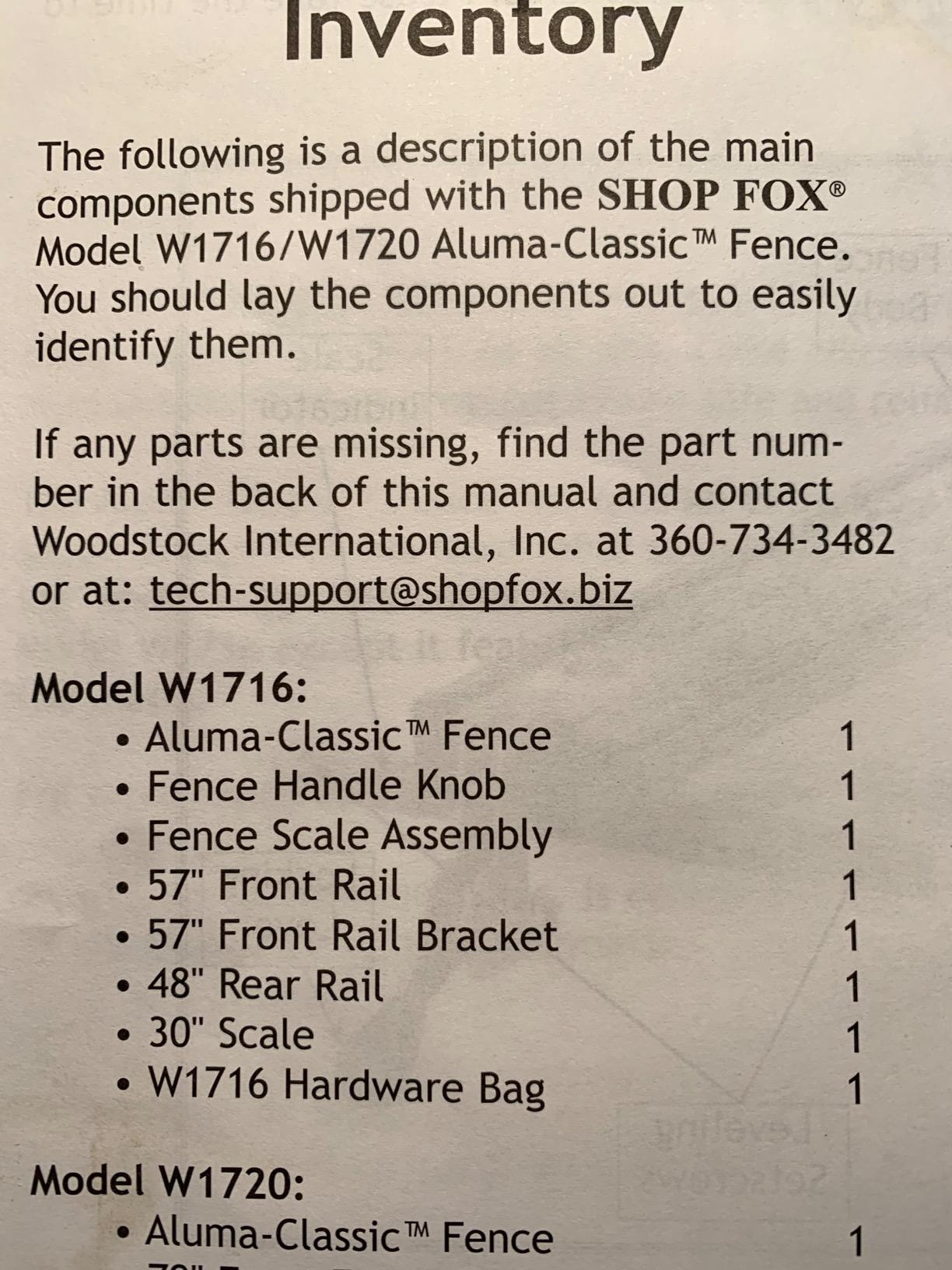
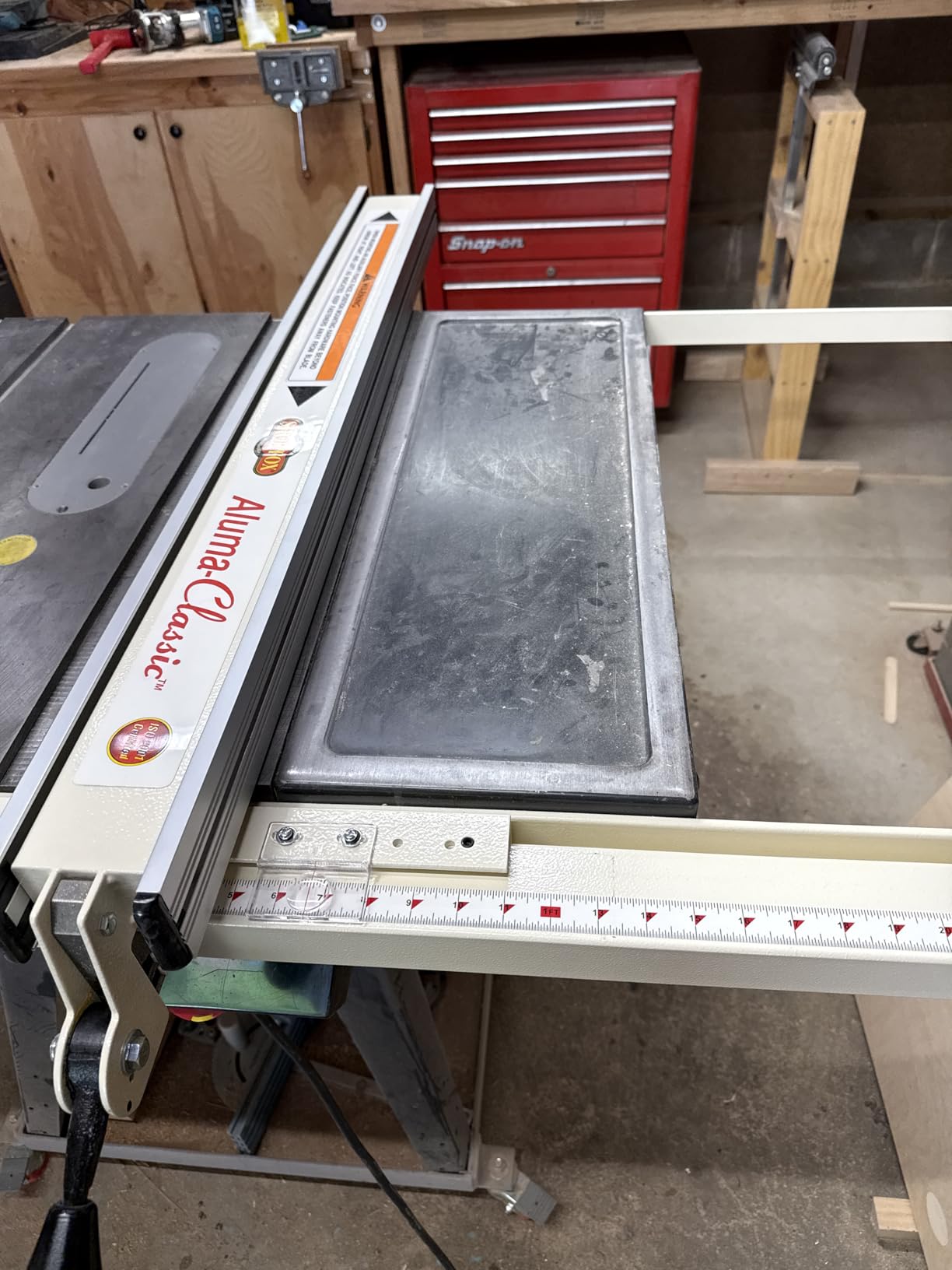
A 57-inch rail system built around panel work
The steel and aluminum body weighs 53.3 pounds, and that mass is the design. It is a fence meant to be bolted to a saw that stays put, not carried between jobs. Owners credit it with holding alignment on large stock where lighter fences visibly flex and wander.
The trade-off is real. A 57 inch footprint needs a large saw and clear floor around it, and on a compact contractor saw the rails can overhang the frame far enough to matter. Before buying, measure the room the rails will actually occupy, not just the saw table.
Cam-action locking and the wide right-angle face
One lever doing the clamping is simpler to reason about than a multi-point system, and it gives an even, repeatable squeeze as long as you close it the same way each time. The wide right-angle face adds vertical support, which reduces the chance of the workpiece tipping away from the fence on a thick panel.
Because the rails are a fixed standard length, this system is closer to a one-size solution than a modular one. That simplicity is a genuine advantage for a shop that cuts the same material day after day and never needs to grow past 30 in. of rip.
Where the 53-pound build becomes a problem
At 53.3 pounds, this is the heaviest item in the group, and it is priced as the premium option too. The weight is a liability on open-frame saws. Long rails plus a heavy fence can overbalance a contractor table, which is the same tipping hazard that makes support legs mandatory on larger systems.
Mobility is the other cost. Moving a saw with a full rail set and heavy fence in the truck can bow the rails and knock the fence out of alignment before you reach the site. If you move your saw regularly, this is a stationary-shop fence even if you own a jobsite saw.
3. INCRA FLIPFNC27-49 Telescoping Flip Fence – Best Budget Path to Indexed Accuracy
INCRA FLIPFNC27-49 Telescoping Flip Fence 27-Inch to 49-Inch
27 to 49 inch range
Telescoping flip design
Silver aluminum
+ Pros
- Repeat cuts without re-measuring
- Reaches stock longer than a standard gauge
- Direct replacement for damaged INCRA fences
- Low cost for an accuracy upgrade
- Cons
- No metric scale on some units
- Extension lacks a non-skid pad
- No adjustment tools included
This is a miter gauge component, not a rip fence, and I want to be straight about that before anything else. What it does is let you repeat an identical cut without re-measuring, which is the accuracy problem it solves. If your question is rip width on a table saw, this is not the product and I would not buy it for that.
It is here because it is the cheapest way to fix a specific and very common failure: an INCRA fence section that has been dropped, dented, or worn past the point where the scale can be trusted.
Repeatability comes from the flip-fence design, not the ruler
The flip-fence design is what earns the accuracy claim. A telescoping section that flips up out of the way lets the fixed scale do the measuring, so the number you read stays fixed while the fence extends. Owners confirm this in reviews, describing repeated cuts made without touching a tape measure.
That is a different mechanism from a rip fence, where the scale moves with the fence and parallelism does the real work. Judge this product on repeatability of a given dimension rather than on how square it holds to a blade.
Telescoping range and what it fits
The range is 27 in. to 49 in., and the mounting hardware is metric Miter Gauge 3000 style using standard hex screws. It is a direct replacement for components on INCRA 1000HD, 1000SE, and 3000 systems, and it works with the INCRA Flip Shop Stop.
Because it is a drop-in section rather than a whole system, check your existing gauge before ordering. If your INCRA uses a different rail standard, this part simply will not bolt on, and no amount of drilling will fix the interface.
The four complaints that repeat in reviews
Some units arrive with no metric millimeter staircase, which matters if you work in metric. The extension section has no non-skid pad, so it can scratch a laminate table surface, and a few owners report units arriving scratched or dented despite intact packaging.
There is also a fit quirk: some units come in a fraction thicker than the rail they attach to and need trimming to sit correctly. Adjustment tools are not included, so keep your hex keys handy. None of these is disqualifying, but all four are worth knowing before you order.
4. BOW Products Ultimate Table Saw XTENDER and Safety Kit – Best for Jobsite Saw Safety
BOW Products Ultimate Table Saw XTENDER & Safety Kit – Includes 46” XT XTENDER Fence, 2-XT1 Support Feeds, 2-XT2 T-Track Clamps, FP1 FeatherPRO Featherboard, and FP4 FencePRO Featherboards
46 inch XTENDER fence
T-slots on face, top and back
About 14 lbs
Featherboards included
+ Pros
- Owners rate it 4.7 across 53 reviews
- Attaches to most existing fences fast
- Turns a portable saw into a larger surface
- Accessories mount on three faces
- Cons
- Not predrilled
- so featherboards can pivot
- Push stick holder may need removal on some saws
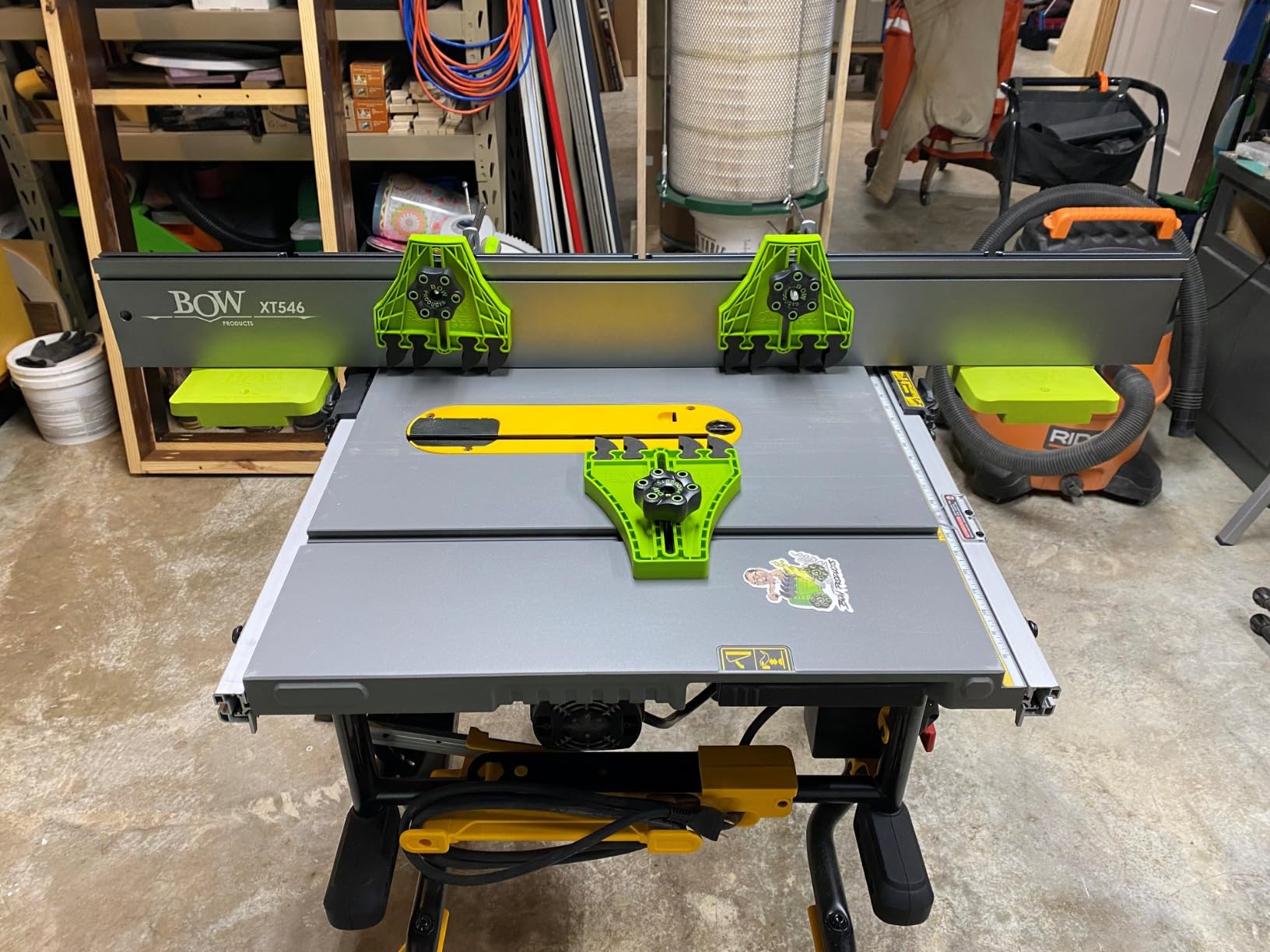
This is the kit I would hand someone who rips sheet goods on a jobsite every week. It is not a replacement fence. It is a bolt-on extension that attaches to whatever fence you already own in under ten seconds and gives you a longer, accessory-ready face with no saw modification.
Owners call it close to indispensable on portable saws, and its 4.7 average across 53 reviews is among the highest in this group. The value is in the bundle: you get a 46 inch XTENDER fence, two XT1 feed supports, two XT2 T-track clamps, an FP1 FeatherPRO, and two FP4 FencePRO featherboards in one box.
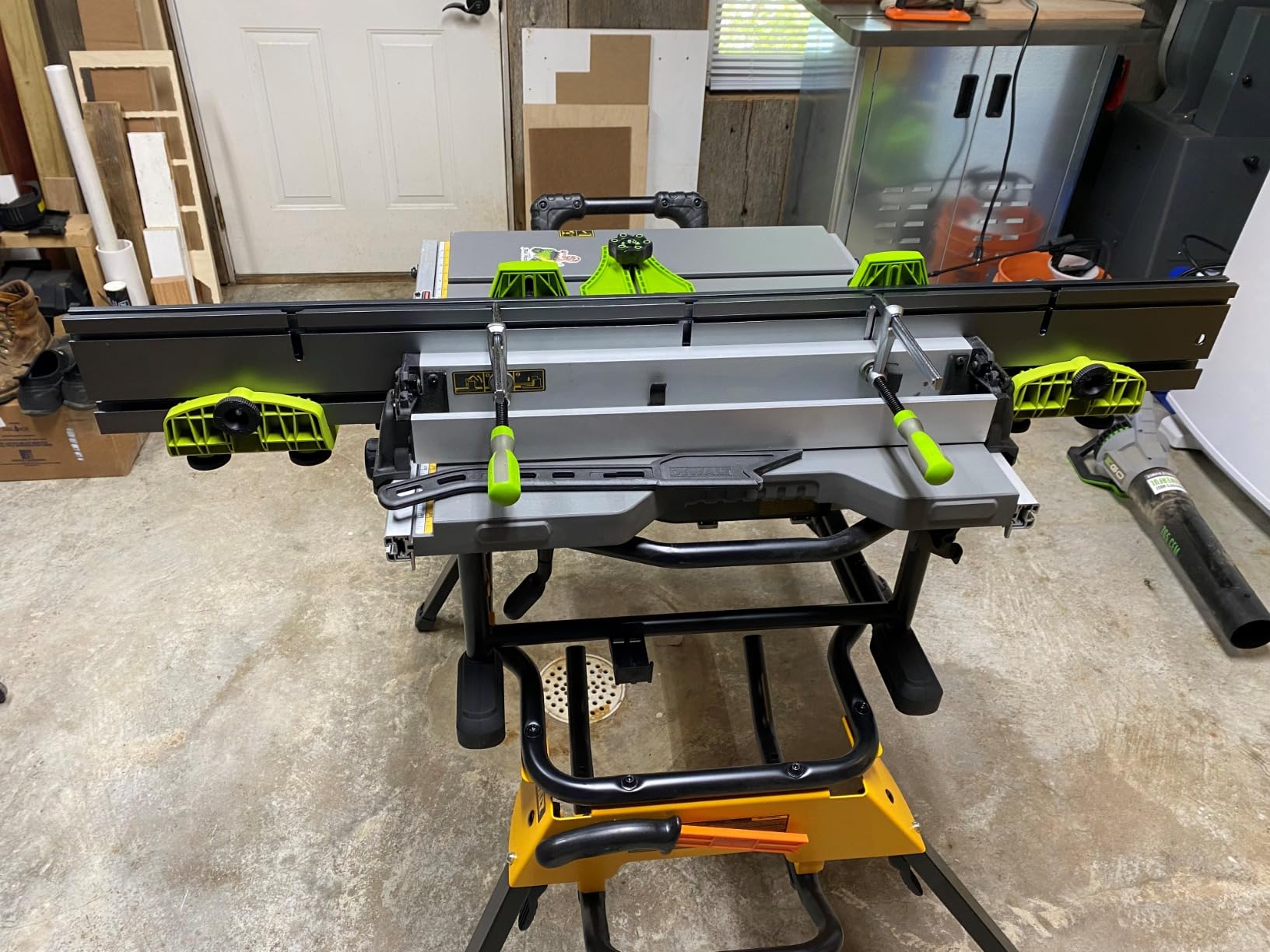
Ten-second attachment and the mounting slot that decides compatibility
Milled slots let the extension sit in infeed, outfeed, or centered position, and a special wide mounting slot accepts a Delta UniFence or Harvey fence. That slot is the single most important compatibility feature on the whole kit, because most portable saws ship with a ratcheting fence that no standard bracket grips properly.
At roughly 14 pounds, the extension adds meaningful mass to the front of a portable saw. On a folding jobsite table that is a real consideration when you are also carrying the saw up stairs.
T-slots on three faces and what they do for accuracy
The T-slots run the full length of the fence on the face, the top, and the back, accepting 5/16 in. or 1/4 in. T-bolts. The face slots take roller supports and hold-downs. The top slot takes a tall featherboard. The back slot is where auxiliary fences and stop blocks live.
This is the part that genuinely improves cut quality rather than convenience. A roller support under the infeed side stops long stock from dropping and pulling away from the fence mid-cut, and a hold-down applies steady downward pressure so the workpiece stays seated as it passes the blade.
Why featherboards need two slots, not one
The most common owner request is more predrilled slots, because the included featherboards can pivot at a single contact point. A featherboard that pivots applies uneven pressure and will guide stock slightly off line.
The workaround is to add a second T-bolt clamp from the XT2 set so the featherboard cannot rock. Worth doing before the first sheet goes through, and a good reason to buy the two XT2 clamps even if the kit already includes them.
5. Woodpeckers ARF-BSCS Auxiliary Rip Fence – Best for Compact and Jobsite Saws
Woodpeckers Auxiliary Rip Fence, 36 Inch Job Site Table Saw Fence Extension, Infeed or Outfeed Support, T-Track Slots, Clamping Blocks – ARF-BSCS
36 inch fence, 3-1/2 in. tall
10 lb
Aluminum
Exactly 2 in. thick with blocks
+ Pros
- Sized for compact and jobsite tables
- Installs without modifying the fence
- Two 7 inch material supports both sides
- T-track slots in the face
- Cons
- Standard track clamps sold separately
- 36 inch version is short for full sheets
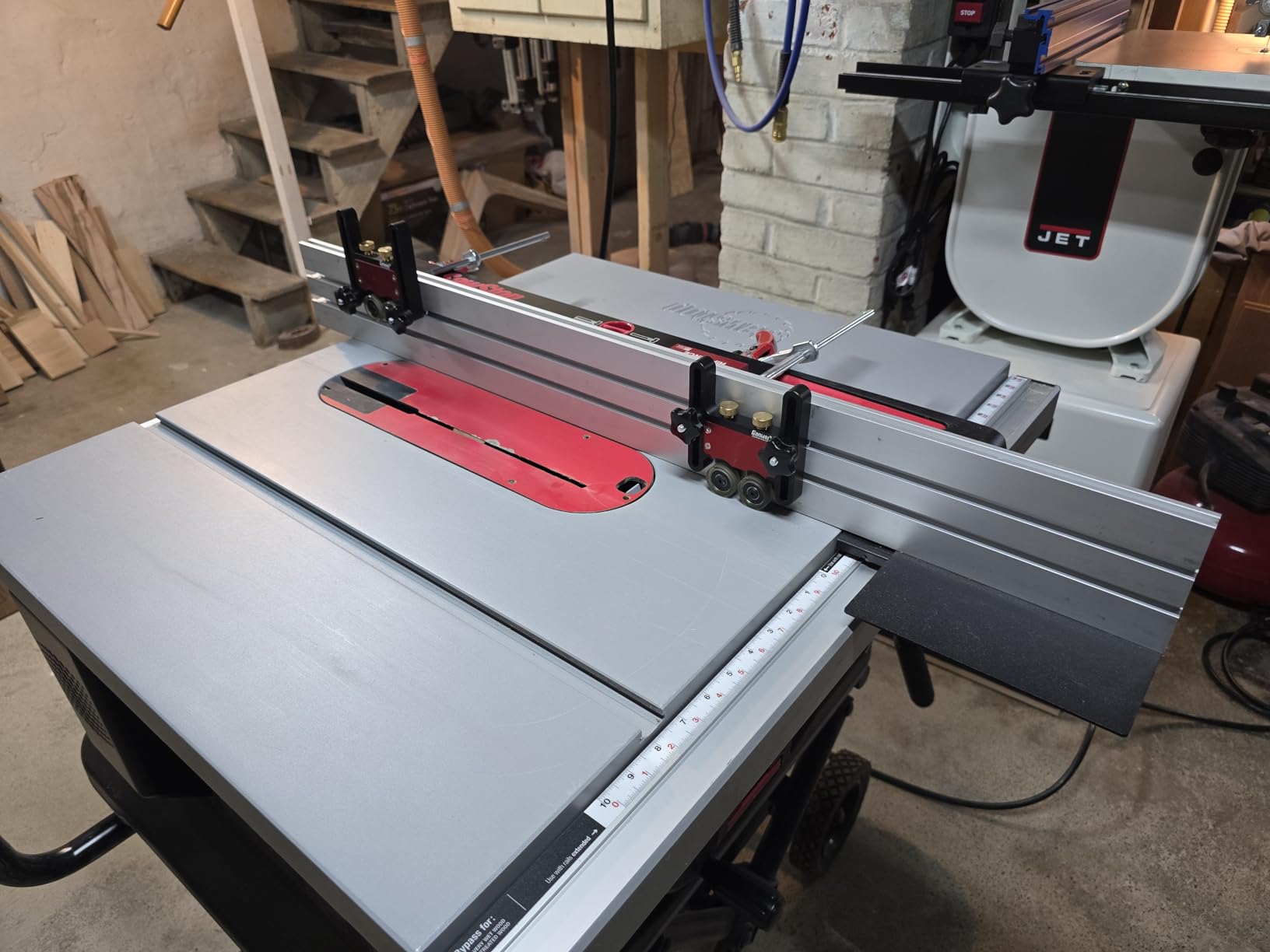
Where the XTENDER aims at a big portable saw, the Woodpeckers ARF-BSCS is deliberately compact. At 36 in. long, 3-1/2 in. tall, and 10 pounds, it bolts to a small fence on a jobsite table, a vintage contractor saw, or a band saw table without turning the machine into something you cannot move.
Buyers like the quick, no-modification install and the paired material supports. The single recurring note is that track clamps are not included.
A two-inch total footprint that clears compact tables
The fence plus its sliding clamping blocks measure exactly 2 in. thick. That number is published, and it is the one you need to check, because it determines whether the assembly clears your existing fence when the block is positioned. Measure before you order rather than after.
Because the clamping blocks slide, you can reposition the grip along the length of the fence rather than committing to one mounting point. On an old fence with a worn section, that flexibility lets you move the load away from the damage.
Material supports on both sides of the blade
Two 7 inch material supports extend the support surface to both the infeed and outfeed side. That is the feature that turns a small table saw into a workable platform for sheet material, because the workpiece no longer tips once more than a foot or two overhangs the stock fence.
Support matters for accuracy as well as safety. A workpiece that sags mid-cut changes the cut width, and the error is invisible until the parts do not fit together.
Track clamps are not included, and that matters
The built-in T-track slots in the face accept standard track accessories, but you have to supply the clamps. Budget for a set of sliding T-track bolts before you start, because without them the slots do nothing.
On sizing, a 48 inch version exists and is the better choice if you handle full sheet goods. The 36 inch model is the right answer when the constraint is the size of the saw, not the size of the material.
6. Peachtree Woodworking Supply Uni Style Fence Section – Best Delta UniFence Upgrade
Peachtree Woodworking Supply Uni Style Table Saw Fence with Sacrificial
One-piece extruded aluminum
43 x 2 x 3 in.
UHMW sacrificial face
Mini tracks accept 1/4-20 bolts
+ Pros
- Highest rated in the group
- Milled mini tracks take standard hardware
- UHMW face enables rabbet cuts
- Much more rigid than the original section
- Cons
- Fence section only
- base and rails not included
- Only fits the Delta UniFence standard
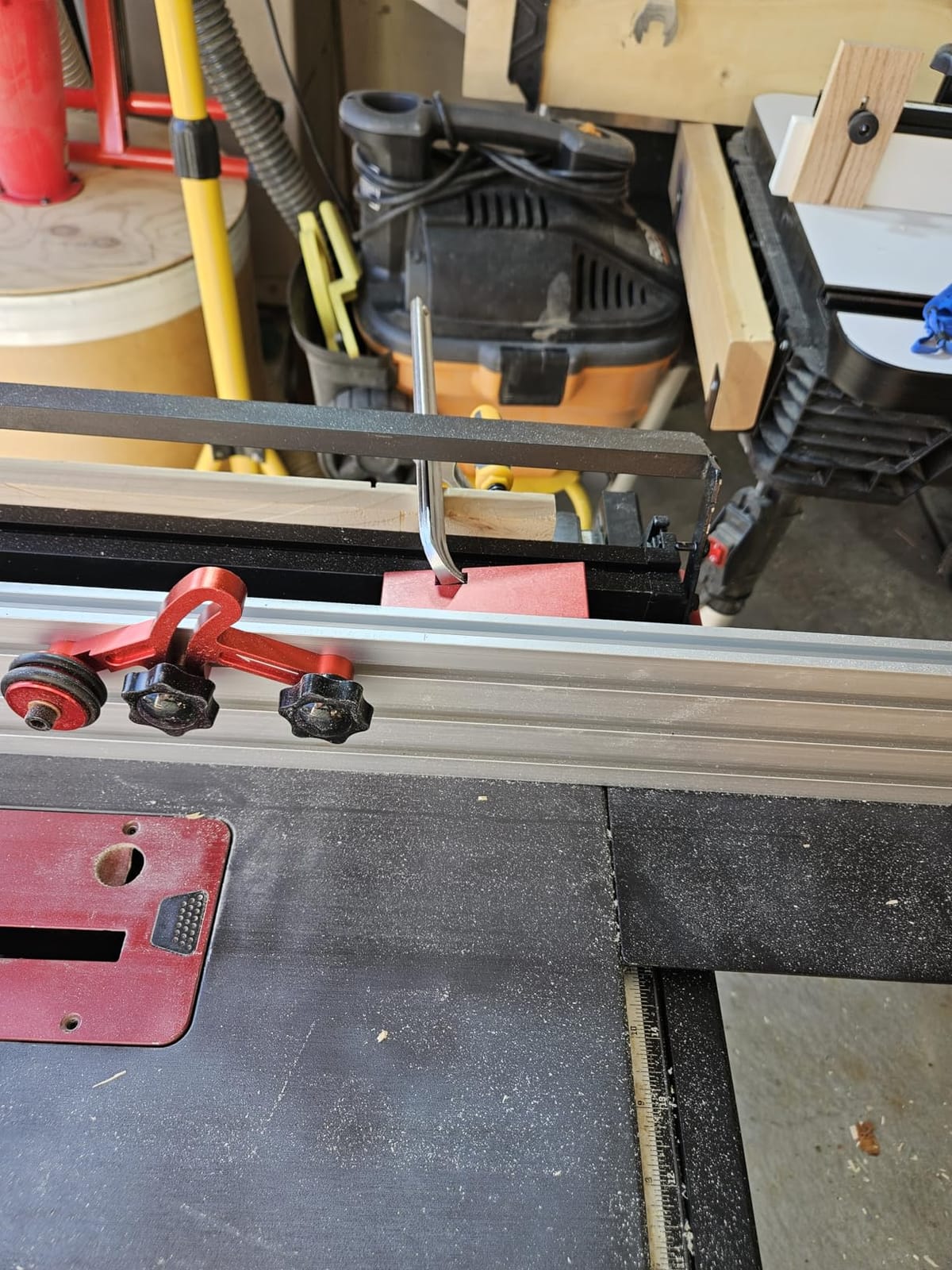
The problem with an older Delta UniFence section is that it is a multi-piece assembly that racks under clamping force. Once it twists into a parallelogram, no amount of tightening brings it back, because the deformation is permanent. This section replaces that assembly with a single extruded aluminum body.
It carries the highest average rating in the group at 4.8, with reviewers reporting no one or two star reviews. The gain is not a new measurement system. It is a fence that stops moving after you set it.
One-piece extruded aluminum replaces the racking section
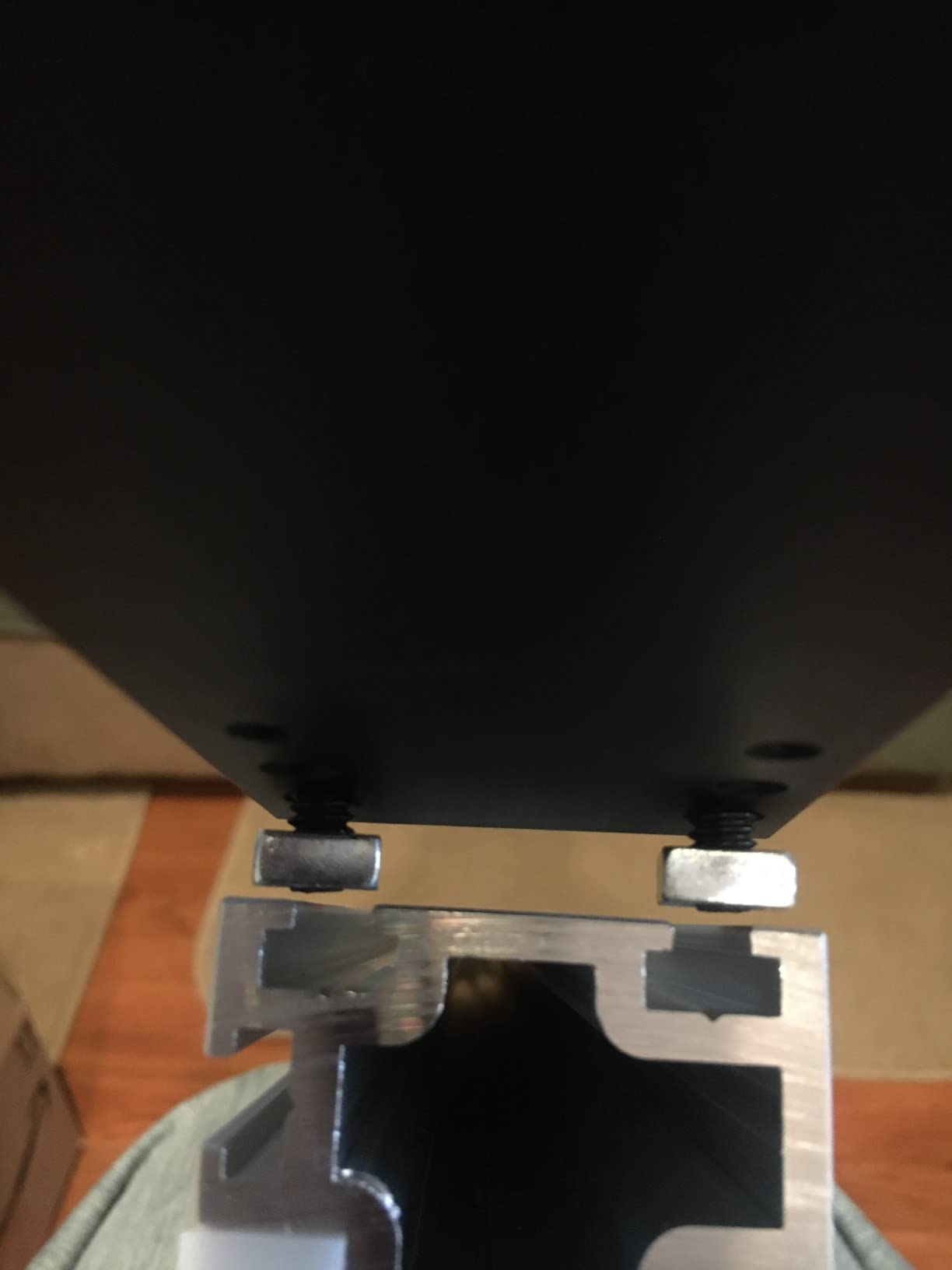
Racking is the failure mode that brings most accuracy complaints in the first place, and it is usually traced to a fence that deforms under the clamp. A one-piece extrusion has no joints to work loose and no stacked plates to skew, which is why this section is the single most direct fix available for a UniFence owner.
Owners describe the result simply as far more rigid than what it replaced. On a Delta saw that has been in service for years, that difference shows up in repeat cuts long before it shows up in any spec sheet.
Mini tracks and the UHMW sacrificial face
Several mini tracks run the full length of the fence and accept 1/4 in. x 20 hex head bolts. Because that is standard hardware, most store-bought jigs, stop blocks, and featherboard mounts fit without adapters, which is a bigger deal than it sounds for anyone building shop-made jigs.
The recessed front face takes a 1/2 in. thick UHMW sacrificial strip. That enables clean rabbet cuts and cut-to-length parts, because the blade can cross the face plane without gouging aluminum. A sacrificial face is a wear item you will replace eventually, which is the trade for not having to re-machine the fence.
This is a fence section, not a fence system
Two things to be clear about. The Delta UniFence base and rails are not included, so if you have no original fence at all this is the wrong purchase. And it only fits the Delta UniFence mounting standard, so it will not adapt to a DeWalt, Bosch, or Craftsman without fabricating an interface.
Within that narrow envelope it is very good value. If you own a Delta UniFence and your cuts will not repeat, this is a small, well-targeted fix rather than a whole system replacement.
7. RED HOUSE TOOLS Multi T-Track 48 Inch Fence System – Best Base for Custom Jigs
RED HOUSE TOOLS Multi T-Track – 3″ Universal T-Track for Woodworking | Anodized Aluminum T Track Fence System | Woodworking Accessories | 48″ Fence System (Set of 2) | Blue
Two 48 inch segments
8.5 lb
Anodized aluminum
3 inch multi-track profile
+ Pros
- Accurate as a miter saw fence replacement
- Accepts standard 1/4-20 accessories
- Doubles as raw material for custom jigs
- Lightweight at 8.5 pounds
- Cons
- Not predrilled
- holes must be drilled
- Extruded faces not machined to a tolerance
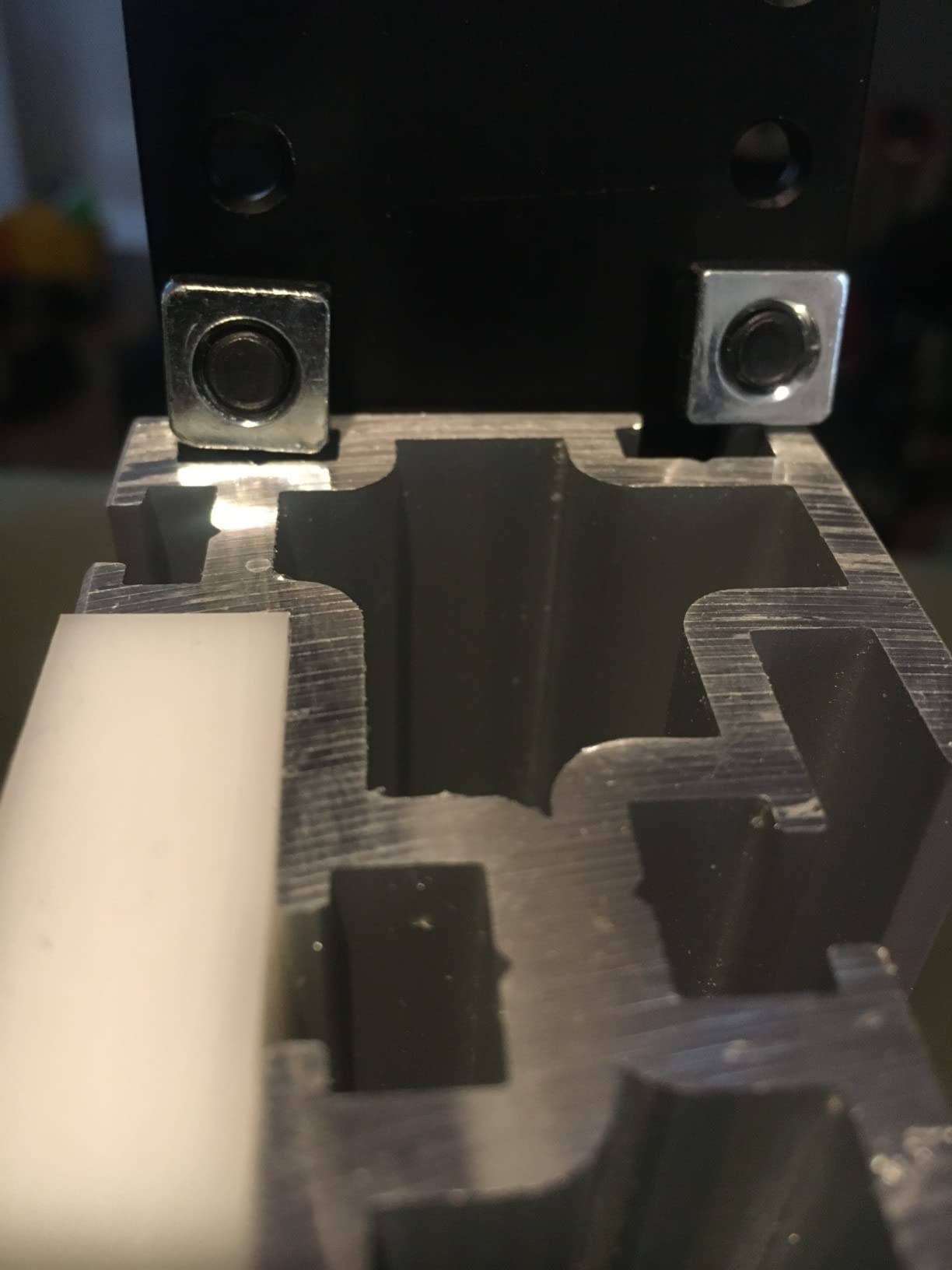
This one does two unrelated jobs. Owners use it as a direct replacement fence for a miter saw, where reviewers report dead-nuts accuracy, and other buyers treat the 3 in. wide rails as raw material for router table fences, bandsaw fences, and shop-made jigs.
The claim to check carefully is that these rails are 25 percent lighter than conventional extruded rails. The set of two 48 in. segments weighs 8.5 pounds total, so the weight claim is plausible. The surfaces, however, are straight but not machined to a stated tolerance after extrusion.
A precision replacement fence and a jig-building blank in one
Used as a miter saw fence, reviewers report it being accurate to 48 inches and holding alignment with a gap underneath so sawdust does not build up in the cut. That last detail is an accuracy fix most people never think about. Dust packed into the cut line is a real source of error in a miter gauge.
Used as raw material, the value is the 3 in. wide multi-track profile. It accepts standard 1/4-20 hardware, so rollers, hold-downs, and stop blocks mount directly with no special adapters.
Weight savings and the accuracy cost of unmachined faces
Light weight is a genuine advantage for a jig you carry around the shop. It is also a compromise, and you should know which one you are trading. A lighter section is a section with less material resisting deflection, and the faces are not machined to a published tolerance.
For a router table or a shop jig, that is an acceptable trade because the workpiece is not usually passing at a fixed dimension. For precision crosscutting where you are relying on the face for a fit, verify the squareness on your own saw before you trust it.
Undrilled holes and missing brackets are the real price
Two practical warnings before ordering. The rails are not predrilled, so every mounting hole has to be drilled by you, and the brackets shown in the product photos are not included. Anodized colors also do not always match the listing photos, so do not plan a color-matched build around the images.
If you are comfortable drilling and aligning, the raw material value is excellent. If you want a turnkey fence for a table saw, this is not that product.
8. DEWALT 514013620 Fence Assembly – Best OEM Repair for a Cracked Miter Saw Fence
DEWALT 514013620 Fence Assembly
OEM part 514013620
2.3 lb
Fits DEWALT and BLACK AND DECKER
Fence assembly only
+ Pros
- Exact OEM replacement for a damaged fence
- Works across many DEWALT and B&D models
- Far cheaper than replacing the saw
- Usually installs without modification
- Cons
- A repair part
- not an accuracy upgrade
- Dimensions listed generically
- confirm fit by model
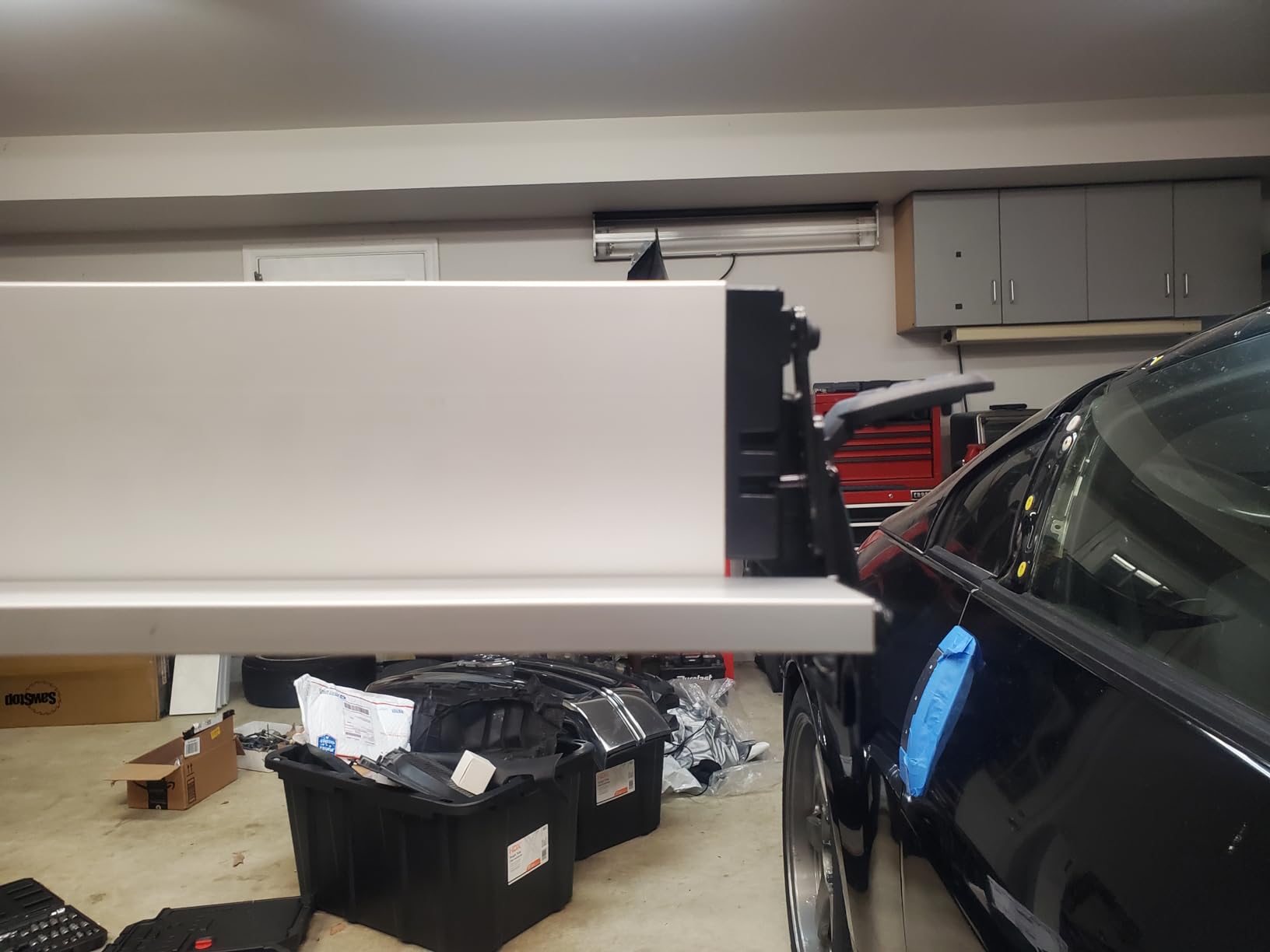
This is a replacement part, and I will not pretend otherwise. It is a DEWALT OEM fence assembly, part number 514013620, sold to put a cracked or bent miter saw fence back into spec rather than to raise accuracy above factory level.
I included it because a broken fence is an accuracy failure in the plainest sense. A bent miter saw fence produces crosscuts that are not square, and no amount of careful measuring fixes a part that is already deformed.
What this part is, stated plainly
The assembly weighs 2.3 pounds and is a non-powered mechanical component. Buyers are largely satisfied that it restores their saw to working order at a fraction of the cost of a new saw, and it typically arrives intact and installs without modification.
With 313 reviews averaging 4.6, this is a well-established repair part. The volume reflects how many miter saw fences take a hit, not how much the part improves a cut.
Compatibility runs on the model number, not the brand
It fits various DEWALT and BLACK AND DECKER miter saw models. The listed product dimensions are given generically as 1 x 1 x 1 inches, which tells you nothing useful about fit, so confirm against your model number before ordering.
That single step prevents almost every return in this category. Miter saw fences look similar across a decade of production and the fit is not interchangeable between families.
Why this belongs in an accuracy roundup at all
Because accuracy is a system property, not a marketing claim. A factory fence in spec, a sharp blade, and a square miter gauge give you a square cut. Take any one of those away and the result drifts, regardless of how good the fence upgrade would be.
What this part will not do is improve rip accuracy on a table saw. It belongs on a miter saw, and if your cuts are wandering there, start with this before spending money anywhere else.
How to Choose a Table Saw Fence for Accuracy
The single most useful thing a buyer can do is decide which fence family belongs on the saw before comparing brands. Most disappointed fence purchases are not bad products in the wrong family.
Three fence families, three accuracy ceilings
Standard and sliding fences are the factory fences on most contractor and jobsite saws. A quality one on a sound saw is genuinely accurate, and there is no shame in keeping it. The ceiling is set by the single-point lock, which is why they drift over years.
T-square fence systems are the rail-mounted family: a fence body riding a front rail, clamped at multiple points, with a rear rail optional. This family holds calibration the longest because there are few moving parts and nothing to stretch. The Delta T3 and the Shop Fox Aluma-Classic are both in this class, and they are the two picks I would make for repeatable ripping.
Auxiliary T-track fences bolt onto an existing fence to add length, T-track mounting, and tapering capability. They improve safety and accessory mounting more than they improve raw parallelism, because the accuracy is still set by the fence underneath. Both the Woodpeckers ARF and the BOW XTENDER sit here.
Locking consistency matters more than the lock itself
Ask how many points the fence clamps at and how much force it takes. A three-point lock that closes smoothly at moderate torque beats a single-point lock you have to crank down hard to stop it racking. Over-torquing dimples aluminum faces and bakes in the very error you are trying to remove.
This is why I rank the Delta system first. Three-point locking with twin hairline pointers addresses parallelism directly rather than asking you to trust a heavier block.
Rip capacity is set by rails, not by the fence
Rip capacity is a function of rail length and table width. A new fence bolted to your existing rails gives you the same maximum rip you had before, with better repeatability inside that range. Capacity only improves when the new rails run longer than the old ones.
Longer rails bring two costs that rarely get mentioned: they add mass high up, which can tip an open-frame contractor saw, and they need a support leg or two to stop the table buckling under fence plus workpiece. On any fence over roughly 30 in., treat support legs as required rather than optional, and budget for a mobile base extension if the saw moves at all.
Material: aluminum versus steel versus a sacrificial face
Aluminum is the standard and, in this application, is as rigid as steel for a given weight. Steel is stronger but heavier, and the rails are steel on nearly every system regardless of what the fence body is made from. Weight matters more than raw strength because a fence you can move easily is a fence you will actually align properly.
The third option is a sacrificial face. UHMW or laminated plywood lets the blade cross the face plane for rabbet and cut-to-length work that a solid metal face cannot do. The tradeoff is a wear cycle, since the strip needs replacing when it gets chewed.
The extras that quietly double the cost
Nobody lists the full price of a fence upgrade, and buyers get ambushed. A T-square system commonly needs front and rear rails, a table board, support legs, a scale and pointer set, and often a mobile base extension, on top of the fence itself.
Read each listing for what is included. The Delta system includes an alignment gauge and mounting hardware. The Woodpeckers ARF excludes track clamps. The Peachtree section excludes the UniFence base and rails entirely. The RED HOUSE rails exclude mounting brackets and arrive undrilled. The BOW kit is unusual in bundling the featherboards and feed supports with the fence, which is most of why owners find such strong value in it.
Who each fence suits by saw and skill level
Beginners on a jobsite saw usually have a saw that is fine and a fence that has drifted. A T-square system like the Delta T3 is the right investment, or a T-track auxiliary fence plus featherboards if the budget is tighter. Install a featherboard early. It improves cut quality more than most fence upgrades and prevents the pressure-related errors that people blame on the saw.
Cabinet and full-size contractor saws in a fixed shop can justify the Shop Fox rail set, where the extra capacity and rigidity matter for sheet work.
Fine woodworkers doing joinery want indexed stops and a scale they can trust, which points at INCRA-based systems.
Anyone moving the saw should avoid long rail systems entirely. Fences get knocked out of alignment in transit, and the Bow or Woodpeckers bolt-on approach travels far better.
How to Test and Calibrate Your Fence in Five Steps
No competitor in this space publishes a method, and it is the question behind the word accuracy. Here is the routine I use after any fence install and again every few months.
1. Clean every contact surface first. Dust and chips between the fence and the rail are the most common cause of a fence that will not hold a setting, and they are also the easiest thing to fix. Brush the rails, the fence rollers, and the clamp faces, then wipe with a damp rag and let them dry.
2. Check squareness to the blade with a machinist square. Place the square against the fence face and the blade plate at several points along the fence travel. Any visible gap means the fence is out of square. Correct it before going further, because a racked fence produces taper rather than a consistent width.
3. Test parallelism with a dial indicator or a straightedge and a machinist square. Zero the indicator on the blade at one point near the front, then move it to the rear without moving the fence. The reading tells you how far the fence drifts out of parallel across the table. Re-zero at each position to keep the reading meaningful. A fence that holds within a few thousandths of an inch across its travel is doing its job.
4. Make a test cut and measure it in two places. Rip a long offcut and measure at each end. If the two readings differ, the fence is not parallel to the blade along its length. If they match but the width is wrong, your scale reading is off, which is a far easier problem. Cutting a sacrificial strip for this is worth more than any guesswork.
5. Re-check after a month of normal use. Fences settle. Re-run steps 2 through 4, and note any drift in thousandths so you know the rate. A fence that has moved measurably in a month has a loose mount or a damaged face, and tightening it will only hide the problem.
Two habits keep this manageable. Never tighten a fence harder than feels necessary to stop movement, because that is what causes permanent racking. And keep a featherboard on every rip cut, since steady pressure does more for consistency than any adjustment you can make with a wrench.
Fence or Crosscut Sled: What Each One Is For
A fence rips. A crosscut sled crosscuts and breaks down panels. No amount of fence quality changes that division, and the recurring r/woodworking orthodoxy is that trying to crosscut accurately with a fence is fighting the tool.
The reasoning is sound. A miter gauge in a tall fence can produce a decent crosscut, but it depends entirely on the gauge being square and the fence holding the gauge without movement, which is two chances to fail. A good sled clamps the workpiece to a rigid body that stays square to the blade by design.
Buy the fence for ripping accuracy. Buy the sled for crosscutting accuracy and panel breakdown. Many owners run both, and the pairing is cheaper than replacing either tool.
Frequently Asked Questions
What is the best table saw fence system?
The Delta 36-T30T3 T3 Fence System is the best overall for repeatable rip cuts, because its three-point locking and twin hairline pointers hold parallelism to within a published 1/64 in. of the blade. For full-size sheet goods the Shop Fox W1716 Aluma-Classic gives you a 57 in. rail set and 30 in. of rip on the wide side of the blade.
How accurate is a Biesemeyer fence?
Style T-square fences like the Delta T3 publish a parallelism figure of within 1/64 in. of the blade, which is a manufacturer spec rather than an independent measurement. The historical forum benchmark for this family is a Wood Magazine test that put a Vega and a Biesemeyer within 0.002 in. of each other on parallelism across range and deflection, and the Vega no worse than 0.003 in. against a Unifence.
Which table saw has the most accurate fence?
Quality rack-and-pinion fences on good contractor and cabinet saws are the most accurate out of the box. An aftermarket T-square system on a budget or jobsite saw can match or exceed them once calibrated, which is why the Delta T3 system works so well on older Delta tables. In every case the fence can only match a saw whose blade and table are already sound.
What is the best material for a table saw fence?
Cast or extruded aluminum is the standard and is as rigid as steel in this application at a fraction of the weight. Steel is stronger but heavier, and the rails are steel on nearly every system regardless of the fence body. A UHMW or laminated plywood sacrificial face is the third option, adding rabbet and cut-to-length capability at the cost of a wear cycle.
Will a fence upgrade increase my rip capacity?
Usually not. Rip capacity is set by rail length and table width, not by the fence, so a longer fence on your existing rails gives you the same maximum rip with better repeatability. Capacity only increases when the new rails run longer than the stock ones, and long rails add weight that can tip an open-frame contractor saw and require support legs.
Do I need support legs with a longer fence?
Yes, on any fence over roughly 30 in. Support legs stop the table buckling under the combined load of fence and workpiece, and they are strongly recommended on open-frame contractor saws to prevent the whole machine tipping. A support leg set or mobile base extension is usually an extra purchase rather than an included part.
Is the INCRA fence worth it?
Yes for fine woodworking, angled work, and repeatable indexed stops, given the telescoping miter and stop system. The flip-fence design is what creates repeatability, since the fixed scale does the measuring while the extension moves. Balance it against the fact that these are miter gauge components rather than rip fences, and that the telescoping section is the part most likely to need replacing.
Who makes the best table saw fence?
No single brand wins every category. Delta covers the full T-square rail systems, INCRA covers indexed accuracy, Shop Fox covers big-box rail sets, Woodpeckers and Bow cover auxiliary T-track extensions, and RED HOUSE TOOLS covers jig-building rails. Pick the family that matches your saw and your work before comparing brands.
The Best Table Saw Fences for Accuracy in 2026
If you want the best table saw fences for accuracy and you own a Delta table, the 36-T30T3 T3 Fence System is the one to buy. Three-point locking, a published parallelism figure, and owners who report setting it once and leaving it alone for years.
If you break down full sheets every week, take the Shop Fox W1716 and accept the weight and the floor space. If your saw moves to job sites, bolt on a Bow XTENDER or a Woodpeckers ARF instead and keep the saw portable. If you rip on a Delta UniFence and nothing repeats, the Peachtree section is a targeted fix for racking rather than a whole new system.
Whichever you choose, run the five-step calibration routine after installation and every few months afterward. A fence that is clean, square, and checked will hold a setting; one that has drifted silently will not. Start with the check, and you may find you never need an upgrade at all.