
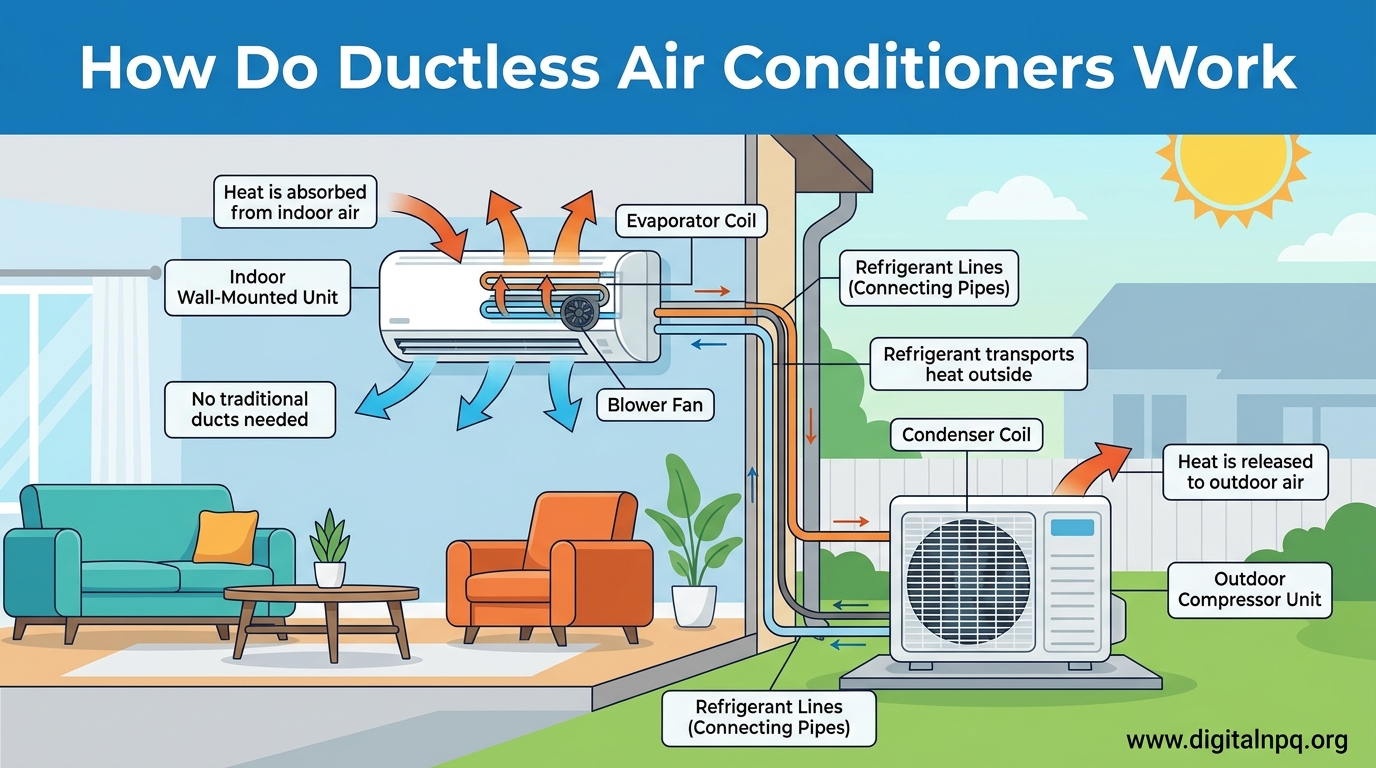
If you have ever wondered how ductless air conditioners work, the short answer is surprisingly straightforward. A ductless system, also called a mini-split, uses an outdoor compressor connected to one or more indoor air handlers through a small conduit in your wall. It cools individual rooms without needing any ductwork at all.
These systems have become one of the most popular cooling options for homeowners who want efficient, room-by-room temperature control. In fact, ductless mini-splits can deliver up to 40% energy savings compared to traditional central air conditioning, according to the U.S. Department of Energy. Whether you live in an older home without existing ducts, are building a room addition, or just want better control over your comfort, understanding how ductless air conditioners work helps you make a smarter choice.
In this guide, our team breaks down the entire cooling process from start to finish. We cover the refrigerant cycle in plain language, walk through every key component, compare ductless systems to central AC, and answer the questions real homeowners are asking.
What Is a Ductless Air Conditioner?
A ductless air conditioner is a type of cooling system that operates without the network of ducts that central air conditioning requires. It goes by several names, including mini-split system, ductless mini-split, and ductless heat pump. The basic setup always involves two main parts: an indoor air handling unit mounted on a wall or ceiling inside your home, and an outdoor condensing unit that sits outside.
These two units are connected by a thin conduit that passes through a small hole in your exterior wall. This conduit houses the refrigerant line, power cable, suction tubing, and a condensate drain. Because there is no need for bulky ductwork running through your attic or walls, installation is far less invasive than putting in a central AC system.
Ductless systems come in two configurations. A single-zone system pairs one indoor unit with one outdoor unit, perfect for cooling a single room or space like a sunroom or garage. A multi-zone system connects multiple indoor air handlers to a single outdoor compressor, allowing you to cool several rooms independently. This zoning capability is one of the biggest reasons homeowners choose ductless systems over other options.
How Do Ductless Air Conditioners Work: The Cooling Cycle Explained
Understanding how ductless air conditioners work means understanding the refrigerant cycle. This is the same basic thermodynamic process that powers your refrigerator and your car’s air conditioner, just on a larger scale. Here is the step-by-step breakdown in plain language.
Step 1: Warm Air Is Drawn Indoors
The indoor air handler contains a fan that pulls warm air from your room through a return grille. A washable filter catches dust, pet hair, and other particles before the air reaches the cooling coils. This is one of the reasons ductless systems tend to improve indoor air quality compared to older window units.
Step 2: Heat Transfers to the Refrigerant
That warm room air passes over evaporator coils filled with cold liquid refrigerant. The refrigerant absorbs the heat from the air, which causes the refrigerant to evaporate from a liquid into a gas. Meanwhile, the now-cooled air is blown back into your room. This is the moment where the actual cooling happens. The warm air gave up its heat to the refrigerant, and what comes back is refreshingly cool.
Step 3: Heated Refrigerant Travels Outside
The warm, gaseous refrigerant travels through the insulated line set that connects your indoor unit to the outdoor unit. This line set passes through a small three-inch hole in your wall, which is why the installation footprint is so minimal compared to running ducts.
Step 4: The Compressor Pressurizes the Gas
Inside the outdoor condensing unit, the compressor squeezes the gaseous refrigerant. This compression dramatically raises both the temperature and pressure of the refrigerant. Think of it like pumping a bicycle tire: as you compress the air, it gets hot. The compressor essentially concentrates the heat energy so it can be released efficiently.
Step 5: Heat Is Released Outdoors
The hot, pressurized refrigerant then flows through the condenser coil in the outdoor unit. A large fan blows outdoor air across this coil, pulling the heat out of the refrigerant and releasing it into the outside air. As the refrigerant loses heat, it condenses back into a liquid state.
Step 6: The Cycle Repeats
Before the liquid refrigerant heads back inside, it passes through an expansion valve that reduces its pressure and temperature. The refrigerant is now cold again and ready to absorb more heat from your indoor air. This cycle repeats continuously while the system runs, keeping your room at the temperature you set on the remote or thermostat.
How Inverter Technology Improves the Process
Most modern ductless mini-splits use inverter-driven compressors rather than old-fashioned fixed-speed ones. An inverter compressor can adjust its speed up or down based on how much cooling is needed. Instead of turning on at full power and shutting off completely like a traditional system, it runs continuously at lower speeds to maintain the exact temperature you want. This variable-speed operation is the main reason ductless systems are so energy efficient and so quiet during operation.
Key Components of a Ductless Mini-Split System
Every ductless air conditioning system has several key components that work together. Understanding what each part does makes it easier to troubleshoot problems and maintain your system properly.
Indoor Air Handler
The indoor unit is the part you see mounted high on your wall, though ceiling-mounted and floor-mounted options exist too. It contains the evaporator coil where heat absorption happens, a blower fan that circulates air, an air filter, and the louvered panels that direct airflow across the room. Most indoor units operate between 19 and 35 decibels, which is quieter than a whisper.
Outdoor Condensing Unit
The outdoor unit houses the compressor, the condenser coil, and an exhaust fan. This is where the heat from your home gets released. The unit sits on a concrete pad or mounted to brackets outside your home, similar to a central AC condenser but typically smaller. It handles the heavy lifting of the refrigerant cycle.
Refrigerant Line Set
The line set is the pair of copper tubes that connect the indoor and outdoor units. One tube carries refrigerant in one direction, and the other carries it back. The lines are insulated to prevent energy loss during the transfer. Refrigerant itself is a specialized chemical compound designed to absorb and release heat efficiently at specific temperatures and pressures.
Condensate Drain Line
When warm humid air meets the cold evaporator coils, condensation forms just like water droplets on the outside of a cold drink. This moisture drips into a drain pan inside the indoor unit and exits through a condensate drain line that runs outside or to a nearby drain. Keeping this line clear is one of the most important maintenance tasks for a ductless system.
Advantages of Ductless Air Conditioners
There are clear reasons why ductless systems have grown so popular in 2026. Our team looked at real homeowner experiences on forums like r/hvacadvice and r/homeowners, and the benefits line up with what manufacturers claim.
Lower Energy Bills
Ductless systems avoid the energy losses that come with ductwork. The U.S. Department of Energy estimates that duct losses can account for more than 30% of energy consumption in central air systems, especially if the ducts run through unconditioned spaces like attics. By eliminating ducts entirely, mini-splits deliver cooled air directly where you need it. Homeowners on Reddit frequently report noticeable drops in their electric bills after switching from window units or adding a ductless system instead of extending existing ductwork.
Zoned Comfort Control
Each indoor air handler operates independently with its own thermostat or remote control. In a multi-zone setup, you can set your bedroom to 68 degrees at night while leaving the living room unit off entirely. This room-by-room control is something central AC simply cannot match without expensive zone dampers and additional hardware.
Quiet Operation
The loudest component, the compressor, sits outside your home. Indoor units typically produce only 19 to 35 decibels of sound. For comparison, a quiet library is about 40 decibels. Multiple Reddit users in r/hvacadvice have described their mini-split systems as nearly silent during operation, which is a major upgrade from the drone of a window unit.
Flexible Installation
Because ductless systems only require a small hole for the conduit, they can be installed in spaces where adding ductwork is impractical or too expensive. Older homes, room additions, converted garages, finished attics, and sunrooms are all ideal candidates. The installation typically takes one day with a professional crew.
Year-Round Use With Heat Pump Models
Many ductless mini-splits are actually heat pumps, meaning they can reverse the refrigerant cycle to provide heating in colder months. The same system that cools your home in summer can warm it in spring and fall, potentially eliminating the need for a separate heater in milder climates.
Disadvantages and Limitations of Ductless Systems
No cooling system is perfect, and ductless air conditioners have some genuine drawbacks worth considering before you invest.
Higher Upfront Cost
Ductless systems cost more upfront than window units and, in some cases, more than central AC on a per-room basis. The equipment itself, plus professional installation with proper refrigerant charging, represents a real investment. However, lower operating costs over the system’s 12 to 20 year lifespan often offset this initial expense.
Cold Weather Performance Drops
Standard ductless heat pumps lose efficiency as outdoor temperatures drop below freezing. At very low temperatures, the system struggles to extract heat from outside air for heating mode. Cold-climate rated models perform better, but supplemental heating may still be necessary in regions with harsh winters.
Aesthetic Considerations
The indoor air handler is mounted on your wall and is always visible. While modern units are sleeker than ever, some homeowners simply do not like the look of a unit on their wall compared to hidden ductwork with floor or ceiling registers.
Contractor Availability Varies
A recurring theme on r/hvacadvice is frustration with finding contractors who are experienced with ductless systems. In some regions, particularly in parts of the United States where central AC has been the default for decades, fewer HVAC technicians specialize in mini-split installation. This can make getting quotes and service more difficult depending on where you live.
Ductless vs Central Air Conditioning: How They Compare
Choosing between a ductless system and central AC comes down to your home, your budget, and your cooling needs. Here is how the two stack up against each other.
Energy Efficiency
Ductless systems generally win on efficiency. Central air systems lose a significant amount of cooled air through duct leaks and thermal transfer in unconditioned spaces. Ductless systems deliver cooled air directly into each room with no transit losses. Modern mini-splits often achieve SEER ratings of 20 to 30, while standard central units typically range from 14 to 22 SEER.
Installation Complexity
If your home already has ductwork in good condition, adding or replacing a central AC system is relatively straightforward. If your home has no ducts, installing them is a major construction project. Ductless installation, by contrast, only requires mounting the units and running the line set through a small wall opening.
Zoning and Control
Central AC with zone control exists but requires motorized dampers, multiple thermostats, and specialized ductwork design. Ductless systems offer native zoning because each indoor unit has its own controls. For homes where different family members prefer different temperatures, or where certain rooms are used at different times of day, ductless zoning is far more practical.
Best Use Cases
Central AC makes the most sense for larger homes that already have functioning ductwork. Ductless systems shine in older homes without ducts, room additions, small apartments, and spaces where individual room control is a priority. Many homeowners actually use both: a central system for the main living areas and a ductless unit for a problem room that never gets cool enough.
Sizing a Ductless AC: BTU Requirements by Room Size
Choosing the right size ductless system is critical. An undersized unit will run constantly and never reach your target temperature. An oversized unit will short-cycle, turning on and off too frequently, which wastes energy and wears out components faster.
The standard rule of thumb is 20 BTU per square foot of living space. However, this is just a starting point. Several factors can adjust your actual BTU needs up or down.
General Sizing Reference
A room between 150 and 250 square feet typically needs a 6,000 to 8,000 BTU unit. A 250 to 400 square foot room calls for 8,000 to 12,000 BTU. Larger spaces from 400 to 650 square feet usually require 12,000 to 18,000 BTU. For open areas between 650 and 1,000 square feet, you are looking at 18,000 to 24,000 BTU. Spaces over 1,000 square feet may need a multi-zone setup with more than one indoor air handler.
Factors That Affect Sizing
High ceilings increase the volume of air that needs cooling, so add roughly 10% to your BTU calculation for ceilings over 9 feet. Rooms with large south-facing windows or poor insulation may need an additional 10 to 20% capacity. Kitchens generate extra heat from appliances, so factor in another 4,000 BTU if the unit will cool a kitchen space. The number of occupants also matters: add about 600 BTU per person beyond two for rooms that regularly host more people.
Installation and Maintenance of Ductless AC Systems
Proper installation and regular maintenance are what separate a ductless system that runs flawlessly for 15 years from one that causes headaches after two.
What Professional Installation Involves
A trained HVAC technician mounts the indoor unit on your wall, secures the outdoor unit on a pad or brackets, drills the conduit hole through your wall, connects the refrigerant lines, runs the condensate drain, and charges the system with the correct amount of refrigerant. The process typically takes between 4 and 8 hours for a single-zone system. Multi-zone installations may take two days.
We strongly recommend professional installation. Refrigerant handling requires EPA certification, and improper charging is the number one cause of early system failure. The warranty on most ductless systems also requires professional installation to remain valid.
Maintenance You Can Do Yourself
Clean or replace the indoor air filters every 4 to 6 weeks during heavy use seasons. Most indoor units have washable mesh filters that slide out easily. Rinse them under running water, let them dry completely, and slide them back in. This single task has the biggest impact on your system’s efficiency and longevity.
Check the condensate drain line monthly to make sure it is flowing freely. A clogged drain can cause water to back up into the indoor unit and leak down your wall. Pouring a cup of vinegar through the drain line every few months helps prevent algae buildup.
Keep the outdoor unit clear of debris, leaves, and vegetation. Maintain at least two feet of clearance around all sides so the fan can exhaust heat properly. In winter, brush snow off the top of the unit if it is not elevated on brackets.
Annual Professional Maintenance
Schedule a professional tune-up once a year, ideally in spring before the cooling season begins. A technician will check refrigerant levels, inspect electrical connections, clean the evaporator and condenser coils, verify proper airflow, and test the system under load. This annual visit catches small problems before they turn into expensive repairs.
How Do Mini Splits Work in Cold Weather?
This question comes up constantly on HVAC forums, and it is a valid concern. The answer depends on the type of system you have and where you live.
When operating in heating mode, a ductless heat pump reverses the refrigerant cycle. Instead of absorbing heat from indoor air and releasing it outside, the outdoor coil absorbs heat from the outside air (even cold air contains heat energy) and the indoor unit releases that heat into your home. This reversal works efficiently down to about 20 to 30 degrees Fahrenheit for standard models.
Below that temperature range, standard heat pumps lose efficiency because there is less heat energy available in the outside air to extract. Cold-climate rated mini-splits, which use enhanced compressors and improved refrigerant formulations, can operate effectively down to minus 15 degrees Fahrenheit or lower. These systems are increasingly popular in northern states and Canada.
If you live in a region with extended periods below 10 degrees Fahrenheit, a cold-climate rated model is worth the investment. Even then, having a supplemental heat source as backup during extreme cold snaps is a smart precaution that many HVAC professionals recommend.
Frequently Asked Questions
Do ventless air conditioners really work?
True ventless air conditioners do not exist in the way most people imagine. Portable evaporative coolers (swamp coolers) work in dry climates by adding moisture to the air, but they cannot lower the temperature below the wet-bulb threshold. Ductless mini-splits are sometimes confused with ventless units, but they do have an outdoor component that vents heat outside. For real air conditioning that removes heat from a room, some connection to the outdoors is always required.
Do ductless air conditioners need to be vented?
Yes, ductless air conditioners require an outdoor condensing unit that releases heat. The indoor unit connects to the outdoor unit through a small conduit in the wall. However, unlike window units or portable ACs, there is no bulky vent hose visible inside your room. The connection is hidden inside the wall with only a small hole about three inches in diameter.
What is the $5000 rule for HVAC?
The $5000 rule is a simple guideline for deciding whether to repair or replace your HVAC system. Multiply the age of your current system in years by the estimated repair cost. If that number exceeds $5000, replacing the system is usually the better financial decision. For example, a 12-year-old system needing a $450 repair gives you $5,400, which suggests replacement makes more sense than the repair.
How long do ductless air conditioners last?
With proper maintenance, a ductless mini-split system typically lasts between 12 and 20 years. Regular filter cleaning, annual professional tune-ups, and keeping the outdoor unit clear of debris all contribute to a longer lifespan. Systems that are neglected or improperly installed tend to fail much earlier.
Can a ductless AC cool a whole house?
Yes, a multi-zone ductless system can cool an entire house by connecting multiple indoor air handlers to a single outdoor compressor. The number of indoor units needed depends on your home’s size, layout, and insulation quality. Some multi-zone systems support up to eight indoor units on one outdoor compressor, which is sufficient for most residential homes.
Conclusion
So how do ductless air conditioners work? They pull warm air from your room, transfer the heat to refrigerant in the indoor evaporator coils, pump that heated refrigerant outside where the compressor and condenser coil release the heat, and send cooled refrigerant back inside to repeat the cycle. It is a continuous loop of heat transfer that keeps your room at the exact temperature you set.
Ductless mini-splits offer an efficient, flexible alternative to traditional central air conditioning, especially for homes without existing ductwork. They provide zoned comfort, quiet operation, and the convenience of heat pump functionality for year-round use. The main trade-offs are higher upfront cost and the need for experienced installation.
If you are considering a ductless system for your home, the best next step is to consult with a licensed HVAC professional who has specific experience installing mini-splits. They can assess your space, recommend the right BTU capacity, and help you decide between single-zone and multi-zone configurations that fit your needs and your budget.