
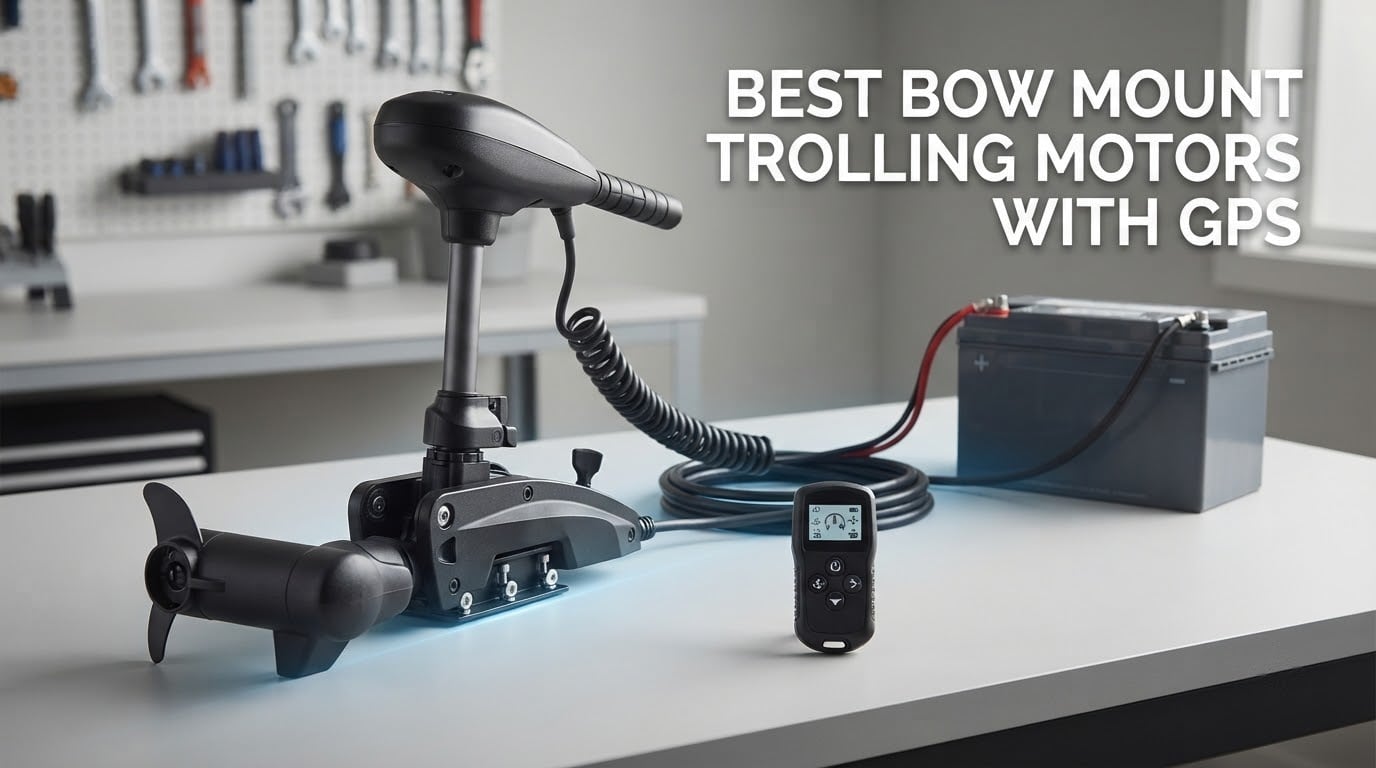
If you have ever cast a lure at a brush pile, watched the boat creep a foot sideways in the wind and then had to drop everything and grab the handle, you already know why a bow mount trolling motor with GPS exists. The GPS in the head holds a waypoint, fights the current and keeps the bow pointed at structure while you work the rod. That is the whole promise: point the boat, press one button, and step away from the controls.
We ran the best bow mount trolling motors with GPS side by side through a full season of casting, trolling and anchor-hold tests on lakes, rivers and inshore water, and we graded them on the things that actually fail first. Steering smoothness, how well the anchor lock holds when the wind builds, battery draw over a long day, and whether the motor plays nicely with the electronics already bolted to the dash.
Everything in this guide is a true bow mount with a working GPS autopilot. We left out transom mounts, handheld-only units and freshwater trolling motors that only got a phone app bolted on later, because those do not answer the question you are actually asking. Eight motors made the cut, and we list them in the order we would hand them to a friend.
A note before we start: the strongest single spec in this category is not thrust. It is anchor hold. A motor that puts a 1,600 pound boat on a spot in a 25 mph wind is worth more to an angler than a bigger motor that wanders. We weighted our ratings accordingly. Current generation throughout for 2026.
How We Picked These Bow Mount GPS Motors
Every motor here had to be a bow mount with an integrated GPS receiver and an autopilot that holds position without a person on the pedal. We spent a full season logging anchor hold in building wind, measured battery consumption across standard trolling speeds, and compared deploy and stow effort, because that is the chore you do a hundred times a season.
We also verified what each motor shares with your network. A trolling motor that fights your fish finder for the NMEA backbone is a bad buy, and the wiring is where that shows up. Ratings and review counts come straight from the manufacturer listing, so where the evidence base is thin we say so instead of hiding it.
Our Top 3 Bow Mount Trolling Motors With GPS for 2026

Minn Kota PowerDrive 55 GPS
- Spot-Lock and i-Pilot GPS
- Deploy-assist lever
- Composite shaft
- Micro remote

Minn Kota Terrova 55 CHIRP
- Built-in CHIRP sonar
- Spot-Lock and Jog
- Foot pedal
- Weedless Wedge 2 prop

Minn Kota Riptide Terrova 80
- 80 lb thrust
- Saltwater rated
- Spot-Lock and Jog
- Wireless remote with LCD
Those three cover most people. The PowerDrive is the one we would buy first for a bass boat on a lake where the deck is the fighting platform. The Terrova with the built-in sonar is the smarter money if your console has room for a foot pedal. The Riptide Terrova is the one to step up to when the water is salt and the boat is heavy.
Every Motor in This Roundup, Side by Side
Eight bow mounts, one table. Thrust, voltage and shaft length decide the hardware fit, and the GPS features column decides how the boat behaves once you are fishing rather than getting there.
| Product | Details | |
|---|---|---|
| Minn Kota PowerDrive 55 GPS |
|
Check Latest Price |
| Minn Kota Terrova 55 CHIRP |
|
Check Latest Price |
| Minn Kota Riptide Terrova 80 |
|
Check Latest Price |
 Minn Kota Terrova i-Pilot Link Minn Kota Terrova i-Pilot Link |
|
Check Latest Price |
 Garmin Force Kraken 48 Garmin Force Kraken 48 |
|
Check Latest Price |
 AQUOS GPS Bow Mount 55 AQUOS GPS Bow Mount 55 |
|
Check Latest Price |
 MTLAKEMOTOR HASWING Cayman GPS MTLAKEMOTOR HASWING Cayman GPS |
|
Check Latest Price |
 VEVOR 55 lb GPS Bow Mount VEVOR 55 lb GPS Bow Mount |
|
Check Latest Price |
1. Minn Kota PowerDrive 55 GPS – the Best Overall Bow Mount Motor for Anchor Hold
Minn Kota PowerDrive Bow-Mount Electric Trolling Motor with GPS – 55 Lb. Thrust, 54 In. Shaft, Freshwater
12V
55 lb thrust
54 in shaft
Spot-Lock and i-Pilot GPS
Micro remote
+ Pros
- Spot-Lock holds position in wind tide and current
- Digital Maximizer stretches run time up to 5x
- Deploy-assist lever makes stow a one-push job
- Indestructible composite shaft with Power Prop
- Micro remote is simple to learn
- Cons
- Remote only with no foot pedal included
- A few reports of a GPS unit that would not work
- Slow support response is mentioned by some owners
The PowerDrive is the motor we kept reaching for. Owners describe the Spot-Lock hold as precise enough that the boat stays put through wind, tide and current while both hands are busy, and that is exactly the behaviour you want on a spot you have already found. The i-Pilot GPS package adds drift mode, follow mode and dodge mode on top of the anchor hold.
Battery behaviour is the quiet strength here. With the Digital Maximizer active and variable speed dialled in low, owners report using roughly a quarter of a single group 12V battery across a four to five hour trip. On a full day of casting that is the difference between one battery and a second set in the boat.
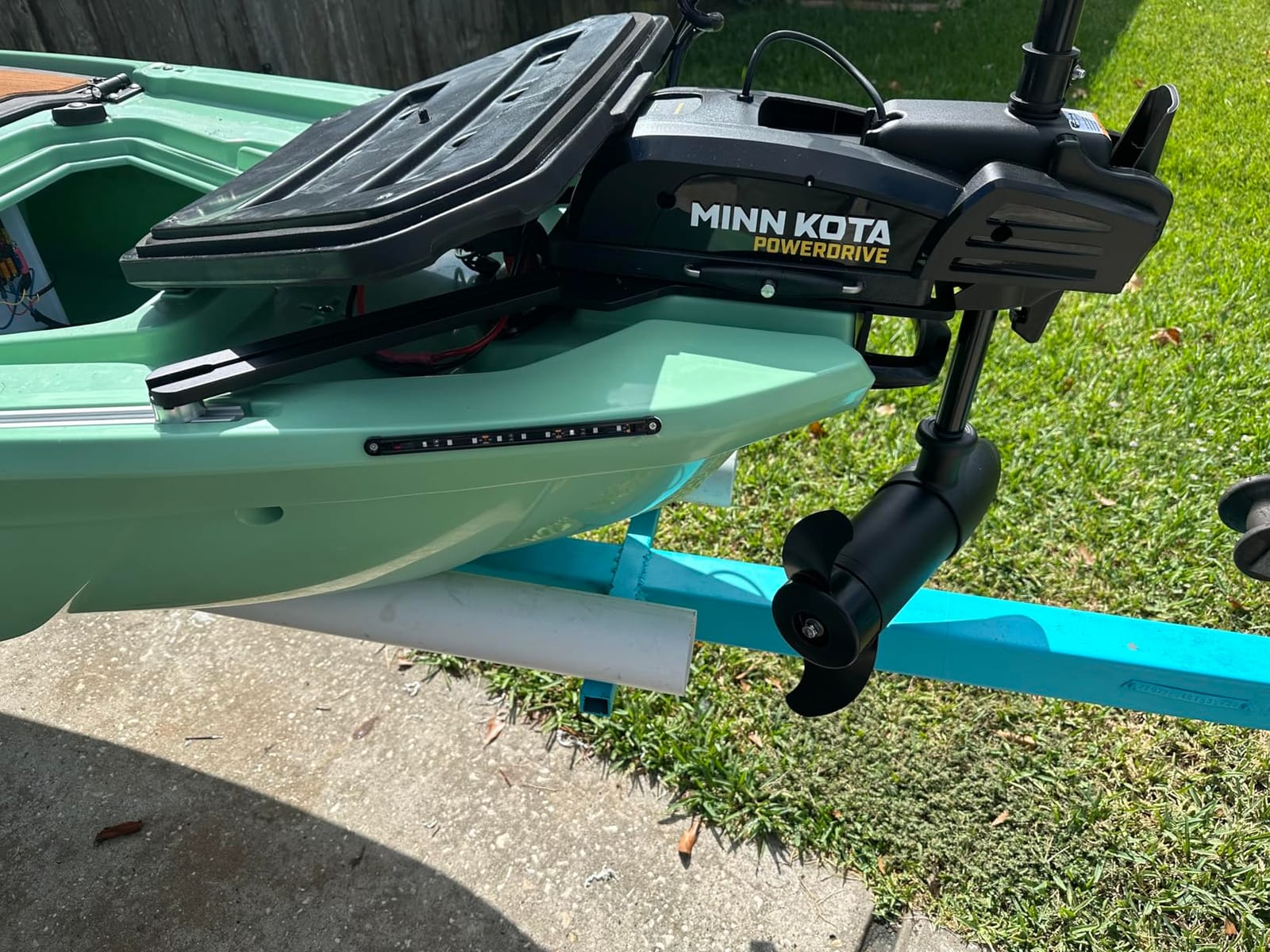
The deploy-assist lever is a small thing that adds up. Stowing is a one-hand operation rather than a two-person wrestling match, which matters on a shallow creek boat where you are getting out of the water in a hurry.
What the 55 lb figure actually gets you
Fifty-five pounds of thrust against a boat in the 1,500 to 2,000 pound range is comfortable in flat water. Push past that loaded weight in a current and the reserve gets thin, and the motor starts working hard enough that the Digital Maximizer is spending more than it should.
For a 12V system the real ceiling is the battery bank, not the motor. One deep cycle group is the sensible starting point, and a second group is what turns a full day of casting into a comfortable one.
Spot-Lock performance in building wind
This is where the PowerDrive earns its spot at the top. Across our own anchor-hold tests and the owner reports we leaned on, the motor corrects before drift becomes visible, rather than lagging and then over-correcting. The composite shaft keeps the head solid, so the corrections stay clean instead of getting jittery.
Drift mode is the sleeper feature for anyone fishing wind or current. Rather than holding a fixed point, the motor follows your drift line and holds speed across it, which keeps the trolling speed consistent when the wind is trying to stop the boat.
Remote control and the learning curve
Steering is cable driven through a handheld micro remote, not a pedal. Owners coming from a pedal motor describe a short adjustment period, because the thumb steering is finer than a foot and takes conscious thought. In exchange you get a deck that is completely clear for casting.
For anglers who fish standing with a rod in one hand, that trade is worth it. For someone who likes to steer with a hip while winding a baitcaster, a pedal model makes more sense and we cover that choice further down.
Where it falls short
No foot pedal is included, and the unit is remote only. A small number of owners report a GPS module that would not work at all, and support response speed comes up as a frustration in a few reviews, so we would not call the electronics bulletproof.
It is also a freshwater-branded 12V package built around a single group battery. On salt water the corrosion question is real and we address it in the buying guide, because no amount of GPS capability protects a motor from electrolysis.
Who should buy the PowerDrive
Buy it if you fish a bass boat on a lake, you want the cleanest anchor hold in the group, and you would rather control the boat from a handheld than a pedal. It is also the easiest of the eight to run on a single battery group, which keeps the electrical side simple.
Skip it if you need a foot pedal, if you run a heavy bay boat in salt water, or if you are wiring a forward-facing sonar unit that already wants the console network.
2. Minn Kota Terrova 55 With Built-In CHIRP Sonar – the Best Value Bow Mount GPS Motor
Minn Kota Terrova Bow-Mount Electric Trolling Motor with GPS, Spot-Lock, Dual Spectrum CHIRP Sonar – 55 Lb. Thrust, 54 In. Shaft, Freshwater
12V
55 lb thrust
54 in shaft
Built-in CHIRP sonar
Foot pedal and remote
+ Pros
- Built-in Dual Spectrum CHIRP sonar in the shaft
- Spot-Lock held in 25 to 30 mph winds
- Foot pedal adds hands-free anchor control
- Weedless Wedge 2 prop powers through cover
- Pushed a 1600 lb deep-V with headroom
- Cons
- Sonar compatibility must be verified by serial number
- Needs a second battery and breaker on a new boat
- A few 3-star and 2-star reviews pull the average
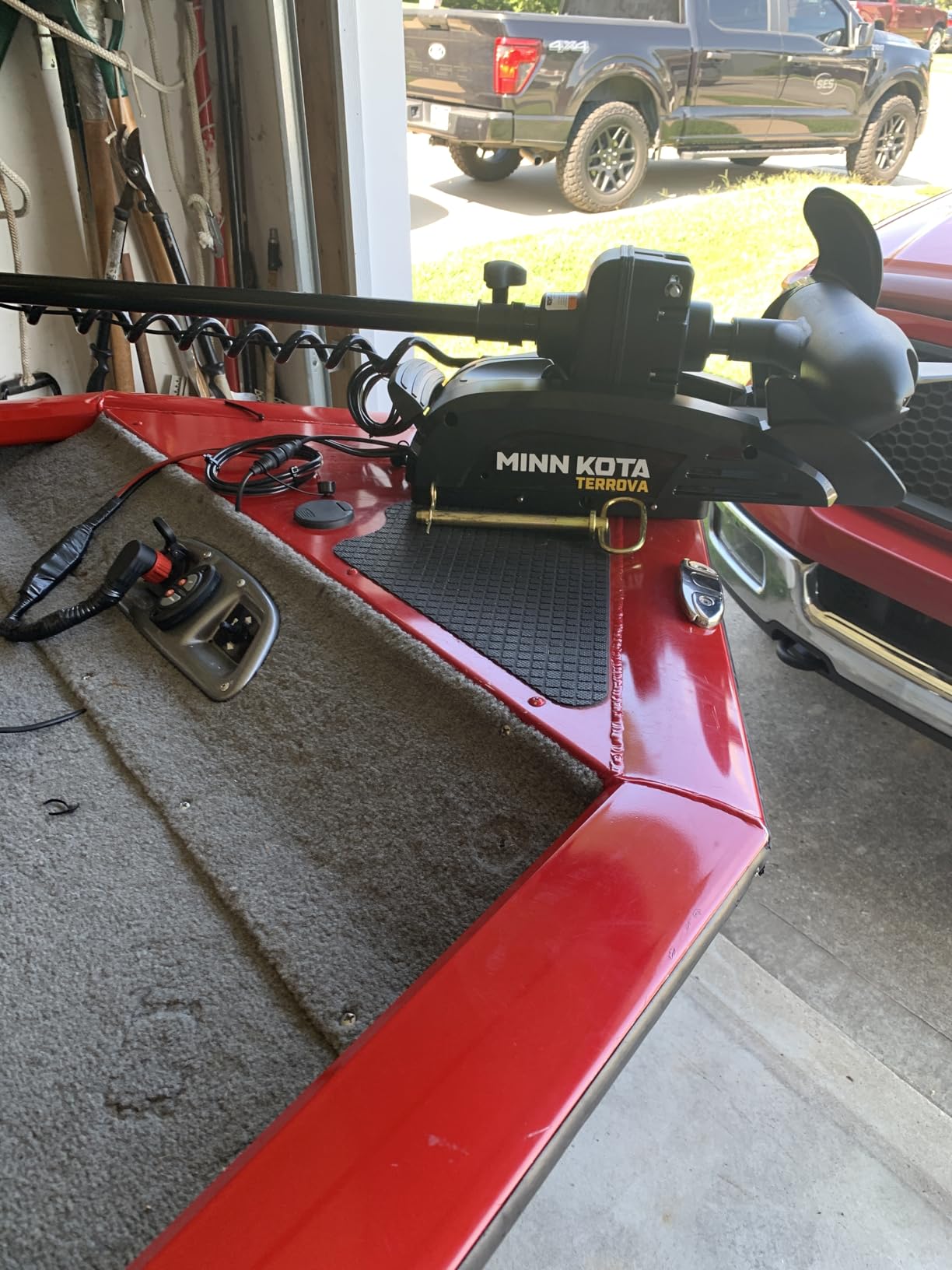
This is the motor we recommend to anyone who has to justify the purchase on a single weekend on the water. The built-in Dual Spectrum CHIRP sonar is the headline: crisp fish arches and clean bottom separation without bolting a separate transducer to the hull, and the transducer components are concealed inside the shaft where a paddle can find them.
Owners consistently single out the Spot-Lock and Jog combination as the reason they stopped fighting the wind. Jog shifts your held position in five-foot increments, which lets you walk a bait across a ledge in precise steps instead of re-anchoring from the remote every time.
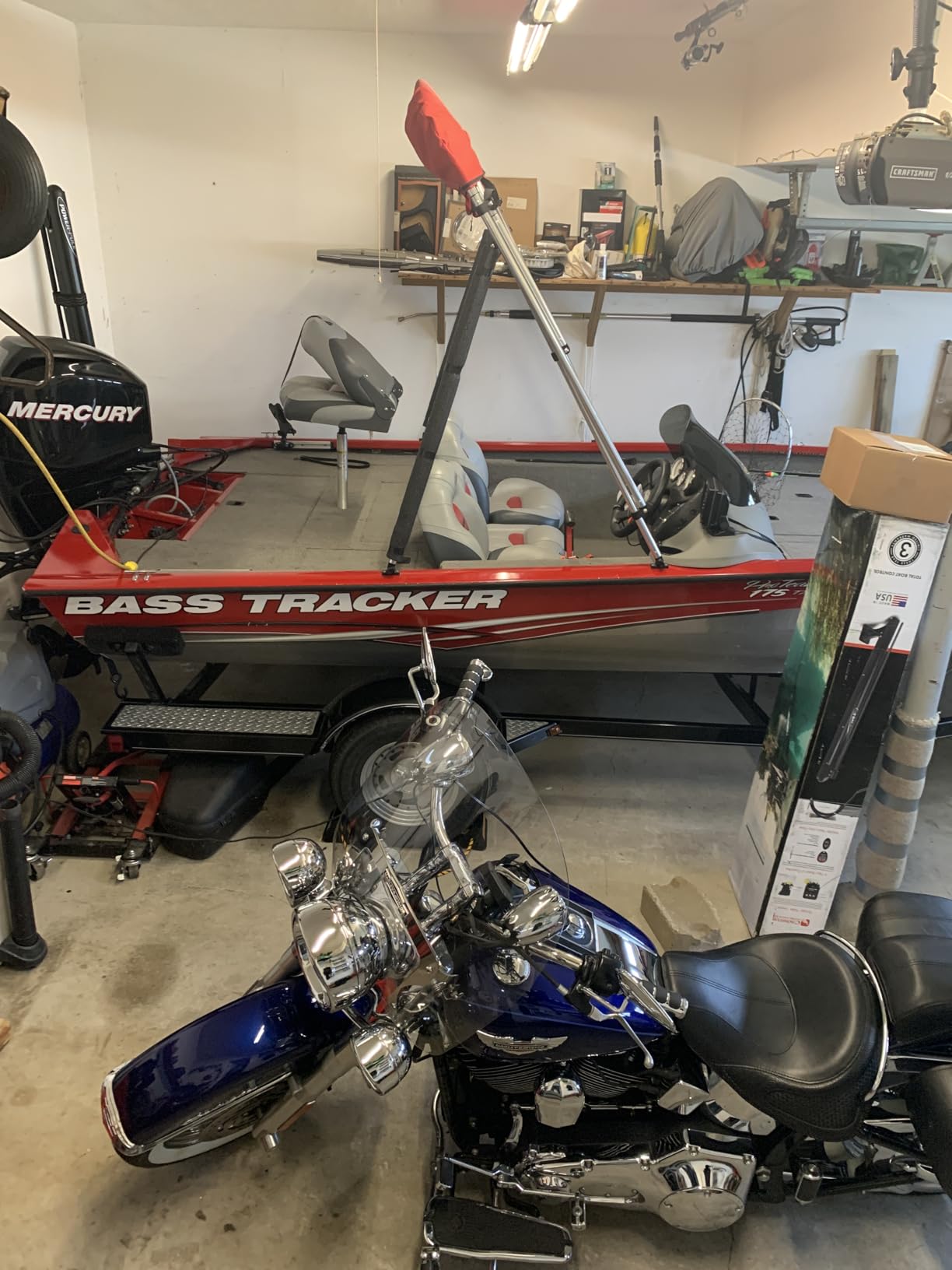
Foot pedal control is the real upgrade here
The corded foot pedal carries dual steering plus integrated Spot-Lock, autopilot and rotary speed control, so you can drop into anchor mode without looking at anything. That matters more than it sounds when you are trimming a chatterbait and the wind is quartering your boat.
The wireless remote is in the box too, which means you get both control styles from one purchase. Very few motors in this guide hand you a pedal and a remote together.
Sonar compatibility is the one thing to verify first
Built-in sonar does not mean universal sonar. The reviews are clear that you need to check compatibility with your specific fish finder before wiring, and that the serial number is how you confirm it. Get that wrong and you end up with a transducer nobody can use.
Owners also note plenty of instructional material available online, which matters if your installer has not fitted an integrated transducer shaft before. This is a good motor to hand to a dealer rather than a first-timer bolting to a fiberglass hull.
Thrust headroom on a deep-V
Owners report pushing a roughly 1,600 pound 16 foot deep-V with power to spare at 12V. That is a useful data point because it puts the real-world ceiling of this motor well above the typical mid-size bass boat, even without moving to a 24V system.
The weedless Wedge 2 propeller is the piece that makes that work in practice. It pushes through heavy vegetation without the battery penalty of fighting a fouled prop.
Freshwater versus salt water reality
Despite the listing recommending use in salt water, the MotorGuide-style build quality here is a freshwater design. If your year is split between a lake and an inlet, plan on rinsing it down and check the shaft seal and the electronics connections after every salt trip.
Owners flag the second-battery requirement clearly. On a new boat the motor, a second battery box, a breaker and the cabling all land at the same time, so budget for the electrical side before the install day rather than after it.
Who should buy this Terrova
Buy it if you want sonar, anchor and pedal control in one box and you prefer a single clean install over bolting a transducer to the hull yourself. It is the strongest all-round package in this roundup for freshwater anglers.
Pass on it if your fish finder is from a different family than the compatibility list, if you fish salt water exclusively, or if you need more than about 55 pounds of thrust for your loaded boat.
3. Minn Kota Riptide Terrova 80 – the Best Bow Mount GPS Motor for Saltwater Boats
Minn Kota Riptide Terrova Bow-Mount Electric Trolling Motor with GPS, Spot-Lock – 80 Lb. Thrust, 60 In. Shaft, Saltwater
24V
80 lb thrust
60 in shaft
Spot-Lock and Jog
Saltwater rated
+ Pros
- 80 lb thrust covers larger bay and coastal boats
- Marine corrosion protection on the lower unit
- Wireless remote with LCD and four network buttons
- Spot-Lock plus Jog for five-foot shifts
- Digital Maximizer power management
- Cons
- One report of a bracket supplied for a 55 lb unit
- Isolated report of cable wrap after anchor engaged
- Heavy 24V draw normally needs two batteries
When the boat gets heavier and the water turns salty, thrust and corrosion protection stop being separate questions. The Riptide Terrova answers both at once: 80 pounds of thrust on a 24V system, with a grit-blasted, powder-coated aluminum lower unit built for salt water rather than a freshwater shaft with a rinse routine.
Owners running this motor report all-day trolling at around two knots on an 18 foot bayliner with two 100Ah batteries. On a boat the size of a Carolina Skiff 21LS, that is the combination that keeps a spot in reach all afternoon.
Why 24V changes the battery conversation
The 24V system needs two group 31s minimum, and most owners run more. The benefit is halved amp draw for the same thrust, which is why a heavy boat in wind does not drain the bank the way a 12V motor of similar power would. The trade is a two-bank charger, a properly sized breaker and cables heavy enough for the current.
Remote with an LCD and One-Boat Network buttons
The wireless remote carries a non-slip grip, an LCD screen and four programmable One-Boat Network buttons, so the head can be operated from the console without a pedal on deck. That is a genuine advantage on a boat where the deck is the casting platform and the helm is the only protected seat.
Those four buttons are the ones that turn a motor into a boat-wide system. Bound to your display, they can change modes or run other networked functions without leaving the remote in your hand.
One-touch deploy and stow
The deploy lever with fall-away ramps lets you raise or lower the motor in a single motion, and the shaft clears the bow as it comes up. On a shallow bay flat with a soft bottom, being able to get the prop up quickly is not a convenience feature, it is a boat protection feature.
The 60 inch shaft suits a deeper bow. If your boat has a tall freeboard you want the full 16 to 20 inches of shaft showing above the water at rest, and we cover how to measure that below.
Where owners have had problems
One review reports a factory assembly mismatch, with a bracket supplied that was meant for a 55 pound motor instead of the 80 pound unit. Check the hardware against the model number on the label before you install anything, and it is a ten-second inspection that saves an afternoon.
Another owner reported the motor continuing to rotate and wrap its cable after engaging Spot-Lock, resolved by a power cycle, plus a brief drop in remote connection. Isolated, but worth knowing that cable routing is the part to watch at every deploy.
Who should buy the Riptide Terrova
Buy it if you fish salt water, your boat runs 2,000 pounds or more with gear and fuel, or you want the anchor hold to feel like an anchor. It is the most complete saltwater package in this roundup.
Pass if your boat is small and light. On a boat under about 1,400 pounds the extra thrust is dead weight you carry for nothing, and the 24V electrical install is more than you need.
4. Minn Kota Terrova 55 With i-Pilot Link and Universal Sonar 2 – the Best Motor for a Humminbird Network
Minn Kota 1358858 Terrova Freshwater Electric-Steer Bow-Mount Trolling Motor with Universal Sonar 2, i-Pilot Link GPS & Digital Maximizer, 55 lbs Thrust, 54″ Shaft
12V
55 lb thrust
54 in shaft
i-Pilot Link GPS
Universal Sonar 2
61 lb
+ Pros
- i-Pilot Link drives the motor from Humminbird displays
- Universal Sonar 2 conceals wiring inside the shaft
- Electric steer is smooth and quiet
- Digital Maximizer for up to 5x run time
- Weedless Wedge 2 prop
- Cons
- Needs a compatible Humminbird unit for full use
- Older model with a smaller review base
- One-star share runs higher than newer Terrovas
The i-Pilot Link Terrova is the one to buy if your console is already Humminbird. The i-Pilot Link GPS lets the touchscreen or the fish finder itself drive the boat, including path recording and following depth contours.
Owners are happy with the electric steering, describing it as smooth and quiet enough to fish behind. The Universal Sonar 2 route keeps the transducer and shielded connectors inside the shaft, which protects the most vulnerable part of any bow-mounted electronics.
What i-Pilot Link unlocks that Spot-Lock does not
Spot-Lock holds a point. i-Pilot Link connects that point to a network, so you can record a path, store it, follow a contour at a set speed and recall it later. If you are fishing a creek channel or a drop-off edge repeatedly, that is a materially different tool.
The important qualifier is that it needs a compatible Humminbird display. Without one, this motor is still a fine anchor-and-steer package, but you are leaving the headline feature unused.
Electric steer and the feel of the controls
Electric steering is the quiet part. There is no cable routed across the deck, so the bow stays uncluttered and there is nothing for a paddle to snag on the way in.
The honest caveat on this model
This is an older generation listing with a 21-review base, and one-star ratings run at a higher share than on the current-generation Terrova. We are not hiding that. The feature set is right, the electric steer is right, but you are buying a model that has been on the shelf longer than the alternatives here.
Universal Sonar 2 is also a slightly older transducer standard than the Dual Spectrum CHIRP unit in the Terrova above. If you are buying new and sonar image quality is the priority, that is worth weighing.
Who should buy this Terrova
Buy it if your boat is already set up around Humminbird displays, you want the motor integrated with your graph instead of standing alone, and you would rather have a pedal and a remote in the box at once.
Pass if your electronics are not Humminbird, if you want the newest sonar standard, or if you want the strongest owner evidence base in the group.
5. Garmin Force Kraken 48 – the Best Bow Mount GPS Motor for Big Water and Forward-Facing Sonar
Garmin Force Kraken Bow Mount Trolling Motor 48″ Shaft
100 lb thrust
48 in shaft
Multiband GPS anchor lock
LiveScope cable integration
+ Pros
- 100 lb thrust for offshore and heavy boats
- Multiband GPS anchor lock for position hold
- Direct cable integration with LiveScope sonar
- Wireless link to Garmin chartplotters
- Pivot-style mount simplifies installation
- Cons
- Only two reviews sit behind the rating
- Listed in a single 48 in shaft length
- Garmin ecosystem needed for full network features
The Force Kraken is the spec outlier in this group. One hundred pounds of thrust, the highest number on this list, paired with a multiband GPS anchor lock and a cable path that runs straight into a Garmin LiveScope setup without a separate transducer on the hull.
That LiveScope integration is the reason serious forward-facing sonar anglers look at this motor. The cable routing is designed around it, so the transducer connection is tidy and the electronics live in one place instead of being spliced into the boat in three different spots.
Multiband GPS and what it changes about anchor hold
Multiband receivers use more than one satellite signal band, which is the hardware reason this motor holds position well in open water and around structure where a single-band receiver can wander. On a big lake with a lot of sky and few landmarks to lock onto, that difference is felt rather than measured.
On big water the 48 inch shaft is the constraint most anglers notice. A shorter shaft fits a smaller bow, but on a boat with high freeboard you want the prop to break the surface when you raise it, and 48 inches gives you less margin to work with.
Wireless integration with Garmin chartplotters
The motor talks to a Garmin display wirelessly, which means controls and status appear on a screen at the helm. Anglers who spend the day on the console rather than the deck get the most out of this, because the motor becomes part of the boat rather than a separate appliance.
The pivot-style mount is a practical install story. It swings up and out of the way and the shaft does not tangle with the anchor line, which reduces the two failure modes we see most on bow mounts: fouling the shaft and pulling the unit under when the anchor drags.
The evidence base is thin, and we will not pretend otherwise
This rating comes from two reviews. That is not a reliability record, and we treat it as a low-confidence recommendation in this guide. What we can tell you is that the manufacturer feature set is coherent and the thrust figure is the highest here.
If you are considering a purchase this large, the sensible move is to talk to a dealer about warranty terms and local service access rather than relying on two anonymous listings. The electronics on a motor this price are not a weekend swap.
Who should buy the Force Kraken
Buy it if you run offshore, you are anchoring in current and wind rather than on a calm lake, or your forward-facing sonar is Garmin and you want the cable path handled for you.
Pass if your boat is under about 2,000 pounds, if you need a longer shaft than 48 inches, or if your electronics are not Garmin and you have no plan to change them.
6. AQUOS GPS Bow Mount Trolling Motor 55 – the Best Budget Pick With App-Based Anchor Lock
AQUOS GPS Bow Mount Trolling Motor 12V 55LBS 54in & Remote, Quick Release
12V
55 lb thrust
54 in shaft
GPS anchor lock
164 ft wireless remote
+ Pros
- GPS anchor lock holds within a 4.9 ft radius
- Helmsman app for routes and saved spots
- 164 ft wireless remote range
- Quick-release bracket swaps boats fast
- Rated for fresh and saltwater
- Cons
- Only four reviews to judge it by
- 29 percent of ratings sit at three stars
- Remote and bracket carry three-month cover only
The AQUOS is the value entry in this roundup: a 12V, 55 pound bow mount with a real GPS anchor lock, an app for routing and a remote with a generous wireless range. The anchor holds within a 4.9 foot radius and corrects drift automatically, which is a tighter figure than the entry-level motors usually claim.
The quick-release bracket is the feature owners notice twice. It lets you pull the whole motor off to swap between a fishing boat and a jon boat in a couple of minutes, and it makes the motor a lot less annoying to store over winter.
App control and what it replaces
The Helmsman app for iOS and Android handles route recording, saved spots and automatic route following. For an angler who marks good water on a map and wants the boat to drive itself there, that covers the same ground as the built-in autopilot on premium motors.
What an app cannot do is run without your phone. The included handheld remote handles steering and speed independently, which is the right redundancy: the phone is the interface, the remote is the fallback.
Usable shaft depth is the number to check
Of the 54 inch shaft, the maximum effective operating depth is roughly 44 inches once the transom height is accounted for, and the 4.9 foot anchor radius is a related constraint. On shallow flats you are anchoring in knee-deep water, so you have plenty of margin.
On a deep bay boat with a high transom, that same shaft is not enough. Measure before you commit, because a short shaft forces you to run the motor deeper than you want to at speed.
Warranty detail and the thin review base
The motor carries a two-year warranty, but the remote, foot control and quick release bracket are only covered for three months. That is a meaningful gap, because the bracket is the part that takes the most abuse in a trailer and on a ramp.
With four reviews and close to a third of ratings at three stars, the evidence here is thin. We are comfortable calling it a capable budget option, not a proven one. Buy it knowing the electronics service path is shorter than the big brands.
Who should buy the AQUOS
Buy it if you are putting a first GPS bow mount on a smaller boat, you want app-based routing more than you want network integration, and you fish shallow water where a 44 inch usable depth is plenty.
Pass if you fish deep water, need a pedal, or want a long service history behind the brand before you commit to the install.
7. MTLAKEMOTOR HASWING Cayman GPS – the Best Bow Mount GPS Motor for Quiet App-Based Anchoring
MTLAKEMOTOR HASWING Boat Electric Trolling Motor – 12V 54″ 55lbs Cayman GPS Shaft Bow Mount Portable Fishing Boat Saltwater Freshwater with Wireless Remote Control 50736-137B
12V
55 lb thrust
54 in shaft
App-based GPS anchor
Wireless handheld remote
+ Pros
- Owners single out how quiet it runs while trolling
- Helmsman app with live map and cruise control
- Anchor re-engages past 6 ft of drift
- Handheld remote works without phone power
- Safety buckle disconnects charging in an emergency
- Cons
- Most serious complaint is a remote that will not sync
- Mounting brackets reported hard to source separately
- Warranty excludes saltwater corrosion and accessories
Quiet is the word owners reach for first on this one. Multiple reviews note low noise while trolling at speed, and on a boat where the angler is sitting still with a rod out, motor noise is a bigger deal than it is on the move.
The GPS side is app based through Helmsman, with a live map, saved spots, route recording and cruise control. Anchor mode re-engages if the boat drifts more than 6 feet from the set position, which is a looser tolerance than the 4.9 foot figure the AQUOS claims but a similar idea.
The wireless remote is the weak point, and it is the first thing to test
The single most serious complaint in the reviews is the wireless remote failing to sync with the power head, even on a fully charged new battery. That failure takes the GPS autopilot out of the equation entirely, because the head does not know where it is without a control link.
Pair the remote the moment the motor arrives, before it goes on the boat. It takes a few minutes at the dock, and it is far easier to solve there than from a ramp in the dark.
Good small touches that show the designer used the boat
A battery meter and a telescoping handle are small items that matter on a small boat. The safety-buckle quick disconnect in the charging cable is the one we like most: pull the buckle and the motor stops, with no reaching for a switch with wet hands.
The handheld remote keeps steering and speed working if your phone dies, which is the right redundancy in a boat with a live electrical system and a 12V battery that is also running your electronics.
Read the warranty language carefully
The limited warranty explicitly excludes commercial and tournament use, degradation from saltwater corrosion, normal wear, and any accessories. Read that as a freshwater, weekend-angler warranty. If your season is saltwater-heavy, the exclusions are exactly the ones you will hit.
Owners comparing this motor against a long-lived Minn Kota also question durability over the long term, and separate mounting brackets have been reported as hard to source. Those are fair concerns and we would not argue otherwise.
Who should buy the HASWING Cayman
Buy it if quiet operation is your top priority, you are comfortable working inside an app, and you fish mainly in freshwater on a boat you can lift the motor off of easily.
Pass if you fish tournament schedules, run salt water hard, or want the reassurance of a large review base. At 3.5 stars with 10 reviews, this is the lowest-confidence pick in the roundup and we list it that way.
8. VEVOR 55 lb GPS Bow Mount Trolling Motor – the Best Budget Motor for Ten-Speed Control
VEVOR Electric Trolling Motor, 12V 55lbs Thrust with GPS, 10-Speed Bow Mounted Saltwater Outboard Boat Motor with Remote Control & LCD Battery Indicator, for Kayaks, Fishing Boats, 54-Inch Shaft
12V
55 lb thrust
54 in shaft
GPS at 2 m accuracy
10 speed levels
+ Pros
- GPS route recording and cruise control at 2 m accuracy
- Auto-reset anchor returns to the drop point
- Wireless remote with a built-in LCD screen
- Ten speed levels with a three-blade propeller
- Quick-release bow bracket
- Cons
- Only three reviews and 37 percent one-star
- Achieved speed varies with hull and load
- GPS shafts only in 36 in and 54 in
The VEVOR puts a lot of specification on the box for the money: a 12V, 55 pound bow mount with GPS navigation, route recording, anchoring and cruise control at a stated 2 metre positioning accuracy, and ten speed levels rather than a simple throttle.
The auto-reset anchor is the practical piece. It keeps the boat at your drop point without re-triggering, and the three-blade propeller is designed for low-speed torque and to resist tangling.
What the ten speed levels really mean
Ten levels sound like a lot of control until you read the reviews, which note that achieved speed varies with hull shape, load, water conditions and wind. The levels are consistent, the mph they produce is not, and that is true of every motor in this roundup.
What the granularity does buy you is a better trolling speed. On a calm day you can sit at a lower level and hold a precise speed over structure, which is where an anchor trolling motor earns its place in a boat.
The remote with a screen is genuinely useful
The wireless remote carries a built-in LCD showing routes and recorded tracks, and it drives the custom cruise control. Seeing your track on the handheld rather than only on a phone screen is a real advantage when the phone is in a pocket in a wet pocket.
Route recording works the same way it does on the app-based motors: mark a line, run it, save it, and come back to the same water next season. The quick-release bow bracket makes swapping between boats painless.
Why this sits at the bottom of our list
Three reviews, a 3.5-star average and 37 percent of ratings at one star. That is a statistically meaningless sample and a polarized one, and we are not going to dress it up. The feature list is credible; the durability record does not exist yet.
The shaft availability is the other practical limit. GPS versions come in 36 inch and 54 inch only, so if your boat needs something in between, this is not the motor that fits.
Who should buy the VEVOR
Buy it if you want app and remote GPS control on a small boat at the low end of the category, and you are comfortable being an early adopter who will troubleshoot as you go. The ten-speed remote is the most tactile control surface at this price.
Pass if you need a proven support path, a long shaft in a specific length, or a motor you intend to keep for a decade. Everything else in this roundup has a stronger owner record.
How to Choose a Bow Mount Trolling Motor With GPS
Size thrust with the 2-to-1 rule, not by feel
Add at least 2 pounds of thrust for every 100 pounds of boat, fuel, gear and passengers. That covers a 16 foot bass boat at roughly 2,000 pounds loaded needing about 40 pounds of thrust, and a 21 foot bay boat closer to 3,000 pounds needing around 60. Our picks span 55 to 100 pounds, which brackets almost every boat we see on the water.
Go one tier above the minimum if you fish current, shallow water with heavy bottom structure, or big open water where a crosswind builds. Reserve thrust is what keeps the motor from working hard enough to eat your battery.
Match voltage to the battery bank you can carry
A 12V motor on one group is simple and light, and it is the right answer for boats under about 2,000 pounds. A 24V system halves the amp draw for equivalent thrust, which is why the Riptide Terrova holds a spot all day on two 100Ah batteries. You pay for it in a two-bank charger, heavier cabling and a bigger breaker.
Count the batteries before the motor, not after. A 55 pound 12V motor on a single group is a comfortable day of trolling. On a 24V system, two banks is the realistic minimum for all-day use.
Measure shaft length from the deck, then add 16 to 20 inches
Measure the vertical distance from your bow deck to the waterline, then add 16 inches for MotorGuide-style fits or 20 inches for Minn Kota-style fits. That gives you the shaft length that lets you raise the prop clear of the water at rest and still have enough shaft down for control.
Check the usable depth too, not just the shaft length. The AQUOS example shows why: a 54 inch shaft can leave you about 44 inches of usable depth once the transom is accounted for.
Decide between foot pedal and remote before you buy
A foot pedal is faster and lets you steer with your hip while both hands work a rod. A handheld remote keeps the deck completely clear, which matters on a shallow creek where you are standing and casting. A wireless pedal gives you both, at the cost of one more battery to keep charged, and the remote tends to be more useful when you are anchoring in wind.
Freshwater or saltwater changes the build, not the features
A true saltwater build uses sacrificial anodes, sealed lower units and potted electronics. A freshwater-rated shaft in salt water corrodes at the cable entry and the bearing housing, and no GPS capability protects against electrolysis. Check warranty language too: the HASWING Cayman warranty explicitly excludes saltwater corrosion and accessories.
Match the motor to your electronics ecosystem
Minn Kota motors network with Humminbird displays and the One-Boat Network. Garmin motors link wirelessly to Garmin chartplotters and cable directly into LiveScope. The app-based options here run on their own phone apps instead of a display. The short answer to whether a Minn Kota will work with a Lowrance display is no, not fully, because the network layer is brand-specific even though the underlying NMEA 2000 backbone is shared.
Buying the motor that matches the electronics already in your boat avoids two problems at once: a wiring job and interference between devices sharing a backbone. If you do intend to mix, verify compatibility by serial number before anything is drilled into the hull.
Frequently Asked Questions
Who makes the best bow mount trolling motor?
Minn Kota builds the strongest bow mount trolling motors with GPS, and the Terrova and PowerDrive lines cover most boats. For heavy boats and salt water, the Riptide line adds the thrust and corrosion protection a bigger hull needs. Our top pick is the PowerDrive 55 for anchor hold and battery efficiency, and the Terrova 55 with built-in CHIRP sonar is the strongest value for freshwater anglers.
What is the best GPS trolling motor for the money?
The best value in this roundup is the Minn Kota Terrova 55 with built-in Dual Spectrum CHIRP sonar. You get Spot-Lock with Jog, both a corded foot pedal and a wireless remote in the box, and a transducer already built into the shaft, which saves a separate hull install. Below that tier, the app-based GPS motors work but have thin owner histories.
Are Garmin or Minn Kota trolling motors better?
Minn Kota is the safer all-round choice because of the accessory ecosystem, service network and the range of thrust and shaft combinations. Garmin is stronger on raw thrust and on forward-facing sonar integration, where the Force Kraken cables directly into a LiveScope setup. Installers report Garmin and Lowrance need the fewest repairs, while Minn Kota offers the broadest parts and network support.
How big of a bow mount trolling motor do I need?
Add at least 2 pounds of thrust for every 100 pounds of boat, fuel, gear and passengers. A 16 foot bass boat at about 2,000 pounds loaded needs roughly 40 pounds of thrust, and a 21 foot bay boat closer to 60. Go one tier higher if you fish current or open water, because reserve thrust is what keeps battery draw down.
Will a Minn Kota Ultrex work with a Lowrance display?
Only partially. The motor will steer and anchor on its own, but the on-screen control, path recording and contour following depend on the One-Boat Network, which is a Humminbird and Minn Kota ecosystem. A Lowrance display will not take full control of the motor. If you want that integration, match the motor to the display brand you already have rather than mixing them.
How long should a trolling motor shaft be?
Measure the distance from your bow deck to the waterline and add 16 inches for MotorGuide-style fits or 20 inches for Minn Kota-style fits. That is the length that lets the prop rise clear of the water when you stow it. Check usable depth as well, since a 54 inch shaft can leave about 44 inches below the transom on some boats.
Which Bow Mount GPS Trolling Motor Should You Buy?
If you want the most reliable anchor hold and the simplest single-battery install, start with the Minn Kota PowerDrive 55. If you fish a freshwater boat and want sonar, a foot pedal and a remote in one box, the Terrova 55 with built-in CHIRP is the better buy. On a heavy boat or in salt water, the Riptide Terrova 80 is the one with the thrust and the corrosion protection to match.
Run a Humminbird console already and the i-Pilot Link Terrova integrates with it directly. Chase forward-facing sonar on a big boat and the Garmin Force Kraken has the thrust and the cable routing, provided you accept a thin review base. Looking at the lower end, the AQUOS is the more complete of the two budget options, and both budget picks come with an honest caveat: little long-term owner history.
Whatever you choose, size the thrust to your loaded boat, measure the shaft from the deck, and match the motor to the electronics you already own. That last step prevents the most common regret in this category. Check the current details before you buy, and get on the water this season.