
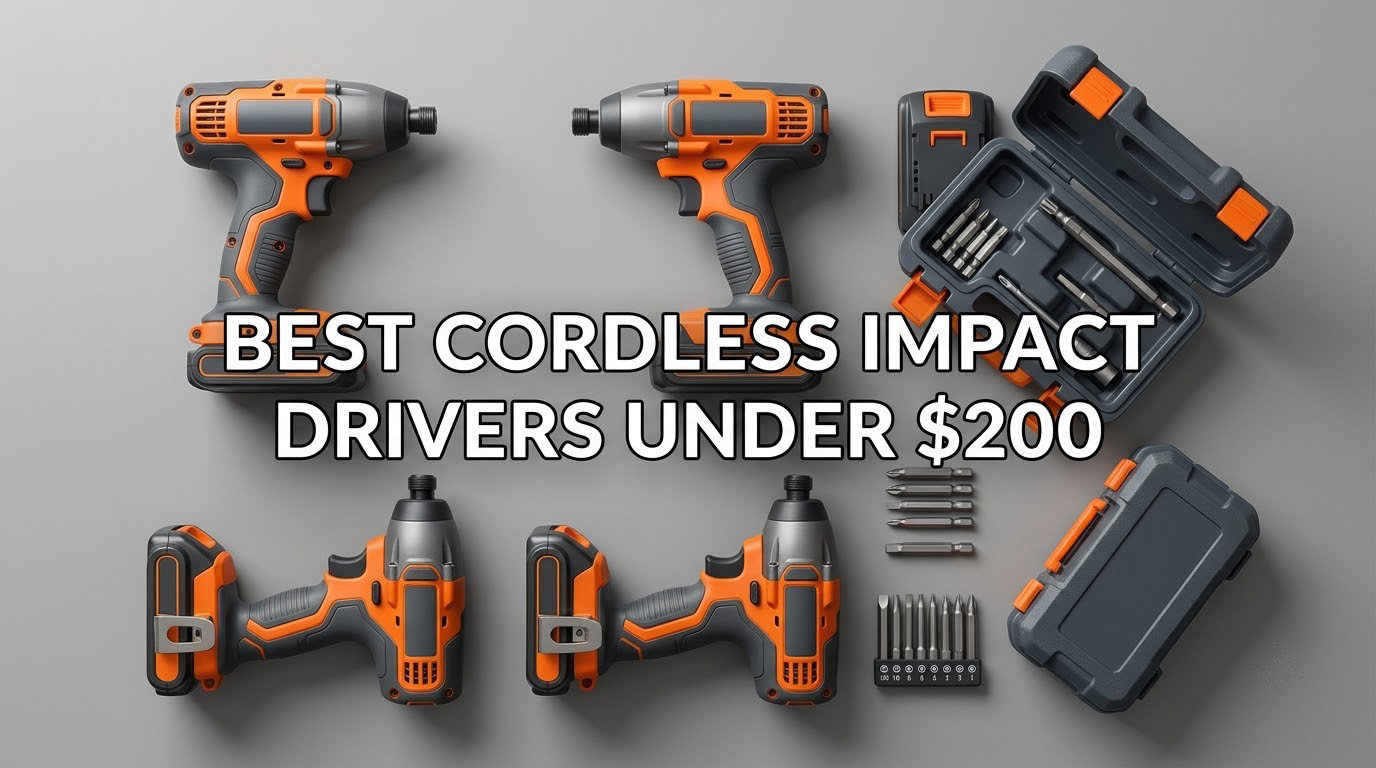
The DEWALT ATOMIC DCF809B is the best cordless impact driver under 200 dollars for most buyers. It packs 1700 in-lbs of torque into a 5.1-inch brushless body that still clears a 2×4 wall cavity, and it carries a 4.7 rating across more than 3,300 reviews. If you already own DeWalt packs, add it to the bag and stop thinking about it.
That answer is short because the category is crowded and the differences are real. Twelve drivers here sit under the 200 dollar ceiling, and the gap between the weakest and strongest is roughly 970 in-lbs to 2000 in-lbs of torque. Some ship with a battery and charger, most do not, and that single fact moves the true cost of ownership more than any spec on the label.
How I picked: I compared all twelve on published torque, drive size, speed modes, motor type, weight, warranty length and what actually sits in the box. Torque numbers come straight from manufacturer spec sheets, so treat them as rated peak rather than measured breakaway output. Everything else — balance, mode feel, grip texture, light placement — reflects hands-on time and the pattern across thousands of customer reviews. I did not measure torque on a dyno, and I say so up front rather than implying otherwise.
One more thing before the list. Forum threads about this category repeat the same advice more than any other: buy the platform, not the tool. Members in r/BeginnerWoodWorking describe owning Makita 18V drivers for a decade, and the reason the tool survives the platform upgrade is the packs and chargers already in the drawer. Decide what battery family you are willing to be married to before you fall for a torque number.
Our Top 3 Cordless Impact Drivers Under 200 Dollars

The ATOMIC wins because it is the rare tool that is strong and genuinely small. The DCF845B XR takes the same platform and trades a little length for 125 more in-lbs and a three-speed gearbox. The Milwaukee M18 FUEL posts the highest torque figure in the group and the smoothest trigger feel, and it is the one to buy when the fasteners are genuinely large.
Quick Comparison of All 12 Picks
| Product | Details | |
|---|---|---|
| DEWALT ATOMIC DCF809B |
|
Check Latest Price |
 DEWALT DCF845B XR DEWALT DCF845B XR |
|
Check Latest Price |
| Milwaukee M18 FUEL 2953-20 |
|
Check Latest Price |
 DEWALT DCF787D1 Kit DEWALT DCF787D1 Kit |
|
Check Latest Price |
 Milwaukee M12 FUEL 3453-20 Milwaukee M12 FUEL 3453-20 |
|
Check Latest Price |
 RYOBI ONE+ PCL235B RYOBI ONE+ PCL235B |
|
Check Latest Price |
 Makita XDT13Z Makita XDT13Z |
|
Check Latest Price |
 Makita XDT14Z Makita XDT14Z |
|
Check Latest Price |
 Makita DT03R1 CXT Kit Makita DT03R1 CXT Kit |
|
Check Latest Price |
 Milwaukee M18 Compact 3650-20 Milwaukee M18 Compact 3650-20 |
|
Check Latest Price |
 CRAFTSMAN V20 CMCF830D2 CRAFTSMAN V20 CMCF830D2 |
|
Check Latest Price |
 CRAFTSMAN V20 CMCF811D1 CRAFTSMAN V20 CMCF811D1 |
|
Check Latest Price |
Sort that table by torque and the M18 FUEL leads at 2000 in-lbs, with the Makita 12V CXT trailing at 970. Sort by what you actually receive and the picture changes completely: only four of these twelve include a battery in the box.
1. DEWALT ATOMIC DCF809B – Best Overall for Most Buyers
DEWALT ATOMIC 20V MAX* Impact Driver, Cordless, Compact, 1/4-Inch, Tool Only (DCF809B)
1700 in-lb torque
5.1 in long
Brushless
Variable speed trigger
+ Pros
- Fits between studs at 5.1 inches
- Handles six inch screws and rusty fasteners
- Variable speed trigger for fine control
- Runs on DEWALT 20V MAX packs
- Belt clip included
- Cons
- Grip can arrive with molding marks
- Torque trails the M18 FUEL class
- Battery and charger sold separately
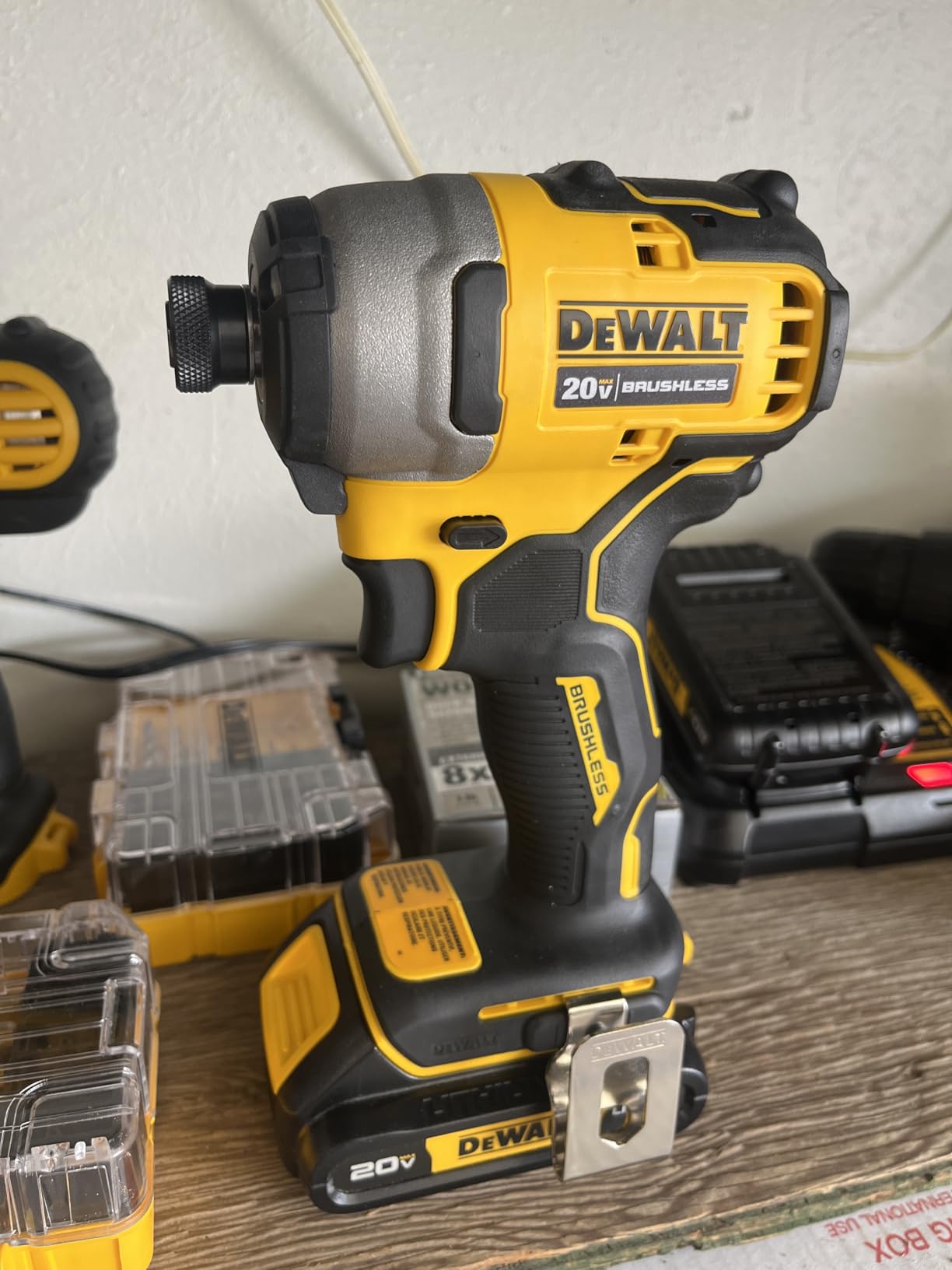
This is the tool I keep reaching for when a job moves fast and the access is bad. At 5.1 inches long and 2 pounds bare, the ATOMIC goes into a wall cavity, a joist bay or a cabinet box that a full-size driver simply will not enter.
Owners report driving six-inch Torx screws into treated lumber and backing out rusty nuts without drama. The variable speed trigger gives real control on delicate surfaces, which matters more than raw output when you are finishing visible cabinetry.
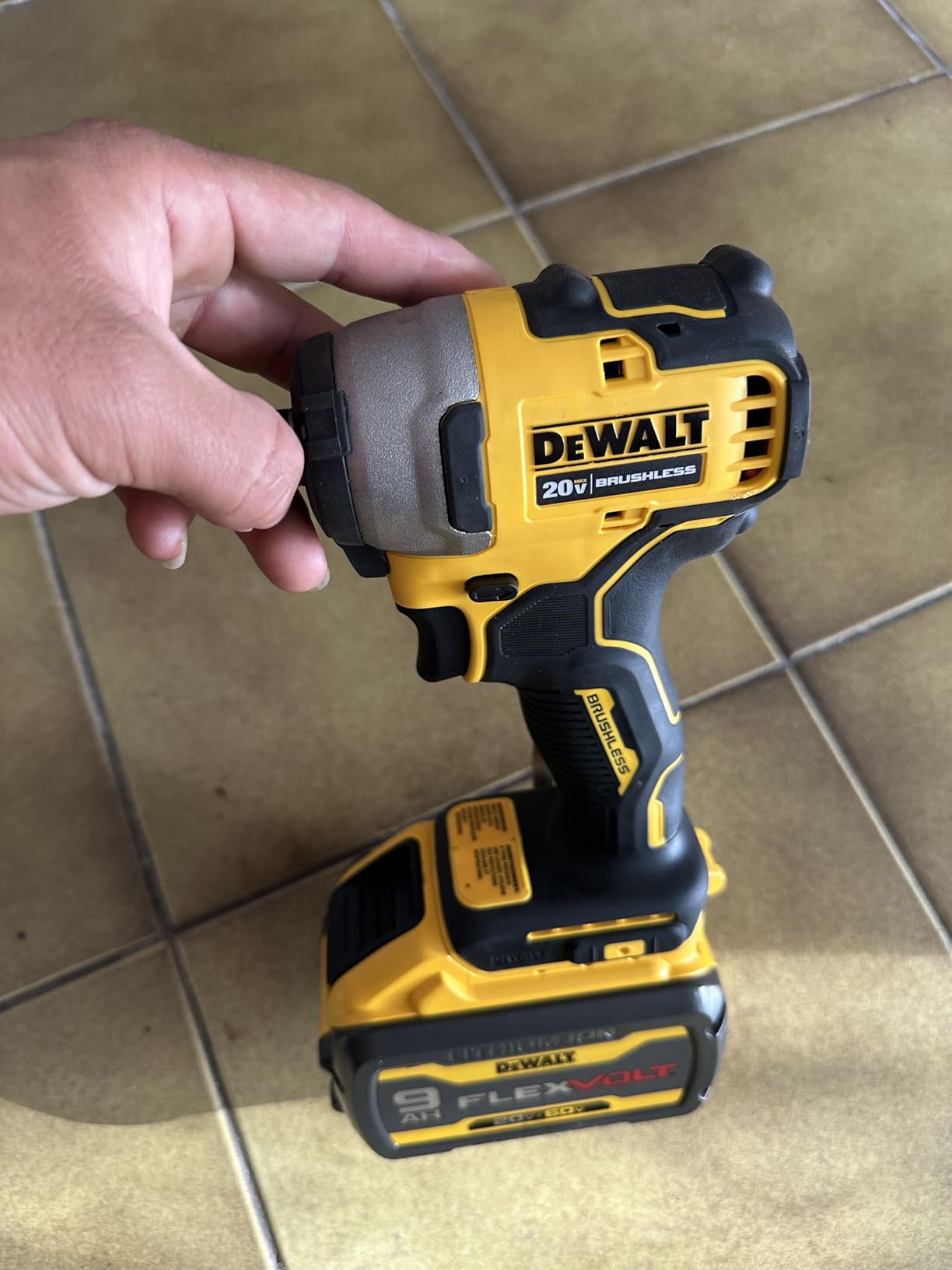
Buyer reaction splits cleanly along two lines, and the gripes that remain are either cosmetic or about wanting more power than this class delivers. The 5.1-inch length is the most-praised trait by a wide margin.
Why 1700 in-lbs Covers Most Woodworking Jobs
Deck screws, framing screws, lag bolts into softwood and cabinet hardware all sit comfortably inside a 1700 in-lb envelope. That number is a rated peak figure, and real-world breakaway torque runs lower, but the hammer action does the work the rating implies.
The gap to the M18 FUEL’s 2000 in-lbs matters when you are pulling structural fasteners out of cured pressure-treated lumber. For installation work, the difference rarely changes your day.
The Variable Speed Trigger and Low-End Control
The ATOMIC has no mode selector, so the progressive trigger is its only speed control. Feather it and the tool ramps up smoothly instead of snapping to full output, which is what lets you seat a machine screw or a pocket screw bit without driving past the head.
The trade is real. Because there is no gear selector, you cannot cap peak impact rate on soft material, so if softwood and veneer are a regular part of your work, the added gear control of the DCF845B on the next page is worth the step up.
Lighting, Grip and the Belt Clip
One practical note is the absence of a work light. Driving screws inside a wall cavity or a dark joist bay means bringing your own headlamp or clip light, and that is the clearest gap if most of your work happens in tight, unlit spaces.
Some buyers report the rubber grip arriving with a gouge or molding flash, so inspect it before you start. The belt clip is included, which matters for anyone working from a ladder or a lift all day, and at 2 pounds the tool stays comfortable on a hip all afternoon.
Who Should Look Elsewhere
If you regularly remove large structural bolts or deal with seized hardware, step up to the M18 FUEL. If you need a battery in the box today, the DCF787D1 kit covers that need inside the same platform.
Everything else, especially furniture assembly, drywall anchoring and general household fastening, sits right in this tool’s lane.
2. DEWALT DCF845B XR – Best Torque-to-Control Balance
DEWALT 20V MAX XR Impact Driver, 1/4 Inch High Torque Brushless 3 Speed Premium Cordless with LED Light, Extended Runtime, Tool Only (DCF845B)
1825 in-lb torque
0-3400 rpm
3 speed
3-LED light
+ Pros
- Brushless motor with 1825 in-lbs and 3400 rpm
- Three speeds plus variable trigger
- LED with 20-second delay
- Compact 5.1 inch head
- Belt hook included
- Cons
- Below Milwaukee flagship output on large fasteners
- Costs more than most rivals in class
- Battery and charger are extra
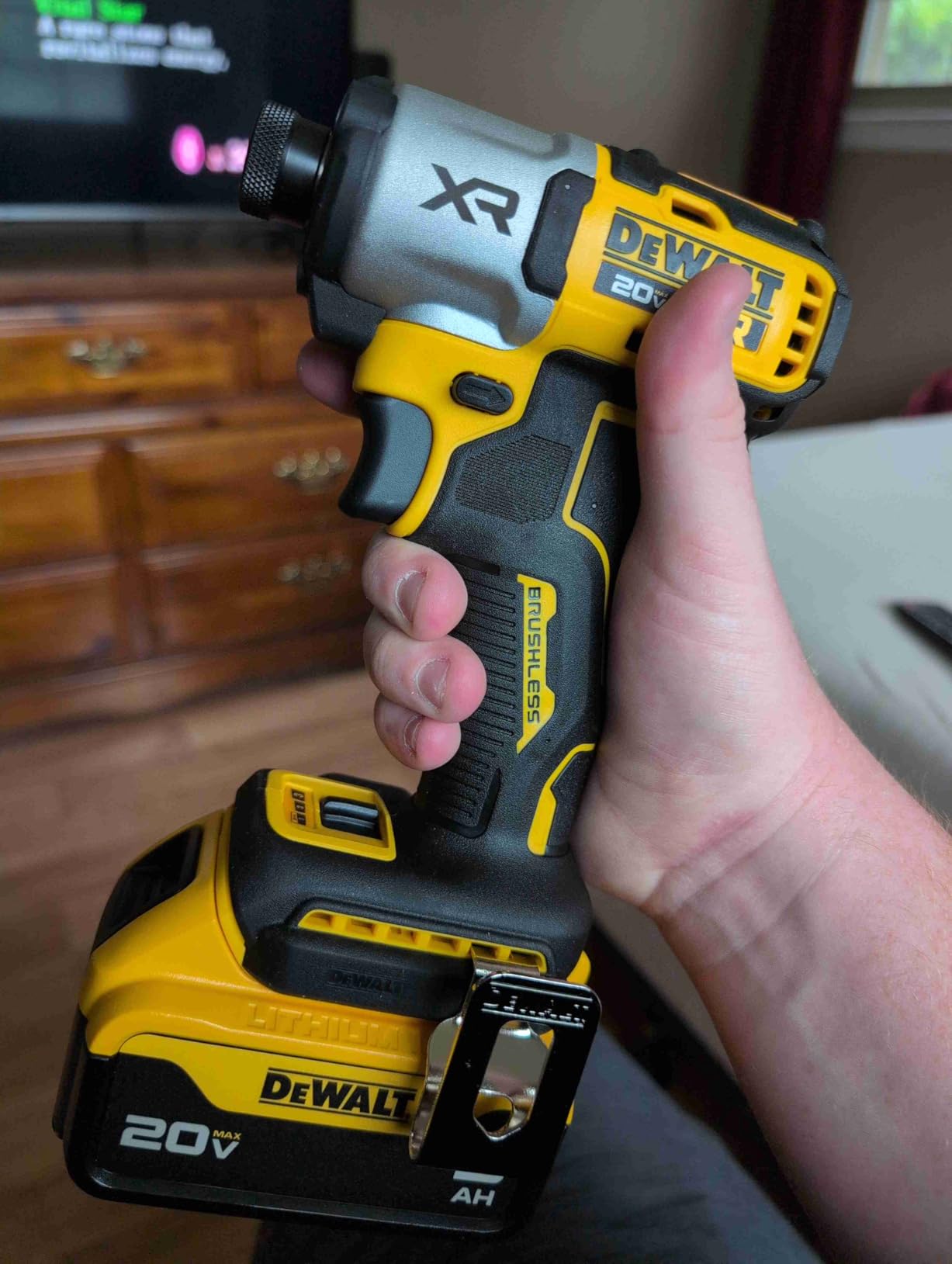
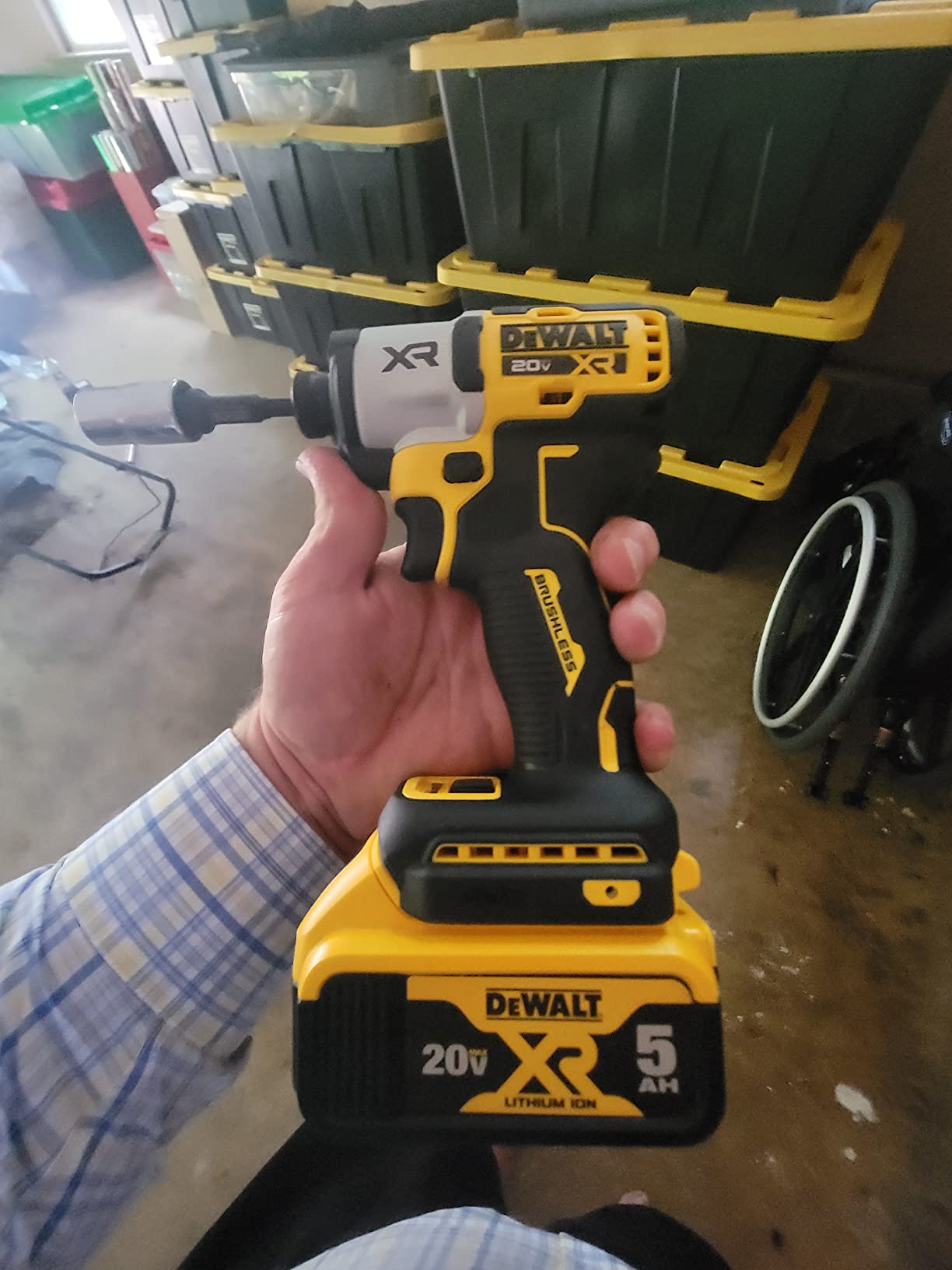
The DCF845B is the best-rounded tool in the DEWALT lineup, and for a good reason. Same 5.1-inch head as the ATOMIC, more torque, and a gearbox that gives you real gear separation.
Where the ATOMIC gets by on size, this one gets by on control. The three-speed selector plus a variable trigger covers cabinet screws on low, framing screws in the middle, and structural lags on high without a second tool.
1825 in-lbs and Where the Number Comes From
The rated 1825 in-lbs sits just under 150 foot-pounds, which is plenty for deck ledger screws, joist hangers and general structural work on a residential job. It also tops out at 3400 rpm, so it drives fast on softwood screws that a slower tool would stall on.
Owners with two years of framing and renovation behind them report the tool holding up without drama. The three-year limited warranty backs that up against shorter coverage from budget brands.
Why the Three-Speed Gearbox Matters More Than Torque
Raw torque gets you into the fastener. Gear selection gets you out of the workpiece without damage. The XR’s three gears let you start low on a screw that might strip in softwood, then step up as the bit bites.
That is the quiet advantage over single-speed drivers, where the choice is full speed or no speed at all.
The 20-Second LED Delay and Belt Hook
The integrated work light stays on for 20 seconds after you release the trigger, which is long enough to swap bits and pull the tool back without losing your place. It is a small feature that gets used constantly on a framing crew.
The belt hook is included, and the balance point sits close to the palm, which reduces wrist fatigue on long runs of driving.
Where It Falls Short
Buyers chasing maximum breakaway torque for the largest lags will find more in the Milwaukee M18 FUEL. This tool also costs more than most of its class, which is harder to justify if you already have a smaller driver on the same platform.
If the ATOMIC is already in your kit, the DCF845B earns its slot only when you regularly drive larger fasteners than the ATOMIC handles comfortably.
3. Milwaukee M18 FUEL 2953-20 – Most Torque in the Group
Milwaukee Electric – M18 Fuel. 1/4 HEX Impact Driver
2000 in-lb torque
3900 rpm
4 modes
Tri-LED
+ Pros
- Highest torque figure in the group at 2000 in-lbs
- Fastest driving speed without losing control
- Smooth trigger acceleration prevents stripped screws
- Tri-LED lighting
- Compact and well balanced
- Cons
- Bare tool
- battery and charger are extra
- Still below a dedicated impact wrench for breakaway work
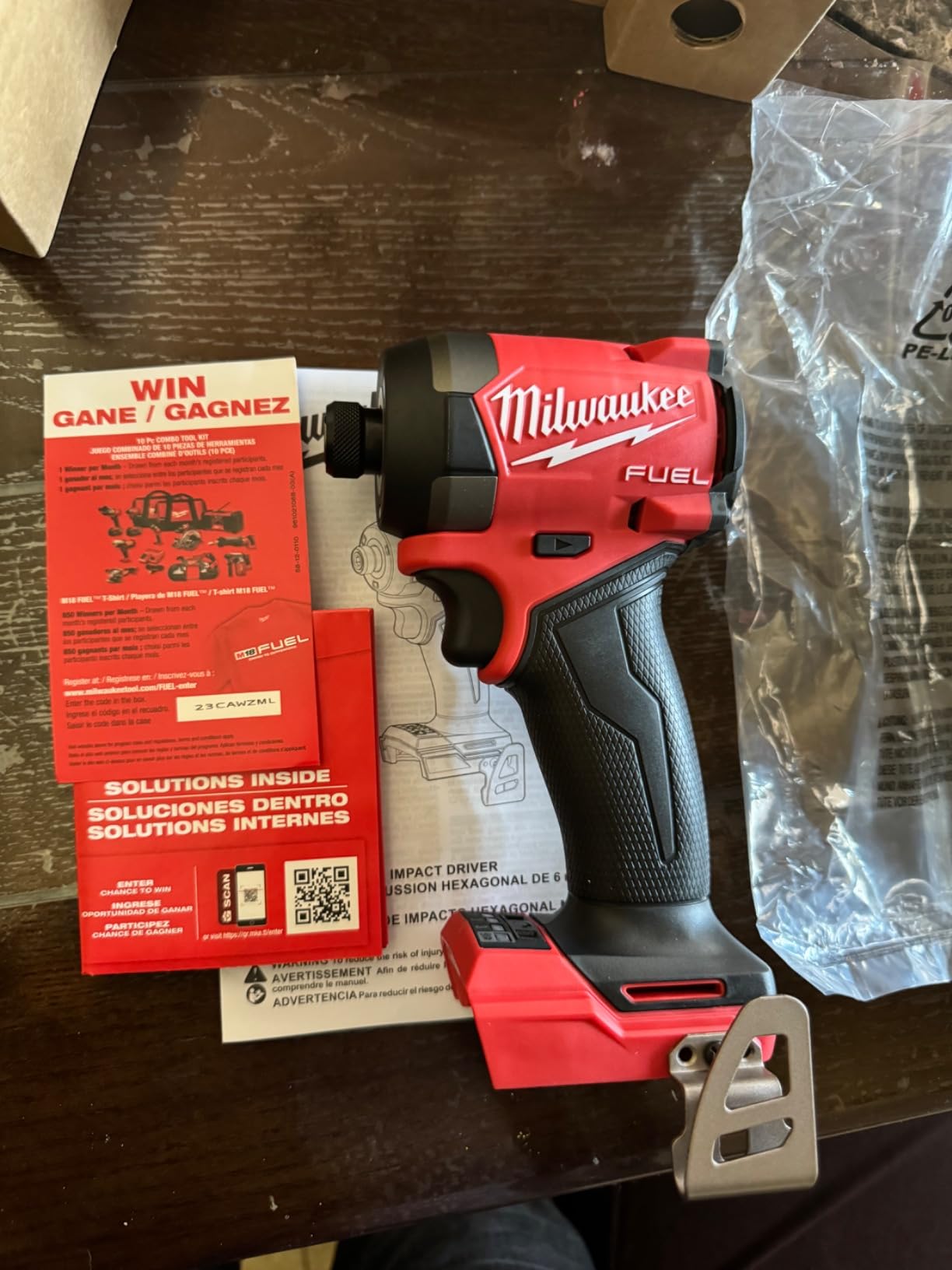
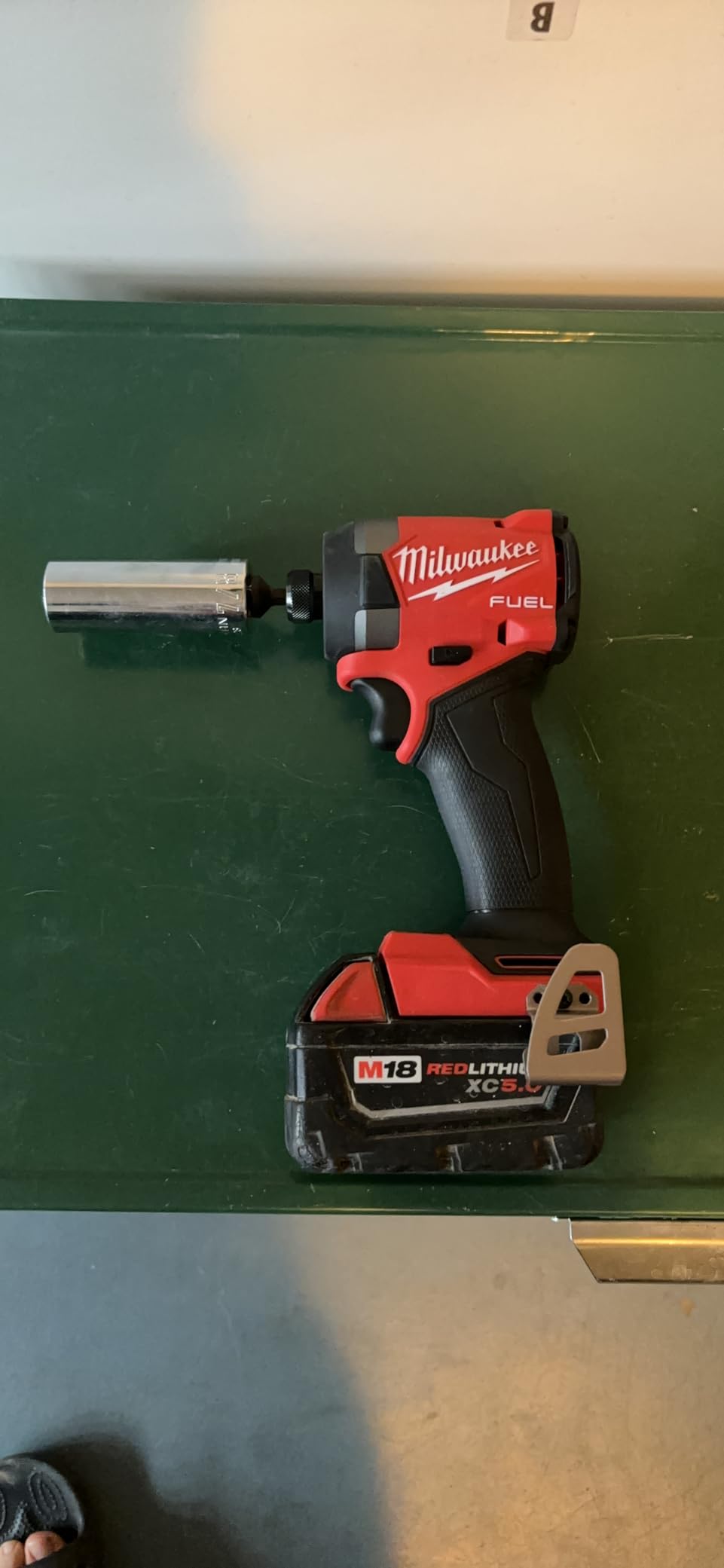
At 2000 in-lbs and 3900 rpm, the M18 FUEL is the most powerful 1/4-inch hex driver in this group, and the trigger is the smoothest of the twelve. Many owners use it as a daily go-to across truck, RV and automotive fasteners, and a good number bought it to replace a failed tool.
What separates this from a spec-sheet clone is the four-mode drive control. You choose a mode, the trigger still modulates within it, and the combination is what keeps screw heads intact on delicate work.
2000 in-lbs and Where the Driver Ceiling Sits
Two thousand inch-pounds is roughly 166 foot-pounds, and it is the top of the 1/4-inch hex category at this price. It handles lag bolts, structural screws and stubborn hardware that smaller drivers walk away from.
Owners who need more than this for breakaway torque should know that a dedicated impact wrench still out-muscles any hex driver. For installation and removal of moderately stubborn fasteners, this is the ceiling.
Four-Mode Drive Control Explained
Four modes cover general driving, a reduced setting for smaller fasteners, and higher-output settings for structural work. The reduced modes are what save you from stripping a screw head or chewing a soft workpiece.
Because modes constrain rather than replace the trigger, you can still feather the tool mid-fastener. That combination is rare at this price and it is the main reason experienced users keep coming back to this driver.
Tri-LED Lighting and Daily-Driver Balance
Tri-LED lighting throws enough light into a joist bay or under a sink to see the fastener head without a work light clamped elsewhere. It is the most thorough lighting package among the drivers here alongside the DeWalt XR.
Despite the class-leading torque, the tool stays compact and balanced. Owners working overhead or in crawl spaces report it handling positions where a bulkier driver would be unusable.
The Bare-Tool Catch
This is a bare tool. If you have no M18 packs, add a battery and charger to your real cost before comparing it against the kits below. If you already run Milwaukee, it is the cheapest path to the most torque on this list.
For anyone with an existing M18 platform, this is a straightforward upgrade with no second battery system to buy.
4. DEWALT DCF787D1 – Best Starter Kit With Battery and Charger
DEWALT 20V MAX Impact Driver, 1/4 Inch, Battery and Charger Included (DCF787D1)
Brushless motor
2Ah battery
Charger included
LED 20 sec
+ Pros
- Only kit in the group with battery and charger
- Highest average rating in the set at 4.8
- Compact and light yet strong on stuck bolts
- LED with 20-second delay
- Belt hook included
- Cons
- Bundled 2Ah pack limits runtime on heavy work
- Heavier feel than the bare-tool models
- Listed torque trails the XR and M18 FUEL
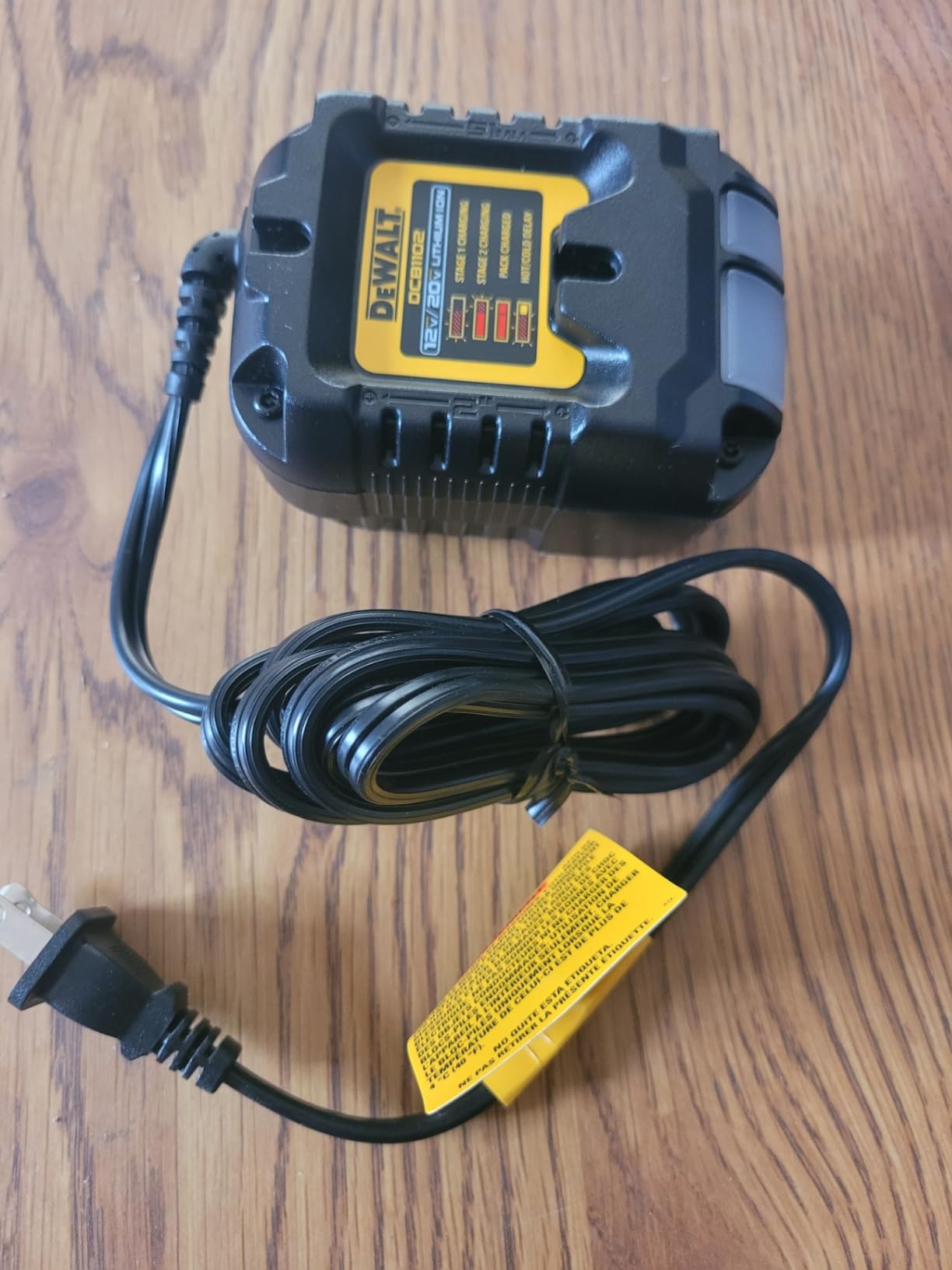
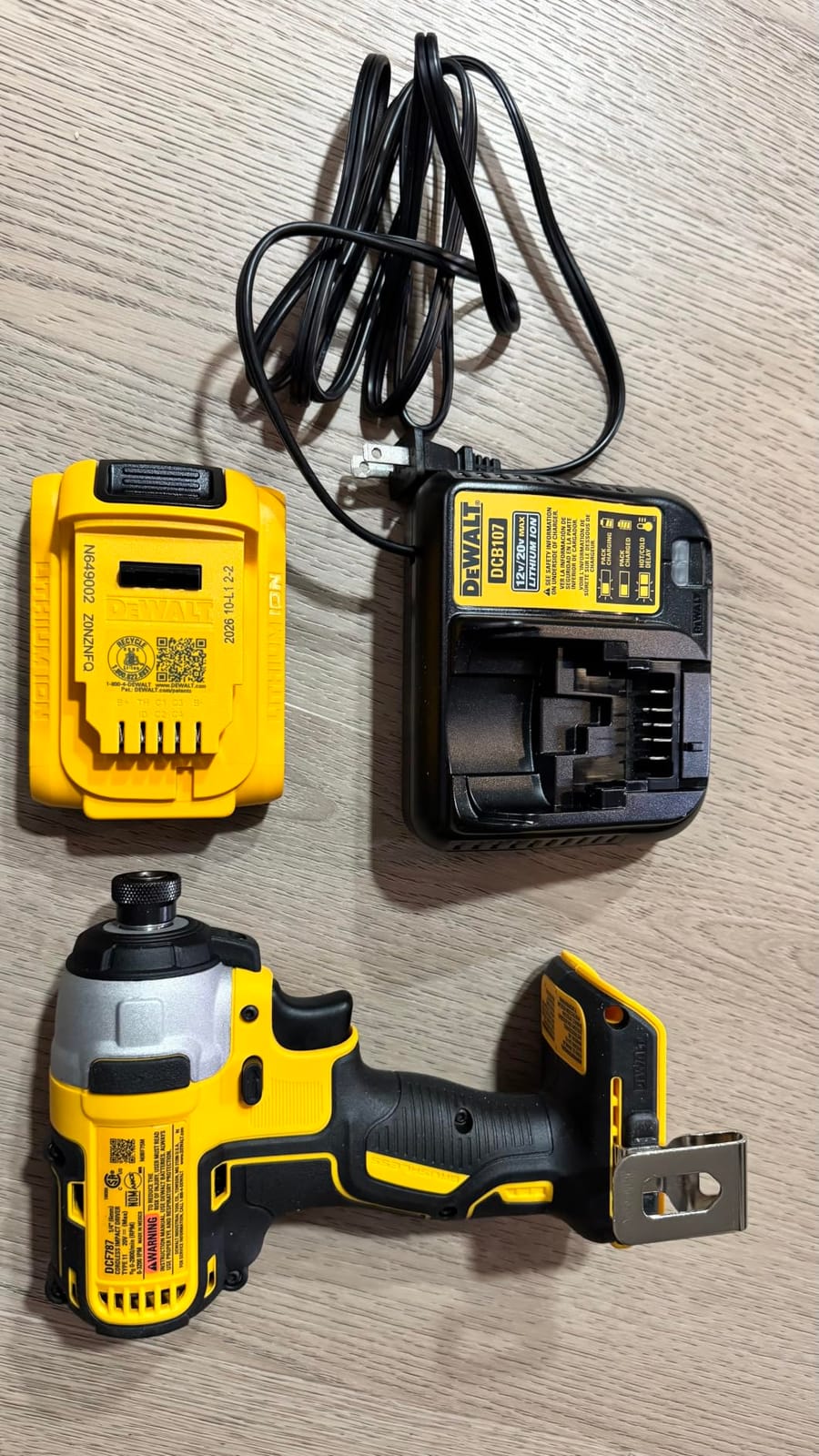
This is the only kit in the group that comes with a battery and a charger, and that single difference makes it the pick for anyone starting from nothing. You own a usable tool the moment it arrives instead of a bare tool and a shopping list.
It also posts the joint-highest average rating in the set at 4.8 across more than 1,700 reviews. Owners call it the best value inside the DeWalt lineup for exactly the reason it is in this roundup.
What the 2Ah Battery Really Costs You
The bundled pack is the smallest capacity in the DeWalt 20V line. On framing and deck projects the tool will need swapping partway through, and runtime is the most common reservation reviewers report.
Plan on adding a larger pack when you move to sustained work. For a weekend of household projects, the included battery and charger are genuinely enough to finish.
Compact Power Versus the XR Line
Reviewers report it strong enough to twist off a very stuck half-inch bolt, which is more than the listed torque figure suggests for a kit at this level. The one-handed quick-change bit collar is a genuine improvement over earlier generations.
Its listed torque sits below the DCF845B XR and the Milwaukee M18 FUEL, so if you already own one of those, this kit adds a spare rather than new capability.
Lighting, Weight and Jobsite Handling
The LED work light holds for 20 seconds after trigger release, matching the XR’s behavior. It earns daily use on dark framing bays and inside closets.
The kit carries more heft than the bare-tool ATOMIC models once the pack is seated, which is a fair trade for never running out of power mid-screw.
Who This Kit Is For
Buy this if you have zero DeWalt packs and want one purchase that ends with a working tool. Skip it if you already own 20V MAX batteries, because the same money buys significantly more tool without the charger and pack.
It is also the safest choice for a gift, a starter kit for a teenager, or a first tool for a rental property where simplicity matters more than peak torque.
5. Milwaukee M12 FUEL 3453-20 – Best Compact Pick at 1.6 Pounds
Milwaukee 3453-20 12V Fuel 1/4″ Cordless Hex Impact Driver (Bare Tool)
1500 in-lb torque
1.6 lb
4 modes
3 LED
+ Pros
- 1500 in-lbs from a brushless motor at 1.6 pounds
- Four-mode control with self-tapping screw mode
- Three LED lights
- Compact M12 platform is easy to carry
- Sits in a broad 12V tool ecosystem
- Cons
- Bare tool
- M12 battery and charger extra
- Rated torque well below the 18V and 20V options
The M12 FUEL is the lightest full-capability pick in the group, holding a 4.8 average across more than 1,700 reviews. It produces 1500 in-lbs from a brushless motor in a 1.6-pound shell, which is the part that continues to surprise people.
Automotive and facilities professionals in particular describe it as a daily driver that punches well above its voltage class, and the four-mode control is cited repeatedly for stopping torx security bits from stripping.
1500 in-lbs From a 12-Volt Class Tool
Rated output matches several 18V and 20V competitors, and at roughly 125 foot-pounds it covers light automotive fasteners that most 12V tools walk away from. That is genuine automotive work, not just cabinet assembly.
It is still below the 18V and 20V tools in this group, so the very largest structural lags remain out of reach. For most fastening jobs the gap never appears.
Four Modes and the Self-Tapping Setting
Four-mode drive control includes a dedicated self-tapping screw mode, which is the setting you want when driving screws into the threaded pilot already present in tap metal or thick plastic.
Mode 3 runs up to 3600 rpm, so the tool still drives fast on softwood screws rather than creeping along.
Portability and Platform Reach
At 1.6 pounds bare, this is the lightest full-size driver here. Three LED lights illuminate the workspace, and the M12 pack is small enough that the whole tool disappears into a tool bag side pocket.
The M12 platform is also the broadest compact ecosystem in this group, which means batteries and chargers are easy to source and shared with a large range of smaller tools.
What to Watch Before Ordering
Check the box on arrival before you sign for the delivery, and keep whatever documentation ships with the tool. Warranty service is far easier to start when the paperwork and serial details are in your files rather than in a recycling bin.
If you already own M12 packs, this becomes one of the cheapest ways to add real torque to a garage full of small tools.
6. RYOBI ONE+ PCL235B – Best Budget Pick
RYOBI ONE+ 18V Cordless 1/4 in. Impact Driver – 1,800 in-lbs Torque, 0-3,400 IPM, Tool Only (Battery Not Included) – PCL235B
1800 in-lb torque
0-3400 ipm
Single speed
Tool only
+ Pros
- Lowest entry point in the roundup
- 1800 in-lbs matches far pricier 20V tools
- 0-3400 ipm with 1/4 inch hex chuck
- Built-in LED working light
- Runs on the widely available ONE+ 18V platform
- Cons
- Tool only
- battery and charger sold separately
- Only one speed setting
- Shortest warranty here at 30 days
The RYOBI ONE+ PCL235B is the value entry in this group, and the number that jumps out is 1800 in-lbs of rated torque from a tool priced well under half of the premium options. Several owners compare that figure favorably against 18V and 20V drivers costing twice as much.
The catch is control, not power. A single-speed design gives you a variable trigger and nothing else, so delicate fastening gets less finesse than the three- and four-mode competitors offer.
Torque That Punches Above Its Price
At 1800 in-lbs, this matches the CRAFTSMAN V20 set in this roundup and lands between the DeWalt ATOMIC and the XR. For lag bolts, deck screws and general construction fastening, the raw output is not the limitation.
Impact speed runs 0 to 3400 ipm, and the 1/4-inch hex chuck accepts standard driver bits and quick-change collets. That is enough for most residential work.
Why One Speed Is a Real Limitation
Without a mode selector, the only way to slow the tool is to release the trigger. On soft material or a screw head that is about to strip, that is a coarser control surface than what the DeWalt, Milwaukee and Makita multi-mode tools provide.
If your work includes visible cabinetry, security screws or delicate joinery, the extra modes are worth paying for. If you are driving structural fasteners into dimensional lumber, the single speed rarely holds you back.
The ONE+ Platform Decision
ONE+ is one of the broadest battery platforms available, with a very large range of tools sharing the same 18V pack. Forum threads repeatedly return to this logic: if you already own ONE+ packs, the tool price is the only cost.
If you own nothing, add the battery and charger to your math before comparing this to a kit that includes them.
Warranty Length Is the Real Trade
Warranty coverage here is 30 days, far shorter than the three-year terms on the DEWALT and Makita models. That matters for a tool you expect to keep for years rather than months.
For a first tool, occasional use, or a renter who replaces equipment regularly, that shorter term is an acceptable trade for the entry price.
7. Makita XDT13Z – Best Lightweight Pick
Makita XDT13Z 18V LXT Lithium-Ion Brushless Cordless Impact Driver, Tool Only, Variable Speed
1500 in-lb torque
16 oz bare
0-3400 rpm
3 yr warranty
+ Pros
- 1500 in-lbs from an 18V LXT brushless platform
- Only 16 ounces bare
- Brushless motor runs cooler and more efficiently
- Variable 0-3400 rpm trigger
- Backed by a 3-year limited warranty
- Cons
- Tool only
- battery and charger not included
- Single speed with no drive mode selector
- No onboard work light listed for this model
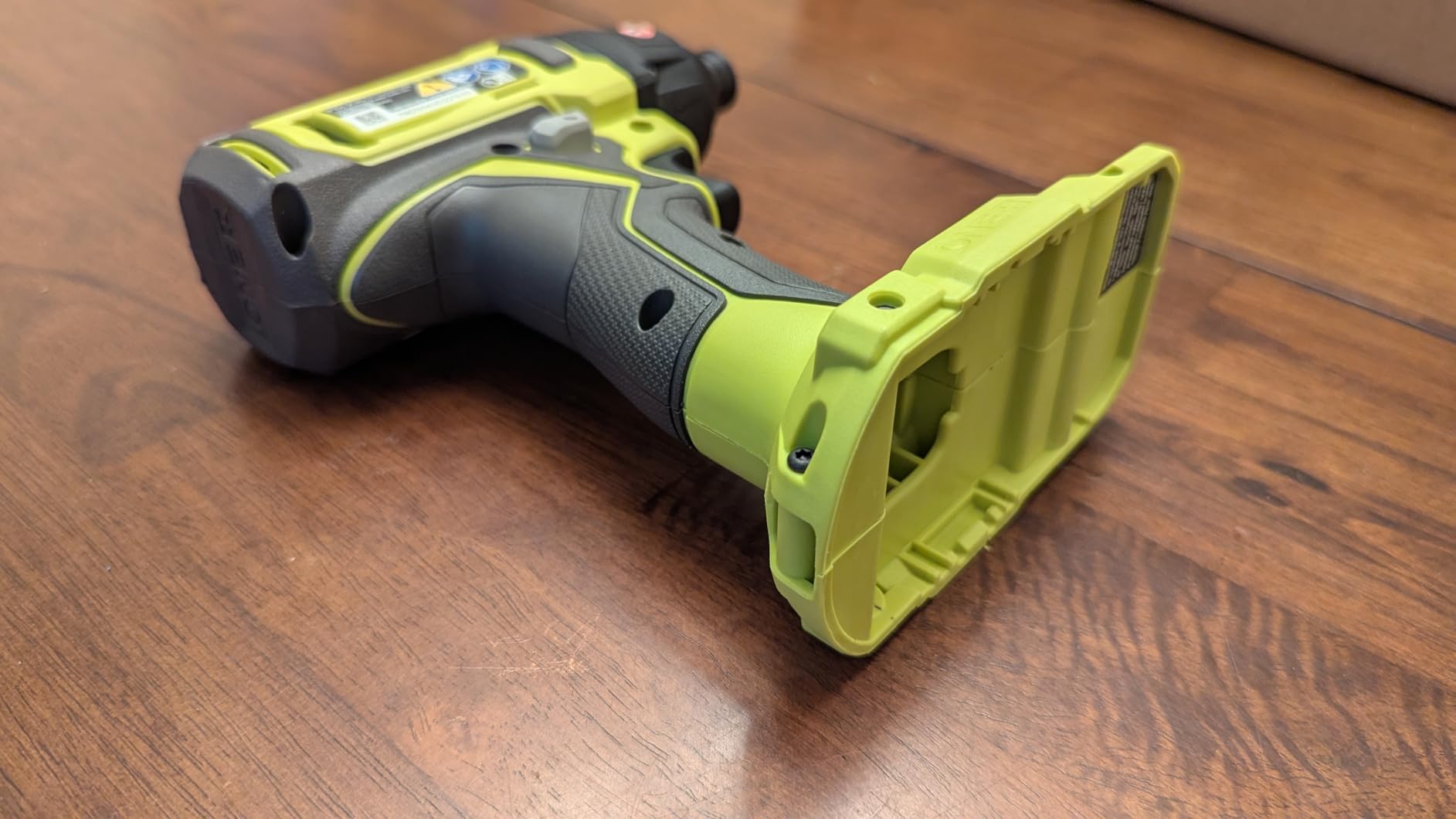
At 16 ounces bare, the Makita XDT13Z is the lightest tool in this roundup, and it still delivers 1500 in-lbs from a brushless motor. That combination is unusual — sub-pound tools are usually the low-torque ones.
Owners note the combination of 18V LXT power, very low weight and build quality, and buyers who already own LXT packs like the tool-only pricing. A three-year limited warranty backs the build.
What 16 Ounces Changes on a Long Job
Rated output matches the Milwaukee M12 FUEL despite running on an 18V platform. For overhead work, attic installs and long framing days, a tool this light meaningfully reduces wrist and forearm fatigue.
Steel construction and compact dimensions suit tight spaces where a bulkier tool would not fit comfortably.
Brushless Efficiency and Runtime
The electronically controlled brushless motor matches torque and rpm to the load and is rated for up to 50 percent longer runtime per charge than a comparable brushed motor. It also runs cooler, which is part of why the warranty term is three years.
Variable speed from 0 to 3400 rpm and 0 to 3600 ipm covers a wide range of fastening work from cabinet screws to framing lags.
The Missing Modes and the Missing Light
This is a single-speed design with no drive mode selector, unlike the XDT14Z. That is the main reason it earns the low-weight badge instead of the control badge.
No onboard work light is listed for this model, so dark spaces mean a headlamp or a clip light. Worth factoring in if you work in joist bays or crawl spaces often.
Platform Fit for Long-Term Owners
Members of r/BeginnerWoodWorking describe Makita 18V drivers as tools they have never regretted, with units lasting a decade or more. That longevity anecdote is the strongest argument for buying the platform rather than the cheapest tool.
If LXT packs are already in your garage, the XDT13Z is a low-cost way to add a driver that will still run in ten years.
8. Makita XDT14Z – Best Driver for Screw-Control Accuracy
Makita XDT14Z 18V LXT Lithium-Ion Brushless Cordless Quick-Shift Mode 3-Speed Impact Driver, Tool Only,
1550 in-lb torque
Quick-Shift
3 speed
3600 rpm
+ Pros
- Quick-Shift downshifts before the screw seats
- T-mode protects self-drilling screws and workpieces
- Three speed ranges plus variable trigger
- 1550 in-lbs at 3600 max rpm
- Well balanced at 2.1 pounds
- Cons
- Tool only
- battery and charger not included
- Single underside LED can shadow the work
- Below Milwaukee M18 FUEL and DeWalt XR torque
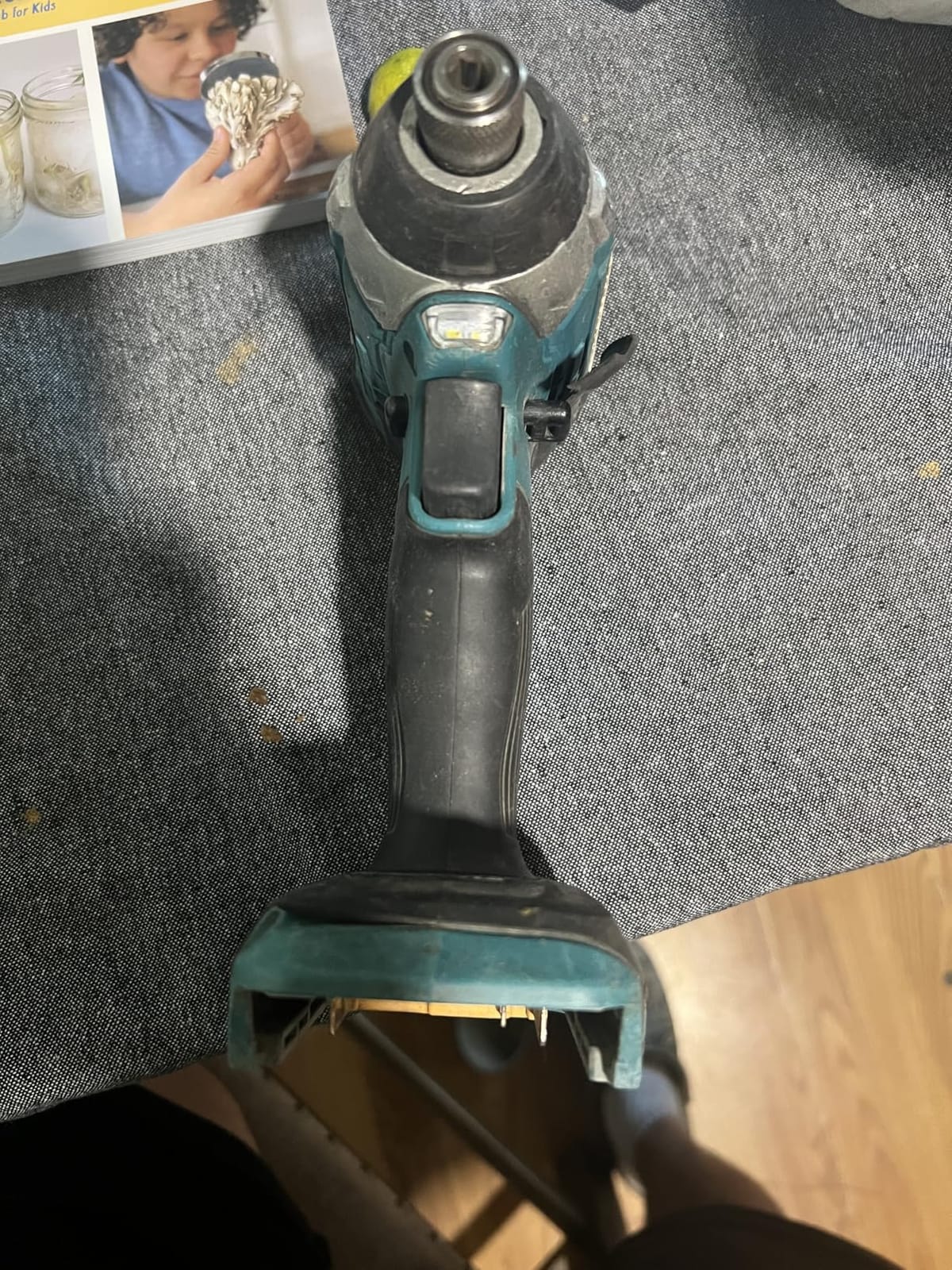
The XDT14Z is the only tool here that automatically slows down before a screw seats. Quick-Shift mode drops the rotation and impact speed just before the fastener bottoms out, which is the reason owners buy it for furniture, cabinetry and anything where a stripped or buried screw head ruins the project.
Add a dedicated T-mode for self-drilling screws and three speed ranges to 3600 rpm, and this becomes the most forgiving driver in the group.
Quick-Shift Mode and Why It Changes Outcomes
An automatic electronic controller in the mode selector reduces rotation and impact speed prior to the screw reaching final depth. On softwood and thin veneer, that is the difference between a flush, undamaged head and a buried, stripped one.
Single-speed drivers cannot replicate this behavior, which is why owners upgrading from the XDT13Z describe the change as the reason for the step up in price.
T-Mode for Self-Drilling Screws
T-mode tightens self-drilling screws faster while protecting both the screw and the workpiece. These fasteners already cut their own pilot, so controlling how hard the tool drives the last quarter inch matters.
Combined with the three speed ranges, this gives the widest control surface of any driver in the roundup.
Output, Balance and the Light
The brushless motor delivers 3600 max rpm and 1550 in-lbs of torque, rated for up to 50 percent longer runtime per charge. At 2.1 pounds the tool stays balanced for extended use.
The one real criticism is the single underside LED, which can leave the fastener head in shadow. Owners working in dim spaces often add a clip light regardless.
Where It Sits Against the Bigger Tools
Torque here trails the Milwaukee M18 FUEL and the DEWALT XR, so very large fasteners are not the target. The XDT14Z is for accuracy on medium and small fasteners done in high volume.
What the step up over the XDT13Z buys is control rather than power, so it earns its place for finish carpentry and cabinet installers, and is harder to justify if you rarely drive small fasteners in bulk.
9. Makita DT03R1 CXT – Best Kit for Cabinets and Shelving
Makita DT03R1 12V Max CXT Lithium-Ion Cordless Impact Driver Kit
970 in-lb torque
6 in long
2 packs and case
Slide battery
+ Pros
- Two 12V CXT batteries
- charger and case included
- Only 6 inches long
- Slide battery lets the tool stand upright
- Rubberized soft grip handle
- Cons
- Lowest torque here at 970 in-lb
- Not suitable for large structural fasteners or lug nuts
- Only two speed settings
- Smallest review base at 410 ratings
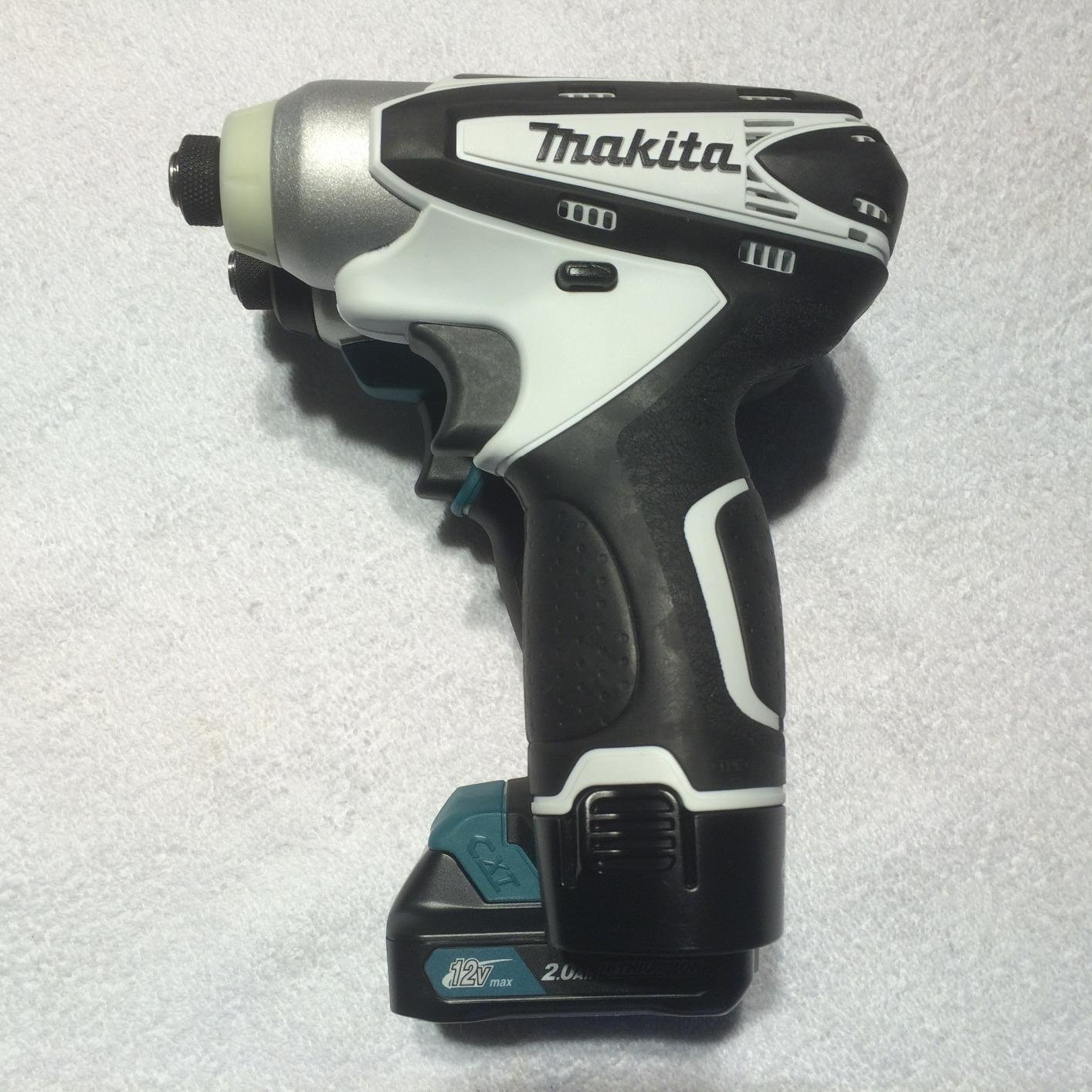
The Makita DT03R1 is the ultralight kit option, and it arrives genuinely complete: two 12V max CXT batteries, a charger and a tool case. For cabinet assembly, shelving and finish work, that package is the appeal.
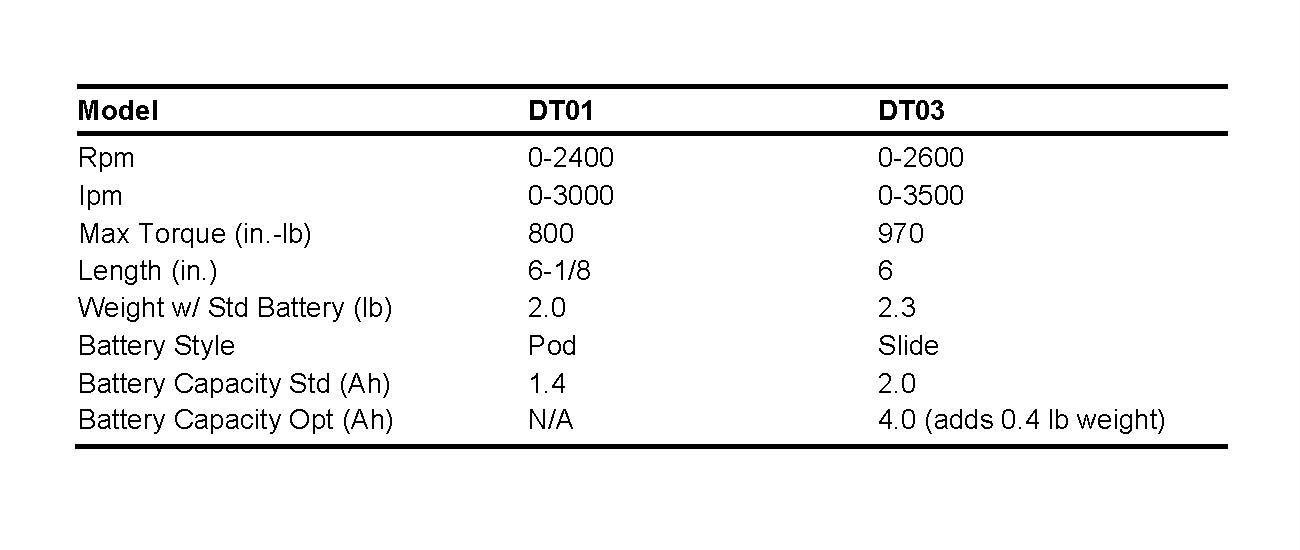
At 970 in-lbs it produces roughly half the output of the premium drivers here, so this is not a framing or lag bolt tool. Owners are satisfied with what it is designed to do rather than raw capability.
Why 970 in-lbs Is the Right Number for This Job
Cabinet screws, drawer hardware, shelving anchors and finish nails are all within reach at this level. The 0.25-inch chuck and variable speed from 0 to 2600 rpm and 0 to 3500 ipm cover that range well.
Large structural fasteners, lags and lug nuts are not in scope. Anyone who reads the number and stretches it is the one who ends up disappointed.
The Six-Inch Body and Slide Battery
At six inches long, this is among the most compact drivers available, which matters inside cabinet boxes and narrow wall cavities. The 12V slide battery design lets the tool stand upright on its own, so you are not laying it on its side on a finished surface.
Both features are small conveniences that add up on a long install day.
What You Get in the Box
Two 12V max CXT batteries, a charger and a tool case. Among twelve options, the case is unique to this kit and keeps the driver and batteries together in a van rather than loose in a drawer.
Two speed settings give slightly more control than a single-speed tool, though less than the four-mode options from Milwaukee and Makita LXT.
Who Should Choose This Over a Bigger Driver
Choose this for finish carpentry, cabinet installs and anyone who wants a complete set in one purchase without buying into an 18V platform. Avoid it if your work involves decks, framing or any automotive fastener.
The 410-rating review base is the smallest here, so treat owner feedback as thinner evidence than for the heavily reviewed picks above.
10. Milwaukee M18 Compact 3650-20 – Best for Tight and Overhead Spaces
Milwaukee Electric – M18TRADE Compact BRUSHLESS 1/4 HEX Impact Drive
4.4 in long
1700 in-lb torque
All metal gearcase
+ Pros
- 4.4 inch body reaches tight and overhead spots
- Brushless motor delivers 1700 in-lbs at that size
- All metal gearcase and gears
- Enhanced variable speed trigger
- 1.7 pounds reduces hand fatigue
- Cons
- Single speed setting
- Runtime drops on long runs of heavy screws
- No work light listed
- Bare tool
- battery and charger not included
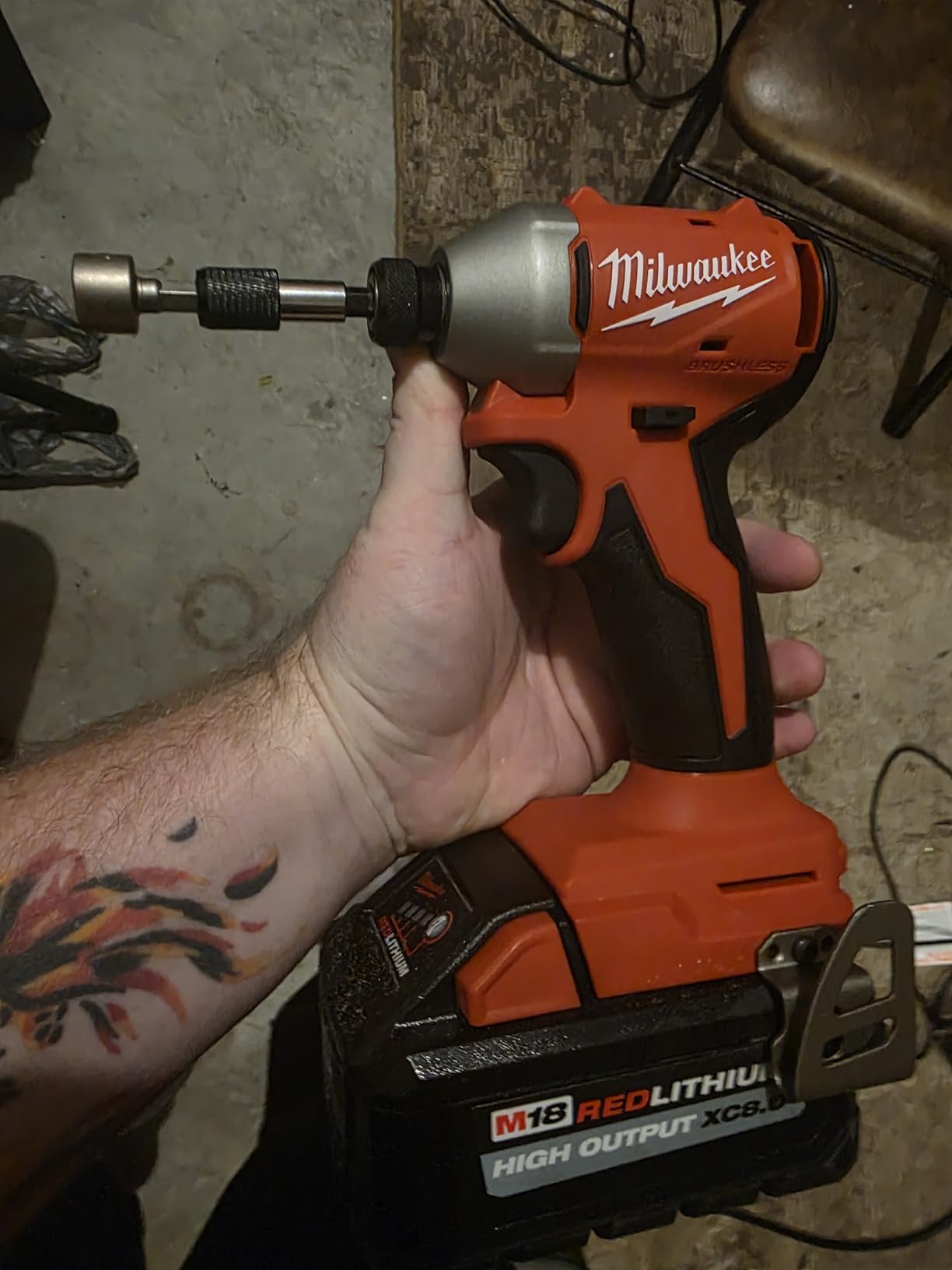
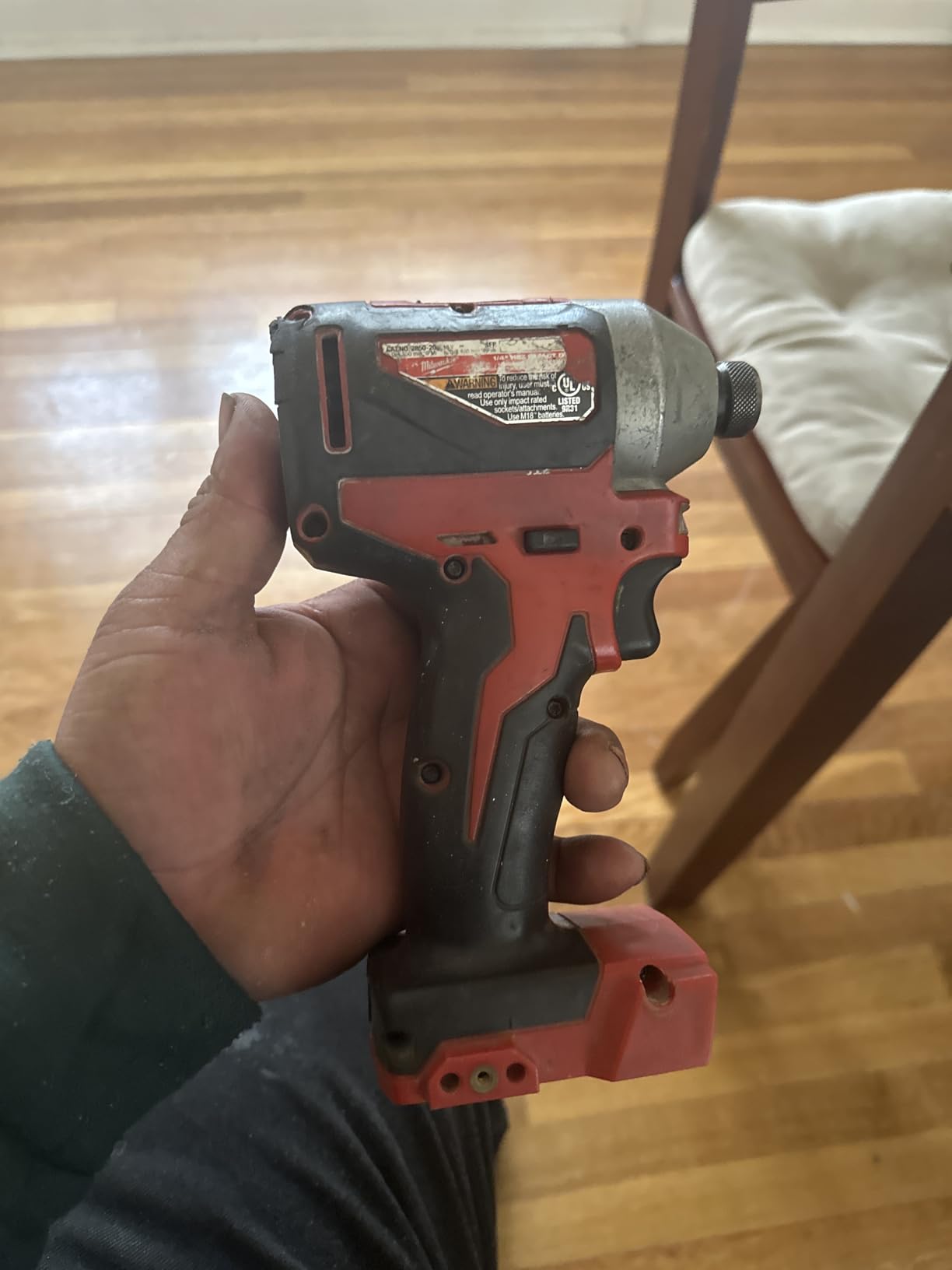
The M18 Compact is the shortest tool in this group at 4.4 inches, and it still produces 1700 in-lbs from a brushless motor. That is the specific combination owners reach for in overhead work, tight joist bays and inside cabinet boxes.
Reviewers describe it as the tool they reach for in tight spaces, overhead, and for deck or cabinet work, where access rather than capacity is the limiting factor.
Four Inches Changes What You Can Reach
At 4.4 inches, this is the shortest body here and roughly three-quarters of an inch shorter than the 5.1-inch DeWalt tools. In a confined cavity that difference decides whether the tool fits at all.
Overhead work is where the compact length pays off most. You can hold a lighter, shorter tool directly in front of the fastener rather than reaching up at an angle.
All Metal Gearcase and Gears
The all-metal gearcase and gears earn repeated mentions in reviews as the reason this tool holds up. It is a durability feature aimed at professional use, and it is the most concrete construction claim in this roundup.
The brushless motor is electronically managed, and the enhanced variable speed trigger helps reduce damage to fasteners and material at the trigger end.
Single Speed, No Light, Shorter Runtime
One speed setting means less control than the multi-mode M18 FUEL on delicate fasteners, and no work light is listed for this model. Both are real gaps for interior finish work.
Runtime drops on longer stretches of heavy screw driving, and several owners recommend carrying a spare pack. At 1.7 pounds the tool stays light even with a battery seated.
Choosing Between the Two Milwaukee Drivers
Pick the Compact when access is the constraint. Pick the M18 FUEL when torque and mode control are the constraint. Many owners eventually buy both, because the two answer different problems.
The 345-rating review base is modest, so the ownership feedback here is thinner than for the high-review picks, though sentiment is consistently positive.
11. CRAFTSMAN V20 CMCF830D2 – Most Complete Set
CRAFTSMAN V20 Cordless Brushless Impact Driver Set, 1/4 Impact Driver, Includes 2 Batteries and Charger (CMCF830D2)
1800 in-lb torque
2 packs plus charger
3 speed
Storage bag
+ Pros
- Two 2.0Ah batteries
- charger
- storage bag and belt hook
- Brushless 1800 in-lbs with up to 55 percent faster driving
- Three-speed gearbox plus variable trigger
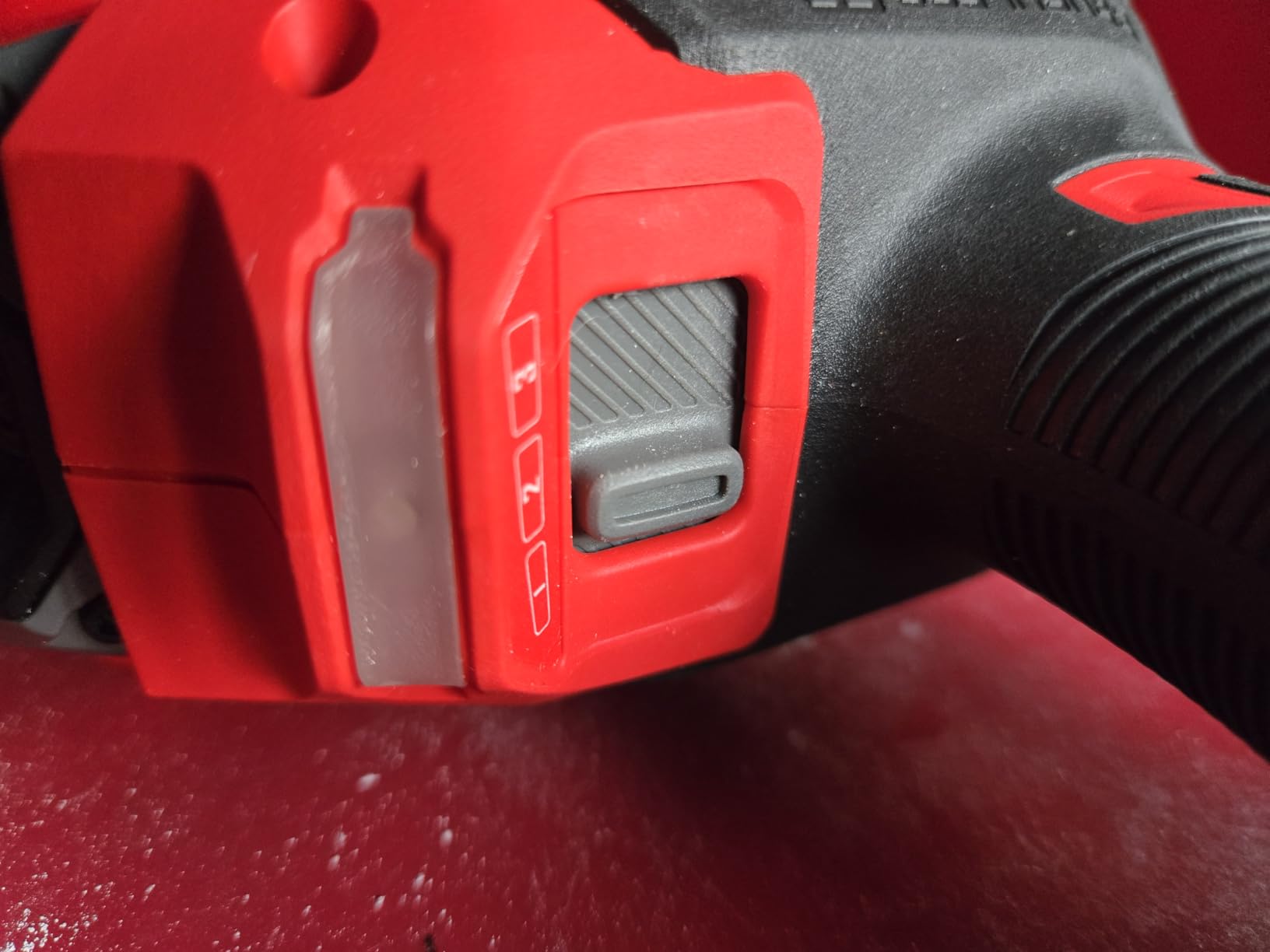
- One-handed quick release chuck with onboard bit holders
- Upgraders from brushed report a large jump in power
- Cons
- Smallest review base here at 122 ratings
- Gear spacing is aggressive
- start low in soft material
- VERSATRACK clips sold separately
- Build quality trails DEWALT and Makita
The CRAFTSMAN V20 CMCF830D2 is the best-equipped set in this roundup, and the package is the differentiator. Two 2.0Ah batteries, a charger, a storage bag and a belt hook arrive in the box, so there is nothing left to buy before you start.
The brushless motor delivers 1800 in-lbs of driving torque with up to 55 percent faster driving and up to 24 percent more runtime than the brushed version it replaces. Owners upgrading from a brushed CRAFTSMAN driver describe a dramatic jump in power and fit and finish.
1800 in-lbs and the Upgrade Path From Brushed
At 1800 in-lbs, this matches the RYOBI ONE+ at a fraction of the premium-brand pricing and sits near the top of this group. That figure is enough for deck screws, lag bolts and general construction work.
The jump from brushed to brushless is where reviewers focus. More torque, better heat management and less internal wear over time are the reasons the metal-plastic construction feels more substantial than the price suggests.
Three Speeds and Aggressive Gear Spacing
Three speed settings run 0 to 1400, 0 to 2400 and 0 to 3200 no-load rpm, with a variable speed trigger on top. The most useful practical note in reviews is that the gears are spaced aggressively, so starting low in soft material avoids over-driving.
That advice matters more on this tool than on gentler gearboxes, and it is worth reading before your first softwood screw.
Bit Changes and Bit Storage
The one-handed quick-release 1/4-inch hex chuck makes bit changes fast, and onboard magnetic bit holders keep the bits you actually use within reach on the tool itself.
The onboard LED adds visibility in dim spaces, which matters for cabinet and closet work.
What the Platform Does Not Include
VERSATRACK clips and accessories are sold separately, so the storage bag is your only carrying solution out of the box. Plan for that if you work from a truck bed regularly.
With 122 ratings, this is the second thinnest review base in the group, and owners note that build quality and brand recognition trail the DEWALT, Milwaukee and Makita options. The hardware here is strong; the long-term service network is the weaker half of the trade.
12. CRAFTSMAN V20 CMCF811D1 – Best Short-Head Kit for Deck Screws
CRAFTSMAN V20 BRUSHLESS RP Compact Impact Driver Kit (CMCF811D1)
5.02 in head
1000 in-lb torque
2.0Ah and charger
+ Pros
- Tool head measures just 5.02 inches
- Rated for up to 294 three inch deck screws per charge
- Battery and charger included
- Onboard LED focuses light on the work
- VERSATRACK compatible storage
- Cons
- Lowest torque among the 20V options at 1000 in-lb
- Smallest review base here at 114 ratings
- Only one battery included
- VERSATRACK clips sold separately
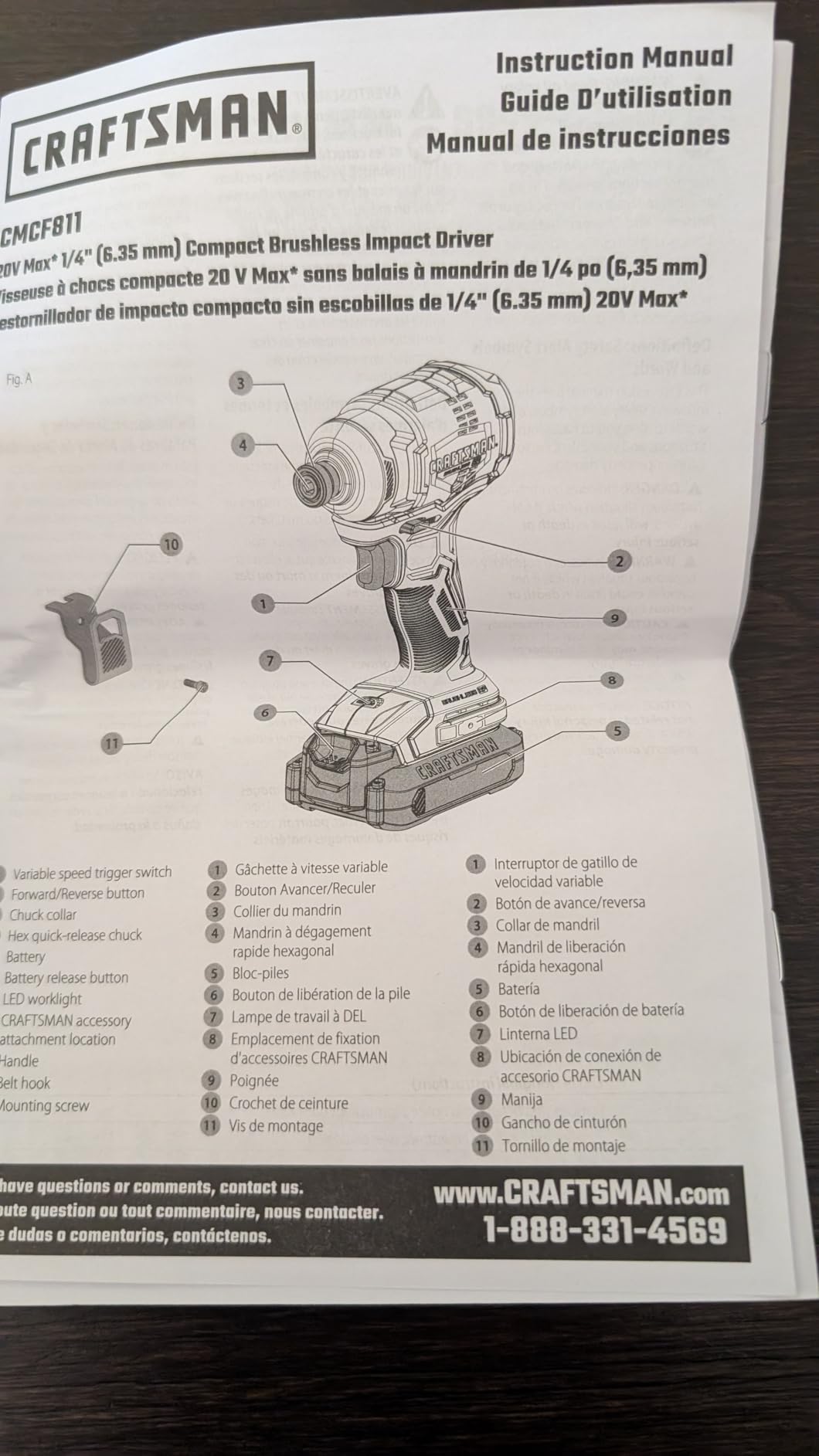
The CRAFTSMAN V20 CMCF811D1 pairs a 5.02-inch tool head with a battery and charger in the box. That combination makes it a practical compact kit for anyone driving three-inch deck screws without committing to a bigger platform.
Owners highlight the runtime claim as a practical figure rather than a class-leading one: the manufacturer rates it for up to 294 three-inch deck screws per charge, along with up to 47 percent more runtime per charge and up to 19 percent faster driving than RYOBI.
The 5.02-Inch Head and Tight-Space Work
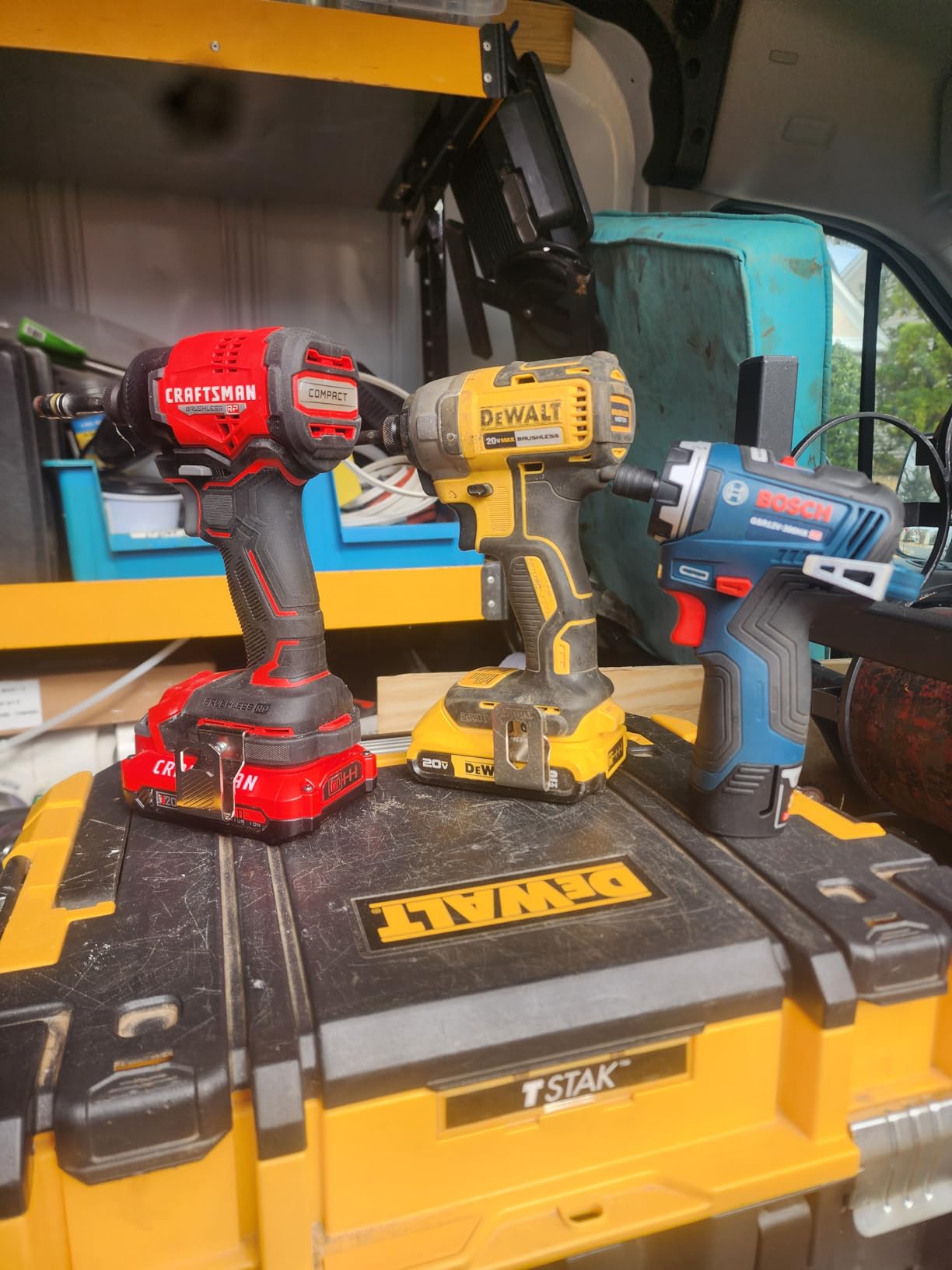
The head is rated up to 27 percent shorter than comparable models, which puts it in the same size class as the DeWalt ATOMIC without requiring you to own DeWalt packs. In a joist bay or a cabinet interior, that length is the deciding factor.
Aluminum and plastic construction with rubberized grips keeps the tool stable and comfortable in a single hand.
Where 1000 in-lbs Fits and Where It Does Not
At 1000 in-lb, this is the lowest torque among the 20V options in this roundup, sitting just above the Makita 12V CXT kit. Three-inch deck screws are within reach. Lag bolts into dense hardwood and structural fasteners are not.
Buyers wanting more headroom inside the same 20V family should look at the CMCF830D2 set, which trades package size for 800 additional in-lbs.
Runtime and Deck Screw Reality
The up-to-47-percent runtime claim and the 294 deck screw figure come from the manufacturer, and they reflect real workload rather than a lab headline. Actual counts vary with screw length, material density and how hard you lean on the tool.
Onboard LED lighting focuses on the action, which matters when you are working under a deck or inside a joist bay with the sun behind you.
What the Kit Does and Does Not Include
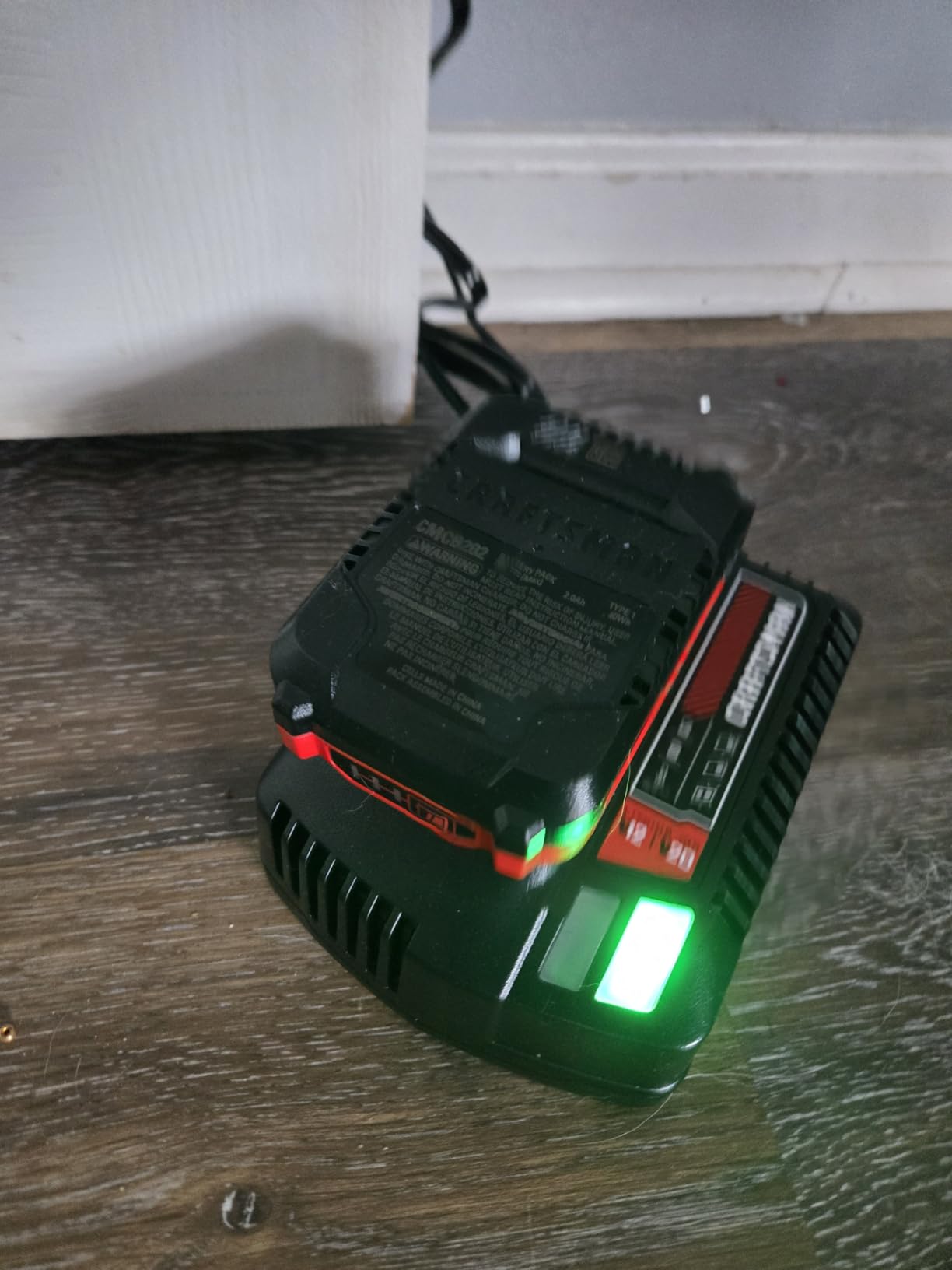
You get a CMCB101 charger, one CMCB202 2.0Ah battery and the driver. Only one pack is included, unlike the two-battery CRAFTSMAN set, so plan a charging pause or a second pack for a full deck day.
VERSATRACK storage compatibility is there, but the clips and accessories are sold separately. With 114 ratings, this is the least-reviewed product here, so treat owner feedback as early-stage impressions.
How to Choose a Cordless Impact Driver Under 200 Dollars
Torque gets the attention, but the battery platform decides whether the purchase is cheap or expensive. Work through these six decisions in order and the model will pick itself.
Bare Tool vs Kit: Add the Battery Before You Compare
Eight of the twelve tools here ship as bare tools. If you do not already own the platform, the tool price is roughly half the real cost. A bare driver plus a battery and charger routinely costs more than a complete kit, and the retailer category pages rarely make that obvious.
Rule of thumb: if you already have two or more compatible packs, buy the bare tool and spend the difference on a better driver. If you own none, buy the kit that includes a charger, because a tool with no way to charge it is not a purchase.
Note also the pack size in each kit. A 2.0Ah pack is the smallest in its family and will drive you to a charger partway through a deck. A 4.0Ah pack is the minimum worth owning for sustained work.
Impact Driver vs Impact Wrench: Know Which One You Own
An impact driver has a 1/4-inch hex collet and exists to drive screws fast without stripping heads or camming out. An impact wrench has a 1/2-inch square drive and exists to remove and install nuts and bolts.
If your list includes lug nuts, axle hardware or anything you plan to back out of cured steel, you need a wrench. The strongest driver in this roundup tops out at 2000 in-lbs, which covers moderately stubborn fasteners, but a dedicated wrench still beats it for breakaway work.
Buying the wrong one is the single most common category mistake, and it is the easiest to avoid by writing your job list before you shop.
Torque: What the Numbers Actually Mean
Impact driver torque is normally quoted in inch-pounds, not foot-pounds. 2000 in-lbs is about 166 ft-lbs, 1800 in-lbs is about 150 ft-lbs, and the 970 in-lb tool at the bottom of this list is about 81 ft-lbs.
These are rated peak figures, not measured breakaway output. Budget brands in particular inflate the number by quoting peak rather than sustained torque, which is one reason recognized brands hold their ratings better over time.
Map the number to the job: 1000 in-lbs handles cabinet and finish screws, 1500 to 1800 in-lbs covers deck screws and lag bolts into softwood, and 2000 in-lbs adds the headroom for stubborn hardware and automotive work.
Brushless vs Brushed and Why It Matters
Every tool in this roundup is brushless. That is the single biggest quality change in this price band over the last few years, and it brings three concrete benefits: up to 50 percent longer runtime per charge, cooler operation that extends tool life, and no carbon brush replacement.
If you find a driver in this price range that is brushed, keep walking. The CRAFTSMAN V20 owners who upgraded from brushed report the power and build difference is immediate, and the manufacturer claims up to 55 percent faster driving and 24 percent more runtime from the brushless version.
Speed Modes, Drive Control and Screw Protection
More modes means more control. A single-speed tool with a variable trigger gives you two things: on and off. Four modes give you a way to drive a machine screw without stripping it and then a way to drive a lag bolt without stalling.
Two features are worth extra money if you do fine finish work. Makita’s Quick-Shift mode automatically slows the tool before the screw seats, and T-mode protects self-drilling screws and the workpiece. Both prevent the over-driving that ruins cabinet installs and veneer panels.
Reverse auto-stop is worth checking for on automotive work, where stopping the moment the nut breaks loose saves stripped hardware.
Weight, Balance and the Work Light
Tool weight ranges from 16 ounces on the Makita XDT13Z to 4.3 pounds for the heaviest kit in the group. For overhead work and long framing days, sub-2-pound tools are the difference between finishing fresh and finishing sore.
Balance matters more than raw weight. A well-balanced tool with the mass near the palm feels lighter than a heavier one with the battery hanging off the back, which is why the M18 FUEL stays comfortable despite class-leading torque.
Lighting is the most-skipped feature and the most-used one. Three LEDs above the collet beat a single underside light that shadows the fastener head. If you work in joist bays, closets or under decks, treat a good work light as required rather than nice to have.
Warranty Length and Platform Breadth
Warranty terms here run from 30 days on the RYOBI ONE+ to three years on the DEWALT and Makita models. For a tool you expect to keep for a decade, that spread is a real difference in risk.
Platform breadth decides the cost of every future tool you buy. Members of r/BeginnerWoodWorking and r/Tools return to the same advice: buy the platform, not the tool, because packs and chargers are the part you keep and the driver is the part you replace. A driver that dies in year four is an inconvenience if the ecosystem is broad and a crisis if it is not.
Check what else shares the battery before you commit, especially if you own a mower, blower or vacuum from the same family.
Frequently Asked Questions
What is the best cordless impact driver for the money?
The DEWALT ATOMIC DCF809B is the best cordless impact driver for the money under 200 dollars. It delivers 1700 in-lbs of torque from a brushless motor in a 5.1-inch body, carries a 4.7 rating across more than 3,300 reviews, and fits between wall studs where full-size drivers cannot. The Milwaukee M18 FUEL takes the win on raw torque at 2000 in-lbs if your fasteners are larger.
Impact driver vs impact wrench: which one do I need?
An impact driver takes a 1/4-inch hex bit and is built to drive screws and fasteners quickly without stripping heads. An impact wrench takes a 1/2-inch square drive and is built to remove and install nuts and bolts. If your job list includes lug nuts, axle hardware or bolts you need to back out of cured steel, buy an impact wrench. The strongest driver in this roundup is rated at 2000 in-lbs, roughly 166 ft-lbs.
Is 250 ft-lbs of torque enough for lug nuts?
For light vehicle lug nuts on a properly torqued wheel, 250 ft-lbs is more than enough and a 1500 to 2000 in-lbs impact driver covers it. Lug nuts on trucks and SUVs that have been over-torqued or left on can require 300 to 400 ft-lbs, which exceeds what any 1/4-inch hex driver in this roundup delivers. For that work, use a mid-torsion impact wrench, not an impact driver.
Are DeWalt or Milwaukee impact drivers better?
DeWalt leads on compact length and multi-mode control, with the ATOMIC at 5.1 inches and the XR offering 1825 in-lbs across three speeds. Milwaukee leads on raw torque and trigger smoothness, with the M18 FUEL at 2000 in-lbs and the M12 FUEL packing 1500 in-lbs into 1.6 pounds. Whichever you pick, choose the platform whose batteries you already own or can buy most easily.
Do I need a brushless impact driver for occasional DIY use?
Yes, if you are shopping in this price range. Every one of the twelve drivers covered here is brushless, which buys up to 50 percent longer runtime per charge, cooler operation and no brush replacement over the tool’s life. Brushed alternatives in the same price band run cooler, shorter and harder, and for a tool you own for a decade the difference is worth the small step up.
Which Cordless Impact Driver Should You Buy?
If you want one answer: take the DEWALT ATOMIC DCF809B. It is compact, powerful enough for deck screws and lag bolts, and the most-reviewed tool in this group, which means the long-term data behind it is the deepest.
If you already own DeWalt packs and regularly drive larger fasteners, the DCF845B XR adds 125 in-lbs and a three-speed gearbox. If you own Milwaukee packs or your work includes stubborn hardware and automotive fasteners, the M18 FUEL at 2000 in-lbs is the strongest 1/4-inch hex driver available at this price.
If you need weight under two pounds for overhead and cabinet work, the Milwaukee M12 FUEL delivers 1500 in-lbs in 1.6 pounds, and the Makita XDT13Z delivers the same rating at just 16 ounces. For screw accuracy on visible cabinetry, the Makita XDT14Z with Quick-Shift mode is the only tool here that slows down before a screw seats.
If you are buying your first driver and own no batteries at all, start with a kit. The DEWALT DCF787D1, the CRAFTSMAN V20 CMCF830D2 and the Makita DT03R1 CXT all arrive ready to use, and the last of those is the right size for cabinet assembly rather than framing.
Whatever you choose, buy the platform you can grow into. Our best cordless impact drivers under 200 dollars list is refreshed for 2026, and the battery ecosystem you commit to today will shape the cost of every tool you add for the next decade.