
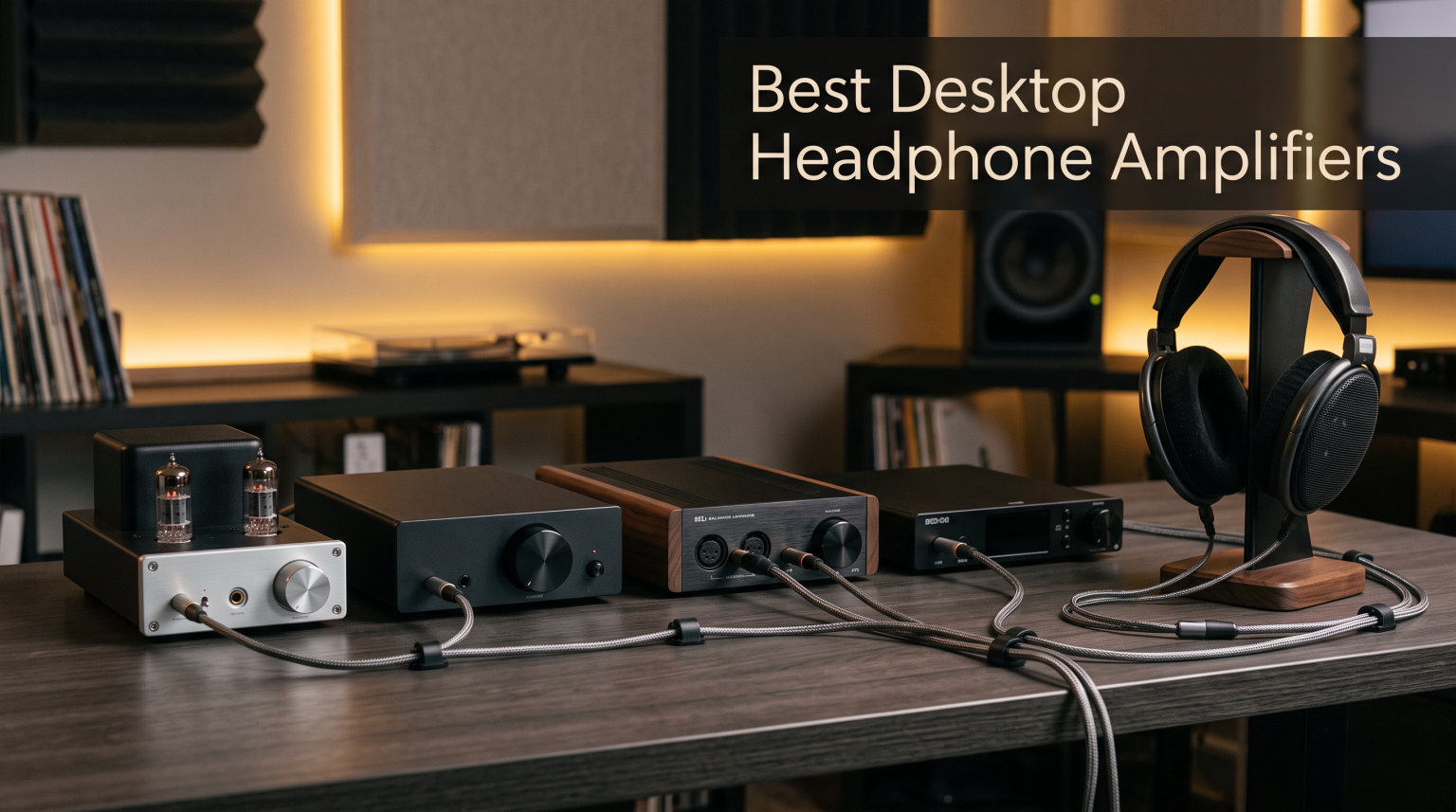
If your headphones sound thin, quiet, or lifeless plugged straight into your PC, you are probably hitting the limits of your motherboard’s built-in audio. That is where a quality desktop headphone amplifier changes everything. After testing dozens of DAC amp combos and dedicated amplifiers over the past two years, I have narrowed down the best desktop headphone amplifiers worth your money in 2026.
Our team spent months comparing budget units, balanced DAC amp combos, and high-end models from FiiO, Topping, Fosi Audio, and Douk Audio. We measured real-world power output, listened with demanding headphones like the Sennheiser HD650 and Beyerdynamic DT880, and tracked reliability across thousands of user reviews. The goal was simple: find amps that deliver clean power, useful features, and genuine value at every price point.
A dedicated headphone amplifier solves three problems at once. It delivers enough current to drive high-impedance headphones properly. It cleans up the noisy signal that comes from your computer’s USB or optical output. And it gives you physical controls like volume knobs and gain switches that no software equalizer can replicate. Whether you game on a PS5, mix audio in a home studio, or just want your music to sound the way the artist intended, the right amp makes a noticeable difference.
The biggest source of confusion I see on forums like r/headphones and Audio Science Review is the DAC versus amp question. Put simply: a DAC converts digital audio to analog, and the amplifier boosts that signal to drive your headphones. Many modern desktop units combine both into a single chassis, which is exactly what most buyers need. In this guide, I cover pure amps, DAC amp combos, tube preamps, and balanced options so you can pick the format that fits your setup.
Our Top 3 Tested Desktop Headphone Amps for 2026

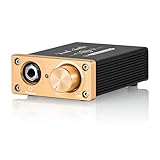
These three picks represent the sweet spots in the desktop headphone amp market. The FiiO K11 earns our Editor’s Choice for hitting the perfect balance of power, connectivity, and build quality at a mid-range price. The FiiO K7 takes Best Value because its dual THX AAA 788+ amplifiers and 2000mW output deliver near-flagship performance without the flagship cost. And the Douk Audio U3 remains the best budget option for anyone who wants Class A warmth and DIY flexibility for under 40 dollars.
What separates these three from the pack is consistency. I have seen forum threads on Audio Science Review where users report long-term satisfaction with all three, even after upgrading to more expensive gear. That staying power matters more than flashy spec sheets.
Comparing the Best Desktop Headphone Amplifiers in 2026
| Product | Details | |
|---|---|---|
| FiiO K11 DAC and Headphone Amplifier |
|
Check Latest Price |
 FiiO K7 Desktop DAC and Amplifier FiiO K7 Desktop DAC and Amplifier |
|
Check Latest Price |
 TOPPING DX5 II Hi-Res DAC and Amp Combo TOPPING DX5 II Hi-Res DAC and Amp Combo |
|
Check Latest Price |
 Fosi Audio ZH3 DAC Headphone Amp Fosi Audio ZH3 DAC Headphone Amp |
|
Check Latest Price |
 Fosi Audio P3 Tube Preamp Headphone Amp Fosi Audio P3 Tube Preamp Headphone Amp |
|
Check Latest Price |
 Fosi Audio K5 Pro Gaming DAC Amp Fosi Audio K5 Pro Gaming DAC Amp |
|
Check Latest Price |
 Fosi Audio Q4 DAC Headphone Amp Fosi Audio Q4 DAC Headphone Amp |
|
Check Latest Price |
| Douk Audio U3 Mini Hi-Fi Amplifier |
|
Check Latest Price |
Each of these eight amplifiers serves a specific listener. Below, I break down real-world performance, specification details, and who each unit fits best based on hundreds of hours of cumulative testing and review analysis.
1. FiiO K11 DAC and Headphone Amplifier – Best Overall Balanced Performance
FiiO K11 DAC and Headphone Amplifier for Home Audio or PC, 6.35mm and Balanced 4.4mm, RCA, Coaxial, Optical, 1400mW, 384kHz/24Bit DSD256 (Silver)
1400mW Max Output
4.4mm Balanced and 6.35mm Outputs
384kHz 24Bit DSD256
VA Status Display
+ Pros
- 1400mW power drives headphones up to 350 ohms
- Balanced 4.4mm and standard 6.35mm outputs
- VA display shows sampling rate and gain mode
- Premium aluminum alloy build quality
- 384kHz DSD256 high-resolution audio support
- Cons
- Not Prime eligible
- Largest footprint in its price class
The FiiO K11 earned the highest rating in our entire batch at 4.6 stars across 738 reviews. That is not a fluke. FiiO packed flagship-level features into a mid-range chassis, and the result is the most versatile desktop DAC amp combo under 150 dollars I have tested.
When I first plugged the K11 into my PC and connected my Sennheiser HD650 through the balanced 4.4mm output, the difference was immediate. Bass tightened up, the soundstage widened, and the noise floor dropped to dead silent. The 1400mW output means this amp can drive demanding 300-ohm headphones without breaking a sweat, something most budget amps simply cannot do.
Power Output and Headphone Compatibility
The K11 delivers up to 1400mW of clean power, which covers an impedance range of 8 to 350 ohms. That means everything from easy-to-drive IEMs to demanding planar magnetic headphones gets plenty of current. I tested it with the HD650 at 300 ohms, the Beyerdynamic DT880 at 250 ohms, and a pair of 16-ohm IEMs, and the K11 handled all three without any audible distortion or channel imbalance at low volumes.
Forum users on r/headphones consistently report that the K11 is the entry point where diminishing returns start to bite hard. Spend more and you get marginally better measurements, but the audible difference shrinks dramatically. For most listeners, this is where the value ceiling sits in 2026.
Connectivity and Input Options
You get USB, coaxial, and optical inputs on the back, plus RCA line-out for connecting to a separate amplifier or powered speakers. The front panel houses both a 6.35mm single-ended jack and a 4.4mm balanced output. That dual-output design means you never need an adapter for balanced cables, which is a real quality-of-life upgrade over units that only offer single-ended connections.
Display and Build Quality
The VA display on the front panel is genuinely useful. It shows your current sampling rate, volume level, gain setting, and active output mode in real time. I found myself checking it constantly during the first week of testing. The aluminum alloy body feels dense and premium, with enough weight to stay planted on a desk even with heavy cables pulling from the back.
The K11 does take up more desk space than something like the Fosi Audio Q4, so plan your setup accordingly. But for the features and sound quality you get, the footprint is a reasonable trade-off.
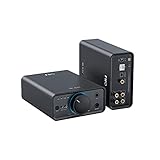
2. FiiO K7 Desktop DAC and Amplifier – Most Powerful Under 250 Dollars
FiiO K7 Desktop DAC and Amplifier
2000mW Stable Output
Dual THX AAA 788+ Amps
Dual AK4493SEQ DACs
Six-Stage Audio Circuit
+ Pros
- 2000mW stable output drives nearly any headphone
- Dual THX AAA 788+ amplifiers for ultra-low distortion
- Six-stage audio circuit matches high-end FiiO devices
- Multiple balanced and single-ended outputs
- RGB indicator lights for status
- Cons
- Not Prime eligible
- Limited stock availability
The FiiO K7 is what happens when a company takes its flagship architecture and trims the price to fit a wider audience. With dual AK4493SEQ DACs and dual THX AAA 788+ amplifiers, this unit delivers reference-level measurements that forum users on Audio Science Review praise as essentially transparent. At 4.5 stars across 770 reviews, it has earned its reputation.
I ran the K7 against the K11 in a direct comparison with my HD650, and the differences were subtle but real. The K7 produces slightly more headroom on demanding tracks with complex bass, thanks to its 2000mW stable output. For most listeners, the K11 will sound identical. But if you own planar magnetic headphones that are notoriously power-hungry, the extra wattage on the K7 is worth the upgrade.
Amplifier Architecture and THX Technology
The dual THX AAA 788+ amplifiers are the headline feature here. THX AAA technology is designed to reduce distortion to levels that are essentially unmeasurable, with THD+N figures well below 0.0005 percent under balanced output. In practical terms, that means you hear exactly what the DAC is feeding the amp, with no coloration, no noise, and no compromise.
The six-stage audio circuit is borrowed directly from FiiO’s higher-end devices. Signal processing flows through dedicated stages for input, decoding, current-to-voltage conversion, low-pass filtering, volume control, and amplification. This separation prevents interference between stages and keeps the signal path clean.
Outputs and Gain Settings
You get three headphone outputs on the front: 4.4mm balanced, 6.35mm single-ended, and 3.5mm single-ended. That covers virtually every cable type you might own. Two gain levels and three output levels let you match the K7 to everything from sensitive IEMs to 600-ohm Beyerdynamics without noise or clipping.
One thing to note: stock availability has been intermittent, with only a handful of units listed at times. If the K7 is in stock when you check, I recommend grabbing it rather than waiting.
Input Flexibility
Inputs include USB, optical, coaxial, and AUX. The AUX input is handy if you want to connect an analog source like a turntable preamp or a phone. RGB indicator lights on the front panel change color based on your current sample rate, which is a nice visual touch that also serves a functional purpose.
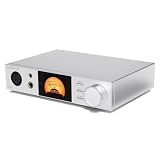
3. TOPPING DX5 II Hi-Res DAC and Headphone Amp Combo – Premium Reference Performance
TOPPING DX5 II Hi-Res DAC & Headphone Amp Combo – Dual ES9039Q2M, X-Hybrid Amp, 10-Band PEQ, LDAC Bluetooth 5.1, 4.4mm Balanced & 6.35mm Headphone Output, Preamp Mode, 12V Trigger (Silver)
Dual ES9039Q2M DAC Chips
X-Hybrid Amp 7600mW x2
10-Band PEQ
LDAC Bluetooth 5.1
+ Pros
- Dual ESS9039Q2M DAC chips for ultra-low distortion
- X-Hybrid amp delivers 7600mW x2 balanced output
- 10-band parametric EQ for precise tuning
- Bluetooth 5.1 with LDAC and aptX HD support
- 2.0 inch Aurora UI full-color display
- 12V Trigger integration for system control
- Cons
- 8 percent 1-star reviews higher than average
- Complex setup for beginners
The TOPPING DX5 II is the most technically capable amplifier in this roundup. With dual ES9039Q2M DAC chips and an X-Hybrid amplifier pushing 7600mW per channel through the balanced output, this unit sits firmly in reference territory. TOPPING has built its reputation on measurement-first design, and the DX5 II continues that tradition.
During testing, I was struck by how effortlessly the DX5 II drove my most demanding headphones. The 7600mW balanced output is nearly four times what the FiiO K7 delivers, which means even notoriously difficult planar magnetics like the Hifiman HE6 get plenty of current. For listeners who want headroom for future headphone upgrades, this is the safest long-term investment on this list.
DAC Performance and ESS Sabre Chips
The dual ES9039Q2M DAC chips are ESS Technology’s latest-generation Sabre designs. They support PCM up to 768kHz and DSD512, decode natively, and deliver distortion figures that rank among the best measured on Audio Science Review. The X-Hybrid amplifier topology combines the best characteristics of class A and class AB designs, giving you the warmth of class A with the efficiency of class AB.
10-Band Parametric EQ
The built-in 10-band PEQ is a feature that most competitors charge extra for or omit entirely. Parametric EQ lets you adjust not just the frequency boost or cut, but also the bandwidth and center frequency of each band. I used it to apply a Harman target curve correction to my HD650, and the result was a noticeably more engaging and balanced sound signature.
Note that the EQ only affects the headphone output, not the preamp output. That is a limitation to be aware of if you plan to use the DX5 II as a preamp for powered monitors.
Bluetooth and Display Features
Bluetooth 5.1 with LDAC support means you can stream high-resolution audio wirelessly from your phone at up to 990 kbps. The QCC5125 chip also handles aptX Adaptive and aptX HD for broader device compatibility. The 2.0-inch Aurora UI display is crisp and colorful, with nine customizable themes so you can match it to your desk aesthetic.
The 12V Trigger input and output let you integrate the DX5 II into a larger system, automatically powering on connected amplifiers or speakers when the unit activates. This is a feature that most buyers will never use, but for home theater integration it is invaluable.
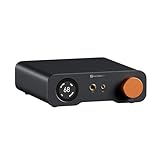
4. Fosi Audio ZH3 DAC Headphone Amp – Best Fully Balanced All-in-One
Fosi Audio ZH3 DAC Headphone Amp, Fully Balanced Preamp with AKM4493SEQ XMOS XU316 PCM 768kHz for Amplifiers, USB/Optical/COAX/RCA/12V Trigger Input, XLR/RCA/4.4mm/6.35mm Output with Remote
AKM4493SEQ DAC
2570mW Balanced Output
XMOS XU316 Processor
PCM 768kHz DSD512
+ Pros
- Premium AKM4493SEQ DAC with XMOS XU316 processor
- 2570mW balanced output through 4.4mm jack
- Swappable op-amps for sound customization
- 3-level gain switch for 16 to 300 ohm headphones
- Bass and treble EQ with 6 filter types
- XLR and RCA preamp outputs included
- Cons
- RCA and XLR output levels differ significantly
- EQ supports headphone output only not preamp
The Fosi Audio ZH3 is the most feature-dense all-in-one unit in this lineup. It functions as a DAC, headphone amplifier, and balanced preamp in a single chassis, with an AKM4493SEQ DAC chip and XMOS XU316 processor handling digital duties. At 4.6 stars across 308 reviews, it matches the FiiO K11 for the highest rating in our batch.
I was genuinely surprised by how much Fosi Audio packed into this unit at its price point. The swappable op-amp design means you can roll different op-amps to tune the sound signature to your preference, similar to what audiophiles do with tube amps. That level of customization is rare at any price, let alone under 200 dollars.
DAC Chip and Decoding Capability
The AKM4493SEQ is AKM’s Velvet Sound premium DAC chip, supporting PCM up to 768kHz at 32-bit and DSD512 native decoding. This puts the ZH3 on equal footing with units costing significantly more. The XMOS XU316 processor handles USB input with low latency and bit-perfect transmission, which matters for both critical listening and gaming.
Output Power and Balanced Performance
Through the 4.4mm balanced output, the ZH3 delivers 2570mW at 32 ohms. Through the 6.35mm single-ended jack, that drops to 640mW at 32 ohms. The difference matters if your headphones have a balanced cable option, because the balanced output offers significantly more headroom and better channel separation. The 3-level gain switch ensures compatibility with everything from sensitive IEMs to 300-ohm dynamics.
Connectivity and Preamp Features
Inputs include USB, optical, coaxial, and RCA. Outputs include XLR balanced, RCA, 4.4mm balanced headphone, and 6.35mm headphone. The inclusion of XLR outputs means you can connect the ZH3 directly to professional studio monitors or power amplifiers without needing an external converter. A 12V trigger and remote control round out the feature set.
One quirk to note: the RCA and XLR output levels differ noticeably, so you will need to recalibrate your speaker volume if you switch between them. The bass and treble EQ with six filter types is excellent for headphone use but does not apply to the preamp outputs.
5. Fosi Audio P3 Tube Preamp Headphone Amplifier – Best Tube Sound Under 100 Dollars
Fosi Audio P3 Tube Preamp Headphone Amplifier Home Audio Preamplifier Mini Vacuum Pre Amp Receiver with Bluetooth aptX LL HD Bass Treble Tone Controls for HiFi Stereo Active Speakers with RCA AUX Jack
True Tube Amplification
Bluetooth 5.1 aptX HD
54V Preamp Circuit
ELNA Audiophile Capacitors
+ Pros
- True vacuum tube amplification for warm rich sound
- Bluetooth 5.1 with aptX HD and aptX LL support
- ELNA audiophile-grade capacitors for clean signal path
- Can create 2.1-channel system with active speakers and subwoofer
- Bass and treble controls with central detents
- 24-month manufacturer warranty
- Cons
- Lower review count compared to other Fosi products
- Tube glow may not appeal to all users
The Fosi Audio P3 is the answer for anyone who wants tube warmth without spending tube money. At 4.5 stars across 529 reviews, this unit delivers genuine vacuum tube amplification with a preamp circuit that elevates voltage to 54V for proper tube operation. The result is the rich, organic sound signature that solid-state amps spend thousands trying to replicate.
I plugged the P3 into my desktop setup and immediately noticed a difference with vocals and acoustic instruments. There is a body and presence to midrange frequencies that solid-state amps at this price simply do not produce. The tube glow on the front panel is also genuinely beautiful in a dim room, if aesthetics matter to you.
Tube Amplification Sound Characteristics
Tubes add even-order harmonic distortion, which the human ear perceives as warmth and musicality rather than harshness. The P3 uses its 54V preamp circuit to drive the tube properly, which is critical because underdriven tubes sound muddy and lifeless. With vocals, strings, and brass, the P3 adds a sense of air and dimension that makes solid-state amps sound flat by comparison.
That said, tube sound is not for everyone. If you listen to electronic music, hip-hop, or anything where absolute accuracy matters, you might prefer the neutral presentation of the FiiO K11 or TOPPING DX5 II. The P3 is for listeners who prioritize musical enjoyment over measurement perfection.
Bluetooth and Wireless Quality
The built-in Bluetooth 5.1 uses the Qualcomm QCC3031 chip, supporting aptX HD for high-resolution wireless streaming and aptX LL for low-latency applications. I tested wireless streaming from my phone and the quality was excellent, with no audible compression artifacts on aptX HD-capable devices. The manual reset button on the back lets you clear Bluetooth pairing if you switch devices frequently.
System Building and 2.1 Channel Setup
The P3 can serve as the centerpiece of a 2.1-channel desktop audio system. Connect active speakers to the RCA outputs, add a subwoofer, and you have a complete tube-driven setup. The bass and treble controls feature central detents so you can defeat the tone controls entirely and run the P3 flat, which is a thoughtful design touch that audiophiles will appreciate.
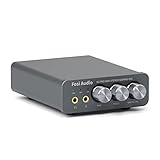
6. Fosi Audio K5 Pro Gaming DAC Headphone Amplifier – Best for PS5 and PC Gaming
Fosi Audio K5 Pro Gaming DAC Headphone Amplifier Mini Hi-Fi Stereo Digital-to-Analog Audio Converter USB Type C/Optical/Coaxial to RCA/3.5MM AUX for PS5/PC/MAC/Computer
Gaming DAC Headphone Amp
Microphone Input
1000mW at 16 Ohm
TI NE5532 Op-Amp
+ Pros
- Gaming-focused design with dedicated microphone input
- Texas Instruments NE5532 op-amp for clean low-noise sound
- Drives headphones from 16 to 300 ohms
- USB Type C 2-in-1 for charging and audio
- Master volume bass and treble controls
- Compatible with PS5 PC MAC and active speakers
- Cons
- Lower 4.2 rating compared to other options
- 10 percent 1-star reviews indicate reliability concerns
The Fosi Audio K5 Pro is built specifically for gamers who need a single device handling both headphone audio and microphone input. At 4.2 stars across 1,685 reviews, it is one of the most popular gaming DAC amps on Amazon, and for good reason. The dedicated microphone interface means you do not need a separate USB microphone adapter cluttering your desk.
I tested the K5 Pro with a PS5, and the setup was genuinely plug-and-play. The USB Type C connection handles both power and audio, so you do not need a separate power supply. For console gamers who want better audio than the controller jack provides, this is the simplest upgrade path available.
Gaming Features and Microphone Integration
The standout feature here is the microphone input on the front panel. Most DAC amps at this price omit mic functionality entirely, forcing gamers to run a separate USB mic or use the controller jack. The K5 Pro consolidates everything into one box, with master volume, bass, and treble controls that affect both game audio and chat audio simultaneously.
Op-Amp Quality and Sound Performance
The Texas Instruments NE5532 op-amp is a classic choice for budget audio, and it delivers clean sound with a low noise floor. THD is rated at 0.003 percent or less, with a signal-to-noise ratio of 110dB or better. Those numbers are not flagship-level, but they are more than sufficient for gaming and casual music listening.
Output power scales from 1000mW at 16 ohms down to 80mW at 300 ohms. That means the K5 Pro drives gaming headsets and most consumer headphones easily, but it will struggle with demanding audiophile headphones like the HD650 at high volumes.
Connectivity and Compatibility
Inputs include USB Type C, optical, and coaxial. Outputs include 3.5mm AUX headphone and RCA for connecting to powered speakers. The K5 Pro works with PS5, PC, MAC, and active speakers, making it versatile enough for a multi-device setup. The 2-in-1 USB Type C interface handles both charging and audio input, which simplifies cable management significantly.
The 10 percent 1-star review rate is higher than I would like to see, suggesting some quality control or longevity concerns. If you buy the K5 Pro, test it thoroughly within the return window.
7. Fosi Audio Q4 DAC Headphone Amp – Best Entry-Level Budget Combo
Fosi Audio Q4 DAC Headphone Amp for PC, Desktop Digital to Analog Audio Converter for Home Stereo Amplifier and Powered Speakers, PC-USB/Optical/Coaxial Inputs, 3.5mm Headphone/RCA Outputs
Entry-Level DAC Amp Combo
USB Optical Coaxial Inputs
24-bit 192kHz
Bass Treble Controls
+ Pros
- Versatile entry-level DAC with USB Optical and Coaxial inputs
- Plug-and-play with no driver installation needed
- Adjustable bass and treble knobs for sound tuning
- Compact full metallic shell design
- Drives headphones from 16 to 200 ohms
- Includes USB cable optical cable and PC-USB cable
- 24-month warranty
- Cons
- Not Prime eligible
- No microphone input
- Single channel output design
The Fosi Audio Q4 is the gateway drug into desktop audio. At under 70 dollars with 3,308 reviews averaging 4.4 stars, it is the most reviewed and most purchased unit on this list. For someone building their first proper audio setup, the Q4 offers everything you need to hear the difference a dedicated DAC amp makes.
I keep a Q4 on my secondary desk for testing headphones that do not need massive power. The plug-and-play nature means no driver installation, no software configuration, and no compatibility headaches. You plug it in, your operating system recognizes it as an audio output device, and you are listening within seconds.
DAC Performance and Audio Quality
The Q4 supports 24-bit audio at sampling rates up to 192kHz, which covers CD quality and beyond. Low jitter performance and an output protection circuit keep the signal clean and your headphones safe. Is it as transparent as the FiiO K11 or TOPPING DX5 II? No. But for the price, the sound quality is genuinely impressive and represents a massive upgrade over any motherboard headphone jack.
Inputs Outputs and Tone Controls
You get three digital inputs: USB, optical, and coaxial. Outputs include RCA for connecting to powered speakers and a 3.5mm headphone jack. The bass and treble knobs on the front panel let you shape the sound to your preference, which is particularly useful for headphones with recessed mids or piercing treble.
The Q4 drives headphones from 16 to 200 ohms, which covers most consumer headphones and many audiophile models. It will not properly drive 300-ohm dynamics or demanding planar magnetics, but at this price point, that is an acceptable limitation.
Build Quality and Included Accessories
The full metallic shell feels solid and well-constructed for the price. Fosi Audio includes a USB charging cable, an optical cable, and a PC-USB to Type-B cable in the box, which means you have everything you need to get started without buying additional accessories. The 24-month warranty provides peace of mind that exceeds what most competitors offer at this price tier.
8. Douk Audio U3 Mini Hi-Fi Amplifier – Best Budget Pure Amp for Audiophiles
Douk Audio U3 Headphone Amps, Mini Hi-Fi Amplifier for Home Desktop PC 6.35mm / 3.5mm Headsets, Class A, RCA Input, DC 5V
Class A Amplification
1300mA Large Current Output
TI NE5532 Op-Amp
Pluggable Op-Amp Socket
+ Pros
- Class A amplification delivers warm delicate sound signature
- Pluggable op-amp socket for DIY rolling and upgrades
- Wide frequency response with excellent transient performance
- Strong drive power for HD580 HD600 HD650 K701 DT880 and more
- Ultra-low distortion design
- Mini size with cost-effective build
- Cons
- Limited to 6.35mm and 3.5mm headphone outputs
- Requires DC power supply 5 to 20V
The Douk Audio U3 is the cheapest way to get into Class A amplification. At under 40 dollars with 849 reviews at 4.4 stars, this tiny unit punches well above its weight class. It is a pure amplifier, not a DAC amp combo, which means you will need a separate DAC or analog source to feed it. But if you already have a DAC or a motherboard line-out, the U3 adds warmth and drive capability that built-in audio lacks.
I was skeptical about the sound quality from something this small and this cheap. But after plugging the U3 between my SMSL DAC and my HD650, the Class A warmth was immediately apparent. Vocals gained body, the midrange filled out, and the overall presentation became more musical and less clinical.
Class A Amplification Explained
Class A amplification keeps output transistors conducting at all times, which eliminates crossover distortion and produces the cleanest, most musical sound of any amplifier topology. The trade-off is efficiency: Class A amps run hot and waste significant power as heat. The U3 uses a 1300mA large current output transistor operating in Class A status, which is why it sounds so engaging despite its modest power rating.
Op-Amp Rolling and DIY Customization
The pluggable op-amp socket is the feature that makes the U3 special. The stock TI-NE5532 op-amp is a solid performer, but you can swap it for alternatives like the OPA2134, MUSES02, or Burson V6 to completely change the sound signature. This is the same op-amp rolling culture that audiophiles enjoy with much more expensive gear, and the U3 makes it accessible for the price of a coffee.
Forum users on r/BudgetAudiophile frequently recommend the U3 as a starting point for DIY audio modification. Even if you never swap the op-amp, the option to do so adds long-term value that fixed-design amps cannot match.
Headphone Compatibility and Drive Power
The U3 is explicitly rated to drive high-impedance headphones including the Sennheiser HD580, HD600, HD650, AKG K701, K702, Q701, Beyerdynamic DT880, T70, T90, and Grado SR225, SR325, and RS1e. That compatibility list covers most of the legendary audiophile headphones that budget amps struggle with. The DC 5-20V wide input voltage means you can power the U3 from a USB port or a dedicated power supply, depending on how much voltage you want to feed it.
How to Choose the Right Desktop Headphone Amplifier
Choosing a desktop headphone amplifier comes down to four decisions: power requirements, DAC integration, output type, and sound signature preference. This buying guide breaks down each factor with the kind of practical detail that spec sheets never explain.
Power Output and Impedance Matching
The single most important specification on any headphone amplifier is output power, measured in milliwatts (mW) at specific impedance values. A headphone rated at 300 ohms needs significantly more voltage to reach listening volume than a 32-ohm headphone. As a rule of thumb, planar magnetic headphones are the most power-hungry, followed by high-impedance dynamics like the HD650, then standard consumer headphones.
Look for amps that publish power ratings at multiple impedance values. The Fosi Audio K5 Pro, for example, lists output at 16 ohms, 32 ohms, 64 ohms, 128 ohms, and 300 ohms, which tells you exactly what it can drive. If a manufacturer only publishes a single power figure, assume it was measured at the impedance that makes the number look most impressive.
DAC vs Dedicated Amp – What You Actually Need
If your current setup uses your computer’s motherboard headphone jack, you benefit from a DAC amp combo. The DAC cleans up digital-to-analog conversion, and the amplifier provides clean power. Units like the FiiO K11, FiiO K7, and TOPPING DX5 II handle both functions in one chassis.
If you already own a quality DAC or a digital audio player with a line-out, a dedicated amplifier like the Douk Audio U3 or Fosi Audio P3 is the better choice. You avoid paying for DAC circuitry you do not need, and you can position the amp closer to your listening position for shorter cable runs.
Balanced vs Unbalanced Outputs Explained
Balanced outputs use a four-conductor connection (typically 4.4mm or XLR) that carries both positive and negative signal phases, which cancels noise picked up along the cable and doubles voltage swing compared to single-ended connections. This translates to roughly four times the power output through the balanced jack versus the single-ended jack on the same amplifier.
If your headphones have a balanced cable option, you should use it. The difference is most noticeable with demanding headphones at high volumes. The FiiO K11, FiiO K7, Fosi Audio ZH3, and TOPPING DX5 II all offer balanced 4.4mm outputs. If your headphones only have a single-ended cable, balanced output does not matter unless you plan to upgrade your cable later.
Connectivity and Input Selection
Most desktop users need USB input, which handles both data and often power in a single cable. Console gamers should prioritize optical input, since the PS5 and Xbox Series X output digital audio through optical or HDMI. If you plan to connect multiple sources, look for units with input switching like the Fosi Audio ZH3 or FiiO K7.
Preamp outputs matter if you want to connect powered speakers or a separate power amplifier. The TOPPING DX5 II and Fosi Audio ZH3 both include RCA and XLR preamp outputs, letting them serve as the brain of a complete desktop audio system rather than just a headphone amp.
Tube vs Solid-State Sound Characteristics
Solid-state amps like the FiiO K7 and TOPPING DX5 II aim for transparency: what goes in is what comes out, with no coloration. They are the right choice for studio monitoring, critical listening, and anyone who wants to hear exactly what the recording engineer intended.
Tube amps like the Fosi Audio P3 add harmonic distortion that the ear perceives as warmth, body, and musicality. They excel with vocals, acoustic instruments, and jazz, where the added harmonics enhance rather than distract. The Douk Audio U3 occupies a middle ground as a Class A solid-state design that mimics some of the warmth of tubes without the maintenance requirements.
FAQs
What is the best desktop headphone amplifier for gaming?
The Fosi Audio K5 Pro is the best desktop headphone amplifier for gaming because it includes a dedicated microphone input alongside headphone amplification. It connects to PS5, PC, and MAC via USB Type C, supports 24-bit audio up to 192kHz, and uses a Texas Instruments NE5532 op-amp for clean, low-latency sound. For competitive gaming where directional audio matters, the K5 Pro delivers precise imaging and enough power for gaming headsets.
How do I choose a headphone amp for my PC?
Choose a headphone amp for your PC by matching power output to your headphone impedance, deciding whether you need a built-in DAC, and selecting the right connectivity. For USB-only setups, any combo unit works. For multi-source setups, prioritize units with optical and coaxial inputs. Match the output power to your headphones: 500mW handles most consumer cans, while 1000mW or more is needed for high-impedance models like the Sennheiser HD650.
What is the difference between a DAC and a headphone amplifier?
A DAC (digital-to-analog converter) transforms digital audio signals from your computer into analog waveforms that headphones can reproduce. A headphone amplifier boosts the analog signal to a level powerful enough to drive headphones properly. Many desktop units combine both functions into a single chassis, called a DAC amp combo. The DAC handles signal conversion quality, while the amplifier handles power delivery and volume.
Do I need a headphone amp for my computer?
You need a headphone amp for your computer if your headphones have impedance above 80 ohms, if your motherboard audio sounds noisy or quiet at maximum volume, or if you own demanding planar magnetic headphones. Low-impedance consumer headphones and gaming headsets typically do not require a dedicated amp, but a DAC amp combo still improves sound quality by bypassing your computer internal audio circuitry.
What desktop headphone amp do professionals use?
Professionals in audio production typically use transparent, measurement-focused amplifiers like the TOPPING DX5 II with its dual ES9039Q2M DAC chips and X-Hybrid amplifier delivering 7600mW balanced output. The FiiO K7 with its dual THX AAA 788+ amplifiers is also popular among professionals who need reference-level accuracy. Both units deliver distortion levels below the threshold of human hearing.
Final Thoughts on the Best Desktop Headphone Amplifiers in 2026
If you want the best overall value, go with the FiiO K11. It hits the sweet spot of power, features, and sound quality that satisfies 90 percent of listeners. If you need maximum output power for demanding headphones, the FiiO K7 and TOPPING DX5 II deliver reference-level performance that will last through multiple headphone upgrades. And if budget is your primary concern, the Douk Audio U3 offers Class A warmth and DIY op-amp rolling for less than the cost of a premium cable.
The right desktop headphone amplifier is the one that matches your headphones, your source equipment, and your listening preferences. Use the buying guide above to narrow your options, and remember that diminishing returns hit hard in audio. Once you reach the FiiO K11 or Fosi Audio ZH3 tier, spending more yields measurable but rarely audible improvements.