

The best dexterity games for family nights share one trait: they teach themselves in under a minute. A dexterity game is a tabletop game where your score comes from physical skill rather than hidden information — flicking, tugging, tossing, spinning or balancing the pieces. That makes them the fastest way to get a mixed-age table, from a four-year-old to a grandparent, laughing within a single turn.
We have played this category more than most: our team has run dozens of family game nights across living rooms, kitchen tables and one genuinely cramped apartment, logging which games kept a fifteen-year-old interested and which ones had the adults quietly checking their phones. This roundup is the result. Twelve games, ranked by how well they hold a real family group, not by how clever the rulebook sounds.
A word on what we left out. Plenty of games marketed as dexterity titles are really luck wrappers with a plastic gimmick attached, and several that look perfect on paper fall apart once the youngest player realises they are going to lose repeatedly. We have flagged that honestly in every entry below, along with the noise level, the table footprint and the age floor where we think most families should start.
Our Top 3 Tested Dexterity Games for a Family Night
Comparing the Best Dexterity Games on the Table in 2026
Every game below appears in our comparison, with the component count, player range and age floor straight from the manufacturer’s listing. Use it to narrow the field before you read the individual verdicts.
| Product | Details | |
|---|---|---|
 Jenga Classic Jenga Classic |
|
Check Latest Price |
 Yeti in My Spaghetti Yeti in My Spaghetti |
|
Check Latest Price |
 Goliath Banana Blast Goliath Banana Blast |
|
Check Latest Price |
 Tinderblox Tinderblox |
|
Check Latest Price |
 Barrel of Monkeys Barrel of Monkeys |
|
Check Latest Price |
 Tower Stack Tower Stack |
|
Check Latest Price |
 Icecool Icecool |
|
Check Latest Price |
 Rhino Hero Super Battle Rhino Hero Super Battle |
|
Check Latest Price |
 Catch the Moon Catch the Moon |
|
Check Latest Price |
 Creature Crash Creature Crash |
|
Check Latest Price |
 Nekojima Nekojima |
|
Check Latest Price |
 Dr. Eureka Dr. Eureka |
|
Check Latest Price |
1. Jenga Classic — The Benchmark Every Family Night Falls Back On
Hasbro Gaming Jenga Game | The Original Wood Block Game with Genuine Hardwood Blocks | Stacking Tower | Ages 6+ | 1 or More Players | Party Games for Kids | Family Games
54 hardwood blocks
2+ players
Ages 6+
840 g
+ Pros
- Smooth hardwood blocks with a durable finish
- Consistent block size keeps the tower fair
- Rules fit in one sentence
- Compact and easy to carry
- Players can join or leave mid-session
- Cons
- No storage tray so the tower is rebuilt by hand
- Blocks are loud when they hit a hard floor
- Some buyers say blocks run smaller than older sets
Jenga is the game we hand a table that has stalled. When two older kids and two grown-ups are stuck in a rules debate, pulling three blocks out of a tower ends the argument faster than any reset button. The whole table can watch every move, which means the game never needs a rules explanation beyond “put it on top, do not knock it over”.
What surprised us on repeated testing is how differently the same box plays at different ages. With a six-year-old the game becomes a coin-flip that everyone treats as a genuine disaster. With a fifteen-year-old and an adult it turns into slow psychological warfare, and the average round stretches out considerably. Either way, nobody is sitting out.
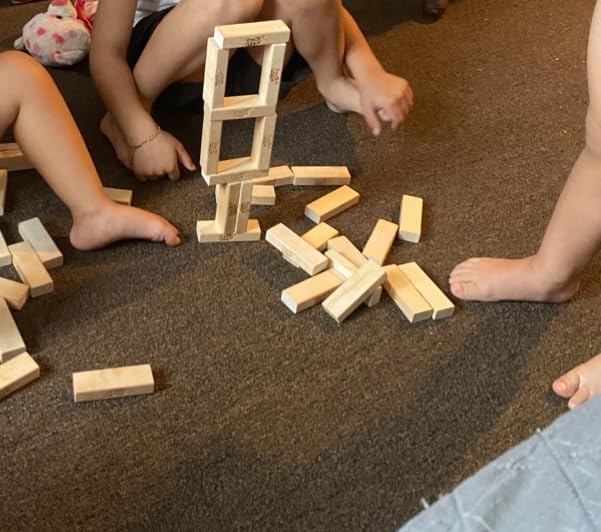
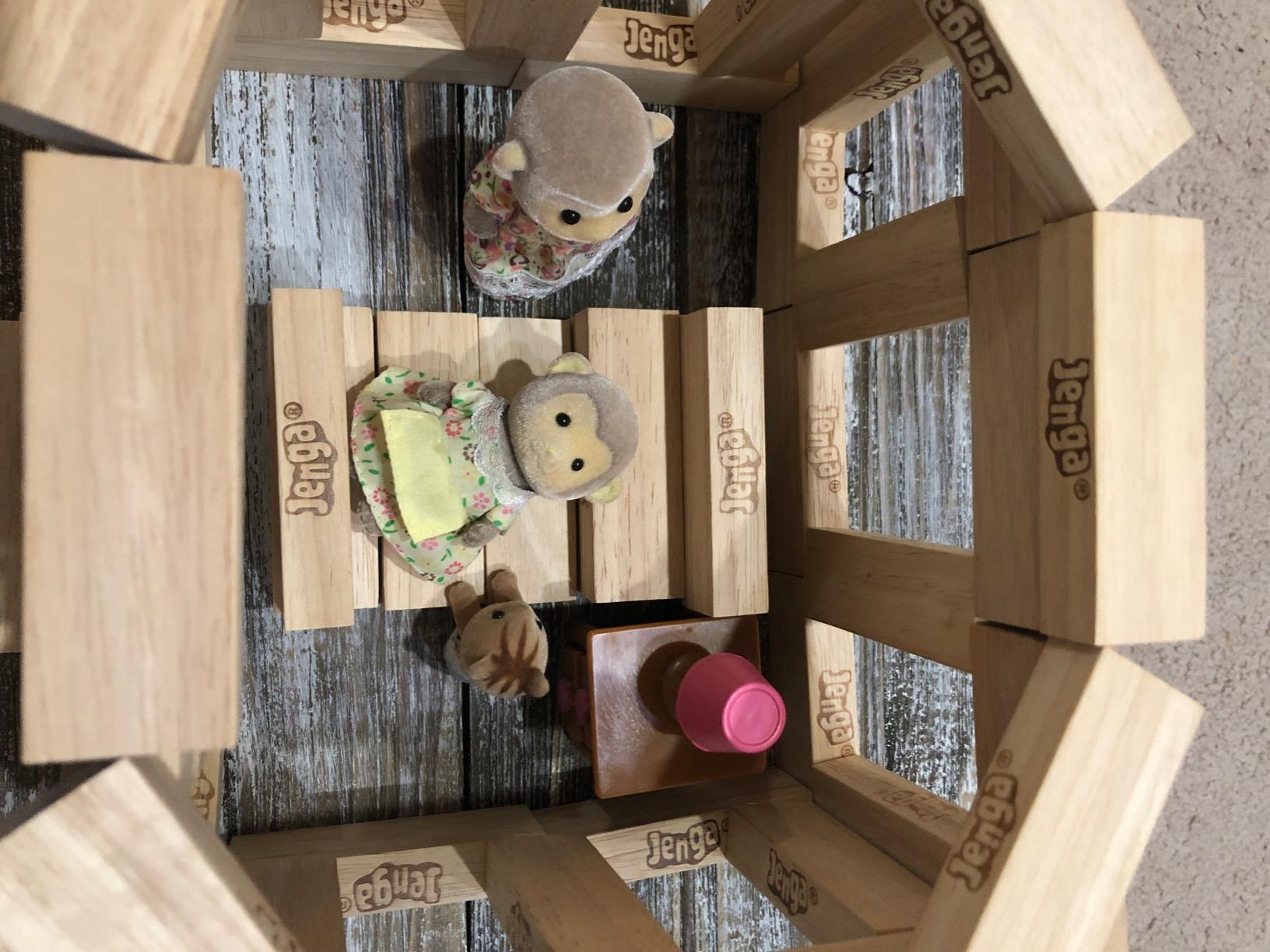
The blocks are genuine hardwood and the finish is smooth enough that stacking does not require a special grip. That said, they are hardwood and not indestructible: repeated drops onto a hard floor will dull the edges over time. We did notice the weight figure of 840 g, which is heavier than it sounds and keeps the tower stable on a wobbly table.
Why it survives more than one session
Replay value here is not about variety, because there is none. It comes from the fact that a full tower takes about eight minutes to build and two minutes to knock down. In a family night that means you can play three rounds inside a coffee break and still get to the heavier games later.
The practical drawback nobody mentions
There is no storage tray in the box. Everything goes back into the sleeve by hand, and if you are not careful you end up assembling a leaning half-tower while the next players argue about who goes first. It is the single most repeated complaint in owner feedback, and it costs you a few minutes every single time.
Noise and table care
A collapse is genuinely loud. On a rug or a padded mat it is satisfying; on a hardwood dining table it will annoy anyone downstairs. This is a game to play somewhere soft, and it is one of the few here that can genuinely mark a tabletop.
Who should skip it
If your table has a glass top, or you are playing in a flat with thin walls and a sleeping baby next door, choose something quieter. Jenga is also not ideal for children under six, who tend to grip blocks with a whole fist rather than two fingers and collapse the tower by accident.
2. Yeti in My Spaghetti — The Best-Kept Secret for Large Family Groups
Yeti in My Spaghetti Board Games for Family Night, Multi-Player Game, 4+
Plastic components
6 players
Ages 4+
168 g
+ Pros
- Sets up in seconds with no complicated rules
- Suspense holds across kids and adults
- Builds hand-eye coordination and patience
- Lightweight and packable for trips
- Works from age four upward
- Cons
- Difficulty drops as the bowl empties
- Six players is the listed maximum
- Limited strategic depth once the trick is known
This is the game we recommend to a parent who has just been handed a list of family games and does not know where to start. Yeti in My Spaghetti asks exactly one thing: pull a plastic noodle out of the bowl without letting the white yeti figure fall off the top. That is the entire rule set, and it works for six players.
On our table the drama was far more reliable than the product photography suggests. Every turn produces a genuine pause, a whispered argument about which noodle, and then a small collapse. The kids shout, the adults groan, and the round lasts about fifteen seconds. There is very little downtime, which is the thing that kills most flicking games at a six-person table.
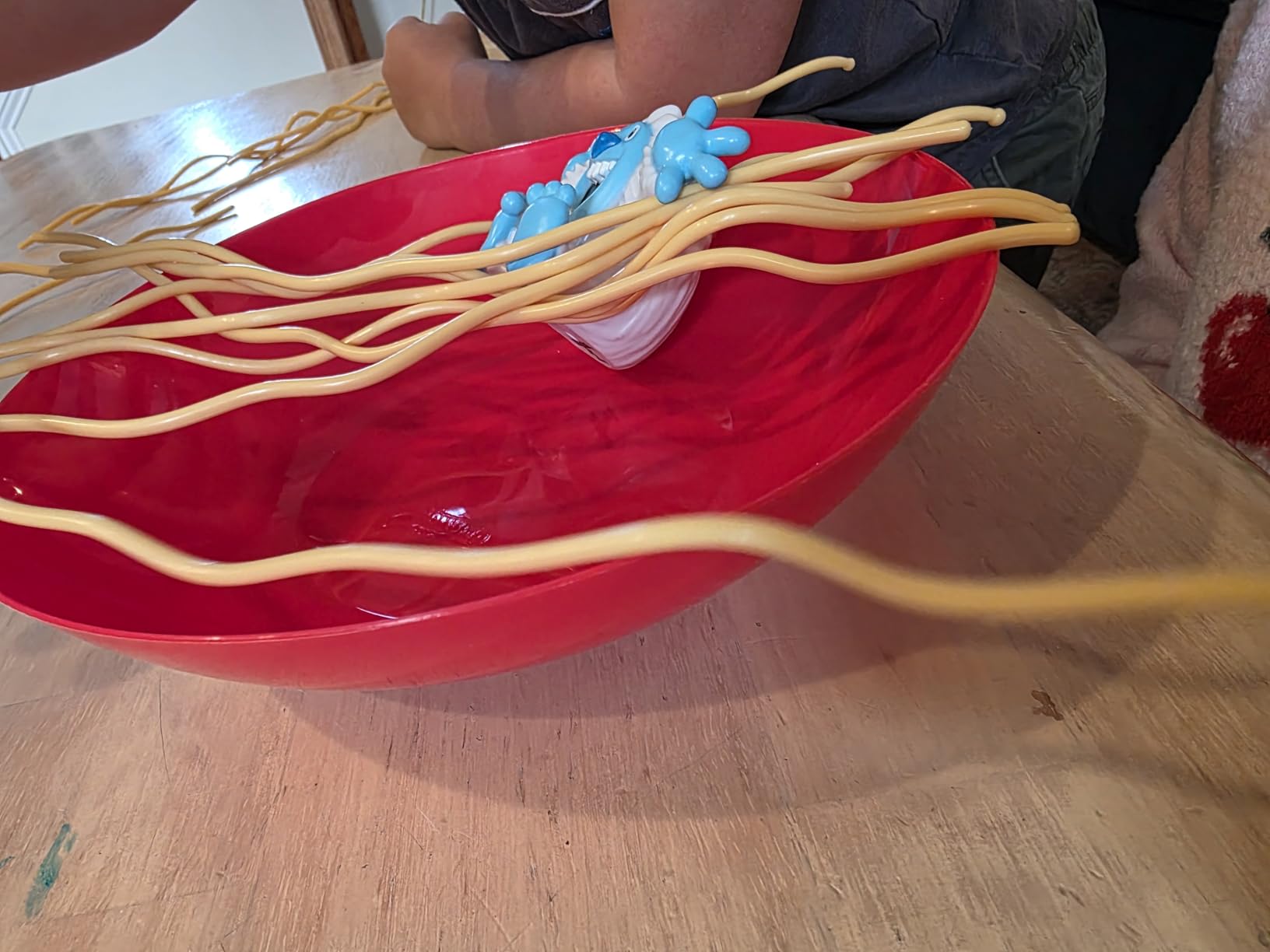
At 168 g the whole set is light enough to travel in a rucksack, and the components are plastic, so nothing gets damaged if it hits the floor. That matters more than it sounds for a game aimed at four-year-olds, because the version of this game with cardboard noodles falls apart after a month of enthusiastic pulling.
How it handles a wide age span
The listed minimum age is four, and we agree with it. A preschooler can play because every turn is one action with a visible result, and nothing about the game requires reading. A teenager or adult gets tense because the noodles are tangled in ways you have to look at rather than guess at.
Where the fun runs out
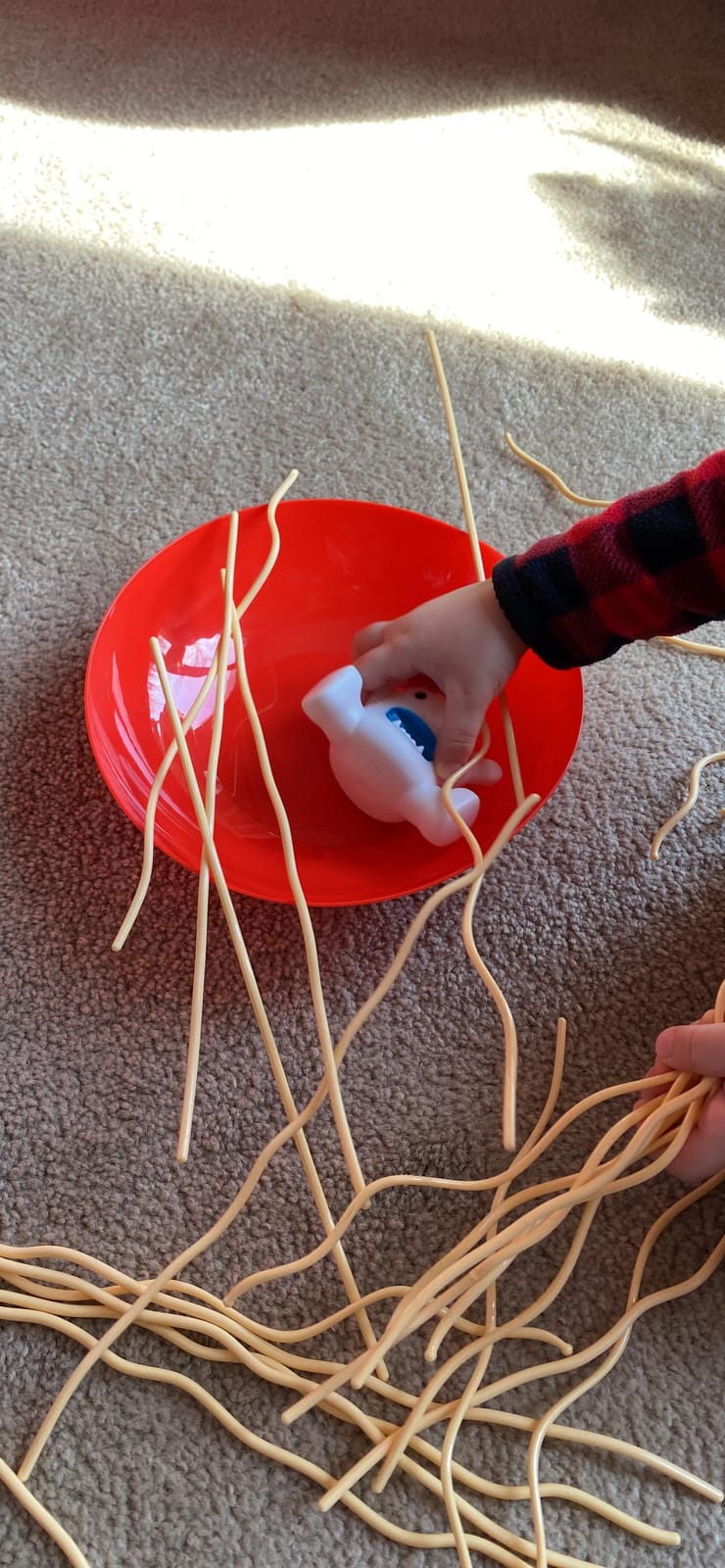
Buyer feedback is consistent on one weakness: the difficulty falls away as the bowl empties. Once a couple of noodles are all that remain, the game becomes a formality and the group drifts. My own fix is to reset every three or four rounds rather than trying to squeeze the whole bowl down to nothing.
What a big group needs instead
Six players is the listed maximum, so a seven-person family night is slightly over capacity. Buying two sets and running them side by side works better than stretching one, because two simultaneous bowls keep everyone moving at their own pace.
Who should look elsewhere
If your family enjoys games where thinking matters as much as touch, this is too thin. It is a party filler of a high order, not a game anyone will ask to replay on its own a month later.
3. Goliath Banana Blast — Loud, Chaotic and Ideal for Ages Four and Up
Goliath Banana Blast – Pull The Bananas Until The Monkey Jumps Game – Includes a Fun Colorful 24pc Puzzle by Goliath , Green
2-5 players
Ages 4+
24-piece puzzle
Tin
+ Pros
- Sturdy base and plastic that resists scratching
- The click and the monkey launch make memorable noise
- Very quick to learn and to reload
- Every player catches the monkey at least once
- Storage works without the box
- Cons
- More chance and reflex than strategy
- Very simple once the die actions are known
- The puzzle bonus is thin
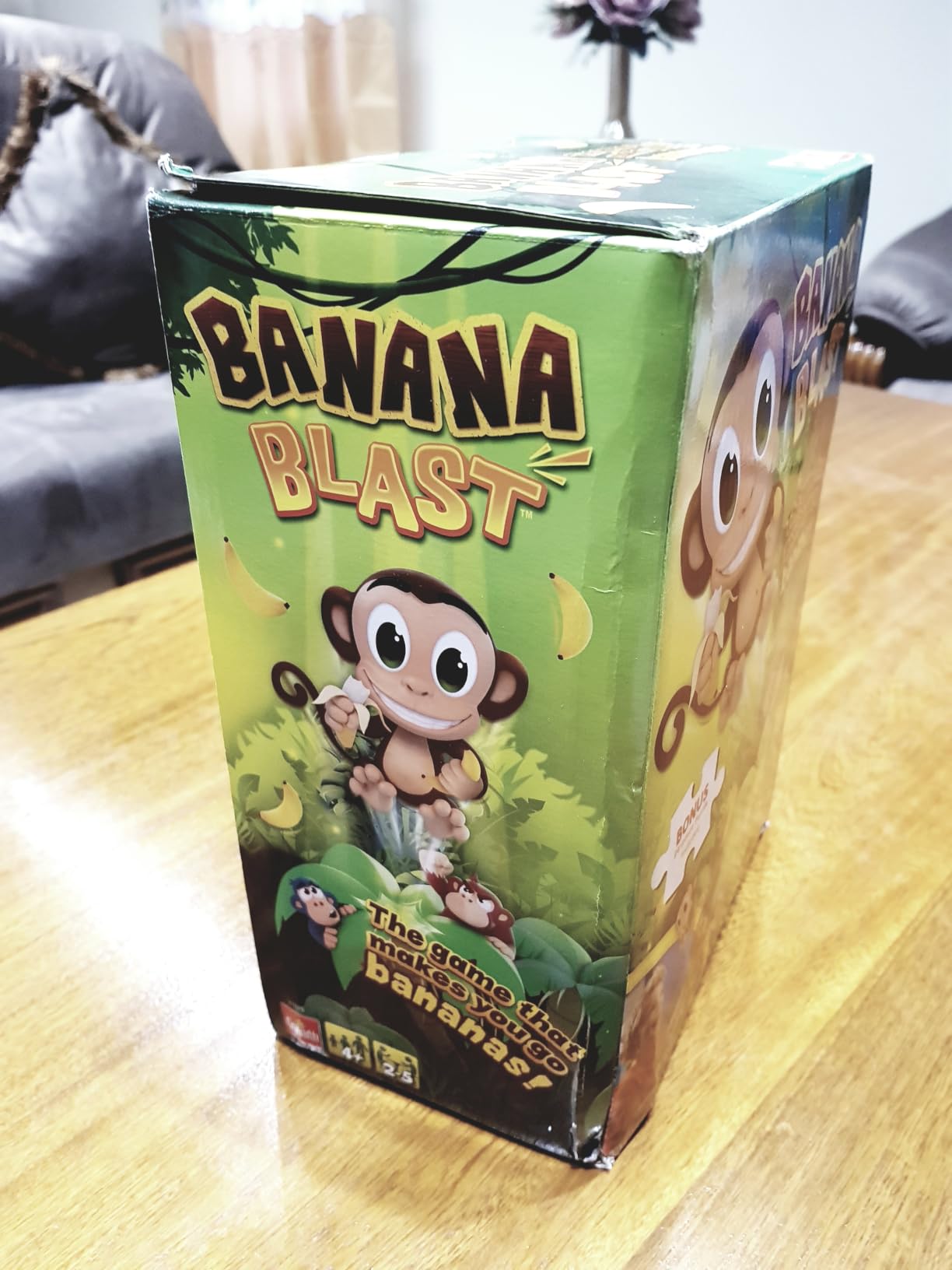
Banana Blast is pure reaction game. Players roll a die, then pull bananas off a treetop until the last banana drops the monkey onto whoever is standing closest. If you want to know whether a game works with a family that spans four to forty, this is the test: everyone plays, everyone screams, nobody needs the rules restated.
We like it most as the second game of the evening rather than the first. The click of a banana coming off the tree is satisfying on its own, and the monkey launch gives the table a genuine payoff moment. It packs for a playdate in a tin, and the whole set weighs just over a pound.
Durability is the standout. Owners report the base holding up over years of use without loss of performance, and the plastic scratches rather than cracks. For a game that will be handed to a four-year-old with adult hands nearby, that matters more than the theme does.
The skill-versus-luck balance
It leans heavily on luck. The die sets how many bananas you take, and the tree sets the timing, so a child and an adult with identical reflexes will not get identical results. That is fine for a party round and frustrating if your family prefers games where the better player reliably wins.
Everyone gets a turn at the payoff
Because the monkey launches toward the nearest player rather than a designated victim, no one is left sitting out. In a group with three children and two adults, that means five equal moments of chaos rather than three, which is exactly why this one recurs on our list.
The bonus puzzle is a bonus, nothing more
The box includes a 24-piece puzzle, and it is genuinely thin for what it adds to the box size and the wait at the register. If the puzzle is the draw for the person you are buying for, fine. If not, treat it as a quiet activity for the youngest while the adults finish a round.
When it stops working
Experienced players learn the die actions quickly, and then the game flattens. We would hand this to a family with children under nine. For teenagers, pair it with something from later on this list that has more depth.
4. Tinderblox — The Best Dexterity Game for a Restaurant, a Tent or a Small Table
Alley Cat Games Tinderblox Board Game
Tweezers stacking
Ages 6+
About 15 minutes
Mint tin
+ Pros
- Fits in a purse or backpack and sets up instantly
- Tweezers add real tension to the stacking
- Rules take under a minute
- Short five to ten minute rounds suit a filler slot
- Campfire theme and artwork have strong shelf appeal
- Cons
- Two tweezer sets are included because the plastic ones are expected to break
- Small pieces scatter if the table is knocked
- Some groups want a second game immediately after
Tinderblox takes the familiar build-a-campfire stack and forces you to do it with tweezers. That single rule change turns a casual balancing game into a genuinely sweaty thirty seconds per turn. It is the pick on this list for a family that travels, eats out a lot, or plays in places where a box of components would be a problem.
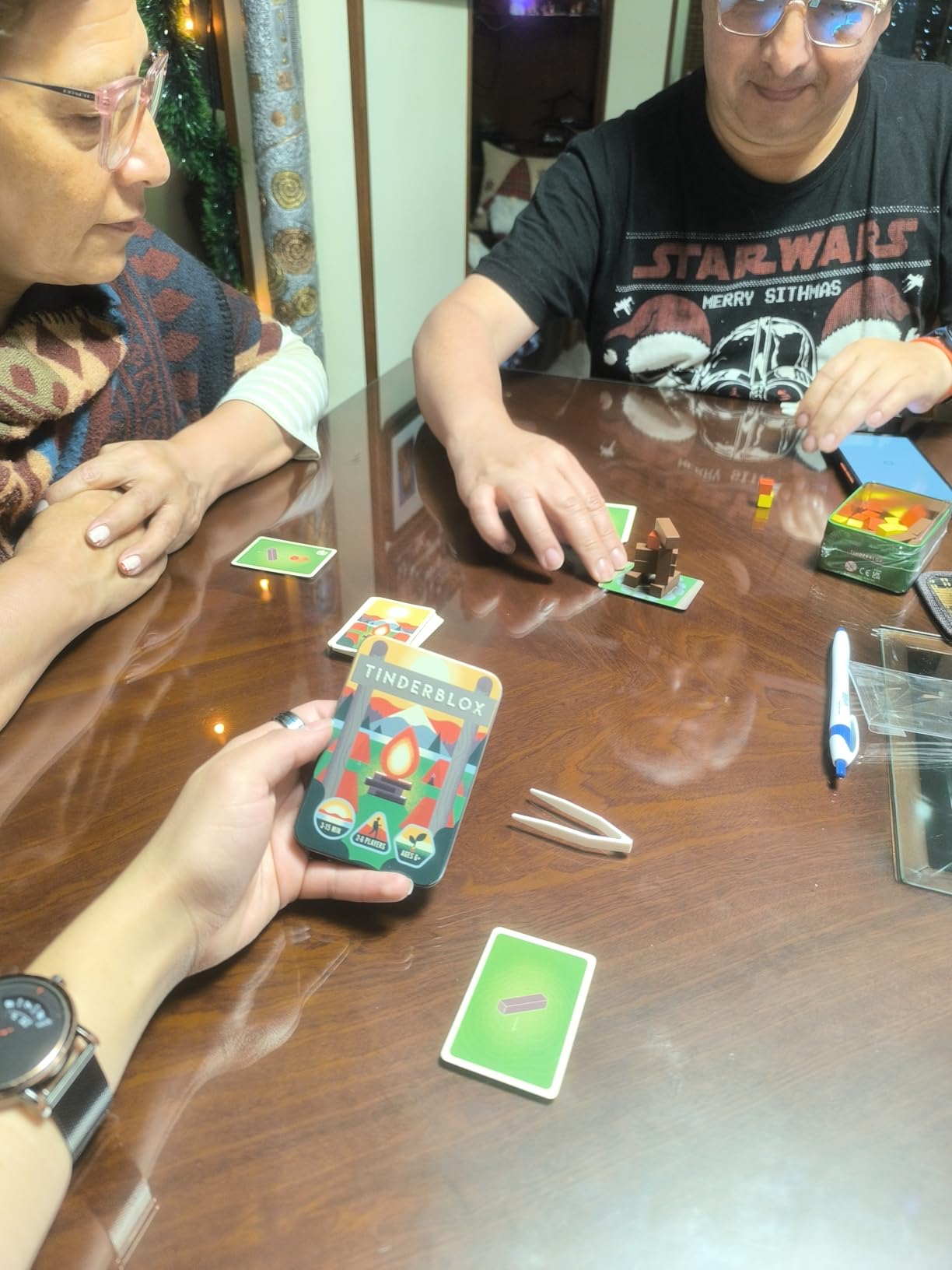
The carton is a mint tin a little larger than a deck of cards, and the instruction cards define the shape you have to build. Every player at the table can join in, ages six and up, and the whole round is short enough to slot between heavier games rather than compete with them.
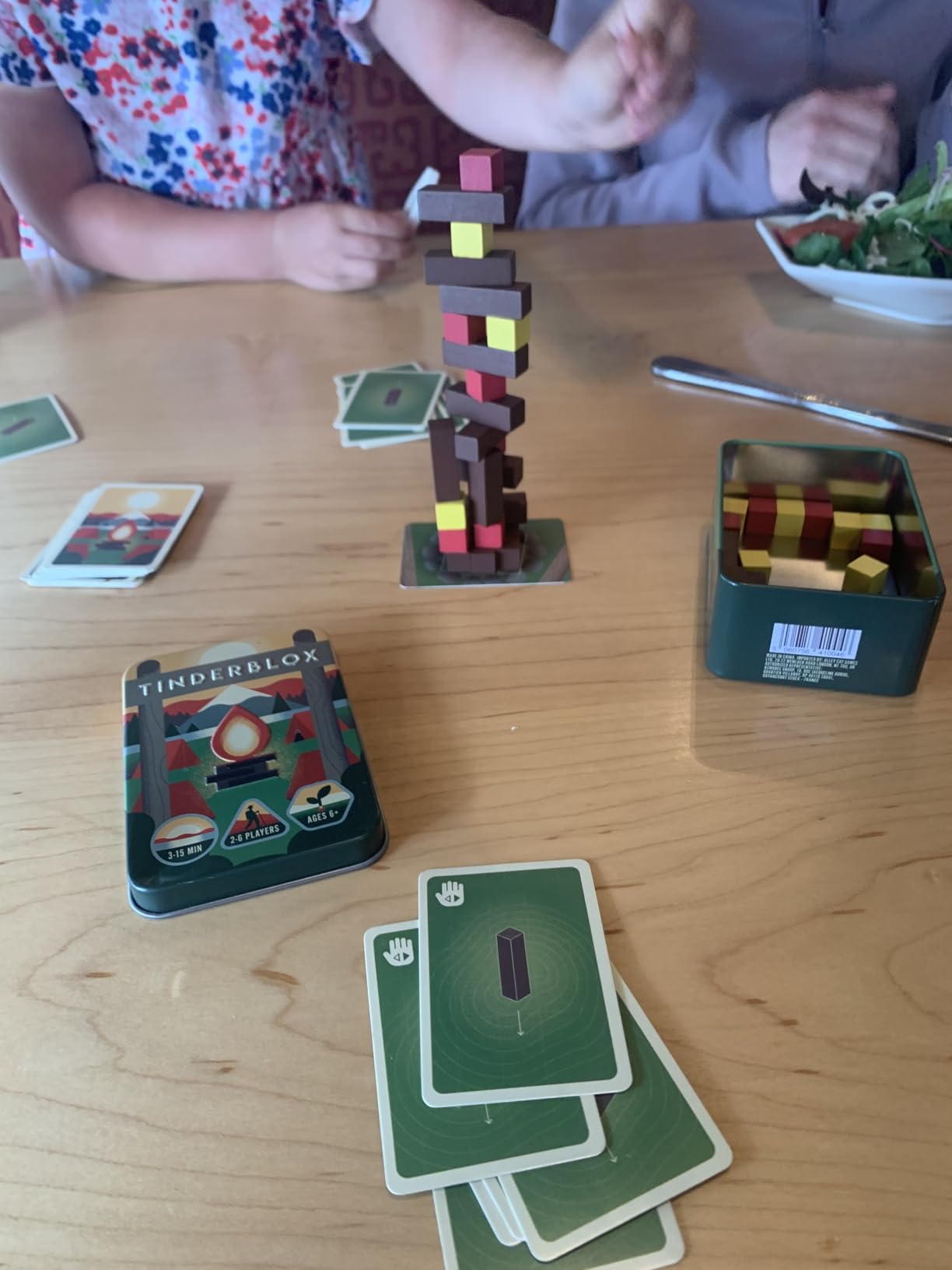
Our rule for travel dexterity games is simple: if it does not fit in a coat pocket and set up in under a minute, it does not come out. Tinderblox passes on both counts, which is why it stays in the bag permanently rather than living in a cupboard.
Why the tweezers change everything
Without a tool, a campfire stack is a balancing puzzle you solve with two fingers and a plan. With tweezers it becomes a hand-steadiness test, and the failure mode is sudden. Reviewers consistently describe the elimination tension as the reason the game gets replayed rather than retired.
Durability is the weak point
Multiple sets of tweezers are included, and that is not generosity, it is an admission. Owners report the plastic tweezers cracking after repeated use. We would budget for a replacement set and treat the whole game as one you store carefully rather than one you leave out on the floor.
Losing pieces is a real risk
The wooden logs and embers are small, and a knock sends them under the table. This is a table-top game, not a sofa game. Keep it on a stable surface, and count the pieces before you start if you have a cat or a small child in the room.
The best filler on this list
Rounds run five to ten minutes, so a group can finish and immediately want something else. That is a feature for a family night with a mixed attention span. It is a weakness if you were hoping for one game to occupy a whole evening, which no dexterity title will do.
5. Barrel of Monkeys — The Best Dexterity Game for Preschoolers
Spin Master Games Barrel of Monkeys Classic Linking & Balancing Kids Game
15 monkeys and 1 barrel
Ages 3+
1-4 players
+ Pros
- Rules a preschooler can grasp quickly
- Linking and balancing genuinely build fine motor skills
- The barrel doubles as storage so clean-up is instant
- A gentle introduction to strategy play
- Works for one child or a family of four
- Cons
- The small curved arms frustrate toddlers at first
- The challenge drops once the linking is mastered
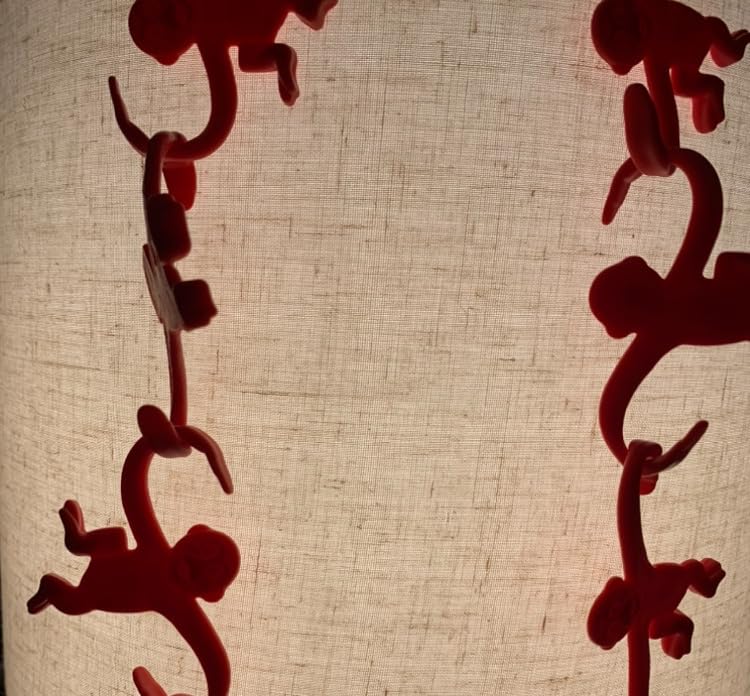
This is the entry point. You pour fifteen plastic monkeys out of a barrel and build the longest chain you can, linking arms together, with the winner being whoever holds on to the last monkey when everything else drops. Ages three and up, one to four players, and no reading at any point.
We put it on the list because so many dexterity roundups assume a six-year-old floor and leave families with a three-year-old and nothing to do. This one fills that gap honestly. The barrel snaps shut and stores everything, which is unusual in this category and turns clean-up into a five-second job.

Fine motor development is the real payload
Curved linking arms are a genuine fine motor exercise, closer to a lacing toy than to a game. That is the point for a preschool household, and it is why this works as a first board game rather than just as a noisemaker.
The first ten minutes are the hard part
Owners consistently note that very young children find the arms frustrating at first, because the grip needed is finer than a three-year-old reliably has. Our approach is to let them build a chain of three, hand the rest to an older sibling or adult, and keep the scoring informal until the fingers catch up.
Where the ceiling sits
The challenge drops quickly once the linking technique is learned, typically inside a single session for a five-year-old. This is a short game, not a long one, and we would not expect a seven-year-old to still be pulling monkeys out of the barrel a month later.
Where it fits in the evening
Use it to open the night with a toddler, or as a calm antidote after a loud flicking game. It is the quietest game on this list and one of the few that genuinely works in a small flat without anyone raising their voice.
6. Tower Stack — the Best Dexterity Game for Teenagers and Adults
WHAT DO YOU MEME? Tower Stack, Exciting Tower Building Game by Relatable
24 blocks and 36 cards
Ages 14+
Head-to-head
+ Pros
- Head-to-head tower building creates real tension and laughter
- Card-driven challenges vary each round
- A slim box that stores in a tight shelf
- Plays solo for practice or as a two-player showdown
- Cons
- Suited to older kids and teens rather than young children
- The tower topples easily once it gets tall
Most stacking games on this list are cooperative. Tower Stack is not. Two players build on the same central tower, drawing from the card deck to decide what goes where, and the whole structure can come down on either of them. For a family with teenagers, that competitive edge is the entire reason to own it.
The listed age is fourteen and up, which we think is honest. There is nothing here a twelve-year-old cannot do physically, but the strategic layer of planning a placement that does not sabotage yourself two moves later does reward a more adult mindset.
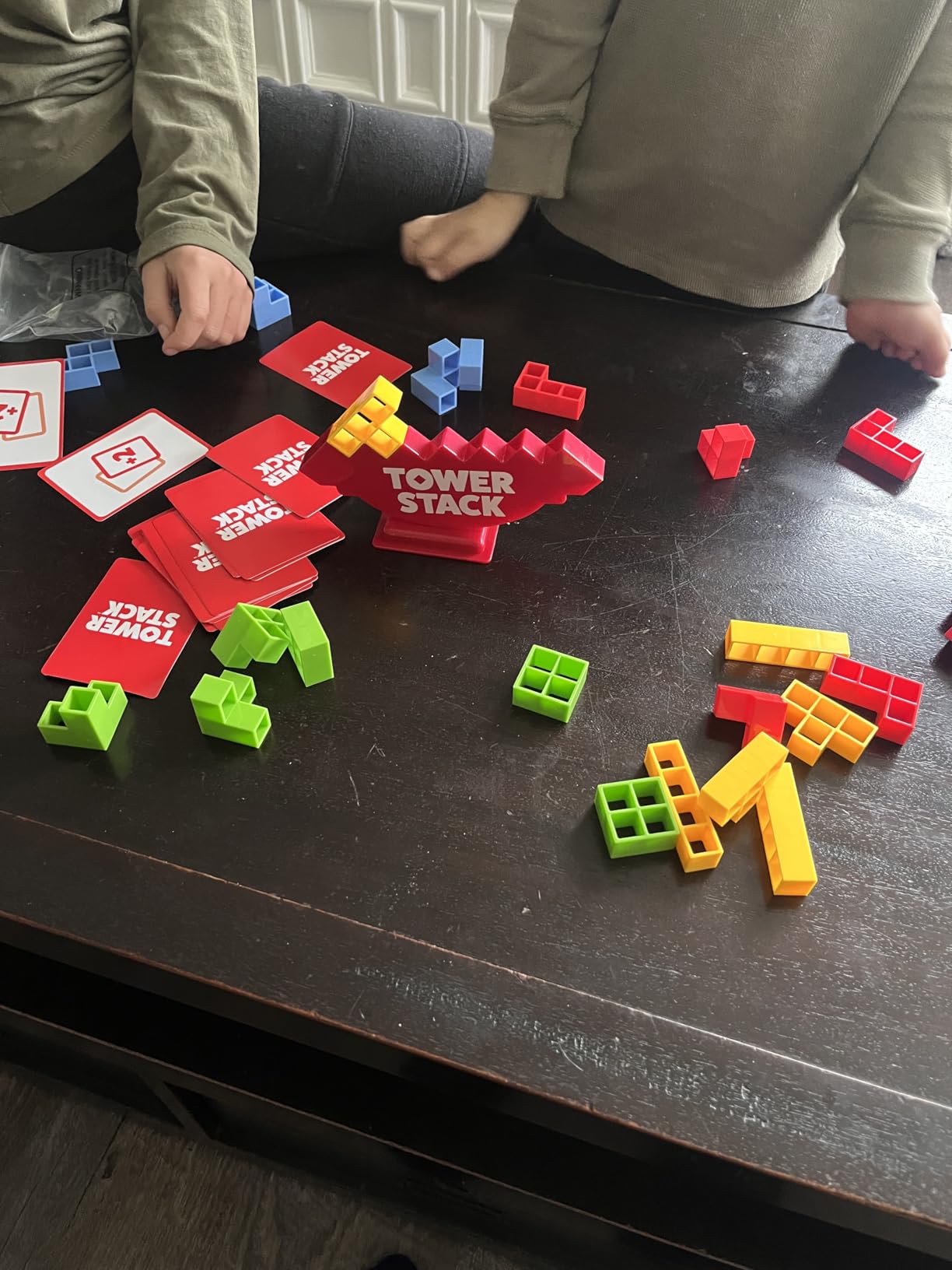
Thirty-six cards and 24 blocks make this a game with more decisions per turn than the pure balancing titles. In testing, that is the difference between a game people finish and a game people ask to play again, provided the audience is old enough to plan.
Two ways to play it
Solo, the card deck becomes a personal puzzle and it works as a practice round between turns. Head to head, the same deck becomes a shared threat. We recommend teaching it solo first, because watching one person place a block slowly teaches the placement rules better than any explanation.
The collapse-everything failure mode
This is the most common complaint in owner feedback, and it is real: once the tower is tall, almost any placement risks a total collapse and the round ends abruptly. Budget for a rebuild every few rounds. That is the game, but it does not suit anyone who does not like losing a hard-won tower to a careless thumb.
Storage matters more than usual
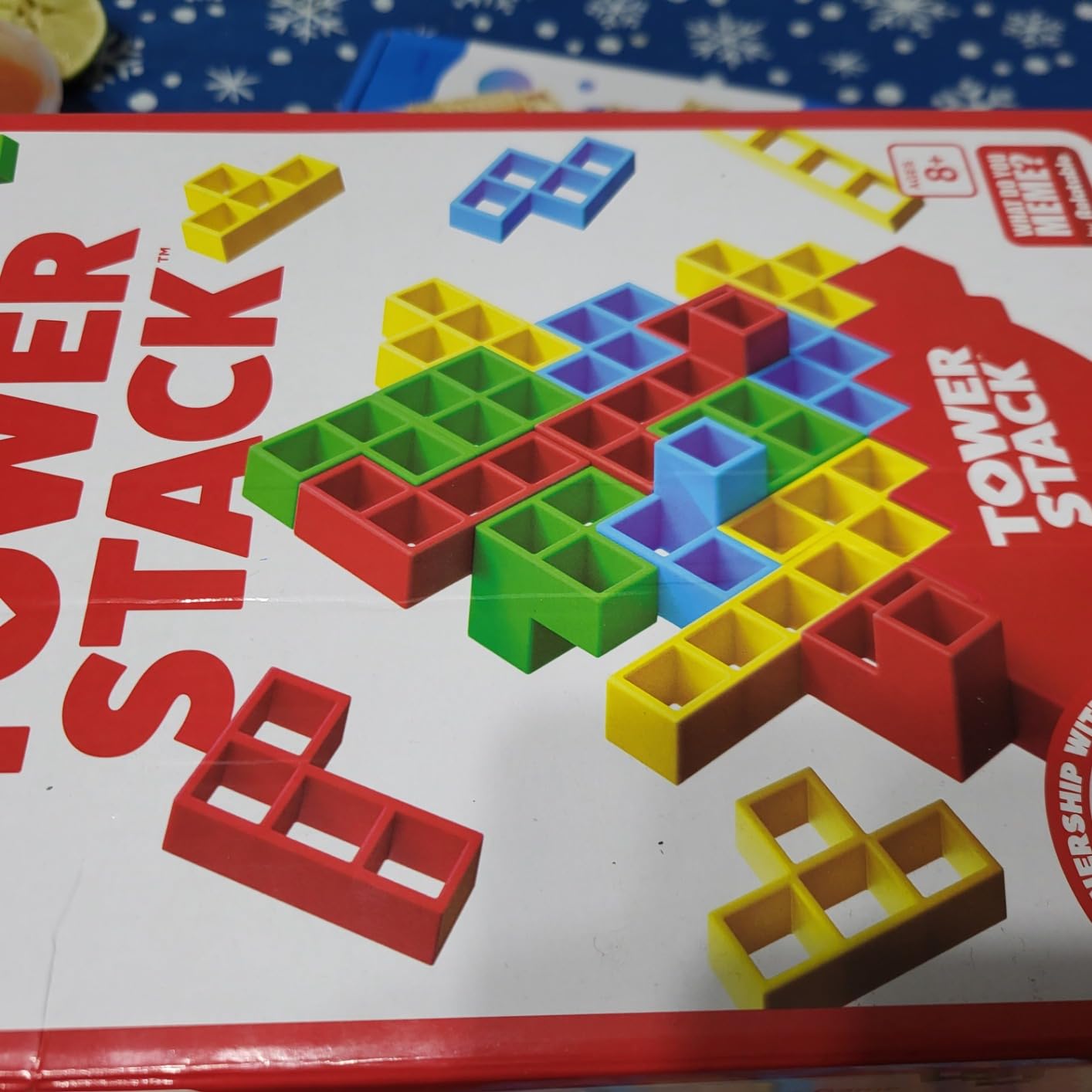
The box is slim and tall, which is a real advantage in a shelf shared with a strategy collection. At one kilogram it is not a portable game, though, so this is a table game rather than a trip game.
Who should pass
Families with children under ten will finish this quickly and move on. Pair it with an entry earlier in this list if the youngest player needs something to do, or hold it back for the adults after the little ones have gone to bed.
7. Icecool — The Best Flicking Game, and the Most Demanding on Space
Amigo 01660, Icecool, Children’s Game of the Year 2017
Penguin figures
2-4 players
Ages 6+
About 30 minutes
+ Pros
- Fast flicking gets players physically on their feet around the arena
- The preformed cardboard arena is sturdy and reusable
- Components include storage bags for pieces and cards
- Simple concept with quick rounds kids ask to replay
- Plays well for two to four mixed ages
- Cons
- Needs clear floor space so furniture often has to be moved
- Some buyers received language versions with limited instructions
- Rounds reward a fast flicking finger more than planning
Icecool is the reason many people first understand what a dexterity game actually is. It comes with a preformed cardboard arena, and you flick wooden penguins across the table to knock each other’s out of the ring. Players get up, move around, and lean over the arena. It is the most physical entry on this list by a wide margin.
Two to four players, ages six and up, roughly thirty minutes. The setup is genuinely fast because the arena arrives preformed rather than assembled, which is unusual and makes it easy to bring out when a group turns up unexpectedly.
Buyer feedback repeatedly calls it a top-ten family game, and we agree for the right room. The quality of the cardboard arena is a genuine step above typical party-game construction, and the storage bags for cards and wooden pieces keep the long tail of components in one place.
The space problem is the whole problem
You need a clear floor and room around the arena, which in most homes means moving furniture first. That is a real cost at the start of a family night, and it is the reason this one scores below the games that stay on the table. Budget five minutes and a metre of clear space per player.
Skill, not strategy
Every round is decided by how quickly and cleanly you can flick. There is no planning layer at all, so the game rewards a fast trigger finger rather than thought. That is what makes it fun for kids and slightly shallow for adults who like to be outsmarted.
Check what arrives in the box
A number of buyers report receiving versions with limited or no readable instructions in English, so check the packaging before you commit to it for a family night. The concept is easy to teach by demonstration, but a rule set in another language slows the first turn.
Small parts warning
The listing carries a small parts choking caution. With children under six at the table, this is one to keep on a high shelf between sessions.
8. Rhino Hero Super Battle — The Best Anchor Game for Families Who Want to Cooperate
HABA Rhino Hero Super Battle – Exciting 3D Stacking Board Game for Kids & Adults, Fun Family Games, Stacking Card Games for Kids, Made in Germany
3D cardboard skyscraper
2-4 players
Ages 5+
Team play
+ Pros
- Sturdy cardboard construction that survives repeated sessions
- Building a full skyscraper gives a shared goal for kids and adults
- The superhero duel mode adds competitive tension on top
- Variable gameplay means it plays differently each time
- Engages concentration and strategic thinking
- Cons
- Takes longer to set up and play than a typical filler
- Needs a clear table because the tower grows large
- Younger children struggle with the fine motor demands
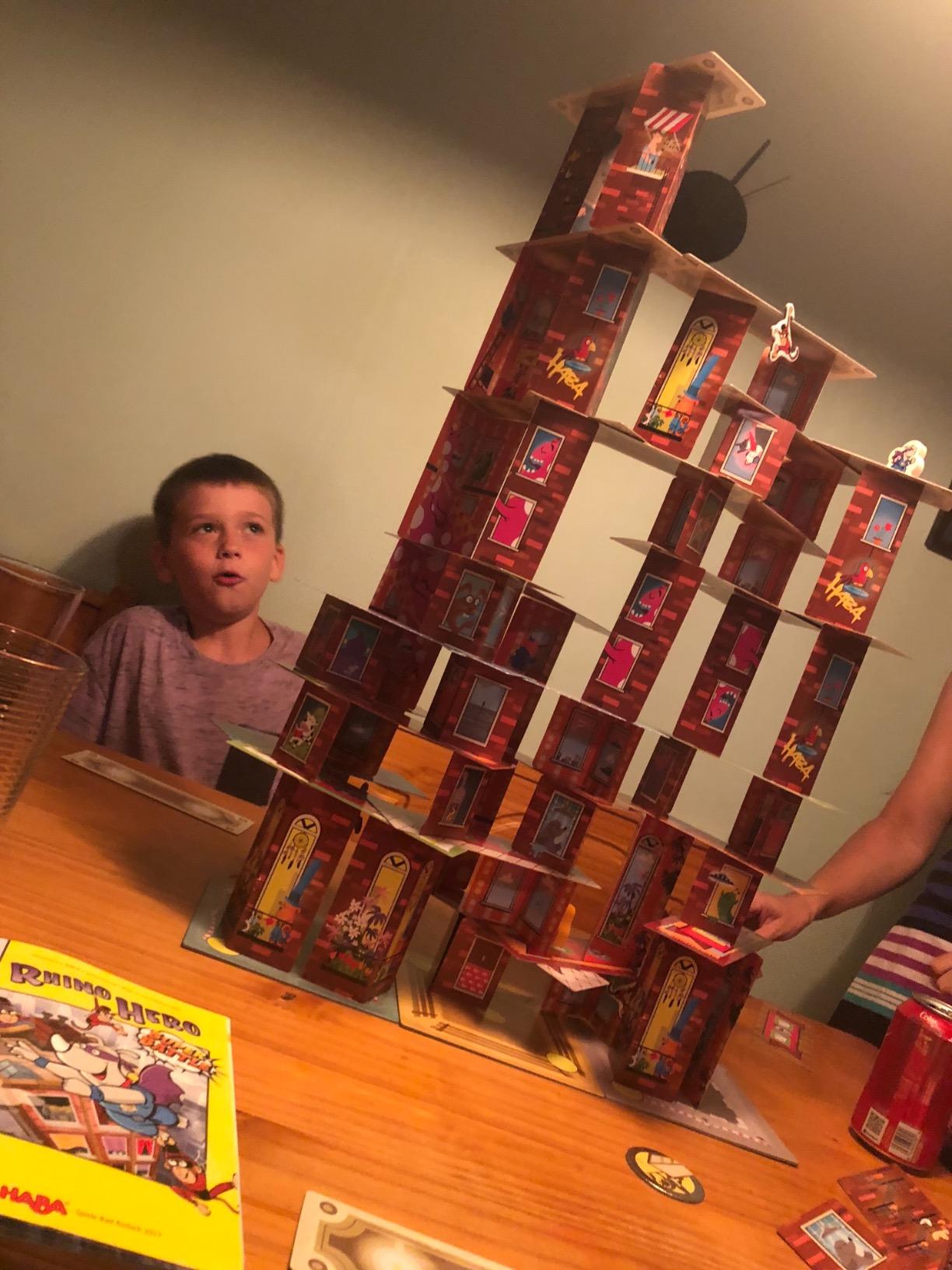
Rhino Hero Super Battle is the entry in this roundup that the hobby community names most often when families ask for one dexterity game, and it earns that. The group builds a three-dimensional cardboard skyscraper together, floor by floor, and then a second phase turns it into a superhero duel. Two to four players, ages five and up.
The thing that makes it work across a wide age span is the shared goal. During the building phase everyone is on the same team, so a five-year-old and a fifteen-year-old are solving the same problem at the same time rather than competing across a gap. Most families who own one dexterity game own this one.
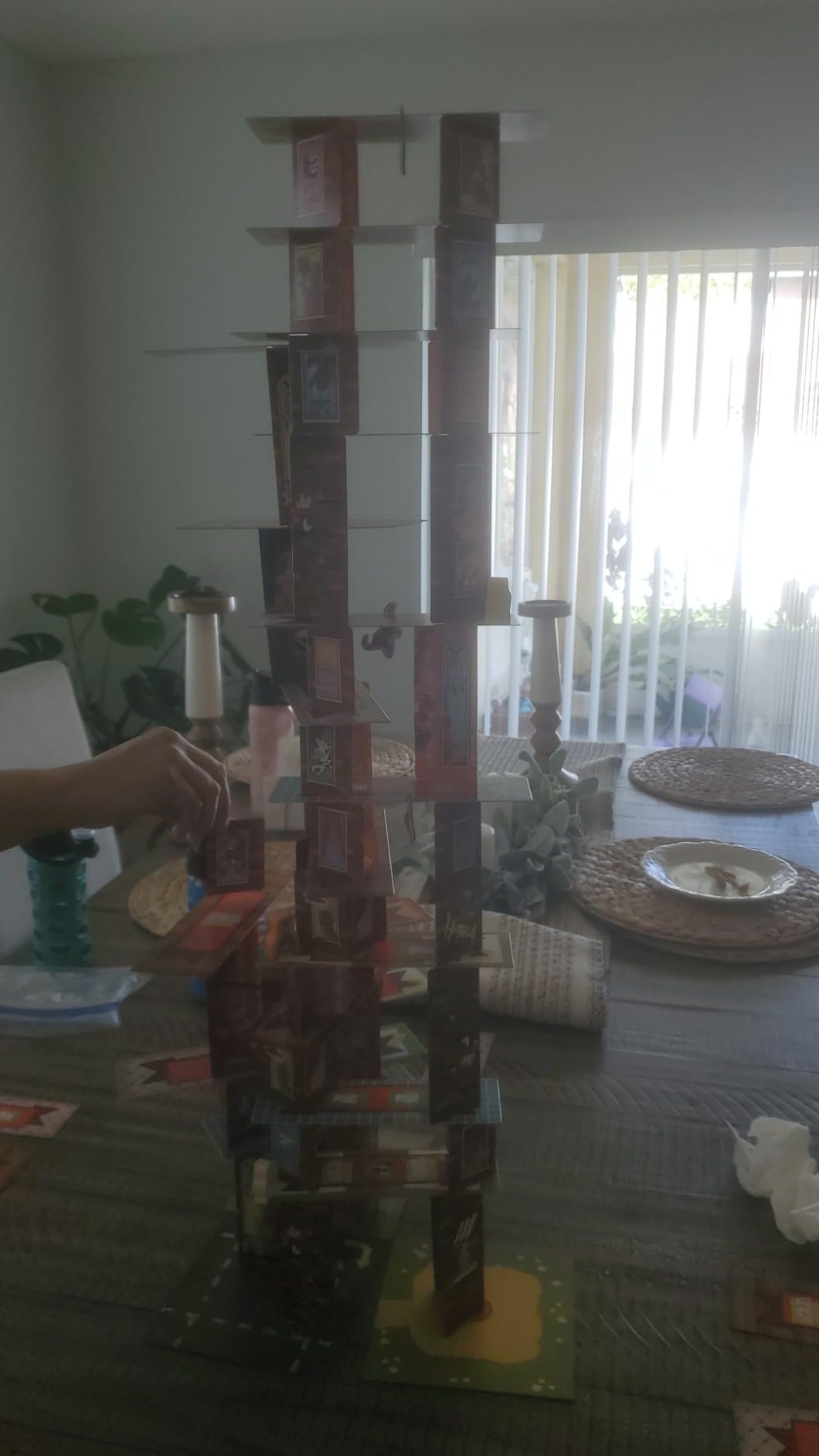
Made in Germany with durable cardboard, the construction holds up to repeat sessions, which matters because it will not be played once. The board footprint is large at nearly 15 inches by 11 inches, and that footprint grows as the tower does.
Cooperation first, competition second
The building phase is genuinely cooperative and produces the kind of collective groan when a wall goes down. The superhero duel phase then gives you a reason to shout at each other, which is the emotional shape most families are looking for from a dexterity game.
It is not a 15-minute filler
Setup and play together take noticeably longer than the quick titles here, and that is the main reason it does not rank higher for casual nights. If you have one evening a month for games, this is a better use of it than anything else in this list.
The fine motor floor
Placing the wall pieces asks for a precision younger children often do not have. Reviewers flag this consistently, and it is why we would not put it at the very front of a table with three-year-olds, despite the listed minimum of five.
Replay value
Variable gameplay and the included advanced variations mean a second and third session plays differently from the first. For a family that wants one game rather than a rotation, that is the strongest argument on this page.
9. Catch the Moon — The Best Cooperative Dexterity Game for Calm Nights
Catch The Moon | Dexterity Stacking Board Game for 1 to 6 Players | Beautiful Design & Whimsical Theme, Balance Wooden Ladders to Reach The Moon | Family Game Night Favorite | Ages 8+
30 wooden ladders
1-6 players
Ages 8+
About 20 minutes
+ Pros
- Beautiful artwork and wooden components
- Rules take a minute so play starts fast
- Genuinely tense ladder placement that rewards a steady hand
- Works across a wide span from children to adults
- Quick 20 minute sessions encourage one more round
- Cons
- Wooden pieces are light and delicate so one slip can topple everything
- Small parts need careful handling to avoid loss
- Rulebook is only in English and German
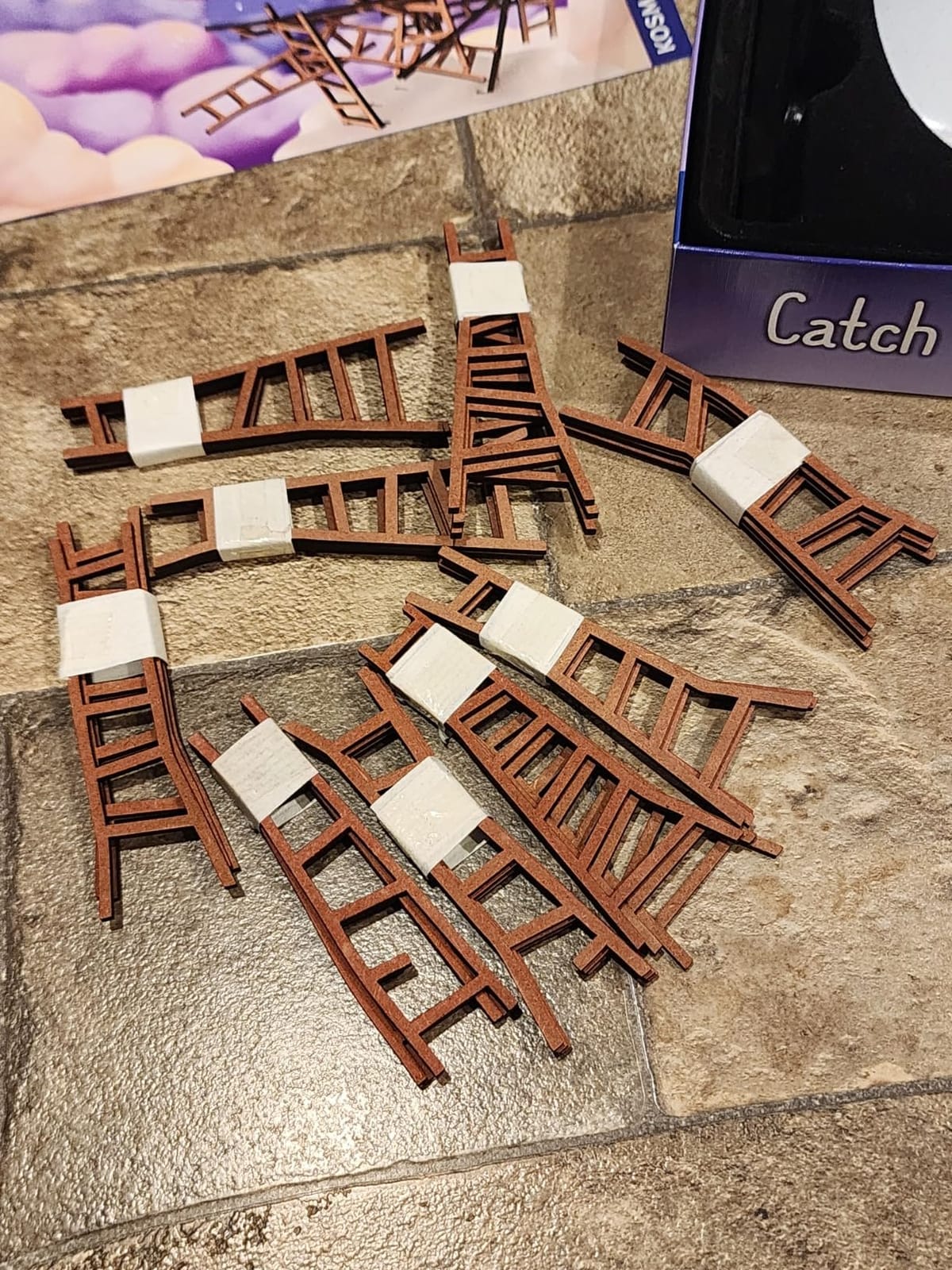
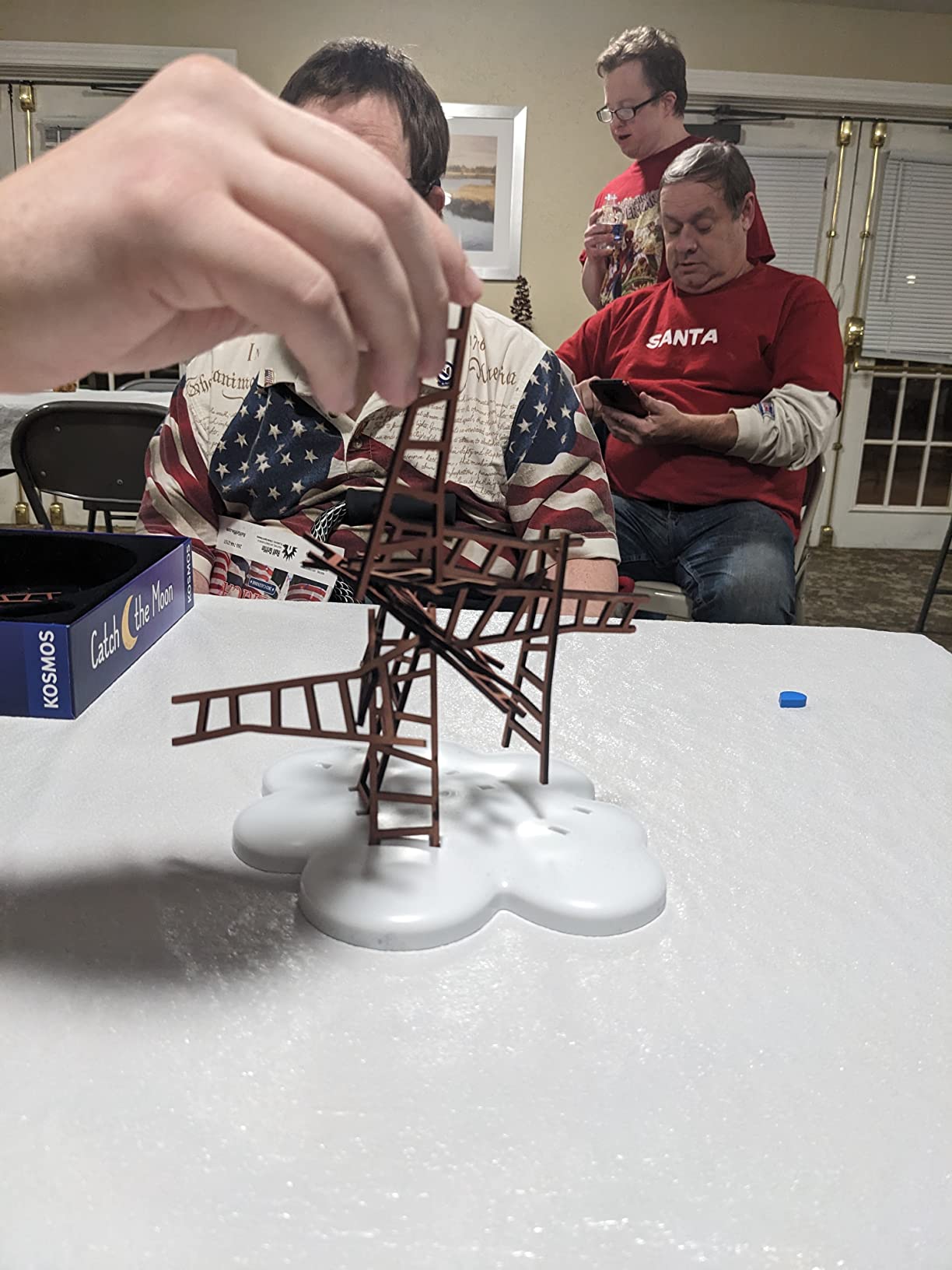
Catch the Moon asks your group to build a network of thirty wooden ladders reaching up toward a cloud, without touching the pieces already in place. Topple anything and you take a raindrop. Fewest raindrops wins, which means everyone is technically playing alone but is physically building the same structure.
One to six players, ages eight and up, about twenty minutes. Those numbers make it unusual here: it scales down to a single child for solo play and up to a six-person table without anyone sitting out, and it can be played cooperatively using the alternative rules in the manual.
This is the calmest game on the list. There is no shouting, no throwing pieces across a table, and no floor space needed. In a flat with thin walls or a house with a sleeping child upstairs, it is the one we actually reach for.
Why the age spread works
Reviewers consistently report playing it with children and adults together. The reason is that the difficulty comes from nerve rather than rules comprehension, so a younger player understands the objective instantly and simply executes it less reliably. Nobody is excluded, and nobody is outclassed in a way that embarrasses them.
Delicate is the operative word
The wooden pieces are light, which makes them pleasant to handle and fragile in the wrong hands. A single misaligned ladder can collapse an entire section, and small parts need handling with care. We would store this one on a high shelf rather than leave it out.
Twenty minutes is a feature
Sessions are short enough that a group naturally plays two, which solves the problem that afflicts Tinderblox and Tower Stack. It is also short enough to sit between two heavier games without losing the evening.
Which version of the rules
The manual covers both a competitive and a cooperative mode in English and German. Read the cooperative rules once before a family night; it changes the entire mood of the game and works better with young players.
10. Creature Crash — The Best Two-Player Dexterity Game for a Pair
Creature Crash – The Capybara Balancing Game by Relatable
2 players
Ages 6-8
About 10 minutes
24 capybaras
+ Pros
- No reading required so it works for pre-readers
- A slim footprint makes it a good travel and restaurant game
- Capybaras that kids specifically ask for by name
- Practices counting and turn taking
- Fast 10 minute rounds between other games
- Cons
- The balance plate is very stable so it can feel unchallenging
- Some sets arrive missing capybara pieces
- The hollow-backed single-sided pieces feel inexpensive
Creature Crash is the answer to a problem most families hit around the eight-year mark: the youngest player has grown past toys and the oldest is not interested, leaving a gap. Roll a die, place that many capybaras on a balance plate, and if the stack goes over on your turn you are out. Two players, ten minutes, no reading.
It works as the between-games filler for a pair, which is exactly what a family night needs when the adults are playing something longer. The kids ask for the capybaras specifically, which is more than we can say for most novelty pieces.

Why two players is the right number
Every capybara you place changes the balance for the next placement, so a duel is where the tension lives. The elimination structure means the game ends quickly and cleanly, which suits a ten-minute slot far better than a longer elimination game would.
Where it falls short
Two complaints dominate owner feedback. The balance plate is very stable, so older children and teens often find it easy and unchallenging. And the capybaras are hollow-backed, single-sided plastic that reads as inexpensive, particularly next to the wooden components elsewhere in this category.
Missing pieces show up
Some sets arrive without the full complement of capybaras. Count them when the box opens, because a short set changes the scoring and there is no spare supply listed with the game.
Age guidance in practice
The listed range is six to eight years, and we would keep it there. For children under six the counting slows the round, and for older players the challenge is thin. In a family with a wide age spread, this one is best used deliberately as a two-player sub-game rather than put in front of the whole table.
11. Nekojima — The Best Dexterity Game for Cat Lovers and for Adults Who Claim They Do Not Play Games
Nekojima | Japanese Cat Board Game – Balance a Wooden Power Grid Before the Cats Knock It Down | Dexterity Stacking Game | Solo, Co-op or 2-5 Players | Kids & Adults | Ages 8+ | 15 Min
80 wood and cardboard pieces
1-5 players
Ages 8+
15 minutes
+ Pros
- Real wood and cardboard pieces give it a substantial feel
- Solo
- cooperative and two to five player modes in one box
- Nothing to assemble and a short rulebook so play starts quickly
- Every placement raises the tension in a way that feels fair
- Themed well enough for non-gamers and cat lovers
- Cons
- Higher complexity than a quick filler so younger players need guidance
- The stack is delicate and a bad placement can end the round early
Nekojima is the most ambitious dexterity game on this list, and the one that most reliably converts an adult who says they do not like board games. You build a power grid by stacking wooden poles and threading cables without touching anything already in place, while cat silhouettes wait to knock it over. The tension comes from placing pieces in a structure you are not allowed to touch.
Twenty-one poles, 28 cubes, seven cat silhouettes, 20 nest tokens and two district dice, packed into a single square box with nothing to assemble. One to five players, ages eight and up, about fifteen minutes, with solo, cooperative and competitive modes all in the same rulebook.
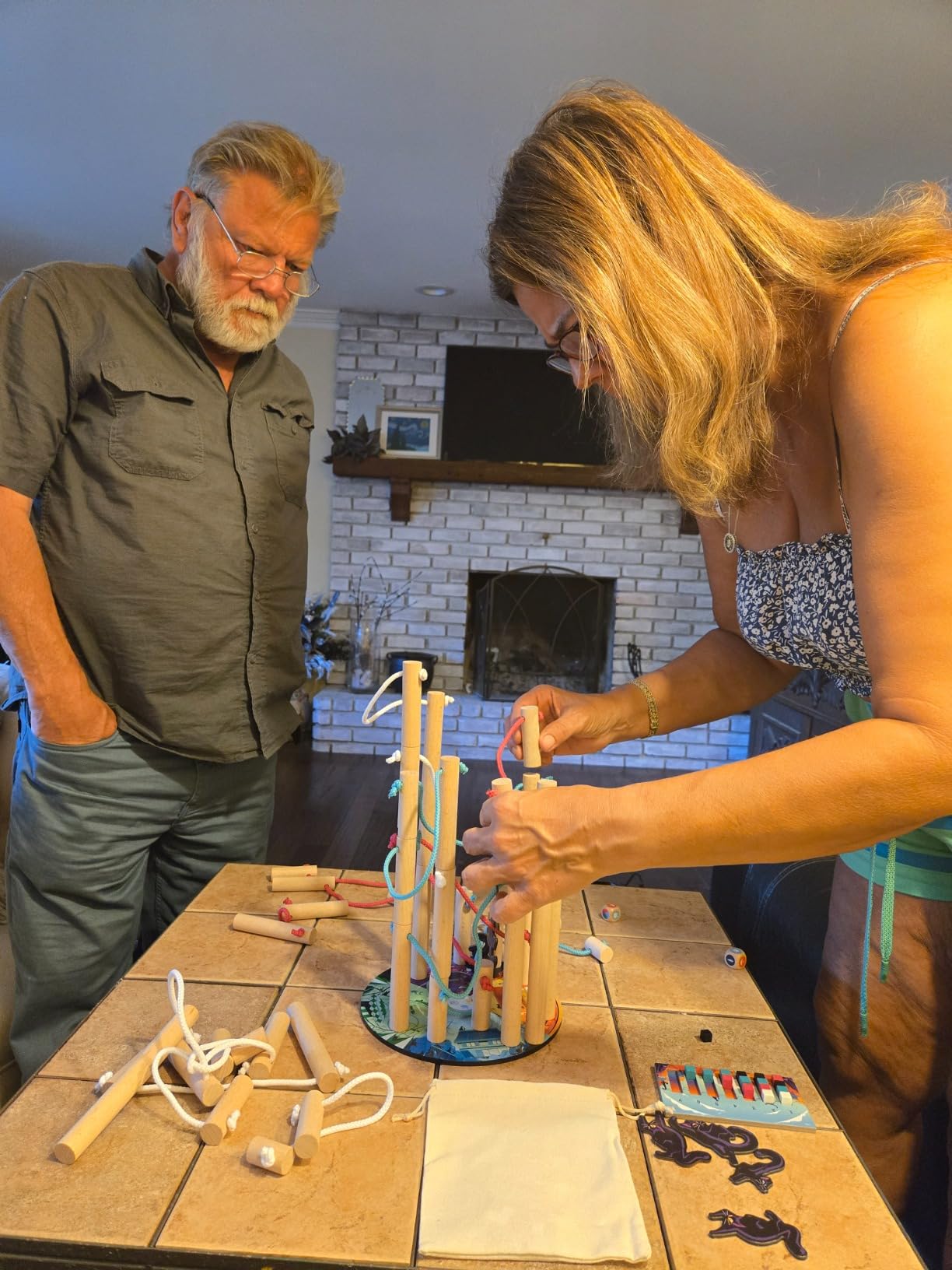
Component quality is the standout. Eighty pieces in wood and cardboard with no glue or plastic frames, and everything returns to one box. That is why it reads as a gift-worthy object rather than a party prop, and it is frequently described as the thing you hand someone who claims they hate board games.
More demanding than a typical filler
This is the most important caveat on the page. Nekojima asks for spatial planning ahead of each placement, so younger players need guidance and a patience that quick flicking games never demand. If your family wants something that needs no thinking at all, this is the wrong pick.
Three modes in one box
Solo, cooperative and two-to-five-player competitive modes all ship in the same manual. That flexibility makes it the single most useful game to own for a household whose table size changes week to week, which is most households.
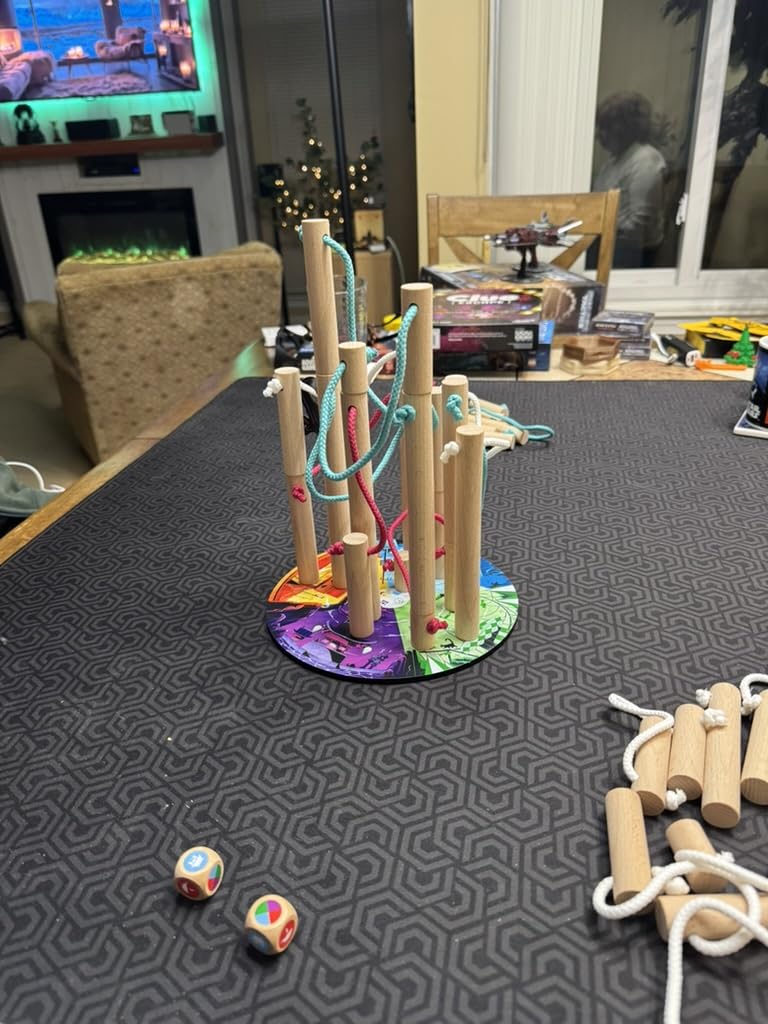
Delicate stacks
Reviewers flag the stack as fragile to a single bad placement. That is the game, but it means the round can end well before the end of the fifteen minutes you budgeted for.
Who should skip it
Families with children under eight and no patience for explaining spatial reasoning. Everyone else should consider it the one game here worth building a collection around.
12. Dr. Eureka — The Best Dexterity Game That Teaches Something Along the Way
Blue Orange Dr. Eureka Speed Logic Puzzle Dexterity Game Games – 1-4 Players for Ages 8+
12 test tubes and 54 cards
Ages 8+
1-4 players
+ Pros
- Racing format creates genuine urgency
- 54 challenge cards give a wide difficulty range
- The molecule rule is a single sentence to learn
- Works solo for one child or with parents and teens
- The science theme suits a classroom or home school
- Cons
- Small balls must be kept away from very young siblings
- Balls can bounce out of the tubes when moved quickly
- Later cards need more than a single roll at a time
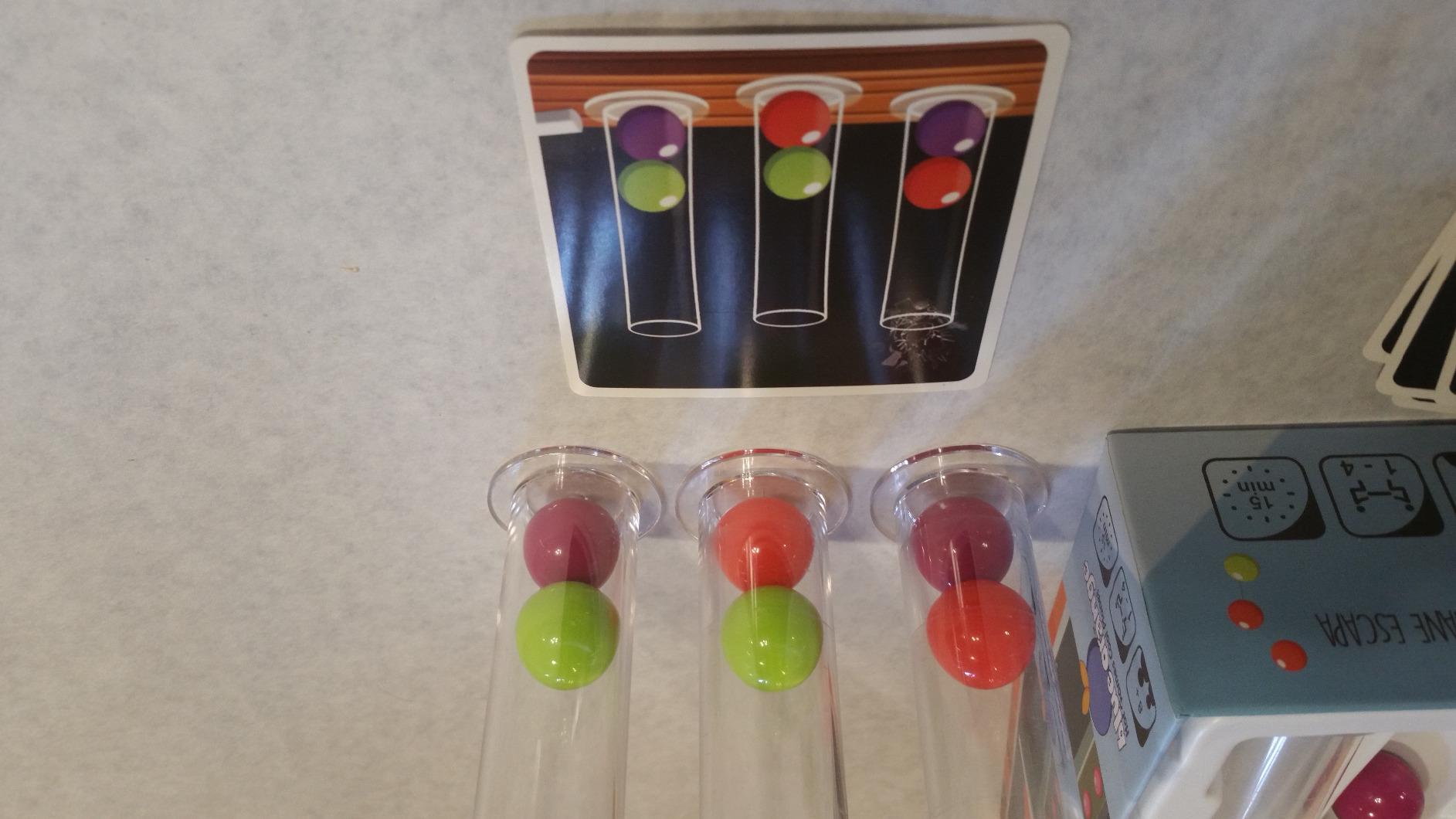
Dr. Eureka is a dexterity game wearing a science lesson. You roll coloured balls from one test tube to another, one at a time and no dropping, to match the formulas on the challenge card. It is the only entry here where a parent can honestly say the kids practised something while playing.
One to four players, ages eight and up, and the box holds 12 test tubes, 24 balls and 54 challenge cards. The rule about molecules only moving between tubes is one sentence long, which keeps the teach time minimal and gets straight to the racing.
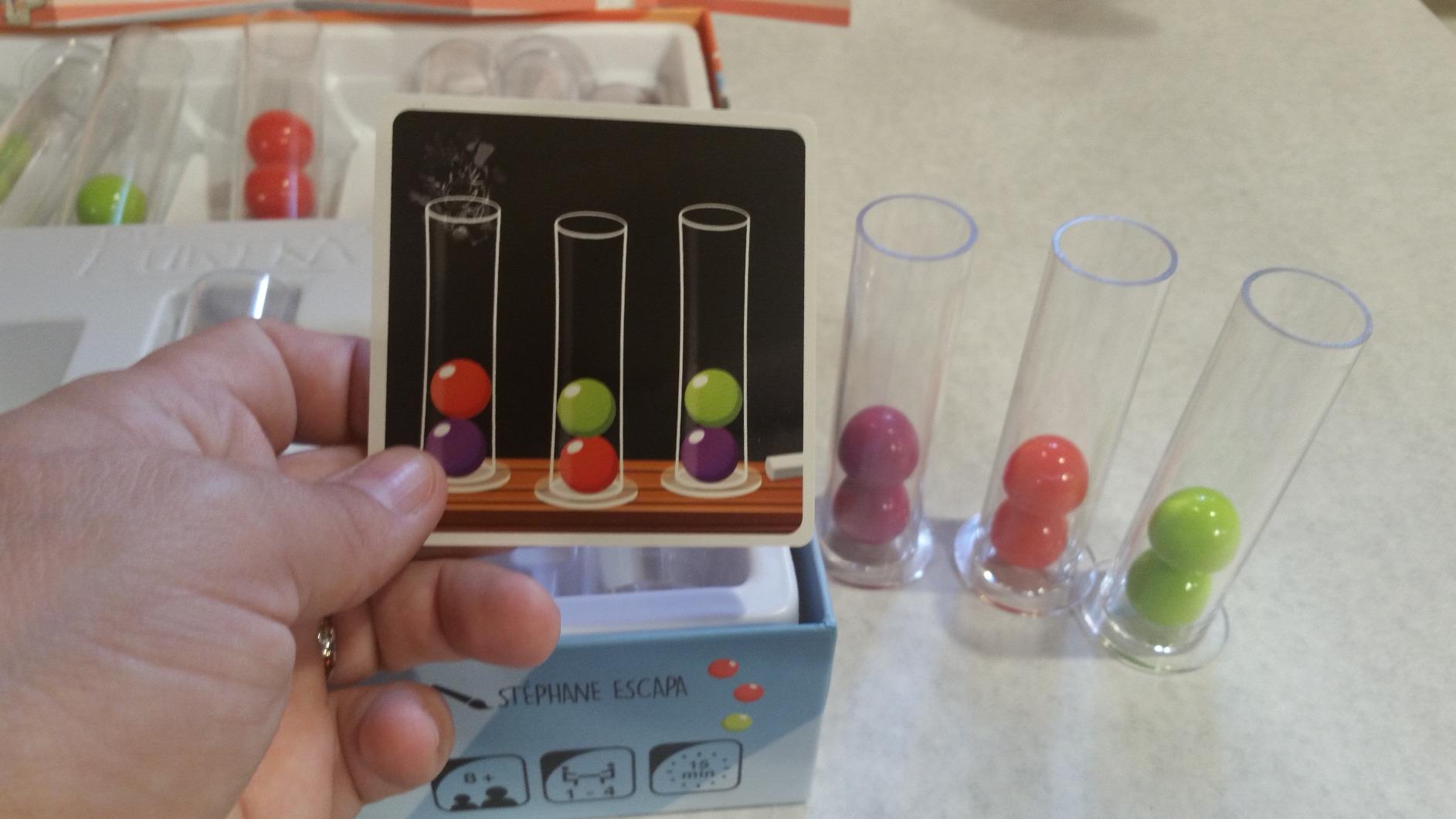
Owners describe it as a strong title in the Blue Orange line and recommend it for family game nights, classrooms and solo play alike. The racing pressure is what makes it work at a mixed table: everyone is solving their own card at the same time, so there is no downtime and no watching.
Fifty-four ways to replay
The challenge card count is the real value here. Early cards need a single roll, and the difficulty ramps until later cards require several careful moves at once. That curve is why families keep coming back rather than finishing it in one sitting.
The small-ball problem
The listing carries a small ball and small parts choking caution, and the balls really do escape if the tubes are shaken. If you have a sibling under three in the room, this one goes on a high shelf and stays there between sessions.
Older kids get the most from it
Because the formula reading and the multi-roll cards require more planning, teenagers and adults stay engaged longer here than with a pure balancing game. This is a reasonable entry for a group whose youngest player is eight.
Where it fits in the evening
It rewards the whole room shouting at once, which makes it a good closer after a calm game. At 719 g it is heavier than it looks, so leave it at home rather than packing it for a trip.
How to Choose a Dexterity Game Your Family Will Actually Replay
Dexterity games fail in predictable ways, and almost all of them come down to fit rather than quality. Five questions decide whether a game survives the third session.
Match the mechanic to your youngest player, not the box
Flicking and dragging need a deliberate two-finger motion that a four-year-old has not reliably developed, so favour pulling, placing and stacking for that age. Tugging an elastic band is the most intuitive mechanic of all because the instruction is physical rather than verbal. The lesson here is simple: start at the mechanic your youngest player can already execute, then move on to harder ones later.
Count real players, not rated players
Manufacturers quote the maximum, which is where the pain lives. At six players in a flicking game, five people spend most of their turn watching, and boredom arrives quickly. Simultaneous games like Yeti in My Spaghetti and Dr. Eureka avoid the problem entirely because everyone plays at once, so if you regularly host seven or eight people, favour those.
Match play time to attention span
A ten-minute game and a thirty-minute game create completely different evenings. Short fillers fit between heavier games and keep a restless child engaged; longer anchor games suit an evening with nowhere else to be. Buy one of each and you can structure a whole night around them.
Think about space and noise
Two categories here need a clear floor rather than a table, which in practice means moving furniture before you play. Separately, wooden block collapses and plastic launches carry a long way in a small flat. Where noise is a factor, the calm stacking games are the better answer than the loud ones.
Check the smallest piece before you buy
Small wooden logs, capybaras, balls and penguin figures all vanish under a sofa. Look for a container that closes, count the pieces when the box opens, and treat replacement parts as a likely future cost rather than a surprise.
Decide how much skill you want the outcome to depend on
Games like Banana Blast are largely luck with a reflex component, so a child and an adult will not get identical results from equal effort. Games like Catch the Moon or Nekojima are almost entirely skill, which means the better player reliably wins. Mixed-age tables usually prefer a bit of luck, because it removes the awkwardness of a child losing consistently.
Teach in ninety seconds or pick a different game
Anything that needs more than a short demonstration to explain is a strategy game wearing a dexterity label. If the youngest player cannot be playing within a minute, the evening has already lost momentum. That test eliminates more bad purchases than any other single rule.
Frequently Asked Questions
What are the best family game night games?
The best family game night games combine a one-sentence rule set with simultaneous play so nobody watches. Jenga covers small and mixed groups, Yeti in My Spaghetti works for up to six, and Dr. Eureka keeps four players busy at the same time. Save a game with real strategy for after the dexterity filler, not before.
What are some good dexterity games for adults?
Adults enjoy dexterity games that add a planning layer, not just physical skill. Nekojima and Catch the Moon reward spatial reasoning and steady hands, and Icecool delivers a genuinely competitive flick if you have the floor space. Tower Stack works as a two-player duel for older teens and adults.
What are some fun family games for a large group?
For eight or more players, prioritise games with no downtime over maximum player ratings. Yeti in My Spaghetti handles six and runs two sets in parallel beyond that, while Dr. Eureka keeps four players racing simultaneously. Banana Blast works for groups up to five. Splitting into two tables beats stretching a single game past its limit.
What games do ADHD people play?
The useful criteria are no reading, no turn sequencing that punishes going slow, and no downtime between turns. Yeti in My Spaghetti, Tinderblox and Creature Crash all fit that shape: every turn is one action with an immediate visible result. Games with long instructions or speed-dependent rounds tend to lose attention faster.
What are the top 5 family games?
Across the dexterity category, our five most reliable family choices are Jenga Classic, Yeti in My Spaghetti, Goliath Banana Blast, Tinderblox and Icecool. They cover ages three to adult, one to six players, and both calm and loud play. Add Nekojima or Catch the Moon if you want depth rather than volume.
Are dexterity games good for kids?
Yes, and they are particularly good for fine motor development. Barrel of Monkeys, Banana Blast and Yeti in My Spaghetti are all rated from four years or younger and require no reading. Check the smallest component first, since several of these titles carry small parts cautions and lose pieces under furniture.
Where to Start With Your Family Game Night Stack
If you own nothing, buy three and stop. A short stack beats a long one because the evening ends when the fun ends, not when the box runs out.
For a mixed group with a wide age range, start with Jenga. It is the most reviewed game in this roundup by a wide margin, it needs no explanation, and it works from a two-player evening up to a large gathering because players can join or leave mid-session.
For a group with children under six, start with Yeti in My Spaghetti and Barrel of Monkeys. Both handle a preschooler at the same table as an adult, and both keep every turn short enough that nobody loses interest.
For adults and teens who want depth, start with Nekojima or Catch the Moon. Both are calmer and more thoughtful than the rest of this list, and both reward planning rather than reflexes.
For a large gathering, keep Dr. Eureka and Yeti in My Spaghetti in reserve. They are the two titles here where every player is busy at the same time, which is the difference between a lively family night and six people watching one person flick.
Whichever stack you build, play one of these between heavier games rather than instead of them. That is how dexterity games are meant to be used, and it is why the ones on this list keep coming out of the box for years. Check the current details for any of them before you buy, and put the kettle on.