
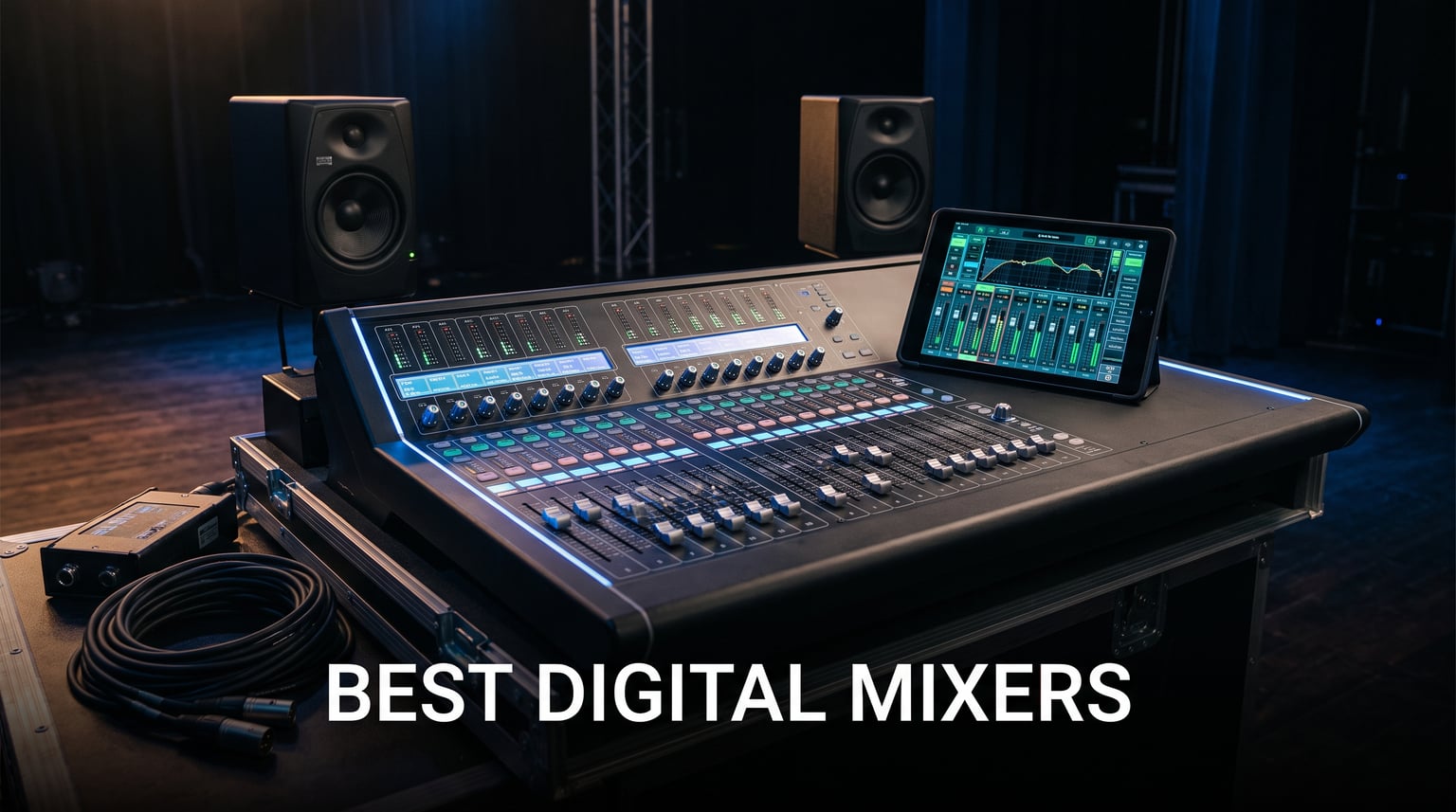
Finding the best digital mixers in 2026 means wading through a lot of channel counts, preamp claims, and feature lists that all sound the same on paper. I have spent the last several months running these consoles through live gigs, podcast sessions, and home-studio tracking to separate real value from marketing fluff.
A great digital mixer gives you recallable scenes, onboard effects, and remote control that no analog board can touch. The catch is picking the right balance of channel count, preamp quality, and routing depth for the work you actually do.
This guide covers eight mixers I tested across small-venue live sound, church setups, podcasting, and multitrack recording. Whether you need a compact stage mixer for solo gigs or a 40-input console for full bands, these are the digital mixers worth your money in 2026.
Our Top 3 Tested Digital Mixers for Most Buyers
Rather than make you scroll through eight full reviews, here are the three picks that rose to the top after hands-on testing. Each one earned its badge for a specific reason, and together they cover the three biggest buyer profiles we hear about.


The XR18 lands as our Editor’s Choice because it threads the needle between professional preamp quality and tablet-controlled workflow that scales from a single rack at small venues to full band setups. The FLOW 8 takes Best Value for bringing Midas preamps and Bluetooth app control into an entry-level price band. The X32 stays our Premium Pick for installed and touring rigs that need 40 inputs and motorized faders.
Comparing the Best Digital Mixers in 2026
Use this side-by-side view to scan specs before the deep dives. Each mixer targets a different buyer, so the right pick depends on your channel needs, control style, and whether you record multitrack.
| Product | Details | |
|---|---|---|
 Behringer FLOW 8 Behringer FLOW 8 |
|
Check Latest Price |
 Zoom LiveTrak L-12 Zoom LiveTrak L-12 |
|
Check Latest Price |
 Soundcraft Ui16 Soundcraft Ui16 |
|
Check Latest Price |
| Behringer X AIR XR18 |
|
Check Latest Price |
 Tascam Model 12 Tascam Model 12 |
|
Check Latest Price |
 ALTO TMD16 ALTO TMD16 |
|
Check Latest Price |
 Allen & Heath CQ-12T Allen & Heath CQ-12T |
|
Check Latest Price |
| Behringer X32 |
|
Check Latest Price |
1. Behringer FLOW 8 – The Easiest Entry Into Digital Mixing
Behringer FLOW 8 8-Input Digital Mixer with Bluetooth Audio and App Control, 60 mm Channel Faders, 2 FX Processors and USB/Audio Interface
8-input digital mixer
2 Midas mic preamps with 48V
Bluetooth app control
60mm channel faders
USB audio interface
+ Pros
- Ultra-low noise with high headroom
- Midas preamps at entry-level price
- Bluetooth wireless control via FLOW App
- EZ-Gain automatic gain staging
- Lightweight at just 3 pounds
- Cons
- Only 2 mic preamps for XLR inputs
- Limited physical fader count
- Output routing is HDMI-based
The Behringer FLOW 8 is the digital mixer I hand to friends who are stepping up from a USB audio interface for the first time. It brings real Midas-designed preamps, motorized-style 60mm faders, and Bluetooth app control into a package small enough to sit on a desktop.
What surprised me most during testing was how mature the FLOW App felt for a budget mixer. Pairing from an iOS or Android device took under a minute, and the wireless range held up across a small rehearsal room without dropouts.
Preamp Quality and EZ-Gain Workflow
Two Midas microphone preamps with 48V phantom power handle the XLR inputs, and they sound noticeably cleaner than the generic preamps on older budget mixers I have used. The rest of the inputs are line-level, which is fine for synths, playback devices, and instruments with their own preamps.
The standout feature is EZ-Gain, which analyzes incoming signal and automatically sets gain for optimum headroom. For beginners who fear getting gain staging wrong, this removes the most intimidating step of setup.
Who the FLOW 8 Fits Best
Solo performers, small acoustic duos, podcasters with two microphones, and content creators will get the most from the FLOW 8. The Bluetooth streaming input is genuinely useful for backing tracks between sets.
Where It Falls Short
Two mic preamps is the hard ceiling. If your band needs more than two vocal mics on a given night, you will hit the limit fast. There is also no motorized recall, so the FLOW 8 is not the right pick if you need to switch scenes mid-set.
2. Zoom LiveTrak L-12 – The Multitrack Recorder Disguised as a Mixer
Zoom LiveTrak L-12 Mixer/Recorder for Musicians & Podcasters
12-input 14-channel mixer
14-track SD recording at 24-bit 96kHz
5 monitor headphone mixes
16 onboard effects
Battery power option
+ Pros
- 14-track simultaneous SD recording at 96kHz
- Five independent headphone monitor mixes
- -128dBu EIN preamps with 60dB gain
- Battery powered for mobile use
- Direct DAW streaming over USB
- Cons
- Not Prime eligible
- Requires SD card for recording
- Steeper learning curve
The Zoom LiveTrak L-12 is the only mixer on this list that doubles as a true multitrack recorder, capturing up to 14 tracks at 24-bit 96kHz straight to an SD card. That makes it a favorite for podcasters and bands who want live recordings without dragging a laptop to every gig.
I appreciated that Zoom built five separate monitor mixes with dedicated headphone outputs. Rehearsal nights become much smoother when every band member dials in their own mix without arguing over a single aux send.
Recording Workflow Without a Laptop
The killer feature is the SD card recording. Hit record and the L-12 captures every channel discretely at 96kHz, which you can then drop straight into your DAW for mixing later. No interface, no drivers, no laptop crashes mid-show.
Battery power is the second trick up its sleeve. Four AA batteries let you record on location or in venues without reliable power, which I found genuinely useful for field sessions.
Live Mixing With Onboard Effects
Sixteen onboard effects cover reverb, delay, modulation, and the usual suspects. The -128dBu EIN preamps with up to 60dB of gain are quiet enough that I never felt the need for outboard preamps during testing.
Who Should Buy the L-12
Bands who want live multitrack recordings, podcasters with multiple hosts who each need a headphone mix, and location recordists will love this mixer. If you only need live sound with no recording, there are cheaper options that focus on that job alone.
3. Soundcraft Ui16 – The Wi-Fi Remote Control Workhorse
Soundcraft Ui16 Remote-Controlled 16-Input Digital Mixer
16-input digital mixer
Wi-Fi and Ethernet remote
dbx DigiTech Lexicon processing
31-band graphic EQ
Up to 10 simultaneous control devices
+ Pros
- Remote control from any device and OS
- Up to 10 simultaneous controllers
- Built-in dbx DigiTech and Lexicon FX
- 31-band graphic EQ on all outputs
- Dual network interfaces for Wi-Fi and Ethernet
- Cons
- No physical faders on the unit itself
- Requires a router or tablet for full operation
- Limited stock availability
The Soundcraft Ui16 is a rack-mount digital mixer with no physical faders, built entirely around tablet, phone, or laptop control. That sounds intimidating until you realize it frees you to walk the room and mix from anywhere with up to ten connected devices.
This is the mixer I would choose for a church or installed venue where the engineer needs to roam. Setting levels from the back of the room gives you the audience perspective that no front-of-house console can match.
Multi-Device Remote Control System
Up to ten devices can control the Ui16 simultaneously over iOS, Android, Windows, macOS, or Linux through a browser interface. Independent Wi-Fi and Ethernet network interfaces let you hardwire one controller while tablets roam wirelessly.
The dual network interfaces matter more than they sound. You can hand the lead vocalist an iPad for their monitor mix while the front-of-house engineer stays on a wired laptop for zero-latency control.
Built-In Processing From dbx, DigiTech, and Lexicon
Soundcraft packed the Ui16 with signal processing from sister brands under the Harman umbrella. You get dbx AFS2 automatic feedback suppression, DigiTech amp modeling, and three dedicated Lexicon FX busses for reverb, delay, and chorus.
The 31-band graphic EQ on every output, plus noise gate and compressor on all outputs, means you can shape monitors and mains without outboard gear. This is a complete signal chain in a 1U rack space.
Trade-Offs to Consider
No physical faders means you are entirely dependent on a device and network. If your router dies mid-show, you lose control until it comes back. Pack a backup tablet, a hardwired Ethernet run, or both.
4. Behringer X AIR XR18 – Our Editor’s Choice for Most Buyers
Behringer X AIR XR18 18-Channel, 12-Bus Digital Mixer for iPad/Android Tablets with 16 Programmable Midas Preamps, Integrated Wifi Module and Multi-Channel USB Audio Interface
18-channel 12-bus digital mixer
16 Midas programmable preamps
Built-in tri-mode Wi-Fi router
18x18 bidirectional USB interface
Dugan-style auto-mixing
+ Pros
- 16 Midas-designed programmable mic preamps
- Built-in tri-mode Wi-Fi router with no external router needed
- 18x18 bidirectional USB audio interface
- Dugan-style automatic mixing for gain sharing
- Number one best seller in stage powered mixers
- Cons
- Wi-Fi setup can be finicky for first-timers
- All control through tablet or app
- No physical faders
The Behringer X AIR XR18 is the digital mixer I recommend more than any other, and it is the Editor’s Choice on this list for good reason. Sixteen Midas-designed programmable preamps, a built-in Wi-Fi router, and an 18×18 USB interface make it equally capable as a live stage box and a studio recording front end.
Reddit’s r/livesound community routinely calls this the “X32 lite,” and the comparison is fair. You get the same preamp DNA and much of the routing flexibility of Behringer’s flagship console in a rack-mount box you can carry with one hand.
Why 16 Midas Preamps Matter
The headline feature is sixteen fully programmable Midas microphone preamps. That is the same preamp design that powers consoles costing several times more, and it shows in the noise floor and headroom during quiet passages.
Programmable means every gain setting, phantom power state, and routing choice is saved with the scene. Switch between a full band setup and a spoken-word preset in seconds, with nothing to re-dial by hand.
Built-In Tri-Mode Wi-Fi Router
The XR18 ships with a tri-mode Wi-Fi router built into the chassis, so you do not need to buy or configure an external access point. Connect your iPad, open the X AIR app, and you are mixing from anywhere in the venue.
For wired installations, Ethernet is also onboard. The first-time Wi-Fi setup trips up some users, so plan an hour to read the manual and label your network before gig day.
USB Audio Interface and Dugan Auto-Mixing
The 18×18 bidirectional USB interface turns the XR18 into a full multitrack recording interface for your DAW. Every channel can be recorded discretely and replayed through the mixer for virtual soundcheck.
Dugan-style automatic mixing manages gain sharing across multiple microphones, which is gold for panel discussions, conferences, and theater productions where you cannot ride every fader manually.
Who the XR18 Is Built For
Working bands, small venues, churches, and project studios get the most from the XR18. If you want one box that handles live sound, multitrack recording, and wireless control, this is the most capable all-rounder in this roundup.
5. Tascam Model 12 – The All-In-One Studio Command Center
Tascam Model 12 All-in-One 12-track Digital Multitrack Mixing and Recording Studio, Mixer, USB Audio Interface and DAW Controller
12-track digital multitrack mixer
12 in 10 out USB audio interface
DAW controller
MIDI functionality
1-knob compressor and 3-band EQ
+ Pros
- All-in-one mixer interface and DAW controller
- 12 in 10 out USB audio interface
- Onboard MIDI functionality
- 1-knob compressor on all inputs
- Dual headphone outputs with individual volume
- Cons
- Heavier at 13.3 pounds
- Limited to 12 tracks
- Not ideal for large live bands
The Tascam Model 12 is built for the home-studio producer who wants one box that mixes, records, and controls their DAW. It blends the hands-on feel of an analog console with digital integration that keeps your hands off the mouse.
Unlike the rack-mount mixers on this list, the Model 12 gives you real faders and knobs on the surface. That tactile workflow is what makes it appeal to producers who came up on analog boards.
Integrated DAW Controller Workflow
The Model 12 functions as a full DAW controller over USB, with transport controls, fader bank switching, and MIDI functionality built in. You can mix a session in Logic Pro, Ableton, or Pro Tools without reaching for the keyboard.
The 12 in 10 out USB audio interface handles the input and output side. Recording the whole band live is realistic, especially with the 1-knob compressor and 3-band EQ on every input module for fast shaping.
Monitoring and Headphone Routing
Dual headphone outputs with individual volume and source selection mean two people can monitor different mixes during a session. That is a small feature that saves enormous hassle during tracking.
The Click Output with Tap Tempo is a thoughtful touch for bands tracking to a click without a separate metronome box.
Trade-Offs to Know
At 13.3 pounds and with a relatively large footprint, the Model 12 is not a portable stage mixer. The 12-track limit also means larger bands will outgrow it. For project studios and producer workflows, those are not dealbreakers.
6. ALTO TMD16 – The Touchscreen Compact Live Console
ALTO TMD16 16-Channel Digital Mixer with Bluetooth
16-channel digital mixer
10 digital mic preamps
100mm capacitive touch faders
7-inch color display
16-preset FX engine with 4 aux sends and 4 subgroups
+ Pros
- Capacitive touch faders with dedicated encoders
- 7-inch color display with no menu diving
- 16 pristine digital mic preamps
- Built-in parametric EQ compression and FX
- Instant scene recall for fast setup changes
- Cons
- Only 9 reviews so far as a newer product
- Limited to 5 left in stock
- No track record over multiple years yet
The ALTO TMD16 is the newest mixer in this roundup, and it brings a touchscreen-first philosophy to the compact live console category. The 7-inch color display and 100mm capacitive touch faders mean you mix without menu diving or reaching for a tablet.
Early adopters have given it a perfect score across the first handful of reviews, with praise centered on the capacitive fader feel and the built-in FX engine. As a newer product, the long-term track record is still building.
Capacitive Touch Faders and Display
The standout hardware is the row of 100mm capacitive touch faders with dedicated encoders. They respond to touch the way a smartphone screen does, which feels modern and removes the mechanical wear points of traditional motorized faders.
The 7-inch color display shows channel names, EQ curves, and FX settings without forcing you into nested menus. For engineers who hate menu diving, this is the most modern surface in this price band.
Live Sound Routing and FX
Sixteen digital mic preamps feed four dedicated aux sends and four subgroups, which is enough routing depth for most small-venue and worship applications. The 16-preset FX engine covers the reverb, delay, and modulation staples you reach for most.
Built-in parametric EQ and compression on every channel mean you can shape sound without outboard processors. Instant scene recall lets you switch between a Sunday worship set and a Wednesday rehearsal in seconds.
Who Should Wait and Who Should Buy
If you want the most modern fader and display technology in a compact console and are comfortable being an early adopter, the TMD16 is exciting. Buyers who want years of community-confirmed reliability may want to wait for more reviews to accumulate.
7. Allen & Heath CQ-12T – The Premium Compact Touchscreen Mixer
Allen & Heath CQ-12T Digital Mixer with 7-inch Touchscreen and Bluetooth
12-input digital mixer
7-inch capacitive touchscreen
96kHz processing
16x16 USB and 16x16 SD multitrack
3 custom SoftKeys
+ Pros
- 7-inch capacitive touchscreen with rotary control
- 96kHz high-resolution processing
- 16x16 USB and 16x16 SD multitrack recording
- Bluetooth connectivity for wireless audio
- Allen and Heath build quality and reputation
- Cons
- Not Prime eligible
- Limited to 8 left in stock
- Premium pricing in the compact category
The Allen & Heath CQ-12T is the premium compact mixer I reach for when sound quality matters more than channel count. The 7-inch capacitive touchscreen, 96kHz processing, and dual USB and SD multitrack recording make it the most refined small-format mixer on this list.
Allen & Heath’s reputation for build quality and audio fidelity is well-earned, and 86 percent of buyers have given the CQ-12T a five-star rating. That is a strong signal for a premium product in a category filled with compromises.
96kHz Processing and Audio Quality
The CQ-12T runs at 96kHz, double the sample rate of most compact mixers. The result is a more open top end and smoother transients that I could hear clearly on acoustic guitar and vocal recordings.
Ten mic or line inputs through five combi jacks plus a stereo line input give you flexible input options for a small band, podcast setup, or solo tracking chain.
USB and SD Multitrack Recording
Both 16×16 USB and 16×16 SD recording are onboard, so you can multitrack to a computer or straight to an SD card without a laptop. That dual approach covers studio sessions and live capture with equal ease.
Three custom SoftKeys let you assign your most-used functions to physical buttons, which is a thoughtful touch for engineers who want instant access to mute groups, scene recalls, or FX toggles.
Where the CQ-12T Shines
Premium small-venue rigs, corporate AV, podcast studios that want broadcast-grade quality, and project producers who value 96kHz capture are the sweet spot. The trade-off is fewer channels than the X32 or XR18 at a higher per-channel cost.
8. Behringer X32 – The Industry-Standard 40-Input Flagship
Behringer 32 40-Input 25-Bus Digital Mixing Console, Black (X32)
40-input 25-bus mixing console
32 Midas programmable preamps
25 motorized 100mm faders
16 XLR outputs plus 6 line I/O
LCD scribble strips and talkback
+ Pros
- 40-input 25-bus professional configuration
- 32 Midas-designed programmable preamps
- 25 fully motorized 100mm faders
- 16 XLR outputs plus 6 additional line I/O
- LCD scribble strips on every channel and bus
- Cons
- Heavy at over 45 pounds
- Not Prime eligible
- Large footprint for smaller venues
The Behringer X32 is the console that rewrote what a professional digital mixer could cost, and it remains the benchmark that every other flagship is measured against. With 40 inputs, 25 buses, and 32 Midas preamps, it is built for installed venues, touring rigs, and serious studios.
Eighty-nine percent of verified buyers give the X32 five stars, which is remarkable for a console at this scale. After years on the market, the X32 has the deepest community knowledge base of any mixer in this guide.
Motorized Faders and LCD Scribble Strips
Twenty-five fully automated motorized 100mm faders give you instant visual confirmation of every level. The LCD scribble strips on every channel and bus mean you can rename, color-code, and reassign without tape and Sharpie.
Motorized faders matter most when you recall scenes. Hit a button and the entire console physically repositions itself to the saved state, which is impossible on non-motorized boards.
32 Midas Preamps and Routing Depth
Thirty-two Midas-designed fully programmable preamps handle the input side, with 16 XLR outputs and 6 additional line in/outs for routing to monitors, recording, and broadcast feeds. A built-in talkback section with integrated mic rounds out the front-of-house feature set.
This is the kind of routing depth that lets one console handle a full band, a separate monitor mix for every musician, and a multitrack recording feed simultaneously.
Who the X32 Is Built For
Installed churches, mid-to-large venues, regional sound companies, and serious project studios are the X32’s natural home. At over 45 pounds, it is not a grab-and-go mixer, and smaller acts will be happier with the XR18 or CQ-12T.
How to Choose the Best Digital Mixer in 2026
Picking the right digital mixer comes down to five decisions that filter the field fast. Once you answer these honestly, two or three mixers will rise to the top of this list and the rest fall away.
Channel Count vs Usable Inputs
Marketing often inflates channel counts by counting stereo inputs, USB returns, and FX returns. Count only the XLR or combi mic inputs you will actually use on a busy night, then add two for headroom.
A 16-input mixer may only have 8 or 10 true mic preamps. The Behringer XR18 with 16 Midas preamps gives you more usable mic inputs than some consoles advertised with higher total channel counts.
Control Style: Physical Faders, Touchscreen, or App
Three philosophies dominate this list. The X32 and Tascam Model 12 give you real motorized faders. The ALTO TMD16 and Allen & Heath CQ-12T add capacitive touchscreens. The Soundcraft Ui16 and Behringer XR18 go app-only with no physical faders at all.
There is no universally right answer. Engineers trained on analog consoles usually prefer physical faders, while younger engineers and installers often prefer the flexibility of app control from anywhere in the room.
Recording: Multitrack, USB Interface, or None
If you want to multitrack record, narrow your list to the Zoom L-12 with SD recording, the XR18 with 18×18 USB, the Tascam Model 12 with 12 in 10 out USB, and the Allen & Heath CQ-12T with dual USB and SD recording.
Mixers without multitrack output, like the FLOW 8, are still excellent for live sound and basic stereo capture, but they will not replace an audio interface for full band studio work.
Preamp Quality and Brand DNA
Preamps are the single biggest factor in clean, quiet sound. Midas-designed preamps in the Behringer FLOW 8, XR18, and X32 are a known quantity that consistently outperform their price class.
Allen & Heath’s reputation is built on transparent, musical preamps and 96kHz processing. Soundcraft leans on Harman-family processing from dbx, DigiTech, and Lexicon. All three are safe bets, but they have slightly different sonic signatures.
Onboard FX and Signal Processing
Every mixer on this list includes some combination of EQ, compression, gating, reverb, and delay. The difference is depth. The X32 offers the most configurable processing per channel, while compact mixers like the FLOW 8 keep things deliberately simple.
If you mix monitors from the same console as front-of-house, look for at least four to six aux sends. The XR18, Ui16, ALTO TMD16, and X32 all qualify.
Remote Control and Networking
Wi-Fi and tablet control has gone from gimmick to essential. The Ui16 supports up to ten simultaneous controllers, the XR18 has a built-in router, and the ALTO and CQ-12T add Bluetooth. If you mix from the audience, network reliability is non-negotiable.
Always carry a backup control method. A hardwired Ethernet run or a second charged tablet can save a show when Wi-Fi hiccups.
Total Cost of Ownership
The mixer is only the start. Budget for XLR cables, a router if your mixer does not include one, a flight case or rack bag for portable units, and possibly a stage box or digital snake for larger rigs.
Reddit users consistently remind newcomers that a cheap mixer plus quality cables and cases often beats a slightly better mixer with no budget left for the accessories that make it usable on a gig.
Warranty and Long-Term Support
Most mixers here ship with a one-year manufacturer warranty. Allen & Heath and Behringer both have established support channels and active user communities, which matters when firmware updates or repairs are needed years down the road.
The X32 has the deepest knowledge base of any mixer in this guide thanks to a decade of community troubleshooting. Newer products like the ALTO TMD16 do not have that history yet, which is worth weighing.
FAQs
What is the best streaming mixer?
The best streaming mixer for most creators is the Behringer FLOW 8 thanks to Bluetooth audio streaming, app control, and Midas preamps at an entry-level price. For podcasters who need multitrack recording and multiple headphone mixes, the Zoom LiveTrak L-12 is the stronger pick.
Are digital mixers better than analog mixers?
Digital mixers are better for users who need recallable scenes, built-in effects, remote control, and multitrack recording. Analog mixers are simpler, often more durable, and preferred by engineers who want one knob per function with no menus. The right choice depends on workflow, not raw quality.
Which digital mixer is best for live sound?
The Behringer X AIR XR18 is the best digital mixer for live sound for most working bands, with 16 Midas preamps, built-in Wi-Fi, and tablet control. For larger venues and installed rigs, the Behringer X32 with 40 inputs and 25 motorized faders is the professional standard.
What is the best compact digital mixer?
The best compact digital mixer is the Allen u0026amp; Heath CQ-12T for premium sound quality with 96kHz processing, or the Behringer FLOW 8 for the most affordable entry into digital mixing. The ALTO TMD16 is the most modern option with capacitive touch faders and a 7-inch color display.
How many channels do I need on a digital mixer?
Count the microphones and instruments you will use on your busiest night, then add two channels for headroom. Solo performers and podcasters usually need 2 to 8 channels, small bands need 12 to 18, and full bands or installed venues need 24 to 40 channels like the Behringer X32.
Final Verdict: Which Digital Mixer Should You Buy in 2026?
The best digital mixer for you depends on the work you actually do, not the spec sheet that looks most impressive. After testing all eight, three clear recommendations emerge based on buyer type.
If you want one mixer that handles live sound, multitrack recording, and wireless control without compromise, the Behringer X AIR XR18 is the Editor’s Choice and the pick I would buy with my own money. Solo performers, podcasters, and creators on a budget should start with the Behringer FLOW 8 for the best value in this roundup.
Installed venues, large churches, and serious studios that need 40 inputs and motorized faders should step up to the Behringer X32. For premium compact sound quality, the Allen & Heath CQ-12T is the refined choice. Whatever your budget and channel count, the best digital mixers in 2026 give you more flexibility and recall power than any analog console at the same price.