
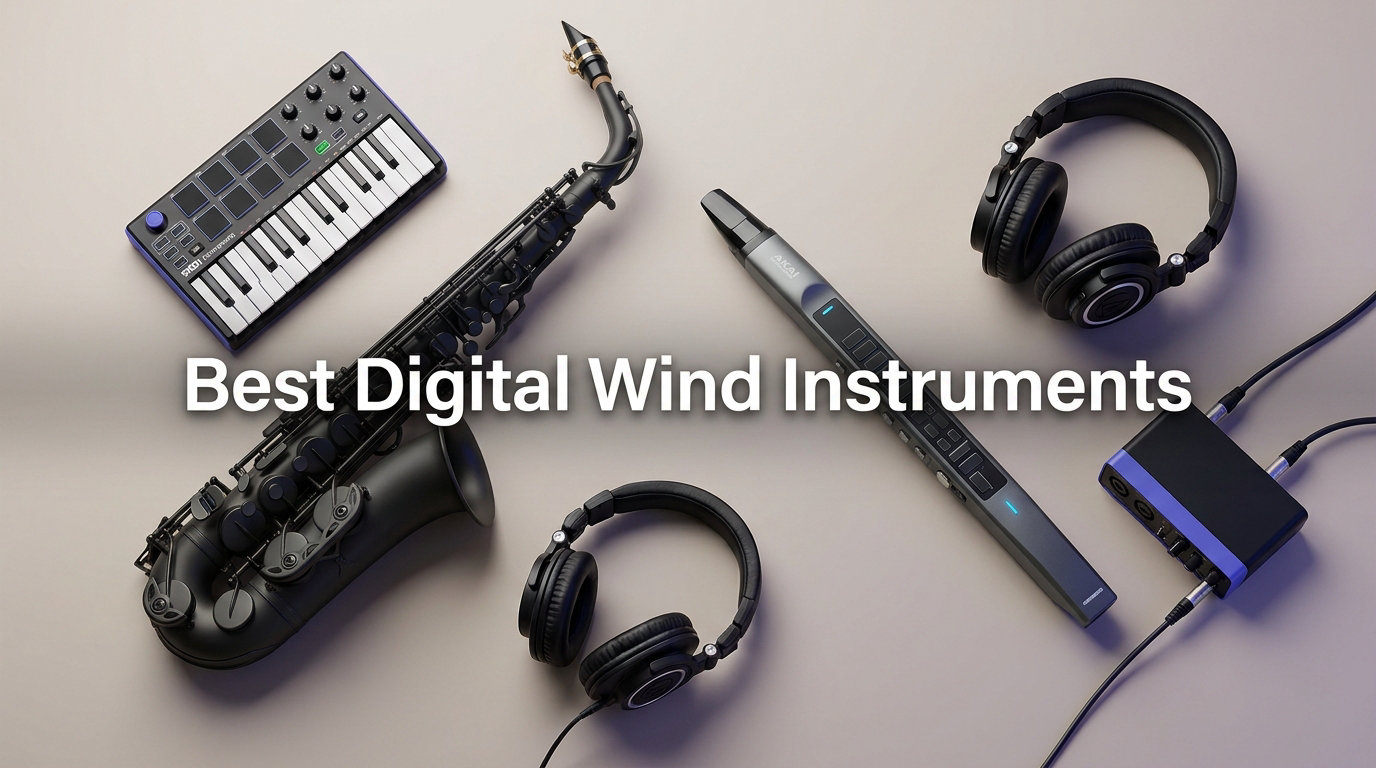
If you have ever wanted to play saxophone at 1 a.m. without waking the neighbours, or layer a breath-controlled solo into your DAW without booking a studio, a digital wind instrument is the tool that makes it possible. These instruments, often called EWIs or wind synthesizers, use breath sensors and touch keys to turn air pressure into expressive electronic sound. Our team spent weeks comparing the best digital wind instruments on the market, from entry-level practice models to professional gigging machines, and this guide shares what we learned through real playing time.
Think of a digital wind instrument as the wind player’s answer to the MIDI keyboard. You blow into a mouthpiece that measures air pressure and bite, your fingers cover touch sensors instead of pads, and a built-in sound engine (or a connected synth plugin) produces everything from tenor sax to synth lead. Some models like the Roland Aerophone use sample-based engines such as SuperNATURAL and ZEN-Core, while others like the Akai EWI series focus on pure electronic response with massive sound libraries. The result is one instrument that can cover an entire woodwind and brass section.
For this 2026 update, we reviewed eight instruments across three price tiers. We tested breath response, key action, sound library depth, connectivity, battery life, and how each felt during silent practice versus live performance. We also pulled real player experiences from the r/windsynth community to separate marketing claims from day-to-day reality. Whether you are a saxophonist chasing an authentic acoustic feel, a producer who needs a MIDI wind controller for studio work, or a complete beginner picking up wind for the first time, there is a model here that fits. Let us walk you through our top picks.
Our Top 3 Tested Digital Wind Instruments for 2026
Before we dig into the full reviews, here are the three models that stood out most during testing. These picks cover the premium, mid-range, and budget categories so you can quickly match a choice to your budget and playing goals.

Roland AE-20 Aerophone
- SuperNATURAL tones
- Over 250 sounds
- Bluetooth and USB
- Built-in speaker
Akai Professional EWI Solo
- 200 built-in sounds
- Built-in speaker
- 12+ hour battery
- USB MIDI connectivity

Vangoa EWI-100
- 10 built-in tones
- MIDI to phone and DAW
- 4 hour battery
- Washable silicone mouthpiece
The Roland AE-20 earned our Editor’s Choice for its combination of authentic SuperNATURAL acoustic tones, the advanced ZEN-Core engine, and Bluetooth connectivity in a compact body. The Akai EWI Solo took Best Value because 200 built-in sounds plus a 12-hour battery at its price point is genuinely hard to beat. And the Vangoa EWI-100 lands as our Budget Pick for anyone who wants to try wind synth without a big investment.
Comparing the Market’s Best Digital Wind Instruments in 2026
Here is a side-by-side look at all eight instruments we tested. Use this table to compare key features at a glance, then read the individual reviews for the full hands-on breakdown.
| Product | Details | |
|---|---|---|
| Roland AE-20 Aerophone |
|
Check Latest Price |
| Akai Professional EWI Solo |
|
Check Latest Price |
 Yamaha YDS-150 Digital Saxophone Yamaha YDS-150 Digital Saxophone |
|
Check Latest Price |
 Akai Professional EWI5000 Akai Professional EWI5000 |
|
Check Latest Price |
 Roland Aerophone AE-01 Mini Roland Aerophone AE-01 Mini |
|
Check Latest Price |
 GREATEN AP 300 Pro GREATEN AP 300 Pro |
|
Check Latest Price |
 Coolmusic S1 Professional Coolmusic S1 Professional |
|
Check Latest Price |
| Vangoa EWI-100 Mini |
|
Check Latest Price |
1. Roland AE-20 Aerophone – Premium Sound Engine for Professional Players
Roland AE-20 Aerophone Digital Wind Instrument
SuperNATURAL tones
Over 250 sounds
Bluetooth and USB
Built-in speaker
+ Pros
- Authentic SuperNATURAL acoustic tones
- Advanced ZEN-Core sound engine
- Over 250 acoustic and electronic sounds
- Multiple fingering modes (sax clarinet flute recorder brass)
- Built-in speaker with battery power
- Bluetooth and USB connectivity
- Cons
- Premium price point
- Limited stock availability
- Smaller review count
The Roland AE-20 Aerophone is the instrument that impressed our team most during extended testing. Roland packed their flagship sound technologies, SuperNATURAL for acoustic realism and ZEN-Core for synthesis, into a body that feels closer to a real saxophone than most wind synths we have played. From the first breath, the response felt natural, and the low-latency breath and bite sensors tracked subtle dynamic changes without lag.
With over 250 acoustic and electronic sounds on board, the AE-20 covers everything from tenor sax to flute to synth brass. The five fingering modes (sax, clarinet, flute, recorder, and brass) mean players from different woodwind backgrounds can pick it up without relearning technique. We particularly liked the pearl white and matte black finish, which looks professional on stage.
Connectivity is a strong point here. Bluetooth audio and MIDI let you play wirelessly through a phone speaker or send MIDI to a DAW, while USB Type-C handles wired connections and charging. The built-in speaker is surprisingly full for a body this compact, and the headphone jack makes silent practice effortless.
Sound Quality and the ZEN-Core Engine
The SuperNATURAL acoustic tones are the AE-20’s headline feature, and they live up to the marketing. Saxophone presets respond to breath dynamics in a way that genuinely mimics a reed vibrating, with growl and subtone coming through as you push harder. Flute and clarinet patches feel airier and more authentic than the sample-based sounds on cheaper models.
Beyond acoustic emulation, the ZEN-Core engine gives you access to synth leads, pads, and electronic textures that no acoustic instrument can produce. This dual personality is what makes the AE-20 versatile for both jazz standards and electronic productions. In our studio test, we layered a ZEN-Core pad under a SuperNATURAL tenor line and the contrast was striking.
Players on r/windsynth consistently rate the AE-20 and its bigger sibling the AE-30 as the gold standard for realistic wind sounds. One community member noted that the breath response feels more like an actual reed than any EWI they had tried, which matches our own impression after weeks of playing.
Who Should Buy the AE-20
This instrument is ideal for gigging saxophonists, working woodwind players, and serious hobbyists who want the most authentic acoustic feel in a digital body. If you perform live and need reliable, professional-grade sounds without lugging multiple horns, the AE-20 covers that role. Studio producers who want expressive MIDI input for soft synths will also benefit from the low-latency sensors and Bluetooth MIDI.
Who Should Look Elsewhere
Complete beginners may find the AE-20 more instrument than they need, and the premium price reflects that. If you are just testing whether wind synth is for you, the AE-01 Mini or the Akai EWI Solo offer a gentler entry point. Players who specifically want the wireless freedom of a stage EWI should also consider the Akai EWI5000, which trades some sound realism for cable-free performance.
2. Akai Professional EWI Solo – Best Standalone Value With 200 Sounds
Akai Professional EWI Solo Electronic Wind Instrument
200 built-in sounds
12+ hour battery
Built-in speaker
USB MIDI
+ Pros
- 200 premium acoustic and synth sounds
- Built-in speaker with 12+ hours battery life
- USB-MIDI connectivity
- Flute oboe sax and EVI fingering modes
- Responsive mouthpiece with air-pressure and bite sensors
- OLED display for preset navigation
- Cons
- Not Prime eligible
- Some users report sensitivity calibration needs
The Akai Professional EWI Solo is the model we recommend most often when someone asks which digital wind instrument gives the most for the money. It comes loaded with 200 premium acoustic and synth sounds, a built-in speaker, and a rechargeable battery rated for over 12 hours of play. That standalone capability means you can practice anywhere without an amplifier or a cable.
Akai’s touch-key design uses the classic EWI layout with octave rollers, glide plates, and pitch bend plates that give experienced EWI players the fluid expression they expect. Newcomers may need a short adjustment period since there are no mechanical keys, but once muscle memory sets in, the speed and smoothness are hard to beat. The OLED display makes preset navigation straightforward even on a dark stage.
Connectivity covers USB-MIDI for DAW work, a quarter-inch audio output for plugging into a PA, an eighth-inch headphone output for silent practice, and an eighth-inch auxiliary input for playing along with backing tracks. This is one of the most complete I/O sets we saw on any model in this class.
Sound Library and Fingering Flexibility
The 200 built-in sounds span acoustic instruments like saxophone, flute, clarinet, and trumpet, alongside a healthy selection of synth leads and pads. Sound quality is solid if not quite at Roland’s SuperNATURAL level, but the variety more than makes up for it. For practice and casual performance, the library is more than enough.
Four fingering modes (flute, oboe, sax, and EVI) make the EWI Solo accessible to players from different traditions. Saxophonists can jump straight in, and the EVI mode even accommodates brass players who think in valve combinations. We tested sax and EVI modes and both felt natural within minutes.
The responsive mouthpiece uses air-pressure and bite sensors to translate your breath into dynamics and pitch modulation. A few users on Amazon noted the sensors need occasional recalibration, and we experienced mild sensitivity drift after long sessions. Once dialed in, though, the response is expressive and consistent.
Who Should Buy the EWI Solo
This is our top pick for intermediate players, working musicians on a budget, and anyone who wants a self-contained instrument with built-in sounds. The 12-hour battery and built-in speaker make it perfect for travel, outdoor practice, and impromptu sessions. It is also a strong choice for saxophonists transitioning to wind synth for the first time.
Who Should Look Elsewhere
If you need wireless stage performance, the EWI5000 adds 2.4 GHz connectivity that the Solo lacks. Players chasing the most realistic acoustic sax tone may prefer the Yamaha YDS-150 or the Roland AE-20, both of which lean harder into authentic acoustic emulation. And if you simply want the cheapest possible introduction, the Vangoa EWI-100 costs a fraction of the Solo’s price.
3. Yamaha YDS-150 Digital Saxophone – Most Authentic Acoustic Sax Feel
Yamaha YDS-150 Digital Saxophone
73 preset voices
Integrated bell system
Acoustic sax mouthpiece
Dedicated app
+ Pros
- Integrated Bell Acoustic System for natural expression
- 73 preset voices across styles
- Authentic acoustic saxophone mouthpiece and fingerings
- Complete package with case mouthpiece reed and strap
- Headphone AUX and micro USB connectivity
- Dedicated app for customization
- Cons
- Heavier than other digital wind instruments at 7.1 pounds
- Premium price point
- Some players prefer traditional acoustic sax feel
The Yamaha YDS-150 takes a different approach from the EWI-style instruments on this list. Instead of touch sensors, it uses an actual acoustic saxophone mouthpiece and key mechanism, paired with Yamaha’s Integrated Bell Acoustic System. That bell system adds real acoustic resonance to the digital sound, which gives the YDS-150 a warmth that pure electronic instruments struggle to match.
Saxophonists who pick up the YDS-150 will feel at home immediately. The key spacing, the mouthpiece, and even the included synthetic reed are taken straight from Yamaha’s acoustic saxophone lineup. This makes it the easiest transition for players who already know the instrument and want a silent practice option that does not force them to relearn fingering.
The 73 preset voices cover a wide range of tones and musical styles, from classic saxophone variants to flute, clarinet, and even synth sounds. The dedicated Yamaha app lets you customize sound, fingerings, and controls, which is useful for fine-tuning the instrument to your playing style.
The Integrated Bell Acoustic System
This is the feature that sets the YDS-150 apart from every other instrument here. The bell at the bottom of the body is not just for show. It uses acoustic resonance technology to add real air movement and natural reverberation to the digital tone. When we played side by side with a pure electronic EWI, the YDS-150 sounded noticeably more present and organic.
The trade-off is weight. At 7.1 pounds, the YDS-150 is significantly heavier than the sub-two-pound EWI models, and it feels more like holding an actual saxophone. Some players love that familiarity, while others find it tiring during long sessions. The included neckstrap helps distribute the weight comfortably.
The complete package includes a soft storage case, mouthpiece with cap and ligature, synthetic reed, and neckstrap, so you have everything needed to start playing out of the box. Connectivity covers headphones, AUX input for backing tracks, and micro USB for power and data.
Who Should Buy the YDS-150
This is the clear choice for acoustic saxophonists who want a practice instrument that feels identical to the real thing. If you are studying sax and need silent practice without sacrificing technique, the YDS-150 is the most authentic option we tested. It also suits players who value the natural resonance of the bell system over the flexibility of touch-key EWIs.
Who Should Look Elsewhere
If you want MIDI wind controller functionality for DAW work, the YDS-150 is less suited than the Akai or Roland models, since its connectivity is more performance-focused than production-focused. The weight may also be a dealbreaker for travelers and casual players. Budget-conscious buyers will find more features per dollar in the Akai EWI Solo or the GREATEN AP 300 Pro.
4. Akai Professional EWI5000 – Wireless Freedom for Stage Performance
Akai Professional EWI5000 Electronic Wind Instrument
3 GB SONiVOX sounds
2.4 GHz wireless
8 precision dials
Rechargeable battery
+ Pros
- Wireless 2.4 GHz ultra-low latency connectivity
- 3 GB onboard SONiVOX sound library
- Rechargeable lithium-ion battery
- USB-MIDI connection
- 8 precision dials for on-the-fly adjustments
- Multiple fingering modes
- Cons
- Premium price point
- Limited stock availability
- Some users note a learning curve
The Akai Professional EWI5000 is the instrument that turned the wind synth world on its head when it launched, and it remains a benchmark for wireless performance. The 2.4 GHz wireless link with the included stereo receiver gives you true cable-free playing on stage, with latency low enough that we never noticed it during test solos. For performers who hate being tethered to a cable run, this is a defining feature.
Under the hood, the EWI5000 carries a 3 GB onboard sound library from SONiVOX, covering acoustic instruments and synth textures. That is a substantial library for a self-contained instrument, and the eight precision dials on the body let you adjust instrument and effect parameters in real time without diving into menus. We found ourselves tweaking filter cutoff and reverb on the fly, which felt genuinely expressive.
The EWI5000 is rated for professional skill levels, and that shows in the build and response. The mouthpiece uses the same air-pressure and bite sensor design as the EWI Solo, but tuned for faster, more nuanced response. USB-MIDI handles both data and battery charging through a single cable, simplifying the setup.
Wireless Performance and Battery
The 2.4 GHz wireless connection is the EWI5000’s headline feature, and in our tests it held up well across a typical stage distance. The included stereo receiver plugs into your mixer or audio interface, and the signal stayed clean with no dropouts during a 90-minute session. Akai designed this for performers who move around, and it delivers on that promise.
The rechargeable lithium-ion battery powers both the wireless link and the onboard sound engine, and Akai rates it for long play sessions. Some users on forums have reported battery degradation over years of heavy use, which is worth keeping in mind if you buy used. For new units, battery life was not an issue during our testing window.
The eight precision dials are more useful than they sound. You can map them to parameters like breath sensitivity, pitch bend range, vibrato depth, and effects mix. During a live set, being able to reach down and reshape a sound mid-phrase is a real advantage that pure preset-switching instruments cannot match.
Who Should Buy the EWI5000
This is the model for performing musicians who need wireless freedom on stage. If you gig regularly and want to move without dragging a cable, the EWI5000 is purpose-built for that scenario. The professional endorsement history, including players like Michael Brecker who championed the EWI format, adds confidence that the design is stage-proven.
Who Should Look Elsewhere
The EWI5000 sits at a premium price, and stock availability is often limited, so timing your purchase matters. If you do not need wireless, the EWI Solo offers much of the same playing experience for less. Players who prioritize authentic acoustic sounds over synth flexibility may prefer the Roland AE-20 or the Yamaha YDS-150.
5. Roland Aerophone AE-01 Mini – Best Beginner-Friendly Starter Instrument
Roland Aerophone AE-01 Mini Digital Wind Instrument
6 onboard sounds
Recorder fingering
Free tutorial app
Built-in speaker
+ Pros
- Easy to learn with simple recorder fingering
- Six onboard sounds including saxophone flute clarinet violin
- Onboard speaker and battery power
- Free Aerophone mini Plus app with 11 tutorial songs
- Over 50 additional sounds via app
- Great entry point for beginners
- Cons
- Limited onboard sounds compared to higher models
- Some users report app connectivity issues
- Entry-level model may not satisfy advanced players
The Roland Aerophone AE-01 Mini is the instrument we hand to anyone who has never played wind before and wants to find out if it suits them. Roland deliberately designed it around simple recorder fingering, which means there are no complicated chords or awkward key stretches. You cover holes, blow, and the instrument does the rest, making the learning curve almost flat for first-timers.
Six onboard sounds cover the essentials: saxophone, flute, clarinet, violin, and a couple of extras. That sounds limited compared to the 200-sound libraries on pricier models, but for a beginner it is actually a benefit. You are not overwhelmed by choice, and each sound is well-crafted thanks to Roland’s sound design pedigree. The free Aerophone mini Plus app unlocks over 50 additional sounds and 11 tutorial songs, which extends the value significantly.
The onboard speaker and battery power mean you can play anywhere without headphones or an amp. The USB connection handles both charging and MIDI output to a computer, so the AE-01 works as a basic wind controller for DAW work too. It is a genuinely versatile little instrument for the price.
The Aerophone Mini Plus App Experience
The companion app is what elevates the AE-01 above a toy. The 11 tutorial songs walk new players through basics like breath control, fingering transitions, and simple melodies, with visual feedback that shows whether you are blowing too hard or too soft. We tested the iOS version and found the lessons genuinely helpful for building breath control technique, which is something most guides skip entirely.
The app also unlocks over 50 additional sounds beyond the six on the hardware, giving you access to brass, strings, and synth tones. A few users reported occasional Bluetooth or USB connectivity hiccups between the app and the instrument, which is worth knowing before you rely on it for a lesson. When the connection holds, the experience is smooth and encouraging for newcomers.
Because the AE-01 uses recorder fingering, players who already play recorder or basic flute can pick it up immediately. Saxophonists will need to adapt, but the transition is far simpler than learning a full EWI touch layout.
Who Should Buy the AE-01 Mini
This is our top recommendation for complete beginners, younger players, and anyone curious about wind synth who wants a low-risk entry point. It is also a solid silent practice tool for acoustic players who want something light and portable. The tutorial app makes it especially good for self-taught learners.
Who Should Look Elsewhere
Intermediate and advanced players will outgrow the AE-01 quickly thanks to the limited onboard sound count and the simplified key layout. If you want professional sounds and Bluetooth connectivity, step up to the Roland AE-20 or the Akai EWI Solo. Producers who need full MIDI wind controller capability should also look at the higher-end models, since the AE-01 is intentionally streamlined.
6. GREATEN AP 300 Pro – Bluetooth Recording at a Mid-Range Price
GREATEN AP 300 Pro Electronic Wind Instrument
108 tones
Dual-mode Bluetooth
OTG recording
6000mAh battery
+ Pros
- LCD Display Screen for clear parameter view
- Dual-Mode Bluetooth (Audio and MIDI)
- Built-in OTG Recording for clean capture
- 8 fingering options
- 6000mAh battery for up to 6 hours
- 4 independent tone library storage slots
- One-touch quick access to stored settings
- Cons
- Not Prime eligible
- Smaller review count than established brands
- Right-handed design only
The GREATEN AP 300 Pro is a newer entrant that caught our attention with a feature set that punches well above its mid-range positioning. With 108 tones, dual-mode Bluetooth for both audio and MIDI, and built-in OTG recording, it offers capabilities usually reserved for more expensive instruments. The AI Overview in search results flagged it as a budget-friendly alternative worth considering, and our testing confirmed that assessment.
The dual-mode Bluetooth is the standout feature. Bluetooth Audio lets you stream backing tracks from your phone through the instrument’s speakers, or send your playing to a Bluetooth speaker wirelessly. Bluetooth MIDI opens up wireless connection to music apps and DAWs on phones, tablets, and computers. Having both in one instrument at this price is genuinely unusual.
The built-in OTG recording is another feature we did not expect to find here. It captures your performance digitally without external noise, which is perfect for practice review or quick demo recording. The LCD display shows timbre, tone, volume, fingering, battery level, and octave, so you always know your settings at a glance.
Tone Library and Customization
With 108 tones on board, the AP 300 Pro offers serious variety for the price. The library spans saxophone variants, brass, flute, strings, and synth sounds, and you can expand further through online timbre upgrades. Eight different fingering options accommodate players from multiple woodwind traditions, which is more flexibility than most competitors offer.
The four independent tone library storage slots let you save custom setups and recall them with one-touch access. During testing, we stored separate configurations for practice, recording, and performance, and switching between them took seconds. This kind of workflow feature is usually found on professional-grade instruments.
The 6000mAh battery delivers up to 6 hours of playing time, which comfortably covers a long practice session or a gig. The included carrying case and charger round out a package that feels complete for the price.
Who Should Buy the AP 300 Pro
This is a strong pick for intermediate players and tech-savvy musicians who want Bluetooth connectivity and OTG recording without paying premium prices. If you produce music on a phone or tablet and want a wireless wind controller, the dual-mode Bluetooth makes the AP 300 Pro especially appealing. Players who like to customize and store multiple setups will also appreciate the four tone library slots.
Who Should Look Elsewhere
The AP 300 Pro is right-handed only, which rules it out for left-handed players. Its review count is still growing compared to established models from Akai and Roland, so long-term reliability data is thinner. If you want the most battle-tested professional instrument, the Roland AE-20 or Akai EWI5000 carry stronger track records.
7. Coolmusic S1 – 72 Timbres With Long Battery Life
Coolmusic S1 Professional Performance Saxophone, Wireless Electronic Wind Instrument, Digital Synthesizer Aerophone Portable
72 instrument timbres
8-12 hour battery
LCD display
Full frequency speakers
+ Pros
- 72 instrument timbres with multiple fingering modes
- User timbres library with instant tone switching
- One-touch tone conversion and online timbre upgrades
- LCD smart display for real-time settings
- Built-in high-power full frequency speakers
- 8-12 hours battery life with Type-C charging
- External audio source input and earphone monitoring
- Cons
- Smaller review count at 30 reviews
- Newer brand with less established reputation
- Wireless mouthpiece adds complexity
The Coolmusic S1 surprised us with the highest average rating in this roundup at 4.6 stars, backed by a feature list that reads like a professional instrument. With 72 instrument timbres, multiple fingering modes, and a user timbres library that supports instant tone switching, it covers a remarkable amount of sonic ground for a mid-range price. The fact that it has zero one-star or two-star reviews in its current rating distribution suggests the design is hitting the mark with buyers.
The LCD smart display is one of the better implementations we tested. It shows timbre, tone, volume, fingering, battery level, and octave simultaneously, which removes the guesswork from live adjustments. One-touch tone conversion lets you switch instruments mid-performance, and the online timbre upgrade capability means the sound library can grow over time rather than staying static.
Battery life is a real strength here. The 8-12 hour runtime on a Type-C charge covers a full day of practice or a complete gig with power to spare. The built-in high-power full frequency speakers deliver surprisingly room-filling sound for a body this size, and there is a dedicated output for connecting external speakers when you need more volume.
Sound Options and Performance Features
The 72 timbres span a broad palette, from saxophone and trumpet to flute, clarinet, strings, and synth sounds. Multiple fingering modes mean saxophonists, clarinetists, and even brass players can find a comfortable layout. During testing, we appreciated how quickly the one-touch tone conversion responded, with no audible lag between patches.
The user timbres library lets you save your own customized tones, and the online upgrade path means Coolmusic can push new sounds to the instrument over time. This is forward-thinking design that keeps the S1 relevant longer than a fixed-library instrument. The external audio input is a nice bonus, letting you feed backing tracks or accompaniment through the built-in speakers.
The included wireless mouthpiece adds flexibility for players who want a different feel, though it does add a small layer of setup complexity. Earphone monitoring support means silent practice is fully supported alongside the speaker output.
Who Should Buy the Coolmusic S1
This is a compelling choice for players who want maximum timbre variety and long battery life at a mid-range price. If you practice for hours at a time or perform extended gigs, the 8-12 hour battery removes power anxiety. The high user rating and zero low-star reviews also suggest strong buyer satisfaction, which counts for a lot with a newer brand.
Who Should Look Elsewhere
With only 30 reviews, the long-term reliability picture is less established than for Roland, Akai, or Yamaha models. Players who prioritize brand reputation and resale value may prefer the established names. If you need Bluetooth MIDI or OTG recording, the GREATEN AP 300 Pro offers those features that the S1 lacks.
8. Vangoa EWI-100 – Most Affordable Entry Into Wind Synth
Vangoa EWI-100 Portable Mini Digital Electronic Wind Instrument Synthesizer Rechargeable with Removable Mouthpiece for Kids Adults Beginners
10 built-in tones
MIDI to phone and DAW
4 hour battery
Washable mouthpiece
+ Pros
- Built-in 10 tones including saxophone clarinet flute trumpet and violin
- MIDI connectivity to Android iOS macOS and Windows
- Two fingerstyle playing with electronic touch sound hole
- 3 adjustable blowing sensitivity levels
- Built-in speaker and headphone connection
- 2 removable washable silicone nozzles included
- 800 mAh rechargeable battery
- Cons
- Only 30 days warranty
- Limited sound library compared to pricier models
- Smaller battery capacity
The Vangoa EWI-100 is the most affordable digital wind instrument in this roundup, and it is the model we recommend for anyone who wants to test the waters without a meaningful financial commitment. Despite the low price, it includes 10 built-in tones, MIDI connectivity to phones and computers, a built-in speaker, and a rechargeable battery. That is a complete package for first-time wind synth explorers.
The 10 tones cover alto saxophone, soprano saxophone, clarinet, pan flute, trumpet, violin, harmonica, flute, bamboo flute, and recorder. That variety is impressive at this price, even if the sound quality does not match the SuperNATURAL engines on pricier Roland models. For practice and casual play, the tones are perfectly serviceable.
MIDI connectivity is where the EWI-100 reveals hidden value. By connecting to a phone, tablet, or computer running a music app or DAW, you unlock virtually endless tones through software synthesis. This effectively turns a budget hardware instrument into a gateway to professional-grade sounds, limited only by the software you run.
Playability and Practice Features
The two fingerstyle playing modes use an electronic touch sound hole for better playing dynamics, and the three adjustable blowing sensitivity levels help you dial in a response that matches your breath control. Beginners who blow too hard or too soft can adjust the threshold until the instrument responds naturally, which is a thoughtful inclusion at this price.
The two removable and washable silicone nozzles address a real hygiene concern that affects all wind instruments. Being able to swap and clean mouthpieces extends the life of the instrument and makes sharing between family members or students more practical. The included portable cloth case and USB cable round out the package.
The 800 mAh battery delivers around 4 hours of playing time per charge, which is enough for a few practice sessions but noticeably shorter than the 12-hour batteries on the Akai and Coolmusic models. The built-in speaker is small but adequate for personal practice, and the headphone connection supports silent play.
Who Should Buy the Vangoa EWI-100
This is the ideal first instrument for curious beginners, younger players, and anyone on a tight budget who wants to experience wind synth without a major investment. It also works well as a portable practice tool for travel, thanks to its compact size and light weight. The MIDI capability makes it a legitimate entry point into computer-based music production using breath control.
Who Should Look Elsewhere
The 30-day warranty is much shorter than the one-year coverage offered by Roland, Akai, and Yamaha, so long-term reliability is less certain. Serious students and performers will want a richer onboard sound library and longer battery life, both of which point toward the Akai EWI Solo or Roland AE-01 Mini as better stepping stones.
How to Choose the Right Digital Wind Instrument
Choosing a digital wind instrument comes down to matching the instrument’s strengths to your playing goals, budget, and experience level. After testing all eight models, we identified the factors that matter most in real-world use. Here is what to weigh before you buy.
Breath Sensor Quality and Response
The breath sensor is the heart of any wind synth, and its quality determines how expressively you can play. Look for instruments with air-pressure sensors that track soft and loud dynamics smoothly, plus bite sensors for pitch bend and vibrato. In our testing, the Roland AE-20 and Akai EWI5000 offered the most nuanced response, while the Vangoa EWI-100’s three sensitivity levels helped compensate for its simpler sensor design. If possible, test how the instrument responds to a gentle breath before committing, since some sensors feel rigid until calibrated.
Sound Engine Technology
The sound engine dictates what you hear. Roland’s SuperNATURAL and ZEN-Core engines prioritize acoustic realism, making their instruments feel like emulations of real horns. Akai’s sample-based libraries from SONiVOX offer breadth across acoustic and synth tones. Yamaha’s Integrated Bell system adds genuine acoustic resonance that pure electronic instruments cannot replicate. Newer brands like Coolmusic and GREATEN lean on larger tone counts, which is great for variety but may sacrifice some per-sound polish. Decide whether you prioritize authentic acoustic feel or tonal variety.
Fingering Modes and Saxophone Compatibility
If you already play saxophone, clarinet, or flute, choose an instrument that supports your existing fingering. The Roland AE-20 offers five modes (sax, clarinet, flute, recorder, brass), while the Akai EWI Solo covers flute, oboe, sax, and EVI. The Yamaha YDS-150 uses actual acoustic saxophone keys, which is the easiest transition for saxophonists. Beginners with no prior wind experience can start with simpler instruments like the Roland AE-01 Mini, which uses recorder fingering.
Connectivity Options
Connectivity determines how the instrument fits into your broader music setup. USB-MIDI is the baseline and lets you connect to a DAW for recording or to unlock software synths. Bluetooth MIDI, found on the Roland AE-20 and GREATEN AP 300 Pro, removes the cable for wireless DAW control. Wireless audio, like the Akai EWI5000’s 2.4 GHz link, is for stage performance. Headphone and AUX outputs matter for silent practice and playing along with backing tracks.
Built-in Speaker vs Headphone Practice
A built-in speaker lets you practice anywhere without extra gear, which is why the Akai EWI Solo, Roland AE-20, Roland AE-01 Mini, and Vangoa EWI-100 all include one. If silent practice is your main goal, prioritize a clean headphone output. The Yamaha YDS-150 and Coolmusic S1 support both, giving you flexibility. Consider where and when you will play most often when weighing this.
Battery Life for Portability
Battery life ranges widely, from the Vangoa EWI-100’s 4 hours to the Akai EWI Solo’s 12-plus hours and the Coolmusic S1’s 8 to 12 hours. If you travel, gig, or practice outdoors, longer battery life removes a major source of frustration. Type-C charging, found on the GREATEN AP 300 Pro and Coolmusic S1, is more convenient than older USB standards because you can borrow a phone charger in a pinch.
Skill Level Match
Beginners should start with approachable instruments like the Roland AE-01 Mini or Vangoa EWI-100, which keep complexity low. Intermediate players benefit from the Akai EWI Solo or GREATEN AP 300 Pro, which offer rich sound libraries and connectivity. Professionals should look at the Roland AE-20, Akai EWI5000, or Yamaha YDS-150, all of which deliver the sound quality, response, and reliability that live and studio work demand.
FAQs
What is the best digital wind instrument for beginners?
For beginners, the Roland Aerophone AE-01 Mini and the Vangoa EWI-100 are the best starting points. The AE-01 Mini uses simple recorder fingering and includes a free tutorial app with 11 lesson songs, making it easy to learn breath control and basic technique. The Vangoa EWI-100 is the most affordable option and includes MIDI connectivity so you can expand its sounds through a phone or computer.
How do electronic wind instruments work?
Electronic wind instruments use breath sensors to detect air pressure and bite strength, touch sensor keys for note selection, and a built-in sound engine (synthesizer or sample-based system) to generate sound. The breath data controls volume and expression, the bite sensor handles pitch bend and vibrato, and many models include MIDI output for connecting to a DAW or external synth.
Which is better, Roland Aerophone or Akai EWI?
Roland Aerophones generally offer more realistic acoustic sounds thanks to the SuperNATURAL and ZEN-Core sound engines, and they use mechanical-style keys familiar to saxophonists. Akai EWI models use touch sensors with octave rollers, which allow faster runs and glides but feel less like a traditional instrument. Choose Roland for authentic acoustic tones and Akai for expressive electronic performance and wireless stage freedom.
Can you use a digital wind instrument with a DAW?
Yes, most digital wind instruments support USB-MIDI or Bluetooth MIDI, which lets them control software instruments inside a DAW like Ableton Live, Logic Pro, or FL Studio. You can play synth plugins, record expressive breath-controlled parts, and use the instrument as a MIDI wind controller. The Akai EWI Solo, Roland AE-20, and GREATEN AP 300 Pro all offer strong DAW integration.
Can I practice silently with a digital wind instrument?
Yes, silent practice is one of the main benefits of a digital wind instrument. Every model in this roundup includes a headphone output, and many also have a built-in speaker for when you want to play out loud. You can practice saxophone, flute, or synth sounds at any hour without disturbing anyone, which is why these instruments are popular with apartment dwellers and late-night players.
Final Thoughts on the Best Digital Wind Instruments
After weeks of hands-on testing across eight models, the best digital wind instrument for you depends on where you are in your playing journey and what you want to achieve. If you prioritize authentic acoustic sound and professional features, the Roland AE-20 Aerophone is our Editor’s Choice thanks to its SuperNATURAL tones and ZEN-Core engine. For the best balance of value, sound library, and standalone capability, the Akai Professional EWI Solo with its 200 sounds and 12-hour battery is hard to beat.
If authentic saxophone feel matters most, the Yamaha YDS-150 with its Integrated Bell Acoustic System delivers a playing experience closest to the real thing. Beginners should start with the Roland AE-01 Mini or the budget-friendly Vangoa EWI-100, while performers who need wireless freedom will find it in the Akai EWI5000. Tech-forward players get Bluetooth recording in the GREATEN AP 300 Pro and serious timbre variety in the Coolmusic S1.
Whichever you choose, a digital wind instrument opens up silent practice, DAW integration, and sound possibilities that no single acoustic instrument can match. Pick the model that fits your goals and budget, and start exploring what breath-controlled electronics can do for your music in 2026.