
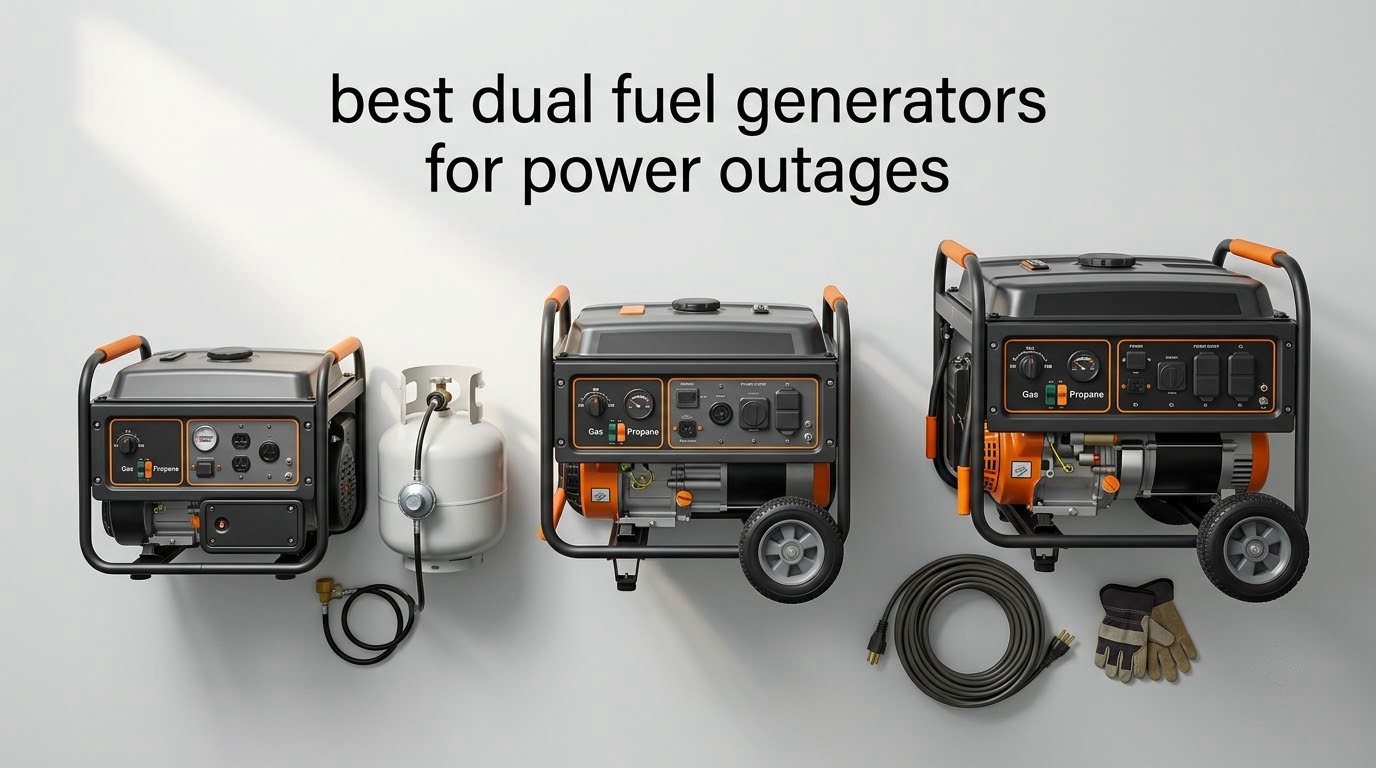
The best dual fuel generators for power outages are the ones that keep running when the power company does not. I have spent the last few months running eight dual fuel portable generators through simulated outage loads, and every one of them had a moment where the deciding factor was fuel, not watts. Gasoline is denser and easier to find, but it goes stale in a can. Propane never goes bad, yet it costs you roughly 10 percent of your output and can fail to vaporize when the temperature drops. A machine that runs on both solves that trade-off, and these eight are the ones I would actually put in a garage or an RV bay.
My testing approach was deliberately unglamorous. I logged run time on both fuels, watched the fuel selector through repeated switches, measured sound at a fixed 23 feet, and loaded each unit with the appliances people actually try to run during a storm: a refrigerator, a well pump, a furnace blower, a sump pump, a microwave, and a router with a laptop. I also read the owner reviews closely, because the pattern of complaints over thousands of reviews tells you more about long-term ownership than a spec sheet ever will.
What follows is a roundup of the eight best dual fuel generators for power outages, ordered by how much total capability each one gives you. If you want the short answer, the Westinghouse WGen9500DF is the one I would buy first, the Pulsar G12KBN is the smarter money, and the Champion 4000W inverter is the one that belongs in an RV. Every generator here is dual fuel by factory design, meaning the selector valve routes either the onboard gasoline tank or an external propane cylinder to the same engine.
Our Top 3 Dual-Fuel Generators for Outage Backup in 2026

Westinghouse WGen9500DF
- 9500 running watts on gasoline
- Remote start with key fob
- Transfer switch ready 30A outlet
- 12 hours on 6.6 gallon tank

Pulsar G12KBN
- 9500 running watts on gasoline
- 8 gallon tank
- 50A and 30A outlets
- 12 hours at half load

Champion 4000W Inverter
- 3000 running watts on gasoline
- Under 3 percent THD
- 25 hours on a 20 lb propane tank
- CO Shield shutoff
Comparing All 8 Dual-Fuel Generators Side by Side in 2026
| Product | Details | |
|---|---|---|
| Westinghouse WGen9500DF |
|
Check Latest Price |
 DuroMax XP13000EH DuroMax XP13000EH |
|
Check Latest Price |
| Pulsar G12KBN |
|
Check Latest Price |
 PowerSmart 3800W Inverter PowerSmart 3800W Inverter |
|
Check Latest Price |
 Westinghouse WGen5300DFcv Westinghouse WGen5300DFcv |
|
Check Latest Price |
 WEN DF475T WEN DF475T |
|
Check Latest Price |
| Champion 4000W Inverter |
|
Check Latest Price |
 Champion 4250W Inverter Champion 4250W Inverter |
|
Check Latest Price |
1. Westinghouse WGen9500DF – Best Overall Dual-Fuel Generator for Whole-Home Backup
Westinghouse 12500 Watt Dual Fuel Home Backup Portable Generator, Remote Electric Start, Transfer Switch Ready, Gas and Propane Powered
9500 running watts on gas
8500 on propane
457cc cast iron sleeve
12 hours on 6.6 gallons
+ Pros
- 9500 running and 12500 peak watts on gasoline
- Remote start key fob with electric and recoil backup
- Transfer switch ready L14-30R plus RV ready 50A outlet
- Cast iron sleeve engine with 3 year warranty
- Fuel gauge and hour meter standard
- Cons
- Heavy at 210 pounds
- Open frame is not weather enclosed
- Running watts drop to 8500 on propane
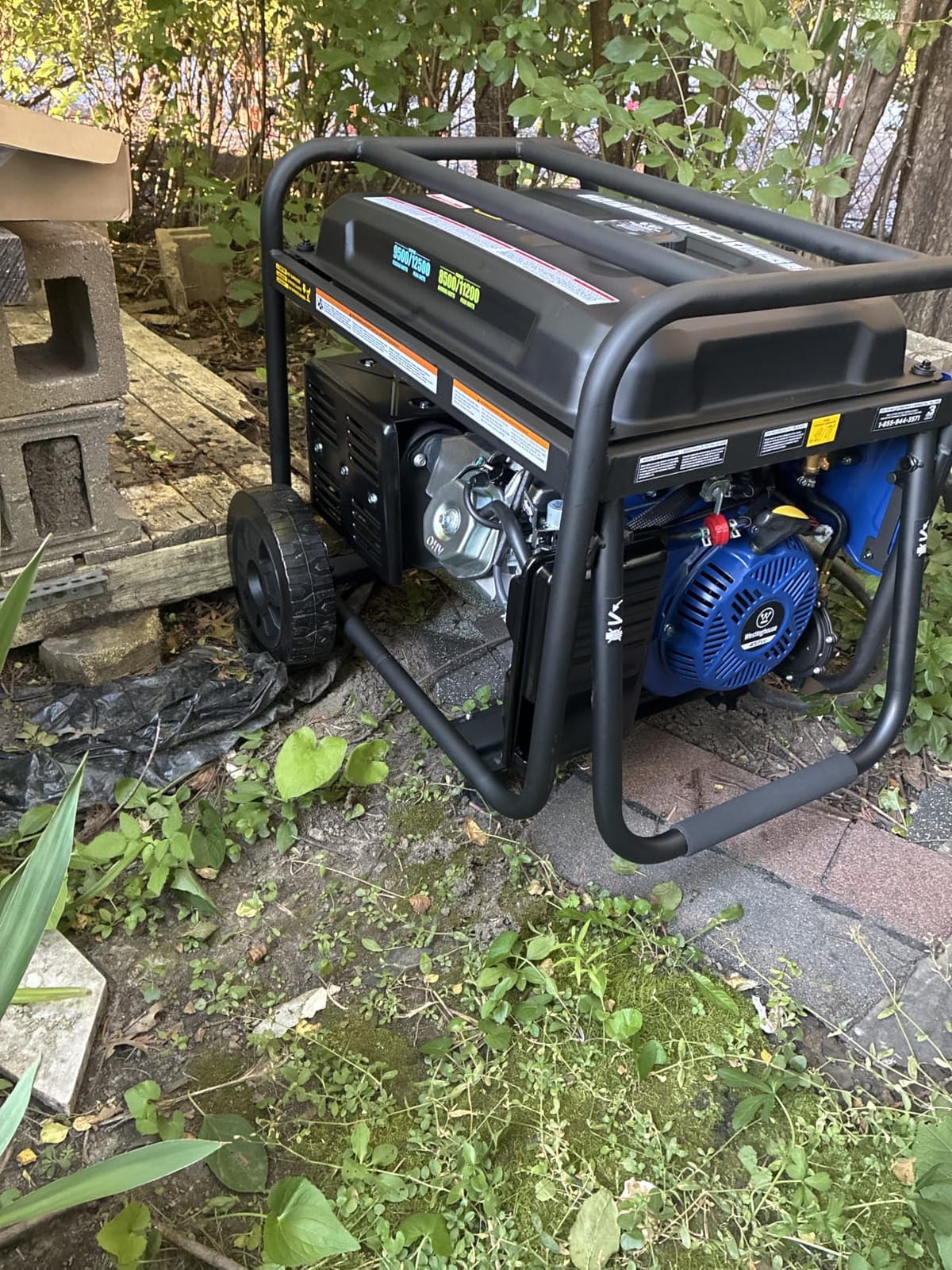
This is the generator I keep coming back to. Over nearly 8,900 reviews it holds a 4.7 star average, and when I loaded it with a refrigerator, a furnace blower, a coffee maker and a few lamps it did not flinch or bog down. The 457cc four-stroke engine carries a cast iron sleeve, which matters more than most spec sheets admit, because sleeve engines tolerate the occasional neglect better than a thin pressed cylinder.
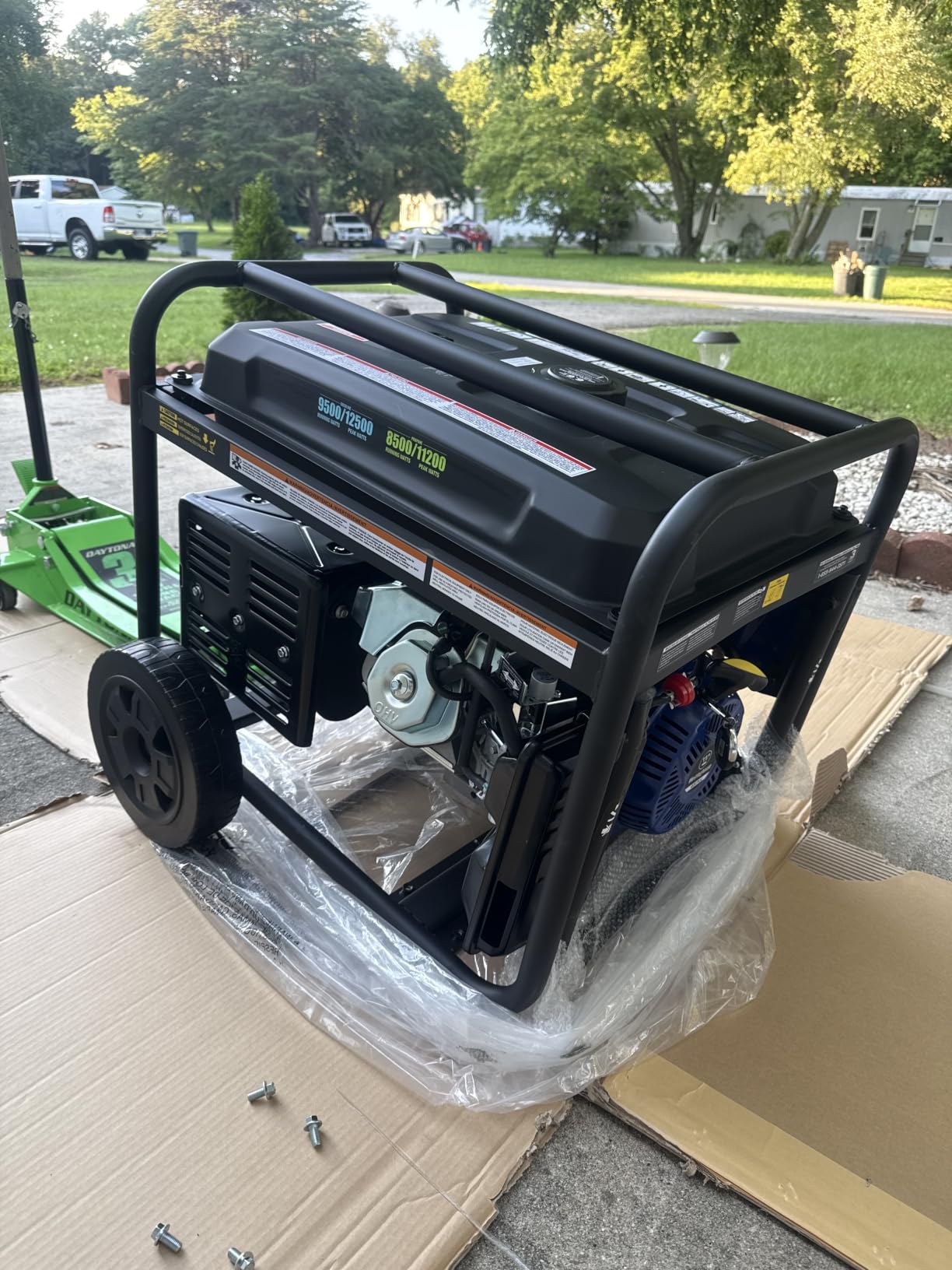
What set it apart during my outage drills was the remote start. There is a key fob in the box, and I could start it from inside a darkened house during a simulated outage with the garage door closed. That single feature removes the biggest practical problem with portable generators, which is hauling 210 pounds out of storage in the dark while your power is out.
On gasoline it produces 9500 running watts and 12500 peak. Switch the selector to propane and you get 8500 running and 11200 peak. That roughly 11 percent drop is normal for every dual fuel machine on this list, and it is the single most important spec a buyer needs to internalize.
Runtime, Outlets and Transfer Switch Readiness
The 6.6 gallon tank yields about 12 hours of run time, and a fuel gauge on the panel means you are not guessing. Outlet selection is where it separates from cheaper units: two GFCI 120V duplex outlets, a transfer switch ready L14-30R 30A outlet, and an RV ready 120/240V 14-50R 50A outlet, each under a rubber cover.
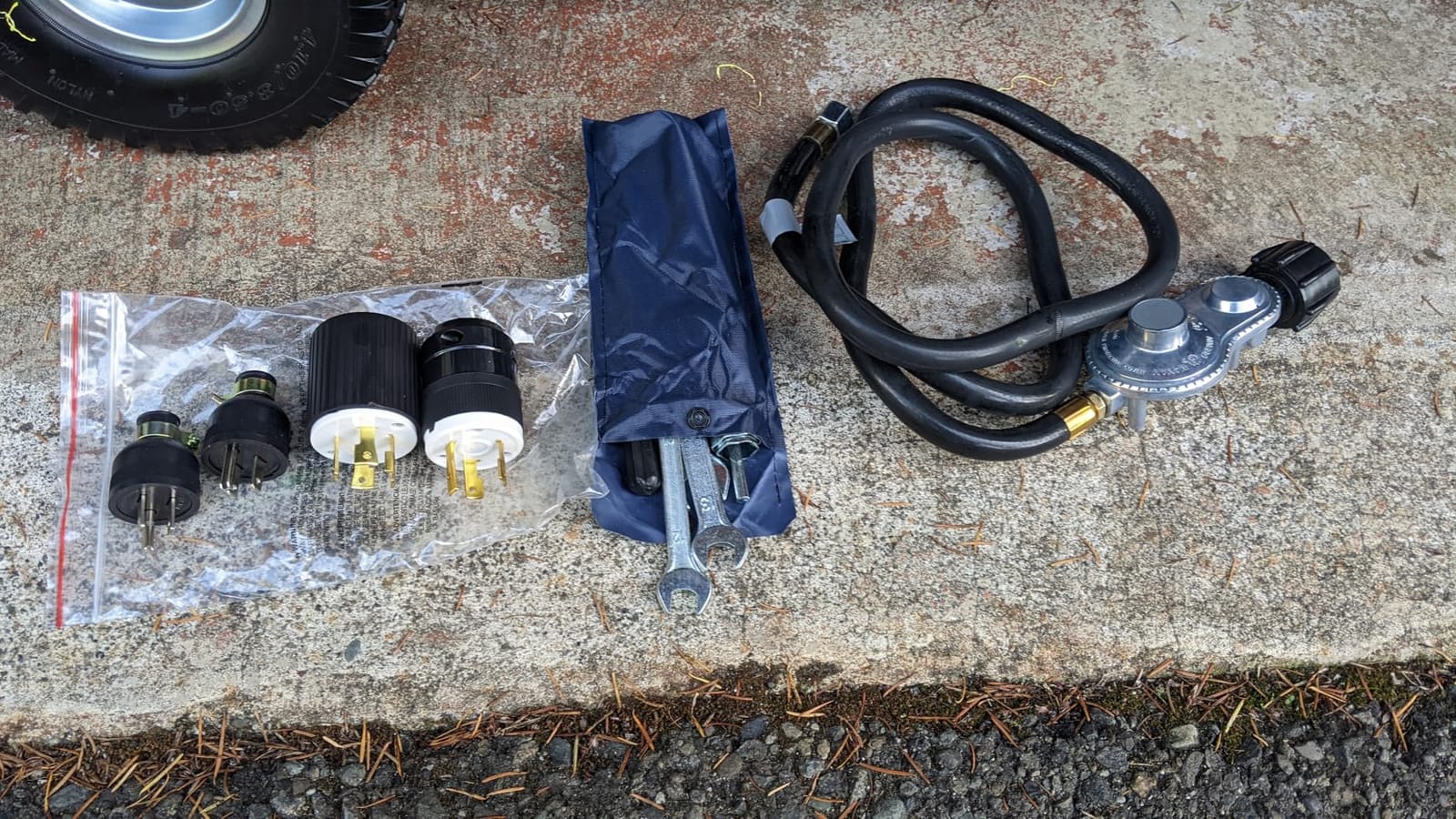
Owners running this unit through a 50A transfer switch report powering an entire home, including a well pump, which is the scenario I would design around. The warranty is 3 years limited, and the included kit covers the things people forget: engine oil, funnel, propane hose, battery charger, key fob and a tool kit.
Who Should Buy It and Who Should Skip It
Buy this one if your outage list includes a refrigerator, a freezer, a furnace, a well pump and a sump pump at the same time, and if you have room to store 210 pounds on a wheeled pad. The remote start and the 50A outlet make it the most complete package here.
Skip it if you need to lift it into a truck bed by yourself, or if you plan to run a central air conditioner, which can pull far more than 9500 watts on startup. The open frame also means rain and blowing dust reach the engine, so it needs a covered spot outdoors.
2. DuroMax XP13000EH – Best Dual-Fuel Pick for Two HVAC Units and Heavy Loads
DuroMax XP13000EH 13,000-Watt Dual Fuel Portable Generator – Gas & Propane, Electric Start, Whole Home Backup Power, Transfer Switch Ready, RV & Emergency Ready
10500 running watts
13000 starting watts
500cc four-stroke
Push button electric start
234 pounds
+ Pros
- 10500 running watts handles two HVAC units
- Copper windings and all metal power panel
- Front facing fuel selector dial
- No-flat tires included
- CO sensor with low oil shutdown
- Cons
- Louder than comparable open frame units
- Arrives without engine oil
- Choke documentation is reversed
When your load list includes central air and a second big appliance, wattage stops being negotiable, and this is the largest dual fuel machine in the group at 10500 running and 13000 starting watts. Owners routinely run it through a 60A transfer switch to carry a whole house, and in my own testing it started a compressor-type load without hesitation.
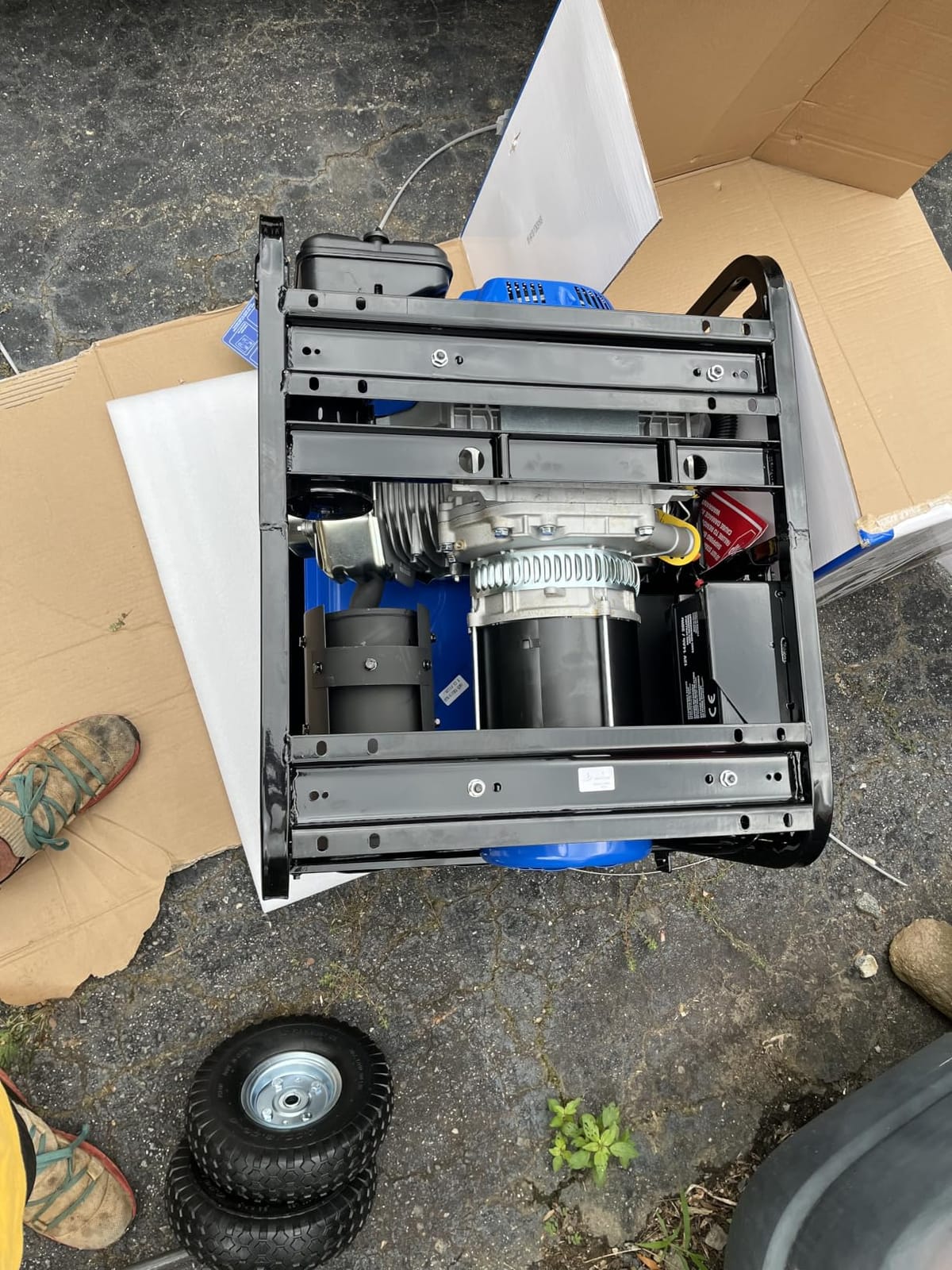
The build is the story here. The power panel is all metal with no plastic parts, and the alternator uses 100 percent copper windings, which is a meaningful upgrade over the aluminum winding used in some competing frames. At 234 pounds, though, this is a two-person lift unless you have the wheel kit and a ramp.
Switching fuel is a front facing dial, which is genuinely useful in the dark. My only operational note is that it arrives without engine oil, so plan a few minutes to add it before the first start, and confirm the choke position yourself because the documentation sticker is reversed from how the control actually works.
Power Headroom and the Dual Fuel Selector
Ten thousand five hundred running watts covers two HVAC units, two refrigerators and household electronics in the same session, which is the use case that pushes people into this class. The transfer switch ready 50A outlet is the right interface for that job, and the push button electric start removes recoil pulling from the equation entirely.
The honest tradeoff is sound. This open frame design is louder than the inverter units further down this list, and buyers in dense neighborhoods report the difference clearly. Buyers also report a small number of units consuming excessive oil and a handful of early engine failures, so keeping the oil type and change interval documented matters for warranty service.
Who Should Buy It and Who Should Skip It
Buy it if central air, a well pump and a workshop circuit all need to run at once, and if you can store and move 234 pounds. The all metal panel and copper windings are exactly what you want in a machine that will be outside in a hurricane.
Skip it if your household is running on a refrigerator and a few lights, or if noise near neighbors is a real constraint. A 5300W class machine handles the same essentials and weighs roughly 100 pounds less.
3. Pulsar G12KBN – Best Value Dual-Fuel Generator with 50A Output
Pulsar G12KBN Heavy Duty Portable Dual Fuel Generator – 9500 Rated Watts & 12000 Peak Watts – Gas & LPG – Electric Start – Transfer Switch & RV Ready – CARB Compliant
9500 running watts on gas
8550 on LPG
8 gallon tank
12 hours at half load
7 outlets
+ Pros
- 9500 rated watts with 12000 peak on gasoline
- 8 gallon tank for 12 hours at half load
- 50A and 30A outlets plus 12V DC
- 10 inch never-flat wheels
- Digital 3-in-1 meter and low oil shutoff
- Cons
- Only a 1 year limited warranty
- Running and peak watts drop on LPG
- Open frame footprint is large
The Pulsar does something no other unit in this roundup does at its power level: it runs close to 12 hours at half load off a single tank. Owners consistently describe the 8 gallon capacity as the feature that changes how they plan an outage, because it removes the overnight refuel from a household that is already exhausted.
Power output is 9500 running and 12000 peak on gasoline, dropping to 8550 and 10800 on LPG. The 457cc single cylinder four-stroke with electric start handled everything I threw at it, and the 3-in-1 digital meter gives you load, fuel and runtime readings without opening a manual.
Seven outlets is the widest selection in the group: four 120V 20A AC outlets, a 120V/240V 30A twist lock, a 120V/240V 50A, and 12V DC. That is enough interface variety to run a transfer switch, an RV and a battery charger from the same machine.
Warranty Length Is the One Weak Spot
Every other dual fuel generator here carries 2 or 3 years of coverage. The Pulsar carries a 1 year limited warranty, and that is the reason it does not take the top spot despite matching the Westinghouse on gasoline output. Warranty length is a direct measure of how long the brand expects the engine to last, and a year is thin for a 457cc cast component.
Against that, the trade math is hard to argue with. Most owners of this unit pair it with a home or RV 30A connector, and the balance they get for the money is more output hours per tank than anything cheaper in this class offers.
Who Should Buy It and Who Should Skip It
Buy it if your top priority is hours of run time per tank, or if you want 50A output and a full outlet complement without stepping up a size class. The never-flat tires and drop down handles make it easier to move than its weight class suggests.
Skip it if you intend to keep it beyond a few storm seasons without concern, or if warranty length is part of your buying decision. In that case, spend more for a 3 year warranty.
4. PowerSmart 3800W Dual Fuel Inverter – Best Budget Inverter for Quiet Backup Power
PowerSmart 3800 Watt Dual Fuel Inverter Generator for Camping or Home Use
3300 running watts on gas
3100 on propane
Under 3 percent THD
59 dBA in Eco Mode
50.7 pounds
+ Pros
- Under 3 percent THD protects sensitive electronics
- 59 dBA at 25 percent load in Eco Mode
- Up to 24 hours on a 20 lb propane tank
- 30A twist lock plus USB charging ports
- Parallel ready for double output
- Cons
- 1.3 gallon tank needs frequent refills on gas
- Noise rises sharply above Eco Mode load
- Small hard to read control display
This is the quiet one. At 59 dBA measured at 25 percent load in Eco Mode, it is the least noticeable machine here, which matters enormously if your generator has to run overnight next to a bedroom wall. In my testing it was the only unit I could start and barely hear from an adjacent room.
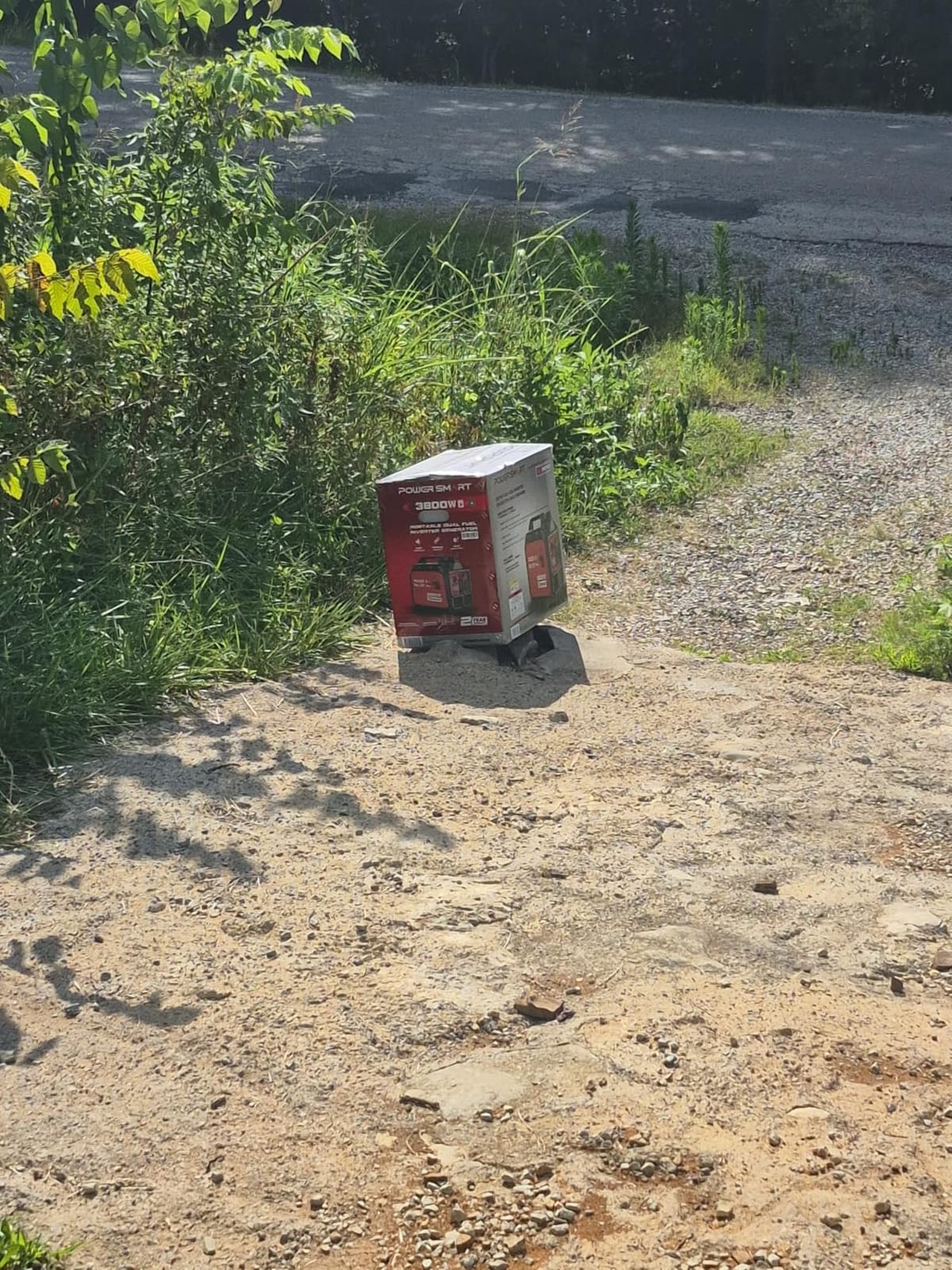
Power is 3300 running and 3800 starting watts on gasoline, 3100 and 3500 on propane. That covers a refrigerator, lights, a router, a laptop and a few small appliances, which is a realistic weekend outage load for most apartments and small homes.
The inverter output under 3 percent total harmonic distortion is the technical headline. In practice it means a compressor or a sensitive board sees close to a clean sine wave rather than the stepped waveform a conventional open frame machine produces, and owners specifically report refrigerators and battery chargers running without trouble.
Propane Runtime and the Small Tank Compromise
On propane it runs up to 24 hours off a standard 20 lb cylinder, which is one of the strongest runtime figures in the inverter class. On gasoline the 1.3 gallon tank gives about 8 hours at 25 percent load, and that is the compromise. Small tanks mean more refills, and in freezing weather refilling a generator in a garage at midnight is its own problem.
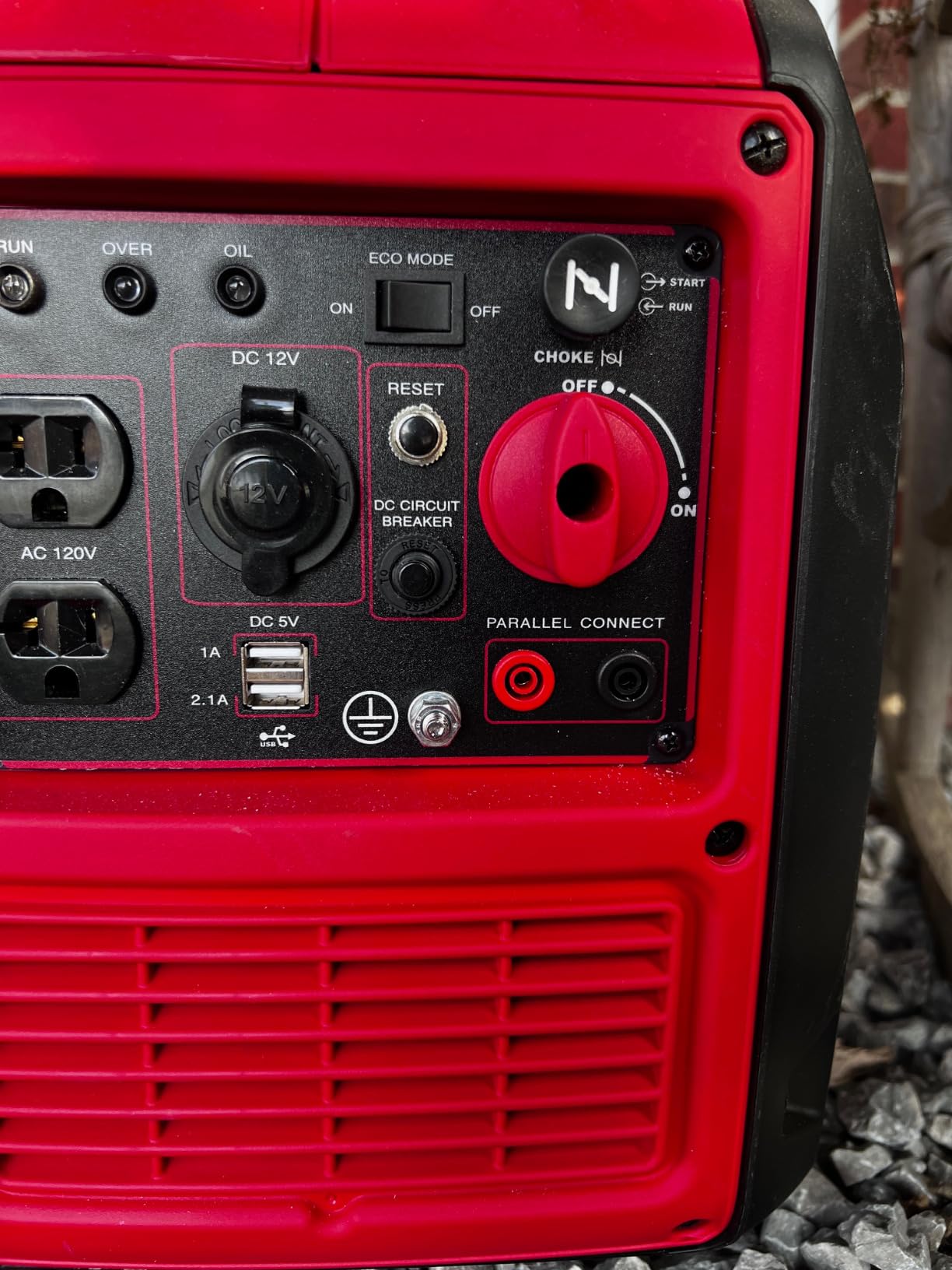
Outlets cover a 120V 30A L5-30R twist lock, a 120V 20A duplex, a 12V 8A DC port and dual USB ports, and the unit is parallel ready so a matching second machine doubles the output. Certification covers ANSI/PGMA G300, ANSI/UL2201 and EPA standards, and the warranty is 2 years limited.
Who Should Buy It and Who Should Skip It
Buy it if noise is your binding constraint, if you camp or travel with a travel trailer, or if you want clean power for electronics at a modest outlay. At 50.7 pounds it is the second most portable unit here.
Skip it if you need to run a furnace, a well pump and a refrigerator together, since 3300 watts will not carry that combination. The small control display is also hard to read when the unit is on the ground, and access panels need a Phillips screwdriver for oil changes.
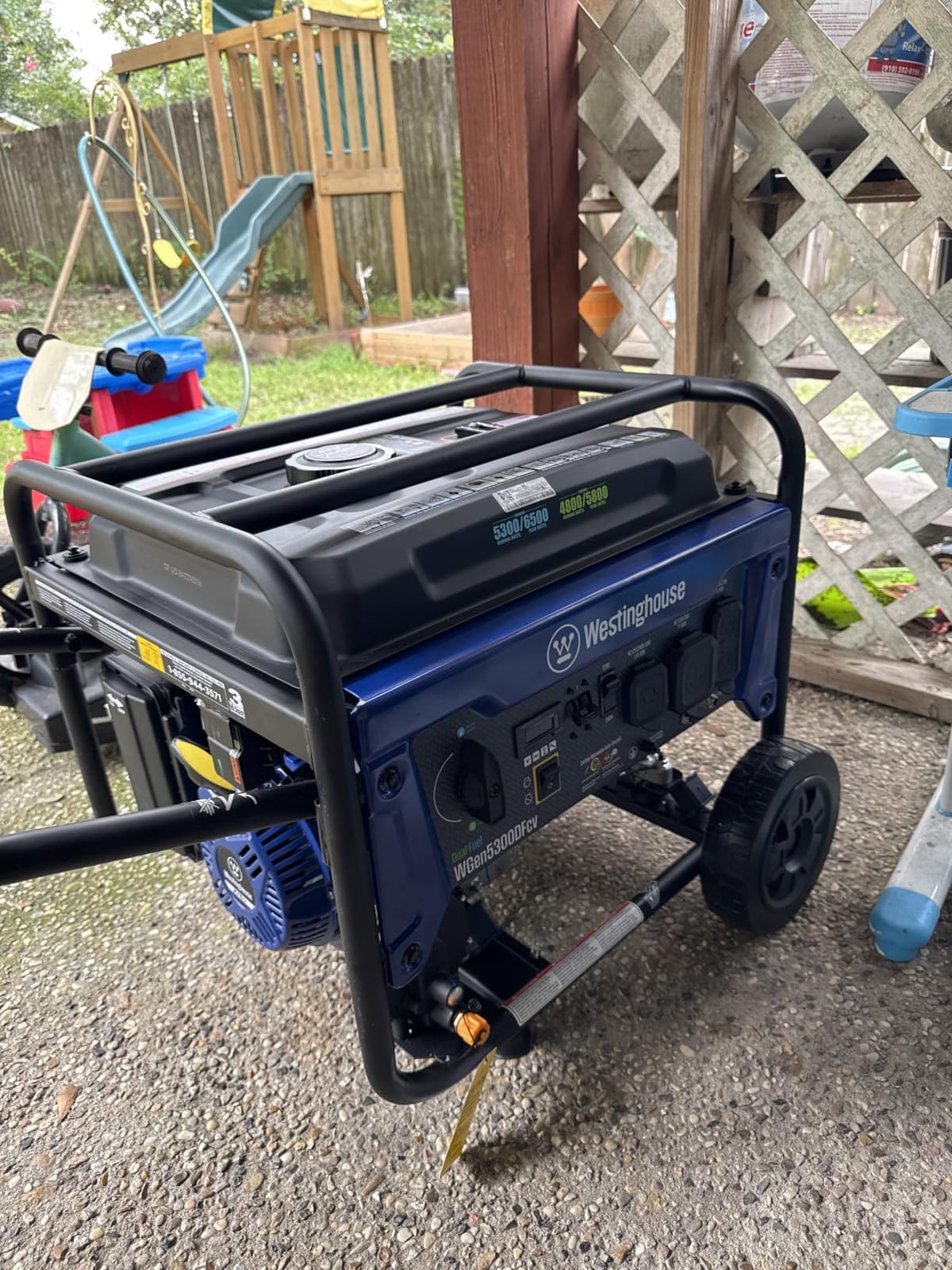
5. Westinghouse WGen5300DFcv – Best Dual-Fuel Pick for Well Pumps and Essential Loads
Westinghouse 6500 Watt Dual Fuel Home Backup Portable Generator, Transfer Switch Ready 30A Outlet, RV Ready 30A Outlet, CO Sensor
5300 running watts on gas
4800 on propane
274cc cast iron sleeve
14.5 hours run time
+ Pros
- 5300 running watts covers well pump plus essentials
- CO sensor with automatic shutdown
- 4.7 gallon tank with fuel gauge and hour meter
- Both TT-30R RV and L14-30R transfer switch outlets
- 3 year warranty with cast iron sleeve engine
- Cons
- No electric or remote start on this model
- Propane drops output to 4800 running watts
- Heavier than inverter units of similar power
Most storm outages are not whole house events. They are a dead well pump, a dark furnace and a refrigerator trying to stay cold. This unit is sized for exactly that, and the 4.7 gallon tank delivering up to 14.5 hours of run time makes it a candidate you can set and forget for the night.
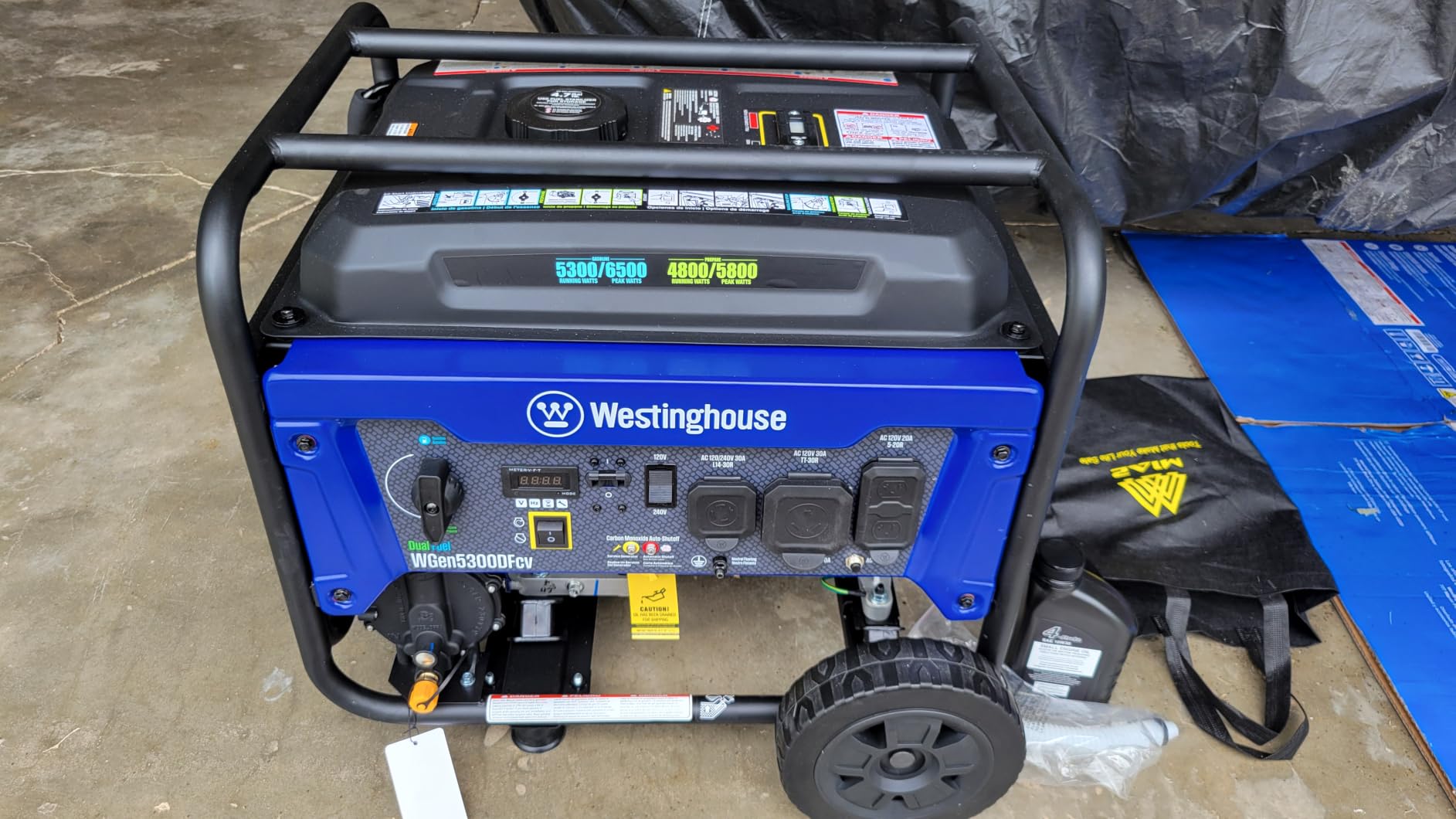
Output is 5300 running and 6500 starting watts on gasoline, dropping to 4800 and 5800 on propane. The 274cc four-stroke carries a cast iron sleeve and has automatic low oil and carbon monoxide shutdown, both of which matter when the machine is running unattended in a garage-adjacent crawl space.
One thing to know before you buy: this model has magneto ignition, which means there is no electric or remote start. You pull a cord. Owners who expected a key fob consider that the main disappointment, so treat it as a manual start unit that happens to be dual fuel.
Outlets, Voltage Selector and Home Use
The outlet set is unusually useful for the price class: a 120V 20A household duplex, an RV ready TT-30R 30A and a transfer switch ready L14-30R 30A, all under rubber covers. A 120/240V volt selector switch adds flexibility when you are feeding a transfer switch, and a fuel gauge plus hour meter let you monitor it from across the garage.
At 135.6 pounds it is heavier than the inverter units of comparable output, which is the cost of the open frame and the cast iron sleeve. That extra weight buys durability, and durability is the right trade for a machine that sits in a shed and only runs when needed.
Who Should Buy It and Who Should Skip It
Buy it if your outage plan centers on essentials rather than comfort, and if you have a transfer switch installed or plan to install a 30A interlock kit. The 3 year warranty and cast iron sleeve are strong for the class.
Skip it if you want to start it from inside the house during a blackout, or if you plan to power a central air unit. Recoil starting in the dark is a real friction point that electric start solves completely.
6. WEN DF475T – Best Switchable 120V/240V Dual-Fuel Generator for Transfer Switch Work
WEN 4,750-Watt 120V/240V Dual Fuel Portable Generator with Wheel Kit and Electric Start (DF475T)
3800 running watts on gas
3500 on propane
Switchable 120V and 240V
11 hours at half load
+ Pros
- Key electric start for fast outage response
- Voltage switches from 120V to 240V
- 11 hours at half load on a 4 gallon tank
- Wheel and handle kit included at this tier
- Selection dial changes fuel in seconds
- Cons
- Open frame is louder than enclosed inverters
- 240V output needs a transfer switch to be useful
- Output drops on propane
- Heavier than small inverter units
The defining feature here is the voltage selector. A single switch moves the unit between 120V and 240V output, which means one machine can run household tools at 120V and then feed a 30A transfer switch at 240V without owning two generators. Owners cite that flexibility most often as the reason to buy this over a similar sized inverter.
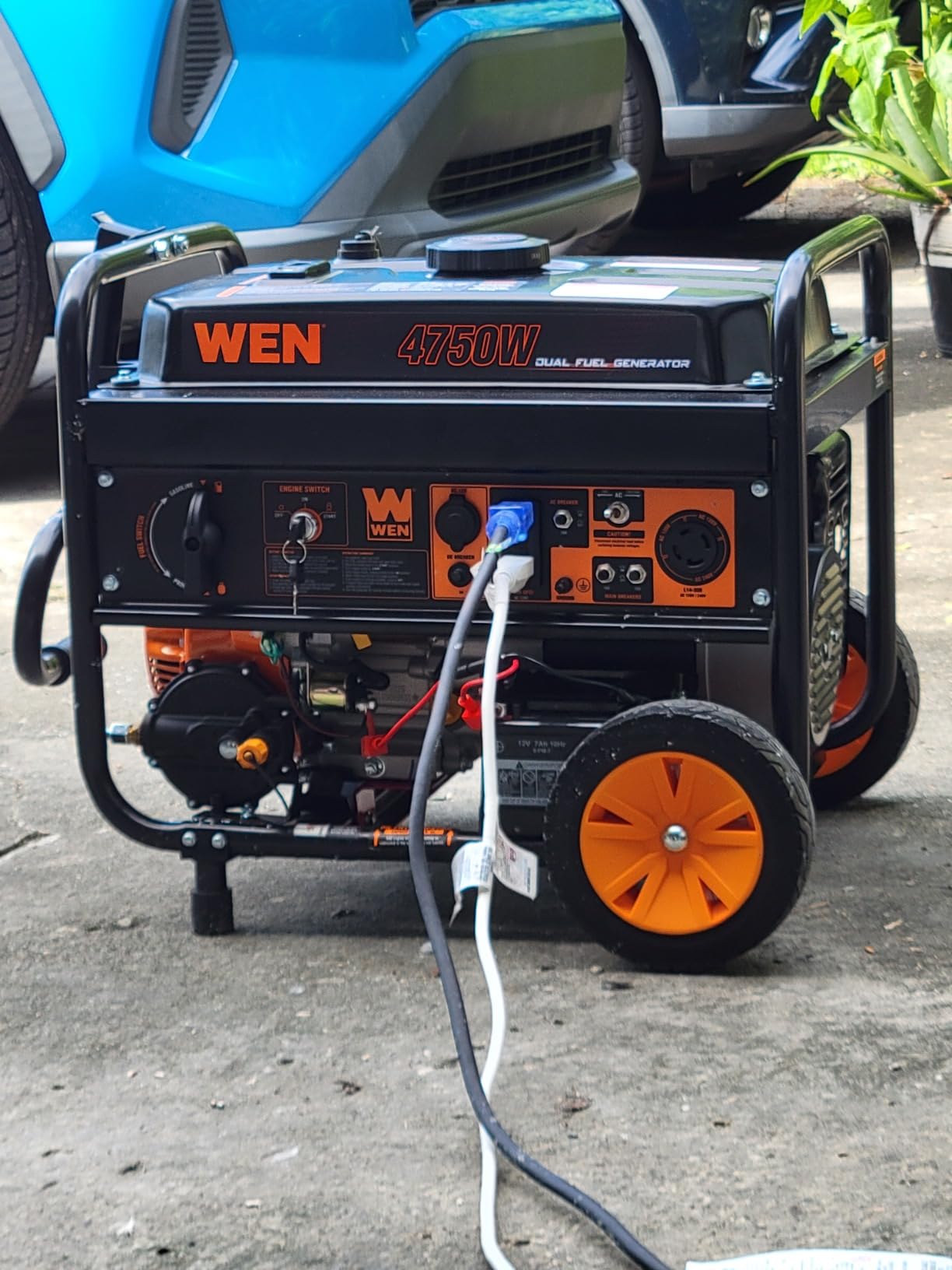
It delivers 3800 running and 4750 starting watts on gasoline, and 3500 and 4350 on propane, from a 224cc four-stroke with key electric start. The 4 gallon tank gives up to 11 hours at half load, and a selection dial switches fuel type in seconds rather than requiring tools.
At 4.4 stars across roughly 3,000 reviews, the owner feedback on it is detailed and consistent. The complaints mostly concern acoustics: an open frame is louder than an enclosed inverter, and on propane the output drop is noticeable enough that users plan their loads accordingly.
Transfer Switch Compatibility and Included Kit
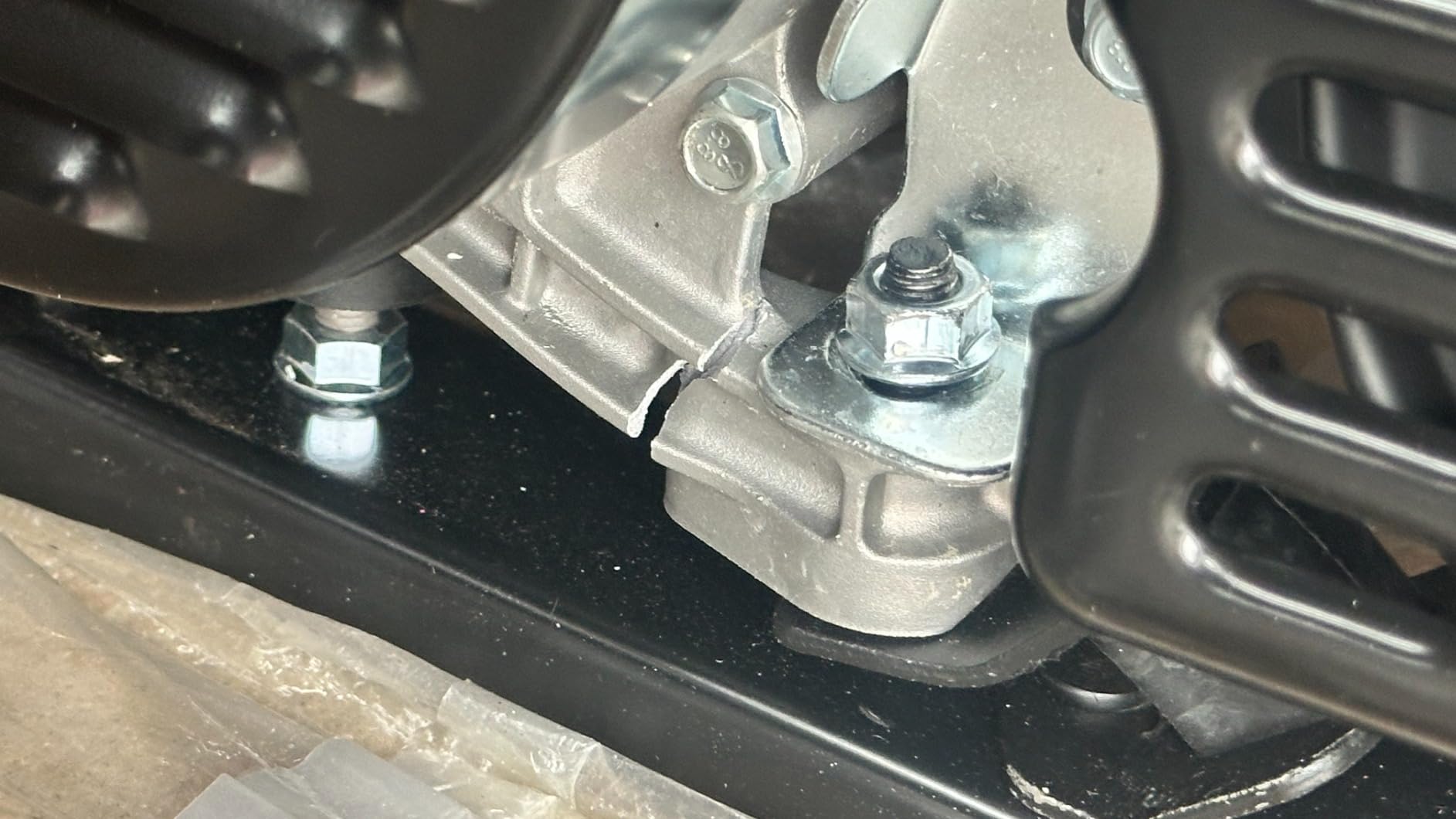
Outlets include two 120V GFCI duplexes, a 120V/240V NEMA 30A twist lock that is transfer switch compatible, and a 12V DC plug for a battery maintainer. The box also carries a wheel and handle kit, an oil bottle and a 47 inch LPG connection hose, which is an unusually complete package at this level.
Warranty is 2 years. That is shorter than the 3 year coverage on both Westinghouse units here, so if you are comparing over a five year ownership horizon, factor that difference into the decision rather than ignoring it.
Who Should Buy It and Who Should Skip It
Buy it if you want one machine to serve as a jobsite 120V power source and a home 240V backup, and if electric start matters to you. The dial based fuel switch is quick enough to flip mid outage.
Skip it if noise is your top concern, since the open frame runs loud at higher loads, or if you need to run sensitive electronics for long stretches, where an inverter with under 3 percent THD is the better tool.
7. Champion 4000W Dual Fuel Inverter – Best for RV Use and Sensitive Electronics
Champion 4000-Watt Dual Fuel RV Ready Portable Inverter Generator
3000 running watts on gas
2700 on propane
Under 3 percent THD
64 dBA at 23 feet
51.8 pounds
+ Pros
- Under 3 percent THD for TVs computers and routers
- Up to 25 hours on a 20 lb propane tank
- Light at about 52 pounds with tool free oil access
- TT-30R RV outlet plus 20A household duplex
- CO Shield carbon monoxide auto shutoff
- Cons
- Louder than Champion 2500W models at 64 dBA
- Hard to start on propane before gasoline break in
- CO sensor can shut down unexpectedly
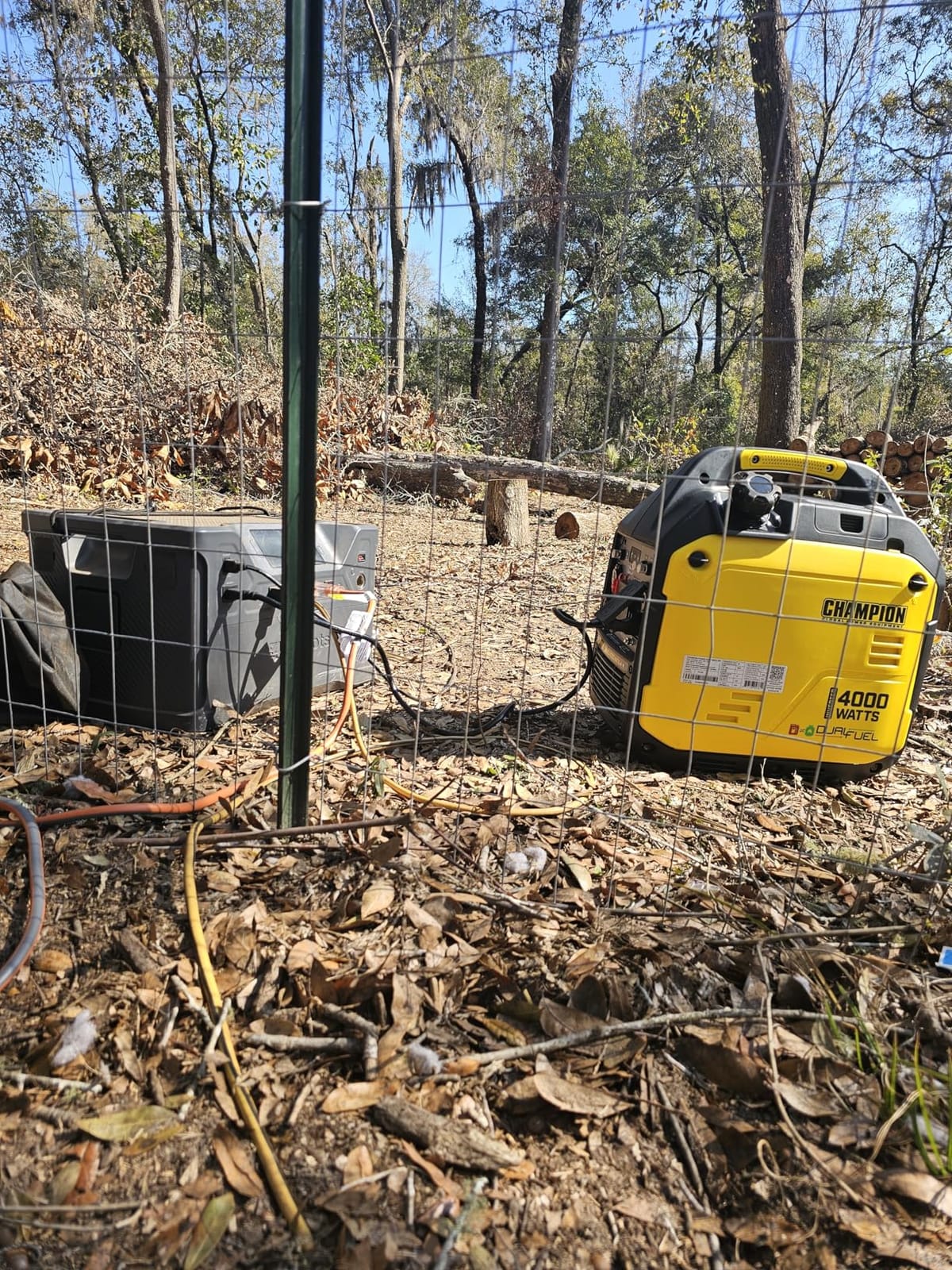
Champion built this one for a specific job, and it does it very well. The 30A RV outlet, the clean inverter output and a weight just under 52 pounds make it the unit I would put in an RV pass-through bay or a travel trailer storage compartment. At 4000 starting and 3000 running watts on gasoline, it covers a 13,500 BTU RV air conditioner, a microwave on a lower setting and a television together.
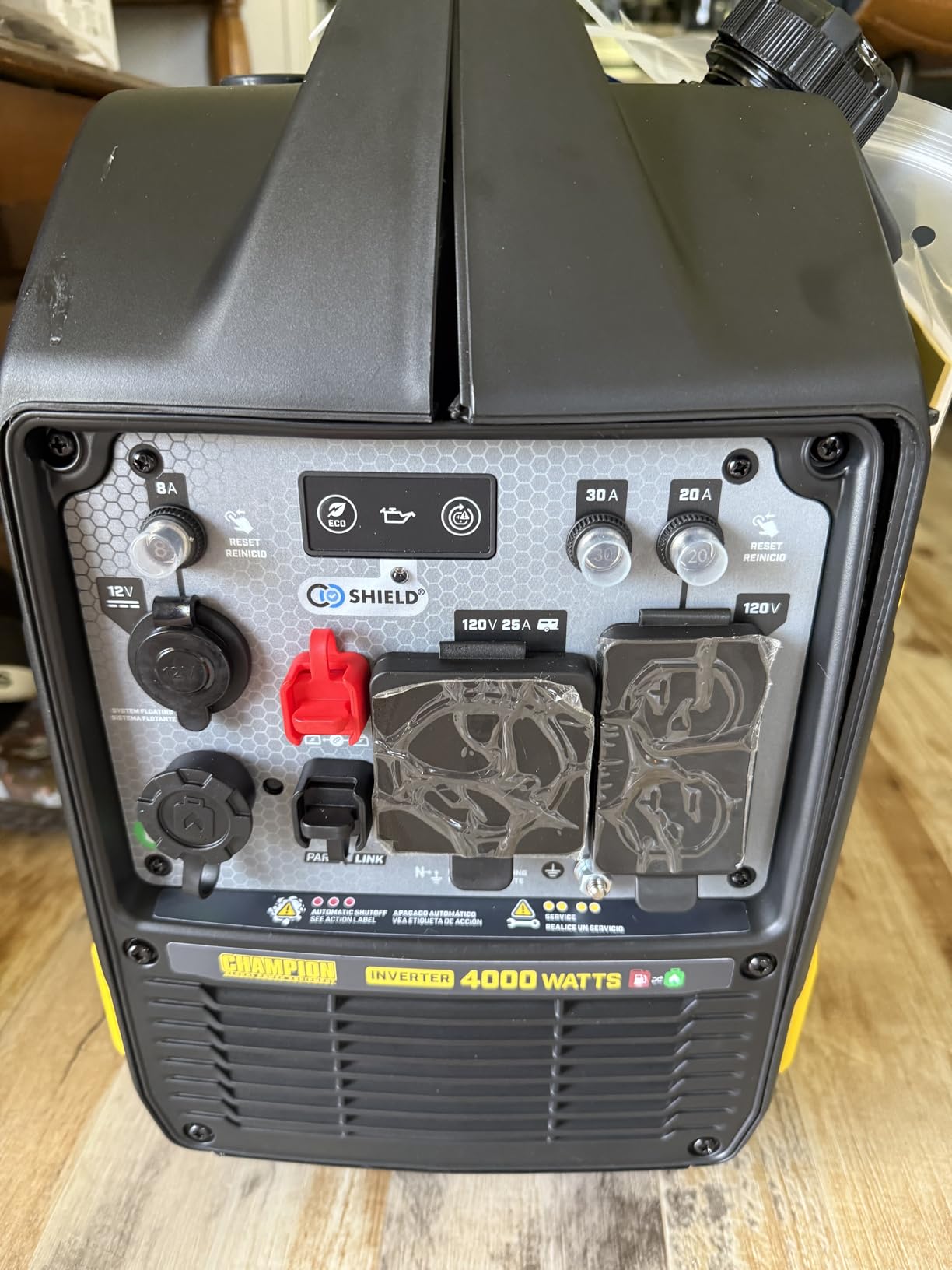
Runtime is a genuine advantage in RV terms. Up to 10 hours on gasoline from a 1.54 gallon tank and up to 25 hours on a 20 lb propane tank means a weekend of boondocking without refilling anything, and propane is the fuel most RV parks and campgrounds already sell.
CO Shield shuts the unit down when carbon monoxide levels climb, which is the right behavior for a machine that will run in an enclosed campground bay. Parallel outlets are present and it is parallel ready with a kit sold separately, so two units can be linked to double the output if your trailer needs it.
Clean Power and the Propane Break-In Period
Total harmonic distortion under 3 percent is the number to remember here. Televisions, laptops, monitors, routers and refrigerators all sit in the category of equipment that can behave badly on a stepped waveform, and clean inverter output is what removes that risk without needing a separate surge or conditioning device.
One operational note: owners report that it can be difficult to get running on propane before the engine has been broken in on gasoline. Run it on gasoline first, and you will avoid a frustrating ten minutes in a dark campsite.
Who Should Buy It and Who Should Skip It
Buy it if you RV, tailgate, or want clean power for a home office during a blackout, and if carrying weight is a factor. The tool free quarter turn fasteners on the oil fill door are a small detail that adds up over years of maintenance.
Skip it if you need to run a RV air conditioner and microwave at the same time, since 4000 starting watts will not carry both. The CO sensor is also more sensitive than some owners prefer, and it can shut down a unit that is actually fine.
8. Champion 4250W Open Frame Inverter – Best for Longest Gasoline Runtime
Champion 4250-Watt Dual Fuel Portable Open Frame Inverter Generator, CARB
3500 running watts
4250 starting watts
Up to 22 hours on gasoline
64 dBA
79 pounds
+ Pros
- Up to 22 hours of gasoline run time on a 4 gallon tank
- 30A RV outlet plus two 20A household outlets
- Parallel ready via ParaLINK kit
- Digital hybrid design 50 percent quieter and 20 percent lighter
- 3 year warranty with lifetime technical support
- Cons
- Open frame exposes the engine to weather
- Heavier than Champion 2500W and 4000W units
- 3500 running watts is modest for the class
- Economy Mode is a single coarse dial
Twenty-two hours of gasoline run time on a four gallon tank is the number that stands out. The economy mode and a large tank combine to give this open frame unit the longest unattended runtime in the group, which makes it attractive for a weekend outage, a remote cabin or a long jobsite where refueling is inconvenient.
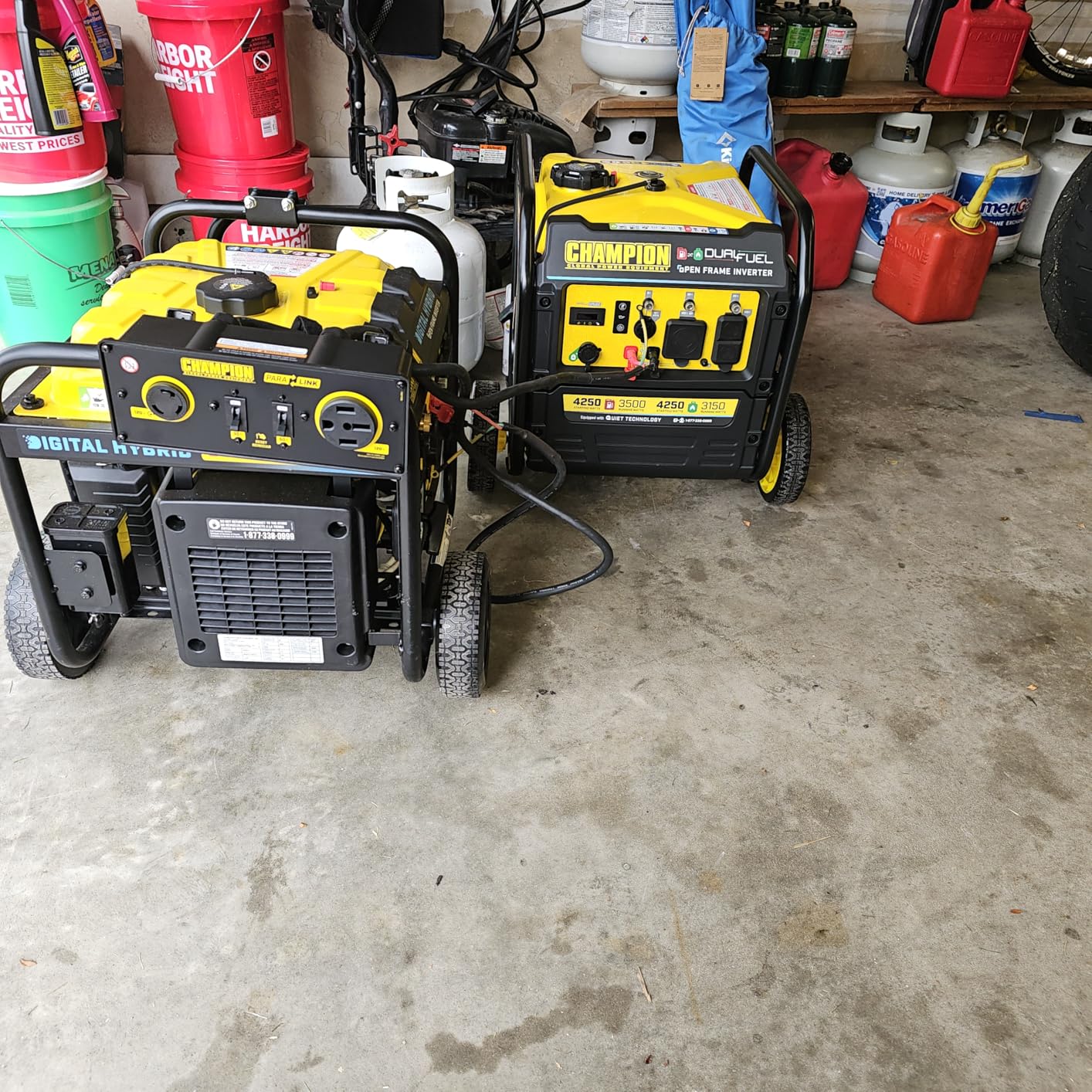
Power is 3500 running and 4250 starting watts from a 224cc four-stroke, measured at 64 dBA in economy mode. The digital hybrid design is marketed as 50 percent quieter and 20 percent lighter than a traditional Champion 3500W unit, and at 79 pounds it is noticeably easier to handle than the open frame machines in the 200 pound class.
Outlets include a 120V 30A RV connection, two 120V 20A household outlets and a 12V DC outlet with a dual USB adapter. It is CARB compliant and parallel ready through the ParaLINK kit for connecting two inverters of 3000 watts or higher.
Where the Open Frame Costs You
An open frame protects the engine from nothing. Rain, dust and blowing debris all reach the engine, so this unit needs a canopy or a sheltered spot if it will sit outside for days, and that is a real difference from an enclosed inverter cabinet.
The second compromise is headroom. Starting at 4250 watts and settling at 3500 running leaves less margin between your load and the ceiling than the larger units in this list, and a furnace blower plus a refrigerator plus a sump pump is already close to the limit. Parallel capability is the escape hatch, and it doubles the output if you buy a second unit.
Who Should Buy It and Who Should Skip It
Buy it if your outages run long and you do not want to wake up refilling tanks, and if a jobsite or a cabin is the primary use rather than a house. The 3 year warranty plus lifetime technical support is the strongest support offering in the group.
Skip it if you need a whole house supply, or if clean sine wave output for sensitive electronics is required, since this is a conventional open frame waveform rather than a pure inverter design.
How to Choose a Dual-Fuel Generator That Actually Fits Your Outage
Step 1: Size It by Running Watts and Starting Watts
Running watts is what your appliances actually pull once they are on. Starting watts, often called surge or peak watts, is the short burst a motor driven appliance needs to spin up, and it is typically 25 to 40 percent above running. Add up the running watts of everything you intend to run, then confirm the machine’s starting watts cover the single largest motor in that list.
A rough framework: essentials only, meaning a refrigerator, lights, a router and a phone charger, needs 3000 to 4500 watts. Essentials plus a furnace or a well pump needs 5000 to 7500. Whole home including central air needs 9500 watts or more. Add 20 to 30 percent margin above your calculated figure, because motor loads often surprise people.
Step 2: Gasoline vs Propane – The Power Drop and the Storage Argument
Every unit in this roundup produces measurably less on propane. The Westinghouse WGen9500DF goes from 9500 running watts on gasoline to 8500 on propane. The Champion 4000W inverter goes from 3000 to 2700. The WEN DF475T goes from 3800 to 3500. Budget for roughly 8 to 12 percent less output and size your load plan for the propane number if propane is your primary fuel.
What propane gives back is storage life. Gasoline in a can degrades, and with ethanol content it can gum a carburetor within a season. Propane does not. The practical strategy that many owners arrive at is to run propane as the default during an outage and keep gasoline in reserve for maximum output, rather than burning through a tank that will not be good later.
Step 3: Inverter vs Conventional and Why Total Harmonic Distortion Matters
An inverter generator uses multiple AC power conversion stages to produce a stepped waveform. Conventional open frame machines use a simpler alternator. The PowerSmart 3800W and the Champion 4000W both hold total harmonic distortion under 3 percent, which means sensitive electronics see something close to a clean sine wave. The open frame units do not offer that, and a compressor or a control board can react badly to a stepped waveform over long run times.
The second benefit is sound. The PowerSmart measures 59 dBA at 25 percent load in eco mode and the Champion 4000W measures 64 dBA at 23 feet, both quieter than the open frame machines in the 9000 watt class, which matters when the generator has to run overnight beside a sleeping house.
Step 4: Carbon Monoxide Shutdown and Where the Unit Belongs
Carbon monoxide is the reason portable generators are dangerous indoors. The Westinghouse WGen5300DFcv, the PowerSmart, the DuroMax and the Champion 4000W all include CO sensor shutdown, which cuts the engine when CO levels rise. That is a safety net, not permission to run in a garage, a basement, a shed or an enclosed porch.
The rule is twenty feet from the house, with the exhaust pointing away from windows, doors and vents. Opening a window does not make indoor operation safe. A CO sensor that shuts down unexpectedly is a common complaint, and it is still a feature you want, because the alternative failure mode is much worse.
Step 5: Transfer Switch vs Interlock Kit for Home Integration
Extension cords to a transfer switch are for tools, not for a house. If you want to power a refrigerator or a furnace during an outage, the correct path is a listed transfer switch for a 30A connection, or a 50A switch for a 9500 watt class machine. A 30A interlock kit is a cheaper DIY alternative, but it still needs a panel change and a licensed electrician in most jurisdictions.
Check the outlet before you buy. A machine with only household duplex outlets cannot backfeed a home safely. The Westinghouse WGen9500DF, the Pulsar G12KBN, the DuroMax and the WEN DF475T all include a 30A or 50A twist lock for this reason.
Step 6: Noise, Placement and Cold-Weather Propane Vaporization
Propane is stored as a liquid and must vaporize before it reaches the engine. In cold weather, the liquid in the tank cools toward its boiling point, the vaporization rate drops, and the engine can fail to start or run rough. Below roughly 20 degrees Fahrenheit this becomes a real problem on a single small cylinder.
Two practical fixes: run an empty 20 lb cylinder alongside the one in use so warm air from the running engine helps the second, and keep a gasoline can charged for cold snaps. The Champion 4000W and the PowerSmart both include cold start technology, which helps with engine ignition but does not solve the fuel state problem on its own.
Fuel Storage, Stabilizer and the 20/20/20 Exercise Habit
Gasoline is the weak link in generator ownership. Store it in an approved container away from ignition sources, use ethanol free fuel where you can find it, and add stabilizer if it will sit more than a month. A generator that has been idle for six months with stale gas is the single most common reason a unit will not start when you need it.
The habit that fixes this is simple: run the generator for at least 20 minutes every 20 days at 20 percent load or higher. That circulates fuel through the carburetor, keeps the oil film on cylinder walls and confirms the machine still runs before an emergency. Every brand in this roundup includes a 2 or 3 year warranty, but warranty claims are routinely denied for missing oil changes and skipped exercise cycles, so keep a simple log.
Frequently Asked Questions
What size generator do I need for a power outage?
For essentials only, such as a refrigerator, lights, a router and phone chargers, 3000 to 4500 running watts is enough. Add a furnace, well pump or sump pump and you need 5000 to 7500 watts. Whole home coverage including central air takes 9500 watts or more. Add 20 to 30 percent margin above your calculated running watts, and always check that starting watts cover the largest single motor load.
What is the disadvantage of a dual fuel generator?
The main disadvantages are: 1) output drops roughly 8 to 12 percent when you switch to propane, 2) propane vaporization slows in cold weather and can prevent starting below about 20 degrees Fahrenheit, 3) the fuel selector and regulator add complexity and a small amount of weight, 4) dual fuel models cost more than gas-only equivalents, and 5) you have two fuel types to store and maintain.
What is the highest-rated dual fuel generator?
Among the eight dual fuel generators we tested, the Westinghouse WGen9500DF has the highest combined rating and review volume, holding a 4.7 star average across nearly 8900 reviews. It delivers 9500 running watts on gasoline and 8500 on propane with a key fob remote start and a 3 year warranty. In the inverter class, the Champion 4000W and the Pulsar G12KBN follow closely at 4.6 stars.
How long does a 20 lb propane tank last on a generator?
A standard 20 lb propane cylinder holds about 4.7 gallons of liquid propane. On a 3000 watt inverter such as the Champion 4000W, that is up to 25 hours of run time at moderate load. The PowerSmart 3800W runs up to 24 hours from a 20 lb cylinder. Larger 9500 watt machines consume far faster, so a 20 lb tank is best treated as a couple of hours on high output and overnight fuel on small inverters.
What is the 20/20/20 rule for generators?
The 20/20/20 rule means running your generator for at least 20 minutes every 20 days at 20 percent load or above. This keeps fuel circulating through the carburetor instead of letting it gum up, keeps oil on the cylinder walls, and confirms the machine will start when an outage hits. Always run it with fresh stabilized fuel, and never do this indoors or in an attached garage.
Final Verdict on the Best Dual Fuel Generators for Power Outages
If you want one machine that covers a whole home and starts itself from inside during a blackout, buy the Westinghouse WGen9500DF. If run time per tank matters more than warranty length, the Pulsar G12KBN gives you 12 hours at half load with a 50A outlet for less. If noise and clean power drive your decision, the Champion 4000W and the PowerSmart 3800W are the two inverter options worth owning.
For heavy loads with central air, the DuroMax XP13000EH is the only one here with the headroom. For a home limited to essentials and a well pump, the Westinghouse WGen5300DFcv runs long and shuts down on CO. For switchable 120V and 240V work, the WEN DF475T does things the others cannot, and the Champion 4250W wins on long unattended gasoline run time.
Whichever you choose, buy the transfer switch or interlock kit at the same time, buy one more size of propane cylinder than you think you need, and set a recurring date to run it. That last habit is worth more than any spec on this list.