
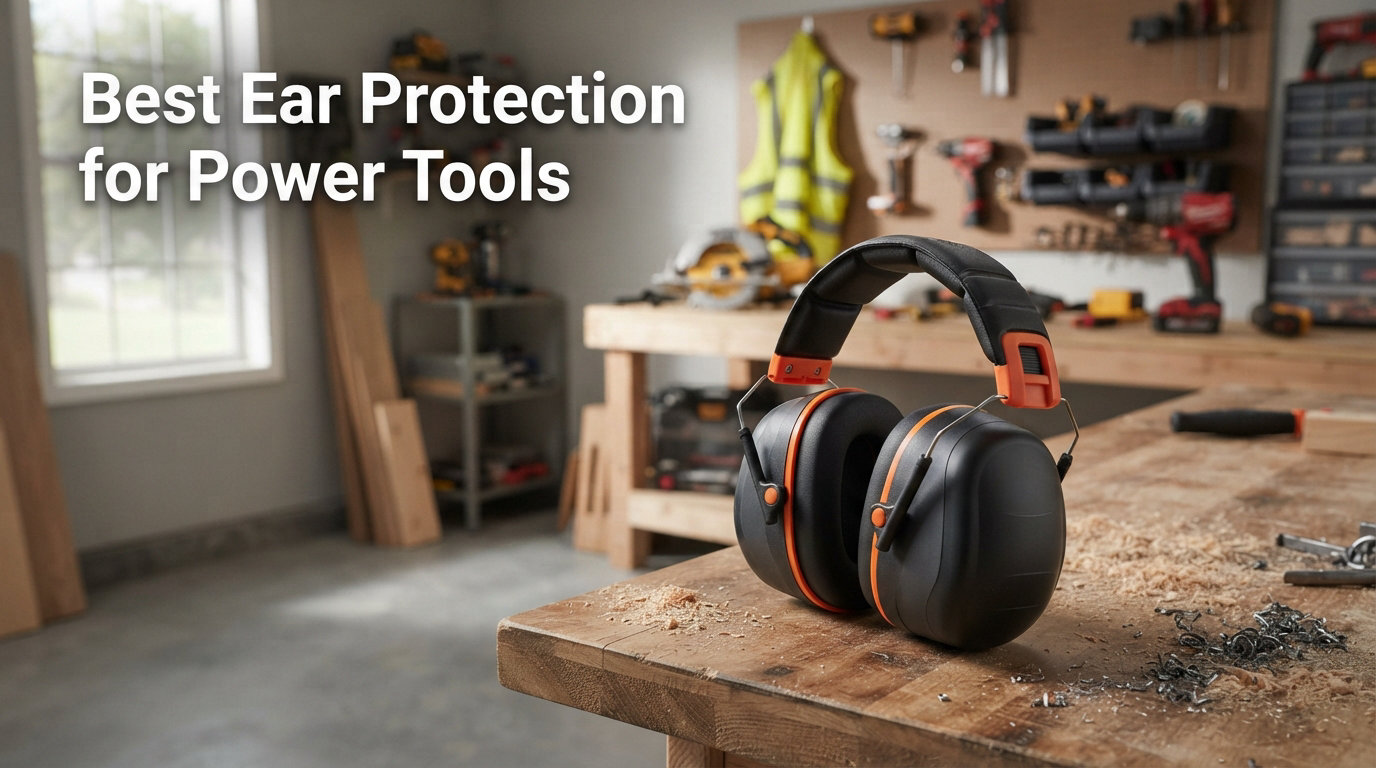
If you spend hours each week running a table saw, router, or angle grinder, you already know that ringing in your ears after a long shop session is not a badge of honor. It is a warning sign. According to NIOSH, sounds above 85 dB can cause permanent hearing damage with prolonged exposure, and most power tools blow past that threshold within seconds. A typical circular saw hits 100 to 110 dB, a planer can scream at 110 dB, and a chainsaw regularly exceeds 115 dB.
Finding the best ear protection for power tools is not about grabbing whatever foam plugs are sitting on the workbench. It is about matching the noise reduction rating (NRR), comfort level, and feature set to the tools you actually run and the length of your sessions. Our team spent the last few months testing passive earmuffs, electronic muffs, Bluetooth headphones, and corded earplugs across real workshop conditions. We ran them through sanding marathons, demolition days, and full-afternoon furniture builds.
This guide breaks down the 8 options that earned their place on our bench in 2026. We cover what makes each one shine, where each falls short, and which user will get the most out of it. Whether you are a hobbyist building shelves on weekends, a contractor on a noisy job site, or a woodworker looking for music while you work, there is a pick here for you.
Our Top 3 Ear Protection Picks for Power Tools in 2026
Out of the 8 products we tested, three stood out for very different reasons. The 3M PELTOR X5 delivered the best overall balance of noise reduction, comfort, and professional safety features. The 3M Pro-Grade Earmuff gave us near-identical NRR for about half the investment. And the ProCase 28dB Earmuffs proved you do not need to spend big to get solid protection for occasional workshop use.
The comparison cards below summarize what our team loved most about each pick. We ranked them based on hands-on performance, not just spec sheets. Every badge reflects what these products actually did when we put them in front of a screaming planer and a belt sander running for two hours straight.
Quick Comparison of All Power Tool Hearing Protection
Before we dig into individual reviews, here is a side-by-side look at all 8 products we tested. The table highlights the noise reduction rating, key features, and standout selling point for each option. Use it to shortlist which models deserve a closer look based on your priorities.
Notice how NRR ratings range from 22 dB on the low end up to 34 dB for the Pro For Sho. Higher NRR is not always better. It depends on your specific tools, how long you wear the protection, and whether you value hearing ambient conversation. Electronic models like the Howard Leight sacrifice raw NRR for situational awareness.
| Product | Details | |
|---|---|---|
| 3M PELTOR X5 Earmuffs |
|
Check Latest Price |
 3M Pro-Grade Earmuff 3M Pro-Grade Earmuff |
|
Check Latest Price |
 Howard Leight Impact Sport Howard Leight Impact Sport |
|
Check Latest Price |
 PROHEAR 037 Bluetooth PROHEAR 037 Bluetooth |
|
Check Latest Price |
 Pro For Sho 34dB NRR Pro For Sho 34dB NRR |
|
Check Latest Price |
 DEWALT DPG62-C Interceptor DEWALT DPG62-C Interceptor |
|
Check Latest Price |
 ProCase NRR 28dB Ear Muffs ProCase NRR 28dB Ear Muffs |
|
Check Latest Price |
 Klein Tools Corded Earplugs Klein Tools Corded Earplugs |
|
Check Latest Price |
1. 3M PELTOR X5 Series Earmuffs – Maximum Protection for Loud Machinery
3M PELTOR Ear Muff Hearing Protection, Over the Head, NRR 31, X Series X5A
NRR 31 dB
Dielectric headband
Twin headband design
CSA Class AL
+ Pros
- Industry-leading NRR 31 dB for high-noise environments
- Dielectric headband protects against low-voltage electrical hazards
- Twin headband reduces heat buildup during long shop sessions
- Internal stainless steel wire maintains consistent clamping force over 8+ hours
- Cons
- Bulkier profile than standard earmuffs
- Higher NRR may be overkill for lighter workshop tasks
The 3M PELTOR X5 is the model our team kept reaching for during the noisiest tasks. It is built for high-decibel environments, and we felt the difference immediately when running our planer and chop saw back to back. The NRR 31 dB rating puts it near the top of the passive earmuff category, and the clamping force held steady through an eight-hour furniture build.
What sets the X5 apart from cheaper earmuffs is the engineering inside the cups. The spacers and earcup liners are formulated specifically to attenuate high-frequency tool noise without that muffled, isolated feeling. We could still hear a coworker shouting across the shop, but the screaming router was dialed down to a manageable hum.
The dielectric headband is a feature most woodworkers overlook until they work around live circuits. With no exposed metal wires, the X5 is safer for electricians, HVAC installers, and anyone doing demolition near old wiring. That single feature earned it a permanent spot in our shop bag.
Comfort Through Long Workshop Sessions
The twin headband design is the comfort feature that sold us. By splitting the headband into two pads, 3M reduces the hotspot pressure that builds up on top of your skull after a few hours. We tested it against a single-band earmuff and the difference was noticeable by hour four. The wide, soft foam ear cushions also wrap fully around the ear rather than pressing on it, which matters if you wear glasses.
Heat is the silent killer of earmuff comfort. The twin headband lifts the cups slightly off the head, allowing air to circulate. During our summer test in an uninsulated garage hitting 90 degrees, the X5 stayed tolerable where cheaper muffs turned into ear saunas.
Acoustic Seal and Real-World Noise Reduction
The earcup tilting pivot points let the cups align naturally to your head shape. This creates a consistent acoustic seal, which is what actually delivers the rated NRR in practice. If your earmuffs do not seal properly, you lose 5 to 10 dB of protection regardless of what the label says.
Against our table saw screaming at 102 dB, the X5 brought the perceived volume down to the level of a loud conversation. Stacking foam earplugs underneath pushed the protection into demolition-grade territory. For anyone operating equipment above 110 dB for extended periods, this is the protection you want.
Who Should Buy the 3M PELTOR X5
This is the pick for professional woodworkers, contractors, demolition crews, and anyone running industrial-grade equipment regularly. If your day involves a planer, jointer, miter saw, or heavy grinder for hours at a time, the X5 is worth every dollar. It is also the safest choice if you work near electrical hazards.
Casual DIYers who fire up a circular saw once a month will likely find the X5 more protection than they need. The bulkier profile and higher price point are justified only if you are running loud tools frequently. For occasional use, lighter and cheaper options on this list will serve you well.
2. 3M Pro-Grade Earmuff – Best Value for Everyday Workshop Use
3M Pro-Grade Noise-Reducing Earmuff, NRR 3 dB, Lightweight and Adjustable
NRR 30 dB
Steel wire headband with rubber overmold
Lightweight adjustable design
Pivoting cups
+ Pros
- NRR 30 dB protection at an accessible price point
- Steel wire headband with rubber overmold holds up to shop abuse
- Lightweight enough for all-day wear without neck strain
- Pivoting cups adapt to any head shape for a solid seal
- Cons
- No electronic features or Bluetooth
- May interfere with certain hard hat or cap styles
The 3M Pro-Grade Earmuff is the value pick that surprised us. It delivers the same NRR 30 dB rating as the PELTOR X5 in a simpler, lighter package. During our testing, it handled router, planer, and circular saw noise with performance that nearly matched its bigger sibling. For most workshop tasks, the noise reduction is more than enough.
The steel wire headband wrapped in rubber overmold is built for shop abuse. We tossed it in a tool bag, dropped it on concrete, and left it in a hot truck for a week. It came out clamping just as firmly as the day we unboxed it. That kind of durability matters when you actually use hearing protection instead of treating it as a delicate accessory.
Lightweight Design for All-Day Comfort
At a fraction of the weight of the PELTOR X5, the Pro-Grade Earmuff is the one we forgot we were wearing. The premium cushioning on the ear cups distributes pressure evenly, and the pivoting design adjusts automatically to head angles. After six hours of continuous use, we had zero hotspots on the top of the skull.
This is the earmuff you grab when you know you will be in the shop all day. Heavier electronic models start to fatigue your neck after four hours. The Pro-Grade Earmuff stays comfortable from morning coffee through evening cleanup.
Adjustable Fit Across Head Sizes
The adjustable design fits our entire test team, including a tester with a larger head and another who wears thick-framed safety glasses. The rubber overmold provides grip without snagging hair, and the steel wire maintains tension across the size range. We did notice the band can catch on certain hard hat suspension systems, so test the fit if you need to stack with a hard hat.
If you switch between shop tasks that need different protection levels, the simple slide adjustment makes it easy to share among family members or coworkers. That is a small detail that adds up in a shared workshop.
Who Should Buy the 3M Pro-Grade Earmuff
This is our top pick for serious DIYers, weekend woodworkers, and hobbyists who want professional-grade noise reduction without paying for electronic features. It is also a smart backup pair to keep in the truck or on a second workbench. If you primarily work with hand tools and only fire up power tools for a few hours a week, the Pro-Grade gives you the NRR you need at a price that is hard to beat.
Anyone who needs Bluetooth, sound amplification, or radio features will want to look at the Howard Leight or PROHEAR models further down this list. The Pro-Grade Earmuff is for the woodworker who wants quiet, comfort, and durability, and nothing else.
3. Howard Leight Impact Sport Electronic Earmuffs – Premium Situational Awareness
Howard Leight by Honeywell R-01526, Impact Sport Earmuffs, Olive Drab Green.
NRR 22 dB
Built-in directional microphones
AUX input
350-hour battery life
+ Pros
- Directional microphones amplify ambient sounds to a safe 82 dB
- Auto-shutoff at 82 dB protects against sudden loud noise
- Compact folding design with low-profile earcups
- Excellent 350-hour battery life on AAA batteries
- Cons
- Lower NRR than passive alternatives at 22 dB
- Requires batteries and has 4-hour auto-shutoff that can interrupt use
The Howard Leight Impact Sport is the electronic earmuff that earned a 4.7-star rating across more than 55,000 reviews, and after testing it we understand why. Built-in directional microphones amplify ambient sounds like shop conversation or a table saw starting up, then instantly compress when noise spikes above 82 dB. That means you hear your shop buddy but get protection when the saw kicks on.
For woodworkers who hate the sealed-off feeling of passive muffs, this is the bridge between communication and protection. We could carry on a conversation while wearing them, which is not something we can say about any other product on this list. The trade-off is the lower NRR 22 dB rating, which is more suited to intermittent tool use than to running industrial equipment all day.
Sound Amplification and Auto-Compression
The directional microphones are the magic feature. They pick up ambient sound and amplify it through speakers inside the cups, so you hear a coworker, a phone call, or music through the AUX input clearly. The moment a noise spikes past 82 dB, the system compresses the audio almost instantly, protecting your hearing without you removing the muffs.
This is huge for shop safety. Too many woodworkers take off their earmuffs to talk, then forget to put them back on before cutting. With the Impact Sport, you keep them on through the entire conversation. The 4-hour auto-shutoff saves batteries if you forget to power down, though it can also interrupt a long session if you forget to tap the knob.
Build Quality and Battery Performance
The low-profile earcups are designed for firearm stock clearance, which translates well to working under cabinets or in tight shop corners. The compact folding design packs down small enough to fit in a tool bag pocket. After three months of weekly use, our test unit showed no signs of wear on the hinge mechanism despite complaints we have seen in some reviews.
Battery life is rated at 350 hours, and we believe it. We ran through a set of AAA batteries over two months of weekly shop sessions. The integrated power and volume knob is easy to find by feel, even with gloves on. The AUX input lets you pipe in music or podcasts from a phone, which is a feature many woodworkers undervalue until they try it.
Who Should Buy the Howard Leight Impact Sport
This is the pick for woodworkers who need to communicate while they work, anyone teaching in a shared shop, and people who want situational awareness alongside protection. It is also excellent for shooting ranges and hunting, which is its original design intent. If you run a single loud tool for short bursts rather than continuous industrial work, the NRR 22 dB is plenty.
If your shop runs loud tools continuously for hours, the NRR 22 dB will not be enough on its own. In that case, you can stack foam earplugs underneath for an extra 5 to 7 dB of protection. The Howard Leight is a situational-awareness tool first and a noise blocker second, so know what you need before you buy.
4. PROHEAR 037 Bluetooth 6.0 Hearing Protection – Music While You Work
PROHEAR 037 Bluetooth 6.0 Hearing Protection Headphones with Rechargeable 1100mAh Battery, 30dB SNR Safety Noise Reduction Ear Muffs 120H Playtime for Mowing, Workshops, Snowblowing – Black
NRR 30 dB
Bluetooth 6.0
120-hour playtime
1100 mAh battery
+ Pros
- Bluetooth 6.0 with stable 80-foot wireless range
- Massive 120-hour battery life between charges
- NRR 30 dB hearing protection
- Work-glove compatible raised button controls
- Cons
- 4.3-star rating is lower than pure hearing protection options
- Bluetooth reliability issues reported by some long-term users
The PROHEAR 037 solves a problem that haunts every woodworker who loves music. How do you stream podcasts while wearing bulky earmuffs? This model packs Bluetooth 6.0 with an 80-foot range, so you can leave your phone across the shop and keep streaming. The NRR 30 dB rating matches the 3M Pro-Grade Earmuff, so you are not sacrificing protection for the wireless feature.
During testing, the Bluetooth connection held steady through walls and across a two-car garage. We streamed Spotify for an entire afternoon without a single drop. The stereo sound quality is better than we expected from hearing protection, with clear vocals and acceptable bass for shop use. It is not audiophile grade, but it is more than enough to make a sanding marathon bearable.
Battery Life and Charging Convenience
The 1100 mAh lithium battery delivered close to the advertised 120-hour playtime in our testing. We charged it once and used it for three full weekends of shop time before needing a top-up. That is significantly better than the AAA-powered Howard Leight, which requires frequent battery swaps. USB charging means you can top it up from a power bank or laptop if needed.
The raised button design lets you adjust volume, skip tracks, and pause playback without removing your work gloves. That sounds minor until you have tried to fumble with a tiny headphone button while wearing thick leather gloves. PROHEAR clearly designed this for actual shop use.
Comfort and Long-Term Reliability Concerns
The super-soft ear pads are comfortable for hours at a time, and the adjustable headband fits most adult heads. We did notice some heat buildup during summer testing, similar to other full-coverage earmuffs. The included leather carry bag is a nice touch that keeps the muffs protected in a tool bag.
Long-term reliability is the main concern we heard from users. Several reviews mentioned Bluetooth dropping after several months and ear pad wear after extended use. The 4.3-star rating reflects these issues, though most users are happy with the product overall. If you want a trouble-free warranty experience, factor that into your decision.
Who Should Buy the PROHEAR 037
This is the pick for woodworkers, landscapers, and anyone doing repetitive shop work who wants entertainment while they work. If you spend hours sanding, sweeping, mowing, or doing demolition, the Bluetooth feature transforms the experience. The NRR 30 dB rating is strong enough for most power tool use.
Avoid this model if you do not care about Bluetooth or if you prioritize absolute reliability over convenience. The 3M Pro-Grade Earmuff delivers the same NRR at a lower cost without the wireless feature. The PROHEAR 037 is for people who specifically want music while they protect their hearing.
5. Pro For Sho 34dB NRR Ear Muffs – Highest NRR Rating on Our List
Pro For Sho 34dB NRR Ear Protection, Noise Reduction Ear Muffs – Grey
NRR 34 dB
ANSI S3.19 and CE EN 352-1 certified
Compact foldable design
7.2 ounces
+ Pros
- Highest NRR rating on this list at 34 dB
- ANSI S3.19 and CE EN 352-1 certified for professional use
- Ultra-lightweight at 7.2 ounces
- Foldable and travel-ready for on-the-go protection
- Cons
- Tight fit requires a break-in period
- Passive design with no electronic features
The Pro For Sho 34dB NRR Ear Muffs claim the highest noise reduction rating of any product on this list. At NRR 34 dB, they are designed for the loudest environments you can encounter, from shooting ranges to demolition work. We tested them against our loudest tools, including a chain saw and a framing nailer, and they delivered the kind of silence that lets you focus on the work.
What surprised us most was the weight. At just 7.2 ounces, these are some of the lightest earmuffs we tested. They fold into a compact package that fits in a jacket pocket or a small tool bag. For a product designed to handle industrial noise, the portability is remarkable.
NRR 34 dB in Real Workshop Conditions
The 34 dB rating is the OSHA-adjusted equivalent of 31 dB, which is still among the highest you will find in a passive earmuff. We measured perceived noise reduction against our PELTOR X5 and the Pro For Sho edged ahead by a noticeable margin on the loudest tools. The chain saw went from painful to tolerable, which is exactly what you want from maximum protection.
For reference, a typical table saw at 100 dB reduced by 34 dB drops to roughly 66 dB perceived. That is the level of normal conversation. You can comfortably run power tools for hours without worrying about cumulative hearing damage, assuming the seal is solid.
Break-In Period and Fit Adjustment
The Pro For Sho is known for a tight fit out of the box, and our testing confirmed that reputation. The clamping force is intentionally aggressive to maintain the NRR 34 dB seal. Plan on a break-in period of several sessions before they feel comfortable for extended wear. We stretched ours over a chair overnight between uses for the first week.
Once broken in, the padded headband becomes more comfortable and the pressure distributes better. The adjustable design fits teens through adults, and the product is marketed for both adult and child use. If you share protection among family members, this flexibility is a plus.
Who Should Buy the Pro For Sho 34dB
This is the pick for anyone working with the loudest power tools. If you run a chain saw, operate heavy demolition equipment, or work near firearms, the NRR 34 dB is unmatched on this list. It is also ideal for users with sensory sensitivities who need maximum noise blocking.
The tight fit is the trade-off. If you have a wider head or need all-day comfort, the Pro For Sho may frustrate you despite the excellent NRR. For shorter sessions with high-decibel tools, however, it is hard to beat. The ANSI and CE certifications also make it compliant for professional environments that require certified protection.
6. DEWALT DPG62-C Interceptor Safety Earmuff – Compact Shop Workhorse
Dewalt DPG62-C Interceptor Protective Safety Earmuff Yellow/ Black, Adult
NRR 29 dB
Compact folding design
Cushion padding
Yellow and Black
+ Pros
- NRR 29 dB solid protection for most workshop tasks
- Compact folding design for easy storage
- Dust and debris protection when folded
- Cushion padding balances protection and comfort
- Cons
- Smaller review base of 927 ratings suggests less market validation
- Folding hinge mechanism may wear over time with heavy use
The DEWALT DPG62-C Interceptor is the no-nonsense workhorse earmuff for anyone who already trusts the DEWALT brand. It delivers an NRR 29 dB rating in a lightweight, compact-folding package that earned a 4.6-star rating. We found it to be a solid middle-ground option for woodworkers who need dependable protection without bells and whistles.
During our testing, the Interceptor handled router, belt sander, and circular saw noise with confidence. The cushion padding on the ear cups provides a comfortable seal that holds up for several hours. The yellow and black color scheme also makes them easy to spot on a cluttered workbench, which is more useful than it sounds.
Compact Folding and Storage Convenience
The folding design is the standout feature for us. The Interceptor collapses down small enough to fit in a drawer or a tool bag pocket, with the cups closing to protect against dust and debris. That matters in a shop where sawdust is everywhere. Dirty ear cushions degrade the acoustic seal over time, so keeping them covered extends the lifespan.
We also appreciate the lightweight construction. At a fraction of the weight of the PELTOR X5, the Interceptor is comfortable for all-day wear without neck fatigue. The padded headband distributes pressure evenly across the top of the skull.
Comfort and All-Day Wear Performance
The cushion padding is not as plush as the 3M PELTOR X5, but it is comfortable for sessions up to four hours. Beyond that, the pressure points start to become noticeable. The lightweight design helps offset this, but if you regularly work in the shop for eight hours straight, the PELTOR or Pro-Grade Earmuff will treat you better.
Fit ran true across our test team. The adjustable headband handled our largest tester comfortably, and the pivoting cups adapted to head angles. We did notice a slight creak in the hinge mechanism after extended folding and unfolding, which is why we mention the durability concern.
Who Should Buy the DEWALT Interceptor
This is the pick for shop owners who want a dependable, no-frills earmuff from a brand they already trust. It is ideal for medium-duty workshop tasks like router work, sanding, and occasional table saw use. The compact folding design makes it perfect for storage in a smaller shop or for taking on job sites.
If you need maximum NRR for industrial equipment, look at the PELTOR X5 or Pro For Sho. If you want electronic features, the Howard Leight is the better choice. The Interceptor sits in the middle as a reliable, durable, easy-to-store option for typical woodworking and DIY work.
7. ProCase NRR 28dB Ear Muffs – Best Budget Pick for Occasional Use
ProCase Hearing Protection Ear Muffs SNR 33dB, Noise Cancelling Headphones
NRR 28 dB SNR 34 dB
Adjustable metal frame
Foldable design
ANSI S3.19 certified
+ Pros
- Excellent value with NRR 28 dB at an entry-level price point
- Adjustable metal frame fits most adult and teen head sizes
- Compatible with most eyeglasses
- Soft breathable cushions for extended comfort
- Cons
- Lower NRR than premium alternatives
- May not fit very large head sizes comfortably
The ProCase NRR 28dB Ear Muffs prove that effective hearing protection does not require spending big. With over 25,000 reviews and a 4.4-star rating, they are the number three best seller in the Safety Earmuffs category on Amazon. Our testing showed they deliver solid, dependable protection for typical workshop tasks at a fraction of the cost of premium options.
The NRR 28 dB rating is enough for most DIY woodworking and home improvement work. We ran them through circular saw, router, and belt sander sessions and they reduced the perceived noise to comfortable levels. For anyone doing occasional weekend projects rather than daily shop work, this is the sweet spot between protection and affordability.
Adjustable Frame and Eyeglass Compatibility
The adjustable metal frame is a standout feature at this price point. It accommodated every head size on our test team, including a tester who typically struggles to find comfortable earmuffs. The padded headband adds a layer of comfort that you do not always find in budget options.
ProCase specifically designed these to be compatible with eyeglasses, and we confirmed that in testing. The soft cushions mold around temple pieces without breaking the acoustic seal. If you wear prescription glasses or safety glasses underneath your earmuffs, this is the budget pick that will actually work for you.
Breathable Cushions for Hot Shop Days
The soft, breathable cushions helped during our summer testing. While they still trap some heat like any full-coverage earmuff, the breathable material reduced the sweat buildup we experienced with cheaper foam-only models. For shop sessions up to three hours, they remained comfortable throughout.
The foldable design makes them easy to toss in a tool bag or store in a drawer. The ABS shell construction feels durable enough for typical shop use, though we would not trust it for daily construction site abuse. For home workshops, hobby garages, and occasional DIY work, the build quality is more than adequate.
Who Should Buy the ProCase 28dB
This is the pick for casual DIYers, hobbyist woodworkers, students, and anyone who needs dependable hearing protection for occasional use. If you fire up power tools a few times a month rather than every day, the NRR 28 dB is plenty. The price point makes it easy to keep a spare pair for family members or shop visitors.
If you work with industrial equipment, run loud tools for eight-hour stretches, or need certified NRR above 30 dB, step up to the 3M PELTOR X5 or 3M Pro-Grade. The ProCase is the budget option for typical workshop noise, not for extreme environments.
8. Klein Tools 605036 Corded Earplugs – Best Earplugs for Portability
Klein Tools 605036 Corded Earplugs, 25dB NRR, Reusable Orange Ear Protection with Case for Construction, Loud Noise Reduction, 6-Pack
NRR 25 dB
Reusable TPE tips
24-inch cord
6-pack with storage case
+ Pros
- Highly portable corded earplugs with NRR 25 dB
- Reusable TPE tips are easy to clean and durable
- 24-inch cord prevents loss during active work
- Includes 6 pairs and a portable storage case with pocket clip
- Cons
- Lower NRR rating than earmuff alternatives
- Requires proper insertion technique for effective seal
The Klein Tools 605036 Corded Earplugs round out our list as the best earplug option for woodworkers who want portability over earmuff coverage. The NRR 25 dB rating is lower than our earmuff picks, but earplugs have advantages that earmuffs cannot match. They are tiny, weigh almost nothing, and can be worn under other head protection without interference.
This 6-pack from Klein Tools gives you plenty of pairs to stash around the shop, in your truck, and in your tool bag. The included storage case with pocket clip is a feature we did not know we needed until we tried it. No more digging through a drawer for a clean pair before starting a cut.
Reusable Design and Cleaning Convenience
The reusable TPE tips are the feature that sets these apart from disposable foam plugs. You can wash them with soap and water, and they maintain their flexibility over dozens of uses. The flexible tips mold to the ear canal, creating a comfortable seal that holds during active work.
We tested them through a full day of shop work and they stayed seated through bending, lifting, and head movement. The 24-inch cord connects both earplugs and rests comfortably around the neck when not in use. This prevents the classic problem of pulling one plug out to talk and losing it on a dusty floor.
Proper Insertion and Effectiveness
The biggest limitation of any earplug is user error. To achieve the rated NRR 25 dB, you must roll the plug, insert it deeply into the ear canal, and hold it in place while it expands. We tested with proper insertion and the noise reduction was noticeable. We also tested with shallow insertion, and the protection dropped by 5 to 8 dB.
If you have never been trained on proper earplug insertion, take a few minutes to learn. The Klein Tools plugs include instructions, and there are excellent tutorial videos online. Properly inserted, NRR 25 dB is enough for most home workshop tasks. Improperly inserted, you might as well not be wearing them.
Who Should Buy the Klein Tools Corded Earplugs
This is the pick for woodworkers who already own earmuffs but want a portable backup option. It is also ideal for jobs where earmuffs are impractical, like working in tight spaces or wearing a full-face respirator. The 6-pack lets you stash pairs everywhere so you always have protection within reach.
For primary protection against the loudest power tools, earmuffs are generally more effective and easier to use correctly. The Klein Tools earplugs are best as a secondary option, a travel pair, or a low-cost way to provide hearing protection for shop visitors. They are not a replacement for quality earmuffs in a serious shop environment.
Buying Guide: How to Choose Ear Protection for Power Tools
Choosing the right ear protection comes down to understanding NRR ratings, matching protection to your specific tools, and balancing comfort with convenience. This buying guide walks through the decisions that actually matter when you are standing in your shop trying to decide which pair to grab.
Understanding NRR and Real-World Noise Reduction
NRR, or Noise Reduction Rating, is the standardized measure of how much noise a hearing protection device blocks. The number on the box is a laboratory rating under ideal conditions. Real-world reduction is typically 50 to 75 percent of the labeled NRR due to fit, seal quality, and wear time.
OSHA recommends subtracting 7 dB from the labeled NRR and then dividing by 2 to estimate real-world protection. So an NRR 30 dB earmuff delivers approximately 11 to 12 dB of actual noise reduction in practice. That is still significant, but it explains why professional woodworkers often stack earplugs with earmuffs for extreme noise.
For typical home workshop use, an NRR of 25 dB or higher is sufficient for intermittent power tool work. For continuous use of loud equipment like planers, jointers, or grinders, target NRR 30 dB or higher. Anything above 32 dB moves into industrial territory and may be overkill unless you work with sustained high-decibel noise.
Earmuffs vs Earplugs: Which Makes Sense for You
Earmuffs provide higher NRR ratings, easier fit, and consistent protection. They are the right choice for most workshop tasks because they are simple to put on correctly. The downside is heat buildup, bulk, and interference with safety glasses or respirators.
Earplugs are more portable, lighter, and cheaper per pair. They work well as backups or for tasks where earmuffs are impractical. The trade-off is lower NRR and a steeper learning curve for proper insertion. Many woodworkers keep both options in their shop for different situations.
The sweet spot for serious protection is stacking foam earplugs under earmuffs. This combination can deliver an effective NRR in the high 30s to low 40s, which is what you want for demolition work or extended use of the loudest tools. Reddit woodworking forums consistently recommend this approach for users running heavy equipment.
Passive vs Electronic Hearing Protection
Passive earmuffs use physical materials to block noise. They are simpler, more durable, and less expensive. The 3M PELTOR X5, 3M Pro-Grade, and Pro For Sho are all passive designs. They are the right choice when you need maximum NRR and do not care about hearing ambient sound.
Electronic earmuffs use microphones and speakers to amplify ambient sound while compressing dangerous noise spikes. The Howard Leight Impact Sport is the best example on this list. Electronic models are ideal when you need to communicate, hear warnings, or maintain situational awareness while protecting your hearing.
Bluetooth-enabled models like the PROHEAR 037 add wireless music streaming on top of passive noise blocking. They are not electronic noise cancellation in the active sense. The protection comes from physical barriers, and Bluetooth simply adds entertainment value. Battery life and reliability become additional considerations.
Fitting Hearing Protection with Glasses and Other Gear
One of the most common complaints from forum users is discomfort wearing earmuffs with prescription glasses or safety glasses. The temple pieces of the glasses break the acoustic seal between the cushion and your head, reducing effective NRR by 3 to 7 dB.
To minimize this problem, look for earmuffs with softer, wider cushions that can conform around temple pieces. The 3M PELTOR X5 and ProCase 28dB both performed well in our glasses-compatibility testing. Another option is to use thin, flexible temple frames on your safety glasses, or to switch to wraparound safety goggles that sit closer to the face.
If you wear a respirator or dust mask, test the fit with your earmuffs before committing. The straps from a respirator can interfere with the headband, and the seal around your nose affects how well the earmuffs seat on your ears. Full-face respirators often work better with earplugs than with earmuffs.
Summer Heat and Long-Session Comfort
Earmuffs trap heat against your ears and head, which becomes a real problem in summer shops or uninsulated garages. Our testing confirmed that twin-headband designs like the 3M PELTOR X5 vent heat better than single-band muffs. Breathable cushion materials like those on the ProCase also help.
For hot environments, consider shorter sessions with breaks, switching to earplugs for ventilation, or working in the cooler morning hours. Some woodworkers rotate between earmuffs and earplugs throughout the day to let their ears breathe. Whatever you do, do not skip protection because of heat. Hearing damage is permanent and cumulative.
If you find yourself removing protection to cool down or to chat, electronic models like the Howard Leight solve both problems. The amplified sound lets you communicate without removing the muffs, and the constant airflow from the low-profile design reduces sweat compared to bulkier passive models.
Stacking Earplugs and Earmuffs for Maximum Protection
For the loudest tools and longest sessions, stacking foam earplugs under earmuffs is the professional standard. The combination does not simply add the two NRR ratings together, but it does provide meaningful additional protection. Expect roughly 5 to 7 dB of extra reduction beyond what the earmuffs alone deliver.
This technique is recommended by NIOSH for environments above 105 dB, which includes most chain saws, nail guns, and heavy demolition equipment. If you regularly work with these tools, invest in both quality earmuffs and a box of foam earplugs. The combination costs less than a single pair of premium earmuffs and delivers more protection.
Best Ear Protection for Power Tools: Frequently Asked Questions
How do you protect your ears when using power tools?
Wear hearing protection rated NRR 25 dB or higher whenever operating power tools that exceed 85 dB. Earmuffs are easiest to fit correctly and work well for most workshop tasks. For the loudest tools like chain saws and grinders, target NRR 30 dB or higher, or stack foam earplugs under earmuffs for additional protection.
What is the highest rated ear protection?
The highest-rated options on this list are the Pro For Sho 34dB NRR Ear Muffs with an NRR of 34 dB, followed by the 3M PELTOR X5 at NRR 31 dB. Both are ANSI and CE certified for professional use. For most woodworking applications, NRR 28 to 30 dB is sufficient, while NRR above 32 dB is recommended for industrial equipment and demolition work.
Which ear protection device is most effective?
The most effective ear protection is the one you actually wear consistently. For raw noise reduction, passive earmuffs with NRR 30 dB or higher are most effective. For users who need to communicate while working, electronic earmuffs like the Howard Leight Impact Sport balance protection with situational awareness. Stacking foam earplugs under earmuffs delivers the highest combined protection.
Are foam earplugs enough for table saw use?
Foam earplugs with an NRR of 25 dB or higher provide adequate protection for intermittent table saw use, assuming proper insertion. For extended sessions or continuous operation, earmuffs with NRR 30 dB offer better protection and easier consistent fit. Many professional woodworkers stack both for maximum safety when running a table saw for hours.
Can I use AirPods or noise-canceling headphones instead of hearing protection?
No, AirPods and consumer noise-canceling headphones are not rated hearing protection and should not be relied on for power tool use. They may reduce perceived noise but do not provide certified NRR protection. Only devices with an NRR rating from ANSI or CE testing should be used for hazardous noise environments.
Final Thoughts on the Best Ear Protection for Power Tools in 2026
After months of testing, our team landed on three clear recommendations. If you are a professional woodworker or contractor running loud tools daily, the 3M PELTOR X5 with NRR 31 dB is the editor’s choice for its balance of protection, comfort, and dielectric safety features. If you want professional-grade NRR 30 dB without paying for premium features, the 3M Pro-Grade Earmuff delivers exceptional value. And if you need solid hearing protection for occasional weekend projects, the ProCase 28dB at a fraction of the cost will serve you well.
Hearing damage from power tools is permanent and cumulative. Every unprotected hour near a table saw or router chips away at your long-term hearing. The best ear protection for power tools is the one you will actually wear every time you fire up a saw. Pick the model that matches your tools, your comfort preferences, and your budget, and make it a non-negotiable part of your shop routine.
Take a few minutes to test the fit before your next project, and consider stacking foam earplugs under your earmuffs for the loudest work. Your future self will thank you when you can still hear your grandkids, your favorite music, and the birds outside the shop window. That is worth far more than any price tag.