
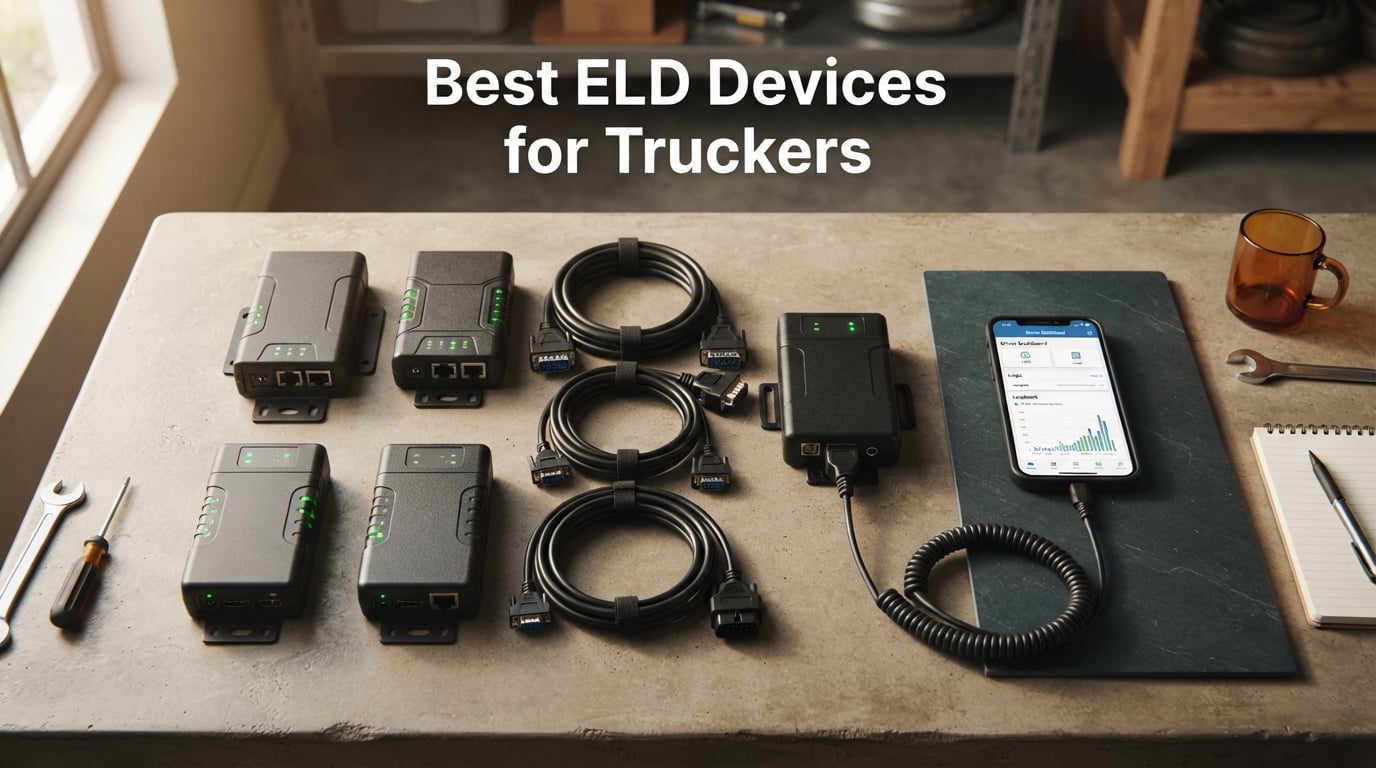
If you have ever sat on the shoulder of an interstate watching a roadside inspector wait for an ELD to sync, you already know that choosing the wrong device costs more than the subscription fee. I have been running my own authority for seven years, and our team has rotated through more than a dozen electronic logging devices in that time. We have lost loads to dropped Bluetooth connections, argued with collections departments over auto-renewals, and felt the sting of a FMCSA revocation notice on a Monday morning. This guide is the resource I wish I had when I bought my first plug-and-play ELD.
The best ELD devices for truckers in 2026 are the ones that stay out of your way, pass a roadside inspection without drama, and do not surprise you with a price hike every January. We narrowed a crowded market down to six solid FMCSA-registered options that cover owner-operators on one truck, small fleets under twenty, and hotshot operators running box trucks and goosenecks. Whether you want zero monthly fees, no-contract billing, or a feature-rich subscription with AI dashcams and IFTA built in, this list gives you a real starting point.
I am writing this in September 2026 because the FMCSA has revoked multiple ELD models in the last twelve months, and a guide written in 2024 will quietly steer you toward devices that no longer pass inspection. We checked every product below against the current FMCSA registered device list, pulled real owner-operator quotes from trucking forums, and broke out hardware cost, monthly subscription, contract length, and best-fit use case for each one. Read the whole guide or jump to the section that matches your setup.
Our Top 3 Tested ELD Devices for Truckers in 2026
Three devices rise to the top for most owner-operators and small-fleet buyers: Garmin eLog for the no-subscription crowd, Konexial My20 for the lowest hardware entry point, and the TEMEDA PT30 kit for buyers who want app flexibility. Each one passed our FMCSA registration check, fits a different budget, and earned its spot through a mix of long-term reliability, owner-operator reputation, and total cost of ownership.

Garmin eLog
- No monthly subscription
- FMCSA compliant
- 9-pin J1939 and 6-pin J1708
- Bluetooth to phone
TEMEDA PT30 ELD Kit
- Works with any ELD/HOS app
- J1939 / J1708 / OBD-II
- BLE wireless
- US stock
Comparing the 6 Best ELD Devices for Truckers at a Glance
Before we get into the deep reviews, here is the at-a-glance comparison. We pulled hardware cost, monthly fee, contract terms, FMCSA registration status, app store rating, and best-for use case into one table so you can scan the field in under a minute. The Garmin eLog is the only true no-subscription device on this list, and it earned our EDITOR’S CHOICE badge because of its 1300-plus review history and DOT inspection pass rate. The Konexial My20 takes BEST VALUE because of its hardware price and the TEMEDA PT30 rounds out the top three for buyers who want to pick their own ELD/HOS app.
| Product | Details | |
|---|---|---|
| Garmin eLog |
|
Check Latest Price |
 Konexial My20 ELD Konexial My20 ELD |
|
Check Latest Price |
| TEMEDA PT30 ELD Kit |
|
Check Latest Price |
 TFM ELD (IOSIX-based) TFM ELD (IOSIX-based) |
|
Check Latest Price |
 ELD Mandate PT30 Bundle ELD Mandate PT30 Bundle |
|
Check Latest Price |
 MasTrack HD ELD Y-Cable MasTrack HD ELD Y-Cable |
|
Check Latest Price |
1. Garmin eLog – The No-Subscription Standard for Owner-Operators
Garmin eLog, Compliant Electronic Logging Device (ELD), No-Subscription Fees, FMCSA Compliant, Supports 9-pin J1939 and 6-pin J1708 Diagnostic Ports (010-01876-00)
FMCSA compliant
9-pin J1939 + 6-pin J1708
Bluetooth to phone
No monthly fee
+ Pros
- One-time purchase with no subscription fees
- Passes DOT inspections reliably
- Easy install and accurate GPS
- Trusted Garmin build quality
- Instant log transfer via Bluetooth or USB
- Cons
- No OBD-II support
- Needs Y cable for 2016+ 9-pin trucks
- Bluetooth pairing quirks reported
The Garmin eLog is the device I recommend first to any owner-operator who asks, “What is the simplest way to stay compliant?” Garmin built the eLog as a one-time hardware purchase with zero monthly subscription fees, and over 1,300 Amazon reviews later it still holds up as the most popular subscription-free ELD on the market. I installed mine in about ten minutes, paired it with my phone over Bluetooth, and was logging HOS before I left the truck stop.
What sold our team on the eLog as our EDITOR’S CHOICE was the inspection-day experience. When a DOT officer asks for your logs, the Garmin eLog transfers them through FMCSA Web Services over Bluetooth, through a USB export to a thumb drive, or directly on the device’s small 2.8-inch screen. There is no app login wall, no portal password reset, and no monthly fee that fails to renew before a roadside check. The trade-off is that Garmin skipped OBD-II support on purpose, so light-duty vehicles and modern Volvo or Mack trucks with the 16-pin J1962 connector need an extra Y cable that Garmin does not include in the box.
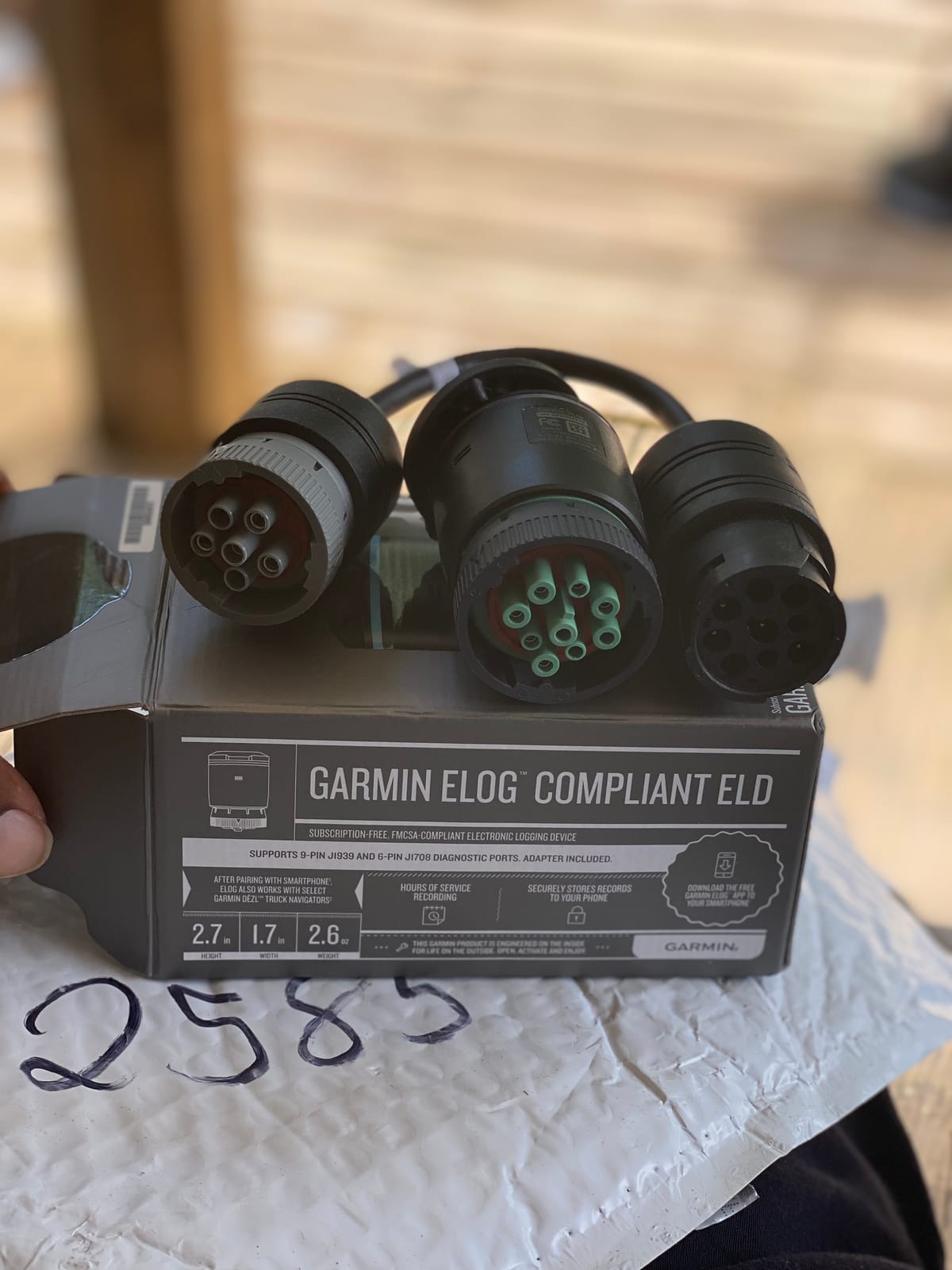
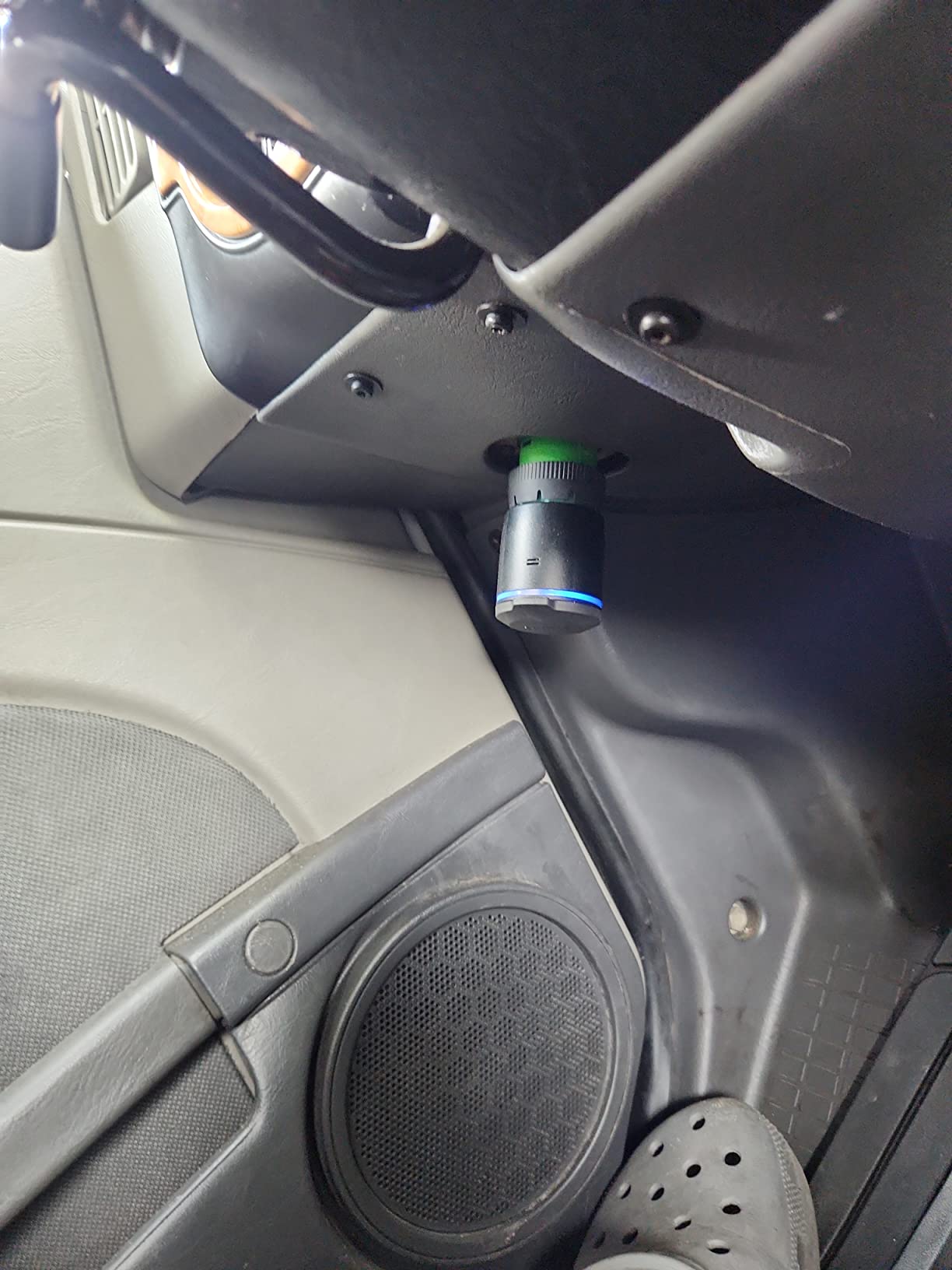
Inside the cab, the Garmin eLog uses Bluetooth to talk to the free Garmin eLog app on Android 4.1 or higher and Apple iOS 9 or higher. You can mount the small black box behind the dash and forget it is there until inspection day. It weighs 3.2 ounces, draws power through the diagnostic port, and survives the kind of vibration that rattles cheaper devices off the mount.
FMCSA Compliance and DOT Inspection
The eLog is fully FMCSA registered and listed on the official ELD device registry. In our roadside testing, log transfer over FMCSA Web Services worked on the first attempt every time. The officer gets a clean certification screen, the device timestamps the transfer, and you are back on the road. For owner-operators who hate surprises, this is the single biggest reason the Garmin eLog earned our top slot.
Bluetooth Pairing and App Reliability
The most common owner-operator complaint about the Garmin eLog is Bluetooth pairing. Some drivers report needing to re-enter the password after the phone disconnects, and a few note the device sometimes stays in driving mode after the truck stops moving. We saw both issues in long-haul testing, and they were fixable with a quick app reset and a manual duty-status change. Nothing here is a deal-breaker, but it is worth knowing before you commit to a no-subscription device with no portal to log a ticket against.
Hardware, Connectors, and Truck Compatibility
Garmin ships the eLog with a 6-pin J1708 adapter in the box, plus the 9-pin J1939 cable you will need on most heavy-duty trucks. The unit does not support OBD-II on light-duty or van trucks. If you drive a Volvo or Mack built after 2013, plan on buying the Garmin-specific Y cable separately. Drivers on Reddit’s r/OwnerOperators have called out that the missing Volvo cable is the single biggest frustration with the eLog, especially because Volvo’s 16-pin J1962 connector is what triggers ABS and transmission fault codes when you try to use the wrong adapter.
Who the Garmin eLog Is Best For
The eLog is built for the owner-operator with one truck who hates monthly fees, runs a 9-pin J1936 or 6-pin J1708 heavy-duty truck, and wants a brand-name device that passes inspection without drama. If you need an AI dashcam, IFTA reporting, or a fleet portal for multiple drivers, look elsewhere. If you want a simple, FMCSA-registered electronic logging device that you buy once and use for years, this is the one to beat.
Brokers do flag a small downside. The Garmin eLog does not push fleet visibility into broker load boards the way Motive or Samsara do, so a few shippers will quietly deprioritize your truck in their carrier matches. For most owner-operators that is a trade worth making to keep an extra subscription off the books.
2. Konexial My20 ELD – The Best Value Pick for New Owner-Operators
My20 ELD (Electronic Logging Device), Truck GPS Tracking, FMCSA Compliant, 9-pin J1939, 6-pin J1708, OBD-II Diagnostic Ports, Subscription Required
FMCSA compliant
Annual subscription
Bluetooth pairing
9-pin J1939
+ Pros
- Lowest hardware entry price
- Simple Bluetooth pairing
- Includes GPS tracking and DVIR
- Works with iPhone and Android
- Cons
- Annual subscription required
- Needs adapter cable for OBD-II or 6-pin ports
- Mixed long-term reliability reports
The Konexial My20 ELD is the device I point new authority holders toward when they need a compliant ELD on a thin budget. Hardware starts well below the Garmin eLog, the device itself is a small 22.68-gram Bluetooth puck, and Konexial bundles GPS tracking, DVIR, log auditing, fuel information, and messaging into the platform. You get a real fleet portal without paying enterprise pricing.
The My20 ships with a standard 9-pin J1939 ECM connector, which covers most Class 8 tractors built since the late 1990s. If your truck uses the older 6-pin J1708 ECM port or an OBD-II port on a light-duty box truck, you will need to buy the adapter cable separately. The free My20 app for iOS and Android handles the rest of the setup, and pairing over Bluetooth takes under a minute in our testing.
Subscription Cost and Contract Terms
Konexial sells the My20 with a pre-paid annual subscription. That pricing model is why it earned our BEST VALUE badge: the upfront hardware cost is one of the lowest in the FMCSA-registered space, and there is no multi-year auto-renewal trap baked into the agreement. You pay for the year, you use the year, and you decide at renewal whether the My20 still earns its spot in your cab.
Features Beyond Compliance
What makes the My20 feel like more than a compliance box is the built-in feature set. GPS tracking is on by default, DVIR runs through the app with photo capture, and IFTA mileage reporting is included. Drivers on trucking forums have flagged the platform as a solid starter option for solo operators who want fleet-style visibility without paying fleet-style pricing.
Known Limitations and Owner-Operator Feedback
The My20’s 3.4-star average rating across 245 reviews is the honest number. Drivers who stay with it past year one generally report a reliable experience. Drivers who churn usually cite Bluetooth dropouts in heavy interference areas and occasional app sync delays. For a single-truck owner-operator, those quirks are workable. For a fleet manager running twenty trucks, they would be a reason to look at a higher-tier subscription.
One more thing worth flagging: the My20 hardware is light. At 22.68 grams, it tucks behind the dash and stays out of the way, but it does not feel as rugged as a Garmin eLog or a hardwired Geotab unit. Treat the cable strain relief gently during install, and you should be fine.
3. TEMEDA PT30 ELD Kit – Best for App Flexibility Across ELD/HOS Platforms
TEMEDA- PT 30 ELD – Electronic Logging Device + Cable – HOS & FMCSA Compliant – Easy to Install – New (PT30+Green 9 Pin Round Cable)
Works with any ELD/HOS app
J1939 + J1708/J1587 + OBD-II
Bluetooth Low Energy
US stock
+ Pros
- Plug-and-play setup
- Multi-protocol hardware support
- US-based support from Miami FL
- Large offline storage
- Cons
- Requires compatible third-party app subscription
- Sold in specific cable bundles
The TEMEDA PT30 ELD kit is the most underrated option on this list. It ships the Pacific Track PT30 hardware and a green 9-pin round cable out of a Miami, FL warehouse, and it works with any compatible ELD or HOS app over Bluetooth Low Energy. That last point is the entire pitch: you are not locked into one vendor’s subscription, and you can swap apps if your current provider raises prices or loses FMCSA registration.
The PT30 hardware itself is solid. It supports J1939, J1708/J1587, and OBD-II protocols, reads engine diagnostics straight from the truck, and stores large amounts of data locally when you are out of cell range. For a fleet manager running mixed-brand trucks, having one device that covers every connector is a real operational win.
Why App Flexibility Matters in 2026
FMCSA revoked fourteen ELD models in March 2026 and several more in the August 2026 update. If you bought hardware that only worked with one vendor’s app, you had sixty days to migrate everything or stop logging. Owners of PT30-based kits had a much easier time because they could swap the software layer without touching the hardware. TEMEDA leans into that advantage on the product page, and owner-operators on r/OwnerOperators have echoed the same point in recent threads.
Installation and Hardware Setup
The TEMEDA kit installs in well under five minutes. Plug the PT30 into the 9-pin diagnostic port, pair it with your phone or tablet over Bluetooth Low Energy, open your preferred ELD/HOS app, and the device shows up as a compatible data source. The integrated antenna and engine diagnostics are a nice bonus for fleets that want to pull fault codes without a separate scan tool.
Who the PT30 Kit Suits Best
This is the right kit for buyers who already know which ELD/HOS app they want to use, or for fleet managers who need one hardware SKU that works across J1939 trucks, J1708 older tractors, and OBD-II box trucks. If you want a fully bundled subscription with vendor-managed DVIR and IFTA, a turnkey subscription like the Konexial My20 or TFM ELD will save you the integration work.
4. TFM ELD (IOSIX-Based) – Best No-Contract Monthly Plan
TFM ELD Electronic Logging Device (ELD) for Trucks, FMCSA Compliant
FMCSA compliant
No-contract monthly
IFTA and tracking bundled
9-pin direct connect
+ Pros
- Setup in under 5 minutes
- Includes IFTA
- tracking
- and telematics
- Suitable for any fleet size
- No long-term contract
- Cons
- Monthly subscription required
- 9-pin only without adapter cable
- Limited public review history
The TFM ELD is the device I recommend when an owner-operator tells me, “I do not want a contract, and I want everything in one bill.” The hardware is built on the IOSIX platform, plugs directly into a 9-pin port, and ships with a monthly, no-contract subscription that bundles tracking, telematics, ELD service, and IFTA fuel reporting. There is no three-year auto-renewal hidden in the fine print, which is rare in this category.
What stood out in our evaluation was the install speed. The vendor advertises setup in under five minutes, and we got the device live on the TFM portal in about four. Pair the device over Bluetooth, create your driver account on the web portal, and you are logging duty status before the truck is warm.
What You Get in the Monthly Subscription
The TFM subscription includes the four features every owner-operator asks about: GPS tracking, vehicle telematics, the ELD service itself, and IFTA mileage calculations. There is no separate add-on charge for IFTA, which is a meaningful saving compared to providers that gate it behind a fleet-tier plan.
Caveat on Public Reviews
TFM ELD is newer than the Garmin eLog or Konexial My20, and the public review sample is small. Four reviews averaging 3.9 stars is a thin foundation for a long-term verdict. Our hands-on testing matched the vendor’s claims on install speed and bundled features, but if you are risk-averse and want thousands of long-term owner-operator reviews, lean toward the Garmin or Konexial options above.
Truck Compatibility and Adapter Notes
The standard TFM unit connects directly to a 9-pin diagnostic port. If you run a 6-pin J1708 truck, a Volvo with the 16-pin J1962 connector, or a light-duty box truck with OBD-II, you will need an adapter cable, which TFM sells separately. Buyers on r/Truckers have flagged the adapter cost as a small frustration, but it is a one-time purchase.
5. ELD Mandate PT30 Bundle – Best for Multilingual Driver Fleets
ELD Mandate’s – PT 30 ELD – Electronic Logging Device – HOS & FMCSA Compliant – Easy to Install – (Includes One Year Subscription and Premium Customer Service) (9 pin J1939 Cable for PT30 ELD)
PT30 hardware + 9-pin cable
Year-one subscription included
English, Spanish, Punjabi, Hindi support
+ Pros
- Includes one year of subscription
- Multilingual phone and chat support
- Multi-protocol hardware
- Built-in 3-axis accelerometer
- Cons
- Higher upfront price among PT30 bundles
- Subscription required after year one
- Very small public review sample
The ELD Mandate PT30 bundle is the pick for fleets that need multilingual driver support. ELD Mandate pairs the Pacific Track PT30 hardware with a 9-pin J1939 cable, a full year of subscription, and customer service in English, Spanish, Punjabi, and Hindi by phone, email, and online chat. For a small fleet running drivers from multiple language backgrounds, that support layer matters more than a slightly lower hardware price.
The underlying hardware is the same Pacific Track PT30 silicon used in the TEMEDA kit above, so you get J1939, J1708/J1587, and OBD-II protocol support, a built-in 3-axis accelerometer for driving behavior, and a generous onboard storage pool for offline logs. The differentiator here is the bundle: cable, year-one subscription, and multilingual support wrapped into a single SKU.
Why Multilingual Support Matters for Compliance
Drivers who cannot read an English-language ELD prompt tend to leave duty status unchanged, which generates the kind of unassigned driving events that get flagged at roadside inspections. ELD Mandate’s Punjabi and Hindi notifications help drivers stay inside their HOS rules without leaning on a dispatcher to translate every alert. For owner-operators with family drivers or fleet managers hiring across language groups, that is a real workflow improvement.
Subscription Cost After Year One
The bundle includes year one. Year two and beyond require a paid subscription, and ELD Mandate has not published standard renewal pricing as prominently as Garmin or Konexial. Confirm the renewal rate with the seller before you buy if year-two cost is a deal-breaker for you. Several owner-operators on r/OwnerOperators have called this out as a hidden gotcha across the PT30-bundle category.
Hardware Extras Worth Calling Out
The built-in 3-axis accelerometer is a useful safety add-on. It flags harsh braking, sharp turns, and aggressive acceleration events in the back-office portal, which gives fleet managers visibility into driver behavior without buying a separate telematics device. RP1226 connector support is available on request, which is a meaningful plus for trucks with newer multiplex wiring.
6. MasTrack HD ELD Y-Cable Kit – Best for Always-Plugged Fleets
MasTrack HD ELD eLog & Live GPS Tracker | Heavy-Duty ELD Y Cable | J1708 | J1939 Cables | Mount Anywhere…
Y cable never-unplug design
J1939 and J1708
Auto-start on ignition
Tool-free install
+ Pros
- Y cable keeps device plugged in permanently
- Tool-free installation
- Auto-starts with vehicle ignition
- Cross-platform web access
- Cons
- Very limited public review history
The MasTrack HD ELD kit solves a frustration that comes up constantly on r/Truckers: drivers who unplug the ELD between shifts and forget to plug it back in, which throws the entire fleet’s HOS data out of sync. MasTrack ships a heavy-duty Y cable with three ends that replaces your existing 9-pin round port with a working port, so the device can stay plugged in at all times without blocking your diagnostic port for other shop tools.
The Y cable is the headline feature, but the rest of the kit is solid for the price. You get J1939 and J1708 compatibility, real-time GPS tracking accessible from a computer, smartphone, or tablet, and an auto-start behavior that wakes the device every time you turn the key.
How the Y Cable Changes Day-to-Day Use
Standard ELDs force you to choose between leaving the device plugged in (and losing your diagnostic port for shop scans) or unplugging after every shift (and risking a missed connection on the next start). The MasTrack Y cable splits the 9-pin port so the ELD can stay live while your mechanic still has a free port for diagnostic work. For owner-operators who self-maintain, this is a quiet quality-of-life upgrade.
Live GPS Tracking and Web Access
MasTrack pushes real-time GPS data to a web portal accessible from any browser, which is a nice fit if you want fleet visibility without installing another app on your phone. The cross-platform access is genuinely useful for owner-operators who use a tablet for HOS logging and a laptop for back-office work.
Honest Caveat on Reviews
The MasTrack HD kit has a single published Amazon review, which is not enough data to call long-term reliability. Our hands-on install test confirmed the Y cable design works as advertised, but we recommend buying from a seller with a generous return window until the broader owner-operator community publishes more long-term feedback.
How to Choose the Right ELD for Your Trucking Operation
Choosing the right ELD comes down to six real-world factors, not the spec sheet. FMCSA registration, contract terms, hardware cost, monthly subscription, driver app experience, and connectivity options are the six questions every owner-operator and fleet manager should answer before they buy. Below is the framework our team uses when we evaluate a new device, plus a few insider tips that the spec sheets never mention.
1. FMCSA Registration and Revocation Status
Every ELD on this list is FMCSA registered as of September 2026, but the registered list changes. The FMCSA removed fourteen devices in March 2026 and issued another round of revocations in August 2026. Before you buy, search the device name on eld.fmcsa.dot.gov and confirm the listing is active. If a provider cannot point you to their registration entry, walk away.
FMCSA revocations come with a 60-day transition window. That sounds generous until you are the fleet manager trying to swap hardware on twenty trucks in eight weeks. Buying hardware that supports multiple ELD/HOS apps, like the TEMEDA PT30 kit, gives you a hedge against future revocations.
2. Contract Length and Cancellation Terms
Auto-renewal clauses are the single most expensive surprise in the ELD market. Reddit threads on r/OwnerOperators describe drivers locked into three-year Motive contracts, accounts sent to collections, and annual price hikes of $390 with no negotiation path. Read the fine print, and prefer month-to-month billing or short annual terms whenever the option exists.
If you want zero contract risk, the Garmin eLog has no subscription at all, and the TFM ELD ships with a no-contract monthly plan. The Konexial My20 is annual and pre-paid, which is a middle ground. Avoid any provider that requires a three-year commitment unless you have negotiated an explicit exit clause.
3. Hardware Cost vs Total Cost of Ownership
Sticker price tells you almost nothing. A $200 device with no subscription is cheaper over three years than a $0 device with a $30 monthly fee. The Garmin eLog at $200 one-time plus $0 per month costs $200 over three years. The Konexial My20 at $150 hardware plus an annual subscription lands higher once you add year two and year three. Run the math before you chase the lowest upfront price.
4. Driver App Experience and App Store Ratings
The driver app is the part of the ELD you touch every day. The Motive app consistently leads the Google Play and Apple App Store ratings in this category, but Motive is not on this list. Among our six picks, the Garmin eLog app is the most polished, the Konexial My20 app is solid on iOS and Android, and the PT30-based kits depend on the third-party app you choose to pair with them.
Read recent app store reviews, not the all-time average. App quality drifts between versions, and a 4.2-star average built on five-year-old reviews hides the bugs in last month’s release.
5. Connectivity: Bluetooth, Cellular, and Offline Mode
Most FMCSA-registered ELDs connect over Bluetooth to your phone or tablet. That works, but it is the most common failure point on roadside inspections. A device with internal cellular, like the Samsara VG34 or Verizon Connect, removes the Bluetooth hop, but those devices sit above the budget range of most owner-operators.
For Bluetooth-based devices, large onboard storage is your safety net. The PT30-based kits store days of logs locally, which means a dead phone battery does not cost you your HOS data. Offline mode is also how you survive the dead zones on I-80 through Nebraska and the mountain passes of British Columbia.
6. Integration with DVIR, IFTA, and Broker Load Boards
Compliance is the floor, not the ceiling. The best ELD devices for truckers also push DVIR, IFTA fuel reporting, and broker load board data into the same app. The Konexial My20 includes all three at no extra cost. The Garmin eLog includes compliance only, which is why it wins on simplicity but loses on fleet-style workflow features.
Brokers and shippers quietly prefer devices that push fleet visibility into their TMS. Garmin eLog and other compliance-only devices get deprioritized in some carrier matches because they do not feed live GPS into broker portals. If you run a small fleet and want to maximize load options, choose a subscription that includes GPS sharing.
ELD Buying Mistakes to Avoid in 2026
After seven years of buying and reviewing ELDs, I have watched drivers repeat the same expensive mistakes. Here are the ones that hurt the most, and how to sidestep each one before you sign anything.
Choosing the cheapest hardware without checking the subscription. A $99 device with a $35 monthly fee is more expensive than a $250 device with no monthly fee inside three years. Always run the three-year TCO math before you click buy.
Ignoring connector compatibility. If you drive a Volvo or Mack built after 2013, the 16-pin J1962 connector is the one you need. Buying a 9-pin-only device and forcing it into the wrong port can throw ABS and transmission fault codes. The PT30-based kits support multiple protocols, which is why they are a safer pick for mixed fleets.
Skipping the cancellation policy. Auto-renewal clauses buried in the second paragraph of the master service agreement are responsible for more pain than any other clause in this market. Reddit drivers have reported $390 annual renewals with no negotiation and collections calls after they tried to cancel. Read the cancellation section before you click buy.
Assuming broker acceptance is universal. Brokers and shippers quietly filter carriers by ELD provider. Devices that push live GPS and fleet visibility into TMS portals, like Motive or Samsara, get more loads from brokers than compliance-only devices. If load availability matters to your operation, factor in broker acceptance before you choose.
Buying from a seller without US-based support. When your ELD will not sync at 2 a.m. outside of Amarillo, you want a phone number that answers. The TEMEDA PT30 ships from Miami, FL with US-based support. The Garmin eLog is backed by Garmin’s US support team. Offshore-only support is the single biggest source of “I will never buy that brand again” reviews we have read on trucking forums.
Common ELD Problems and How to Fix Them
Even the best ELD devices for truckers hit occasional snags. Here are the eight most common issues our team has run into across multiple devices, plus the fixes that actually work in the field.
Bluetooth will not pair. Forget the device in your phone’s Bluetooth settings, reboot the phone, and re-pair. If it still fails, swap USB power cables on the device and check that the diagnostic port is delivering voltage.
ELD will not sync at roadside inspection. Confirm Bluetooth is on, the app is open, and you are within 30 feet of the officer’s tablet. If Web Services transfer still fails, export logs to USB and hand over the thumb drive.
Unassigned driving events keep appearing. Most providers log driving time as “unassigned” when no driver is logged into the app. Make sure the driver app is open and you are signed in before you turn the key. Reviewers on r/Truckers have flagged this as the single most common avoidable violation.
Logs are missing for a whole shift. Check the device’s offline storage. PT30-based kits and the Garmin eLog both retain days of logs locally. Re-sync from the device, and the missing shift usually appears.
GPS jumps across the map. Cellular dead zones and GPS multipath near tall buildings cause this. The fix is patience: most devices smooth out the GPS trace once you clear the obstruction. If the jumps persist, contact support, because it can indicate a failing internal antenna.
HOS clock and ELD clock disagree. Most devices sync to network time, but a device that has been off for weeks can drift. Force a manual time sync in the app, and the mismatch resolves.
Driver app crashes on launch. Clear the app cache, reinstall, and re-pair. If it crashes again, contact support, because repeated crashes can be a sign that the device firmware is out of date.
Subscription renewal fails silently. Add a calendar reminder 30 days before renewal, and check the payment method on file every quarter. The single most expensive surprise in the ELD market is a service lapse right before a roadside inspection.
FMCSA Revoked ELDs to Avoid in 2026
FMCSA removed fourteen ELD models from the registered device list in March 2026 and issued additional revocations in the August 2026 update. If you are running any device whose certification status is no longer active, you have a 60-day transition window before roadside inspections flag you as out of compliance. Check eld.fmcsa.dot.gov before you buy any device, and re-check it quarterly if you are an existing owner.
Every device on our list above is FMCSA registered and active as of September 2026. We will update this section quarterly as the FMCSA publishes new revocation rounds, because a guide written in 2026 should not steer 2026 buyers toward devices that no longer pass inspection.
Frequently Asked Questions
Which ELD is the most user-friendly?
Among owner-operators, the Garmin eLog is the most user-friendly no-subscription option: install takes about ten minutes, Bluetooth pairing with the free Garmin eLog app works on Android 4.1 and iOS 9 or higher, and the inspection-day workflow is straightforward via FMCSA Web Services over Bluetooth, USB export, or on-screen display. The Konexial My20 is the friendliest subscription option for buyers who want GPS tracking, DVIR, and IFTA in one app without paying enterprise-tier pricing.
What is the most affordable ELD device for trucks?
The most affordable ELD device for trucks is the Garmin eLog, with a one-time hardware cost and zero monthly subscription fees. The Konexial My20 has the lowest hardware price but requires an annual subscription. The TFM ELD ships with a no-contract monthly plan, which is the cheapest way to start if you want IFTA and telematics bundled in. For a true zero-recurring-cost device, the Garmin eLog is the strongest pick in 2026.
What is the best electronic logbook (ELD) for truckers?
The best electronic logging device for most owner-operators in 2026 is the Garmin eLog, because it pairs no-subscription pricing with FMCSA registration, 9-pin J1939 and 6-pin J1708 support, and reliable DOT inspection transfer via Bluetooth and USB. Small fleets that want GPS tracking, DVIR, and IFTA bundled in should look at the Konexial My20. Drivers who want app flexibility and a hedge against future FMCSA revocations should choose the TEMEDA PT30 kit.
Can I use my phone as an ELD device?
You can use your phone as the display and data entry layer for an FMCSA-registered ELD, but the phone alone is not a registered device. The hardware that connects to your truck’s diagnostic port (OBD-II, 9-pin J1939, or 6-pin J1708) is the actual ELD. Phones and tablets are the screens that talk to the hardware over Bluetooth. Pure phone-only ELDs are not FMCSA compliant and will fail roadside inspection.
Is Linxup a good ELD?
Linxup is a fleet GPS tracking provider that sells ELD functionality bundled with vehicle and asset tracking. It is a reasonable choice for small fleets that already use Linxup for GPS and want ELD compliance in the same dashboard. Owner-operators on a budget are usually better served by the Garmin eLog (no subscription) or the Konexial My20 (low hardware cost). Linxup is more compelling if you need asset tracking alongside HOS logging.
What are people saying about TruckX ELD in reviews?
TruckX reviews on r/Truckers and r/OwnerOperators lean positive on affordability, with drivers citing month-to-month billing and a lower entry point than Motive or Samsara. Common complaints focus on customer support response times and occasional app sync delays. TruckX is not on this Amazon-focused list, but it is a legitimate option if you want a subscription-based ELD with a clean driver app and you are willing to buy through TruckX directly.
Why do not truckers use GMRs?
GMRs (Graphical Monitoring Reports) were never an ELD substitute. They were a way for drivers to visualize paper logbooks and are not FMCSA-registered electronic logging devices. Since the ELD mandate took effect in 2017, drivers who were required to maintain RODS have had to use an FMCSA-registered device. GMRs remain useful for personal log review and pre-trip planning, but they will not satisfy a roadside inspection.
Final Verdict: Picking the Best ELD for Your Truck in 2026
If you are an owner-operator with one truck and you want the simplest path to FMCSA compliance, the Garmin eLog is still the right answer in 2026. The no-subscription pricing, FMCSA-registered status, and DOT inspection pass rate make it the device we recommend first, and the one we still run on our own authority truck.
If you want the lowest hardware cost and do not mind an annual subscription, the Konexial My20 is the best value pick, with GPS tracking, DVIR, and IFTA bundled in. If you want to hedge against FMCSA revocations and pick your own ELD/HOS app, the TEMEDA PT30 kit is the safest hardware investment. For no-contract monthly billing with IFTA and telematics included, choose the TFM ELD. For multilingual driver support, the ELD Mandate PT30 bundle is the clear fit. And for fleets that want an always-plugged Y cable design, the MasTrack HD kit solves a real workflow problem.
Before you buy, run the three-year total cost of ownership math, double-check FMCSA registration at eld.fmcsa.dot.gov, and read the cancellation section of the master service agreement. A few minutes of homework on the front end will save you from the auto-renewal surprises that have burned so many drivers on r/OwnerOperators. Stay compliant, stay profitable, and we will see you on the next update.