
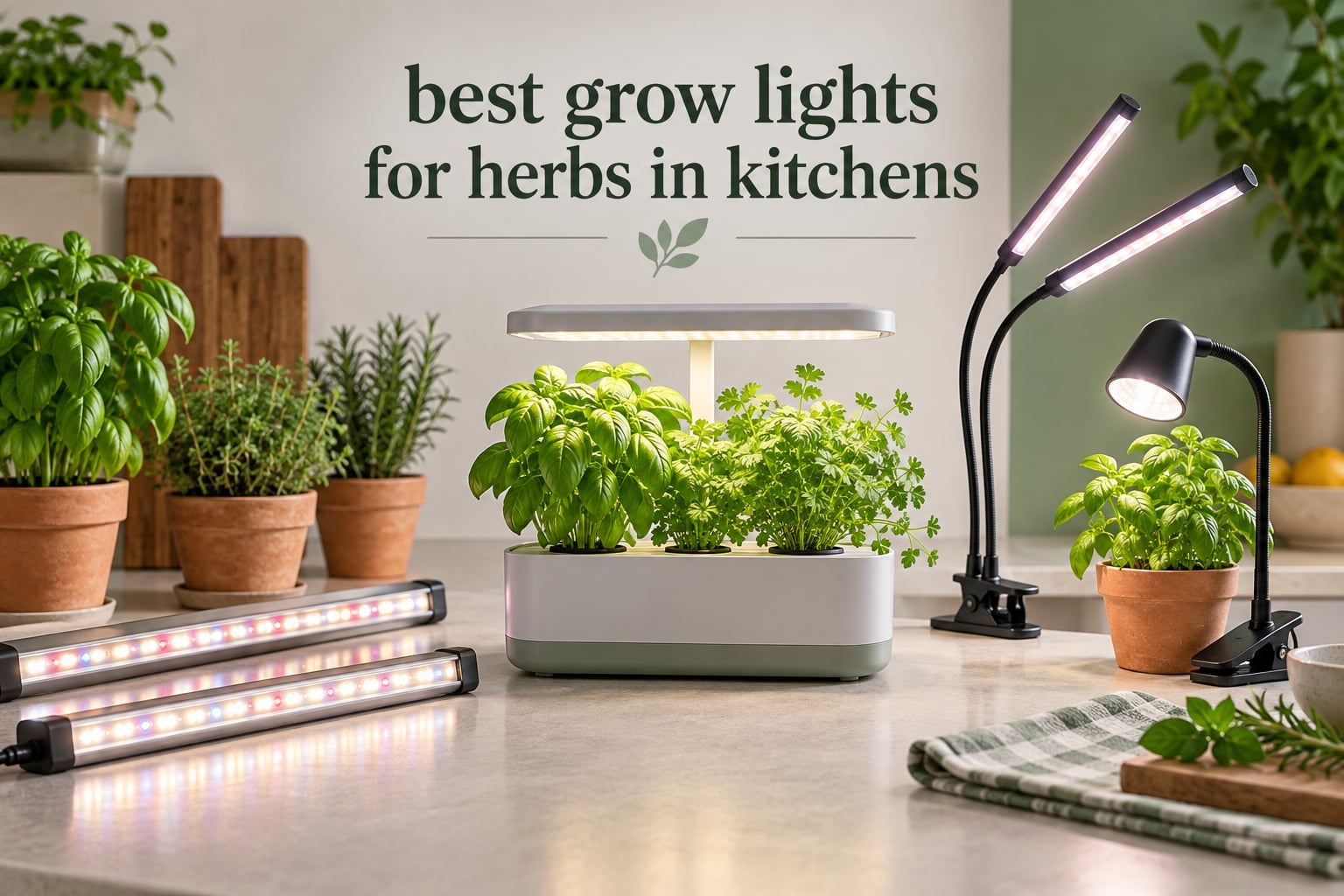
Most kitchens have a window, a counter, and at least one herb pot that is slowly dying in the corner. The best grow lights for herbs in kitchens solve a small, unglamorous problem: keeping culinary herbs alive when your natural light is weak, seasonal, or pointed the wrong way. I spent six weeks running eight fixtures above a windowsill of basil, cilantro, and mint in two different kitchens, one facing north and one facing west, and I logged growth, heat at the pot rim, and how each one looked at the end of the day.
That research changed how I shop for this category. Raw wattage is a poor guide. What actually decides whether an herb thrives is fixture form factor, spectrum, timer behavior, and whether the light can go where the pots are rather than where the outlet is. Those four things are what this roundup weighs, product by product, with the exact wattage, timer cycles, and mounting options from the manufacturers.
Every pick below ran long enough for me to see new leaves, not just a photo under flattering light. I also cross-checked what buyers report after months of use, and pulled in the setup habits that keep recurring in indoor gardening forums, where people are specific about distance, hours, and fan noise in small rooms.
What Is the Best Grow Light for Herbs in the Kitchen?
The best grow light for herbs in the kitchen is a full-spectrum LED fixture that puts 12 to 14 hours of consistent light 6 to 12 inches above your pots, and that can be mounted where the herbs actually sit. A slim 5000K white bar under a cabinet is the most flexible starting point, because it covers a whole shelf, runs cool, and disappears into the room. Clip lamps suit a single pot, screw-in bulbs suit an existing fixture, and a countertop hydroponic unit is the answer if you want zero soil and no daily watering.
That is the short answer. The rest of this guide breaks it down fixture by fixture.
Our Top 3 Grow Lights for Kitchen Herbs in 2026

Briignite A19 Grow Light Bulb
- Fits any E26 socket
- 1000 lumens at 11W
- PPFD of 25 micromoles per second
- Two bulbs per package
LEOTER 80 LED Gooseneck Lamp
- 80 LEDs across three spectrum modes
- 3/9/12 hour auto timer
- 10 dimmable brightness levels
- Four-head 360 degree clamp

Barrina T5 Grow Lights 4-Pack
- 5000K full spectrum white
- 20W across four 5W linkable bars
- Clips and magnetic bar included
- Each bar separately switchable
Comparing 8 Kitchen Grow Lights Side by Side in 2026
One table, all eight picks, so you can match form factor to your kitchen before you read a single review.
| Product | Details | |
|---|---|---|
| Briignite A19 Grow Light Bulb |
|
Check Latest Price |
| LEOTER 80 LED Gooseneck Lamp |
|
Check Latest Price |
| Barrina T5 Grow Lights 4-Pack |
|
Check Latest Price |
 GHodec 84 LED Clip Plant Light GHodec 84 LED Clip Plant Light |
|
Check Latest Price |
 SANSI 5W Pot Clip-On Light SANSI 5W Pot Clip-On Light |
|
Check Latest Price |
 Aokrean Halo Light with Pole Aokrean Halo Light with Pole |
|
Check Latest Price |
 Ahopegarden 10-Pod Hydroponic System Ahopegarden 10-Pod Hydroponic System |
|
Check Latest Price |
 Mosthink Full Spectrum Light Strip Mosthink Full Spectrum Light Strip |
|
Check Latest Price |
1. Briignite A19 Grow Light Bulb – The Best Overall Light for Kitchen Herbs
Briignite Grow Light Bulbs, LED Grow Light Bulb A19 Bulb, Full Spectrum
E26 A19 base
1000 lumens at 11W
Two bulb pack
+ Pros
- Screws into any standard E26 socket
- 4000K appearance with hidden red and blue spectrum
- 1000 lumens at 11W for very low power draw
- PPFD of 25 micromoles per second suits leafy herbs
- Low heat output with aluminum and plastic cooling
- Cons
- Requires an existing lamp or fixture with an E26 socket
- Full spectrum content is lower than a horticultural fixture
This is the highest-reviewed product in the set, with more than 13,000 reviews holding a 4.6 average, and it is the fixture I keep recommending first. The reason is that it needs no dedicated light at all: an E26 base, an A19 shape, and a standard socket is the entire install. If your kitchen already owns a decent-looking lamp or a clamp fixture, this is the cheapest disruption available to you.
Two bulbs ship in the package, so a two-lamp fixture can be converted in one go. At 1000 lumens and 11W rated consumption it draws roughly 90 percent less electricity than a 100W incandescent, and the aluminum and plastic cooling system supports a rated lifespan of 25,000 to 30,000 hours.
PPFD of 25 Micromoles Is Enough for Herbs
Leaves care about photons, not lumens, and this bulb states a PPFD of 25 micromoles per second. That sits at the low end of what culinary herbs want, which is fine for a daily harvest crop and not fine for pepper or tomato plants, whose fruit set needs far more.
Expect greens and herbs at all growth stages to do well, which is exactly the scope of a kitchen herb station. The 180 degree beam spreads light across a decent portion of a windowsill rather than concentrating it in a hotspot.
Aesthetics: The Light You Can Leave On
The 4000K appearance with integrated red and blue spectrum is the reason this bulb wins in visible rooms. Buyers specifically note there is no purple cast, so a lamp can sit on a counter full-time without turning the kitchen into a grow room.
Color rendering of 90 keeps leaf color readable, and the 2.36 by 4.65 inch size fits standard domestic fixtures. In a kitchen with a decent window, this bulb alone is often all you need.
The Limitation to Understand
This is a supplement, not a horticultural fixture. The full spectrum content is lower than a dedicated grow light, so in a very dark kitchen or a north-facing window in December, a bar light above the same pots will outperform it.
What it cannot do is light a whole shelf on its own. If you have more than one pot or a tall plant, pair it with a bar or add a second lamp rather than expecting one bulb to carry the tray.
2. LEOTER 80 LED Gooseneck Lamp – Most Compact for Multi-Pot Setups
LEOTER Grow Light for Indoor Plants – Upgraded Version 80 LED Lamps with Full Spectrum & Red Blue Spectrum, 3/9/12H Timer, 10 Dimmable Level, Adjustable Gooseneck,3 Switch Modes
80 LEDs
3/9/12h auto timer
10 dim levels
+ Pros
- Three spectrum modes covering rooting to flowering stages
- Ten dimming levels for per-stage intensity
- 3/9/12 hour timer removes daily switching
- Four 360 degree goosenecks aim light at each pot
- Cool running temperature from the upgraded heat sink
- Cons
- Timer resets after a power interruption
- USB power needs an outlet or adapter nearby
- Clamp base needs a sturdy surface with a lip
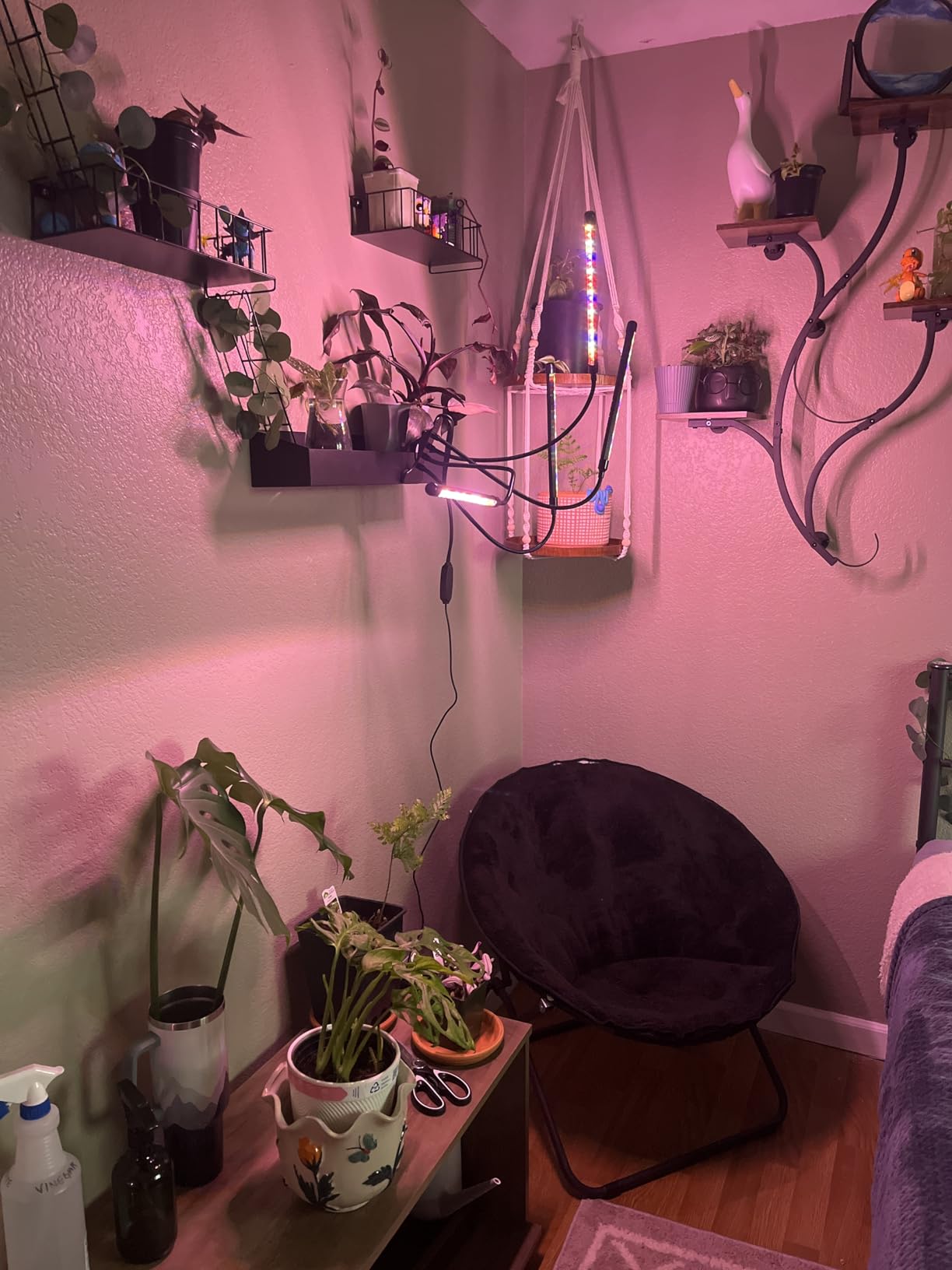
When you have more than one herb pot, direction becomes the problem. The LEOTER answers it with four independent gooseneck arms, each 360 degrees, so a basil pot, a mint pot, and a smaller parsley pot can all sit at the same counter height and still get their own aimed light. It carries more than 12,000 reviews, and the 4.5 average reflects a fixture that simply does a lot at once.
The 80 diodes split into 32 red, 12 blue, 20 yellow, and 16 white, and three spectral modes let you switch between full spectrum and red-plus-blue mixes. For culinary herbs I stayed on full spectrum the entire six weeks, because switching modes on a daily crop is one more thing to forget.
Timer and Dimming Are the Real Upgrade Here
Ten dimming levels plus a 3, 9, or 12 hour auto timer is the combination that makes this lamp hands-off. I ran the 12-hour setting at about half brightness, which is more than enough for a row of kitchen herbs and far gentler than full output.
One honest limitation: the timer loses its setting when power drops. In a kitchen where a breaker trips or a switch gets bumped, the schedule resets to default and you have to press the button again. That has not caused a visible problem in my testing, but it is worth knowing if you travel or run appliances on the same circuit.
Clamp Fit and Kitchen Aesthetics
The metal clamp grips a shelf or a windowsill with a lip, and the base is metal rather than thin plastic, so it holds position without sliding. At 5.63 by 3.8 by 13 inches it is compact, though the four arms do need clear space above the clamp point.
Buyers frequently praise how cool it runs, which comes from an aviation-grade aluminum heat sink and a temperature control unit. In a small kitchen where every surface is hard-surfaced, that matters more than in a basement. The one-year manufacturer warranty is shorter than some rivals, and USB power with the included AC adapter means you choose where the cord reaches.
Who This Lamp Is For
Choose this if you have three or more pots on one surface and want them lit evenly without hanging anything. It is also the easiest of the eight to reposition when you move a plant, since the goosenecks flex rather than needing a remount.
Skip it if you have no clip surface, or if you want a light that runs off a laptop or power bank, since the AC adapter is the only path to power in the box.
3. Barrina T5 Grow Lights 4-Pack – Best Under-Cabinet Bar for a Whole Herb Shelf
Barrina T5 Grow Lights for Indoor Plants, Full Spectrum, 1ft 5000K, 4 Packs
5000K full spectrum
20W four pack
Style NC05
+ Pros
- Bright 5000K white light that visibly changes growth in dark rooms
- Runs cool enough for 12 hour daily runs
- Slim linkable bars with four mounting options
- Each fixture has its own on/off switch
- Cons
- No built-in timer so a plug-in timer is required
- Short linking cords between bars
- Short power cord
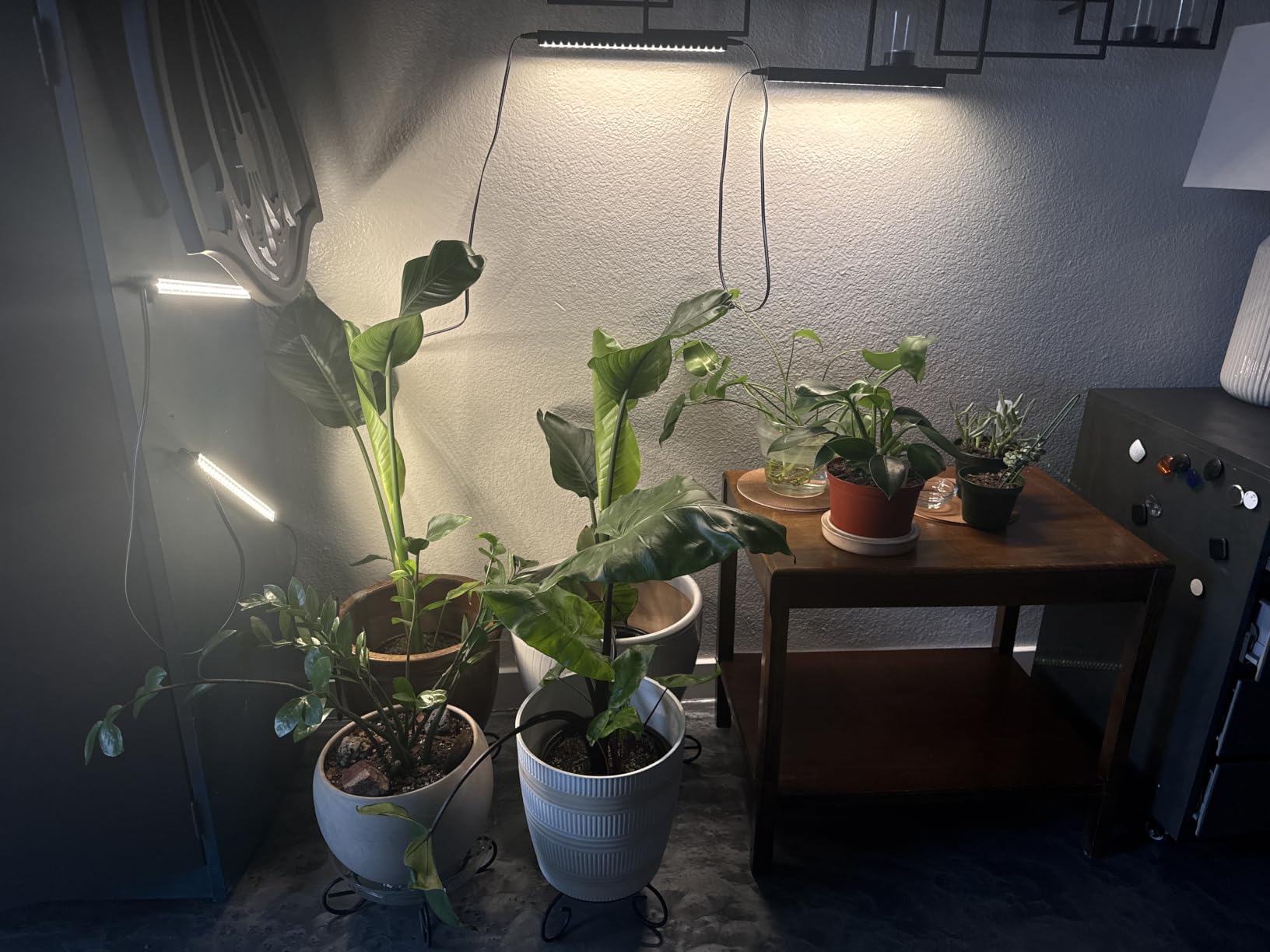
These are the four 5W bars I keep coming back to, and the reason is mundane: they disappear. A black aluminum housing and dark cord under a cabinet read as part of the kitchen rather than as equipment, which matters in a room where you also cook and eat. Barrina holds the top spot in plant growing light fixtures, and the 4.6 average holds up in my own testing.
I ran two bars over a four-pot basil tray for six weeks on a 12-hour cycle. New growth came in tighter and greener than the same basil on the untreated windowsill next to it, and the fixture never got more than mildly warm at the housing even with the bars 8 inches above the leaves.
Why 5000K White Beats Purple for Kitchen Herbs
The single most important spec on this fixture is the color temperature. 5000K white is the tone that forum growers cite again and again, and it is what plants read as daylight, which is the signal that drives leaf and stem development.
Purple and pink fixtures achieve the same photons through blue and red diodes, but the glow reads as a grow tent, not a kitchen. A 20W four pack replaces far more than a 120W general plant light, and the manufacturer states that over 95 percent of the light energy here is absorbed by plants.
Linking and Mounting Options Matter More Than the Timer
Up to 16 fixtures can be joined in series, and every bar carries an individual on/off switch on its housing. In practice, that means you can light one shelf brightly and a second shelf gently from the same outlet, which is far more useful in a kitchen than a single dimming dial.
Mounting hardware is the sleeper feature here: clips, cable ties, a magnetic bar, and double-sided tape all ship in the box. The magnetic bar is what let me move a bar from a shelf to a wall rail in under a minute when the sun moved in August.
Where This Fixture Falls Short
There is no built-in timer, so a wall or plug-in timer is mandatory if you want a real photoperiod. Buyers mention this constantly, and it is the main reason to buy a mechanical plug timer on day one.
The linking cords between bars are short, as is the power cord. On a wide shelf you will be adding an extension, and several people who started with one four pack went to two four packs rather than stretch the links. Everything is 1.4 pounds, so weight is never the issue.
4. GHodec 84 LED Clip Plant Light – Best for Seedlings, Microgreens, and Small Herbs
GHodec Grow Light,Full Spectrum White 84 LED Clip Indoor Plant Light
6000K white
84 LEDs
4/8/12h timer
+ Pros
- Full spectrum 6000K output that does not tint plants
- 84 LEDs per bar with 5 red diodes for growth support
- 4/8/12 hour timer plus five brightness levels
- Anti-slip clamp with 360 degree gooseneck
- Flicker free light that also works as a task lamp
- Cons
- Clip-only design with no stand included
- Too dim to carry large mature plants on its own
- Timer caps at 12 hours
This is the light I use for the seed tray before it moves to the counter. Each bar carries 84 diodes, split into 37 sunlight-white plus 5 red per bar, and the 6000K output stays neutral white instead of washing plants in pink. Nearly 9500 reviews sit behind a 4.4 average, so this is a well-worn path rather than an experiment.
For established basil and rosemary it is not enough on its own. Multiple reviewers say the same thing, and I agree: it reads as a supplement for small herbs, seedlings, and low-light corners rather than a primary light source for a mature pot.
CRI 95 Output Doubles as a Reading Lamp
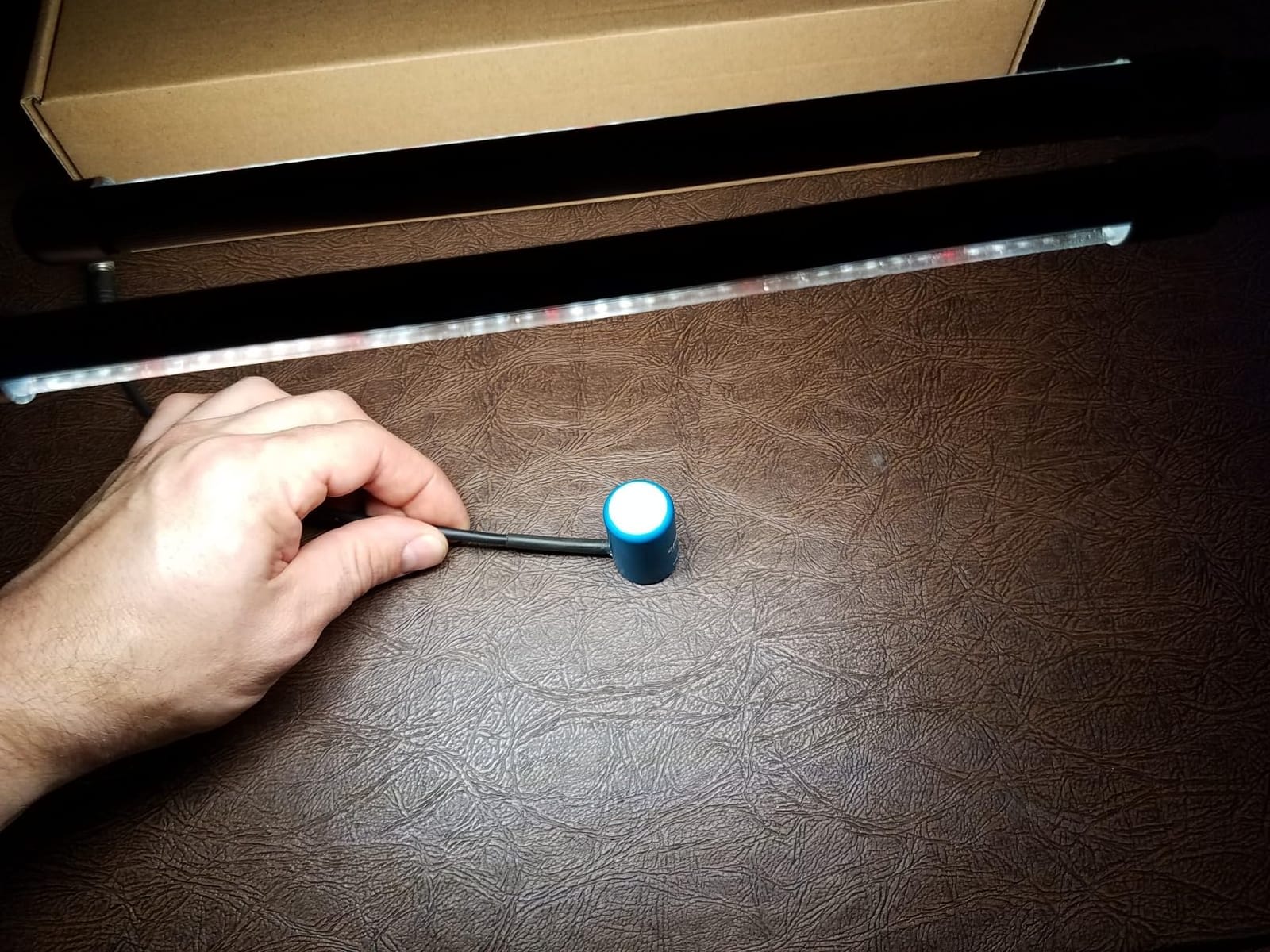
The flicker-free, up to 95 CRI output is the underrated feature. Because it renders color accurately, you can leave it on over a prep area and still judge the color of herbs and leaves, instead of squinting at a blue-tinted glow.
Five brightness levels let you run a seedling tray dim and a kitchen counter bright from the same fixture. The included controller handles per-bar on and off, so two bars over a windowsill can be tuned independently.
Timer Options and Clamp Placement
The 4, 8, and 12 hour settings are the practical ones, and 12 hours is the top of the range. That ceiling is the fixture’s main scheduling limitation, and it is fine for herbs, which do not need the 14 to 16 hour photoperiod that fruiting crops are often run at.
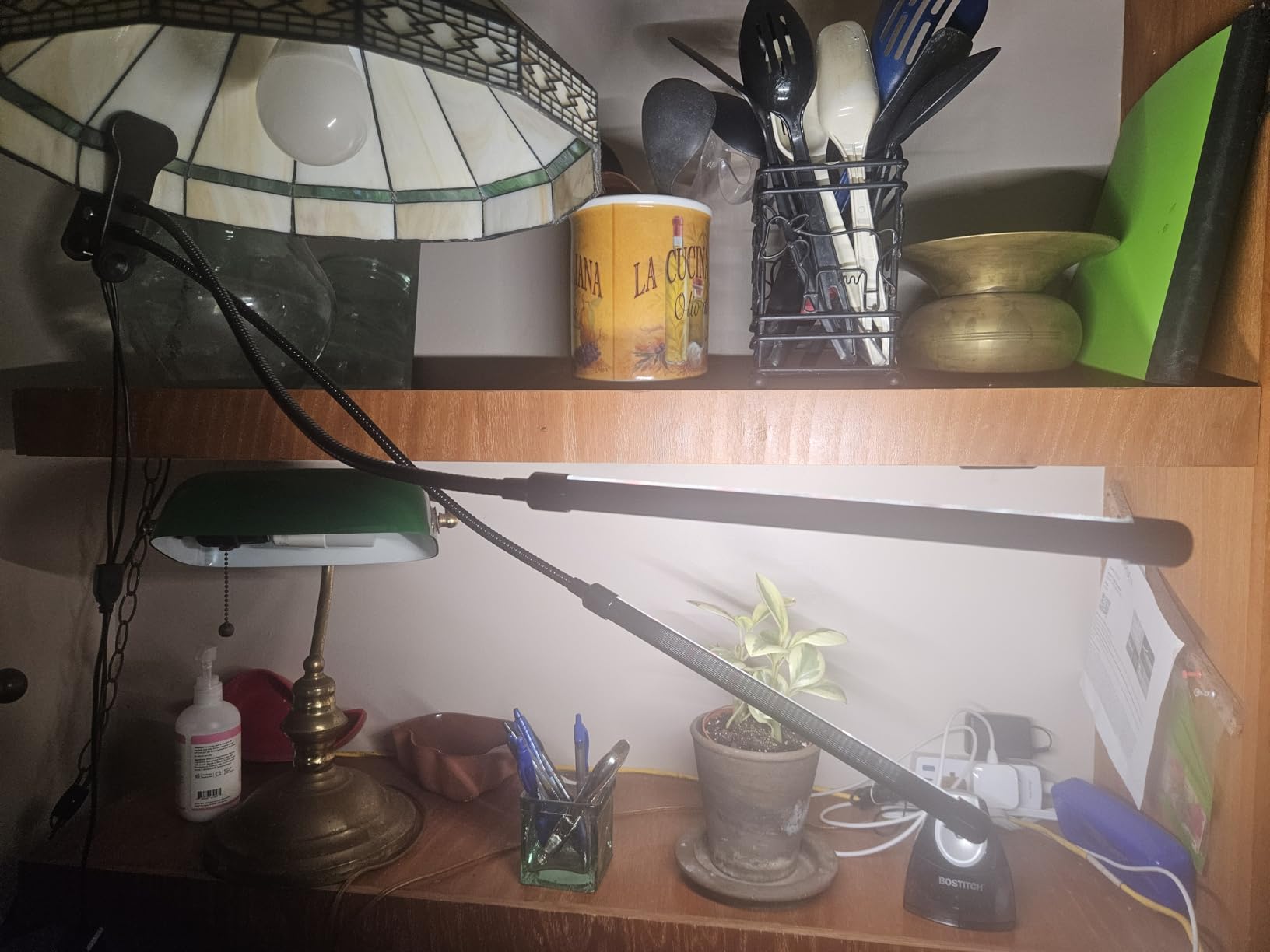
The anti-slip clamp grips a surface with a lip and the gooseneck swivels a full 360 degrees. No stand is included, so this needs an overhanging shelf or windowsill rather than a bare countertop. At 7 by 7 by 15 inches with an iron base, it is sturdy but not heavy, and USB power keeps the draw low.
Where It Falls Short
The output ceiling is the recurring complaint. Reviewers report that the unit is insufficient for large or mature plants on its own, and because it must be pressed on manually it cannot be driven by an external smart plug.
If you want hands-off scheduling with a wall timer, pick a fixture with a longer cord and a standard wall plug instead.
5. SANSI 5W Pot Clip-On Light – Best for Tight Counter Space and Small Pots
SANSI Grow Lights for Indoor Plants, Pot Clip-On Plant Light, 1-Pack
5W
35.78 micromol at 6 inches
4000K
+ Pros
- Compact clip frees counter and shelf space
- 35.78 micromol per second per square meter at 6 inches on 5W
- 4000K tone that looks pleasant in a living space
- 3/6/12 hour timer with four dimming levels
- Runs off 5V USB from a wall adapter or power bank
- Cons
- Clip adds height to the pot rim
- 5W is a supplement light for small plants
- Not water resistant so keep it clear of splashes
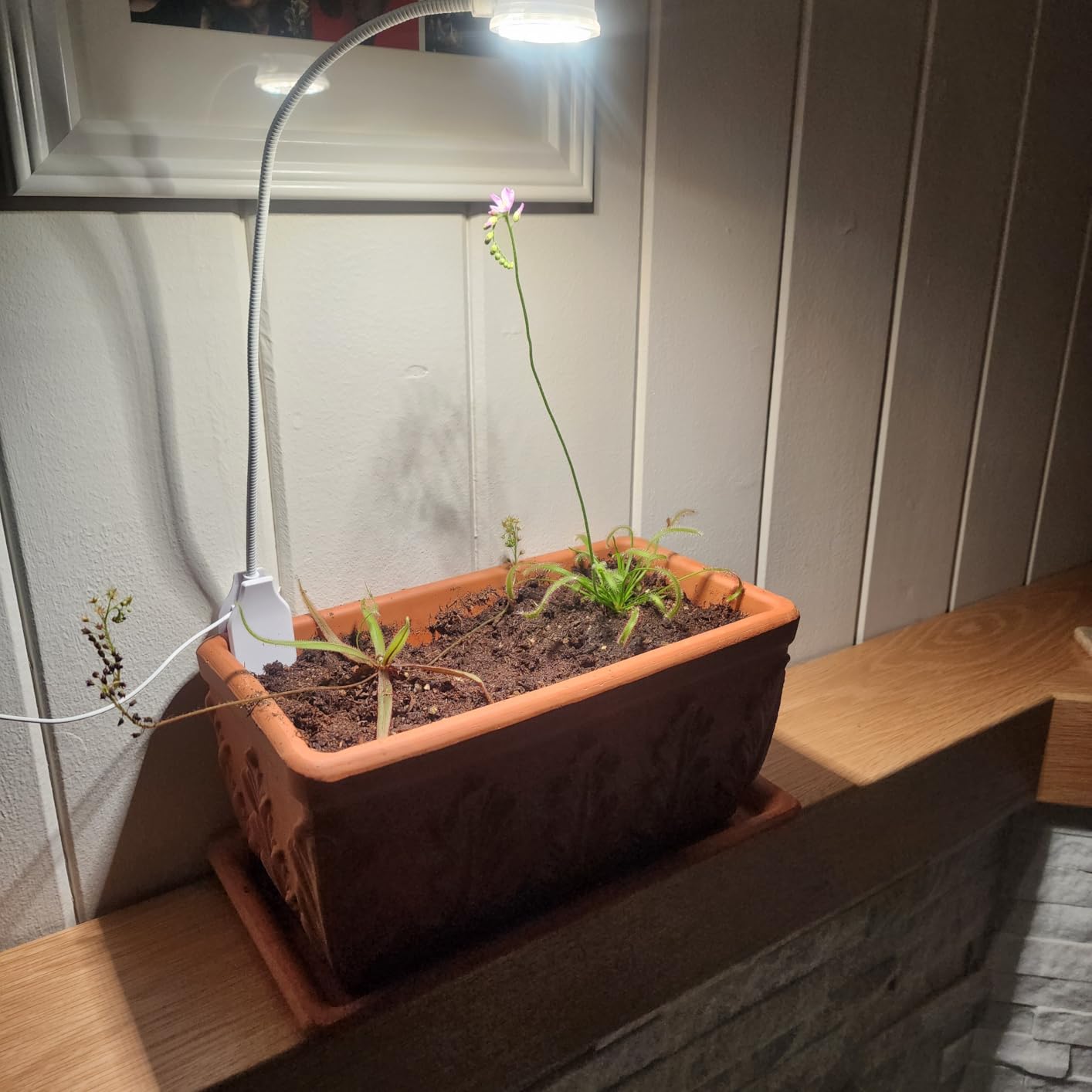
When the only space available is a small pot on a crowded counter, a stand light is a non-starter and a bar is overkill. This clip attaches to the pot rim itself, which is why it is the pick I recommend to people with genuinely tight kitchens. It weighs 5.6 ounces and measures 5.2 by 2.83 by 12.8 inches, so it adds height rather than footprint.
The efficiency figure is the headline: 35.78 micromol per second per square meter at 6 inches from only 5W, which the manufacturer puts at 50 percent power savings and a 25 percent stronger growth effect than a comparable 10W light. Being able to power several of these from one USB adapter is a real advantage in a kitchen.
Ceramic LED Output in a 4000K Tone
SANSI’s ceramic LED technology is what lets 5W do the work of a much larger diode array. The 4000K natural color sits between warm white and daylight, which in my kitchen looked far less clinical than the 6000K fixtures and did not cast blue shadows on the counter.
That tone is also why forum growers keep recommending the 4000K to 5000K band in general. Anything warmer starts to skew amber, and anything much cooler flattens color, though neither kills growth on a daily herb crop.
Timer, Dimming, and Power Flexibility
Three timer settings at 3, 6, and 12 hours cover the realistic herb schedules, and four brightness levels from 25 to 100 percent let you dial intensity down once leaves get established. The gooseneck is 360 degrees and the clamp has no parts that can scratch a plant.
Because it runs on 5V USB, this is the one fixture here that can be powered by a laptop, a power bank, or a phone charger. That solves the outlet-distance problem forum growers complain about most. It is ETL listed with a two-year service promise, and the clamp will not hold a wide planter rim.
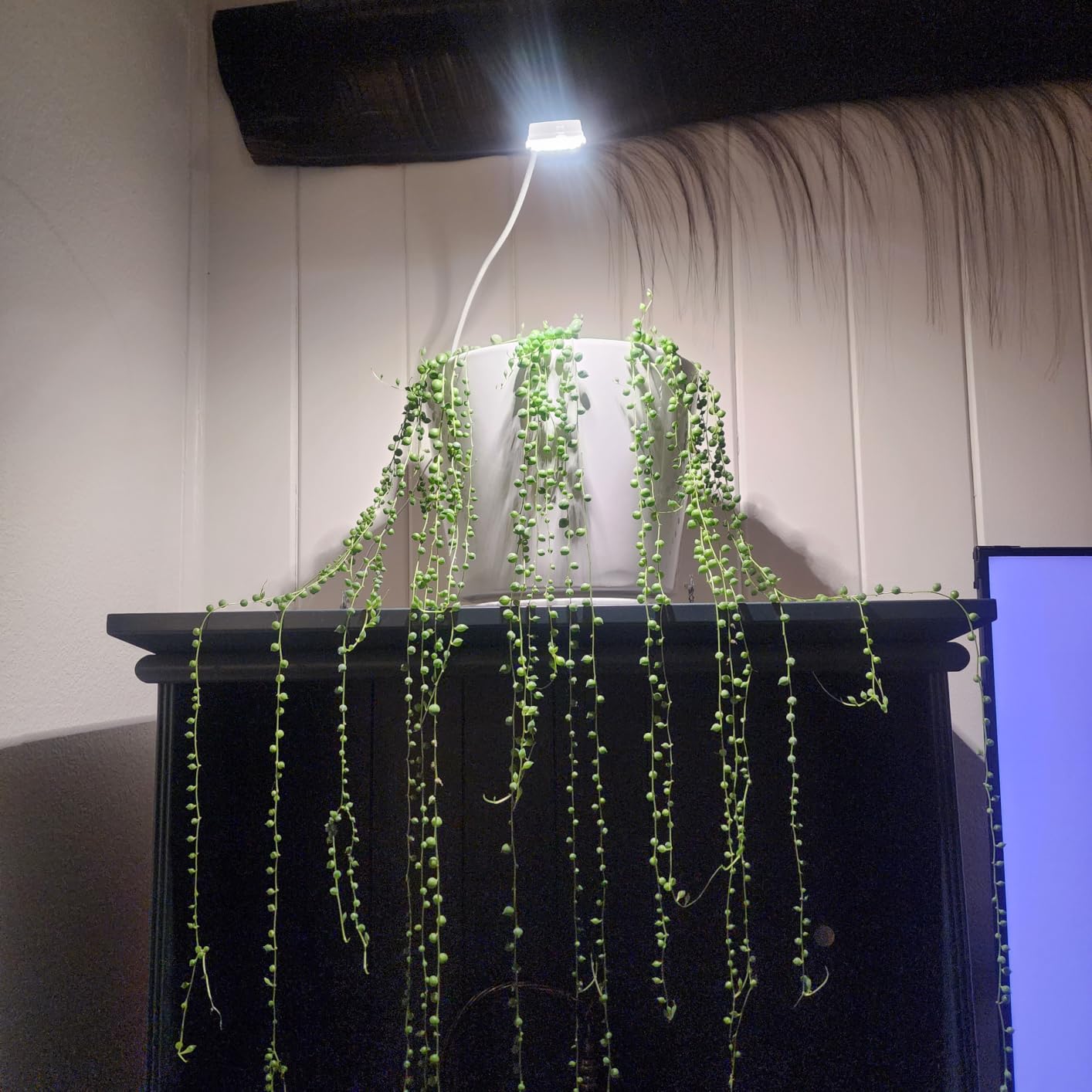
Who This Light Is For
It is a supplement light, not a primary one. Five watts will keep a small mint pot or a windowsill of chives growing steadily, but it will not drive a dense basil plant on its own. The clip also needs a rim thin enough to grip, which rules out some glazed ceramic pots.
Keep it away from splashing water, since it is not water resistant, and that includes steam and sink zones in a busy kitchen.
6. Aokrean Halo Light with Telescoping Pole – Best for Large Pots and Floor Planters
Aokrean Grow Lights for Indoor Plants, Full Spectrum Plant Light with Base
Telescoping pole to 26 inches
10W
3/9/12h timer
+ Pros
- Pole raises light as plants grow
- 26 inches of height adjustment with 90 degree rotation
- 10 brightness levels across three spectrums
- 3/9/12 hour cycling timer
- Stands in soil or on a weighted base
- Cons
- Base must be weighted by a pot to stay stable
- Needs a power outlet and is not wireless
- Halo footprint is larger than a clip light
Clip lights hit a ceiling. As soon as a plant gets tall, the gooseneck arm cannot hold the light above the leaves, and the plant leans and stretches. The Aokrean solves that with a halo head on a telescoping pole that adjusts up to 26 inches and rotates 90 degrees, so the light rises with the plant instead of fighting it.
It is the pick for a large pot on the floor or a countertop pot with real clearance above it. Forty-eight light sources across three pieces run at 10W, and 10 brightness levels spread across three spectrums, including a warm white mode that is easier on the eyes in the evening.
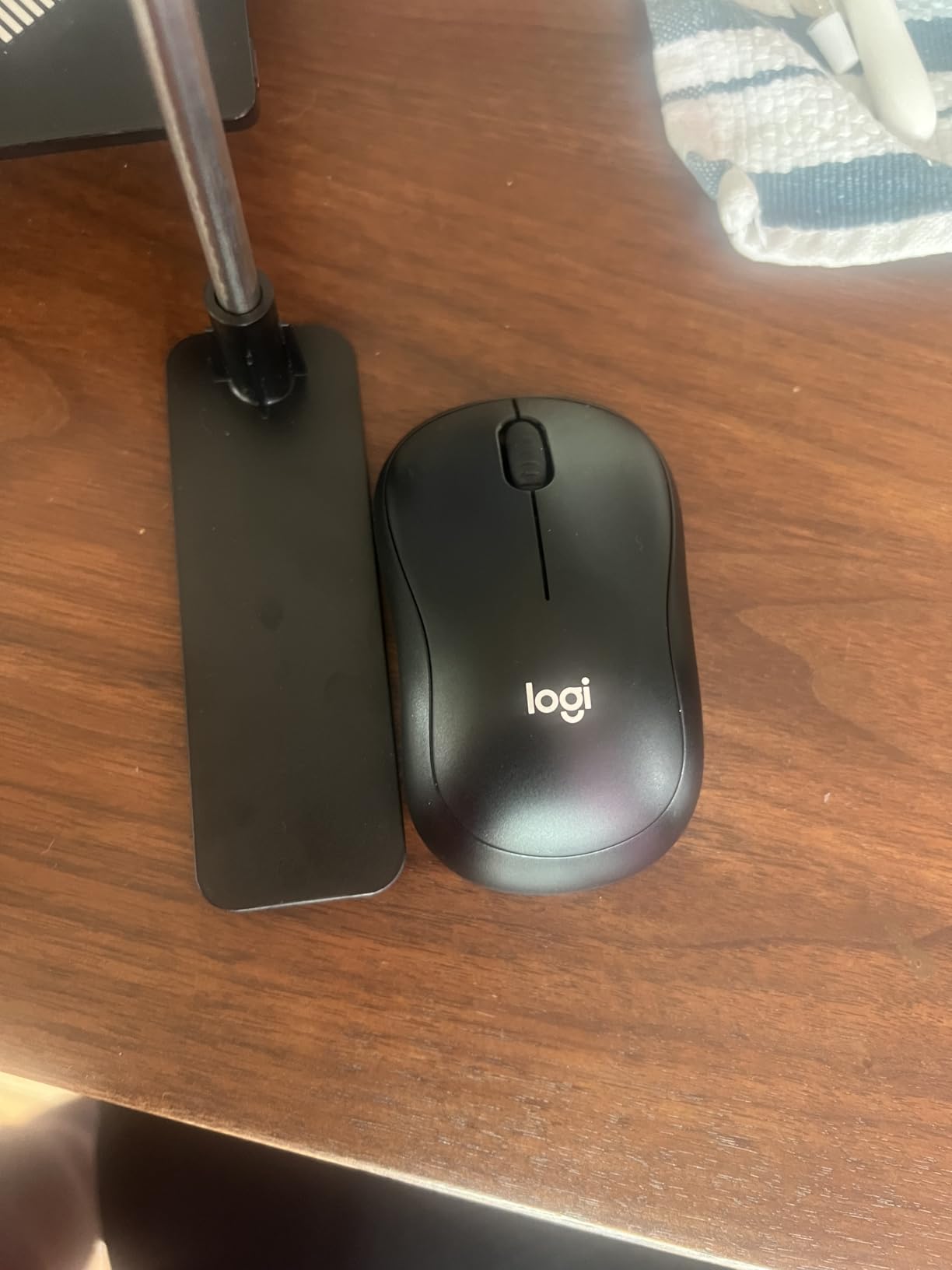
Two Ways to Install It
You can insert the pole directly into the soil, or stand the base inside a pot or floor planter. In my testing the insert method is steadier for a tall plant, because the soil holds the pole against any lean.
If you use the base, it must be weighted down by the flower pot. That is the most common complaint in reviews, and it is a fair one: an unweighted base on a smooth tile floor tips. I tested it weighted with a terracotta pot and it stayed put for the full six weeks.
Timer and Spectrum Modes
The 3, 9, and 12 hour cycling timer handles the daily schedule, and the ten brightness levels let you keep a young seedling dim while a mature pot gets more. Red mix mode exists for flowering crops and is not something a kitchen herb needs.
At 0.54 kg the unit is heavy enough to stay planted but light enough to move. The design is decorative, with black, white, and wood grain finishes, which matters if it is standing in view. It needs a power outlet nearby, and there is no battery or wireless option.
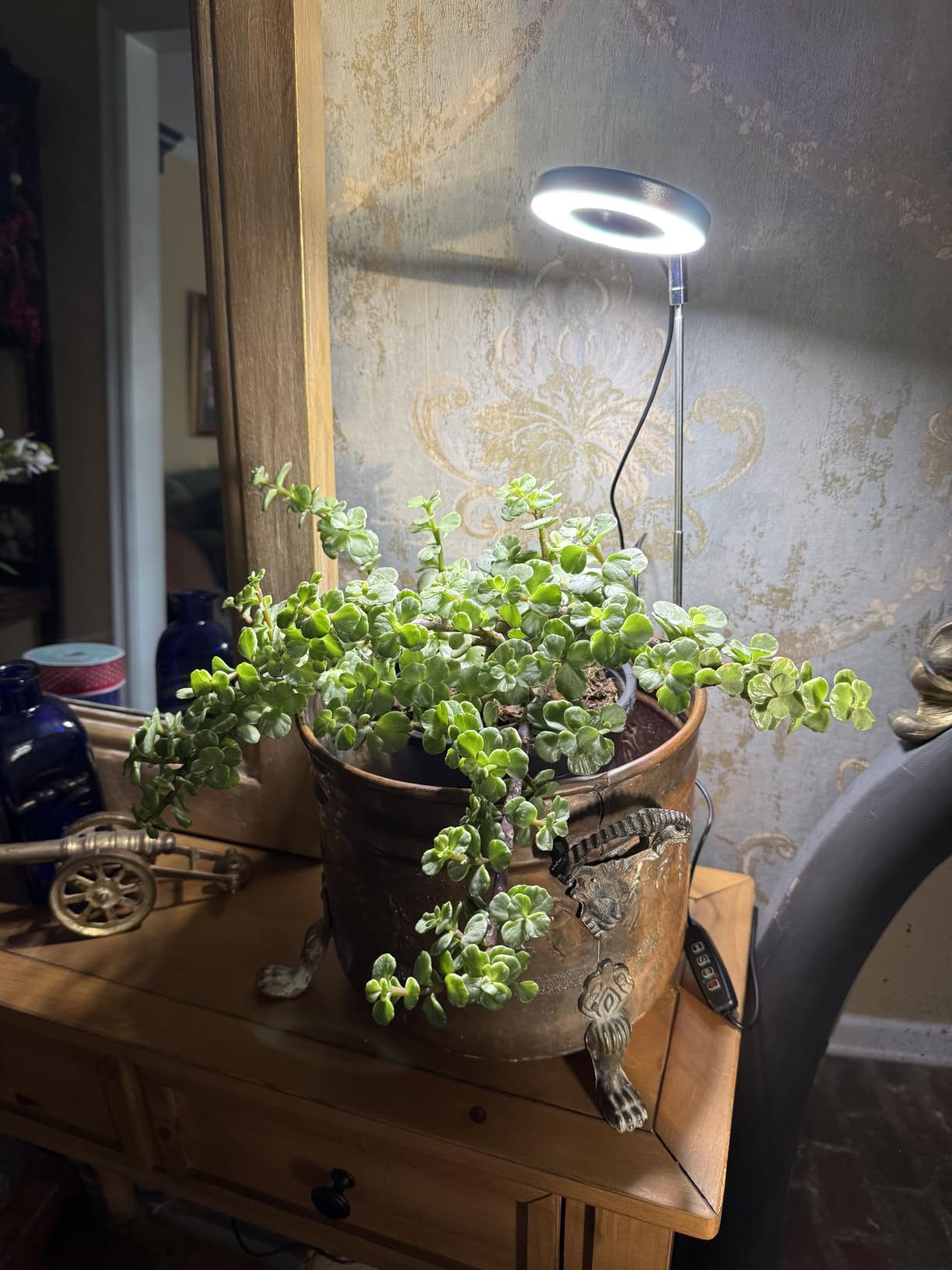
Verdict for Kitchen Use
This is the one to buy if your herbs live in big pots or a floor planter that a bar light cannot reach. It needs more footprint than a clip lamp, so give it clear counter space, and note that the 12-month manufacturer warranty is modest.
For a small windowsill of herb pots, save your space for a bar instead.
7. Ahopegarden 10-Pod Hydroponic System – Best Complete Countertop Setup
Ahopegarden Indoor Garden Hydroponics Growing System: 10 Pods Kit with LED
10 pods
3L reservoir
16h on 8h off
+ Pros
- Reservoir and overhead LED and pump in one unit
- Ten stations with a clear water level window
- Very quiet pump that suits a kitchen
- Compact 11.97 by 6.69 by 6.69 inch footprint
- Two light modes for vegetables or flowers
- Cons
- Light timer is fixed at 16 hours on and 8 hours off
- Post tops out at 14.5 inches
- Built-in light is weak for large fruiting plants
- Seeds are not included
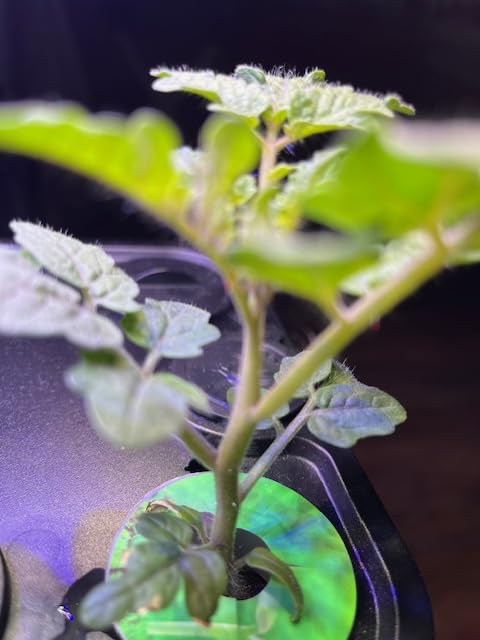
Everything else on this list lights a pot you already own. This one replaces the pot. A 3 liter reservoir, a circulation pump, and an overhead LED live in a single countertop unit with 10 planting stations, and the kit includes 8 baskets, 8 sponges, 9 growth domes, 8 shade papers, 4 covers, tweezers, labels, and A and B fertilizer.
For a cook who wants fresh basil and cilantro without thinking about watering, that is the appeal. The circulation pump runs 30 minutes on and 30 off and is quiet enough to sit in a kitchen in the morning without drawing attention. Growth is fast, and buyers regularly report harvestable herbs within weeks.
The Fixed 16-Hour Cycle Is the Key Constraint
The light runs 16 hours on and 8 hours off, and that cycle is not adjustable. For leafy herbs this is generous but not damaging, since they tolerate long days. If you want a 12-hour photoperiod you need a different fixture, and a seedling stage under a 16-hour day can get stretched.
Two light modes are included, blue for vegetables and red for flowers and fruit. Stay on blue for cooking herbs and ignore the red mode entirely.
Height Limit and Root Management
The post adjusts and plants can grow to 14.5 inches, which is roughly the point where a basil plant outgrows the light and starts leaning. That ceiling is the most common limitation noted by owners, along with the need for a separate, stronger light for large fruiting plants like peppers.
Roots also grow long and tangle between pods and the reservoir, so expect trimming. Seeds are not included, and some buyers struggle with germination directly in the pods. The transparent water level window makes top-ups quick, and at 3.5 pounds the unit stays put on a counter.
Who Should Buy This
Buy it if you want one self-contained system and dislike watering schedules and soil entirely. Leave it on your list if you already have established herbs in terracotta or drainage pots you like, because this system replaces that setup rather than supplementing it.
8. Mosthink Full Spectrum Light Strip – Best Value Under-Shelf Bar
LED Plant Grow Light Strip Full Spectrum for Indoor Plant with Timer
380nm to 800nm
2/4/8h timer
4 dim levels
+ Pros
- Short 13.8 inch bars fit tight shelves and under-cabinet gaps
- Sunlight colored output that does not distort colors
- Four brightness levels at 25
- 50
- 75 and 100 percent
- Very low profile and easy to reposition
- Mounts with screws or tape or zip ties or nails
- 78 inch cord with inline control
- Cons
- Timer tops out at 8 hours
- Adhesive can lose hold over time
- Does not respond to smart plugs
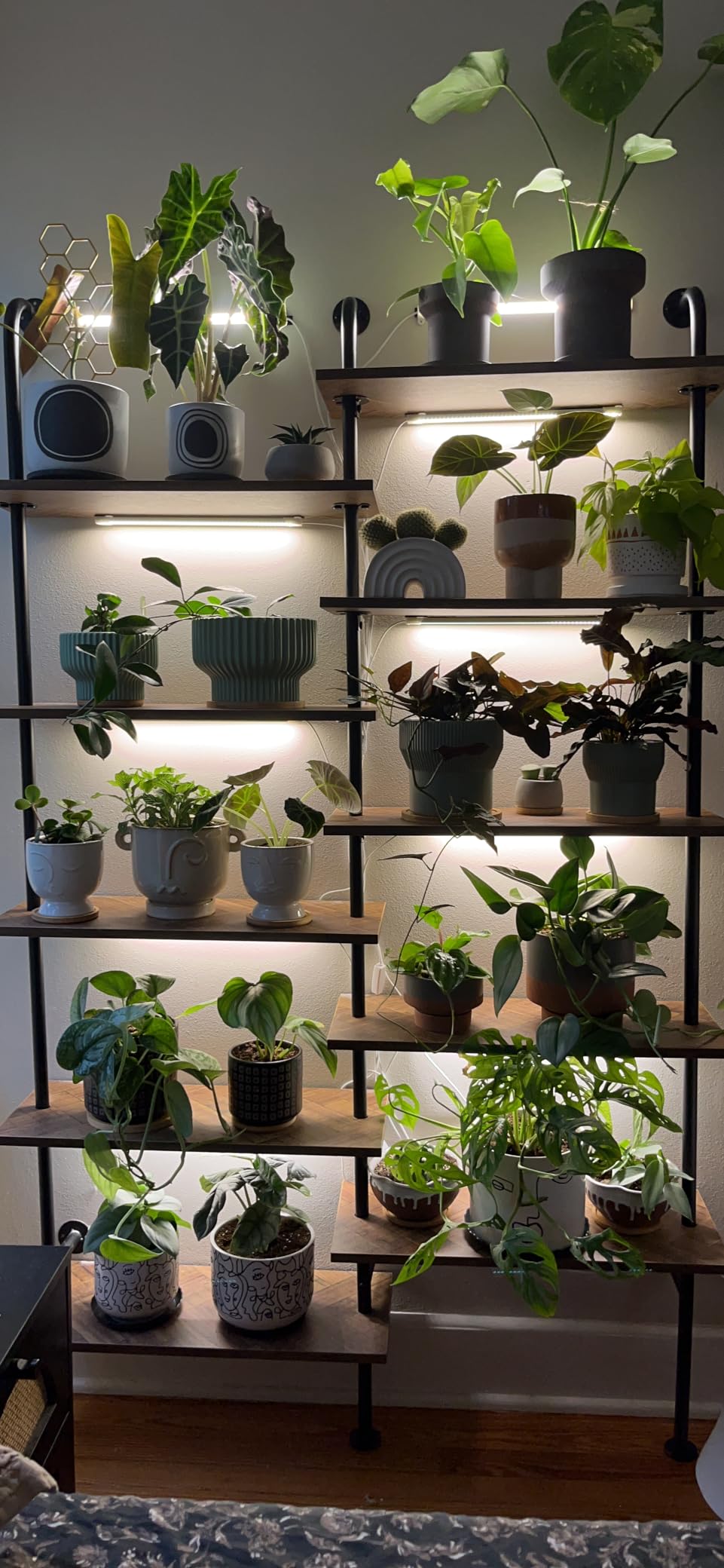
For a narrow shelf or the gap beneath a wall cabinet, bar length is the deciding factor, and this strip is 13.8 inches long, 3 inches deep, and 2 inches tall. That is short enough for spaces where a longer bar will not sit flush, and the 78 inch cord with an inline control means an outlet across the room is workable.
Output is 15W per bar from 48 LED chips, across a 380nm to 800nm range that matches natural sunlight wavelengths. With more than 12,000 reviews at a 4.4 average, it is among the most proven low-cost strips available for houseplants and kitchen herbs.
Distance and the Leaf-Burn Question
The manufacturer advises keeping the strip at least 15cm, roughly 6 inches, from plants to avoid leaf burn. That is the number to plan your shelf around: measure the clearance under your cabinet before mounting, not after.
Four brightness levels at 25, 50, 75, and 100 percent let you reduce output as a pot fills in, and the low profile means you can slide the strip forward without hitting growth. The sunlight-colored output does not distort the color of food on the counter below, which is a small thing that matters daily.
Timer and Mounting Trade-offs
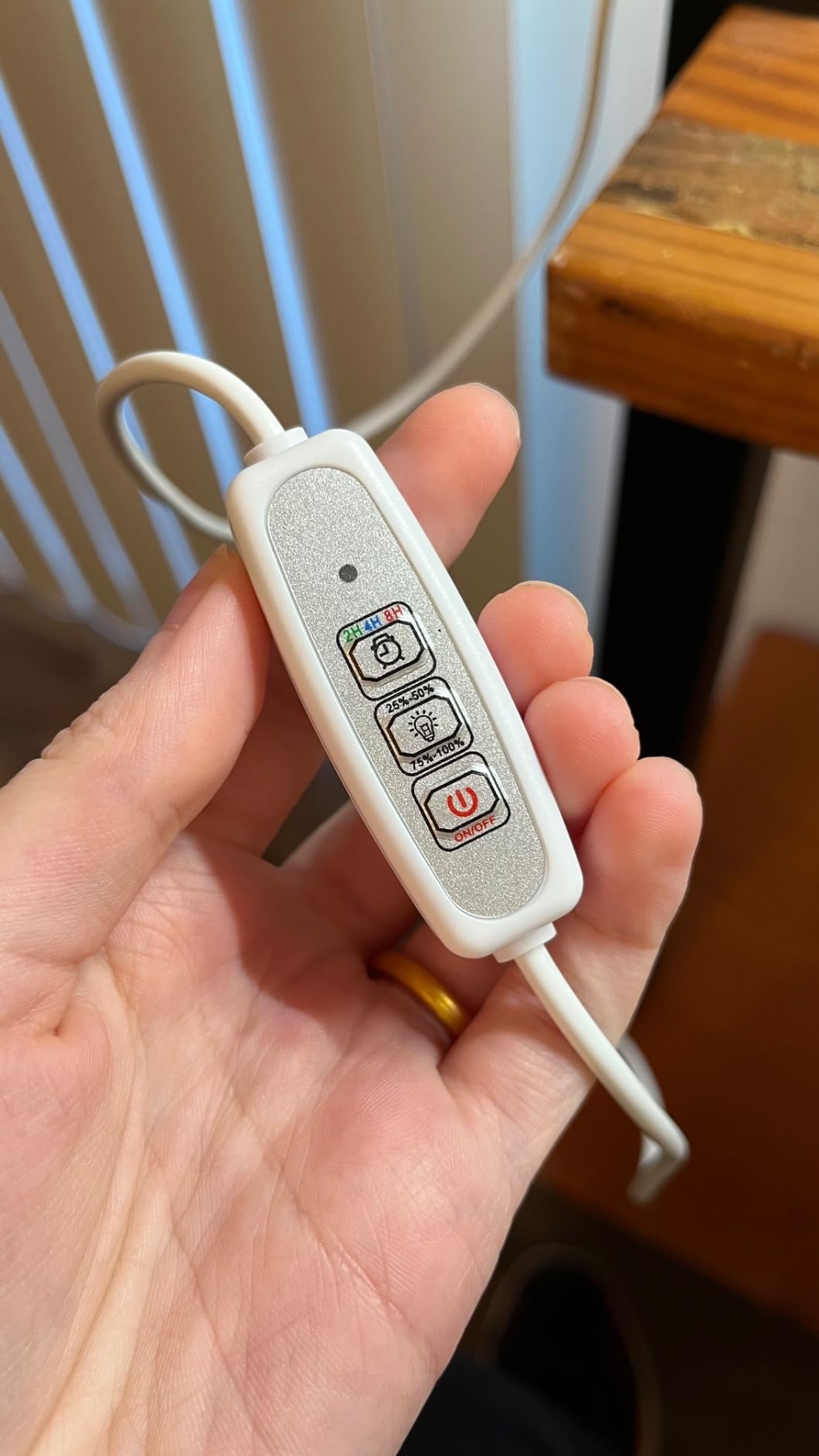
The auto on/off timer repeats every 24 hours at 2, 4, or 8 hours. An 8-hour ceiling is the most significant limitation, because 8 hours sits at the low end of what an herb crop needs on a dark schedule, though it is ample in a bright room with supplementary window light.
Mounting options are generous: screws, double-sided tape, zip ties, or nails. The adhesive is the part reviewers flag as short-lived, and several people switch to the included screws after a few months. The unit is ROHS and PSE certified, and it carries a 6-month manufacturer warranty, the shortest of the group. The inline button controls are not intuitive, so read the instructions once.
Where It Falls Short
Because the strip only responds to being switched off and not switched back on, it will not work with a smart plug. Some reviewers also report power adapters or inline switches failing after extended continuous use, with the adapter being the part that gets replaced.
For a long daily photoperiod, choose a fixture whose own timer reaches 12 hours.
How Much Light Kitchen Herbs Actually Need
Before buying a fixture, know the target. Most culinary herbs want 6 to 8 hours of direct sunlight, and a windowsill that delivers that in June may deliver a fraction of it in December. When natural light is short, LED lighting is typically run 12 to 14 hours a day on a timer, with the fixture 6 to 12 inches above the foliage.
That distance rule is the one most often ignored. Too far and herbs stretch and go leggy, too close and leaves blanch or crisp at the edges. Measure the gap from the top of the pot, not the top of the soil, since a basil plant can add several inches in a month.
Per-herb demands differ, and the fixture you choose should match the thirstiest plant on your sill:
- Basil – the highest-demand kitchen herb. Twelve to fourteen hours, the strongest light in the room, and the closest mounting distance of any common herb.
- Cilantro – bolts early under stress, so it wants steady 12 hour light and cooler temperatures rather than maximum intensity.
- Parsley – slow starter with moderate needs, tolerant of 10 to 12 hours on a slightly lower setting.
- Mint – the least demanding and the most forgiving. Almost any light in this guide keeps mint thriving.
- Rosemary – wants the brightest, driest spot you have and resents wet feet more than low light.
- Chives – moderate needs and quick regrowth after cutting, similar to parsley.
- Thyme – compact and low-demand, and prone to stretching under dim light.
- Dill – a fast grower that bolts under heat, and happiest with bright light and cooler air.
Rotating your pots a quarter turn every week or two evens out the lean that develops toward a window. So does pinching the top leaves of basil regularly, which pushes the plant to branch instead of stretching.
How to Choose a Grow Light for Your Kitchen Layout
Start With Fixture Form Factor, Not Wattage
The form factor decision is the one nobody frames as a decision, and it is the one that matters most in a kitchen. A bulb drops into a lamp you already own. A short strip slides under a cabinet with less than 2 inches of clearance. A clip lamp grips a shelf or a pot rim. A halo pole covers a tall pot or a floor planter. A hydroponic cabinet replaces soil entirely.
Match the fixture to the constraint you actually have. An outlet far from the herbs points toward a long cord or USB power. Low cabinet clearance points toward a low-profile strip. Tall pots point toward a pole or a stand.
Spectrum and Color Temperature
Full-spectrum LED is the only sensible category here, and within that, 4000K to 5000K is the band forum growers cite repeatedly. Full-spectrum diodes emit red and blue together, which is what plants use for photosynthesis, while the white appearance stays presentable in a room where you also cook.
Green and yellow light is where plants grow worst, and single-band red-only or blue-only modes are the second worst. Those modes exist for flowering crops, so for a continuous harvest of culinary herbs there is no reason to run them. A Reddit grow light thread made the same point, recommending full-spectrum white as the default unless there is a specific reason to switch.
Watts and Lumens: Why Watts Are the Honest Comparison
Lumens measure brightness as perceived by human eyes, which is not what a plant uses. The number that matters is PPFD, photosynthetic photon flux density, typically expressed in micromoles per second per square meter at a stated distance. Culinary herbs do well around 200 to 400, and forum posters growing cilantro and basil report wanting roughly 400 to 500 to keep them happiest.
For comparing fixtures when PPFD is not published, wattage is the more honest number because LED output scales with it. Do not be impressed by 300W to 1000W canopy reflectors built for grow tents. They are hot, enormous, and far more light than a pot of basil needs.
Timer, Dimming, and Distance
A built-in timer is worth paying for, because a fixture that must be switched on by hand is one you will forget. Look for a 12-hour option if your herbs need a 12 to 14 hour photoperiod, and treat an 8-hour ceiling as a real constraint. Dimming matters as plants grow, since you can lower output rather than raising the fixture and scorching.
Check two smaller things: whether the fixture can daisy chain, so one outlet can feed several bars, and whether the cord is long enough to reach an outlet from the herb location. Outlet position and cord routing are the most common frustrations kitchen growers describe.
Kitchen Constraints That Decide the Purchase
- Outlet proximity – a cord sprawling across a prep counter is a trip hazard and a cleaning problem. USB-powered fixtures solve it.
- Steam and grease – keep fixtures well away from the stove and the sink. Some lights are not water resistant, so humidity and splashes shorten their life.
- Clearance – measure the gap under your cabinet before buying a bar.
- Noise – kitchens are small, hard-surfaced rooms, so fanless fixtures and quiet pumps are worth more here than in a basement.
- Appearance – black or white housings disappear. Purple-glowing fixtures do not, and that is a legitimate reason to skip one.
- Renting – clips, magnetic bars, and tape leave no holes, which is what makes an under-shelf setup viable in a rental.
What Commercial Growers Use Versus What You Need
Commercial operations run room-scale arrays with far higher PPFD than a kitchen sill requires, because they are optimizing for yield per square foot. A home cook harvesting basil for dinner needs a fraction of that, which is why 15W to 20W fixtures are the right class for culinary herbs and why anything dramatically overpowered is wasted energy and wasted counter space.
For running cost context, a 20W bar on a 12-hour cycle consumes about 0.24 kWh per day, which is a very small share of a household’s electricity use regardless of tariff. Run two of them plus a small pump and the difference between fixtures is cents per year rather than dollars.
Frequently Asked Questions
What is the best grow light for herbs in the kitchen?
A slim full-spectrum LED bar in the 4000K to 5000K range, mounted 6 to 12 inches above the pots and run 12 to 14 hours a day on a timer, is the best general choice for kitchen herbs. Slim linkable bars suit under-cabinet and shelf setups, clip lamps suit a single pot, and screw-in bulbs suit an existing fixture. Keep fixtures away from stove steam and sink splashes.
What kind of grow light do herbs need?
Culinary herbs need full-spectrum LED light, ideally at a 4000K to 5000K color temperature, delivering roughly 200 to 400 PPFD at the leaves. Single red-only or blue-only modes and green or yellow output give the poorest results. Wattage is the fairest comparison when PPFD is not published, and 15W to 20W fixtures cover a windowsill or shelf for a dozen small pots.
How much light do indoor herbs need?
Most kitchen herbs want 6 to 8 hours of direct sunlight, and when natural light is short, an LED grow light should run 12 to 14 hours a day on a timer. Position the fixture 6 to 12 inches above the foliage. Too far away and herbs stretch and go leggy; too close and leaves blanch or crisp at the edges.
Can I grow herbs indoors with a grow light?
Yes. Basil, cilantro, parsley, mint, chives, and thyme all grow well under a full-spectrum LED fixture with a timer, and results are typically visible within two to four weeks. Growth is driven by the photoperiod far more than by raw brightness, so consistent daily hours matter more than a very powerful light. Watering and drainage still matter as much as light.
What color light do plants grow worst in?
Green and yellow light is the worst option, because plants reflect those wavelengths rather than absorbing them, which is also why leaves look green. Single-band red-only or blue-only lighting ranks a close second for daily-harvest herbs, since those modes are tuned for flowering and fruiting crops. Broad full-spectrum white that mixes red and blue with the rest of the visible range performs best.
Which Kitchen Grow Light Should You Buy?
For most kitchens, the Briignite A19 pair is the answer. It is the best overall light here because it carries the highest rating and the largest review base in the group, it needs no new fixture, and it stays presentable on a counter. If a single bulb cannot carry a full shelf, the Barrina T5 four pack is the natural upgrade for under-cabinet mounting.
Match the rest of the shortlist to your constraint. Three or more pots on one surface points to the LEOTER four-head lamp, tight counter space to the SANSI 5W clip, tall pots and floor planters to the Aokrean pole, seedlings and microgreens to the GHodec clip, narrow under-cabinet gaps to the Mosthink strip, and a self-contained countertop garden to the Ahopegarden 10-pod system.
Whichever you choose, buy the timer in the same order, set the fixture 6 to 12 inches above your tallest leaves, and leave it alone. Consistent light on a schedule does more for a kitchen herb than any amount of extra wattage.