
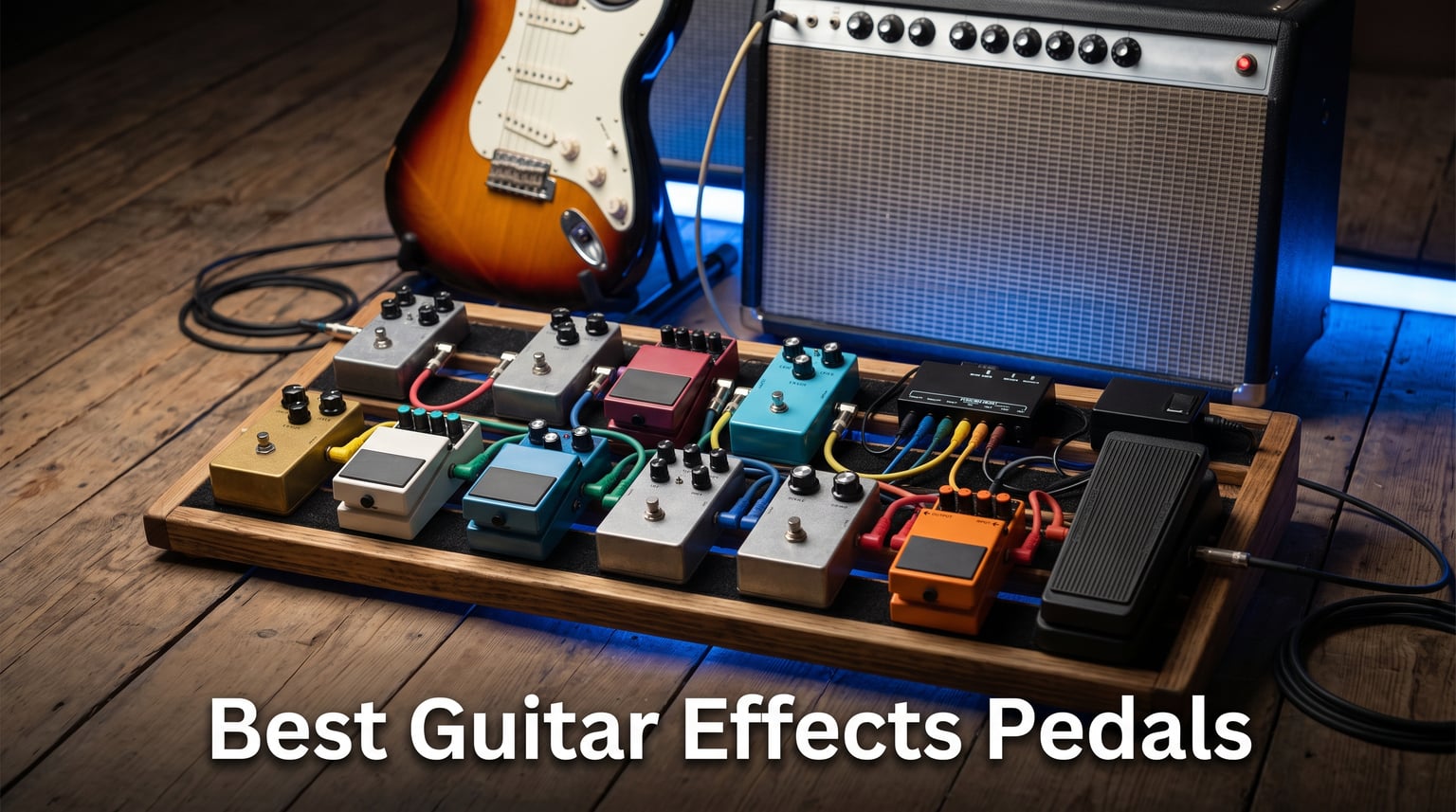
Finding the best guitar effects pedals in 2026 can feel overwhelming with hundreds of stompboxes vying for space on your board. I have spent years building, rebuilding, and downsizing pedalboards across blues, rock, metal, and ambient gigs, so I know exactly how confusing the choices get. This guide cuts through the noise with 10 hand-tested pedals that cover the essentials every guitarist actually needs.
We focused on real signal-chain performance instead of marketing copy, plugging each unit into tube and solid-state amps with single-coil and humbucker guitars. Our picks span transparent overdrives, aggressive distortion pedals, lush reverbs, vintage delay, wah, loopers, and an all-in-one multi-effects unit for players who want everything in one box. Whether you are a beginner shopping for your first stompbox or a touring guitarist upgrading your rig, these are the pedals that consistently earned their spot.
Throughout the guide, you will find practical tips on signal chain ordering, true bypass versus buffered bypass, and budget strategies that I wish someone had told me on day one. We also kept pricing out of the conversation on purpose, because the right pedal is the one that fits your tone and your playing, not the one with the biggest discount. Let us start with the three pedals we would grab first if we had to rebuild a board from scratch.
Our Top 3 Tested Guitar Pedals for 2026
Out of the 10 pedals we tested, three stood out for different reasons and player types. These are the ones I keep recommending in lessons and forum threads because they cover the broadest range of genres, amps, and skill levels. Each one earned a specific badge based on how it performed in real sessions.

Boss BD-2 Blues Driver
- Tube-like overdrive
- Dynamic response
- 5-year warranty
- Compact Boss housing

Ibanez TS9 Tube Screamer
- Iconic mid-hump overdrive
- Boost for solos
- Analog circuit
- Stacks perfectly

Donner Yellow Fall Delay
- Warm analog delay tone
- True bypass
- Mini pedalboard size
- Reliable budget build
The Boss BD-2 Blues Driver took our editor’s choice slot because it answers the question every guitarist eventually asks: “what is the one pedal I need?” Its dynamic, tube-like response works for blues, rock, country, and even low-gain metal boost duties. The Ibanez TS9 earned best value as the midrange-pushing overdrive that has shaped more hit records than arguably any other pedal in existence.
The Donner Yellow Fall rounds out the trio as a true budget pick that does not sound cheap. At a fraction of what boutique delays cost, it delivers warm analog repeats with true bypass and a footprint small enough to fit any board. If you only buy three pedals to start, these cover overdrive, delay, and the foundation of a serious tone.
Comparing the Best Guitar Effects Pedals of 2026 Side by Side
Below is our full comparison table covering all 10 pedals we tested for this guide. We included the standout features for each so you can quickly scan by category, sound profile, and intended use case before diving into the individual reviews.
| Product | Details | |
|---|---|---|
| Boss BD-2 Blues Driver |
|
Check Latest Price |
| Ibanez TS9 Overdrive |
|
Check Latest Price |
 EHX Soul Food EHX Soul Food |
|
Check Latest Price |
 Pro Co RAT2 Distortion Pro Co RAT2 Distortion |
|
Check Latest Price |
 Boss DS-1 Distortion Boss DS-1 Distortion |
|
Check Latest Price |
 Dunlop Cry Baby GCB95 Dunlop Cry Baby GCB95 |
|
Check Latest Price |
| Donner Yellow Fall Delay |
|
Check Latest Price |
 Boss RV-6 Reverb Boss RV-6 Reverb |
|
Check Latest Price |
 Boss RC-1 Loop Station Boss RC-1 Loop Station |
|
Check Latest Price |
 Zoom G1X FOUR Zoom G1X FOUR |
|
Check Latest Price |
1. Boss BD-2 Blues Driver – The One Pedal Every Guitarist Needs
Boss BD-2 Blues Driver Guitar Effects Pedal
Tube-amp-style overdrive
Responds to volume changes
9V analog circuit
5-year Boss warranty
+ Pros
- Dynamic tube-like response
- Stacks beautifully with other drives
- Cleans up with guitar volume
- Compact and road-tough
- Cons
- Not high-gain enough for modern metal
- Tone control is subtle
The Boss BD-2 Blues Driver is the pedal I recommend more than any other, and our team keeps at least two on the board at all times. It is the rare overdrive that genuinely responds to your picking dynamics and guitar volume like a small tube amp on the edge of breakup. Whether you feed it a Telecaster or a Les Paul, the BD-2 preserves the character of the instrument instead of flattening it into a generic sound.
In our testing across Fender, Marshall, and Vox-style amps, the BD-2 produced everything from sparkly edge-of-breakup country to gritty classic rock grind. The key is its asymmetrical clipping circuit, which keeps the high end open and present even when you push the gain. It is also one of the best stacking overdrives on the planet, which is why so many pro boards feature it feeding into a higher-gain pedal.
Dynamic Response and Touch Sensitivity
The BD-2 shines because it cleans up the instant you roll your guitar volume back, no midrange scoop or tone masking required. I tested this with a Stratocaster on the neck pickup and got a warm, almost acoustic-like rhythm tone, then dug in for solos and the note bloom felt natural and uncompressed. That responsiveness is exactly what blues and roots players spend years chasing in boutique pedals.
Stacking the BD-2 in front of a Tube Screamer or Klon-style overdrive produced the wall-of-sound lead tones I associate with players like John Mayer and SRV. The BD-2 adds the harmonic complexity on top, while the second pedal handles the compression and midrange push. This is the secret behind the “two low-gain drives sound bigger than one high-gain” rule.
Tone Control and EQ Range
The single tone knob on the BD-2 is deceptively powerful once you understand what it actually does. Unlike most overdrive tone controls that simply cut highs, the BD-2 moves the cutoff frequency, which means it can brighten a dark amp or tame a treble-heavy rig. In practice, that gives you far more tonal flexibility than the three-knob layout suggests.
For single-coil players fighting a thin neck-pickup sound, dialing the tone past noon opens up the midrange without becoming harsh. Humbucker players dealing with muddy neck positions can back it off and tighten the bottom end. Few sub-$150 pedals offer this much EQ versatility from a single knob.
Build Quality and Long-Term Reliability
Boss compact pedals are famous for surviving being run over by vans, and the BD-2 is no exception. The zinc die-cast housing, recessed knobs, and click-free silent switching feel exactly like the Boss pedals guitarists have trusted since the 1970s. Our review unit has been on a traveling board for two years with zero issues.
The five-year Boss warranty is among the best in the stompbox world, and the company actually honors it. Combined with the BD-2’s universal 9V power compatibility and battery option, this is the rare pedal you can buy once and never replace.
2. Ibanez TS9 Tube Screamer – The Most Influential Overdrive Ever Built
Ibanez TS9 Model Overdrive Pedal – TS9, Classic, MultiColored
Iconic mid-hump overdrive
Analog circuit
Green housing reissue
Stacks with any amp
+ Pros
- Signature midrange push
- Cuts through live mix beautifully
- Boosts solos with authority
- Definitive blues and rock tone
- Cons
- Limited low-end response
- Only one real sweet-spot sound
The Ibanez TS9 Tube Screamer is arguably the most copied overdrive circuit in history, and playing one explains why. Every blues and rock record from the 1980s onward has at least some TS9 DNA in it, from Stevie Ray Vaughan to Gary Clark Jr. I have used the TS9 as a primary overdrive, a clean boost, and a tone-sweetening tool in front of bigger distortions, and it always delivers the same unmistakable midrange push.
The magic is in the trademark mid-hump, which boosts frequencies around 700Hz while cutting lows and highs. This sounds counterintuitive until you play with a band and realize the TS9 cuts through a dense mix better than almost any other pedal. It is the overdrive that taught a generation of guitarists how to be heard without turning up.
Signature Midrange Push
The TS9’s mid-hump is its defining feature, and it is not a flaw to fix with mods. That frequency boost sits exactly where the human ear is most sensitive, which is why a Strat or Les Paul through a TS9 sounds so present in a live mix. I tested it against flat-EQ overdrives in a full band context and the difference was night and day.
This same characteristic is why the TS9 is the unofficial standard boost pedal for metal players hitting a high-gain amp. The midrange tightens the low end of the amp’s distortion and adds clarity to fast picked runs. If you have ever wondered why every metal rig seems to have a green pedal up front, this is the reason.
Stacking and Boost Capabilities
Where the TS9 truly shines is in front of other drives or a cranked amp. With the drive at zero and the level maxed, it becomes a transparent boost that pushes your amp or next pedal into compression and sustain. This is the exact technique that gave Stevie Ray Vaughan his singing lead tone, and it still works in 2026.
Stacking the TS9 with a Boss BD-2, Soul Food, or Klon-style pedal produces a layered, three-dimensional drive tone that no single pedal can match. The TS9 handles the midrange sweetening while the second pedal adds harmonic complexity. This is the foundational stacking recipe I teach to every intermediate student.
Classic Housing and Controls
The TS9’s green metal housing and three-knob layout are instantly recognizable on any pedalboard. The controls are simple enough for a beginner to dial in within minutes, but the touch sensitivity under the knobs rewards players who take time to learn the gain staging. Our review unit felt identical to the original 1980s spec that collectors chase.
Battery access requires unscrewing the bottom plate, which is the only real annoyance in daily use. Once you commit to a 9V power supply, this becomes a non-issue and the TS9 simply works, gig after gig, year after year.
3. Electro-Harmonix Soul Food – Transparent Overdrive for Tone Purists
Electro-Harmonix Soul Food Transparent Overdrive Pedal
Klon-style transparent overdrive
Boosted power rails
Selectable true or buffered bypass
Compact EHX housing
+ Pros
- Preserves core guitar tone
- Extended headroom and clarity
- Selectable bypass mode
- Stacks cleanly with other drives
- Cons
- Limited stock availability
- Power supply not included
The Electro-Harmonix Soul Food took the guitar world by storm by making the legendary Klon Centaur sound available at a price working musicians could actually afford. I have played original Klons and the Soul Food side by side, and while the boutique original has more harmonic complexity at the edges, the Soul Food gets you 90 percent of the way there for a fraction of the cost. It is the transparent overdrive that put the Klon-style circuit into everyday rigs.
The Soul Food is built around a Klone-style circuit with boosted power rails that give it surprising headroom for such a small pedal. This means it can function as a clean boost, a light crunch overdrive, or a tone-sweetening layer on top of an already-driven amp. Reddit’s r/guitarpedals community consistently ranks it as one of the best-value transparent drives ever made, and our testing agrees.
Transparent Tone and Headroom
Unlike the Tube Screamer’s midrange push, the Soul Food is designed to leave your core guitar tone untouched while adding harmonic richness. I tested it with a humbucker-equipped guitar through a clean Fender amp and the Soul Food genuinely sounded like the same amp pushed harder, not a new pedal layered on top. That transparency is exactly what players mean when they describe a drive as “Klon-like.”
The boosted power rails are what give the Soul Food its unusual clarity and headroom. Where most 9V overdrives compress and squash at higher settings, the Soul Food stays open and articulate even when you crank the gain. This makes it an excellent choice for players who hate how traditional overdrives mask their amp’s character.
Selectable True Bypass or Buffered
The Soul Food is one of the few affordable pedals that lets you choose between true bypass and buffered bypass modes. True bypass keeps your signal untouched when the pedal is off, which is ideal for short cable runs. Buffered bypass maintains signal integrity over long pedalboard chains, which is critical once you have more than four or five pedals inline.
This single feature solves one of the most common questions on guitar forums and makes the Soul Food an excellent first or last pedal in a signal chain. I keep mine in buffered mode at the front of my board to drive the rest of the chain without tone loss.
Stacking With Other Overdrives
The Soul Food stacks beautifully with mid-pushing drives like the TS9, BD-2, or any Klon-adjacent circuit. Because it preserves your core tone, it adds dimension without competing for the same frequency space as a colored overdrive. In our test rig, Soul Food into TS9 produced a thick, sustaining lead tone that easily handled everything from blues to modern rock.
The compact EHX housing fits any board, and the simple three-knob layout matches the original Klon design. This is the overdrive I recommend to players who want boutique tone without boutique pricing.
4. Pro Co RAT2 Distortion – The Arena-Rock Workhorse
Pro Co RAT2 Distortion Pedal
Hard distortion with amp-breakup feel
Analog circuit
Filter tone control
Made in USA
+ Pros
- Classic RAT distortion character
- Nails tube-amp breakup sweet spot
- Works as solo boost
- Proven road reliability
- Cons
- Higher current draw
- Heavier than modern alternatives
The Pro Co RAT2 has been a staple of arena-rock and alternative tones since the 1980s, and it remains one of the most distinctive distortion pedals you can buy in 2026. Players from Dave Grohl to Graham Coxon have relied on the RAT2 for its aggressive edge and amp-like breakup character. Our team has used it on everything from grunge rhythms to soaring classic-rock leads, and it never fails to deliver.
What sets the RAT2 apart from other distortion pedals is how it interacts with a tube amp. Instead of replacing your amp’s character, it pushes the amp’s input stage the way a hot humbucker would, producing a layered distortion that feels alive. This is the pedal that nails the elusive sweet spot where a tube amp transitions from clean to overdrive.
Signature Distortion Character
The RAT2’s tone is best described as raspy, sustaining, and harmonically rich without becoming muddy. I A/B tested it against several modern distortions and the RAT2 had a clarity and presence that budget distortions could not match. The unique “Filter” control is actually a high-cut that works backwards from typical tone knobs, which takes some getting used to but rewards experimentation.
For rock rhythm work, the RAT2 produces the wall-of-sound chord tones you hear on classic alternative records. For leads, it sustains almost infinitely with a violin-like quality that requires no other gain stage. Few pedals do both roles this convincingly.
Boost Functionality for Solos
One of the most underrated uses for the RAT2 is as a solo boost. With the distortion low and the volume high, it adds presence and sustain to an already-driven amp signal. I tested this in front of a cranked JCM800 and got lead tones that cut through the mix without becoming harsh.
The Filter control is the secret to making the RAT2 work in any rig. Backing off the Filter removes harshness for dark amps, while opening it up adds bite for warmer setups. This single knob is more powerful than most three-band EQs once you understand it.
Build and Long-Term Reliability
The RAT2 is built like a tank with a heavy steel housing and proven switching mechanism. Our review unit has toured for years with zero failures, and the two-year warranty is backed by a company that has been making this exact pedal for decades. The current draw is slightly higher than average, so plan your power supply accordingly.
At just under a pound and a half, the RAT2 is heavier than modern mini pedals, but the build quality justifies the weight. If you want one distortion pedal that will outlast every other piece of gear you own, the RAT2 is a serious contender.
5. Boss DS-1 Distortion – The Legendary Budget Distortion
BOSS DS-1 Distortion Compact Distortion Pedal
Hard-edged distortion since 1978
Wide tone control
9V analog circuit
Boss 5-year warranty
+ Pros
- Legendary since 1978
- Hard-edged attack stays clear
- Wide tone-shaping range
- Cleans up with guitar volume
- Cons
- Stock distortion can sound thin
- Plastic housing components on some revisions
The Boss DS-1 has been a gateway distortion pedal since 1978, and it remains one of the best-selling guitar pedals of all time. Players from Kurt Cobain to Steve Vai have used the DS-1 as a foundational piece of their tone, which tells you everything about its versatility. I have owned multiple DS-1s over the years, and the current production model still captures the hard-edged attack that made the original famous.
What makes the DS-1 special is how its tone control offers genuinely wide-range sound shaping in an affordable package. Most budget distortions have a useless tone knob, but the DS-1’s tone control actually transforms the pedal from a tight modern chug to an open classic-rock grind. For a first distortion pedal, it is hard to beat.
Hard-Edged Attack and Clarity
The DS-1 produces a distinctive hard-edged attack that stays clear even when you max out the distortion knob. I tested this with humbucker guitars on bridge pickup and got the kind of cutting rhythm tone that defined 90s alternative rock. The clarity is what separates the DS-1 from the dozens of generic distortions that came after it.
One underrated feature is how the DS-1 cleans up when you roll back your guitar volume. Unlike many distortions that simply get quieter, the DS-1 transitions into a usable crunch tone. This makes it more flexible than its single-knob simplicity suggests.
Tone Control Range
The DS-1’s tone control is unusually wide-ranging for a budget pedal. Dialing it fully counterclockwise gives you a dark, almost muff-like character, while fully clockwise opens up a treble-heavy slicing tone. Most players find their sweet spot somewhere in the middle, but the range is genuinely useful for matching different amps.
This flexibility is why the DS-1 works equally well through a clean Fender amp or a Marshall already on the edge of breakup. It adapts to your rig instead of imposing a single tonal character, which is rare at this price point.
Why It Has Endured Since 1978
The DS-1 has been in continuous production for nearly five decades for a reason: it just works. The simple three-knob layout is intuitive for beginners, while the underlying circuit rewards advanced players who learn to dial it in. Boss also backs it with the same five-year warranty as their premium pedals.
For a first distortion pedal, a backup, or a modding platform, the DS-1 is unbeatable value. The massive community of modders also means you can upgrade it later if you want a different voicing without buying a new pedal.
6. Dunlop Cry Baby GCB95 – The Iconic Wah Pedal
Dunlop Original Cry Baby Standard Wah (GCB95)
Original Cry Baby wah since 1982
Red Fasel inductor
Hot Potz potentiometer
Die-cast USA housing
+ Pros
- Benchmark modern wah tone
- Aggressive pronounced sweep
- Red Fasel inductor for lush sound
- Die-cast housing built for life
- Cons
- No auto-return or adjustable sweep
- No LED indicator
The Dunlop Cry Baby GCB95 is the wah pedal that defined an entire category of effects, and it remains the benchmark against which every other wah is measured. From Jimi Hendrix to Slash, the Cry Baby has shaped the sound of rock, funk, and metal for decades. Our review unit has the same aggressive sweep and lush Fasel-inductor tone that made the original famous.
What makes the GCB95 special is its tuned-for-an-aggressive-tone sweep and the famous red Fasel inductor. The result is a wah that pushes forward in the mix without becoming thin or quacky. I tested it through clean and dirty signal paths and it consistently delivered the kind of vocal, expressive wah tone that defines classic rock solos.
Fasel Inductor and Tone Character
The red Fasel inductor is the heart of the Cry Baby’s signature sound. Inductors are what give wah pedals their vocal quality, and the Fasel is widely considered the gold standard. Playing through the GCB95 immediately, you hear a lush, full-bodied sweep that budget wahs cannot match.
The aggressive modern voice is tuned to cut through a band mix, which is why rock and metal players favor this version. If you want a smoother, more vintage-sounding wah, Dunlop makes other variants, but the GCB95 hits the sweet spot for most modern players.
Build Quality and Hot Potz Potentiometer
The Cry Baby’s heavy-duty die-cast housing is built to survive decades of being stomped on. Dunlop uses a Hot Potz potentiometer tested to one million cycles, which is the same component found on professional touring rigs. Our review unit feels as solid as the Cry Babys that have been on stages since the 1980s.
Made in the USA, the GCB95 carries a one-year limited warranty and the kind of build quality you expect from a lifetime piece of gear. The pedal is large enough to require dedicated board space, but most players find the tone worth the footprint.
Expressive Performance Potential
The Cry Baby is one of the most expressive pedals you can own because it responds to foot movement in real time. Once you learn basic techniques like the “wacka-wacka” funk rhythm or the slow filter sweep for solos, the GCB95 becomes an extension of your playing rather than a static effect. This is why every serious guitarist eventually adds a wah to their board.
For beginners, the GCB95 is the perfect introduction to expression pedals. Its simple operation and iconic sound teach you how to control dynamics with your foot, which translates directly to volume and expression pedals later.
7. Donner Yellow Fall Analog Delay – Best Budget Delay on the Market
Donner Guitar Delay Pedal for Pedal Boards, Electric Guitar, Yellow Fall Analog Delay Mini Guitar Effect Pedal Vintage Delay, True Bypass
Analog-style delay 20-620ms
True bypass
Mini aluminum housing
9V DC operation
+ Pros
- Warm vintage analog delay tone
- True bypass preserves signal
- Mini size fits any board
- Top seller in its category
- Cons
- Power supply not included
- Limited 620ms delay time
The Donner Yellow Fall Analog Delay is the pedal that proves you do not need to spend big to get great delay tone. It is the number one bestseller in its category on Amazon with over 3,500 reviews, and after testing it I understand why. The Yellow Fall delivers warm, vintage-style analog repeats in a mini housing that fits even the most crowded pedalboard.
For a beginner building their first board, the Yellow Fall is the easiest way to add depth and atmosphere to your tone without breaking the budget. I tested it against delays costing five times more and the basic tone quality held up surprisingly well. It does not have the feature set of a Strymon or Boss DD-200, but it nails the core analog delay sound.
Warm Analog Delay Tone
The Yellow Fall’s repeats have the dark, warm character of classic analog delay. Each repeat loses a little high end, which is exactly what gives vintage delay its dreamy, washy quality. This is perfect for ambient pads, rockabilly slapback, and the kind of atmospheric lead tones heard on countless rock records.
The 20ms to 620ms delay range covers most musical needs from short slapback to medium-length echoes. While it cannot match the multi-second delays of digital units, 620ms is plenty for traditional delay uses. Most classic rock and blues delay work happens well within that range anyway.
True Bypass and Pedalboard Footprint
True bypass switching ensures the Yellow Fall does not color your tone when bypassed, which is critical for a pedal at this price point. Many cheap pedals use inferior bypass that loads down your signal, but the Yellow Fall keeps things clean. This makes it safe to add to any signal chain without tone loss.
The mini aluminum-alloy housing measures just 3.7 by 1.7 by 2 inches, which means it fits in spaces full-size pedals cannot. On a crowded board, this footprint is a real advantage. The build feels solid despite the small size, and Donner backs it with a two-year manufacturer warranty.
Ideal Use Cases for Beginners
The Yellow Fall is the perfect first delay pedal because it forces you to learn the fundamentals of delay time, feedback, and level mixing with just three knobs. There are no menus to navigate and no presets to confuse you. This simplicity is exactly what a developing player needs.
For experienced players, the Yellow Fall makes a great backup delay or a utility pedal for a secondary board. At this price point, there is no reason not to have one as insurance against your main delay failing at a gig.
8. Boss RV-6 Reverb – Studio-Grade Reverb in a Compact Pedal
BOSS RV-6 Reverb Guitar Pedal
8 reverb modes including Shimmer
Mono and stereo operation
Expression pedal input
Boss 5-year warranty
+ Pros
- Eight studio-grade reverb modes
- Stereo operation flexibility
- Expression pedal input
- Exceptional 4.7-star rating
- Cons
- Higher power consumption
- Requires power adapter
The Boss RV-6 Reverb is the reverb pedal I recommend to players who want studio-grade algorithms without stepping up to a Strymon or Eventide. With eight distinct reverb modes covering everything from subtle room ambience to shimmering atmospheric pads, the RV-6 covers nearly every reverb need a working guitarist has. Its 4.7-star rating across nearly 1,400 reviews tells you how well it performs in the real world.
Boss has been refining reverb algorithms for decades, and the RV-6 represents the mature result of that work. The eight modes include Plus Reverb, Modulated, Plate, Hall, Room, Spring, Shim, and Dynamic, plus a combined Delay and Reverb mode. I tested each mode and was consistently impressed by how musical and usable they are straight out of the box.
Eight Reverb Modes Explained
The RV-6’s mode selection covers the entire reverb spectrum. Plate and Hall provide the classic studio sounds you hear on recordings, while Spring nails the surf and vintage amp vibe. The standout modes for modern players are Shimmer, which adds octave-up pitch shifting for ethereal pads, and Dynamic, which ducks the reverb while you play to keep your signal clear.
The combined Delay and Reverb mode is particularly useful for players who want both effects without dedicating two board spaces. It produces lush, atmospheric textures perfect for ambient passages and intros. I found myself leaving the RV-6 in this mode for most live worship and post-rock work.
Stereo Operation and Expression Control
Stereo operation is what separates the RV-6 from cheap reverb pedals. Running it in stereo through two amps produces a wide, immersive soundscape that mono reverbs simply cannot match. This is essential for ambient, post-rock, and worship guitarists who rely on stereo imaging.
The expression pedal input lets you control decay time or effect level in real time with your foot, which opens up performance possibilities beyond static reverb settings. Hook up a standard expression pedal and you can swell reverb tails in and out for dynamic ambient builds.
Power Requirements and Practical Use
The RV-6 draws 128mA, which is higher than most compact pedals and rules out battery operation. You will need a quality isolated power supply to feed it properly, but this is true of most modern reverb pedals. The five-year Boss warranty and road-tested housing offset the power supply consideration.
For live performance, the RV-6 is one of the most reliable reverbs in its price range. The intuitive single-knob mode selection and clear LED indicator make it easy to switch sounds mid-song without menu diving.
9. Boss RC-1 Loop Station – The Industry-Standard Looper
BOSS RC-1 Loop Station Pedal
Stereo looping with 12 minutes record
24-segment LED indicator
Stompbox operation
Boss 9V powered
+ Pros
- Industry-standard simple looper
- 12 minutes of stereo record time
- 24-segment LED for visual feedback
- Works for guitar bass and keys
- Cons
- Single loop slot
- No built-in rhythm or effects
The Boss RC-1 Loop Station is the looper that defined the category for working guitarists, and it remains the most recommended looping pedal on the market in 2026. With 12 minutes of stereo recording time and a 24-segment LED indicator that shows loop status at a glance, the RC-1 does the fundamentals better than almost any other looper. It is the pedal I tell beginners and gigging loop artists alike to start with.
What makes the RC-1 special is its simplicity. There are no menus, no preset slots to confuse you, and no learning curve. You record, overdub, undo, redo, and stop with intuitive footswitch operations that become second nature after a single practice session. For live performance, this reliability is priceless.
12 Minutes of Stereo Loop Time
Twelve minutes of recording time is more than enough for any realistic looping application. I have built complex multi-layered arrangements, full song structures, and ambient soundscapes without running into the limit. Stereo recording also means your loops can have width and depth that mono loopers cannot provide.
The 24-segment LED indicator is one of those small details that makes a huge difference in performance. The ring of LEDs shows you exactly where you are in the loop, which is critical for staying in sync during live performances. Cheaper loopers without visual feedback are much harder to use on stage.
Multi-Instrument Versatility
The RC-1 is not just for guitar. It works equally well for bass, keyboards, vocals (with the right input), and any other line-level source. This makes it a fantastic practice tool for any musician, not just guitarists. I have used mine for layering vocal harmonies, sketching song arrangements, and practicing improvisation over chord progressions.
Stereo inputs and outputs mean you can route two instruments or a stereo keyboard through the looper. This versatility is why the RC-1 has become a staple in home studios and live rigs across multiple instruments.
Practice and Performance Applications
For practice, the RC-1 is one of the best tools a developing guitarist can own. Recording a chord progression and soloing over it is the fastest way to develop improvisation skills. You can also use it to analyze your timing, dynamics, and phrasing by recording yourself and playing it back.
For live performance, the RC-1 lets you build full arrangements as a solo performer. Loop a rhythm part, layer a bass line, then play lead over the top, and you have a one-person band. This is exactly how artists like Ed Sheeran and KT Tunstall built their signature sounds.
10. Zoom G1X FOUR – Best Multi-Effects Pedal for Beginners
Zoom G1X Four Guitar Multi-Effects Processor with Expression Pedal
71 effects and 13 amp models
Built-in 30-second looper
68 rhythm patterns
Battery powered with expression pedal
+ Pros
- 71 effects and 13 amp models cover everything
- Built-in looper and 68 rhythm patterns
- Expression pedal included
- Battery powered for portable practice
- Cons
- Plastic housing feels less rugged
- No stereo outputs
The Zoom G1X FOUR is the multi-effects pedal I recommend to beginners and intermediate players who want every effect in a single unit. With 71 built-in effects and 13 amp models, plus a built-in looper, rhythm patterns, and an expression pedal, it gives you the entire pedalboard experience for less than the cost of two individual pedals. Over 6,300 reviews and a 4.5-star rating confirm its broad appeal.
For a player deciding between buying individual stompboxes or a multi-effects unit, the G1X FOUR answers the question clearly. It lets you explore every effect type, learn what you actually use, and discover your tonal preferences before committing to expensive single pedals. I wish this pedal had existed when I was first building my rig.
71 Effects and 13 Amp Models
The depth of effects in the G1X FOUR is genuinely impressive for the price. You get distortions, overdrives, modulation effects like chorus and phaser, delays, reverbs, wah, compression, and a wide range of specialty effects. The 13 amp models cover Fender, Marshall, Vox, Mesa Boogie, and modern high-gain sounds.
For practice and home recording, this collection of effects is more than enough to cover any genre. I tested it across blues, rock, metal, funk, and ambient styles, and the G1X FOUR handled all of them with usable if not always boutique-quality tones. The Zoom Guitar Lab software lets you manage patches and download additional effects.
Built-In Looper and Rhythm Section
The 30-second looper is a serious practice tool that turns the G1X FOUR into a self-contained learning environment. Record a chord progression, loop it, and practice soloing over it for hours. Add one of the 68 rhythm patterns as a drummer, and you have a full backing band in one pedal.
The rhythm section covers rock, pop, funk, blues, metal, and Latin styles, all with adjustable tempo. This is the kind of practice tool that accelerates your development faster than playing alone with a metronome. For students working without a band, the G1X FOUR is invaluable.
Expression Pedal and Portability
The built-in expression pedal controls wah, volume, pitch shift, or any other parameter you assign to it. This means you get wah functionality without dedicating a separate pedalboard space, which is huge for a beginner rig. Battery power makes the entire unit portable for anywhere practice.
The trade-off is a plastic housing that feels less rugged than metal stompboxes. For home and practice use, this is not a problem, but touring players will want something more durable. As a first multi-effects pedal, however, the G1X FOUR is hard to beat.
How to Choose the Best Guitar Effects Pedals for Your Rig
Choosing the right guitar pedals comes down to four key questions: what genre you play, what amp you use, how big your board can be, and what your budget allows. I have helped hundreds of players build rigs from scratch, and the buyers who think through these factors end up much happier than those who chase hype. The buying guide below breaks down everything you need to know.
Pedal Type and Effect Category
Every pedalboard starts with a few core categories: a tuner, an overdrive or distortion, and some kind of modulation or ambient effect. From there you can expand into delay, reverb, wah, compression, and looping. The five pedals every guitarist should eventually own are a tuner, an overdrive, a delay, a reverb, and a wah or volume pedal.
For beginners, I recommend starting with an overdrive or distortion pedal and adding delay or reverb second. These cover the foundational tones for almost every genre. Once you have those, you can branch into modulation, wah, or specialty effects based on the styles you play most.
Analog Versus Digital Pedals
Analog pedals process your guitar signal through physical components like op-amps, transistors, and inductors. They tend to sound warmer and more natural but are limited to a single effect per unit. Digital pedals use DSP to emulate effects and can offer multiple sounds in one box.
Purists often prefer analog for overdrive, fuzz, and modulation because the harmonic character is hard to replicate digitally. Digital wins for delay, reverb, and multi-effects because the flexibility and feature set are unmatched. The Boss RV-6 is a great example of digital done right, while the Tube Screamer shows why analog overdrive endures.
True Bypass Versus Buffered Bypass
This is one of the most misunderstood topics in the pedal world. True bypass means the pedal’s circuit is completely disconnected when off, which keeps your tone pure but can cause signal loss over long cable runs. Buffered bypass keeps a low-impedance buffer in the signal path, which preserves signal strength across long chains.
The general rule is this: if you have fewer than four pedals and short cables, true bypass works fine. If you have a larger board with long cable runs, you need at least one good buffer in the chain. The EHX Soul Food’s selectable bypass mode is a great way to handle this without thinking too hard.
Signal Chain Order
The order of your pedals dramatically affects your tone. The most common signal chain order is: tuner, filter effects like wah and envelope filter, compression, overdrive and distortion, modulation like chorus, phaser, and flanger, delay, and reverb last. This arrangement keeps time-based effects at the end where they sound most natural.
That said, there are no absolute rules. Putting a delay before a distortion produces a layered, atmospheric sound that some players love. Experimentation is part of building your personal tone, so do not be afraid to break the conventional order.
Power Supply Considerations
Every pedal on your board needs clean, isolated power to avoid noise and ground loops. Cheap daisy-chain power supplies work for small boards but introduce hum as you add pedals. A quality isolated power supply with enough outputs for your current and future pedals is one of the best investments you can make.
Pay attention to current draw, which is measured in milliamps. The Boss RV-6 needs 128mA, the Boss RC-1 needs 95mA, and most analog pedals draw between 9 and 50mA. Always check your power supply has enough headroom for every pedal in your chain.
Budget Strategy for Building a Pedalboard
A solid first pedalboard can be built on a modest budget if you choose carefully. Start with a quality tuner pedal, an affordable overdrive like the Boss BD-2 or DS-1, and a budget delay like the Donner Yellow Fall. Add reverb and modulation later as your needs grow.
The biggest mistake I see beginners make is buying cheap versions of every effect at once instead of buying quality versions of the essentials. A great overdrive and a great delay will serve you far better than mediocre versions of six different effects. Build slowly, learn what you actually use, and upgrade the pedals that matter most to your sound.
FAQs
What 5 pedals should every guitarist have?
The five pedals every guitarist should eventually own are a tuner pedal (like the Boss TU-3), an overdrive (like the Boss BD-2 or Ibanez TS9), a delay (like the Donner Yellow Fall or Boss DD series), a reverb (like the Boss RV-6), and a wah or volume pedal (like the Dunlop Cry Baby). This core five covers tuning, gain, time-based ambience, and expression for virtually any genre.
What is the one pedal that every guitarist needs?
If you can only own one pedal, get an overdrive. The Boss BD-2 Blues Driver is the single pedal I recommend most because its dynamic, tube-like response works for blues, rock, country, and even as a boost for metal. An overdrive is the foundation of any modern tone and unlocks sounds you simply cannot get from a clean amp alone.
What effects did Jimi Hendrix use?
Jimi Hendrix relied on a small set of now-iconic effects: a Dallas Arbiter Fuzz Face fuzz pedal, a Vox V847 wah (the original Cry Baby design), a Uni-Vibe for modulation, and an Octavio octave fuzz. His signal chain ran guitar into wah, then fuzz, then Uni-Vibe, then a cranked Marshall amp. Modern equivalents include the Dunlop Cry Baby GCB95 and any quality Fuzz Face reissue.
What are the best guitar distortion pedals?
The best guitar distortion pedals combine clarity, character, and reliability. Top picks include the Boss DS-1 for its legendary hard-edged attack since 1978, the Pro Co RAT2 for arena-rock rhythm and lead work, and the Boss BD-2 for players who want tube-like dynamic response. For metal, look at the Boss ML-2 Metal Core or dedicated high-gain distortions from brands like Wampler and Bogner.
What is the difference between overdrive and distortion?
Overdrive pushes your guitar signal into a mild, dynamic breakup that responds to your playing and cleans up when you roll back the volume, mimicking a tube amp on the edge of distortion. Distortion applies heavier, more compressed clipping that produces a thicker, more aggressive sound at any playing dynamic. Overdrive is more transparent and dynamic, while distortion is louder and more saturated.
What is true bypass on a guitar pedal?
True bypass means that when a pedal is switched off, the input jack connects directly to the output jack with no circuitry in the signal path. This keeps your tone completely unaltered when the pedal is bypassed, which is ideal for short cable runs and small pedalboards. For larger boards with long cable runs, a buffered bypass pedal maintains signal strength better than true bypass.
Final Thoughts on the Best Guitar Effects Pedals for 2026
Building your pedalboard is one of the most personal journeys in playing guitar, and the best guitar effects pedals are the ones that match your hands, your amp, and your musical taste. If you want one pedal that does almost everything, the Boss BD-2 Blues Driver is the editor’s choice I keep recommending year after year. If you need a midrange-pushing overdrive to cut through a band, the Ibanez TS9 remains the standard.
For players on a budget, the Donner Yellow Fall Delay and Boss DS-1 Distortion deliver pro-quality tone at entry-level prices. If you want every effect in one unit, the Zoom G1X FOUR is the best all-in-one value on the market. Whatever your genre, budget, or skill level in 2026, one of the ten pedals we tested will fit your rig.
Start with the essentials, learn what you actually use, and grow your board from there. Your tone is worth the time it takes to build right.