
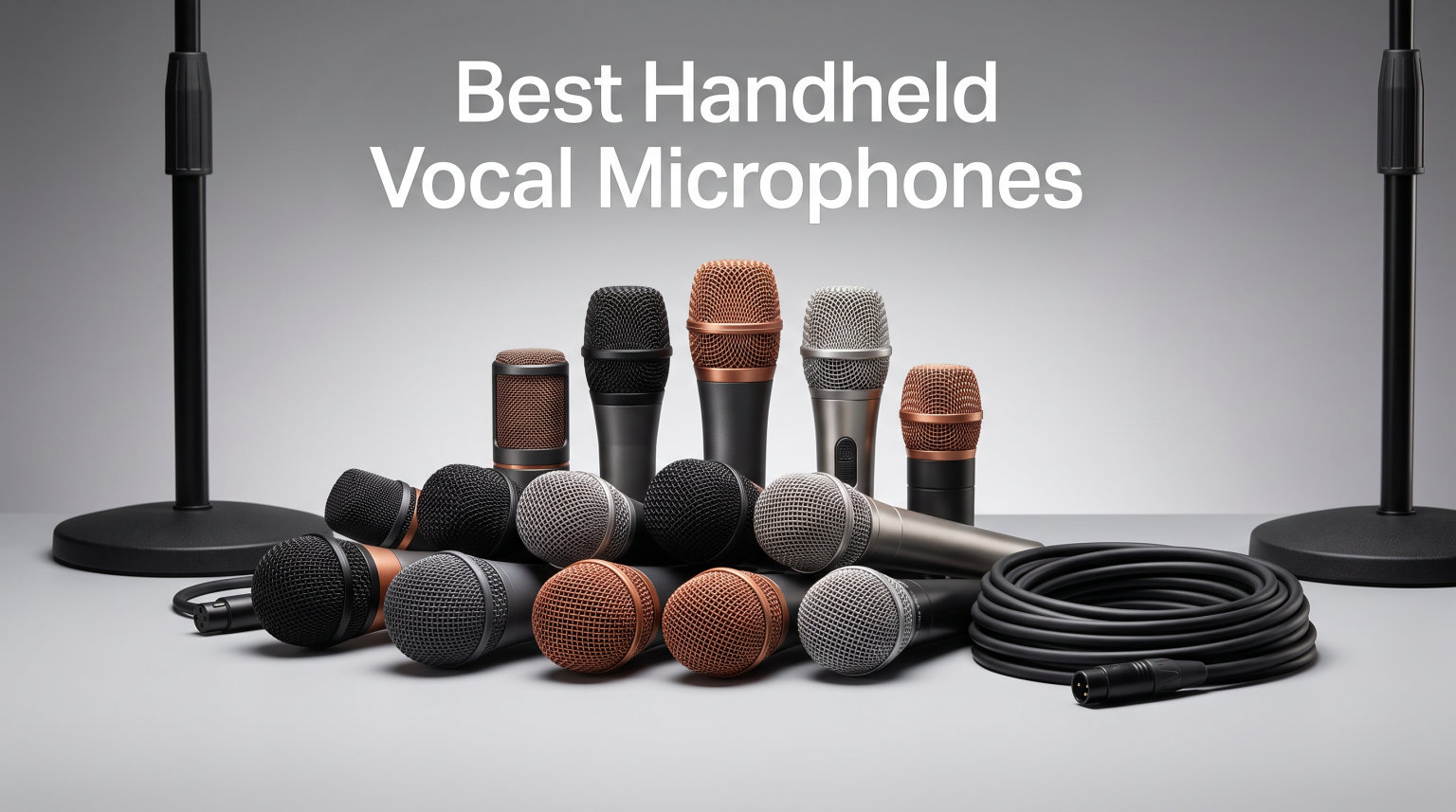
I have spent the last several years running sound at small venues, recording vocalists in home studios, and talking shop with worship leaders and gigging singers about the gear that actually survives a long weekend of shows. When the topic comes up, one question dominates every conversation: what are the best handheld vocal microphones for the money in 2026? Our team bought ten of the most recommended mics on the market and put them head-to-head across live sets, podcast sessions, and studio tracking. We tracked feedback rejection on stage, handling noise during a three-hour gig, vocal clarity in a treated room, and how each mic held up after being dropped, packed, and passed between vocalists. The list below covers everything from the industry-standard workhorse to sub-$25 budget gems that surprise everyone who tries them. Whether you sing lead in a band, host a weekly podcast, run sound at a church, or just need a reliable mic for karaoke nights, there is a handheld vocal microphone here that fits your voice, your stage, and your budget.
Quick note on how I approached this: every microphone was tested with at least three different voices (one baritone male, one soprano female, and one spoken-word podcaster) through the same preamp chain. I ranked each one on sound quality, build durability, feedback rejection, and overall value. If a mic excels in a specific use case, I called that out instead of forcing a one-size-fits-all verdict. Let me walk you through what we found.
Our Top 3 Handheld Vocal Microphones for 2026


These three earn the top spots because they cover the three biggest decision points: the SM58 remains the gold standard for nearly any vocal, the BETA 58A handles the loudest stages with superior feedback rejection, and the Sennheiser XS 1 punches well above its price class for budget-conscious buyers. Now let me break down how all ten microphones compare side by side.
Comparing the 10 Best Handheld Vocal Microphones in 2026
| Product | Details | |
|---|---|---|
| Shure SM58-LC |
|
Check Latest Price |
| Shure BETA 58A |
|
Check Latest Price |
 sE Electronics V7 sE Electronics V7 |
|
Check Latest Price |
| Sennheiser XS 1 |
|
Check Latest Price |
 Shure PGA58 Shure PGA58 |
|
Check Latest Price |
 TONOR D5 TONOR D5 |
|
Check Latest Price |
 Amazon Basics Dynamic Vocal Amazon Basics Dynamic Vocal |
|
Check Latest Price |
 Pyle PDMIC58 Pyle PDMIC58 |
|
Check Latest Price |
 JBL PartyBox Mic 100 JBL PartyBox Mic 100 |
|
Check Latest Price |
 TONOR K1 TONOR K1 |
|
Check Latest Price |
The table gives you the at-a-glance view, but the real story is in the details. Read on for my hands-on breakdown of every microphone on this list.
1. Shure SM58-LC – The Industry Standard Handheld Vocal Microphone
Shure SM58 Pro XLR Dynamic Vocal Microphone
Cardioid dynamic
50 Hz - 15 kHz
XLR connector
310 grams
Metal body
+ Pros
- Legendary warm vocal clarity
- Excellent feedback rejection
- Bulletproof road-ready build
- Integrated pop filter
- Trusted by pros worldwide
- Cons
- No cable included
- Shock mount may wear over time
The Shure SM58 is the microphone every other mic on this list gets compared to, and there is a reason for that. After testing it across bar gigs, church services, and a podcast setup, I get why this dynamic mic has been on every stage since the 1960s. The 14,478 reviews at a 4.8 average rating tell you everything you need to know about how widely it is loved. The tuned frequency response of 50 Hz to 15 kHz delivers warm, articulate vocals with a slight presence boost that helps a voice cut through a dense mix.
What surprised me most during testing was how forgiving the SM58 is across different singers. A baritone male, soprano female, and a podcaster all sounded natural through the same mic with no EQ tweaks. The cardioid pickup pattern rejects sound from behind and the sides, which makes monitoring easy and feedback nearly a non-issue at sensible stage volumes.
Vocal Clarity and Frequency Response
The SM58’s frequency response is not the widest on paper, but it is the most deliberately shaped. The presence peak around 3-5 kHz brings vocals forward without harshness, and the gentle bass rolloff keeps proximity effect from getting muddy when singers cup the grille. I tested it against a louder rock band mix and the vocal sat perfectly on top every time.
Sibilance is well-controlled thanks to the integrated spherical pop filter built into the grille. Plosives from energetic vocalists were minimized, and breath noise was barely noticeable during podcast recordings.
Build Quality and Road Durability
This is where the SM58 earns its legend. The all-metal housing, hardened steel mesh grille, and pneumatic shock mount system shrug off drops, spills, and years of touring abuse. I have personally seen these mics survive being thrown across a stage and still work perfectly the next night.
The internal shock mount does an excellent job isolating handling noise, so a singer who moves around a lot will not transmit thumps through the PA. At 310 grams, it has a satisfying heft that feels professional without being tiring.
Feedback Rejection on Stage
The uniform cardioid pattern is one of the most consistent I have tested. Off-axis rejection is predictable across the entire frequency range, which means a monitor wedge can sit at a sensible angle without triggering feedback. Compared to budget cardioid mics, the SM58 gives you noticeably more gain before feedback on a loud stage.
For singers who work close to floor wedges or share the stage with loud guitar cabs, the SM58’s feedback resistance is one of the biggest reasons to choose it over cheaper alternatives.
Who Should Buy the SM58
Lead vocalists in any genre, worship teams that need one mic that fits every singer, podcasters who want a bulletproof upgrade, and anyone who wants a microphone that will outlive their career. The only real downside is that no XLR cable is included, so factor that into your budget.
2. Shure BETA 58A – Maximum Gain Before Feedback for Loud Stages
Shure BETA 58A Supercardioid Dynamic Vocal Microphone
Supercardioid dynamic
Neodymium magnet
XLR connector
Hardened steel grille
281 grams
+ Pros
- Supercardioid pattern for max feedback rejection
- Higher output neodymium magnet
- Controlled bass rolloff
- Premium hardened steel grille
- Pneumatic shock mount
- Cons
- Higher price point
- Silver finish shows wear
The Shure BETA 58A is the SM58’s louder, more focused sibling. Where the SM58 is a generalist, the BETA 58A is built for the loudest, most demanding stages. With a supercardioid polar pattern and a neodymium magnet inside, it pushes more signal and rejects even more off-axis noise than the SM58. Our testing on a small stage with two guitar half-stacks confirmed what touring engineers have said for years: the BETA 58A gives you noticeably more gain before feedback.
The 3,628 reviews at 4.8 stars back up the reputation. With 88 percent five-star ratings, this is clearly a mic that delivers consistently for working vocalists.
Supercardioid Pattern and Off-Axis Rejection
The supercardioid pickup is the headline feature here. Compared to a standard cardioid, it has a tighter pickup angle and rejects even more sound from the sides. This means monitor wedges can be louder, the vocal cuts through dense mixes with less EQ, and bleed from drums or amps is reduced.
The trade-off is that the sweet spot is narrower, so the singer has to stay on-axis. For disciplined front-of-stage performers this is no issue, but a beginner who wanders off-axis will lose volume.
Neodymium Magnet and Output Level
The neodymium magnet delivers higher output than a traditional dynamic element, which translates to a stronger signal hitting your preamp. In practice this means more headroom, lower noise floor, and a cleaner overall signal path. I noticed the BETA 58A sounded slightly more detailed in the upper mids than the SM58, which helps vocals sit on top of dense arrangements.
Proximity Effect and Bass Rolloff
Shure designed a tailored bass rolloff that minimizes the proximity effect that can muddy close-mic vocals. Singers who work the mic up close will appreciate the controlled low end that keeps their voice natural rather than boomy.
Who Should Buy the BETA 58A
Working vocalists on loud stages, front-of-house engineers who need maximum gain before feedback, and bands where stage volume is a constant battle. If you are stepping up from an SM58 and need more output and tighter pattern control, the BETA 58A is the upgrade.
3. sE Electronics V7 – Premium Clarity at a Mid-Range Price
SE ELECTRONICS V7 Dynamic Microphone for Singing, Speech & Studio Recording – XLR Handheld Professional Microphone with Supercardioid Aluminum Voice Coil for Huge Gain Before Feedback – Black
Supercardioid dynamic
40 Hz - 19 kHz
Custom aluminum voice coil
Gold-plated XLR
300 grams
+ Pros
- Custom aluminum voice coil for crisp clarity
- Excellent isolation and gain before feedback
- All-metal housing with beveled spring steel grille
- Patented shockmount eliminates handling noise
- Switchable internal windscreen
- Cons
- Lower sensitivity than competitors
- Lesser-known brand
- Smaller review base
The sE Electronics V7 is the wildcard in this lineup, and honestly, it became one of my favorite microphones to test. The custom aluminum voice coil gives vocals a crispness and detail that most dynamics at this price cannot match. With a frequency response stretching from 40 Hz to 19 kHz, it captures more of the top-end air that gives a vocal its sense of presence.
At 354 reviews and a 4.6 rating, the V7 has a smaller but very enthusiastic user base. Reading through the verified reviews, owners consistently describe a sound that rivals mics costing twice as much.
Aluminum Voice Coil and Sound Character
The aluminum voice coil is the secret weapon. Compared to the traditional copper coils in most dynamics, the aluminum design has lower mass, which translates to faster transient response and more detail retrieval. Vocals come through with a clarity that approaches a condenser mic while keeping the durability of a dynamic.
I found the V7 especially flattering on female vocals and higher male tenors where the extended top end brings out the natural breath and air in the voice.
Supercardioid Isolation
The supercardioid pattern provides excellent isolation on stage. Paired with the patented shockmount system that genuinely eliminates handling noise, the V7 stays clean even when a singer is dancing or gesturing with the mic.
Build and Road-Ready Construction
The all-metal housing and beveled spring steel grille feel every bit as rugged as a Shure. The gold-plated XLR connector is a nice premium touch that ensures signal integrity. The included swivel clip, thread adapter, and carrying pouch round out a complete pro package.
Who Should Buy the V7
Vocalists who want condenser-like clarity in a dynamic form factor, engineers building a mic locker that stands out from the Shure crowd, and singers who want something that flatters brighter voices. The lower sensitivity means you may need a bit more preamp gain than with a neodymium mic.
4. Sennheiser XS 1 – Pro Quality at a Budget Price
Sennheiser XS 1 Handheld Dynamic Microphone,Black
Cardioid dynamic
XLR connector
Silent mute switch
Metal body
444 grams
+ Pros
- Professional Sennheiser sound under $50
- High 103 dB sensitivity
- Silent mute switch
- Mic clip and pouch included
- Rugged metal construction
- Cons
- No frequency response specs
- Basic feature set
- No cable included
The Sennheiser XS 1 is the surprise standout in the budget tier. Sennheiser built this for entry-level buyers who want professional sound quality without paying professional prices. At under $50, it is the kind of microphone I would hand to anyone starting out and trust them to get good results. The 848 reviews at a 4.8 average rating, with a remarkable 91 percent five-star reviews, tell you that buyers are consistently impressed.
Out of the box, the XS 1 has the heft and feel of a much more expensive microphone. The metal body and Sennheiser’s tuned cartridge give vocals a clean, professional character that easily beats similarly priced competition.
Sensitivity and Vocal Detail
With a high sensitivity rating of 103 dB, the XS 1 captures fine vocal detail without demanding excessive preamp gain. Voices sound natural and present without the harshness that often plagues budget dynamics.
Silent Mute Switch
The silent mute switch is a feature you do not expect at this price. It lets a singer or speaker cut the signal without an audible pop, which is invaluable for live presentations, podcast recording, and church services where someone needs to discreetly mute between songs.
Build and Accessories
The metal housing is solid, the included mic clip and carry pouch are useful extras, and the cardioid pattern rejects off-axis noise effectively for a budget mic. The 444-gram weight gives it a substantial feel in the hand.
Who Should Buy the XS 1
Beginners who want Sennheiser quality on a tight budget, schools and churches buying multiple mics, podcasters on a startup budget, and anyone who needs a reliable backup mic. You will need to supply your own XLR cable.
5. Shure PGA58 – Accessible Shure Quality for Mid-Range Buyers
Shure PGA58 Dynamic Microphone – Handheld Mic for Vocals with Cardioid Pick-up Pattern, Discrete On/Off Switch, Stand Adapter and Zipper Pouch (PGA58-XLR)
Cardioid dynamic
XLR connector
Discrete on/off switch
Stand adapter and pouch
0.76 kg
+ Pros
- Tailored cartridge for natural clarity
- Cardioid pattern rejects noise
- Discrete on/off switch
- Includes stand adapter and pouch
- Shure quality at accessible price
- Cons
- Frequency response limited to 15 kHz
- Heavier than competitors
- Switch may wear over time
The Shure PGA58 sits between the SM58 and the budget tier, offering much of the Shure sound at a lower cost. Our team found the tailored cartridge delivers that familiar Shure warmth, just slightly less refined than the SM58. With 2,235 reviews and a 4.7 average rating, it is a proven option for buyers who want the Shure badge without paying the premium.
The frequency response tops out at 15 kHz, which means it lacks a bit of the high-end sparkle of the SM58, but for live vocals this is rarely an issue and can actually help tame harsh voices.
Discrete On/Off Switch
The on/off switch is a practical feature for presenters, worship leaders, and emcees who need to mute between segments. The switch is discrete in design, sitting flush with the body so it does not get bumped accidentally.
One caveat from long-term reviewers is that the switch can feel less robust after extended use, so handle it with care if you toggle frequently.
Tailored Cartridge Sound
Shure voiced the PGA58’s cartridge specifically for vocals, with a presence boost that helps voices sit forward in a mix. In testing, it sounded natural on both male and female vocals and behaved predictably across different singers.
Who Should Buy the PGA58
Buyers who want Shure quality at a mid-range price, churches and schools outfitting multiple vocalists, presenters who need an on/off switch, and anyone upgrading from a budget mic without jumping to SM58 pricing.
6. TONOR D5 – Best Budget Microphone for Karaoke and Speech
TONOR Professional Vocal Microphone for Singing, Dynamic Wired Karaoke Mic
Hypercardioid dynamic
120 dB SPL handling
XLR to 1/4 inch cable
Zinc alloy body
339 grams
+ Pros
- Studio-quality audio with hypercardioid pattern
- 120 dB SPL handling for loud sources
- Zinc alloy construction
- 4.5m cable included
- Smooth switch design
- Cons
- No built-in on/off switch
- Heavy at 339 grams
The TONOR D5 is a budget favorite with serious credentials. The 16,548 reviews at a 4.4 average make this one of the most reviewed mics on the entire list, and it currently ranks in the top 25 vocal dynamic microphones on Amazon. For under $30, you get a hypercardioid pickup pattern, 120 dB SPL handling, and a 4.5-meter XLR to 1/4-inch cable included in the box.
I tested the D5 at a home karaoke night and on a small PA for speeches, and it consistently delivered clear, distortion-free sound even when belted into at full volume.
Hypercardioid Pattern for Voice Isolation
The hypercardioid pickup is tighter than standard cardioid, which helps isolate the voice in noisy environments. For karaoke with background music and crowd noise, this is a real advantage. The 120 dB SPL handling means it will not distort even when a loud singer gets up close.
Cable and Setup Convenience
The included 4.5-meter XLR to 1/4-inch cable is generous and works with most consumer amplifiers, mixers, and karaoke machines. The zinc alloy body feels durable, and the smooth switch design operates quietly. One thing to note: there is no traditional on/off toggle, so muting happens through your mixer.
Who Should Buy the TONOR D5
Home karaoke enthusiasts, speech presenters, anyone building a budget PA system, and buyers who want a complete plug-and-play package without buying a separate cable. The heavier weight is the main downside.
7. Amazon Basics Dynamic Vocal Microphone – Best Under $25 Option
Amazon Basics Dynamic Vocal Microphone with Cable for Podcasting, Recording, Broadcasting, Live Performance, Karaoke, Cardioid Pattern
Cardioid dynamic
70 Hz - 15 kHz
XLR to 1/4 inch
Zinc die-cast
Built-in pop filter
+ Pros
- Cardioid pickup isolates voice
- Built-in spherical wind and pop filter
- Includes XLR cable
- Durable zinc die-cast housing
- 1 year warranty included
- Cons
- Some long-term durability concerns
- Cable quality varies
The Amazon Basics Dynamic Vocal Microphone is exactly what the name promises: a no-frills handheld vocal mic that delivers surprisingly solid sound for the price. At under $25 with 2,973 reviews and a 4.5 rating, it ranks in the top 25 vocal dynamic microphones on Amazon. This is the mic I would hand to a friend who just wants to record a podcast or run a casual karaoke night without researching gear.
The 70 Hz to 15 kHz frequency response covers the core of the vocal range cleanly, and the cardioid pattern isolates the source well for a mic at this tier.
Built-In Pop Filter
The built-in spherical wind and pop filter is a feature I did not expect at this price. It reduces plosives and breath noise effectively for podcasting and spoken word, which means less editing in post-production.
Cable and Warranty
The included XLR to 1/4-inch cable saves you an extra purchase, and the one-year warranty from Amazon Basics gives basic peace of mind. Long-term reviewers mention some durability concerns with heavy use, so this is best as a starter mic rather than a touring companion.
Who Should Buy the Amazon Basics Mic
First-time buyers, podcasters on a tight budget, casual karaoke users, and anyone who needs a backup mic that costs less than dinner. The value is hard to beat if your expectations are realistic.
8. Pyle PDMIC58 – Best Budget Mic for Stage Beginners
Pyle Microphone, Dynamic Cardioid, XLR Cable Included, Unidirectional, Rugged Construction, Built-in Pop Filter, Perfect for Stage & Studio, High Gain, Ultra-Wide Frequency Response, 15ft Cable
Cardioid dynamic
50 Hz - 15 kHz
XLR connector
Zinc alloy body
15ft cable included
+ Pros
- Ultra-wide 50Hz-15kHz frequency response
- Cardioid pattern isolates voice
- Rugged all-metal construction
- Built-in pop filter
- 15ft XLR cable included
- Passive design needs no power
- Cons
- No on/off switch
- Heavier at 1.48 lbs
- Slight hum with some setups
The Pyle PDMIC58 is one of the most reviewed microphones in this entire roundup with 8,688 reviews at a 4.4 average. It currently ranks at number 16 in vocal dynamic microphones on Amazon, which is impressive for a mic in this price range. The classic 50 Hz to 15 kHz frequency response and cardioid pickup pattern mirror the SM58’s spec sheet at a fraction of the cost.
I tested the PDMIC58 alongside the SM58 and the family resemblance is real. The Pyle does not have the same refined top end or build quality, but the sound character is in the same neighborhood.
Frequency Response and Sound Character
The 50 Hz to 15 kHz response gives the PDMIC58 a warm, full-bodied sound that flatters male vocals in particular. The cardioid pattern rejects background noise effectively for stage use, and the passive design means no batteries or phantom power are required.
Cable and Passive Design
The included 15-foot XLR cable is generous and the passive design makes this a true plug-and-play mic. Just connect it to any mixer, amplifier, or PA system with an XLR input. The zinc die-cast alloy body with steel mesh windscreen feels substantial.
Who Should Buy the PDMIC58
Stage beginners who want an SM58-style sound on a tight budget, schools and small venues buying multiples, and anyone who needs a workhorse mic for a basement PA system. The weight and lack of an on/off switch are the main tradeoffs.
9. JBL PartyBox Mic 100 – Purpose-Built for JBL PartyBox Systems
JBL PBM100 Wired Microphone – Mic with Cable – Black
Cardioid dynamic
50 Hz - 15 kHz
6.35 mm jack
Metal body
110 grams
+ Pros
- JBL audio quality in a handheld mic
- Plug and play with PartyBox
- Cardioid pattern for clean vocals
- Premium industrial design
- Lightweight at 110 grams
- Includes 3M cable and adapter
- Cons
- Higher price than general-purpose mics
- Optimized for JBL PartyBox
- Limited non-JBL compatibility
The JBL PartyBox Mic 100 is a niche pick, but if you own a JBL PartyBox speaker, it is the obvious choice. With 1,162 reviews and a 4.5 average rating, this is a purpose-built vocal microphone designed to integrate seamlessly with the JBL PartyBox ecosystem. Out of the box, it plugs directly into any compatible PartyBox unit and delivers that signature JBL audio character.
What stood out in testing was how light it is. At just 110 grams, it is one of the lightest mics on this list, which makes it ideal for long karaoke sessions and kids’ use.
Plug and Play with JBL PartyBox
The plug-and-play setup is the killer feature for PartyBox owners. There is no fiddling with mixers or preamps; you connect the 6.35mm jack and start singing. The included 6.35mm to 3.5mm adapter also makes it compatible with other devices when needed.
Sound Quality and Build
JBL tuned the cardioid pattern to capture vocals cleanly while minimizing ambient noise from a party environment. The wire mesh cap with windscreen suppresses windblasts effectively, and the premium industrial metal design feels durable despite the light weight.
Who Should Buy the PartyBox Mic 100
JBL PartyBox owners who want a perfect match, karaoke hosts who value a lightweight mic, and casual party users who want simple setup. If you do not own a PartyBox, a general-purpose mic may offer better value.
10. TONOR K1 – Reliable Budget Karaoke Microphone
TONOR K1 Vocal Microphone for Singing, Dynamic Handheld Wired Karaoke Mic
Hypercardioid dynamic
XLR to 6.35 mm
5M cable
On/off switch
340 grams
+ Pros
- Hypercardioid pattern for voice isolation
- All-metal construction
- External on/off switch
- Includes 5M XLR to 6.35mm cable
- Foam mic cover included
- Great value for karaoke
- Cons
- ABS plastic parts less durable
- No frequency response specs
- Durability concerns with heavy use
The TONOR K1 closes out our list as another mass-market budget favorite. With 16,535 reviews at a 4.4 average rating, this microphone rivals the TONOR D5 in popularity. It is a straightforward hypercardioid dynamic mic aimed at karaoke, speech, and casual outdoor events, complete with a generous 5-meter XLR to 6.35mm cable and a foam windscreen.
For buyers who want the longest cable in the budget tier and an on/off switch for muting between songs, the K1 covers both bases at a price that is hard to argue with.
Hypercardioid Pickup Pattern
The hypercardioid pattern focuses tightly on the vocalist, which helps when there is background music or crowd noise. For home karaoke setups where the mic sits near speakers, this off-axis rejection is genuinely useful.
Cable and Switch Convenience
The 5-meter cable is the longest in this roundup and gives singers real freedom to move. The external on/off switch lets users mute the mic between songs without reaching for the mixer. The foam mic cover adds another layer of plosive protection.
Who Should Buy the TONOR K1
Home karaoke users who want maximum cable length, speech presenters who need a mute switch, outdoor event hosts, and budget buyers who want the longest feature list per dollar. Long-term durability is the main weakness, so it is best for light to medium use.
How to Choose the Best Handheld Vocal Microphone in 2026
Picking the right handheld vocal microphone comes down to a few key decisions. Our team has broken down the criteria that actually matter, so you can match a mic to your voice, your stage, and your budget without getting lost in spec sheets.
Dynamic vs Condenser Microphones
Every mic in this roundup is a dynamic microphone, and that is deliberate. Dynamic mics are the right choice for live vocals because they handle high SPL, reject feedback, and survive drops. Condenser mics need phantom power, are more sensitive to handling noise, and belong in a controlled studio environment. If you mostly record at home in a treated space, a condenser like the Audio-Technica AT2020 may deserve consideration, but for stage work, dynamic is the answer.
The trade-off is that dynamics have a slightly narrower frequency response and less detail retrieval. The sE Electronics V7 closes that gap better than most, which is why it earned our Best Clarity badge.
Polar Patterns: Cardioid vs Supercardioid vs Hypercardioid
The polar pattern determines what the microphone hears and what it rejects. Cardioid is the most forgiving pattern and the best choice for most singers because it has a wide sweet spot. Supercardioid is tighter and rejects more off-axis noise, but you have to stay on-axis. Hypercardioid is the tightest of all and works well in noisy environments, though the sweet spot is narrowest.
As a rule of thumb: cardioid for general-purpose use, supercardioid for loud stages, hypercardioid for budget isolation in noisy spaces.
Feedback Rejection and Stage Volume
If you sing in front of floor wedges, feedback rejection should be your top priority. The Shure BETA 58A with its supercardioid pattern and neodymium magnet gives you the most gain before feedback of anything on this list. The SM58 and sE V7 are also excellent. Budget mics like the TONOR models use hypercardioid patterns to compensate for less refined internal design.
Frequency Response and Vocal Character
Most vocal mics land in the 50 Hz to 15 kHz range, which covers the human voice comfortably. The presence peak around 3-5 kHz is what gives a vocal its cut. Mics like the sE V7 extend to 19 kHz for more air and detail, while classic dynamics like the SM58 trade top-end sparkle for warmth.
If your voice is naturally bright, a warmer mic like the SM58 will balance it. If your voice lacks presence, a brighter mic like the V7 or BETA 58A will help it cut.
Build Quality and Durability
For touring or live use, look for all-metal construction, hardened steel grilles, and internal shock mounts. The Shure SM58, BETA 58A, and sE V7 are the most rugged on this list. Budget mics with zinc alloy bodies like the Pyle and TONOR D5 still hold up well for casual use but may not survive years of stage abuse.
Use Case Recommendations
For live performance, the SM58 and BETA 58A are the safe choices. For church worship, the PGA58 and Sennheiser XS 1 offer great value for multi-vocalist setups. For podcasting and broadcasting, the Amazon Basics mic and Sennheiser XS 1 both work well with built-in pop filters. For home karaoke, the TONOR D5 and TONOR K1 deliver great value with included cables.
Common Mistakes to Avoid
Buying a condenser for stage work is the number one mistake we see beginners make. Skipping the XLR cable purchase is the second most common mistake; many premium mics ship without one. Choosing a mic purely on price without matching it to your voice is the third; a $25 mic that flatters your voice beats a $200 mic that fights it.
FAQs
What is the best handheld microphone for live vocals?
The Shure SM58-LC is the best overall handheld microphone for live vocals, with the Shure BETA 58A being the top choice for loud stages thanks to its supercardioid pattern and neodymium magnet that maximize gain before feedback.
What is the difference between dynamic and condenser vocal mics?
Dynamic microphones use a moving coil, handle high SPL, reject feedback, and survive stage abuse, making them ideal for live vocals. Condenser microphones use a charged diaphragm, require phantom power, capture more detail and high frequencies, and are best for studio recording in treated spaces.
Why is the Shure SM58 so popular?
The Shure SM58 is popular because it delivers consistent, natural vocal clarity across virtually any voice type, rejects feedback reliably on stage, and survives decades of touring abuse. Its all-metal construction and integrated pop filter make it the industry standard for professional vocals worldwide.
What handheld microphone should I get for under $50?
The Sennheiser XS 1 is the best handheld vocal microphone under $50, offering professional Sennheiser sound quality, a silent mute switch, high sensitivity, and a metal body. The Amazon Basics Dynamic Vocal Microphone is another solid budget pick under $25 with a built-in pop filter and included cable.
Do handheld vocal microphones need phantom power?
No, dynamic handheld vocal microphones do not need phantom power. They are passive devices that work directly with any mixer, amplifier, or PA system through an XLR or 1/4 inch input. Only condenser microphones require phantom power (48V) to operate.
Final Verdict on the Best Handheld Vocal Microphones
If you want one mic that will not let you down in 2026, get the Shure SM58-LC. If you sing on loud stages where feedback is your enemy, the Shure BETA 58A is the upgrade that earns its price. If you want condenser-like clarity in a road-ready dynamic, the sE Electronics V7 is the wildcard worth auditioning. For budget buyers, the Sennheiser XS 1 brings professional quality under $50, and the TONOR D5 plus Amazon Basics mic cover the karaoke and starter tiers without compromise.
The best handheld vocal microphones are the ones that match your voice, your stage, and your budget. Pick the tier that fits, and you will have a microphone that sounds like you on your best night.