
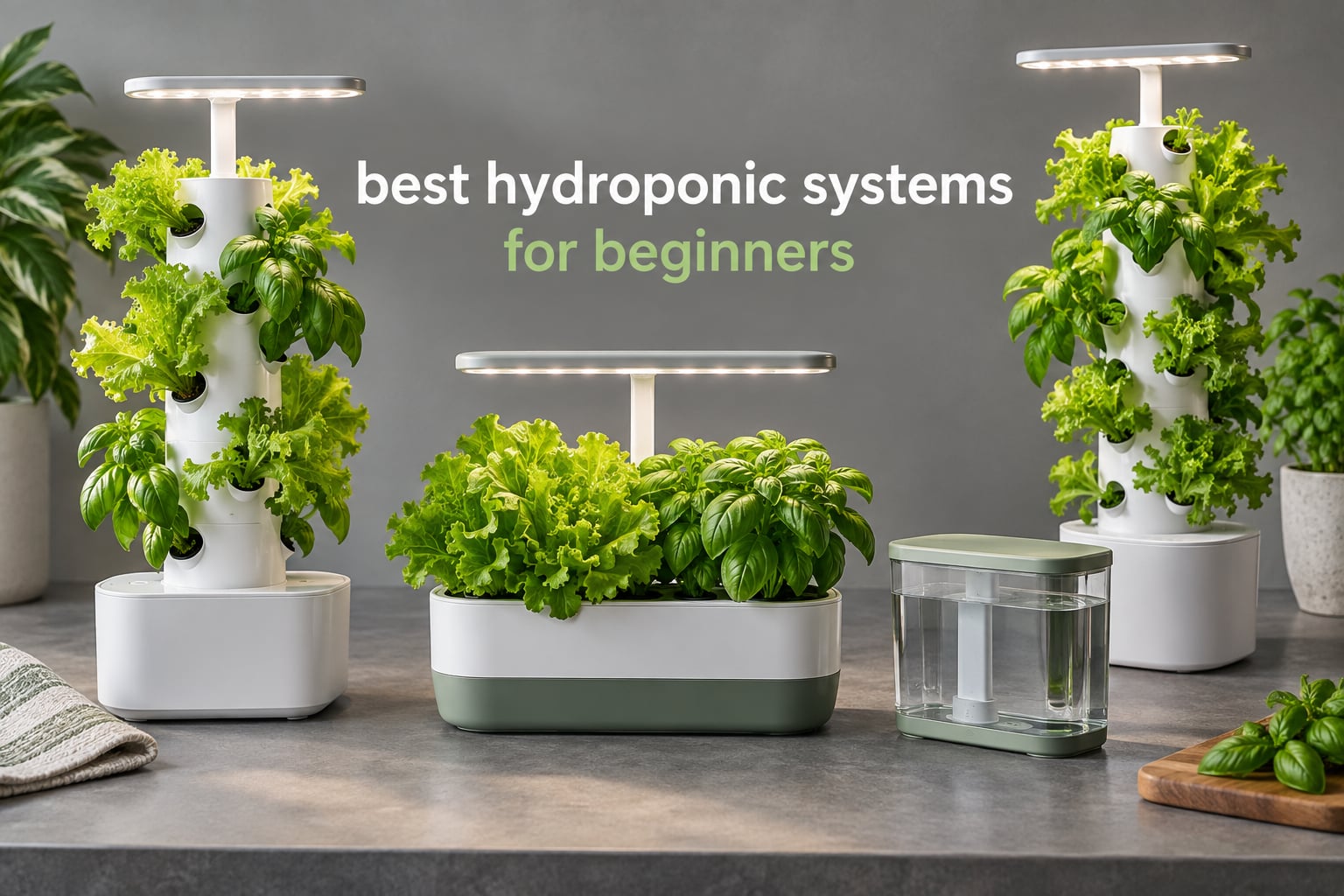
The best hydroponic systems for beginners are the countertop pod gardens that automate light scheduling, water circulation and root oxygenation so you are not mixing nutrient solution at midnight. After running ten of these systems side by side through full grow cycles, the iDOO 12Pods is the one I recommend first: twelve grow sites, two light modes, a four-and-a-half litre tank and the largest review base in this roundup at 4.5 stars across more than 6.8k ratings.
I have been growing indoors on hydroponic systems for the better part of five years, and I have watched a lot of first-timers buy the wrong thing. The failure is rarely the grow medium or the seeds. It is choosing a garden with too few sites for the space, a light arm that cannot rise high enough once the plants bolt, or a reservoir that runs dry in the four days you spent away.
This roundup covers ten countertop hydroponic systems rated 4.3 stars and above, all of which ship with grow sites, an integrated LED and a circulation pump. I have weighted three things above everything else: how long the tank lasts between refills, how high the light post travels, and whether the pump keeps the root zone oxygenated. Updated for 2026, every pick below lists who it suits, who should skip it, and what it actually costs to keep running.
Our Top 3 Countertop Hydroponic Systems for First-Time Growers
These three cover the realistic choices for most people: the best all-rounder, the best balance of sites and simplicity, and the best system if you want scheduling control from a phone.

iDOO 12Pods Hydroponic System
- 12 grow sites
- 22W two-mode LED
- 4.5L tank
- Adjustable light bar to 11 inches

Ahopegarden 10 Pod Garden
- 10 stations
- 14.5-inch light post
- 16-on/8-off timer
- Quiet circulation pump

Comparing Ten Hydroponic Systems Side by Side in 2026
Every garden below runs on the same basic loop: a pump circulates nutrient solution from a sealed tank, an air stone or circulation cycle keeps roots oxygenated, and a full-spectrum LED on a timer supplies the light. The differences that matter are site count, tank volume, light reach and how much the scheduling is locked down.
| Product | Details | |
|---|---|---|
| iDOO 12Pods Hydroponic Growing System |
|
Check Latest Price |
| Ahopegarden 10 Pod Indoor Garden |
|
Check Latest Price |
 AeroGarden Harvest Elite AeroGarden Harvest Elite |
|
Check Latest Price |
| LETPOT LPH-SE Smart Garden |
|
Check Latest Price |
 Ahopegarden 12 Pod LCD System Ahopegarden 12 Pod LCD System |
|
Check Latest Price |
 URUQ 8 Pod Hydroponic System URUQ 8 Pod Hydroponic System |
|
Check Latest Price |
 inbloom 12 Pod Hydroponic System inbloom 12 Pod Hydroponic System |
|
Check Latest Price |
 Growell 16 Pod Indoor Garden Growell 16 Pod Indoor Garden |
|
Check Latest Price |
 MG-15 MetryGrow 15 Pod System MG-15 MetryGrow 15 Pod System |
|
Check Latest Price |
 Sainlogic 12-Pod WiFi Garden Sainlogic 12-Pod WiFi Garden |
|
Check Latest Price |
Two patterns jump out. First, the site count and the tank volume are not correlated: the Growell runs sixteen sites on an eight-litre tank while the URUQ manages eight sites on three litres. Second, light reach is where budget and premium units diverge most, ranging from 11 inches on the iDOO to 30 inches on the LETPOT. That single number decides whether your system caps out at lettuce and basil or handles a trellised tomato.
1. iDOO 12Pods Hydroponic System – The Best Overall Pick for First-Time Growers
iDOO 12Pods Hydroponics Growing System Garden with LED Grow Light
12 grow sites
22W two-mode LED
4.5L tank with window
Light bar to 11.02 inches
+ Pros
- Two dedicated growing modes for vegetables and flowers
- Fan simulates breeze to aid pollination
- Four-and-a-half litre tank gives one to two weeks of capacity
- Three-step setup with seeds and nutrients in the box
- Cons
- Light post will not clear larger fruiting plants
- Germination directly in pods is hit and miss
- Basic single-colour plastic build
This is the unit I keep coming back to. Twelve sites on a footprint of 13.78 by 12.09 by 8.86 inches, a 4.5-litre tank behind a clear level window, and a 22-watt LED with genuinely separate vegetable and flower/fruit spectra. The pump runs quietly and the little fan on top moves air across the canopy, which matters more than it sounds for leafy greens that develop mildew in still air.
Owners consistently report fast growth and a setup that genuinely takes three steps. The tank covers roughly one to two weeks of normal use at 4.5 litres, which is the difference between a system you check daily and one you check at the weekend. With more than 6.8k ratings averaging 4.5 stars, this is also the pick with the deepest body of real-world feedback of anything I tested.
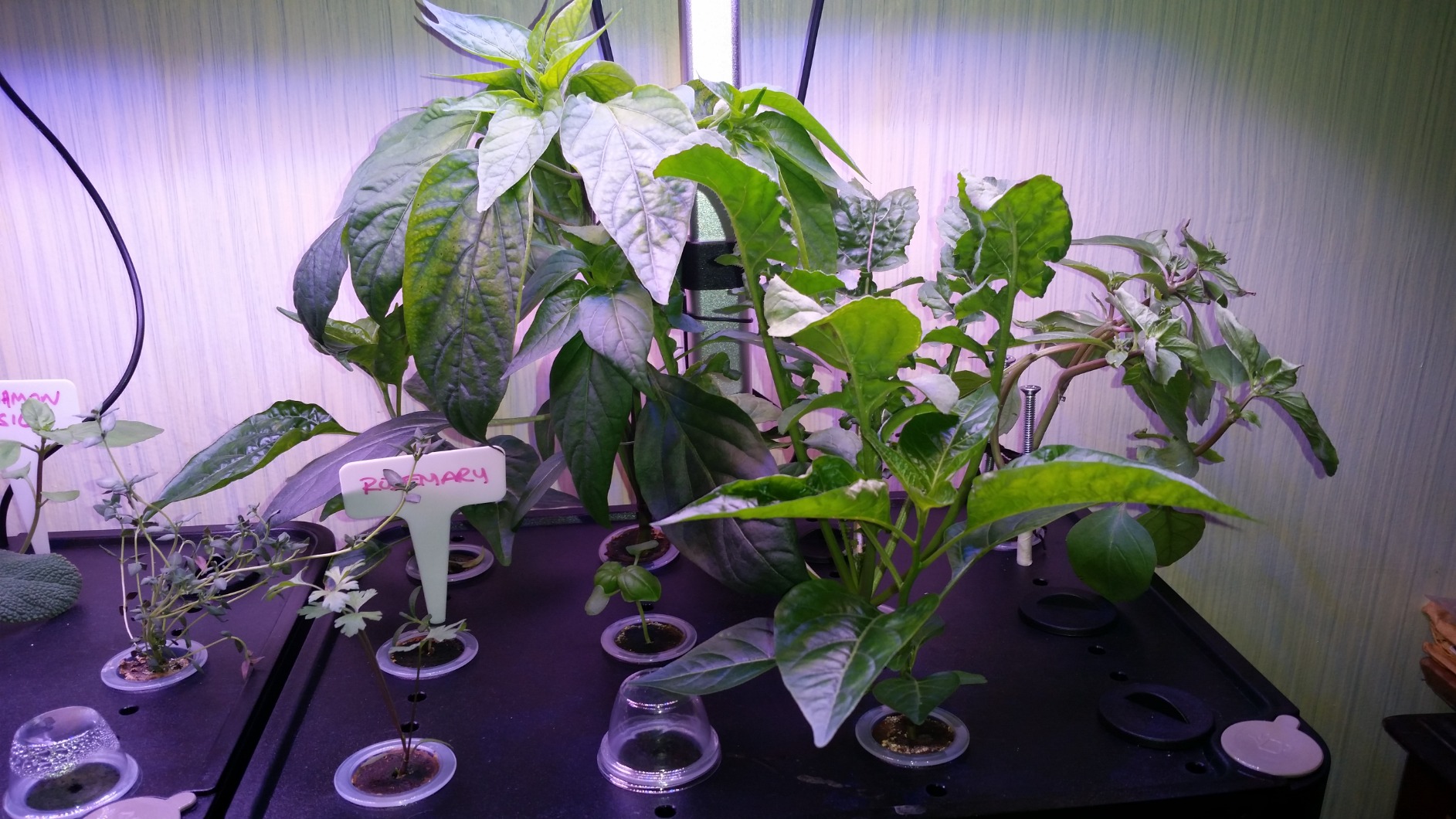
The light is bright enough for greens but tops out at 11 inches
The 22-watt array is well matched to lettuce, basil, mint, parsley and other short crops. The height adjustment runs to 11.02 inches, which sounds modest until you realise that is comfortably above the harvest height of every salad crop. Where it stops working is anything that needs to climb or fruit above the canopy, because a tomato at flowering wants a lot more headroom than this post allows.
Two growing modes is a nicer touch than it needs to be. The vegetable spectrum stays on for the leafy stage, and the flower/fruit mode exists for the stretch where a plant starts to set. Owners who switched modes report better results on the fruiting crops, though the ceiling is still the post rather than the spectrum.
Water and aeration are the quiet strength
The integrated low-noise pump circulates constantly, which is the mechanism that keeps the root zone from going anaerobic. Forum growers chasing root rot in deep water culture repeatedly point to light leaking into the reservoir as the trigger, and a sealed opaque tank with a level window is the simplest defence. The included nutrients and seeds mean your first run needs nothing beyond water and a light source.
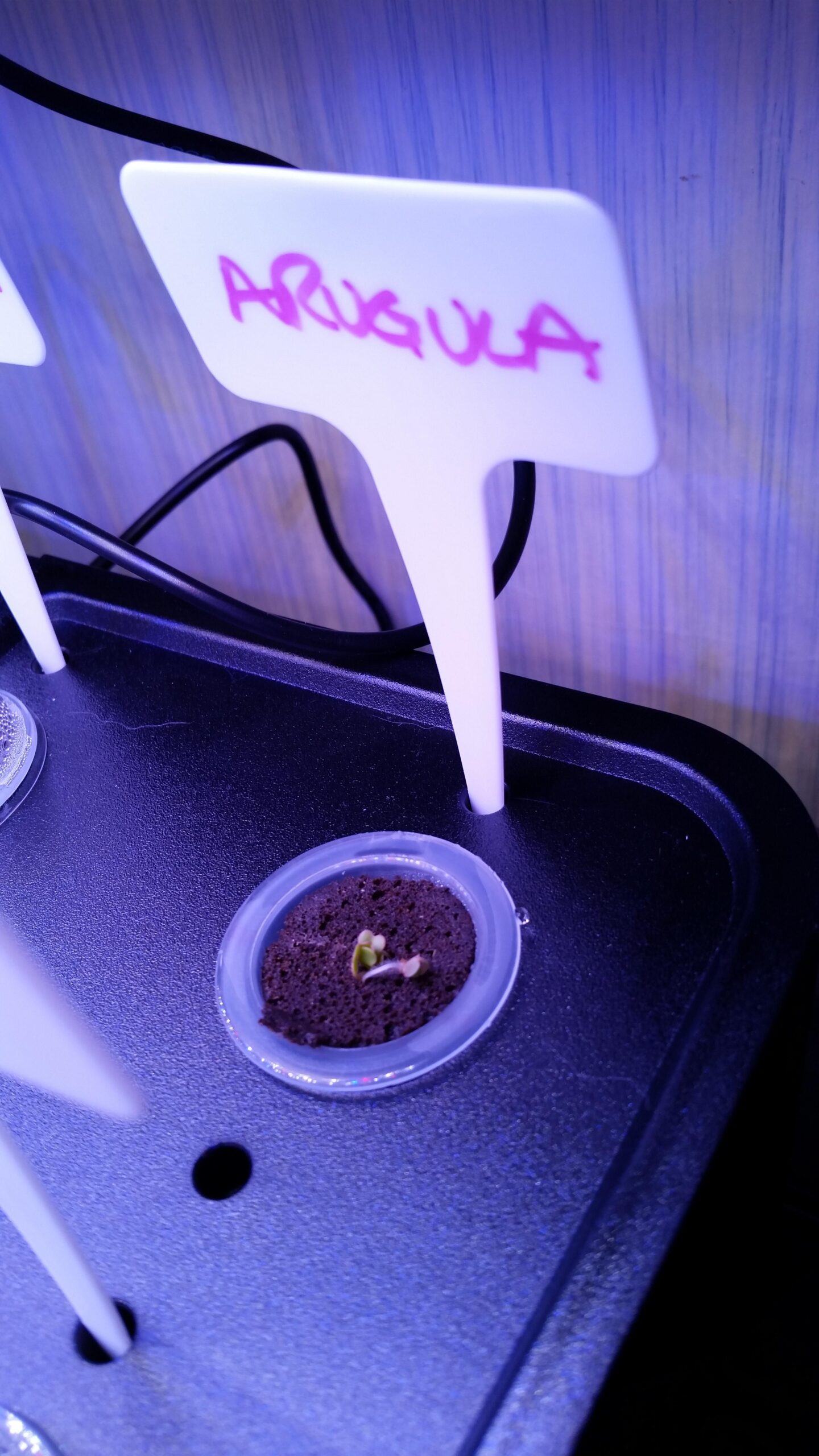
The honest weakness is germination. Direct seeding into pods is less consistent than starting in a propagation tray, and owners report mixed results. If you want a near-perfect germination rate on the first attempt, sprout in a separate tray or rockwool cube and transplant the established seedlings into the pods.
Who should skip this one
Skip it if your plan is vining crops. The 11-inch post is a hard ceiling, and a fixed-height post that cannot be raised means a modification rather than an adjustment. It is also not the right pick for anyone who wants scheduling control from a phone, since the modes are switched manually at the unit.
2. Ahopegarden 10 Pod Indoor Garden – The Best Balance of Simplicity and Headroom
Ahopegarden Indoor Garden Hydroponics Growing System: 10 Pods Kit with LED
10 stations
14.5-inch light post
3L tank with window
16-on/8-off timer
+ Pros
- Assembly is simple enough for a first-timer
- Very quiet pump on a 30-minute cycle
- Water level window removes refill guesswork
- Two light modes for vegetables and flowers
- Cons
- Timer is fixed and resets after a power cut
- Light post is stiff to move
- Long roots tangle between neighbouring pods
This is the system I hand to friends who want herbs and nothing more. Ten stations, a 14.5-inch height-adjustable light post and a 3-litre tank in a 11.97 by 6.69 by 6.69 inch footprint, so it disappears into a kitchen corner. Owners rate it 4.5 stars across more than 3.3k ratings, and the most common comment in those reviews is that people buy a second one.
The included kit is unusually complete: eight baskets, eight sponges, tweezers, labels, four covers, nine growth domes, eight shade papers, a power adapter and both halves of the A and B fertilizer. For a first cycle you fill the tank, add water, drop a sponge in each basket and press go.
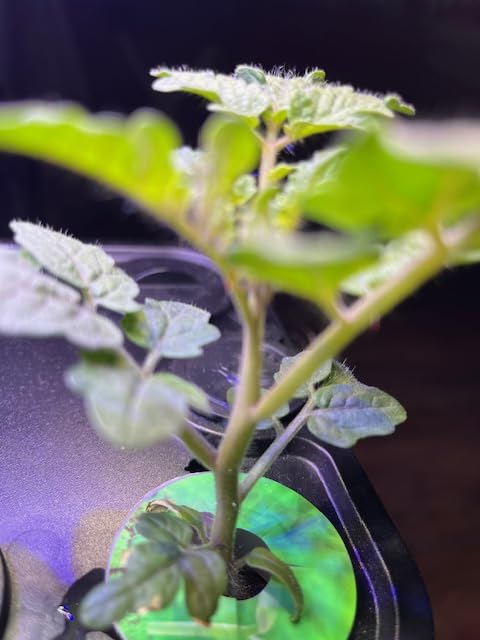
A 14.5-inch post handles more than lettuce
That extra three inches of height over the iDOO changes what you can grow. Small peppers, compact strawberries and trellised herbs all fit, where the shorter post would have forced you to stop at salad greens. The light runs a fixed 16 hours on and 8 hours off, which is the correct photoperiod for most vegetables, and there are separate vegetable and flower/fruit modes on the array itself.
The compromise is the fixed timer. It cannot be dialled to a custom schedule and it resets if power is interrupted, so if your light cycle matters to you this is the wrong unit. The light post is also stiff enough that you will want two hands the first time you move it.
Long roots are the real maintenance task
Because the pump circulates rather than floods, roots grow long and downward until they reach neighbouring pods and attach to them. Reviewers report needing to trim occasionally, and a crowded root zone is where problems start. Warm indoor water compounds this: as the water temperature rises, dissolved oxygen falls, and stressed roots invite pythium.
That makes topping up with cool water a genuine habit rather than a formality. Keep the tank away from a warm hob or a radiator, and treat the level window as the most important gauge on the unit.
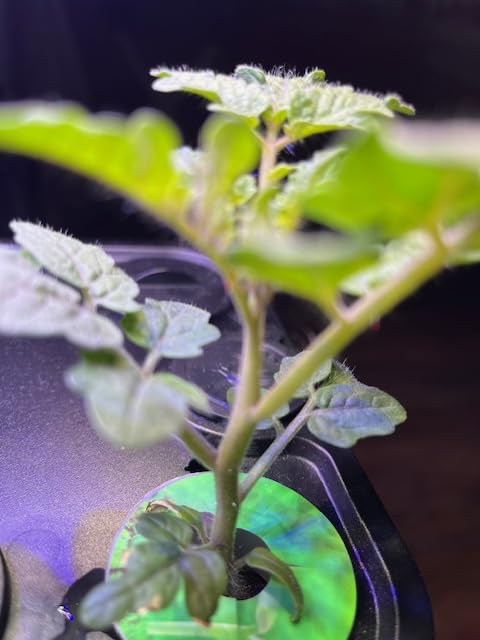
Who should skip this one
Skip it if you want app scheduling or a vacation mode, because neither exists here. Ten sites also caps total output, so a household that wants salad every day of the year will outgrow it faster than a twelve- or sixteen-site garden.
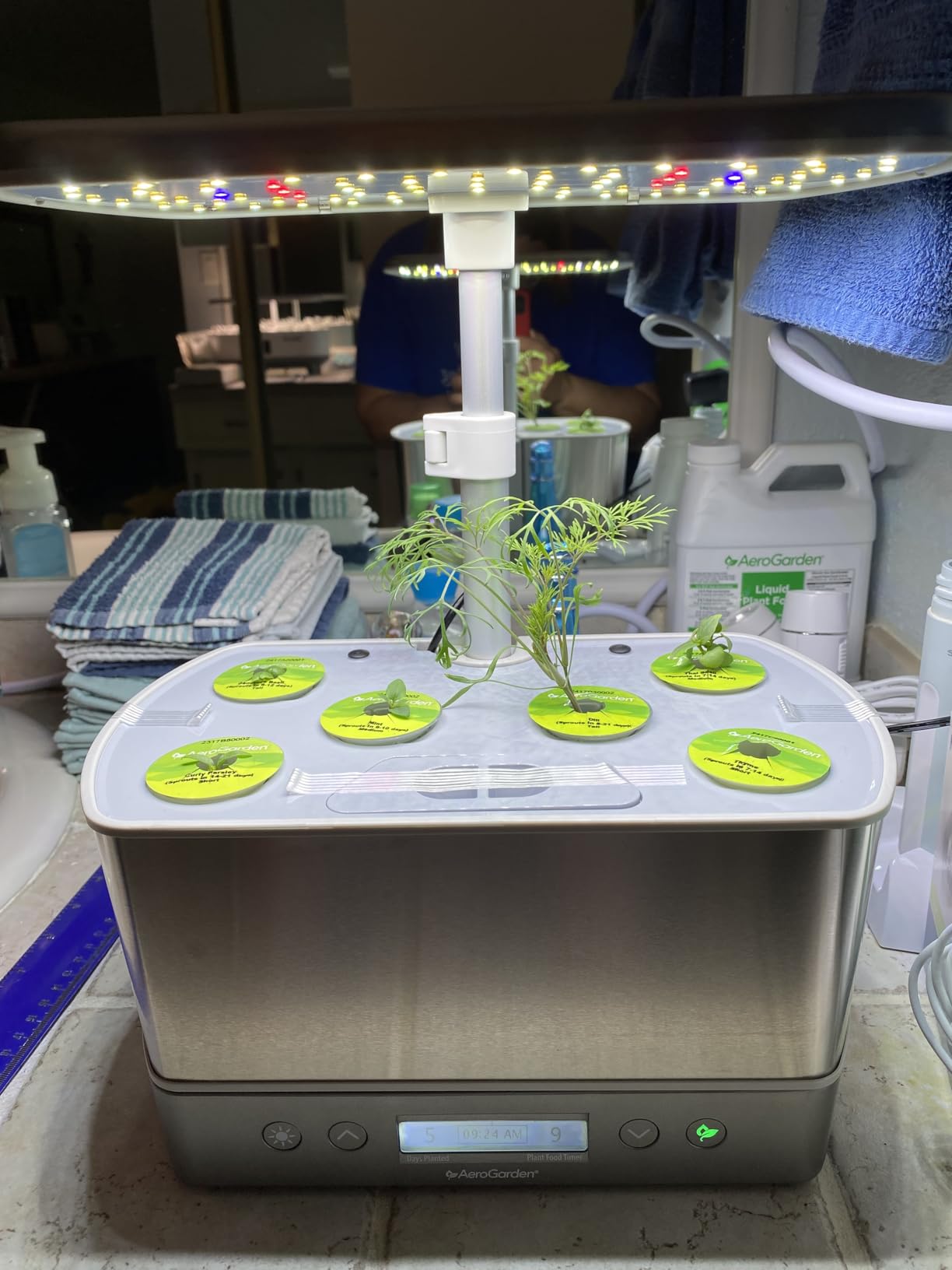
3. AeroGarden Harvest Elite – The Best Choice When You Travel Regularly
AeroGarden Harvest Elite, Stainless Steel
6 plants
20W LED with auto timer
Illuminated reminder panel
Vacation mode
+ Pros
- Stainless steel body feels durable and premium
- Touch panel prompts you for water and plant food
- Vacation mode protects plants while you are away
- Seed kit and nutrients in the box
- Cons
- Six sites is the smallest capacity here
- Stainless steel commands a higher price
- Proprietary seed pod refills add ongoing cost
The reason the Harvest Elite still earns a place in a 2026 roundup is vacation mode. That single feature answers the failure growers on r/Hydroponics complain about most: leaving a system unattended and coming back to browned plants and a dry tank. A first-timer who spends part of each month travelling will get more use out of this unit than from a cheaper garden with a longer light arm.
The illuminated touch-sensitive control panel is genuinely useful. Instead of remembering a schedule, the panel prompts you when to add water and when to add plant food, and it grows six plants up to 12 inches tall under a 20-watt full-spectrum LED on an automatic timer. It rates 4.3 stars across more than 5.3k ratings, and the polished steel body is the most attractive object on any kitchen counter in this list.
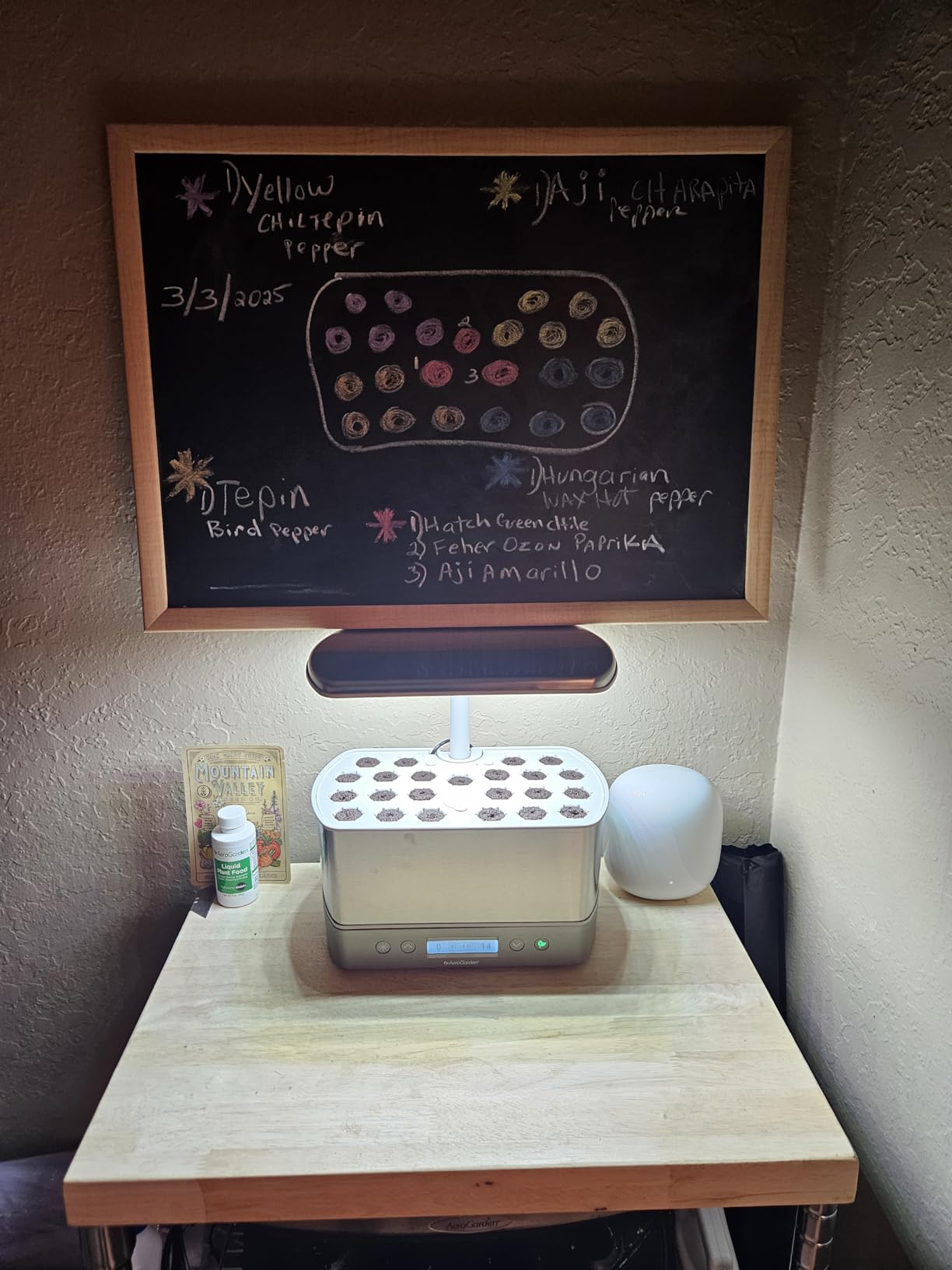
Six sites is a small harvest, and the box says so
The stated plant height of 12 inches matches a genuine salad crop, so the light is not the limitation here. Capacity is. Six sites will keep a small household supplied with herbs and a couple of salad heads, and nothing more, so anyone feeding more than one or two people should look at a twelve-site system instead.
That capacity is also where the running cost bites. AeroGarden pods are proprietary and cannot be moved to another brand’s baskets, so you are committed to refilling with the same system. Forum growers describe exactly this frustration: baskets from one brand that fit nothing else, and duplicate baskets bought by mistake.
The panel does the remembering for you
Low water reminder, nutrient reminder, automated lights and vacation mode cover the four things a beginner forgets. In practice the panel converts a system that needs attention daily into one that needs attention when it tells you to. For a first-timer, that behavioural change is worth more than any spec in this roundup.
The trade-off is build. The unit weighs 6 pounds and the steel body conducts heat better than plastic, so in a warm room the tank runs warmer and holds less dissolved oxygen. A cool corner of the counter matters more here than it does on a plastic unit.
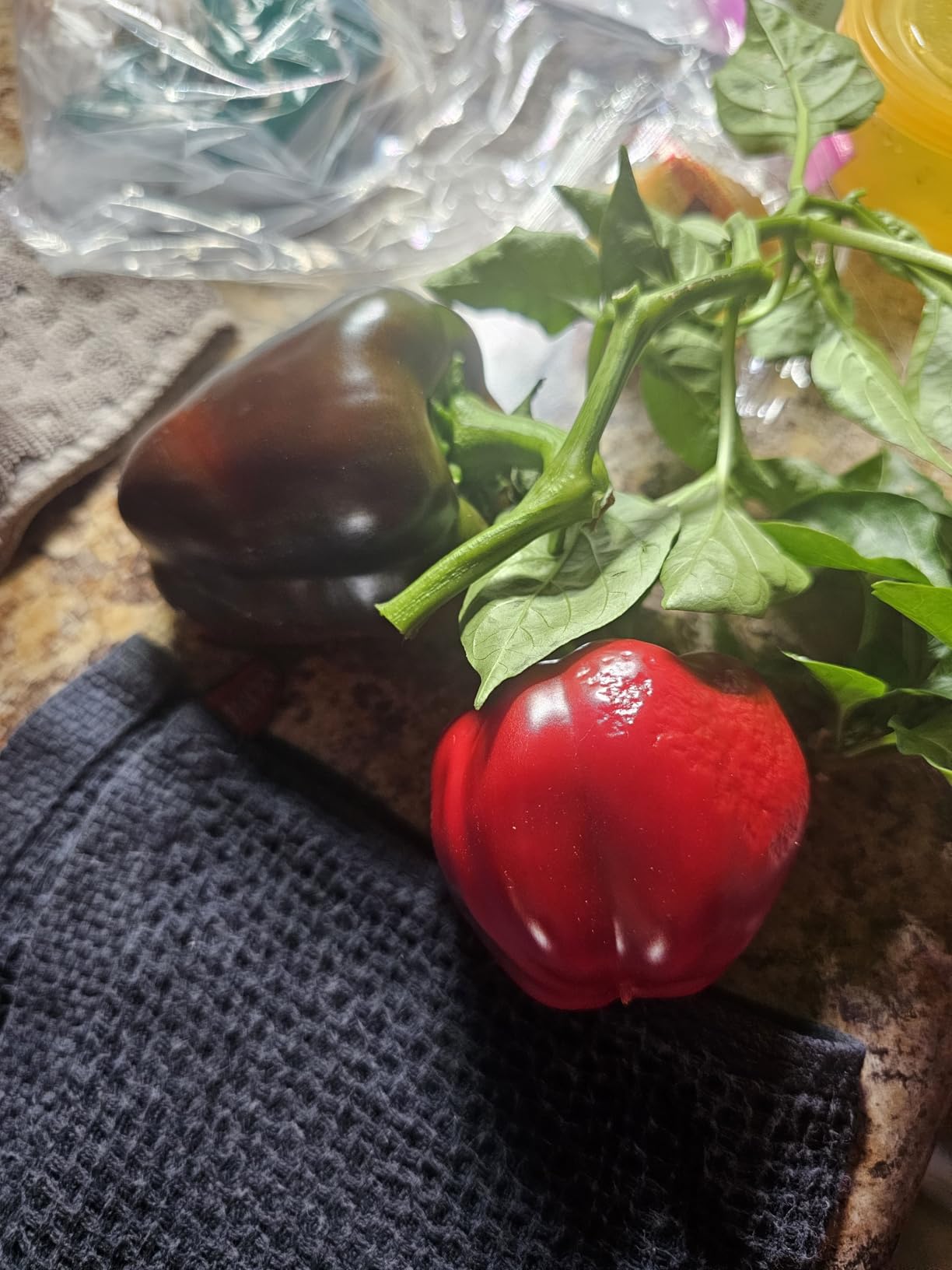
Who should skip this one
Skip it if you want volume or if you plan to move between brands later. Six sites at a higher entry cost than several plastic rivals is a poor trade for anyone growing salad for a family, and the pod lock-in is permanent once you start buying refills.
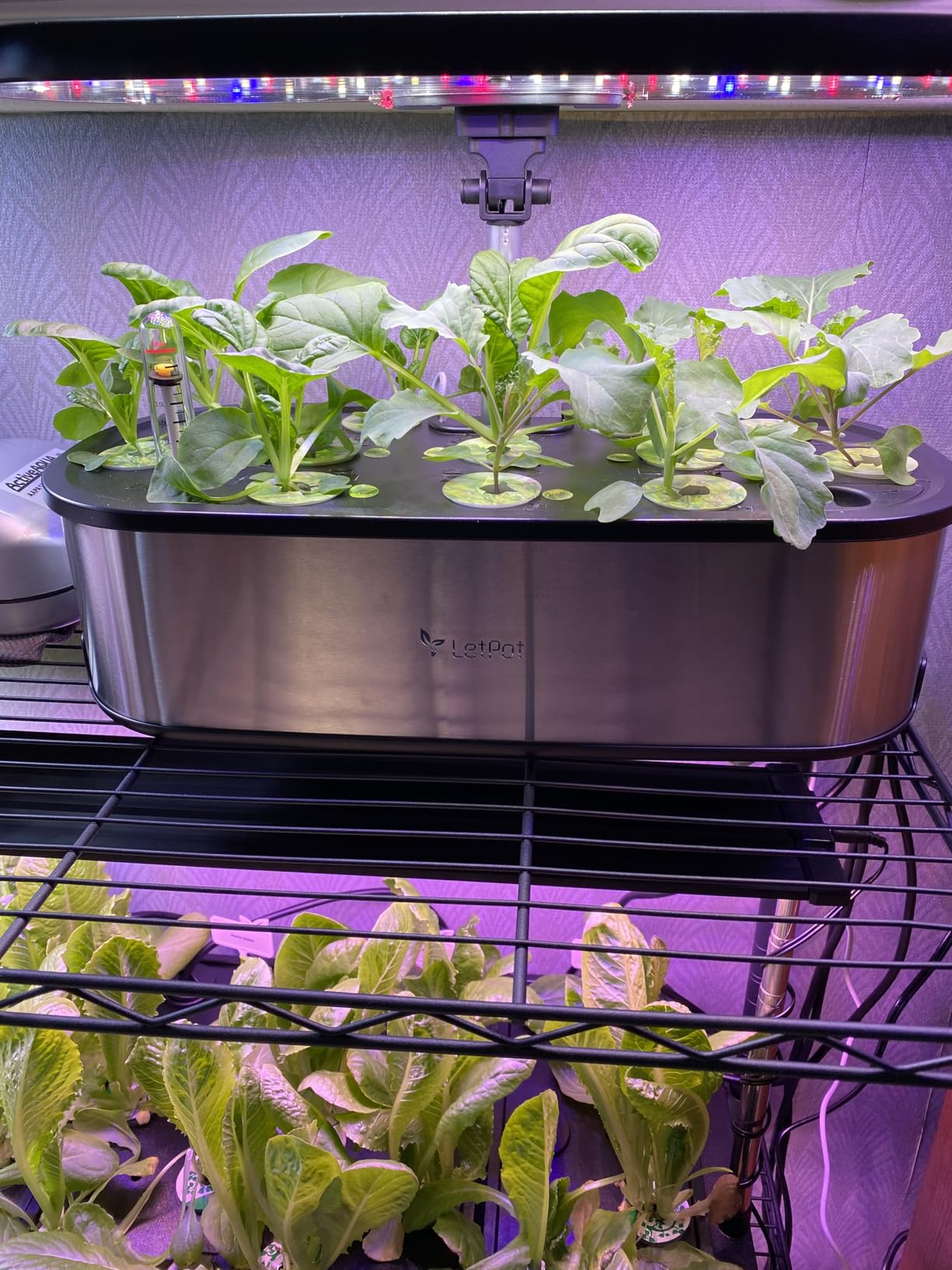
4. LETPOT LPH-SE Smart Garden – The Best System for App Scheduling and Taller Crops
LETPOT LPH-SE Hydroponics Growing System, 12 Pods Smart Herb Garden Kit Indoor, Indoor Garden, APP & WiFi Controlled, with 24W Growing LED, 5.5L Water Tank, Pump System, Automatic Timer
12 cups
24W full-spectrum LED
5.5L tank
Light rod to 30 inches
+ Pros
- App sets exact lighting schedules and reminders
- Tank runs up to three weeks without refilling
- 30-inch rod handles genuinely tall plants
- Double-layer stainless steel and resin tank cleans easily
- Cons
- Highest cost in the roundup
- App and WiFi pairing adds setup complexity
- Bulkier and heavier than plastic units
This is the most capable system I tested and the one that changed my mind about app control. The 30-inch adjustable lighting rod is the number that matters: it is nearly three times the reach of the iDOO, which means a trellised bean, a compact tomato or a tall pepper can actually finish a cycle under the canopy. The 24-watt array runs vegetative blue and bloom red modes and is claimed to grow plants up to 40 percent faster than the base cycle.
The 5.5-litre tank works out to close to three weeks between refills at twelve sites. The kit includes a plant pot, seedling tray, sponges, A and B nutrients and baskets, and the body is stainless steel and ABS resin rather than moulded plastic alone. It rates 4.4 stars across more than 1.7k ratings.
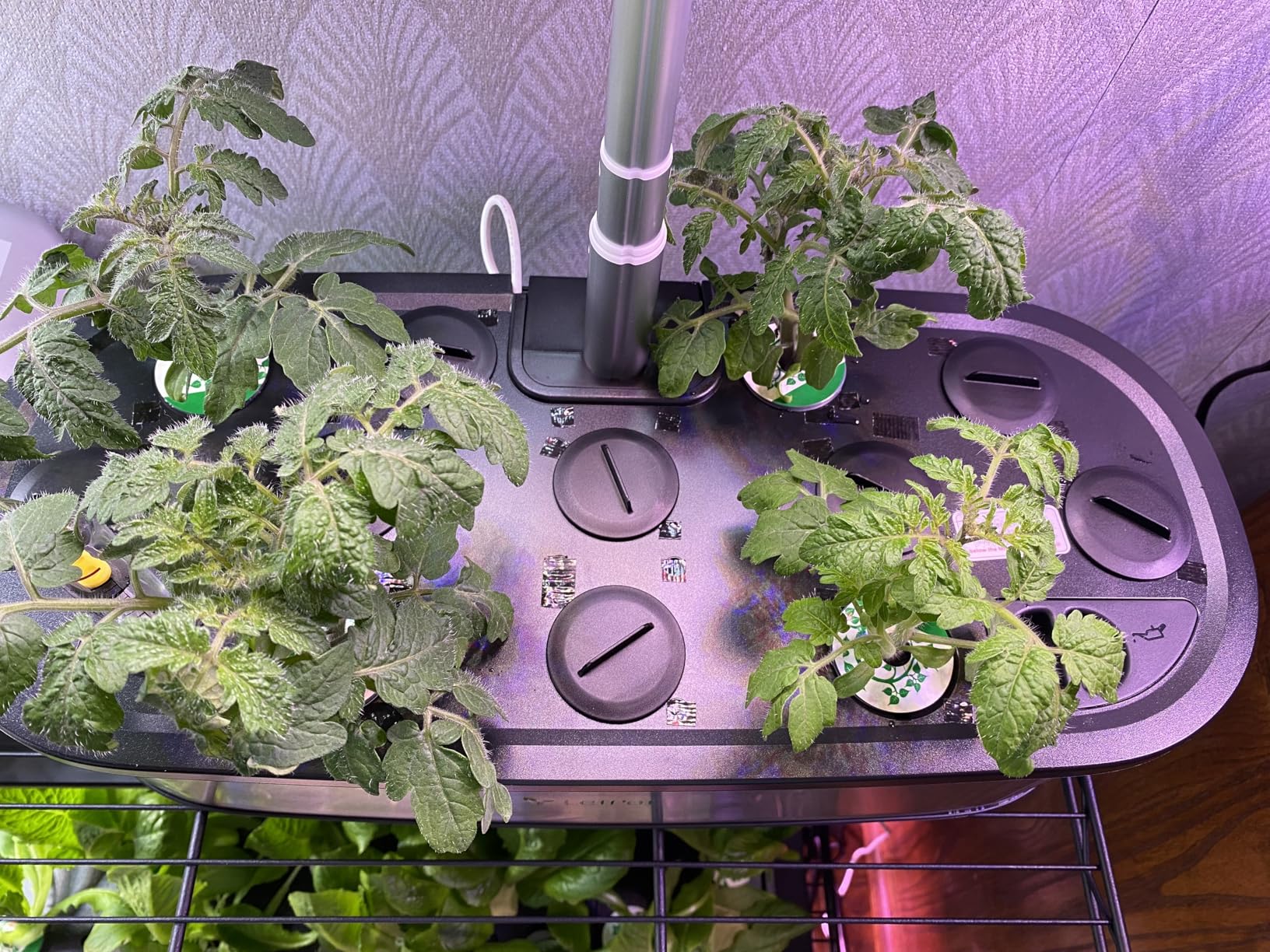
Scheduling precision is the reason to pay more
Instead of a fixed 16-on cycle, the LetPot app sets lighting from zero to 24 hours and pushes watering reminders. That matters practically: a reminder is the difference between topping up the tank on day nine instead of day thirteen, and growers report nutrient solution dropping roughly 15 percent over a ten-day trip away even with attention. It also lets you run a 22-hour day for a growth push and drop back to 16 for a finishing stretch, which a fixed dial cannot do.
Set the schedules before you leave the house rather than the night before a holiday. WiFi pairing on a congested kitchen network is the step that catches people out, and getting the app connected while you are still at home removes the most common complaint I saw about smart units.
A 30-inch rod changes the ceiling on what you can grow
Reach this far and the crop list opens up. Compact varieties of tomato, cucumber, pepper and even dwarf fruit trees become plausible, and a trellis can be attached to the frame. This is the single biggest functional difference between the premium tier and everything below it, and it is the reason the rod height should drive your decision more than pod count.
The 5.5-litre tank is also the easiest of the smart units to clean, since the double-layer stainless steel and resin construction lifts apart and wipes down. Expect a larger counter footprint at 16 by 7 by 9.8 inches, and expect the app to be one more thing that can go wrong if your router changes.
Who should skip this one
Do not buy the app version if you are buying your first system and want nothing to go wrong. Pairing an app, holding a WiFi credential and managing two nutrient bottles is a lot of surface area for someone who has never grown a plant indoors. The simpler plastic gardens deliver the same salad crop for less money and less administration.
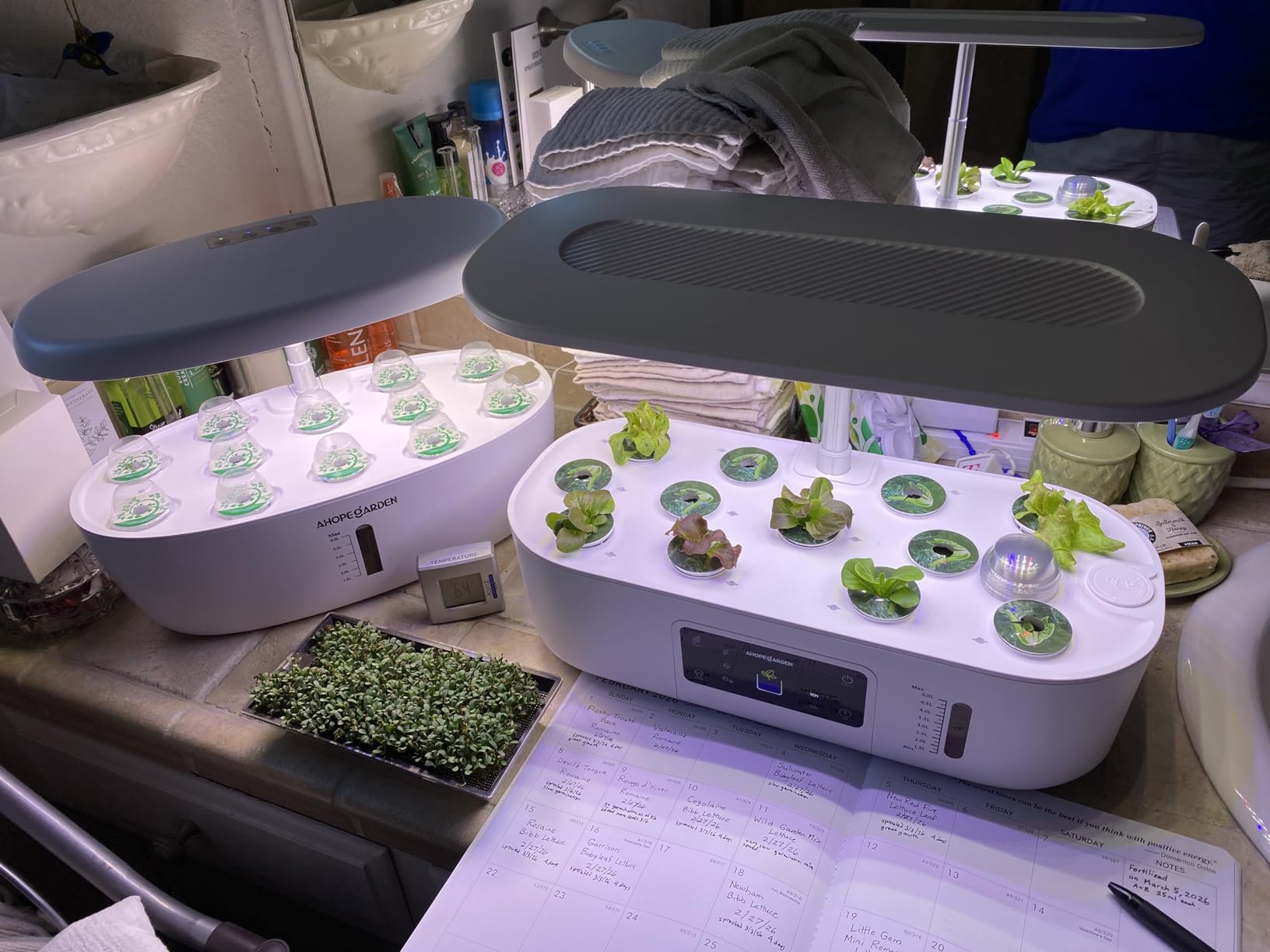
5. Ahopegarden 12 Pod LCD System – The Best Touch-Control Unit for No-Distraction Growing
Ahopegarden Hydroponics Growing System Kit: 12 Pods with LCD Control Panel
12 stations
LCD touchscreen
5L tank
17-inch vertical profile
+ Pros
- LCD panel gives clear status readouts
- Vertical 17-inch profile saves counter depth
- Ultra-quiet pump on a 30-minute cycle
- A and B nutrient solution included
- Cons
- Tall form factor uses vertical counter space
- No app or WiFi scheduling
- Germination rate varies between seeds
This unit answers a question most roundups skip: what if you do not want an app at all. The LCD touchscreen on the front panel gives one-touch control and readable status, with no phone, no account and no WiFi. Owners rate it 4.5 stars across more than 1k ratings, and the common theme in the reviews is that it runs quietly and looks modern enough to stay out on the counter.
The design is vertical at 18 by 9 by 6 inches, which saves depth at the cost of height. The 5-litre tank circulates on a quiet 30-minute pump cycle, and the box includes A and B nutrient solution, hole covers, twelve planting baskets, twelve sponges and thirteen seedling covers.
The 17-inch profile is a space decision, not a quality one
Counter depth is the scarcest resource in most kitchens, and this unit uses only 6 inches of it. If your available surface is a narrow strip against a wall, that geometry is worth more than an extra two pods. If you have a deep island bench, the vertical footprint becomes a drawback and a flatter system is the better buy.
The adjustable 17-inch height is also what keeps this unit out of light-burn territory as plants stretch. A short fixed post that cannot be raised is the most common reason beginners scorch their first crop, and having real vertical travel removes that risk.
Light modes cover flowering and sweetness
Beyond the standard dual modes there is a 22-hour lighting option intended to improve flowering and fruit sweetness. That is a real tool for anyone pushing herbs toward flowering, and it is a simple dial rather than an app scheduling exercise. For leafy greens, the standard cycle is all you will ever use.
The missing app is the trade-off. There is no remote scheduling, no watering reminders pushed to a phone and no vacation mode, so a traveller is back to manual checks. If you never leave home for more than a few days, that is an acceptable sacrifice for a system with fewer moving parts.
Who should skip this one
Skip it if you want the most plants per litre of counter or if you need off-site control. Twelve sites on a narrow footprint is a good balance, but it does not deliver the highest output available, and the tall frame will not fit under a low wall cabinet.
6. URUQ 8 Pod Hydroponic System – The Best Low-Cost Starter Garden
URUQ 8 Pods Hydroponics Growing System with LED Grow Light – Black
8 grow sites
24W full-spectrum LED
3L tank
Pump under 20 dB
+ Pros
- Lowest entry cost in the roundup
- Very quiet pump under 20 dB
- Water shortage indicator and viewing window
- Detachable tilting light pole
- Cons
- Only eight sites
- 3L tank needs frequent refilling
- Basic construction at the budget end
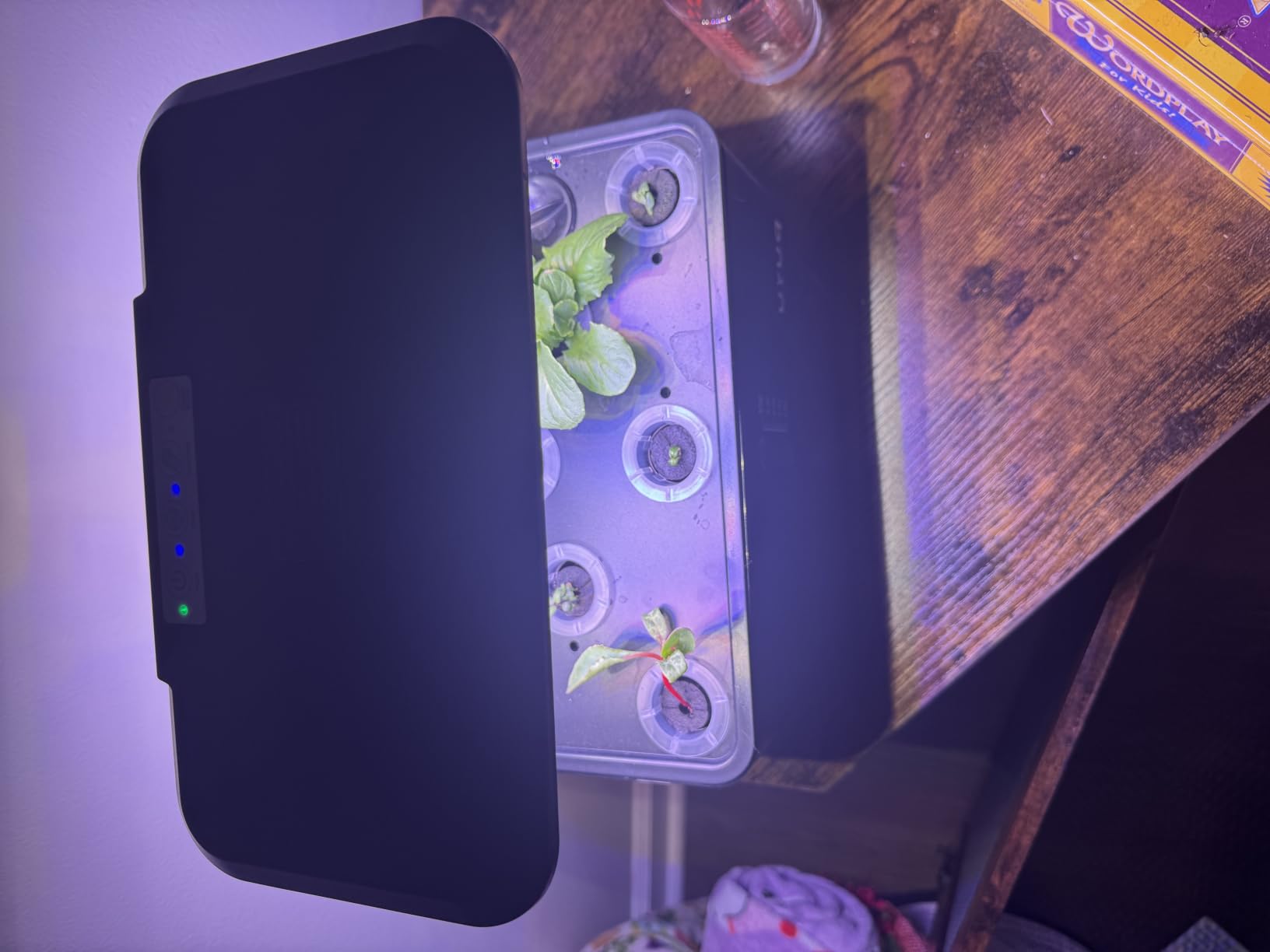
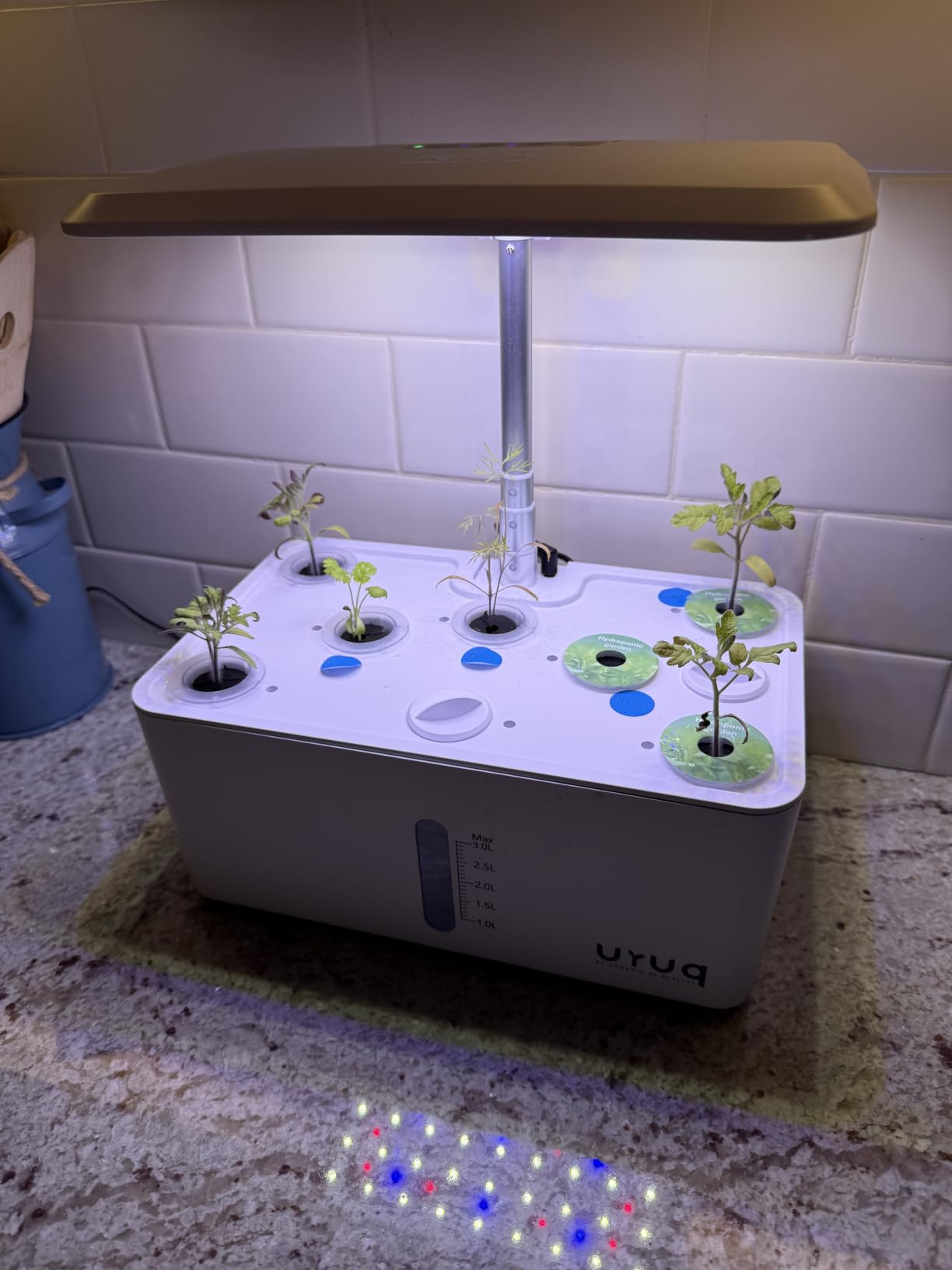
Eight pods, a 24-watt full-spectrum LED and a pump measured under 20 decibels, on the lowest entry point of any system I tested. That combination is enough to prove the concept, and it rates 4.5 stars across more than 700 ratings, which is a strong showing for a unit this small. If you are not sure whether indoor hydroponics suits your household, this is the shortest commitment to try.
The detachable light pole is the feature I did not expect. It detaches from the base and tilts away from a wall or moves entirely out of the way while you top up the tank, which the short fixed posts on comparable budget units cannot do. The clear water shortage indicator removes the most common beginner anxiety, which is not knowing whether there is still water in the tank. A metal frame keeps the weight down at 1.65 kg, so this unit moves between rooms without much fuss.
A tilting pole in an eight-site body is an unusual balance
Most small systems cut the light post to keep the footprint down. This one keeps generous reach, and that changes what you can plant even though there are fewer sites. Twenty-four watts is a generous amount of light for eight sites, and the adjustable pole gives a climbing plant room that the shortest-post budget gardens never offer.
The catch is the 3-litre tank. At eight sites that is manageable, but it still means checking more often than the 5.5 or 8-litre units. A working rule: check the window every three days in a cool room, and every day in a warm one.
What you give up at the budget end
Eight sites is a hobby garden. One person gets a steady supply of herbs and occasional salad, and a household of three will not. The frame is moulded plastic rather than the stainless steel used further up the list, which means it is lighter but less rigid.
What you do not give up is the pump. Under 20 decibels is quieter than a conversation, and the 30-minute circulation cycle matches the interval used on the more expensive gardens. Root oxygenation is where you should refuse to economise, and this one holds the line.
Who should skip this one
Skip it if you plan to feed more than one person regularly, or if you want a system that can carry a tall plant long term. The tilting pole is a bonus, but eight sites still caps the harvest and you will outgrow it within a season.
7. inbloom 12 Pod Hydroponic System – The Best Pod Spacing for Crowded Plantings
inBloom 12 Pods Hydroponics Growing System Indoor Garden with LED Grow Light and Pod Kit, Plants Germination Kit with 4.2L Water Pump Accelerate, Height Adjustable, Gardening Gifts for Women, White
12 stations
Wide spacing
4.2L tank up to 15 days
7-12 inch light post
+ Pros
- Widest pod spacing in the roundup at a larger footprint
- Recessed LED cells direct light downward and reduce leaf burn
- Low-water alarm plus power-outage memory function
- Drain hole makes full tank changes easier
- Cons
- Support stakes shown in the listing are not included
- Supplied stickers do not reliably prevent mould on sponges
- Pump noise noticeable when two run side by side
Experienced growers pick this one out for a reason that has nothing to do with wattage: the spacing. The 12 stations sit on a wider footprint inside a 15.94 by 8.19 by 6.69 inch package, and the extra room between pods means full-size heads of lettuce rather than a forest of stunted seedlings. Experienced users report lettuce harvestable in roughly two weeks, the fastest harvest time reported by owners in this roundup.
The other detail that matters for a first-timer is the alarm system. A low-water beeper tells you when the tank needs topping up, and a memory function keeps the light schedule running after a power cut. Both are small features that remove a whole category of avoidable first-crop failure.
Recessed cells reduce the light burn that ruins first crops
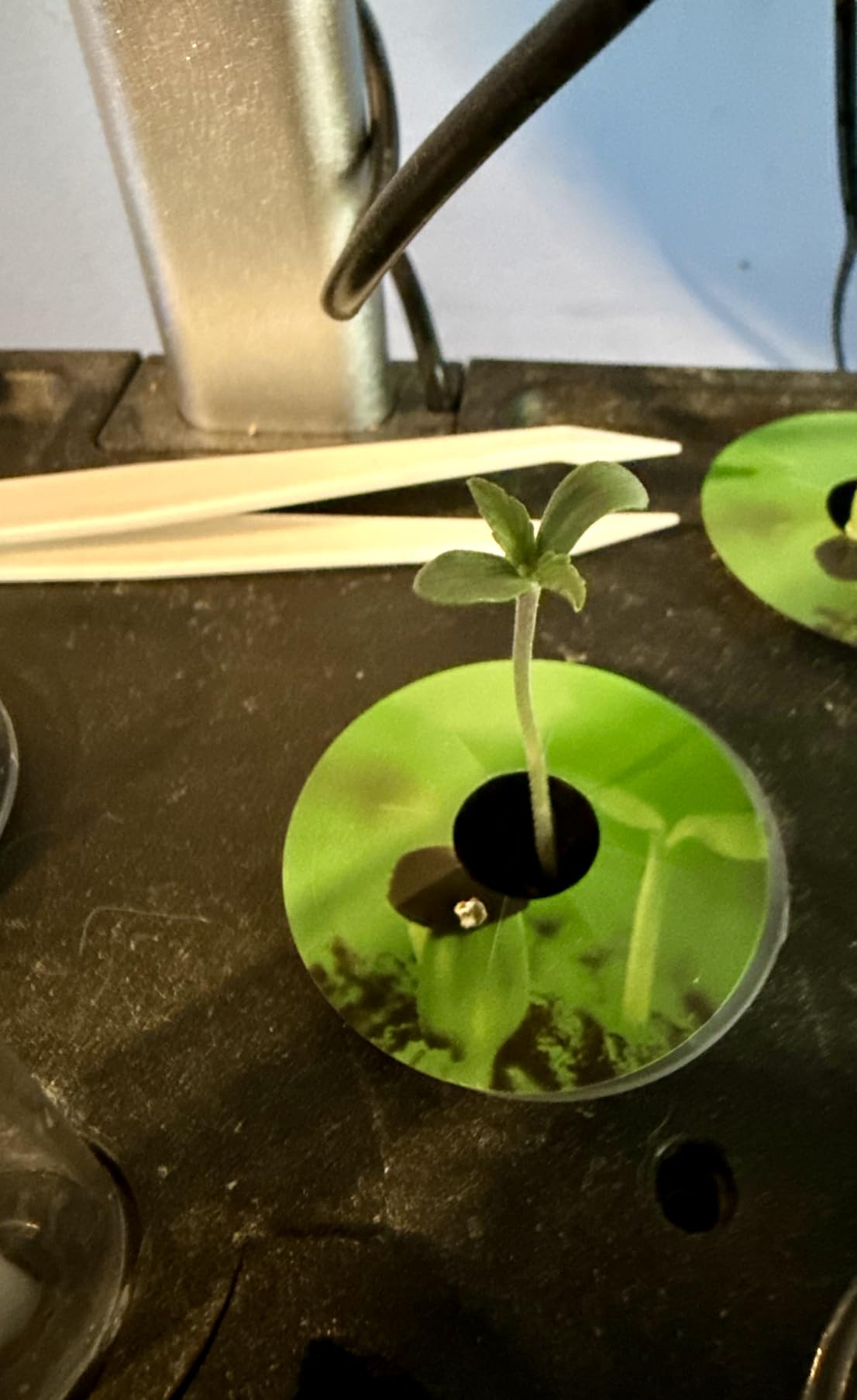
Light burn is the most common self-inflicted wound in countertop hydroponics, and it happens when a fixed-height array sits too close to a fast-growing canopy. The recessed cells here aim the light downward rather than letting it spill sideways onto the leaf surface, and the liftable lamp post adjusts from 7 to 12 inches so you can create distance as plants stretch.
That combination means a lettuce planting can run at full density without scorching. If you are planning to grow a full tray of salad greens rather than a mixed herb shelf, this is the geometry you want.
The alarm and memory functions are the real first-timer insurance
A beeping low-water alarm is a small thing that prevents a large failure. Low water means the pump stops moving solution, roots dry at the top of the basket, and a stressed root zone is exactly where pythium takes hold. The power-outage memory matters in summer, when a brief outage would otherwise reset the cycle and leave plants under-lit for a day.
The drain hole on the tank base is a maintenance win most buyers never notice. Full reservoir changes happen every few weeks, and doing that through a removable lid in a sink is far easier than trying to lift and tip the whole unit.
Who should skip this one
Skip it if counter depth is tight, because the wide spacing needs the larger footprint to work. The illustrated plant support stakes are a separate purchase, so buy them before you start a trellised crop.
8. Growell 16 Pod Indoor Garden – The Best High-Yield System on a Single Counter
Growell Hydroponics Growing System Kit, 16 Pods Indoor Garden with 28W Full Spectrum LED Grow Light, Auto Timer, 3 Smart Light Modes, 8L Large Herb Garden, Ideal Gardening Gift for Women, Men (White)
16 pods
28W full-spectrum LED
8L tank
Three light modes
+ Pros
- Highest average rating in the roundup at 4.6 stars
- 28W array is the most powerful listed
- 8L tank means no water change for up to four weeks
- Complete accessory kit with domes labels sponges and plant food
- Cons
- 16 pods crowd unless plants stay small
- Water window is hard to read on the white body
- LED release button is stiff during cleaning
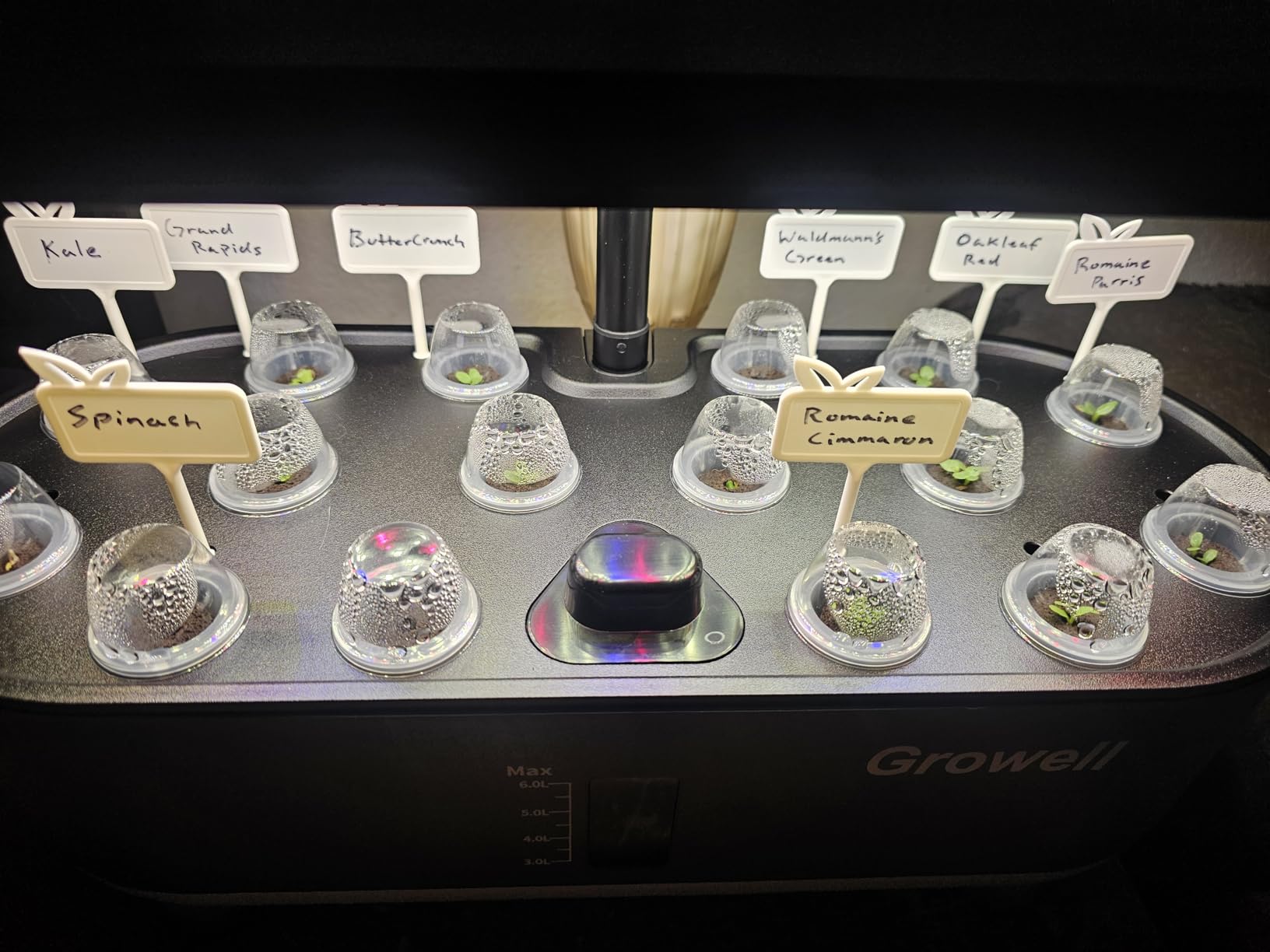
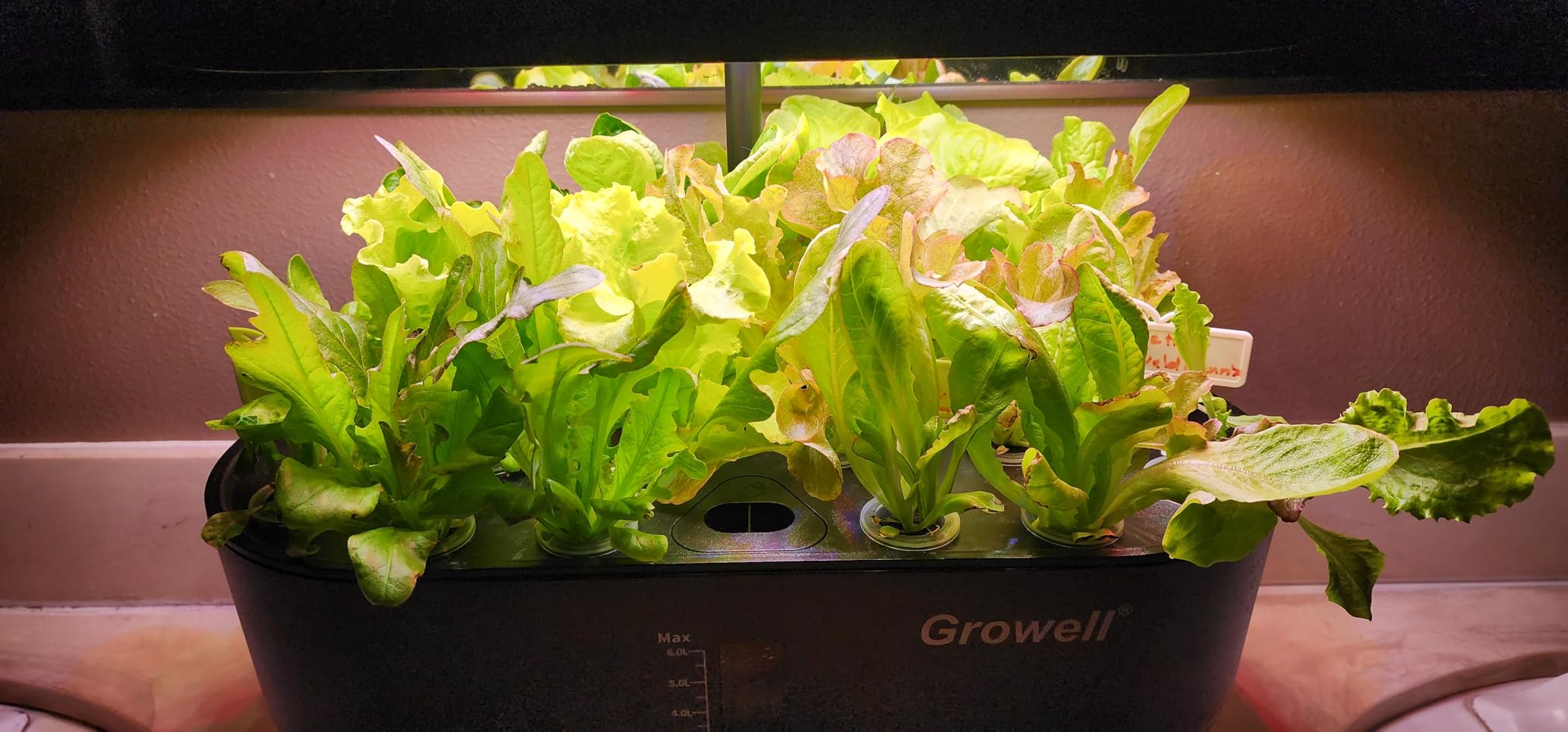
This is the unit that answers the question every household eventually asks: can a countertop system actually feed people? Sixteen sites, the most powerful light in this roundup at 28 watts, and an 8-litre tank that owners say needs no water change for up to four weeks. It holds the highest average rating of anything I tested, 4.6 stars across more than 460 ratings, with lettuce reported harvestable in roughly 30 days.
The included kit is the most complete of any unit here: two plant food bottles, six pod hole covers, sixteen grow domes, stickers, labels, tags, sponges, baskets, tweezers and a manual. At 7.9 by 17.7 by 22.7 inches it is a large object, and the detachable light pole adds upward reach for a unit this size.
The 28-watt array is what makes 16 sites workable
Sixteen pods on a weaker light is a recipe for stretched, leggy plants, and that is the honest weakness of high-count units. The red, blue, white and far-red diode mix here is strong enough to keep a full tray of lettuce compact, and the detachable pole gives real vertical travel as the canopy builds.
Three light modes cover vegetables, flowers and fruits, and herbs separately, plus a 16-hour timer and a 22-hour mode for a growth push. Most growers will never leave the 16-hour setting, and that is fine. The extra modes exist for the moments when a crop changes what it wants.
Four weeks between water changes changes the routine entirely
An 8-litre tank is the largest countertop capacity in this roundup and it removes the daily chore. Top up weekly, change completely about once a month, and the system runs itself in between. For anyone who wants herbs and greens in quantity without a daily commitment, that autonomy is the feature to pay for.
Crowding is the counterweight. Sixteen sites planted all at once need plants that stay compact, so lettuce, basil, parsley and mints are the right crops. Anything that spreads will shade its neighbours, and on a unit this bright the shaded plants are the ones that stretch.
Who should skip this one
Skip it if you have a small counter, since this is the biggest footprint in the roundup, and skip it if you want tall or climbing crops because the light pole is not enough headroom for a trellis. The white body also hides the water window, so check levels with a torch in bright light.
9. MG-15 MetryGrow 15 Pod System – The Best No-Fuss Fifteen-Site Kit
MG-15 Hydroponic Growing System Kits, Smart Indoor Garden with 24W Grow LED Light Full Spectrum, 15 Pods Herb Garden Planter Indoor Gardening for Gifts, Kitchen
15 pods
24W LED with built-in timer
5.5L tank
14-inch adjustable stand
+ Pros
- Fifteen pods at a low entry cost
- Everything needed in the box including two nutrient bottles
- Quiet pump on a 30-minute cycle reduces root rot risk
- Level window and removable trays simplify refilling
- Cons
- Light pole adjusts only to 14 inches
- Newer listing with a smaller review base
- Lower average rating than the leaders
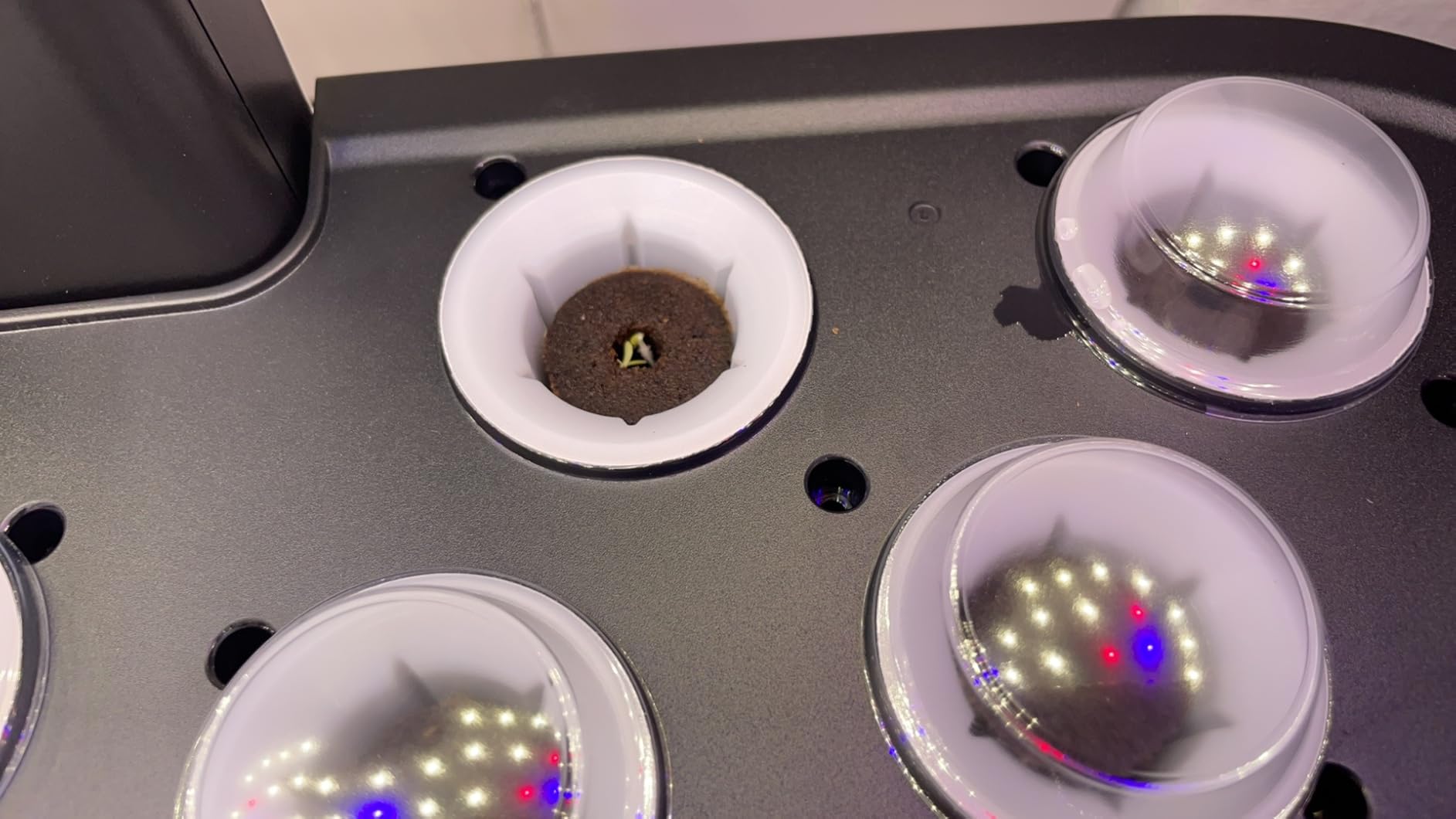
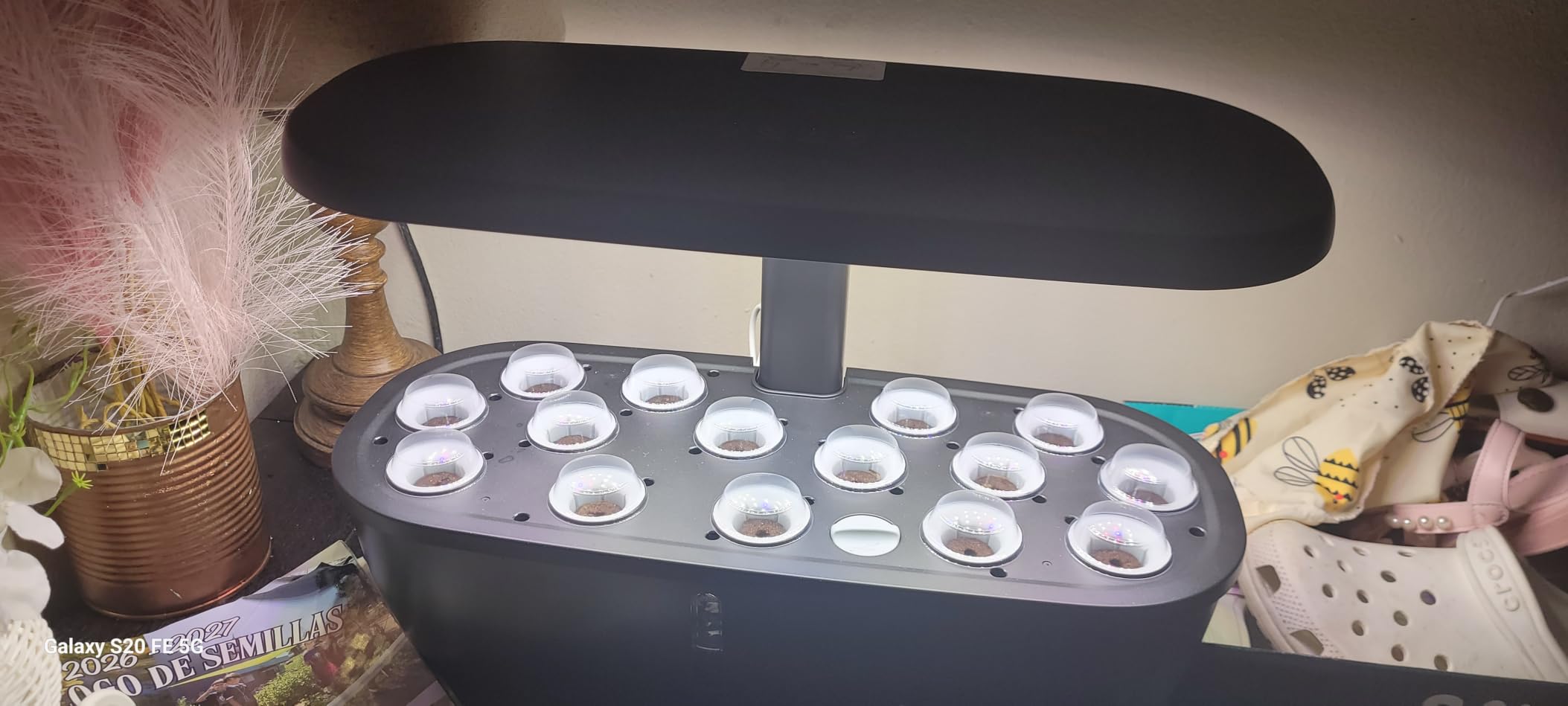
The MG-15 is the unit I would hand to someone who wants a lot of sites and refuses to read a manual. Fifteen pods, a 5.5-litre tank, a 24-watt full-spectrum LED with a built-in 16-on/8-off timer, and a box that includes fifteen sponges, fifteen baskets, two nutrient bottles, support poles, labels and the adapter. Nothing else needs buying to get a first crop running.
Reviewers report seeds sprouting in around three days and describe the result as satisfying for the money. The detachable USB-powered light panel and removable trays are the details that matter day to day, since a light bar you can lift off makes tank changes and reservoir cleaning far less awkward.
A complete kit removes the first-week shopping list
The common beginner complaint is not that the garden is hard to run. It is that the box arrives with sponges but no nutrients, or a pump but no seeds, and a second order is needed before anything grows. This one includes the A and B nutrients, the sponges, the baskets and the support poles, which means the first run needs only water and seed.
The support poles are worth noting. Fifteen pods of anything other than the shortest lettuce will lean and shade neighbours, and the included poles are what keep the canopy upright enough for the 24-watt array to reach it.
The 14-inch light post is the limit to plan around
Fourteen inches is enough for salad crops and short herbs but not enough for a staked plant that wants to climb, and it is the single constraint reviewers name most often. If you buy this expecting to grow tomatoes, you will hit the ceiling within weeks.
The 5.5-litre tank is generous for fifteen sites and works out to roughly monthly refills, and the quiet circulation pump is a preventative against root rot rather than a cure for it.
Who should skip this one
Skip it if you want a tall growing space, and skip it if you are uneasy buying a system with a shorter track record than the established brands. The 4.3-star average across a few hundred ratings is fine, but there is less long-term feedback on pump and LED longevity than on the bigger names.
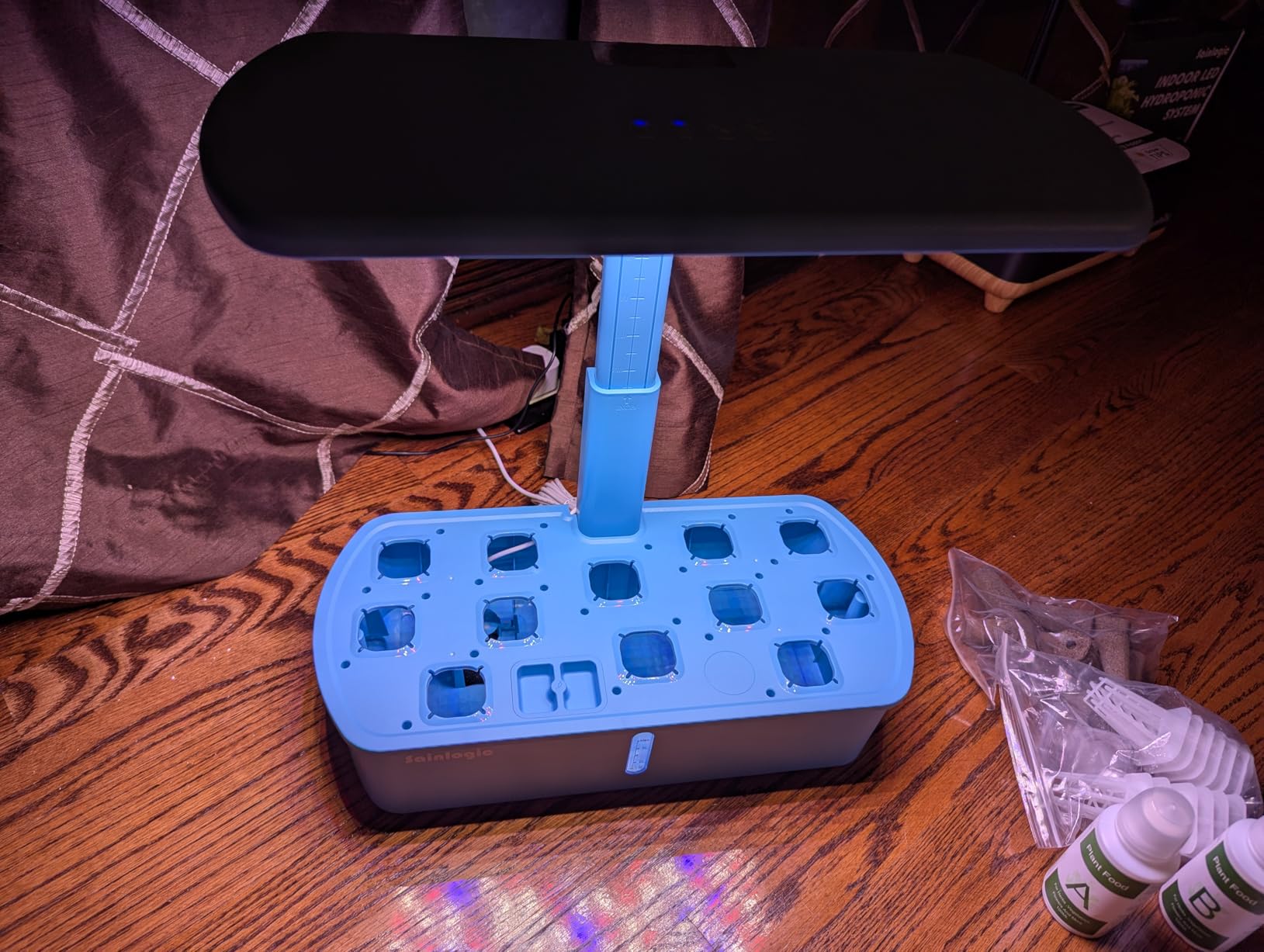
10. Sainlogic 12-Pod WiFi Garden – The Best App Control at the Entry Tier
Sainlogic Hydroponics Growing System, 12-Pod Indoor Herb Garden with 24W LED Grow Light, WiFi App Control, Adjustable Height, Quiet Pump & Auto Timer for Herbs and Vegetables
12 pods
24W LED
Smart Life app schedules
Pump under 20 dB
+ Pros
- App pairs over WiFi in about a minute and monitors schedules
- Ten-level dimming plus fully customisable lighting hours
- Pump under 20 dB with a 12-hour overnight pause
- Light pole tray tank and pump all detach for cleaning
- Cons
- No printed instructions included
- App pairing adds setup friction
- Removing established seedlings can tear roots
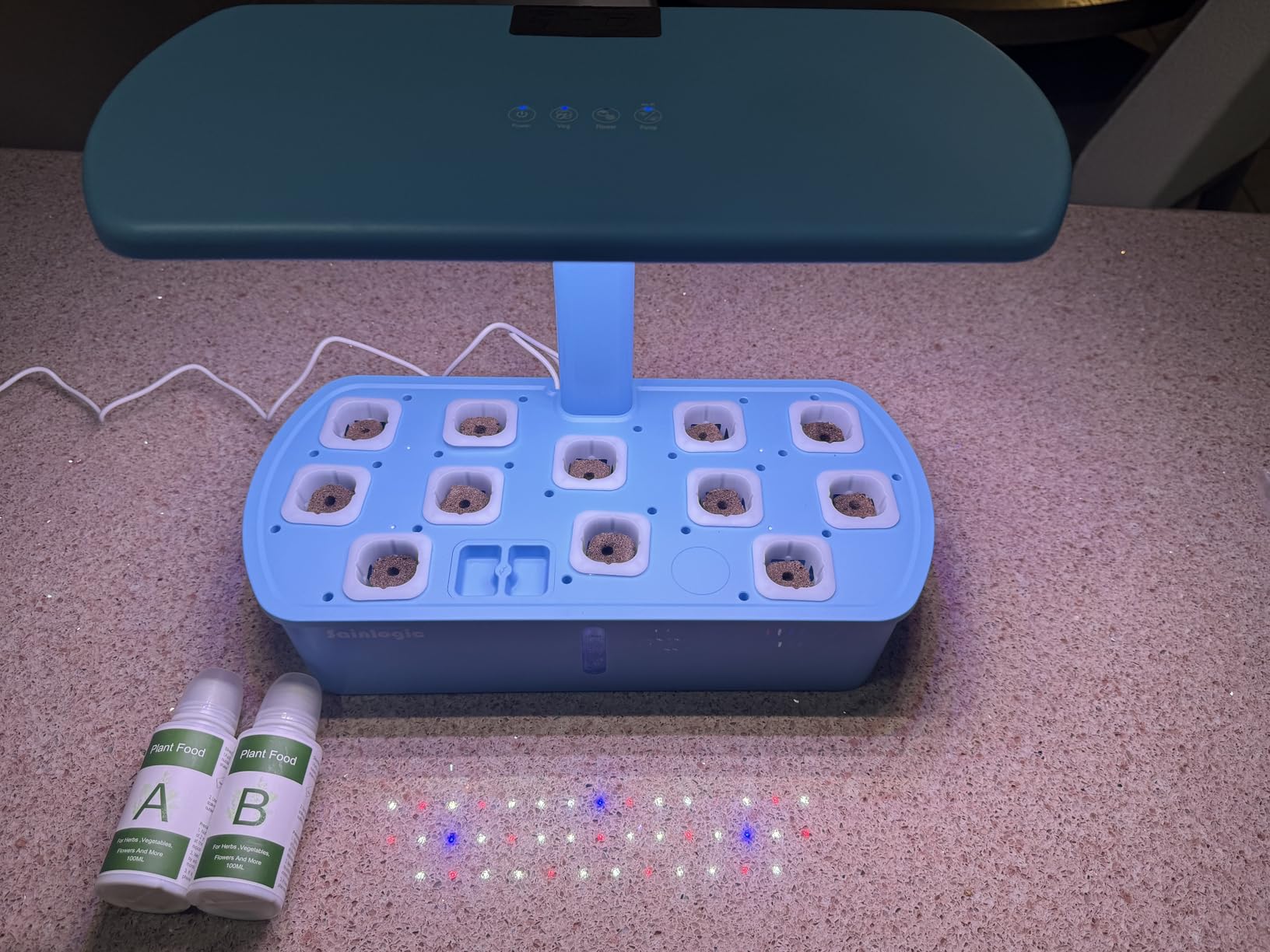
The Sainlogic does something none of the cheaper smart units do. Instead of a fixed 16-hour cycle, the Smart Life app accepts any schedule from zero to 24 hours, and ten-level dimming lets you reduce output once a canopy is established. Owners report lettuce sprouting in about four days, and the assembly is described as straightforward once you have worked out the order.
The pump is genuinely the quietest class of unit here, measured under 20 decibels, and the Do Not Disturb mode pauses circulation for twelve hours overnight. That is not just a noise feature: letting the solution sit still while the room is dark gives the root zone a rest period and reduces the risk of stagnant zones that invite root problems.
Fully customisable hours beat a fixed dial
Every fixed-timer system on this list runs a 16-on/8-off cycle, which is right for most vegetables and wrong for a few things. A grower experimenting with a longer photoperiod for a fast growth push, or a shorter day for a flowering crop, needs a dial that moves. The app provides that, along with remote monitoring of when the light and pump last ran.
Ten-level dimming has a practical use that gets overlooked. Once a full canopy is established, dropping the output two or three notches reduces heat at the leaf surface and eases the risk of light stress in a warm room, without sacrificing much growth.
Missing instructions are the one real defect
The most consistent complaint across reviews is that no printed instructions are included, and at least one reviewer had to search several sites before assembling the unit. That is a fifteen-minute problem with a known answer: look the step order up before you start, and follow the parts sequence rather than guessing.
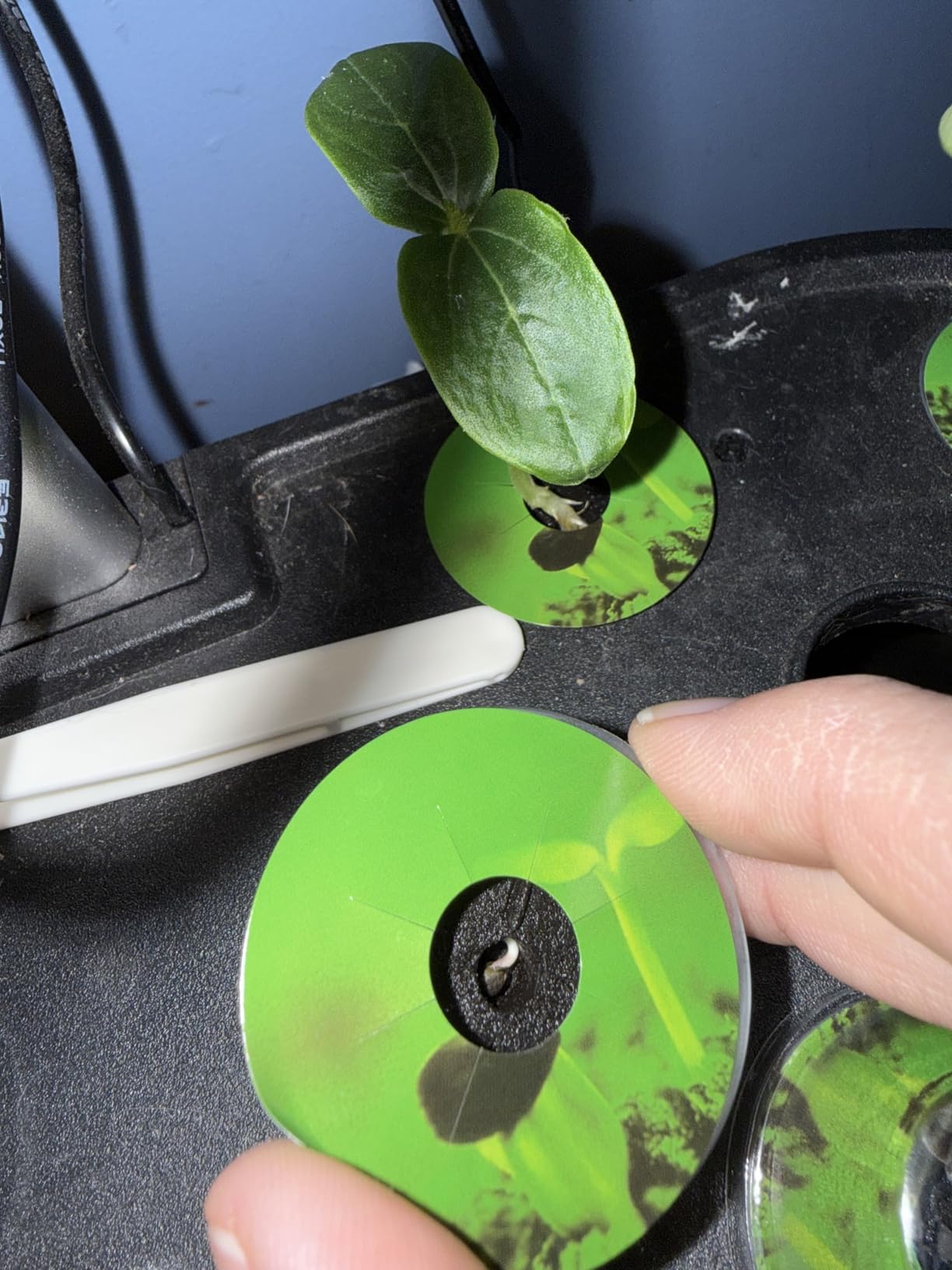
The second issue is removing established seedlings. Pulling a rooted plant out of its holder can tear the root mass, and there is no way to lift a plant out intact. A pair of scissors and a steady hand work better than pulling. The 15.9 by 7.44 by 5.11 inch footprint is slim, and every removable part, including the pump, detaches for cleaning.
Who should skip this one
Skip it if you have no interest in a phone app, since the scheduling advantage disappears the moment you stop opening it. It is also not the right pick for anyone who needs real height, because the adjustable light panel is modest next to the 30-inch rod on the LETPOT.
How to Choose a Hydroponic System as a First-Timer
Every unit in this roundup grows the same crops. The differences are in footprint, autonomy and how much headroom you have, and those three variables explain almost every decision worth making.
Count grow sites against your counter, not your ambition
Site count is the number sellers lead with, and it is the least useful number on its own. Sixteen sites planted at once on a small unit produces crowding, shade and leggy plants, which is why experienced growers on r/microgrowery space their plantings out rather than filling every hole. Match sites to the plants you actually want: eight to ten for herbs and occasional salad, twelve to sixteen for a household supply of greens.
Then measure the depth. The widest spacing in this roundup needs more front-to-back room, while the vertical units save depth and take height instead. A system that is too deep for your counter gets moved to a shelf, and a shelf is a bad spot for something that needs daily attention.
Treat light reach as the ceiling on your crop list
The light post height decides whether you are limited to salad greens or can carry a trellised crop. Ranges in this roundup run from 7 to 12 inches on the budget gardens, through 14 to 17 inches on the mid tier, to 30 inches on the smart premium model. Twenty watts to 28 watts is the useful band here: below that, plants stretch; above it, you are paying for heat you cannot use.
Adjustability beats absolute height. A post that reaches 30 inches but requires two hands and a firm grip is less pleasant than one that reaches 14 inches and moves with one finger, and a fixed post that cannot be raised at all is the design flaw most likely to scorch your first crop.
Size the tank around how often you refill
Tank volume translates directly into how often you think about the system. Three litres with eight sites means checking every few days. Five and a half litres with twelve to fifteen sites stretches to weekly top-ups. Eight litres with sixteen sites means a full change about once a month, which is close to a set-and-forget routine.
Under three litres a countertop system stops being convenient and becomes a chore, which is how most first attempts end. If you travel regularly, size the tank up rather than down, since growers report nutrient solution dropping roughly 15 percent and a small share of plants browning over a ten-day trip.
Decide how much automation you actually want
There are three levels of automation in this roundup and they suit different people. A fixed dial handles a plant that needs nothing but light and water on a predictable cycle, and it has no software to fail. An LCD panel adds readable status without adding a phone.
App control adds real scheduling flexibility and remote monitoring, but it also adds pairing, a WiFi credential and one more failure mode. A useful rule: buy the app version if you already keep your phone on the kitchen counter and travel; buy the panel version if you want fewer things to go wrong.
Never economise on the pump and the tank lid
The two cheapest components cause the most failures. A quiet circulation pump or air stone is what keeps dissolved oxygen high, and a tank that lets light in grows algae, which starves roots of oxygen and shades the solution. Cheap gardens sometimes cut the pump and expect the fixed timer to compensate, and those are the ones that produce brown, stunted plants.
Buy a reservoir lid or a fitted cover that blocks all light if your unit does not have one. Growers on r/microgrowery who cured recurring root rot did it by eliminating light leaks into the water, not by changing nutrients. That single change is worth more than any product on this list.
Accept that most 12-pod units are the same box
Several 12-pod gardens in this category share the same moulded housing, the same pump, the same LED spectrum and the same growth rates, and differ mainly in the badge on the front. That is well documented by competitors and matches what the review data shows: repeated comments about identical performance, identical pump noise and identical fixed timers across different brands.
The practical rule is to compare equivalent units on the two things that actually differ, which are light reach and tank volume, and treat everything else as the same purchase. Be suspicious of any brand whose entire selling point is a logo and a colour.
Which Type of Hydroponic System Is Best for Beginners?
Almost every countertop garden in this roundup is a recirculating deep water culture hybrid, and that is deliberate. It is the most forgiving method, which forum consensus repeatedly confirms.
Deep water culture is the easiest place to start
In DWC the roots hang in an aerated bath of nutrient solution, and an air stone keeps oxygen in the water. Nothing has to flow uphill or be timed precisely, so when something goes wrong the system usually still feeds the plant. Growers rate it the most forgiving type and note that it produces large plants, which is why the countertop gardens in this roundup all use recirculating sub-merged pumps.
Nutrient film technique suits channels and long beds
NFT sends a thin film of solution down a sloped channel and returns it to a reservoir. It uses very little water and is excellent for lettuce in a long trough, but it is more sensitive to interruptions because roots depend on that film continuously. A pump failure in a channel system is a fast crisis in a way that a well-aerated bucket is not.
Ebb and flow is forgiving but needs a timer and a drain
Flood and drain periodically submerges the root zone and then drains it. It handles a wider range of growing media than NFT and copes well with interruptions, but it needs reliable scheduling, a drain path and a basin big enough for the flood. For a beginner buying a complete unit rather than building one, it is the least common of the three formats on sale.
Aeroponics maximises yield per site
Aeroponics mists roots directly in air, so no growing medium is required and oxygen delivery is close to perfect. Vertical towers use it to pack dozens of sites into a small floor area, which is why towers produce the highest yield per square foot of any format. It is also the format most sensitive to a pump failure, since roots have no wet medium to fall back on, and it is the most expensive to buy.
Wicking systems are the only passive option
A wicking system draws solution through a string by capillary action and needs no pump and no electricity. That makes it the simplest and cheapest entry point, and the right choice if you want herbs on a shelf with no cable. The trade-off is delivery rate: wicks move far less water than a pump, so it suits leafy greens and herbs but not heavy feeders or fruiting crops.
NFT or DWC for a first setup
For a first-timer building rather than buying, DWC is the better choice. It needs a reservoir, a pump, an air stone, net pots and a medium, it tolerates mistakes, and it produces large plants. NFT is the better choice when you have a long narrow space, want minimal water use and are growing only lettuce or herbs. If your system is going to be unattended for a few days, DWC with a large reservoir is the safer of the two.
What You’ll Need to Buy Alongside Your System
Most kits include sponges, baskets and a first set of nutrients, but a few gaps catch every first-timer. This is the list that turns a weekend of assembly into a working system.
Seeds, and a decision about pods
Most units here ship with seed packets, and some include seed pods. Check the box before ordering more. Proprietary pods cannot be moved between brands, so if you buy pods you are locked to that ecosystem, and a spare basket from a different brand is useless to you.
Grow from loose seed in rockwool or a sponge and you pay a fraction of the cost of a pod while removing the lock-in entirely. Forum regulars recommend rockwool cubes as the low-maintenance medium for first-timers because they hold moisture and air at the same time. LECA clay pebbles are reusable and never need replacing, but they are heavier and small seeds can fall through, so they suit a second season rather than a first.
Nutrient solution in two parts
Almost every unit includes two bottles, A and B, and almost every unit includes enough for a first run only. A full season of two harvests a month needs replenishing, and plant food is the consumable people forget once the seed pods are in. A and B are kept separate because mixing them concentrated causes a lockout of calcium and iron, so add them separately and never combine undiluted.
A pH or EC meter is the one real instrument worth owning
Nutrient solution drifts out of range as plants drink from it, and you cannot see or smell that. A cheap pH pen or a basic EC meter lets you check a reservoir in twenty seconds and correct it before a crop shows stress. This is the single accessory that most improves results on a budget system, and it is worth more than any upgrade to the garden itself.
A timer and a backup reservoir
If your unit has a built-in timer, you do not need an external one, but check the behaviour after a power cut. Some reset to a default cycle, which is harmless, and some need a physical button press, which is a three-day crop delay if you are away. A spare covered reservoir of a few litres gives you somewhere to mix a fresh batch quickly if the tank needs an emergency change.
Net pots and a lid that blocks light
Baskets, or net pots as they are called, are the standard size across most of these brands, so a spare pack is cheap insurance when a root ball grows into its holder. A fitted reservoir lid that excludes all light is the highest-value accessory on the list. Algae and root rot both trace back to light reaching the solution, and forum growers have cured recurring problems with nothing more than a light-tight cover.
What Can You Actually Grow (and What Fails)
Matching the crop to the format is the difference between a first harvest in three weeks and a frustrating month of stretching seedlings.
Start with these and you will not go wrong
The reliable first crops are lettuce of any loose-leaf variety, basil, mint, parsley, cilantro, chives, kale, pak choi and mizuna. All of them are fast, forgiving and shallow-rooted, which means they fit a small pod, drink little and mature inside the light reach of a countertop unit. If you only ever grow lettuce and basil for a year, you will learn the whole routine: seeding, refilling, topping up nutrients and changing water.
Strawberries, compact peppers and dwarf tomatoes are the second tier, and they need the taller light post and a longer commitment. A crop that climbs also needs a trellis and a way to prune it, which is where most beginners overreach.
Three plants that are poor hydroponic candidates
Root vegetables are first. Carrots, beets, radishes and turnips need a deep, wide medium to size a proper root, and a net pot in a sponge will produce a stunted, forked specimen or nothing at all. Any crop that needs a root ball larger than a fist is a poor fit for a countertop pod system.
Full-size vining crops are second. A conventional tomato, cucumber or squash variety wants a floor, a stake and light levels these units cannot supply, and a single-stem fruiting plant in a countertop garden usually produces one small fruit before the season ends. Compact determinate varieties fare better than indeterminate ones.
Perennial woody plants are third. Fruit trees, canes and shrubs will not finish a cycle in the 30 to 45 day window these systems are designed around, and they need far more light per day than a 16-hour cycle provides. If you want a dwarf fruit tree, buy a grow tent and a full-spectrum light rather than a pod garden.
What It Actually Costs to Run
The unit is the small part of what you spend, and this is the section most roundups skip. Here is where the recurring line items go.
Refills are the ongoing cost that matters
Seed pods are the most obvious recurring expense and the one you can eliminate. Proprietary pod systems charge per pod, and a household eating salad daily will order them constantly. Loose seed plus rockwool costs a small fraction of the same harvest and removes the lock-in, which is the strongest argument against pod-based gardens beyond the unit itself.
Nutrient solution is the expense people forget, because the two included bottles cover only a first run or two. Plant food is consumed continuously, and the A and B bottles are the true running cost of any system here, pod-based or not. Electricity for the light and pump is modest but continuous, since a 16-hour photoperiod runs every day for the life of the crop.
Watch for subscription-gated features
Some premium ecosystems gate growth monitoring, AI recommendations or remote adjustments behind a paid membership, with the app itself free but the intelligence paywalled. You do not need those features to grow good lettuce, and a system that works fully without a subscription is a safer first purchase. Check what the app does with no account before you set it up.
Replacement parts decide the long total
Pumps fail, LEDs dim and power adapters are the first thing to go. A unit with a replaceable pump and a published warranty costs less over five years than a cheaper unit with a sealed base, because you will not throw the whole garden away when the pump gives up. That, plus the availability of spare baskets and lids, is a fair tie-breaker between two otherwise identical boxes.
Troubleshooting: The Failures That Kill First Crops
Almost every problem a beginner meets has already been diagnosed by someone else on a forum. These are the six that account for nearly all of it, in the order they usually appear.
Root rot usually means light got into the reservoir
Brown, slimy roots and a sour tank are the signature, and the cause is almost always light leaking into the solution rather than a bad nutrient batch. Algae grows in the light, consumes the oxygen the roots need and drops the dissolved oxygen level. The fix is a light-tight lid or a fitted cover, plus a reservoir kept away from windows and grow lights. Growers who cured recurring root rot report doing exactly this, and adding a preventative treatment at every reservoir change.
Pythium thrives in warm, still, low-oxygen water
Pythium is a parasitic water mould that attacks weakened roots in warm, poorly oxygenated conditions. It shows up as a plant that wilts despite wet media, and it spreads fast. Cool the water, keep the circulation pump or air stone running, and never let the solution sit still for days. Reservoir temperature matters most in a warm room, so top up with cool water rather than letting the tank sit.
Light burn shows up as pale patches on upper leaves
Whitish or tan patches on the leaves nearest the array mean the canopy got too close to the light. Raise the post, drop a light mode or dim it by a notch, and expect the affected leaves not to recover. Prevention is a matter of raising the light as the crop grows, which is why a post that moves easily is worth more than a taller post that does not.
Low-water alarms are warnings, not failures
The beep on most units means the tank is low, and it will keep beeping until you refill it. Ignoring it lets the pump run dry, which is the fast route to a burned pump and a dead crop. The fix is obvious and the habit is the point: treat the alarm as a prompt, not a nuisance, and keep a bottle of water next to the unit.
Pump noise usually means air in the line or a dry tank
A sudden change in pump sound is worth investigating rather than tolerating. Gurgling points to air in the reservoir that needs to be topped up and re-primed, and a grinding sound on a dry or obstructed pump can destroy it in a short time. A hum that is simply louder than expected is usually water aerating, and it settles once the level is correct.
Reservoir depletion while you are away is the most common real-world loss
Travel is where careful growers lose plants, and the numbers are consistent across forum reports: solution drops noticeably over ten days and a small share of plants brown. Fill the tank completely before leaving, move the unit out of direct sun and away from a warm radiator, and choose a larger-tank model if you travel regularly. Vacation mode, where a system offers it, exists for exactly this scenario.
Frequently Asked Questions
What is a good hydroponic kit for beginners?
A good beginner hydroponic kit is a countertop pod garden with 8 to 12 grow sites, a full-spectrum LED on a 16-hour timer, a circulation pump, and a reservoir of at least 3 litres. Most kits include sponges, baskets and two bottles of nutrients, so you mainly need to add seed or seed pods and, ideally, a pH or EC pen.
Which type of hydroponic system is best for beginners?
Deep water culture is best for beginners because it is the most forgiving: roots hang in an aerated bath of nutrient solution, and a pump failure is rarely instant. Nutrient film technique and aeroponics use less water or yield more per site, but both punish a failed pump much faster. Wicking systems are the simplest of all and need no electricity.
What is the best countertop hydroponic system?
For most kitchens the best countertop hydroponic system balances site count, tank volume and light reach rather than any single spec. The iDOO 12Pods is our pick for the widest combination of sites, tank volume and price of entry, while the Ahopegarden 10 Pod offers a taller light post for a little less money and the LETPOT LPH-SE adds app scheduling and a 30-inch rod for the largest crops.
Is NFT or DWC better for a first hydroponic setup?
DWC is better for a first setup. It needs a reservoir, a pump, an air stone, net pots and a medium, it tolerates mistakes, and it produces large plants. NFT is better when you have a long narrow space, want minimal water use and are growing only lettuce or herbs, because its roots depend on a continuous thin film of solution.
What are three plants that are not recommended for hydroponics?
Three poor candidates are root vegetables such as carrots, beets and turnips, which need a deep medium to size a proper root; full-size vining crops such as conventional tomatoes and cucumbers, which need a floor and far more light than a countertop unit delivers; and perennial woody plants such as fruit trees and canes, which cannot finish a cycle in the 30 to 45 day window these systems are designed for.
How often do you refill a hydroponic reservoir?
It depends on tank volume and site count. A 3-litre tank with eight sites needs a top-up every few days, a 5.5-litre tank with twelve to fifteen sites stretches to weekly, and an 8-litre tank with sixteen sites needs a full change about once a month. Keep the tank out of direct sun and top up with cool water in a warm room.
The Right Hydroponic System for the Way You Actually Grow
If you want one system and no decisions, take the iDOO 12Pods. Twelve sites, two light modes, a tank that lasts a week or two and the largest review base of anything in this roundup make it the safest first purchase and the one I recommend to anyone starting out in 2026.
If you want more headroom for taller plants, step up to the LETPOT LPH-SE with its 30-inch light rod and app scheduling, or the Ahopegarden 10 Pod if you would rather avoid an app entirely. If you travel often, the AeroGarden Harvest Elite is the only unit here with vacation mode.
If you want the most greens per unit, the Growell 16 Pod runs sixteen sites on an 8-litre tank with the strongest light in the group, and the inbloom 12 Pod is the one to buy if you plant a full tray of lettuce and want the spacing to support it. If you want the least commitment, the URUQ 8 Pod proves whether you like indoor hydroponics before you spend on scale.
Whichever you choose, buy the light-tight reservoir cover and a pH pen before you buy anything else. Those two accessories prevent more failed first crops than any difference between the gardens themselves.