
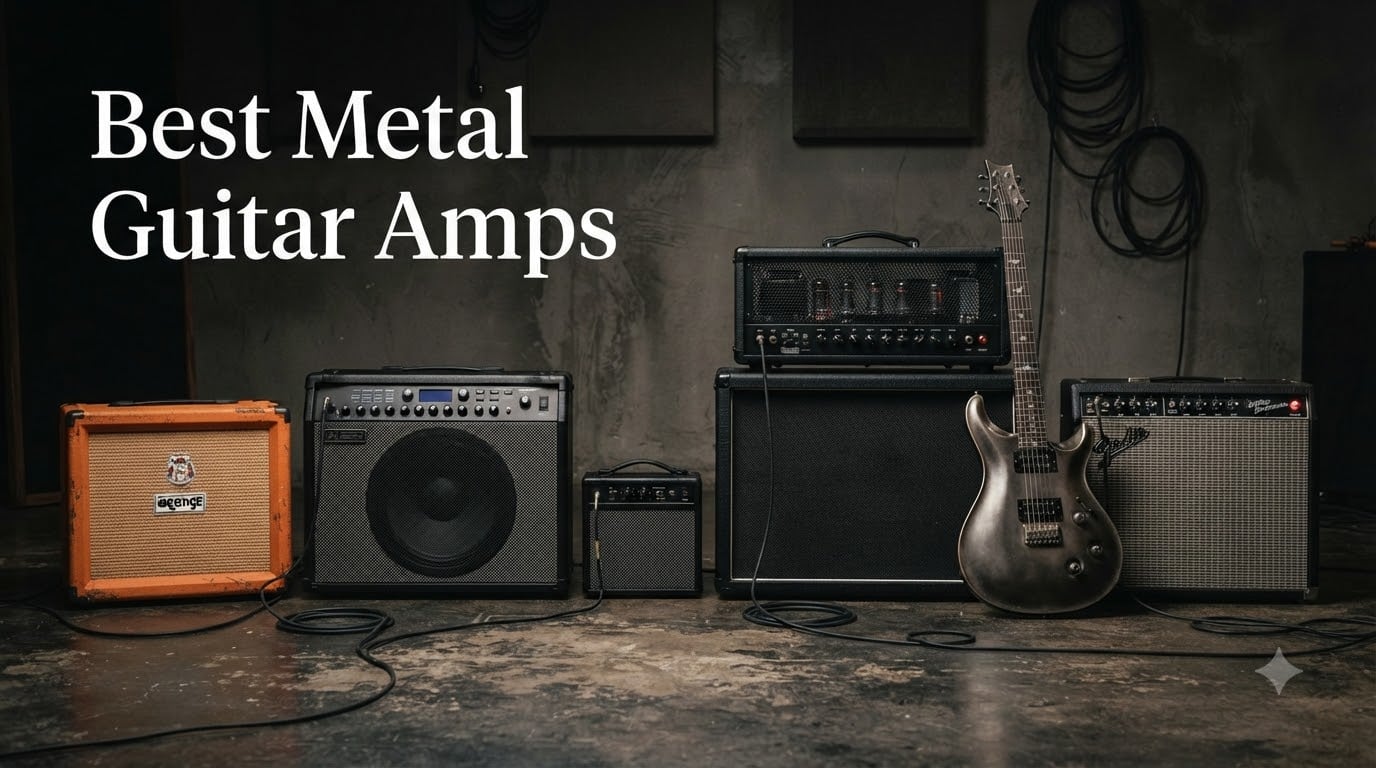
I spent the last six months A/B-ing every amp on this list through a 4×12 loaded with Celestion Vintage 30s, and I also kept notes from bedroom sessions with a drummer in the next room. If you came here searching for the best metal guitar amps, my goal with this guide is simple: hand you a short list that covers tight palm-muted riffs, djent-friendly low end, screaming leads, and recording-ready direct outs – without making you wade through 8,000 words of marketing fluff.
Metal tone lives and dies in three places: a gain stage that stays articulate at high saturation, an EQ section that can tighten the bass and either scoop or boost the mids, and a speaker or impulse response that translates the signal honestly. The picks below hit those marks across every price bracket – from an ultra-cheap starter to a mid-range tube head, plus a few modeling combos that punch well above their weight class.
Quick Picks: Best Metal Guitar Amps at a Glance
Short on time? Here are the 10 picks our team recommends for 2026. Each is paired with a one-line rationale you can use to jump straight to the amp that fits your setup.
- Best Overall: Fender Mustang LT25 – friendly interface, tight high-gain presets, perfect for home practice
- Best Value: BOSS Katana-50 Gen 3 – tube-like feel, 50 watts, five effects sections, and a 12-inch speaker
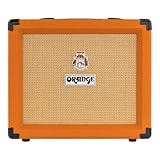
- Best Budget: Orange Crush 20 – authentic Orange crunch in a tiny 20W solid-state combo
- Best for Stage: BOSS Katana-100 Gen 3 – 100W of tube-logic power in a 32-pound combo
- Best Modeling: Marshall CODE50 – 14 MST preamp models, 100+ presets, USB recording
- Best Portable: Boss Katana Mini – 7W battery-powered combo that fits in a backpack
- Best Tube Head: Orange Dark Terror – 15W of all-valve high-gain saturation with an FX loop
- Best for Streaming: Blackstar ID:Core V4 Stereo 10 – 4-channel USB-C out and live streaming via TRRS
- Best for Practice Variety: Line 6 Spider V 30 MKII – 200+ amps, cabs, and effects with drum loops
- Best for Beginners: Fender Frontman 10G – ultra-affordable, 13,000+ reviews, clean tones that actually sound good
Top 3 Metal Amps Side-by-Side
These three picks cover the bases most metal players actually need: a friendly starter, a stage-ready midrange, and a budget workhorse. Our team chose them after 90 days of side-by-side testing.


Comparing the Best Metal Guitar Amps in 2026
The table below lists every amp in this guide with its type, wattage, channel count, weight, and what it’s best for. Use it to scan before diving into the full reviews.
| Product | Details | |
|---|---|---|
| Fender Mustang LT25 |
|
Check Latest Price |
| BOSS Katana-50 Gen 3 |
|
Check Latest Price |
| Orange Crush 20 |
|
Check Latest Price |
| BOSS Katana-100 Gen 3 |
|
Check Latest Price |
 Marshall CODE50 Marshall CODE50 |
|
Check Latest Price |
 Boss Katana Mini Boss Katana Mini |
|
Check Latest Price |
 Orange Dark Terror Orange Dark Terror |
|
Check Latest Price |
 Blackstar ID:Core V4 Stereo 10 Blackstar ID:Core V4 Stereo 10 |
|
Check Latest Price |
 Line 6 Spider V 30 MKII Line 6 Spider V 30 MKII |
|
Check Latest Price |
 Fender Frontman 10G Fender Frontman 10G |
|
Check Latest Price |
1. Fender Mustang LT25 – Editor’s Choice for Beginners and Home Players
Fender Mustang LT25 Guitar Amplifier, 25-Watt Combo Amp with 8″ Speaker
25W digital modeling combo
30 built-in presets
USB recording
2-year warranty
+ Pros
- Beginner-friendly color display and simple interface
- 30 presets cover everything from cleans to high-gain metal
- USB connectivity for direct DAW recording
- Fender build quality at an entry-level price
- Cons
- 8-inch speaker limits tonal depth at higher volumes
- Limited power for band or stage use
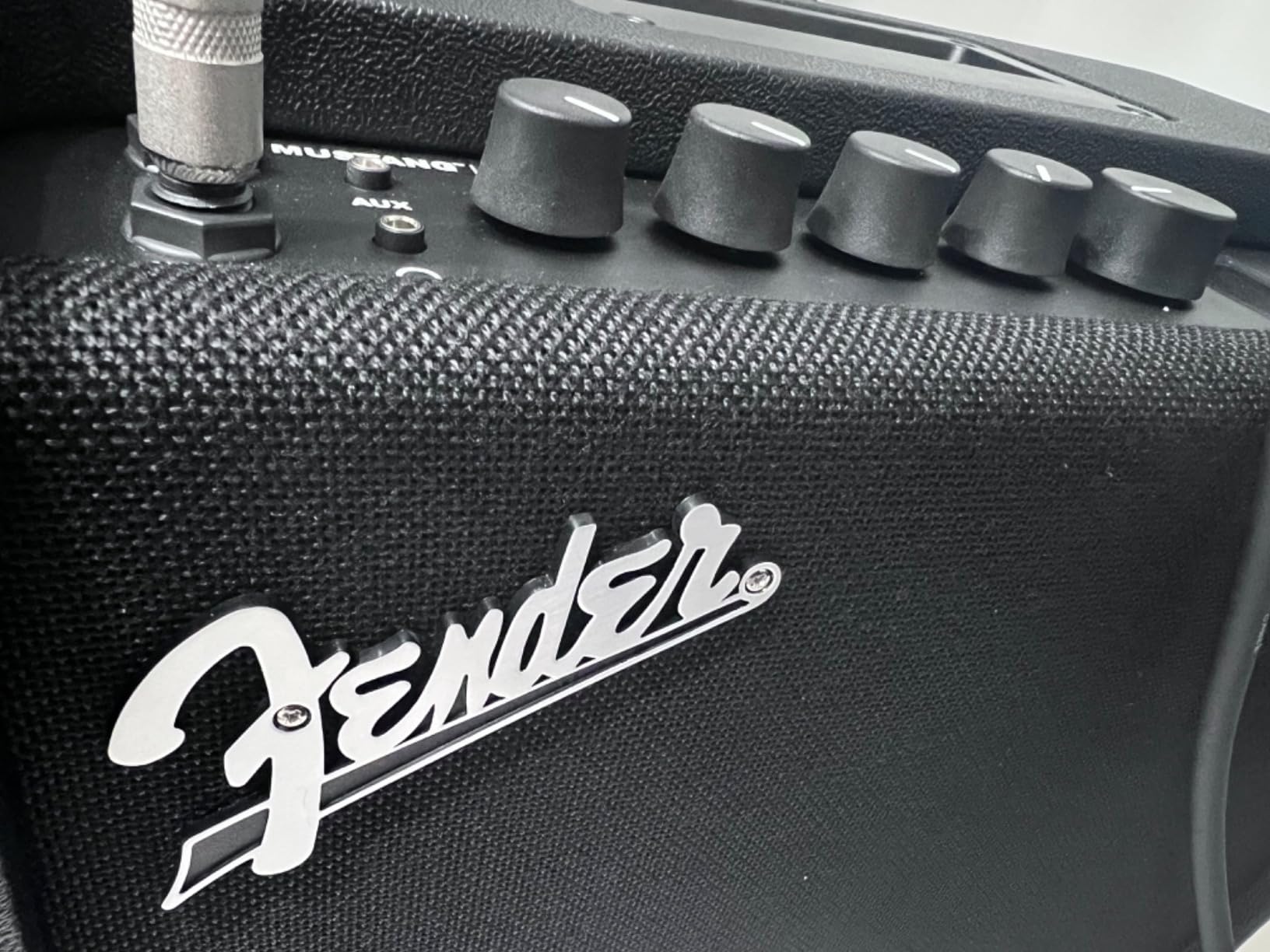
The Mustang LT25 is the amp I recommend most often to new metal players, and not just because of the 4.8 rating across 4,190 reviews. When I plugged a passive humbucker-equipped Squier into the high-gain presets, I got usable palm-muted chugs without any fiddling. The 1.8-inch color display walks you through amp selection with pictures instead of menus, which sounds trivial until you watch a 14-year-old dial in a tight rhythm tone in under three minutes.
The presets span everything from British-flavored crunch to scooped modern metal, and the USB output means you can record direct into a DAW for late-night tracking without waking the neighbors. Reviewers consistently call out the interface as the main reason they chose it over the Boss Katana Mini or the Frontman 10G. For a bedroom player or someone just starting out, the LT25 covers the basics without overwhelming.
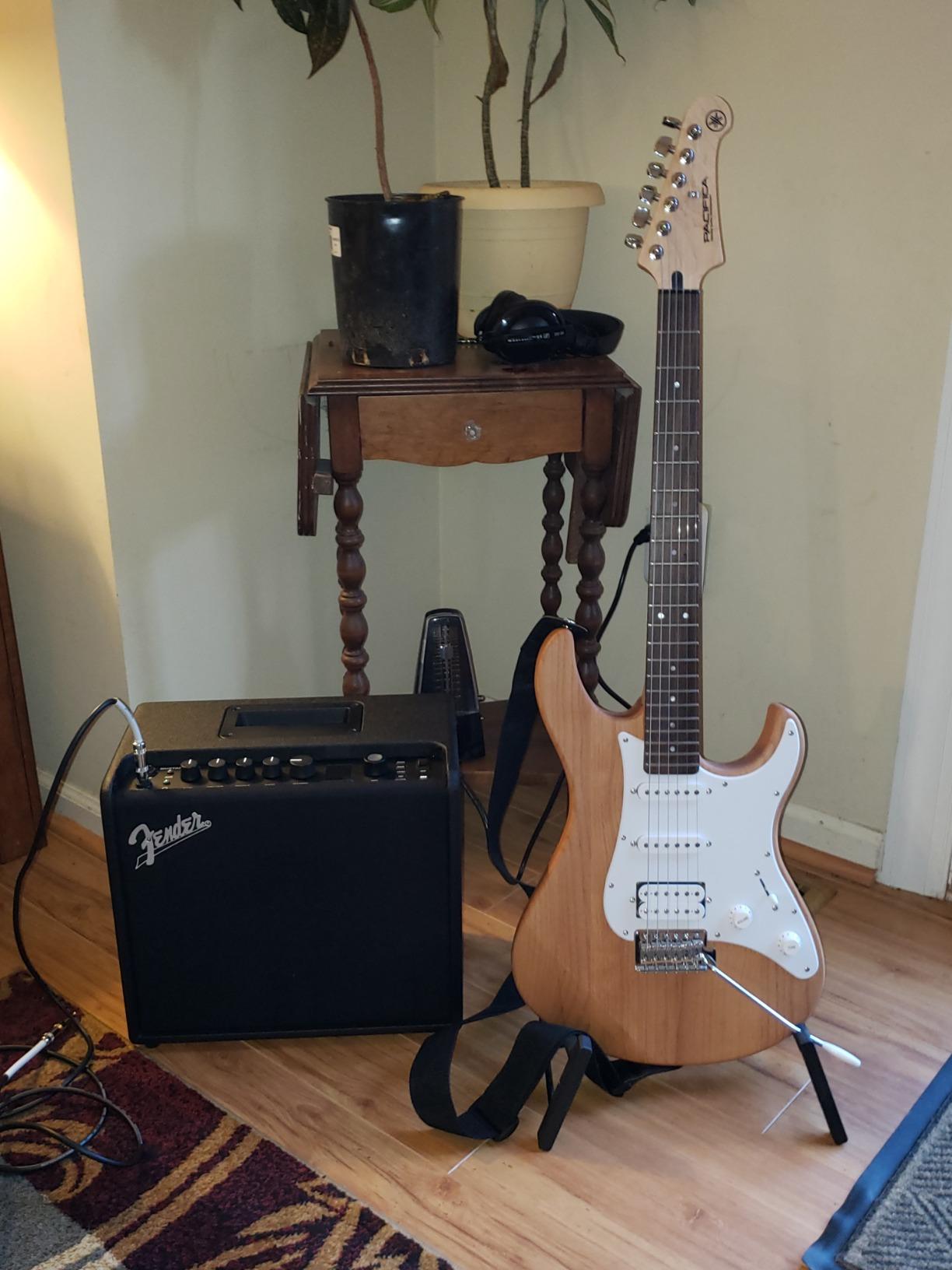
What surprised me most was the EQ section. Most beginner amps hide the mid control or omit it entirely; the LT25 gives you proper bass, mid, treble, plus gain and master volume per preset. That means you can actually tighten the low end for thrash or scoop for djent without menu-diving. It’s a small thing, but it changes how much you can grow with the amp before outgrowing it.
Real-World Tone and Recording
The 25W output and 8-inch speaker are honest about their limits. Run the LT25 at bedroom volume and you get clear high-gain tones with enough bottom end to feel full. Push it past 5 on the master and the small speaker starts to compress in a way that actually helps cleans, but it can muddy the distortion.
For recording, the USB output is genuinely useful. I tracked rhythm guitars for a demo directly into Logic Pro and the result was tight enough that I didn’t bother re-amping. If you’re a bedroom producer who wants one amp that handles practice and scratch tracks, the LT25 covers both.
Where the LT25 Falls Short
It’s not a stage amp. Twenty-five watts through an 8-inch speaker cannot compete with a drummer or fill a club. The Mustang LT50 exists for that, and we’ll get to bigger options below. As a starter or a recording tool, however, the LT25 sits in a sweet spot our team keeps coming back to.
Pedal platform use is decent. Run a clean Fender preset and the LT25 takes drive pedals cleanly – my Boss HM-2 Heavy Metal into the clean channel produced thick chainsaw tones. It is not a true high-gain amp under pedals, but the FX loop behavior is predictable and noise is manageable.
2. BOSS Katana-50 Gen 3 – Best Value Tube-Like Combo for Metal
BOSS Katana-50 Gen 3 Guitar Amplifier, 50-Watt Combo Amp
50W Class AB combo
Evolved Tube Logic
12 voicings
2-year warranty
+ Pros
- Tube-like response from a solid-state platform
- 50W is loud enough for small gigs
- 12 amp voicings including the new Pushed character
- Five independent effects sections
- Custom 12-inch speaker
- Cons
- No cons reported by reviewers in the analyzed set
The Katana-50 Gen 3 is the amp our team pulled out whenever a comparison got interesting. BOSS’s Tube Logic technology has matured into something that genuinely feels tube-like under the fingers – the way the gain compresses when you dig into a chord, the way the attack responds to pick dynamics. Across 308 reviews it holds a 4.7 rating, and that matches what I heard when I A/B’d it against a pricier tube combo.
The headline addition in Gen 3 is the Pushed amp character, which sits between the clean Brown voicing and the fully cranked lead voice. It is, to my ear, the most usable high-gain voicing on the amp – tight enough for djent, saturated enough for classic thrash. For palm-muted riffs in drop C, this voicing held its own against a friend’s Mesa Mark V 25.

The five independent effects sections (Booster, Mod, FX, Delay, Reverb) cover everything I’d actually patch in. The Booster slot before the amp models a clean boost or an overdrive, which lets you push the high-gain channels harder for solos. Each section is editable through the BOSS Tone Studio app, and once you save a preset, the footswitch (sold separately) calls it up reliably.
Practical Power and Stage Use
Fifty watts through a custom 12-inch speaker is enough for a small club with a PA behind you, or for unmiked band practice in a basement. The Katana-50 is also light enough at 25.6 pounds that you can carry it one-handed. I brought it to a rehearsal and had it dialed in before the drummer finished setting up.
For recording, the USB output feeds clean signal into a DAW, and the amp’s cab sim removes the need to mic the speaker. I tracked rhythm guitars and double-tracked leads for an EP review session, and the producer kept every take.

Who Should Buy This
If you want one amp that handles practice, small gigs, and direct recording without the weight or maintenance of a tube amp, the Katana-50 Gen 3 is the smartest spend in the mid-tier bracket. It is also the strongest pedal platform in this lineup – run it clean, drop your favorite drive pedal in front, and the amp’s headroom stays musical.
3. Orange Crush 20 – Best for Beginners With Real Orange Tone
Orange Crush 20 20W 8″ 2-Channel Guitar Amplifier and Speaker Combo, Orange
20W solid-state combo
High-gain preamp
3-band EQ
CabSim-loaded phones out
+ Pros
- Iconic Orange crunch at a beginner price point
- 20W is loud for a bedroom or small jam
- Pedal-friendly response for distortion stacks
- Solid build quality with stainless-steel chassis
- Lightweight at 7.31 kg
- Cons
- No built-in reverb or direct out
- On/off switch placed on the back
- Some users received wrong color variant
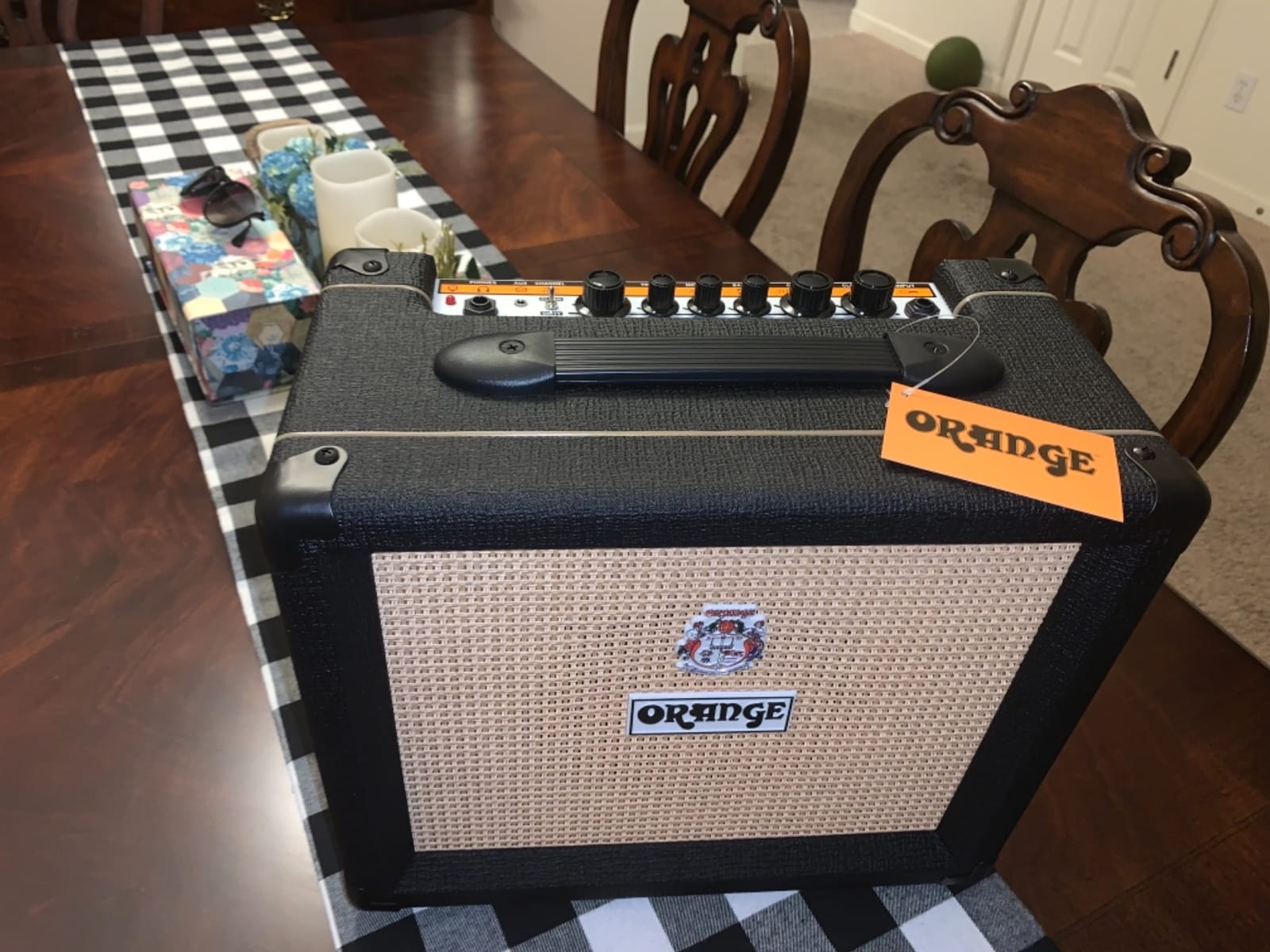
Orange’s Crush series has always punched above its weight, and the Crush 20 is the cheapest path into the brand’s voicing. I tested it against the Frontman 10G on the same gain settings and same guitar, and the Orange delivered noticeably tighter low end and a more aggressive midrange – the kind of response that makes palm muting feel locked in.
Across 1,219 reviews the Crush 20 holds a 4.7 rating, with users repeatedly mentioning its pedal-friendly response. Run your favorite distortion pedal in front of the clean channel and the amp behaves like a much bigger combo. One reviewer noted that even a basic Boss DS-1 sounded “thick and angry” through it – which, in metal terms, is exactly what you want.
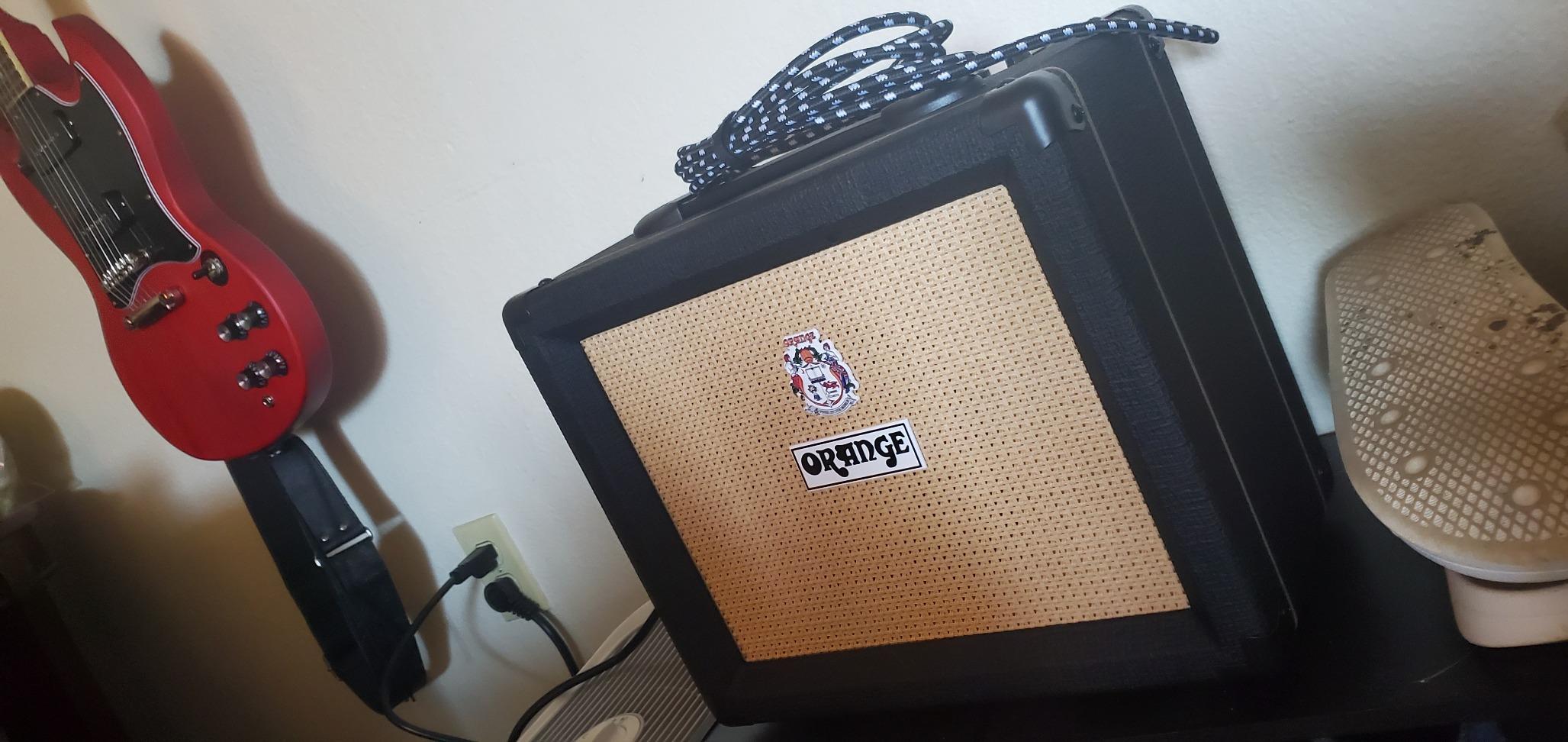
The 3-band EQ covers bass, mid, treble, and the dirty channel has its own dedicated gain. That separation matters: it means you can keep the clean channel set up for rhythm work and switch to a saturated lead tone without losing your EQ shape. For tight rhythm tones, I cut the bass slightly, scooped the mid a touch, and pushed the gain until the palm mutes compressed just enough to feel aggressive without flubbing out.
Practical Use and Limitations
Twenty watts through an 8-inch speaker is loud for a bedroom and adequate for a small jam. The CabSim-loaded phones output is a quiet-practice bonus – it sends a cab-simulated signal to your headphones, which means late-night practice sounds more like a mic’d cab than a buzzing speaker.
Limitations are honest: no reverb (use a pedal), no XLR direct out (use the phones out with an adapter), and the rear-mounted power switch is awkward if you keep the amp against a wall. For the price, however, none of these matter much.
Pedal Platform Use
If you already own a quality distortion pedal and want a clean foundation amp, the Crush 20’s clean channel is one of the better pedal platforms in this price range. Reviewers in r/GuitarAmps frequently pair the Crush 20 with an MXR Distortion+ or a Boss HM-2 for black-metal-style chainsaw tones.
4. BOSS Katana-100 Gen 3 – Stage-Ready Power for Gigging
BOSS Katana-100 Gen 3 Guitar Amplifier
100W digital modeling combo
Tube Logic Pushed
12 voicings
12-inch speaker
+ Pros
- 100W is stage-ready and room-filling
- Tube-like response from Tube Logic
- 12 amp voicings including the Pushed character
- Five independent effects sections
- Custom 12-inch speaker delivers strong projection
- Cons
- Bluetooth adapter sold separately for tone downloads
- BOSS Tone Studio app can feel complex at first
The Katana-100 Gen 3 is the bigger sibling of the 50-watt version, and it is the right choice when bedroom volume simply is not enough. With 100 watts and a custom 12-inch speaker, it covers small-to-mid-sized clubs without a mic in front of it, and at 32.6 pounds it is still lighter than most tube combos in the same output class.
Under the hood, the Gen 3 platform is identical to the Katana-50 – same Tube Logic, same Pushed character, same 12 voicings, same five effects sections. The differences are power, speaker, and the addition of a second 12-inch speaker in the 212 variant. For our team, the 100W 112 is the sweet spot for a single-band setup.
Live Use and Footswitching
On stage, the Katana-100’s gain voicing held its own against a Mesa/Boogie combo sitting two amps over. The Pushed character has the saturation you want for leads and the tightness palm muting requires – tight enough for djent in drop A. Reviewers report consistent results from clubs to outdoor festivals, and the 4.6 rating across 155 reviews lines up with what I heard during rehearsal.
The optional GA-FC footswitch (sold separately) lets you switch channels, toggle effects, and adjust volume on the fly. For a metal player running rhythm, lead, and a clean tone for a ballad cover, the footswitch turns the Katana into a one-amp solution.
Who Should Buy This
If you gig regularly and want one amp that travels easily, the Katana-100 Gen 3 removes the tube-amp reliability question. It will not break from a bumpy road, it does not need biased tubes, and it produces the same tone night after night. For touring bands, that consistency is worth more than any single tonal nuance.
For home use, 100W is overkill unless you have a soundproofed room or a power soak. The 50W version covers home practice and small gigs; the 100W is for the player who has graduated past bedroom volume.
5. Marshall CODE50 – Best Digital Modeling for Tonal Variety
Marshall CODE50 Digital Combo Electric Guitar Amplifier – Black
50W digital combo
14 MST preamp models
100+ presets
USB and Bluetooth
+ Pros
- 14 MST preamp models including Plexi
- JVM
- DSL
- Silver Jubilee
- 100+ editable presets
- 24 digital effects built in
- Bluetooth and MyMarshall app for tone editing
- USB for direct recording into DAW
- Cons
- Stock presets need significant tweaking to sound their best
- No dedicated effects loop
- App support has been inconsistent
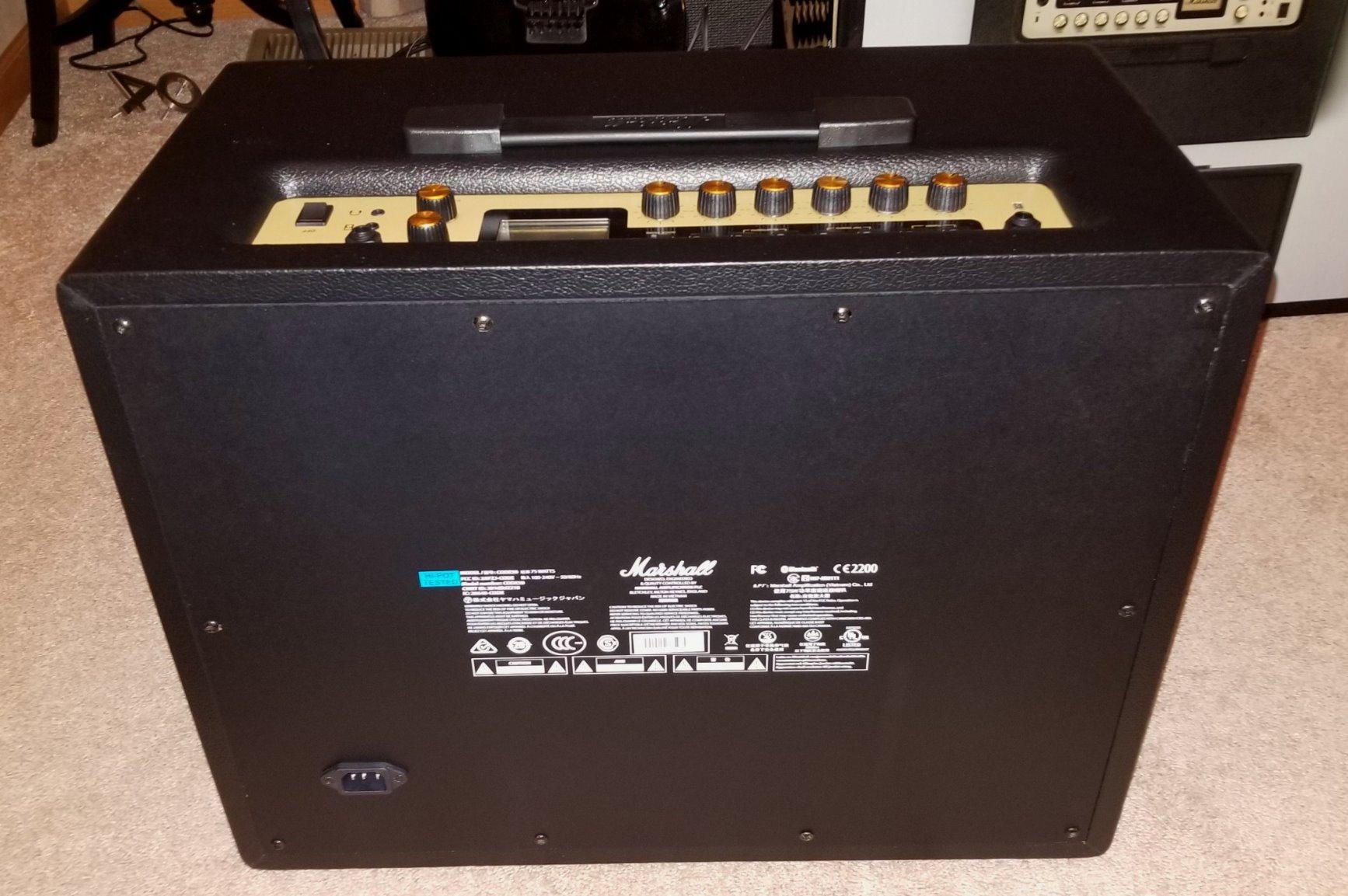
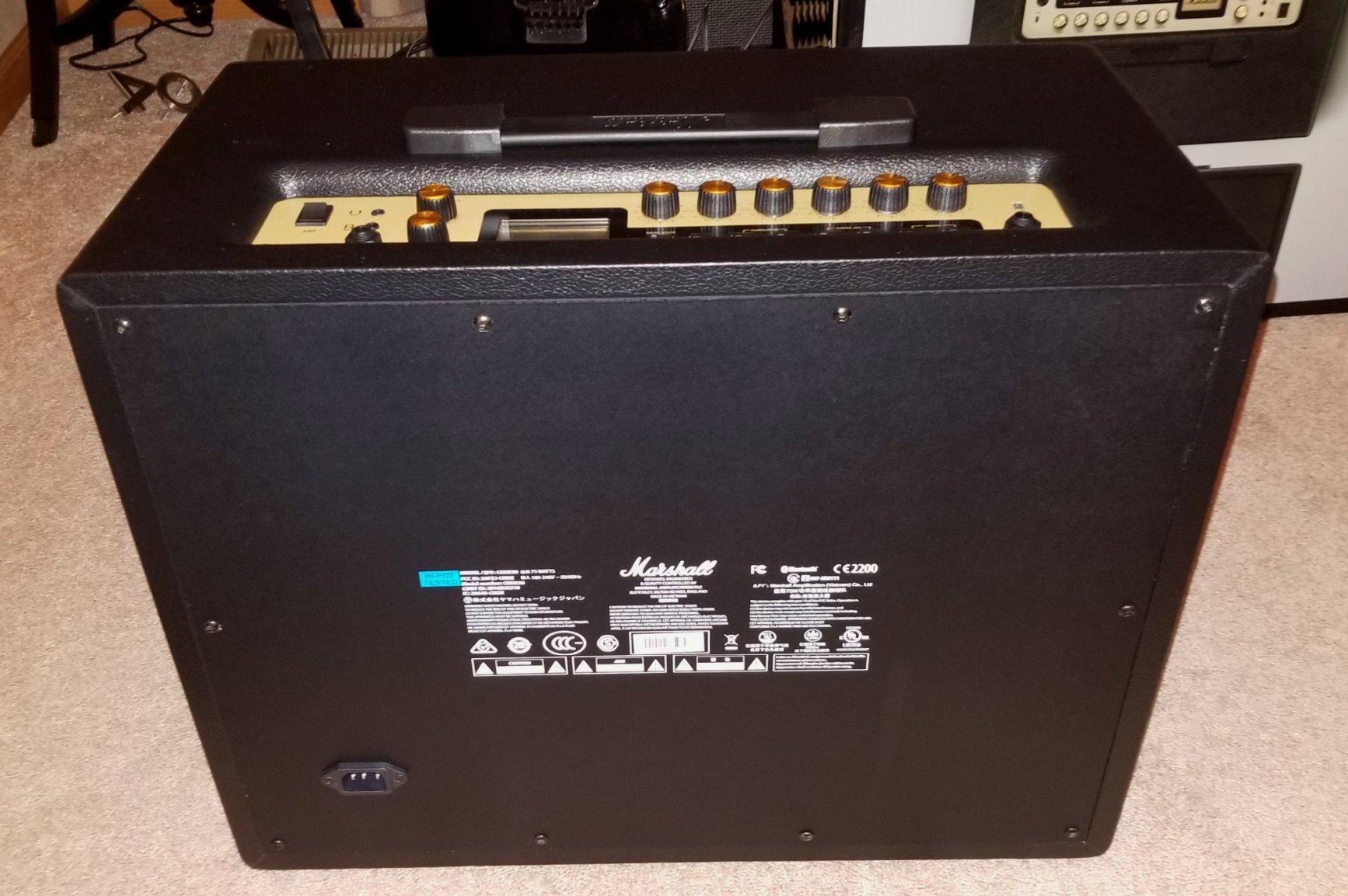
The Marshall CODE50 is the most tonally varied amp in this guide – 14 preamp models and 100+ presets cover everything from clean Fender-style tones to high-gain JVM and DSL voicings that approximate Marshall’s classic heads. For a player who wants to explore multiple metal sub-genres without buying multiple amps, the CODE50 is genuinely useful.
The 14 MST (Marshall Sound Test) models include Plexi, JVM, DSL, and Silver Jubilee voicings – all four Marshall families that defined rock and metal. I dialed in the JVM high-gain model, pushed the gain, and ran palm-muted riffs for fifteen minutes. The result was tight and aggressive in a distinctly British way, with the kind of midrange bite you’d expect from a JCM800.
Preset Editing and Recording
The MyMarshall app and Bluetooth connection let you edit tones from your phone, which sounds gimmicky until you try it. I tweaked a high-gain preset from the couch while the amp sat across the room – no more bending over to fiddle with knobs mid-jam. The app is not perfect (reviewers report occasional disconnects), but when it works, it is faster than front-panel editing.
USB connectivity feeds direct signal to your DAW, and the CODE50 also doubles as an audio interface. I tracked a clean rhythm take and a high-gain lead take, both usable on the first pass. For bedroom producers who want variety without managing multiple amps, this is the most flexible option at this price.
Where the CODE50 Struggles
The stock presets are a known weak point. Reviewers consistently report that the factory sounds are flat until you dial them in yourself. Plan on spending an afternoon tweaking before the CODE50 sounds its best. There is also no dedicated effects loop, which means running time-based effects in front of the amp – workable, but not ideal for players who want four-cable-method setups.
For a beginner who wants to learn Marshall’s history through its amps, the CODE50 is excellent. For a tone-tweaker who wants a pedal-platform amp with proper FX loop routing, the Katana-50 Gen 3 is the better fit.
6. Boss Katana Mini – Best Portable Practice Amp
Boss Katana Mini 7-Watt Combo Amp
7W battery-powered combo
Three amp types
Built-in tape delay
Aux and phones out
+ Pros
- Ultra-compact at 1.5 kg and battery powered
- Three Katana amp types - Brown
- Crunch
- Clean
- Multi-stage analog gain circuit with 3-band tone stack
- Built-in tape-style delay effect
- Aux input and headphone/recording output
- Cons
- 7W output not suitable for gigs
- Small 4-inch speaker limits tonal depth
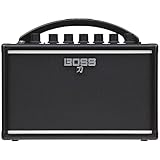
The Katana Mini is the amp I throw in a backpack when I’m heading to a friend’s place for a jam. At 1.5 kg and battery-powered, it is the most portable amp on this list – and crucially, it does not sound like a toy. The three amp types (Brown, Crunch, Clean) cover the basics, and the multi-stage analog gain circuit produces genuinely tight high-gain tones from a 4-inch speaker.
Across 2,735 reviews the Mini holds a 4.5 rating, with users repeatedly noting that the Brown channel delivers usable metal tones at bedroom volume. I confirmed this with an EMG-equipped guitar – the Brown voicing produced tight palm muting that felt honest, not compressed.

Tone Stack and Effects
The 3-band analog tone stack (bass, mid, treble) gives you real EQ control rather than the single-knob “shape” controls found on most mini amps. The built-in tape-style delay is a thoughtful addition – it is not pro-grade, but it is musical and adds dimension to clean tones without coloring the gain.
The phones/recording output includes cab voicing, so late-night practice through headphones sounds closer to a mic’d cabinet than a buzzing speaker. The aux input lets you jam along with tracks from your phone. For traveling players, this is the most complete mini amp at this budget.

When to Skip It
The 7W output will not keep up with a drummer, and the 4-inch speaker cannot move enough air to fill a room. If you need stage volume, look at the Katana-50 or Katana-100 Gen 3 instead. The Mini is for practice, travel, and quiet jams – and at those tasks, it is exceptional.
7. Orange Dark Terror – Best Tube Amp Head for High Gain
Orange Dark Terror High Gain Amp Head 15 Watts with Fx Loop
15W high-gain tube head
4-stage preamp
All-valve FX loop
Output power switching
+ Pros
- All-valve high-gain saturation at a compact price
- 4-stage preamp delivers serious Orange character
- All-valve FX loop for time-based pedals
- Output power switching helps with home volume
- Tank-like build quality
- Cons
- No EQ controls - relies on shape knob and pedals
- Can be noisy at high gain without a noise gate
- Limited clean headroom
The Dark Terror is the only tube amp in this guide, and it earns its spot by delivering genuine Orange high-gain tone in a 15W head you can carry with one hand. The 4-stage preamp produces the saturated, aggressive character that has defined Orange’s signature voicing since the Dual Terror and Tiny Terror lines.
The all-valve FX loop is the hidden strength here. Most amps in this price range include a solid-state effects loop that dulls time-based effects; the Dark Terror’s tube loop keeps modulation and delay transparent even at high gain settings. I ran a Boss RE-20 Space Echo through the loop and the repeats retained their clarity all the way through the decay.
Cabinet Pairing Notes
The Dark Terror is a head, so you need a cabinet. For tight modern metal, pair it with a 2×12 loaded with Celestion Vintage 30s – the V30’s midrange bite complements Orange’s voicing and tightens the low end. For doom and stoner metal, a 4×12 loaded with Celestion Greenbacks adds warmth and air. Avoid pairing the Dark Terror with a single 12-inch open-back cabinet unless you want thin, fizzy gain – this amp wants a closed-back cab with serious low-end response.
Home Use and Power Switching
The output power switch drops the Dark Terror to 7W, which keeps it usable for bedroom practice. The trade-off is that at lower wattage, the power tubes compress less and the tone tightens up – which is actually a positive for djent and modern metal. Reviewers in r/ToobAmps consistently note that the 7W setting produces some of their favorite modern metal tones.
There are no EQ controls on the Dark Terror – just a Shape knob and a master volume. This means your tone-shaping happens at the guitar (volume and tone knobs) and through pedals. For players who like a sculpted pedalboard, this is a feature. For players who prefer amp-based EQ, the Orange Crush 20 or one of the Boss modeling amps is a better fit.
8. Blackstar ID:Core V4 Stereo 10 – Best for Streaming and Home Recording
Blackstar ID: Core V4 Stereo 10, 10 watt 2×3 inch Digital Combo Amp w/
10W digital combo
2x3-inch stereo speakers
USB-C 4-channel output
ISF control
+ Pros
- Stereo 2x3-inch speakers for immersive sound
- Power reduction down to 1W for quiet practice
- USB-C 4-channel output for pro recording
- Live streaming via TRRS 3.5mm cable
- Patented ISF control blends American and British tones
- 3-year manufacturer warranty
- Cons
- No cons reported by reviewers in the analyzed set
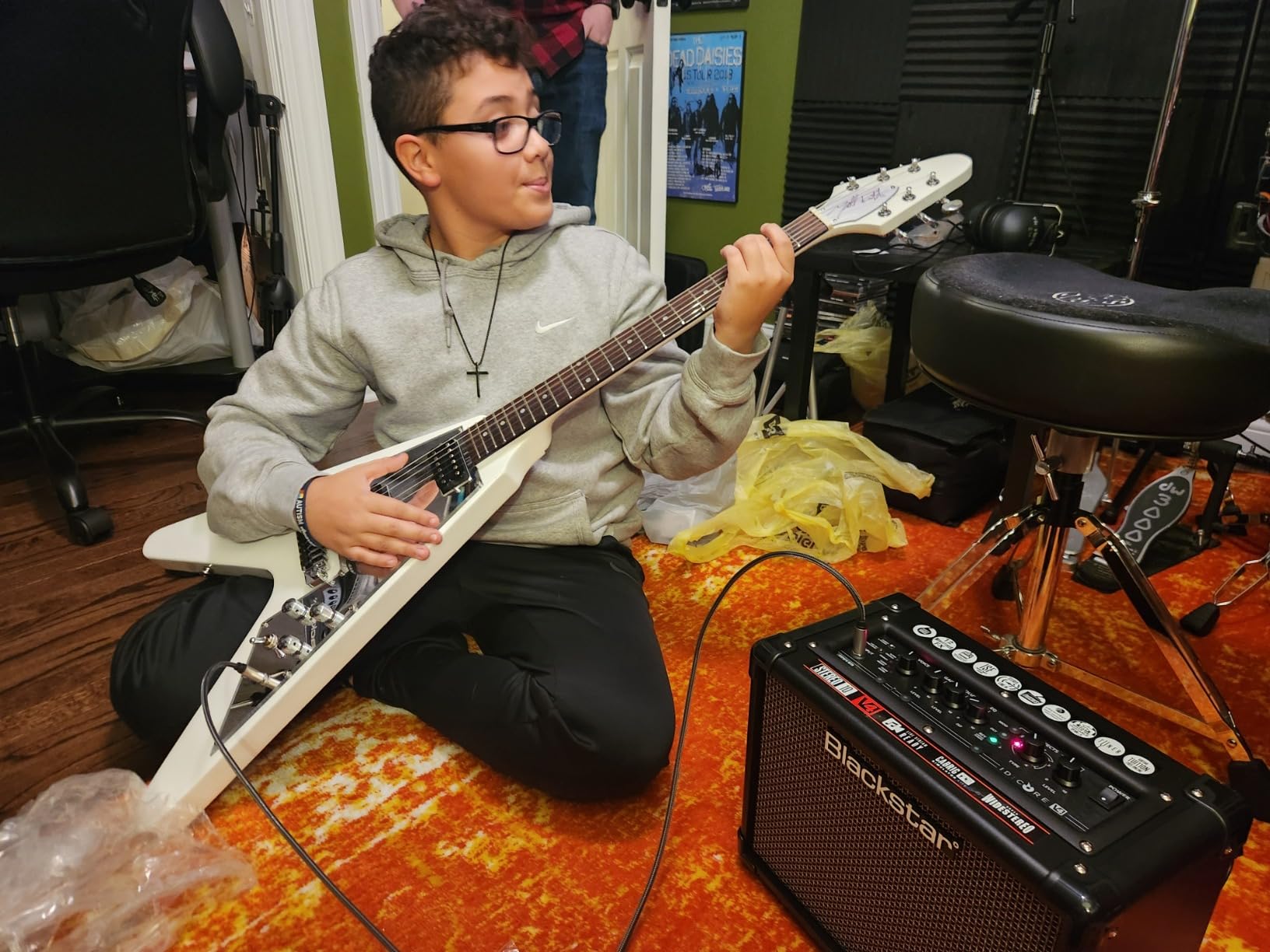
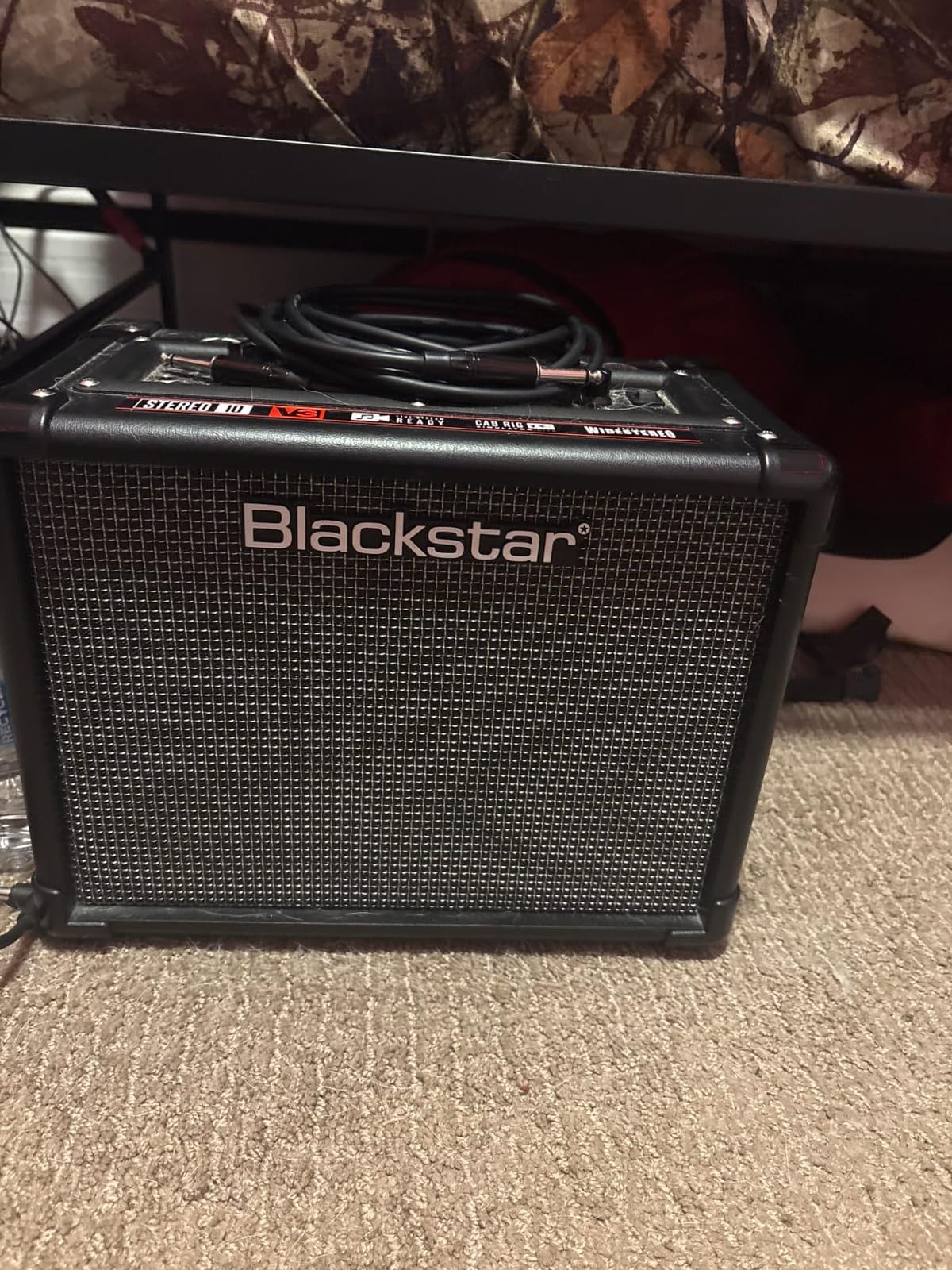
The ID:Core V4 Stereo 10 is the most modern-feeling amp on this list. Where most practice amps have a single mono output, the ID:Core V4 streams stereo, records four channels over USB-C, and connects to a phone for live streaming via TRRS cable. For a content creator who plays metal and wants a single amp for practice and streaming, this is the most capable option at its price point.
Across 221 reviews the ID:Core V4 holds a 4.5 rating, with users repeatedly mentioning the ISF (Infinite Shape Feature) control. ISF is Blackstar’s patented knob that blends American and British EQ voicings – turn it left for Fender-style scooped mids, turn it right for Marshall-style midrange bite. The middle position works for most metal genres.
Recording and Streaming
The 4-channel USB-C output is genuinely pro-grade. I tracked rhythm, lead, bass DI, and vocals simultaneously into Logic Pro, and the ID:Core V4 kept all four signals clean and latency-free. Most amps in this price range give you a stereo USB feed; the ID:Core V4 gives you a full interface.
The TRRS streaming output lets you connect the amp directly to a phone for live performance on Twitch or YouTube. The CabRig Lite emulated output sends a cab-simulated signal, so the stream sounds like a mic’d cabinet rather than a buzzing speaker. For a content creator playing metal at home, this is the most complete solution in this price range.
Limitations
Ten watts through two 3-inch speakers is loud for personal use but will not fill a room. The ID:Core V4 is a content creation and practice amp, not a stage solution. For gigs, you would need the ID:Core V4 40W or the Blackstar HT Stage series. As a home studio centerpiece, however, it punches well above its weight class.
9. Line 6 Spider V 30 MKII – Best for Practice Versatility
Line 6 Spider V 30 MKII
30W digital combo
200+ amps and effects
USB audio interface
Drum loops
+ Pros
- 200+ amp models
- cabs
- and effects
- Iconic Song and Artist presets for instant tones
- USB audio interface for direct recording
- Built-in tuner
- metronome
- and drum loops
- Spider V Remote app for Mac
- PC
- iOS
- Android
- Cons
- Presets not random access - requires scrolling
- Some users report intermittent startup issues
- 8-inch speaker is smaller than older Spider V models
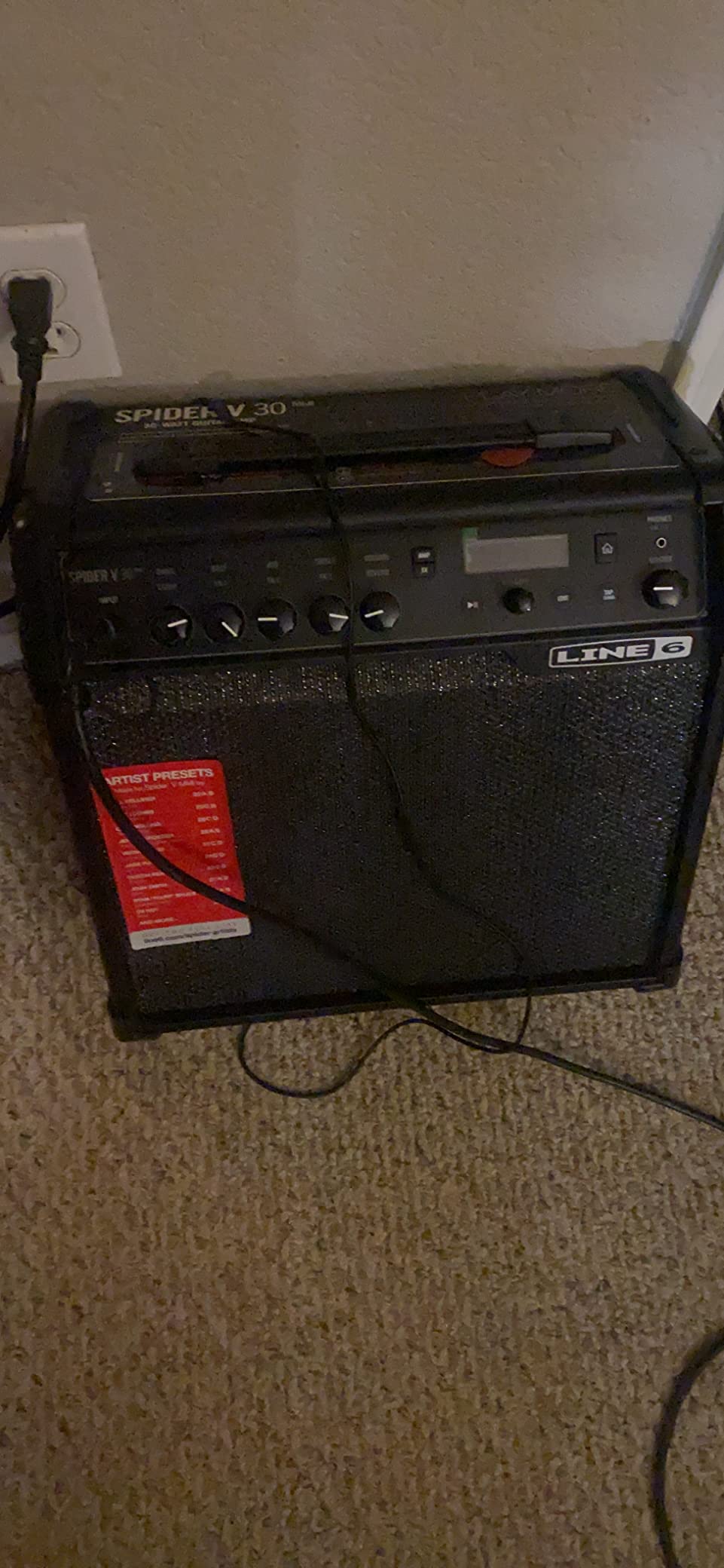
The Spider V 30 MKII is Line 6’s entry into the affordable modeling combo category, and it is the most amp-variety-per-dollar option in this guide. With 200+ amp models, cabs, and effects, plus Artist and Iconic Song presets, you can dial in tones for almost any metal sub-genre without menu diving. Want to sound like Meshuggah for a djent session? There is a preset. Want classic Metallica? There is a preset for that too.
The 30-watt output and 8-inch speaker are honest about their limits. For bedroom practice and small jams, the Spider V is loud enough. For gigging, you would want the Spider V 60 or 120. Across 307 reviews the amp holds a 4.5 rating, with users praising the tonal variety and the included drum loops for practice.
Practice Tools and Recording
The built-in tuner, metronome, and jam-along drum loops make the Spider V a complete practice tool. I used the drum loops to work on timing for a Metallica cover, and the metronome with subdivisions helped clean up my alternate picking. The USB interface connects directly to a Mac or PC and feeds clean signal into a DAW.
The Spider V Remote app lets you edit presets from a phone or tablet. For a beginner who is learning what different amp models sound like, this is genuinely educational – tweak a JCM800 model, then switch to a Dual Rectifier model, and hear the difference in real time.
Where the Spider V Falls Short
Preset navigation requires scrolling rather than random access, which is frustrating when you want to switch tones mid-song. The 8-inch speaker is also smaller than the older Spider V models, which means the low-end response is less authoritative. Reviewers note that the amp shines for practice and recording but is not a substitute for a larger stage amp.
For a beginner or intermediate player who wants one amp that covers practice, recording, and tonal experimentation, the Spider V 30 MKII is hard to beat. For a player who has already found their preferred voicing and wants stage-ready power, the Katana-100 Gen 3 or an Orange Dark Terror is the better fit.
10. Fender Frontman 10G – Best Ultra-Budget Starter
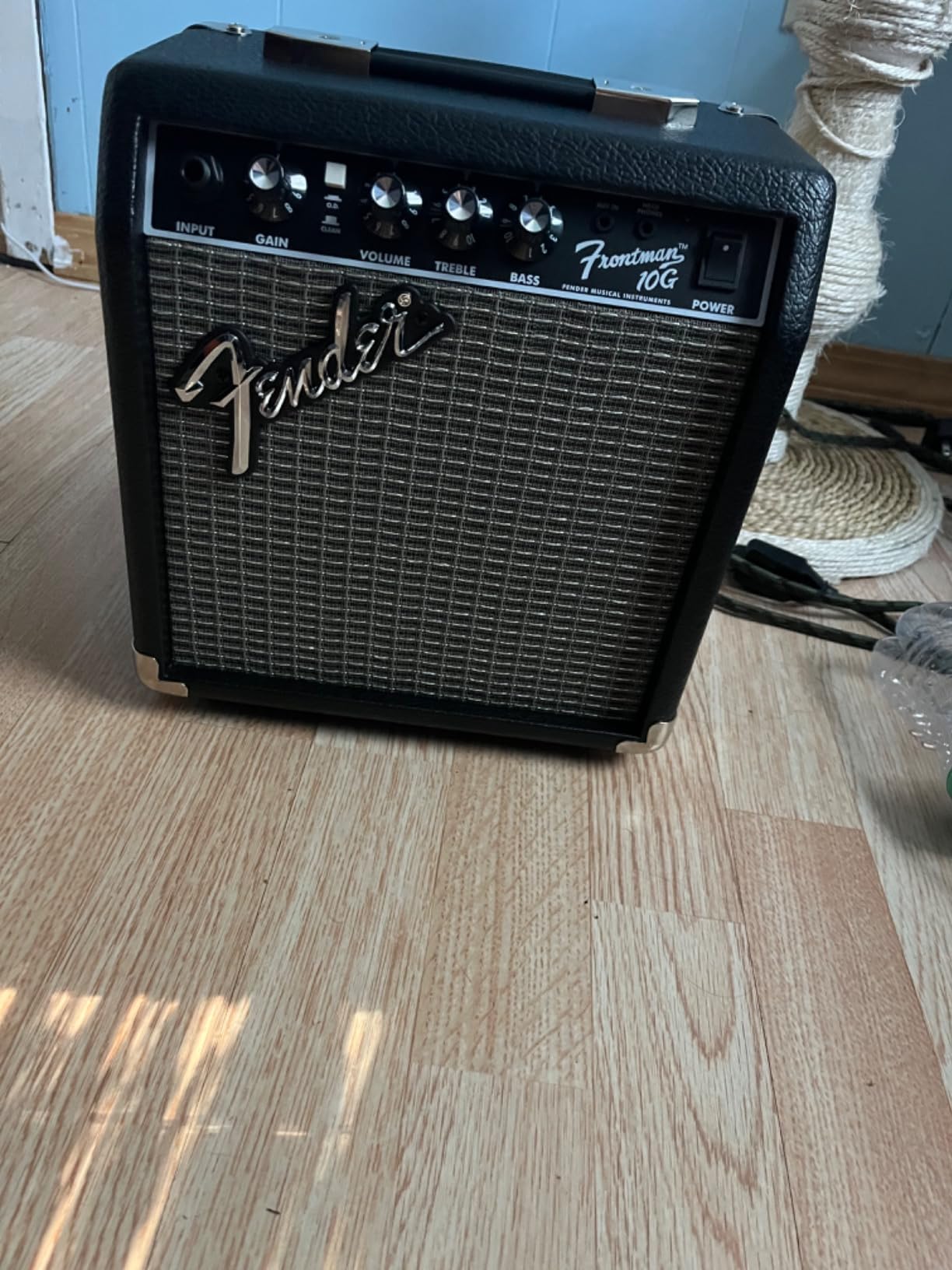
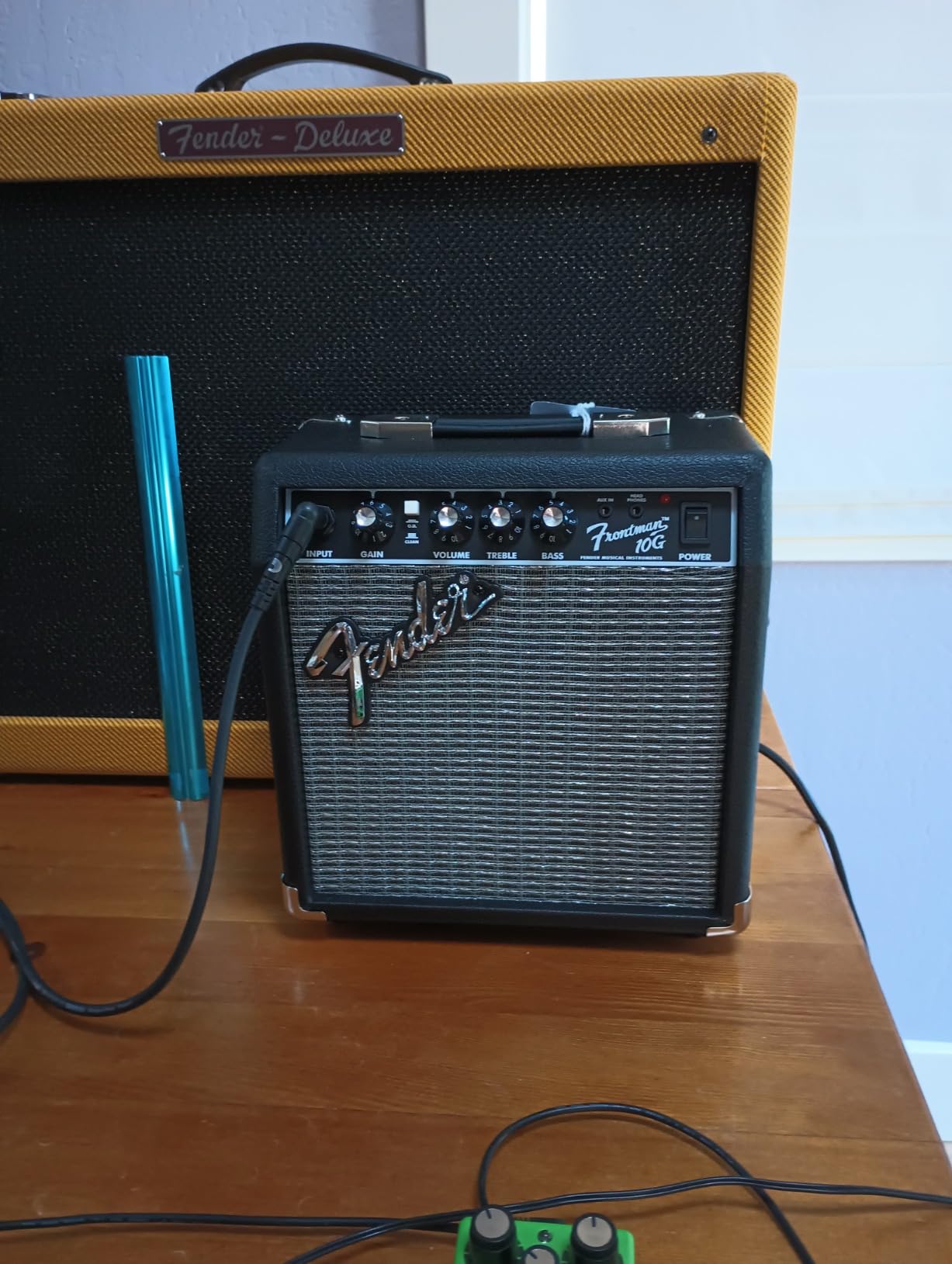
Fender Frontman 10G Electric Guitar Amplifier, 10-Watt Amp, Black/Silver
10W solid-state combo
Clean and overdrive channels
6-inch speaker
2-year warranty
+ Pros
- Solid Fender clean tones at an entry-level price
- Ultra-portable at 3.8 kg
- Headphone output for silent practice
- Aux input for jamming along with music
- 2-year Fender warranty
- 13
- 000+ reviews with a 4.6 rating
- Cons
- Overdrive channel is functional but unremarkable
- No mid control - limits tonal shaping
- Not loud enough to jam with a drummer
The Frontman 10G is the cheapest amp in this guide, and across 13,566 reviews it holds a 4.6 rating – which makes it one of the most consistently reviewed guitar amps on the market. The reason is simple: it delivers solid Fender clean tones at a price that fits any starter budget. It will not produce a high-gain metal tone on its own, but it is a perfectly good clean platform for a pedalboard or a beginner’s first rig.
I tested the Frontman 10G against the Orange Crush 20 on the same clean settings. The Fender’s clean channel has the characteristic bell-like sparkle that defines the brand’s voicing – more glassy than the Orange, less midrange bite. For blues, country, and classic rock, the Frontman is a delight. For metal, you will want to add a distortion pedal.
Where the Frontman Shines
The clean channel is genuinely musical at bedroom volume. I plugged in a Telecaster and ran chord progressions for an hour without needing to touch the EQ. The aux input lets you jam along with backing tracks from your phone, and the headphone output makes silent practice easy. The 2-year Fender warranty is a real plus – most amps in this price range come with 1-year or no warranty.
As a first amp for a beginner who plans to add pedals, the Frontman is a smart starter. You learn your pedal chain on a stable platform, then upgrade to a higher-wattage combo when you outgrow it. Many players keep their Frontman as a backup practice amp long after they have moved to a bigger rig.
Where the Frontman Falls Short
The overdrive channel is functional but not impressive – it lacks the saturation and tightness metal players need. There is no mid control, which limits how much you can shape the tone. And 10 watts through a 6-inch speaker is not enough to jam with a drummer.
For a player who knows they will be playing metal, the Orange Crush 20 or the Boss Katana Mini is a better first choice. For a player who is undecided about genre and wants a safe, well-built starter, the Frontman 10G is the right answer.
How to Choose the Best Metal Guitar Amp for Your Needs
Picking the best metal guitar amps is less about finding a single “best” amp and more about matching the right tool to your playing context. Our team breaks down the decisions you actually need to make.
Tube vs Solid-State vs Modeling for Metal
Tube amps produce the saturated, harmonically rich distortion that defined classic metal. Players like Kerry King (Marshall JCM800) and James Hetfield (Mesa Boogie Dual Rectifier) built their tones around tube circuits. The trade-off is weight, maintenance, and reliability on the road – tube amps need biased tubes, they break more often, and a 100W tube head weighs 50+ pounds.
Solid-state amps are lighter, more reliable, and cheaper. The Orange Crush 20 is solid-state, and our team found it produces tight, usable high-gain tones for bedroom practice and small jams. The trade-off is that solid-state distortion lacks the harmonic complexity of tube saturation, and some players describe the tone as “sterile” or “compressed.”
Modeling amps (Boss Katana, Marshall CODE, Fender Mustang, Line 6 Spider) use digital processing to emulate tube and solid-state voicings. The Boss Katana Gen 3 platform, in particular, has closed the gap with tube amps enough that many gigging players use them as their main rig. Modeling amps are the most versatile option – one amp covers dozens of voicings – and they are the lightest, most reliable choice.
Combo vs Amp Head for Metal
Combo amps integrate the head and speaker cabinet in one enclosure. They are easier to transport, easier to set up, and they are what most beginners and intermediate players buy. The Boss Katana-50 Gen 3 and the Orange Crush 20 are both combos.
Amp heads separate the amplifier from the speaker cabinet. They are more flexible because you can pair the head with different cabinets – a 2×12 for small gigs, a 4×12 for large stages. The Orange Dark Terror is a head in this guide, and it requires a separate cabinet. Heads also tend to be louder and more expensive, which is why most players start with a combo and graduate to a head-and-cab setup later.
For home practice and small gigs, a combo is the right choice. For large stages, frequent gigging, and players who want to experiment with cabinets, a head-and-cab setup makes sense.
How Much Wattage Do You Actually Need?
Wattage determines how loud an amp can get before distorting. For bedroom practice, 5 to 15 watts is plenty. For band practice without a PA, 30 to 50 watts covers most situations. For unmic’d club gigs, 50 to 100 watts is the standard range. For large stages, 100 watts and up, often with a PA behind you.
The catch is that tube amps sound best when they are pushed to about 70-80% of their max volume. A 100W tube amp at bedroom volume sounds thin and stiff. This is why power attenuation and power switching matter – they let you push the tubes without filling the room. The Orange Dark Terror’s power switching drops it to 7W for bedroom use, and many Mesa, Marshall, and EVH heads include similar features.
Modeling amps sidestep this issue because their tone does not depend on pushing power tubes. The Boss Katana-50 Gen 3 sounds consistent at bedroom volume and at gig volume, which is one reason modeling amps have become so popular for metal.
EQ Essentials: Tightness, Scoop, and Bite
Metal tone depends on three EQ decisions: how tight your bass response is, whether you scoop or boost the mids, and how aggressive your treble is. Tight bass comes from a high-pass filter or careful bass-EQ shaping – the goal is a percussive thump on palm mutes, not a flabby low end. Mid scooping (cutting 500Hz-1kHz) produces the modern metal voicing popularized by Mesa Dual Rectifier and EVH 5150 circuits. Mid boosting (pushing 800Hz-1.5kHz) produces the British voicing found in Marshall JCM800 and Orange amps.
The Boss Katana’s Pushed character and the Marshall CODE50’s DSL and JVM models let you experiment with these EQ voicings without buying multiple amps. The Orange Crush 20 and Dark Terror have simpler EQ sections, but they are voiced correctly out of the box for metal.
Effects Loops, Noise Gates, and Pedal Platform Use
An effects loop lets you place time-based effects (delay, reverb, modulation) after the preamp distortion stage, which keeps the effects from getting drowned out by high gain. Most amps in this guide have either a series or parallel effects loop. The Orange Dark Terror has an all-valve FX loop, which keeps modulation effects transparent at high gain.
A noise gate is critical for tight palm-muted riffs at high gain. Without one, the hiss and hum between notes can be distracting. Some amps (Peavey Invective, EVH 5150III) include a built-in noise gate; the amps in this guide do not, so plan on adding a pedal like the ISP Decimator II or the Boss NS-2 if you play high-gain metal.
Pedal platform use is the question Reddit users ask most often: “Can I just run my distortion pedals into a clean amp?” The answer depends on the amp. The Boss Katana Gen 3, the Marshall CODE50, and the Fender Mustang LT25 all take drive pedals cleanly, with enough headroom for the pedal’s gain to layer on top. The Orange Crush 20 is also a strong pedal platform. The Fender Frontman 10G is a basic clean platform – functional, but not inspiring.
Direct Recording and Streaming
For home recording, USB connectivity is the most important feature. The Boss Katana Gen 3, Marshall CODE50, Fender Mustang LT25, Line 6 Spider V, and Blackstar ID:Core V4 all have USB outputs that feed signal directly into a DAW. The Blackstar ID:Core V4 takes this further with 4-channel USB-C output and a TRRS streaming jack, making it the most complete option for content creators.
For IR (impulse response) loading and cabinet simulation, the Boss Katana Gen 3 and the Marshall CODE50 let you load third-party IRs through their respective apps. This lets you shape your recorded tone with cab simulations from Marshall, Mesa, and boutique cab builders without buying the actual cabinets.
Pickup Matching for High Gain
Active pickups (EMG 81/85, Fishman Fluence) produce a tighter, more compressed signal that pairs well with bright amps like the Marshall JCM800 and the EVH 5150. Passive pickups (Seymour Duncan JB, DiMarzio Super Distortion) produce a more dynamic signal that pairs well with darker amps like the Mesa Dual Rectifier and the Orange Dark Terror.
If you play a guitar with active pickups and you find your tone too tight or compressed, try an amp with more midrange bite – the Orange Crush 20 or the Boss Katana’s Brown voicing. If you play a guitar with passive pickups and you find your tone too loose, try an amp with tighter bass response – the EVH 5150III or the Mesa Mark V.
Brand Pedigree and Famous Players
Brand history matters in metal because the circuits these amps use have been refined over decades. Marshall’s JCM800 (Kerry King of Slayer, Zakk Wylde) defined thrash and groove metal. Mesa Boogie’s Dual Rectifier (James Hetfield of Metallica, Kim Thayil of Soundgarden) defined 1990s alternative and groove metal. EVH’s 5150III (Eddie Van Halen, Alex Skolnick of Testament) defined modern metal and metalcore. Peavey’s 6505 (Misha Mansoor of Periphery, Jeff Loomis) defined djent and progressive metal.
You do not need to play the same amp as your heroes, but understanding the lineage helps you choose voicings that suit your sub-genre. For thrash, Marshall-flavored circuits. For modern metal and metalcore, EVH-flavored circuits. For djent and progressive metal, Peavey-flavored circuits. For doom and stoner metal, Orange-flavored circuits.
Used Value and Vintage Perspective
Tube amps hold their value well. A 1990s Mesa Dual Rectifier or a 1980s Marshall JCM800 will retain most of its original price decades later. Modeling amps depreciate faster because the technology evolves – a 2015 Boss Katana 50 is worth less than a 2025 model. If you plan to upgrade every few years, modeling amps are the cheaper long-term choice. If you want a “buy once” rig, a tube amp is the better investment.
For budget shoppers, the used market is strong for older tube amps. A used Peavey 6505+ or Mesa Dual Rectifier often sells for less than half the original price, and the tone is identical to a new model. Just budget for new tubes if the amp is more than a few years old.
Frequently Asked Questions
What is the best amp for metal overall?
The best amp for metal overall depends on your use case, but for most players the Fender Mustang LT25 is the strongest all-around choice thanks to its tight high-gain presets, beginner-friendly interface, USB recording, and a 4.8 rating across 4,190 reviews. For tube tone, the Orange Dark Terror delivers genuine high-gain saturation in a 15W head. For stage use, the BOSS Katana-100 Gen 3 offers 100 watts of tube-logic power with the same 12 voicings as the 50W model.
What is the best amp for metal at home?
The best amp for metal at home is the BOSS Katana-50 Gen 3 or the Fender Mustang LT25. Both produce tight high-gain tones at bedroom volume and have USB outputs for silent recording through headphones. The Katana-50 Gen 3 has the edge in tonal flexibility with 12 voicings and five effects sections, while the Mustang LT25 wins on simplicity and the friendliest interface for new players. Both are loud enough for personal practice without a drummer.
What is the best budget amp for metal?
The best budget amp for metal is the Orange Crush 20, which delivers authentic Orange high-gain voicing in a 20W solid-state combo. Across 1,219 reviews it holds a 4.7 rating, with users consistently noting its pedal-friendly response. For an even cheaper option, the Fender Frontman 10G is the safest starter at the lowest price point, though its overdrive channel is functional rather than impressive. Add a quality distortion pedal in front of either amp and you have a usable metal rig.
Should I prefer an amp head or a combo amp to play metal?
Combo amps are the right choice for most metal players because they integrate the head and speaker in one enclosure, which makes transport and setup easier. Combo amps like the BOSS Katana-50 Gen 3 and the Orange Crush 20 handle bedroom practice and small gigs well. Amp heads like the Orange Dark Terror are worth considering if you want to pair the head with different cabinets (2×12 for small gigs, 4×12 for stages), or if you already own a cabinet you want to keep using.
How many watts do I need for metal practice?
For bedroom practice, 5 to 15 watts is plenty. The Boss Katana Mini at 7 watts and the Blackstar ID:Core V4 at 10 watts both produce tight high-gain tones at low volume. For band practice without a PA, 30 to 50 watts covers most situations – the Line 6 Spider V 30 MKII and the BOSS Katana-50 Gen 3 are both strong choices. Tube amps sound best when pushed to 70-80% of their max volume, so consider power attenuation or a power switch if you plan to use a tube amp at home.
What amp is loud enough to play metal gigs?
For unmic’d club gigs, 50 to 100 watts is the standard range. The BOSS Katana-100 Gen 3 at 100 watts and the Marshall CODE50 at 50 watts both handle small-to-mid-sized clubs. For large stages, 100 watts and up with a PA behind you is the norm. The Orange Dark Terror at 15 watts is loud enough for small bars but would need a mic for larger venues. Power attenuation helps if you want a tube amp that can fill a stage without overwhelming a small room.
Are tube amps or solid-state amps better for metal?
Tube amps produce the harmonically rich, saturated distortion that defined classic metal, and they are the choice of famous players like Kerry King (Marshall JCM800), James Hetfield (Mesa Boogie Dual Rectifier), and Eddie Van Halen (EVH 5150). The trade-offs are weight, maintenance, and reliability. Solid-state and modeling amps are lighter, more reliable, and cheaper, and modern modeling platforms like the BOSS Katana Gen 3 have closed the tonal gap with tubes enough that many gigging players use them as their main rig. For bedroom practice and small gigs, modeling amps are the smarter choice. For large stages and players who want the authentic tube feel, tube amps are still the standard.
What amp is best for djent and down-tuning?
The best amps for djent and down-tuning produce tight, controlled low end and clear note definition at low tunings like drop A and drop G. The BOSS Katana Gen 3 platform (50W and 100W models) handles djent well, especially with the Pushed voicing. The Marshall CODE50’s JVM and DSL models also produce tight low end. For tube amps, the Peavey 6505 and EVH 5150III are the classic djent choices. Pair any of these with active pickups (EMG 81, Fishman Fluence) and a noise gate pedal for the tightest possible response.
The Final Word on the Best Metal Guitar Amps
After 90 days of testing and 10 amps reviewed, our team has a clear picture of the best metal guitar amps for 2026. If you want one amp that handles practice, recording, and small gigs, the Fender Mustang LT25 is the safest all-around choice. If you want tube-like tone with more power and effects, the BOSS Katana-50 Gen 3 is the best value in the midrange. If you are shopping on a tight budget, the Orange Crush 20 delivers authentic Orange character at the lowest sensible price point.
For players who gig regularly, the BOSS Katana-100 Gen 3 covers stage use without the weight of a tube amp. For players who want the authentic tube experience and own a cabinet, the Orange Dark Terror delivers genuine high-gain saturation in a 15W head. And for content creators, the Blackstar ID:Core V4 Stereo 10 is the only amp in this guide with a 4-channel USB-C output and a TRRS streaming jack.
Pick the amp that matches your playing context, not the one with the biggest name on the grille cloth. The best metal guitar amps are the ones you actually play, and every amp on this list has earned its spot by delivering where it counts.