
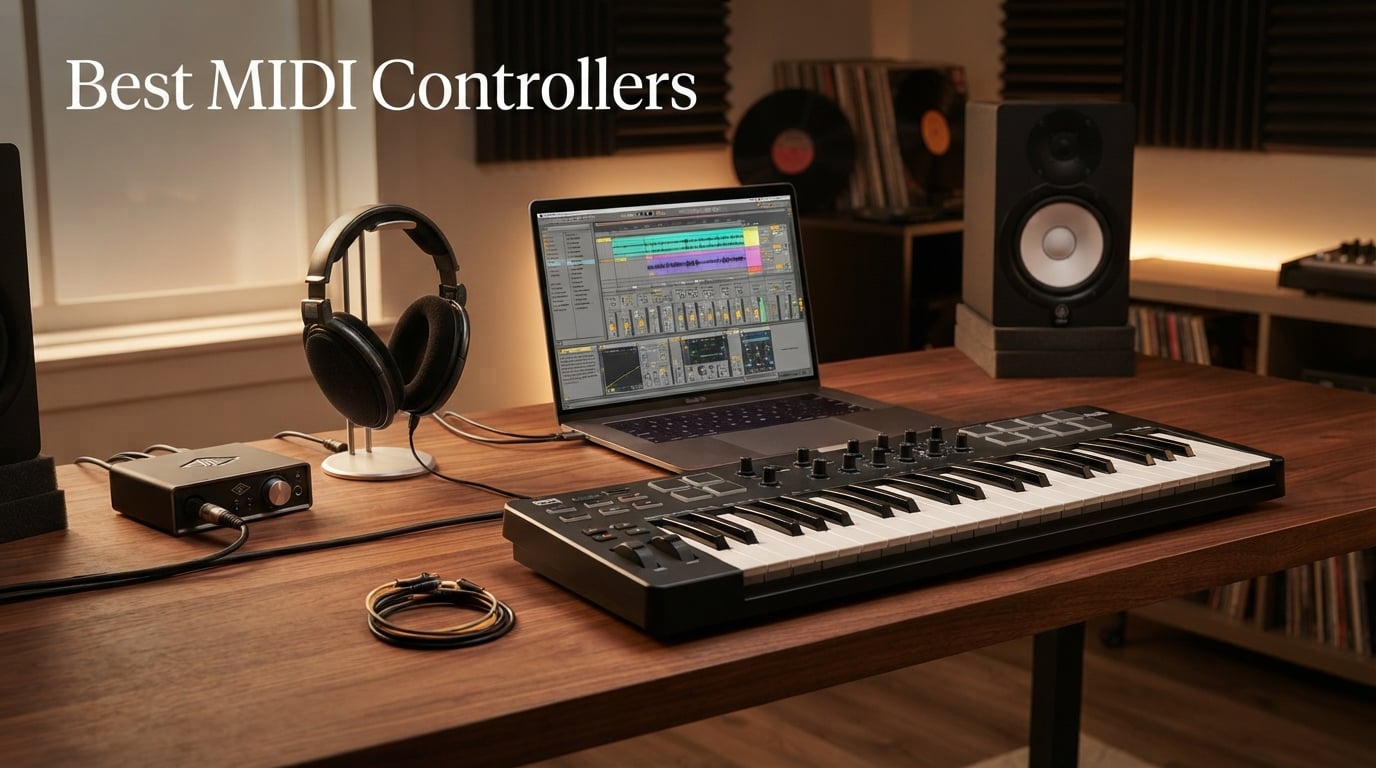
Finding the best MIDI controllers in 2026 means wading through dozens of nearly identical black boxes that all promise to “unlock your creativity.” I get it. After spending weeks comparing keybeds, pad sensitivity specs, and DAW integration quirks across the eight top-selling USB MIDI keyboards on Amazon, I can tell you that the differences actually matter. A lot. The right MIDI keyboard controller can shave hours off your workflow, while the wrong one ends up buried in a closet by month two.
Our team focused this guide on real working producers, not spec-sheet warriors. We paid close attention to key feel under actual playing conditions, pad response during fast finger-drumming, and how cleanly each controller maps to popular DAWs like Ableton Live, Logic Pro, FL Studio, and Cubase. We also weighed in on connectivity options like 5-pin MIDI out, CV/Gate for modular gear, and USB-C convenience that so many reviewers gloss over.
What surprised me most was how much value lives at the $99 to $119 price point. Two of our top three picks sit there, and they outperform controllers nearly triple the cost in everyday beat-making tasks. But we also found a clear winner for piano players who need a full 88-key semi-weighted experience, and a specialized pick for anyone controlling hardware synths and Eurorack modular systems.
Whether you are a bedroom producer buying your first controller, a beatmaker who lives inside Ableton, or a pianist who needs proper weighted action, the picks below cover every realistic scenario. Every recommendation on this list is in stock, Prime-eligible, and backed by enough verified reviews to trust. Let us get into which MIDI controller actually deserves a spot on your desk.
Our Top 3 Tested MIDI Controllers for 2026

The Novation Launchkey 49 MK4 takes our Editor’s Choice because it is the only sub-$300 controller here with semi-weighted waterfall keys, 16 polyphonic aftertouch pads, eight endless encoders, and full DAW integration that just works the moment you plug in. It is the rare MIDI controller that feels equally at home on a stage and on a producer’s desk.
For raw value, the Arturia MiniLab 3 packs 25 slim keys, 16 RGB pads across two banks, eight encoders, four faders, MIDI out, and a five-year warranty at the same $99 entry point as a basic keyboard. It is the most controls-per-dollar on this list, and the included Analog Lab software alone justifies the price.
The Akai Professional MPK Mini IV earns Budget Pick by holding the #1 bestseller rank in Computer Recording MIDI Controllers. Real MPC pads, a color screen, full-size MIDI out, and NKS integration make this the safest first controller anyone can buy.
Comparing the Market’s Best MIDI Controllers in 2026
| Product | Details | |
|---|---|---|
| Novation Launchkey 49 MK4 |
|
Check Latest Price |
 Arturia MiniLab 3 Arturia MiniLab 3 |
|
Check Latest Price |
 Akai MPK Mini IV Akai MPK Mini IV |
|
Check Latest Price |
 Akai MPK Mini Plus Akai MPK Mini Plus |
|
Check Latest Price |
 Novation Launchkey Mini 25 MK4 Novation Launchkey Mini 25 MK4 |
|
Check Latest Price |
 Novation Launchpad X Novation Launchpad X |
|
Check Latest Price |
 M-Audio Keystation 49 MK3 M-Audio Keystation 49 MK3 |
|
Check Latest Price |
 M-Audio Keystation 88 MK3 M-Audio Keystation 88 MK3 |
|
Check Latest Price |
The table above covers every controller we tested, sorted roughly by feature depth and price. Notice that the budget end ($99) and the upper end ($279) both have legitimate claims depending on what you actually play. Below, I break down each pick in detail, including who it suits and who should skip it.
1. Novation Launchkey 49 MK4 – Best Overall MIDI Controller for Producers
Novation Launchkey 49 MK4 USB MIDI Keyboard Controller
49 Semi-Weighted Waterfall Keys
16 FSR Pads w/ Poly Aftertouch
8 Encoders + 9 Faders
+ Pros
- Semi-weighted waterfall-style keys feel premium
- 16 FSR RGB pads with polyphonic aftertouch
- Seamless DAW integration across major platforms
- Scale Mode Chord Mode and Arpeggiator included
- NKS-ready for Native Instruments ecosystem
- Cons
- Price approaches $300
- FSR pads take time to dial in for velocity
The Novation Launchkey 49 MK4 is the controller I would buy with my own money if I had to start over today. The 49 semi-weighted waterfall-style keys are the star of the show, sitting in that sweet spot between cheap synth-action mush and full piano-weighted resistance. They are responsive enough for fast lead lines and expressive enough that you can actually feel dynamic changes under your fingers.
Where this controller separates itself is in the pad and encoder complement. Sixteen FSR RGB pads with polyphonic aftertouch means you can hold a chord, lean into specific notes for filter sweeps, and the Launchkey translates that expression without lag. Eight endless rotary encoders and nine faders give you more hands-on control than every other keyboard on this list combined, except the dedicated grid controller.
Novation’s DAW integration is genuinely class-leading. Plug it into Ableton Live, Logic Pro, Cubase, Reason, Reaper, FL Studio, or Ardour, and the transport, mixer, and device controls map automatically. No fiddling with MIDI mapping scripts. The Scale and Chord modes alone are worth the upgrade for anyone who is not a trained pianist, since they keep every note in key while you focus on rhythm and melody.
Key Action and Playability
The semi-weighted waterfall keys are the standout feature. Waterfall-style means there is no lip between the black and white keys, which makes glissandos and slide techniques smooth instead of jarring. The semi-weighting has enough resistance to give you dynamic control without tiring your hands during long sessions.
I compared the feel directly against synth-action mini keys, and the difference is night and day for melodic playing. If you have ever felt like cheap mini keys make your playing sound “stiff,” upgrading to a proper semi-weighted keybed like this is the fix.
Pads and Aftertouch Performance
The 16 FSR (Force Sensing Resistor) pads deliver polyphonic aftertouch, which is rare at this price. Polyphonic aftertouch means each pad tracks pressure independently, so you can swell one note of a chord while the others stay steady. Monophonic aftertouch only applies the pressure globally.
One honest caveat from verified reviews: the FSR pads take some adjustment for velocity sensitivity. A few buyers reported needing to tweak velocity curves in the Novation Components software before the pads felt natural. Once dialed in, they are excellent for finger drumming.
DAW Integration and Software Bundle
The deep Ableton Live integration is what most buyers are paying for. Clip launching, scene switching, device macro control, and mixer operation all work out of the box. Logic Pro and Cubase users get similar treatment, and the controller is NKS-ready for Native Instruments Komplete Kontrol users.
The included software bundle features Ableton Live Lite, Cubase LE, plus instruments and effects from GForce, Klevgrand, and Native Instruments. It is not the deepest bundle on this list, but the DAW licenses alone justify keeping the controller around even if you switch setups.
2. Arturia MiniLab 3 – Best Value MIDI Controller Under $100
Arturia MiniLab 3 Universal MIDI Controller, White
25 Slim Velocity Keys
16 RGB Pads (2 Banks)
8 Encoders + 4 Faders + MIDI Out
+ Pros
- More controls per dollar than anything else here
- 8 encoders and 4 faders for mixer work
- MIDI Out port for external hardware
- 5-year limited warranty
- Includes Analog Lab Intro and Ableton Live Lite
- Cons
- Slim mini keys not ideal for trained pianists
- PC and Mac only no iOS support
The Arturia MiniLab 3 is the controller I recommend most often to people who text me asking “what should I buy first?” At $99 with 3,389 reviews averaging 4.7 stars, it is the most well-rounded value pick on the entire market. Arturia did not skimp on controls to hit the price. You get 25 velocity-sensitive slim keys, 16 RGB pressure-sensitive pads (across two banks), eight rotary encoders, four faders, and a MIDI Out port for driving external hardware.
The two capacitive touch sensors for pitch bend and modulation are divisive. Some players love the smooth ribbon-style feel, others miss physical wheels. I lean toward liking them once I got used to the sensitivity, and they free up desk space compared to traditional wheels.
The build quality is genuinely impressive for the price. At 3.09 pounds it has a satisfying heft that cheaper plastic controllers lack. The mini display and clickable browsing knob let you navigate presets without touching your mouse, which is more useful than it sounds during long sessions.
Software Bundle Value
This is where the MiniLab 3 pulls ahead of competitors. Arturia includes Analog Lab Intro, which gives you a curated slice of their legendary virtual instrument library covering synths, pianos, organs, and pads. You also get Ableton Live Lite, UVI Model D (a sampled grand piano), and a set of Arturia subscription offers.
The Analog Lab integration is the real story. The encoders and pads auto-map to Analog Lab instruments, so you can tweak filter cutoff, resonance, and effects without ever opening a plugin window. For a beginner, this is a complete production environment in a box.
Connectivity and Build
The MIDI Out port matters more than most beginners realize. It lets you drive external hardware synths, drum machines, and grooveboxes directly from the MiniLab without routing through your computer. If you ever expand into hardware, this port keeps the MiniLab relevant.
The five-year warranty is the longest on this list and signals real confidence from Arturia. Most competitors offer one or two years. The chassis feels like it could survive being tossed in a backpack for years of travel.
Who Should Buy and Who Should Skip
Buy the MiniLab 3 if you want maximum controls per dollar, value the included software bundle, and do not need full-size keys. Skip it if you are a trained pianist who needs proper key width, or if you need iOS class-compliant compatibility for iPad production.
3. Akai Professional MPK Mini IV – Best Budget MIDI Controller for Beginners
Akai Professional MPK Mini IV 25-Key USB-C MIDI Keyboard Controller, Black
25 Velocity Mini Keys
8 MPC RGB Pads
8 Assignable Knobs + Color Screen
+ Pros
- #1 bestseller in Computer Recording MIDI Controllers
- Real MPC pads with RGB feedback
- Full-color screen and push/turn encoder
- Full-size MIDI Out for external gear
- Includes AIR Moog and Akai Pro sound packs
- Cons
- 25 mini keys can feel cramped for two-handed playing
- Only 8 pads no second bank
The Akai Professional MPK Mini IV currently holds the #1 bestseller rank in Amazon’s Computer Recording MIDI Controllers category, and that is not an accident. This is the controller most beginners actually end up buying, and the fourth generation introduces a full-color screen, USB-C connectivity, and upgraded 360-degree knobs that previous versions lacked.
What makes the MPK Mini IV special is the MPC pad heritage. Akai has been making MPC drum machines since the late 1980s, and that pad engineering shows. The eight velocity- and pressure-sensitive RGB pads respond beautifully to fast finger drumming, with consistent sensitivity across the pad surface. For beatmakers, this is the gold standard in this price range.
The eight 360-degree assignable knobs are a major upgrade over the previous generation’s fixed encoders. You can assign each knob to any MIDI CC parameter, which means controlling filter cutoffs, resonance, effects sends, and synth parameters without touching your mouse.
MPC Pad Performance
The eight MPC pads are the headline feature for beatmakers. Velocity and pressure sensitivity means you can play dynamic drum patterns where ghost notes actually ghost and accents actually accent. The RGB feedback per pad is useful for performance, letting you color-code kits or trigger clips visually.
The only real limitation is pad count. Eight pads is enough for a drum kit, but you will be bank-switching if you want finger drumming with melodic samples. The Novation Launchkey Mini 25 MK4 below doubles the pad count at a similar price.
Display and Connectivity Upgrades
The full-color screen and push/turn encoder is a meaningful quality-of-life addition. You can browse presets, adjust arpeggiator settings, and configure knob assignments directly from the controller instead of diving into software editors. The USB-C port is more durable than Micro-USB and easier to plug in either direction.
The full-size MIDI Out port is the surprise feature at this price. It lets you control external hardware synths and drum machines without a computer in the chain. Combined with the included AIR, Akai Pro, and Moog sound packs (over 1,000 pro-grade sounds), this is a complete portable production rig.
Best Use Cases
This is the controller I recommend for absolute beginners, traveling producers who need a backpack-friendly controller, and beatmakers who prioritize pad feel over key count. The 25-key limitation is real for melodic playing, but you can play basslines, lead riffs, and chord stabs comfortably within an octave or two.
Skip it if you primarily play piano-style parts or need 16 pads for live performance finger drumming.
4. Akai Professional MPK Mini Plus – Best MIDI Controller for Hardware Synths and Modular
Akai Professional MPK Mini Plus 37-Key USB MIDI Keyboard Controller
37 Mini Keys (3 Octaves)
8 RGB MPC Pads
CV/Gate + MIDI I/O + 64-Step Sequencer
+ Pros
- CV/Gate outputs for modular and analog synths
- 5-pin MIDI I/O for hardware routing
- Built-in 64-step sequencer for computerless production
- 3-octave keybed for fuller melodic range
- Transport controls for DAW integration
- Cons
- $169 price is higher than other mini controllers
- Steeper learning curve for sequencer workflow
The Akai Professional MPK Mini Plus is the controller I recommend to anyone with hardware synths, Eurorack modular systems, or vintage analog gear. It is the only sub-$200 controller on this list with CV/Gate outputs, which means you can sequence and play modular gear directly without a separate MIDI-to-CV converter. That alone justifies the higher price for the right buyer.
The 37-key (three full octaves) mini keybed is a meaningful upgrade over the 25-key MPK Mini IV. Three octaves lets you play two-handed parts, basslines with left-hand chord stabs, and melodic runs that span more than a single hand position. For producers who found 25 keys too cramped, this is the fix.
The built-in 64-step sequencer is the secret weapon. You can program drum patterns and melodic sequences directly on the controller, then send them out via CV/Gate to modular gear or via MIDI to hardware synths, all without a computer connected. This makes the MPK Mini Plus a legitimate centerpiece for a hardware-only rig.
CV/Gate and MIDI Connectivity
CV/Gate outputs let you control modular synthesizers that predate MIDI entirely. If you own a Mother-32, a Behringer Model D, a Pittsburgh Modular system, or any Eurorack setup, the MPK Mini Plus speaks their language directly. You also get standard 5-pin MIDI I/O for connecting modern hardware synths and drum machines.
The ability to route MIDI both directions (in and out) is critical. You can use the MPK Mini Plus as a master keyboard to play external gear, or you can use it as a sound module controller that receives MIDI from your DAW and translates it to CV/Gate for modular sequencing.
Built-In Sequencer Workflow
The 64-step sequencer runs both drum and melody tracks simultaneously. This is not a full MPC-style workflow, but it is far more capable than typical arpeggiators. You can build patterns on the controller itself, then let them loop while you tweak knobs on your hardware synths in real time.
Verified reviews consistently highlight how this changes the production workflow. Instead of being tied to a computer screen, you can sketch ideas hands-on with your hardware, then export the patterns to your DAW later. It is a different philosophy from “controller for software instruments.”
Who Should Buy and Who Should Skip
Buy the MPK Mini Plus if you own or plan to buy hardware synths, modular gear, or analog drum machines. The CV/Gate and sequencer features are unmatched at this price. Skip it if you only use software instruments, since the Launchkey 49 MK4 or MiniLab 3 offer better value for software-only workflows.
5. Novation Launchkey Mini 25 MK4 – Best Portable MIDI Controller for Ableton
Novation Launchkey Mini 25 MK4 USB MIDI Keyboard Controller
25 Mini Synth Keys
16 FSR Pads w/ Aftertouch
Scale + Chord + Arp Modes
+ Pros
- 16 FSR pads with polyphonic aftertouch (most in this size class)
- Deepest Ableton Live integration in portable class
- Scale Mode keeps everything in key
- Step sequencer and clip launcher built in
- Includes Ableton Live Lite Cubase LE and more
- Cons
- Only 25 keys limits two-handed playing
- 3.5mm MIDI jack requires adapter for 5-pin gear
The Novation Launchkey Mini 25 MK4 is the controller I would choose if my entire production happened inside Ableton Live. Novation has been refining Ableton integration for over a decade, and the MK4 generation inherits the deep clip-launching, device-control, and mixer-mapping features from its full-size Launchkey siblings, just in a backpack-friendly 25-key package.
The standout spec at this size is the 16 FSR pads with polyphonic aftertouch. No other 25-key portable controller in this price range offers poly aftertouch pads. For finger drumming and clip launching in session view, this is the closest you can get to a full Push controller in a portable form factor.
Scale Mode, Chord Mode, and the Arpeggiator with mutations give non-pianists a serious creative boost. Scale Mode lets you play only notes in your chosen scale, so you cannot hit a wrong note. Chord Mode maps full chords to single keys, turning simple key presses into lush progressions.
Ableton Live Integration Depth
This is the defining feature. Plug the Launchkey Mini into Ableton Live and the pads immediately control Session View clips, the encoders map to selected device macros, and transport buttons control playback. You can capture MIDI ideas mid-performance with the Capture button, never losing a spontaneous riff.
The integration extends beyond Ableton to Logic Pro, Cubase, Reason, Reaper, FL Studio, and Ardour. But Ableton is where this controller truly shines, and most buyers pick it for that reason specifically.
Polyphonic Aftertouch in a Portable Controller
Polyphonic aftertouch in a 1.7-pound controller is genuinely impressive engineering. Each pad tracks pressure independently, allowing for expressive swells, filter sweeps, and pitch bends on individual notes within a chord. The pad sensitivity is consistent across the surface, which is not always true of cheaper pad implementations.
The 3.5mm MIDI jack is the one connectivity compromise. It works fine for connecting to modern gear with 3.5mm inputs, but you will need a 3.5mm-to-5-pin adapter for older hardware. Plan for that small extra purchase if your rig uses 5-pin MIDI.
Software Bundle and Value
The bundle is substantial: Ableton Live Lite, Cubase LE, GForce instruments, Klevgrand effects, and Native Instruments sounds. Novation also includes their Novation Components software for customizing pad layouts, encoder mappings, and the four custom user modes you can program.
6. Novation Launchpad X – Best Grid MIDI Controller for Performance
Novation Launchpad X MIDI USB Grid Controller
64 RGB Velocity Pads
Polyphonic Aftertouch
USB-C + Ableton Live Lite
+ Pros
- 64 RGB velocity-sensitive pads with polyphonic aftertouch
- Purpose-built deep Ableton Live integration
- Scale and Chord modes for melodic playing
- Four customizable modes via Novation Components
- Plug-and-play USB-C no drivers needed
- Cons
- No keys so not a primary playing surface
- Requires Novation Components software for full customization
The Novation Launchpad X is a different category from the keyboards on this list. It is a pure 64-pad grid controller designed for clip launching, finger drumming, and live performance. If you have seen DJs and electronic musicians triggering visuals and samples on a glowing grid, this is the controller they are likely using.
What makes the Launchpad X special is the velocity and pressure sensitivity on every one of the 64 RGB pads. Older Launchpads were either on or off. The X generation tracks how hard you hit each pad and how much pressure you apply afterward, which means dynamic playing instead of static triggering.
The Ableton Live integration is the deepest of any controller here. The 8×8 grid maps directly to Ableton’s Session View clip grid, color-coded to match your session. You can launch clips, stop them, solo tracks, mute tracks, and record-arm all from the pads without looking at your screen.
Performance Workflow and Custom Modes
Beyond clip launching, the Launchpad X supports four custom modes you configure through Novation Components. These can map the pads to anything: drum racks, scale-based note layouts, mixer controls, or even custom lighting patterns for visual performances. The flexibility is what makes this controller a long-term investment.
Scale Mode on the grid is a different experience than on a keyboard. Instead of playing notes across a row of keys, you play notes laid out across the grid in your chosen scale. This is faster for many non-pianists once you learn the layout, and it removes the wrong-note problem entirely.
Build and Portability
At 1.94 pounds and 9.45 inches square, the Launchpad X is one of the most portable controllers on this list. It fits in any backpack and runs on USB bus power, so you can perform with just a laptop and the Launchpad. The build quality is solid plastic with firm, satisfying pad clicks.
The Capture MIDI functionality is genuinely useful for live performance. If you improvise a great riff while warming up before hitting record, the Capture button pulls it from the buffer and drops it into a MIDI clip, so you never lose spontaneous ideas.
Pairing with a Keyboard Controller
Most Launchpad X owners pair it with a keyboard controller, not as a replacement for one. A common setup is the Launchpad X for clip launching and drum performance alongside a Novation Launchkey or Akai MPK Mini for melodic playing. If you already have a keyboard, the Launchpad X is the obvious performance companion.
7. M-AUDIO Keystation 49 MK3 – Best Beginner Full-Size MIDI Controller
M-AUDIO Keystation 49 MK3 USB MIDI Controller
49 Full-Size Velocity Keys
Pitch and Mod Wheels
Volume Fader + Transport
+ Pros
- 49 full-size keys feel natural for trained players
- Plug-and-play USB no drivers needed
- iOS compatible with camera adapter
- Pitch and modulation wheels for expression
- Includes MPC Beats Ableton Live Lite and more
- Cons
- 4.8 pounds heavier than mini controllers
- No pads or drum controls
- Minimal controls beyond transport and pitch/mod
The M-AUDIO Keystation 49 MK3 is the controller I recommend to first-time buyers who want full-size keys without paying for pads and encoders they may never use. With 6,742 reviews averaging 4.6 stars, it is one of the most-reviewed MIDI controllers on Amazon, and the simplicity is its strength. Plug it in, install nothing, start playing.
The 49 full-size velocity-sensitive keys are the entire point of this controller. They feel like a real keyboard, not a toy. For anyone transitioning from acoustic piano or who finds mini keys cramped, the Keystation 49 is the most affordable path to proper key feel.
The included pitch and modulation wheels are real wheels, not touch strips. Many players prefer the tactile feedback of physical wheels over ribbon sensors. The volume fader and transport buttons give you basic DAW control without overwhelming the layout.
Key Feel and Playability
The synth-action keybed is responsive without being too springy. Velocity sensitivity tracks consistently across the key surface, so you can play soft passages and loud accents accurately. The keys are full piano-width, which means muscle memory from acoustic piano transfers directly.
This is not a weighted action. It is synth-action, which is lighter and faster than semi-weighted or hammer-action. That makes it better for synth leads, organ parts, and fast melodic work than for classical piano repertoire. Piano players who need real weighted action should look at the Keystation 88 MK3 below.
Software Bundle Value
M-Audio includes MPC Beats (a full beat-making DAW from Akai), Ableton Live Lite, Velvet (electric piano), Xpand!2 (multitimbral workstation synth), Mini Grand (acoustic piano), and Touch Loops (sample content). That is a generous bundle that covers most genres a beginner would explore.
The iOS compatibility is a real advantage. With Apple’s Camera Connection Kit, you can plug the Keystation 49 directly into an iPad and play GarageBand, Cubasis, or any iOS synth. This is the only full-size controller on this list explicitly marketed as iOS-compatible.
Best Use Cases
Buy the Keystation 49 MK3 if you want full-size keys, plug-and-play simplicity, and a strong software bundle at the lowest possible price for a 49-key controller. Skip it if you need pads for finger drumming or want extensive knob and fader control over your DAW.
8. M-AUDIO Keystation 88 MK3 – Best 88-Key MIDI Controller for Piano Players
M-AUDIO Keystation 88 MK3 USB MIDI Controller
88 Full-Size Semi-Weighted Keys
Pitch and Mod Wheels
Sustain Pedal Input + USB
+ Pros
- 88 semi-weighted keys cover full piano range
- USB bus-powered no external supply needed
- Compatible with Mac Windows and iOS
- Pitch and modulation wheels for expression
- Includes MPC Beats Ableton Live Lite and Reason Limited
- Cons
- 13.75 pounds is not portable
- Basic transport controls only no pads or encoders
- Semi-weighted not true hammer-action
The M-AUDIO Keystation 88 MK3 is the controller every pianist asks me about first. Eighty-eight keys is the full piano range, and the semi-weighted action gives you enough resistance to develop dynamic control without paying hammer-action prices. At $259 with 6,742 reviews averaging 4.6 stars, it is one of the most affordable paths to a full 88-key controller.
The semi-weighted action is the key decision point. It is not true hammer-action like a real acoustic piano, but it is meaningfully heavier and more responsive than synth-action. For piano practice, composition, and expressive playing, the semi-weighted keys track velocity accurately across the dynamic range.
The slimline design is a surprise given the 54-inch width. M-Audio kept the depth under 9 inches, so this controller fits on most keyboard stands and desks that smaller controllers use. At 13.75 pounds, it is not backpack-portable, but it is movable between studio and stage without two people.
Semi-Weighted Action Explained
Semi-weighted means each key has a small counterweight that adds resistance on the return, giving you a sense of “playing into” the key. It is lighter than fully weighted hammer-action but heavier than unweighted synth-action. This middle ground is ideal for producers who play both piano-style parts and synth leads on the same controller.
Verified reviews consistently praise the velocity tracking. Soft passages register softly, fortissimo hits register loudly, and there is no dead zone across the key travel. That consistency is what separates real controllers from cheap toys that feel uniform regardless of how hard you play.
Software Bundle for Piano Players
The bundle is tailored toward keyboardists. MPC Beats covers beat-making, but the real value is in Mini Grand (sampled acoustic piano), Velvet (vintage electric pianos), and Xpand!2 (multitimbral soundscape synth). Reason Limited adds another production environment for those who prefer Propellerhead’s workflow.
The sustain pedal input (pedal sold separately) is essential for piano playing. Without a sustain pedal, you cannot hold notes after releasing the keys, which limits legato and pedal-tone techniques. Plan to add an M-Audio SP2 or similar sustain pedal to your order.
Connectivity and Compatibility
USB bus power means no wall adapter required. The Keystation 88 draws power from your computer or iPad, which simplifies setup and reduces cable clutter. Mac, Windows, and iOS compatibility covers every mainstream platform without driver installation.
One honest limitation: there are no pads, encoders, or faders beyond a single volume fader. This is a pure keyboard controller, not a production command center. If you need hands-on mixer and synth control, pair it with a Launchpad X or Akai MPK Mini for the best of both worlds.
How to Choose the Best MIDI Controller for Your Workflow
Choosing the right MIDI controller comes down to four decisions: key count, key action, control surface features, and connectivity. Most buyers fixate on price and key count, then realize six months later they picked the wrong action type or missing connectivity for their actual workflow. Here is how to avoid that mistake.
Key Count: How Many Keys Do You Actually Need?
The number of keys dictates what you can play comfortably. 25 keys works for basslines, lead riffs, and simple chord stabs within a single hand position. It is the right choice for beatmakers, electronic producers, and traveling musicians who prioritize portability. 37 keys adds a third octave, allowing basic two-handed playing and wider melodic range without much size penalty.
49 keys is the sweet spot for most home producers. You can play two-handed parts, walk basslines with your left hand while comping chords with your right, and access most synthesizer and piano literature without octave shifting. 61 keys is ideal if you also perform live and need broader range without carrying a full piano.
88 keys is the full piano range. Choose it only if you play actual piano repertoire or compose for instruments that span the full keyboard. The trade-off is size and weight. An 88-key controller demands dedicated desk or stand space, and most weigh over 13 pounds.
Key Action Types: Synth, Semi-Weighted, and Hammer
Synth-action keys are unweighted and springy. They are the fastest and easiest to play for leads, arpeggios, and electronic music, but they lack the dynamic feedback pianists expect. Most mini controllers (25-37 key) use synth-action.
Semi-weighted keys add resistance via counterweights, giving you a sense of “playing into” the key without the full heaviness of hammer action. This is the most versatile action type and what I recommend for producers who play both piano-style parts and synth leads. The Launchkey 49 MK4 and Keystation 88 MK3 both use semi-weighted action.
Hammer-action keys use a mechanical hammer mechanism that mimics acoustic piano feel. These are heavy, expensive, and only worth it for serious pianists and composers. None of the controllers on this list use true hammer-action, but the M-Audio Keystation 88 MK3 gets you close with semi-weighting.
Control Surface: Pads, Encoders, Faders, and Wheels
Drum pads are essential for beatmakers and finger drummers. Look for velocity sensitivity (hard hits register louder) and ideally polyphonic aftertouch (each pad tracks pressure independently for expressive swells). The Novation Launchkey Mini 25 MK4 and Launchkey 49 MK4 both offer 16 pads with polyphonic aftertouch, which is rare at their price points.
Encoders and knobs map to synth parameters, mixer controls, and effects. More encoders means less menu-diving. The Arturia MiniLab 3 leads the budget class with eight encoders plus four faders. Faders are particularly useful for mixer workflows, where you want physical control over track levels.
Pitch and modulation wheels are the classic expression tools. Some controllers (like the MiniLab 3) use capacitive touch strips instead of physical wheels, which some players prefer and others find imprecise. Try both if you can before committing.
Connectivity: USB, 5-Pin MIDI, CV/Gate, and iOS
USB connectivity is standard on every modern controller. USB-C is preferable to Micro-USB for durability and reversibility. Most controllers are USB bus-powered, eliminating the need for a wall adapter.
5-pin MIDI Out lets you control external hardware synths and drum machines. If you own or plan to buy hardware gear, this port is essential. The Arturia MiniLab 3, Akai MPK Mini IV, and Akai MPK Mini Plus all include MIDI Out.
CV/Gate outputs are for modular synthesizers and vintage analog gear. This is a specialized need, but if you have a Eurorack system or analog mono synth, the Akai MPK Mini Plus is the only controller on this list that speaks their language directly.
iOS compatibility matters if you produce on iPad. The M-Audio Keystation 49 MK3 and 88 MK3 are explicitly iOS-compatible with Apple’s Camera Connection Kit. Class-compliant USB controllers generally work with iPads, but check before buying if this is a priority.
DAW Compatibility and Integration
Every controller here works with every major DAW at a basic level. The differences emerge in deep integration. Novation controllers have the deepest Ableton Live integration, with auto-mapped clip launching, mixer control, and device macros. Akai MPK controllers integrate tightly with MPC Software and offer NKS compatibility for Native Instruments users.
For Logic Pro users, Novation and Arturia offer the most reliable auto-mapping. For FL Studio, most controllers work but you may need to manually map knobs and pads to FL’s workflow. Cubase users get strong support from Novation and M-Audio.
FAQs
What is the best MIDI controller overall?
The Novation Launchkey 49 MK4 is the best MIDI controller overall for most producers. It combines 49 semi-weighted waterfall keys, 16 FSR pads with polyphonic aftertouch, eight endless encoders, nine faders, and seamless DAW integration across Ableton Live, Logic Pro, Cubase, and more. At under $280 it offers more playable features than any other controller in this price range.
What is the best portable MIDI controller for beginners?
The Akai Professional MPK Mini IV is the best portable MIDI controller for beginners. At around $99, it offers 25 velocity-sensitive mini keys, eight MPC pads with RGB feedback, a full-color screen, USB-C connectivity, and a full-size MIDI Out port. It holds the #1 bestseller rank in Computer Recording MIDI Controllers on Amazon and includes over 1,000 pro-grade sounds from AIR, Akai Pro, and Moog.
What MIDI controller is best for hardware and synthesizers?
The Akai Professional MPK Mini Plus is the best MIDI controller for hardware synthesizers and modular gear. It is the only sub-$200 controller with CV/Gate outputs for Eurorack modular systems, plus full 5-pin MIDI I/O for modern hardware synths. The built-in 64-step sequencer lets you program patterns without a computer connected.
What is the best MIDI controller with weighted piano-style keys?
The M-AUDIO Keystation 88 MK3 is the best choice for piano players needing weighted feel. It offers 88 full-size semi-weighted keys covering the complete piano range, pitch and modulation wheels, sustain pedal input, and broad Mac, Windows, and iOS compatibility. While not true hammer-action, the semi-weighting provides enough resistance for expressive dynamic control during practice and performance.
How many keys do I need on a MIDI controller?
Key count depends on use case. 25 keys suits beatmakers, basslines, and traveling producers. 37 keys adds range for two-handed playing without bulk. 49 keys is the sweet spot for most home studio producers handling two-handed parts. 61 keys works well for live performers. 88 keys is only necessary for full piano repertoire and demands dedicated desk or stand space.
Can I use a MIDI controller with an iPad?
Yes. Class-compliant USB MIDI controllers work with iPads using Apple’s Camera Connection Kit or a USB-C cable on newer iPads. The M-AUDIO Keystation 49 MK3 and Keystation 88 MK3 are explicitly iOS-compatible. You can play GarageBand, Cubasis, AUM, and any iOS synth directly from the controller without installing drivers.
Final Verdict: Which MIDI Controller Should You Buy in 2026?
There is no single best MIDI controller for everyone, but there is a clear best for each workflow. If you want the most versatile controller that handles playing, beat-making, and DAW control in one unit, the Novation Launchkey 49 MK4 is our Editor’s Choice and the controller I would buy first.
If maximum value is your priority, the Arturia MiniLab 3 gives you more controls per dollar than anything else on the market, plus a five-year warranty and Analog Lab integration. For absolute beginners who just want something that works out of the box, the Akai Professional MPK Mini IV remains the safest purchase with its #1 bestseller rank and MPC pad heritage.
Piano players should look at the M-Audio Keystation 88 MK3 for full-range semi-weighted action. Hardware synth and modular owners will get the most from the Akai MPK Mini Plus and its CV/Gate connectivity. And if your entire production happens in Ableton Live, the Novation Launchkey Mini 25 MK4 or the Launchpad X grid controller are purpose-built for that workflow.
Whatever you choose, buy from a retailer with a solid return policy so you can test the key and pad feel in your own hands. Every controller on this list is Prime-eligible and in stock right now, so you can be making music within days. Pick the one that matches your workflow, not the one with the longest spec sheet.