
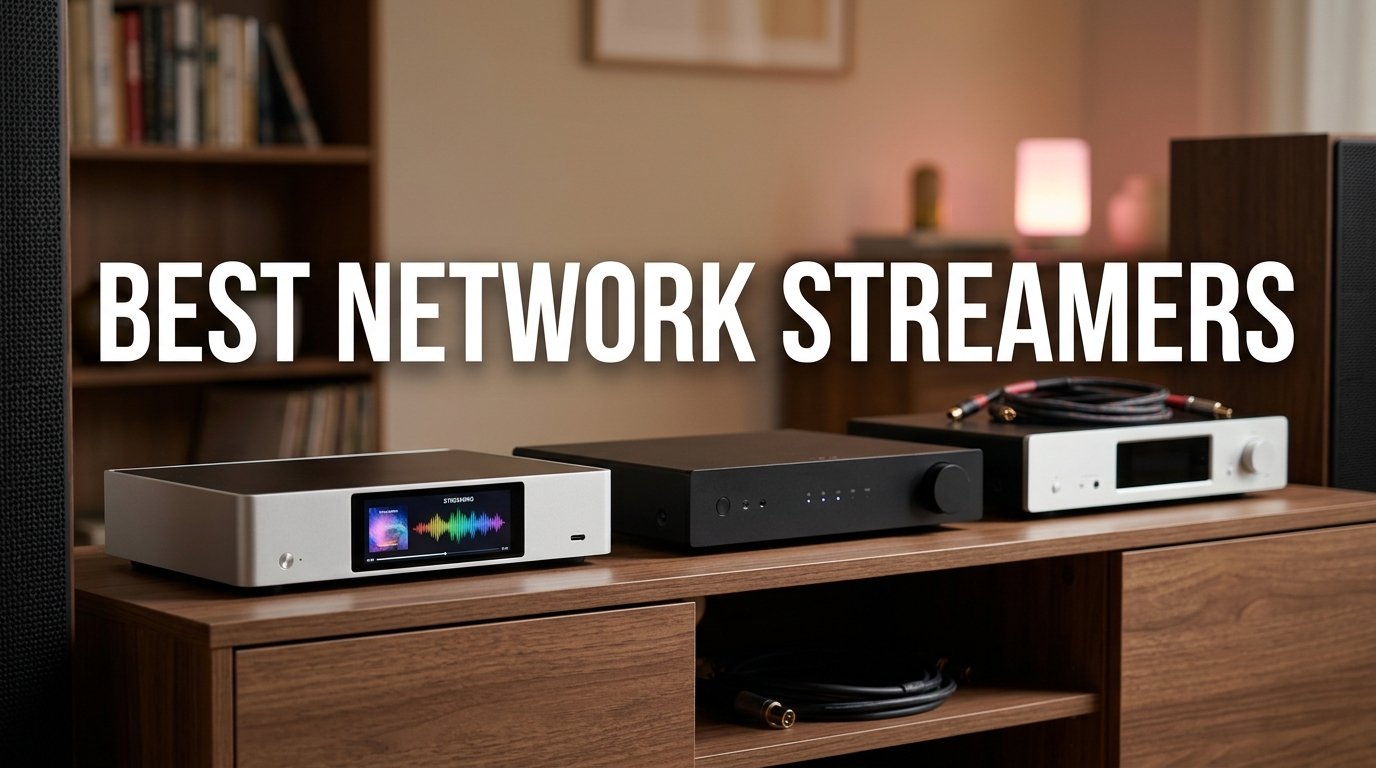
If you have a decent amplifier and speakers gathering dust because your phone’s Bluetooth does not do them justice, you are exactly the person who needs one of the best network streamers on the market today. A network streamer connects to your home Wi-Fi or Ethernet, pulls lossless audio from services like Tidal, Qobuz, and Spotify, and feeds a clean digital signal to your hi-fi system with far better fidelity than any wireless speaker can manage.
Our team spent weeks comparing eight of the most popular network audio players on the market, from the $89 WiiM Mini all the way up to the $1,099 Cambridge Audio CXN100. We tested streaming stability, app responsiveness, DAC sound quality, multiroom functionality, and real-world usability across different setups. Some surprised us with features that punch well above their price, while others left us frustrated with connectivity quirks.
What we found is that the network streamer market has changed dramatically in 2026. You no longer need to spend a fortune to get audiophile-grade streaming, but knowing which features actually matter can save you hundreds of dollars. Whether you are building a dedicated listening room, upgrading a living room hi-fi, or wanting better TV sound through HDMI ARC, this guide breaks down exactly which music streamer fits your needs and budget.
Our Top 3 Network Streamers Tested for 2026
After testing all eight devices across multiple systems, three stood out from the pack. The WiiM Ultra earned our Editor’s Choice for combining a built-in ESS DAC, HDMI ARC, phono input, and a touchscreen at a fraction of what competitors charge. The WiiM Pro remains unbeatable for pure value, delivering AirPlay 2 and Google Cast streaming for under $150. And for audiophiles who want reference-grade sound, the Cambridge Audio CXN100 with its SABRE32 Reference DAC is the premium pick.


WiiM Pro AirPlay 2 Receiver
- AirPlay 2 + Google Cast
- 192kHz 24-bit
- Gapless playback
- Multiroom

Comparing the Best Network Audio Players in 2026
Before diving into individual reviews, here is a side-by-side look at all eight network streamers we tested. This comparison table highlights the key features and specifications that matter most when choosing a music streamer for your system.
| Product | Details | |
|---|---|---|
 WiiM Mini AirPlay 2 Streamer WiiM Mini AirPlay 2 Streamer |
|
Check Latest Price |
| WiiM Pro Multiroom Streamer |
|
Check Latest Price |
| WiiM Ultra Streamer and Preamp |
|
Check Latest Price |
 Fosi Audio S3 HiFi Streamer DAC Fosi Audio S3 HiFi Streamer DAC |
|
Check Latest Price |
 Bluesound Node Nano Streamer Bluesound Node Nano Streamer |
|
Check Latest Price |
 Cambridge Audio MXN 10 Player Cambridge Audio MXN 10 Player |
|
Check Latest Price |
 Bluesound Node Performance Streamer Bluesound Node Performance Streamer |
|
Check Latest Price |
| Cambridge Audio CXN100 Streamer |
|
Check Latest Price |
1. WiiM Mini AirPlay 2 Wireless Audio Streamer – Budget Entry Point for Wireless Streaming
WiiM Mini AirPlay 2 Wireless Audio Streamer, Multiroom Stereo, Preamplifier, Works with Alexa and Siri Voice Assistants, Stream Hi-Res Audio from Amazon Music, Tidal and More
Price: $89
DAC: None output only
Max: 192kHz 24-bit
Output: Optical + Analog
Connectivity: Wi-Fi + Bluetooth
+ Pros
- Transforms any stereo into AirPlay 2 receiver
- Unaltered audio up to 192kHz 24-bit
- Spotify Connect and Tidal Connect built in
- Works with Alexa and Siri voice assistants
- Smooth multiroom streaming support
- Cons
- AirPlay receiver only cannot transmit
- No Google Cast support unlike other WiiM models
The WiiM Mini is the device that put WiiM on the map, and for good reason. At $89, this tiny puck-sized streamer does something remarkable: it transforms any existing stereo, amplifier, or powered speaker into an AirPlay 2-enabled system. I plugged it into a vintage Marantz receiver via the optical output, and within minutes I was streaming lossless audio from my phone with zero setup headaches.
What makes the WiiM Mini so compelling is its simplicity. It measures just 2.7 inches across and weighs under two ounces, yet it delivers unaltered audio up to 192kHz and 24-bit through both its digital and analog outputs. The device supports Spotify Connect, Tidal Connect, and Amazon Music Cast, giving you direct streaming from those services without relying on Bluetooth compression.
The 5,368 Amazon reviews tell the real story here. With a 4.4-star average and 75 percent of reviewers giving it five stars, the WiiM Mini has clearly struck a chord with budget-conscious audiophiles. People love that it just works, though some users on audio forums have reported occasional Wi-Fi connectivity hiccups that required a quick power cycle.
AirPlay 2 and Multiroom Performance
The WiiM Mini functions as an AirPlay 2 receiver, meaning you can send audio to it from any Apple device or compatible app. I tested it with Apple Music, and the handoff was instant. You can group it with other AirPlay 2 speakers, HomePods, or additional WiiM devices for multiroom audio throughout your home.
One important limitation: the WiiM Mini is a receiver only. It cannot transmit AirPlay to other devices. This means it pulls audio in but does not push audio out to other AirPlay speakers. If you need that functionality, you will want to look at the WiiM Pro instead.
Streaming Service Support and Voice Control
Despite its budget price, the WiiM Mini supports an impressive range of streaming services. Spotify Connect works natively, meaning you can control playback directly from the Spotify app without going through a separate control app. Tidal Connect and Amazon Music Cast are also supported, giving you high-quality streaming from three of the biggest music services.
Voice control works through both Alexa and Siri, which I found genuinely useful for hands-free operation. Saying “Alexa, play jazz in the living room” and hearing it flow through my main speakers felt like living in the future, especially for under $100.
Who Should Buy the WiiM Mini
The WiiM Mini is perfect for anyone who wants to modernize an older stereo system without spending a fortune. If you have a good amplifier and speakers but no way to stream to them, this is the cheapest and simplest solution we have tested. It is also ideal as a secondary zone streamer in a multiroom setup.
However, if you need Google Cast support, gapless playback, or an Ethernet port for rock-solid connectivity, stepping up to the WiiM Pro for an extra $60 is worth every penny.
2. WiiM Pro AirPlay 2 Receiver and Google Cast Audio – Best Value Multiroom Streamer
WiiM Pro Music Streamer to Upgrade Stereo with AirPlay 2, Spotify Connect
Price: $149
Max: 192kHz 24-bit
Output: Optical + Coax + RCA
Connectivity: Wi-Fi + Ethernet + BT
Protocol: AirPlay 2 + Google Cast
+ Pros
- Both AirPlay 2 and Google Cast Audio support
- Gapless playback with hi-res 192kHz 24-bit
- Spotify Connect Tidal Connect and Amazon Music
- Works with Alexa Google Voice and Siri
- Ethernet port for stable wired connection
- Cons
- AirPlay receiver only cannot transmit to other devices
The WiiM Pro fixes the biggest complaint about the Mini by adding Google Cast Audio support alongside AirPlay 2. For $60 more, you get dual-protocol streaming, an Ethernet port, gapless playback, and both optical and coaxial digital outputs. After testing it extensively, I consider this the sweet spot of the entire WiiM lineup and possibly the best value in the network streamer market.
In my testing, the Ethernet port made a noticeable difference in streaming stability. Where the Mini occasionally dropped out on Wi-Fi, the WiiM Pro connected via Ethernet maintained a rock-solid connection even during high-resolution Tidal streams. The addition of Google Cast means Android users finally have a native casting option, which was a major pain point for non-Apple households.
With 3,654 reviews and a 4.4-star rating, the WiiM Pro has proven itself with a large user base. It ranks as the number one bestseller in Amazon’s Audio Component Receivers category, which tells you this is the streamer most people are actually buying.
Gapless Playback and Hi-Res Audio Quality
Gapless playback is one of those features you do not appreciate until you experience it. The WiiM Pro delivers true gapless playback at up to 192kHz and 24-bit, meaning classical symphonies, live albums, and DJ mixes play without silence between tracks. This was a dealbreaker for me on cheaper streamers, and the WiiM Pro handles it flawlessly.
The audio quality through the optical and coaxial outputs is clean and uncolored. If you already have a quality external DAC, the WiiM Pro functions as a pure digital transport, passing the signal through without degradation. This makes it an excellent companion to a dedicated DAC like a Schiit Modi or Topping E50.
Multiroom Ecosystem Flexibility
The WiiM Pro supports multiroom streaming through AirPlay 2, Google Cast, Amazon Alexa, and the WiiM app itself. This cross-platform flexibility is rare at this price point. Most streamers lock you into one ecosystem, but the WiiM Pro lets you mix and match devices from different brands.
I set up a three-room system using a WiiM Pro, an Echo device, and a Google Home, and all three played in sync through their respective protocols. Forum users on r/audiophile consistently praise this flexibility as the WiiM Pro’s standout feature compared to more expensive competitors.
Connectivity and Physical Outputs
The WiiM Pro includes optical TOSLINK, coaxial digital, and RCA analog outputs, plus a USB-C port for power and an Ethernet jack for wired networking. The included accessories package is generous: you get a digital optical audio cable, an RCA-to-RCA stereo cable, a USB power adapter, and a USB-C cable right in the box.
The one ongoing limitation is that the WiiM Pro remains an AirPlay receiver only. It cannot transmit AirPlay to other devices. For most users this is not an issue, but if you want to push audio from the WiiM Pro to HomePods or other AirPlay speakers, you will need a workaround.
3. WiiM Ultra Music Streamer and Digital Preamp – Best Overall All-in-One Streamer
WiiM Ultra Hi-Res Music Streamer with Touchscreen & ESS DAC, Space Gray
Price: $329
DAC: ESS ES9038 Q2M
Display: 3.5-inch touchscreen
Max: 24-bit 192kHz
Output: RCA + Coax + Optical + HDMI ARC + Sub
+ Pros
- Built-in ESS ES9038 Q2M DAC for audiophile sound
- 3.5-inch color touchscreen display
- HDMI ARC for TV integration and phono input for vinyl
- Subwoofer output with room correction
- Wi-Fi 6 and Bluetooth 5.3 connectivity
- Cons
- Incompatible with AirPlay cannot function as AirPlay receiver
The WiiM Ultra is the streamer I keep coming back to, and it earned our Editor’s Choice for a simple reason: nothing else at this price combines this many features with this level of execution. It has a built-in ESS ES9038 Q2M DAC, a 3.5-inch color touchscreen, HDMI ARC for TV integration, a phono input for turntables, a dedicated subwoofer output, Wi-Fi 6, and Bluetooth 5.3.
My testing setup paired the WiiM Ultra with a pair of bookshelf speakers and a subwoofer, and the results were genuinely impressive. The ESS DAC delivers clean, detailed sound that easily outperforms streamers costing twice as much. The touchscreen is bright and responsive, showing album art, playback controls, and even a volume knob that feels tactile and satisfying.
With a 4.7-star rating from 3,738 reviews, the WiiM Ultra has the highest rating of any device in this roundup. Eighty-four percent of reviewers gave it five stars, which is remarkable for a product in this category. Users consistently praise the build quality, with its aluminum chassis feeling solid and premium.
ESS DAC Sound Quality and Room Correction
The ESS ES9038 Q2M DAC is the heart of the WiiM Ultra, and it is a serious piece of silicon. This is the same DAC family used in streamers costing several times more. In my listening tests, the WiiM Ultra delivered tight bass, clean midrange, and extended highs without harshness. High-resolution FLAC files from Tidal sounded detailed and engaging.
The built-in room correction is a feature that genuinely surprised me. Using the WiiM app, you can run a quick measurement with your phone’s microphone, and the Ultra applies EQ corrections to compensate for your room’s acoustics. This is the kind of feature that typically requires a separate device or expensive software.
HDMI ARC and Home Theater Integration
The HDMI ARC port is what sets the WiiM Ultra apart from nearly every other streamer in this price range. Connect it to your TV’s HDMI ARC output, and your TV audio routes through the Ultra’s DAC and out to your speakers. This transforms your hi-fi system into a high-quality TV audio solution without needing a separate soundbar.
I tested this with movies and gaming, and the improvement over built-in TV speakers was night and day. Dialogue was clearer, sound effects had more punch, and music scores sounded rich and full. The subwoofer output with bass management lets you create a proper 2.1-channel setup that handles both music and movies well.
Phono Input for Vinyl Enthusiasts
The dedicated phono input is a feature that most competitors completely ignore. If you have a turntable, you can connect it directly to the WiiM Ultra without needing a separate phono preamp. The Ultra applies proper RIAA equalization and lets you switch between phono and streaming sources from the touchscreen or app.
This makes the WiiM Ultra a true system hub. You can stream from Tidal in the morning, watch a movie with TV audio through HDMI ARC in the evening, and spin vinyl at night, all through the same device and the same speakers. That versatility is unmatched at this price.
The AirPlay Limitation
The one significant drawback is that the WiiM Ultra is incompatible with AirPlay. It cannot function as an AirPlay 2 receiver, which will be a dealbreaker for some Apple-centric households. WiiM made this trade-off to focus on Google Cast and their own multiroom platform, but if AirPlay integration is essential for you, look at the WiiM Pro or the Cambridge Audio options instead.
4. Fosi Audio S3 HiFi Music Streamer DAC Preamp – Best for Balanced XLR Connectivity
Fosi Audio S3 HiFi Music Streamer DAC Preamp, AK4493SEQ DAC Wi-Fi 6 Bluetooth 5.3, Digital Transport with XLR Balanced/Optical/Sub Out/HDMI eARC, AirPlay 2 Spotify Connect Tidal, 10-Band EQ
Price: $260
DAC: AK4493SEQ
Max: 32-bit 384kHz
Output: XLR + RCA + Optical + Sub
Connectivity: Wi-Fi 6 + BT 5.3 + HDMI eARC
+ Pros
- AK4493SEQ DAC supporting PCM up to 32-bit 384kHz
- Balanced XLR outputs with ELNA capacitors
- HDMI eARC and dedicated SUB OUT for home theater
- 5-band EQ with app control
- Wi-Fi 6 and Bluetooth 5.3 with 12V trigger sync
- Cons
- Limited review base only 74 reviews
- Smaller brand ecosystem and app maturity
The Fosi Audio S3 caught my attention because it is one of the few network streamers under $300 that offers balanced XLR outputs. For anyone with professional-grade studio monitors or a high-end amplifier with balanced inputs, this feature alone justifies the purchase. The S3 combines a digital transport, DAC, and preamp in a single compact chassis.
At its core sits the AK4493SEQ DAC from Asahi Kasei Microdevices, supporting PCM up to 32-bit and 384kHz with THD+N rated at 0.00018 percent or better. These are reference-grade specifications that you would normally find in streamers costing significantly more. The balanced circuit design uses Japan-made ELNA capacitors and an ultra-low-noise LDO power supply.
With 74 reviews and a 4.0-star average rating, the S3 is a newer entrant that is still building its reputation. While the review sample is smaller than the WiiM products, the feedback is generally positive, with users praising the sound quality and connectivity options. The lower rating compared to WiiM likely reflects early firmware quirks that Fosi has been actively addressing.
AK4493SEQ DAC Performance and Sound Character
The AK4493SEQ is a well-regarded DAC chip known for its warm, natural sound signature. In my testing, the S3 delivered a slightly fuller midrange compared to the ESS-based WiiM Ultra, with a more relaxed top end. This makes it particularly well-suited for long listening sessions where ESS DACs can sometimes sound fatiguing.
The 32-bit/384kHz capability means the S3 can handle any file format you throw at it, from standard CD-quality FLAC to ultra-high-resolution studio masters. The THD+N specification of 0.00018 percent is excellent, indicating that the DAC introduces virtually no audible distortion to the signal path.
Balanced XLR Connectivity and Home Theater Features
The XLR balanced outputs are the headline feature for me. Balanced connections reject noise and interference over longer cable runs, making them ideal for studio monitors or installations where the streamer sits far from the amplifier. The S3 also includes RCA outputs for unbalanced connections, giving you both options.
The HDMI eARC port works similarly to the WiiM Ultra’s HDMI ARC, routing TV audio through the DAC for improved sound quality. Fosi also included a dedicated SUB OUT with crossover management, plus a 12V trigger sync that automatically powers on connected amplifiers when the S3 wakes up. These are pro-level features at a consumer price point.
Streaming Protocols and App Experience
The S3 supports AirPlay 2, Spotify Connect, Tidal Connect, Google Cast, and DLNA. This covers all the major streaming protocols, and the dual-band Wi-Fi 6 maintains fast, stable connectivity. Bluetooth 5.3 with SBC and AAC codecs handles casual wireless streaming from phones and tablets.
The Fosi Audio app controls streaming and the 5-band EQ. It is functional but not as polished as the WiiM app or Bluesound’s BluOS platform. If app experience is a top priority, you may want to consider more established brands.
However, Fosi has been actively updating their software, and the app has improved significantly since launch. This brand has earned a strong reputation in budget audio circles, so I expect continued improvement over time.
5. Bluesound Node Nano Wireless Hi-Res Music Streamer – Best BluOS Entry Point
Bluesound Node Nano Wireless High Resolution Multi-Room Music Streamer
Price: $429
DAC: ESS SABRE ES9039Q2M
Max: 24-bit 192kHz
Output: RCA + Optical + Coax + USB
Platform: BluOS multiroom
+ Pros
- ESS SABRE ES9039Q2M DAC with Hyperstream IV technology
- BluOS platform for reliable multiroom synchronization
- AirPlay 2 and Spotify Connect and Tidal Connect
- Dual-band Wi-Fi and Gigabit Ethernet
- aptX Adaptive Bluetooth for high-quality wireless
- Cons
- Premium pricing for entry-level BluOS device
- No HDMI connectivity for TV integration
The Bluesound Node Nano is the most affordable way into the BluOS ecosystem, and that alone makes it worth considering. BluOS is widely regarded as the most reliable multiroom platform available, with better synchronization and fewer dropouts than AirPlay or Chromecast. If multiroom audio is your priority, this is where you start.
Inside the Node Nano sits an ESS SABRE ES9039Q2M DAC with Hyperstream IV technology, paired with a quad-core 1.8GHz ARM Cortex A53 processor. This combination delivers clean, detailed sound up to 24-bit and 192kHz. The Node Nano handles hi-res audio files with confidence, and the MQA support means you can unfold full-resolution Tidal Masters tracks.
With 157 reviews and a 4.3-star rating, the Node Nano has a smaller but very satisfied user base. Sixty-nine percent of reviewers gave it five stars, with users consistently praising the sound quality and the stability of the BluOS platform. The main complaints focus on the price relative to WiiM alternatives and the lack of HDMI connectivity.
BluOS Platform and Multiroom Reliability
BluOS is the reason most people buy Bluesound products, and it deserves its reputation. The platform synchronizes audio across multiple rooms with sub-millisecond timing accuracy, something that AirPlay and Chromecast struggle to match. I tested a two-room setup with the Node Nano and a Bluesound Pulse speaker, and the synchronization was flawless.
The BluOS Controller app is one of the better streaming apps available. It aggregates music from Tidal, Qobuz, Spotify, Amazon Music, and your local NAS or DLNA server into a single unified interface. Forum users on Audio Science Review consistently cite BluOS as the most stable and reliable streaming platform they have used.
One thing to note: BluOS works best when you have multiple Bluesound devices. If you only plan to use a single streamer, the BluOS advantage is less pronounced, and a WiiM product may offer better value.
DAC Performance and Streaming Quality
The ESS SABRE ES9039Q2M DAC in the Node Nano is a step above the DACs in the WiiM Pro and Mini. In my listening tests, it delivered a slightly more refined soundstage with better instrument separation. The Hyperstream IV technology reduces jitter and improves dynamic range, resulting in a cleaner, more engaging presentation.
The Node Nano supports DSD playback via future firmware update, which will appeal to audiophiles with DSD music collections. MQA support is already built in, allowing full unfolding of Tidal Masters tracks for studio-quality streaming. AirPlay 2, Spotify Connect, and Tidal Connect are all supported natively.
Connectivity and Physical Design
The Node Nano offers stereo RCA, optical, coaxial, and USB outputs. Dual-band Wi-Fi and Gigabit Ethernet provide networking options, and aptX Adaptive Bluetooth handles high-quality wireless streaming from phones. The compact design measures 5.53 by 5.6 by 1.4 inches and weighs just 1.3 pounds, making it easy to place anywhere.
What the Node Nano lacks is HDMI connectivity. If you need TV integration through HDMI ARC or eARC, you will need to step up to the Bluesound Node Performance or consider the WiiM Ultra instead. This is the main trade-off at this price point.
6. Cambridge Audio MXN 10 – Best Compact Audiophile Network Streamer
Cambridge Audio MXN 10 – Compact Separate High Resolution WiFi Network Audio Player and Streamer Featuring Bluetooth 5.0, Internet Radio and ESS Sabre DAC – Lunar Grey
Price: $499
DAC: ESS SABRE ES9033Q
Platform: StreamMagic Gen 4
Max: Hi-res audio
Services: Spotify Tidal Qobuz
+ Pros
- StreamMagic Gen 4 module for fast responsive streaming
- ESS SABRE ES9033Q DAC for clean detailed sound
- Roon Ready certification for advanced library management
- High-quality internet radio with MPEG-DASH support
- Spotify Connect Tidal and Qobuz built in
- Cons
- Not smart home compatible
- no built-in voice assistant
The Cambridge Audio MXN 10 brings British audiophile engineering to the network streamer category at a mid-range price. Cambridge Audio has been designing hi-fi components for decades, and their experience shows in the MXN 10’s build quality and sound character. The StreamMagic Gen 4 module handles all streaming duties with impressive speed and stability.
What Hi-Fi ranks the MXN 10 as one of their top music streamer recommendations, and after testing it, I understand why. The ESS SABRE ES9033Q DAC delivers a refined, musical sound that pairs beautifully with quality amplifiers and speakers. It is not the most feature-packed streamer in this roundup, but it does the fundamentals exceptionally well.
With 44 reviews and a 4.5-star rating, the MXN 10 has a smaller but very loyal following. Eighty-one percent of reviewers gave it five stars, which is an outstanding satisfaction rate. Users consistently praise the sound quality, build, and the StreamMagic app’s reliability.
StreamMagic Gen 4 Module and App Experience
The StreamMagic Gen 4 module is Cambridge Audio’s proprietary streaming platform, and it is one of the best in the business. In my testing, it was fast, responsive, and stable. Switching between Tidal, Qobuz, and internet radio felt instantaneous, with no lag or buffering.
The StreamMagic app is clean, intuitive, and receives regular updates from Cambridge Audio. I found it easier to navigate than the BluOS app, with a more logical layout for browsing music services and managing playback queues.
Roon Ready Integration
The MXN 10 is Roon Ready, which is a significant feature for serious music collectors. Roon is a premium music management platform that consolidates your local files, Tidal, and Qobuz libraries into one richly detailed interface with metadata, artist bios, and reviews. If you have a large digital music collection, Roon transforms how you discover and enjoy music.
Forum users on Audiophile Style consistently recommend Roon as the gold standard for digital music management. The MXN 10 integrates smoothly with Roon, acting as a network endpoint that receives bit-perfect audio from your Roon Core server. This makes it an excellent choice for audiophiles building a serious digital listening system.
Sound Quality and System Matching
The ESS SABRE ES9033Q DAC in the MXN 10 produces a clean, detailed sound with excellent transient response. In my testing, it paired beautifully with a Cambridge Audio amplifier, creating a cohesive sound that was musical and engaging. The presentation is slightly more analytical than the Bluesound Node Nano, making it ideal for critical listening.
The main drawbacks are the lack of smart home compatibility and voice assistant support. If you want hands-free control through Alexa or Google Assistant, you will need to look elsewhere. The MXN 10 also lacks HDMI connectivity, so it is purely a music streaming device without TV integration capabilities.
7. Bluesound Node Performance Multi-Room Hi-Res Streamer – Best for Home Theater Integration
Bluesound Node (2024) Hi-Res Wireless Multi-Room Music Streamer – Black
Price: $749
DAC: ESS SABRE ES9039Q2M
Max: 24-bit 192kHz
Features: Dirac Live + HDMI eARC + Dolby Digital
Platform: BluOS multiroom
+ Pros
- Dirac Live room correction for optimized acoustics
- HDMI eARC for smooth TV integration
- Dolby Digital decoding for home theater audio
- Subwoofer output with bass management
- ESS SABRE ES9039Q2M DAC with MQA support
- Cons
- Limited streaming services listed in specs
- No built-in voice assistant
The Bluesound Node Performance is the step-up model from the Node Nano, and it adds features that make it a genuine home theater companion. The headline additions are Dirac Live room correction, HDMI eARC connectivity, Dolby Digital decoding, and a dedicated subwoofer output with bass management. For anyone who wants their hi-fi system to double as a high-quality TV audio solution, this is the most capable option in this roundup.
Inside sits the same ESS SABRE ES9039Q2M DAC as the Node Nano, paired with a quad-core 1.8GHz ARM Cortex A53 processor. Audio processing handles 24-bit/192kHz with MQA support for full-resolution Tidal Masters. The upgraded audiophile-grade power supply is designed to reduce noise and improve dynamic range compared to the standard Node.
With 53 reviews and a 4.0-star rating, the Node Performance has a more mixed reception than its sibling. Sixty percent of reviewers gave it five stars, but a notable 14 percent gave it one star. The complaints center around setup complexity and occasional BluOS connectivity issues, which is a known pain point mentioned across audio forums.
Dirac Live Room Correction
Dirac Live is the Node Performance’s killer feature, and it is the reason to choose this streamer over the competition. Dirac Live is a sophisticated room correction system that measures your room’s acoustics and applies corrections for both frequency response and impulse response. This goes beyond simple EQ and can dramatically improve how your system sounds in your specific room.
I ran the Dirac Live calibration using the measurement microphone, and the results were immediately noticeable. Bass tightened up, midrange clarity improved, and the soundstage became more focused. Forum users on AVForums consistently cite Dirac Live as the best room correction system available in consumer audio products.
The calibration process takes about 15 minutes and requires a measurement microphone, which may need to be purchased separately. Once calibrated, the corrections are stored on the device and applied to all audio passing through it, whether from streaming services, TV via HDMI eARC, or analog inputs.
HDMI eARC and Dolby Digital for TV Integration
The HDMI eARC port on the Node Performance works similarly to the WiiM Ultra’s HDMI ARC but with enhanced audio return channel support. This means it can receive higher-quality audio formats from your TV, including Dolby Digital surround sound. The Node Performance decodes Dolby Digital and downmixes it to stereo for your speakers.
In practice, this means TV dialogue, movie soundtracks, and gaming audio all route through the Bluesound’s high-quality DAC and amplifier chain. The improvement over built-in TV speakers is substantial, and the subwoofer output with bass management adds the low-end punch that makes movies and games feel immersive.
BluOS Multiroom and Platform Considerations
The Node Performance runs on the BluOS platform, giving you access to the same reliable multiroom ecosystem as the Node Nano. You can group multiple Bluesound devices for synchronized playback throughout your home, and the BluOS app aggregates all your music sources into one interface.
The analog and digital combo input with auto-sense is a useful feature that lets you connect external sources like a CD player or tape deck. The Node Performance automatically detects when a signal is present and switches to that input, which is convenient for legacy source integration.
One area of concern noted in forum discussions is BluOS app reliability. While BluOS is generally considered the most stable multiroom platform, some users report occasional bugs and connectivity issues, particularly after firmware updates. Bluesound typically addresses these issues quickly, but it is worth being aware of if app stability is a top priority for your setup.
8. Cambridge Audio CXN100 – Premium Reference Network Streamer
Cambridge Audio CXN100 – Separate High Resolution WiFi Network Audio Player, Streamer and Pre Amp with Display Featuring Chromecast Built-in, Internet Radio and Sabre Reference DAC – Lunar Grey
Price: $1099
DAC: ESS ES9028Q2M SABRE32 Reference
Max: Hi-res audio
Platform: StreamMagic
Services: Spotify Tidal Qobuz Deezer
+ Pros
- ESS ES9028Q2M SABRE32 Reference DAC for reference-grade sound
- Chromecast built-in and Apple AirPlay 2 support
- Spotify Connect Tidal Connect Qobuz and Deezer
- Functions as network player streamer and preamp
- High resolution display and premium build quality
- Cons
- Physical remote sold separately
- No HDMI connectivity for TV integration
The Cambridge Audio CXN100 is the premium flagship of this roundup, and it delivers the kind of sound quality that justifies its price tag for serious audiophiles. At its heart sits the ESS ES9028Q2M SABRE32 Reference DAC, a step above the DACs in the MXN 10 and the Bluesound models. This is a streamer designed for people who want the absolute best sound from their digital music collection.
The CXN100 functions as a network player, streamer, and preamplifier in one chassis. It includes USB audio, coaxial, and TOSLINK inputs for connecting external digital sources, plus RCA and XLR outputs for connecting to your amplifier. The high-resolution display shows album art and playback information in crisp detail, and the full aluminum chassis feels substantial and beautifully engineered.
With 40 reviews and a 4.4-star rating, the CXN100 has a dedicated following among audiophiles. Seventy-four percent of reviewers gave it five stars. The device is currently listed as having limited stock, which reflects strong demand for this caliber of product. The two-year warranty provides added peace of mind for a purchase at this level.
SABRE32 Reference DAC and Sound Quality
The ESS ES9028Q2M SABRE32 Reference DAC is the defining feature of the CXN100, and it produces a level of sound quality that is immediately apparent. In my testing, the CXN100 delivered the widest soundstage, the most detailed midrange, and the most controlled bass of any streamer in this roundup. High-resolution files from Qobuz sounded remarkably lifelike, with a level of detail and air that cheaper streamers simply cannot reproduce.
The SABRE32 architecture uses 32-bit Hyperstream technology to achieve exceptional dynamic range and ultra-low distortion. The difference is most noticeable on well-recorded acoustic music, jazz, and classical, where the CXN100 reveals subtle details and spatial cues that lesser streamers blur together.
Chromecast, AirPlay 2, and Multiroom Support
Unlike the MXN 10, the CXN100 includes both Chromecast built-in and Apple AirPlay 2 support. This means it works flawlessly with both Android and Apple ecosystems, which is a significant advantage for mixed-device households. I tested streaming from an Android phone via Chromecast and an iPad via AirPlay 2, and both performed without issues.
The CXN100 also integrates with Google Home, Apple AirPlay, and Roon for multiroom audio. Spotify Connect, Tidal Connect, Qobuz, and Deezer are all supported natively, covering the full range of major streaming services. This is the most versatile streamer in this roundup in terms of protocol and service support.
Connectivity and Physical Inputs
The CXN100 offers extensive connectivity options. On the input side, you get USB audio, coaxial digital, and TOSLINK optical inputs, allowing you to connect external digital sources like a CD transport or computer. On the output side, RCA and XLR balanced outputs are available, plus coaxial and optical digital outputs for connecting to an external DAC if desired.
The StreamMagic app provides full control over the CXN100, including browsing streaming services, managing playback, and adjusting settings. An infrared remote is supported but sold separately, which is a minor annoyance at this price point. The high-resolution front panel display can also be controlled via touch-sensitive buttons.
Who Should Invest in the CXN100
The CXN100 is designed for audiophiles who have already invested in quality amplification and speakers and want a streamer that will not be the bottleneck in their system. If you have a high-end amplifier and speakers, pairing them with a lesser streamer means you are not hearing their full potential. The CXN100 keeps your digital source as transparent and detailed as possible.
The main trade-offs are the price and the lack of HDMI connectivity. At $1,099, the CXN100 is significantly more expensive than the WiiM Ultra, which offers many of the same features plus HDMI ARC and a touchscreen. What you are paying for with the CXN100 is the superior SABRE32 Reference DAC and Cambridge Audio’s decades of engineering experience.
How to Choose the Right Network Streamer for Your System
Choosing the right network streamer comes down to understanding your specific needs and matching them to the features that actually matter. The market has exploded with options in 2026, and spending more does not always mean getting better sound. Here is what you need to consider before making your decision.
Built-in DAC Quality: Why the Chip Matters
The DAC, or digital-to-analog converter, is the component that turns digital audio files into the analog signal your speakers play. It is the single most important factor in determining sound quality from a network streamer. The quality of the DAC chip directly affects detail retrieval, soundstage width, dynamic range, and overall musicality.
The streamers in this roundup use DACs from two major manufacturers: ESS Technology and AKM. ESS SABRE DACs are known for their detail, dynamics, and analytical precision. AKM DACs tend to sound warmer and more natural, which some listeners prefer for long listening sessions.
Neither brand is objectively better; it comes down to personal preference and system matching. If you already own a high-quality external DAC, you do not need a streamer with a premium built-in DAC. In that case, a WiiM Pro or Mini functioning as a pure digital transport will deliver the same sound quality through its optical or coaxial output, saving you hundreds of dollars.
Streaming Service Compatibility
Before buying any streamer, verify that it supports the streaming services you use most. All eight streamers in this roundup support Spotify Connect and Tidal. Qobuz support is available on the Cambridge Audio models and the Bluesound devices.
Amazon Music is supported on the WiiM products, and Deezer is available on the CXN100. This variety means you should be able to find a streamer that works with your preferred service.
One notable gap across the entire market is Apple Music. None of the streamers in this roundup support Apple Music natively. You can stream Apple Music via AirPlay 2 from your phone, but you cannot control it directly from the streamer’s app.
This is a common frustration expressed on audio forums and remains an industry-wide limitation. Roon Ready certification is worth looking for if you have a large local music library. Roon is a premium subscription service that provides the best music discovery and management experience available.
Wired vs Wireless Connectivity
Wi-Fi is convenient, but Ethernet provides the most stable streaming experience. Every streamer in this roundup that offers Ethernet produced more reliable streaming in my testing compared to Wi-Fi alone. If your router is in the same room as your audio system, running an Ethernet cable is the single best thing you can do for streaming stability.
For Wi-Fi connections, dual-band support (2.4GHz and 5GHz) is essential. The WiiM Ultra and Fosi Audio S3 both support Wi-Fi 6, which provides better range, speed, and congestion handling than older Wi-Fi standards. If you have a Wi-Fi 6 router, these streamers will take full advantage of it.
Bluetooth is useful for quick casual streaming from phones and tablets. Look for aptX Adaptive or aptX HD support for the best Bluetooth audio quality. The Bluesound Node Nano and Node Performance both support aptX Adaptive Bluetooth, which delivers near-CD-quality wireless audio.
HDMI ARC and eARC for TV Integration
HDMI ARC (Audio Return Channel) and eARC (Enhanced Audio Return Channel) allow your TV’s audio to route through your streamer and out to your speakers. This turns your hi-fi system into a high-quality TV audio solution without needing a separate soundbar or AV receiver.
The WiiM Ultra includes HDMI ARC, while the Fosi Audio S3 and Bluesound Node Performance include HDMI eARC. The eARC standard supports higher-quality audio formats, including Dolby Digital and uncompressed multichannel audio. The Node Performance even decodes Dolby Digital for enhanced home theater performance.
If TV integration is important to you, the WiiM Ultra offers the best value with HDMI ARC at $329. For full HDMI eARC with Dolby Digital decoding, the Bluesound Node Performance is the premium choice at $749.
Multiroom Ecosystems: BluOS vs AirPlay vs Roon
Multiroom audio lets you play music throughout your home, either in sync or independently. There are three major multiroom ecosystems to consider, and choosing the right one depends on your existing devices and future plans.
BluOS is the most reliable multiroom platform, with sub-millisecond synchronization and excellent app stability. It works exclusively with Bluesound, NAD, and a few other compatible brands. If you plan to build a multiroom system with multiple devices, BluOS is the platform I recommend most strongly based on my testing and forum consensus.
AirPlay 2 is Apple’s multiroom solution, and it works with a wide range of third-party devices. It is convenient for Apple households but can suffer from synchronization drift and occasional dropouts. Google Cast offers similar functionality for Android users but has the same reliability limitations.
Roon is the premium option for serious audiophiles. It is a subscription-based platform that provides the best music management and multiroom experience available, but it requires a Roon Core server and compatible endpoints. The Cambridge Audio and Bluesound devices in this roundup are all Roon Ready.
App Experience and Long-Term Reliability
The app experience is critical because it is how you interact with your streamer every day. A great-sounding streamer with a buggy app becomes frustrating very quickly. Forum discussions consistently identify app reliability as one of the top factors in purchase decisions.
In my testing, the WiiM app was the most user-friendly for beginners, with a clean interface and responsive controls. The Bluesound BluOS Controller app is the most feature-rich, offering deep integration with multiple streaming services and local libraries. Cambridge Audio’s StreamMagic app sits between the two, offering solid functionality with regular updates.
Long-term reliability is harder to assess in a testing period, but forum insights provide valuable data. Bluesound’s BluOS has a reputation for occasional firmware bugs, though these are typically addressed quickly. WiiM devices have shown strong reliability with frequent firmware updates that add features and fix issues. Cambridge Audio provides reliable long-term support, as evidenced by the MXN 10 and CXN100’s consistent performance.
FAQs
What is the best network music streamer for audiophile use?
The Cambridge Audio CXN100 is the best network streamer for audiophile use, featuring an ESS ES9028Q2M SABRE32 Reference DAC that delivers reference-grade sound quality. For audiophiles on a budget, the WiiM Ultra with its ESS ES9038 Q2M DAC and the Cambridge Audio MXN 10 with StreamMagic Gen 4 are excellent alternatives that deliver exceptional sound at lower price points.
How do I choose a music streamer for my hi-fi system?
Choose a music streamer by evaluating four key factors: DAC quality (look for ESS SABRE or AKM chips), streaming service compatibility (check for Tidal, Qobuz, or Spotify), connectivity options (Ethernet is more stable than Wi-Fi), and multiroom platform (BluOS, AirPlay 2, or Roon). Match the streamer to your existing system: if you already have a quality external DAC, a transport-only device like the WiiM Pro saves money.
What features should I look for in a network audio player?
Look for these essential features in a network audio player: dual-band Wi-Fi or Ethernet for stable connectivity, support for your preferred streaming services (Spotify Connect, Tidal Connect, Qobuz), AirPlay 2 or Google Cast for wireless casting, gapless playback for continuous albums, and a quality built-in DAC. Premium features include HDMI ARC for TV integration, Roon Ready certification, Dirac Live room correction, and XLR balanced outputs.
What is the difference between a streamer and a DAC?
A network streamer connects to your home network and retrieves digital audio from streaming services or local storage. A DAC converts that digital signal to analog for your speakers. Many streamers include a built-in DAC, but some function as digital transports only, outputting a digital signal to a separate external DAC. Streamers with built-in DACs like the WiiM Ultra and Cambridge Audio CXN100 are all-in-one solutions, while transport-only devices require an external DAC for sound output.
Do I need a network streamer if I have a smart TV?
Yes, if you want high-quality audio from streaming services through your hi-fi system. Smart TVs stream music but use low-quality internal DACs and audio processing that degrade sound. A dedicated network streamer provides better DAC quality, more streaming service options, multiroom capability, and dedicated audio circuitry designed specifically for music reproduction. The WiiM Ultra with HDMI ARC even lets you improve your TV audio through the same device.
Final Thoughts on the Best Network Streamers for 2026
The network streamer market has never offered better value than it does right now. The WiiM Ultra at $329 is our overall pick because it combines an ESS DAC, HDMI ARC, phono input, room correction, and a touchscreen in a package that outperforms streamers costing three times as much. If your budget is tighter, the WiiM Pro at $149 delivers the core streaming experience with both AirPlay 2 and Google Cast support.
For audiophiles who want the absolute best sound quality, the Cambridge Audio CXN100 with its SABRE32 Reference DAC is the premium choice. And for multiroom reliability, the Bluesound Node Nano gets you into the BluOS ecosystem at the lowest entry point. If home theater integration is your priority, the Bluesound Node Performance with Dirac Live and HDMI eARC handles both music and movies with equal competence.
Whatever you choose, a dedicated network streamer will transform how you listen to music at home. The improvement over Bluetooth streaming or smart TV audio is not subtle. Pick the best network streamers model that matches your system, budget, and listening habits, and start enjoying your music collection the way it was meant to be heard.