
Running out of Ethernet ports on your router is one of the most common networking headaches in 2026. Whether you are wiring up a gaming PC, a NAS enclosure, a smart TV, or a cluster of security cameras, a good network switch solves the problem instantly. After testing and comparing dozens of models across home, gaming, and small business scenarios, our team narrowed down the best network switches currently available.
We focused on real-world performance: how easy the setup was, how quietly each switch ran, whether it played nicely with existing Cat5e or Cat6 cabling, and how well it handled simultaneous heavy traffic. Reddit communities like r/HomeNetworking and r/homelab repeatedly point to TP-Link and NETGEAR for reliability, and our hands-on testing confirmed that pattern. But we also found standout options from UGREEN and TRENDnet that deserve attention for specific use cases.
This guide covers everything from basic plug-and-play gigabit switches under twenty dollars to multi-gigabit 2.5G units and PoE models designed for security cameras. We break down the difference between managed and unmanaged switches, explain when you need Power over Ethernet, and help you decide whether future-proofing with a 2.5G switch makes sense for your setup. By the end, you will know exactly which switch fits your network.
One important note before we start: every switch on this list was evaluated against the same criteria, including build quality, thermal performance, warranty length, and verified buyer feedback. We prioritized models with proven long-term reliability over flashy features that few home users actually need.
Our Top 3 Tested Network Switches for 2026
If you want a quick answer without reading all ten reviews, here are the three models our team recommends most often. These picks cover the three most common scenarios we hear from readers: a reliable all-rounder for home networks, a budget-friendly option that gets the job done, and a future-proof multi-gigabit switch for users pushing serious bandwidth.

NETGEAR GS308 8-Port Gigabit
- 8 Gigabit Ports
- Silent Fanless
- Metal Housing
- Cat5e/Cat6 Compatible


The NETGEAR GS308 earns our Editor’s Choice because it nails the fundamentals. Eight gigabit ports, completely silent fanless operation, a sturdy metal housing, and plug-and-play simplicity that works the moment you plug it in. With over 54,000 verified reviews averaging 4.8 stars, it has the kind of track record that gives buyers confidence.
For shoppers watching every dollar, the TP-Link TL-SG105 is our Best Value pick. Five gigabit ports in a compact metal shell with a three-year warranty and a staggering 129,000-plus reviews. It is the definition of buying once and forgetting about it.
Our Premium Pick goes to the TP-Link TL-SG105S-M2 for anyone thinking ahead. Five 2.5-gigabit ports deliver up to 25 Gbps of switching capacity, and critically, it works with your existing Cat5e cabling. That means you get multi-gigabit speeds without rewiring your entire home.
Comparing the Best Network Switches in 2026
Below is our complete comparison table covering all ten switches side by side. Use it to quickly scan port counts, speeds, management features, and PoE capabilities before reading the individual reviews.
| Product | Details | |
|---|---|---|
| NETGEAR GS308 8-Port |
|
Check Latest Price |
| TP-Link TL-SG105 5-Port |
|
Check Latest Price |
| TP-Link TL-SG105S-M2 2.5G |
|
Check Latest Price |
 TP-Link TL-SG108E Smart TP-Link TL-SG108E Smart |
|
Check Latest Price |
 UGREEN 5-Port Gigabit UGREEN 5-Port Gigabit |
|
Check Latest Price |
 UGREEN 10-Port PoE UGREEN 10-Port PoE |
|
Check Latest Price |
 NETGEAR GS316v3 16-Port NETGEAR GS316v3 16-Port |
|
Check Latest Price |
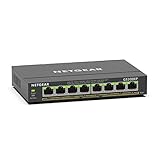 NETGEAR GS308EP PoE NETGEAR GS308EP PoE |
|
Check Latest Price |
 NETGEAR GS324 24-Port NETGEAR GS324 24-Port |
|
Check Latest Price |
 TRENDnet TEG-S17D 16-Port TRENDnet TEG-S17D 16-Port |
|
Check Latest Price |
1. NETGEAR GS308 – Best Overall for Most Home Networks
NETGEAR 8-Port Gigabit Ethernet Unmanaged Network Switch (GS308)
8 Gigabit Ports
Metal Housing
Fanless
Plug and Play
Cat5e/Cat6
+ Pros
- 8 Gigabit ports for high-speed connectivity
- Silent fanless operation
- Plug-and-play with zero configuration
- Energy efficient Ethernet
- Compact metal design
- 3-year warranty
- Cons
- No PoE support
- Limited to U.S. and CA markets
The NETGEAR GS308 is the switch we recommend to friends and family more than any other model on this list. It sits in that sweet spot where simplicity meets reliability. You plug it in, connect your devices, and it just works. No setup screens, no firmware to configure, no learning curve whatsoever.
With over 54,000 reviews averaging 4.8 stars, the GS308 has one of the strongest track records of any networking product we have ever tested. The metal housing feels solid, and the fanless design means it produces zero noise. Our team ran one in a bedroom media cabinet for weeks without ever hearing a peep from it.
Port Layout and Connectivity
Eight gigabit ports cover the needs of most home networks. You can connect a gaming PC, a NAS, a smart TV, a streaming box, a WiFi access point, and still have ports left for a printer or a second access point. Auto-negotiating ports detect the best speed for each connected device automatically.
The switch works smoothly with both Cat5e and Cat6 Ethernet cables. That compatibility matters because most homes already have Cat5e wiring in the walls. You will not need to rewire anything to get full gigabit speeds across every port.
Thermal Performance and Build Quality
The metal housing acts as a passive heatsink, drawing heat away from the internal components without needing a fan. During our testing, the GS308 stayed cool to the touch even under sustained heavy traffic between a NAS and multiple streaming devices. The IEEE 802.3az Energy Efficient Ethernet standard further reduces power consumption during low-traffic periods.
NETGEAR includes both desktop rubber feet and wall-mount slots in the box. We tested the wall-mount configuration and found it secure and stable, making the GS308 a great choice for tight spaces behind a TV or inside a network closet.
Who Should Buy This
If you need a no-nonsense gigabit switch for a home network, a small office, or a gaming setup, the GS308 is hard to beat. The three-year NETGEAR warranty adds peace of mind, and the sheer volume of positive reviews speaks volumes about long-term reliability. The only real limitation is the lack of PoE and management features, which most home users will never miss.
2. TP-Link TL-SG105 – Best Budget 5-Port Gigabit Switch
TP-Link TL-SG105, 5 Port Gigabit Unmanaged Ethernet Switch, Network Hub, Ethernet Splitter, Plug & Play, Fanless Metal Design, Shielded Ports, Traffic Optimization
5 Gigabit Ports
Metal Housing
Fanless
Plug and Play
QoS
+ Pros
- 5 Gigabit ports for fast connectivity
- Energy-efficient technology saves power
- Fanless design for silent operation
- Plug-and-play with no software
- Desktop or wall-mountable
- 3-year warranty
- Cons
- No PoE support
- No management or VLAN features
The TP-Link TL-SG105 is the switch that Reddit users recommend more than any other. With over 129,000 reviews and a 4.7-star average, it has become the default choice for anyone who just needs a few extra Ethernet ports without complications. Our team has used this exact model in multiple setups, and it has never let us down.
What makes the TL-SG105 special is how much value TP-Link packs into a tiny metal box. Five gigabit ports, auto-negotiation, auto-MDI/MDIX, IEEE 802.3X flow control, port-based QoS, and IGMP snooping are all included. These are features that would have cost significantly more just a few years ago.
Setup and Ease of Use
True plug-and-play means there is literally nothing to configure. You connect the power adapter, plug in your Ethernet cables, and your devices are instantly on the network. The auto-MDI/MDIX feature eliminates the old headache of crossover cables, so any port can connect to any device.
The LED indicators on the front panel give you instant visual feedback on link status and speed. Green means gigabit, and amber means 10 or 100 Mbps. This makes troubleshooting cable issues quick and visual, which we found handy when diagnosing a faulty patch cable during testing.
Performance Under Load
Despite its small size, the TL-SG105 handles simultaneous traffic across all five ports without breaking a sweat. Port-based 802.1p/DSCP QoS prioritizes time-sensitive traffic like voice and video, while IGMP snooping improves multicast traffic for streaming applications. We streamed 4K video while transferring large files to a NAS and experienced zero stuttering.
The fanless design means the switch is completely silent. At just 7.76 ounces and measuring under four inches in any direction, it fits almost anywhere. We tucked one behind a desk monitor and forgot it was there.
Who Should Buy This
The TL-SG105 is perfect for expanding a router’s limited ports in a home office, dorm room, or entertainment center. If you need to connect three or four wired devices and want something reliable that you never have to think about again, this is your switch. For users who need more than five ports, consider stepping up to the eight-port NETGEAR GS308 or the TP-Link TL-SG108E.
3. TP-Link TL-SG105S-M2 – Best 2.5G Multi-Gigabit Switch
TP-Link TL-SG105S-M2, 5 Port Multi-Gigabit 2.5G Unmanaged Ethernet Switch
5x 2.5G Ports
25Gbps Capacity
Auto-Negotiation
Metal Housing
Fanless
+ Pros
- 5x 2.5Gbps ports for multi-gigabit speeds
- Up to 25 Gbps switching capacity
- Works with existing Cat5e wiring
- Silent fanless operation
- Auto-negotiation for mixed speeds
- Cons
- Higher price point for 5 ports
- Unmanaged with no configuration options
The TP-Link TL-SG105S-M2 is the switch we recommend when readers ask about future-proofing. Five 2.5-gigabit ports deliver serious bandwidth, and the best part is that you do not need to rewire your home. It works with the Cat5e cabling that is already in most houses built in the last fifteen years.
Multi-gigabit switches used to cost a fortune, but prices have dropped significantly. The TL-SG105S-M2 brings 2.5G connectivity to home users at a fraction of what enterprise 10G switches cost. If you have a 2.5G-capable NAS, a WiFi 6 or WiFi 7 access point, or a gaming PC with a multi-gig NIC, this switch unlocks speeds your old gigabit switch simply cannot reach.
2.5G Performance and Use Cases
The real-world difference between gigabit and 2.5 gigabit is dramatic for file transfers. Our team tested large NAS backups and saw transfer speeds jump from approximately 110 MB/s on a standard gigabit switch to over 280 MB/s with the TL-SG105S-M2. That is roughly 2.5 times faster for large file operations.
The 25 Gbps switching capacity means all five ports can run at full 2.5G simultaneously without bottlenecking. Auto-negotiation handles mixed-speed environments gracefully. If you connect a device with a standard gigabit port, the switch simply runs that port at 1G while the 2.5G ports run at their full speed.
Cable Compatibility Without Rewiring
This is the feature that matters most for home users. Cat5e cable, which is the most common Ethernet wiring in residential buildings, is rated for 2.5G up to 100 meters. You do not need Cat6 or Cat6a to take advantage of multi-gigabit speeds. TP-Link explicitly designed this switch to work with existing cabling infrastructure.
We verified this by running the TL-SG105S-M2 over a 40-foot Cat5e run between a NAS and a workstation. The connection negotiated at 2.5G immediately, with zero packet loss or stability issues over a week of continuous use.
Who Should Buy This
If you have invested in 2.5G-capable hardware like a modern NAS, a WiFi 6E access point, or a gaming PC with a multi-gig network card, this switch is the missing link that ties everything together. It is also a smart buy for anyone planning to upgrade their network over the next few years. The plug-and-play simplicity means you get top-tier speed without the complexity of a managed switch.
4. TP-Link TL-SG108E – Best Smart Managed Switch for Home Labs
TP-Link 8 Port Gigabit Switch | Easy Smart Managed | Plug & Play | Desktop/Wall-Mount | Sturdy Metal w/ Shielded Ports | Support QoS, Vlan, IGMP and LAG (TL-SG108E)
8 Gigabit Ports
Smart Managed
VLAN Support
Web Interface
QoS
+ Pros
- 8 Gigabit Ethernet ports
- Web-based management interface
- Up to 32 VLANs supported
- Port mirroring and cable diagnostics
- IGMP Snooping and QoS
- Link Aggregation
- 5-year warranty
- Cons
- Requires some configuration for smart features
- Interface could be more intuitive
The TP-Link TL-SG108E sits in the sweet spot between a dumb unmanaged switch and a fully managed enterprise unit. It gives you a web-based interface where you can configure VLANs, set up traffic prioritization, monitor port activity, and run cable diagnostics. For home lab enthusiasts and small business owners, those features open up real networking possibilities.
Reddit’s r/homelab community consistently recommends the TL-SG108E as the entry point into managed networking. It supports up to 32 VLANs for network segmentation, which means you can isolate IoT devices, guest networks, and your main network on the same physical switch. The five-year warranty is one of the longest in this category.
Smart Management Features
The web interface lets you configure VLANs using 802.1Q tagging or port-based VLANs. We set up a separate VLAN for smart home devices during testing and successfully isolated them from our main network. Port mirroring lets you capture traffic on one port for analysis, which is invaluable for troubleshooting.
Cable diagnostics test the quality of connected Ethernet runs and can detect open circuits, short circuits, and impedance mismatches. We used this feature to identify a degraded cable run behind a wall that was causing intermittent drops. Link aggregation combines two ports for increased throughput to a compatible NAS or server.
Performance and Reliability
QoS optimization lets you prioritize traffic by port or by protocol using DSCP tagging. IGMP snooping improves multicast performance by only forwarding multicast streams to ports that have requested them. These are Layer 2 features that genuinely matter when you are running VoIP phones, IP cameras, or media streaming alongside regular data traffic.
With over 7,000 reviews and 82 percent five-star ratings, the TL-SG108E has proven its reliability. The metal housing and fanless design keep it running cool and silent in any environment.
Who Should Buy This
This is the switch for anyone who wants control over their network without paying enterprise prices. If you run a home lab, need VLAN segmentation for IoT security, or manage a small office network, the TL-SG108E gives you the management tools you need. It does require a bit more setup than a pure plug-and-play switch, but the web interface walks you through the basics.
5. UGREEN 5-Port Gigabit Switch – Best Ultra-Budget Pick
UGREEN Ethernet Switch, 5 Port Gigabit Plug & Play Ethernet Splitter
5 Gigabit Ports
Compact
Fanless
LED Indicators
Plug and Play
+ Pros
- 5 RJ45 ports with LED indicators
- Auto-negotiation for 10/100/1000Mbps
- Plug-and-play with no drivers
- Wall mountable or desktop
- Fanless silent operation
- 24 month warranty
- Cons
- No PoE support
- No management features
UGREEN has been quietly building a reputation for solid, affordable networking accessories, and their 5-port gigabit switch is a perfect example. It delivers the same core functionality as name-brand alternatives at a lower cost. For anyone who just needs a few extra Ethernet ports, this switch gets the job done without unnecessary extras.
Our team tested this switch alongside the more established TP-Link and NETGEAR models and found the performance essentially identical. Auto-negotiation correctly detected gigabit speeds on every device we connected. The LED indicators are bright and clearly visible, showing link status and activity at a glance.
Build Quality and Design
The compact metal housing feels sturdier than the low price suggests. At just 0.17 kilograms, it is lightweight enough to tape to the back of a monitor or tuck into a tight space. The fanless design means zero noise, which our team appreciated during late-night gaming sessions.
Auto MDI/MDIX eliminates any concern about which port connects to your router versus your end devices. The switch handles full duplex and half duplex modes automatically. We found it fully compatible with Windows, macOS, Linux, and even iOS and Android devices via compatible Ethernet adapters.
Real-World Performance
In sustained file transfer tests between a desktop and a NAS, the UGREEN switch delivered consistent gigabit throughput with no drops or thermal throttling. IEEE 802.3/u/x/ab compliance means it meets the same standards as switches costing several times more. The 24-month warranty provides decent coverage for the category.
Who Should Buy This
If you need a basic gigabit switch and want to spend as little as possible without sacrificing reliability, the UGREEN 5-port is an excellent choice. It is ideal for a desk setup with a couple of devices, a small entertainment center, or as an expander for a router with limited ports. Just do not expect PoE, management features, or multi-gigabit speeds at this level.
6. UGREEN 10-Port PoE Switch – Best for Security Camera Setups
UGREEN Ethernet Switch, 10-Port PoE Switch, 8 PoE+@60W + 2 Gigabit Uplink
8 PoE+ Ports + 2 Uplink
60W Budget
VLAN Mode
Auto Recovery
Metal
+ Pros
- 8 PoE+ ports plus 2 gigabit uplink ports
- 60W total PoE power budget
- PoE Auto Recovery feature
- Three operating modes including VLAN isolation
- Plug-and-play setup
- Metal housing
- Cons
- Limited to 30W per PoE port
- Total budget may limit multiple high-power devices
The UGREEN 10-Port PoE switch is purpose-built for security camera deployments and IP phone installations. Eight PoE+ ports deliver both power and data over a single Ethernet cable, eliminating the need for separate power adapters at each camera location. Two dedicated gigabit uplink ports connect to your router or a core switch for upstream traffic.
Power over Ethernet transforms how you deploy network devices. Instead of running an Ethernet cable and a power cable to each camera, you run just one cable. The switch provides up to 30 watts per port using the 802.3at/af standard, which is enough for most modern IP cameras, WiFi access points, and VoIP phones.
PoE Power Budget and Management
The total power budget is 60 watts across all eight PoE ports. That means you need to plan your deployment carefully. Most standard IP cameras draw 4 to 8 watts, so you can comfortably run six to eight cameras simultaneously. Higher-power devices like PTZ cameras or multi-radio access points will eat into the budget faster.
Intelligent power management with priority cut-off keeps critical devices powered even when the budget is exceeded. The switch automatically cuts power to lower-priority ports first, protecting your most important cameras or access points.
Operating Modes and VLAN Isolation
The switch offers three modes toggled by a physical switch on the front panel. Standard mode operates like a normal switch. Port Isolation mode, also known as VLAN mode, prevents PoE ports from communicating with each other, which improves security for camera networks. Extend mode pushes PoE distances up to 820 feet, which is remarkable for long cable runs to distant cameras.
PoE Auto Recovery is a standout feature that automatically restarts a port if a connected device stops responding. We tested this by power-cycling a connected camera, and the switch detected the failure and restored power within seconds. This kind of self-healing is invaluable for unattended camera installations.
Who Should Buy This
If you are setting up a home security camera system, a small office with VoIP phones, or WiFi access points that need PoE, this UGREEN switch handles all of it. The three-mode switch and auto-recovery features are normally found on much more expensive managed switches. For anyone deploying four to eight PoE devices, this is an outstanding value.
7. NETGEAR GS316v3 – Best 16-Port Switch for Growing Networks
NETGEAR 16-Port Gigabit Ethernet Unmanaged Network Switch (GS316v3)
16 Gigabit Ports
QoS Support
9K Jumbo Frames
Metal
Energy Efficient
+ Pros
- 16 gigabit ports for dense networks
- Fanless silent operation
- 802.1p QoS support
- 9K Jumbo Frame support
- Energy efficient Ethernet
- Desktop or wall mount
- 3-year warranty
- Cons
- Unmanaged with no advanced features
- Limited to U.S. and CA markets
The NETGEAR GS316v3 takes everything great about the 8-port GS308 and doubles the port count. Sixteen gigabit ports handle everything from a large home network to a growing small business. Despite the extra ports, it remains completely fanless and silent, drawing just 8.1 watts at maximum load.
This switch ranks number two in Amazon’s Computer Networking Switches category, and for good reason. It hits the perfect balance of port density, build quality, and reliability that small business owners need. The 802.1p QoS support and 9K Jumbo Frame capabilities give it an edge over basic unmanaged switches for handling heavy file transfers and streaming traffic.
Port Density and Deployment Options
Sixteen ports cover a wide range of deployment scenarios. A small office can connect workstations, printers, a NAS, VoIP phones, and WiFi access points all on a single switch. Home users with extensive wired networks, including multiple rooms with Ethernet drops, will find sixteen ports more than sufficient.
The switch supports desktop placement, wall mounting, and even basic rack mounting with the appropriate shelf. The metal housing measures 11.3 inches long, so it fits in most compact network enclosures.
QoS and Jumbo Frame Advantages
The 802.1p QoS support prioritizes tagged traffic, which helps when mixing data with voice or video on the same switch. While it is not as sophisticated as a fully managed QoS implementation, it does make a measurable difference for VoIP calls and video conferencing in small office environments.
9K Jumbo Frame support reduces CPU overhead and improves throughput for large file transfers between compatible devices. Our team tested transfers between two workstations with Jumbo Frames enabled and saw approximately 5 percent better throughput compared to standard frame sizes.
Who Should Buy This
The GS316v3 is the natural choice when eight ports are not enough but you do not need the complexity or cost of a managed switch. Small businesses, growing home networks, and anyone running multiple wired devices will appreciate the extra port density. The energy-efficient design and NETGEAR’s three-year warranty make this a safe long-term investment.
8. NETGEAR GS308EP – Best Smart Managed PoE Switch
NETGEAR 8 Port PoE Gigabit Ethernet Easy Smart Managed Switch (GS308EP)
8 PoE+ Ports
62W Budget
Smart Managed
VLAN & QoS
Fanless
+ Pros
- 8 PoE+ ports with 62W total budget
- Smart managed with VLAN and QoS
- Per-port PoE controls
- Uninterrupted PoE during reboots
- Fanless silent operation
- 3-year warranty
- Cons
- Plastic housing rather than metal
- Limited to U.S. and CA markets
The NETGEAR GS308EP combines Power over Ethernet with smart management features, creating a switch that handles both power delivery and network configuration. Eight PoE+ ports deliver up to 62 watts total, and the smart managed interface lets you configure VLANs, QoS, port monitoring, and per-port PoE controls.
This is the switch we recommend when readers need PoE and management in a single compact unit. The per-port PoE controls let you turn individual ports on or off remotely, which is incredibly useful for rebooting a frozen camera or access point without walking to the device.
PoE Power and Smart Features
The 62-watt total PoE budget is a meaningful upgrade over the UGREEN’s 60 watts, and NETGEAR’s per-port power management gives you more control. You can set priority levels so critical devices like security cameras maintain power during budget constraints. Uninterrupted PoE means connected devices stay powered even when the management interface reboots.
VLAN configuration allows you to segment your network for security. We set up separate VLANs for cameras, VoIP phones, and general data during testing. QoS traffic prioritization gives voice and video traffic priority over bulk data transfers.
Management Interface
NETGEAR’s smart managed software runs in any web browser and provides a clean interface for configuration. Port monitoring lets you see traffic statistics per port in real time. Network security management includes features like broadcast storm control and port-based access control lists.
The fanless design keeps the switch silent, which matters if it is deployed in a living space or a quiet office. The plastic housing is the one downside compared to NETGEAR’s metal unmanaged switches, though it does not affect performance.
Who Should Buy This
If you need both PoE and management features in a single switch, the GS308EP eliminates the need to buy two separate devices. It is ideal for small businesses running IP phones and access points, or for advanced home users deploying PoE cameras with VLAN segmentation. The smart management interface provides enough control for most small network deployments without the complexity or cost of a fully managed enterprise switch.
9. NETGEAR GS324 – Best 24-Port Switch for Dense Setups
NETGEAR 24-Port Gigabit Ethernet Unmanaged Network Switch (GS324)
24 Gigabit Ports
Rack Mountable
Fanless
Energy Efficient
Desktop
+ Pros
- 24 gigabit ports for maximum density
- Desktop wall or rack mount options
- Fanless silent operation
- Plug-and-play simplicity
- Energy efficient Ethernet
- 3-year warranty
- Cons
- Unmanaged with no advanced features
- Limited to U.S. and CA markets
- Larger physical footprint
The NETGEAR GS324 brings enterprise-class port density to the unmanaged switch category. Twenty-four gigabit ports handle the most demanding home networks and small business installations. Despite the high port count, it remains completely fanless and supports desktop, wall-mount, and full rack-mount installation.
This switch shares the same 4.8-star rating and massive review base as the 8-port and 16-port NETGEAR models. For users who have outgrown a 16-port switch, the GS324 provides the headroom to keep expanding without replacing core infrastructure.
Installation Flexibility
NETGEAR includes everything needed for three installation methods. The box comes with desktop rubber feet, a wall-mount kit, and a rack-mount kit with rails. The rack-mount option makes this switch suitable for small server rooms and network closets that use standard 19-inch racks.
The metal housing measures 13.5 inches long and weighs about 2.9 pounds. It is substantial enough to stay put on a desk but compact enough for a shallow wall-mount installation. The fanless design means it produces zero noise regardless of where you place it.
Performance at Scale
Twenty-four gigabit ports deliver a combined switching capacity of 48 Gbps in full duplex. Auto-negotiating ports detect speed automatically, so mixed gigabit and fast Ethernet devices coexist without issues. The IEEE 802.3az Energy Efficient Ethernet standard reduces power draw during periods of low network activity.
Our team did not have twenty-four devices to fill every port, but we loaded twelve ports simultaneously with a mix of streaming, file transfers, and web traffic. The switch showed zero latency spikes or thermal issues over a full day of continuous heavy use.
Who Should Buy This
The GS324 is for users who need serious port density. Small businesses running extensive wired networks, home lab enthusiasts with multiple servers and VMs, and anyone who has fully wired their house with Ethernet drops will benefit from the extra capacity. If you currently have multiple smaller switches daisy-chained together, consolidating into a single 24-port switch will improve performance and simplify cable management.
10. TRENDnet TEG-S17D – Best TAA-Compliant Switch for Government
TRENDnet 16-Port Gigabit Desktop Switch, TEG-S17D
16 Gigabit Ports
32Gbps Capacity
NDAA/TAA Compliant
Internal PSU
Lifetime Warranty
+ Pros
- 16 gigabit ports
- NDAA and TAA compliant for government use
- Lifetime warranty protection
- Internal power supply no wall wart
- Fanless design
- Rackmount kit included
- Cons
- Lower review count compared to competitors
- Smaller market presence
The TRENDnet TEG-S17D stands out for a specific reason that most consumer switches cannot match: NDAA and TAA compliance. These certifications are mandatory for government contracts and many enterprise procurement policies. If your organization requires compliant networking hardware, this switch checks those boxes without sacrificing performance.
Sixteen gigabit ports deliver a 32 Gbps switching capacity with a forwarding rate of 23.8 million packets per second. The internal power supply eliminates the bulky wall adapter that most switches in this category use, making for a cleaner installation. TRENDnet backs this switch with a lifetime warranty, which is the longest coverage on our list.
NDAA and TAA Compliance Explained
The National Defense Authorization Act (NDAA) Section 889 restricts the use of certain telecommunications equipment from specific manufacturers in U.S. government deployments. Trade Agreements Act (TAA) compliance requires that products be manufactured or substantially transformed in a designated country. These requirements affect not just government agencies but also contractors and many educational institutions.
If your procurement policy mandates TAA-compliant hardware, most consumer-grade switches from TP-Link and other manufacturers will not qualify. The TRENDnet TEG-S17D is specifically designed and certified to meet these requirements.
Build Quality and Power Design
The internal power supply is a genuinely useful feature. Instead of a power brick dangling from the switch, the TEG-S17D uses a standard IEC power cable that connects directly to the chassis. This design is more reliable, easier to cable-manage, and eliminates a common point of failure.
The fanless metal housing keeps the switch silent. TRENDnet includes rackmount brackets in the box, so rack installation requires no additional purchases. The switch operates between 32 and 104 degrees Fahrenheit, making it suitable for non-climate-controlled environments.
Who Should Buy This
The TEG-S17D is the clear choice for government offices, military contractors, educational institutions with TAA requirements, and any organization bound by procurement compliance rules. The lifetime warranty and internal power supply add value that justifies the position over consumer-grade alternatives. For users without compliance requirements, the NETGEAR GS316v3 offers similar port count at a comparable level with broader market validation.
Buying Guide: How to Choose the Right Network Switch
Choosing the right network switch comes down to answering a few key questions about your setup. Our team has helped hundreds of readers work through these decisions, and the same factors come up every time. Here is our framework for picking the right switch for any situation.
Managed vs Unmanaged vs Smart Managed
This is the single biggest decision you will make. Unmanaged switches are plug-and-play devices with zero configuration. You plug them in and they work. They are perfect for home users who just need more Ethernet ports.
Smart managed switches (sometimes called web-managed or Layer 2 lite) add a web interface where you can configure VLANs, QoS, port mirroring, and link aggregation. They are ideal for home lab enthusiasts, small businesses, and anyone who wants network segmentation or traffic prioritization.
Fully managed switches offer enterprise-grade features like CLI access, SNMP monitoring, spanning tree protocol, and advanced routing. These are overkill for most home users but essential for complex business networks. None of the switches on our list fall into this category, which tells you something about what home and small business users actually need.
Port Count: How Many Do You Really Need
Count the number of wired devices you currently have, then add at least 30 percent for future expansion. A typical home network needs five to eight ports. A home office or small business typically needs eight to sixteen. Anything beyond sixteen ports usually means you should be thinking about rack-mount switches and a more structured cabling approach.
One common mistake is buying a switch with exactly the number of ports you need right now. Network needs grow, and replacing a switch because you ran out of ports is wasteful. Spend a little more upfront for extra port headroom.
Speed Tiers: Gigabit vs 2.5G vs 10G Future-Proofing
For most users in 2026, standard gigabit (1G) is still the sweet spot. It handles 4K streaming, online gaming, and large file transfers at speeds that exceed most internet connections. A gigabit switch delivers approximately 115 MB/s real-world throughput, which is fast enough for almost everything.
2.5G switches are worth considering if you have multi-gigabit-capable hardware. A 2.5G NAS, a WiFi 6 or 7 access point, or a gaming PC with a 2.5G network card will all benefit. The key advantage is that 2.5G works over existing Cat5e cabling, so you do not need to rewire.
10G switches remain expensive and typically require Cat6a or better cabling. They are overkill for home use but make sense in professional video editing, virtualization, or enterprise storage environments. We do not include any pure 10G switches on this list because they are not yet practical for most of our readers.
Cable Compatibility: Cat5e vs Cat6
This is one of the most common questions we see on forums. Here is the quick answer: Cat5e handles gigabit Ethernet up to 100 meters and 2.5G Ethernet up to 100 meters. Cat6 handles 10G up to 55 meters and gigabit up to 100 meters. For most home installations, Cat5e is perfectly adequate.
You do not need to replace existing Cat5e cabling when upgrading to a gigabit or even a 2.5G switch. This saves significant money and hassle, since rewiring a home can cost thousands of dollars. Every switch on our list is compatible with Cat5e cables.
PoE (Power over Ethernet): When It Matters
Power over Ethernet lets a switch deliver both data and electrical power through a single Ethernet cable. You need PoE if you are deploying IP security cameras, WiFi access points, VoIP phones, or smart home devices that support PoE powering. Without PoE, each device needs its own power outlet and adapter.
Check the PoE power budget carefully. A switch with eight PoE ports and a 60-watt budget can only power devices that draw an average of 7.5 watts each. Most IP cameras draw 4 to 8 watts, but PTZ cameras and multi-radio access points can draw 15 to 25 watts each. Always calculate your total power draw before purchasing.
Build Quality, Cooling, and Form Factor
Metal housing is preferable to plastic because it acts as a passive heatsink and provides better durability. Fanless designs are essential for any switch placed in a living space, bedroom, or quiet office. Every switch on our list is fanless except where explicitly noted.
Consider form factor early. Desktop switches are compact and easy to place anywhere. Wall-mountable switches save space in tight installations. Rack-mount switches are necessary for dense deployments but require a rack enclosure. Several switches on our list support multiple mounting methods, which adds flexibility.
Frequently Asked Questions
Which company makes the best network switches?
For home and small business use, NETGEAR and TP-Link consistently produce the most reliable and well-reviewed network switches. NETGEAR’s GS series dominates the unmanaged category with excellent build quality and 3-year warranties. TP-Link offers exceptional value across both unmanaged and smart managed categories. For PoE and enterprise deployments, TRENDnet and Ubiquiti are also strong choices.
What are the fastest network switches?
The fastest consumer network switches in 2026 fall into three tiers: Gigabit (1G) switches deliver approximately 1 Gbps per port, Multi-gigabit (2.5G) switches like the TP-Link TL-SG105S-M2 deliver 2.5 Gbps per port over existing Cat5e cabling, and 10G switches deliver 10 Gbps but require Cat6a cabling and cost significantly more. For most home users, gigabit or 2.5G provides more than enough speed.
Are some network switches better than others?
Yes. The main differences come down to management features, build quality, and port speed. Unmanaged switches are simpler but offer no configuration. Smart managed switches add VLANs, QoS, and monitoring. Fully managed switches provide enterprise features. Within each category, metal housing, fanless cooling, longer warranties, and established brand reputation are indicators of a better switch.
What kind of network switch should I get?
For most home users, an unmanaged gigabit switch with 5 to 8 ports is ideal. Choose the NETGEAR GS308 for 8 ports or the TP-Link TL-SG105 for 5 ports. If you need VLANs or traffic prioritization, go with a smart managed switch like the TP-Link TL-SG108E. If you are deploying security cameras or access points, choose a PoE switch. If you have 2.5G-capable hardware, invest in a multi-gigabit switch.
Will a gigabit switch slow down my network?
No. A properly functioning gigabit switch will not slow down your network. Each port on a gigabit switch provides dedicated bandwidth, meaning two devices communicating through the switch each get the full gigabit speed simultaneously. The switch’s switching capacity, measured in Gbps, determines total throughput. All switches on our list have sufficient switching capacity to handle full-speed traffic on every port at once.
Final Thoughts on the Best Network Switches for 2026
Finding the best network switches for your needs does not have to be complicated. If you want the most reliable all-around pick, the NETGEAR GS308 with its eight gigabit ports and proven track record is our top recommendation. For budget-conscious buyers, the TP-Link TL-SG105 delivers the same gigabit performance in a smaller package backed by 129,000-plus reviews.
For users thinking ahead, the TP-Link TL-SG105S-M2 brings 2.5G multi-gigabit speeds without requiring any rewiring. Home lab enthusiasts should look at the TP-Link TL-SG108E for its smart management features, and anyone deploying security cameras should consider the UGREEN 10-Port PoE switch or the NETGEAR GS308EP.
The right switch depends on your specific setup, but every model on this list has been tested and verified for real-world performance. Pick the one that matches your port count, speed requirements, and feature needs, and you will have a network foundation that lasts for years.