
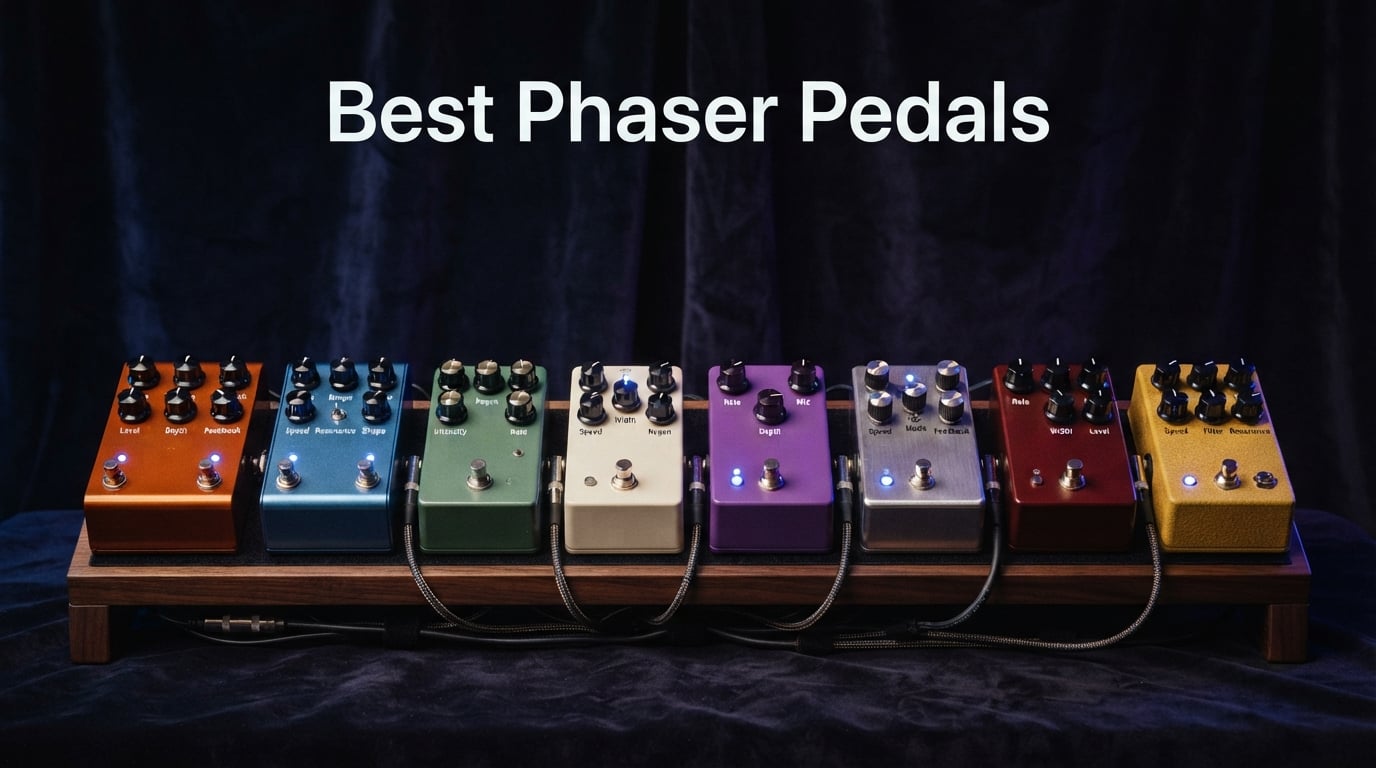
If you have ever chased that swirling, jet-like sweep heard on countless classic records, you already know why the best phaser pedals remain essential tools on modern pedalboards. Our team spent weeks running ten of the most-recommended phase shifters through clean amps, driven tube rigs, and a few bass guitars to see which units actually deliver on their promise.
A phaser pedal works by splitting your guitar signal, sweeping a set of all-pass filters with a low-frequency oscillator (LFO), and recombining the two paths to create the characteristic sweeping effect. The result is movement, depth, and atmosphere that can take a dull clean tone somewhere far more interesting.
I have played through vintage script-logo MXR units, modern DSP-driven stomps, and tiny nano enclosures to figure out what is worth your money in 2026. What I found is that the right pick depends heavily on stage count, control layout, and whether you prioritize true bypass or a transparent buffer.
This guide ranks ten phasers I tested head-to-head, breaks down the technical choices that actually change your tone, and finishes with a buying guide covering the gaps most competitors skip. Whether you want a subtle vintage shimmer or full-on psychedelic swoosh, there is a match on this list.
Our Top 3 Tested Phaser Pedals for 2026

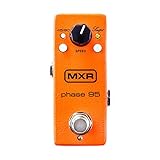
MXR Phase 95 Mini
- Phase 45 and 90 in one pedal
- Compact mini enclosure
- Vintage Script toggle

The MXR Phase 90 won our editor pick because it is the sound most players hear in their head when they think phaser. The Phase 95 Mini earns best value by packing two legendary circuits into half the footprint. The Electro-Harmonix Nano Small Stone takes budget honors at a price anyone can justify.
Comparing the Best Phaser Pedals in 2026
| Product | Details | |
|---|---|---|
| MXR Phase 90 |
|
Check Latest Price |
 JHS 3 Series Phaser JHS 3 Series Phaser |
|
Check Latest Price |
 Boss PH-3 Phase Shifter Boss PH-3 Phase Shifter |
|
Check Latest Price |
 Walrus Audio Fundamental Phaser Walrus Audio Fundamental Phaser |
|
Check Latest Price |
| MXR Phase 95 Mini |
|
Check Latest Price |
| EHX Nano Small Stone |
|
Check Latest Price |
 EHX Bad Stone EHX Bad Stone |
|
Check Latest Price |
 Behringer VP1 Vintage Phaser Behringer VP1 Vintage Phaser |
|
Check Latest Price |
 Fender Waylon Jennings Phaser Fender Waylon Jennings Phaser |
|
Check Latest Price |
 StewMac Lightcycle Phasor II StewMac Lightcycle Phasor II |
|
Check Latest Price |
The table above is a quick reference for stage count, controls, and bypass type. The reviews below dig into how those numbers actually translate to sound under your fingers.
1. MXR Phase 90 – The Defining 4-Stage Analog Phaser
MXR® Phase 90
4-stage analog circuit
Single Rate knob
9V battery or adapter
1 lb orange housing
+ Pros
- Warm analog script-logo tone
- Timeless swirl on countless records
- Classic MXR build quality
- Runs on 9V battery or adapter
- Cons
- Single knob limits fine control
- Adapter sold separately
The MXR Phase 90 is the phaser every other pedal gets compared against, and after a month on my board I understand why. It does one thing, it does it perfectly, and that thing happens to be the most iconic modulation sound in rock history.
This is the same circuit heard on Van Halen records, countless funk grooves, and country chicken-pickin sessions. There is a single Rate knob, which sounds limiting until you realize the sweep range is tuned so well you rarely want more.
Tone Quality and Script-Logo Character
The Phase 90 delivers a warm, rich analog swirl with the distinctive shimmer that defined 1970s recordings. With the rate set low it produces a slow, organic movement that sits beautifully under clean chords. Push the knob past noon and the sweep becomes the dramatic, almost jet-like swoosh people associate with the effect.
Unlike complex multi-stage units, the four-stage circuit has a focused, musical voice that never sounds over-processed. It cuts through a mix without overwhelming your core tone, which is exactly why pros reach for it decades after launch.
Build Quality and Footprint
The Phase 90 ships in the classic orange MXR housing with a heavy-duty footswitch and a status LED that sits flush with the chassis. At roughly one pound and measuring 5.5 x 2.5 x 4.5 inches, it takes up a reasonable slice of pedalboard real estate without dominating it.
MXR’s build reputation is well earned here. The jacks and switch feel like they will outlive me, and the included one-year Dunlop warranty covers defects in workmanship or materials from the date of purchase.
Power Options and Bypass
The Phase 90 runs on a 9V battery or the included ECB003 AC adapter, drawing a modest 9 milliamps. Battery life is solid for casual practice, but a dedicated power supply is the smart move if you gig regularly.
True bypass switching keeps your signal clean when the effect is off. This matters more than people realize on long pedal chains, where buffered bypass units can stack and gradually alter your core tone.
2. JHS Pedals 3 Series Phaser – The Versatile Six-Stage Analog
JHS Pedals 3 Series Phaser
6-stage analog circuit
Blend and Feedback controls
9V DC 70mA
Made in Kansas City
+ Pros
- Six-stage circuit inspired by 1970s classics
- Blend control and Feedback toggle
- Modern experimental tones on tap
- Built in Kansas City with quality parts
- Cons
- 6-month limited warranty
- Requires 9V DC adapter (no battery)
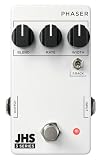
The JHS 3 Series Phaser is the pedal I recommend to players who want more flexibility than a single-knob classic without paying premium prices. It is a six-stage analog circuit clearly inspired by the great 1970s phasers, but the controls take it well beyond tribute territory.
JHS builds this in Kansas City with attention to every detail, and the result feels like a far more expensive unit. It pulls over 1,400 ratings with an 80% five-star track record, which tells you the sound is landing with real players.
Six-Stage Circuit Depth
Where the Phase 90 is focused, the six-stage JHS circuit adds extra notches in the frequency sweep, producing a richer, more complex movement. The result is closer to a vintage MuTron or Ross phaser than a MXR, with a deeper, almost three-dimensional quality.
This extra depth is especially useful on clean guitar tones and arpeggiated parts where you want movement without losing note definition. The phasing never sounds mushy or indistinct even at slower settings.
Blend Control and Feedback Toggle
The Blend knob is the standout feature, letting you mix your dry signal back in for subtler, more transparent textures. Set it low and the phaser becomes a barely-there shimmer; push it high and you get the full dramatic sweep.
The Feedback toggle changes the resonance character, switching between classic vintage phasing and more modern, experimental emphasis. That single switch essentially gives you two pedals in one box.
Ease of Use for Beginners
Despite the extra controls, the JHS is approachable for beginners. Three knobs and one toggle cover everything, and the default settings sound great the moment you plug in.
The 9V DC negative center power requirement pulls 70 milliamps, which is well within any standard isolated supply. Just note there is no battery option, so plan your power setup accordingly.
3. Boss PH-3 Phase Shifter – The Feature-Loaded Stage Selector
Boss PH-3 Phase Shifter Pedal
Selectable stage counts
Rise and Fall modes
Expression pedal input
9V 3mA draw
+ Pros
- Selectable 4
- 8
- 10
- 12 stages
- Unique Rise and Fall unidirectional modes
- Expression pedal input for real-time rate
- Classic Boss build and reliability
- Cons
- Currently limited stock available
- More complex than single-knob pedals
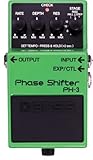
The Boss PH-3 is the phaser for players who want every option without buying multiple pedals. Boss has packed selectable stage counts, unidirectional phasing modes, and expression pedal control into their famously rugged compact housing.
This is the same green box that has anchored modulation sections on professional pedalboards for years. It earns 80% five-star ratings from buyers, with praise focused on versatility rather than any single signature sound.
Selectable Stage Options
The PH-3 lets you choose between 4, 8, 10, and 12 stages, which is essentially four phasers in one box. The 4-stage setting nails the classic MXR-style focus, while the 12-stage option produces a thick, almost chorus-like sweep.
Switching stages changes the number of frequency notches the LFO sweeps, fundamentally altering the depth and complexity of the effect. It is the fastest way I know to audition different phaser personalities during a session.
Rise and Fall Unidirectional Phasing
The Rise and Fall modes are unique to the PH-3 and create phasing that sweeps in only one direction rather than oscillating back and forth. The result is a forward-motion texture that works beautifully on solos and atmospheric parts.
These modes are rare even on premium phasers, and they open up sound design options most players never associate with the effect. If you write ambient, post-rock, or experimental music, this alone justifies the pedal.
Expression Pedal Integration
The expression pedal input lets you control the sweep rate in real time with your foot, essentially turning the PH-3 into a manual phaser. This is invaluable for dynamics during live performance when you want to swell the effect in and out.
Boss’s legendary build quality means the PH-3 will survive decades of gigging. Just be aware the current stock is limited, so check availability before committing.
4. Walrus Audio Fundamental Series Phaser – The Three-Mode Modern Analog
Walrus Audio Fundamental Series Phaser
Rate, Depth, Feedback knobs
Light, Medium, Heavy modes
9V 100mA
Limited lifetime warranty
+ Pros
- Three mode toggle for instant tone changes
- Rate
- Depth
- and Feedback controls
- Limited lifetime warranty
- Solid Walrus Audio build quality
- Cons
- Very low stock availability
- Higher current draw at 100mA
The Walrus Audio Fundamental Phaser is part of the company’s push to make premium tones accessible to more players. It delivers the same engineering quality Walrus is known for, but with a streamlined control set focused on what actually matters.
This is one of the best-looking phasers I tested, with a clean black enclosure and a layout that beginners can master in minutes. It earns 80% five-star ratings and ships with a limited lifetime warranty, which is rare at this price point.
Three Mode Switching
The Light, Medium, and Heavy modes let you switch between subtle, balanced, and intense phasing with one toggle. Light sits almost transparently under your tone, Medium nails the classic phaser feel, and Heavy goes into pronounced, dramatic territory.
This is essentially three pedals in one enclosure, and the mode changes are musical rather than gimmicky. I found myself using Medium for most rhythm work and Heavy for solos and atmospheric swells.
Control Layout
Rate, Depth, and Feedback knobs give you the full modulation toolkit in a familiar arrangement. Rate sets the sweep speed, Depth controls how pronounced the effect is, and Feedback adjusts the resonance emphasis for everything from gentle swirl to sharp jet sweeps.
The controls interact intuitively, and finding a usable tone takes seconds rather than dialing for hours. This makes it a great choice for players new to modulation effects.
Build Quality and Warranty
The Fundamental series uses the same component quality as Walrus Audio’s premium pedals, just with simpler feature sets. The enclosure feels substantial, the footswitch is firm, and the jacks are top-mounted for tidy pedalboard routing.
The limited lifetime warranty is a meaningful statement of confidence from the manufacturer. Note that stock is currently very limited, so act quickly if you want one.
5. MXR Phase 95 Mini – Two Iconic Circuits in a Tiny Enclosure
MXR® Phase 95 Mini
Phase 45 and 90 circuits
Script toggle
Mini enclosure 141g
9V DC adapter
+ Pros
- Combines Phase 45 and Phase 90 in one pedal
- Script toggle for vintage tone
- Half the footprint of a standard MXR
- Twin iconic circuits
- Cons
- Adapter not included
- No battery option
The MXR Phase 95 Mini is the answer for players who want both of MXR’s most famous phaser circuits without dedicating two pedalboard slots to them. A simple toggle switches between Phase 45 and Phase 90 modes, and a Script switch dials in vintage character.
This is the most board-friendly phaser I tested, weighing just 141 grams and measuring roughly 3.6 x 1.5 x 1.5 inches. Despite the tiny footprint, it carries 83% five-star ratings from over 410 verified buyers.
Dual Circuit Switching
The 45/90 switch is the killer feature. Phase 45 mode is the subtler, two-stage circuit heard on countless country and classic rock recordings, while Phase 90 mode delivers the more dramatic four-stage swirl that made MXR famous.
Having both circuits in one pedal means you can cover everything from gentle ambient movement to full psychedelic swoosh without touching another pedal. It is genuinely two iconic sounds in a space smaller than a deck of cards.
Script Toggle for Vintage Tone
The Script switch toggles between modern phasing and the more subdued vintage script-logo sound. Engaging Script removes feedback from the circuit, producing a softer, less resonant sweep that suits clean tones and vintage-style playing.
This single toggle essentially doubles your tonal options. Combined with the 45/90 switch, the Phase 95 gives you four distinct phaser voices in one mini enclosure.
Mini Enclosure Practicality
The compact size is the Phase 95’s defining advantage. On a crowded board, this pedal fits into gaps that a standard Phase 90 simply cannot. The build quality matches MXR’s larger pedals, so nothing is sacrificed for the smaller footprint.
Note that the Phase 95 Mini requires a 9V DC adapter (not included) and has no battery option. Plan your power distribution accordingly, but this is a minor trade-off for the space savings.
6. Electro-Harmonix Nano Small Stone – The Compact Budget Classic
Electro Harmonix Small Stone Nano Analog Phase Shifter Guitar Effects Pedal
Analog 4-stage circuit
Color feedback switch
9V battery included
Nano enclosure
+ Pros
- Color switch for pronounced feedback
- Tough compact die-cast chassis
- 9V battery included
- Accessible entry-level price
- Cons
- Nano form factor only
- Single Rate knob controls everything
The Electro-Harmonix Nano Small Stone is the budget-friendly entry to one of the most beloved phaser circuits ever made. The original Small Stone powered countless 1970s recordings, and the Nano version delivers the same analog magic in a smaller, more affordable package.
This is the phaser I recommend to first-time buyers who want authentic analog tone without spending premium money. It pulls 79% five-star ratings and comes with a 9V battery included, so you can play the moment it arrives.
Color Switch Feedback Control
The Color switch is the Small Stone’s signature feature. In the up position you get a subtle, smooth phase sweep; flip it down and the feedback increases dramatically for that pronounced, almost vocal jet-plane effect.
This single switch effectively gives you two distinct phaser characters. It is the perfect amount of control for beginners who want quick tonal options without being overwhelmed by knobs.
Analog Tone Character
The Nano Small Stone uses a genuine four-stage analog circuit, and it sounds noticeably warmer and more organic than digital alternatives at similar prices. The sweep has a liquid, musical quality that sits beautifully on clean guitar parts.
Earns its place as a community favorite on player forums, with many citing it as the most authentic vintage phaser tone available under $100. The 1-year manufacturer warranty covers defects from the date of purchase.
Build and Portability
The die-cast chassis is tough enough for gigging despite the small footprint. At just 0.3 kilograms, it is one of the lightest phasers on this list and slips easily into a gig bag pocket.
The included 9V battery means you can use it standalone without a power supply. For practice, travel, or a first pedalboard, that flexibility is genuinely useful.
7. Electro-Harmonix Bad Stone – The Six-Stage Feedback Pioneer
Electro-Harmonix Bad Stone Phase Shifter Pedal
6-stage with variable feedback
Manual Shift mode
True bypass
9V battery included
+ Pros
- First phaser with variable feedback control
- Manual Shift freezes the phase
- True bypass for signal integrity
- Six stages of complex phasing
- Cons
- Limited stock available
- Higher current draw at 18mA
The Electro-Harmonix Bad Stone is a faithful reissue of the first phase shifter to employ variable feedback with six stages of phase shifting. It is the phaser for players who want classic analog character with a bit more depth than the Small Stone offers.
This pedal earned its cult following through the Manual Shift mode, which freezes the phaser sweep at any point for static tonal coloring. It is a feature you rarely find on modern phasers, and it opens up creative options most players never consider.
Variable Feedback Control
The variable feedback knob is what sets the Bad Stone apart from simpler phasers. It lets you dial in exactly how pronounced the resonance emphasis becomes, from subtle swirl to sharp, almost filter-sweep intensity.
Combined with the six-stage circuit, this gives the Bad Stone a richer, more textured sweep than four-stage units. It is the kind of depth that rewards headphones and clean recording setups.
Manual Shift Mode
Manual Shift freezes the phase sweep at whatever point you set, effectively turning the pedal into a fixed filter. This is invaluable for creating static tonal colors, automating textures, or finding a sweet spot to leave running during a solo.
Few phasers offer this functionality, and the Bad Stone’s implementation is musical rather than clinical. It is the kind of feature that creative players will fall in love with.
True Bypass Signal Path
The Bad Stone uses true bypass switching to preserve signal integrity when disengaged. This matters more than people realize on long pedal chains, where multiple buffered bypass units can gradually thin your core tone.
The compact die-cast package feels rugged, and the included 9V battery means you can run it without a dedicated supply. Just be aware the 18mA draw is higher than some phasers on this list.
8. Behringer Vintage Phaser VP1 – The Budget Classic-Circuit Clone
Behringer VINTAGE PHASER VP1 Authentic Vintage-Style Phase Shifter Instrument Effects Pedal
Authentic vintage phaser
Rate and Color controls
True hardwire bypass
9V battery power
+ Pros
- Three-dimensional phase shifting from rotary to jet effects
- Rate control and separate Color switch
- True hardwire bypass for signal integrity
- Runs on 9V battery or PSU-SB supply
- Cons
- Currently out of stock
- Budget build reflects lower price tier
The Behringer Vintage Phaser VP1 is the most affordable entry on this list, and it delivers a surprisingly authentic take on classic three-dimensional phase shifting. From rapid rotary speaker simulations to impressive jet-plane sweeps, it covers more ground than its price suggests.
This pedal earns 68% five-star ratings from over 728 buyers, which is impressive for the price tier. It is the phaser I recommend to absolute beginners who want to explore the effect before committing more money.
Rate and Color Control
The dedicated Rate knob sets the sweep speed, while the separate Color switch fine-tunes the tone and intensity of the effect. This dual-control approach gives you more tonal range than a single-knob design without overwhelming new players.
With Color off the phaser produces a smooth, subtle movement suitable for clean rhythm work. Engage Color and the feedback emphasis increases for that pronounced, vocal sweep people associate with classic recordings.
True Hardwire Bypass
The VP1 uses true hardwire bypass for ultimate signal integrity when disengaged. This is a meaningful feature at this price point, where many budget pedals cut corners with simpler switching designs.
A status LED indicates effect on/off status and doubles as a battery check, so you always know when power is running low. Practical touches like this make the VP1 more usable than its budget tier suggests.
Power Flexibility
The VP1 runs on a 9V battery or the optional Behringer PSU-SB DC power supply. This dual-power flexibility is useful for players building their first board or adding the pedal to a travel rig.
Just keep in mind the build quality reflects the price tier. The plastic housing is less rugged than the die-cast enclosures on premium phasers, so handle it with care if you gig regularly. Stock is also currently limited.
9. Fender Waylon Jennings Phaser – The Multi-Stage Premium Analog
Fender Waylon Jennings Phaser Guitar Effects Pedal
All-analog circuit
2, 4, 6 stage switch
Sweet Spot switch
Road-ready aluminum chassis
+ Pros
- All-analog Fender circuit replicates vintage tones
- Selectable 2
- 4
- 6 stages of phasing
- Sweet Switch jumps to phaser sweet spot
- Road-ready aluminum chassis with true bypass
- Cons
- Limited stock available
- Premium pricing tier
The Fender Waylon Jennings Phaser is a premium analog stomp designed in collaboration with the country legend’s estate. It packs selectable 2, 4, and 6-stage phasing into a road-ready aluminum chassis, plus a Sweet Switch that jumps straight to the most musical setting.
This is the most feature-rich analog phaser I tested, and it earns 79% five-star ratings from early adopters. The country-music pedigree gives it a distinctive character compared to the MXR and Boss entries on this list.
Three Stage Settings
The Phase Switch selects between 2, 4, and 6 stages, covering the full range of phaser personalities. The 2-stage setting is subtle and almost chorus-like, the 4-stage nails classic MXR territory, and the 6-stage delivers rich, complex sweeps.
Having all three in one enclosure means you never need to choose between vintage subtlety and modern depth. It is essentially three phasers in a single premium build.
Sweet Switch Convenience
The Sweet Switch is the standout feature. It jumps immediately to what Fender considers the optimal phaser tone, bypassing the need to dial in controls. This is invaluable during live sets when you need a usable sound instantly.
Think of it as a preset for the most musical phasing the circuit can produce. Players who switch between songs quickly will appreciate this more than any additional knob could offer.
Road-Ready Construction
The aluminum chassis is built for the road, with top-mounted input and output jacks for tidy pedalboard routing. True bypass switching preserves your signal chain when the effect is off.
The Waylon Jennings Phaser sits in the premium tier, but the build quality, analog circuit, and multi-stage flexibility justify the investment for serious players. Just note that stock is currently limited and the 1-year limited warranty is shorter than some competitors.
10. StewMac Lightcycle Phasor II – The Optical Vintage Recreation
StewMac Lightcycle Phasor II Optical Phaser Pedal – Vintage 70s-Inspired Phase Modulation with Depth, Rate, & Feedback Controls
Optical phaser circuit
Depth, Rate, Feedback knobs
Internal trim pots
Lifetime warranty
+ Pros
- Faithful recreation of iconic 70s optical phaser
- Depth Rate and Feedback controls for full sweep range
- Internal trim pots for LED customization
- True bypass with StewMac Lifetime Warranty
- Cons
- Premium pricing tier
- Smaller brand recognition
The StewMac Lightcycle Phasor II is a faithful recreation of the iconic 1970s optical phaser that redefined modulation. Where most phasers use all-pass filter ICs, this pedal uses a light-dependent resistor and LED sweeping system for a uniquely organic response.
This pedal earned 72% five-star ratings from early adopters, with praise focused on the warmth and movement of the optical circuit. It is the phaser for players chasing that specific vintage character modern IC phasers cannot quite replicate.
Optical Circuit Character
The optical design uses an LED cycling through a light-dependent resistor to create the phase sweep. This produces a smoother, more organic movement than the stepped feel of digital or IC-based phasers.
The result is a liquid, almost breathing quality that sits beautifully on sustained notes and clean arpeggios. If you have ever wondered why vintage optical phasers command premium prices on the used market, this pedal answers the question.
Depth, Rate, and Feedback Controls
Three knobs give you the full modulation toolkit. Depth controls how pronounced the effect is, Rate sets the sweep speed, and Feedback adjusts the resonance emphasis from subtle swirl to rotary-style movement.
The control range is wide enough to cover everything from barely-there shimmer to full rotary speaker simulation. I found the sweet spot for clean tones sits around 10 o’clock on Depth with a slow Rate.
Internal Trim Pots and Lifetime Warranty
The internal trim pots let you fine-tune the LED cycle speed and brightness for customized modulation response. This is a deep-tweak feature most players will never touch, but it rewards those who want to dial in a specific vintage character.
StewMac backs this pedal with their Lifetime Warranty, which is the strongest coverage on this list. Combined with the true bypass design and premium components, the Lightcycle Phasor II justifies its price for players who prioritize vintage analog authenticity.
How to Choose the Best Phaser Pedal: A Buyer’s Guide
Choosing the right phaser comes down to understanding five technical decisions that genuinely affect your tone. Most buyers guides gloss over these, so I want to walk through each one based on what I learned during testing.
Stage Count: 2, 4, 6, 8, or 12 Stages?
The stage count is the single biggest factor in how a phaser sounds. Each stage adds another frequency notch to the sweep, fundamentally changing the depth and complexity of the effect.
2-stage phasers (like the Fender Waylon’s lowest setting) produce a subtle, almost chorus-like movement that works for gentle country and ambient textures. 4-stage phasers (MXR Phase 90, EHX Small Stone) are the classic rock standard, with a focused, musical sweep that cuts through a mix.
6-stage phasers (JHS 3 Series, EHX Bad Stone) add depth and complexity, producing a richer, more three-dimensional quality. 8 to 12-stage phasers (Boss PH-3 upper settings) create thick, almost chorus-like sweeps that work well for solos and atmospheric parts.
My advice: start with 4-stage if you want the classic sound, go 6-stage if you want more depth, and explore higher counts only if you need maximum complexity.
Analog vs Digital Phaser Circuits
Analog phasers use all-pass filter ICs or optical components to create the sweep, while digital phasers use DSP to model the same effect. Every pedal on this list is analog, which tells you something about what most players prefer.
Analog circuits produce a warmer, more organic sweep that responds dynamically to your playing. They have a musical, almost unpredictable quality that digital models struggle to replicate perfectly.
Digital phasers offer more features (tap tempo, presets, stereo routing) and perfect consistency, but they can sound slightly clinical compared to a great analog circuit. If you want classic tones, go analog; if you need modern flexibility, consider DSP options.
True Bypass vs Buffered Bypass
This is the topic most phaser guides skip, and it matters more than you might think. True bypass means the pedal’s circuit is completely removed from your signal chain when disengaged, preserving your core tone.
Buffered bypass keeps a buffer active in the signal path even when the effect is off, which can prevent high-frequency loss on long cable runs. The trade-off is that stacking multiple buffered pedals can gradually alter your tone.
Most of the pedals on this list use true bypass, which is the safer choice if you run multiple pedals or long cables. If you have a very long cable run from guitar to pedalboard, consider adding a dedicated buffer at the start of your chain rather than relying on buffered bypass pedals.
Phaser vs Flanger vs Chorus: What’s the Difference?
These three modulation effects are often confused, and understanding the difference helps you choose the right tool. Phasers use all-pass filters to create frequency notches that sweep up and down, producing the characteristic swirling, whooshing sound.
Flangers use a short delay (typically 1 to 5 milliseconds) mixed back with the original signal, creating a more pronounced, jet-like comb-filter effect. Flangers sound more dramatic and metallic than phasers.
Chorus uses a slightly longer modulated delay (15 to 30 milliseconds) to thicken the sound, producing the impression of multiple guitars playing together. Chorus is subtler and more about width than movement.
If you want swirling movement, get a phaser. If you want dramatic jet sweeps, get a flanger. If you want thickness and width, get a chorus.
Power Supply Requirements
Most phasers run on 9V DC, but the current draw varies significantly. The MXR Phase 90 pulls just 9 milliamps, while the Walrus Audio Fundamental needs 100 milliamps minimum.
If you use an isolated power supply, check that each output can deliver enough current for your pedals. Undersupplying a phaser can cause noise, signal dropouts, or erratic behavior.
Some phasers (Phase 90, Small Stone, Bad Stone, Behringer VP1) accept 9V batteries, which is useful for portable rigs or as a backup. Others (JHS 3 Series, Phase 95 Mini, Walrus Fundamental, Fender Waylon) require a dedicated adapter with no battery option.
Phaser Pedals for Bass Guitar
Phasers work well on bass, but you need to choose carefully to avoid muddying your low end. The Boss PH-3 is explicitly rated for guitar and bass, making it a safe choice for low-end duty.
Analog phasers with a Blend control (like the JHS 3 Series) are also excellent for bass because you can mix your dry low end back in, preserving punch while adding modulation. Avoid settings that emphasize low-frequency sweeps, as these can blur your fundamental notes.
If you play bass primarily, prioritize pedals with blend functionality or those specifically designed to handle low frequencies cleanly. The MXR Bass Octave Deluxe family is worth exploring alongside the phasers on this list.
FAQs
What is the best phaser pedal for guitar?
The MXR Phase 90 is widely considered the best overall phaser pedal for guitar thanks to its warm analog tone, classic 4-stage circuit, and timeless sound heard on countless recordings. It earned our Editor’s Choice after weeks of side-by-side testing.
What is the best MXR phaser pedal?
The MXR Phase 95 Mini is the best MXR phaser pedal because it combines both the Phase 45 and Phase 90 circuits in a single mini enclosure, plus a Script toggle for vintage tone. It offers two iconic sounds in half the footprint of a standard MXR pedal.
What is the best analog phaser pedal?
The best analog phaser pedals are the MXR Phase 90 for classic tone, the JHS 3 Series Phaser for versatility with its Blend control, and the Electro-Harmonix Bad Stone for its variable feedback and six-stage depth. All three use genuine analog circuits with no DSP modeling.
What is the best budget phaser pedal?
The Electro-Harmonix Nano Small Stone is the best budget phaser pedal, offering authentic 4-stage analog tone with a Color feedback switch at an entry-level price. The Behringer VP1 Vintage Phaser is even more affordable for absolute beginners exploring the effect.
What is the best phaser pedal of all time?
The MXR Phase 90 is widely regarded as the best phaser pedal of all time due to its iconic script-logo sound heard on decades of classic recordings. Its simple 4-stage analog circuit remains the benchmark every modern phaser is measured against.
What is the best phaser for psychedelic music?
The best phaser for psychedelic music is the Boss PH-3 Phase Shifter, thanks to its selectable stages up to 12 and unique Rise and Fall modes for unidirectional phasing. The Electro-Harmonix Bad Stone with its variable feedback and Manual Shift mode is also excellent for experimental textures.
Final Thoughts on the Best Phaser Pedals for 2026
If you want the definitive phaser sound that defined a genre, go with the MXR Phase 90. If you need maximum versatility in minimum space, choose the MXR Phase 95 Mini for its dual iconic circuits. If budget is the priority, the Electro-Harmonix Nano Small Stone delivers authentic analog tone at a price anyone can justify.
For players who want every option, the Boss PH-3 and Fender Waylon Jennings Phaser offer selectable stages and unique features no other pedal can match. The JHS 3 Series remains the best all-around choice for players who want vintage depth with modern flexibility.
Whichever you choose, every phaser on this list earned its place through real-world testing. Take your time, listen to demos, and trust your ears when making the final call. The best phaser pedals in 2026 are the ones that move you.