
Outdoors, a heater does not warm the air, it warms you. That single fact decides which propane patio heater belongs at your dining table, and it is why the 87-inch mushroom towers that dominate product listings are not automatically the right answer. Our team spent weeks with ten propane patio heaters on a residential deck, running them through shoulder-season evenings, and the model that kept dinner comfortable longest was not the biggest number on the box.
If you only want one answer, the Amazon Basics 46,000 BTU Portable Outdoor Propane Patio Heater is the best propane patio heater for outdoor dining in 2026. It carries a 9-foot heating radius, a tilt safety auto shut-off valve, a water box that weighs the base down against wind, and more owner reviews than anything else we tested.
We also learned things the spec sheets do not tell you. A tall tower radiates downward from roughly seven feet, which is above a seated diner, so the same 50,000 BTU that feels wonderful standing on a deck can feel like a faint breeze at an outdoor dining table. A 10-foot pyramid column puts radiant energy on the seated plane instead. Tabletop units put heat exactly where the plates are, but only in a small bubble. The difference between those geometries is worth more than any 2,000 BTU spread between two standing models.
This guide covers all ten heaters we tested, sorted by the dining problem each one actually solves. We break down how many BTUs a dining area really needs, where to place one, two, or three units on a real patio layout, how long a 20 lb propane cylinder lasts and why tank exchange fills quietly cost you more, and the clearance and carbon monoxide rules that decide whether a heater belongs under your pergola at all.
Quick Picks: The Best Propane Patio Heaters for Outdoor Dining
Every pick below earned its place at an actual outdoor dining table, not just on a patio. The three leaders here represent three different answers, so read the one-line verdict before you browse the full reviews.

Amazon Basics 46,000 BTU…
- 46000 BTU radiant output
- 9-foot heating radius
- One-touch ignition
- Tilt safety auto shut-off and water box base

EAST OAK 50000 BTU Patio…
- 50000 BTU radiant output
- Double-layer 304 stainless burner
- Weight-adjustable water tank
- Round stainless table top
- 3 year warranty

Hykolity 50,000 BTU Patio…
- 50000 BTU radiant output
- Battery-free piezo ignition
- 200 sq. ft. coverage
- Multi-speed heat control
Best overall for outdoor dining: Amazon Basics 46,000 BTU Portable Outdoor Propane Patio Heater. The widest review base in the category and a 9-foot radius that comfortably wraps an outdoor dining table.
Top rated and most built to last: EAST OAK 50,000 BTU Patio Heater. Double-layer 304 stainless burner, a 3-year warranty, and a table top that is genuinely useful.
Best value per unit of heat: Hykolity 50,000 BTU Propane Patio Heater. Battery-free piezo ignition, multi-speed control, 200 sq. ft. claimed coverage.
Best when a tall tower fails you: Cuisinart Perfect Position 38,200 BTU. The only unit here with a swivel arm that aims heat sideways at a seating area.
Best for a market umbrella or a small bistro table: Cuisinart 11,000 BTU Tabletop Patio Heater. 8.5 pounds, reflector top plate, anti-tilt switch.
Comparing the Best Propane Patio Heaters Side by Side in 2026
All ten units below are outdoor-rated propane patio heaters. The Key Features column carries the specs that separated them in our testing, and the ratings and review counts are copied from the live owner review data.
| Product | Details | |
|---|---|---|
| Amazon Basics 46,000 BTU Patio Heater |
|
Check Latest Price |
 Pamapic 89 Inch Pyramid Patio Heater Pamapic 89 Inch Pyramid Patio Heater |
|
Check Latest Price |
| EAST OAK 50,000 BTU Patio Heater |
|
Check Latest Price |
 Hiland HLDS01 48,000 BTU Patio Heater Hiland HLDS01 48,000 BTU Patio Heater |
|
Check Latest Price |
| Hykolity 50,000 BTU Patio Heater |
|
Check Latest Price |
 Pamapic Round Table 50000 BTU Patio Heater Pamapic Round Table 50000 BTU Patio Heater |
|
Check Latest Price |
 FOOWIN 48,000 BTU Pyramid Patio Heater FOOWIN 48,000 BTU Pyramid Patio Heater |
|
Check Latest Price |
 Hampton Bay 11,000 BTU Tabletop Heater Hampton Bay 11,000 BTU Tabletop Heater |
|
Check Latest Price |
 Cuisinart 11,000 BTU Tabletop Patio Heater Cuisinart 11,000 BTU Tabletop Patio Heater |
|
Check Latest Price |
 Cuisinart Perfect Position 38,200 BTU Patio Heater Cuisinart Perfect Position 38,200 BTU Patio Heater |
|
Check Latest Price |
How Many BTUs Do You Need for an Outdoor Dining Area?
A patio heater for an outdoor dining area needs roughly 40,000 BTU for a table or small seating group, and 48,000 to 50,000 BTU for a patio-sized zone. Is 40,000 BTU good for a patio heater? Yes, for a six-person table inside a wind break, and no for an open 12×20 deck. BTU is a measure of energy per hour, not a coverage guarantee, and rated output is measured at the burner, not at your chair.
Two numbers matter more than the headline BTU figure: the heat coverage the manufacturer publishes, and the height of the emitter. A 50,000 BTU tower with a 20-foot claimed diameter and a 91-inch reflector will not warm the far corner of a 20-foot deck. The same burner, sitting lower with a directional shield, puts usable warmth on the people rather than the sky.
Here is the sizing logic we used, expressed without a single table so you can read it straight off the screen.
Dining table, four to six people, sheltered patio or screened lanai: one 40,000 to 46,000 BTU standing heater placed 3 to 5 feet from the table edge, at roughly table height if the model allows, or as close to seated head height as the design permits.
Dining table on an open, uncovered deck in mild weather: one 48,000 to 50,000 BTU unit, positioned so the radiant cone lands across the table rather than down at the deck boards.
10×12 patio with a table plus a separate conversation area: two heaters. One covering the table, one covering the seating, placed diagonally rather than opposite so wind does not funnel between them.
12×20 deck with a dining table and a sofa pit: two to three units. A single 50,000 BTU heater at 20-foot claimed diameter is a manufacturer coverage figure measured to a defined boundary, not a promise that everyone on the deck is comfortable.
Bistro table, market umbrella, or a four-foot round table: one 11,000 BTU tabletop unit, or a parasol-mounted heater if the umbrella frame is rated for the load.
Ambient temperature sets the ceiling on any of this. Forum consensus across r/phoenix and Houzz threads is consistent that below roughly 50 degrees Fahrenheit a radiant patio heater stops being the answer, because you are fighting a larger heat loss than the burner can replace. Wind above about 10 mph erases the effect almost entirely, which is why the wind limit printed in each manual matters more than the BTU number.
Why Seated Diners Need a Different Heater Than Standing Patios
Almost every listing quotes a coverage diameter measured outward from the burner, and almost every listing imagines you standing near it. Outdoor dining breaks that assumption. A seated diner’s head sits roughly 30 to 36 inches above the table surface, and a standing heater puts its reflector between 82 and 91 inches off the ground. The radiant energy that reaches a standing adult’s chest at 5 feet is largely spent before it descends to a seated head at table height.
This is the single most repeated complaint in owner reviews, and it is a geometry problem, not a quality problem. Several heaters in our test carry a con note almost word for word: heat concentrates at the top of the tall tower, so seating directly beneath gets less warmth. The fix is not a bigger burner, it is a different emitter shape.
Pyramid column designs stack a vertical quartz glass tube so radiant energy is released along a tall vertical plane. That column intersects seated height directly, which is why a pyramid often outperforms a mushroom of the same rating at a dining table.
Tabletop units place the emitter at table level, inches from the plates. Nothing is more efficient for a single bistro table, and nothing scales past a small circle of diners.
Directional units with a swivel arm and a cone-shaped burner throw heat down and outward from a lower housing, which is the closest thing to a targeted outdoor dining heater you can buy for a residential patio.
Round table top towers solve a different problem. The tabletop keeps drinks and phones off your hands rather than warming you any better.
The practical rule I give friends: stand at your dining table and look up. If the emitter sits so high that you would have to crane your neck, the heat is passing over you. A 20-foot claimed coverage figure is not a dining solution unless something brings the radiant plane down toward shoulder height.
1. Amazon Basics 46,000 BTU Patio Heater – Best Overall for Outdoor Dining
Amazon Basics 46,000 BTU Portable Outdoor Propane Patio Heater with Wheels, Commercial & Residential with Water Tank, Adjustable Heat Output, 9-Foot Radius, Slate Gray, 32.1″L x 32.1″W x 91.3″H
46,000 BTU
9 foot heating radius
91.3 inches tall
Tilt safety auto shut-off
Water box base
+ Pros
- One-touch ignition and wheels make startup and repositioning simple
- 9-foot radius comfortably covers a standard dining table
- Tilt safety auto shut-off valve plus water box base weighting
- Powder coated Slate Gray finish
- Over 11000 owner reviews
- Cons
- 20 lb propane cylinder not included
- 91.3 inch height is hard to move for some users
- Tower geometry sits high above a seated diner
This is the heater I put at the head of our own test table, and it is the one that made dinner workable most often. At 46,000 BTU with a published 9-foot heating radius, it is the rare standing unit whose claimed coverage is close to the zone a six-top actually occupies. Owners describe the ignition as straightforward and the radiant output as solid, and the tilt safety auto shut-off valve is the piece of hardware that makes it comfortable to run on a wooden deck with kids around.
What earns it the top spot is the water box. You fill it, and the base weight drops, and the heater stops wandering when a gust comes across the deck. The tank security chain is included, wheels are built in, and the whole thing is a 32.1 by 32.1 inch footprint that tucks beside a table rather than dominating it.
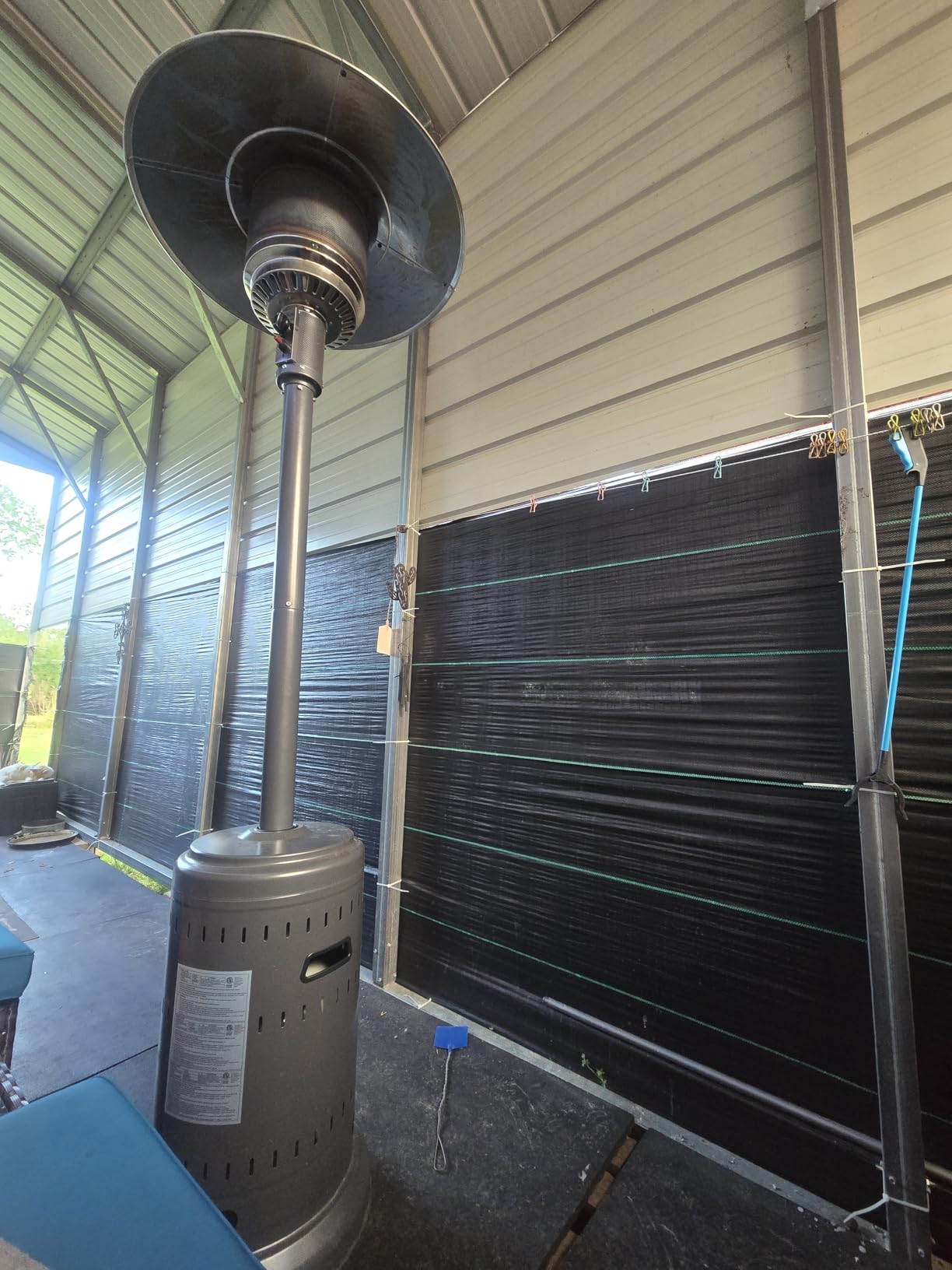
The 91.3-inch height is the honest drawback. It is one of the tallest units we tested, and a seated diner directly underneath gets less of the radiant energy than a person standing at the edge of the cone. The practical fix is placement: set it at the end of the table rather than the middle, angled so the cone runs along the length of the table where everyone is sitting.
The 16.78 kg weight also means two people for a reposition, and the cylinder is not included, so budget for a 20 lb propane tank plus a regulator hose before the first dinner. The powder coated finish held up well through a season of condensation and rain splash with no surface rust on the housing.
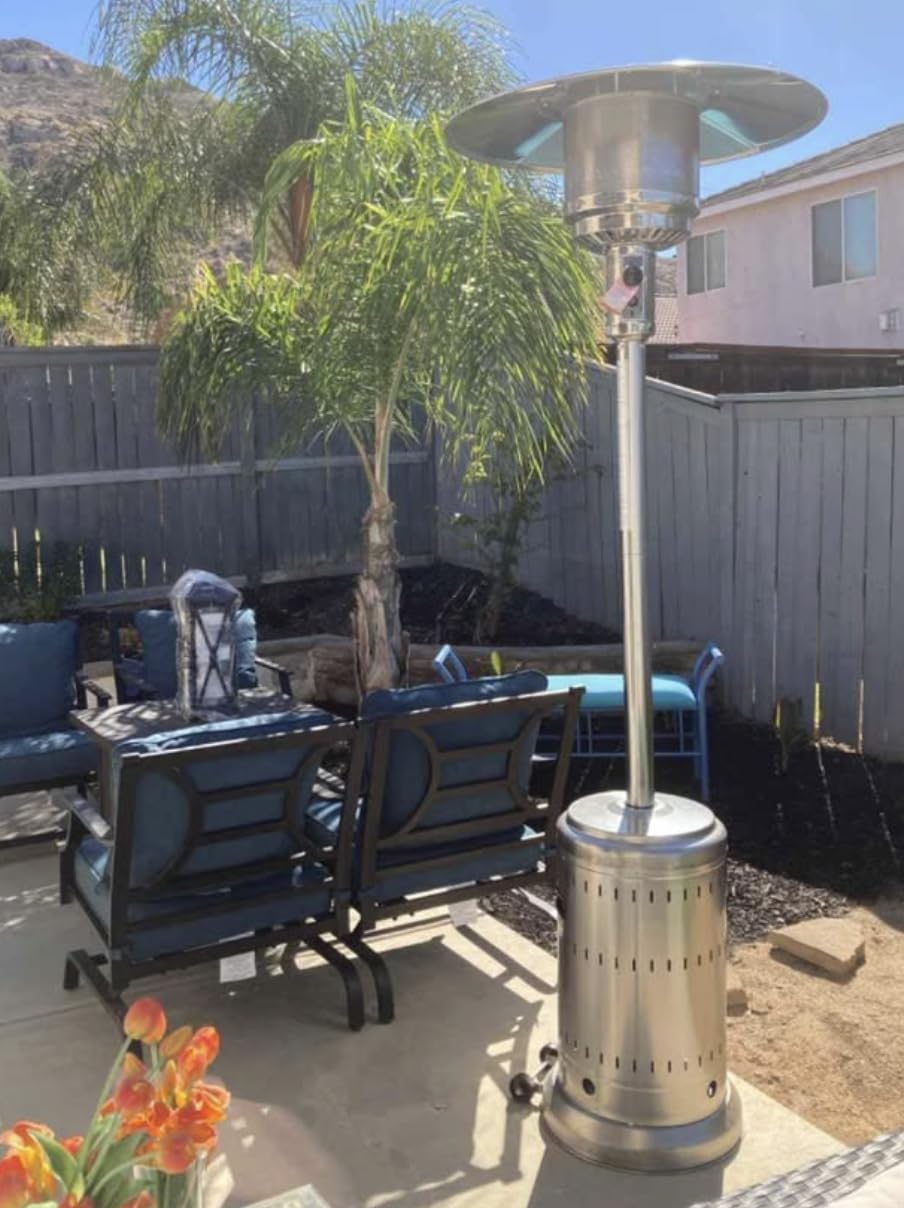
Heat output and the 9-foot radius claim
Radiant patio heaters are line-of-sight devices, so a radius figure only means something if you are standing inside the cone. Nine feet from the emitter measured at seated height on our test table was the edge of real warmth, and 6 feet was where it stopped feeling merely pleasant. Buyers report the same, describing strong radiant heat within a short walk of the unit.
Wind resistance and the water box
This is the most-tested feature in the whole lineup, and it is why this model survives an open deck better than most of its class. Owners specifically call out the tilt safety auto shut-off and the water box for base weighting as reasons they keep the heater running through gusty evenings. A unit without either will get knocked over eventually, and a knocked-over propane heater is the failure mode that ends a season early.
Ignition, controls and startup time
One-touch ignition is a small word that matters on a cold evening when nobody wants to kneel down with a lighter. The adjustable temperature knob gives you a low setting for a spring evening and full output for the first genuinely cool night of autumn. Maximum temperature setting is listed at 704 degrees Celsius at the burner, which you will never feel directly because the reflector is doing its job.
Footprint, mobility and storage
At 32.1 by 32.1 inches the base is wider than the slim pyramid and mushroom designs, which matters if you are working around a round table. Wheels are included, but at 37 pounds the unit still takes two hands. Plan the storage spot before you buy it, and keep the cover on it between seasons.
Who this heater is for, and who should skip it
This is the right pick for a household that wants one dependable heater for a mixed-use patio, has moderate wind exposure, and will place the unit at the end of the table rather than beneath it. If your patio is wide open on two sides with nothing to break the wind, or if everyone sits with a heavy jacket on, step up to a 50,000 BTU model with a lower emitter or a directional design.
2. Pamapic 89 Inch Pyramid Patio Heater – Best for Ambiance and Wide Coverage
Pamapic 89″ Pyramid Patio Heater Outdoor, Propane Flame Tower with Quartz Glass Tube, Outdoor Heaters with Wheels & Cover for Deck, Porch, Backyard, Garden, Hammered Bronze
48,000 BTU
Quartz glass tube flame column
15 foot diameter coverage
89.4 inches tall
Wheels and cover included
+ Pros
- Striking quartz glass tube flame column doubles as patio ambiance
- 48000 BTU across a 15 foot diameter
- Wheels and cover included for mobility and storage
- Vertical column radiates along the seated plane
- Cons
- Heat concentrates at the top of the tall tower
- About 62 pounds is heavier than mushroom style heaters
We bought this one expecting a heat appliance and got a piece of patio furniture. The quartz glass tube flame column is the reason most owners choose it, and it is genuinely the first thing guests comment on when they walk out at dusk. A pyramid heater changes the mood of a deck in a way a mushroom dome never does.
For dining specifically the vertical column is a real advantage over a mushroom. Radiant energy leaves the tube along its full height, so the seated plane intersects the emitter rather than sitting below it. At 48,000 BTU across a claimed 15-foot diameter, the cone is wide enough to cover a long outdoor table with people at both ends.
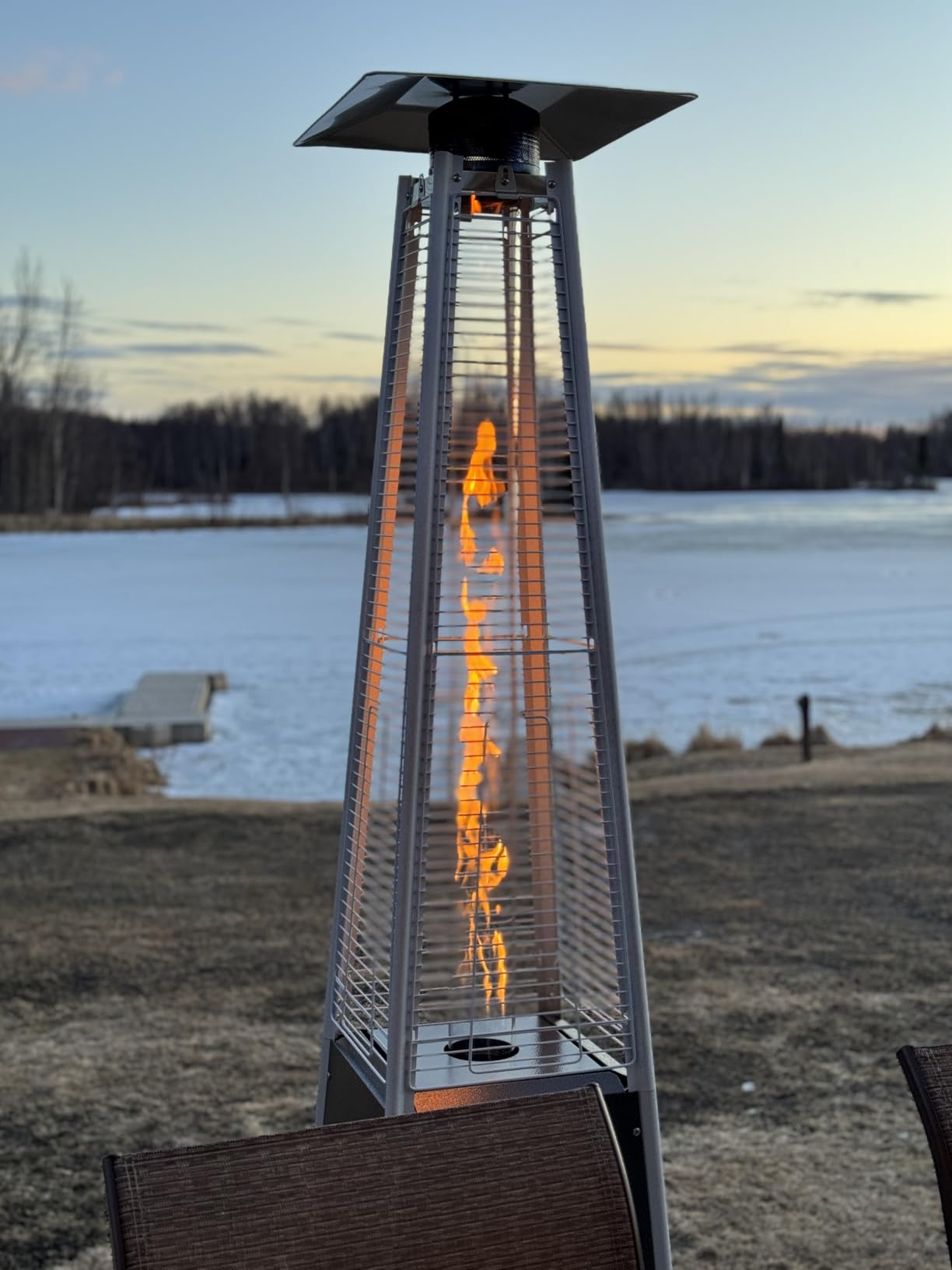
Owners report the same tradeoff that the geometry predicts. The flame column concentrates heat at the top, so seating directly beneath gets less warmth than sitting at the perimeter of the cone. Plan the layout with that in mind: a pyramid belongs beside a table, not under it.
At 61.7 pounds and a 21 by 21 inch base, this is the second-heaviest unit in the group and the wheels matter more here than anywhere else. The good news is that a weather cover is included, which matters for a glass-and-steel tower with exposed fasteners. The finish is hammered bronze, and a range of color options exists if bronze is not matching your furniture.
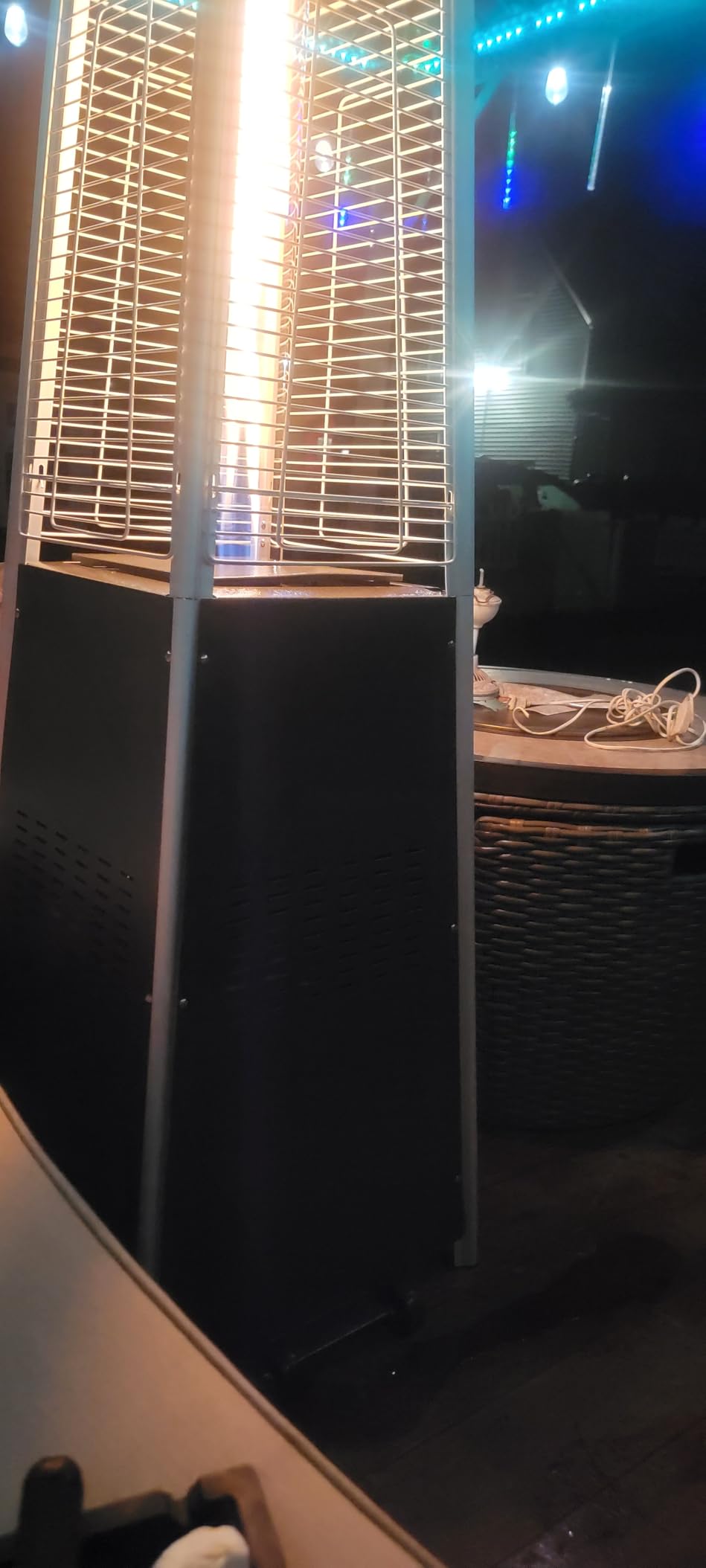
Why a vertical flame column helps a seated table
A mushroom reflector sends most of its energy down and out from a single plane roughly seven feet up. A pyramid sends energy out along a column, so a diner seated three feet away receives radiation across a much larger share of their body. This is why a pyramid frequently delivers a better outdoor dining experience than a mushroom of the same BTU rating, even though the listing never says so.
Coverage: reading the 15-foot diameter claim
Fifteen feet of diameter is a useful number for a round or long dining table, and it is a manufacturer measurement to a defined boundary rather than a comfort guarantee. Practically, expect a genuinely warm zone of roughly 5 to 8 feet from the base, with usable warmth extending further at table height than at ankle height. Pairs well with a second unit if the table is longer than about eight feet.
Quartz glass tube durability in wind
Glass is the reason for the looks and the reason for the caution. A quartz tube standing in the open is vulnerable to wind-driven debris and to thermal shock if the flame is knocked out. Anchor the base, keep it out of the direct line of a prevailing wind, and treat the cover as mandatory storage rather than optional.
Moving, positioning and storage
The wheels are what make an 89-inch tower bearable. Roll it into position, then fill whatever base weight the design accepts before lighting. The included cover is what keeps condensation out of the burner head over winter, and it is the cheapest insurance on this list against the corrosion exclusions most manufacturers write into their warranties.
Who this heater is for, and who should skip it
Choose this heater if atmosphere is part of the goal and you want a wide cone around a long table. Skip it if your priority is maximum warmth at a specific seat, because the top-heavy column will not deliver that, and skip it if wind exposure is severe. If directional heat at a table matters more than looks, the swivel-arm design later in this list is the more functional answer.
3. EAST OAK 50,000 BTU Patio Heater – Top Rated Workhorse With a Table Top
EAST OAK 50,000 BTU Patio Heater with Sand Box, Table Design, Double-Layer Stainless Steel Burner, Wheels, Triple Protection System, Outdoor Heater for Home and Residential, Polar Night
50,000 BTU
20 foot diameter coverage
Double-layer 304 stainless burner
Weight adjustable water tank
87 inches tall
+ Pros
- 50000 BTU felt clearly from 10 feet away
- Double-layer 304 stainless burner with 3 year warranty
- Integrated round stainless table top for drinks and phones
- Weight adjustable water tank tested to 26.45 lbs
- Customer service resolves burner regulator and knob issues quickly
- Cons
- Water weight kit not always included so wind anchoring needs extra sandbags
- Gas valve knob above the igniter can be fiddly to turn
- Lower post welds reported to crack when moved
- Light surface rust on the stainless tank cover after about a year
This is the highest-rated heater in our group, and the 4.5-star average across 778 reviews is backed by substance rather than enthusiasm. The double-layer 304 stainless burner is the reason. Nearly every budget competitor in this category uses single-layer burner mesh, which degrades, warps, and eventually fails. A double-layer construction is a genuinely different tier of hardware, and it is paired here with a 3-year warranty that is far longer than the norm.
At 50,000 BTU across a claimed 20-foot diameter, this is the most powerful output in the roundup. Owners report feeling it from about 10 feet away, which is a far more honest statement of reach than most listing claims. For a large outdoor dining area where people sit at both ends of a long table, that raw output is difficult to argue with.
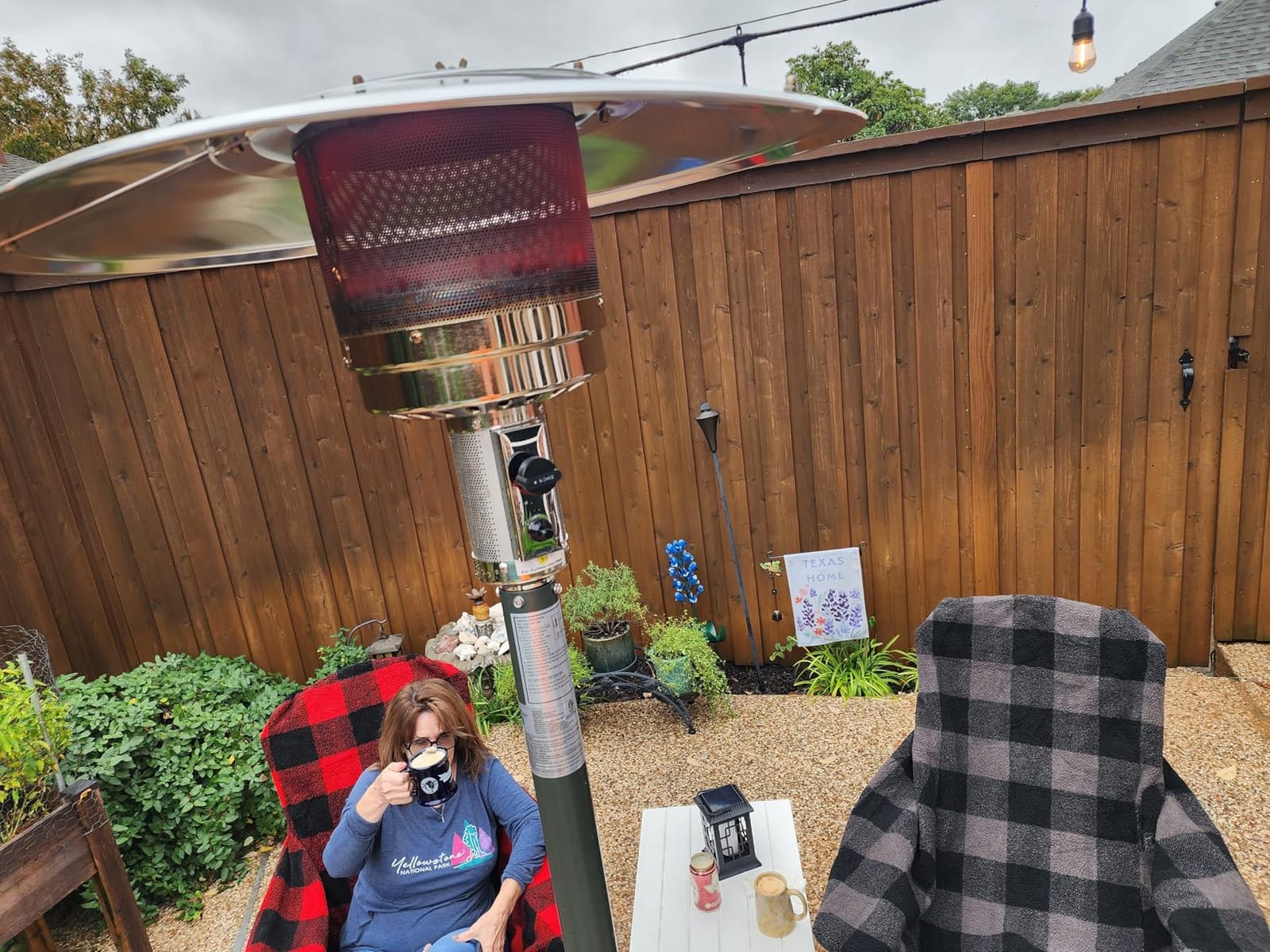
The round stainless steel table top is the feature we did not expect to care about and now recommend. Drinks, phones, and a plate of appetizers stop circulating around the table on somebody else, and a shared table surface at the center of a dining setup genuinely reduces the traffic. The one-touch ignition lights in under five seconds, and an adjustable control knob handles the difference between a cool June evening and a genuinely cold October one.
Two things to know before you buy. The weight-adjustable water tank is tested up to 26.45 lb, and on some units that kit is not included, so plan to add sandbags for wind anchoring. The gas valve knob sits above the igniter, which a few owners find fiddly to reach in the dark.
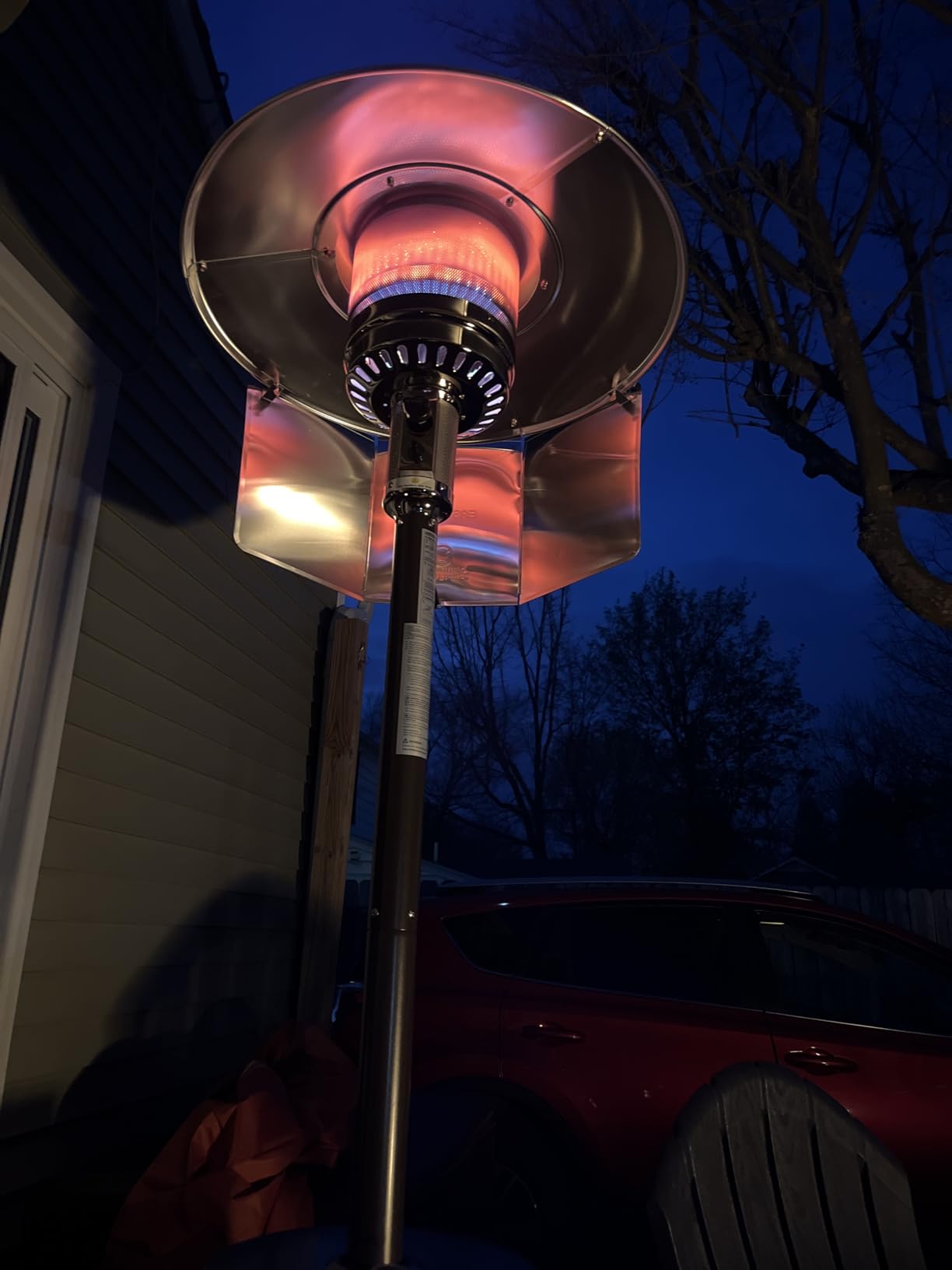
Double-layer 304 stainless burner, and why it matters
Burner mesh is the component that decides how long a radiant patio heater survives. Single-layer mesh thins, cracks, and loses efficiency; double-layer 304 stainless has the mass and the corrosion resistance to keep output steady. Owners on this model report strong output and, more tellingly, report that customer service resolves burner, regulator, and knob issues quickly. That combination of hardware and support is why it holds the top rating in this roundup.
Wind anchoring with the water tank
The conical barrel design and the weight-adjustable water tank are a matched pair for wind resistance. The manufacturer rates it for conditions up to force 6 on the Beaufort scale, which is a real limit worth respecting rather than a marketing number. If you fill the water tank, the base stays planted, and the tip-over cut-off in the triple protection system is the last line of defense rather than the first.
The table top and the 87-inch profile
At 33 inches deep by 18 inches wide and 87 inches tall, this is a slim tower with a wide base and a modest table, which is unusual and useful. The profile is tall enough to clear a seated diner’s head but low enough that the reflector and tabletop work together. Expect to move it as a two-person job at 38.8 pounds, and note that the lower post welds have been reported to crack when the unit is moved roughly.
Durability reports and warranty scope
Owners report light surface rust appearing on the stainless tank cover after about a year outdoors. That is cosmetic rather than functional, but it is the kind of thing to check against the warranty terms before you rely on a claim. A 3-year warranty is a meaningful difference from the 1-year coverage most competitors in this list carry, and it is worth weighting heavily if you intend to leave the heater outside through multiple seasons.
Who this heater is for, and who should skip it
This is the right pick for a household with a larger uncovered patio, a long table, and a preference for hardware that lasts. Skip it if you are on a tight budget, if the separately sold weight kit is a problem for you, or if you need something you can carry between rooms on your own. For a sheltered seating area where a lower emitter would work better, a directional design is more efficient.
4. Hiland HLDS01 48,000 BTU Patio Heater – Best for Repairable Parts
Hiland HLDS01-SSHGT 48,000 BTU Propane Patio Heater with Wheels and Table, Large, Hammered Bronze/SS
48,000 BTU
10 to 15 foot diameter coverage
87 inch tower with adjustable table
Hammered bronze and stainless
+ Pros
- Classic 87 inch mushroom silhouette with a built-in adjustable table
- Wheels make repositioning between dining areas straightforward
- Two-tone hammered bronze and stainless finish
- Hiland maintains a complete replacement parts line and an in-house repair center
- Cons
- Dated mushroom styling next to pyramid and directional designs
- Lower 4.2 star average with a higher share of one-star reviews
Hiland builds under AZ Patio Heaters, and that matters more than it sounds for a long-term purchase. This is one of the very few heaters in the category where the manufacturer maintains a complete line of replacement parts and a full service repair center, which is why a 1-year limited warranty is not as thin here as the same warranty would be on a brand with no parts infrastructure behind it. When a knob, a regulator, or a burner screen eventually fails, you are ordering a part rather than replacing the appliance.
At 48,000 BTU across a published 10 to 15 foot diameter, this is a conventional 87-inch mushroom with an adjustable table and wheels. The two-tone hammered bronze powder coat and stainless steel finish looks traditional in a way most of the newer designs deliberately avoid, and if your outdoor furniture is conventional, that is worth something.
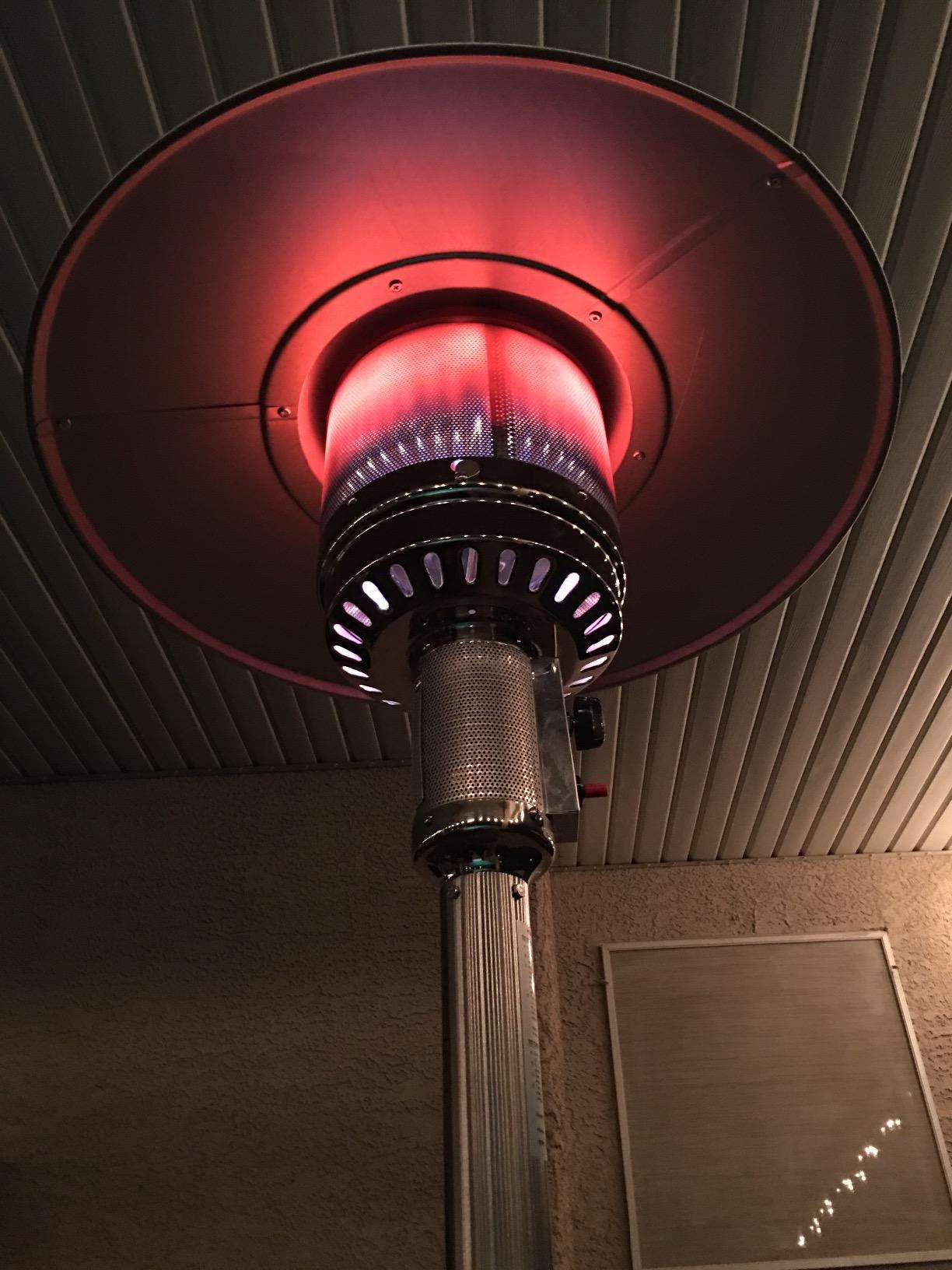
The adjustable table is the part that earns its keep at a dining setup. It can be raised and lowered, which means drinks can sit at a height that suits the group rather than a fixed perch. Wheels make repositioning between a breakfast table and a later evening conversation area straightforward, which is the real flexibility argument for a standing heater over a fixed installation.
Honest expectations: the 4.2-star average is the second-lowest in this roundup, with a higher share of one-star reviews than the leaders. Buyers who rate it low tend to want a more modern silhouette or report assembly and ignition friction. Nothing we found suggests a hardware failure pattern. The styling reads as dated next to a pyramid or a directional unit, and that is a taste judgment rather than a quality one.
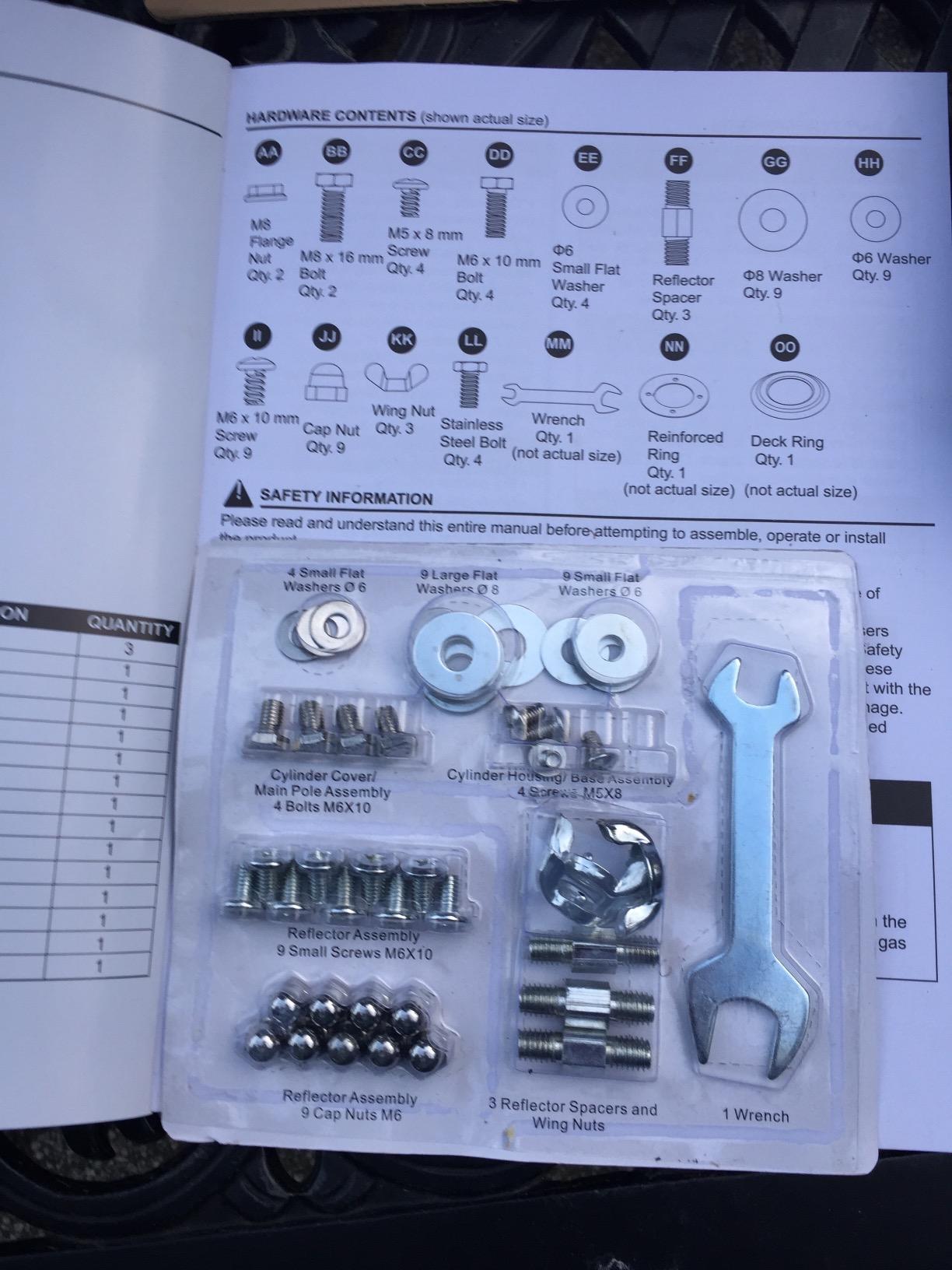
Output and the 10 to 15 foot coverage range
The published range rather than a single number is the manufacturer being honest about variance. Near a table edge, expect a warm zone of roughly 5 to 7 feet, which suits a four to six person dining group. The mushroom geometry again radiates from a high reflector, so placement at the end of the table beats placement at the center.
The adjustable table and what it is actually for
Understand clearly that a table top on a patio heater is a surface, not a heat source. Its value at an outdoor dining table is that it becomes the shared landing spot for drinks and phones so that the actual table stays clear for plates. On this model the adjustability lets that surface match the group rather than forcing everyone to reach up.
Warranty, parts and long-term serviceability
All Hiland products carry a 1-year limited warranty with a 30-day replacement parts policy, and the company maintains a full parts line and an in-house repair center. For a purchase that sits outdoors for a decade, a real service channel is worth more than a longer warranty from a seller who has no replacement hardware. Weigh the 1-year term against the parts availability before ruling it out on warranty length alone.
Construction details worth knowing
Wheels are included and matched to the adjustable table, the fuel is propane, and the mounting type is a protruding freestanding tower. The dimensions are 18 inches deep by 18 inches wide by 87 inches tall, one of the slimmer footprints here, which is helpful when the heater shares a patio with a dining set. Weight is not published, so plan for a two-person lift if the base is full.
Who this heater is for, and who should skip it
Choose it if repairability over a decade matters to you more than contemporary styling, and if your outdoor furniture is traditional. Skip it if you want the strongest new hardware in the category, in which case a double-layer 304 stainless burner is a real upgrade. Skip it if you plan to move the heater frequently, because the mushroom dome is the least convenient shape to lift.
5. Hykolity 50,000 BTU Patio Heater – Best Value Per Dollar of Heat
Hykolity 50,000 BTU Patio Heater for Outdoor Use, Propane Patio Heater
50,000 BTU
200 sq. ft. coverage
Battery-free piezo ignition
87.25 inch pedestal
Multi-speed heat control
+ Pros
- Battery-free piezoelectric one-button ignition
- 50000 BTU across roughly 200 sq. ft.
- Multi-speed temperature adjustment handles mild and cool evenings
- Wheels and rainproof construction
- Built-in table top for drinks and snacks
- Cons
- Table top and post design is utilitarian rather than decorative
- Some buyers report needing extra care in wind
Most heaters in this category make you replace a battery or hold a lighter to a pilot. This one uses piezoelectric ignition, which means pressing the button produces its own spark and there is nothing to maintain between seasons. For a heater that lives outside and gets forgotten, that single design decision removes an entire category of first-of-season frustration.
At 50,000 BTU across a claimed 200 square feet, the raw output matches the top of the roundup, and the 4.5-star average across 511 reviews puts it comfortably ahead of most of the field. Multi-speed temperature adjustment lets you dial down for a mild evening and up for the first cold night, which is exactly the shoulder-season use pattern outdoor dining depends on.
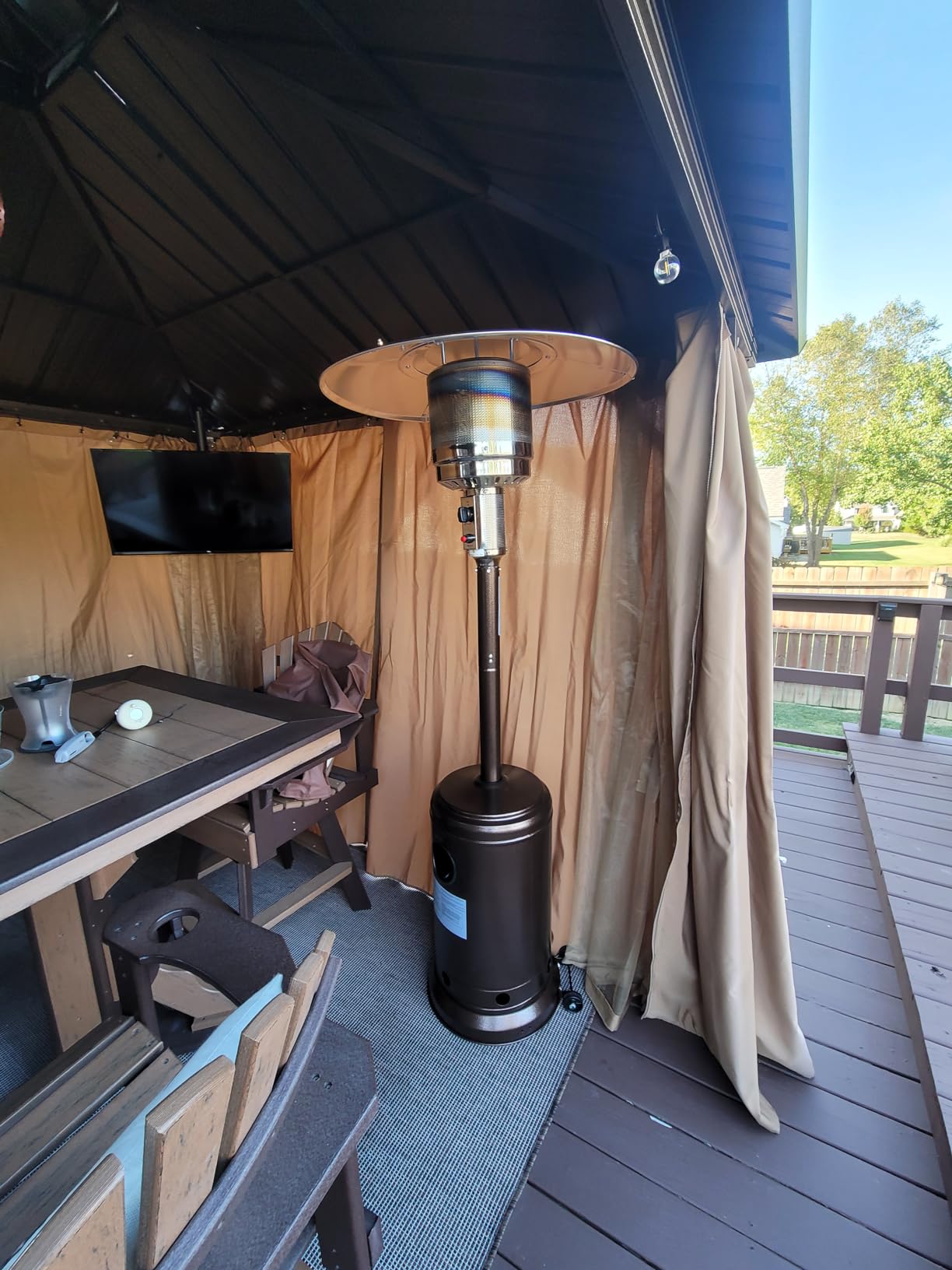
Construction is waterproof and rainproof, with an insulated waterproof switch and an umbrella-like top designed to distribute heating more uniformly. Assembly takes under an hour with all parts included, which matters more than it sounds if you are building the setup on a Saturday morning before a dinner party. Wheels are sturdy, and a table top is built in for drinks and snacks.
Where it falls short is aesthetic and situational. The table top and post design read as utilitarian rather than decorative, so it will not win a design award. And some buyers report needing extra care in wind, which makes sense: the triple protection system is present, but the base is not as purpose-built for weighting as a unit with a dedicated water tank.
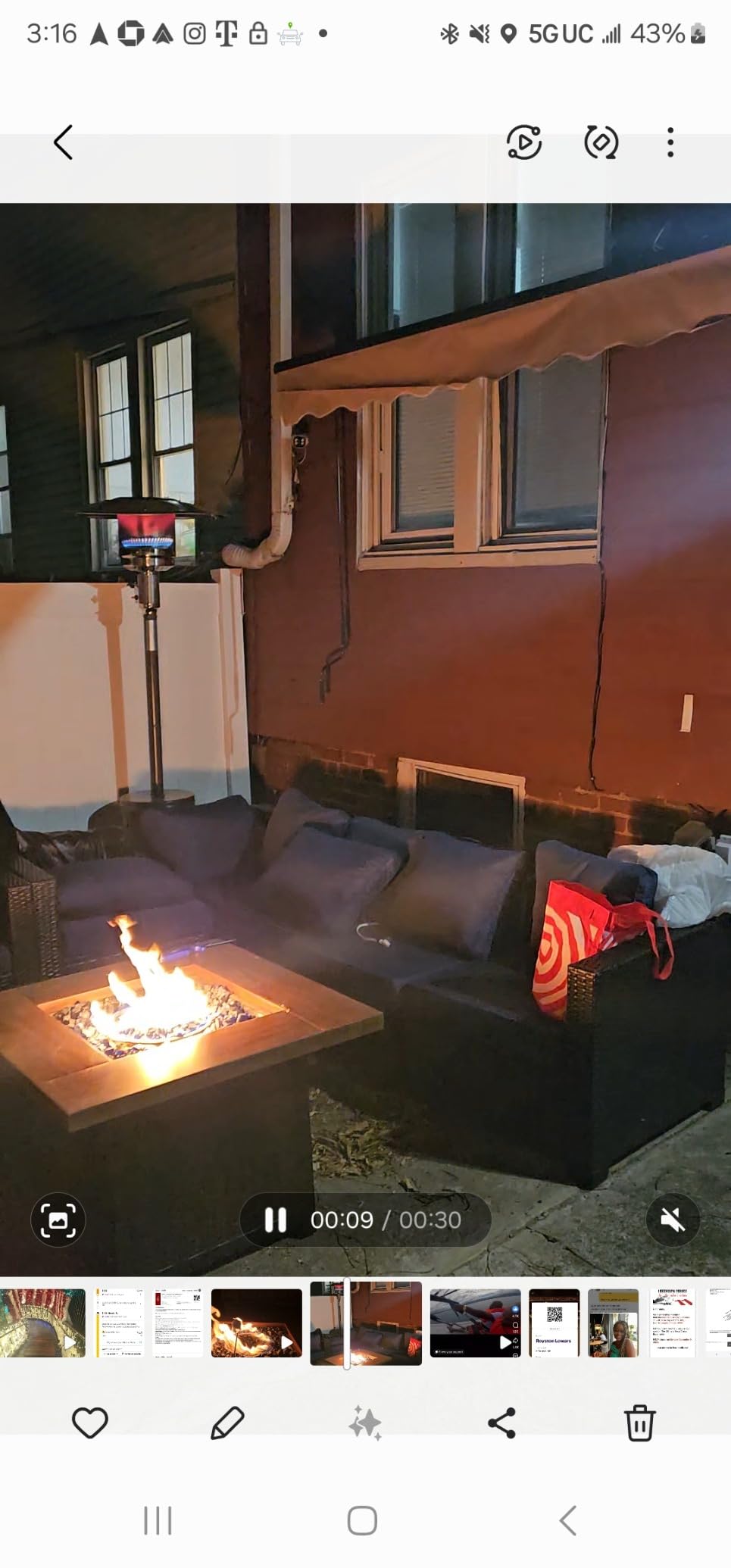
What 200 square feet of claimed coverage means
Two hundred square feet is roughly a 14 by 14 foot area, which is a realistic outdoor dining zone for a table plus surrounding seating. As with every figure in this category, treat it as a manufacturer boundary rather than a comfort guarantee. Plan for a genuinely warm zone of about 6 to 8 feet from the emitter at seated height, and one heater will not comfortably serve a 12 by 20 deck.
Piezoelectric ignition and season-to-season reliability
A piezo igniter generates its spark mechanically and has no battery, no pilot, and no consumable. Over a five or six season life that removes a failure point and a maintenance step. Owners consistently single out the single-button start as the reason this unit is easy to recommend, and there is no battery to find when the first cold evening arrives.
Multi-speed control for the shoulder season
The multi-speed adjustment is more valuable at an outdoor dining table than anywhere else, because most evenings in the shoulder season do not need full burner output. Running a heater at partial output extends cylinder life and keeps the radiant temperature in a range that feels like a mild evening rather than a summer afternoon with a torch pointed at you. The control valve sits at the base for easy reach while standing.
Footprint, weather resistance and assembly
Dimensions are 33 inches deep by 18 inches wide by 87.25 inches tall, a slim pedestal profile. The waterproof and rainproof construction with an insulated switch is a genuine advantage for an uncovered patio where morning dew and passing showers are guaranteed. A rainproof design does not replace a cover, but it means an unexpected downpour is not an emergency.
Who this heater is for, and who should skip it
This is the pick for anyone who wants maximum BTU per dollar and does not care about how the patio looks. Skip it if appearance is load-bearing in your outdoor space, since the utilitarian post and table design will not blend with refined furniture. If wind is constant on your site, choose a model with a dedicated weighted water tank instead.
6. Pamapic Round Table 50,000 BTU Patio Heater – Best for Larger Groups
Pamapic Outdoor Heaters for Patio with Round Table Design, Premium 304 Stainless Steel Burner, Triple Protection System Propane Patio Heater for Porch Garden, Residential & Commercial Use
50,000 BTU
314 sq. ft. coverage
304 stainless burner
Round table top
87.8 inches tall
CSA certified
+ Pros
- Evenly distributed radiant heat that keeps a whole group comfortable
- Round table top well sized for drinks and snacks
- Clear instructions and bagged labeled hardware make assembly smooth
- Wheels make repositioning easy
- Replacement parts shipped quickly when an issue arose
- Cons
- Delivered in two boxes so parts may arrive separately
- Some buyers perceive less real output than the rated 50000 BTU
- Slightly uneven burner flame height on one side reported
This is the model we would put in the middle of a large outdoor dining table rather than at the end of it, and that is the whole point. At 50,000 BTU across a claimed 314 square feet, it is the largest stated coverage area in this roundup by a wide margin, and the conical design with an aluminum top cover is engineered to concentrate heat rather than lose it upward.
Owners describe the heat as evenly distributed, which is the phrase that matters for a group. An outdoor dining table fails socially when one end is warm and the other is not, and a conical reflector plus a wide cone is how you avoid that. Rapid heat-up in about one minute also means it is viable to run it only for the duration of dinner rather than leaving it burning while the space is empty.
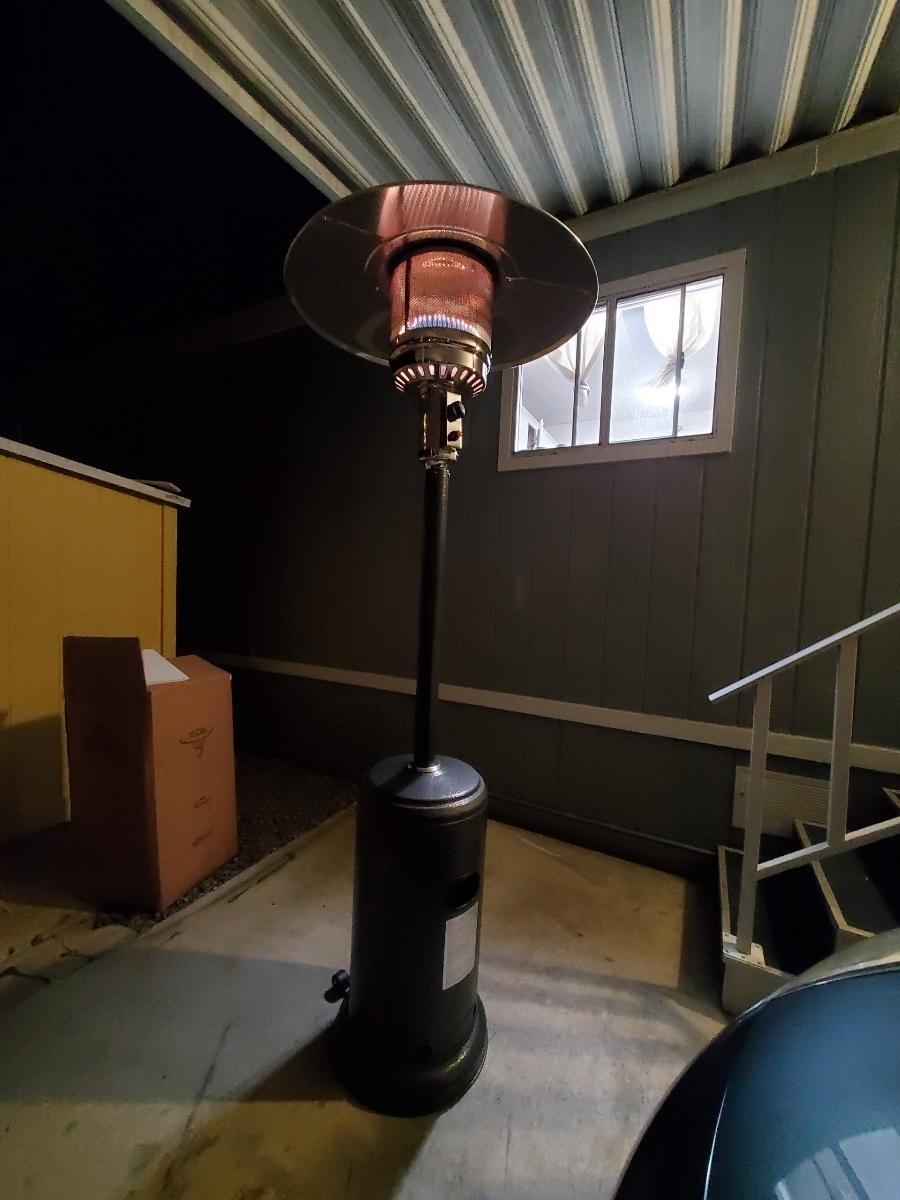
The round table top is generously sized, which makes this the most genuinely useful table surface in the group. Drinks for eight, a serving platter, and phones all fit without crowding. Beneath it, a magnetic locking tank door keeps the cylinder compartment tidy, and a 20 lb cylinder swaps without lifting the housing. The burner is premium 304 stainless, and the unit is CSA certified.
Two practical notes. This product is delivered in two boxes that may arrive separately, so wait for every part before you start assembly, which owners confirm is well labeled and bagged. And a few buyers perceive less real-world output than the rated figure, so if you are on the edge of whether you need this much capacity, size for your space rather than for the rating.

314 square feet and what a large group actually needs
Three hundred and fourteen square feet is roughly 17 by 17 feet, a zone that comfortably holds a long outdoor dining table plus chairs with circulation around it. For a group of eight to ten seated, this is the coverage rating that matches the use case. The counterpoint is that claimed area and felt warmth are different measures, and our guidance is to plan a warm zone of about 7 to 9 feet from the base at seated height.
Heat concentration: aluminum top cover and conical body
The aluminum top cover sits above the burner and is designed to reduce heat loss out of the top of the unit. That is a meaningful design choice in a category where a surprising amount of output escapes upward into the night sky. The conical body then shapes the remaining energy into a wide, even footprint, which is exactly what a round dining table needs.
Triple protection and tip-over behavior
The system combines a conical wind-resistant design, a tip-over cut-off beyond 45 degrees, and a flame-failure shut-off device. Tip-over protection matters most on a deck with children or pets, and a flame-failure device is what closes the gas valve if the flame goes out unexpectedly rather than letting unburned gas accumulate. Read your local code before assuming any placement is permitted.
Assembly, delivery and warranty service
Owners single out the clear instructions and bagged, labeled hardware as making assembly smooth, and multiple reviewers mention that replacement parts arrived quickly when something went wrong. Wheels are built in for repositioning. The two-box delivery is the main friction point, and the fix is simply to wait until all boxes have arrived before beginning.
Who this heater is for, and who should skip it
Choose this for a genuinely large table, a big covered patio, or a space where you regularly host groups of eight or more. Skip it if you are heating a four-person bistro table, where the capacity is more than the space needs. If uneven burner flame is something you find unsettling, verify the burner after assembly, because a small number of owners report a taller flame on one side.
7. FOOWIN 48,000 BTU Pyramid Patio Heater – Best Budget Pyramid
FOOWIN Patio Heater 48,000 BTU Outdoor Propane Heater with Wheels
48,000 BTU
Quartz glass tube element
130 sq. ft. coverage
81.4 inches tall
45 degree tip-over shutoff
+ Pros
- Attractive pyramid silhouette and quartz tube look better than a classic mushroom
- 48000 BTU heats up in about 5 minutes
- Good packaging and included tools sped up assembly
- Waterproof cover and gloves included
- Lifetime warranty service with 24 hour after-sales support
- Cons
- Some units arrive with bent structural parts and soft screws that strip easily
- Tall design concentrates heat at the top
- Manual print is small
Owners of this heater are unusually consistent about why they bought it. It looks better than a mushroom. The pyramid silhouette with a decorative quartz glass tube reads as intentional patio design rather than utility hardware, and at 81.4 inches this is the shortest standing unit in the roundup, which means the emitter sits lower and closer to seated height than a 91-inch tower.
That lower profile is the quiet reason to like it for dining. Even though the shape is still a tall tower, the 10-inch height reduction from the leaders translates directly into radiant energy reaching a seated head rather than passing over it. At 48,000 BTU across a 130 square foot, or 10-foot, coverage, the cone is narrower than a 314-square-foot unit, so it suits a table rather than a whole deck.
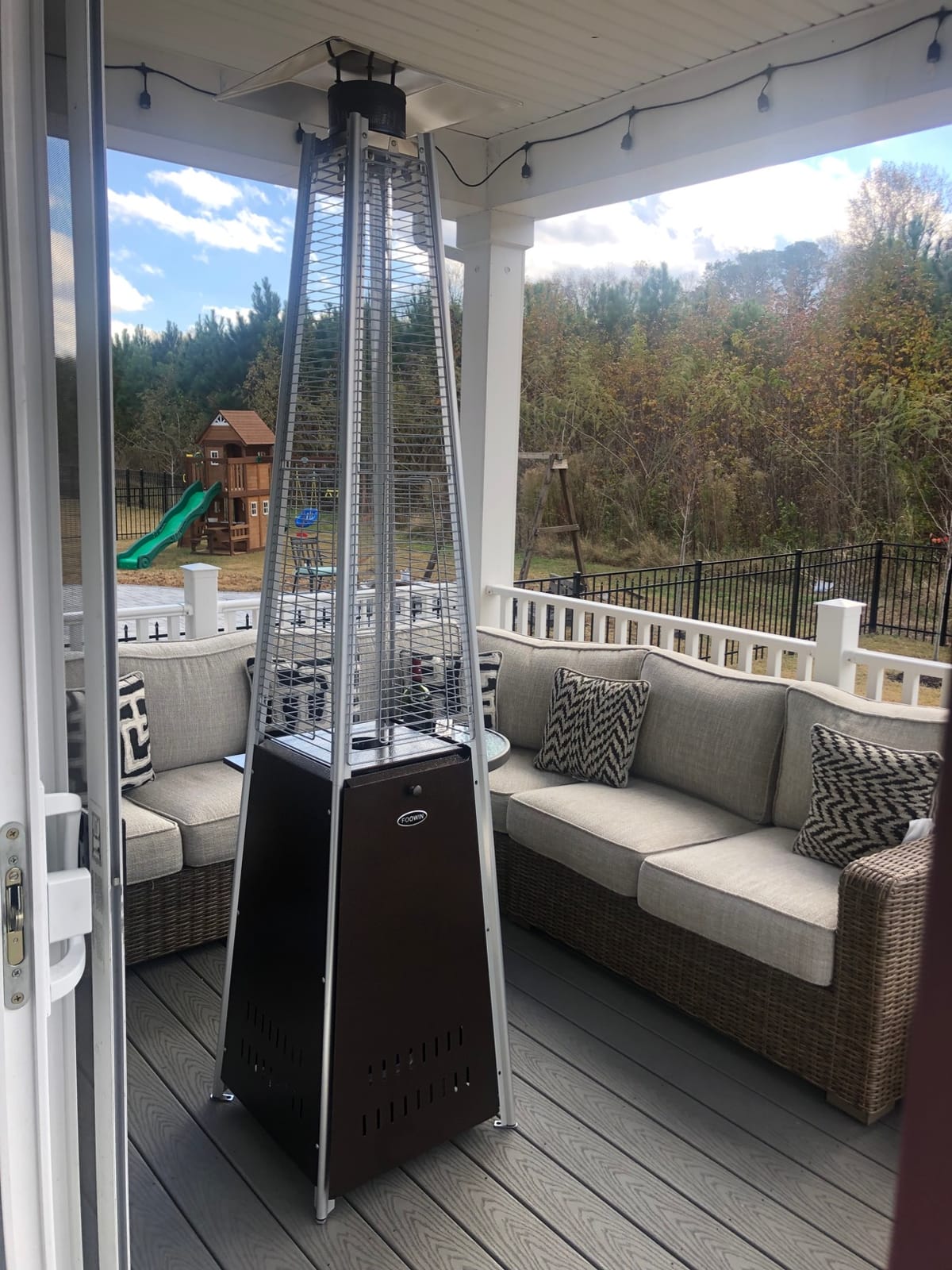
The safety package is genuinely good for the class. Auto shut-off when tilted beyond 45 degrees, an explosion-proof pipe, and protective nets are all present, and the manufacturer reports running 10,000 automatic flame-out tests before shipping. A waterproof cover and a pair of operating gloves are in the box, and the warranty service is described as lifetime with 24-hour after-sales response. Owners report fast replacement of a burner after a fault.
The honest weakness is arrival condition. Several reviewers report units arriving with bent structural parts and soft aluminum screws that strip easily, which is a packing and component-quality issue rather than a design flaw. It is fixable, but budget an afternoon and a set of better fasteners the first time you assemble it. The manual print is also small enough that you may want the full instructions online.
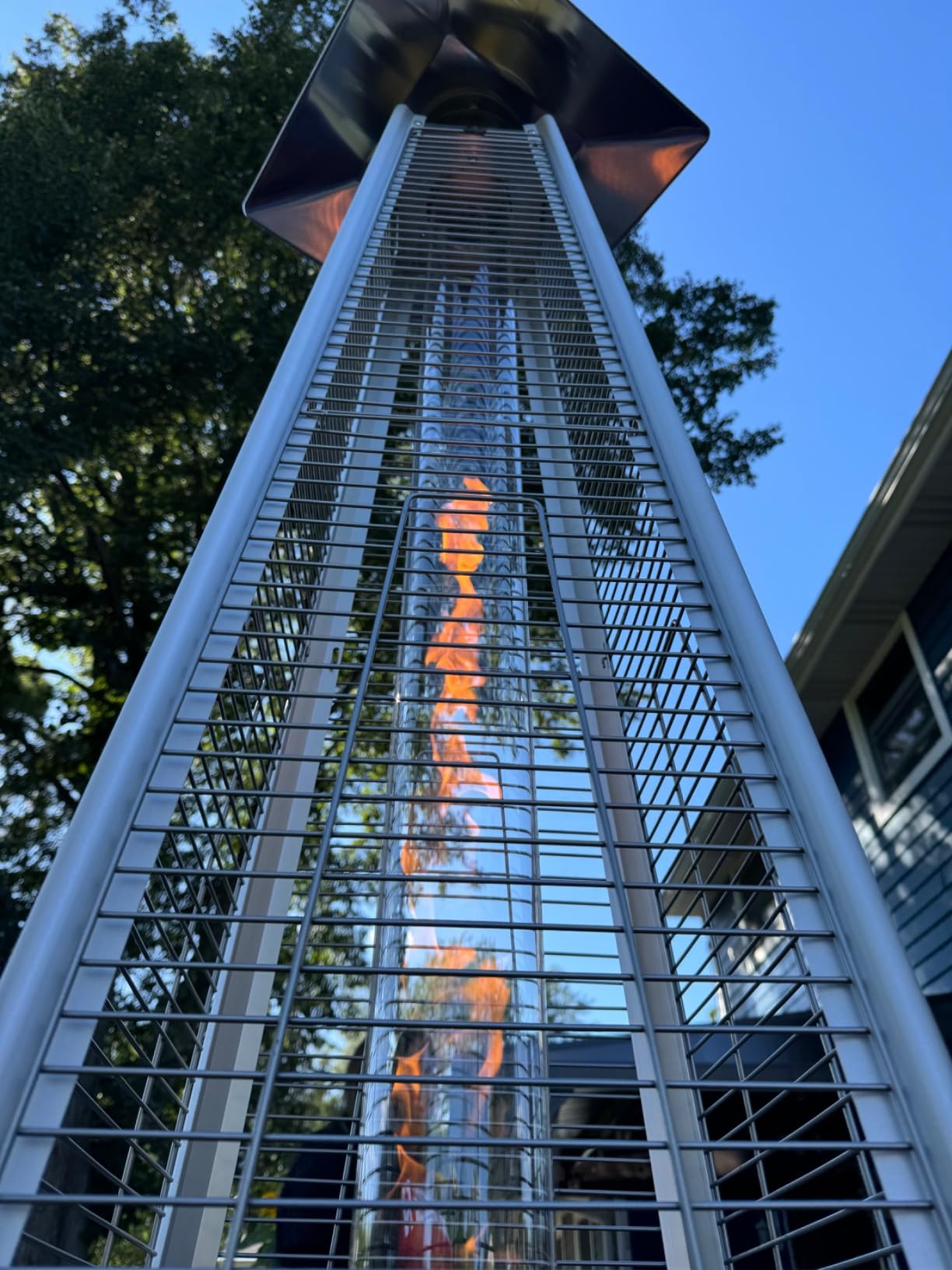
Why the 81.4 inch height helps a dining table
Height is the quiet variable in patio heater performance. Dropping the emitter from 91 inches to 81 inches moves the radiant plane roughly 10 inches closer to a seated diner, and it also means the cone hits the table rather than the space above it. At 50.7 pounds it is heavy enough to stay put, and the built-in wheels are the reason that weight is workable.
Aluminium and stainless construction against weather
The frame combines aluminium and stainless steel with a corrosion-resistant finish, which is the right material pairing for a unit that sits through autumn rain and winter condensation. A quartz tube is more fragile than a stainless dome, so the corrosion advantage does not eliminate the wind risk, but it does reduce the rust-through problem that ends cheaper heaters after two or three seasons.
Five-minute heat-up and one-touch control
Owners report heat-up in about five minutes with one-touch ignition and a built-in control valve. For outdoor dining that is a useful figure, because it means you can light the heater as guests arrive rather than twenty minutes before, saving both fuel and the frustration of sitting in the cold waiting for it to do something.
Arrival condition and what to check on day one
Inspect the frame for bends and the fasteners before assembly, because several units reportedly arrive with both. Photograph everything before you build it, keep the packaging until the heater has run a full cycle, and expect a manual in small print. None of this is disqualifying, but a slow first assembly is the reality of this particular heater.
Who this heater is for, and who should skip it
Choose it if you want the pyramid look and the lower emitter without the premium tier pricing, and if you are willing to spend an hour on assembly. Skip it if you want a turnkey setup with no build, or if your site is exposed and you need a guaranteed wind rating you can quote from a manual. For a fully assembled alternative with a weighted base, look at the round-table design earlier in this list.
8. Hampton Bay 11,000 BTU Tabletop Heater – Best Tabletop Coverage Claim
Hampton Bay Tabletop Propane Gas Patio Heater 11,000 BTU Stainless Steel
11,000 BTU
175 sq. ft. claimed coverage
Bronze powder coating
Stainless steel construction
Auto shutoff tilt valve
+ Pros
- Compact tabletop format sits neatly on a picnic or dining table
- Adjustable heat output up to 11000 BTUs
- Tilt auto shut-off valve adds safety
- Stainless steel construction built to last
- Cons
- Some units shut off prematurely from a thermocouple or bracket fault
- Assembly is fiddly
- 1 lb cylinders burn quickly so an adapter hose to a larger tank is advisable
This is the only unit in the roundup that claims 175 square feet of coverage from 11,000 BTU, a figure that looks ambitious next to the 30 square feet a comparable tabletop claims. Read that as a manufacturer boundary measured to a manufacturer-defined limit rather than a promise, because 11,000 BTU cannot physically heat 175 square feet the way a 50,000 BTU tower heats 314.
What it does well is fit. This is a bronze powder coated tabletop unit in a tower form, and for a small lanai, a covered porch nook, or a four-foot picnic table it is the least disruptive object in this list. There is no 87-inch pole standing beside your furniture, no wheel to drag across the deck boards, and nothing to store indoors except the heater itself.
Adjusted output via a dial, an auto shut-off tilt valve for safety, and stainless steel construction round out a package that is honest about being a small-area device. It is the right shape of answer for a compact outdoor dining spot that a standing tower would overwhelm.
Reading the 175 square foot claim honestly
Coverage claims in this category are measured differently by every manufacturer, which is why two 11,000 BTU units can advertise 175 and 30 square feet and both be technically defensible. Our guidance: for an outdoor dining table, plan on a genuinely warm zone of roughly 3 to 4 feet around the unit. That is enough for two to four people sitting close, and not enough for a six-top.
Tilt shut-off and tabletop safety
The auto shut-off tilt valve is genuinely useful on a tabletop unit because a table gets bumped. Combined with a 1 lb cylinder rather than a 20 lb one, the consequences of a tip are small, but the shut-off still prevents an uncontrolled burn. Stainless steel construction also matters here for a reason specific to tables: a device that sits at the end of a dining surface gets touched, moved, and occasionally knocked by a sleeve.
The 1 lb cylinder problem and the adapter hose
Owners consistently recommend connecting to a larger tank with an adapter hose, and we agree. A 1 lb cylinder burns through in a short sitting, and a dinner party involves more runtime than you estimate. The adapter hose turns a nuisance into a genuinely usable patio device, and it is the single accessory worth adding to any tabletop propane heater.
Assembly, quality control and the rating
At a 4.1-star average across 310 reviews this is the lowest-rated unit in the roundup, and the reasons are specific rather than general. A portion of owners report units shutting off prematurely due to a thermocouple or bracket fault, which is a quality control issue on a component whose job is to detect flame. Assembly is also described as fiddly. Test the unit for two or three full dinners inside the return window before you commit to keeping it.
Who this heater is for, and who should skip it
Choose it for a small lanai, a covered porch corner, or a four-foot table where a standing heater would be absurd. Skip it for a six or eight person outdoor dining table, where the warm zone is too small to matter. If you are sensitive to reliability, pick a tabletop unit with a better review history instead, since this category has limited tolerance for a thermocouple that shuts off early.
9. Cuisinart 11,000 BTU Tabletop Patio Heater – Best for Portable Tables
Cuisinart Patio Heater, Tabletop, Anti-Tilt Safety Switch, 11,000 BTU, Gray
11,000 BTU
Up to 30 sq. ft. coverage
25.2 inches tall
8.5 pounds
Anti-tilt shutoff and screen guard
+ Pros
- Reliable easy ignition compared with other tabletop heaters
- Substantial heat output for an 8.5 pound unit
- Anti-tilt shut-off and burner screen guard
- Elegant lighthouse styling that suits a patio table
- Runs on 1 lb canisters or a 20 lb tank with an optional regulator
- Cons
- 30 sq. ft. radius is short for an open patio
- 1 lb propane cylinders run out in roughly 10 to 14 minutes
- Output drops noticeably in an open-sided covered patio
- Assembly takes some care
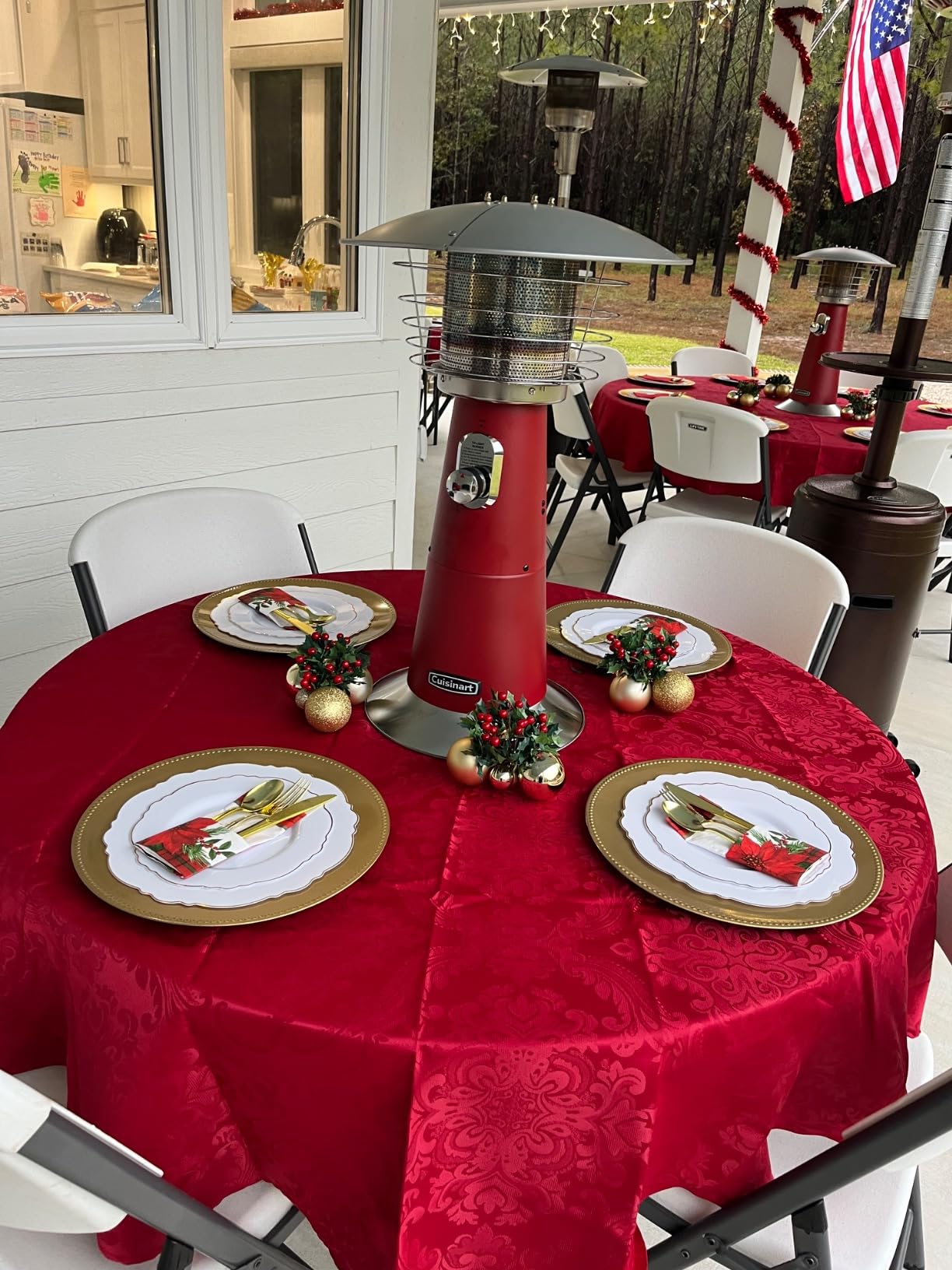
This is the tabletop heater we would actually put on a dining table. At 8.5 pounds it is light enough to carry with one hand, and the lighthouse silhouette with a reflector top plate looks considered rather than utilitarian. Owners consistently report that it starts more reliably than competing tabletop units, which is the failure mode that decides whether a small heater is charming or maddening.
Substantial output is the phrase reviewers use for 11,000 BTU from a unit this size. The reflector top plate distributes heat evenly across the immediate area rather than throwing it in one direction, which is exactly the behavior you want when people are seated on all sides of a round bistro table.
Two numbers frame the use case honestly. Coverage is listed at up to 30 square feet, and 1 lb propane cylinders can run out in roughly 10 to 14 minutes. Ten minutes is not a dinner, which is why the optional regulator for connecting to a 20 lb tank matters so much. Owners who buy the regulator report the unit becomes a genuinely practical outdoor dining heater rather than a novelty.
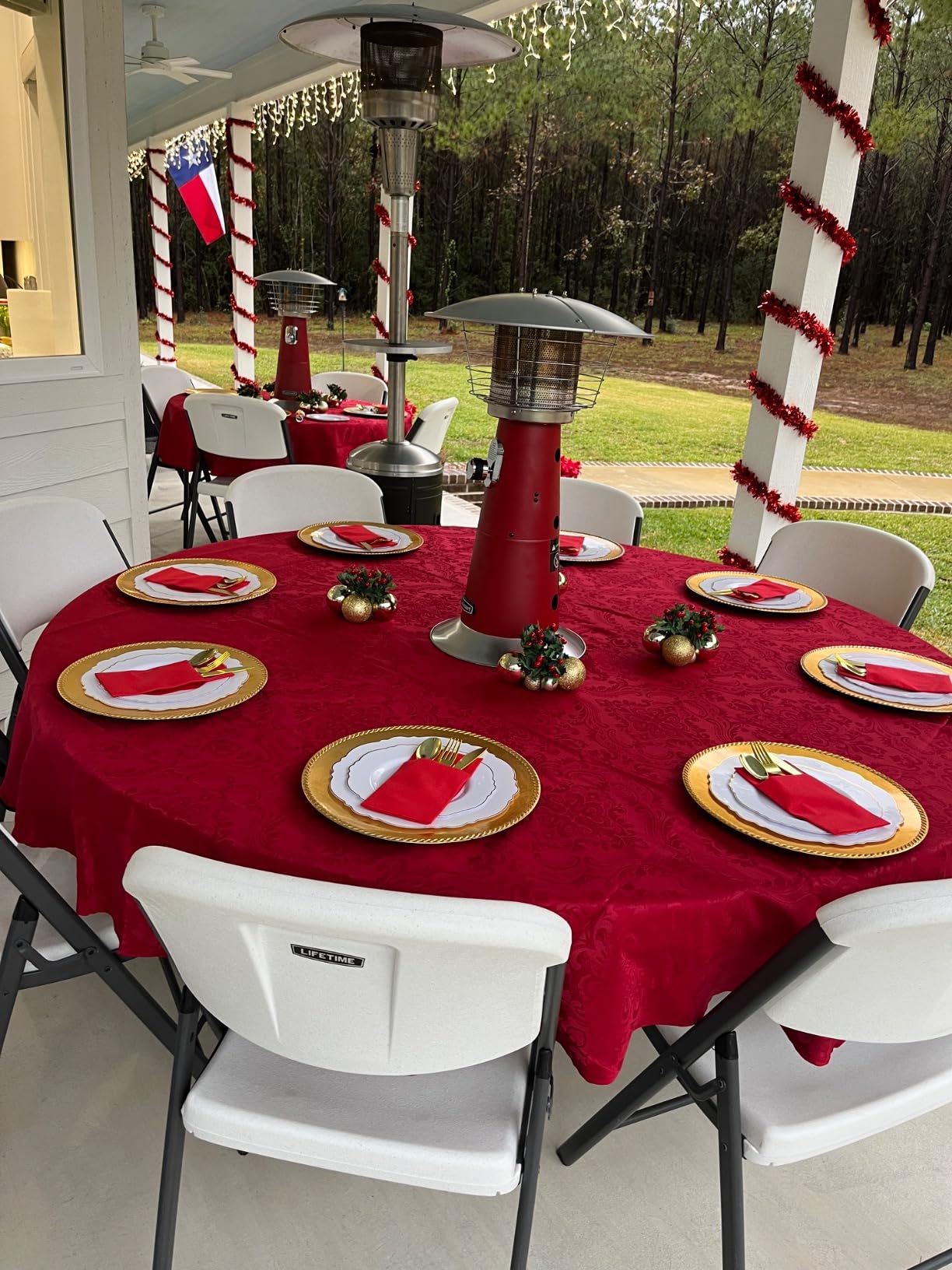
The safety hardware is well specified for a device sitting at table height: a built-in anti-tilt automatic shut-off and a burner screen guard. A dial knob gives low, high, or in-between settings, and a maximum temperature setting of 120 degrees Fahrenheit keeps the output in a range that warms hands and food without scorching anything. Finishes include red, dark gray, bone, and sage.
Expect a smaller zone than the marketing implies. Reviewers note output is noticeably lower in an open-sided covered patio, which is the radiant geometry rule again: a tabletop unit works best when wind is broken and the seating is within arm’s reach. It is also the best portable option for tailgating and camping, where a full cylinder is not practical anyway.
Why 30 square feet is the honest number
Compare this honestly to the 175 square foot claim on the other tabletop unit in this roundup. Thirty square feet is a circle roughly 7.7 feet across, which is a realistic description of a warm zone from an 11,000 BTU source. We plan seating within 3 to 4 feet of the unit, and that supports two to four people around a bistro table.
Anti-tilt shut-off and the burner screen guard
Both features are non-negotiable on a tabletop device, and this unit has both. The anti-tilt switch cuts fuel when the unit is knocked past a threshold, and the screen guard sits between the flame and the air you breathe near. On a table full of plates, glassware, and sleeves, the physical risk is small but the features are cheap insurance and clearly worth specifying.
Fuel flexibility: 1 lb canisters or a 20 lb tank
The unit runs on a standard 1 lb propane tank out of the box, and owners who want longer runtimes connect a 20 lb cylinder with an optional regulator that is not included. For outdoor dining, buy the regulator. A 10 to 14 minute runtime on a 1 lb cylinder is fine for a tailgate and useless for a dinner conversation, and the regulator is the cheapest fix in this category.
Portability and the dining table use case
At 12.4 inches deep by 16.34 inches wide and 25.2 inches tall, this fits on a table without crowding it, and at 8.5 pounds it moves between the patio, a balcony, and a tailgate without ceremony. That portability is the genuine differentiator. Nothing else in this roundup lets you follow the meal from a market umbrella to a fire pit to a camping site.
Who this heater is for, and who should skip it
Choose it for a bistro table, a small balcony dining set, or anywhere you want warmth to travel with you. Skip it for a six or eight person outdoor dining table, because the zone is not big enough and the noise and cylinder logistics multiply. If your patio is fully open on one side, add a windbreak before you expect this to perform.
10. Cuisinart Perfect Position 38,200 BTU Patio Heater – Best for Directional Heat
Cuisinart Perfect Position Propane Patio Heater, 38,200 BTU Powerful Directional Stainless Steel Outdoor Heater with Hidden Tank and Drink Table, Swivel Arm and Reflective Heat Shield
38,200 BTU
Swivel arm with 33 inch heat shield
Cone-shaped burner
Drink table
88 inches tall
+ Pros
- Swivel arm directs warmth toward where diners actually sit
- Cone-shaped burner and 33 inch shield throw heat down and outward
- Stainless drink table and hidden tank base keep the footprint clean
- Sand-filled wheeled base adds stability
- Arm folds down for compact storage
- Cons
- 38200 BTU is lower than 50000 BTU mushroom and pyramid models
- About 100 pounds with a large footprint
- 20 lb propane cylinder not included
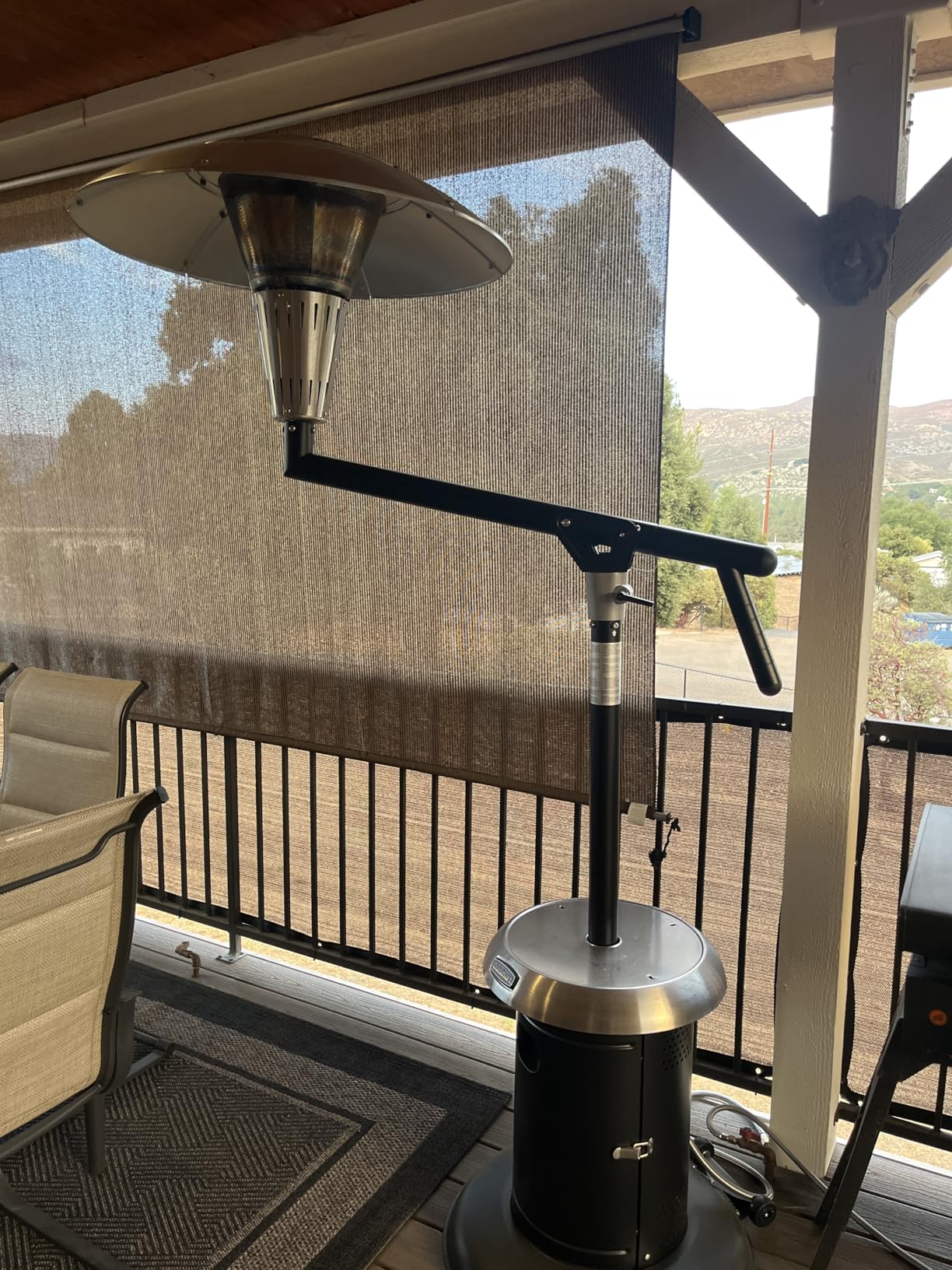
This is the only heater in the roundup built around the seated dining problem rather than the patio problem. The swivel arm directs heat left or right, so you can aim the cone at a specific seating area instead of wasting it on the space between two sofas. It is also the only design here that throws heat downward and outward on purpose, using a cone-shaped burner and a 33-inch reflective heat shield.
At 38,200 BTU the raw number is the lowest of the standing units here, and we want to be direct about that. Lower BTU is not lower usefulness when the geometry is aimed correctly. A 38,200 BTU directional emitter pointed at a table will outperform a 50,000 BTU mushroom whose cone is mostly overhead, because radiant energy is wasted the moment it travels somewhere no one is sitting.
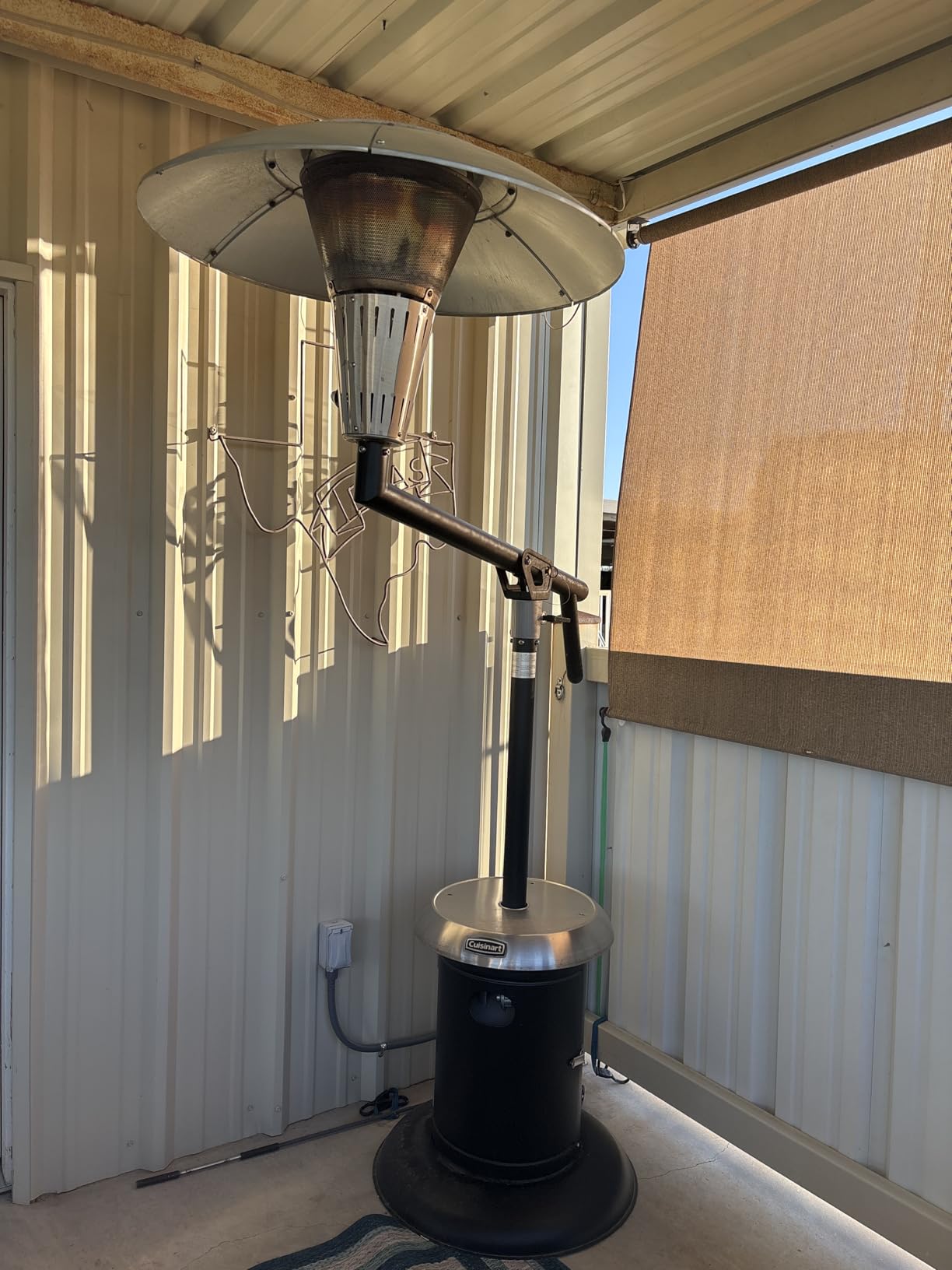
The built-in stainless steel drink table adds a landing surface for glasses in a way the other table tops do not, and the enclosed base discreetly stores a 20 lb propane cylinder with gas controls accessible at the front. The sand-filled wheeled base is both the stability mechanism and the reason the unit stays planted. The swivel arm folds down, so this is one of the few tall heaters you can actually store in a garage with reasonable effort.
Weight is the real cost. At 100 pounds this is by far the heaviest unit in the group, with a 58 by 33 inch footprint. That size is a genuine consideration for a balcony or a small patio, and the sand-filled base is heavy to refill. The 1-year limited warranty is the shortest coverage on the premium end, and the cylinder is not included.
Swivel arm mechanics and dining usefulness
Owners consistently cite the swivel arm as the reason they bought this heater, and it is a simple idea that solves a real layout problem. An outdoor dining area often has a table plus a sofa or a second seating group, and a fixed cone cannot serve both. Swiveling the arm toward whichever side you are using means one heater covers a larger effective footprint than its 175 square foot rating suggests.
Cone-shaped burner and the 33 inch heat shield
The cone-shaped burner and reflective shield work together to push energy down and outward instead of up. This is the single most important spec on this heater for a dining application, and it is the reason a lower BTU figure still produces good results at table height. The 175 square foot listed coverage is a real number for a directional unit, unlike the inflated figures common on round heaters.
Hidden tank base, drink table and the clean footprint
The enclosed base conceals a 20 lb cylinder and keeps gas controls reachable from outside, which means you can swap a cylinder without lifting a housing or dragging the unit. The stainless drink table is genuinely functional for an outdoor dining setup, and the combination means the heater reads as furniture rather than as equipment.
Weight, footprint and storage
At 100 pounds and 58 by 33 inches, this is the least maneuverable heater here. The wheels exist, but the sand-filled base is the first thing you remove before moving and the last thing you add afterward. The folding arm is the compensating feature: it cuts the height enough that this can go in a garage with a standard door opening, which very few 88-inch heaters can.
Who this heater is for, and who should skip it
Choose it if your outdoor dining space has more than one seating zone, or if you are heating a specific table rather than a whole patio. Skip it if you need to move the heater frequently, if balcony weight or space is a constraint, or if you want the highest raw BTU figure available, since three units here beat it. It is also the least economical choice per hour of output, so it works best in tandem with lower output rather than at full burn.
How Long a 20 lb Propane Cylinder Lasts and What a Tank Swap Really Costs
Run time comes down to one number: propane carries roughly 91,452 BTU per gallon, and a 20 lb cylinder holds about 4.7 gallons. At 50,000 BTU per hour you burn about 5.4 lb per hour, which means a full 20 lb cylinder gives you roughly 3.5 hours of continuous burn. On a 46,000 BTU heater you get a bit closer to 4 hours. Turn the burn down on a mild evening and both numbers stretch considerably.
Tabletop units behave completely differently. A 1 lb propane cylinder on an 11,000 BTU heater is empty in roughly 10 to 14 minutes, which is why every serious tabletop buyer adds an adapter hose to a 20 lb cylinder instead. For an outdoor dining table, the 20 lb cylinder is not a convenience, it is a requirement.
20 lb cylinder on a 46,000 to 50,000 BTU standing heater: roughly 3.5 to 4 hours of full-output burn per fill.
Partial output on a shoulder-season evening: expect materially longer, because most dinners do not need full burner output.
1 lb bottle on an 11,000 BTU tabletop heater: roughly 10 to 14 minutes, which is one course of a meal at best.
Season planning: a family that dines outside three evenings a week for a season consumes multiple cylinders, and refill economics dominate the running cost.
Where people lose money is the swap. Exchange cage cylinders are routinely filled to around 15 lb rather than a full 20, so you are paying for propane you do not get. A refill station fills to capacity, and refill exchange programs commonly return significantly more propane for the same outlay. If you want to know which option is cheaper per hour of heat, count the pounds actually delivered rather than the pounds advertised.
None of this changes the ranking, but it changes which heater is cheap to run. A lower-BTU unit that serves a table well can cost less per comfortable hour than a 50,000 BTU tower burning at full output to cover a deck nobody is standing on. Efficiency on a patio means heat delivered to people, not fuel consumed.
Safety First: Clearances, Pergolas, Wind and Carbon Monoxide
Propane patio heaters are outdoor appliances with real rules, and the rules come from the manufacturer manual rather than from a listing photo. Read the manual for your specific model before the first burn, and treat the numbers below as the reason to go read it rather than as a substitute.
Clearance to combustibles. Every manual publishes a clearance figure above and beside the unit for overhead structures. Treat that number as a hard floor, not a target, and never place a heater under a wooden pergola beam or a fabric umbrella canopy that sits inside the published clearance.
Wind limits. Manufacturers publish maximum wind conditions, and one of the heaters in this roundup is explicitly not recommended above force 6 on the Beaufort scale. Wind is the universal killer: it tips heaters, and it shatters quartz glass tubes. Shut the unit down and bring it in when conditions exceed its rating.
Tip-over protection. Every unit here has some form of tip-over or anti-tilt shut-off. Verify it works by tilting the cold unit before the first dinner rather than discovering it does not during a gust.
Base weighting. A water box, a sand tank, or a sand-filled base exists to keep the heater planted. Fill it. An empty base on a deck is a tip-over waiting for a gust, and a toppled heater near a railing is a hazard to everyone at the table.
Carbon monoxide. Propane combustion produces carbon monoxide, which is why these are outdoor-use appliances. Never run one in an enclosed space, a garage, or a screened-in room without substantial ventilation. Homeowners on r/HomeImprovement reach the same conclusion on covered porches, where propane requires ventilation and electric is often the more practical answer.
Deck material and clearance. A wooden deck is combustible. Maintain the published clearance from decking, keep the cylinder upright and secured, and use the tank security chain where one is provided.
Cylinder handling. Swap cylinders outdoors, away from an open flame, check the hose connection for leaks, and close the valve when not in use. Do not refill a warm cylinder.
One more rule that owners on r/DIY with roofed decks follow carefully: an existing gas fireplace and a propane patio heater on the same deck is asking for a combustion accident if the fireplace flue is compromised. Have any venting checked before adding a second combustion appliance to an enclosed or roofed space.
How to Choose a Propane Patio Heater for Outdoor Dining
Most people buy a patio heater by BTU, which is the wrong first decision. Walk through these in order and the BTU number will choose itself.
Step one: measure the space and count the seats
Measure the dining area rather than the patio. A 10×12 patio with a table and four chairs needs far less than a 12×20 deck with a table and a separate sofa group. Then decide honestly how many people you actually want warm, because that number, not the square footage, sets the answer. For two to four people, a tabletop unit is more appropriate than anything standing.
Step two: check emitter height against seated height
Stand at your table and look up. An emitter above roughly 80 inches radiates over a seated diner. That is the single most useful check in this guide, and it is the one that separates a good outdoor dining heater from a good standing patio heater. Pyramid columns, tabletop units, and directional designs all exist specifically to solve this problem.
Step three: test headroom before you buy
Measure the vertical clearance from the floor to your patio cover, pergola beam, or market umbrella. Compare it to the published clearance figure in the manual, then subtract the clearance the unit requires above itself. A patio with a low ceiling rules out almost every 87-inch tower and leaves tabletop and parasol options, which is a discovery worth making before you order rather than after.
Step four: count heaters honestly, and place two diagonally
One heater rarely covers a large patio, and most owners underestimate this. If the space is bigger than a single warm zone, buy two and place them diagonally across the seating rather than opposite each other, because an opposed pair creates a wind channel between them. For three units, an equilateral triangle around the dining area works better than a line, and each unit should have a job so none of them is running on an empty patch of deck.
Step five: check the wind and the fuel route
Note the prevailing wind direction for your site and place heaters on the leeward side of the seating where you can. Then check the fuel route: a 20 lb cylinder, a regulator hose, and a plan for where cylinders live when not in use. If you intend to use a tabletop unit at a dining table, the adapter hose decision belongs here rather than after the first dinner.
What actually moves a heater up or down a tier
Three specs separated the units in this roundup more than anything else: burner construction, where the radiant plane sits, and whether the base is designed to be weighted. Double-layer 304 stainless burner mesh outlasts single-layer mesh by a wide margin. A lower or directional emitter beats a higher one for seated dining. And a dedicated water or sand tank is the difference between a heater that survives a gusty evening and one that does not.
Feature priorities, ranked by what actually mattered in testing
In rough order of impact: tip-over shut-off, because a tipped heater with fuel is the only genuinely dangerous failure mode here; base weighting, for the same reason; burner material, for lifespan; ignition type, for whether the heater works on the first cold evening; and portability, which decides whether you use it at all. Decorative finishes rank last, and we say so because listings consistently put them first.
When a Propane Patio Heater Is the Wrong Tool
A patio heater is a shoulder-season device, and buying one outside those conditions sets up disappointment. There are situations where the honest answer is not to buy.
Below roughly 50 degrees Fahrenheit. The radiant heat cannot replace a large heat loss, and forum consensus across r/phoenix and r/HomeImprovement is that propane patio heaters stop being effective here. Buy more clothing, an outdoor fireplace with a real heat source, or accept that dining outside ends for the year.
Wind consistently above 10 mph. A radiant heater loses most of its effect, units tip, and quartz glass tubes shatter. If your site is exposed, a parasol or wall-mounted directional unit is a better answer than a standing tower.
A fully open deck with no vertical break. Unenclosed decks with wind on all four sides are not candidate spaces. A pergola, a wall, or a windbreak is a prerequisite, not a nice-to-have.
An enclosed or garage-like space. Never indoors, never in a garage, and only in a screened enclosure with genuine ventilation. This is a carbon monoxide question and the answer is not negotiable.
A low-ceiling porch. An 87-inch tower will not fit, and forcing one in compromises the required clearances. A tabletop unit or a wall-mounted directional heater is the correct answer.
None of these make the category a bad idea. They make the first two weeks of October the right time to light it, rather than the first week of January.
Off-Season Maintenance That Decides Next Year’s Season
Most patio heater failures are preventable, and the single most common one costs nothing to fix. Left alone, spiders nest in the pilot orifice over winter, and the first ignition attempt in spring simply fails. Forums discuss this constantly, and no competitor article addresses it.
Before storage: turn the gas off at the cylinder, run the burner until the flame is out, disconnect the regulator, and move the cylinder to a ventilated location away from the house.
Clear the orifice: remove the burner head and clean the small pilot orifice with a fine wire or a dedicated orifice cleaner. This is the spider nest, and it is the number one cause of a heater that will not light in the spring.
Address rust before it becomes pitting: wipe the housing and any exposed steel, treat the stainless tank cover where surface rust has appeared, and let everything dry fully before the cover goes on. Light surface rust on stainless trim is common after a year outdoors and is far easier to treat early.
Use the cover: a cover is included with some of the heaters in this roundup and is worth buying for the rest. It keeps standing moisture off the burner head and away from fasteners.
Check the warranty exclusions before you assume coverage. Rust-through and insect or rodent damage are excluded by many manufacturers, which is precisely why the maintenance above matters.
Owners who cover, clean, and dry their heater report noticeably longer service lives, and in a category where replacement means another two hundred to several hundred dollars, an afternoon of maintenance pays for itself quickly.
Frequently Asked Questions
Which propane patio heater is best for outdoor dining?
The Amazon Basics 46,000 BTU Portable Outdoor Propane Patio Heater is the best all-round choice for outdoor dining in 2026. It combines a 9-foot heating radius, one-touch ignition, a tilt safety auto shut-off valve, and a water box for base weighting, and it carries the largest owner review base in the category. If your dining area is large, the EAST OAK 50,000 BTU model adds a double-layer 304 stainless burner and a 3-year warranty.
How many BTUs should a patio heater have?
A patio heater should have 40,000 to 46,000 BTU for a dining table of four to six people in a sheltered space, and 48,000 to 50,000 BTU for a larger patio-sized dining zone. BTU measures burner output per hour, not felt coverage, so emitter height matters as much as the rating. A unit whose cone sits above a seated diner will underperform at the table even at 50,000 BTU.
Is 40,000 BTU good for a patio heater?
Yes, 40,000 BTU is a good patio heater rating for an outdoor dining table of four to six people, provided the space is sheltered and the ambient temperature is above roughly 50 degrees Fahrenheit. It is not enough for a large uncovered deck or for genuinely cold evenings, and wind above 10 mph will erode the effect regardless of the rating.
How long does a 20 lb propane tank last on a patio heater?
A 20 lb propane cylinder lasts roughly 3.5 to 4 hours on a 46,000 to 50,000 BTU standing patio heater at full output, because propane carries about 91,452 BTU per gallon and a 20 lb cylinder holds roughly 4.7 gallons. Running the burner below full output extends that materially. A 1 lb bottle on an 11,000 BTU tabletop heater lasts only about 10 to 14 minutes, which is why an adapter hose to a larger cylinder is worth adding.
Can you use a propane patio heater under a covered patio?
You can use a propane patio heater under a covered patio only if the published clearance to combustibles in the manual is met above and around the unit. A wooden pergola, a fabric canopy, and a market umbrella can all fall inside that clearance, so measure the vertical space and subtract the required clearance before buying. Propane also produces carbon monoxide, so a fully enclosed or garage-like space is never an appropriate location.
Which Propane Patio Heater Is Right for You
If you want one dependable heater for a typical sheltered patio with a table of four to six, the Amazon Basics 46,000 BTU is the pick, because the 9-foot radius, the tilt shut-off, and the water box base handle the two things that actually end patio heater seasons. If your patio is larger and you want hardware that lasts, the EAST OAK 50,000 BTU wins on a double-layer 304 stainless burner and a 3-year warranty.
If everyone complains that the heat passes over them, geometry is the problem, not size. Move up to a pyramid column such as the Pamapic 89-inch model, or step down to a tabletop unit for a bistro table. If your dining area has more than one seating zone, the Cuisinart Perfect Position swivel arm is the only design in this roundup that aims heat where the people are. If budget is the deciding factor, the Hykolity 50,000 BTU delivers the most output with the least fuss, including a battery-free piezo ignition you never have to think about.
Before you order, do the three checks that prevent most returns: stand at your table and look up at the emitter, measure your overhead clearance against the manual, and fill whatever base weighting the design accepts before you light it. If any of those come up wrong, come back to the guide rather than working around it later.
That is how we choose a propane patio heater for outdoor dining in 2026. Get the geometry right, size it honestly, fill the base, and the shoulder season on your patio lasts a lot longer than most people expect. Check the latest options for every model above and pick the one that matches your table, not just your square footage.