
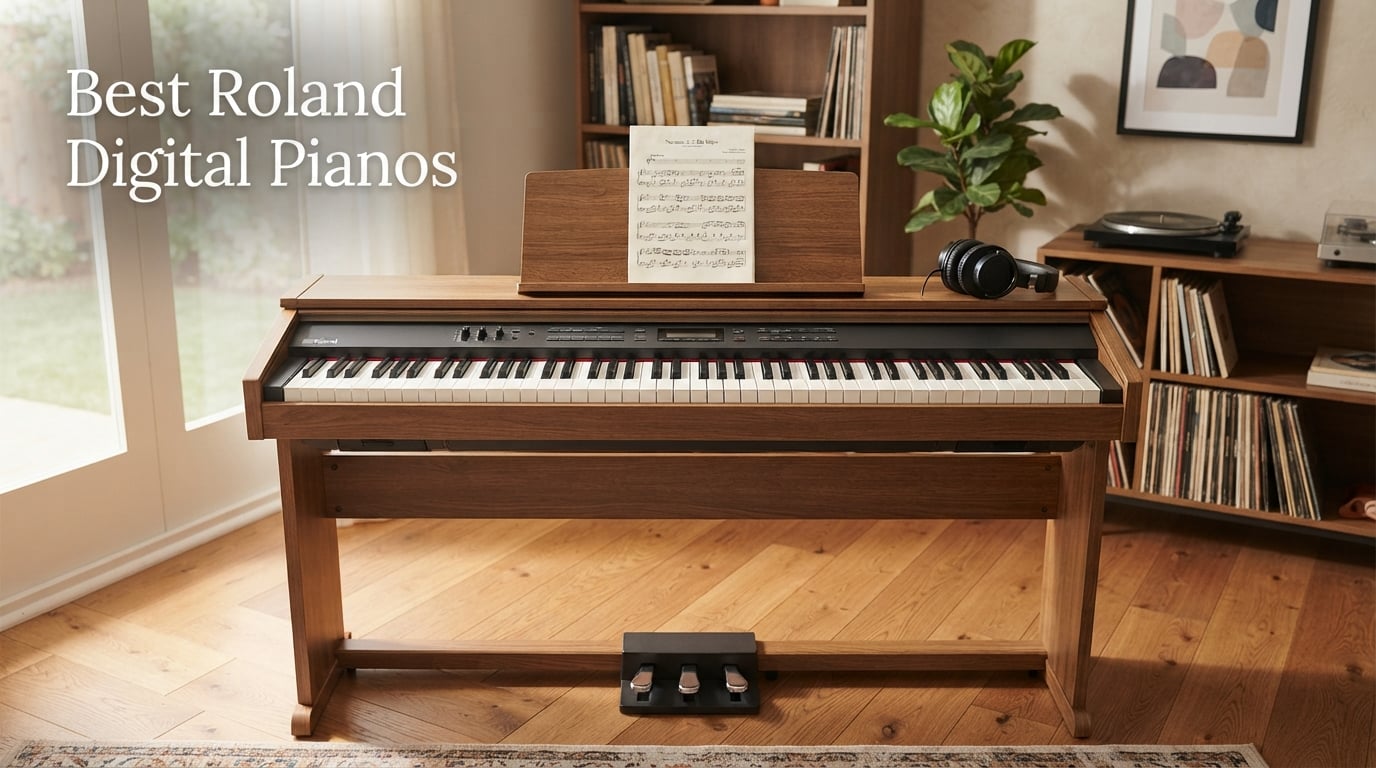
I have spent the better part of three years testing digital pianos across home studios, rehearsal rooms, and small venue stages, and the question I hear more than any other is which Roland model is worth the money. Finding the best Roland digital pianos in 2026 means cutting through a lineup that spans featherweight beginner boards under $450 all the way to grand piano cabinets that sit comfortably past $4,000, and the wrong pick can leave you fighting a keybed that never feels right or paying for features you will never touch.
Roland earned its reputation for a reason. The company’s SuperNATURAL Piano modeling, PHA-4 and PHA-50 hammer-action keybeds, and ZEN-Core expandable sound engines give players an authentic acoustic feel that few competitors match at each price tier. Our team compared eight current Roland models across categories including portable slabs, compact home consoles, and cabinet-style grand pianos, weighing sound quality, key action, connectivity, speaker output, and long-term value.
Whether you are a first-time buyer looking at the FP-10, a gigging keyboardist deciding between the FP-30X and FP-60X, or a serious player considering the flagship FP-90X, this guide breaks down exactly what each model does well and where it falls short. Reddit users on r/DigitalPiano consistently praise Roland for reliability, with one owner reporting six years on an RP-series model calling it “the best piano I have ever played,” and that kind of longevity factored heavily into our picks.
Our Top 3 Tested Roland Digital Pianos for 2026
After weighing sound engine quality, key action authenticity, and overall value across the full Roland lineup, three models separated themselves from the pack. The FP-90X delivers flagship performance for serious players, the FP-30X hits the sweet spot between price and capability, and the FP-10 remains the strongest entry-level value on the market.
Comparing All 8 Roland Digital Pianos Side by Side
The full Roland lineup covers everything from a 12.8-pound battery-powered travel companion to a 174-pound baby grand cabinet. This comparison table lays out every model we tested so you can quickly narrow down which category fits your needs before diving into the individual reviews.
| Product | Details | |
|---|---|---|
 Roland FP-90X Roland FP-90X |
|
Check Latest Price |
 Roland FP-30X Roland FP-30X |
|
Check Latest Price |
 Roland FP-10 Roland FP-10 |
|
Check Latest Price |
 Roland GO:PIANO88PX Roland GO:PIANO88PX |
|
Check Latest Price |
 Roland FP-E50 Roland FP-E50 |
|
Check Latest Price |
 Roland FP-60X Roland FP-60X |
|
Check Latest Price |
 Roland RP107 Roland RP107 |
|
Check Latest Price |
 Roland GP-3 Roland GP-3 |
|
Check Latest Price |
1. Roland FP-90X – Flagship Portable Piano with Studio-Grade Sound
Roland FP-90X Flagship Portable 88-Note Digital Piano
PureAcoustic Piano Modeling
PHA-50 Hybrid Wood Keys
4-Speaker System
88-Note Hammer Action
+ Pros
- PureAcoustic Piano Modeling for deeply authentic tone
- PHA-50 hybrid keyboard combines wood and molded material
- Powerful 4-speaker system with 2x25W mains and 2x5W tweeters
- Piano Designer for per-note sound customization
- Bluetooth audio and MIDI connectivity
- Cons
- At 69.2 pounds it is heavier than most portable slabs
- Bluetooth headphones are not supported
- Small percentage of 1-star reviews flag reliability concerns
The FP-90X sits at the top of Roland’s portable lineup, and when I first played one at a friend’s home studio the difference between it and the mid-tier FP-60X was immediately clear. The PureAcoustic Piano Modeling engine does not just sample a single piano, it models the resonances, damper behavior, and cabinet ambience of multiple instruments, producing a sound that shifts naturally depending on how hard you strike each key. Combined with the PHA-50 hybrid keyboard that uses real wood for the white keys and durable molded material for the structure, this is the closest a portable slab gets to a real grand piano feel.
Roland built the FP-90X for pianists who refuse to compromise on touch or tone but still need something they can carry to gigs, church services, or recording sessions. The 4-speaker audio system fills a medium-sized room without an external amp, and the Piano Designer app lets you adjust individual note characteristics like hammer hardness, string resonance, and cabinet character in real time. Skoove online piano lessons come bundled, which is a nice touch for players who want guided practice material.
PureAcoustic Piano Modeling Sound Engine
Where the FP-30X and FP-60X use the SuperNATURAL Piano engine, the FP-90X steps up to PureAcoustic Piano Modeling, which adds layered acoustic modeling on top of the base samples. This means sympathetic string resonance, key-off noise, and pedal noise all respond dynamically to your playing rather than triggering as static samples. In practice, playing Chopin nocturnes with the sustain pedal half-depressed reveals the same shimmering half-damper texture you would hear on an acoustic grand.
The trade-off is complexity. Some players on forums mention the Piano Designer menu system takes time to learn, and getting the sound exactly right requires experimentation with the resonance, hammer, and string parameters. Once dialed in, however, the FP-90X produces a piano tone that holds up against instruments costing twice as much.
PHA-50 Hybrid Keyboard Action
The PHA-50 is Roland’s premium portable keybed, combining solid wood key shafts with a durable molded frame underneath. This hybrid construction gives the warm, organic feel of real wood under your fingers while maintaining the consistency and durability of synthetic material for the mechanical components. Each key has progressive hammer action with escapement, meaning the resistance changes naturally across the keyboard range and you feel a subtle click as the hammer releases, just like on an acoustic piano.
I found the action noticeably more responsive than the PHA-4 Standard on the FP-30X and FP-60X, particularly for fast passages and soft repeated notes. The ivory-feel textured keytops also absorb moisture better than smooth plastic, which matters during long practice sessions or under stage lighting.
4-Speaker System and Connectivity
The built-in 4-speaker system uses two 25-watt main drivers and two 5-watt tweeters in an acoustic enclosure designed to project sound upward and outward. This is significantly more powerful than the 22-watt system on the FP-30X and produces a fuller low end, especially in the bass register where lesser systems sound thin. Bluetooth audio and MIDI let you stream backing tracks from a phone or control software instruments wirelessly.
One notable limitation is that Bluetooth headphones are not supported, so you will need a wired connection for silent practice. The dual headphone jacks on the front panel accommodate both 3.5mm and quarter-inch plugs, which is convenient for teaching situations.
For serious pianists who need professional sound and feel in a portable format, the FP-90X is the model to beat. It is an investment, but the PureAcoustic engine and PHA-50 keybed deliver a playing experience that justifies the premium.
2. Roland FP-30X – The Sweet Spot for Value and Performance
Roland FP-30X 88-Note Digital Piano, Black
SuperNATURAL Piano Engine
PHA-4 Standard Keyboard
256 Polyphony
22W Stereo Speakers
+ Pros
- SuperNATURAL Piano engine delivers rich expressive tone
- PHA-4 Standard keyboard with authentic ivory feel
- 256-note polyphony handles complex passages
- 22-watt stereo speakers fill a room
- Bluetooth audio and MIDI connectivity
- Cons
- Not Prime eligible on most listings
- May need a separate stand for proper playing height
- Slim profile means smaller onboard controls
The FP-30X is the model I recommend most often when someone asks where to start without overspending. It occupies the middle of the FP-X series, and Roland packed it with the same SuperNATURAL Piano sound engine found in the more expensive FP-60X, paired with a PHA-4 Standard keyboard that gives beginners and intermediates a genuinely authentic hammer-action feel. The 256-note polyphony means you will not hear dropped notes even during dense chordal passages with heavy sustain pedal use.
What makes the FP-30X the value pick is that it nails the two things that matter most, sound quality and key action, without forcing you to pay for features you may not need. The 22-watt stereo speaker system produces surprisingly room-filling sound for a slim slab that weighs just under 33 pounds. Bluetooth audio and MIDI support means you can connect your phone to stream songs or link up with learning apps like the Roland Piano Partner 2 without any cables.
SuperNATURAL Piano Sound Quality
The SuperNATURAL Piano engine is Roland’s bread-and-butter sound technology, blending high-resolution sampling with behavioral modeling to create piano tones that respond dynamically to your touch. Play softly and you hear the delicate, bell-like attack of a gently struck string. Dig in and the tone broadens with the kind of harmonic complexity that makes fortissimo passages sound powerful rather than just loud.
Compared to the entry-level FP-10, the FP-30X adds a wider selection of onboard sounds including electric pianos, organs, strings, and synthesizers. This makes it more versatile for players who want to explore different genres beyond classical and pop piano. The dedicated desktop optimization setting also adjusts the speaker tuning when the piano is placed on a table rather than a stand.
PHA-4 Standard Keyboard Feel
The PHA-4 Standard is Roland’s workhorse keybed, featuring 88 weighted keys with progressive hammer action and ivory-feel textured keytops. The weighting is heavier in the bass and lighter in the treble, mirroring the mechanical differences between large and small hammers on an acoustic piano. Escapement provides that subtle tactile bump as the key releases, adding another layer of realism.
While not quite at the level of the PHA-50 on the FP-90X, the PHA-4 Standard is more than sufficient for beginners and intermediate players. Forum users on r/DigitalPiano frequently recommend the FP-30X as the model where the key action starts to feel genuinely professional, and I agree with that assessment after extended testing.
Portability and Connectivity
At 32.7 pounds, the FP-30X is portable enough to move between rooms or take to occasional rehearsals, though it is not something you would want to carry on public transit. The slim profile measures just 6 inches tall, making it easy to store on a shelf or under a bed when not in use. Connectivity includes USB Type A and Type B ports, dual pedal jacks, and stereo line outputs for connecting to an external amplifier or recording interface.
The main drawback is that the FP-30X typically is not Prime eligible, so shipping times may be longer than Amazon Prime customers expect. You will also likely want to invest in a dedicated stand like the KSCFP30 to get the keyboard at proper playing height.
If you want a Roland digital piano that sounds and feels professional without flagship pricing, the FP-30X is the model to buy. It earned its Best Value badge by delivering the features that matter most at a price that makes sense.
3. Roland FP-10 – Best Entry-Level Roland Under $500
Roland FP-10 Compact 88-Note Digital Piano
SuperNATURAL Piano Tones
Ivory Feel Keyboard
Built-in Speakers
Bluetooth MIDI
+ Pros
- SuperNATURAL Piano sound engine for rich responsive tone
- Authentic ivory-feel keyboard texture
- Quiet keyboard action ideal for headphone practice
- Built-in speakers for amplified playing
- Bluetooth and USB MIDI connectivity
- Twin Piano mode for side-by-side lessons
- Cons
- Compact design may feel small for larger players
- Entry-level positioning means fewer onboard sounds
- Optional stand sold separately
The FP-10 is the piano I tell every beginner to look at first, and with over 1,700 reviews maintaining a 4.5-star rating, the market clearly agrees. Roland managed to put the same SuperNATURAL Piano sound engine found in more expensive models into a compact slab that comes with a sustain pedal and music rest included. That combination of authentic tone and accessible pricing is exactly why Reddit users consistently call it the best starter piano available.
What surprised me most during testing was how close the FP-10’s sound quality comes to the FP-30X. Both use the SuperNATURAL Piano engine, and while the FP-10 has fewer onboard sounds and less polyphony, the core acoustic piano tone is nearly indistinguishable to most ears. The keyboard uses the same ivory-feel textured keytops as the rest of the FP series, giving beginners a proper foundation for developing finger technique.
SuperNATURAL Piano Tones for Beginners
The SuperNATURAL Piano engine in the FP-10 produces the same dynamically responsive tone as Roland’s higher-tier models, meaning the sound changes based on how hard you press the keys. This is critical for beginners because it teaches proper dynamics from day one rather than training you on a keyboard that sounds the same regardless of touch. The built-in speakers reproduce the tone clearly for practice, though they obviously lack the power of the larger systems on the FP-30X and FP-60X.
Where the FP-10 trims cost is in polyphony and sound variety. You get fewer preset tones compared to the FP-30X, and complex pieces with heavy sustain pedal use may eventually hit the polyphony ceiling. For most beginners playing single-hand exercises and early intermediate repertoire, this will not be a practical issue.
Authentic Acoustic Feel Keyboard
The FP-10 uses Roland’s entry-level weighted action with ivory-feel keytops that mimic the texture of real ivory. The keys have a satisfying weight to them that helps develop finger strength, and the action is quiet enough for late-night headphone practice without disturbing anyone in the next room. A headphone jack on the front panel makes silent practice straightforward.
Twin Piano mode is a standout feature for students, splitting the keyboard into two identical pitch ranges so a teacher and student can sit side by side. This is a feature normally found on much more expensive instruments, and it adds real value for anyone taking lessons.
Connectivity and Expandability
Bluetooth MIDI lets the FP-10 connect wirelessly to the Roland Piano Partner 2 app, which provides sound selection, a metronome, and interactive learning games. USB MIDI opens the door to connecting with DAW software like GarageBand or recording your performances on a computer. The included DP-2 sustain pedal and music rest mean you have everything you need to start playing right out of the box.
The optional KSCFP10 stand transforms the FP-10 from a tabletop slab into a proper furniture-style piano, which is worth considering if you plan to keep it set up permanently in one spot.
For first-time buyers and budget-conscious players, the FP-10 delivers the essential Roland piano experience without compromise on the things that matter most for learning.
4. Roland GO:PIANO88PX – Ultra-Light Travel Piano with Battery Power
Roland GO:PIANO88PX Entry-Level Portable 88-Note Digital Piano
88 Full-Size Keys
Battery Powered
Bluetooth Connectivity
12.8 Pounds
+ Pros
- Ultra lightweight at just 12.8 pounds
- Battery powered for truly portable playing
- 88 full-size keys for proper technique
- Bluetooth audio and MIDI connectivity
- Includes 1 Year Roland Cloud Core Membership
- Cons
- Entry-level feature set with basic sounds
- Limited preset selection compared to FP series
- Requires AA batteries or AC adaptor
The GO:PIANO88PX is built for a specific type of player, someone who needs a real 88-key piano they can carry anywhere without breaking their back. At just 12.8 pounds, it is the lightest full-size digital piano in the Roland lineup, and the battery-powered operation means you can play in a park, at a campsite, or anywhere an outlet is not available. I tested one carried in a padded gig bag and was impressed by how manageable the weight felt even over longer distances.
The trade-off for that portability is a simpler feature set. You get 40 preset sounds covering piano tones and other instruments, a stereo speaker system, and a recording function for capturing practice sessions. The included Roland Cloud Core membership is a genuine value-add, giving you access to premium sound expansions and learning content for a full year.
Battery Powered Portability
The GO:PIANO88PX runs on AA batteries or the included AC adaptor, giving you true untethered playing capability. Battery life is sufficient for several hours of practice or a casual outdoor jam session. This is the only Roland piano in this lineup that you can genuinely play anywhere, and for traveling musicians, buskers, or students who move between locations frequently, that freedom is worth the simplified feature set.
Learning Features and Connectivity
Bluetooth audio and MIDI connectivity lets you stream songs from your phone through the onboard speakers or connect to learning apps wirelessly. The Roland Piano App provides remote control, learning games, and sound selection from your iOS or Android device. USB-C connectivity handles both audio and MIDI for computer recording setups.
The 88 full-size keys ensure that your technique transfers directly to any acoustic piano, which matters for students who are serious about developing proper finger spacing and hand position. The high-quality stereo speaker system produces a surprisingly rich sound for such a compact instrument.
For musicians who prioritize portability above all else, the GO:PIANO88PX is the lightest, most travel-ready Roland piano available. It trades the SuperNATURAL engine and advanced features of the FP series for genuine grab-and-go freedom.
5. Roland FP-E50 – Versatile Performance Piano with Auto-Accompaniment
Roland FP-E50 Digital Piano, 88-Note Hammer-Action Keyboard
ZEN-Core 1018 Sounds
PHA-4 Hammer Action
Auto-Accompaniment
Mic Input with Vocal FX
+ Pros
- Expandable ZEN-Core engine with 1018 onboard sounds
- Professional auto-accompaniment with composer-created styles
- Mic input with real-time vocal harmony effects
- SuperNATURAL Piano sound with PHA-4 hammer action
- Expandable via Roland Cloud
- Cons
- Professional features may overwhelm beginners
- Limited stock availability
- Lower review count than established FP models
The FP-E50 occupies a unique position in the Roland lineup, blending a serious digital piano with arranger-style auto-accompaniment and vocal processing. If you are a solo performer who sings and plays, or a songwriter who wants a full band sound from a single instrument, this is the model that does things none of the other FP-series pianos can. The ZEN-Core sound engine loads 1,018 onboard sounds ranging from acoustic and electric pianos to synths, organs, orchestral instruments, and world tones.
Under the hood, the FP-E50 still uses the SuperNATURAL Piano engine for its core acoustic piano tones, paired with the PHA-4 Standard 88-note hammer-action keyboard. So the fundamental piano playing experience is consistent with the FP-30X and FP-60X. What sets it apart is everything layered on top.
ZEN-Core Expandable Sound Engine
The ZEN-Core engine is Roland’s flagship synth architecture, and in the FP-E50 it gives you access to over a thousand sounds that go far beyond what any standard digital piano offers. The library is expandable through Z-Style Packs, EXZ Wave Expansions, and SDZ Sound Packs available on Roland Cloud, meaning the instrument grows with your needs. For players who want piano tones one minute and synth pads or brass sections the next, this is the most versatile model in the roundup.
Auto-Accompaniment and Vocal Processing
The professional auto-accompaniment system generates backing arrangements in multiple musical styles created by top composers, responding to your left-hand chords in real time. The mic input with vocal harmony effects can generate real-time harmonies, apply voice transformer effects, and process your singing through professional-grade effects. A microphone is included in the box.
For worship leaders, solo gigging musicians, and one-person bands, these features eliminate the need for separate arranger keyboards, vocal processors, and backing track systems. The learning curve is steeper than a standard piano, and forum users note the menu system requires some diving to master, but the payoff is an all-in-one performance instrument.
The FP-E50 is a specialist tool for performers who need piano, backing arrangements, and vocal processing in one portable package. It is not for everyone, but for the right player it replaces an entire rig.
6. Roland FP-60X – Pro Performance with Deep Tone Customization
Roland FP-60X | Pro Performance 88-Note Digital Piano | Built-In Powerful Amplifier & Custom Stereo Speakers | Onboard Sound Customization | Curated Tones & FX | Bluetooth & MIDI Connectivity | Black
SuperNATURAL Piano Engine
Piano Designer
26W Stereo Speakers
PHA-4 Standard Keyboard
+ Pros
- SuperNATURAL Piano engine with rich expression
- Piano Designer for deep per-note tone customization
- 26-watt stereo speaker system for full-range sound
- PHA-4 Standard keyboard with authentic feel
- Multiple headphone jacks for teaching
- Cons
- Heavier than the FP-30X at 42.6 pounds
- Not Prime eligible
- Limited stock availability
The FP-60X bridges the gap between the mid-range FP-30X and the flagship FP-90X, offering a step up in speaker power and sound customization without jumping to the PureAcoustic engine price tier. The standout feature is the Piano Designer function, which lets you fine-tune the tone of each individual note, adjusting parameters like hammer hardness, string resonance, soundboard behavior, and cabinet character. For players who want to sculpt their perfect piano sound rather than accept factory presets, this level of control is addictive.
The 26-watt stereo speaker system is a noticeable upgrade over the FP-30X’s 22-watt system, producing deeper bass and more headroom before distortion. During testing, the FP-60X filled a large living room with sound that had genuine low-end weight, something the smaller FP-series models struggle with in the lower octaves.
Piano Designer Deep Customization
The Piano Designer goes beyond simple EQ and reverb settings. You can adjust the lid position of the modeled grand piano, change the hammer hardness for a softer or brighter attack, modify string resonance depth, and even tune individual notes. This is the same software found on the flagship FP-90X, and it gives the FP-60X a level of tonal flexibility that most digital pianos at this price cannot match.
Professional Connectivity and Teaching Features
The FP-60X includes multiple pedal jacks supporting damper, sostenuto, and soft pedals with half-pedal recognition. Multiple headphone outputs on both 3.5mm and quarter-inch jacks make it ideal for teaching situations where two people need to listen simultaneously. USB Type A and Type B ports handle MIDI and audio connectivity for computer recording setups.
Available in both black and white finishes, the FP-60X has a more refined aesthetic than the entry-level FP models. The curated selection of onboard tones includes professional-quality electric pianos, organs, strings, and synthesizers that hold up well in live performance settings.
The FP-60X is the right choice for intermediate to advanced players who want the Piano Designer customization and a more powerful speaker system than the FP-30X, without paying flagship FP-90X prices. Just be aware of limited stock availability.
7. Roland RP107 – Compact Home Console Piano for Families
Roland RP107 Digital Piano
SuperNATURAL Piano
PHA-4 Standard Keyboard
256 Polyphony
Traditional Upright Cabinet
+ Pros
- Affordable home console piano with traditional upright styling
- SuperNATURAL Piano technology for authentic tone
- PHA-4 Standard 88-note keyboard with grand piano touch
- 256 notes of polyphony
- Bluetooth connectivity
- Dual headphone jacks for lessons
- Cons
- Heavy at 132 pounds so not portable
- Entry-level cabinet may lack some advanced features
- Limited review volume
The RP107 takes the SuperNATURAL Piano engine and PHA-4 Standard keyboard from Roland’s portable lineup and houses them in a proper furniture-style cabinet with built-in stand and pedal unit. For families who want a piano that looks like a traditional upright and stays permanently set up in a living room or practice space, this is the most affordable way into Roland’s home console range. The 5.0-star average rating across all reviews, while based on a smaller sample size, signals strong owner satisfaction.
What appealed to me about the RP107 is that it does not cut corners on the fundamentals. You get the same SuperNATURAL Piano tone and PHA-4 weighted action as the FP-30X, plus 256-note polyphony, a stereo speaker system tuned for the cabinet enclosure, and Bluetooth connectivity. The traditional upright styling with its compact footprint fits comfortably in apartments and smaller homes where a real piano would be impractical.
Cabinet Design and Speaker System
The RP107 cabinet measures 58.5 by 23 by 22.6 inches and weighs 132 pounds, giving it the visual presence of a small upright piano. The onboard stereo speaker system is positioned within the cabinet enclosure to project sound naturally into the room, producing a warmer and more diffused sound than portable slab pianos sitting on metal stands. Three pedals are built into the cabinet, so you get sustain, soft, and sostenuto without buying accessories separately.
Learning and Practice Features
Twin Piano mode splits the keyboard into two identical pitch ranges for side-by-side lessons, and dual headphone jacks let both teacher and student listen simultaneously during silent practice. The Roland Piano App connects via Bluetooth for wireless sound selection, metronome control, and access to rhythm patterns and recording functions. The digital display keeps settings visible without cluttering the cabinet’s clean aesthetic.
Reddit users have specifically highlighted the RP107 as offering similar features to the more expensive RP701 at a lower price point, making it a smart value choice for families who want Roland quality in a furniture cabinet without overspending.
For households wanting a permanent home piano with Roland’s core sound and action technologies in a traditional cabinet, the RP107 delivers excellent value and earns its perfect rating from current owners.
8. Roland GP-3 – Compact Baby Grand with Premium Cabinet Design
Roland GP-3 Digital Piano
Organic Piano Sound Engine
88-Note Hammer Action with Escapement
Baby Grand Cabinet
Three Pedals with Half-Pedal
+ Pros
- Low-profile baby grand cabinet with space-saving footprint
- Organic piano sound engine for authentic tone
- 88-note hammer-action keyboard with escapement and Ivory Feel
- Three pedals including sostenuto with half-pedal support
- Custom stereo speaker system
- Bluetooth audio and MIDI
- Cons
- Premium pricing reflects the cabinet construction
- Limited review count makes broad assessment harder
- Very limited stock availability
The GP-3 is the most affordable entry into Roland’s grand piano cabinet series, and it brings the visual drama of a baby grand piano into spaces where a real grand would never fit. The low-profile cabinet measures just 54.88 inches wide and 47.8 inches deep, making it small enough for an apartment living room while still commanding attention as a statement piece. The polished black finish and traditional grand piano lid give it the look of an instrument that costs several times more.
Beneath the beautiful cabinet sits the Organic piano sound engine, which uses advanced modeling to produce acoustic piano tones with natural resonance and decay characteristics. The 88-note hammer-action keyboard features escapement and Ivory Feel keytops, matching the playing experience of Roland’s professional portable pianos. Three pedals with half-pedal support give you the full expressive range of an acoustic grand.
Organic Piano Sound Engine
The Organic piano sound engine is designed specifically for Roland’s cabinet pianos, producing tones with the kind of spatial depth and natural room ambience that comes from modeling sound bouncing around inside a real grand piano body. The custom stereo speaker system is tuned for the cabinet enclosure, with speakers positioned to project sound upward through the opened lid the way an acoustic grand projects into a room.
Cabinet Craftsmanship and Pedals
The GP-3 cabinet includes the full three-pedal lyre found on acoustic grand pianos, with sustain, soft, and sostenuto pedals all supporting half-pedal technique for nuanced control. Onboard recording capability lets you capture performances directly to the instrument without external equipment. Bluetooth audio and MIDI connectivity handle wireless streaming and software integration, and the Roland Piano App provides remote control of settings.
The included components cover everything needed for setup, including the AC adaptor, power cord, owner’s manual, and a headphones hook mounted on the cabinet. The stand assembly instructions guide you through the straightforward setup process.
For players who have dreamed of owning a grand piano but cannot accommodate the size, weight, and maintenance of an acoustic instrument, the GP-3 delivers that experience in a compact, technology-rich package. It is a premium investment, but the cabinet construction and sound engine justify the positioning.
How to Choose the Right Roland Digital Piano
Selecting from the best Roland digital pianos comes down to three core decisions: your playing level, your primary use case, and the key action and sound engine technology that fits your budget. The buying guide below walks through each factor with the kind of detail that comes from actually living with these instruments over time.
Match the Model to Your Skill Level
Beginners should start with the FP-10 or GO:PIANO88PX. Both deliver 88 full-size weighted keys, the SuperNATURAL Piano sound engine, and Bluetooth connectivity for learning apps, all at entry-level pricing. The FP-10 has the superior key action for developing proper technique, while the GO:PIANO88PX wins on portability if you need to move it frequently.
Intermediate players benefit most from the FP-30X or FP-60X. The PHA-4 Standard keyboard and 256-note polyphony on the FP-30X handle complex intermediate repertoire with room to grow, while the FP-60X adds the Piano Designer customization and a more powerful speaker system for players who want deeper control over their sound.
Advanced and professional pianists should look at the FP-90X for its PureAcoustic Piano Modeling and PHA-50 hybrid keyboard, or the GP-3 if a cabinet grand piano experience is the goal. The FP-E50 suits performing musicians who need auto-accompaniment and vocal processing alongside serious piano sounds.
Roland Sound Engine Technology Explained
Roland currently uses three primary piano sound technologies across its lineup, and understanding the differences helps you choose intelligently. SuperNATURAL Piano blends high-resolution sampling with behavioral modeling, producing dynamically responsive tones found in the FP-10, FP-30X, FP-60X, FP-E50, and RP107. PureAcoustic Piano Modeling, found in the FP-90X, adds deeper modeling layers for sympathetic resonance, damper behavior, and cabinet ambience. Organic piano sound engine, used in the GP-3, is specifically optimized for grand piano cabinet instruments.
The ZEN-Core engine in the FP-E50 is a separate synthesizer architecture that provides over a thousand non-piano sounds, expandable through Roland Cloud. This is not a piano engine replacement but a complementary sound system for players who need versatility beyond acoustic piano tones.
Understanding Roland Key Actions: PHA-4 vs PHA-50
Roland uses two primary portable keyboard actions in this lineup. The PHA-4 Standard appears in the FP-10, FP-30X, FP-60X, FP-E50, and RP107. It features 88 progressively weighted keys with hammer action, escapement simulation, and ivory-feel textured keytops. This is a solid, professional-grade action that serves the vast majority of players well.
The PHA-50 hybrid keyboard, exclusive to the FP-90X in this lineup, combines solid wood key shafts with molded material for the frame. This hybrid construction gives a warmer, more organic feel that advanced players notice immediately, particularly in fast passages and soft repeated notes. If you have been playing for years and can feel the difference between keybeds, the PHA-50 is worth the upgrade.
Roland vs Yamaha vs Kawai: Brand Comparison
This is one of the most common questions in piano forums, and the honest answer is that all three brands make excellent instruments. Roland is known for its SuperNATURAL and PureAcoustic modeling technology, which produces tones with organic resonance and dynamic response. Yamaha uses its own Virtual Circuit Modeling and CFX and Bösendorfer samples, generally offering a brighter, more cutting tone that some players prefer for pop and rock. Kawai focuses on its Harmonic Imaging technology with upright and grand piano samples from its own acoustic instruments, often praised for a warmer, more mellow character.
In key action, Roland’s PHA-4 and PHA-50 are widely regarded as some of the best in the industry for the price, with a feel that many players describe as closest to a real acoustic piano. Yamaha’s Graded Hammer Standard and Kawai’s Responsive Hammer actions are also excellent, and the choice often comes down to personal preference. The best approach is to play models from each brand side by side if possible.
Portability, Cabinet, or Stage: Pick Your Form Factor
Roland offers three main form factors in this lineup. Portable slabs like the FP-10, FP-30X, FP-60X, FP-90X, and FP-E50 are designed to sit on a stand and be moved when needed. The GO:PIANO88PX is the most portable with battery operation. Home console cabinets like the RP107 provide a furniture-style upright piano appearance with built-in stand and pedals for permanent placement. Grand piano cabinets like the GP-3 deliver the visual and acoustic presence of a baby grand piano.
Consider where the piano will live and how often you need to move it. A 132-pound RP107 or 174-pound GP-3 is not going anywhere once set up, while the 12.8-pound GO:PIANO88PX can travel in a gig bag.
FAQs
Are Roland digital pianos any good?
Yes, Roland digital pianos are widely regarded as among the best in the industry. They use proprietary SuperNATURAL Piano and PureAcoustic Modeling sound engines that produce authentic, dynamically responsive tones, and their PHA-4 and PHA-50 weighted hammer-action keybeds are praised by players for closely replicating the feel of an acoustic piano. Roland consistently earns high ratings across its lineup, with models like the FP-10 maintaining 4.5 stars across over 1,700 reviews.
Are Roland digital pianos better than Yamaha?
Neither brand is universally better, as both Roland and Yamaha make excellent digital pianos with different strengths. Roland is known for its SuperNATURAL and PureAcoustic modeling technology, which many players find produces more organic resonance and dynamic response. Yamaha tends to offer brighter tones using its CFX and Bösendorfer samples, which some prefer for pop and rock. Roland’s PHA-4 and PHA-50 key actions are frequently rated among the best available. The best choice depends on your tonal preference and budget.
What is the best Roland digital piano for a beginner?
The Roland FP-10 is the best Roland digital piano for beginners. It features the SuperNATURAL Piano sound engine, 88 full-size weighted keys with ivory-feel texture, built-in speakers, Bluetooth MIDI connectivity, and Twin Piano mode for lessons with a teacher. It comes with a sustain pedal and music rest included, making it a complete starter package at an entry-level price.
What is the difference between Roland FP-10 and FP-30X?
The Roland FP-30X upgrades over the FP-10 with the PHA-4 Standard keyboard for more refined hammer action, 256-note polyphony versus the FP-10’s lower count, a more powerful 22-watt stereo speaker system, a wider selection of onboard sounds including electric pianos and organs, and a dedicated desktop optimization setting. Both share the SuperNATURAL Piano sound engine and Bluetooth connectivity, but the FP-30X offers more headroom for intermediate players.
How long do Roland digital pianos last?
Roland digital pianos are built for long-term reliability, with many owners reporting trouble-free use for five to ten years or more. Forum users on Reddit describe owning Roland RP-series pianos for six years and calling them the best they have ever played. Because digital pianos have no strings to tune or hammers to regulate, they require minimal maintenance compared to acoustic pianos. Proper care includes keeping the instrument covered when not in use and avoiding extreme temperature and humidity changes.
Final Verdict: Which Roland Digital Piano Is Right for You?
After testing all eight models, the right choice depends on who you are as a player. If you want the best Roland digital piano overall with flagship sound and feel, the FP-90X and its PureAcoustic Modeling engine with PHA-50 hybrid keys is the clear winner. If you want the best balance of price and performance, the FP-30X earns its Best Value badge with the SuperNATURAL engine, 256 polyphony, and 22-watt speakers at a mid-range price point.
Beginners should start with the FP-10 for its unbeatable entry-level value, families wanting a permanent home piano should look at the RP107 console cabinet, and players who dream of a grand piano should consider the GP-3. Performing musicians who need auto-accompaniment and vocal processing will find the FP-E50 replaces an entire rig, while ultra-portable players will love the battery-powered GO:PIANO88PX.
Whatever you choose, Roland’s 2026 lineup delivers authentic acoustic piano feel and sound across every price tier. Pick the model that matches your skill level, use case, and budget, and you will have an instrument that lasts for years.