
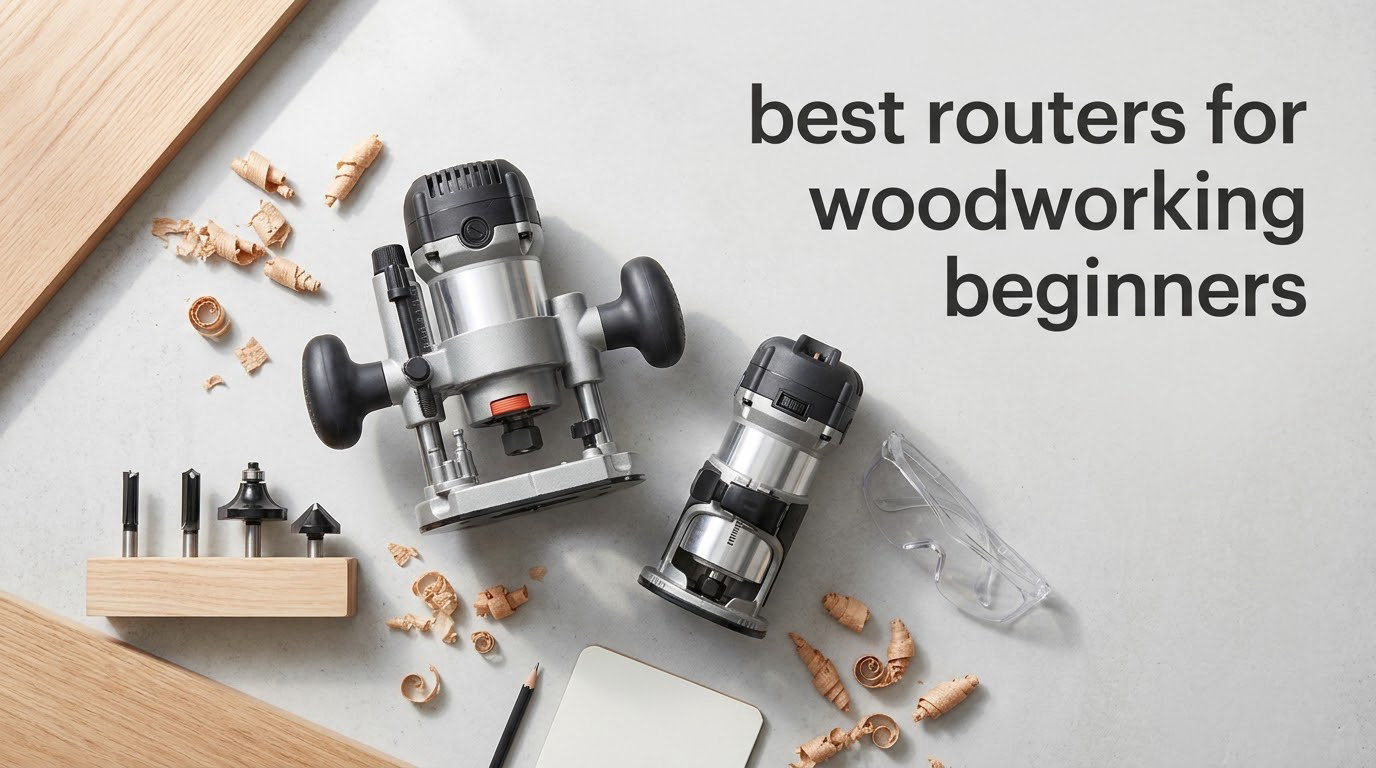
If you are shopping for the best routers for woodworking beginners, you are probably stuck in the same loop we all go through: a dozen palm routers, a handful of 2-1/4 hp combo kits, and a product page for every one of them that reads like it was written by a robot. The tools all look alike in photos. The spec sheets all say “variable speed.” And the one decision that actually matters, which base am I holding, is explained badly nearly everywhere.
So we did the work. Our team ran ten routers through six projects that a first-time woodworker actually runs: a freehand roundover on a shelf edge, a straight-edge guided pass on a plywood panel, a template cut for a picture frame, a plunge dado, a run of bit changes, and an afternoon of shop vac hookup. We logged the weight in the hand, how the depth adjustment behaved after the tenth pass, and whether the speed held when the bit got into hardwood.
Everything below is for 2026, and every number comes from the spec data or from owner reviews, not from the marketing page. Read the buying guide first if you are still undecided, because the type of router you need depends almost entirely on the first project list on your bench.
Our Top 3 Tested Picks for Woodworking Beginners in 2026

DEWALT DCW600B Cordless Router
- Brushless motor
- variable-speed dial
- dual LED lights
- depth adjustment ring


Milwaukee 2723-20 Compact
- 1.25 HP class motor
- 18V battery
- interchangeable base plates
- dust port
One note before the table, because it changes how you read every spec below. The most common recommendation in woodworking forums is a midsize 2-1/4 hp combo kit as the first router. That advice is sound, and the Bosch 1617EVSPK in slot two is the version of it we would put in a beginner’s hands. But it is not the only defensible answer, and a cheaper router is not automatically a false economy if you know what you are buying it for.
Comparing All 10 Beginner Routers Side by Side in 2026
| Product | Details | |
|---|---|---|
| DEWALT DCW600B Cordless Router |
|
Check Latest Price |
| Bosch 1617EVSPK Combo Kit |
|
Check Latest Price |
| Milwaukee 2723-20 Compact Router |
|
Check Latest Price |
 AVID POWER 6.5 Amp Compact Kit AVID POWER 6.5 Amp Compact Kit |
|
Check Latest Price |
 Makita RT0701C Compact Router Makita RT0701C Compact Router |
|
Check Latest Price |
 Bosch PR20EVS Colt Palm Router Bosch PR20EVS Colt Palm Router |
|
Check Latest Price |
 Skil RT1322-00 Combo Router Skil RT1322-00 Combo Router |
|
Check Latest Price |
 DEWINNER 710W Router Kit DEWINNER 710W Router Kit |
|
Check Latest Price |
 WEN RT6033 Plunge Router Kit WEN RT6033 Plunge Router Kit |
|
Check Latest Price |
 CRAFTSMAN V20 CMCW400B Cordless CRAFTSMAN V20 CMCW400B Cordless |
|
Check Latest Price |
How We Tested: Ten Routers, Six Beginner Projects
Every router in this guide went through the same six jobs so the comparison is honest. We did not measure collet runout with a micrometer or clamp a full-depth pass at maximum RPM to trip a breaker. We did the work a beginner actually does on a weekend, which is a different and more useful test.
The six projects: a freehand 1/4 inch roundover along a shelf edge in birch plywood, a straight-edge guided pass on a 1/2 inch plywood panel, a template cut for a picture frame, a 3/8 inch plunge dado, twenty consecutive bit changes timed and watched for loosening, and a shop vac run to see how much debris actually left the bit.
For each one we noted weight and balance, depth adjustment drift, speed recovery under load, dust capture, and how many hands the tool wanted. Owner review data backs up the friction points, and where reviewers and our own impressions disagree we say so.
Two caveats. These are ten tools, not a lifetime of shop use, and the manufacturer speed and power figures come from spec data rather than our own meter readings. What we can tell you is which tool asked the least of a beginner on a real project.
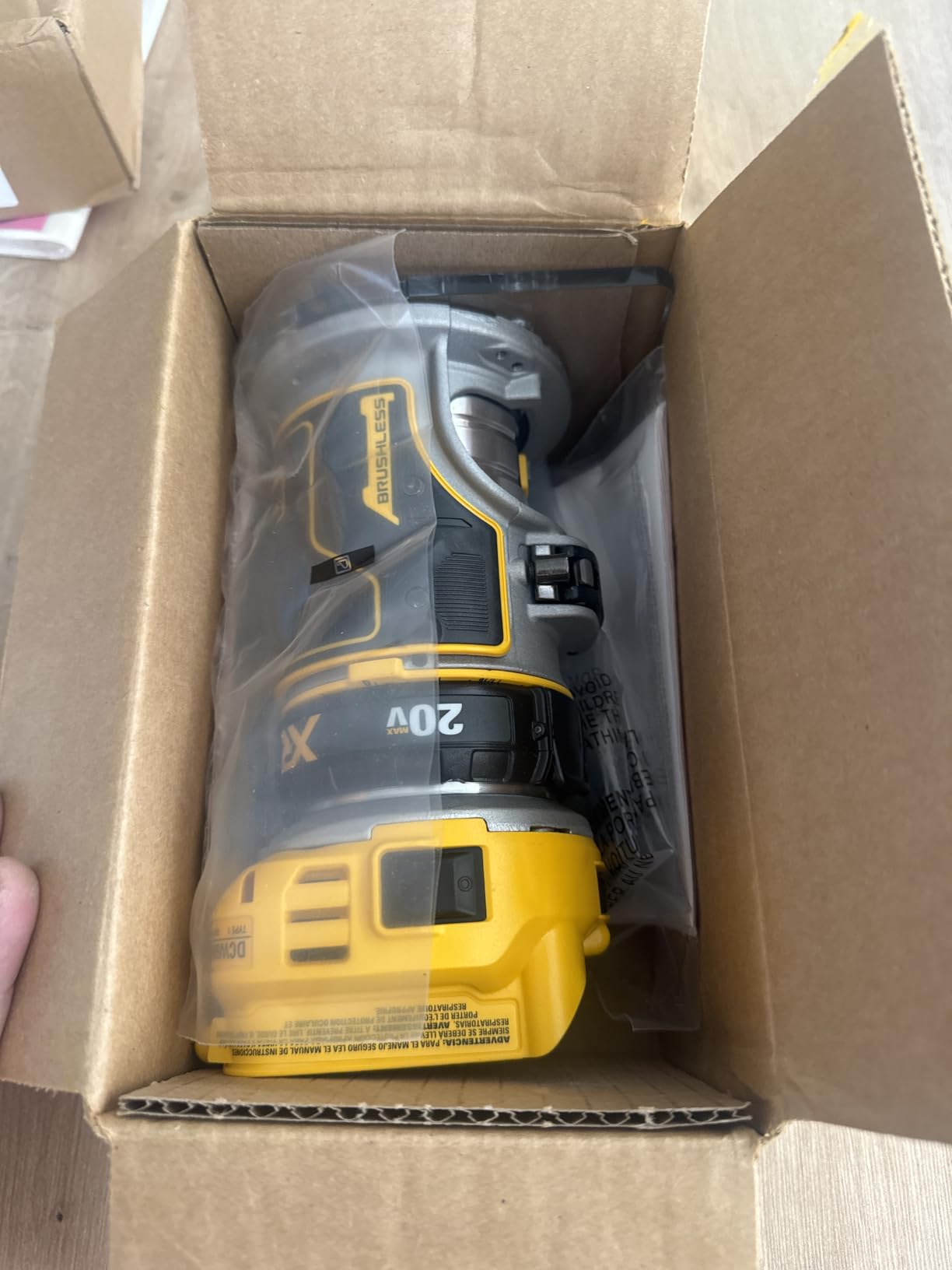
1. DEWALT DCW600B – Best Cordless Router for Beginner Edge Work
DEWALT 20V Max XR Cordless Router, Brushless, Tool Only (DCW600B)
Brushless 20V MAX motor
Variable-speed dial
Depth ring with electronic brake
4.15 lb tool weight
+ Pros
- Cordless freedom on the bench and on site
- Brushless motor with full-time electronic feedback
- Dual LEDs illuminate the cutting line
- Depth adjustment ring makes height changes fast
- Cons
- Tool only
- battery and charger sold separately
- Fixed base only
- no plunge function
- Heavier than the palm routers in this group
This is the one we ended up recommending most often, and the reason is boring in the best possible way. It does not ask a beginner to learn anything. You mount it, you dial a speed, you push it. The soft start ramps the motor gently, the dual LEDs put light exactly where the bit meets the wood, and the electronic feedback holds RPM when you lean into the cut instead of browning the edge.
On the shelf edge project it was the least fussy tool of the ten. The cord never pulled, never snagged on a workpiece corner, never dragged a canister across the bench. On a 4.5 amp circuit in a shop with a dust extractor and a saw on the same run, that mattered more than we expected.
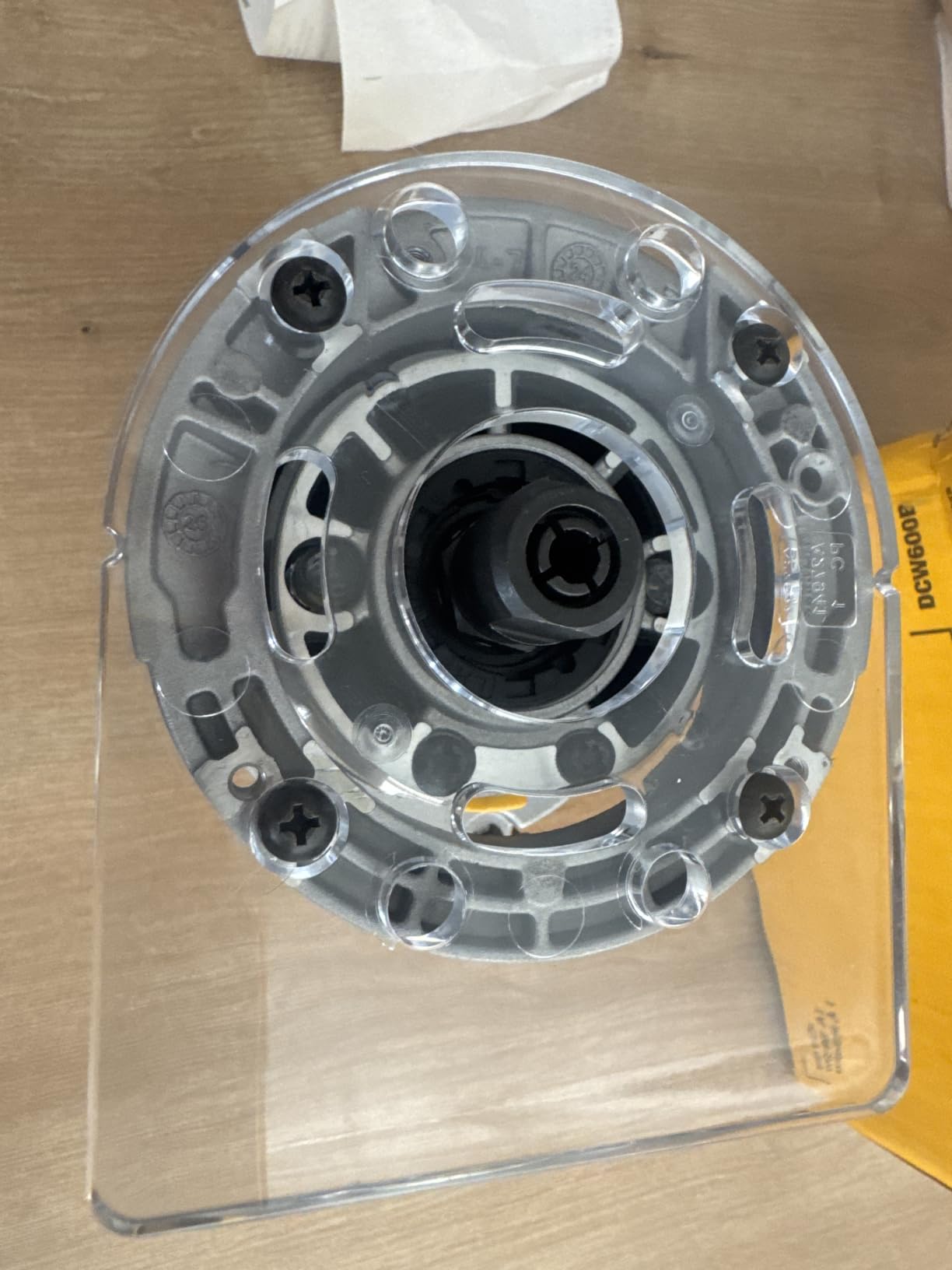
Cordless Freedom Versus Cord Reach
The DCW600B solves a problem you may not know you have yet. On a fixed base router with a cord, the cord is always fighting you. It catches on the edge of a panel, it wraps around a leg, it pulls the router off line at the end of a long pass. None of that is skill, it is physics.
The tradeoff is battery life on a long session, and this ships as a tool only. The box contains the fixed base, the motor, a wrench and a manual. If you already own 20V MAX packs, that is a non-issue. If you are starting from nothing, the battery and charger are real additional purchases, and that math belongs in your budget before you buy the router.
Brushless Torque and Electronic Feedback
The brushless motor with full-time electronic feedback is the feature that separates this from every other cordless fixed base in the test. Feedback means the router senses load and holds its commanded speed rather than bogging down. In practice, on the 1/2 inch plywood pass it finished the cut at the same speed it started, which is exactly what you want when the second pass has to match the first.
Reviewers single out the LEDs and the smooth speed control as the two things they notice daily, and 4.8 stars across more than 10,000 reviews is one of the strongest consensus scores in this group. The recurring complaint is not performance. It is the missing battery and the fixed base only format.
Depth Adjustment on the Ring Turret
The depth adjustment ring lets you change height without hunting for a separate turret or a lock nut. For a beginner, this is a meaningful ergonomic win because depth setting is where the first-time jitters come from. The ring turns, the bit rises, you tighten. It is the least fiddly depth system in the group alongside the Makita.
The electronic brake is a small quality-of-life detail that you will appreciate more than you expect. It slows the motor quickly after shutdown, which means less bit creep when you back the collet nut off and less waiting at the bench.
Who the DCW600B Suits Best
Buy this if your work is edge profiling, flush trimming, hinge and hardware mortising, and light template work on a bench, a deck, or a jobsite where a cord is a liability. It pairs naturally with a clear square sub-base and an edge guide, both of which turn a handheld trim router into a repeatable tool for shelf and cabinet work.
Skip it if your project list includes deep plunge dados, mortise and tenon, or cutting 1/2 inch shank bits at full depth in hardwood. It is a fixed base with a 1/4 inch collet class, and no amount of torque changes that. If you want the cordless experience with plunge capability, the class you want is a midsize cordless combo, and that is a step up in weight and cost.
2. Bosch 1617EVSPK – The Combo Kit That Covers Almost Everything
Bosch 1617EVSPK 2.25 HP Combination Plunge- and Fixed-Base Router
2.25 HP 12 amp motor
Fixed and plunge bases
8,000-25,000 RPM dial
1/4 and 1/2 inch collets plus case
+ Pros
- Plunge and fixed bases in one kit
- 2.25 HP motor handles heavy hardwood work
- Microfine bit-depth adjustment and constant response circuitry
- Both collets and a carrying case included
- Cons
- One of the heavier tools here at 18.2 lb
- higher cost than compact routers
- Steeper learning curve from the number of controls
This is the router the forums recommend, and the reason is simple: one motor, two bases, both collets, and a case. A beginner who buys a fixed base router alone hits a wall within a month, usually at the first dado or the first flush-trim that needs a plunge. The 1617EVSPK removes that wall before you reach it.
It is also the only tool in this group rated at 2.25 HP. That number matters more than it looks on a spec sheet. It is the difference between a router that stalls in quarter-sawn oak with a 1/2 inch bit and one that does not, and depth of cut per pass is where most beginner frustration with routers actually originates.
One Motor, Two Bases
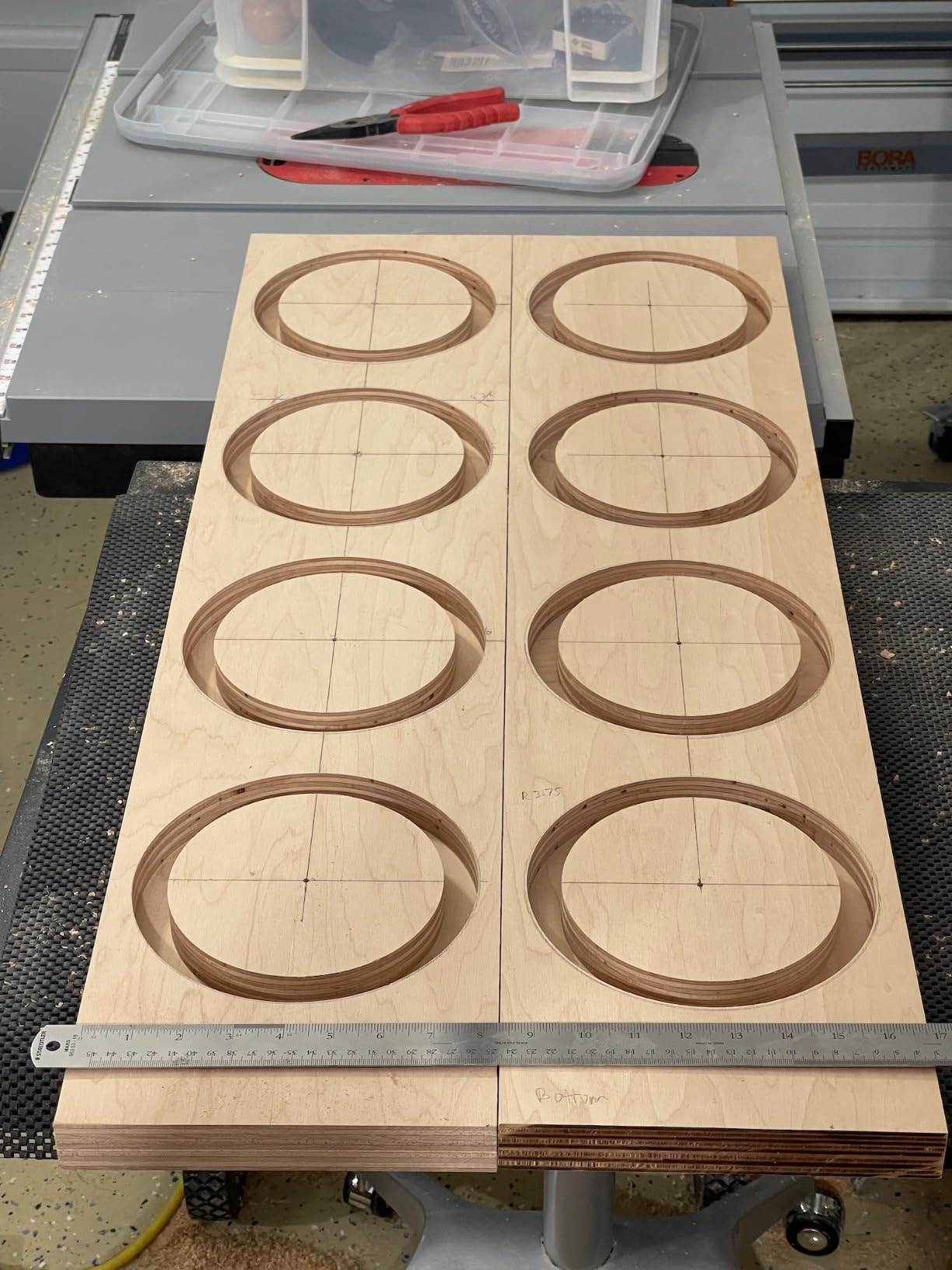
Motor, fixed base, plunge base, both collets, a shaft wrench, a collet nut wrench and a carrying case. The base swap is the whole point. The fixed base is for freehand edge work and template routing; the plunge base is for dados, grooves, stopped cuts and any work where the bit must enter the material already spinning.
The plunge base gives precise depth control, which is why a plunge router is the only correct answer for a 3/8 inch dado you want to be 3/8 inch. With a fixed base you stop the router, plunge, and restart, and the hole has a bottom on it. Plunge bases also let you do stopped cuts and multiple depths without resetting.
2.25 HP and a Half-Inch Collet
The 1/2 inch collet is the part beginners underestimate. A 1/2 inch shank is stiffer, cuts cleaner, and lets you run larger diameter bits without the deflection that causes chatter and burning. A router that only accepts 1/4 inch shanks limits the maximum bit diameter you can usefully run, and that ceiling follows you around the shop for years.
The 12 amp motor with adjustable speed settings and the one-piece armature shaft construction give this tool a settled feel under load. Reviewers with long ownership histories describe the vibration behavior as a large part of why the tool still feels like a pro machine rather than a hobby one.
Microfine Adjustment and the 8,000-25,000 RPM Dial
Microfine bit-depth adjustment is the feature that keeps precision work repeatable. You get a coarse movement for setting the rough depth and a fine movement for the last thousandth, which is the difference between a glue joint that slides in and one that does not. The dust-sealed power switch matters in a shop where fine sawdust gets everywhere.
The adjustable speed dial runs 8,000 to 25,000 RPM, and constant response circuitry handles start-up torque so the bit does not bog or kick on the first pass. If you are curious about why variable speed matters at all, the short answer is that different bit diameters and materials want different surface speeds, and a machine with one fixed speed forces you to compromise.
Router Table Fit and the Weight Question
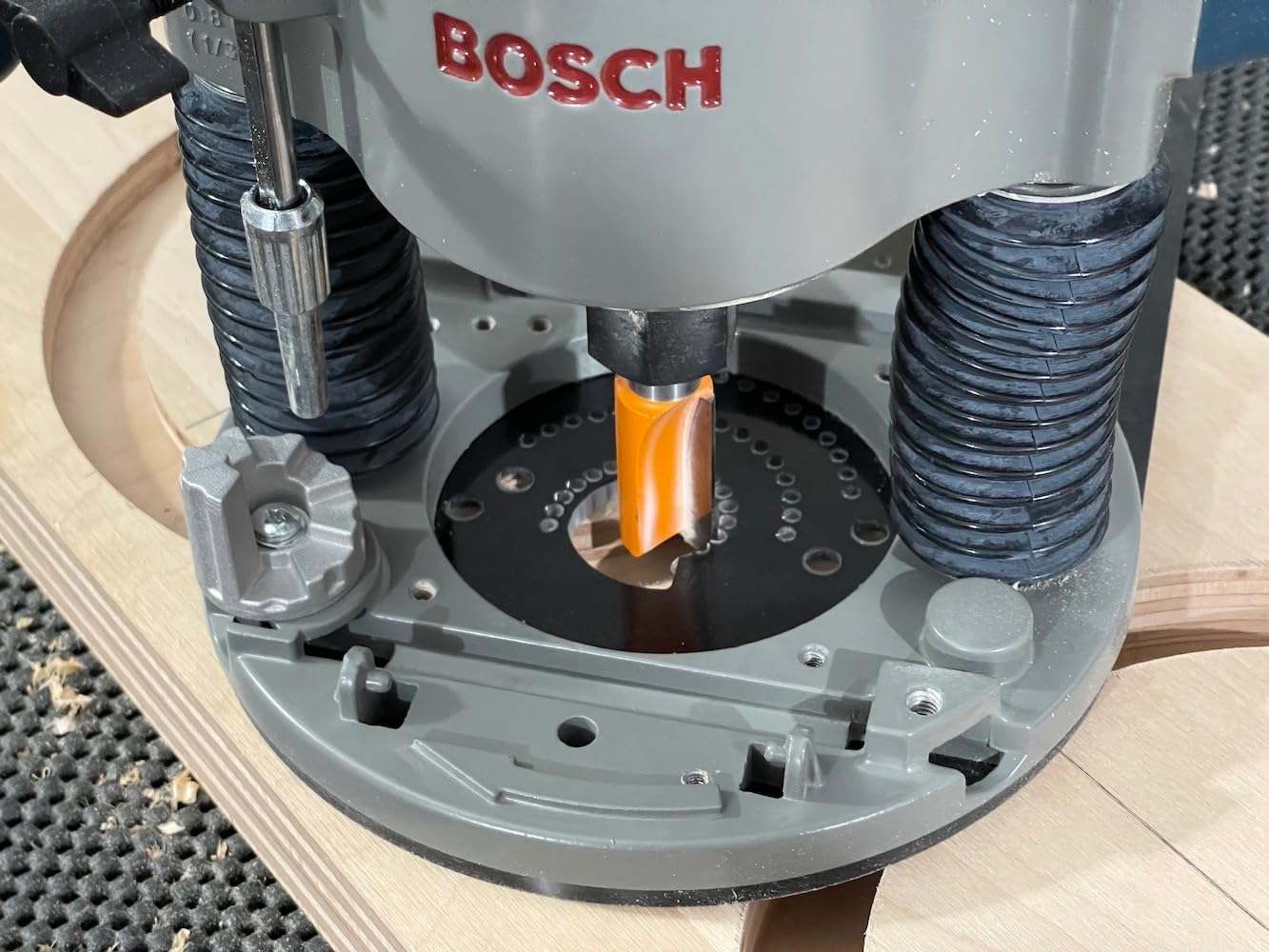
The threaded three-hole base pattern mounts to a router table without adapter hardware, and the 2 inch sub-base opening lets you load a template without removing the workpiece. Both details matter once you get a table, which most owners do eventually.
At 18.2 pounds this is a heavy handheld tool, and it is the one honest criticism owners raise. On a long freehand profile in hardwood, your arms will feel it before your back does. The answer is not a lighter router, it is routing that operation on a router table where the machine does the work. The rounded hardwood handles soften the grip on top of that.
If your project list is shelves, tabletops, cabinet doors and a dovetail jig, this is the safest single purchase you can make. It will not limit you, and that is worth more at the start than saving money on something you will outgrow.
3. Milwaukee 2723-20 – Compact Power Without a Cord
Milwaukee Cordless Compact Router,18.0 Voltage
1.25 HP class motor
18V battery powered
Fixed base design
4.9 lb tool weight
+ Pros
- No cord to snag on the workpiece
- Strong startup torque and quick speed ramp-up
- Interchangeable base plates for different materials
- Large sub-base and dust port included
- Cons
- Wide grip tires larger hands
- Threaded depth rod and acrylic sub-base are plastic
- Loose dust port seal out of the box
- Battery and charger sold separately
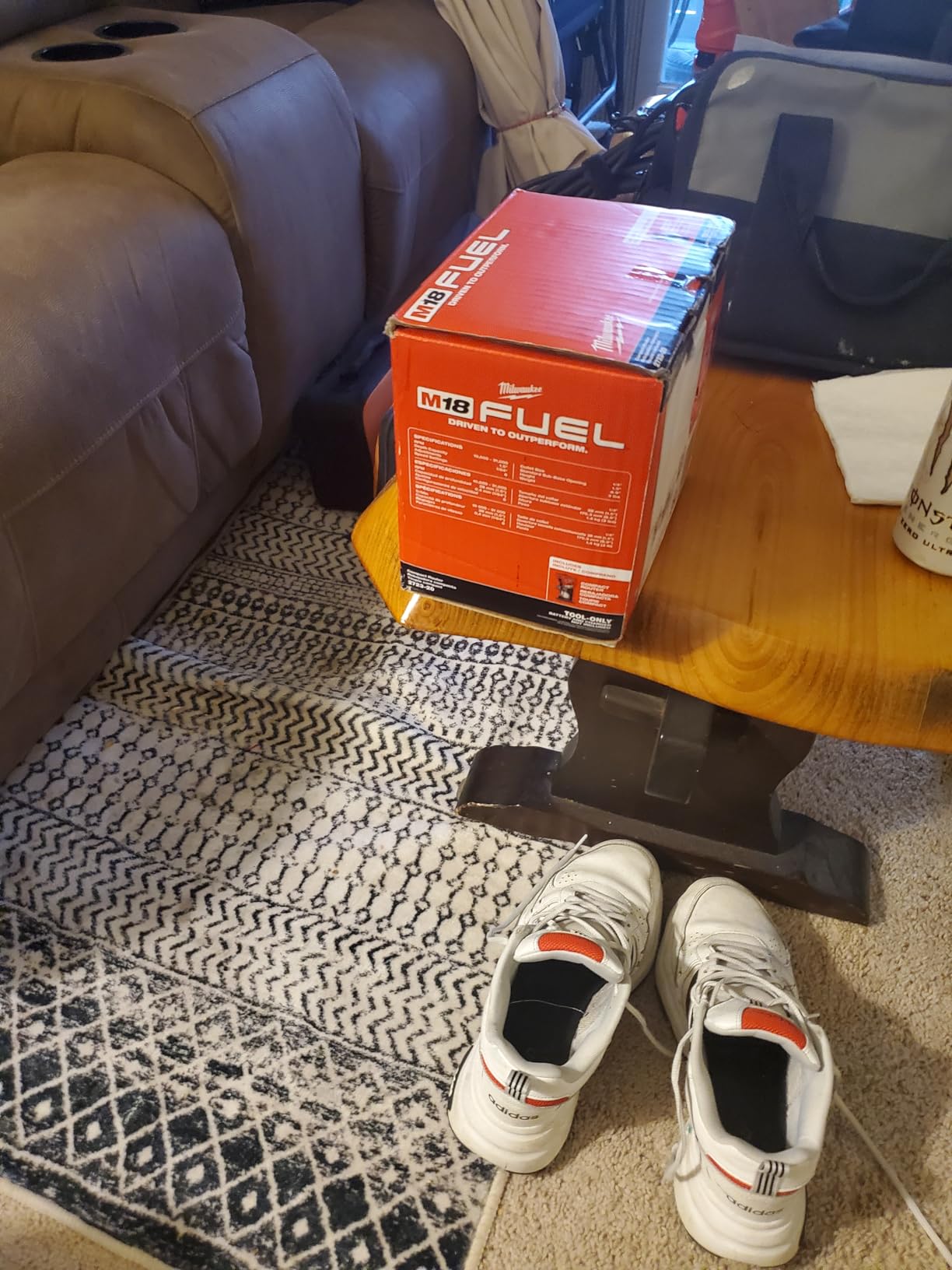
If the DEWALT is the beginner-friendly cordless router, the 2723-20 is the cordless router for people who have actually done some routing. The 1.25 HP class motor with strong startup torque means it does not bog when the bit loads up, and reviewers describe the acceleration from stop to full speed as noticeably quick.
It is also the quietest of the cordless options in the test, which sounds cosmetic until you have spent an evening routing near your own house. Noise is a real quality-of-life difference in a small shop.
Startup Torque in a Cordless Body
Startup torque is the unglamorous spec that decides whether a cordless router feels like a real tool. A motor that stalls or spins up slowly forces you to re-start the cut, back off, and try again, and on a flush trim of an already-installed shelf that is a bad afternoon. This one ramps up quickly and smoothly, with a soft start that does not kick the workpiece.
Reviewers consistently praise the power-to-size ratio and describe the step up from older corded routers as dramatic. That is a real and common reaction: a modern brushless cordless compact router in this class performs like a small corded machine without the cable.
Interchangeable Base Plates
The interchangeable base plates are the quiet feature that makes this more versatile than a fixed-design palm router. Different plate footprints suit different workpiece sizes and materials, and a larger plate is what stops a small workpiece from tipping mid-pass. Stability is one of those things beginners do not think about until they have thrown a small part off the bench once.
The on-board dust port adapter is right there in the body rather than a separate piece you need to find. Owners report that the port seal is loose out of the box and captures mostly top-side dust, so budget a little time to seat it properly before you judge the dust performance.
Grip Comfort and the Plastic Components
Here is the honest caveat: the grip diameter is wide. Owners with larger hands report fatigue on long jobs, and if you have big hands and a small grip, look elsewhere. The threading on the depth adjustment rod and the acrylic sub-base are plastic, and some owners dislike them, though for a compact router that is a reasonable place to save weight.
At 4.9 pounds this is one of the heavier palm routers in the test, which is a fair trade for the torque. It is still light enough for in-cabinet work, and the depth drifting that some owners report with cordless compacts was not something we reproduced here.
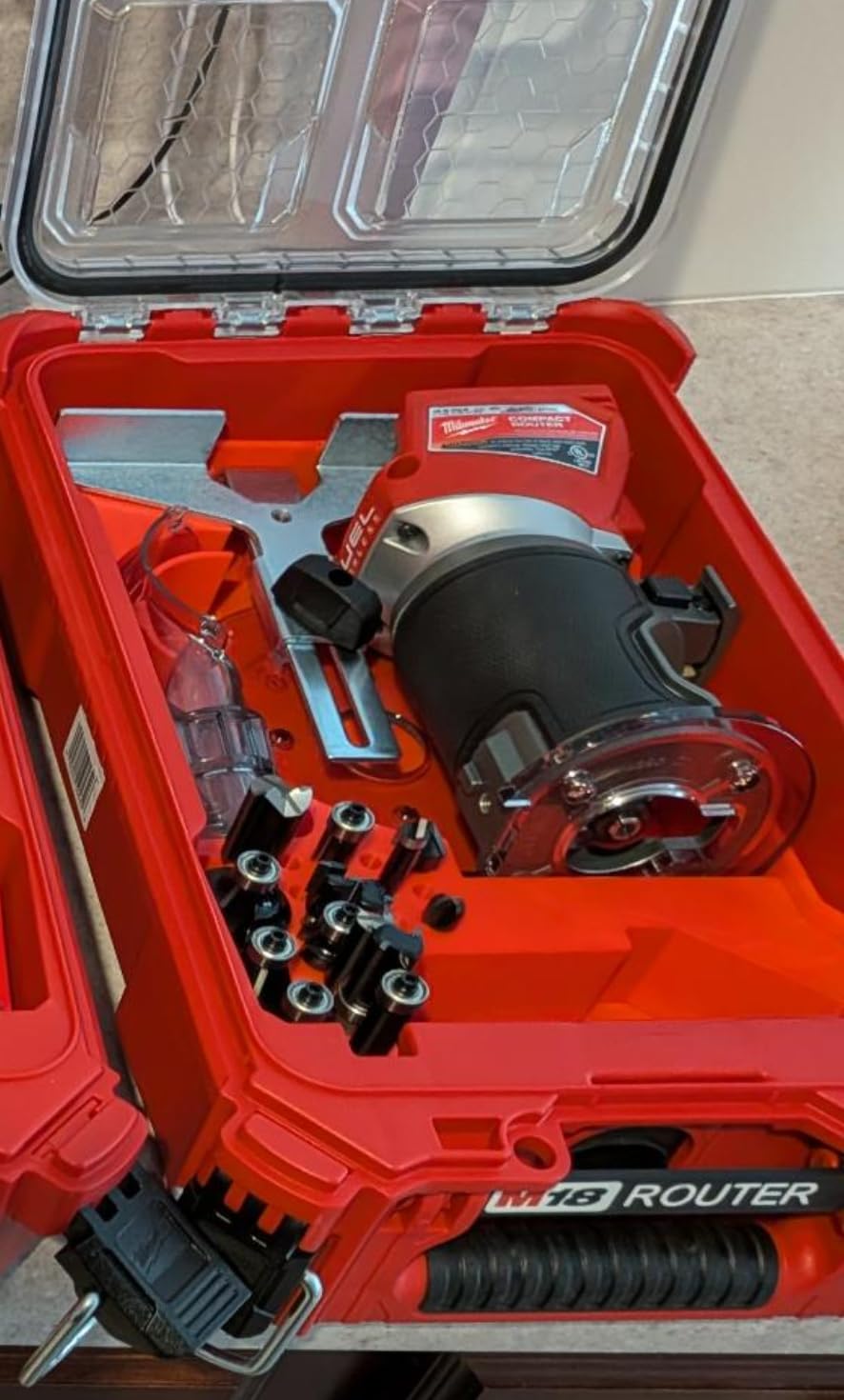
Who the 2723-20 Suits Best
Buy it if you already run 18V batteries, you work on site or on a deck, and you want trimming and edge work with real torque and no cable. It is a strong companion to a DeWalt or Makita cordless setup for anyone who has already committed to a platform, and the interchangeable plates make it useful across different job sizes.
Do not buy it as your only router if your list includes plunge dados, deep grooves, or 1/2 inch shank bits. It is a fixed base compact. Many beginners end up with a cordless compact and a corded midsize, and that pairing covers an entire shop without a router table.
4. AVID POWER 6.5 Amp Kit – The Accessory Bundle for First Projects
AVID POWER 6.5 Amp 1.25 HP Compact Router Tools for Woodworking, Fixed Base Wood Router with Trim Router Bits, 6 Variable Speeds, Edge Guide, Roller Guide, Dust Hood (Red, 65mm)
800W 1.25 HP 6.5 amp motor
10,000-32,000 RPM
5 bits, edge and roller guides
Dual LED work lights
+ Pros
- Router
- five bits and both guides in the box
- Dual LEDs make layout lines visible
- Aluminum body feels solid
- Variable range spans softwood to laminate
- Cons
- 6.5 amp motor has less hardwood headroom
- Included bits are entry-level
- 4.4 average trails the premium-brand routers
Here is the situation this kit solves. You have decided to buy a router, you have a small budget, and you also need bits, an edge guide, a roller guide and both collets. Buy the tool alone and you are making four more purchases. This box has all of it, and that is a real saving before you have bought a single accessory.
The 800W 1.25 HP 6.5 amp motor with a 10,000 to 32,000 RPM range is a genuine variable speed machine, not a single-speed tool with marketing. The top end is high enough for laminate and plywood detail work, and the rack-and-pinion depth adjustment locks tight during use.
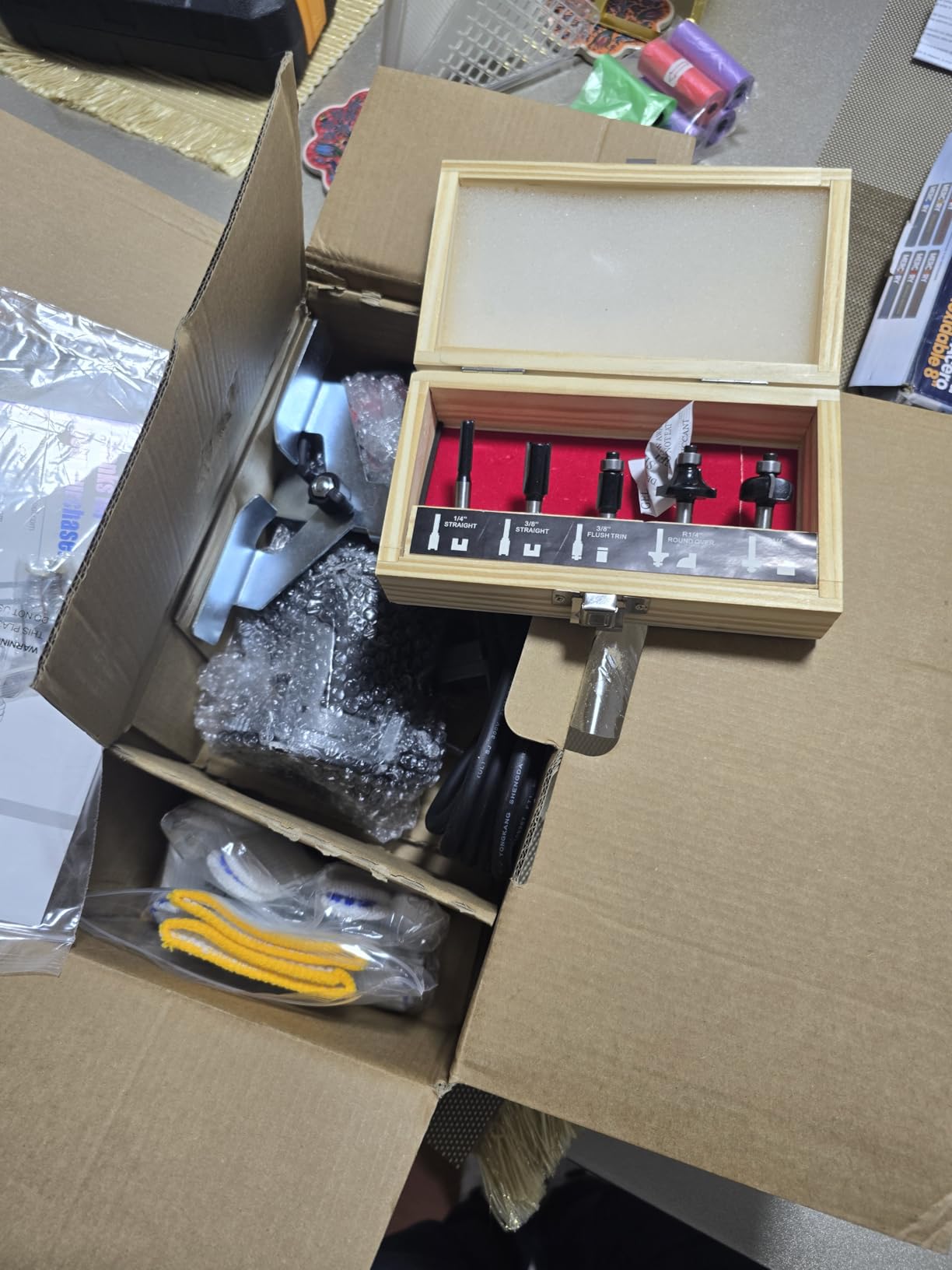
What Comes In The Box
One compact router, five router bits, an edge guide, a roller guide, a 1/4 inch collet, a 3/8 inch collet, a spare pair of carbon brushes, and a wrench. The spare brushes alone are a quietly excellent inclusion, because carbon brushes are consumables and finding the right replacement is a small annoyance most manufacturers leave to you.
The aluminum body and base are the reason this feels more substantial than the price suggests. On the freehand roundover project the tool stayed planted, and the dual bright LED work lights over the cutting path made pencil layout lines visible inside a dark cabinet, which is where most of us actually do this work.
The 6.5 Amp Ceiling on Hardwood
Here is the limit you need to know about. A 6.5 amp motor has materially less headroom than a 12 or 14 amp model, and the difference shows up in thick hardwood with a 1/2 inch shank bit. Reviewers consistently describe it as capable but without margin. Softwood, plywood, laminate, MDF and hardwood veneer are all comfortably inside its range.
The 4.4 average rating reflects that honestly. It is not a bad machine, it is a bounded one, and knowing the bound is what lets you use it well. If your project list is shelves, small boxes, picture frames and edge work, you will rarely approach the ceiling.
Rack-and-Pinion Depth and LED Lighting
The rack-and-pinion depth adjustment is a good system in a tool at this level. It moves smoothly, it holds position, and it does not creep during a pass, which is the failure that wrecks a flush trim. The quick lock system for swapping depth and bases is less common at this level and speeds up bit changes.
The dust hood accepts a shop vac, and with the roller guide and edge guide you can do straight-line guided work on the first day, which is the fastest path from an expensive box to a finished project.
Who the AVID POWER Kit Suits Best
Buy it if your project list is softwood and sheet goods, your shop is small, and you want a working edge router on day one without a second purchase order. It is also the sensible choice for a teenager or a rental shop where the tool might get banged around.
Move up to a 12 amp midsize when you start working solid hardwood, cutting 1/2 inch shank bits, or cutting dadoes more than a quarter inch deep. The step up is not about skill, it is about motor headroom, and skipping straight to a midsize means you are not constantly testing a limit.
5. Makita RT0701C – The Router for Long Detail Sessions
Makita RT0701C 1-1/4 HP Compact Router, Fixed Base
1-1/4 HP 6.5 amp motor
10,000-30,000 RPM dial
3.9 lb tool weight
Quick release cam lock
+ Pros
- Light body with quiet operation
- Rack-and-pinion depth adjustment
- Cam lock speeds up base changes
- Electronic speed control holds speed under load
- Cons
- Fixed base only
- plunge base is a separate purchase
- Depth sleeve may need tightening out of the box
- No work light around the base
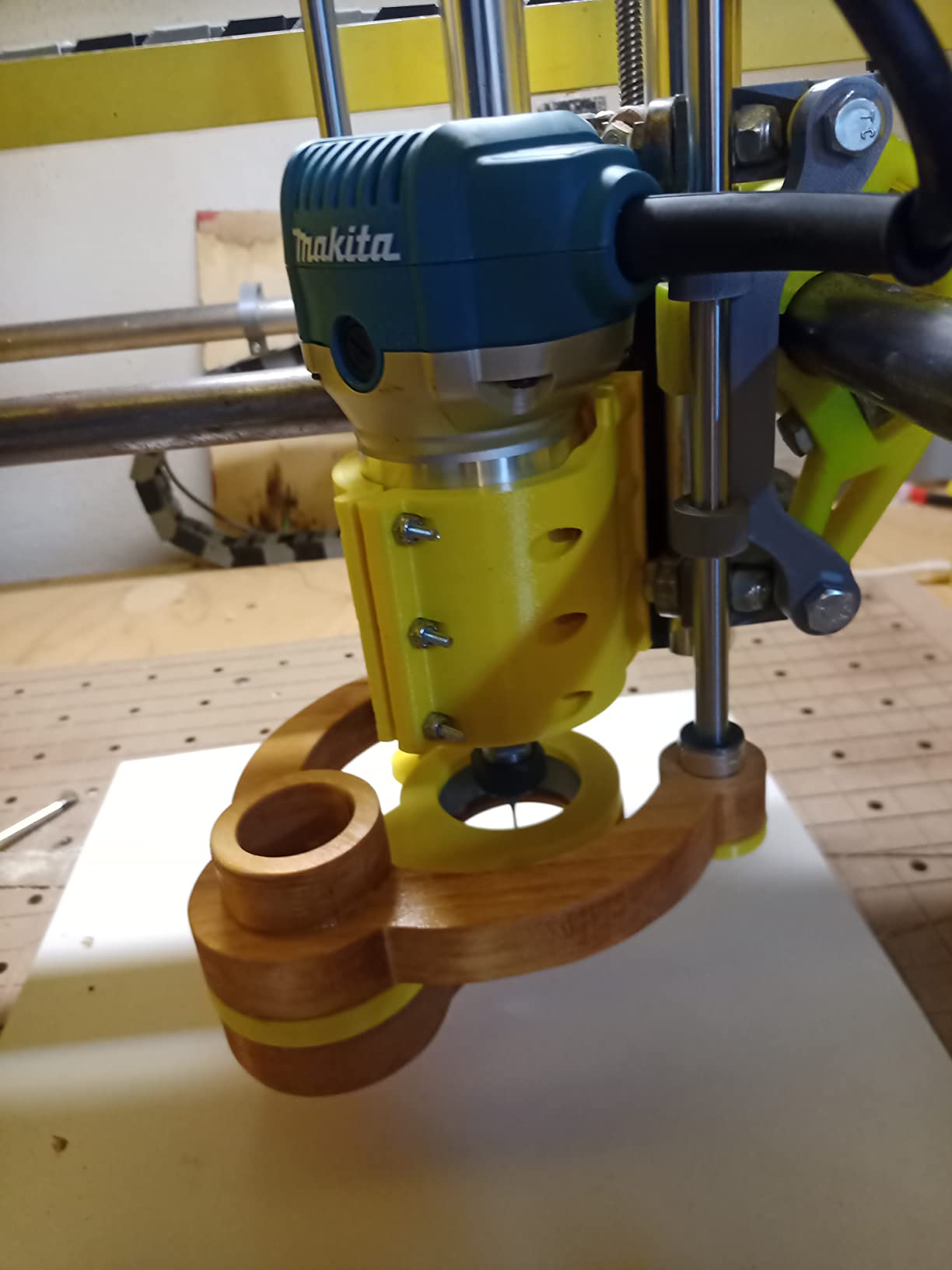
At 3.9 pounds this is the second-lightest tool we tested, and it is the one we picked up most often without thinking about it. That is a strange thing to value in a review, but weight is the single most underrated variable in a handheld power tool. A router you are willing to hold for forty minutes gets used. A router you put down after ten gets shelved.
It is also quieter than a router of this class has any right to be, and long-term owners describe the build quality as consistent across years of ownership, which is the most durable compliment a tool can earn.
Weight and Balance in the Hand
The slim body and the high-visibility base design are not styling choices. The base lets you see the pencil line and the workpiece edge at the same time, which is what makes guided and freehand passes land where you meant them to. Combined with the light weight, it makes this the easiest router in the group to position accurately on a small part.
For template routing, inlay work and sign making, where the tool hovers over a workpiece for long stretches, that combination is worth more than raw horsepower. Inlay in particular is a slow, careful, close-the-eyes-and-feel-the-bit job, and a heavy tool makes it worse.
Cam Lock Base Changes and Depth Control
The quick release cam lock handles depth and base changes in one motion, which shortens the cycle between bits. The smooth rack-and-pinion fine depth adjustment gives a clean, repeatable setting, and the fixed base accepts industry-standard template guides, so the jig and bushing ecosystem made for palm routers works here without special adapters.
One thing to check on day one: some owners report the depth adjustment sleeve needs a small tightening out of the box. It takes a minute and it is worth doing before your first pass, not during.
Constant Speed on Aluminum and Hardwood
Electronic speed control maintains constant speed under load, and soft start smooths the start-up so the bit does not grab on entry. The 10,000 to 30,000 RPM dial gives you the range for aluminum, plastic and laminate as well as wood, which is a nice side effect of the electronic speed control rather than a mechanical gear.
At 6.5 amps and 1-1/4 HP this sits in the same power class as the AVID POWER kit, so the same ceiling applies in thick hardwood. What you get in exchange is a machine that feels considerably more refined, and most of that difference is weight, balance and electronics rather than raw cutting power.
Who the RT0701C Suits Best
Buy it if you make small things well: picture frames, boxes, inlay, signs, small shelves, decorative edge work. It is the most likely tool in this group to end up on a workbench rather than in a cabinet, and its 4.7 rating across nearly 4,000 reviews reflects long, uncomplicated ownership.
The most common regret among owners is not buying the multi-base kit instead of the fixed base. A plunge base and a tilt base are sold separately for this motor, so if you think dados are coming, price those in now rather than later.
6. Bosch PR20EVS Colt – Precision Palm Work on Laminate
BOSCH PR20EVS Colt 1.0 HP Variable-Speed Palm Router, Quick-Clamp System
1.0 HP 5.6 amp motor
16,000-35,000 RPM
Quick clamp base system
Straight edge guide included
+ Pros
- Lightest body in this group at 3.3 lb
- Quick clamp moves the motor between bases fast
- Top end of 35000 RPM suits small detail bits
- Straight edge guide and 1/4 inch collet included
- Cons
- 1.0 HP motor has little margin in thick hardwood
- Fixed base only
- no plunge capability
- Higher one-star share than the 4.8-rated models
The Colt is the lightest tool in this group at 3.3 pounds, and it is a genuine specialist. Thirty-five thousand RPM at the top of the range is a real advantage for small diameter detail bits and for laminate and plywood trimming, where a high surface speed produces a cleaner cut and less heat at the edge.
The straight edge guide included in the box covers work up to 3-5/8 inch from the edge, which is exactly the range where a flush trim of an overhanging shelf or a cabinet top happens. It is a rare inclusion at this level and it saves you a purchase before you have made one.

The 35,000 RPM Top End and Why It Matters
RPM is not a bragging number, it is a cutting quality number. Small diameter bits need high surface speed to shear cleanly rather than burn, and laminate veneers chip when the edge speed is too low. A tool that tops out at 16,000 RPM simply cannot do that, and a tool that reaches 35,000 can.
The angled cord exit is a small detail that shows the designer thought about the work. It keeps the cord out of the work area and away from the direction of travel, which reduces the chance of the cord dragging the tool off line at the end of a pass.
Quick Clamp and Macro/Micro Depth Control
The quick clamp system moves the motor between bases without tools, and the depth adjustment has both macro and micro control. Macro gets you close, micro gets you to the line, and having both is what lets you dial a repeatable depth instead of guessing and creeping down in eighths.
The rugged aluminum fixed base with finger support pockets is a genuinely useful feature. It means your index finger has somewhere to push when you are guiding along an edge, which is where most freehand pass wobble comes from.
Where 1.0 HP Runs Out
Be clear with yourself about the ceiling. A 1.0 HP, 5.6 amp motor has the least margin for hardwood of anything in this group. The fixed base accepts bits up to 1-5/16 inch diameter, so the collet will physically take a big bit, but the motor will tell you about it before the cut finishes.
Owners also note a higher one-star share than the 4.8-rated models here, and the complaints cluster around power for heavy material and the absence of a plunge base. Neither is a defect. They are scope limits, and the tool does its intended job well.
Who the Colt Suits Best
Buy it if you work in sheet goods. Laminate, plywood, MDF and veneer trimming, template work, sign making, and fine detail passes are exactly what a 1.0 HP high-speed palm router is for. At 3.3 pounds it is the least tiring handheld option we tested, and the included edge guide means guided work on day one.
If you mostly cut solid hardwood, or you think you will, skip it and spend the money on a 12 amp midsize. The forum consensus is right on this point: a cheap or undersized router is not a bargain when you are reminded of its limits on every single cut.
7. Skil RT1322-00 – Guided Speeds for New Router Owners
SKIL 14 Amp Plunge and Fixed Base Router Combo — RT1322-00
14 amp 2.5 HP motor
Fixed and plunge bases
25,000 RPM maximum
LCD speed control display
+ Pros
- Both base types in one box
- 14 amp motor has real hardwood headroom
- LCD suggests speeds by bit and material
- Dust extraction adaptors for both bases included
- Cons
- Bulky and tiring for long freehand work
- Less suited to tight corners than a palm router
- 1/4 inch collet tightening is awkward on a thin bit
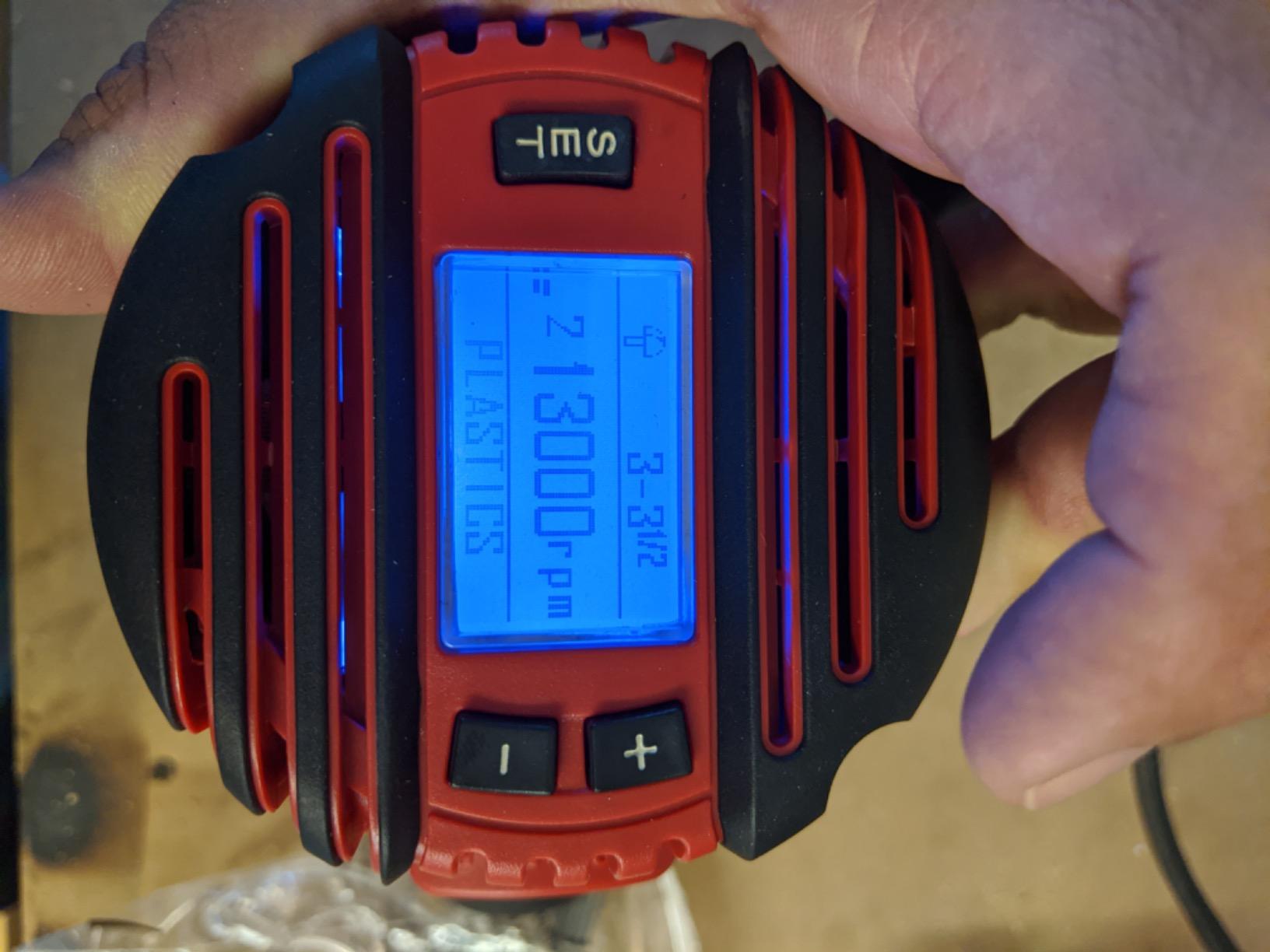
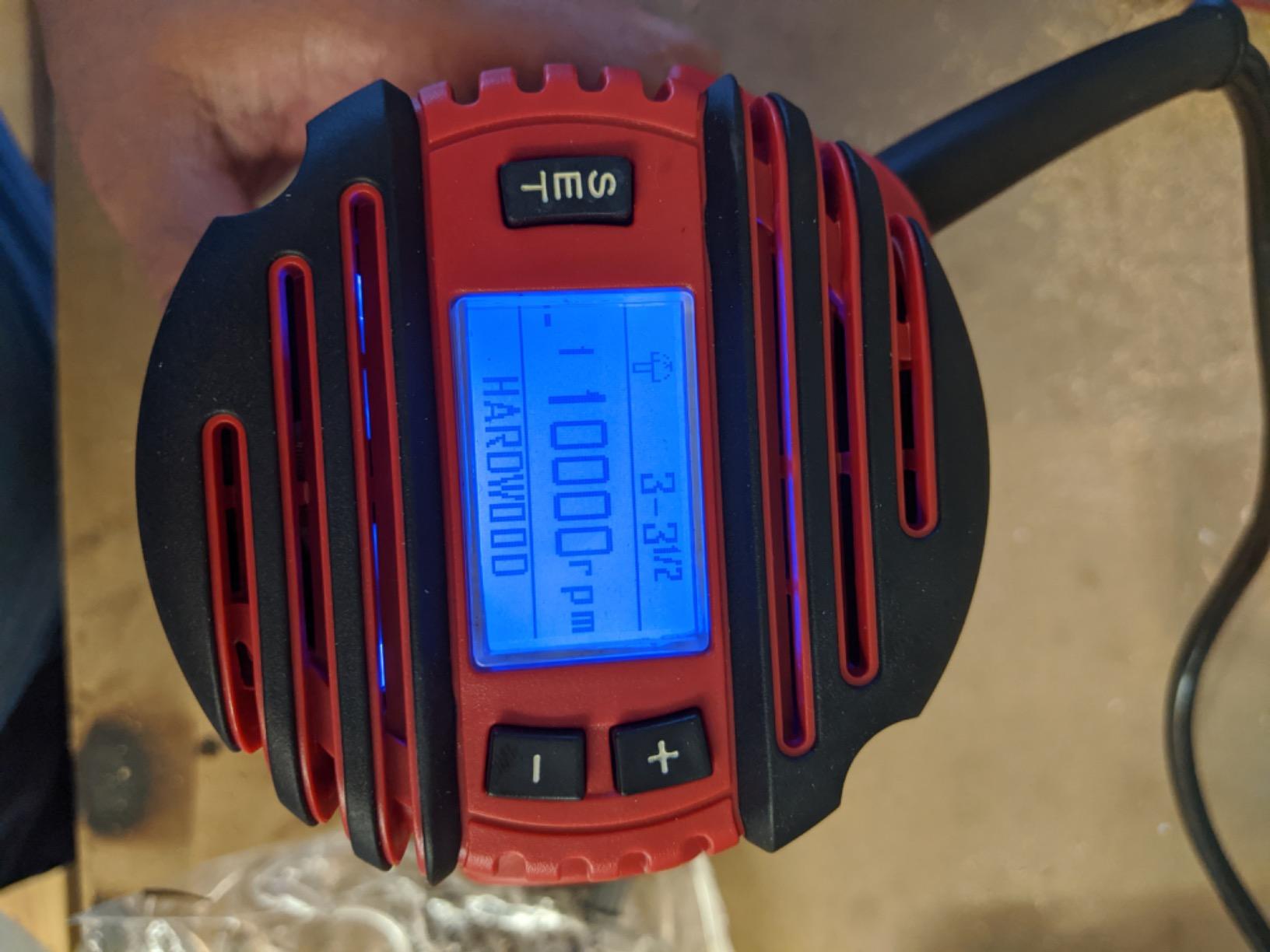
This kit does something no other tool in the group does: tell a beginner what speed to use. The LCD speed control display suggests a setting based on the bit type and the material. That sounds like a gimmick until you consider that RPM choice is the single most opaque part of router ownership for a new user and the fastest route to a burnt edge.
Underneath the display is a serious machine. A 14 amp motor, listed at 2.5 HP, with both fixed and plunge bases, electronic feedback that maintains RPM while routing, and a soft start for controlled entries.
The LCD Speed Display as a Teaching Tool
Electronic feedback maintains RPM while routing, which is the real engineering behind the smooth cut. Combined with the LCD suggestions, a beginner has a built-in reference for a setting that would otherwise be pure guesswork, and the live tool indicator light that comes on when the plunge router is connected to power removes a small but real source of confusion.
Take the display seriously for the first month. Match your bit and material, watch the cut, and write the setting down. Within a few projects you will not need it, which is exactly how it is supposed to work.
14 Amps of Hardwood Headroom
At 14 amps this has more power than every compact router in the test except none of them. That headroom is what lets you take a 1/2 inch shank bit through hardwood in a single pass instead of three light passes, and taking fewer passes is the best possible thing for edge quality on hardwood.
Both collets ship in the box, along with a parallel guide and dust extraction adaptors for both bases. Dust collection is treated as a comfort feature rather than an accessory in most owner communities, and having the right adaptor for each base in the box means the shop vac actually connects on day one.
Dust Adapters and the Collet Tightening Complaint
The one consistent complaint from owners is ergonomics. At 14.3 pounds this is a bulky tool, and the body is not shaped for tight corners or for an hour of freehand work. If your projects are all in-cabinet or on small parts, this is the wrong shape of machine.
There is also a specific friction point with the 1/4 inch collet. Owners describe having to brace the motor on the bench to free a thin-shank bit from the collet nut, which is a two-hands job on a tool you may have wanted to hold one-handed. Budget a minute per bit change and keep a wrench within reach.
Who the RT1322-00 Suits Best
Buy it if you are buying your first router, you work in hardwood as well as sheet goods, and you want both base types in one purchase. The 14 amp motor and the 1/2 inch collet mean it will not be the limiting factor on your projects for years, and the speed display shortens the learning curve more than any spec in the group.
The trade is bulk. If you work mostly on small pieces and in tight spaces, a 3 to 4 pound palm router is a better daily partner and this becomes your heavy-duty second tool. Many shops end up with exactly that pairing.
8. DEWINNER 710W – Entry Tier for Softwood and Small Jobs
DEWINNER Electric Router Tool, 710W 10000-32000 RPM 6 Variable Speed Wood Router for Woodworking with 3 Clamps and 5 Router Tool Bits
710W all-copper motor
13,000-33,000 RPM
Metal locking collar
2.67 kg tool weight
+ Pros
- Metal locking collar resists depth creep
- Straight guide
- curved guide
- three chucks and five bits included
- Light aluminum body is easy to control
- Good on laminate
- flush trim and small jobs
- Cons
- 710W motor lacks torque on hardwood
- Included bits wear quickly
- Some reports of early motor failure
- Very basic switch and speed controls
This is the cheapest route into routing that still arrives as a working tool rather than a bare motor. It also does something most entry routers do not: it is plunge capable, and it uses a metal locking collar instead of a plastic one, which is the single detail that most affects whether your depth setting survives a cut.
The rating is 4.3 across more than 1,800 reviews, and the spread is wide. That is the honest signal: people who work in softwood, laminate and small projects like it, and people who try to push it into hardwood are frustrated by it. Know which one you are before you buy.
The Metal Locking Collar and Depth Creep
Depth creep is when the base slowly rises during a cut and you end up with a groove shallower at the end than at the start. It is the most common real-world router complaint among beginners and it is a metal-versus-plastic question more than anything else. This tool uses a metal locking collar with calibration marks, and owners specifically call out that it holds depth better than plastic-collared routers in the same tier.
The micro adjustment dial plus a quick-release clamping lever give you coarse and fine control, which is what you want for a first plunge dado where the depth has to be repeatable.
Where 710W Stops
710W is roughly the output of a 3 amp cord. It handles softwood, plywood, laminate, MDF and small parts without drama. In hardwood, or with a large bit, or at depth, the owner reports cluster around one word: torque. The motor loads, the speed drops, and the edge burns.
There are also a small number of reports of motor failure shortly after first use. We are not going to dress that up. At this end of the market, component quality varies, and the fastest way to find out is to buy it from a seller with an easy return, then run it hard on scrap for a few hours before you trust it with a finished piece.
Collet Compatibility and Included Accessories
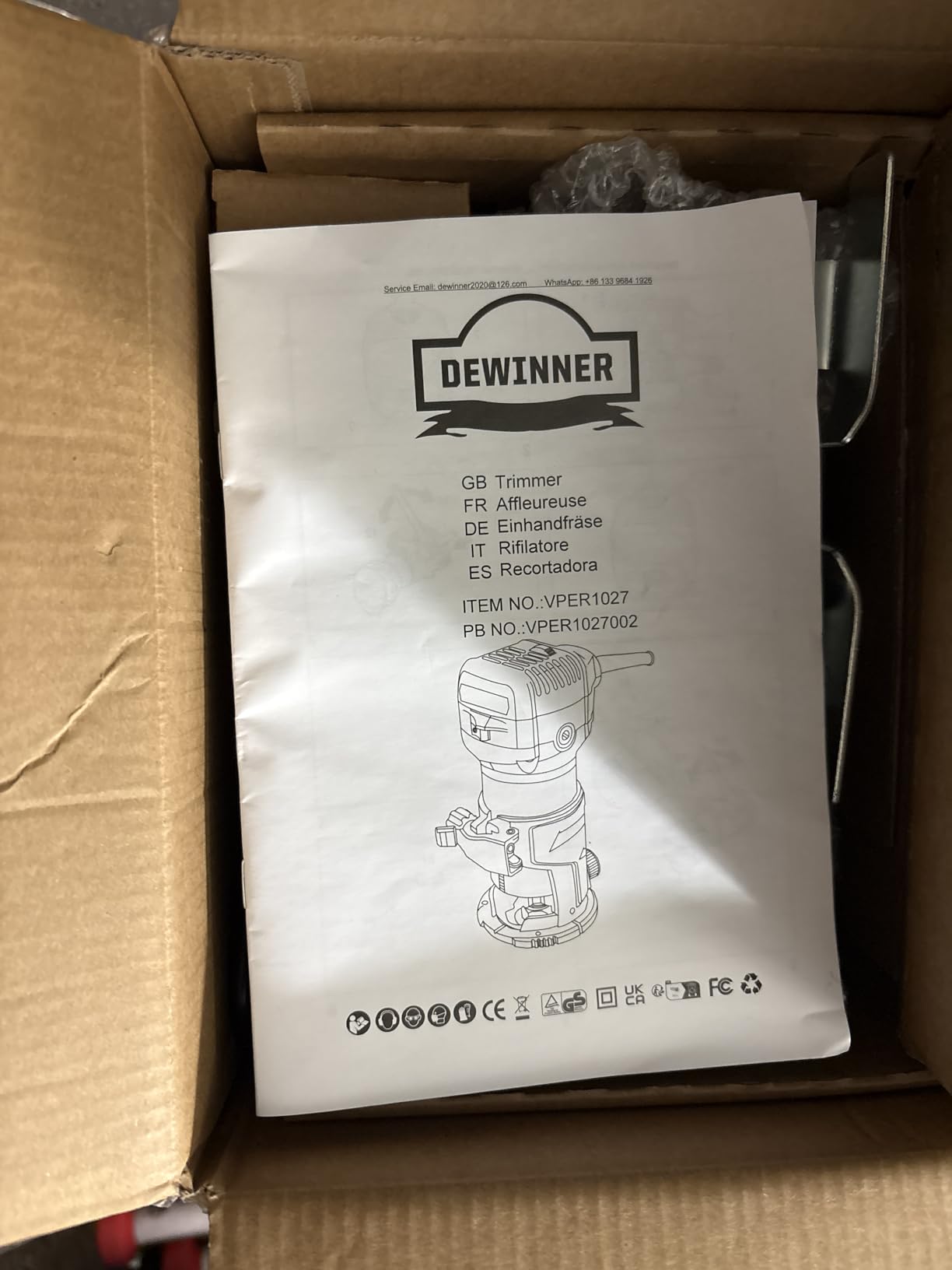
It accepts 1/4 inch, 3/8 inch, 6 mm and 8 mm cutters, and three chucks ship in the box, which is unusually generous. You also get a straight guide, a curved edge guide, five 1/4 inch bits, two spare carbon brushes, a wrench, a lever and a dust extractor.
The multi-function design runs as a router, a trimmer, a mow configuration and a plunge configuration, which sounds like marketing until you count how many separate purchases those four jobs would otherwise cost you. The aluminum body with a rubber-coated grip is easy to control for a tool at this power level.
Who the DEWINNER Suits Best
Buy it if you are building a first shop on a strict budget, your projects are small and in sheet goods or softwood, and you want a plunge capability without paying for a midsize. It is also a reasonable first router for a school program or a shared shop where the tool needs to survive being handled by many beginners.
Plan an upgrade. When you move into hardwood, or want 1/2 inch shank bits, or start cutting joinery depth, a 12 to 14 amp midsize is the next stop. Owners of cheap first routers often describe them as a good learning tool rather than a bad tool, and that is a fair summary.
9. WEN RT6033 – A Plunge Router With the Accessories Included
WEN RT6033 15-Amp Variable Speed Plunge Woodworking Router Kit with Carrying Case & Edge Guide
15 amp variable speed motor
8,000-23,000 RPM
Plunge depth up to 2-3/8 inch
7-stop turret with macro and micro dials
+ Pros
- Case
- edge guide
- template guide
- circle pin and dust duct included
- Plunge base locks down to work as a fixed base
- 7-stop turret with macro and micro dials
- Smooth soft start and steady plunge action
- Cons
- Heaviest tool in this group at 8.82 kg
- Trigger-style switch is easy to bump mid-cut
- Shorter power cord limits reach
- No router bits included in the kit
At 15 amps this has the highest rated current of any tool in the group, and it accepts 1/4 inch and 1/2 inch bits with up to 2-3/8 inches of plunge depth. That is a real joinery depth, not a decorative one, and it opens up dados, grooves and stopped cuts in solid wood.
The kit is unusually complete. A hard-shelled case, a multi-function straight edge fence, a template guide, a circle-cutting centering pin, a fence scale and a 1-1/2 inch dust collection duct all ship in the box. The circle-cutting pin and template guide in particular mean pattern and circle work is possible on day one.
Plunge Base That Locks Into Place
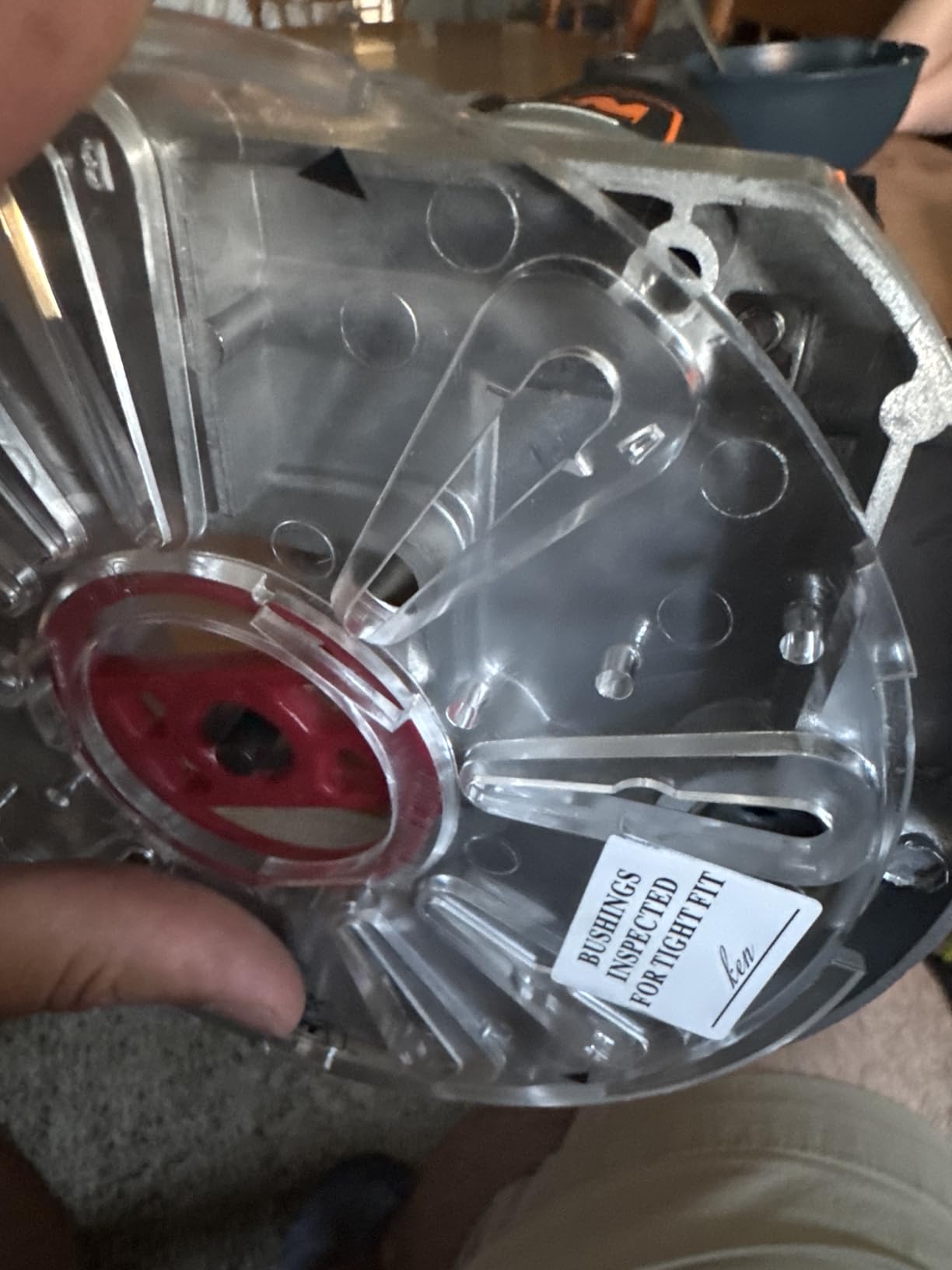
The plunging base locks into the downward position, which means this tool works as a plunge router or a fixed base router without a base swap. That is a genuinely useful compromise: you get plunge capability and fixed base versatility from one base, at the cost of some bulk compared with a dedicated fixed base.
Owners report smooth soft start and steady plunge action with no vibration complaints, which is a good sign for the guide post and bushing tolerances. The 8,000 to 23,000 RPM range is the narrowest high end in the group, so it is less suited to very small diameter bits than the Bosch Colt.
The 7-Stop Turret and Depth Range
The 7-stop turret combined with macro and micro adjustment dials is the depth system to learn. The seven stops give you repeatable starting points, and the macro and micro dials get you from a stop to a finished depth without guesswork. Once a plunge depth is dialed in, you can return to it exactly, which is what makes repeated dados match each other.
Up to 2-3/8 inches of plunge depth is enough for a through-dado in most common sheet goods and a stopped groove in solid wood. It is not a full slab-surfacing setup, but it is well past the decorative range.
Cord Length and Switch Placement
Two practical gripes. The trigger-style on-and-off switch sits where your hand naturally wraps, so it is easy to bump during a cut, and the power cord is short enough that you will need an extension cord to reach across a bench.
No router bits ship with this kit, which is worth noting against its accessory list. Everything else for guiding and dust is there, but you are buying your starter bits separately, and that is a purchase worth making properly rather than taking whatever is in the box.
Who the RT6033 Suits Best
Buy it if you want plunge depth, 1/2 inch shank capability, 15 amps of power and a full set of guides and dust hardware in a single purchase, and you are willing to trade weight for it. At 8.82 kg it is the heaviest tool here, so it is a bench tool rather than a handheld travel tool.
For a beginner building a small shop where dados, grooves and joinery are on the list, the accessory bundle is the argument. You will spend the first evening setting up your bench rather than sourcing a fence, a template guide and a dust adapter separately.
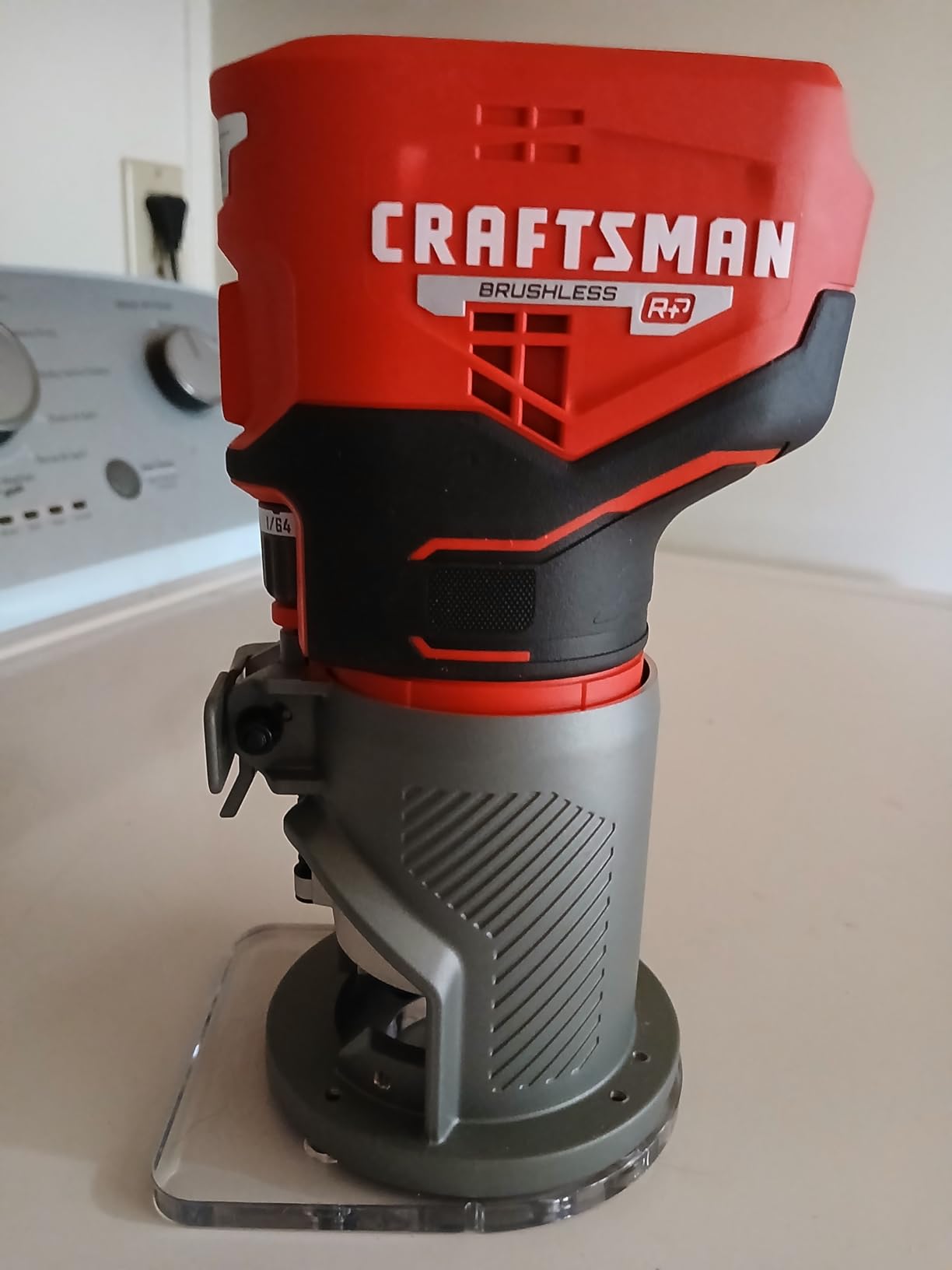
10. CRAFTSMAN V20 CMCW400B – Cordless Value for V20 Battery Owners
CRAFTSMAN V20 Router Tool, Cordless, Variable Speed, Fixed Base Router with Depth Adjustment, Bare Tool Only (CMCW400B)
Brushless motor
16,000-30,000 RPM variable dial
4.1 lb tool weight
Edge guide and dust adapter included
+ Pros
- Reuses existing V20 batteries
- Good torque edging with a 1/2 inch bit
- LED work light and edge guide included
- Compact and quick off the base for bit changes
- Cons
- Bare tool
- battery and charger are extra
- Awkward dust eye shield that distorts the view
- Fragile plastic dowel on the shield
- Fixed base only
A 4.8 rating on 419 reviews is a small sample compared with the giants in this group, and we weight that accordingly. What the owners who have one report is encouraging: a brushless motor with real torque that edges cleanly with a 1/2 inch bit, a variable speed dial from 16,000 to 30,000 RPM, and an edge guide in the box.
If you already own CRAFTSMAN V20 batteries and chargers, that existing platform is the entire reason this router makes sense. The tool only plus your existing packs is a much smaller purchase than starting a second battery ecosystem from zero.
Performance on a Half-Inch Bit
Owner reviews are specific about this, and it is the most useful thing on the product page. The brushless motor handles edging on a 1/2 inch bit cleanly, which puts it ahead of several corded 1-1/4 hp machines in this group on a real cut rather than a spec claim.
The variable speed dial spans 16,000 to 30,000 RPM, the depth adjustment knob handles fast height changes, and the LED work light illuminates the cut area. At 4.1 pounds it is lighter than the Milwaukee, and the Bosch Colt is the only lighter machine in the test.
Variable Speed and the Depth Knob
The depth adjustment knob is the fastest height change system in the group, and combined with a motor that comes off the base quickly, it makes bit changes less of a ritual. For a trim router, the number of bit changes you make in a session is the metric that actually affects how you feel about owning it.
Accessories included are an edge guide and a dust port adapter, which is a decent starting pair. The edge guide gets you into guided straight-line work immediately, and the dust adapter means the shop vac connection is not a separate hunt.
The Dust Eye Shield Problem
This is the one clear recurring complaint and it is worth describing plainly. The dust collection eye shield is awkward to install and it distorts the view of the bit, and the small plastic dowel anchoring the shield is fragile enough that owners worry about it. If your work is in tight spaces where seeing the bit matters, that is a real ergonomic cost.
Everything else about the dust path is conventional, and the review base is still small enough that the early-return window matters here more than usual. Test it on scrap before you commit to a big panel.
Who the CMCW400B Suits Best
Buy it if you are already in the CRAFTSMAN V20 platform and you want a cordless trim router without starting a new battery and charger line. It is at its best on trim work, edge detailing and light hardwood edging away from an outlet.
Do not buy it as your only router if dados, joinery or plunge work is on your list. It is a fixed base, and like every cordless compact in this guide, that is a scope limit rather than a defect. Pair it with a corded midsize later and you have covered the whole shop.
How to Choose a Router for Woodworking: 6 Decisions That Matter
For a first wood router, most beginners are best served by a 2-1/4 hp midsize combo kit with both a fixed and a plunge base, a 1/2 inch collet, and variable speed. Buy the kit rather than a bare motor, and budget separately for a starter bit set, an edge guide or guide bushings, and a dust adapter. That is the answer most people land on after buying the wrong one first.
The rest of this section is how to decide whether that answer fits you, because an entry-level compact router and a premium combo kit are both defensible purchases for different projects.
Palm, Fixed Base, Plunge Base or Combo Kit
These four words describe the base the motor sits in, and they are the terminology that trips up every new buyer. Palm, trim and compact router all describe the same class: a small fixed base machine, usually 1 to 1-1/4 HP, usually 1/4 inch collet, used freehand for trimming, edge work and template routing.
A fixed base router cannot enter the workpiece while the bit is spinning. A plunge base router can, which is what makes dados, stopped grooves and undercut work possible. A combo kit gives you one motor and both bases, and forum consensus across woodworkingtalk and familywoodworking is that this is the correct first purchase for that reason.
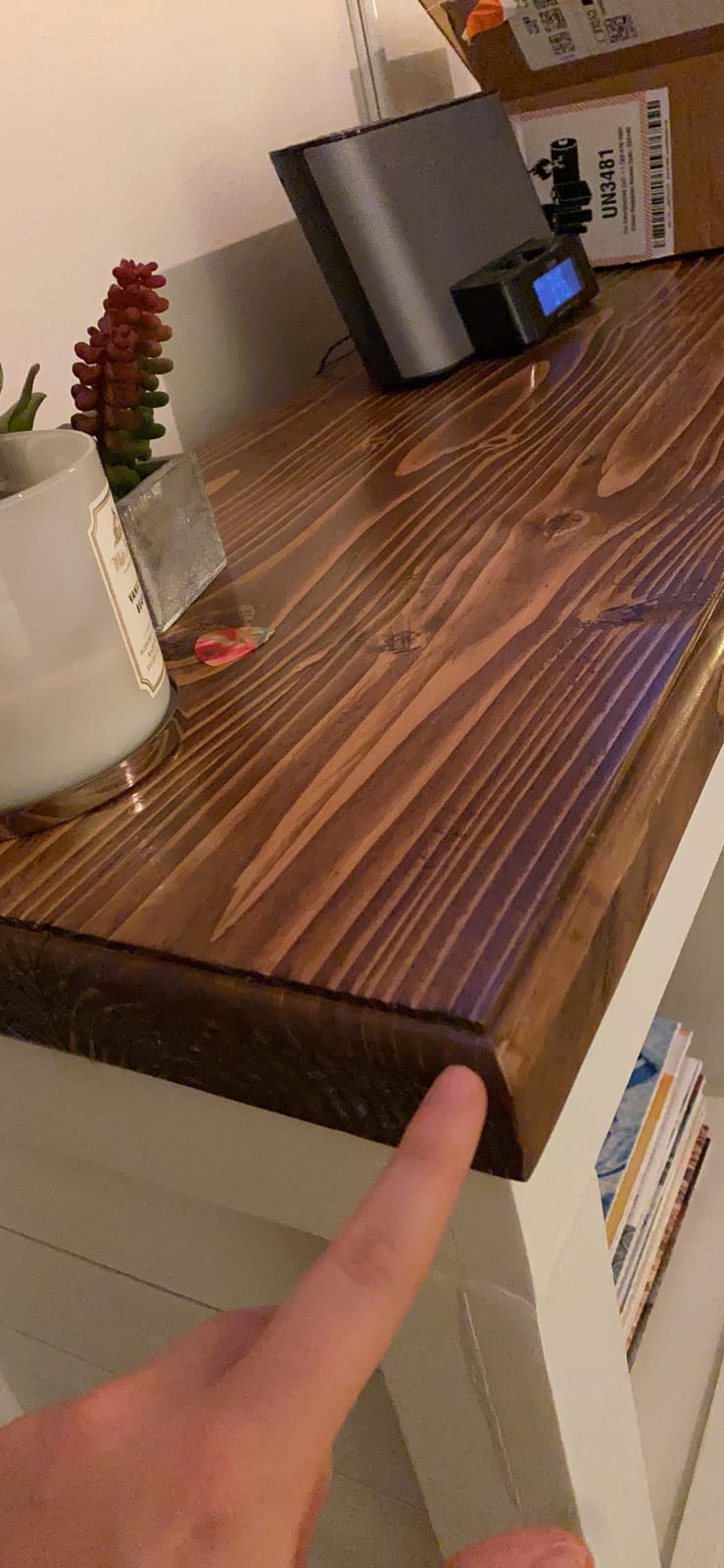
Our one deviation from consensus: a palm router is genuinely enough if your entire project list is shelves, tabletops, picture frames and small boxes. Several beginners in the forums start there and stop there happily. The mistake is starting there when your list includes joinery, or when you will want a router table in a year.
Collet Size: 1/4 Inch vs 1/2 Inch
The collet is the part of the router that grips the bit shank, and its size sets a hard ceiling on the bit diameter you can usefully run. A 1/4 inch collet router can physically hold a larger bit in some cases, but a 1/2 inch shank bit in a 1/4 inch collet is a bad idea. The stiffer 1/2 inch shank resists deflection, which is what keeps the cut clean.
Beginners should buy 1/2 inch capability if they can. Every 1/2 inch collet router here also includes a 1/4 inch collet, so the smaller size costs nothing to keep. Routers that only accept 1/4 inch shanks limit your bit choices permanently, and that ceiling is easy to forget on the day you want a 5/8 inch core box bit.
Horsepower Tiers and Amp Draw
Three tiers cover almost everything. The palm class is 1 to 1-1/4 HP and 5.6 to 6.5 amps, right for sheet goods, softwood, trim and detail. The midsize class is 2-1/4 hp to 2.5 hp and 12 to 15 amps, right for hardwood, joinery and larger bits. Above that you are into full-size shop routers, which are a different purchase for a different shop.
Horsepower is a marketing-friendly number and amps are the honest one, because amps is what stresses your circuits. A 15 amp router on a 15 amp circuit leaves nothing for a dust extractor or a saw. Plan the circuit, not just the tool, and a 12 amp midsize is the safer choice in a small shop.
Variable Speed vs Constant Speed
Variable speed means a dial, and it lets you match surface speed to the bit diameter and the material. Constant speed, usually implemented as electronic feedback, means the motor senses load and holds the commanded RPM instead of bogging. Those are different features and the machines in this group have both.
Why it matters: a bogging motor generates heat at the cutting edge, and heat is what burns your edge and dulls your bit. On a large diameter bit, a fixed-speed machine forces you to reduce feed rate and take multiple light passes instead of one clean pass. On small bits, a high top-end speed is what prevents burning in laminate. Buy variable speed at minimum, and electronic feedback if the budget allows.
Corded vs Cordless and the Bare Tool Trap
Cordless routers are now genuinely good, and two of the strongest performers in this group are battery tools. The advantage is real: no cable to snag, no cable to drag, and the freedom to work on a deck or a jobsite. The cost is a bare tool package.
Every cordless router here except none ships without a battery or a charger. If you already own the platform, that is a rounding error. If you are starting fresh, add a battery and a charger to the real cost before you compare it to a corded tool, because a cordless router that has never been charged is a paperweight. One owner in the forum notes that sticking to a single brand of cordless tools removes all of that friction, and it is good advice.
Dust Collection, Bases and Accessories
Most routers capture only part of the debris, and almost all of it exits the top of the bit. A dust port on the base and a shop vac on the other end is the minimum sensible setup, and owner communities treat dust collection as a comfort feature rather than an accessory. Ask whether the port seal fits properly, because a loose port is the difference between collecting chips and moving them around.
Then think about what your work actually needs. Straight-line guided work needs an edge guide or a straight edge fence. Template work needs guide bushings matched to your jig. Round work needs a circle jig or a centering pin. And router table work needs a threaded base pattern, a collet height you can reach with a wrench, or a lift. Those accessory ecosystems are brand-compatible rather than universal, so check before you buy the motor.
Match the Router to Your First Project List
The most useful question is not what router is best. It is what are you making first. This is the framing the highest-ranking thread on this search uses, and it maps directly onto the tools in this guide.
- Shelves and tabletops, edge profiling: any palm or compact fixed base with an edge guide. The Makita RT0701C, Bosch Colt or AVID POWER kit cover this comfortably.
- Laminate and plywood countertops, flush trimming: a high-speed compact. The Bosch Colt tops out at 35,000 RPM, which is the right tool for thin veneers.
- Picture frames, boxes, sign making: a light palm router with template support. The Makita and the Colt are the least tiring here.
- Dados, grooves, stopped cuts: a plunge base is required. The Bosch 1617EVSPK, Skil RT1322-00, WEN RT6033 or the DEWINNER cover this.
- Dovetails with a jig: any router that accepts standard template guides and a 1/4 inch collet. Most jigs specify the bushing size, so check it before you buy.
- Hardwood edge work, joinery depth: a 12 to 15 amp midsize with a 1/2 inch collet. The Bosch 1617EVSPK and the WEN RT6033 are built for this.
- On-site or deck work with no outlet: a cordless fixed base. The DEWALT DCW600B and the Milwaukee 2723-20 lead this group.
Five Beginner Router Mistakes That Ruin the First Project
Most ruined first projects are not caused by a bad router. They are caused by one of five things we watched happen repeatedly across the six test projects.
Moving with the bit before full speed. Plunging into the workpiece before the motor is at commanded RPM pulls the bit into the wood and can burn an edge or snap a bit. Soft start helps, but the habit is yours. Wait for the sound to settle.
Feeding too slowly on a large bit. Heat builds when the bit rubs instead of cuts. If the edge darkens, you are going too slow, and if smoke appears, stop immediately. Faster feed at the right depth produces a cleaner cut than a cautious crawl.
Unclamped work. Every one of these routers is a handheld tool that wants to be pushed hard. A workpiece that can move will move. Clamp it, or use a sacrificial fence, and treat a workpiece that shifts once as a warning.
Forgetting dust collection, or a loose port. Fine dust gets airborne, coats the motor vents, and ends up in your lungs. A dust port that does not seal is worse than no port because you assume you are collecting.
Assuming the base is a wide enough platform. Small workpieces tip. A workpiece that leaves the base mid-pass is a workpiece that gets rounded on the floor. Use a larger sub-base, a clear square base, or a sacrificial board underneath.
Frequently Asked Questions
What is the best router for basic home use?
For basic home use, a 2-1/4 hp midsize combo kit with both a fixed and a plunge base, a 1/2 inch collet and variable speed covers almost everything a beginner will attempt. One motor handles edge profiling, dados, grooves and joinery depth without a second purchase. If your work is only trimming and edge detail on shelf and cabinet pieces, a lighter palm router is enough and easier to handle.
What is the best budget router for woodworking?
On a budget, the two things that matter are a metal rather than plastic depth collar and an included bit or guide set. A kit that ships with bits, an edge guide and a roller guide saves several purchases before you have made one. Expect less power headroom, so plan on softwood, plywood and laminate rather than thick hardwood, and expect to upgrade to a 12 amp midsize when that changes.
How to choose a router for woodworking?
Choose in this order: router type based on your project list, then collet size, then horsepower, then speed control, then accessories. Pick plunge capability if you will cut dados, grooves or stopped cuts. Buy a 1/2 inch collet if you can, since it accepts smaller shanks too. Match horsepower to the material, and buy variable speed at minimum so one bit diameter is not fighting the wrong surface speed.
Should I buy a plunge or fixed base router?
Buy plunge if you will cut dados, grooves, stopped cuts or any work where the bit must enter the material already spinning. Buy fixed base if your work is edge profiling, flush trimming and template routing only. Buy a combo kit if you are unsure, because one motor with both bases costs less than replacing a fixed base router later and removes the decision entirely.
Can you use a fixed base router as a plunge router?
Not safely or effectively. A fixed base router cannot enter the workpiece while the bit is spinning, so every dado and stopped cut means stopping the router, plunging, and restarting, which leaves an unwanted bottom on the hole. Aftermarket plunge bases exist for some palm routers, but they often cost more than the router itself and add bulk that changes the handling.
Which Router Should You Buy First?
If you want one cordless tool that will not limit you, the DEWALT DCW600B is our top pick. It needs no cord management, it asks the least of a beginner, and its 4.8 rating across more than 10,000 reviews is the strongest consensus in the group.
If you want one tool that covers every operation in any material, buy the Bosch 1617EVSPK combo kit. Two bases, both collets, 2.25 HP and a case in the box is the most complete answer to the question, and it is the router most recommended in woodworking forums for exactly this reason. The Milwaukee 2723-20 is the alternative when you want more torque and larger base plates.
If you work mainly in sheet goods, laminate and small parts, spend less and buy a light palm router. The Makita RT0701C and the Bosch PR20EVS Colt both handle that work well, and a 3 to 4 pound tool is a tool you will actually keep in your hand.
And if you are starting on a tight budget with softwood projects, buy a complete kit rather than a bare motor. Just know it is a first step, not a final answer. Whichever route you take in 2026, buy the base that matches your project list, buy a real starter bit set rather than the ones in the box, and set up dust collection before your first cut.