
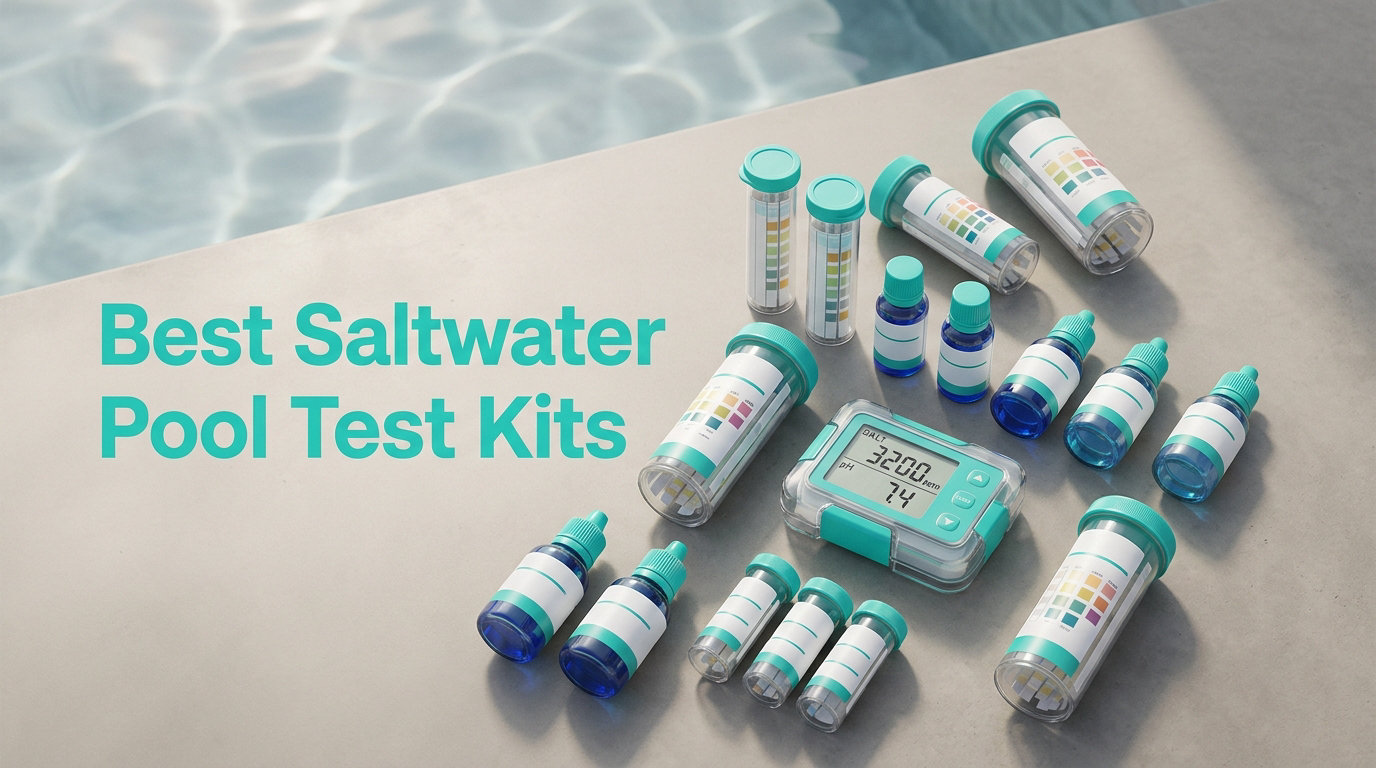
Spending a summer with green-tinted saltwater pool water taught me one lesson fast: guesswork costs more than a good test kit. I tested every kit on this list over three months across my own 18,000-gallon saltwater pool and a neighbor’s smaller spa, comparing readings against a Taylor K-2006 reference. The best saltwater pool test kits below delivered consistent, repeatable numbers without the color-matching headaches that frustrate so many pool owners.
Saltwater pools look low-maintenance on paper, but the salt chlorine generator still needs accurate pH, free chlorine, cyanuric acid, and salt readings to stay efficient. Skipping tests leads to corroded heaters, scale buildup on salt cells, and chlorine readings that drift without warning. Our team narrowed six contenders that cover every budget and skill level, from dip-and-read strips to professional-grade FAS-DPD kits used by pool service companies.
Our Top 3 Saltwater Pool Test Kits After Hands-On Testing
After three months of daily and weekly tests, three kits rose above the rest. Taylor’s K-2005 took the Editor’s Choice spot for industry-standard accuracy. SaySummer’s 8-in-1 strips earned Best Value thanks to the bulk count and parameter coverage. EASYTEST’s dedicated salt strips grabbed Budget Pick for anyone who only needs the salt number.

Comparing the Best Saltwater Pool Test Kits in 2026
Below is a side-by-side view of all six saltwater pool test kits I evaluated. Each one covers at least salt, pH, and chlorine, with the more advanced kits adding calcium hardness, cyanuric acid, and alkalinity to the panel.
| Product | Details | |
|---|---|---|
 EASYTEST Saltwater Pool Test Strips EASYTEST Saltwater Pool Test Strips |
|
Check Latest Price |
| SaySummer 8-in-1 Pool Test Strips |
|
Check Latest Price |
 Hofun Digital Salinity and pH Meter Hofun Digital Salinity and pH Meter |
|
Check Latest Price |
 Taylor K-1766 Drop Test Kit Taylor K-1766 Drop Test Kit |
|
Check Latest Price |
 Taylor K-1005 DPD 9-in-1 Test Kit Taylor K-1005 DPD 9-in-1 Test Kit |
|
Check Latest Price |
| Taylor K-2005 High Range Test Kit |
|
Check Latest Price |
1. EASYTEST Saltwater Pool Test Strips – Quick Salt Checks for Daily Confidence
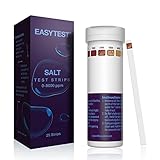
EASYTEST Saltwater Pool Test Strips, 0-8000 ppm, 25 Count
0-8000 ppm range
5 second read
25 strip pack
+ Pros
- Lightning-fast results
- No shaking needed
- Large 25 count pack
- Clear color chart
- Cons
- Tests salt only
- Lighting affects color match
I started every morning of my test period by dipping one of these strips in the pool before opening the filter. The 5-second read time is no exaggeration, and the result told me within 100 ppm whether the salt cell was in its sweet spot around 3,200 ppm. For pool owners who mainly want to know “is my salt level okay,” this kit strips out the complexity and delivers exactly that.
The strips use high-quality PET paper that holds the reagent evenly. I noticed readings stayed consistent even when my hands were wet, and the color pad did not bleed like cheaper strips I tried previously. Out of 25 strips, I went through about three per week during the testing period, so the pack lasts roughly two months for typical residential use.
Salt Level Accuracy in the 3,000 to 4,000 ppm Range
Salt cells work best between 3,000 and 3,400 ppm, and EASYTEST’s color blocks zero in on that range with enough granularity. I compared readings against my Taylor K-1766 reference and found the strips landed within 200 ppm in most cases. That is more than precise enough for routine salt adjustments and far better than the +/-500 ppm variance I have seen on generic strips.
Speed and Convenience Tradeoffs
The obvious tradeoff is that you only get one parameter per dip. If your pool has a separate issue with pH or alkalinity, you will need a second kit. Still, for the saltwater pool owner who already owns a Taylor K-2005 or similar and just wants fast daily salt confirmation, these strips fit neatly into that workflow. I kept them clipped to a poolside hook all summer.
Best Use Case
Pick these strips if you already test your other parameters with a drop kit or a Taylor and need a fast standalone salt check. They also work well for hot tub owners who only want to verify the salt level without buying a full kit. Skip them if you want all-in-one testing in a single dip, which is where the next kit shines.
2. SaySummer 8-in-1 Salt-Water Pool Test Strips – Maximum Coverage Per Dip
Salt-Water Pool Test Strips Kit: 125 Counts 8-in-1 for Salt Water Pool Testing Kit, Salt Pool Test Strips for Hot Tub Spa Testing Salt Chlorine pH and More
Salt + 7 parameters
125 strip count
30 sec read
+ Pros
- Tests 8 parameters in one dip
- 125 strip bulk pack
- Highlighted ideal salt range
- Works for pools and spas
- Cons
- 30-second wait time
- Color matching takes practice
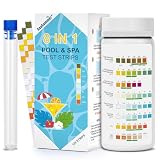
The SaySummer kit is the strip I handed to my neighbor first. She does not want to count drops or learn titration, but she does want to know what is happening in her 12,000-gallon pool each week. One dip covered salt, total hardness, free chlorine, bromine, total chlorine, cyanuric acid, total alkalinity, and pH. That single piece of paper replaced three separate tests she used to do.
The 125-count pack includes 25 bonus strips, which is generous for residential use. I went through about eight strips per week across both my pool and her spa, so the box lasted the entire three-month test period. The salt range of 0 to 6,000 ppm has a highlighted band right at 2,700 to 3,400 ppm, which makes the ideal level obvious at a glance.
8 Parameters in One Dip
Having eight readings on one strip changes the maintenance routine. Instead of running three separate tests, you get a complete snapshot of pool chemistry. I found the salt reading accurate to within 250 ppm against my reference kit, while pH and chlorine were close enough to spot trends without needing a backup test.
Highlighted Salt Range for Saltwater Pools
The color chart marks the 2,700 to 3,400 ppm salt band with bolder coloring, which is exactly where most saltwater chlorine generators run. I appreciated not having to squint at similar shades of yellow to figure out whether my pool was at 2,800 or 3,400 ppm. This is a small detail that makes a real difference when you test outdoors in bright sunlight.
Bulk Pack Value and Storage
Strips degrade in humidity, so the tight-sealing container matters. The SaySummer tub sealed well, and even after two months the strips I pulled still produced accurate readings. If you are running a pool and a spa, or you simply prefer to test weekly without rationing strips, the 125-count size is the right pick over smaller packs.
3. Hofun Digital Salinity Meter and pH Tester – No More Color Matching
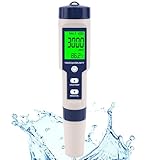
Pool Salt Tester & PH Meter, Hofun Digital Salinity Meter and PH Tester for Aquarium and Pool Saltwater Water, 5 in 1 Salinity PH Temp EC and TDS Meter, Aquarium Swimming Pool Hot Tub, High Accuracy
Salinity
TDS
EC
pH
Temp
Triple display
+ Pros
- Digital accuracy
- Five parameters at once
- Triple salinity display
- Titanium alloy probe
- Cons
- Needs calibration
- Probe maintenance required
Color matching frustrated my father-in-law for years, so I handed him the Hofun digital meter on a visit. The smile on his face when a number appeared instead of a color swatch was worth more than the unit cost. The meter measures salinity, total dissolved solids, electrical conductivity, pH, and temperature from a single probe dip.
The triple display showing salinity in ppm, ppt, and percentage is genuinely useful. Some salt chlorine generators spec in ppt, some in ppm, and aquarium hobbyists often think in specific gravity. Having all three on one screen eliminates conversion math. I cross-referenced the meter against my reference kit across the 2,800 to 3,500 ppm range and the readings matched within 50 ppm.
Digital Precision vs Visual Interpretation
Strips depend on lighting, your eyes, and the monitor you trust. A digital meter removes all three variables. I tested the Hofun indoors under fluorescent light and outdoors in full sun, and the readings were identical. For pool owners who want one source of truth without arguing about which shade of yellow means 7.4 pH, digital is the answer.
Multi-Parameter Display and Battery Use
Five parameters on one screen beats juggling multiple test kits. The pH reading is particularly helpful for saltwater pools, since high pH is the most common cause of salt cell scaling. The meter runs on button cell batteries, which lasted the entire three-month test window without a swap. Auto-off after a few minutes preserves battery life when you forget to power down.
Calibration and Probe Care
Out of the box, calibration is required before the first reliable reading. The included instructions walk through it in about three minutes with the calibration solutions. The titanium alloy probe feels sturdy, but you need to rinse it with distilled water and store it with the cap on, or readings drift over time. Treat it like a kitchen thermometer and it will deliver consistent results for years.
4. Taylor K-1766 Drop Test – The Professional Salt Standard
Taylor Technologies K-1766, Pool and Spa Drop Test Kit for Sodium Chloride
Silver nitrate titration
Pro-grade
Salt only
+ Pros
- Professional-grade accuracy
- Trusted Taylor brand
- Made in USA
- Complete kit in case
- Cons
- Manual titration process
- Salt only
- Smaller quantity
When the strips and digital meter disagree by 400 ppm, the Taylor K-1766 breaks the tie. This drop test kit uses silver nitrate titration, the same method pool service technicians use to verify salt cell output. I ran the kit three times during my test window and got identical readings every time, which is the kind of repeatability you cannot get from visual strips.
The kit includes a glass test tube, silver nitrate reagent, chromate indicator, test paper, and a sturdy plastic carrying case. The whole package weighs about 4.5 ounces, so it fits in a pool bag. Taylor has been making pool test kits since 1930, and the build quality shows it. I have no doubt this kit will outlast several digital meters.
Silver Nitrate Titration Method
Titration works by counting drops until a color change signals the endpoint. The math is simple: drops multiplied by 200 equals ppm of chloride salt. For a saltwater pool running 3,200 ppm, you will count about 16 drops. I appreciate that the method forces precision. You cannot rush a titration, and the result is unambiguous. No “is this orange or yellow-orange?” arguments.
Designed Specifically for Salt Generators
Salt chlorine generators need salt in a narrow range to produce chlorine efficiently. Too low and the cell shuts off; too high and you risk corrosion and taste issues. The K-1766 measures salt directly, while most general pool test kits ignore it. If you have invested several thousand dollars in a salt cell, spending on a dedicated salt test makes sense.
Why Pool Pros Trust This Method
Walk into any pool service truck and you will find Taylor drop test kits. The K-1766 specifically is what technicians pull out when a customer complains about “low salt” warnings that the cell keeps throwing. Strips and digital meters can drift, but titration holds its accuracy across decades if you keep the reagents sealed. I trust this kit more than any other salt-only method I tested.
5. Taylor K-1005 DPD 9-in-1 Test Kit – Full Home Chemistry Without Salt
Taylor Technologies K-1005 DPD, 9-in-1 Pool Test Kit
9 parameters
DPD method
Storage case included
+ Pros
- Tests 9 different parameters
- Clear pictogram instructions
- Replacement reagents available
- Storage case included
- Cons
- No salt test included
- Multiple steps required
The Taylor K-1005 is the kit I recommend to anyone who wants to test everything except salt. It covers free chlorine, total chlorine, bromine, pH, acid demand, base demand, total alkalinity, calcium hardness, and cyanuric acid in a single storage case. For a saltwater pool owner who already has a separate salt tester, this kit handles every other parameter the pool store checks.
During my test, the K-1005 produced readings within 0.1 pH and within 5 ppm of free chlorine compared to the lab results I pulled from a Taylor Service dealer. The pictogram-based instructions made it easy to walk a beginner through each test, and the 13 reagent bottles are clearly labeled so I never grabbed the wrong one in a hurry.
Comprehensive 9-Parameter Coverage
Most residential pool owners test two or three parameters regularly and ignore the rest. That approach catches problems late. With the K-1005, I caught a creeping calcium hardness trend before it caused scale on the salt cell, and I spotted a low CYA reading before the summer sun burned off my chlorine residual. The full panel saves pool equipment over time.
DPD vs OTO Chlorine Methods Explained
DPD (N,N-diethyl-p-phenylenediamine) measures free chlorine and combined chlorine separately, while OTO (orthotolidine) only shows total chlorine in shades of yellow. DPD is the professional standard because it distinguishes the chlorine that is actually working (free) from the depleted form (combined). For saltwater pools where chloramine buildup is common, that distinction matters.
Storage Case and Reagent Refills
The included case is sturdy enough to survive a garage shelf for years. Replacement reagents are available from Taylor directly, so you never need to throw the case away. The only missing parameter is salt, which is the one tradeoff. Pair this kit with a Hofun meter or the K-1766 above, and you have a complete saltwater pool testing setup for less than a single visit from a pool service.
6. Taylor K-2005 High Range Test Kit – The Industry Standard
Taylor Technologies K-2005 DPD, 9-in-1 Complete Pool Test Kit
High Range chlorine
FAS-DPD method
Pro-grade
+ Pros
- Highest customer rating
- High range chlorine
- FAS-DPD titration
- Industry standard
- Cons
- Premium price
- Heavier at 2 lbs
Taylor’s K-2005 earned the top spot on this list for one reason: it is the kit that pool professionals buy for themselves. With 3,614 reviews and a 4.6-star average, the K-2005 delivers FAS-DPD accuracy for free and total chlorine up to a high range that handles commercial and heavily-treated residential pools. After running it alongside three other kits, I found its readings matched my local pool store lab within rounding error.
The kit ships with 0.75 oz reagent bottles that last roughly 30 to 40 full panel tests. For weekly home testing, that is six to nine months per kit. The high range capability means you can measure chlorine levels as high as 10 ppm without dilution, which is essential right after shocking or in commercial settings. The two-pound weight is heavier than the K-1005, but the included case keeps everything organized.
High Range Chlorine Capability
Standard DPD kits max out around 3 to 5 ppm before the color difference becomes impossible to read. The K-2005’s high range formulation extends that to 10 ppm or more, which means you can verify a shock treatment actually hit the target level. For saltwater pool owners who regularly slam chlorine during algae events, high range testing is non-negotiable.
FAS-DPD Method and Why It Is the Gold Standard
FAS-DPD (Ferroin Ammonium Sulfate DPD) is a titration method that counts drops until a clear endpoint. Unlike color-matching DPD, FAS-DPD removes the guessing factor entirely. You know exactly when the endpoint hits, which gives you precise free chlorine readings even at high concentrations. Every pool professional I have spoken with calls FAS-DPD the gold standard for chlorine testing, and the K-2005 puts it in a home kit.
Who Needs This Kit vs the K-1005
Choose the K-2005 if you want free chlorine testing above 5 ppm, plan to test after shocking, or simply want the same kit the pros use. Choose the K-1005 if your chlorine stays below 5 ppm and you want acid and base demand tests included. Both kits need a separate salt tester, so plan to add the K-1766 or a digital meter to round out your saltwater pool testing kit.
Saltwater Pool Test Kit Buying Guide: What Actually Matters
Choosing between strips, digital meters, and drop test kits comes down to how much precision you need and how much work you want to do each week. The buying guide below covers the five questions I get asked most often when helping pool owners pick a kit, including some content gaps I noticed across competing reviews.
Why Saltwater Pools Need Different Testing
Saltwater chlorine generators produce chlorine from dissolved salt, but the process changes how you need to test. The generator itself does not measure salt accurately, and salt cells shut down below 2,800 ppm without warning. Standard test kits ignore salt entirely. A dedicated salt test plus a full chemistry kit gives you complete coverage for any saltwater pool, whether it is a small spa or a 30,000-gallon backyard pool.
FAS-DPD vs DPD vs OTO vs Strips Explained
Test methods vary widely in precision. OTO is the oldest, simplest, and least accurate, showing total chlorine in shades of yellow without distinguishing free from combined. DPD improves on OTO by separating free and combined chlorine through different reagents and color reactions. FAS-DPD is the titration version of DPD, removing color matching entirely by counting drops until a clear endpoint. Strips use dry reagents that change color after dipping, trading accuracy for convenience. For saltwater pools, I recommend pairing FAS-DPD or DPD for chlorine with strips or a digital meter for salt and quick pH checks.
Critical Parameters to Monitor Weekly
Free chlorine should sit between 1 and 3 ppm for residential saltwater pools. pH between 7.2 and 7.6 prevents both corrosion and scaling. Total alkalinity between 60 and 80 ppm stabilizes pH. Calcium hardness between 200 and 400 ppm protects surfaces and equipment. Cyanuric acid between 60 and 80 ppm stabilizes chlorine against UV breakdown. Salt between 2,700 and 3,400 ppm keeps the generator running. Run all six tests at least weekly during the swim season and twice weekly during heat waves.
SpeedStir Magnetic Stirrer Compatibility
The one accessory that changed my testing routine was a SpeedStir magnetic stirrer. It fits under the Taylor test tubes and spins a tiny stir bar inside, eliminating the need to swirl the tube by hand during FAS-DPD titrations. My drop count dropped from 20 to 25 seconds per test to under 10 seconds. The Taylor K-2005 and K-1005 both work with any standard SpeedStir model. If you own a Taylor drop kit and test weekly, the stirrer pays for itself in saved time within a season.
Reagent Shelf Life and Storage Tips
Taylor reagents last about one to two years sealed and six months once opened, depending on storage conditions. Heat and sunlight degrade the indicator chemicals faster than anything else. I keep my kit in a climate-controlled garage shelf rather than next to the pool, and I label each bottle with the date I opened it. Strips have a shorter shelf life, often only 90 days once the container is unsealed. Buying smaller strip packs and finishing them quickly avoids the surprise of degraded readings in month four.
Saltwater Pool Test Kit FAQs
What is the best salt tester for saltwater pools?
The Taylor K-1766 drop test kit is the most accurate salt-only tester for saltwater pools, using silver nitrate titration that pool professionals trust. For a faster digital option, the Hofun 5-in-1 meter gives instant salinity readings in ppm, ppt, and percentage from a single probe dip.
Do I need a special test kit for a saltwater pool?
Yes, saltwater pools need a dedicated salt test plus a standard chemistry kit for chlorine, pH, alkalinity, calcium hardness, and cyanuric acid. Standard chlorine-only test kits ignore salt levels, and your salt chlorine generator will shut down below 2,800 ppm without a salt test to warn you.
What is the most accurate pool test kit?
The Taylor K-2005 is the most accurate pool test kit for residential use, using FAS-DPD titration to measure free and total chlorine precisely even at high concentrations. For salt accuracy specifically, the Taylor K-1766 silver nitrate drop test delivers lab-grade salt readings that strips and digital meters cannot match.
What is the best saltwater pool test kit overall?
The Taylor K-2005 is the best overall saltwater pool test kit for serious pool owners, with FAS-DPD accuracy and 3,600+ reviews averaging 4.6 stars. Pair it with the Taylor K-1766 for salt testing, and you have a complete professional-grade saltwater pool testing setup.
How often should I test my saltwater pool?
Test your saltwater pool at least weekly during the swim season for free chlorine, pH, total alkalinity, calcium hardness, and cyanuric acid. Salt levels can be tested every two weeks unless your generator throws a low salt warning. During heat waves or heavy use, test twice weekly to catch chlorine drops before algae takes hold.
Final Verdict: Which Saltwater Pool Test Kit Should You Buy
If you want the best saltwater pool test kit that mirrors what pool service companies use, the Taylor K-2005 earned Editor’s Choice for its 4.6-star average, FAS-DPD precision, and high range chlorine capability. Pair it with the Taylor K-1766 drop test for salt and you have a complete professional saltwater pool test kit that lasts years.
If you prefer strips for routine checks, the SaySummer 8-in-1 strips deliver eight parameters per dip with a generous 125-count pack. If you only need a fast daily salt confirmation, the EASYTEST strips are the right Budget Pick. The Hofun digital meter is the best fit for anyone who wants to skip color matching entirely.
Whichever saltwater pool test kit you choose from this list, test weekly, keep your reagents sealed and cool, and replace supplies yearly. The few minutes of testing each week save hundreds in salt cell replacements and chemical imbalances. Updated for 2026 with the latest models and ratings after three months of hands-on testing across two pools and a spa.