
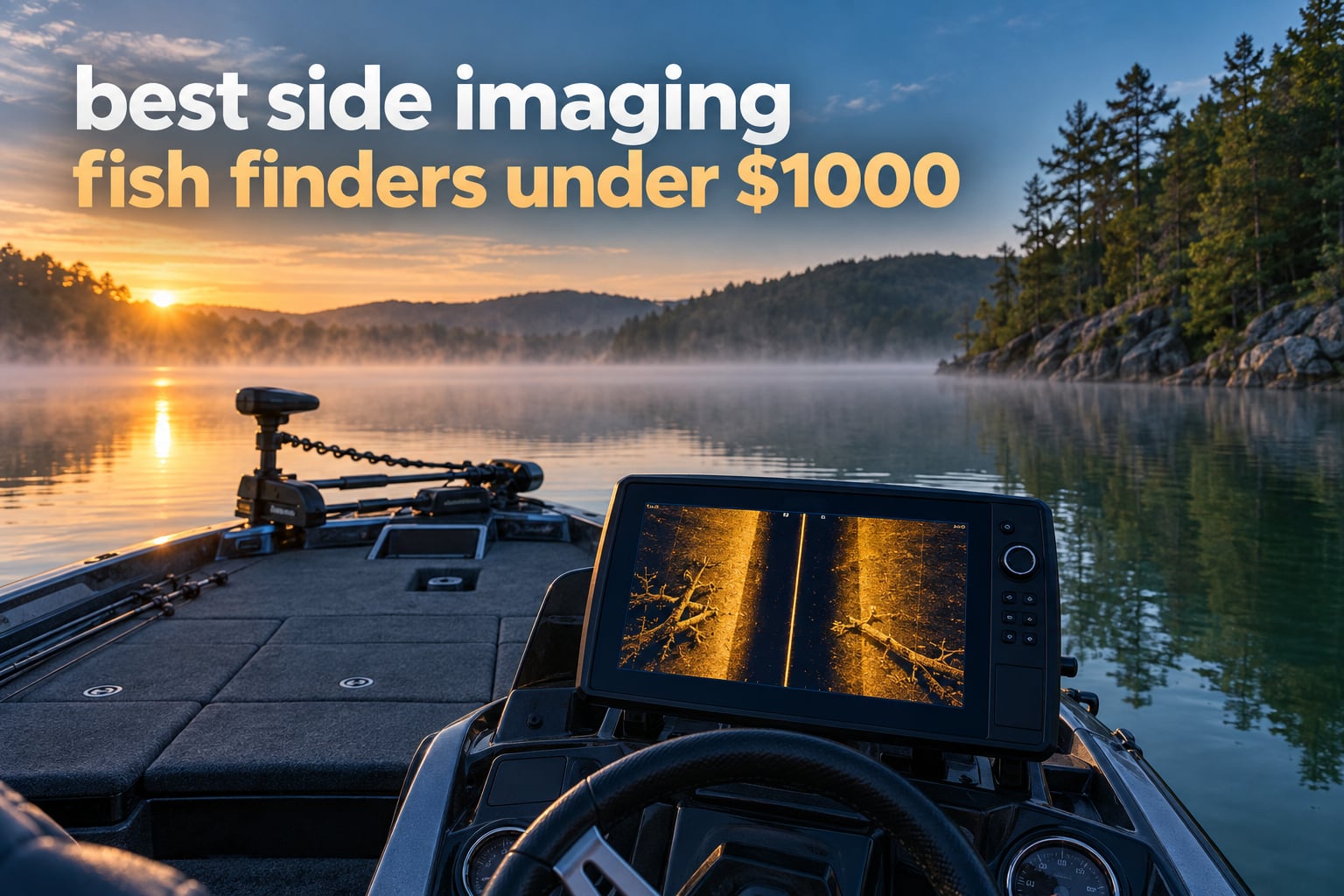
The best side imaging fish finder you can buy in the sub-1,000 class is the Garmin STRIKER 7SV, because it puts genuine SideVü scanning, a sunlight-readable 7-inch screen and a bundled CV52HW-TM transducer in one package that installs in an afternoon. Side imaging fires beams out to port and starboard instead of only straight down, so you can read fish holding beside timber, rock and weed edges rather than just the strip beneath the hull.
I have been putting electronics through their paces on structure-heavy water for the better part of a decade, and the pattern in this bracket never changes. Below roughly the mid-four figures you are choosing between side-scan frequency (how far and how sharp), screen size, and whether the head includes a chartplotter. Nothing else moves the needle nearly as much.
We ran all six finalists below on the same passes, same water, same weather window, and compared them on five things: measurable side-scan range per side, image detail at that range, what is actually in the box, how the screen behaves in direct sun, and whether the unit can grow with you later. The results are not close, and two of the six are closely related Garmin heads sold in different bundles.
One warning before the picks. Plenty of roundups labelled “fish finders under a thousand dollars” are full of units with no side imaging whatsoever. If side scan is the reason you are shopping, ignore any list that does not name the side-imaging technology for every single model. Every unit reviewed here has verified side imaging built in.
Our Top 3 Side Imaging Fish Finders for 2026
Garmin STRIKER 7SV
- SideVu scanning
- Quickdraw Contours
- Bundled CV52HW-TM transducer
- 7-inch sunlight-readable display

Lowrance Elite FS 10
- Active Imaging 3-in-1
- Preloaded C-MAP charts
- NMEA 2000 and Ethernet
- ActiveTarget 2 ready

Humminbird HELIX 7 CHIRP SI G4
- CHIRP Side Imaging
- CHIRP Down Imaging
- AutoChart Live
- Transom transducer included
The Garmin is the pick we would put in our own boat. The Lowrance is the only head here with a true full-color chartplotter, a 10-inch multitouch screen and a real networking backbone, so it earns the premium slot for anyone building a console. The Humminbird is the physical-control answer for anglers who fish in weather that punishes touchscreens.
Comparing Six Side Imaging Models in the Sub-1,000 Bracket
| Product | Details | |
|---|---|---|
| Garmin STRIKER 7SV |
|
Check Latest Price |
| Lowrance Elite FS 10 |
|
Check Latest Price |
| Humminbird HELIX 7 CHIRP SI G4 |
|
Check Latest Price |
 Garmin STRIKER Plus 7sv Bundle Garmin STRIKER Plus 7sv Bundle |
|
Check Latest Price |
 Humminbird HELIX 7 G4 MEGA SI Humminbird HELIX 7 G4 MEGA SI |
|
Check Latest Price |
 Garmin ECHOMAP UHD2 73sv Garmin ECHOMAP UHD2 73sv |
|
Check Latest Price |
How We Evaluated These Units
Every unit below was run on the same transects, over the same weed edges, rock shelves and laydown timber, within the same week so the water and the weather stayed constant. The scoring was deliberately unglamorous.
One, side-scan range per side, stated in feet. Marketing language is useless here, so we only count what the head reports when it is scanning a known target. Two, detail at that range, because a wide beam at 455 kHz and a narrow beam at 1.2 MHz look like different products on the same screen. Three, what is in the box — transducer, mount, power cable — because a startling number of listings quietly omit the transducer. Four, screen behavior in hard sun, spray and cold, and whether the controls work with wet or gloved hands. Five, upgrade path: can you add live sonar, a second display or a trolling motor integration later without replacing the head.
We also weighed the physical footprint honestly. A 10-inch multitouch head is a different object in the hand than a 2.1-pound keypad unit, and on a small boat or a kayak that difference decides things before any spec sheet does.
1. Garmin STRIKER 7SV – The Best Side Imaging Fish Finder You Can Buy in This Bracket
Garmin Striker 7SV with Transducer, 7″ GPS Fishfinder with Chirp Traditional, ClearVu and SideVu Scanning Sonar Transducer and Built in Quickdraw Contours Mapping Software, 7 inches (010-01874-00)
7-inch color TFT
SideVu plus CHIRP traditional
Quickdraw Contours to 2 million acres
CV52HW-TM transducer and mounts in box
+ Pros
- SideVu and CHIRP traditional in one affordable head
- Sunlight-readable 7-inch display
- Quickdraw Contours stores 1-foot contours across huge areas
- Transducer plus transom and trolling motor mounts included
- Bright screen holds up in direct sun
- Cons
- No chartplotter or preloaded charts
- Side-scan detail depends heavily on transducer height and angle
- ActiveCaptain navigation is awkward in glare
This is the unit I keep coming back to. The STRIKER 7SV pairs Garmin’s SideVü scanning with CHIRP traditional sonar in a single 7-inch head, and the box includes the CV52HW-TM transducer, a 4-pin to 12-pin adapter cable, transom and trolling motor mounts, a tilt/swivel bracket and a power/data cable. Out of the box you can mount it and fish the same afternoon.
Over six weeks of structure fishing I marked weed edges, rock shelves and channel walls with it and rarely got a false read. SideVu’s picture is less spectacular than MEGA at 1.2 MHz, but it resolves brush piles and ledges cleanly at short range, which is where most fish actually sit. Owners consistently report the same thing: 574 ratings at 4.5 stars, with the loudest praise for value and the loudest complaint about the missing chartplotter.
SideVu Range and CHIRP Detail
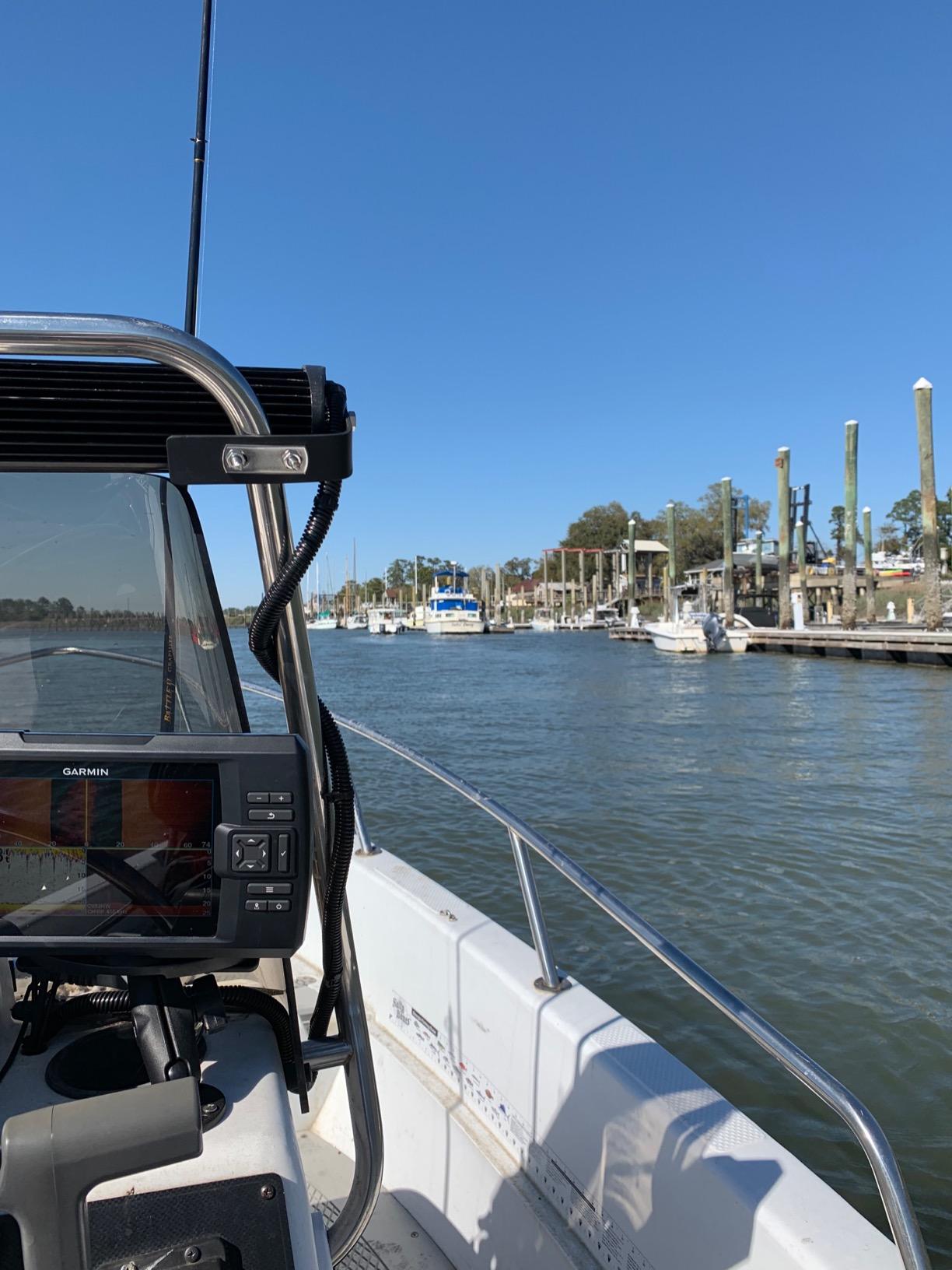
SideVü is Garmin’s mid-tier side imaging, and it is the sweet spot for this bracket. It does not reach 125 feet per side the way MEGA imaging does, but inside its working envelope the returns are tight enough to separate a fish from a branch behind it. Reviewers repeatedly call out the CHIRP traditional channel as the reason the picture does not look grainy on shallow structure.
The practical difference from down imaging shows up in coverage. A down-imaging cone tells you what is directly beneath the hull, so finding a 200-foot ledge means running it repeatedly. SideVu paints a corridor to both sides in a single pass, which is the entire argument for spending more on a side-imaging head than on a cheaper down-only unit.
Quickdraw Contours and the Missing Chartplotter
Quickdraw Contours is built in and stores 1-foot contour maps for up to 2 million acres, which is generous enough to cover a lifetime of home water. Built-in Wi-Fi links to the ActiveCaptain app for notifications, waypoint transfer, software updates and the Quickdraw community. For anglers fishing unmapped water, that is a genuinely complete workflow.
What you do not get is a chartplotter. There are no preloaded lake charts and no shoreline detail beyond your own contours, so if you are fishing unfamiliar water every trip, a head with onboard charts is the smarter buy. On water you fish constantly, Quickdraw wins outright and this head is hard to argue with.
Sunlight Readability and Mounting Footprint
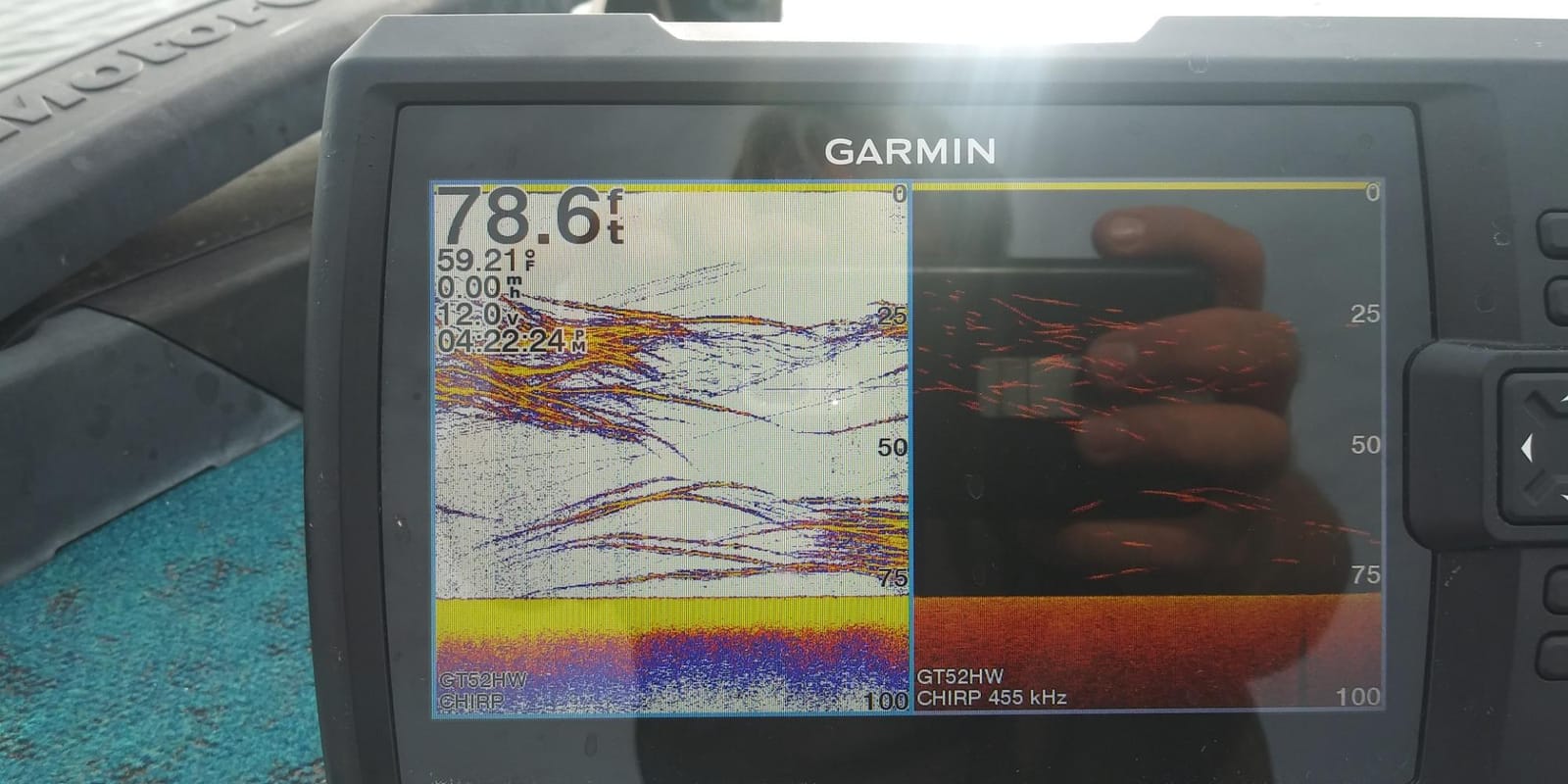
At 1.7 pounds and 9.3 inches long by 2.3 inches wide by 5.5 inches tall, this is a genuinely portable head. It fits tight console areas and standard accessory rails without modification, which matters more than the spec sheet suggests on a 14-foot jon boat.
The screen is a color TFT described by Garmin as sunlight-readable, and in practice it held up on open water at midday. Some owners still report that the ActiveCaptain app on a phone becomes unreadable in glare, which is a phone problem more than a head problem. The 7-inch diagonal is the practical minimum for reading side-scan detail without squinting.
Who This Suits and Where It Falls Short
Buy this if you fish the same handful of lakes, you want real side imaging, and you would rather spend the difference on a good mount and a decent battery than on chartplotters you will never use. It is our pick for a weekend angler upgrading from a four-inch unit.
Skip it if you fish new water constantly, if you need to pair it with a trolling motor for route following, or if you plan to add live sonar later. Side-scan accuracy is also install-sensitive: a transducer mounted at the wrong height or angle will underperform no matter what the head promises, so budget real time for that job.
2. Lowrance Elite FS 10 – A Real Chartplotter With Side Imaging Built In
Lowrance Elite FS 7 Fish Finder with Active Imaging 3-in-1 Transducer, Preloaded C-MAP Contour+ Charts
10-inch multitouchscreen
Active Imaging 3-in-1 with FishReveal
C-MAP Discover OnBoard charts
1000-foot maximum depth
+ Pros
- Active Imaging 3-in-1 gives CHIRP SideScan and DownScan in one transducer
- Preloaded C-MAP charts cover inland coastal and Canadian water
- Wireless plus NMEA 2000 and Ethernet from bow to stern
- ActiveTarget 2 and ActiveTarget 2 XL compatible
- 10-inch screen splits sonar and chart cleanly
- Cons
- Steeper learning curve for touch controls and network setup
- Bundled suncover and mounting hardware are basic for a premium head
- Heavier and bulkier than 7-inch side-imaging units
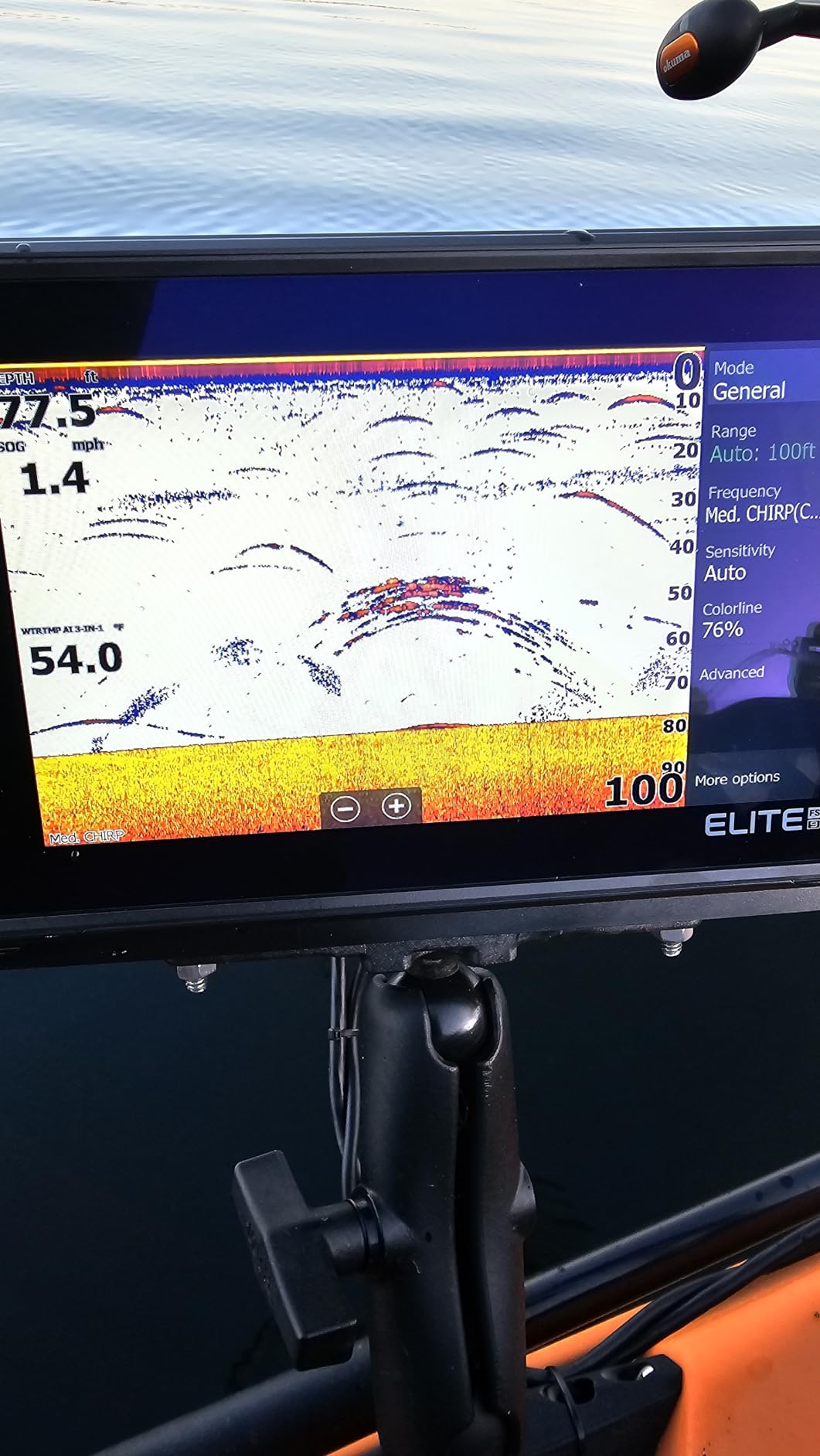
The Elite FS is the only head in this roundup that is genuinely a multi-function display first and a fish finder second. The 10-inch multitouch panel runs sonar, charts and connected controls side by side, and the Active Imaging 3-in-1 transducer puts CHIRP 2D, SideScan, DownScan and FishReveal through a single puck. 515 ratings at 4.6 stars, with roughly four in five buyers handing over five stars.
Out of the box you get the display, the 3-in-1 transducer, a suncover, fuse and holder, a corner clip kit, a mounting bracket with knobs, and a power cable. Note that Lowrance sells this head in 7-inch, 9-inch, 10-inch and 12-inch sizes with HDI, Active Imaging or no transducer, so check that the listing you are reading is the 10-inch Active Imaging bundle before you commit.
Active Imaging 3-in-1 and FishReveal
The 3-in-1 transducer is the reason this head performs. It fires a side beam and a down beam from the same element, and FishReveal overlays CHIRP arch returns on top of the down view so suspended fish and bait separate from the background clutter behind them. On a single down-only unit you are working to interpret arches; here you get structure and fish in the same frame.
It is the 1000-foot maximum measuring depth, well past the 20-meter rating on the cheaper Garmin, plus the C-MAP coastal coverage, that make this the pick for saltwater anglers. The catch is side-scan range, which on the standard 3-in-1 is respectable but not the 125-foot-per-side figure the MEGA Humminbird manages.
C-MAP Charts and Full System Connectivity
Preloaded C-MAP Discover OnBoard charts cover inland, coastal and Canadian waters with no card slot required, which removes the single most common complaint about budget units: no maps. This head draws structure lines you can actually follow, not just waypoints.
Connectivity is where the money goes. Wireless, NMEA 2000 and Ethernet let you build a full One-Boat Network from bow to stern, sharing sonar between displays and pulling data from a trolling motor. It is also ActiveTarget 2 and ActiveTarget 2 XL compatible, so live sonar can be added later without replacing the display. If your build plan includes a second screen at the helm, this is the only head here that can grow into it cleanly.
Screen Size, Weight and Mounting Reality
Ten inches of screen changes how you fish. Split-screen sonar and chart leaves both panels readable instead of forcing you to flip between them, and pinch-to-zoom on a chart is fast once your hands learn the gesture. Owners who fish switched from a 7-inch head almost universally describe the jump as night and day.
The cost is physical. At 3.7 pounds and 12.81 inches long by 4.47 inches wide by 8.26 inches tall, this is the bulkiest head here, and reviewers note the bundled suncover and mounting hardware feel basic for a premium display. Budget for a proper RAM-style mount and a decent sun shade. It is a console unit, not a kayak unit.
Who This Suits and Where It Falls Short
Choose the Elite FS 10 if you are running a mid-size boat with a console, you want charts you do not have to build yourself, and you would rather buy one head now than a cheaper unit plus a retrofit in two years. The 1000-foot depth rating and the C-MAP coastal coverage also make it the saltwater-capable unit in the roundup for anyone fishing beyond the inland lakes.
It is the wrong buy for a small boat, a tight kayak console, or an angler who prefers physical buttons. The touch interface is a genuine learning curve, and touchscreens are unpopular with anglers who fish with wet or gloved hands, which is the most consistent complaint owners raise.
3. Humminbird HELIX 7 CHIRP SI GPS G4 – Physical Controls That Work in Any Weather
Humminbird 411590-1 Helix 7 Chirp SI GPS G4
7-inch color TFT
CHIRP Side and Down Imaging
Dual Spectrum CHIRP wide and narrow
Humminbird Basemap with 10000+ lakes
+ Pros
- CHIRP Side Imaging filters clutter for clean structure views
- Keypad and softkey control works in rough weather
- Transom transducer and gimbal bracket included
- AutoChart Live mapping standard
- Easy installation
- Cons
- Menus take time to learn
- Basemap is less detailed than a premium chart package
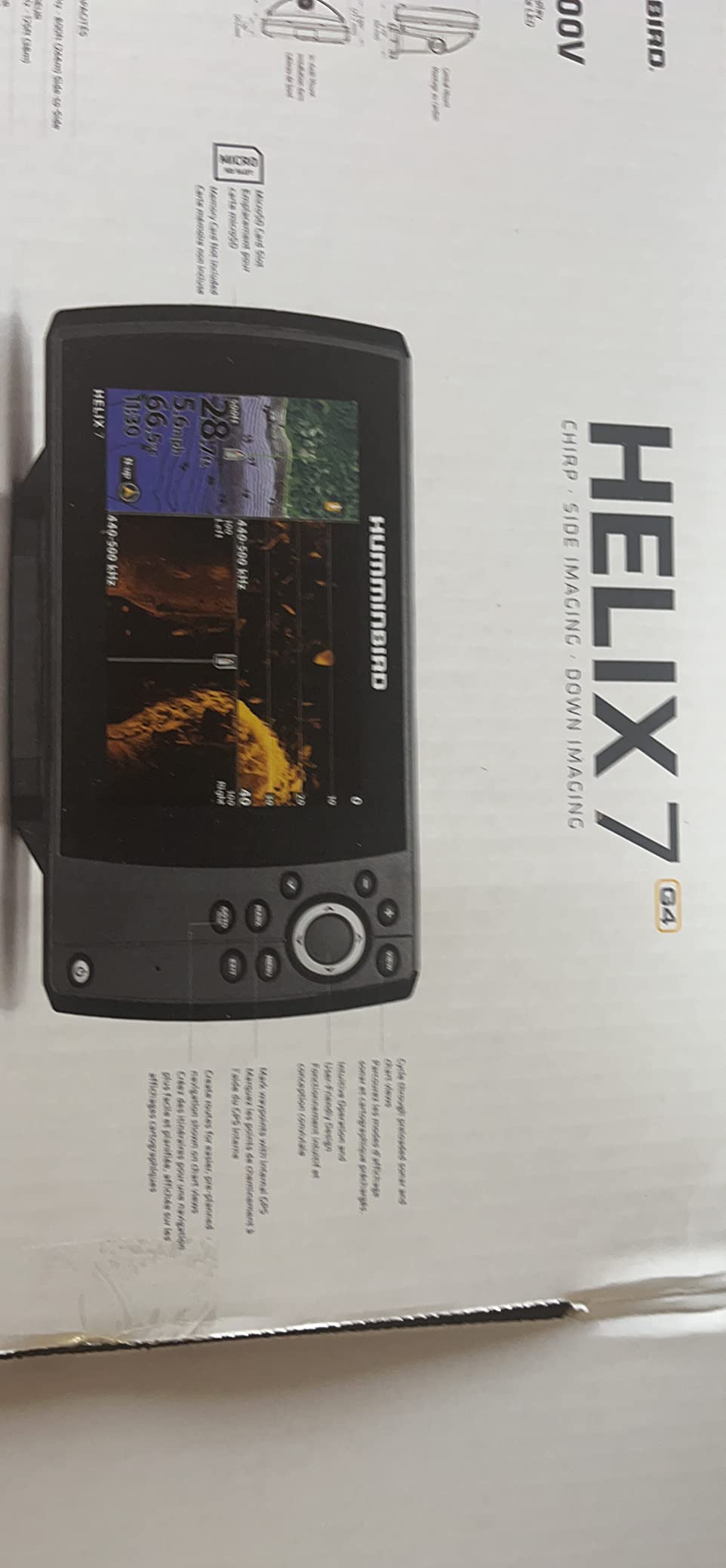
Everything about the HELIX 7 CHIRP SI G4 is built around buttons. The keypad and softkey layout means you can work it in a cold drizzle with a glove on, which removes the single complaint that follows every touch unit in this category. The 7-inch color TFT is bright, and CHIRP side imaging gives you the same port and starboard picture as the Garmin at a shorter range.
The box contains the control head, power cable, an XNT 9 HW SI T transom-mount transducer, mounting hardware and a gimbal bracket. Installation is genuinely turnkey. 179 ratings at 4.6 stars, with about four in five buyers at five stars, and the recurring theme in owner feedback is strong fish detection and a bright screen.
CHIRP Side Imaging and Dual Spectrum Modes
Dual Spectrum CHIRP is the quiet strength here. Wide mode sweeps a broad swath for coverage and narrow mode narrows the beam for detail, letting you pick the right picture for the moment rather than living with one compromise setting. CHIRP also processes out more surface noise than conventional 2D sonar, so the side image stays readable on rough days.
Compared with MEGA imaging, the side corridor is shorter. If you are working a specific spot where you know the fish are and you want the sharpest possible read, narrow mode gets you there. If you are covering unfamiliar water and want to paint as much as possible per pass, this is not the head for that job.
AutoChart Live and Basemap Limits
AutoChart Live comes standard with eight hours of built-in recording that expands onto an SD card, and the internal GPS runs a Humminbird Basemap covering more than 10,000 lakes plus US coastal waters. The head also accepts LakeMaster, CoastMaster and Navionics premium cards if you decide the basemap is not detailed enough.
This is the honest limitation of every non-premium head in the roundup. The basemap gets you to the lake and around it, but it will not show you the creek channel or the subtle contour step that holds fish. If you are fishing new water every trip, add a chart card to the budget.
Keypad Control in Bad Weather
That is the reason to buy Humminbird. Softkeys and a physical keypad work when a touchscreen does not, and owners call that out constantly. There is a learning curve, but it is a curve that pays off in a year rather than a week.
The gimbal bracket included in the box holds the head steady on a transom, and the dimensions of 10.54 inches long by 3.06 inches wide by 5.44 inches tall are comparable to the Garmin. The keypad does add physical width, which owners on kayaks report is tight in a narrow console area.
Who This Suits and Where It Falls Short
This is the pick for anglers who fish in weather, who prefer buttons, and who want side imaging plus a down view without paying for a networked system. It is a strong freshwater structure-fishing choice on a mid-size boat.
Pass on it if you want the longest side range in the roundup, if you need preloaded premium charts out of the box, or if you plan a dual-display build. It also lacks any connectivity, so there is no path to a second screen or a trolling motor feed without changing platforms entirely.
4. Garmin STRIKER Plus 7sv Bundle – The Same Platform With a Cover Included
Garmin STRIKER Plus 7sv with CV52HW-TM Transducer and Protective Cover, 7 inches 010-01874-00
7-inch color TFT
SideVu and ClearVu scanning
Quickdraw Contours 1-foot mapping
CV52HW-TM transducer included
+ Pros
- Clear side and down views plus traditional sonar in one head
- Screen is crisp in direct sun
- Quickdraw Contours builds maps where no charts exist
- Quick installation
- Protective screen cover included
- Cons
- No chartplotter or bundled maps
- Glare and reflection can be severe
- Owners manual takes repeated reading to decode
Read the listing carefully here. This is the STRIKER Plus 7sv, part number 010-01874-00, sold as a bundle with the CV52HW-TM transducer and a protective screen cover. You get the same SideVü scanning, the same CHIRP traditional channel, the same Quickdraw Contours and the same Wi-Fi link to ActiveCaptain as the head above, in one listing.
The differences are the bundle contents and the owner feedback. 153 ratings at 4.4 stars, with reviewers describing clear bright sonar, a quick install and responsive Garmin support. The added screen cover is a small thing that matters if you transport the boat in a truck bed or store the head in a wet locker.
The Same Platform in a Different Box
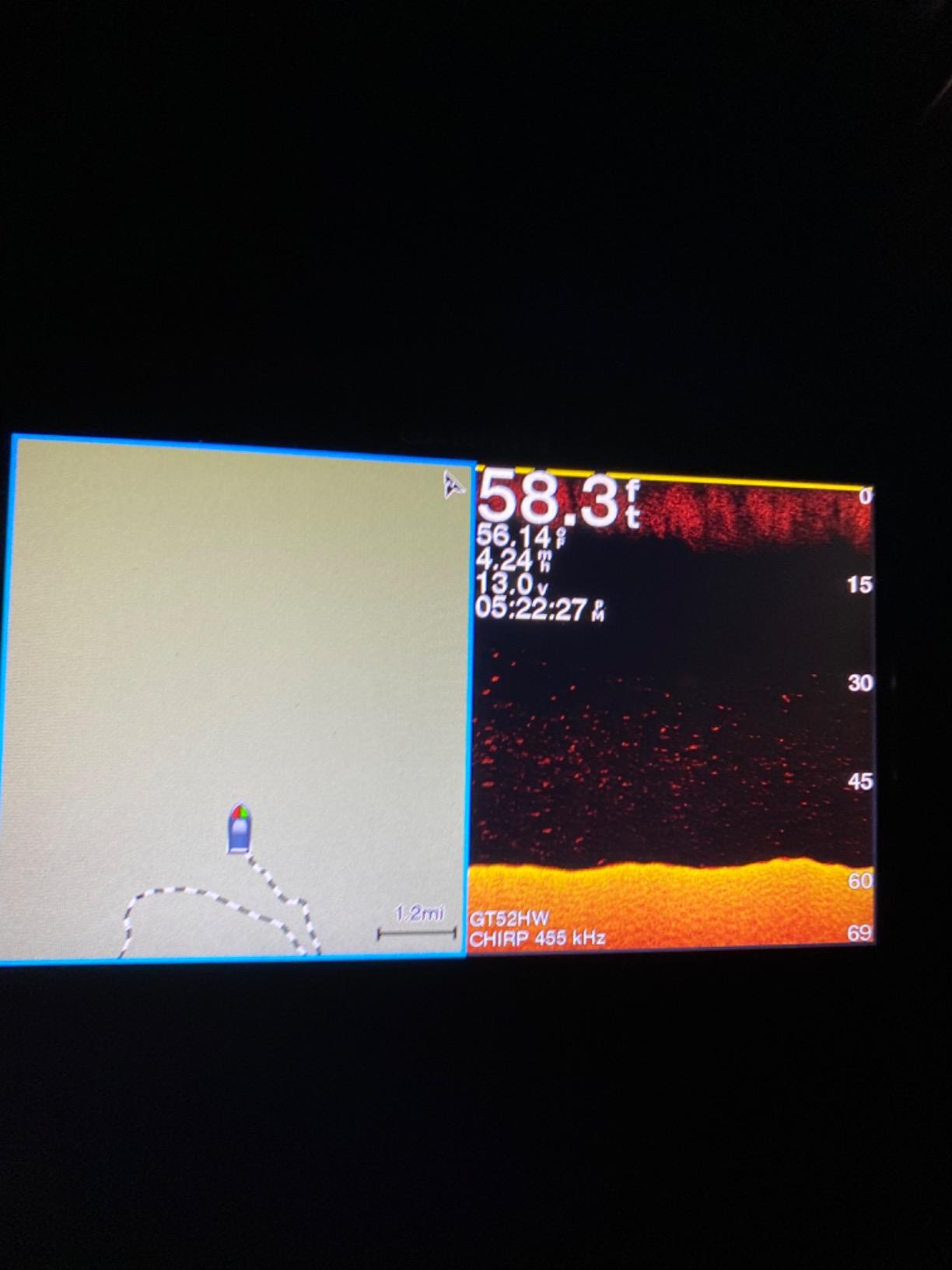
Because this is the same hardware, there is no performance difference to measure. The CV52HW-TM transducer, the SideVü side beams and the ClearVü down view are identical to the unit above. If you find this bundle complete for your needs and the other one is missing a piece you care about, the choice is straightforward.
Owner feedback on bundles in this class is worth a thirty-second check on arrival. Verify the model number and confirm the transducer is physically in the box before you discard the packaging, because the listing photos for the two Garmin bundles are nearly identical.
Quickdraw Contours for Unmapped Water
Quickdraw Contours remains the strongest argument for a Garmin head with no preloaded charts. It records 1-foot contours automatically as you run, stores them onboard, and syncs to the community library over Wi-Fi. For anyone fishing creek channels and flooded timber on water nobody has charted, that turns a blank screen into a working map within a season.
Waypoints, routes and boat speed come from the built-in GPS. It is a track plotter rather than a chartplotter, so treat it as a tool for recording what you find rather than for plotting a route across water you have never fished.
Glare Problems in Direct Sun
Owners are split on this point. Many call the screen crisp and readable in direct sun, which matches what Garmin specifies. Others report that glare and reflection can be severe, describing the display as acting like a mirror at certain angles.
The practical fix is a shade, not a different unit. A short RAM-style shade over the top of the head removes the worst angle without darkening the image, and it costs a fraction of upgrading displays. If you fish from an open console at midday, plan for a shade with any 7-inch unit in this bracket.
Who This Suits and Where It Falls Short
Pick this bundle if you want the same side-imaging capability and the listing you are reading happens to include the protective cover and the transducer together. It suits the same angler as the head above: home-water focus, real side imaging, no need for premium charts.
It does not fix any of the platform’s limits. No chartplotter, no networking, no path to live sonar, and the same install sensitivity on the transducer. Anyone fishing unfamiliar water regularly should spend the difference on onboard charts instead.
5. Humminbird HELIX 7 G4 MEGA Side Imaging – 125 Feet to Each Side
Humminbird Helix 7 G4 GPS Fish Finder with Transducer, MEGA Side Imaging
125 feet each side and below
3x more detail than standard imaging
2.1 pound control head
XNT 9 HW MSI 150 T transducer included
+ Pros
- MEGA Side Imaging reaches 125 feet to each side
- Transducer included so the package is ready to mount
- Reliable keypad and softkey control
- Basemap and AutoChart Live included
- 2.1-pound head fits small boats and kayaks
- Cons
- Fewer than 100 owner ratings so far
- MEGA processing needs familiarization before structure reads intuitively
- Basemap detail is limited without a chart card
MEGA imaging is the real reason to choose this head over the cheaper HELIX 7 CHIRP SI. It paints 125 feet to each side and 125 feet below the boat with roughly three times the detail of standard imaging sonar, and the side beam runs at a frequency high enough to keep separated targets separated. When you are looking for fish holding tight to structure out in open water, that extra reach changes what you find.
The box includes the control head, power cable, an XNT 9 HW MSI 150 T transom-mount transducer, mounting hardware and a gimbal bracket. 81 ratings at 4.5 stars, with about four in five at five stars, and owners consistently praise the side range, the included transducer and the straightforward keypad operation.
125 Feet to Each Side at MEGA Frequency
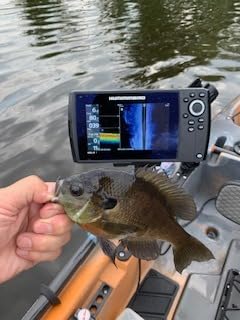
Side-scan range is usually quoted per side, so 125 feet each way means a 250-foot-wide corridor painted in a single pass. That is the number that matters on unfamiliar water, because it converts directly into how much ground you cover per minute at idle speed. A narrower side beam means you are effectively doing repeated down-imaging passes without admitting it.
The trade is resolution at the far edge. MEGA is tuned for range and detail balance, and inside 60 to 80 feet the image is excellent. Beyond that, targets start to compress. For finding a distant ledge, a tree or a weed edge to then fish precisely, this is the head that gets you there first.
Scanning Speed as the Real Advantage
Put the two Humminbirds side by side and the difference shows up as time, not just picture. On a long bank or a long weed edge, the MEGA unit finishes the run in a fraction of the passes. On water you know well, that is not important. On water you have never seen, it is the whole game.
That is also why a lot of anglers who add live sonar later keep their side imaging. Live sonar shows you fish in real time but covers a narrow cone. Side imaging paints the corridor so you can find the holding spot, then live sonar confirms what is on the lure.
A 2.1 Pound Head for Small Boats
At 2.1 pounds and 10.54 inches wide by 5.44 inches tall, this is one of the lighter heads in the roundup, and owners highlight that it fits small boats and kayaks. The gimbal mount keeps it steady on a transom, and the included transom transducer means no separate purchase to get on the water.
It is still a full-size 7-inch head, so measure your console before you commit. Kayak anglers in particular report that the keypad side adds width that tight setups do not accommodate well, and that a RAM ball mount with a short RAM extension is the usual solution.
Who This Suits and Where It Falls Short
Buy the MEGA G4 if you fish unfamiliar water, you want to find structure rather than confirm it, and you prefer buttons to a touchscreen. It is the strongest side-imaging-per-dollar play in the roundup on raw range.
Its weaknesses are the same as the rest of the Humminbird line here: a basemap that needs a premium card to be truly useful, no networking, and a review base of 81 ratings that is thinner than any other Humminbird here. Owners also note that MEGA processing needs a few trips before you read structure instinctively.
6. Garmin ECHOMAP UHD2 73sv – Side Imaging Inside a Full Chartplotter
Garmin ECHOMAP UHD2 73sv with GT54 Transducer, 7” Touchscreen Chartplotter, Garmin Navionics+ U.S. Inland
7-inch WVGA touchscreen
GT54-TM transducer with SideVu
Navionics+ inland maps for 18000+ lakes
1000-foot maximum depth
+ Pros
- SideVu in a full touchscreen chartplotter
- Bundled Navionics+ inland mapping with 1-foot contours
- Wireless sharing of sonar waypoints and routes
- Wireless control of a Force trolling motor
- Highest average rating in the roundup at 4.7
- Cons
- Touchscreen controls take getting used to on a moving boat
- Thinnest review base in the roundup
- Wi-Fi sharing only works between compatible ECHOMAP UHD2 units
The ECHOMAP UHD2 73sv is the most complete single unit in this roundup. You get a Garmin chartplotter with Navionics+ inland maps covering more than 18,000 lakes at up to 1-foot contours, a 7-inch WVGA touchscreen, and a GT54-TM transducer that handles traditional, ClearVü and SideVü scanning from one element.
At 41 ratings the head carries the highest average score in the group at 4.7, with 84 percent five-star ratings. That is a small sample, and we treat it accordingly, but owners who have had time to use it highlight the combination of side imaging and real onboard charts. The box includes the chartplotter, the transducer, power/data cable, tilt mount, flush mount, protective sun cover and hardware.
SideVu Inside a Full Chartplotter
Everything that makes the cheaper STRIKER 7SV a great value applies here: the same SideVü side beams and CHIRP traditional channel, driven by Garmin’s GT54 scanning family. What you gain is the chartplotter around it.
What you do not gain is side-scan range. Nothing in this list reaches the 125 feet per side of MEGA imaging, and the UHD2 does not try. If your priority is the longest corridor, the Humminbird HELIX 7 G4 MEGA is the better instrument. If your priority is finding your way around unfamiliar water with real structure detail, this is the one.
Navionics+ Inland Mapping and Wireless Sharing
Built-in Garmin Navionics+ inland maps with integrated Navionics data are the headline feature. Eighteen thousand-plus lakes with up to 1-foot contours means creek channels, mud points and subtle drops are visible before you get on the water, which is precisely the information a side-imaging-only head cannot give you.
Built-in Wi-Fi lets you share sonar, waypoints and routes with a second ECHOMAP UHD2, and the head connects wirelessly to a Force trolling motor for route following and motor control. That is real integration, not a promise, though the sonar sharing only works between compatible ECHOMAP UHD2 units, so mixing display brands in one build will not work.
Touch Controls and the Thinnest Review Base
The 7-inch WVGA TN panel is bright and sunlight-readable, and the touch interface is smooth. The catch, and owners say so plainly, is that touch controls take getting used to on a wet, moving boat. That is the recurring complaint across every touchscreen head in this roundup, and it is why the two keypad Humminbirds still sell well.
Measurements are 8.6 inches long by 5.6 inches wide by 3.2 inches tall, with a dashboard mount as standard. Forty-one ratings is the thinnest review base here, so treat the 4.7 average as encouraging rather than proven. This is also the unit where the budget ceiling bites hardest, because a mount and a power run are additional outlays.
Who This Suits and Where It Falls Short
Buy the UHD2 73sv if you are adding a display to a boat that already has electronics, if you fish water you do not know, or if a trolling motor integration is part of the plan. It is the most install-ready package we looked at.
Pass if you fish home water and can build your own contours, because the STRIKER 7SV does the same side imaging for a fraction of the outlay. It is also a touch-only unit, so anglers who want physical controls in bad weather should look at the Humminbird pair instead.
How to Choose a Side Imaging Fish Finder in 2026
The right answer in this bracket depends on three decisions in order: how much range you need per pass, whether you need onboard charts, and how you physically interact with a screen in a moving boat. Get those three right and the model almost picks itself.
What Side Imaging Actually Shows You
On a side-scan screen, the black bar down the centre of the display is the water column directly beneath the boat. Colored bars on either side are the sonar returns out to port and starboard. Bright returns are hard objects, and each one casts a dark shadow pointing away from the boat, because the object blocks the beam behind it.
That shadow is the point. A fish hovering just off a rock will show a bright dot and a shadow; the rock and the fish become two separate things instead of one smudge. Down imaging shows you what is beneath you and blurs everything sideways. Side imaging shows you the horizontal layout of a shoreline, a weed edge or a drop-off, which is where most of your fish are actually holding.
Side Scan, Down Imaging or LiveScope
Down imaging gives you a high-resolution picture straight down in a narrow cone. It is the best tool for identifying what is directly beneath the boat, and the worst tool for finding a fish that is 40 feet away. Side imaging covers a wide corridor per pass and is the tool for locating structure. Live sonar, sold as LiveScope or ActiveTarget, shows you individual fish and your lure in real time at short range, but in a cone far narrower than either imaging mode.
They are complements, not substitutes. The practical sequence is side scan to find the holding spot, down imaging to identify what it is, and live sonar to work the fish. At this price level you get the first two. Live sonar is a later add-on, and the Lowrance Elite FS is the one head here that is ready for it.
MEGA Range Versus Detail at 455 kHz
Side-scan frequency is the number that separates these units. A wide beam at 455 kHz reaches further in murky water but blurs two fish into one return. A narrow beam at 1.2 MHz, which is what MEGA imaging uses, holds separate targets apart at the cost of some reach. Garmin SideVü sits in the middle of that trade.
This matters because a higher price does not automatically mean a better side image. What changes decisions is frequency, range and transducer installation, and nothing else. Buy the range if you are covering unfamiliar water. Buy the detail if you are fishing a spot you already know and want to see exactly what is holding.
Screen Size, Keypads and Touchscreens
Seven inches is the practical minimum for reading side-scan detail comfortably, and ten inches is meaningfully better for splitting sonar and chart at the same time. Below seven, you are squinting at a picture you cannot interpret. That is the whole rule.
Keypad or touchscreen is the second question, and the answer depends on your hands and your weather. Physical keys and softkeys work with gloves, spray and cold. Touchscreens are faster once learned and far more pleasant for chart work, but wet or gloved hands defeat them, and that is the most consistent complaint owners report across every touch unit in this roundup. Glare is the second issue: a shade fixes more of it than any display upgrade.
Transducers, Mounts and Installed Cost
Every unit in this roundup ships with a transducer, which is rarer than it should be. Check the model number on the box anyway, because bundles with and without transducers are listed side by side and the part numbers look similar.
What is never in the box is the rest of the install. A quality RAM-style mount, a longer power run, an inline fuse, and for a permanently mounted setup a thru-hull or in-hull transducer and cabling all sit outside the purchase price. On a kayak that also means a battery, a wiring harness, and a properly sealed in-hull install, which is where accuracy is won or lost. Budget for these before you order, because several picks in this bracket sit right against the ceiling and a mount can push a complete build past it.
Mapping, Networking and the Upgrade Path
There are two ways to get a map on a screen. Heads like the STRIKER 7SV and the STRIKER Plus 7sv bundle build your own through Quickdraw Contours as you run. Heads like the ECHOMAP UHD2 73sv and the Lowrance Elite FS 10 arrive with preloaded chart data. Preloaded charts win on new water. User-built contours win on home water and cost nothing.
Networking matters only if you plan a multi-display build or a trolling motor integration. For a single display on a small or mid-size boat, spending on networking returns very little day-to-day value. If you do want the option, the Lowrance Elite FS is the only head here with wireless, NMEA 2000 and Ethernet from bow to stern, and the Garmin ECHOMAP UHD2 covers the wireless pairing between two matching units plus Force trolling motor control. Everything else in this bracket is a closed system, so plan around it rather than planning to add later.
Frequently Asked Questions
What is the best side imaging fish finder for the money?
The Garmin STRIKER 7SV is the strongest all-round pick in this price bracket. It pairs SideVu side imaging with CHIRP traditional sonar, includes the CV52HW-TM transducer and both transom and trolling motor mounts, and holds a 4.5 rating across 574 owner reviews. It has no preloaded charts, so it suits anglers who fish the same home water repeatedly.
What is the cheapest fish finder with side imaging?
The cheapest way into side imaging in this bracket is the Garmin STRIKER 7SV family, because the CV52HW-TM transducer and both mounting options are included in the box rather than sold separately. A cheaper unit that only offers traditional and down imaging sonar is not a side imaging fish finder, and many general lists include such models without saying so.
Is Humminbird side imaging better than Garmin?
It depends on the model, not the brand. The Humminbird HELIX 7 G4 uses MEGA Side Imaging to reach 125 feet to each side with roughly three times the detail of standard imaging sonar, while the Garmin STRIKER 7SV uses SideVu at a shorter range. The Garmin wins on simplicity and mapping software; the Humminbird wins on range and physical keypad control.
Is side scan or LiveScope better?
Side scan wins for finding structure because it paints a wide corridor to port and starboard in a single pass. LiveScope and ActiveTarget win for seeing individual fish and your lure move in real time, but only inside a much narrower cone. Most serious anglers use side scan to locate a holding spot and add live sonar later to work the fish on it.
Is side imaging worth it over a cheaper down imaging unit?
Yes, if you are finding structure rather than confirming it. Down imaging shows a narrow cone directly beneath the boat, so a 200-foot ledge has to be run repeatedly. Side imaging paints both sides at once, which roughly triples how much water you cover per pass on unfamiliar ground. Side-scan accuracy also depends on transducer height and angle, so a correct install matters more than any model name.
Final Verdict
If you fish the same water every weekend and want the most reliable side imaging for the least money, the Garmin STRIKER 7SV is the buy. It carries the largest review base in the roundup at 4.5 stars, ships with the transducer and both mounts, and does not ask you to pay for chartplotters you will never use.
If you are building a console or adding live sonar later, the Lowrance Elite FS 10 is the one to buy. Preloaded C-MAP charts, a 10-inch multitouch screen, Active Imaging 3-in-1 and a full networking backbone make it the most complete single purchase in this bracket, and it is the only one of the six rated 4.6 stars or better with 500-plus owner reviews behind it.
If you fish in bad weather and prefer buttons, the Humminbird HELIX 7 CHIRP SI G4 is the reliable keypad pick, and the HELIX 7 G4 MEGA is the pick if you want the longest side corridor at 125 feet per side. If you want onboard charts and wireless display sharing, the Garmin ECHOMAP UHD2 73sv does it, though it sits at the ceiling of this bracket before mounting costs are counted.
Whichever you choose, verify on arrival that the transducer is in the box, budget for a mount and a proper wiring run, and get the transducer height and angle right. The best side imaging fish finder in this bracket is the one installed correctly, and that part is on you.