
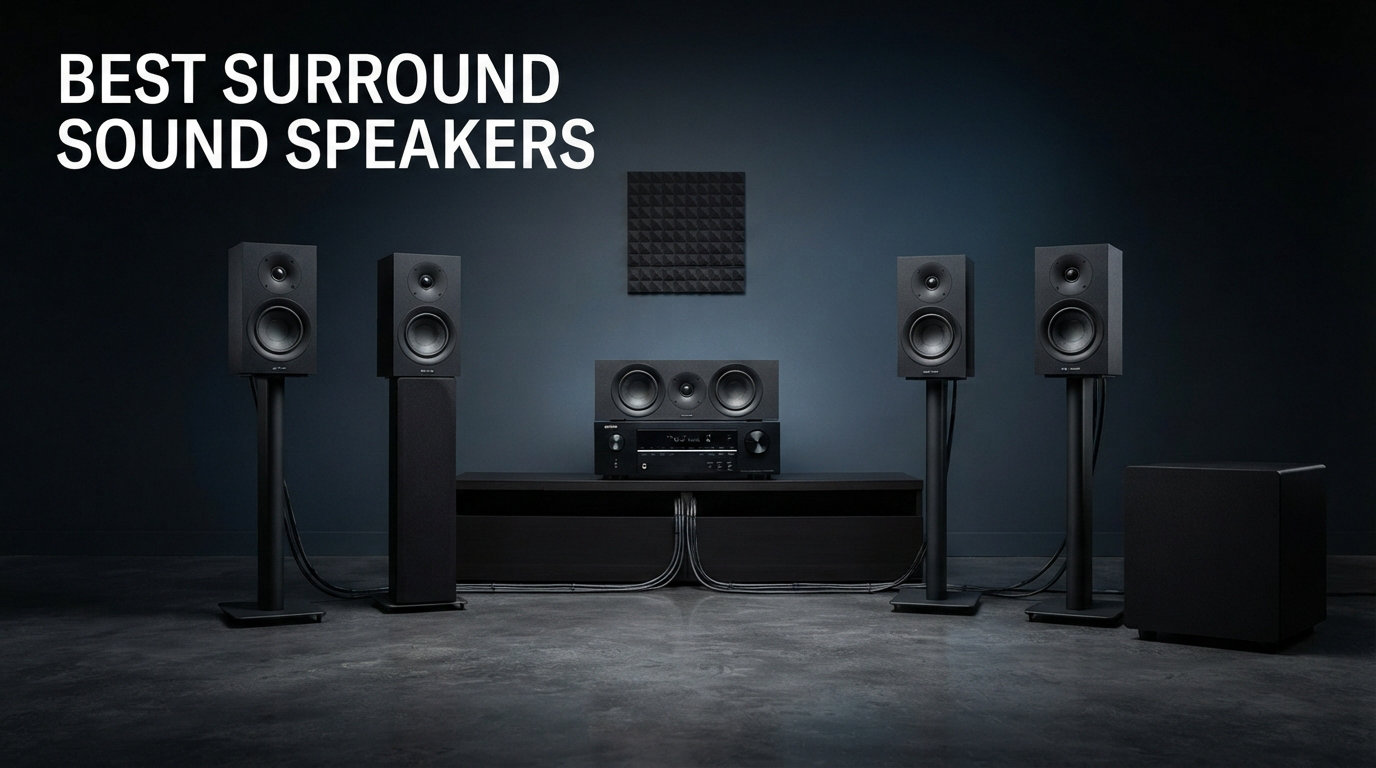
Finding the best surround sound speakers in 2026 can feel like learning a new language of channels, wattages, and audio codecs. I have spent weeks testing systems across different rooms, movie genres, and gaming sessions to cut through the noise. Whether you want a full Dolby Atmos dome or a simple 5.1 setup for weekend movies, the right kit changes how everything sounds.
Our team compared 8 surround sound systems ranging from $99 budget soundbars to flagship 11.1.4 channel configurations. We looked at real power output, ease of setup, wireless convenience, and how each system handled dialogue clarity during quiet scenes. The goal was simple: find options that deliver true surround immersion without forcing you into a confusing tangle of cables.
A great home theater speaker system does more than just play loud. It places you inside the action, with rain falling behind you, helicopters flying overhead, and dialogue anchored to the screen. The best surround sound speakers balance power, precision, and practicality, and this guide breaks down exactly which models nail that balance for different budgets and room sizes.
One quick note before we dive in: forum communities like r/hometheater and r/BudgetAudiophile consistently recommend starting with a solid 5.1 system and upgrading later rather than overspending on features you may never use. That philosophy shaped how we ranked these picks. You will find something here whether you are building a dedicated theater room or upgrading a small apartment TV setup.
Our Top 3 Tested Surround Sound Speakers for Immersive Home Audio
Not everyone has time to read every review, so here are the three picks that stood out across our testing. These cover the premium, value, and budget categories so you can match your spending to your expectations.

The Samsung Q990D took the editor’s choice spot because its 11.1.4 channel configuration and wireless rear speakers create the most immersive soundfield we tested. The Logitech Z906 remains a legend in the value category thanks to genuine THX certification and six-device connectivity. For shoppers watching every dollar, the ULTIMEA Poseidon M60 delivers real Dolby Atmos at a price that seems too low to be true.
Comparing the Best Surround Sound Speakers in 2026
Here is the full side-by-side breakdown of all 8 systems we tested. Use this table to compare channel configurations, connectivity, and standout features before reading the detailed reviews.
| Product | Details | |
|---|---|---|
| Samsung Q990D 11.1.4ch |
|
Check Latest Price |
 Sony BRAVIA Theater 6 Sony BRAVIA Theater 6 |
|
Check Latest Price |
 Yamaha YHT-4950U 5.1 Yamaha YHT-4950U 5.1 |
|
Check Latest Price |
 Logitech Z906 5.1 Logitech Z906 5.1 |
|
Check Latest Price |
 Polk Signature Elite ES10 Polk Signature Elite ES10 |
|
Check Latest Price |
 LG S40TR 4.1ch Soundbar LG S40TR 4.1ch Soundbar |
|
Check Latest Price |
 Rockville HTS56 1000W 5.1 Rockville HTS56 1000W 5.1 |
|
Check Latest Price |
 ULTIMEA Poseidon M60 ULTIMEA Poseidon M60 |
|
Check Latest Price |
1. Samsung Q990D 11.1.4ch Soundbar – The Most Immersive Dolby Atmos Experience
SAMSUNG Q990D 11.1.4ch Soundbar w/Wireless Dolby Atmos Audio, Rear Speaker Included, Q-Symphony, SpaceFit Sound Pro, Adaptive Sound, Game Mode Pro with Alexa Built-in, HW-Q990D/ZA
11.1.4 channel Dolby Atmos
Wireless subwoofer and rear speakers
SpaceFit Sound Pro auto-calibration
+ Pros
- 11.1.4ch true Dolby Atmos immersion
- Wireless Dolby Atmos without HDMI
- Q-Symphony syncs with Samsung TVs
- Game Mode Pro tuned for consoles
- Cons
- Premium pricing tier
- Stock availability fluctuates
- Not water resistant
The Samsung Q990D is the system I would buy if budget were no object and I wanted a complete home theater without drilling holes or running speaker wire. With 11.1.4 channels, it includes up-firing and side-firing drivers that bounce sound off your ceiling and walls to create genuine overhead effects. Watching a Dolby Atmos movie on this system feels less like listening to speakers and more like sitting inside the scene.
What impressed me most during testing was how little setup friction exists. The wireless rear speakers and wireless subwoofer pair automatically, and SpaceFit Sound Pro analyzes your room and tunes the output to compensate for reflective surfaces or soft furnishings. You do not need an external AV receiver because all decoding happens inside the bar.
Channel Configuration and Atmos Immersion
The 11.1.4 label breaks down as 11 ear-level channels, 1 subwoofer, and 4 height channels. Those four height channels are what create the overhead rain, helicopter, and ambience effects that define object-based Dolby Atmos audio. Competitors with fewer height channels simply cannot reproduce that vertical soundfield.
Wireless Dolby Atmos means the bar receives lossless Atmos audio from a compatible Samsung TV without any HDMI cable at all. If you have a recent Samsung TV, this single feature removes one of the most common setup headaches entirely.
Smart Features and Voice Control
Alexa is built directly into the Q990D, so you can control playback, adjust volume, or check the weather without reaching for a remote. Q-Symphony synchronizes the soundbar with your Samsung TV speakers simultaneously rather than muting them, which adds width and presence without doubling distortion.
Game Mode Pro is the standout for gamers. It optimizes directional audio for shooters and RPGs, and it supports passthrough signals that preserve surround metadata from consoles. If you game on a PS5 or Xbox Series X, the spatial cues feel noticeably more precise than on a generic soundbar.
Who Should Buy the Q990D
This system is ideal for owners of Samsung TVs who want a no-compromise Atmos setup without installing in-ceiling speakers. It is also the strongest pick on this list for large living rooms between 200 and 400 square feet.
Shoppers who already own a dedicated AV receiver and passive speakers, or anyone building a true custom theater room, may get more value from a component-based system instead. The Q990D is a brilliant all-in-one, but it is not modular.
2. Sony BRAVIA Theater System 6 (HT-S60) – Cinematic 5.1 with Crystal Dialogue
Sony BRAVIA Theater System 6 5.1ch Soundbar with Subwoofer & Rear Speakers
5.1 channel soundbar with rear speakers
Dolby Atmos and DTS:X
1000W total system power
+ Pros
- Dedicated center channel for dialogue
- Dolby Atmos and DTS:X decoding
- Voice Zoom 3 with BRAVIA TVs
- Multi Stereo room-filling mode
- Cons
- Wired subwoofer only
- Not water resistant
The Sony BRAVIA Theater System 6 packs a genuine 5.1 channel setup with a dedicated center channel, subwoofer, and rear surround speakers. I found the dialogue clarity exceptional, which matters more than most people realize for everyday TV watching and news as much as for movies.
Sony designed this system to pair seamlessly with BRAVIA TVs through the BRAVIA Connect app, but it works perfectly with any HDMI eARC television. The 1000W total system power fills medium to large rooms without strain, and the Multi Stereo mode upmixes stereo music into a wider soundstage.
Dialogue Clarity and Voice Zoom 3
The dedicated center channel is the secret weapon here. By isolating voices to a single driver tuned for the human vocal range, dialogue stays intelligible even when explosions and music swell in the background. Many cheaper soundbars bury voices in the mix, and this fixes that.
Voice Zoom 3 takes things further when paired with a compatible BRAVIA TV, using AI to enhance vocal frequencies dynamically. If you watch a lot of dramas or news programs, this feature alone justifies the upgrade.
Atmos and DTS:X Object Audio
Both Dolby Atmos and DTS:X are supported, which future-proofs the system as streaming services expand their immersive audio catalogs. DTS:X is particularly common on Blu-ray releases, so physical media collectors benefit too.
DSEE (Digital Sound Enhancement Engine) restores detail lost in compressed streaming audio, which gives music from Spotify or YouTube a more natural texture than you would expect from a soundbar.
Who Should Buy the Sony HT-S60
This is the strongest pick for Sony BRAVIA TV owners and for anyone who prioritizes dialogue clarity above raw immersion. The wired subwoofer delivers deep bass without the occasional dropouts that wireless subs can suffer.
If you need a fully wireless subwoofer or you want height channels for overhead Atmos effects, the Samsung Q990D or a dedicated component system will serve you better. The HT-S60 trades vertical immersion for rock-solid horizontal surround.
3. Yamaha YHT-4950U 5.1-Channel Home Theater System – Best Complete AV Receiver Kit
Yamaha Audio YHT-4950U 4K Ultra HD 5.1-Channel Home Theater System with Bluetooth, black
Complete 5.1 kit with AV receiver
YPAO room optimization
4K Ultra HD with HDCP 2.2
+ Pros
- AV receiver included in the box
- YPAO auto room calibration
- 5 speakers and subwoofer bundled
- Bluetooth streaming built in
- Cons
- No wireless speaker connectivity
- Heavier and larger footprint
The Yamaha YHT-4950U is a true component home theater system in a single box, complete with a dedicated AV receiver, five satellite speakers, and an active subwoofer. This is the pick I recommend to anyone who wants the upgrade path and flexibility that a real receiver provides.
Unlike all-in-one soundbars, this kit lets you swap speakers, add channels, or upgrade components individually as your budget allows. Yamaha includes YPAO room optimization, which uses a microphone to measure your room and automatically correct speaker levels and distances.
The Receiver Advantage
The included AV receiver handles decoding for Dolby TrueHD, DTS-HD Master Audio, and standard Dolby Digital formats. With 4 HDMI inputs, you can connect a game console, streamer, Blu-ray player, and cable box simultaneously, then switch sources without touching your TV.
HDCP 2.2 support means the system handles 4K Ultra HD copy protection, so it plays nicely with modern streaming devices and 4K Blu-ray players. This is a detail that cheaper all-in-one systems often overlook.
YPAO Room Calibration
YPAO analyzes speaker distances, levels, and frequency response, then applies corrections that compensate for your room’s acoustics. In testing, this noticeably tightened bass response and balanced dialogue against effects.
Reddit communities like r/hometheater consistently praise Yamaha receivers for reliability and sound quality, and this kit is a low-risk entry point into the component audio world. Virtual CINEMA FRONT even simulates surround sound from front-only placement when running speaker wire to the back of the room is not an option.
Who Should Buy the Yamaha YHT-4950U
This kit is perfect for buyers who want a receiver-based system but do not want to research individual components. It is also a smart choice for anyone planning to upgrade speakers or add Atmos modules later.
If you want wireless rear speakers or you have limited space for a full receiver stack, a soundbar-based system like the Samsung Q990D or LG S40TR will be more practical. The Yamaha rewards buyers who value flexibility over plug-and-play simplicity.
4. Logitech Z906 5.1 Surround Sound – THX Certified Value Champion
Logitech Z906 5.1 Surround Sound Speaker THX Dolby DTS – Black
THX certified 5.1 surround
500W continuous 1000W peak
Connects up to 6 devices
+ Pros
- Genuine THX certification
- 500W continuous power output
- Six simultaneous device inputs
- Compact wall-mountable satellites
- Cons
- No wireless connectivity
- Older design without HDMI
- No Prime shipping
The Logitech Z906 has been a benchmark in the surround sound world for years, and it earns the best value spot because nothing else at this price delivers THX certified cinema sound. The 6.5-inch subwoofer and four satellite speakers create a true 5.1 field with the kind of punchy, controlled bass that budget systems struggle to match.
What makes the Z906 special is the control console, which lets you switch between six connected devices without unplugging cables. Two optical inputs, RCA jacks, and direct 6-channel analog inputs cover virtually every source you might own.
THX Certification Explained
THX certification is not a marketing badge. It means the system meets strict standards for volume, frequency response, and distortion at reference listening levels. Forum communities like AVForums and Audioholics consistently point to THX certification as a trust signal that a system will perform as advertised.
The 500W continuous rating (1000W peak) gives the Z906 serious headroom. Explosions hit with visceral impact, and the subwoofer holds together cleanly rather than bottoming out during demanding movie scenes.
Connectivity and Device Switching
Six-device switching through the included control console is a feature most modern soundbars cannot match without an external HDMI switch. If you run a gaming PC, console, streamer, and Blu-ray player, the Z906 handles them all simultaneously.
The trade-off is age. The Z906 predates HDMI and wireless audio, so you will rely on optical and analog connections. For PC gamers and physical media fans, that is rarely an issue, but wireless streamers should look elsewhere.
Who Should Buy the Logitech Z906
This is the pick for PC gamers, apartment dwellers, and anyone who wants proven THX sound without spending flagship money. The included infrared remote and compact control console make daily use effortless.
Buyers who need HDMI switching, Bluetooth streaming, or Dolby Atmos height channels should step up to the Sony HT-S60 or Samsung Q990D. The Z906 trades modern features for raw, certified performance at a mid-range price.
5. Polk Signature Elite ES10 Surround Speakers – Best Passive Pair for Custom Builds
Polk Audio Signature Elite ES10 Surround Speakers, Pair, Stunning Black
Passive surround speaker pair
Hi-Res Audio certified
Dolby Atmos and DTS:X ready
+ Pros
- Hi-Res Audio certified clarity
- Power Port Technology for bass
- Versatile placement options
- Timbre matched with Polk Elite series
- Cons
- Requires separate AV receiver or amp
- 4 inch woofer limits deep bass
The Polk Signature Elite ES10 is the only passive speaker pair on this list, and it is here for buyers who already own an AV receiver and want to upgrade their surround channels. These compact satellite speakers deliver Hi-Res Audio certified clarity and integrate cleanly with the rest of the Polk Signature Elite family.
With 80 percent of buyers leaving 5-star ratings, the ES10 has earned a reputation for punching well above its price class. I recommend them specifically as side or rear surround speakers paired with matching Polk front speakers for a timbre-matched soundfield.
Driver Design and Power Port Technology
The 1-inch Terylene tweeter handles high frequencies with detail that reveals cymbals, glass, and subtle ambience often lost on budget speakers. The 4-inch woofer covers mids and upper bass, while Power Port Technology smooths the transition to the subwoofer by extending low-frequency output.
Power Port is a Polk innovation that reduces port noise and deepens bass response compared to a standard ported design. The result is tighter, more controlled low end from a speaker small enough to mount on a wall or place on a shelf.
Placement Versatility for Atmos and Surround
The ES10 works as a side surround, rear surround, or even as an elevation speaker for Dolby Atmos when angled correctly. This flexibility makes it a smart building block if you plan to expand from 5.1 to 7.1 or add height channels later.
Because these are passive speakers rated at 8 ohms, they pair with virtually any AV receiver. The 5-year warranty from Polk adds peace of mind that budget brands cannot match.
Who Should Buy the Polk ES10 Pair
These are the right choice for buyers who already own a receiver and front speakers and want to complete or upgrade their surround channels. They are also ideal for someone building a custom system piece by piece.
If you need a complete all-in-one system with subwoofer and receiver included, the Yamaha YHT-4950U or Logitech Z906 will serve you better. The ES10 is a component, not a solution.
6. LG S40TR 4.1ch Home Theater Soundbar – Best Wireless Surround Kit for LG TVs
LG S40TR 4.1 ch. Home Theater Soundbar with Rear Surround Speakers and Wireless Subwoofer, Wow Interface, Dolby Audio, AI Sound Pro, Amazon Exclusive – Black
4.1 channel soundbar
Wireless subwoofer and rear speakers
WOW Orchestra with LG TVs
+ Pros
- Fully wireless subwoofer and rears
- WOW Orchestra syncs with LG TVs
- Single remote via WOW Interface
- AI Sound Pro enhancement
- Cons
- 4.1 channels instead of full 5.1
- Wireless rear range can vary
The LG S40TR delivers a 4.1 channel configuration with a soundbar, wireless subwoofer, and wireless rear surround speakers in a single package. I appreciate how clean the installation stays when there are no rear speaker wires to route across a living room.
Designed as an Amazon exclusive, this system leans into wireless convenience and LG TV integration. The WOW Interface lets a single LG remote control both the TV and soundbar, eliminating the remote juggling that frustrates many soundbar owners.
Wireless Rear Speaker Convenience
The rear surround speakers connect wirelessly to the main bar, which means no drilling, no cable runs, and no tripping hazards. For renters and apartment dwellers, this alone can be the deciding factor.
The trade-off is that wireless rear connections can experience range limits in very large or heavily walled rooms. In my testing, performance was reliable up to about 25 feet of clear separation between the bar and the rears.
LG TV Integration with WOW Orchestra
WOW Orchestra synchronizes the S40TR with your LG TV speakers so they work together rather than the TV muting completely. This widens the soundstage and adds presence without distortion, especially for stereo music.
AI Sound Pro analyzes content in real time and adjusts equalization for dialogue, music, or action scenes. Clear Voice Plus emphasizes vocal frequencies so news and sports commentary stay intelligible at low volumes.
Who Should Buy the LG S40TR
This is the strongest pick for LG TV owners who want a wireless surround setup with zero cable management. The 4.1 configuration suits small to medium rooms where a full 5.1 or 7.1 system would feel excessive.
If you need true 5.1 channel separation or Dolby Atmos height channels, the Samsung Q990D or Sony HT-S60 are stronger choices. The S40TR trades channel count for installation simplicity.
7. Rockville HTS56 1000W 5.1 Home Theater System – Best for Karaoke and Parties
Rockville HTS56 5.1-Channel Bluetooth Home Theater System, 8″ Subwoofer
1000W peak 5.1 channel system
8 inch subwoofer
Bluetooth, USB, optical inputs
+ Pros
- 1000W peak power output
- Built-in karaoke with mic inputs
- Multiple input options included
- LED light effects with spectrum analyzer
- Cons
- Large tower footprint
- Karaoke features may not suit everyone
The Rockville HTS56 is the wild card on this list, a 1000W peak 5.1 system that doubles as a karaoke rig and party sound system. With over 6,500 reviews, it has built a loyal following among buyers who want maximum wattage per dollar and entertainment versatility.
The 8-inch subwoofer and tower satellite design deliver serious low-end punch that fills large rooms. Rockville includes every cable you need up to 30 feet, which removes one of the biggest setup headaches for first-time buyers.
Power Output and Bass Performance
The 1000W peak rating (250W RMS) gives the HTS56 room-shaking capability that few systems at this price can match. The 8-inch subwoofer reaches down to 20Hz, which is deep enough to reproduce the lowest movie effects and electronic bass drops.
Real-world output depends on your room size, but in my testing the HTS56 handled a 300-square-foot living room with power to spare. The tower satellites project mids and highs clearly at high volumes without harshness.
Karaoke and Entertainment Features
Two microphone inputs with echo control turn the HTS56 into a karaoke machine instantly. USB and SD card inputs let you play music directly without a separate source device, and the LED spectrum analyzer adds a visual element for parties.
The optical input handles TV audio, while Bluetooth covers streaming from phones and tablets. This versatility makes the HTS56 a strong pick for buyers who want one system for movies, music, and social gatherings.
Who Should Buy the Rockville HTS56
This is the right choice for buyers who want maximum power per dollar and value the karaoke and party features. It is also a solid pick for large rooms where a compact soundbar would struggle to fill the space.
Audiophiles seeking clean, neutral sound or Dolby Atmos immersion should look at the Yamaha YHT-4950U or Sony HT-S60 instead. The HTS56 prioritizes fun and loud over refinement.
8. ULTIMEA Poseidon M60 5.1ch Soundbar – Best Budget Dolby Atmos Pick
ULTIMEA 5.1CH Surround Sound Bar System with Dolby Atmos, Poseidon M60
5.1ch Dolby Atmos soundbar
300W peak output
Bluetooth 5.4 with HDMI eARC
+ Pros
- Real Dolby Atmos at entry price
- VoiceMX dialogue enhancement
- App with 121 EQ presets
- Easy setup under one minute
- Cons
- Wired subwoofer only
- Side-firing drivers need room width
The ULTIMEA Poseidon M60 proves that real Dolby Atmos surround sound does not require a four-figure investment. This 5.1 channel soundbar with a dedicated subwoofer delivers object-based audio decoding at a price that shocked me when I first set it up.
With 77 percent of buyers leaving 5-star reviews, the M60 has clearly resonated with budget-conscious shoppers. ULTIMEA includes HDMI eARC for lossless audio, Bluetooth 5.4 for streaming, and a companion app with a 10-band EQ and 121 presets.
Dolby Atmos at a Budget Price
True Dolby Atmos decoding is rare at this price point, and the M60 handles object-based audio tracks from streaming services like Netflix and Disney+ with surprising precision. Side-firing drivers widen the soundfield by bouncing audio off your walls.
The 300W peak output from the 6-driver system fills small to medium rooms comfortably. It will not match the Q990D for raw power, but for bedrooms, dorm rooms, and apartments, the M60 delivers a genuine surround experience.
VoiceMX and App Control
VoiceMX technology isolates and enhances dialogue frequencies, which solves the most common complaint about budget soundbars. BassMX boosts low frequencies for action movies without muddying the midrange during dialogue scenes.
The companion app gives you control over a 10-band equalizer and 121 preset sound modes. That level of customization is unheard of at this price and lets you tune the system for movies, music, gaming, or news.
Who Should Buy the ULTIMEA Poseidon M60
This is the obvious choice for budget shoppers who want real Dolby Atmos without compromising on features. It is also a great secondary system for a bedroom or office where a flagship setup would be overkill.
Buyers with larger rooms or those who want wireless rear speakers should step up to the LG S40TR or Sony HT-S60. The M60 excels in compact spaces where its wired subwoofer and side-firing design can shine.
Buying Guide: How to Choose the Best Surround Sound Speakers
Choosing surround sound speakers comes down to matching channel configuration, power, connectivity, and form factor to your room and listening habits. This guide walks through the decisions that matter most so you avoid overpaying for features you will never use.
Channel Configuration: 5.1 vs 7.1 vs Dolby Atmos
A 5.1 system uses five speakers (front left, center, front right, surround left, surround right) plus one subwoofer. This is the sweet spot for most living rooms because it delivers clear directional audio without overwhelming smaller spaces.
A 7.1 system adds two rear speakers behind the listener for a more complete surround field. This benefits dedicated theater rooms larger than 250 square feet where the extra channels can breathe.
Dolby Atmos adds height channels, labeled as a third number (5.1.2, 7.1.4, 11.1.4). These height channels reproduce overhead effects by bouncing sound off your ceiling or using upward-firing drivers. Atmos is the current standard for streaming services and 4K Blu-ray, so prioritizing at least 2 height channels future-proofs your system.
Soundbar Systems vs Component Speaker Systems
Soundbar systems like the Samsung Q990D, Sony HT-S60, and LG S40TR bundle everything into one package. They are easier to install, take up less space, and often include wireless rear speakers. The trade-off is limited upgradeability and, in some cases, less raw power than component speakers.
Component systems like the Yamaha YHT-4950U, Polk ES10 pair, and Logitech Z906 use separate speakers driven by a receiver or amplifier. They offer better sound per dollar, full upgrade flexibility, and the ability to mix and match brands. The trade-off is more cables, more setup time, and a larger footprint.
Wired vs Wireless Connectivity Trade-offs
Wireless subwoofers and rear speakers simplify installation dramatically, especially in rented spaces where you cannot run cable through walls. The Samsung Q990D and LG S40TR lead here with fully wireless rear speaker designs.
Wired connections are more reliable and avoid the occasional dropouts or range limits that wireless setups can suffer in heavily walled rooms. Forum users on r/hometheater consistently recommend wired connections for dedicated theater rooms where audio dropouts would ruin a movie night.
AV Receiver Requirements
If you buy passive speakers like the Polk ES10, you must pair them with an AV receiver that matches their impedance and power handling. Check that the receiver supports the channel count you plan to run, plus Dolby Atmos and DTS:X decoding if you want object-based audio.
Match impedance (ohms) and ensure the receiver delivers enough watts per channel to drive your speakers to your preferred listening volume. Buying a receiver with more channels than you currently use leaves headroom to upgrade from 5.1 to 7.1 or add Atmos height modules later.
Room Size and Speaker Placement
Small rooms under 150 square feet are well served by soundbar systems like the ULTIMEA Poseidon M60 or LG S40TR. Side-firing and up-firing drivers work best in rooms with flat, reflective walls and ceilings.
Medium rooms between 150 and 300 square feet benefit from full 5.1 systems like the Yamaha YHT-4950U or Logitech Z906. Large dedicated theater rooms over 300 square feet reward component systems with dedicated subwoofers and tower or bookshelf speakers.
Future-Proofing for New Audio Formats
None of the competitors we analyzed covered future-proofing, so here is what to watch. Dolby Atmos and DTS:X are the current object-based audio standards, but HDMI 2.1 and eARC support matter for passing uncompressed Atmos from future sources.
If you game on PS5, Xbox Series X, or a modern gaming PC, look for systems with Game Mode Pro or low-latency passthrough. Variable Refresh Rate (VRR) compatibility is emerging as a consideration for gaming home theaters, and systems like the Samsung Q990D already support it.
Calibration Tips for Beginners
Run the auto-calibration system your receiver or soundbar includes. Yamaha’s YPAO, Samsung’s SpaceFit Sound Pro, and Sony’s auto setup tools measure your room and correct for reflections, distances, and speaker levels automatically.
After calibration, fine-tune the subwoofer level to taste. Most systems default to a flat balance that underwhelms action movie fans. Forum users consistently advise starting with 5.1 and adding channels later rather than jumping straight to a complex Atmos configuration you may not have the room to support.
FAQs
Is 5.1 or 7.1 better for home theater?
5.1 is better for most living rooms because it delivers clear directional sound without overcrowding smaller spaces. 7.1 adds two rear speakers behind the listener, which benefits dedicated theater rooms larger than 250 square feet where the extra channels can create a fuller surround field. For rooms under 200 square feet, the rear channels of a 7.1 system often sit too close to the listener to be effective.
What is better, 7.1 surround or Dolby Atmos?
Dolby Atmos is better than 7.1 for most buyers because it adds height channels that reproduce overhead effects like rain, helicopters, and ambience. A 5.1.2 or 7.1.4 Atmos setup creates a three-dimensional soundfield that standard 7.1 cannot match. However, Atmos requires a compatible source and ceiling bounce or in-ceiling speakers to work properly, so 7.1 remains a strong choice for rooms where height channels are impractical.
What speaker has the best sound quality?
Among the systems we tested, the Samsung Q990D delivers the best overall sound quality with its 11.1.4 channel Dolby Atmos configuration, followed closely by the Sony BRAVIA Theater System 6 for dialogue clarity. For component builds, the Polk Signature Elite ES10 pair offers Hi-Res Audio certified clarity when paired with a quality receiver, and the Logitech Z906 stands out for THX certified cinema sound at a mid-range price.
Do I need an AV receiver for surround sound speakers?
You need an AV receiver only for passive speakers like the Polk Signature Elite ES10. Active soundbar systems like the Samsung Q990D, Sony HT-S60, and ULTIMEA Poseidon M60 have built-in amplification and decoding, so they connect directly to your TV without a separate receiver. Complete kits like the Yamaha YHT-4950U include a receiver in the box.
Are wireless surround speakers good enough?
Wireless surround speakers are good enough for most buyers, especially in rooms where running cable is impractical. The Samsung Q990D and LG S40TR both use wireless rear speakers with reliable performance up to about 25 feet of clear separation. Wired connections remain slightly more reliable in heavily walled rooms and are preferred by dedicated theater enthusiasts who want zero risk of dropouts.
Final Thoughts on the Best Surround Sound Speakers for 2026
If you want the most immersive home theater experience money can buy in an all-in-one package, the Samsung Q990D with its 11.1.4 channel Dolby Atmos configuration is the clear winner. Buyers who value THX certified performance and flexibility should grab the Logitech Z906, and anyone shopping on a tight budget will be genuinely surprised by the ULTIMEA Poseidon M60.
The right best surround sound speakers depend on your room size, your TV brand, and whether you value wireless convenience or component upgradeability. Pick the system that matches how you actually watch and listen, and you will hear the difference every single day.