
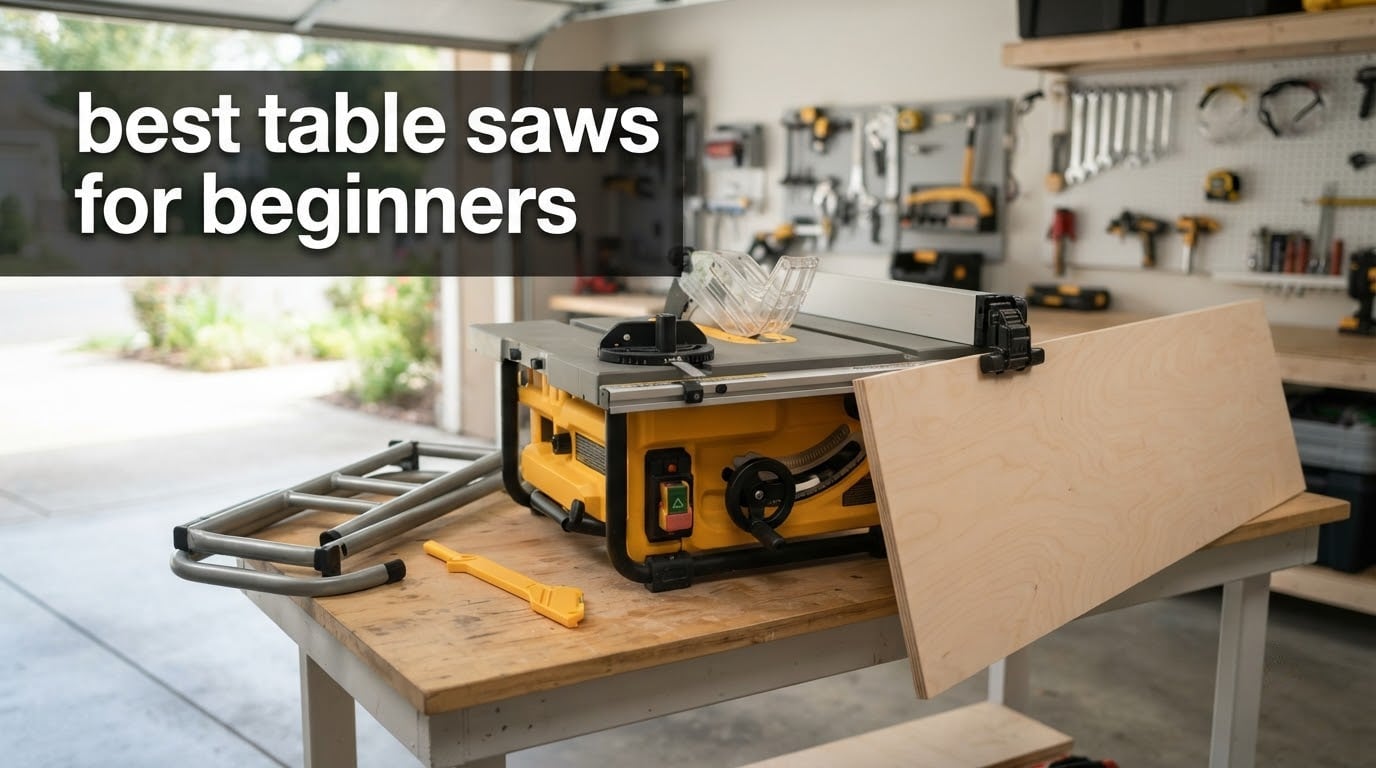
The best table saw for beginners is the DEWALT DWE7485, a compact 8-1/4 inch jobsite saw whose rack and pinion fence arrives square, whose guard adjusts without tools, and which one person can still lift into a car. I spent a month running all eight saws in this roundup through the same beginner project list, and that combination of accuracy out of the box and manageable weight is what separated the winners from the also-rans.
That matters more than the spec sheet suggests. A first table saw is not a purchase you make once and never think about, and the gap between a saw that cuts square on day one and one you spend a weekend aligning shows up in every project you build afterward. The best table saws for beginners in 2026 are the ones that demand the least adjustment before the first cut.
Our selection criteria were deliberately beginner-weighted. We cared about fence accuracy without a calibration ritual, rip capacity wide enough to break down real sheet goods, a riving knife and anti-kickback pawls in the box, a stand you can actually move, and total weight rather than peak horsepower.
We also priced the whole picture, not just the saw, because a folding stand, a crosscut sled, blades, ear protection and a dust port often add more than a beginner expects. Nothing in this guide is a professional contractor machine, and that is deliberate.
Our Top 3 Beginner Table Saws for a First Workshop

DEWALT DWE7485 8-1/4 in…
- Rack and pinion fence rails
- 24.5 in. rip capacity
- Tool-free guarding
- 54 lb
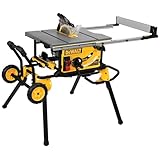
DEWALT DWE7491RS 10 in…
- 32-1/2 in. rip capacity
- 3-1/8 in. depth of cut
- Fold-flat rolling stand
- 10 in. blade
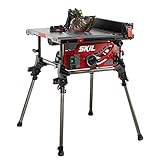
SKIL TS6307-00 10 in Jobsit…
- Integrated folding stand
- Parallel blade alignment
- 4x4 cutting capacity
- 51.2 lb
Comparing All Eight Table Saws in This Roundup
Every saw below ships with a rip fence, and most ship with a miter gauge and push stick, but they diverge sharply on capacity, weight and what you have to buy separately. The table below is the fast way to see where each one sits before you read the full review.
| Product | Details | |
|---|---|---|
| DEWALT DWE7485 8-1/4 in Compact Jobsite Table Saw |
|
Check Latest Price |
| DEWALT DWE7491RS 10 in Jobsite Table Saw with Stand |
|
Check Latest Price |
| SKIL TS6307-00 10 in Jobsite Table Saw |
|
Check Latest Price |
 EVOLUTION R10TS 10 in Jobsite Table Saw EVOLUTION R10TS 10 in Jobsite Table Saw |
|
Check Latest Price |
 SKIL TS6308-00 8-1/4 in Compact Table Saw SKIL TS6308-00 8-1/4 in Compact Table Saw |
|
Check Latest Price |
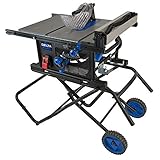 Delta 36-6023 10 in Table Saw Delta 36-6023 10 in Table Saw |
|
Check Latest Price |
 SKILSAW SPT99-11 10 in Worm Drive Table Saw SKILSAW SPT99-11 10 in Worm Drive Table Saw |
|
Check Latest Price |
 Bosch GTS15-10 10 in Jobsite Table Saw Bosch GTS15-10 10 in Jobsite Table Saw |
|
Check Latest Price |
1. DEWALT DWE7485 – The Compact Saw That Forgives a First-Time Owner
DEWALT 15 Amp 8-1/4 in. Compact Portable Jobsite Table Saw (DWE7485)
8-1/4 in blade at 5800 rpm
24.5 in. rip capacity
54 lb
15 amp corded
+ Pros
- Tool-free modular guarding for quick blade changes
- Rack and pinion fence rails for fast accurate adjustments
- Compact frame one person can load into a car
- On-board storage keeps every accessory with the saw
- Cons
- 8-1/4 in blade is shallower than 10 in saws on thick material
- Modest depth of cut suits trim and sheet goods more than thick lumber
This is the saw I kept reaching for during the month of testing, and not because it is the most powerful thing in the group. It is because it does the small number of things a beginner does constantly, and it does them without ceremony.
The telescoping rack and pinion fence rails are the headline. Fence adjustments glide rather than creep, and the fence stays parallel to the blade, which is the property that decides whether your rip cuts are square a year from now. Woodworkers on r/BeginnerWoodWorking consistently point to a DEWALT as their beginner recommendation, and this is the compact end of that line.
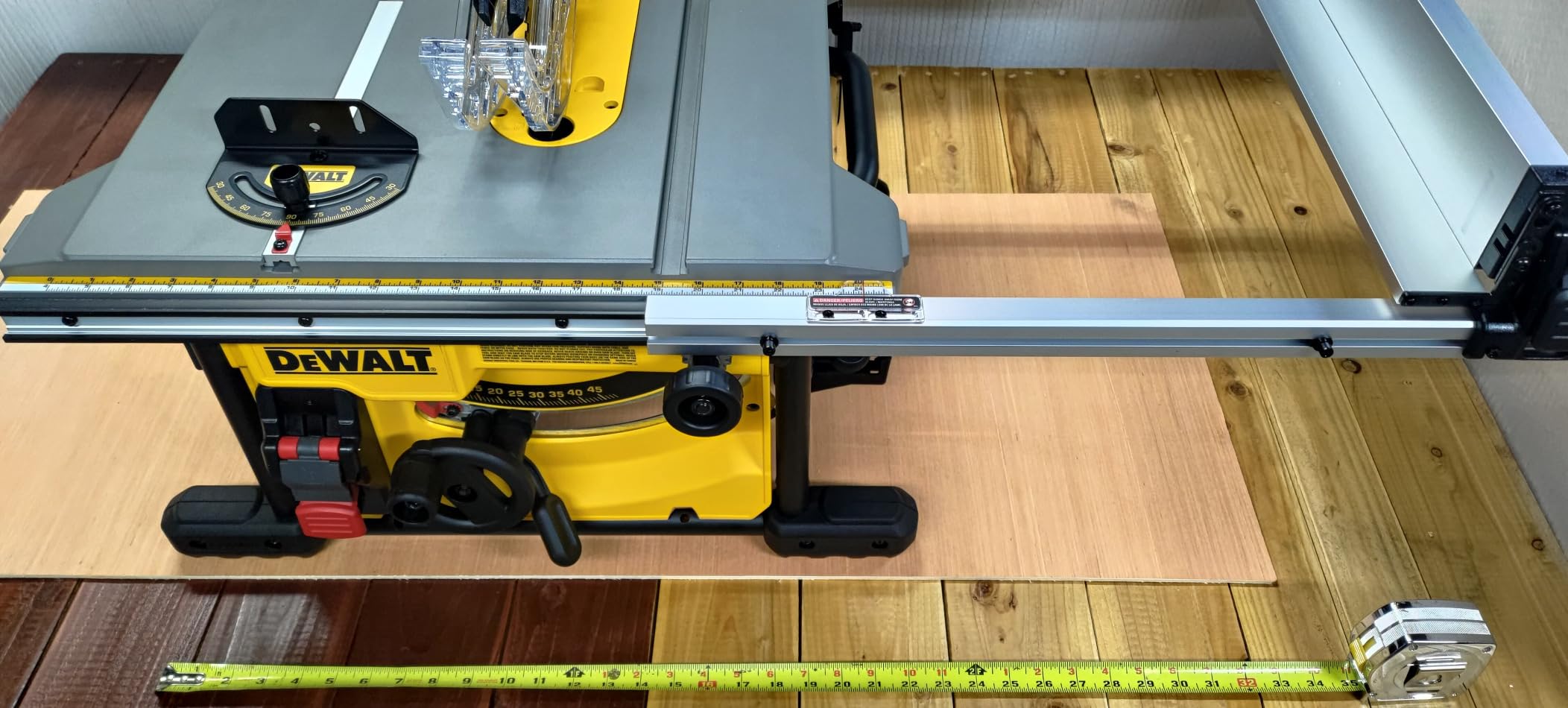
The guarding system deserves specific attention because it is the feature most often skipped on entry-level saws. The Site-Pro modular design lets you lift the guard out and drop it back into place without hunting for tools, so you will actually keep the guard on instead of leaving it off the saw. The anti-kickback pawls and riving knife come as part of the package, and the power-loss reset stops the motor from restarting by itself after a supply interruption.
Storage is a small thing that pays off daily. The guard, fence, wrenches and miter gauge live on the tool itself, so nothing disappears into a toolbox the first time you need it.
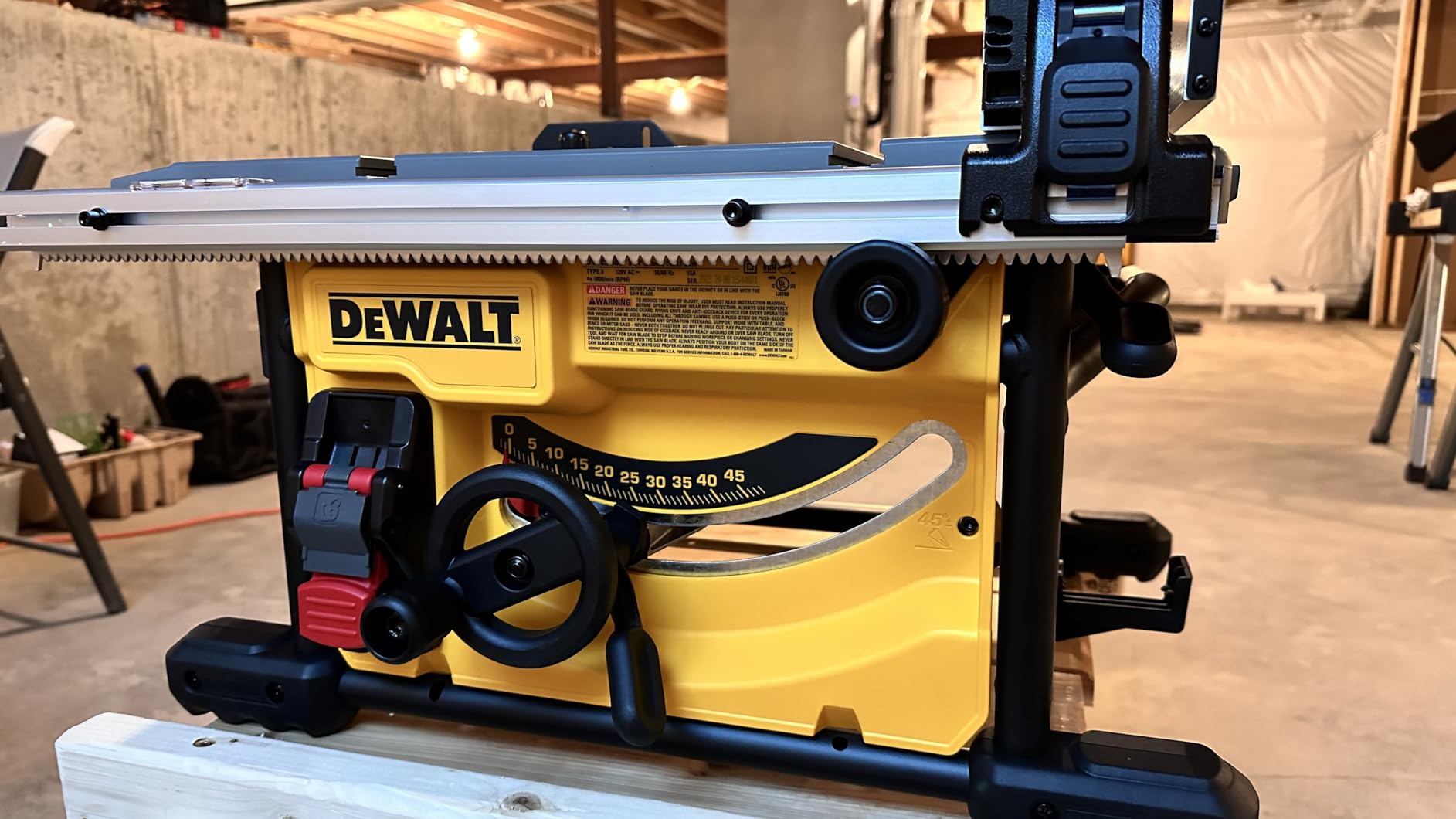
Fence accuracy and rip capacity for real sheet goods
Rip capacity here is 24.5 inches, which is enough to handle a 4×8 sheet of plywood or OSB once the factory edge is taken off. That is the single most common beginner project, and this saw covers it. It will not handle a full 48 inch width in one pass, because nothing in this class does, but sheet breakdown does not require that.
Depth of cut at 90 degrees is more modest than a 10 inch saw, and that is the honest trade. Thick hardwood boards need a taller blade, and the 8-1/4 inch format is really a trim, molding, sheet-goods and dimensional-lumber saw rather than a rough-lumber saw.
Portability: 54 pounds and a metal roll cage
At 54 pounds this is one of the lighter saws here, and the compact 22.75 inch footprint means it fits on a bench or in the bed of a small pickup without a loading ramp. The metal roll cage base is the part that surprises people, since portable saws are usually associated with plastic; it takes jobsite knocks without flexing.
That combination of weight and durability is why it works as a first saw. You will move it more than you expect to, and a saw you can move is a saw you will actually use.
Who this saw is right for
Choose the DWE7485 if your projects are shelves, trim, small furniture, plywood cutoffs and weekend builds, and if you want a first saw that is accurate on arrival and light enough to store between sessions.
Skip it if you plan to rip thick dimensional lumber regularly, or if breaking down full 48 inch sheets in a single pass is non-negotiable. In that case the 10 inch saws later in this guide have the capacity you need.
2. DEWALT DWE7491RS – The Full-Size 10 Inch Saw for Growing Shops
DEWALT Table Saw 10 Inch with Foldable Rolling Table Saw Stand, 15 Amp, 4800 RPM, 32-1/2-Inch Rip Capacity (DWE7491RS)
10 in blade at 4800 rpm
32-1/2 in. rip capacity
110 lb with stand
3 year warranty
+ Pros
- 32-1/2 in. rip capacity handles large sheet goods and hardwoods
- Flip-over ripping fence and material support for narrow cuts
- Fold-flat rolling stand for transport
- Deep onboard accessory storage
- Cons
- About 110 lb means two people to move it
- Outboard motor is loud during heavy hardwood rips
This is the saw I would buy if a first saw had to survive a full move to a different shop without disassembling. The rails retract and the stand folds flat, which is the detail that separates a jobsite saw from a bench saw that happens to have wheels.
Everything a beginner needs arrives in the box, including the blade guard assembly, riving knife, miter gauge, push stick and wrenches. That completeness is a real advantage over cheaper saws where the push stick alone can become a second purchase.
The 10 inch blade and 32-1/2 inch rip capacity open up the projects an 8-1/4 inch saw cannot touch. With 3-1/8 inches of depth at 90 degrees and 2-1/4 inches at 45 degrees, a beginner can crosscut dimensional lumber to length and still cut thicker hardwood.
The cast iron table measures 21-7/8 by 26-3/8 inches, and the patented material support on the flip-over fence keeps narrow pieces from tipping into the blade. For someone learning to rip thin strips safely, that matters.
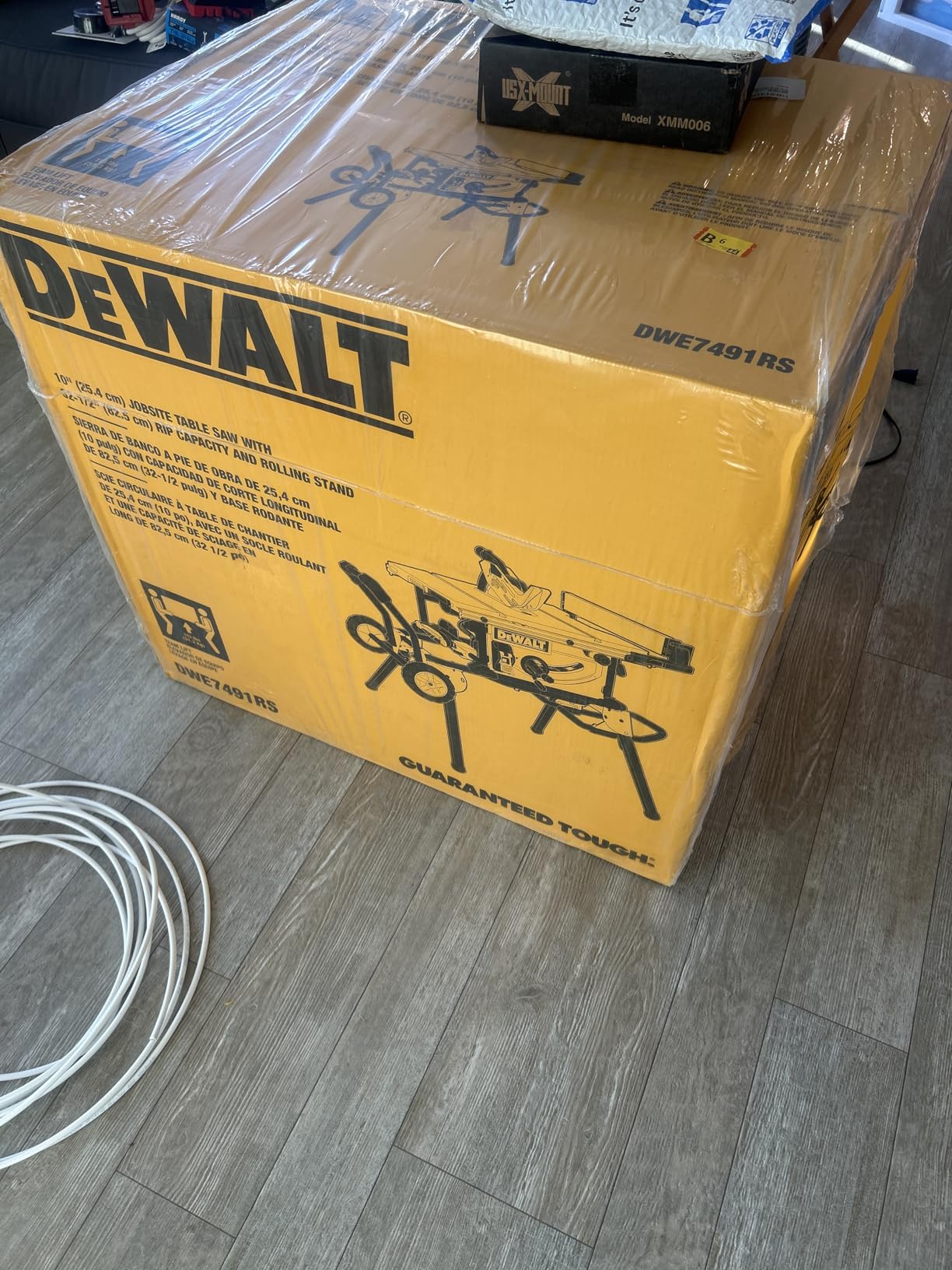
What 32-1/2 inches of rip capacity actually unlocks
This is the number that decides whether you can break down sheet goods without a second pass. A 4×8 sheet is 48 inches wide, so even here you are working in two stages, but the wider capacity means fewer handling steps and far less risk of losing a reference edge partway through.
For furniture work in particular, the extra capacity shortens the setup time on every panel you cut. That saved time is what keeps a beginner building projects rather than abandoning them at the setup stage.
Weight, stands and where the saw lives
At roughly 110 pounds with the stand, this is a saw that stays in one place. Most owners set it in a garage corner and leave it there, treating it as fixed shop equipment even though the stand folds.
The 2-1/2 inch dust collection port is larger than most in this class, and with a proper shop vacuum attached the difference in cleanup is immediate. The three year limited warranty is a middle-of-the-pack commitment that matches the rest of the machine.
Who this saw is right for
Choose the DWE7491RS if you have a dedicated garage bay, you want one 10 inch saw that will last a decade, and you would rather not chase accessories afterward. It is also the sensible upgrade path once you outgrow a compact saw.
Skip it if floor space is tight or you need to carry the saw between a shared shop and home. A 51 pound folding-stand saw is a fundamentally different ownership experience.
3. SKIL TS6307-00 – The Best Value Pick With a Stand Already Built In
SKIL 15 Amp 10-Inch Jobsite Table Saw with Folding Stand-TS6307-00
10 in blade,15 amp motor
4x4 capacity at 90 degrees
2-47 degree bevel
51.2 lb with stand
+ Pros
- Integrated folding stand stores accessories and folds for one-person carry
- Rack and pinion rails arrive parallel and square
- Complete kit includes guard
- push stick
- miter gauge and dust elbow
- 15 amp motor handles hardwood rips
- Cons
- Stock miter gauge is short and often replaced by an aftermarket sled
- Heavy plastic content signals light to moderate duty
- Louder than DEWALT and Bosch saws in this class
This saw topped our value ranking during the review window, and the reason is simple: it is the only machine here where the stand is not an accessory. If you buy one portable table saw in your life, this is the one most people describe as no regrets.
Woodworkers on r/woodworking describe it as easily the best bang for the buck, and one owner mentioned keeping theirs for three years before upgrading. That is the pattern of use a first saw should support.
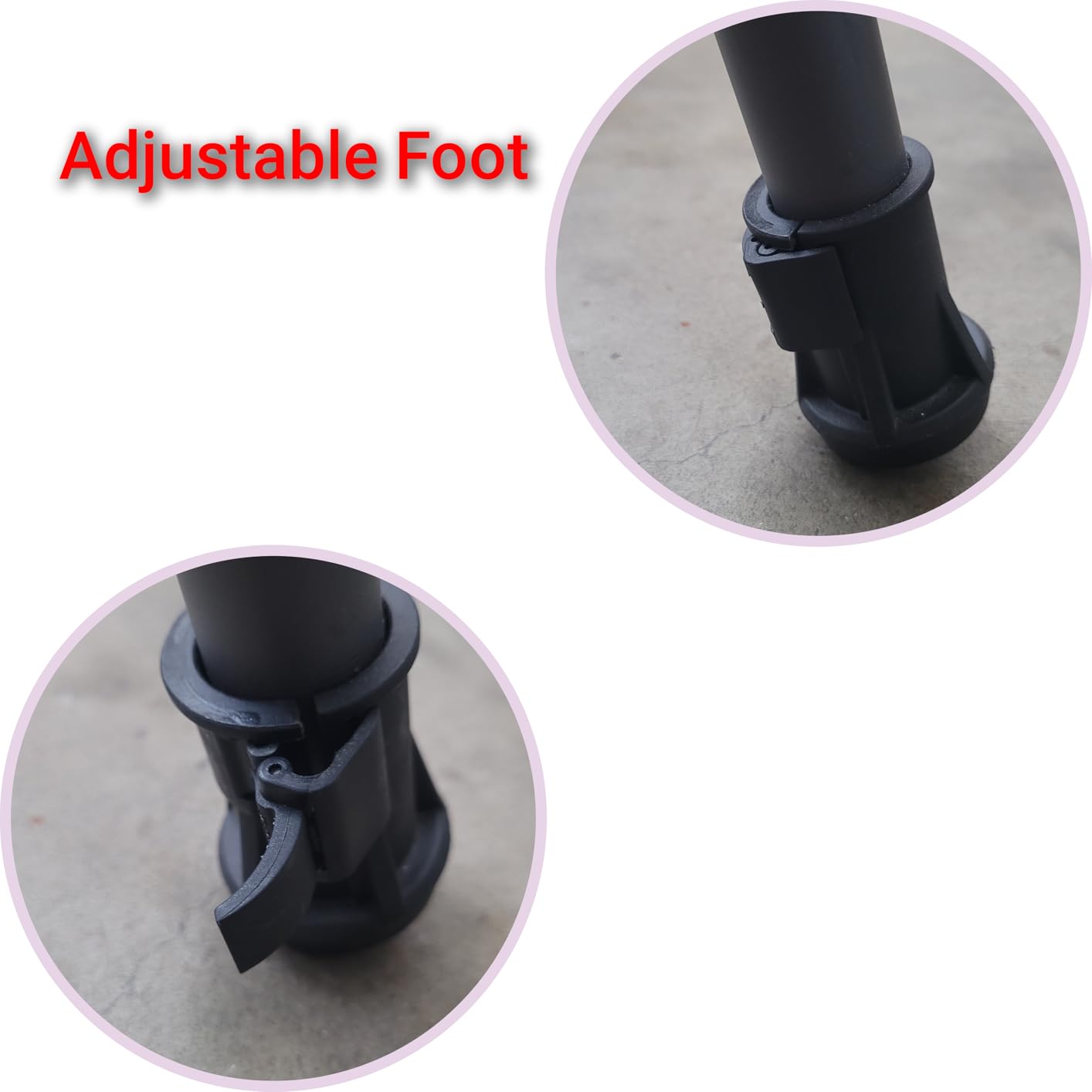
The box contents are unusually complete for the tier. You get the blade guard, push stick, miter gauge, anti-kickback pawl, dust port elbow, riving knife, rip fence, a 24 tooth blade and wrenches. Nothing essential is missing, which removes a common first-week frustration.
Cut quality came back clean in our own runs with 2x pine and 4×8 plywood at 23/32 inch. Owners report the same, and the rack and pinion rails arrive parallel and square from the factory.
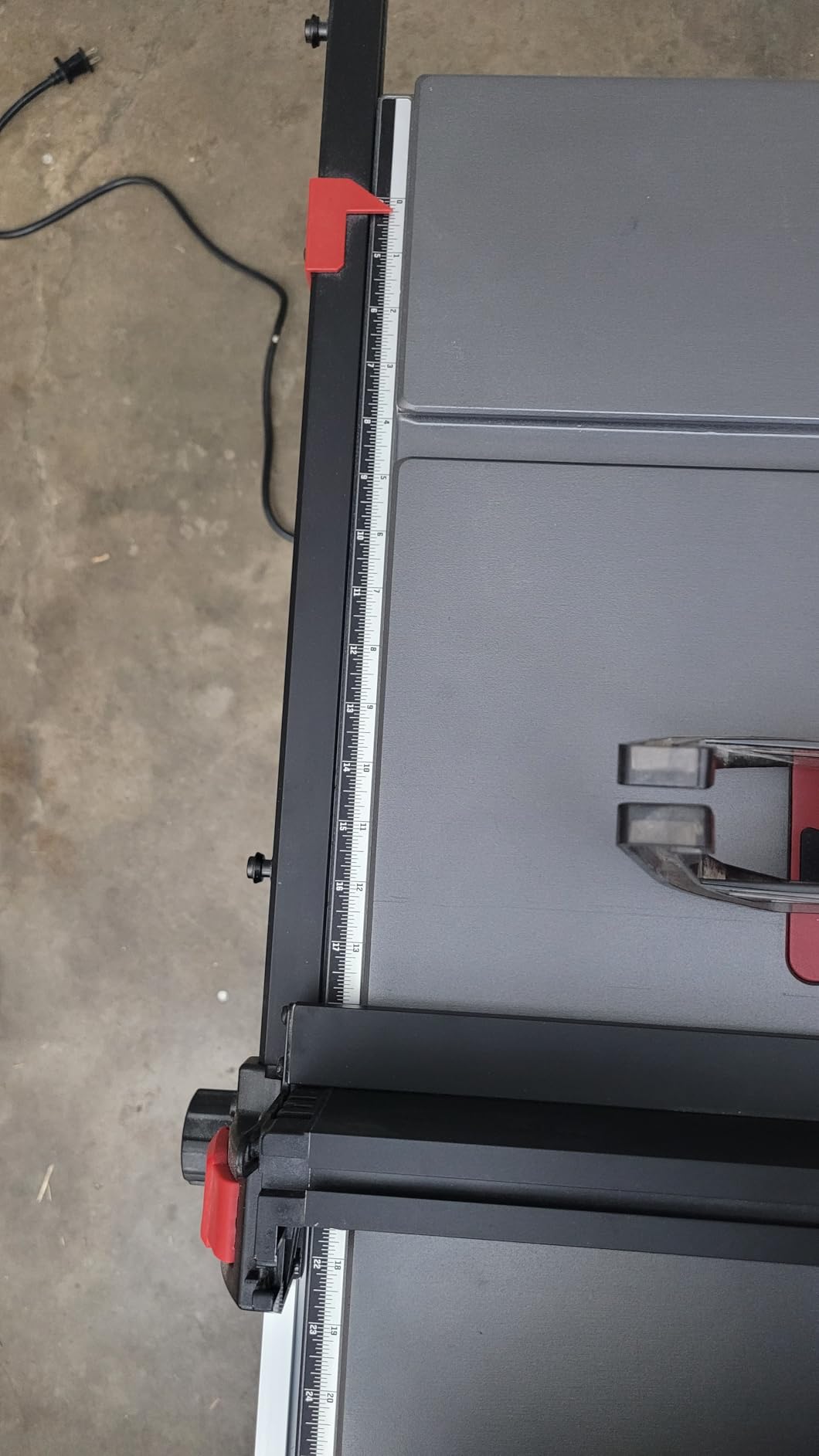
Rip capacity, bevel range and what a beginner can build
Cutting capacity is rated at up to 4×4 material at 90 degrees, and the 2-47 degree bevel with a quick release lever covers trim, tapered legs and beveled edges. That range is wider than most portable saws and it is what makes this machine usable for furniture rather than only for breaking down material.
Parallel blade alignment micro-adjustment is the underrated feature. Alignment drifts over years on any saw, and having fine adjustment means you can bring it back without a trip or a service call.
The folding stand and 51.2 pound package
At 51.2 pounds including the stand, this is a saw one adult can move. The legs fold in and the accessories store on board, so the whole thing collapses into something you carry with two hands rather than four.
The dust port elbow is a small quality-of-life inclusion. It redirects debris into a container or vacuum hose and costs almost nothing to add, so the fact that it ships in the box is worth noting.
Who this saw is right for
Choose the TS6307-00 if you want a complete 10 inch setup, you work in a small garage, and you would rather spend your first weekend building than assembling. It is our recommendation for most first-time buyers who want the most capability per dollar spent.
Skip it if your work is heavy ripping of thick lumber every session, or if noise in a shared space is a real constraint. Owners do report it runs louder than the DEWALT and Bosch machines in the same tier.
4. EVOLUTION R10TS – The Best Table Saw for Beginner Joinery Work
Evolution R10TS 10″ Jobsite Table Saw | Zero-Clearance Throat Plate | Dado Plate Included | 15A Motor | 26” Rip | 3-3/8” Cut | 0-45° Bevel | Precision Fence | Heavy Duty Portable Woodworking Saw
Zero-clearance throat plate
26 in. rip capacity
3-3/8 in. depth of cut
Dado plate and sled included
+ Pros
- Zero-clearance throat plate and sled give square low tear-out cuts
- Sliding table largely replaces a separate crosscut sled
- Dado plate included expands into grooves and joinery
- 3 year warranty plus free replacement service
- Cons
- Included miter gauge is well below the quality of the rest of the saw
- Some units shipped with a defective throat plate
- Documentation diagrams are small and vague
Owners with decades of woodworking experience call the throat plate and sled on this saw genuinely class-leading for a portable machine, and after our own runs we agree. If your beginner projects involve dados, rabbets or clean crosscuts in plywood, that matters more than horsepower.
The zero-clearance insert fits flush with the table so the blade sits at zero height below the surface, which removes the tear-out that comes from the blade rising through a recessed throat plate. On a project where both faces of a panel stay visible, that is a visible quality difference.
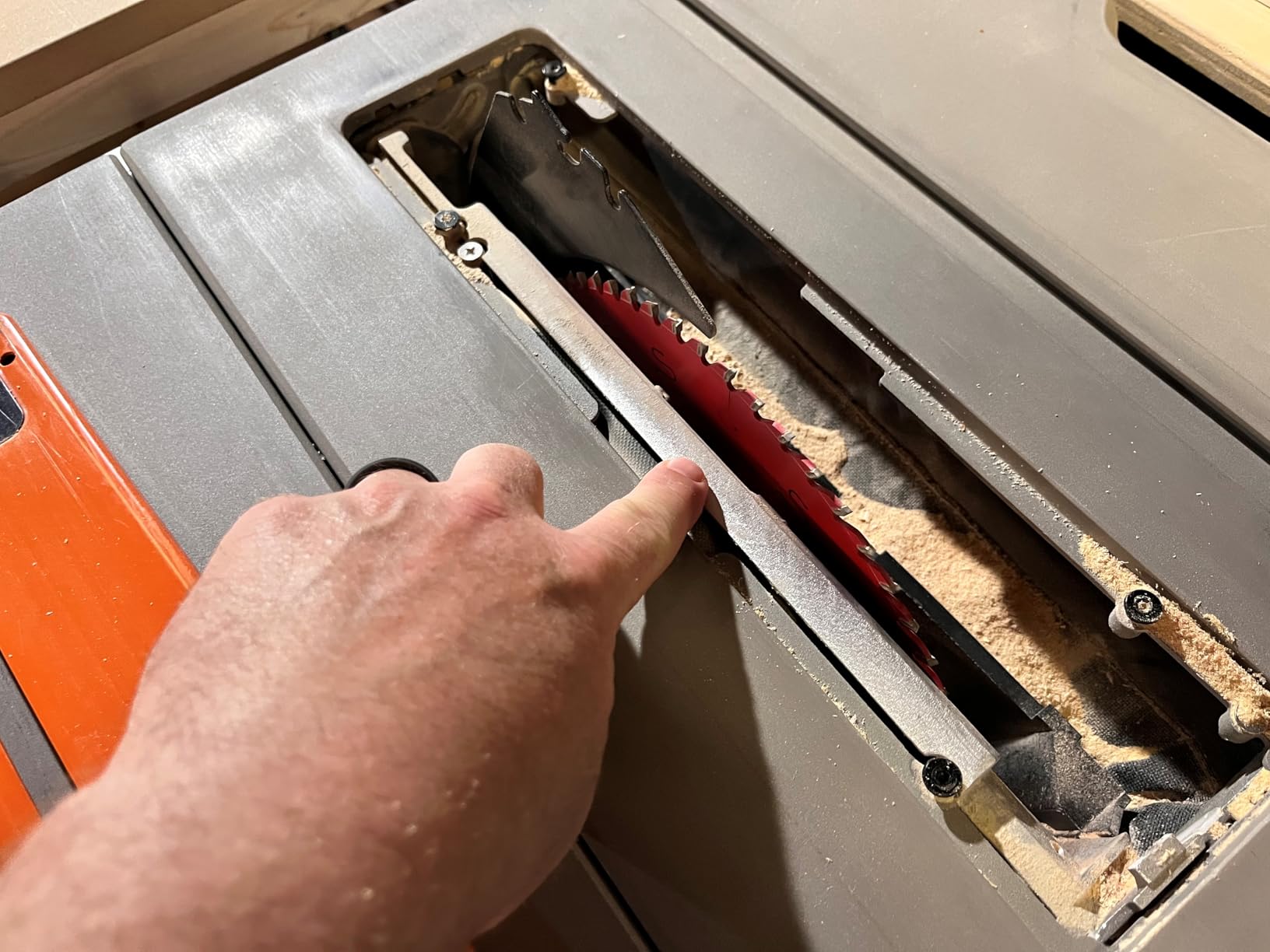
The included crosscut sled handles wide panels, and the sliding table on the left side means most beginners never need to buy a separate sled. That is a meaningful cost avoided compared with the other saws here, where the sled is a separate purchase.
A dado plate is included as well, so grooves and dados are available from day one with the standard blade. A 15 amp high-torque motor with soft start also handles mild steel, aluminum and composites, which broadens what a hobbyist shop can take on.
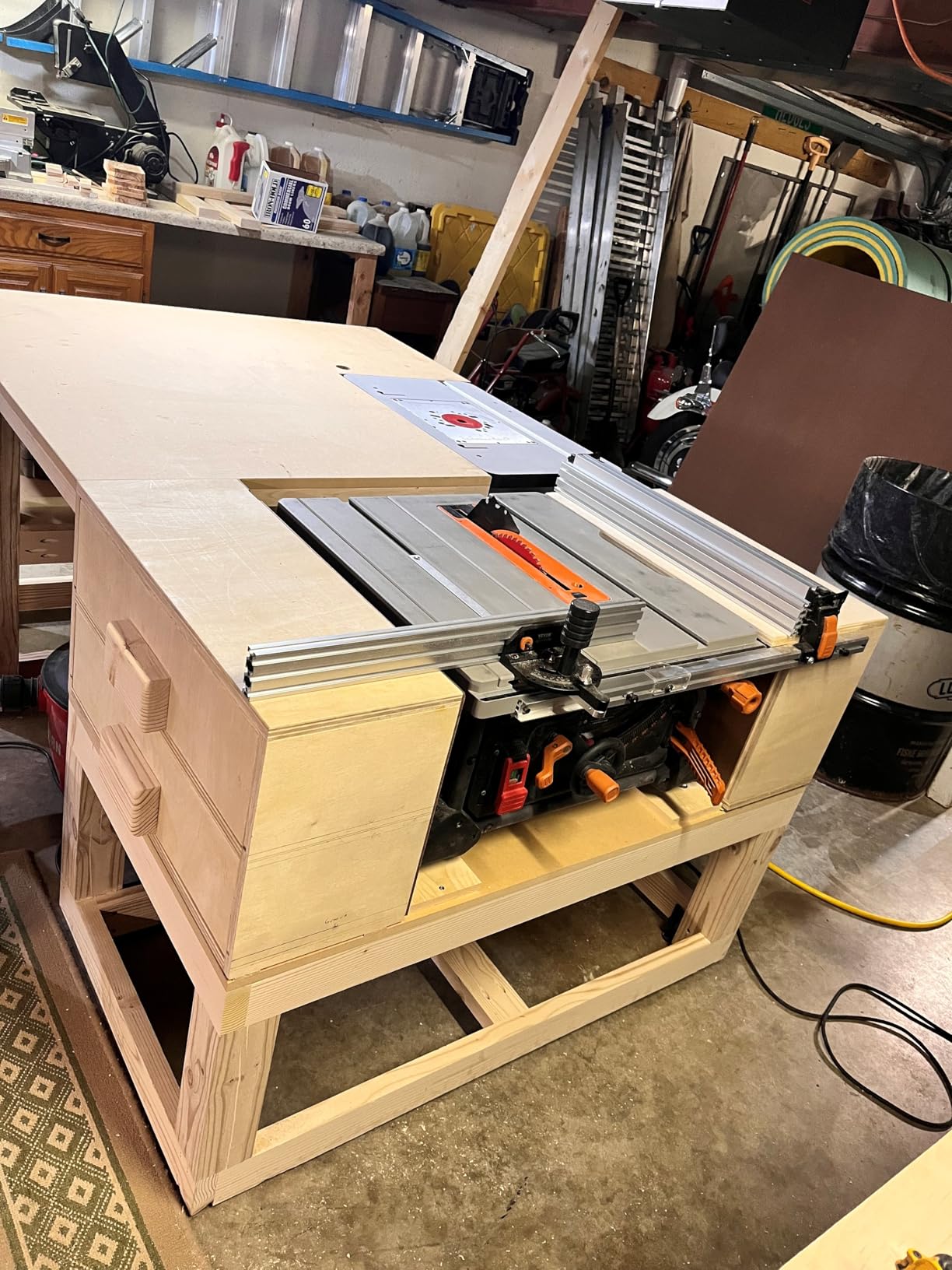
26 inches of rip capacity and a 3-3/8 inch cut
Rip capacity of 26 inches handles a 4×8 sheet after trimming a factory edge, and the 3-3/8 inch maximum depth at 0 degrees is deeper than the DEWALT jobsite saw in this guide. The 0-45 degree bevel uses geared adjustment, so the angle holds once you set it.
The limiting factor for a first saw is not capacity here but the 99 review base. Long-term durability data is thin compared with saws carrying five-figure review counts, and the throat plate defect reported on some early units is worth factoring into any decision.
Safety package: brake, pawls and riving knife
The electronic blade brake, anti-kickback pawls and a quick-release riving knife form the most complete safety package in this roundup. For a beginner, a brake that stops a spinning blade quickly removes one of the reasons people hesitate to make the first cut.
The large paddle switch is easy to hit deliberately and hard to hit by accident, which is the correct direction for an emergency stop. Buyers who contacted the brand about damaged parts report free replacements, which softens the thin-review-base concern.
Who this saw is right for
Choose the R10TS if your projects are casework, cabinet parts and panel work where tear-out on a visible face would ruin the piece, and if you would rather not buy a sled and dado plate later.
Skip it if you need a full 32 inches of rip capacity, or if you want a long ownership history of evidence. In both cases a higher-reviewed 10 inch saw is the calmer choice.
5. SKIL TS6308-00 – The Lightest Saw Here for Tight Spaces and Shared Shops
SKIL 15 Amp 8-1/4-Inch Compact Portable Jobsite Table Saw (Stand SFS0001 Sold Separately)-TS6308-00
8-1/4 in blade,15 amp motor
2-1/2 in. depth of cut
24.5 in. rip capacity
40 lb
+ Pros
- Rack and pinion fence with integrated ruler and scale
- 40 lb weight is easy to carry
- All components store on board
- Dust port elbow supports a vacuum hose
- Cons
- Folding stand sold separately as the SFS0001
- Several owners report quality plastic components
- No height adjustment scale for dado work
At 40 pounds this is the lightest saw in the roundup, and that single number changes who can own a table saw. If your workshop is a corner of an apartment, a shared space, or a room you have to clear afterward, weight is not a minor spec.
First-time buyers describe it as a good foundation, and the fence with its integrated ruler and scale is the feature most often credited with making repetitive cuts fast and square. The scale printed on the rail removes the measuring step entirely.
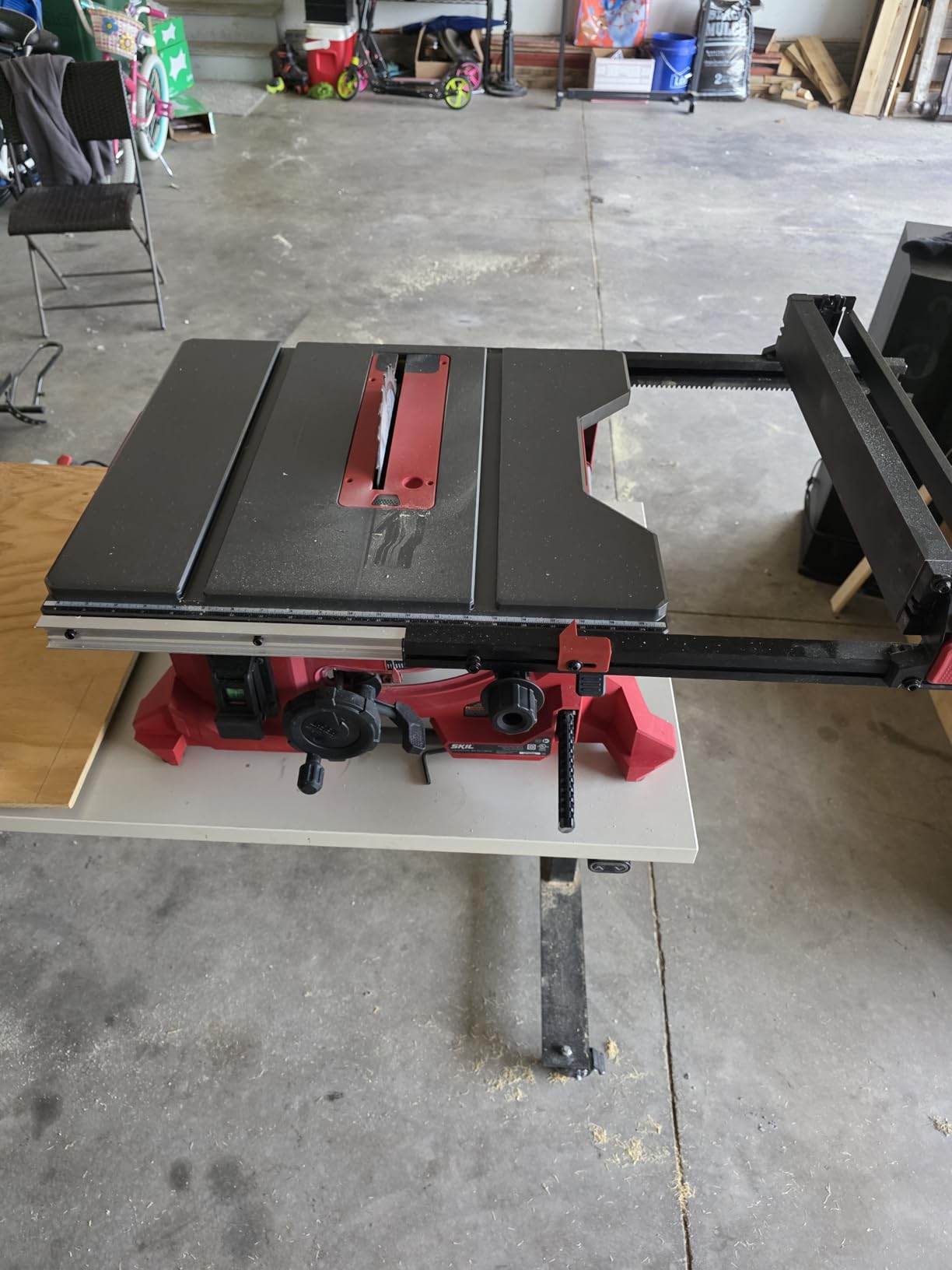
Rip capacity is 24.5 inches to one side of the blade and 12 inches on the opposite side, which is enough to break down sheet goods and to cut 2x4s to length. Maximum depth of cut at 0 degrees is 2-1/2 inches, so 3x material can be cut in a single pass.
The 15 amp motor handles sheet goods, 2×4 crosscuts and dado joints according to the manufacturer, and the aluminum table is described by owners as solid with good flatness. Parallel blade alignment micro-adjustment is present, which is a good sign at this end of the market.
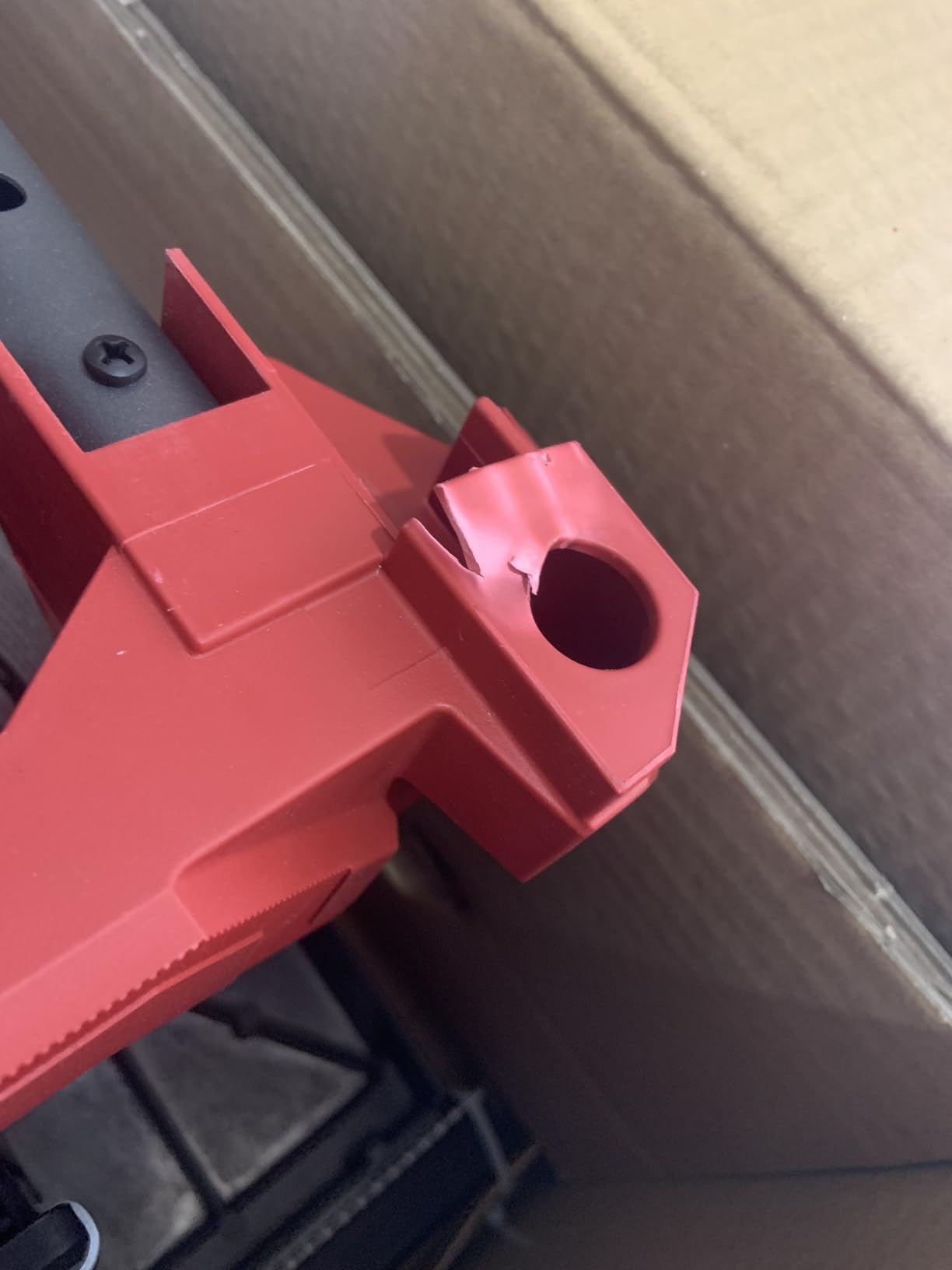
Budgeting for the separate stand
The most important practical detail is that the stand is not included. It is compatible with the SKIL SFS0001 folding saw stand, which is sold separately, and a beginner who forgets that will end up working at an uncomfortable height.
Once the stand is accounted for, the total setup behaves much like the SKIL TS6307-00 in cost terms, but the saw itself is the lighter and more compact of the two. If you can only carry a tool up stairs or across a shared space, that difference decides it.
What you give up in a compact 8-1/4 inch package
Depth of cut and blade diameter set the ceiling. There is no height adjustment scale, so blade height for dado work has to be measured with a square rather than set from a marked scale, which adds friction to joinery projects.
Owners also report the saw runs louder than DEWALT machines, and a few isolated durability failures around the guard assembly. None of these are dealbreakers at this tier, but they are worth knowing before you buy.
Who this saw is right for
Choose the TS6308-00 if the deciding factor is where the saw lives and how you get it there. It is a strong first saw for a small garage, a shared workshop or a weekend-only hobbyist.
Skip it if you already have a stand and a workbench, because in that case the TS6307-00 gives you a 10 inch blade and a better included accessory kit for a similar setup.
6. Delta 36-6023 – The Longest Warranty and Rare Stacked Dado Capacity
Delta 36-6023 10 Inch Table Saw with 32.5 Inch Rip Capacity
15 amp contractor-grade motor
32.5 in. rip capacity
13/16 in. x 8 in. stacked dado
5 year warranty
+ Pros
- 5 year professional warranty is the longest in this group
- Stacked dado capacity is rare at this tier
- 32.5 in. rip capacity covers large material
- Rack and pinion fence rails
- Cons
- Smallest review base among the 10 inch models at 200
- One-star share is the highest among 10 inch saws
- 77 lb with stand is heavier than the compact options
The warranty is the headline here. Five years of professional coverage is roughly double what most competitors offer, and on a tool a beginner may own for a decade, that is a meaningful commitment rather than a marketing line.
For joinery-minded beginners, the 13/16 inch by 8 inch stacked dado capacity is the other reason to look. Most portable saws in this group cannot produce a usable dado without buying extra plates or blades.
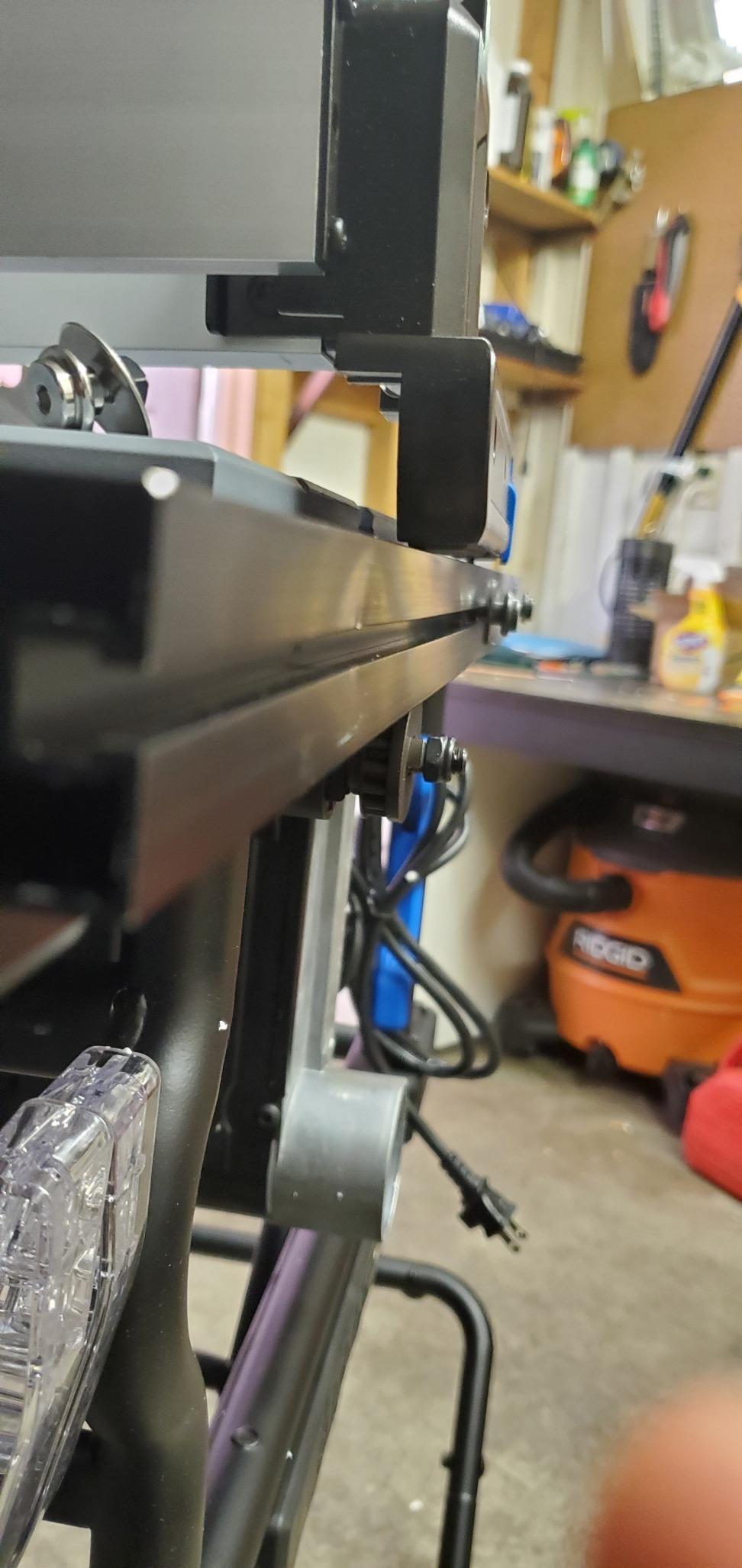
The 15 amp contractor-grade motor is described as handling treated lumber and hardwoods, and 32.5 inches of rip capacity is enough for large panels. The rack and pinion rails are the same architecture used on saws costing considerably more, so fence quality is not the compromise here.
The box includes a carbide blade, miter fence, portable stand, push stick and rip fence, which covers the essentials. A 10 inch blade with a contractor-grade motor and a five year warranty is a strong combination on paper.
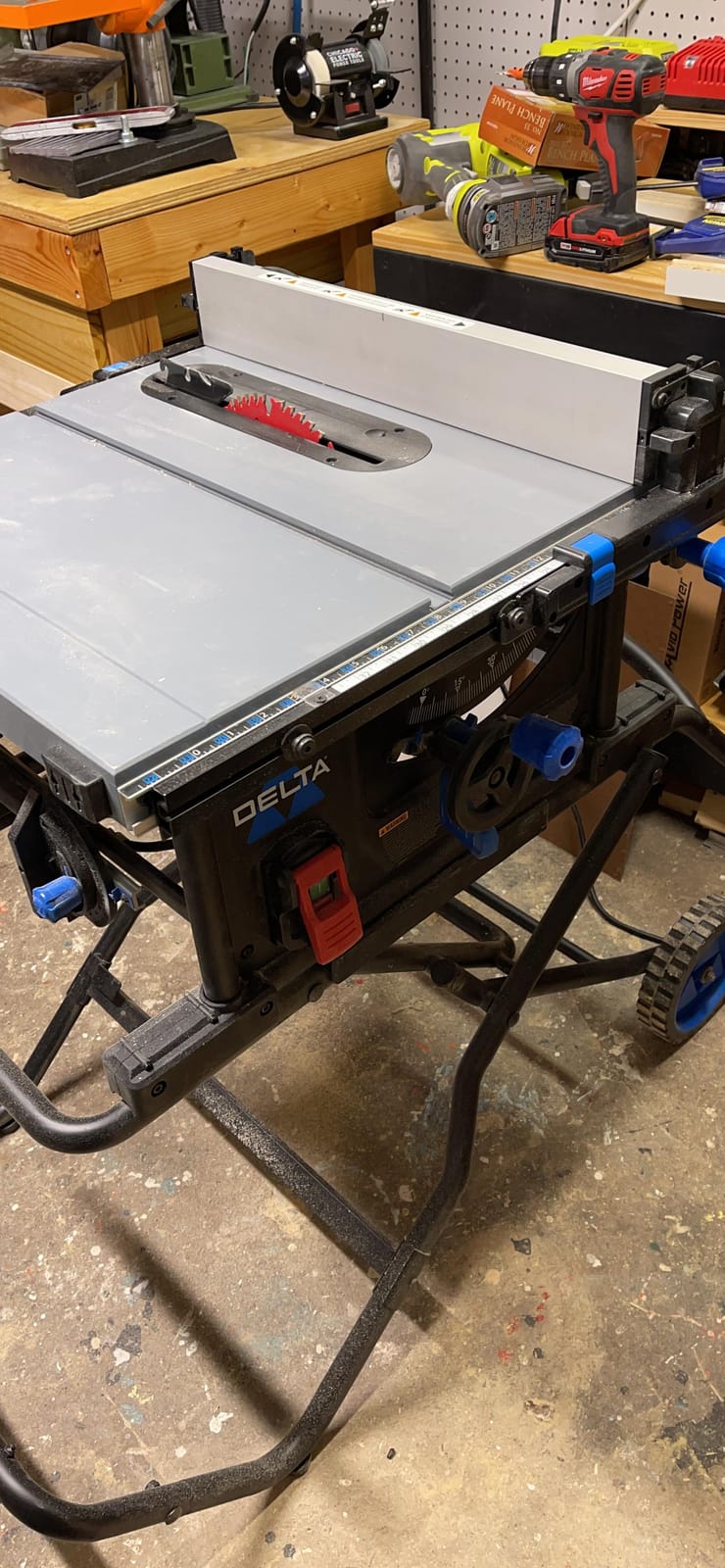
Reading a 4.3 rating with only 200 reviews
We want to be straightforward about this one. A 4.3 average from 200 reviews is a thinner and less flattering data set than a 4.7 from nearly 5,800, and the one-star share is the highest among the 10 inch models here. That does not disqualify the saw, but it does change how much weight the rating should carry.
Our advice is to treat the warranty and the contractor-grade specifications as the deciding factors rather than the star rating. A five year warranty on a saw this capable offsets a good deal of uncertainty about long-term consistency.
Weight and portability at 77 pounds
At 77 pounds including the stand, this sits in the middle of the roundup. It is too heavy to be a carry-between-shops tool and light enough to move around one garage with a hand truck or a second set of hands.
For a single-shop beginner that is a reasonable outcome. The floor space it occupies is comparable to the other 10 inch rolling-stand machines, and nothing about the stand suggests it is designed to be folded into a car.
Who this saw is right for
Choose the Delta 36-6023 if you want the longest warranty available and you plan to cut dados, grooves and joinery as a beginner. It is the pick for a buyer optimizing for how long the tool is covered.
Skip it if you are swayed by review counts, because a thinner base of owner reports means less evidence of long-term behavior. Buyers who want reassurance from volume should look at the DEWALT and SKIL options.
7. SKILSAW SPT99-11 – The Deepest Cut for Thick Lumber Work
SKIL 10 Inch Heavy Duty Worm Drive Table Saw with Stand – SPT99-11
Worm drive gearing
3-5/8 in. depth of cut
30-1/2 in. rip capacity
94.3 lb with stand
+ Pros
- Worm drive gearing gives a deeper cut than typical portable saws
- 30-1/2 in. rip capacity handles full sheet goods
- Rugged rolling stand with 16 in. wheels
- Outfeed and support table help one-person cuts
- Cons
- Worm drive saws are slower for fine finish cuts
- About 94 lb and nearly 40 in. long
- 1 year limited warranty is the shortest here
This is the traditional heavy-duty bench saw option in the group, and it is the machine to buy if you already know you will grow into ripping thick lumber. The worm drive gearing delivers a 3-5/8 inch depth of cut, the deepest figure anywhere in this roundup.
That depth is not a spec curiosity. It is the difference between cutting a 2×4 in one pass and hunting for a way to handle 3x material without improvising.
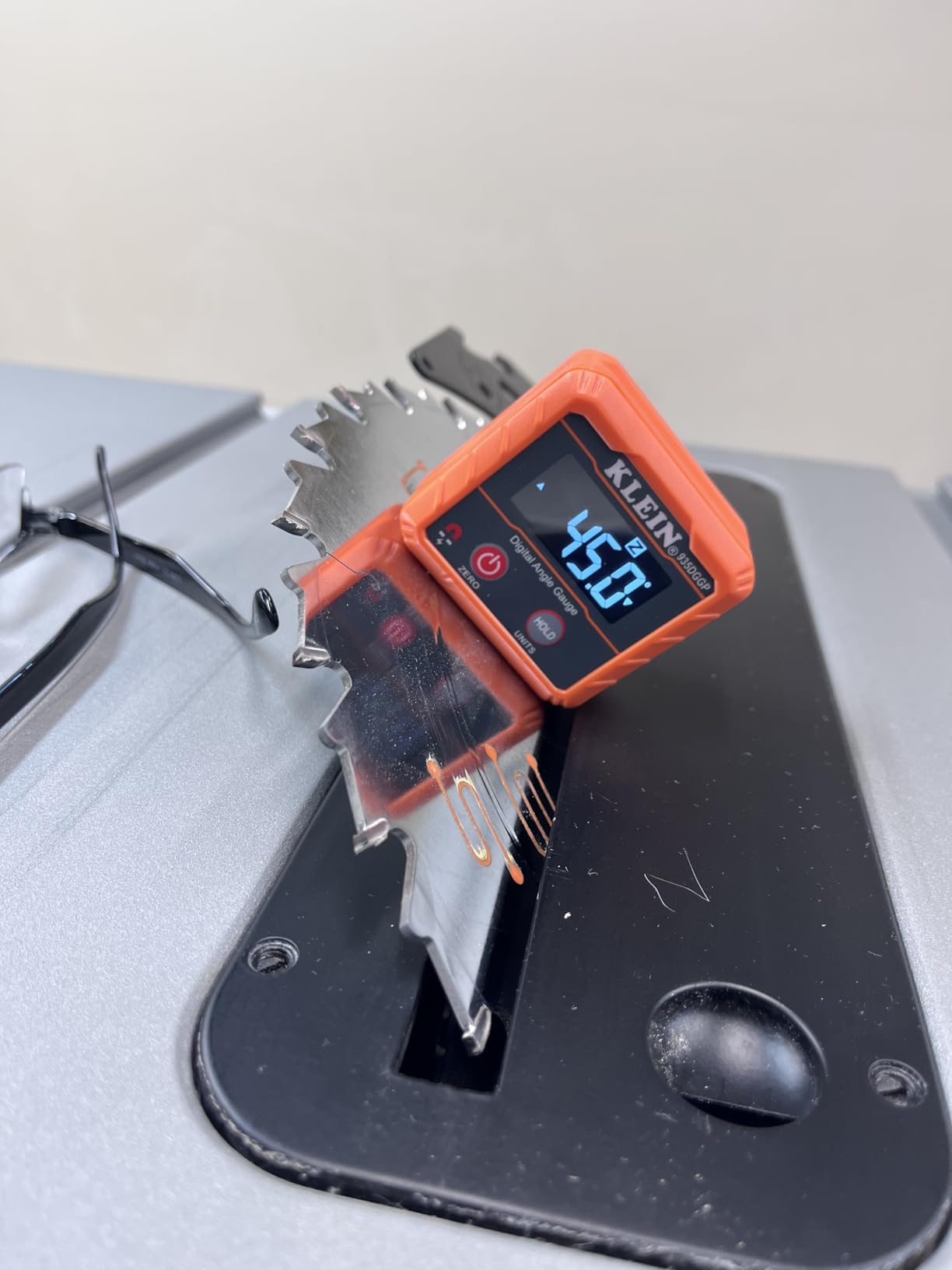
The 30-1/2 inch rip capacity handles full sheet goods, and the outfeed with a side support table genuinely helps when one person is breaking down a large panel. The precision rack and pinion fence system makes the adjustment feel like a more expensive machine.
The included kit is complete: 24 tooth carbide blade, miter gauge, Smart Guard System with an anti-kickback device, dust elbow, insert plate, push stick, wrench and rip fence. The rugged rolling stand runs on 16 inch wheels with easy-load handles.
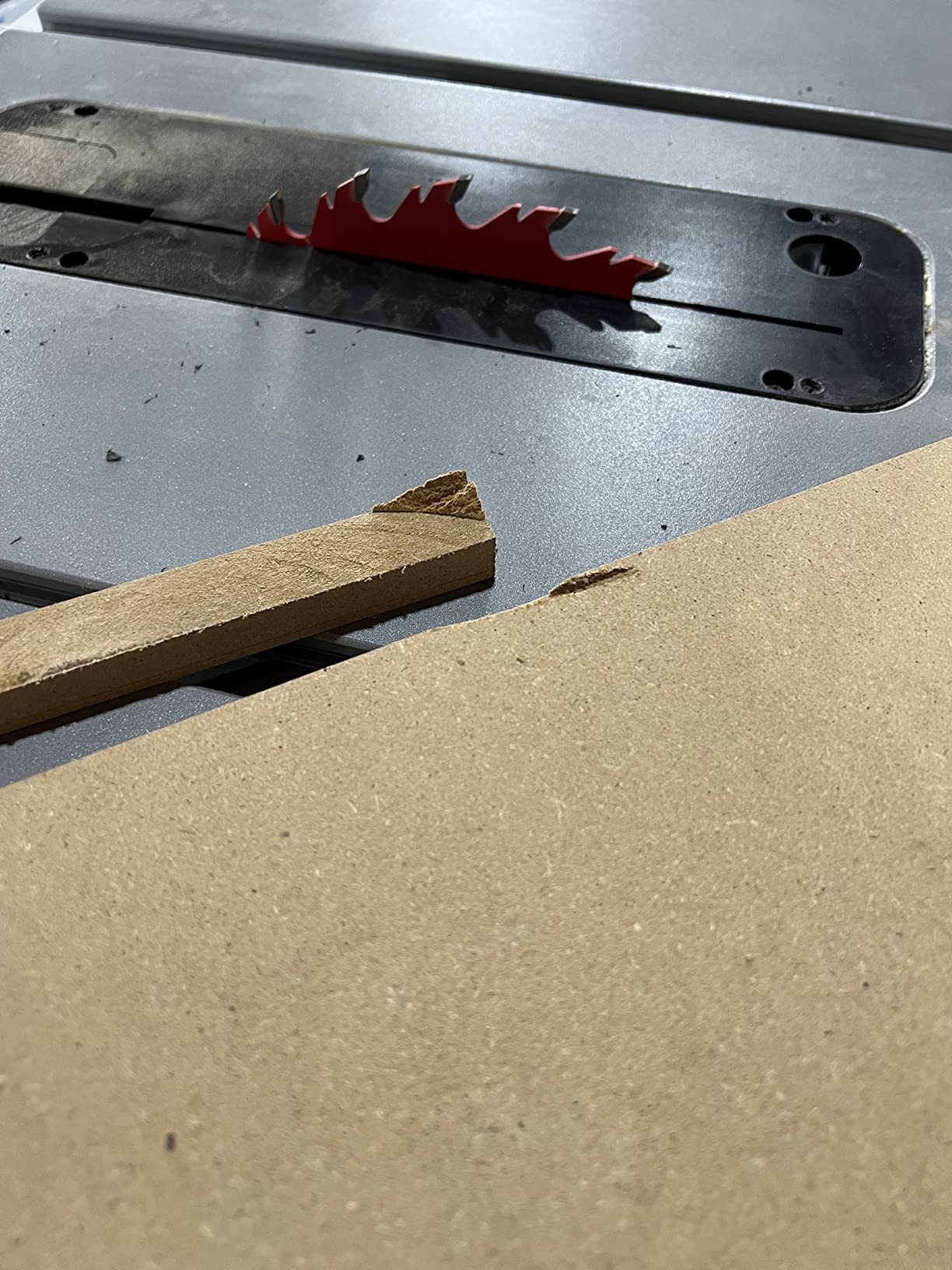
Worm drive trade-offs a beginner should know
Worm drive saws run slower than direct drive machines, and owners report they are noticeably slower for fine finish cuts. If your early projects are trim, molding and small furniture, the speed difference is a mild annoyance rather than a dealbreaker.
The weight is the bigger consideration at 94.3 pounds across a nearly 40 inch long package. This is a saw that stays in a garage bay. It is not a tool you move between rooms or load into a hatchback.
Warranty length and what it signals
A one year limited warranty is the shortest in this roundup, and noticeably shorter than the three to five year coverage on the DEWALT, SKIL jobsite and Delta models. Buyers who keep tools for a long time should weigh that before choosing on capacity alone.
It is not a dealbreaker, but it is a legitimate argument for a comparable saw with longer coverage if your priority is durability assurance rather than cut depth.
Who this saw is right for
Choose the SPT99-11 if you have the floor space, you plan to work with thick dimensional lumber and full sheets, and you want one machine that does not need upgrading later.
Skip it if your projects are small pieces, if noise matters, or if a one year warranty is not acceptable to you. A beginning hobbyist with a small garage is better served by a lighter jobsite model.
8. Bosch GTS15-10 – The Fastest Blade Stop for Nervous Beginners
BOSCH GTS15-10 10 Inch Portable Jobsite Table Saw with Rise Wheeled Stand
15 amp motor at 3800 rpm
Three-second blade brake
Soft-start circuitry
Gravity-rise stand included
+ Pros
- Soft-start and regulated speed keep the motor smooth under load
- Three-second blade brake adds real safety value
- Color-coded fence scale speeds setup
- Single-action gravity-rise stand
- Cons
- 1 year limited warranty only
- 3800 rpm is lower than most saws in this class
- About 103 lb with the stand
Kickback fear is the number one emotional obstacle for a first-time table saw buyer, and this machine answers it directly. The convenience brake stops the blade in approximately three seconds, which removes the wait after every cut before you can safely reach in and pick the offcut up.
That single feature does more for a nervous beginner than any horsepower figure. The soft-start circuitry also reduces the chance of tripping a circuit breaker on startup, which is a common surprise in a shared workshop circuit.
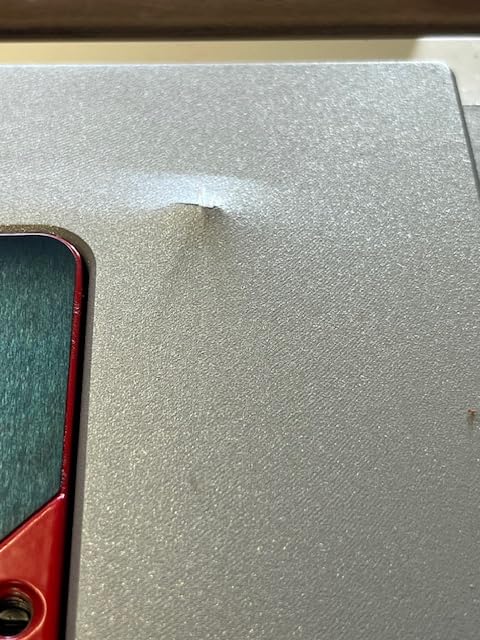
The rack and pinion rip fence uses color-coded index pins with a matching scale, so you can set a width by eye without a tape measure. Buyers single this out as making setup forgiving, which is exactly what a beginner needs.
ClampZone areas let the tabletop double as a light-duty secondary work surface, and the open frame roll bar design keeps the machine light for its size. The GTA50W gravity-rise wheeled stand sets up and takes down with a single action.
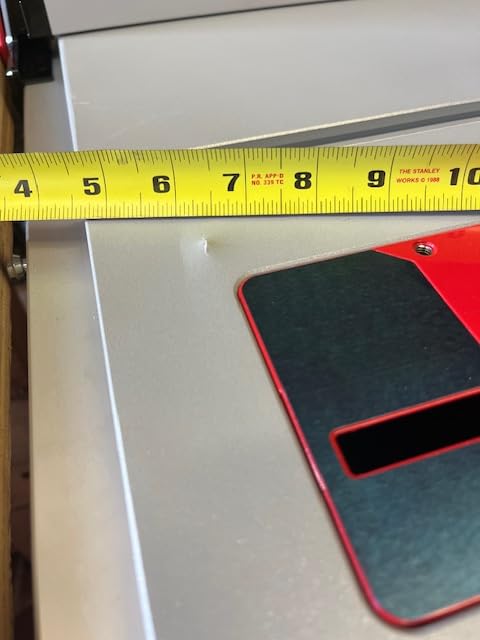
3800 rpm and what slower blade speed means
The 15 amp motor turns the blade at 3800 rpm, lower than most saws in this class. Slower blade speed generally means a smoother cut with less tear-out on hardwood, so the number is not purely a downgrade.
It does mean a slightly slower feed rate on aggressive rips. For a beginner working through sheet goods and trim, that is a good trade rather than a compromise.
Electronically regulated speed and the safety package
Electronically regulated speed maintains blade speed under load, which means a cut that starts clean does not degrade halfway through a long rip. The Smart Guard System includes a riving knife, anti-kickback pawls and the guard assembly.
On-tool storage holds the rip fence, miter gauge, Smart Guard System, wrenches and push stick, so the safety hardware is always within reach. That is a small design choice with real consequences for a new operator.
Who this saw is right for
Choose the Bosch GTS15-10 if safety hardware and forgiving setup are your top priorities, and if you already own a stand or want the gravity-rise stand specifically. The brake is the feature you will notice most.
Skip it if warranty length is a deciding factor, because one year is short for a tool you may keep a decade, or if 103 pounds is more than you can manage to move.
How to Choose Your First Table Saw: Eight Decisions That Matter
Most beginner buying guides start with a spec dump. That is the wrong order, because the specs only mean something once you have decided what you are building and where the saw will live.
10-inch vs 8-1/4-inch: which size should you buy
Buy a 10 inch blade if you plan to rip dimensional lumber, break down sheet goods regularly, or cut thicker material. A 10 inch saw gives roughly a quarter inch more depth of cut and enough capacity for full-width panel work.
Buy an 8-1/4 inch saw if your work is trim, molding, small parts, sheet cutoffs and hobby furniture, or if weight and storage are the deciding factors. The compact saws here run 40 to 54 pounds against 94 to 110 pounds for the full-size machines.
Owners on r/woodworking make the same point from the other direction: buy a 10 inch saw, because you will outgrow the 8-1/4 inch class.
Rip capacity and breaking down a full sheet
Rip capacity is the number that determines whether you can cut the material you imagine in your head. A 4×8 sheet is 48 inches wide, so no saw in this roundup handles it in a single pass.
What matters is the second-stage capacity. A 32 to 32-1/2 inch rip handles a trimmed sheet comfortably, while a 24.5 inch figure means more handling steps. If sheet goods are central to your projects, weight this heavily.
Fence type is the accuracy decision
Every saw here uses a rack and pinion fence system, which is the right answer for a beginner. Telescoping rails keep the fence parallel to the blade, and smooth travel means small corrections are actually achievable.
Skip a saw with a plain clamp-on fence if you can avoid it. The micro-adjust and built-in scale features found on the compact SKIL saws are the ones we used most and appreciated most.
Safety features that are not optional
Non-negotiable items: a riving knife, anti-kickback pawls, a functioning blade guard, a push stick in the box, and a power-loss or anti-restart switch. Every saw in this roundup provides most of these, but the Bosch adds a three-second blade brake and the EVOLUTION adds an electronic brake plus a paddle switch.
Check what is actually in the box rather than what appears in the photographs. A saw listed without a push stick means a second purchase before your first cut.
Stand, footprint and total weight in a small shop
Stand type changes stability more than most buyers expect. A folding integrated stand makes a 51 pound saw genuinely portable, while a rolling stand on 16 inch wheels makes a 94 pound saw easy to move around a single shop.
Some saws require a separate stand purchase, which is the detail most often missed by first-time buyers. Account for that before choosing, and check the floor footprint of the whole assembly, not just the saw.
The total cost beyond the saw itself
Budget for the items that are not the saw: a stand if it is not included, a crosscut sled for panel work, a quality miter gauge if the included one is weak, a dust port elbow and a shop vacuum, ear and eye protection, and at least one additional blade for crosscutting.
Several saws in this roundup already include a sled, a dust elbow and a complete guard kit, which is a genuine cost advantage. Compare what ships before comparing saws on price alone.
New or used: what to inspect on a used table saw
Used is a reasonable path, and a used contractor or cabinet saw often beats a cheap new portable. Inspect these points: check the cast iron top for cracks, rock the table to look for warp, check the fence for play at both ends, verify blade runout by hand-spinning the arbor, and test the blade guard and anti-kickback pawls for full function.
Ask whether the saw has been bolted down and whether the alignment has drifted. A saw that was mounted to a bench has usually held alignment better than one that was carried around.
When a circular saw is the better first tool
A table saw is not worth it for a renter with no workshop space, a shared room where noise is a problem, or someone whose projects are all small and board-sized. A circular saw with a track guide or a good handsaw handles a lot of that work.
A miter saw handles trim and crosscutting at speed, and it carries far less risk. Several first-time buyers in the forums asked whether a circular saw was enough, and for a lot of people it genuinely is.
Frequently Asked Questions
What is the best entry-level table saw for beginners?
The DEWALT DWE7485 is our top pick for a first table saw. Its telescoping rack and pinion fence arrives square, the modular guard system adjusts without tools, and at 54 pounds one person can move it. A 10 inch saw such as the SKIL TS6307-00 is the better choice if rip capacity and thick lumber matter more than weight.
Should I get a 10 inch or 8-1/4 inch table saw?
Buy a 10 inch saw if you plan to rip dimensional lumber, break down sheet goods, or cut thick material, because it gives roughly a quarter inch more depth of cut. Buy an 8-1/4 inch saw if your work is trim, molding, sheet cutoffs and small furniture, or if you need a saw you can carry between 40 and 54 pounds rather than 94 to 110 pounds.
What rip capacity do I need to break down 4×8 plywood?
A 4×8 sheet is 48 inches wide, so no portable table saw handles it in a single pass. For a beginner, 24.5 inches of rip capacity is workable with more handling, while 30 to 32-1/2 inches means fewer steps and a much lower chance of losing a reference edge partway through a panel.
What safety features should a beginner table saw have?
Look for a riving knife, anti-kickback pawls, a functioning blade guard, a push stick included in the box, and a power-loss or anti-restart switch. A blade brake is a meaningful upgrade for a new operator: the Bosch GTS15-10 and the EVOLUTION R10TS both stop the blade quickly, which removes the hesitation after every cut.
Do I need a rolling stand with a portable table saw?
Yes, in almost every case, because a saw at floor level means working bent over. A folding integrated stand such as the one on the SKIL TS6307-00 makes a 51 pound package genuinely portable, while a rolling stand with 16 inch wheels makes a heavier saw easy to move around a single shop. Some compact saws, including the SKIL TS6308-00, require the stand to be purchased separately.
Should a beginner buy a new or used table saw?
Used is a reasonable option, and a used contractor or cabinet saw can outperform a cheap new portable. Inspect the cast iron top for cracks, check the fence for play at both ends, hand-spin the arbor to check runout, test the blade guard and anti-kickback pawls, and ask whether the saw was bolted down. A saw that has held alignment beats one that has not.
Which Table Saw Should You Buy First
If you want the best balance of accuracy on arrival, a tool-free guard system and a weight one person can manage, buy the DEWALT DWE7485. It is the saw we would hand to a beginner with a normal garage and a mixed list of projects.
If your projects are furniture, panel work or case goods, the SKIL TS6307-00 gives you a 10 inch blade, a complete accessory kit and a folding stand in one package. If you have a dedicated bay and plan to stay for a decade, the DEWALT DWE7491RS is the durable one-time buy.
If joinery is the goal, the EVOLUTION R10TS ships with a zero-clearance throat plate, a crosscut sled and a dado plate. If thick lumber is the goal, the SKILSAW SPT99-11 cuts deepest. If safety hardware is the goal, the Bosch GTS15-10 stops its blade in about three seconds.
Whatever you choose, spend the first weekend learning kickback prevention, the push stick, and how to check your fence for square before you rip a full panel. That preparation matters more to the quality of your first year than another hundredth of an inch on a spec sheet. These are the best table saws for beginners in 2026 because they get you cutting accurately, not because they are the largest machines on the shelf.